California Teen’s Unstoppable Drive to Change the World
Meet Daily Point of Light Award honoree Abigail Chiang. Read her story, and nominate an outstanding volunteer or family as a Daily Point of Light.
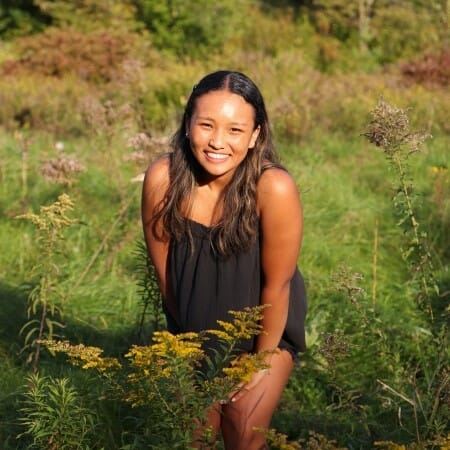
As a 15-year-old in high school involved in more than four nonprofit organizations, Abigail Chiang stays busy. But she wouldn’t have it any other way. The California native leads her local chapter of a global organization of pen pals and advocates, inspires others with STEM, cares for hospital patients and has a passion for encouraging quality care and compassion toward her senior community.
Chiang believes that her volunteerism stems from a profound sense of purpose and a passion to effect positive change, and she wants to inspire others to do the same.
What inspires you to volunteer?
My inspiration to volunteer is really driven by a sense of passion, purpose and a passionate desire to make a positive impact in the world. It’s not just limited to just one area of service, it really encompasses all of my volunteer roles. For example, at UnifyStem, my inspiration stems from the belief that every student, regardless of their background, should have access to the opportunities and knowledge that STEM fields offer.
At Torrance Memorial Hospital, I’m deeply inspired by the dedication of the healthcare profession — it’s a privilege to support hospital staff. But more importantly, I’m motivated by the chance to directly contribute to the wellbeing of patients by being a compassionate presence during their healthcare journey. Being the chapter president of Kids for Peace is another source of inspiration where I have the opportunity to foster kindness, compassion and unity among young people. It’s really, really rewarding. Whether it’s sending pen pals across the country, or even providing aid to communities — it’s deeply inspiring.
Lastly, my involvement with the South Bay Senior Care Center creates a respect for our seniors in a sincere desire to enhance their quality of life through compassion and care. I bring music to seniors because it’s a passion of mine and I’ve seen the positive impact it has on wellbeing.
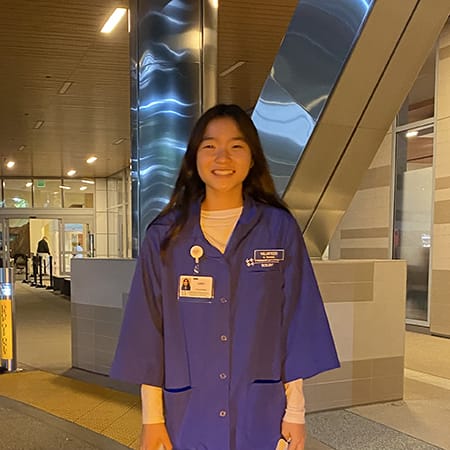
Abigail Chiang volunteers at Torrance Memorial Hospital and supports hospital staff in Torrance, California, by caring for patients and enjoys educating herself about the healthcare field. /Courtesy Abigail Chiang
Tell us about your volunteer roles with the organizations you’re a part of.
My volunteer role at the hospital is as a blue jacket volunteer, and it’s allowed me to serve the medical community and patients in a meaningful way. I undertake weekly shifts to discharge patients and ensure the timely delivery of blood and waste samples, patient admissions and hospital requests. These responsibilities actively support the hospital and give me a firsthand insight into healthcare operations. It’s allowed me to be a compassionate presence and helped me with being the chapter president at Kids For Peace. I’m deeply committed to fostering kindness and compassion and unity among young people. We coordinate impactful kindness and peace projects throughout the school year.
Pen Pals also help contribute to essential aid and supplies to communities in need by hosting monthly meetings, coordinating projects and events, and keeping open communication with adult advisors. Together, we create a community of young leaders dedicated to spreading positivity and making the world a better place.
What’s been the most rewarding part of your work?
The most rewarding part of my volunteer work has been the personal connections and stories of impact that I’ve experienced especially at UnifyStem. I’ve seen other students get access to STEM education and it’s really unlocking doors to a brighter future. Additionally, volunteering at the hospital allows me to directly contribute to the well being of patients, and witnessing their journeys has been incredibly moving. Peace is the transformation of young people as they come together to spread kindness and make a positive impact and it truly touches my heart.
What have you learned through your experiences as a volunteer?
I’ve learned the power of resilience and the importance of community engagement. I’ve learned to adapt and to be resourceful using various tools, educate students and support hospital operations, gaining valuable insights into healthcare and the need for compassionate care. It’s deepened my appreciation for the human spirit and the significance of coming together to create a positive change.
Any advice for people who want to start volunteering?
To those considering volunteering, I would advise you to follow your passion and seek opportunities that resonate with you personally because of the potential to connect with causes that genuinely move you. Regardless of the area you choose to volunteer in, it’s important to be open to diverse opportunities and stay committed to the cause. You’re onto the journey of self-discovery and personal growth, and it’s immeasurable.
Why is it important for others to get involved with causes they care about?
Getting involved in the causes you care about is crucial because it allows you to grow to a larger purpose and make a difference in areas that deeply matter to you. It’s not just about “giving back.” It’s about finding fulfillment and meaning in your actions. The emotional rewards of making differences in a cause you care about deeply are really not measurable. It’s a lasting impact on the world.
Tell us about future partnerships, programs or events that you are excited about.
I’m excited about the potential for UnifyStem to expand its reach and its impact by establishing more partnerships with tech companies, educational institutions, scholarship programs and startups who can help host more STEM lectures and global hackathons. It’ll help us reach even more underserved students worldwide.
At Kids For Peace, we’re excited about the opportunity to coordinate our kindness projects and a potential partnership that involves organizing music therapy sessions for patients at the hospital. I’m deeply passionate about music and its therapeutic benefits. And I see this as an opportunity to bring even more comfort to patients to their hospital space.
In Good Company: Retired Teacher Brings Peace to Those in Hospice Care
Meet Daily Point of Light Award honoree Ana Dolores González. Read her story, and nominate an outstanding volunteer or family as a Daily Point of Light.
In 1971, at just 15 years old, Ana Dolores González and her parents left Cuba and settled in Massachusetts. They left everything behind and set out for a place they had no relatives and—as they discovered—an unreliable sponsor. “I was the only child, and my dad wanted something better for me. So, would I have come on my own? No. We just followed him, and I’m glad we did. But it was a very traumatic experience at that age,” Ana recalls.
As time went on, life offered Ana many wonderful opportunities: She had a son who graduated from Harvard, who is bilingual and is studying to become a Catholic priest. She fell in love with golf. After a nearly three-decade career in telecommunications, she moved into a role as a Spanish teacher with Brockton Public Schools, a position she held for 17 years until retirement. She spent her days helping others speak her native tongue and her nights mentoring those facing housing insecurity at a local shelter.
While community service has always been a part of her life, it had looked different in her home country.
“We were required as students to do 45 days of voluntary work at the fields, cleaning the trees around the roots. We didn’t pay for our education or books or anything. That was a way of contributing to the school and the community,” she remembers.
When she was just 13 years old, Ana joined her classmates in the fields. It was her first time away from home and involved more than a month of sleeping in dorms and eating what she described as undesirable food. She loved when her parents would visit with care packages and remembers the bond it created amongst the kids fondly.
“Every one of us knew each other, helped each other, loved each other. It was great community building to be away like that,” she says.
Ana’s care and compassion for others continued when she came across Old Colony Hospice’s call for volunteers through a church bulletin. There was a need for people to provide companionship to patients in their final days, doing things like reading, looking at old pictures and talking about their lives while giving respite to their caregivers, who are often hesitant to leave but rarely have time for themselves. But first, Ana would have to undergo training.
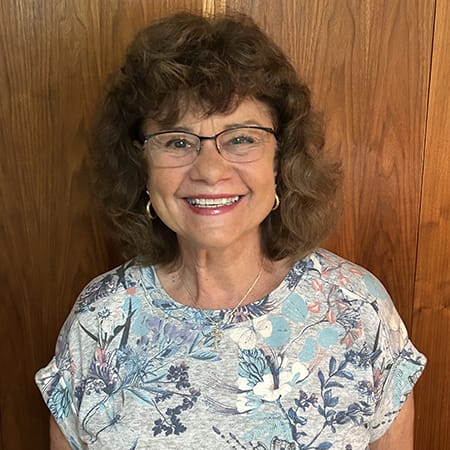
Ana Dolores Gonzales, long-time volunteer for Old Colony Hospice, offers companionship to patients and a respite for caregivers./Courtesy Ana González
“We usually put our volunteers to about 15-16 hours of training,” says Janela Shtylla, volunteer program manager and former volunteer at Old Colony. “There is some internal training that we do. There is some required state training that we offer. And then we have an online program, which is about 11 hours, that covers end of life, boundaries and how to deal with families at this difficult time in their lives.”
Once trained, volunteers learn about the process and are matched with a patient when a request comes in. Janela typically sees people volunteer who have given to others throughout their lives—retired nurses, healthcare professionals and teachers. Ana has been visiting patients now for more than 22 years, since before they even kept records. On an average week, she visits patients once or twice for one to three hours, typically in their home but occasionally in nursing homes or assisted living facilities.
“It’s something that I really find rewarding and that teaches me a lot of humbleness and perspective and different views,” she states. “It doesn’t cost me anything to sit and hold a dying woman’s hand. It’s my time, which I have plenty of.”
Ana’s dedication can always be relied upon. Janela once called her on a Wednesday to sit with a patient for a few hours on both Saturday and Sunday so their spouse could run errands. Ana didn’t hesitate, and they were so pleased with her kindness, the couple wanted to extend her visits.
“Even during the pandemic, she would drive by the patients’ houses when she couldn’t go in. She would call them. She would drop flowers on their porch,” Janela adds.
Typically paired with two patients at a time, Ana remains with them until they pass. It’s a comfort to know that they are not suffering and are usually at home, surrounded by family. Old Colony provides complete medical support, religious care and access to social workers as well.
“It’s hard, because you get close to somebody. You form a friendship; you lose them, and you move to the next person. It’s hard, because you can’t help but get involved emotionally,” Janela says. “We’ve had volunteers who try it and realize it’s not for them, and they move on. Ana has never stopped. She’s always there for anything that is asked. She’s always been amazing.”
Amidst caring for her patients and her aging mother, now 91, Ana also fostered a 3-year-old boy from 2019 to 2022 before he was placed with his grandmother.
“I was 60-something. I actually wanted a newborn, and my friends and family thought I was crazy. Then, I got my JJ, and I loved him like I love my son,” she reflects.
Being there for others is a common theme in Ana’s life and one that has allowed her to befriend many people at the most challenging times of their lives. Her kind nature has and will remain a valuable asset to her community.
“I think I’ve always recognized that I’ve been given a lot of blessings, an abundance of resources and love when I first came to this country and throughout my whole life here. So, for me, it’s very rewarding that I can do the same for someone else. I can make their life easier, make their existence better by just being there.”
Atlanta High Schooler Works to Alleviate Period Poverty and Destigmatize Menstruation
Meet Daily Point of Light Award honoree Deeksha Khanna. Read her story, and nominate an outstanding volunteer or family as a Daily Point of Light.
Deeksha Khanna grew up in Atlanta and has close ties to the city. She has always been inclined toward academic and athletic excellence. It wasn’t until high school that Deeksha discovered a passion for social justice and social entrepreneurship. She began exploring the themes of menstrual justice in high school because she saw it was a health crisis overshadowed in the media by other “bigger” health crises.
She founded the Elea Project in 2022 and has been actively working to ensure that girls and women always have access to menstrual supplies. She also works to destigmatize menstruation; something that half of the world’s population copes with for a large part of their lives, yet is still a taboo subject in the media.
Deeksha hopes to go to college to study global health. She also hopes to continue her work with Elea no matter where she ends up studying. She plans to eventually spread the Elea Project and have multiple chapters in different parts of the country.
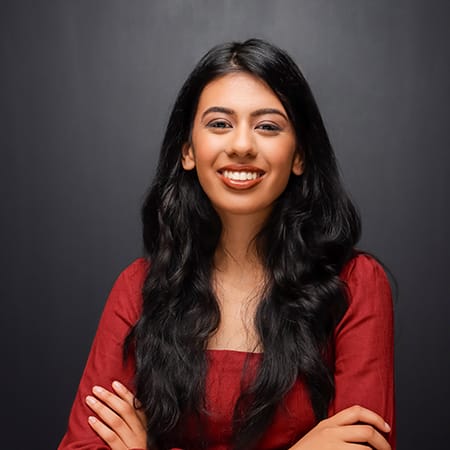
Empowering girls and women through access to menstrual supplies: Deeksha Khanna, founder of the Elea Project, making a difference since 2022./Courtesy Deeksha Khanna
What inspires you to volunteer?
My mother is a gynecological oncologist. Seeing her so passionate about helping others in her work, I wanted to help similarly, but in an age-appropriate way.
My fellow female students and I found that during the pandemic, menstrual supplies were in short supply. This was a firsthand experience with not being able to get the supplies I needed, and brought to light the fact that many girls and women simply don’t have access to these basic needs. I saw this as an opportunity to help.
Describe your volunteer role with the Elea Project.
I am the Founder and Executive Director of the Elea Project. We partner with over fifty organizations including women’s shelter. The bulk of my focus is ensuring they have enough menstrual supplies to serve the women in their care.
I conduct regular donation drives and continually seek to expand partnerships with local homeless shelters, women’s shelters, community centers, and schools. Currently we have over 50 partners in the Atlanta area and beyond. My dream is to expand our reach nationwide. To date we have raised almost $4,000 to fund menstrual product purchases.
I also partner with Georgia STOMP, which is a grassroots organization that seeks to eliminate the tampon tax which is extremely discriminatory and demeaning to women. I also partner with DIVAS Who Win, which is an organization that supports victims of domestic violence, prostitution and sex trafficking.
One of my key partnerships is with the University of Georgia Period Project. This organization’s advocacy efforts are similar to the Elea Project, at a collegiate level.
I’m excited to host a podcast called “Empowered.” Guests have included Ashlie James of Atlanta GLOW, Lena Vann, founder of the Black Period Project, and Alison Hoover, Associate Director of Global Health Programs at Emory University.
This past year, I hosted two virtual educational panel events on menstrual equity policy and global advances, as well as the challenges and setbacks women face.
What’s been the most rewarding part of your work?
I have one particular memory that’s the most meaningful. It is my work with the Global Village Project, which is a school for refugee girls. The Global Village Project was the recipient of the first donation drive that I conducted with a neighboring school. I found a major lack of access to period products at the Global Village school. After donating, I saw the girls take the period products home and distribute it among their friends. The difference between before and after was heartwarming!
After that, I partnered with the University of Georgia (UGA) Period Project to make take-home kits so girls could take these supplies home. The UGA Period Project assembles period packages and sends them to their partner organization to spread supplies to as many regions as possible. Similarly to Elea, they work on eliminating the menstrual taboo on campus.
What have you learned through your experiences as a volunteer?
You can never plan too much. Always have contingency plans for when things go wrong. Near the end of last year, our fundraiser input was low. For several months, we had little monetary support and it was hard to serve the community. We lost some traction. This made me realize that I had to constantly think ahead and how to pivot when things go wrong. Also, progress isn’t linear. Some months are more successful than others. I try not to quantify the impact each month. I prefer to focus on the big picture of spreading Elea Project’s impact outside the Atlanta area.
Tell us about future partnerships, programs, or events that you are excited about.
I recently launched the Elea Project podcast. We’ve done three podcasts so far. I look forward to expanding our lineup of guest speakers. I’m also hoping to launch another educational panel event in local high schools. These panel events are open to everyone. The main goal is to make an impact and reach out to boys and girls alike.
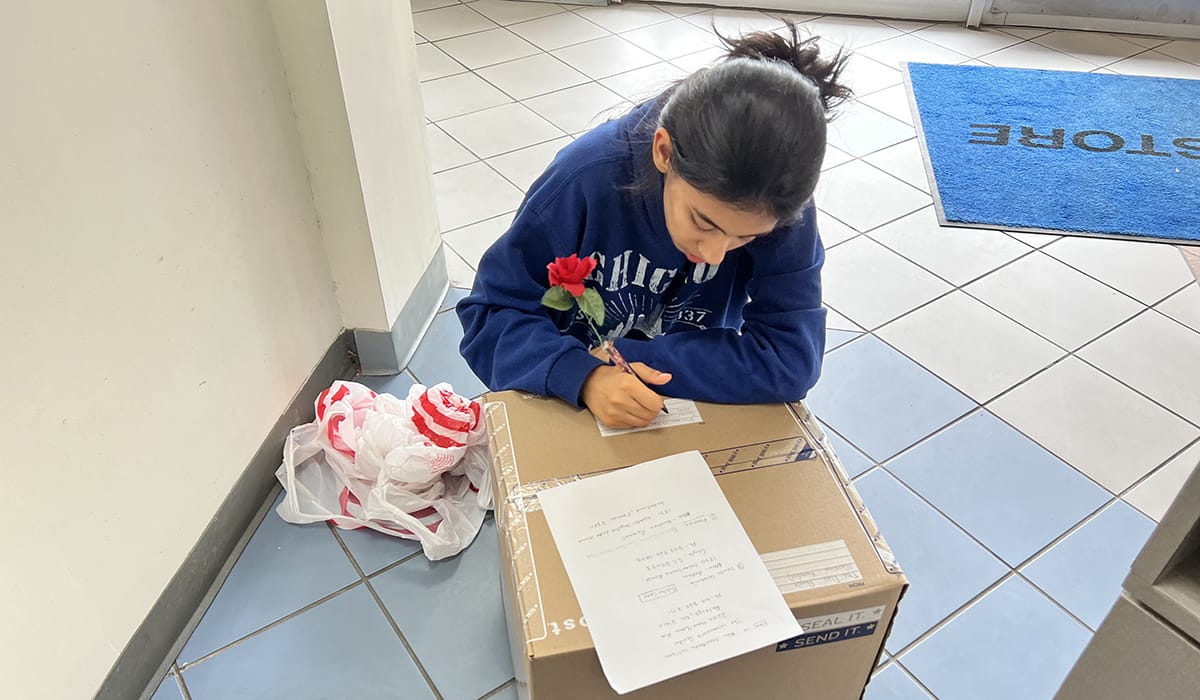
Deeksha mailing inventory to out-of-state regional divisions in the U.S./Courtesy Deeksha Khanna
Why is it important for others to get involved with causes they care about?
For me, giving back comes in the form of eliminating period poverty. I know that giving back looks different for everyone but it’s important to act in an area you’re passionate about so that all of a community’s varied needs can be met. You can get involved as early as possible on a smaller scale and then scale your efforts to address systemic issues.
What do you want people to learn from your story?
Find a mentor. Without Georgia STOMP and the UGA Period Project and people who have more experience and perspective, I wouldn’t have been able to gain the support and direction from people who know how to make things happen. I reached out to UGA students who had been or were in similar situations and brainstormed.
Ask for feedback. When I started Elea, I was no expert in maintaining social media platforms, website visitor experiences, how to reach out to organizations or how to fundraise. Through feedback I was able to learn these critical skills.
Progress isn’t linear. Some organizations make a huge impact in a short period of time and it can be discouraging for small organizations not to meet the needs of the community in the way they want. Focus on the journey and know that it’s not a linear progression.
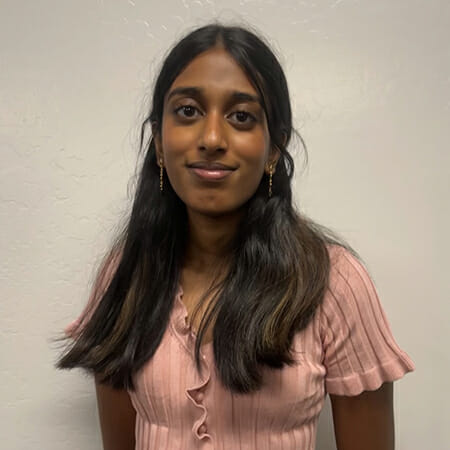
Arizona Teen Takes Initiative to Expand and Improve Her Community Library
Meet Daily Point of Light Award honoree Sruti Peddi. Read her story, and nominate an outstanding volunteer or family as a Daily Point of Light.
Seven years ago, Sruti Peddi, now 17, moved to Fountain Hills, Ariz. As an avid reader and a new kid in town, she was drawn to the local public library and eventually became a volunteer. There, she met kind librarians and found a safe space to relax and read. She became more involved when the COVID-19 pandemic led to budget cuts. Sruti took on roles as the youngest director on the library board and the first teen representative with the associated nonprofit, Friends of the Library. Her dedication to fundraising has helped raise over $300,000 for the library’s innovative programs, improvements and scholarship expansion.
Sruti’s love of reading also extends to the news. After becoming more exposed to domestic and international affairs through speech and debate clubs, she found passion in working on policy and showing people the part we play in how we are governed. In addition to her advocacy for civil rights and political education—namely how to vote and get involved—she plans to major in public policy and economics with the goal of working in government.
What inspires you to volunteer?
I’m a big reader. I’ve been going to the library for as long as I can remember. When I first moved to town, I started volunteering. Then, because I saw how much they were impacted by the pandemic–we had a lot of programs closing–I joined our nonprofit group, Friends of the Library, to help. Since then, I’ve done a lot to spread the love of reading, because it’s something that means a lot to me.
Sruti Peddi, 17, is a volunteer director and teen representative at the Fountain Hills Library./Courtesy Sruti Peddi
During the pandemic, our budget was cut, so Friends of the Library started fundraising. We started selling used books. We also started applying for grants and hosting membership drives where people within the community could donate.
Once we were back on our feet, I used my role as a teen representative to start some new teen-oriented programs like magazine events and book clubs. Over 800 teens have attended these so far! We also created an entirely new teens-only space. We have books, programs, arts and crafts, etc. So that more people can enjoy the library.
Each year, we also give out the $3,000 Golden Eagle Scholarship to a student from our town. I reach out to young people to tell them about it. Sometimes, when we have problems with people who aren’t able to receive the money, I advocate to make sure that they can receive things like books, supplies and transportation.
You also coded the library’s website. Where did you learn to code?
We were trying to get more people involved in fundraising, so I taught myself. We don’t have coding classes in my school. I usually just looked at tutorials online. It’s been a long process, but it’s been worth it. We’re able to reach a lot more people with the website. I run their social media as well.
What’s been the most rewarding part of your work?
It’s not only working with the people in the nonprofit but the librarians and the community members. I know the librarians. Every time I walk by, I can start a conversation and get to know them better. It’s really rewarding to meet so many cool people from all over the state who are just as passionate about the library and who care about our town. It’s been great to see how much our library has grown and changed for the better over the past few years because of our work.
There are a lot more young people. When I first started, I would often be the only teenager there. But now when I come, there are teens sitting in the teen area, and there are new sections that people can browse. We’ve even used the money to renovate, so it looks a lot nicer–different, but with the same charm and spirit.
What have you learned through your experiences as a volunteer?
Patience. When I first started volunteering we had a lot of plans, and sometimes things didn’t work out. I would say to other potential volunteers to just be patient. It takes time to do programs. If something doesn’t work out, move on. There are still people who need your help.
Tell us about future partnerships, programs or events that you are excited about.
We’re in full swing advertising for the scholarship, but we also have an event called Stories in the Hills that the Friends of the Library does every year. We invite people from the town to tell their stories. It’s a great way to see upcoming storytellers and get people interested in the library and our events.
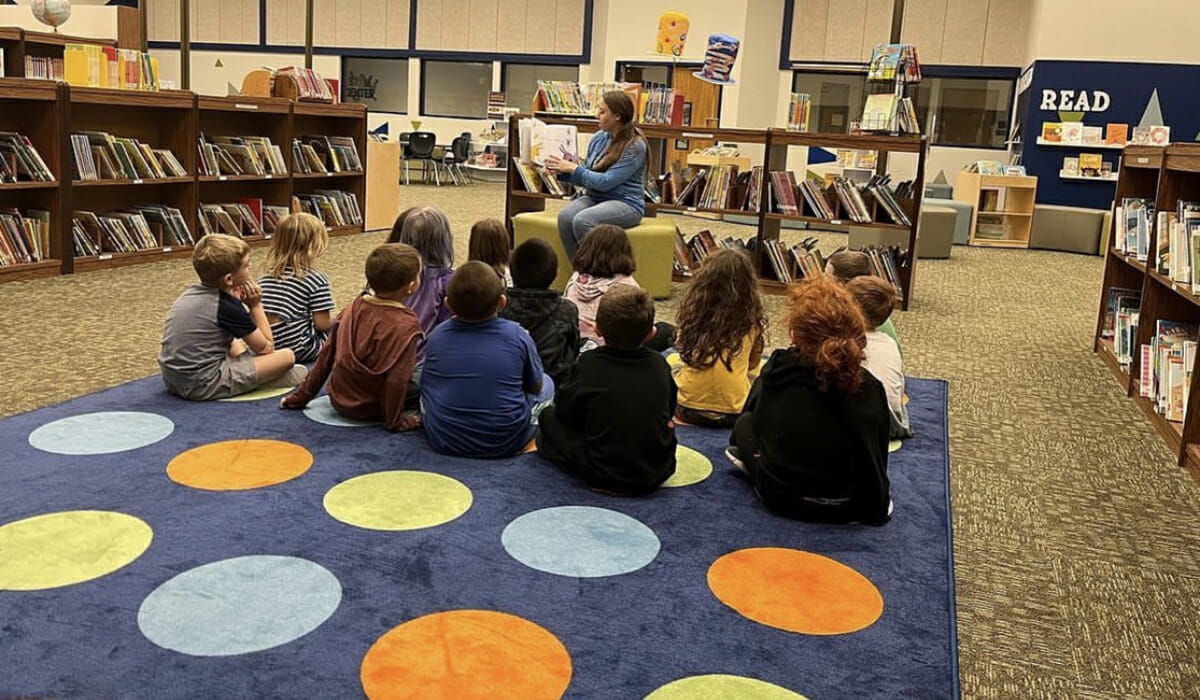
Students from the local elementary school read on a newly-donated storytelling rug./Courtesy Sruti Peddi
Why is it important for others to get involved with causes they care about?
Your community is made up of the people around you. People often ignore the local level, because they think it’s not important. If you advocate for something, you change something, every time you leave your house. You’ll see your work reflected in your community and make it a better place for yourself, your family and your friends.
What do you want people to learn from your story?
I want people to understand that anyone can make an impact. It’s not just a certain type of person or a person with experience that can change things for the better but someone who deeply cares. When I first started working at the library, I didn’t have experience, but I cared a lot about making it a better place for everyone. And there were people who were there to help, support and guide me. Once you find the right community, you can do anything.
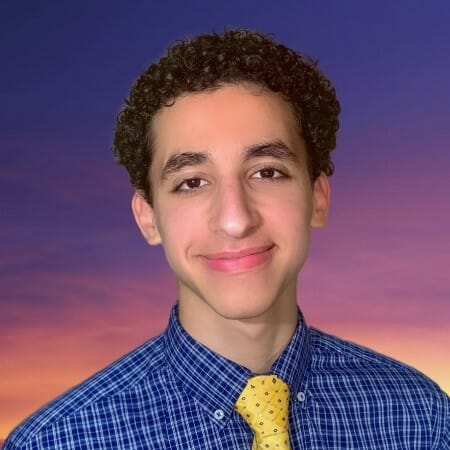
Pre-Med Student Seeks to Break Down Language Barriers Faced by New Immigrants
Meet Daily Point of Light Award honoree Michael Boulis. Read his story, and nominate an outstanding volunteer or family as a Daily Point of Light.
Michael Boulis is the oldest of three children and the son of immigrants from Egypt. His mother hails from Lower Egypt, while his father comes from Upper Egypt. They immigrated to the U.S. shortly before he was born, but Michael still has close family ties there. Growing up, Michael was raised by his maternal grandparents, who helped his parents while they adjusted to life in a new country.
Being close to his grandparents as a child, Michael saw them deal with worsening health scares. It was heart-wrenching for Michael to watch their health decline. He later learned that this path stemmed from their lack of health literacy. His personal experience led Michael to become a health literacy instructor. Many of his students were immigrants, just like his family, and while health literacy benefits them, Michael realized that a lack of health literacy wasn’t the only issue holding them back: it was also a lack of English literacy.
To respond to this need, he created a program called the Student-Refugee Mentor Initiative (SRMI) through his nonprofit, Hearts for Health. The mission of SRMI is to help immigrants ease into their new lives through English instruction. At the same time, Michael also began teaching English literacy to gain a deeper understanding of students’ needs and refine SRMI to better serve them.
To date, Michael and his volunteers have helped more than 4,000 individuals.
What inspires you to volunteer?
I vividly remember scenes of Grandma dealing with one health scare after another. She spent the majority of her life in Egypt during a time when the concept of health insurance didn’t exist. So, there was little, if any, preventative care. She wasn’t aware of what to watch out for, so by the time she developed acute symptoms, her health was already in dire condition. This inspired me to become a health literacy instructor at my local literacy center, the Permian Basin Adult Literacy Center.
Michael Boulis is the founder of Hearts for Health, a nonprofit promoting accessible, engaging opportunities for pre-health students./Courtesy Michael Boulis
Beyond a lack of health literacy, some of my family has recently moved to the United States and they don’t speak English. Adjusting to life in the U.S. without speaking English proved to be a big adjustment for them. It wasn’t just a language barrier; it was a barrier to securing a stable job. That’s why I didn’t just stop at health literacy.
Many of the folks we help are in the same situation as recent immigrants. Their unemployment or under-employment has even farther-reaching implications. It can exclude them from employer-sponsored health coverage. At the same time, their lack of income prevents them from buying health insurance on their own. It’s a difficult dilemma. The same barrier to their employment also restricts their access to health insurance. This is why some students’ dreams of building a future in this country were thwarted by the difficulty of sustaining their lives within its borders.
Describe your volunteer role with Hearts for Health.
Hearts for Health started out as a solo project of mine, featuring healthcare professionals who spoke about their careers as part of a virtual shadowing program for pre-health students. During the COVID-19 pandemic, this virtual shadowing program helped students get the clinical hands-on exposure they couldn’t otherwise get because of pandemic restrictions.
As the program grew, I recruited a 20-member team, and our collective work has reached students in 40 states, allowing us to expand with volunteering programs. I lead these programs, offering patient companionship, English literacy instruction, pre-health mentorship and post-discharge patient support. All in all, we have had over 300 volunteers from across the country.
The Student-Refugee Mentor Initiative, or SRMI, is our English literacy program. We have seven partners including the Permian Basin Adult Literacy Center (PBALC), several local colleges and Casa Marianella, a nonprofit supporting displaced immigrants, where we teach English literacy. For some partners, we are bolstering their ongoing literacy program, and for others, we are introducing a new literacy program.
I manage volunteer application cycles to meet our partners’ specific needs, whether that involves proficiency in a certain language or a particular level of teaching experience. I meet over Zoom with volunteers and help co-create our English literacy curriculum, which we offer to partners who don’t already have a curriculum in place. Our program looks different for each of our partners. At some, we offer small group instruction. Sometimes, it’s one-on-one. Sometimes, it’s more conversational practice than it is instruction. By intentionally structuring SRMI under a flexible model, we can tailor our support to each partners’ needs.
What’s been the most rewarding part of your work?
I love that I have the ability to offer a genuine impact to people who need it. When SRMI first launched, a graduate student from Michigan contacted us on behalf of a couple who had been displaced by the war in Ukraine. They were hoping to relocate to the United States, but they had no means of securing a job or housing. Learning English was the first step, which is why they reached out. I felt humbled that I could offer them tangible help, especially because my own family struggled with those same needs.
What have you learned through your experiences as a volunteer?
I developed an appreciation for the process of creating something from scratch, specifically the learning curve that comes with it. This steep learning curve is where I’ve found personal growth because it pushed me to think critically and act creatively to design programs that fit the needs of all partners, ranging from hospitals to shelters supporting displaced immigrants. It also developed a strong sense of grit, balanced by an informed understanding of my limitations.
Since seeing how far my determination can take me, I don’t second guess myself anymore about starting up a project, no matter how ambitious it is. For example, with one program, the Patient Discharge Initiative, I just decided to present it to Tampa General Hospital (TGH), one of the nation’s highest ranked hospitals, even though we were just a student group. There was nothing to lose and everything to gain. It would benefit TGH, who dealt with an overwhelming volume of patients, and our volunteers, who were eager to help out. Soon enough I watched it come to life.
Tell us about future partnerships, programs or events that you are excited about.
Right now, I’m entering my second gap year after college. As I’ve reflected on my work during my first gap year, my experiences with service-oriented innovation have drawn me to medical innovation, where physicians can be more than users of medical devices. Physicians see the true gravity of inequitable distributions of equipment like ventilators and can precisely direct their innovative focus towards creating affordable devices. Yet, what physicians have in expertise they lack in time, and it’s the opposite with students.
I hope to bridge this gap by creating an innovation lab in medical school. I would collaborate with peers from engineering, law and business backgrounds, meet with physician mentors and create novel solutions together. Through an innovation lab, I hope to not only address issues with the affordability of healthcare, but also bring my school’s student body together to express their own diversity of experience. I believe facilitating this expression of diversity is key to addressing inequities because diversity in our student body exposes us to needs and perspectives that enable us to better serve a diverse population. It feeds back into what we will do as physicians.
We are also developing a program called “MED-Tank,” inspired by the TV show “Shark Tank” to equip peers to create their own service-oriented programs. Similar to “Shark Tank,” students pitch their ideas. The only caveat is that we don’t offer financial support. Instead, we surround them with a team tailored to their needs to tackle the two biggest barriers to getting started — which are the need for more time or talent.
From personal experience, I understand how difficult it is to materialize an idea. When I first began Hearts for Health as a solo project, there was only so much I could do. Working alongside a team allowed the organization to expand with four volunteering programs. Nevertheless, gathering a team was a challenge in itself, given that Hearts for Health was relatively unknown when it began. Through “MED-Tank,” I hope to dissolve the daunting barriers that peers face along their journey of turning an idea into a reality.
Why is it important for others to get involved with causes they care about?
When you’re passionate about something, it doesn’t feel like work. You just want to do it for the fulfillment. I don’t consider volunteering to be work. I enjoy the process of identifying a need and taking action. Through volunteering I’ve grown more aware about my own tendencies, thought processes and limitations. Seeing how my solution develops is also part of the excitement.
What do you want people to learn from your story?
I hope people can learn the power of initiative. In my case, it goes beyond the cliché “you can do anything you put your mind to.” Taking initiative allows you to see more of your character as a person. When Hearts for Health began, I didn’t plan out all of the initiatives that we have today. The organization is a product of taking initiative when I saw a community need. Beyond this, volunteering has developed me as a person in ways that wouldn’t be possible through a job.
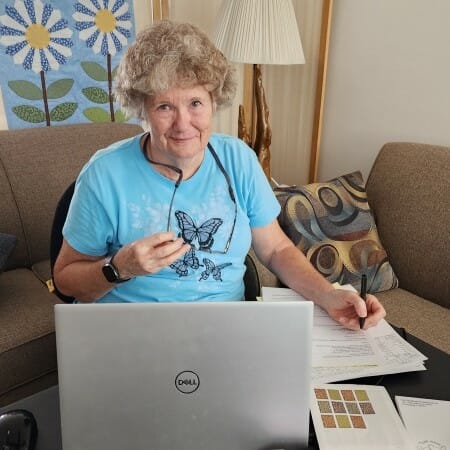
Florida Retiree Encourages Continued Engagement With Personalized Acknowledgements
Meet Daily Point of Light Award honoree Barbara Dietrichsen. Read herstory, and nominate an outstanding volunteer or family as a Daily Point of Light.
Barbara Dietrichsen grew up mainly in Tennessee and Georgia, with a stint abroad when her parents acted as missionaries in Taiwan. She was visiting her parents in their hometown of St. Petersburg, Florida, where she met the man who would convince her to set down roots — a man she was married to for 37 years. She spent a couple of years working as a chemist followed by a rewarding career working for the State of Florida before retiring. Today, she enjoys gardening in a backyard filled with butterflies and flowers all year long. She also lives near her daughter’s family, including her two teenage granddaughters.
It was through one of her granddaughter’s volunteering experiences that she first discovered something else to be thankful for, The Kind Mouse (TKM). TKM is an organization with a mission to feed local children experiencing food insecurity and currently, on average, provides 3,519 meals each week and more than 166,050 since their founding in 2012. Donating to the noble cause, Barbara was surprised and pleased to receive personalized, handwritten thank you notes with every check she wrote.
Since 2020, Barbara has sat on the other end of those notes, spending around 25-30 hours a month expressing appreciation with every card she has written. Recognizing every individual, partner, organization, business and agency that contributes to TKM’s success, she promotes continued involvement in the mission that has become very close to her heart.
What inspires you to volunteer?
I heard about The Kind Mouse when my granddaughter was looking for volunteer work for her church confirmation. And when I heard about kids learning to help other kids, I decided this is where I wanted to not only make monetary donations but to volunteer.
I started off helping out in the pantry. I inspected incoming cases of foods and put an expiration date on each item and then repackaged them into the meal bags for kids. I’m not a fast-walking person anymore, so that suited my mobility.
Then there was an opportunity to help out the person who did the acknowledgments. I was glad to do that, because when I started donating, I would get handwritten notes each month. It was really amazing. And so, I was glad I could take on that role and learned a great deal about the organization and the variety of ways they get people to donate: grants, individual contributions, business campaigns.
Barbara dedicates her time to acknowledging donors with hand-written thank you notes detailing how their donations will be used./Courtesy Barbara Dietrichsen
Describe your current roles with The Kind Mouse and your church.
The previous leader passed the baton to me on the first of this year. Now, for example, they just did a back-to-school fundraiser, where they took out the empty bins to a couple dozen businesses that have the donations for people that come in. When those came back, I coordinated with those people to send acknowledgements confirming what the money was going to be used for. I can look in the database to see which people are first-time donors and which ones have done this before in order to customize the comments and let them know how much they’re appreciated.
When I started, I would go to the office, and they had handwritten logs of donations. They’d run me a photocopy of what needed to be sent, and I’d work from that. Now we have a CRM database that makes things more efficient and makes it easy to see notes about the donation, like if someone is donating in memory of someone who has passed away or donating on someone else’s behalf. I can use donor details and history to personalize their acknowledgement.
I also volunteer with my church group. We’re finishing up making things like nap pad pillowcases for a daycare over in Tampa. I’m a novice seamstress, but I can sew straight lines. In the next month, we’ll be finishing up a project making bags of school supplies to give as Christmas presents to migrant kids. In a couple of weeks, we’re making up bags for homeless people to give to the free clinic that contain things like a toothbrush, toothpaste, shampoo, conditioner and socks.
Why are The Kind Mouse thank you notes you send important?
When I was receiving them, I enjoyed the personal touch. I was thinking of putting a caption, “I am not a robot. This is not AI. This is just a retired person,” to let people know that what they’re doing makes a difference. This is a local company making a difference to local people. It’s nice to let donors know that their contribution is a part of a larger, successful, very efficient organization.
What’s been the most rewarding part of your work?
To know that I can do my part to continue feeding hungry kids. To me, that is a fundamental part of society. Kids need to eat. I was glad to help out in the pantry, but if I can do something that helps save time for the frontline people, I do that. As each year goes by–even through the pandemic–they’ve increased their contribution to the community.
What have you learned through your experiences as a volunteer?
I can not only be thankful for what I have, but I can contribute to other people’s lives. I’ve learned that I can learn new things. I can have new experiences. And I’ve learned what talents and capabilities other people have. I can also use what I learned in my career even after retirement in order to make the organization more effective.
Tell us about future partnerships, programs or events that you are excited about.
Every time I go, I learn about some new event they’re hosting, some new way to make people aware of the problem and how The Kind Mouse is solving it. They’ve got the annual holiday food campaign with different businesses coming up.
I also look forward to learning more about the computer system and how I can contribute behind the scenes to help others go further. One thing the new computer system has enabled me to do is to respond more quickly. The faster you get feedback and encouragement, the better.
Why is it important for others to get involved in causes they care about?
You just feel better about life when you’re helping somebody else, and there’s so much need out there. As each year goes by, there’s more and more need. It’s such a challenge for parents these days.
I’m blessed with what I have, and it’s important for people who have financial security to contribute to society. These kids are the future of our country. We need to get involved in every way we can. I’m not going to be the person out there giving a speech, but I can support those people who are by using the skills and resources I have.
What do you want people to learn from your story?
Whatever your talents are, there’s an organization that can use them. Don’t think you don’t have anything to contribute. I went to The Kind Mouse and started sitting and labeling food, but it turned out, I could use my computer skills.
Not only is it important to support kids, but parents need financial and food help, as well. You get back as much as you give, but the more you do, the more you can do. It just makes each day brighter.
Virginia Siblings Team Up to Bake and Deliver Food to Local Shelters
Meet Daily Point of Light Award honorees Sydney and Hunter Guthrie. Read their story, and nominate an outstanding volunteer or family as a Daily Point of Light.
Virginia natives Sydney and Hunter Guthrie are both approaching important milestones in their lives. Sydney, 17, is a high school senior filling out college applications that will determine where her life as an independent adult will begin. As a dually-enrolled student, she already completed her Associates’ Degree earlier this year. Hunter, 15, has recently received his learner’s permit and will get his license to drive soon. Both are members of their high school swim team, and Hunter has his eye on competing at the college level.
Volunteering has always been a priority for them. Sydney remembers Keira, their mom, taking her and a friend to pass out flowers at a senior home in third grade. Hunter remembers visiting Stop Hunger Now with his mother. It was on one such trip when a realization came to the Hunter.
“I saw a homeless person lugging around a very big and heavy sleeping bag. When I got home, I thought that there had to be a better, more efficient way to help them,” he recalled.
After a stint donating plastic grocery bags to be woven into mats for people faced with housing insecurity with the Lafayette Plarn Project, they decided to look for other ways to contribute. In 2022, they started bringing homemade baked goods to the Emory Rucker Community Shelter, and things took off from there.
“As my brother and I were doing that, the shelter started a policy where they didn’t turn anyone away, and we realized that we could do so much more. The need was greater than ever,” Sydney said.
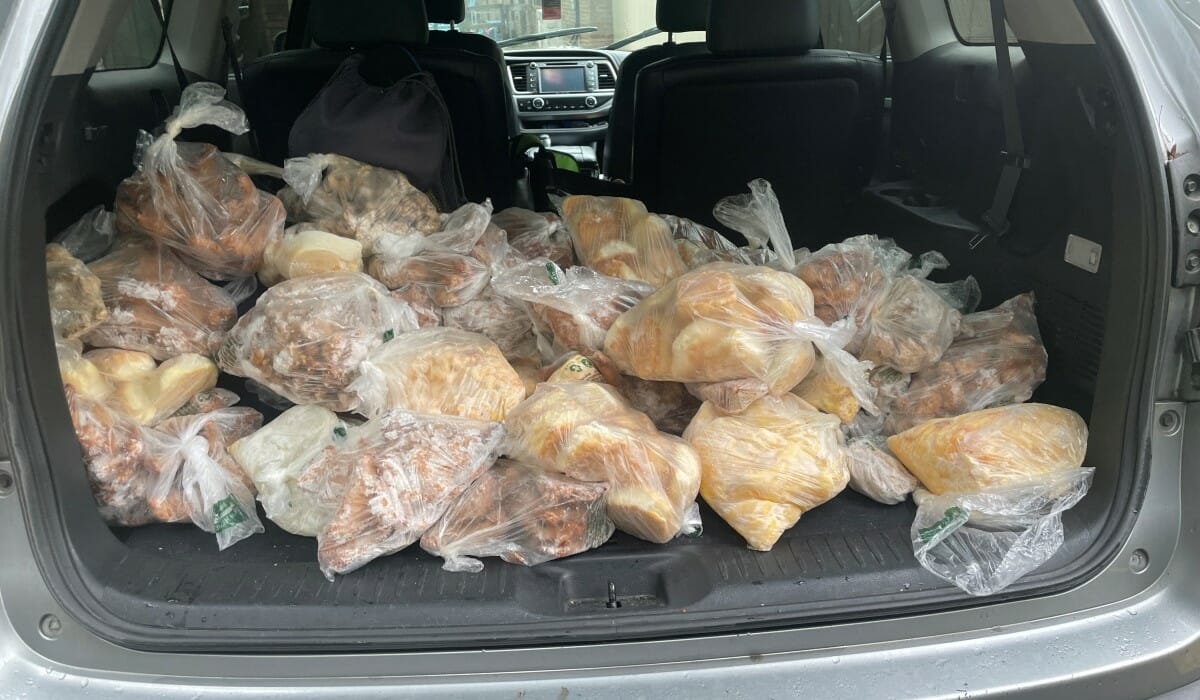
A Taste of Home, Inc., was born, and the duo at the helm began negotiating with local restaurants for day-old items that would otherwise be thrown away or donated elsewhere. In just over a year, between restaurant goods and homemade contributions, the organization has donated more than 650,000 servings of food.
“They’re always first to volunteer, no questions asked, and it’s really nice,” said Saira Sufi, director of volunteer and community engagement at Cornerstones, the social services company that runs the Embry Rucker Shelter.
Multiple times a week, they pick up donations before 6:30 a.m. swim practices or at 9:30 p.m., after closing, and deliver them to the shelter, food pantries and local middle schools. Once, after an emergency 4 a.m. surgery, Hunter was unloading donations five hours later.
Sydney Guthrie, 17, drops off donations from Panera at the Embry Rucker Community Shelter after her job at a pediatric office./Courtesy Sydney and Hunter Guthrie
Saira is grateful for the level of commitment the Guthries have shown to their deliveries as well as to educating community members about housing and food insecurity. They inspire others to join the mission.
“I don’t think many people even in our area know that the shelter exists. It’s kind of tucked away, and not many people realize the need,” she mused. “They’re good at explaining [it] in a way that’s relatable and gets the job done.”
“I know that a lot of people, especially in the United States, are much less fortunate and don’t have secure access to food,” Hunter emphasized. “To be able to provide those people with a little bit of hope and food to get them by, to make them feel like they’re going to be okay […], makes me feel good.”
He and his sister have also raised more than $5,000 to purchase items requested by the shelter and have recruited more than 400 student volunteers through a system of credited service hours.
“We offer an extra hour if they go to the shelter and drop it off personally, because it’s a way for them to see that this is in their community. It’s real, and is happening right next door,” Sydney said.
One volunteer decided to bake because her uncle had once relied on help of the shelter, and she wanted to make sure others could get the same assistance.
“With someone’s help with food, her uncle was able to have a more stable life and get back on his feet,” Hunter added. “It gives people hope. There are people in the world who are looking out for them and want them to succeed.”
Both siblings emphasize the importance of doing anything you can to help those around you, regardless of the size of the gesture.
“There are no small acts of service,” Sydney said. “[Volunteering] helps us see things from different perspectives, and I think it’s incredibly important for people to understand that sometimes, you need others to be there for you, and sometimes you need to be there for others. This is their time to be there for others.”
There have been other positive effects, as well. Throughout the years, this amateur baker has taken her skills to a new level.
“I actually just made Whoopie Pies for the first time and they turned out perfectly! I still haven’t perfected my macaron, but I’m working on it,” Sydney laughed.
Donated funds are used to purchase specifically requested items for the shelter./Courtesy Sydney and Hunter Guthrie
So, what’s next for this duo?
While Hunter will be taking on more responsibility within their organization, Sydney will be moving out. Following in her grandfather’s footsteps, she plans to continue working with her community by becoming a pediatrician and cites he and her grandmother as multiple-year blood donor volunteers and her personal inspiration.
“They were kindest, sweetest people who always felt they should give back to their community because the community was great to them,” she said. “And I’m really trying to do that and make them proud.”
Though Hunter isn’t set on a career path yet, he finds motivation in seeing Saira’s work.
“Her main focus is to make the world a better place and to help people less fortunate than her. It takes a lot to go full-time with that. It’s very selfless of her and very admirable,” he said.
As devoted to their community as they are, they will undoubtedly bring a taste of home with them wherever they choose to charge ahead.
Helping Young Nepali Bostonians Retain and Honor Their Heritage
Meet Daily Point of Light Award honoree Sudikshya Gurung. Read her story, and nominate an outstanding volunteer or family as a Daily Point of Light.
Sue Gurung, a 17-year-old volunteer at Nepali Class Boston, dedicates every Sunday to supporting Nepali education in the Boston area. Having logged more than 600 hours of volunteer work at the educational center, she leads students in cultural activities, teaching Nepali language to the students in reading and writing. The children love Sue, and her heart certainly lies in her volunteer work as she shares Nepali culture through a blended curriculum.
But this remarkable young woman also leads her school’s community action program, which helps in ways such as supporting seniors in adapting to technology, running food drives for food pantries and spreading cultural awareness at the regional cultural council. She has an additional total of more than 150 volunteer hours from the past few years with this program.
Read on to find out what inspires Sue and how she got involved with volunteering.
Describe your volunteer role.
Nepali Class Boston (NCB) is a nonprofit organization in Boston and when it started in 2014, I was 7 years old. I took classes there until I was 14. During my freshman year, I started volunteering there because I realized it was such a big part of my life up until then, and it would have felt very strange to just let it go after graduating. So I decided to join as a volunteer and contribute to my younger cousins, brother, sisters.
Sue Gurung is passionate about educating young Nepali students./Courtesy Sudikshya Gurung
I primarily work with younger students, 4 to 6 years old, and we introduce them to the Nepali alphabet, language, music, dancing – all things culture. We also help them with classroom etiquette and other in-person school activities. Some of the younger ones haven’t even gone to preschool yet, so it’s new for them. We provide a blend of American schooling and Nepali schooling, so they’re connecting with other Nepali friends. And hopefully, they create strong relationships for the future.
Why are you passionate about this cause in particular?
It’s important so you don’t lose your heritage. Also, when I was growing up in a suburban town, there were no other Nepali students throughout my years of elementary and high school. So being able to go to NCB and connect with so many other young Nepali students around my age, as well as older and younger, I felt really at home. We all have really good connections and commonalities that we can easily bond together over. So, I just hope that these young students will also feel a sense of community.
What’s your favorite Nepali tradition or dish?
A really popular one is called Momo. They’re Nepali dumplings, stuffed with meat, like chicken or pork or veggies like onions or greens, as well as some spices.
Share a rewarding story from your volunteer work.
Well, I recently started my own club as part of NCB. I teamed up with a Nepali professor from Wentworth Institute of Technology, Boston. We supported each other in making this NCB Engineering and Robotics Team.
We’re hoping that this year we can help the middle schoolers and the older students, introducing them into the world of STEM and giving them an upper hand. We want to give them more knowledge in this field. Especially for immigrant families, where parents may not know much about going into certain fields, we want to give them an extra resource to benefit them moving forward.
Why is it important for people to get involved with the causes they care about?
There’s that sense of getting involved. There are so many things out of your control in the world. So many things. So, it’s also for your own peace of mind. Recycling even one extra thing, just a little bit of involvement, can help out a lot in the grand scheme of things in your community. You can also make a lot of close relationships by volunteering. I found a lot of my own interests and hobbies through my own volunteer work as well.
What’s one thing you want people to learn from your story?
Try new things. Even if you don’t like something at first. When I was a student at NCB, I dreaded “another day of school” on Sundays. But throughout the years, I discovered my own interests. Communication skills. Leadership skills. Collaboration skills. I’ve learned a lot from my experiences volunteering.
Future Engineer Dedicates Skills to Easing Homelessness and Addressing Fair Housing
Meet Daily Point of Light Award honoree Chris Dittmer. Read his story and nominate an outstanding volunteer or family as a Daily Point of Light.
It’s not all that common to find someone whose skills and interests line up across aspects of their life, but 17-year-old high school senior Chris Dittmer has found a passion he takes from school to volunteering, and hopefully, into his future career. As he applies to civil engineering programs with a focus on environmentalism, Chris uses the construction skills his grandfather taught him to help others. He learned about Habitat for Humanity at school and, after discovering a knack in fixing things around the house and a passion for learning beyond the classroom, he decided to get involved.
Following his first build with Habitat for Humanity, Chris created Habitat Club at his high school as a sophomore and has recruited more than 100 volunteers. He and his group have since dedicated time to the construction of 21 homes, helping with repairs, advocating for fair housing legislation and fundraising. Together, The Equity Project and Rake-a-thon events have raised over $15,000.
In addition to Habitat, Chris prepares and delivers meals to 15 families every month at HomeStart, a local homeless shelter run by Inter-Faith Council for Social Service. This devoted volunteer helps members of his community build a better future from the ground up.
What inspires you to volunteer?
I like seeing change happen by my own hands. Social media has enabled us to be able to reach a wider audience online, but it’s also really impactful to do hands-on work. Being part of the change that you want to make is really powerful.
Describe your volunteer role with your Habitat for Humanity Club and HomeStart.
As president of our Habitat Club, I’ve been responsible for recruiting members and organizing meetings and events. It also includes working with other clubs in our county in a combined effort for our local Habitat chapter. Outside of the club are things like building, fundraising and organizing campaigns with The Equity Project. All funds go to renovating old homes that have been neglected and building new ones. It’s really important that we keep the communities we already have alive and growing as well as building more.
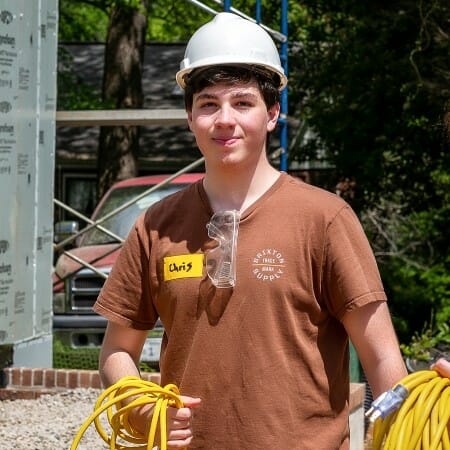
Chris Dittmer, founder and president of his high school’s Habitat Club, has participated in many builds with Habitat for Humanity./Courtesy Chris Dittmer
On builds, we do things like bricklaying, carpentry, scaffolding, painting, structuring roofs, landscaping, etc. There’s a wide range of jobs that are involved in creating a home and creating a community. People help are often beginners who may have never even looked at a hammer before, but we teach them. That’s also part of my job, helping everybody learn the way around and be able to build the houses themselves and also to have fun with it. Having that communication is always important. And enjoying your time building with your friends. The actual Habitat staff is great at coordinating the clubs as well.
Last year, as a club, we decided to tackle fair housing and housing inequality on a larger scale by contacting our local congresspersons about fair housing legislation. We were able to get all of our club members to sign a petition. It was a really fun way for our more politically-minded people to make even bigger changes than what they could on their own.
For HomeStart, we plan, prepare and cook meals for the homeless shelter and then deliver them once a month. I have fun cooking and feeding a community.
What were some of the biggest challenges with creating your own branch?
One of our biggest hurdles has been creating everything ourselves. We don’t have a guide or a manual from previous years that map out the road. Getting new people to commit was also a challenge. It’s important to get active members who are willing to go out and spend time actually hammering.
What’s been the most rewarding part of your work?
The most rewarding part of working with Habitat and HomeStart has been seeing my efforts materialize. When I drive by Lodi Street, a Habitat neighborhood project that we recently completed, it fills me with joy to see my efforts come together to become houses that families have moved into. Talking with the people who are living in those homes is also rewarding.
Habitat offers sweat equity where future owners can participate on builds to reduce the final price of the home. It’s always cool to meet the people who will be living in the house that you’re turning bags of cement and planks of wood into. Talking to people that you’re feeding through HomeStart and building those relationships is great, too. It’s good to put a face to the cause.
What have you learned through your experiences as a volunteer?
I’ve learned the organization and management that really goes beyond logistics for these big causes. Every issue is really not that simple, so it’s important that it’s managed right. Organizing has always been something that I’ve had to focus on in both my roles in Habitat Club and HomeStart.
But I’ve also learned the importance of patience and believing in and having hope for the work that you’re doing. Specifically, knowing that you can’t finish the whole house in one day. You’ll have to come back again and again, spending your weekends working with others, going through the different steps of construction of your final project.
Tell us abuot future partnerships, programs, or events that you are excited about.
Because I’m graduating, this will be my last year with Habitat Club. We’re recruiting a new leader in order to ensure the organization continues to contribute to our local Habitat chapter after we’ve graduated. We’ll also have another rake-a-thon, which is an annual Habitat fundraiser where we ask for donations in exchange for sweeping and raking lawns. That’s been a really fun event for a couple years now. While it’ll be my final one, I hope it will be a lot of others’ firsts and hopefully not their last.
I’m also looking forward to The Green Mission, another Habitat fundraiser that we created which focuses on sustainable and renewable building practices. Funds raised pay for homes that will be greener and more future-ready.
We’ve recently completed the Odie Street neighborhood that we have been working on for last couple years. I’ll be starting on our new project, for which Habitat will be responsible for creating a portion of over 250 homes as part of a new community called Weaver’s Grove. We hope our members will join other clubs in the area over the next couple of years to finish it and go beyond in order to ease the pain of housing insecurity.
Why is it important for others to get involved in causes they care about?
Without any effort put in, you can’t really create change. You have to be passionate about the causes you support and the changes that you want to make. Changes don’t happen overnight. Be active, and go after it.
What do you want people to learn from your story?
It’s important that everybody knows that they can dream big. When I started Habitat Club, I was hoping to raise a couple hundred dollars for Habitat for Humanity and go out onto a couple of builds. Over the last couple of years, I’ve been able to not only surpass that but make a change on a much larger scale. You can dream big, and you can really make a difference.
LA TEEN CREATES INNOVATIVE WAY TO SUPPLY FREE, HEALTHY FOOD TO THOSE IN NEED
Meet Daily Point of Light Award honoree Sarayu Kocharlakota. Read her story and nominate an outstanding volunteer or family as a Daily Point of Light.
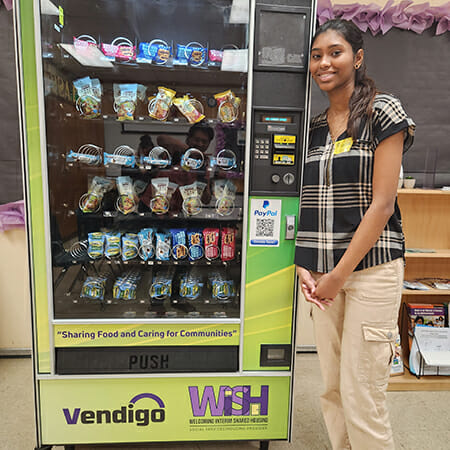
Sarayu Kocharlakota, 17, still cannot believe that a vending machine she created has now distributed over 6,000 free snacks to a middle school in the Los Angeles area. Inspired by her volunteer service with Welcoming Interim Shared Housing (WISH), she founded Vendigo, a free vending machine with the goal of offering healthy snacks to people who are unhoused and under resourced communities.
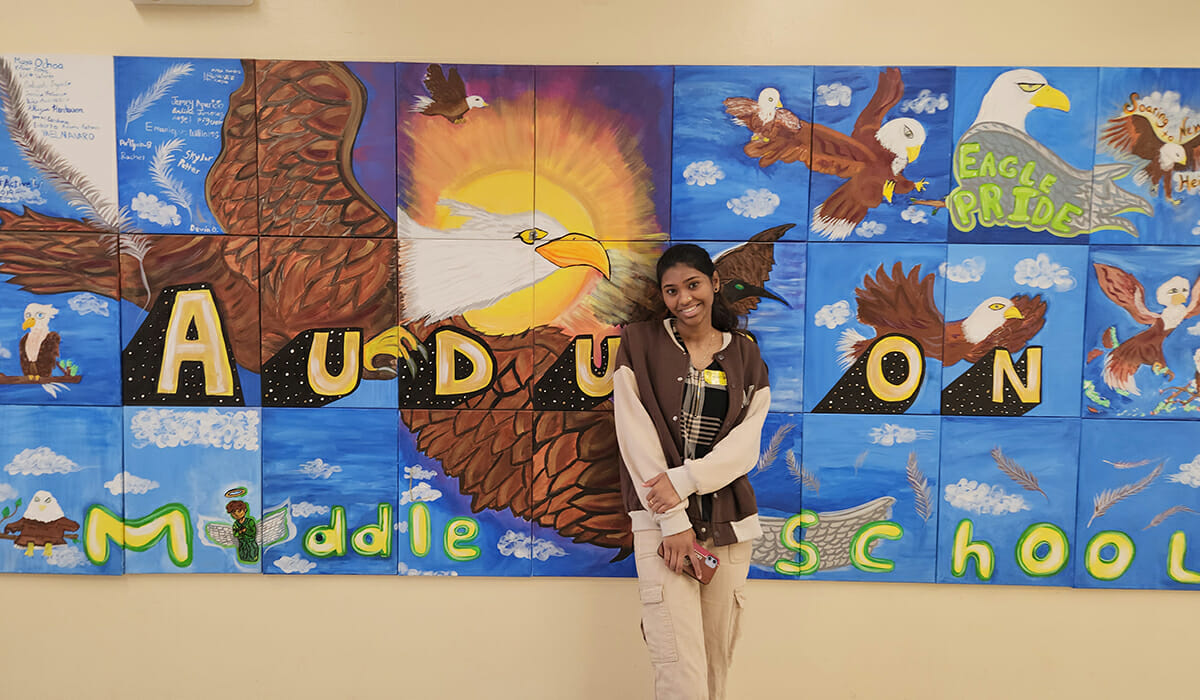
Currently, one of her vending machines is installed in Audubon Middle School, and she is installing two machines in two additional schools. Her goal is to get Vendigo vending machines out in the greater community as well, so those facing food insecurity can have access to healthy snacks whenever they need.
In the schools, the vending machines operate with tokens that are handed out to all students. Sarayu said that it’s not about who gets access to free snacks, it’s about offering access to everyone. She said that growing up in Los Angeles made her realize how fortunate she is to have access to food whenever she needs it, and she wants to someday offer that same situation to those who need it most.
What inspires you to volunteer?
When I was younger, I’d always be happy when I received gifts from my parents or when I received gifts from my friends. But as I grew older, I realized volunteering teaches you the art of giving, and the art of giving, honestly, has made me a better person. Also, it has opened my eyes to the importance of doing service for my community because we are all in this together, and we all need to try to keep our eyes open to the world around us, and not only on ourselves.
Sarayu Kocharlakota created Vendigo, a project that uses vending machines to dispense free healthy snacks. /Courtesy Sarayu Kocharlakota
Describe your volunteer role with WISH.
I have about three main roles with WISH. I am the publicist for WISH, so I make flyers. For example, this last month, I made a flyer about all the upcoming events. Also, I help distribute food at Saturday events. And then I’m the face of Vendigo. I came up with this initiative, so I handle Vendigo tasks.
How did you come up with the idea of Vendigo?
Where I grew up in Los Angeles, I would see a lot of unhoused people. It’s a big problem here, and I feel that it’s so unfair that some people don’t get food for days because I know I get hungry without food for two hours. So, food insecurity has always been one of the problems that I really wanted to try to help and contribute my part to solve. When I volunteer at the WISH Saturday events, I distribute food for a span of two hours. However, there are still people that don’t know about where we’re handing out food, or don’t know this location and they can’t access the food.
I also think it’s unfair that some people aren’t able to have access to food 24/7, when I’m able to get that access at home. So, I was thinking of ideas and how I could make food more available, 24/7, and it felt logical to set up vending machines. My school has a vending machine, and it helps me a lot – I can get food whenever I forget to pack myself a lunch. With vending machines, anyone can go up to one and can get the food inside. The food in Vendigo – it’s free with the use of dummy tokens. I have one set up in my school, and it’s completely free. I just felt that it was a logical idea to set up vending machines where the food is accessible 24/7 rather than just a period of two hours on a Saturday.
What are the next steps for Vendigo?
I put the first vending machine in Audubon Middle School, and honestly, seeing how much it’s helped the kids has just motivated me to keep going. It’s a challenging process, but when kids come up to me and tell me that this food helped them when they didn’t have breakfast that day really warms my heart. It makes me want to put up vending machines in more schools and communities. So, we’re about to install another vending machine in Wigan Elementary School, and recently the community center manager of Ottawa Middle School decided to install one there as well. I also want to put a vending machine outside of the WISH office because a lot of people pass by there.
I just want this project to grow, as in I want these vending machines to be in more schools that either want it or need it, and I want to put them up in community centers too. Also, I want people to be able to learn from my experience and be able to set this up in their communities as well. On my website, I have the entire procedure on how I started this project because I want people to be able to implement it in their cities as well.
I’m also in the process of applying for some grants because paying for all the food by myself and from donations from friends and families is not sustainable long term.
You said that the CEO of WISH, Malik Owens, is your mentor. Why do you think it’s important to have mentors?
Okay, first of all, I am only 17, right? I’m young! And when I first had the idea of a free vending machine, I never, ever thought that I could even pull it off because – where do I even get a vending machine? Where do I put the vending machine? How do I move a vending machine? In the beginning, my parents were shocked by the idea.
I was already volunteering for WISH before I even spoke about this idea to Malik, and I just felt like partnering with such a good nonprofit organization and getting Malik’s help would be invaluable. He helped me find locations and helped me coordinate moving the vending machine into to the school.
He’s just a guide there for me whenever I have questions, and this is a challenging journey, but a rewarding journey. Having a mentor is so important. I can rely on and ask any questions that I need because I know for a fact I can’t do this all by myself. I learned from Malik how to communicate with school’s principals and teachers, and I’ve learned a lot from that process.
Inspired by her volunteer service with Welcoming Interim Shared Housing (WISH), Sarayu founded Vendigo, a free vending machine with the goal of offering healthy snacks to unhoused individuals or under resourced communities./Courtesy Sarayu Kocharlakota
What’s been the most rewarding part of your work?
The whole journey has been rewarding, but when I set up the first vending machine in Audubon Middle School, we had a grand opening for my vending machine, and I gave a little speech and kids came up to me and they told me that they loved this idea. One teacher came up to me after I gave my speech and started crying saying, “This is going to change our school, this is such an amazing idea and we really appreciate it.” That was the first, most rewarding thing that’s ever happened.
Also, a week after I set the machine up, I went back to the school and I just saw a huge line of kids just getting food, and I didn’t even know if people were going to use it. So, the fact that there was a line of kids excited to grab a snack from the machine made me so happy.
Why is it important for others to get involved in causes they care about?
I’ve just learned this about myself, that when I’m this passionate about something I’ll be able to convey it and I’ll be able to make it happen. When I’m passionate about something, I’m just going to get the output no matter what. Also, it’s such a rewarding experience. You only live once. You’ve got to do what you feel you want to make an impact on.
What do you want people to learn from your story?
So, I’m in school, I have hard classes and I’m stressed all the time, but I can’t sacrifice something that I’m this passionate about just for school. I balance both, but the fact that I was able to do this project during school makes me want to tell people that it’s going to be challenging. I still can’t believe I was able to get this output, but you really have to believe in yourself. If you don’t believe in yourself, then no one’s going to believe in you. You have to believe in yourself first, and you have to know that whatever you put your mind to, you will get an output.