High School Student Provides Financial Support for Displaced People Pursuing Higher Education
Meet Daily Point of Light Award honoree Tanya Sachdev. Read her story and nominate an outstanding volunteer or family as a Daily Point of Light.
After she learned about the Afghan Refugee Crisis in 2021 on the radio, Tanya Sachdev was moved to make a difference. So, she set out to volunteer weekly with an organization that provides services to displaced people, Refugee Hope Partners. This led her to start a local chapter of STAR: Students Together Assisting Refugees at her school and after learning that only 3% of displaced children have access to secondary education, she was even inspired to start her own nonprofit, Empowering Refugee Children.
As Tanya tries to stay educated on the global refugee crisis, she continues to raise thousands of dollars to support displaced individuals and inspires her whole community to get involved.
What inspires you to volunteer?
For me, it was actually one moment. I was driving to school with my mom and on the way to school we had National Public Radio (NPR) on. NPR was sharing a story on the Afghan refugee crisis — this was back in August of 2021. In that story, just hearing about how impactful the reporter was in sharing the story really moved me, because I had never heard about the global refugee crisis. I never knew anything about the sheer extent of the crisis. Hearing about that led me to wanting to learn more.
So, I began researching and I learned about this crisis — how people are forcibly displaced and also how there were many refugee organizations in my own community. I decided to start a club at my school called Students Together Assisting Refugees (STAR), which is a club branch for an international organization that has over 30 club branches total. Through that organization, I began meeting with my peers and working to spread awareness about the global refugee crisis and to help better the lives of displaced people in our own community. Those efforts eventually brought me to work at organizations such as Church World Service (CWS) Durham and Refugee Hope Partners, two neighboring service organizations in my area. I began to be a weekly volunteer at Refugee Hope Partners, and I participated in their homework help and their English education programs from elementary to high school. As I became more involved with that organization, I realized a little bit about the educational accessibility disparity faced by community members who have been displaced and that made me want to do something more and lead to the nonprofit I created: Empowering Refugee Children (ERC).
Describe your volunteer role with the different organizations you are a part of.
I’ll start with ERC, since it happened because of my work with Refugee Hope Partners and CWS. ERC is my 501(c)(3) organization that I started last year after a session working with high school students with Refugee Hope Partners. One of the students there shared her dream of attending college and getting a four-year degree in History. But due to her family’s financial obligations, she shared that it might not be possible.
As Tanya tries to stay educated on the Global Refugee Crisis, she continues to raise thousands of dollars for displaced people and inspires her whole community to get involved. /Tanya Schdev
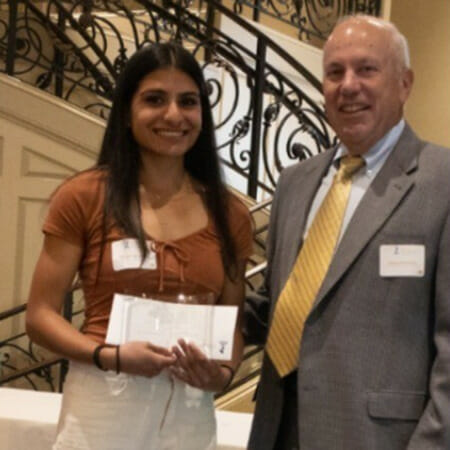
After learning that only 3% of displaced people are able to pursue higher education, I wanted to do something. I started conversations with my local organizations about ways that I as an individual could help out, and they shared about how scholarships and financial contributions are the most beneficial. So, ERC began with the goal of improving educational accessibility and amplifying voices of displaced youth. The work for that organization was definitely very difficult, especially being a 17-year-old girl advocating for your nonprofit and starting it from the ground up. But this past summer we awarded our first $1,000 scholarship to a student from Tanzania. Just seeing her reaction and seeing the amount of support that an organization like ERC has gotten has really made it all worth it. That’s one of the biggest passion projects — scholarships.
With Refugee Hope Partners, I’m a weekly volunteer. They’ve been such an integral part of this journey of my advocacy and making me more involved in the community. For example, I’m a part of their programs, as I mentioned, like their homework and English language programs, and this summer I also had the opportunity of leading a health class for around 30 children from displaced families. It was so great. That was one of my highlights of the summer — getting to create the curriculum, working in Canva, working on PowerPoints and finding books and videos to help teach about topics covering everything from nutrition to oral health.
I try my best to do weekly volunteering for their shifts. I genuinely treasure the conversations that I have with the high school- and college-aged students, which is a completely new experience from the elementary school kids that I worked with over the summer. It’s just so great getting to talk and bond over nominal things like pop culture gossip, as well as to bigger topics like talking about our days and some of the bigger issues that they face.
What’s been the most rewarding part of your work?
One of the most rewarding parts of the work is not only seeing the tangible impact made through the money raised or the products donated, but rather the support from individuals in the community wanting to be a part of working towards and helping the displaced community. That has been really rewarding.
For example, just seeing the support behind ERC, or even the STAR Club at my school where faculty reached out to ask about how they can further their involvement — so many people care about the mission and it has been so amazing. As a 17-year-old, it’s really hard to show that an organization can contribute to something much bigger than itself and having that support has been the most beautiful thing.
What have you learned through your volunteer experiences?
One thing that I’ve learned is the importance of sharing stories and building connections. Personally, I noticed that at STAR Club, it was really easy for me to stand up in front of a crowd and talk about the statistics. But it wasn’t until I got involved with the Refugee Hope Community that I got to share stories and connect with people on a personal level, and I realized that people are more important than the statistics and the numbers.
One of the events that we put on last year was a dinner with a documentary event where we were showcasing a documentary and had dinner provided — it was a free event because we wanted to really spread awareness. The event struck a chord with so many people that reached out to me afterwards and wanted to learn more about the organizations I’m a part of. We had a panel discussion with representatives from local organizations and it was just the awareness event that made so much more of a difference than just donating did.
What are your goals for Empowering Refugee Children?
One of my goals is to continue working towards building ERC to continue handing out scholarships. I want to be able to continue this program, because there’s a definite need for educational resources. I’d also like to explore my own personal interests of healthcare accessibility and continue to stay involved with the community of displaced people.
Why is it important for others to get involved in causes they care about?
I think that being able to work for something beyond myself has been ultimately such a rewarding experience. So, for individuals that are interested in a topic or want to contribute and lend their time and talent, I’d say 100% go for it. It’s so rewarding, and you get to explore more about your own identity while also supporting communities and individuals.
Tell us about future partnerships, programs or events that you are excited about.
ERC has opened our next set of scholarships for this upcoming scholarship cycle. The deadline is in December. We’re really excited to be able to hand out another scholarship with the support of generous donors and donations.
HIGH SCHOOL SENIOR CREATES FREE STEM TUTORING SERVICE FOR ELEMENTARY STUDENTS
Meet Daily Point of Light Award honoree Jasmine Garry. Read her story, and nominate an outstanding volunteer or family as a Daily Point of Light.
Jasmine Garry, 17, has been passionate about technology since she was young. When she learned that girls often lose interest and are underrepresented in STEM fields, she knew she wanted to do something to inspire young students. Also, she wanted to make sure STEM pathways were accessible to any student who was interested.
To meet the needs of her community, she founded CREATE, a free STEM tutoring service that connects high school students with elementary students. CREATE uses social media platforms, such as Facebook, to reach out to parents whose kids might be interested in receiving STEM tutoring. Now, Jasmine and the other volunteers with CREATE have logged more than 10,000 hours of free STEM education and service work. Additionally, Jasmine recently won a Congressional App Challenge in her home state of Minnesota.
She is currently a senior at Eden Prairie High School and wants to pursue a major in computer science.
“Being a part of CREATE has really solidified the fact that [technology] is definitely a passion of mine, and just being a part of the community has motivated myself to just continue building apps,” said Jasmine.
What inspires you to volunteer?
Back when I started CREATE, I was just really passionate about helping my community. I have always been involved in my community through various activities. Then during the onset of COVID, I felt like I lost something, I couldn’t spend as much time around other people as I liked to. So, after COVID, I was really motivated to volunteer to bring communities together, specifically in relation to tutoring and STEM education. It’s important for me to be able to connect with the youth and continue inspiring them. I give them the resources that I know I didn’t have when I was in elementary school. Tutoring or STEM courses are very expensive, and my goal is to make sure that we can reach all students, and they can have access to that without any sort of financial burden or fear of it not working out – just give them a place to explore.
Jasmine Garry founded CREATE, a free STEM tutoring service for elementary students. /Courtesy Jasmine Garry
Describe your volunteer role with CREATE.
I founded CREATE four years ago, in the beginning of January of 2021, it was a New Year’s resolution. I really wanted to do something impactful throughout my high school journey and beyond. As the founder, I work with all of our tutors, who are based all over the United States, and some that are international. I set up meetings with the tutors and help with the scheduling with the students. I also handle meetings with our board members, and make sure that we’re able to set up events.
I love event planning and being involved in community events, so anytime that kind of thing pops up, I’m really involved in brainstorming, finding sponsors, getting people together and advertising. Additionally, I manage CREATE’s Instagram, Facebook and LinkedIn accounts. I’ve learned a lot from that role, like how to market this service to students and to parents, how to get involved with other organizations and how to gain a following and presence on social media.
Why are you passionate about STEM?
I’ve been very passionate about STEM ever since I was young, but the passion really grew when I was in middle school. Then, when COVID happened and school was being taught online, I noticed that math and science were tricky to conduct online. Pair that with my love of technology and aspirations to pursue a career in technology, and it just kind of clicked that we needed something in our community where students could get access to a focused STEM education. Also, I have a background in creating apps – I’ve even been recognized by the Congressional App Challenge for an app I built. I really wanted to pass along all my knowledge and passion to other students.
Additionally, there are studies that have shown that before third grade, girls and boys have the same interest in STEM. After third grade, the interest from girls usually declines. I feel like the beauty of CREATE is that we reach students before that happens by specifically targeting elementary students.
Tell us more about the Congressional App Challenge you won.
The Congressional App Challenge is hosted by the representatives in Congress, and each representative judges the student’s submissions in their district. I created an app called RexCycle, and the app is an AI app that detects whether an item is recyclable or not. You can just scan a product, for example a water bottle or a pizza box, and then the app lets you know if the product is recyclable, not recyclable or partially recyclable. Or it informs you of the steps you need to take to make the product recyclable, like removing a label or cleaning the product. Once you recycle a product, you receive points, and you can be on a leaderboard to compete against your friends to see who’s recycling the most. It is a passion project of mine. I really wanted to learn more about AI, and I noticed that there are a lot of nuances in recycling. Because of the nuances, a lot of stuff that we try to recycle ends up not even getting recycled, which is kind of upsetting. I realized that people want to recycle, but there is no easy way to learn all of the rules unless you have an app that’s been trained to tell you that.
What’s been the most rewarding part of your work?
I think seeing STEM become a career path possibility for students, especially girls. So, we conduct a lot of workshops for girls to get into STEM. The most rewarding thing is seeing that “light bulb moment.” Like when a student gets super excited whenever they’ve coded a project, and even if it’s a simple project, they get so excited to show their parents and continue working on it at home. Then when we get feedback from the parents and hear that the student is still working on their projects and thinking of new ideas, it’s amazing. Even if the student doesn’t choose to do STEM in the future, at least they saw it as an option and an opportunity to learn something new.
What have you learned through your experiences as a volunteer?
I was intimidated by the challenge of creating an organization like this, and I think many are, but I learned that I’m capable of bringing people together for a common goal, and that I’m able to learn various aspects about creating a service. I learned how to market a service, how to reach specific communities and how to create successful events. I’ve learned so many real-life applications that I know I can carry on into my work, and I’ve already been able to use what I’ve learned. Because of my involvement in CREATE, I’ve been offered multiple internships where I’ve been able to use these skills.
In general, I’ve learned that anyone can make an impact. There are so many problems in our community and obviously one person can’t solve all of them, but when you bring people together and they are able to work on what they are passionate about. Then they can use their knowledge to create an app that can help solve a problem and teach others about how to solve the problem. I think it’s so amazing that you can teach kids how to use technology to solve problems, and they can then come up with creative ideas of their own because everyone’s life experiences are different.
Tell us about future partnerships, programs, or events that you are excited about.
I’m going to host a hackathon. I’ve been a part of many hackathons and it’s just a blast. It’s a great event to learn and get all those creative juices flowing. I’m working on the curriculum right now, basically students are going to learn about how to create an app through block-based coding, and then at the end of that program they’re going to have the opportunity to pitch their own product to a panel of judges. Winners will be picked and there will be a big celebration. I’m super excited for it because it combines two things that I feel like I’ve learned from this experience: tech and entrepreneurship, which are both key skills for any student, no matter what they choose to pursue in the future.
Why is it important for others to get involved in causes they care about?
Everyone has their own story and their own life experiences. So, there’s no way for me to be able to address a problem as well as someone else who may be living that problem or has experienced it themselves firsthand. When you get involved in a bigger network that can support you, you’re able to work together to solve that problem.
Then, when I’m working with the other volunteers who work with CREATE, I learn something new every day. They all have these amazing stories, goals and aspirations. So, just being inspired by these other volunteers motivates me and the other tutors to continue exploring and learning. Fostering this community of learning is so important because at the end of the day, whenever we have this prominence of education, it will always lead to more innovation and that is for the betterment of our society.
What do you want people to learn from your story?
What I want people to learn is that it doesn’t matter what you’re interested in or how old you are. What you say does have value, and you can change an entire community. I’ve seen my community change entirely with this new ability to code apps. So many people are much more involved. Also, there will always be people supporting you along the way that will make sure that this change happens, so don’t be afraid to put yourself out there to create change.
Health Equity Advocate Founds Nonprofit to Combat Disparities
Meet Daily Point of Light Award honoree Fatimah Amer. Read her story, and nominate an outstanding volunteer or family as a Daily Point of Light.
Fatimah Amer of Scottsdale, Ariz., is on a mission to address health disparities in her area and beyond. Three years ago, she founded SPARKHope, a nonprofit organization dedicated to leading public health initiatives and inciting greater civic engagement.
One such cause Fatimah has taken on is food insecurity. SPARKHope’s Food For Families initiative tackles the food insecurity issue, aiming for political commitment as a long-term solution. The organization hosted a food drive last year, where more than volunteers raised 10,740 pounds of food, donating it to various food banks. The UNITE initiative – targeted toward engendering civic engagement in the youth – donated packages that included civic engagement comic books, handwritten notes and more.
As founder of SPARKHope, Fatimah spearheaded each initiative. The organization continues to grow, now addressing impending adversaries such as mental health, education, civic engagement, housing and healthcare access. Read on to find out what sparks hope for Fatimah and keeps her passion for the cause alive.
Describe your volunteer role.
I’m founder and CEO of SPARKHope. This is a youth organization I founded three years ago. Although I’m president of the organization and have an administrative role, I really do like to work with all of our volunteers, personally talk to our volunteers, and speak at engagements to share SPARKHope’s message. I recently got to present at a health equity conference here in Arizona. I truly believe that having sustainable community partnerships is essential. So, I work on the administrative side, I work with volunteers and I connect with other community partners.
Fatimah is passionate about public health and health equity./Courtesy Fatimah Amer
What inspired you to start SPARKHope?
This was a very personal mission. A few years ago, the pandemic hit and of course we’re still seeing the ripple effects of that. I was very lucky because I grew up in an environment where the values of civic engagement and community service were really instilled in me. And so, it was really when I would go with my mom and donate small food items to food banks, where these values were really instilled in me.
When the pandemic hit, we had to stop that volunteer work. I had attended several conferences and had been a part of UNICEF, so I was already familiar with food insecurity. And so, initially, when I started the nonprofit, it was to address food insecurity and provide a sustainable support system to have these resources. That’s really when I started learning more about the social determinants of health, which exacerbate health disparities.
Then, SPARKHope started expanding. And since then, I’ve been so interested in public health and learning more about these health disparities, not just in Arizona but across our nation as well.
Why is addressing these issues so important in today’s world?
Our youth, Gen Z, are the hardest hit by these social determinants of health and by health disparities. And unfortunately, most people in office, as well as people on the committees and collaboration groups addressing these issues, are in older generations. They do a good job talking about the issues and raising awareness, but it’s critical to have the Gen Z voice and a youth perspective to help tackle these issues. It’s essential that our generation, who is being hit the most, has a say. We have personal experiences we can bring. Personal voice and personal experience are essential in order to make static change. Having that lens is crucial.
Share a rewarding story from your volunteer work.
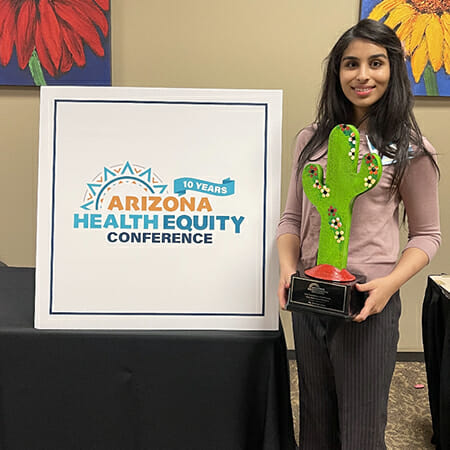
Actually, earlier this week, I got to present at the annual Arizona Health Equity Conference. I got to present my poster on SPARKHope. Later in that conference, I was absolutely honored to receive the Stella Kiarie Innovation in Health Equity Award.
But it was a conversation I had afterward with a public official that was so rewarding. She came up to me, in tears. She said it was so inspiring and that she’d just been having a conversation with her steering committee members about how they needed to have a younger perspective on public health issues. She said it was inspiring to see someone young receive the award. This conversation touched my heart.
Just knowing that I’m inspiring people – and not just the youth, but also people in office who can help us sustain those long-term partnerships – is so gratifying. Together, we can keep moving forward to bring advocacy and awareness to the next level.
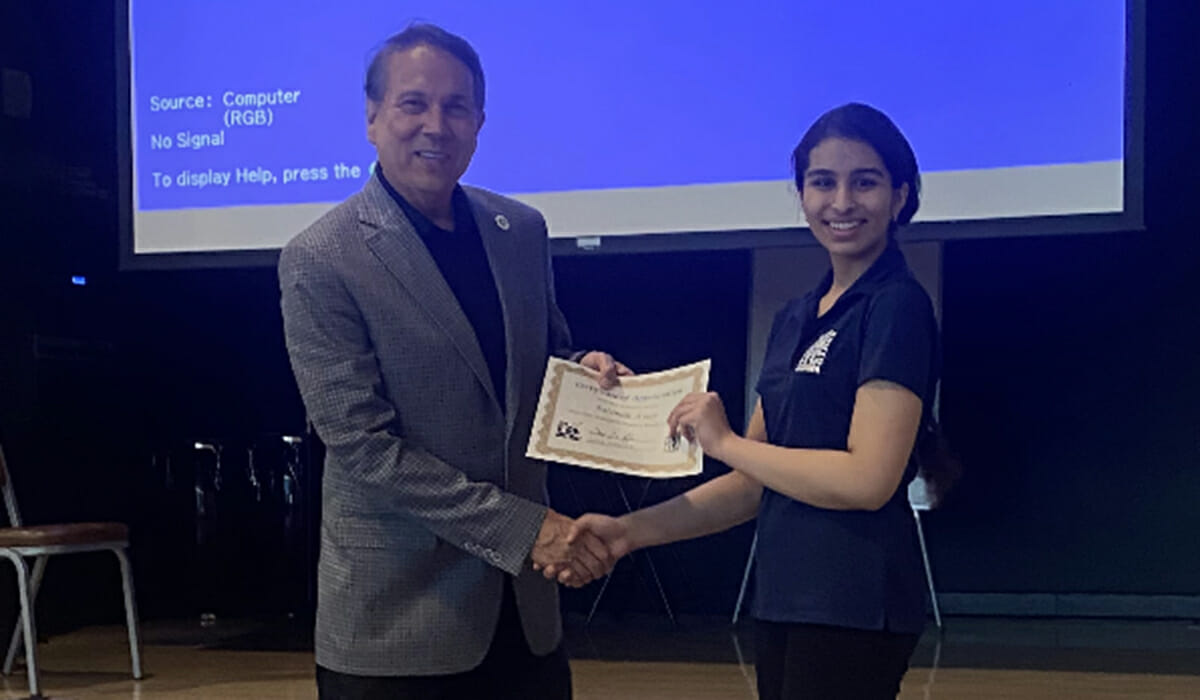
Fatimah Amer with Scottsdale Mayor David Ortega. /Courtesy Fatimah Amer
Why is it important for people to get involved with the causes they care about?
I think it’s really important to explore your inner talents and passions. Personal aptitude is the engine to societal success. In order to learn what you’re passionate about, it’s essential to go out and volunteer. Really explore these issues and organizations you’re interested in. This may further finesse your interests, or it could make you aware of another topic you might want to explore.
At the same time, you’ll be getting involved in your community while also growing. One of my key takeaway messages from SPARKHope is that you’re never too young. There will always be challenges, but it’s essential to overcome those and work with others to overcome them. You’ll learn more about yourself while helping your community.
What’s one thing you want people to learn from your story?
Health disparity, or any other issue, can’t be solved by just one organization. This is why I encourage people to volunteer with others, and work with other organizations. Whatever you do, do it in community partnerships and do it long term. It’s vital that we work with a long-term mindset and develop and sustain these community partnerships. So I encourage everyone, regardless of your age, to keep volunteering.
How can people get involved?
You can go to the SPARKHope website and our social media pages to see our current needs and get involved.
California Teen Encourages Kids to Fall in Love with Reading
Meet Daily Point of Light Award honoree Alexa Schmeltzer. Read her story and nominate an outstanding volunteer or family as a Daily Point of Light.
Alexa is the middle child of three sisters. Her parents emphasized doing well in school, but were very supportive of whatever she wanted to do outside of academia. Alexa’s older sister had been volunteering with Wise Readers to Leaders, a Los Angeles-based nonprofit that helps elementary school students who have been historically underserved increase reading comprehension.
Their parents suggested that Alexa follow in her sister’s footsteps, so Alexa started volunteering with the organization in ninth grade as a Teacher’s Assistant, helping students develop reading confidence. She quickly fell in love with volunteering and has continued to volunteer with Wise Readers to Leaders for three years. She even expanded her volunteering to other organizations that work to bridge the educational gap.
What inspires you to volunteer?
It’s not fair that some people have access to great educational opportunities but others don’t. I think it’s important that everyone has equal access. I have been working with Wise Readers to Leaders for three years and I also volunteer at other programs to help bridge that gap. The kids that I tutor are primarily under-resourced elementary school kids, ages 6 to 10. Since I don’t live in Los Angeles, where Wise Readers to Leaders is based, I volunteer virtually.
Alexa volunteers with organizations such as Wise Readers to Leaders, Peninsula Bridge and Halford Young Women’s Leadership Program to promote reading and self-confidence in under-resourced fifth grade girls./courtesy Alexa Schmeltzer
Describe your volunteer role with Wise Readers, Halford Young Women’s Leadership Program and Peninsula Bridge.
With Wise Readers to Leaders, I tutor elementary kids in reading. My main objective when I sit down with kids is to develop reading comprehension, but because I grew up loving to read, I want to instill the love of reading in them. Reading opens up worlds to them that they would otherwise not experience. Confidence in reading is so important because throughout school you’re going to have to do it a lot and you may as well learn to like it. Reading also improves your writing and vocabulary – and most of all it’s nice to sit down and enjoy a book. I work one-on-one with my reading buddy. We read books, I ask questions about the book and we discuss what we read. I volunteer with Wise Readers to Leaders once a week.
I also volunteer with a mentorship program at my school called Halford Young Women’s Leadership Program. I’m one of the leads this year. The mentors are high school students and the mentees are motivated fifth-grade girls from underserved communities. Our goal is to build relationships between the mentors and mentees and increase their academic and social-emotional skills. I’m in charge of organizing activities and recruiting high school mentors. Typically, we have about 20 mentees participating throughout the school year, and about 15 high school volunteers, so it’s almost a one-to-one ratio of “big sisters” to “little sisters.” I volunteer with Halford twice a month on Saturdays throughout the school year.
Finally, I volunteer for Peninsula Bridge, an intensive summer program that identifies high-potential elementary students from under-resourced communities and helps these students bridge the education gap so they can excel academically and attend the college of their choice. It’s an intensive five-week summer program where student leaders teach math, English, robotics, theater, art and other subjects. I volunteer for Peninsula Bridge over the summer, every day for six hours for the five-week session.
What’s been the most rewarding part of your work?
I love seeing the kids become more confident in their reading abilities. I also love seeing the kids open up to me. By the end of the year, we often spend a lot of time talking like friends because we have gotten to know each other. Many students are shy at first and it’s beautiful to see them blossom and come out of their shells by the end of the year. Many kids come to the program with a predisposed dislike of reading because reading requires patience which in this day of technology is hard to come by. Sometimes the kids are nervous because they’re not sure if they will mess up, so I help boost their confidence as readers. I always see their potential and do my best to inspire them. I’ve noticed big improvements in most kids’ excitement and appreciation of reading.
What have you learned through your experiences as a volunteer?
Everyone needs support in their life from someone who believes in them. The smallest things can make a big difference. Just talking to people, asking them questions about themselves, listening to them, making them feel important can be life-changing. Helping them learn to be good communicators can help them achieve their goals.
Why is it important for others to get involved with causes they care about?
Some people are fortunate to have many opportunities. Because they have them, they should give back and share with those who don’t have those opportunities. Volunteering helps to level the playing field. I believe it’s important to try new things and see what sparks your interest. There’s always more that can be done in the world to help. Volunteering has also opened up my own future. I realized I love working with and motivating children and I’m planning on pursuing a career in education.
What do you want people to learn from your story?
I started volunteering with very little knowledge about education inequality. This experience has definitely opened my eyes. Helping underserved kids find their voices is life-changing – not only for them but for the volunteers.
Michigan Teen Co-founds Nonprofit Offering Free STEAM Education, Promoting Equal Opportunities for All Children
Meet Daily Point of Light Award honoree Anish Nandamuri. Read his story, and nominate an outstanding volunteer or family as a Daily Point of Light.
At just 16 years old, Anish Nandamuri of Canton, Michigan, is on a mission to reshape education and bridge the opportunity gap for children from all backgrounds. Co-founding UsForThem Inc. with four friends from his high school, Anish’s vision is clear: to provide free STEAM (Science, Technology, Engineering, Art and Mathematics) education to young students, regardless of their financial circumstances.
Established in 2020, UsForThem’s flagship program is a free 10-week after-school experience where high school volunteers who are passionate about STEAM serve as educators. During this program, these young mentors teach elementary and middle school students a diverse array of STEAM lessons. They guide students in crafting circular gliding airplanes, delve into the world of architectural engineering by building structures with straw and tape, and even bring in guest lecturers, including medical doctors, computer programmers and other experts, to provide real-world insights into the STEAM fields.
While initially focused on local Michigan students with in-person classes and workshops, UsForThem has expanded its reach by offering virtual classes to communities across the United States including California and Georgia and even internationally in India.
Anish Nandamuri is co-founder of UsForThem, a youth-led organization providing a free 10-week educational program to elementary and middle school students./Courtesy Anish Nandamuri
What inspired you to co-found UsForThem?
Throughout elementary and middle school, I was involved with advocacy for youth with disabilities in my school. It was during that time that I became aware of the insufficient funding and limited access to STEAM education in under-resourced communities in Metro Detroit. So, my co-founders and I started UsForThem to provide fully free educational programs.
We started our first program at Wattles Elementary School in Troy, Michigan, which had to be virtual due to the COVID-19 pandemic.
In my role, I oversee the UsForThem website and focus on the EECS (electrical engineering and computer science) component. I collaborate with fellow team members to develop computer science lessons for the kids in a way that they can really understand what’s typically a complex subject matter.
How many high school educators volunteer with UsForThem?
We have about 25 full-time volunteers. And then on top of that, we have around 50 freelance volunteers, who we train for specific programs. Together, they’ve instructed around 650 students so far in 20 schools.
What are some of your favorite UsForThem lessons?
My personal favorite is when we teach students how to make circular glider planes. It’s just really fun for everyone. Another one we did was on structures. We taught them about the history of structures such as the pyramid and the engineering aspect of it. Then they built their own structures out of straws and other materials like pipe cleaners. We’ve also brought in people from other clubs at our school such as the Programming Club to talk to the kids about computer programming as simply as possible.
What has the students’ and parents’ feedback been?
The students have had a great time through all the programs. We’re not really lecturing them. All our workshops and lessons are hands-on, like games and crafts, so they have a lot of fun with it.
The parents have told us that they love sending kids to types of programs like this and for free. They can see that their kids are learning a lot in the process, while also having fun and engaging with other kids. They’re able to explore different career paths and explore their passions.
What’s been the most rewarding part of your work?
The most rewarding part of our work would be just seeing the kids light up when they’re making something new or sharing with their friends what they made.
What do you hope for the future of these students?
Whether or not they pursue a STEAM field, I hope that UsForThem instills a love of learning in them.
Why is it important for others to get involved in causes they care about?
Giving back to your community is mutually beneficial since you’re not only helping the people in your area, but you’re also engaging with them and you’re gaining a new perspective on the issues that people face. Being able to make one person smile, have a good time or learn something new can really resonate with not only them, but yourself as well.
Houston Native Fights for Education and Literacy in Her Hometown
Meet Daily Point of Light Award honoree Victoria Villarreal. Read her story and nominate an outstanding volunteer or family as a Daily Point of Light.
As a born-and-raised Houstonian, 33-year-old Victoria Villareal takes pride in her Texan roots. Her family has lived in the state for as long as it’s been one. Much of that pride is directed toward her hometown and fuels her desire to make it a better place for everyone who calls it home.
During the week, Victoria works at a large corporate bank as a client-community relations consultant getting corporate dollars back out into the community by helping with charitable giving and corporate sponsorships, an aspect of her job that allows her to work with local sports teams and events like the rodeo. She also oversees volunteers representing the company off-site.
Her service work blends seamlessly between her personal and professional lives leaving many acquaintances with the impression that she works at the Barbara Bush Houston Literacy Foundation, the organization with which she has volunteered for 10 years spreading literacy. She also serves on the boards of and donates time to both Dress for Success, an organization that prepares women entering or reentering the workforce with things like professional clothing and resume assistance, and Nativity Academy, a small, under-resourced private school.
How did your parents shape your view of volunteering?
I’m the second of four kids. My parents always worked really hard, and they always showed up. Whether it was being on the board of the orchestra’s parents’ group or being room mom. They did a good job of demonstrating that importance to us. I knew that I needed to do my part.
My grandparents also took us to serve meals to people experiencing homelessness and to donate the toys that we no longer used. Those little acts really added up to who I am today. You don’t realize that until you get older. I just feel called to create change in the world, and I’ve run with that.
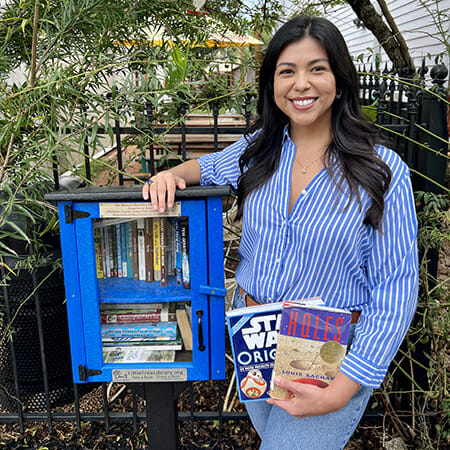
Victoria Villarreal, Storybook Gala co-chair for the Barbara Bush Houston Literacy Foundation and volunteer stands by one of the 25 Barbara’s Book Boxes she installed as part of the program she started throughout the city./Courtesy Victoria Villarreal
What inspires you to volunteer with these particular causes?
From Kindergarten to third grade, you learn to read, and from third grade and beyond, you read to learn. If you don’t have that skill, life is going to be harder. If you can help someone learn to read, you’re changing the trajectory of their life. Living in Houston, one of the most beautifully diverse cities in our country, comes with the reality that not everyone has the same access to libraries and resources. To be able to bring those opportunities to the people who don’t have them is special.
Through a previous employer, I created a soft skills program for high school students and was helping them get summer jobs and prepare for college. With that, you need proper suiting, and so I connected with Dress for Success. They help women even after they get the job, give them financial education and help them build out their career path. It all comes together with my early childhood and literacy focus. If you’re improving the life of a mother, you’re improving the life of a child. So, I got involved in their young professionals group called Women of Wardrobe.
Describe your volunteer roles.
I’m the Storybook Gala co-chair for the Literacy Foundation this year that’s taking place November tenth. I’m planning and raising funds and awareness. This year’s theme is “Around the World with Madeline”. Each year, we pick a storybook and Madeline is my favorite children’s book. Her tale is so interesting, because she’s the smallest, but she’s also the bravest and mightiest.
In my previous roles with the YPG, I served as communications chair, vice-chair, chair and service chair. I created partnerships with local organizations and schools to provide books to children, secured funds to renovate libraries and send covid relief funds to local early childhood centers, recruited and led hundreds of volunteers, and started the Barbara’s Book Box program.
At Dress for Success, I’ve co-chaired their annual Spring Fling for Women of Wardrobe twice to raise money to continue programming and suiting women. I’ve helped women find careers. And now, I also serve on the board.
I started volunteering with Nativity Academy about six years ago. It’s a small school in the neighborhood of Gulfton. My employer helped fund them when they first started, and I used to read to the students twice a month. Since then, I’ve coordinated health fairs, provided literacy resources and served on the board.
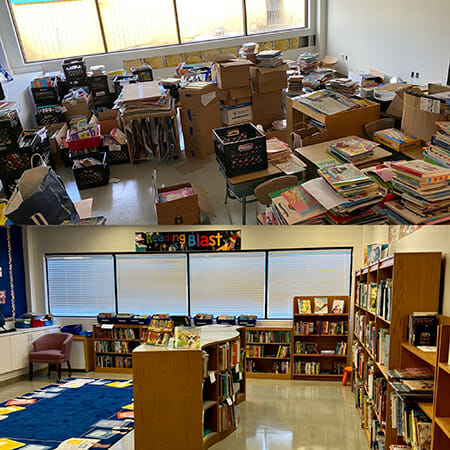
In 2021, I connected the Literacy Foundation with Nativity Academy, and we created a beautiful library by adding bookshelves, rugs, chairs, a cataloging system, new books, etc. They have a fantastic volunteer librarian who celebrates themes every month and makes sure they get the books any other school would get.
What’s been the most rewarding part of your work?
Being able to help create change for parts of the city that maybe didn’t realize that they were lacking resources, or didn’t know how to get them, has been really rewarding. I just feel really lucky to be able to do that and to have built fantastic friendships along the way.
What have you learned through your experiences as a volunteer?
There’s always more to do, but people are grateful for any amount of help you can give them. Whenever you’re passionate about something and you share that with other people, it’s contagious. Other people will want to help create change as well. That’s what’s so great about the Barbara Bush Literacy Foundation and our YPG. We’ve really been able to build a village of people who want to make our city a better place.
Before and after Victoria and the Young Professionals’ Group transformed the storage room into a library for the kids at Nativity Academy of Houston for the 2022-2023 school year./Courtesy Victoria Villarreal
Tell us about future partnerships, programs or events that you are excited about.
The gala is the big one. It’s number one on the mind, because there’s a lot of time and planning going into that right now. The band and getting dolled up is fun, but it’s what we’re able to do after that that really motivates me. That’s when the work really starts.
We’ve already made plans to build another library for a housing center. The YPG also funds a program called Camp Adventure, a yearly summer camp. And we’ll continue to provide more literacy materials and resources for our early childhood partners and elementary schools.
Why is it important for others to get involved in causes they care about?
Find your calling, whether it’s financial literacy or homelessness. We all have to help each other out. No matter what your socioeconomic status is, life is hard. But life is easier when you have a roof over your head, food in your stomach and a place to go to learn. If we’re able to help contribute anything to those who don’t get to take that for granted, we should.
What do you want people to learn from your story?
You, too, can create change. It can be as small as donating an afternoon to read to a child who doesn’t get that one-on-one time with anybody. That child will remember that. Or you could send a word of encouragement or a thank you to someone that has made your day. We’re all capable of doing our part. Find what calls to you.
Through Education and Beautification, One Woman’s Love of Gardening Grows Across San Diego
Meet Daily Point of Light Award honoree Lynn Langley. Read her story, and nominate an outstanding volunteer or family as a Daily Point of Light.
Lynn Langley of San Diego grew up with a love of gardening, helping her mother take care of her roses. She’s always had a green thumb, but in recent years has turned her passion for gardening into a meaningful contribution to her community through volunteering at Forever Balboa Park.
“I love helping take care of Balboa Park,” Lynn shared. “It’s one of my favorite places in the city. To see projects I’m involved with, enhancing the park for everyone who comes to see it and enjoy it just gives me so much pleasure. It’s so neat!. We’ll be sitting there working on something, and strangers will come up and thank us for keeping the park beautiful.”
Lynn is a Forever Balboa Park trustee and also volunteers as a tree steward, tree planting team leader and garden steward. Lynn also volunteers with the Master Gardener Association of San Diego County.
“What’s so cool about Master Gardeners is that we’re tasked to produce science-based information to anyone in the county who has gardening questions,” Lynn described. “We’re under the auspices of the University of California Agricultural Extension, so we have all that science at our fingertips to share with people who call in and ask us questions. I’m very proud to be part of that organization as well – it’s extremely selective. And we’re celebrating our 40th anniversary this year.”
Lynn helps educate students, from elementary school through high school, on gardening, growing food and taking care of their ecosystem./Courtesy Lynn Langley
Lynn initially started with the San Diego Floral Association, where she served on the board. She was recommended by another board member to be a member of the Friends of Balboa Park, one of the organizations that formed Forever Balboa Park. Once she was recruited to that board, she got very involved with projects to enhance the park.
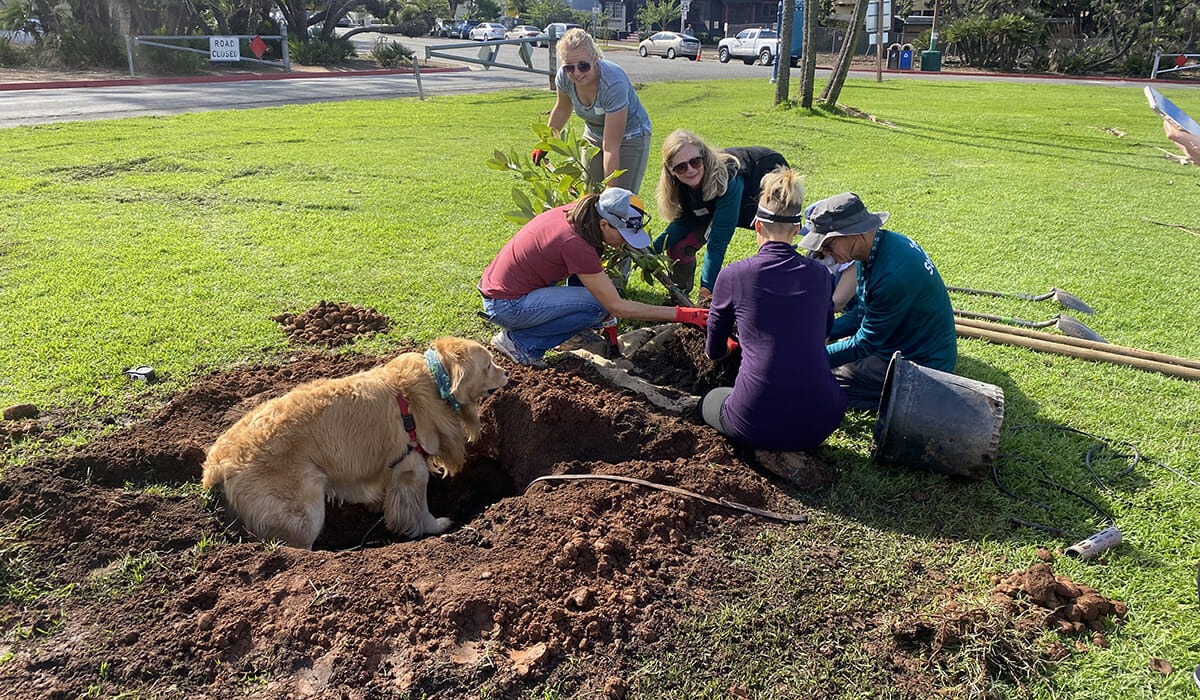
As a tree steward, Lynn monitors one of Balboa Park’s largest tree zones monthly with her volunteer partner, Alex Corona. At tree planting events, Lynn leads groups of up to seven volunteers in how to properly plant a tree. Volunteers and staff are always eager to work with her and her golden retriever, Wyatt, who tags along to volunteer events. As a master gardener, Lynn also helps lead Forever Balboa Park’s garden steward training.
“I look at what our volunteer program at Forever Balboa Park does,” Lynn said. “They’re going out there and making the gardens look gorgeous. Parks and Rec doesn’t necessarily have the time or [people power], but with dedicated volunteers who come and spend three hours, the gardens look immaculate. A little bit of effort that you can give greatly contributes to others.”
Through the Master Gardener Association of San Diego County, Lynn develops and visits school gardens. First, she works with teachers and parents to create these gardens on school campuses. Then, she visits the gardens to educate students, from elementary-aged children to middle schoolers to high schoolers, on the origins of produce and how to tend a garden. Lynn also helps teach the parents about gardening, and many of them go on to start gardens at home.
“There are kids who don’t understand that a carrot comes out of the ground,” Lynn shared. “Their little faces get so excited when they pull up a vegetable. They find out where their food comes from, and it’s so much fun. They’re willing to try things that they typically aren’t, and parents are shocked. There’s something about picking food off of a tree or out of the ground that makes them much more open to try new things.”
Lynn Langley volunteers with San Diego’s Forever Balboa Park, often bringing along her golden retriever, Wyatt./Courtesy Lynn Langley
When asked what her favorite thing to garden is, Lynn shared, “It’s a dangerous question to ask a master gardener. I’m always experimenting. We get together, exchange cuttings, try this and try that. I like growing food, but I really love beautiful flowers – they remind me of my mom. There’s not any one type. It’s better for pollinators and the ecosystem to have multiculture, rather than monoculture, which means you have a lot of different species to entice a lot of different wildlife to your garden.”
Lynn believes that we all have a responsibility to reach out beyond ourselves.
“If everyone would pick up one piece of trash that wasn’t theirs, we probably wouldn’t have the trash problem we do. And nothing teaches better than doing, so I think volunteering our time is so important,” she said. “We have a lot of resources if we combine them, and it makes a huge difference. Volunteering allows you to turn outward, and time is one of the most valuable things you can give, because it’s finite.”
Gia Gupta was born into a family that emphasized exploring diverse perspectives and broadening cultural horizons. But as she grew up, she recognized that not everyone has this same worldview or even the opportunity to cultivate it.
Now, this Cherry Hill, New Jersey, teen paves the way as co-president and co-founder of Little Mentors, a nonprofit that works to foster connections between local and international students through its various events and projects.
Gia has also spearheaded the Teddy Talks initiative as part of Little Mentors, which works to bring the leaders of tomorrow to the leaders of today with speakers like Shark Tank entrepreneurs, Forbes “30 Under 30” innovators, a Holocaust survivor, Broadway actors, New York Times bestselling authors, Emmy Award winners and more.
Read on to find out more about Gia’s passionate work in the space of global citizenship.
Describe your volunteer role.
Right now, the main focus of our organization is empowering students. One of the methods we do that with is Teddy Talks. So I conduct a lot of interviews with leaders who are currently making a difference and whose stories could inspire others to make a difference. I’ve been working a lot on reaching out to these leaders and conducting the interviews, as well as sharing the interviews with our audiences.
I work with the Little Mentors chapter at my local high school to develop events. And outside of the organization, I also work with the Leukemia & Lymphoma Society, doing a lot of fundraising and working on their Junior Leadership team.
I love talking with people from diverse backgrounds so I’m always trying to carry out the mission statement in my own life – holding conversations with people from various backgrounds and trying to share their stories with as many people as possible.
What inspired you to get started with this initiative?
I’m a triplet, and my dad is from India. When we were in eighth grade, my dad was telling us that when he was a child in India, he would have liked the opportunity to speak with people from diverse backgrounds. A lot of times, where you’re from can become an isolating bubble. And you’re exposed to the perspectives of the people in your community. When those perspectives are monolithic, it can be an echo chamber. It can be hard to expose yourself to new ideas about how the world works, as well as the reality of the diversity of the world.
Given that seed, my siblings and I then began talking to students in India – my dad still had family over there and we were able to contact some schools there. Just starting with the smallest introductory details about their lives, we began realizing that the world was so much broader than us. It made us realize the importance of global citizenship. I had cofounded the initiative, which became a nonprofit, with my siblings. We were still in middle school at the time so we worked on developing a middle school chapter and building a board.
Then, we started running projects and events like book drives, volunteering with the Ronald McDonald House, it was mainly on a local level. Now, we focus on both the local level and the international level. We started doing a lot of calls with students globally, from India, from Mexico and more. After those conversations, we started focusing on Teddy Talks, which is our primary point of focus now.
Why is addressing global citizenship so important in today’s world?
One of the biggest things is that you conform to the ideas of people in your circle. And it’s kind of like confirmation bias. You’re constantly being exposed to that, and then, especially with the rise of new media, you’re allowed to keep exposing yourself to that same information. And when that content is villainizing or harmful to certain groups, you’ll never really hear that other perspective unless you listen.
For instance, we were talking to students from Mexico. We’ve seen a lot of anti-Mexico rhetoric within the United States and it’s escalated over the past few years. Just hearing their side of the story makes you realize how much greater the world is, and it opens your eyes to the people who are labeled in these situations. Seeing people as actual human beings, humanizing the situation, understanding they’re human just like you, helps you realize they have the same complex and nuanced lives as you do.
Share a rewarding story from your volunteer work.
For a Teddy Talks event, we had a Holocaust survivor come and speak to a bunch of students in the area. This took place in our primarily Jewish community, so it was very impactful for everyone to hear her story. She was also talking about the rise of antisemitism today. Just the whole notion of peace and equality, and hearing her tell her story was so impactful.
You can learn about the Holocaust in a textbook or through other forms of media, but hearing it from the actual person was so eye opening. And it was heart breaking, but it really opens your eyes to how these stories really affect people. I think the best way to learn is through another person, so I think hearing that story face –to face was so moving for us.
Why is it important for people to get involved with the causes they care about?
The first step to solving an issue or cause is getting educated about it. Understand it first. Being educated about a topic is one of the most important steps to actually making a difference.
You can use the analogy of the climate crisis. There’s a lot of performative activism, acting just for the sake of acting. Not making much impact. But if you can find a cause you really love – we’re working on global citizenship, for example – if you can find something you align with, not only does it make your work more fulfilling, but you’re making a difference in someone’s life.
A lot of people think change needs to be broad and all encompassing, but in reality, just changing one person’s life can then change someone else’s life they then impact. You just have to think about the question: what’s the legacy you want to leave?
What’s your best advice for people who want to start volunteering?
Start by addressing what’s holding you back. A lot of people say they don’t have time for volunteering. But the truth is we all have the same 24 hours in a day. It’s all a matter of what you want to prioritize.
Make sure you understand your own privilege. Then, once you recognize that, you can reconcile it through volunteering. Volunteering is one of the most rewarding things I’ve ever done. It just makes you realize that the world is greater than you. The sooner you can recognize that, the sooner your life will be changed.
Coder Creates: High School Senior Tackles STEM Gender Disparities and School Violence Through Computer Science
Meet Daily Point of Light Award honoree Rebecca Wang. Read her story, and nominate an outstanding volunteer or family as a Daily Point of Light.
Amidst the stressful college application season, Rebecca Wang, a 17-year-old high school senior, has a lot of things to focus on. Aside from figuring out where she’ll be attending college, she’s a competitive swimmer and has been engaging in the sport since she was 10. She’s in the water so often, she jokes about the continual smell of chlorine that follows her wherever she goes.
Rebecca’s other passion is to create. Leaning into her support for gender equity and STEM, she runs Hydra Hacks, a hackathon she founded three years ago that has become one of the largest events of its kind for marginalized genders on the West Coast. It’s an idea she continued to run with when building her Dare to Dream app to encourage girls to get into STEM. She also serves as vice chair on the youth advisory council of the California Commission on the Status of Women and Girls (CCSWG). Her role involves promoting equitable access to STEM opportunities. In her spare time, she and three of her friends also created a patent-pending AI device to reduce response time in school shootings by providing a map of the school with the location of detected gunfire to police, students and staff. They’re in the process of securing funding to scale it up.
Wherever she ends up finding her college dream, Rebecca Wang will no doubt continue to work for the betterment of her community. And, of course, continue to create.
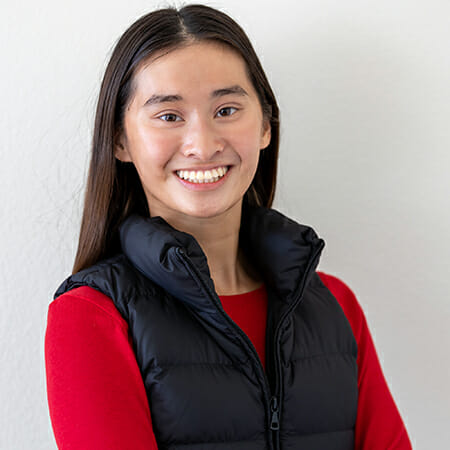
Rebecca Wang, founder of Hydra Hacks, STEM and school safety advocate and vice-chair of the youth advisory counsel for the California Commission on the Status of Women and Girls./Courtesy Rebbeca Wang
What inspires you to volunteer?
I want to contribute to positive change, to address critical issues in the world, like gender inequality and gun violence and STEM accessibility. I believe my generation has the power to create a better future. Every day I take action in small and big ways, whether it’s helping a friend or mentoring girls in STEM. These small acts chip away at larger problems. My end goal is to inspire others to join in, because together we can cultivate a more just, peaceful and equitable world.
How did you become interested in coding, and how did you learn how to do it?
In 2020, I entered the world of computer science through an untraditional path. I learned through workshops at a hackathon, which is a 24-hour marathon of learning and coding projects. And despite entering without any prior coding experience, I built a website on financial literacy and won a prize sponsored by Capital One.
But I became aware of the gender disparities within the tech industry, whether it was through subtle microaggressions or being one of the five girls at the event. And a week later, I started Hydra Hacks.
As I worked more with technology, I realized that I also needed to work on policy. I saw an opportunity to be part of the inaugural Youth Advisory Council with the California Commission on the Status of Women and Girls and applied. Later on, I was elected as the vice chair. Now, I have the opportunity to work alongside high school- and college-aged women to advise state-appointed commissioners on legislation regarding promoting gender equity and education for all of California’s girls and women.
Describe your volunteer role with Hydra Hacks and CCSWG.
I founded Hydra Hacks, a hackathon for marginalized genders. Hydra Hacks aims to inspire technological innovation and to create a lasting impact. To date, I’ve organized three hackathons and eight events, uniting over 5,000 students from historically underrepresented backgrounds in technology, particularly focusing on high school girls. And I’ve collaborated with over 30 corporate sponsors including Google and Jane Street to secure funding, mentors and laptops for these events. I’ve devoted almost 800 volunteer hours for Hydra Hacks over the past three years.
For CCSWG Youth Advisory Council, I compile research on period poverty and the inaccessibility to STEM resources for girls, then propose changes to influence policy conversations in meetings to 17 state-appointed commissioners.
Tell us more about SIREN and your Dare to Dream app.
Like many of my peers, I’ve been involved in school shooting threats. The issue of gun violence in a supposedly safe place of learning prompted me and three of my friends to develop a device to detect gunshots, reduce response times and improve communication between police, school staff and students.
It started out as a side project, and we later applied to competitions in order to gain funding and media exposure, in hopes of scaling our product. We won the Conrad Spirit of Innovation Challenge, and in less than three weeks, we’ll be in Washington for the T Mobile Challenge.
I started the Dare to Dream app in January. I originally wanted to write it as a children’s book in order to inspire girls to code. It would feature historical and contemporary trailblazers. But mid-process, I realized that creating an app would be more beneficial and would increase accessibility for users worldwide.
So, I did that and submitted it to Apple’s Swift Student Challenge. Luckily, I won and had the opportunity to present it to Apple CEO Tim Cook and Karlie Kloss who founded one of the first coding camps I went to.
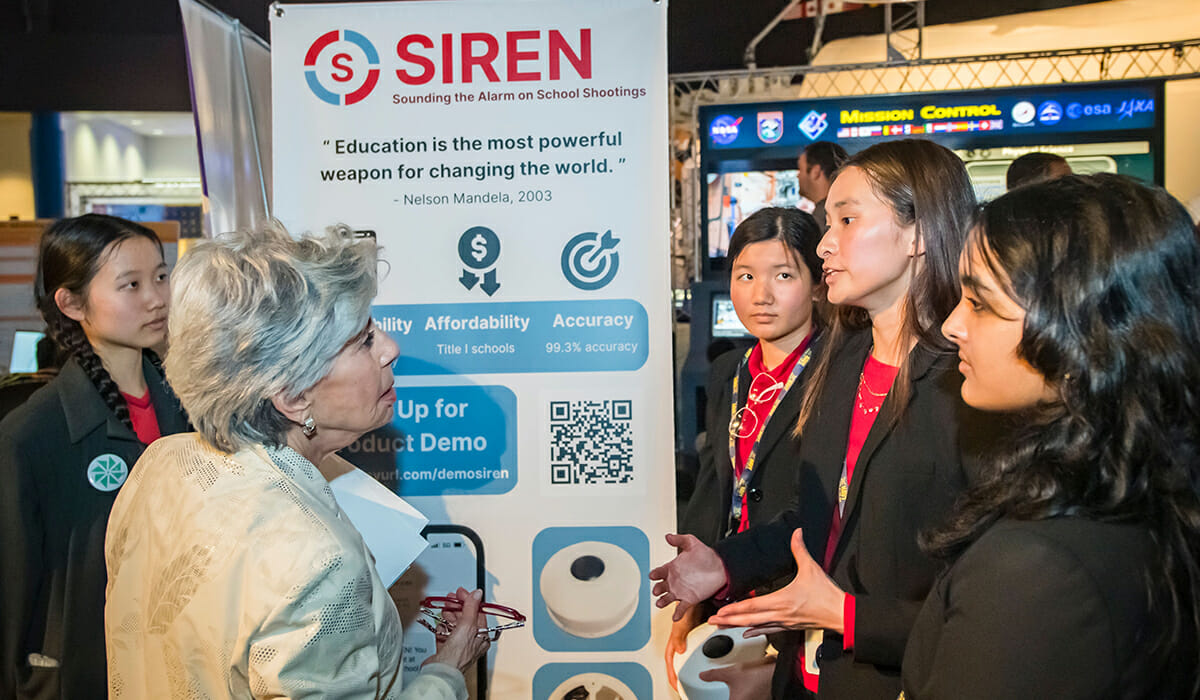
During a public exposition at the NASA Houston Space Center, Rebecca [speaking, second from right] presents SIREN to Nancy Conrad, founder of The Conrad Challenge./Courtesy Rebbeca Wang
What’s been the most rewarding part of your work?
I think seeing the impact of my workshops and innovations on one or thousands of students is so rewarding. For example, when I was pitching SIREN at the NASA Space Center in Houston with my team, there were groups on field trips all the way from Maine, Virginia and California. It was inspiring to see their message for us and to have their support.
What have you learned through your experiences as a volunteer?
Volunteering is a lot about uplifting others and allowing others to uplift you as well. It’s a two-way street, and we both gain satisfaction and something for our self-journey from it.
How have you seen your work affect your community?
Right now, I’m working on increasing STEM accessibility to under-resourced girls in my community. I’m going to middle and elementary schools to tell them about events like Hydra Hacks and opportunities like coding camps that are tailored to their age where they can come in, get a free computer and leave with an amazing experience and a newfound skill set. That’s what makes me smile. And that’s what makes me want to continue to volunteer and organize.
Tell us about future partnerships, programs or events that you are excited about.
I’m looking forward to attending a woman empowerment conference later this month in San Francisco. Other than that, I’m looking to organize a winter conference for Hydra Hacks that will feature a panel of inspirational women in technology. We had around 500 people attend last year.
Why is it important for others to get involved in causes they care about?
I think it’s extremely important. Our generation is facing so many problems that we have never seen before. And also, past problems that still exist. More than anything right now, we need to find one thing we’re passionate about, volunteer and solve it. Even if it’s a small or crazy idea. Everything makes a difference.
“LEAF” IT TO SERVICE TO BRING STUDENTS WITH DISABILITES AND GARDENING TOGETHER
Meet Daily Point of Light Award honoree Dani Mendell. Read her story, and nominate an outstanding volunteer or family as a Daily Point of Light.
Dani Mendell, a senior at North Oconee High School, has a lot of pride for her hometown of Watkinsville, Ga. Since she was young, she realized how the town integrated people with disabilities into the community. This approach inspired her to get involved in a summer camp and a nonprofit after school program that works with kids and students with disabilities.
Dani is also active in environmental causes, and when she noticed her school didn’t have an environmental club, she started North Oconee High School (NOHS) Eco Club. Then, with the help of fellow students, started a school gardening club, NOHS Gardenerds, which Dani was very eager to join as well. Dani’s work with the Gardenerds club motivated her to apply for a grant to get a hydroponic garden for the school. Dani explained that a hydroponic garden grows plants directly in water, eliminating the need for soil and is more eco-friendly in the long term.
When she was awarded that grant, she saw it as an opportunity to unite both of her volunteer passions. She connected Gardenerds with Eco Club members, , bringing everyone together to grow plants and produce for the school.
What inspires you to volunteer?
What inspires me to volunteer is the community support of people with disabilities here in my town. It’s really cool and unique and something that when I was younger, I didn’t realize other towns weren’t like this. A big part of our community – not just the people I volunteer with – we all sort work together to support the people with disabilities in our area. Growing up that had a really big influence on me, and that’s what made me want to volunteer. For example, at the local Publix and Kroger they employ people with disabilities as checkout employees, and there is a business called Lovecraft, a craft studio, that sells art made by kids with disabilities. Then there is the afterschool program, Extra Special People (ESP) that I work with. So, I just think it’s the way that our local community rallies for that population that made me want to volunteer.
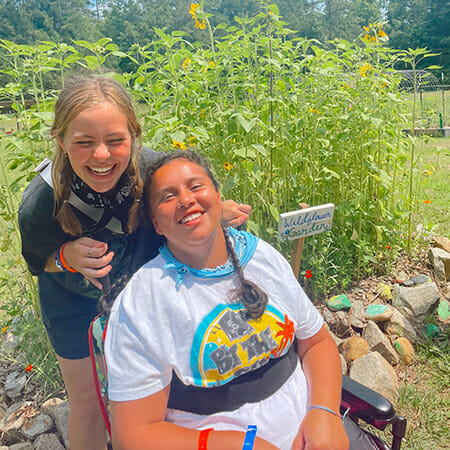
What brings a smile to Dani Mendall’s face? Pairing her two passions: gardening and spending time with kids with disabilities. /Courtesy Dani Mendell
When did your passion for gardening start?
My dad studied forestry, and when we go on family trips, he likes to plan to go to places that are environment-focused. When I was younger, we went to Costa Rica for two summers and we stayed at an eco-lodge and there were gardens there. Later, in sixth grade for my engineering class project, I built a raised garden bed with my dad. We built the garden bed in our front yard and started gardening as a family. Then I thought I would love to garden at my school, so I helped start the gardening club, Gardenerds.
Describe your volunteer role with Gardenerds.
With Gardenerds, it’s all student-led, we have an outdoor garden and hydroponic gardening. My role is getting the students with disabilities involved. They help us plant the seeds outside, package up grown lettuce from the hydroponics and distribute it to teachers. We have a really cool program that we started last year called Veggie Valentine’s, where around Valentine’s Day, the students with disabilities and I decorate bags, package up lettuce and give them to teachers for Valentine’s Day. This develops the students with disabilities communication skills and job skills, which is really cool.
What’s been the most rewarding part of your work?
I really think that the most rewarding part of my work is that I get to spend time and interact with the same kids and fellow students throughout the organizations I’m involved with. I volunteer with the same kids at a summer camp, the ESP after school program and in the gardens at school. For example, there is a student, Cindy, who has autism, and we have been hanging out together since my Freshman year. She attends the summer camp, she comes to the afterschool program, then this year on the first day of school, we were walking into school together and she told me how excited she was to start gardening. She’s also excited because last year she designed a poster for the club and some artwork for a gardening event we had.
It’s really rewarding because a lot of the kids have varying levels of ability, but they all remember me and the other students that work with me in the club. And it’s really great to see that they get excited because they don’t get to leave their classroom for a lot of other activities.
What have you learned through your experiences as a volunteer?
I feel like I’ve learned so much. The most important thing I’ve learned is to have patience when volunteering because it can be difficult when things do not go the way that you planned. But having patience really helps because if you aren’t patient and you give up, then there’s no one there to do the work.
Last year, we had some issues with the water circulation in the hydroponics garden. By readjusting and being patient with each other and the garden itself, we were able to figure out the problem and fix it. I have the same mindset when volunteering with students with disabilities because it takes them longer to communicate with us, but we really want to make sure that we treat them the way that they should be treated and give them the time that they need. If it takes a student longer to do a certain activity, we just would wait instead of trying to rush them and put them on our own timeline.
Tell us about future partnerships, programs or events that you are excited about.
The Garden Table is a new event that Gardenerds puts on in the school garden. The first one was last spring, and we are going to do our second one this fall. The plan is to do two a year. The fall Garden Table will be Halloween-themed, which we’re really looking forward to because we just planted pumpkins in the garden outside. So, we may be able to do pumpkin carving, and we can base our crafts and food around pumpkins. The whole club is looking forward to it, and Halloween is also my favorite holiday.
Why is it important for others to get involved in causes they care about?
This is something that I’m super passionate about, so I really love that question. I think that sometimes it can be overwhelming because there are so many causes, and so many things that you want to fix in the world and find ways to make a difference, but sometimes a particular cause is just not your thing or there are too many people involved. By picking something that you’re really passionate about and then focusing on getting really involved with it makes a difference on a local scale.
Then, if we all get involved with something we’re passionate about, that helps to make the world a better place overall. By doing all our projects we are individually interested in it makes a larger global difference. I’m very passionate about working with kids with disabilities, so I put in a lot of effort and come up with new ideas, whereas if someone else is passionate about a different cause, they would put that same level of care into it.
What do you want people to learn from your story?
I want people to learn that there’s always something you can contribute, and that you don’t always need to go into everything with a plan. I would’ve never thought that me volunteering with kids with disabilities would somehow turn into also getting to garden with the kids, because I never would’ve thought those two things would go together. But dream big – if you have an idea and you work for it, even when isn’t easy, it’s definitely possible to make it happen. Also, get other people involved. If you’re passionate about something, it attracts people that want to help out.