Former Teacher Helps Bring Peace to the End of Life
Meet Daily Point of Light Award honoree Deanne Tetrault. Read her story, and nominate an outstanding volunteer or family as a Daily Point of Light.
From the time Deanne Tetrault was a young girl, she wanted to be a teacher. She spent a total of 47 years teaching — 37 years in public schools teaching first, second and third grades, and 10 years in a private Christian academy. Having large classes of more than 30 students presented challenges, and Deanne always appreciated the support offered by her paraprofessionals, or teacher aides. These volunteers made a huge difference in daily routines. They made life less stressful for both teachers and students.
As she approached retirement, Deanne looked ahead, planning a purposeful path. One of her student’s parents worked in hospice, and this idea planted a seed. Deanne realized that, although the exuberant energy of young children was a joy, she felt called to work with people at the end of their lives. Shortly after she retired, she saw an article about hospice in the local paper. She thought this was a way she could continue to be needed – by offering comfort and compassion to the ill and dying as well as their families.
Deanne started volunteering in September of 2014. Through a local nonprofit, Community Nurse Home Care, an organization with 100 years of history, Deanne completed a training program and began visiting hospice patients. As soon the COVID-19 pandemic began in 2020, volunteers were no longer able to sit with patients, so Deanne transitioned into a role as an administrative support volunteer for the Community Nurse and Home Care staff. She has remained in that capacity since then.
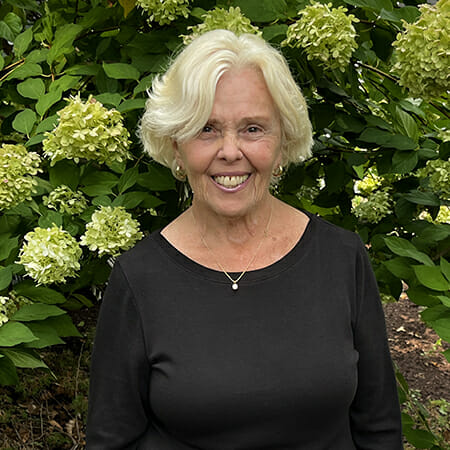
Deanne Tatrault found her calling in offering comfort and compassion to hospice patients and their families as a volunteer with Community Nurse Home Care. /Courtesy Community Nurse Home Care
What inspires you to volunteer?
Well, I wasn’t ready to retire. I have always had a nurturing spirit and wanted to help. The idea of switching from children to elders was meaningful to me. I could help ease their loneliness and offer some comfort to their families.
Initially, when I started, I visited patients who were not expected to live long, although my first patient lived over a year. Working with people in hospice is very rewarding and fulfilling. In some cases they wouldn’t even know I was there, so I would befriend the caregiver who needed a friend during this difficult time. As a volunteer we can’t do much for the patient, except to be present. Family caregiver support is just as important. Their quality of life is destroyed as well due to having a terminally ill loved one. I am reminded that with Alzheimer’s patients, you lose your loved one twice. First, they forget who you are. They don’t know you anymore and they lose their personality. Then, you lose them again when they pass. It’s incredibly hard on their family caregivers.
Describe your volunteer role with Community Nurse Home Care.
Prior to COVID I saw patients in hospice. I would go in two or three times a week. As soon as COVID hit, we volunteers weren’t allowed to sit with patients. Even before COVID, I was asked help out in the office to do a little filing. This turned into an almost full-time job. I got called back to return to the office after COVID, and this has become my primary role.
Each patient has a folder, and it’s my job to organize and maintain these. The materials in the folders explain procedures, logistics, ins and outs of hospice care, information for families and other resources. If there are any other jobs in the office that need to be done, I do them. I shred documents, hand-write invitations and gift tags, and other tasks to help out the office staff. Last Christmas I put tags and bows on poinsettia gifts.
What’s been the most rewarding part of your work?
I love knowing that I’m making someone’s day, that I’m lightening the load and easing the burden whether I’m sitting with a patient, chatting with a family caregiver or helping in the office.
What have you learned through your experiences as a volunteer?
I have learned to be more confident in myself and what I have to offer in helping others. I’m becoming someone who is even more dependable and responsible. I’ve learned it doesn’t take much to brighten someone’s life.
Why is it important for others to get involved with causes they care about?
You need to be able to live outside yourself. Being too centered on yourself can make you an unhappy, joyless person. Living out of your own box and living for others is important. My life is simple. I don’t have a grand life, but I love serving, I love helping. I am so happy because of this. It’s a privilege to work with this particular organization. You are never too old to learn from someone else.
What do you want people to learn from your story?
I can sum it up with this beautiful devotional from Streams in the Desert, Vol. 2 by Mrs. Charles Cowman that helps me start each and every day. It helps me to remember that you can live a very beautiful life, even if you’re not important or famous. You can be a blessing even if you live the smallest life that fills its place.
“A life need not be great to be beautiful.
A beautiful life is one that fulfills its mission in this world,
This is what God made it to be, and does what God made it to do.
Those with only commonplace gifts are in danger of thinking that they cannot live a beautiful life,
Cannot be a blessing in this world.
But, the smallest life that fulfills its place well is far lovelier in God’s sight than the largest and most splendidly gifted, yet fails in its divine mission.”
On a Mission to Connect One Million People and Combat Social Isolation Around the Globe
Meet Daily Point of Light Award honoree David Good. Read his story and nominate an outstanding volunteer or family as a Daily Point of Light.
The experience of isolation during the 2020 pandemic lockdowns was enough to affect anyone’s mental health. But for some, remote work, solo living and the effects of a dreary winter exacerbated the feelings of loneliness and desolation.
David Good of Byron Center, Michigan, harnessed the isolation he experienced throughout his life and turned his frustration and depression into a force for good. David is the founder of International Friend Connection, an organization committed to combating social isolation and loneliness by giving people a platform to connect, “face to face.”
“I have Asperger’s Syndrome, and my brain often catches things that other people miss,” David shared. “When I saw the social isolation that was happening, I thought, ‘Someone needs to do something about that.’ People on the spectrum can also make big contributions to society.”
David is no stranger to organizing events. In fact, he’s been hosting local and international events since 2014. But it wasn’t until the pandemic lockdowns in November of 2020 that International Friend Connection really started to grow.
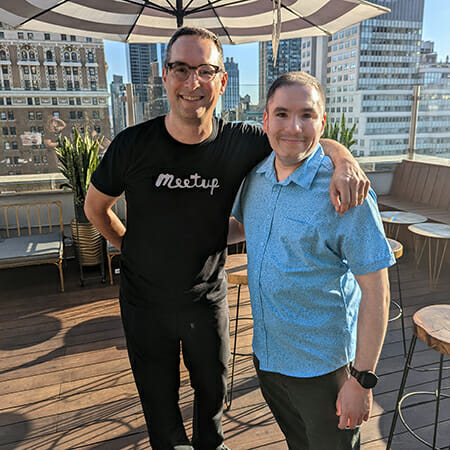
David Good, founder of International Friend Connection, with David Siegel, CEO of Meetup./Courtesy David Good
This all-volunteer organization hosts more than 32,000 members from all over the world, spanning 36 different groups. David has also built a team of 30 volunteers in cities worldwide to help accomplish his goal of reaching and connecting one million people by 2030.
“I was a software developer. I was in a car accident and was really sick with chronic migraines and treatment-resistant depression,” David recalled. “I had my whole career taken away. I kind of lost my purpose. I was a really lonely person – I was so bullied that I really didn’t like people at all. Then, I found a website called Meetup, where you could go on and people would have little community groups. I started realizing that there were some awesome people out there.”
After reading a quote about giving what you want to receive, David knew that the best way to make friends was to help others make friends. In 2014, he started “West Michigan Geeks,” his first Meetup group.
Years later, the COVID-19 pandemic rolled around. David shared, “I knew with my depression, I was going to do really bad if I didn’t see people face-to-face that winter. So I figured, since people were using Zoom for meetings, why not use it for Meetups. Let’s help each other get through lockdown. I’d get 12 to 20 [attendees], at first. They were locked in in these big cities, like New York, for weeks. They didn’t see people for weeks. They said the meetings helped them get through.”
David hosted meetings every single night via Zoom. He started opening more groups tailored to more cities on the Meetup platform. Soon, he saw a hundred or more people come in and out of the meetings – from everywhere from Australia to Japan – over the course of a couple of hours. Then, his daily meetings turned into multiple meetings a day.
“Four couples from the groups have gotten married – before and during COVID,” David said. “I was in one wedding. He and his wife are my good friends to this day. They just had their first baby in December. Three other couples got married, and they’re doing great.”
David ended up scaling back in 2021 as things started opening back up. He had been taking care of his mother, who passed away last year. While she had been a companion, her absence put David at risk of social isolation again.
“But because of all the local friends I’d made through my groups, I didn’t have to spend any time alone for the first six weeks after she passed,” he recalled. “At night, friends came over after work. If she had passed 10 years ago, I would have been all alone. I don’t know how I would have gotten through. That’s when I realized how important this work is and how everyone deserves to have friends.”
David’s mission originated in Michigan, and that’s where many of his groups remain./Courtesy David Good
David wants everyone to have the experience of friends coming over to sit on the couch during periods of extreme grief. He knows the virtual Meetups are impactful, especially as they connect folks from across the globe, but it’s the in-person relationships that can help get someone through the darkest periods, both mentally and emotionally.
“Having friends in real life is tougher, but it’s more rewarding. And those are the people who are going to carry you when you fall. And in turn, you get to carry them when they fall. That’s your honor,” David said.
Now, David is refocusing some of the groups and giving talks about how he overcame his social anxiety. He shares tools that he has picked up over years of therapy and coaching that allowed him to be in social settings such as those Meetup groups. He considers it his life’s mission to help connect people around the world and to help people who are shy to beat their social anxiety so that they don’t have to live a lonely life.
“One of the keys to happiness is having meaning and purpose in life,” David encouraged. “Look at every sacred text out there. The Bible. The Bhagavad Gita. The Quran. They all teach that everyone needs to do something altruistic in life. It’s essential to happiness. There’s nothing wrong with making a lot of money. In fact, it’s a good thing – the more you have, the more you can help. But you have to have something altruistic, something with meaning. Everyone goes through hard times. My life’s purpose is what keeps me alive.”
Chicago Teen Inspires Youth to Volunteer through Monthly Acts of Compassion
Meet Daily Point of Light Award honoree Ava Gresser. Read her story, and nominate an outstanding volunteer or family as a Daily Point of Light.
At the age of 6, Ava Gresser’s journey into volunteerism began with a simple yet profound moment. Sitting in the car with her mother, they cruised down the Dan Ryan Expressway in Chicago when her eyes fixed upon a disheartening sight – litter strewn carelessly along the highway’s shoulder.
Helen Dixon, Ava’s mother, recalled, “As an adult, you tend to overlook these things in your day-to-day life, but Ava pointed and said, ‘It’s so dirty, Mom. Who’s doing something about it?’”
As Helen searched for an answer, Ava declared, “I’m going to do something about it.”
Together, they searched for volunteer opportunities and came across The Honeycomb Project, an organization that empowers kids to lead the charge for social change. Ava’s journey with Honeycomb began with her first project, helping to clear invasive species in a nature reserve.
Her dedication led her to volunteer in numerous other initiatives, including building bookshelves for Chicago classrooms, assembling and packing toys for hospitalized children and serving food at a women’s shelter. With an average of one to three projects a month, Ava established herself as a passionate volunteer.
Fast forward to today. Ava, now 14, has taken on an even greater role within Honeycomb. She serves as a member of the Honeycomb Leadership Corps, helping lead volunteer programs and mentoring younger participants. She is also a youth correspondent for Honeycomb, conducting interviews with project coordinators, parents and young volunteers to get the scoop on the day’s project. These interviews are then shared on Honeycomb’s social media platforms to inspire others to make a positive impact within their community.
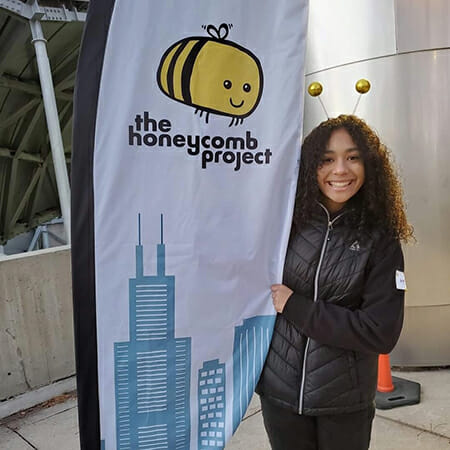
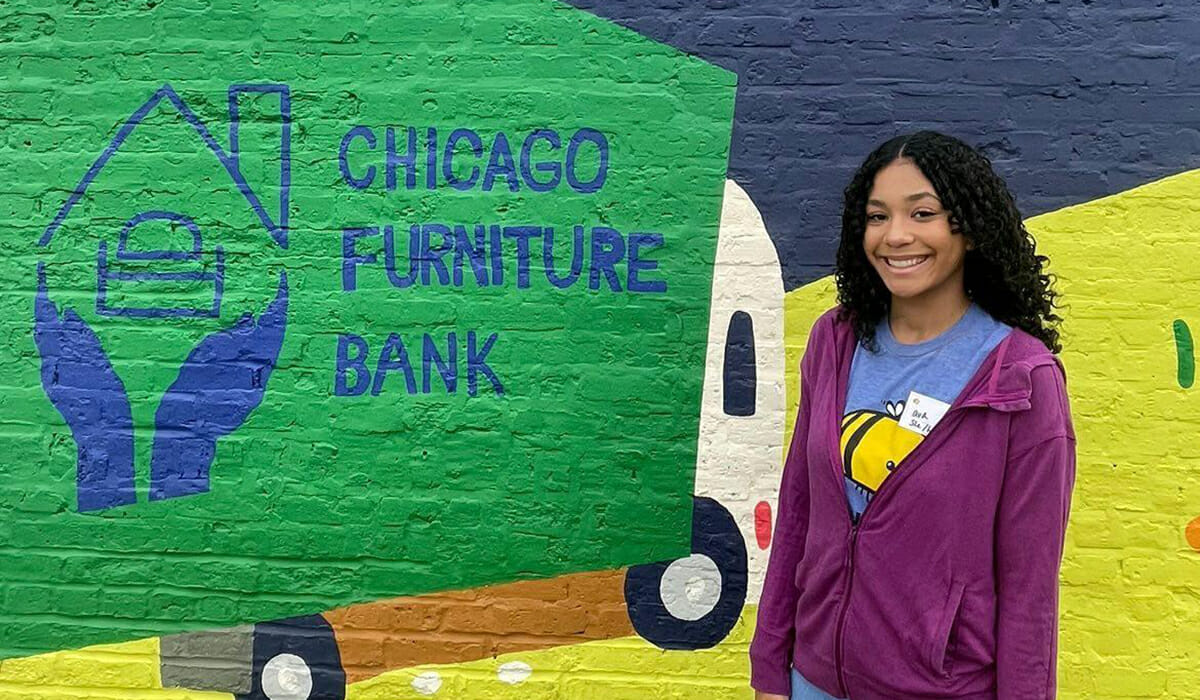
As a youth correspondent for the Honeycomb Project, Ava conducts interviews with project coordinators, parents and young volunteers about the day’s project, which are then posted online to inspire others to volunteer as well./Courtesy Helen Dixon
Tell us about The Honeycomb Project and why you like volunteering with the organization.
The Honeycomb Project is all about strengthening Chicago’s communities with families. Kids of any age can volunteer. And there are a variety of projects that you can choose from, whatever spikes your interest. My favorite ones at the moment are the beach cleanup and the Chicago Furniture Bank, where we sort kitchenware, furniture and other household goods to help furnish homes for impoverished families.
Honeycomb sets up their projects in a way that’s interactive and fun. It makes kids want to get involved. Before the COVID-19 pandemic, I was able to make food at a women’s shelter and serve it out. A couple of other ones I did were making bookshelves for CPS (Chicago Public Schools) classrooms and making blankets and toys for the cats and dogs at the Anti-Cruelty Society.
A way I can get Honeycomb more out there and more volunteers is by being their youth correspondent. I go around and interview volunteers. I ask them what they like about Honeycomb, why they did this project, the impact that they made and if they’d do it again, and that gets posted to Honeycomb’s social media pages. Last year, I co-emceed their annual fundraiser to help them raise over $100,000.
What’s one volunteer project that is particularly memorable for you?
During COVID, seniors couldn’t get out and buy their groceries or other necessities they needed, so families bought groceries with their own money, and we helped deliver them to senior homes. I remember one elderly man came up to me when I was working at the fruit and vegetable table, and he told me that he didn’t have any food stamps left for the rest of the month, so he couldn’t buy any more food. He said he was grateful that we came by because he wouldn’t have had anything to eat. It really made me see the impact that I was making, especially during such a hard time for everyone.
How has your passion for volunteerism been recognized?
When I was 8 years old, I won a Disney “Be Inspired” grant and donated the funds to the Honeycomb Project. I won the Guaranteed Impact Award in 2017. And during Covid, I won a couple Hershey grants, which I used to help fund the Chicago Furniture Bank project and the Senior Citizens Home project.
Ava Gresser volunteers every month through the Honeycomb Project, participating in a variety of projects such as packing disaster kits for the Red Cross and sorting school supply donations for Chicago teachers./Courtesy Helen Dixon
What’s been the most rewarding part of your work?
Being able to see the impact I’m making, especially at the senior citizens’ home or at the women’s shelter. I got to see people’s faces light up and it truly makes you feel grateful that you were able to help.
What have you learned through your experiences as a volunteer?
If I didn’t volunteer, I wouldn’t have been a youth correspondent or an emcee. When I’m older, I want to be a news reporter so the work that I’m doing now has prepared me for that.
Why is it important for others, especially youth, to get involved in causes they care about?
I believe that we are the future. If you want to be an advocate for the things that you’re passionate about in the future, you have to start speaking up now. Especially as a teen today, there are so many ways to do it such as TikTok and Instagram. I created my own advocacy page on Instagram where I share my thoughts on pressing topics like volunteerism or school education systems.
What do you want people to learn from your story?
That the smallest actions can accomplish the biggest things. Volunteering only takes an hour or two out of your day. But every time you show up, the hours add up. The awards and grants that I’ve won definitely make me proud, but what makes me the proudest is seeing pictures of myself over the years volunteering at different projects and thinking about the impact I’ve made.
Vivian Nguyen, 16, grew up in Vietnam, but it wasn’t until she moved to Australia that she realized her access to STEM classes (science, technology, engineering and mathematics) had been limited in her home country. Throughout her schooling in Australia, her interest in astrophysics grew, and so did her concern for other students who might be lacking exposure to comprehensive STEM education in historically under-resourced countries.
Vivian and her older brother decided they would create an online science journal with the purpose of sharing knowledge with children all over the world. Sciencious (the combination of “science” and “conscious”) was born. However, Sciencious did not stop there. It is now also a platform that provides knowledge and studies via video, podcasts and tutoring.
Vivian moved to the U.S. just last year, but Sciencious is global. The platform has more than 30 global chapters and eight regional tutoring programs in the America, Colombia, Vietnam, Thailand, Canada, U.A.E., U.K. and Japan, with more than 30 members and students per program. Sciencious has around 70 authors, 130 articles, 5,990 subscribers, three magazines, 20 podcast episodes and around 15 experiment videos uploaded on YouTube. More recently, Vivian and her team have also started hosting competitive events such as Sciencious Hackathons, a STEM Writing Competition and a Medical Writing Conference.
What inspired you to create Sciencious?
I was born in Vietnam, a country with a struggling educational system, especially in public schools. Then, when I was 12 years old, I had the opportunity to go to Australia for four years to experience a more inclusive, world class education. My time is Australia profoundly affected my perspective on educational inequality. It made me realize that students in my home country, and other historically disinvested countries, don’t receive the same quality in education, especially in STEM education. In Vietnam, the resources necessary for a comprehensive education were often scarce. I wasn’t surrounded by the abundance of computers, the libraries didn’t have STEM textbooks, and we didn’t have quality trained teachers to guide me through my STEM studies. While that had me disheartened, it also inspired me to start this project.
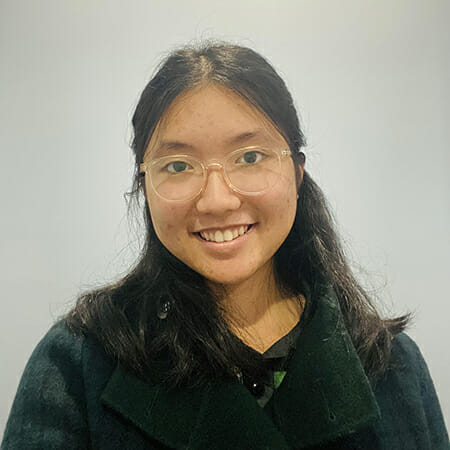
Vivian Nguyen co-founded Sciencious with her brother when she was just 12 years old. /Courtesy Vivian Nguyen
With the help of my older brother, I first started a STEM article publication platform. The vision was that students could share their scientific ideas and perspectives in this inclusive platform and then get feedback from us who have more experience in STEM education in Australia. In the beginning, I quickly began to realize that we need more members in our team who have different perspectives and different experiences. So, I started to gather students from my school, and then around the world, to obtain their perspectives.
After hearing from my peers, I realized that not all students in their communities have experience in writing, reading and even understanding scientific articles. It occurred to me that reading articles or writing articles might not be the best way to educate and inspire children, especially those who digest information in different ways through different learning styles.
I started to brainstorm different inclusive learning platforms that deliver STEM education. I then expanded to 30 chapters worldwide — U.S.A., Colombia, Vietnam, Thailand, Canada, U.A.E., U.K. and Japan — with each of the chapters represented by one of our members, to bring STEM closer to children who don’t have access to computers. Sciencious does all sorts of things such as fundraising, STEM book drives, workshops and freelance tutoring. We started a YouTube channel where we create experiment videos for visual learners and podcasts for auditory learners. Then, we expanded more in a competitive way, like hackathon workshops and conferences where we foster collaboration among peers and among other innovative syllabuses.
What about science and other STEM subjects excites you?
My older brother was into STEM first, and he realized that my grandmother suffered from this disease that related to biochemical engineering. As he was trying to understand the disease better, he realized that the quality education in Australia allowed him to utilize what he learned in classrooms to potentially develop a certain products or medicine that could help the medical communities to solve the problem that my grandmother is currently facing.
I was very inspired by that. I too started getting more into science and visiting libraries more regularly to learn more. First, I started getting interested in astronomy, but I realized that to understand the universe, you need to understand physics. So, I started to do astrophysics, and that’s what got me into science. It’s really interesting because I always have this drive to find answers that no one has figured out yet, and maybe those answers might help the development of technology or the development of society.
Describe your volunteer role with Sciencious.
As a co-founder, I’ve been primarily engaged in the development of Sciencious, with a mission to advance STEM education for historically excluded children around the world. However, my commitment at Sciencious extends beyond expansion of education. It revolves around fostering diversity and inclusion within our platform and our team, which is what I focus most on in my role. I have gathered team members and volunteers from diverse corners of the world, each bringing unique backgrounds and perspectives to the table. These individuals share common passion and privilege – which in this case means the privilege of contributing to those who lack access to quality education. I believe that everyone on the team has invaluable insights because they reside in different corners of the world, so that enables us to tailor our activities to cater to the specific needs of children in all regions.
I also support every aspect of Sciencious. I started out with the article publication platform. In the beginning I wrote articles, and then I recruited more authors who volunteered to research and write their own articles. I worked on promoting all the articles that we write monthly or weekly to subscribers to our science journal (the first platform that we created).
I created a tutoring program starting in eight different countries, each with their own director of tutoring to lead a team in that nation. The directors recruited dedicated teams of volunteers in their regions to provide free in-person or online STEM tutoring to children who might not have access to the learning resources.
Additionally, I initiated a podcast series – we currently have 20 episodes – where we engaged with global professors and scientists. We discuss intriguing STEM subjects and new research. This podcast series will be tailored to auditory learners.
Last year, we created free online courses to deliver knowledge that we have learned in class and our research, to children who would like to learn more about STEM, but not in a face-to-face way. We posted them online where they could have access to all the videos that we create.
These videos are done in an innovative way, not at all like a lecture at school. We teach concepts as well as application and examples that go along with it. We also created conferences and competitions for those who have more experience in STEM, and are passionate about developing more. The competitions are for students to showcase their passions in a fun way where they could get awarded for their achievements.
What have you learned through your experiences as a volunteer?
I learned the power of true leadership. I know everyone wants to strive to be a leader, but I realized the true definition of leadership for my own organization. A few years ago, I kept questioning myself. How could I bring together more than 50 individuals from 30 nations who possess different ranges of perspectives, experiences, values and passions in STEM into a single organization?
What I realized is that my experience from working with multicultural individuals from Vietnam, Australia and the U.S., helped me understand that the answer to that question is inclusiveness. I learned that the vital quality of a good leader does not end with the ability to make the best decision, but I think a good leader is the one who spreads empowerment and inspiration to each and every single member of a team or a community regardless of race, gender or cultural backgrounds.
Tell us about future partnerships, programs or events that you are excited about.
My team and I just had a meeting the other day where we would like to make our tutoring programs even more inclusive by creating an online peer tutoring program. I would like to create a platform where children could film themselves teaching a certain concept in STEM and share it on a common platform for everybody else to see and comment on. The vision is that there would be videos from different people around the world, from different backgrounds, different ages, different genders all coming together to discuss a certain STEM topic in a video.
What do you want people to learn from your story?
I would like to address young people who receive quality sufficient education — those who have the privilege of being educated. This is a privilege that should not be taken for granted. Having an education does not only mean building a better future for yourself, but it also implies that you have the opportunity and the obligations to share the knowledge for those in need in order to make the world a better place. It doesn’t necessarily mean that you have to teach children from the other side of the world, but instead, think about what you’ve learned in order to benefit the community, especially those who lack the privilege to learn the same things you have.
Californian Improves Mental Health and Wellbeing Through Sleep Education
Meet Daily Point of Light Award honoree Nancy Bosnoian. Read her story, and nominate an outstanding volunteer or family as a Daily Point of Light.
Nancy Bosnoian, originally from Aleppo, Syria, is working to put an end to the “silent sleep epidemic.” When she was 18 years old, Nancy, now 23, founded End No Sleep, an organization with the goal of improving mental health and wellbeing through sleep education.
As part of her service with End No Sleep, Nancy is teaching fellow young people how to improve their sleep, prioritize regular sleep habits and the importance of sleep for mental health, optimum brain power and physical function. Through her efforts, including her free End No Sleep curriculum for high school and middle school students, Nancy has helped educate more than 5,000 students to date. By 2030, she aims to reach over a million young people.
What inspires you to volunteer?
The idea of this was when I was facing a lot of medical problems in high school. I was in and out of hospitals for a while, and that’s really when I started to think about sleeping problems as well as mental health problems. I realized the correlation between sleep and overall wellbeing. I was trying to reach out to physicians and find resources to fix my symptoms, because I was sleeping a lot, and I was always tired. I found out that there was really a lack of what I needed. There were really no specific resources that I could find or people who I could easily reach out to. That is when I came to the realization that sleeping was the ultimate luxury, which I had never understood before.
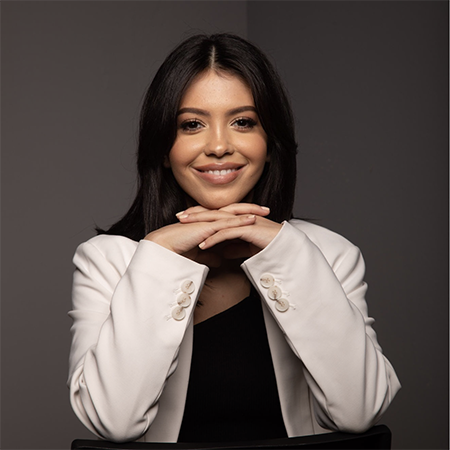
Nancy Bosnoian teaches others how to prioritize regular sleep habits for optimum brain power and physical function, and has helped educate over 5,000 high school and middle school students to date./Courtesy Nancy Bosnoian
Describe your volunteer role with End No Sleep.
What we do is offer a curriculum that focuses on preventative mental health care by providing sleeping resources, such as the history of sleep, why we should sleep and any sleeping tips and tricks. Then there are also interactive mindfulness exercises to help high school students really understand the importance of sleep and how it connects to mental health. As the founder and executive director, I do a lot of outreach emails. I connect with different high schools to make sure that they can use our curriculum for free. We also do social media outreach, write different blogs and try to recruit volunteers to help us and spread the mission and help us connect with more high schools and educational districts throughout the United States. We also recently received grant funding to use technology to further our mission.
The “silent sleep epidemic” is a term that was coined due to the crisis where people are just not getting quality sleep. It goes very much deeper than that, but it’s basically saying that a lot of people worldwide are not getting the required amount of sleep needed for survival and optimal function. Specifically, in many countries, the silent sleep epidemic is also leading to an economic crisis. The U.S. loses billions of dollars a year due to sleep deprivation and sleeping problems that have not been addressed.
What’s been the most rewarding part of your work?
It’s definitely hearing testimonies and understanding that this works. When it comes to the
mental health crisis and the silent sleep epidemic, there have to be huge, systemic
changes, but I think educating students, as well as teachers or parents, is also important. And then they themselves take action to ensure that they’re taking care of themselves and sleeping well. This holistic care is extremely rewarding because I believe it all starts with one person, and then it spreads from that one person. We recently had a testimony from a student all the way in Mumbai, India that this has changed her life. Hearing from students about their successes is very rewarding.
What have you learned through your experience with End No Sleep?
I think a few things. One of them is when the younger generation, people like Gen Z, see problems and want to address them, there’s a belief in the issue and they do not give up. I think it can be very discouraging when you’re trying something and it’s just it’s not working out quickly, but you should continue to believe in that and pursue it. It will be rewarding, even if it’s just one person working to do good. The second thing is understanding the power of brain health and holistic care for myself, and continuously advocating for myself and allowing other students to advocate for themselves as well. It’s all about giving ourselves tools we need to function.
What are your goals for End No Sleep?
One of our goals is to educate over a million students by 2030. Hopefully, even before that. Another goal is to make the curriculum we have completely free for high schools, especially those in underserved communities, part of a mandatory education. I think that it is very beneficial, specifically in high school or middle school settings. Given the mental health crisis right now, where unfortunately suicide is the second leading cause of death in the United States, and then also having statistics from the CDC where over 60% of high school students sleep less than six hours — there’s a correlation there. And I think teachers and schools have a huge role to play in ensuring that students are growing up healthy and that we do have a support system, because most of us spend more time in school setting than we do at home.
Why is it important for others to get involved in causes they care about?
We have to be the change we want to see in the world. I think oftentimes causes can sound so big or intimidating. But it all starts with one person. I do believe that our world is in a constant state of change, nothing is set in stone. So, when we see something we dislike, or it’s affecting marginalized communities disproportionately, I think our voice is enough to be heard. Just taking one step forward will spark other people to join you.
Tell us about future partnerships, programs or events that you are excited about.
Now all high schools can access our curriculum separately by just logging into our website and requesting access to the information and the presentation. We also have a chapter system, so even if you’re not part of a high school, but you’re working with young adults or adolescents, you can fill out a chapter form online, and then you can bring our vision into your community and make the curriculum accessible there.
Notre Dame Alum Bridges the Gap Between Low-Income/High-Achieving Students and Selective Colleges
Meet Daily Point of Light Award honoree Adam Farchone. Read his story and nominate an outstanding volunteer or family as a Daily Point of Light.
Adam Farchone grew up in suburban Detroit and attended the University of Notre Dame where he studied chemical engineering. Notre Dame is focused on social justice and post-graduate service. Students are encouraged to get involved in their communities through volunteering, and this ideal was one of the catalysts for Adam’s journey into helping high school students prepare for college through his work with Minds Matter Bay Area.
What inspires you to volunteer?
I had a wonderful high school physics teacher who inspired me to pursue education. I took two gap years after graduating from Notre Dame to teach high school physics and chemistry in Tampa, Florida, as a part of the Alliance for Catholic Education (ACE), a service-learning program through Notre Dame. After finishing ACE, I moved to the Bay Area in California to take a job in the biotech industry. The transition from education to biotech found me missing the pastoral and mentorship aspects of my teaching role. I wanted to continue my involvement in education, though not in a full-time capacity. This is what led me to volunteer with Minds Matter.
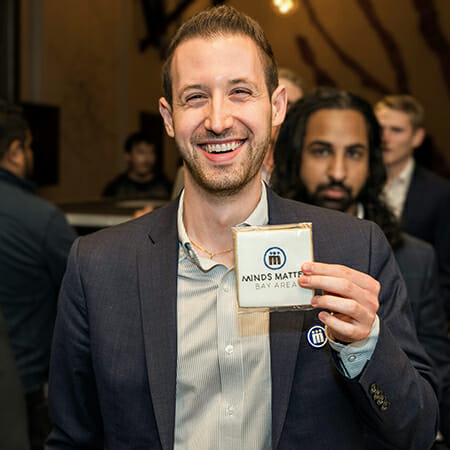
Adam Farchone was featured in MMBay’s Raising Minds holiday giving campaign in 2022, which highlighted his work to codify the organization’s curriculum into an integrated three-year arc during the summers of 2020 and 2021./Courtesy Adam Farchone
Minds Matter Bay Area (MMBay) is an education nonprofit that connects driven and determined students from economically disadvantaged families with the people, preparation and possibilities to succeed in college, create their future and change the world. Volunteers engage with students from the San Francisco Unified School District (SFUSD) at weekly Saturday sessions. The organization offers SAT instruction (math and verbal) as well as individualized mentoring to help students prepare for college success. What makes the organization stand out is its focus on serving economically disadvantaged, high-achieving students in the San Francisco Bay Area. Their mission is to address “undermatching,” which is the underrepresentation of these highly competent students at selective colleges across the country, and they do this by teaching students how to carefully evaluate their school options, how to navigate the college admissions process and how to apply for financial aid.
In addition to SAT preparation, MMBay holds weekly mentoring sessions, where mentees are taught “softer” skills focused on social-emotional growth and identity development to help them figure out who they are in the world. The organization also facilitates mentees’ attendance at summer programs and internships to provide them with additional real-world experiences before they even set foot on a college campus.
Each mentee is paired with two mentors who focus on supporting their student throughout their three years in the program (sophomore through senior year of high school). Many students we serve are first-generation college students, and for some, English is not their first language. In many cases, their parents may not speak English fluently, adding another barrier to the already daunting college application process.
Tell us about your volunteer role with Minds Matter Bay Area (MMBay).
Over the past five years, I’ve held a variety of roles at MMBay. During my first two and a half years, I was a Sophomore Pod Leader and a Sophomore Mentoring Lead. A pod leader is effectively the “teacher” during mentoring sessions, facilitating the two-hour lesson for the day by guiding group discussions and activities. The mentoring lead writes the curriculum that describes what pod leaders do each week, and the pod leaders are responsible for executing on that plan.
For the next two years, I served as a co-chief programming officer (CPO). My partner co-CPO and I led the organization’s programming team, consisting of 50+ volunteers including pod leaders, mentoring leads, instruction leads, instructors and our ancillary support teams (summer learning, college admissions, financial aid). We were the team responsible for ensuring that Minds Matter happened each week.
Currently, I am transitioning into a coaching role where I offer support to the mentoring side of the organization. I am responsible for advising on best practices for mentorship so that our mentors and pod leaders can be the most effective in preparing students for the difficult transition out of high school and into college.
What’s been the most rewarding part of your work?
Helping mentees achieve more than they ever thought was possible. I love witnessing students get accepted at colleges that they had never dreamed of attending.
I have directly and indirectly supported around 100-120 students. It’s been rewarding to see our alumni come back and help new mentees as volunteers in the organization. In fact, we have about five MMBay alumni serving as mentors this year and one as a pod leader.
What have you learned through your experiences as a volunteer?
I have learned so much about team leadership and specifically nonprofit leadership. I’ve learned how to influence without formal authority. By nature, volunteers are all giving of their own free time, so the importance of inspiring and motivating teams is elevated compared to a typical workplace. I’ve learned how to bring people together behind a common goal and support them in seeing it through. I’ve also had the privilege of learning how a well-run nonprofit functions behind the scenes in terms of organizational structure and funding.
Adam Farchone facilitates group discussion at an MMBay Saturday session as a Sophomore Pod Leader in the fall of 2019./Courtesy Adam Farchone
Tell us about future partnerships, programs or events that you are excited about.
MMBay was founded in 2010 and began by serving students within San Francisco. We are very excited to be actively expanding from our San Francisco site to several satellite locations in the Bay Area over the coming years. We recently rebranded from Minds Matter San Francisco to Minds Matter Bay Area as a first step in our mission to broaden the organization’s impact.
Our next major event is our fall ‘School Night’ fundraiser, which takes place on October 10, 2023. More details can be found on our event webpage.
Why is it important for others to get involved with causes they care about?
Volunteering provides a deeper connection to the local community. It allows you to learn things about yourself and discover passions that extend outside of your normal day-to-day routine. Beyond this, volunteering also allows you to see other people in a new light. In our careers or in school, we can sometimes feel boxed in by our role titles and the expectations that accompany them. As volunteers, individual backgrounds don’t seem to matter as much, since there is a communal effort to support a shared goal. Individuals from all walks of life intentionally choose to come together to do something good.
What do you want people to learn from your story?
Community work is incredibly important and rewarding. By investing your time and energy in supporting others, you can help shape the trajectory of someone’s life and learn more about yourself in the process.
Nonprofit Shines Light and Shares Support for Families With Children Facing Health Diagnoses
Meet Daily Point of Light Award honoree Mindy Atwood. Read her story and nominate an outstanding volunteer or family as a Daily Point of Light.
Content Warning: Points of Light is proud to share the following uplifting and inspiring story. However, we acknowledge that a small portion may be difficult for some readers. We encourage you to please care for your own well-being above all.
Mindy Atwood of Hillard, Ohio, has been dealt more tragedy than most, but she has used those experiences to fuel more good in the world. In 1975, her mother and grandmother were murdered in a domestic violence situation, and In 1982, her son was diagnosed with Wilms’ tumor. In 1992, she faced a second son’s diagnosis with a congenital heart defect and open-heart surgery, and two years ago, she lost her oldest son. But anyone who has the privilege to meet Mindy today will see a hopeful, compassionate and mission-driven person who understands that helping others is a way to process grief.
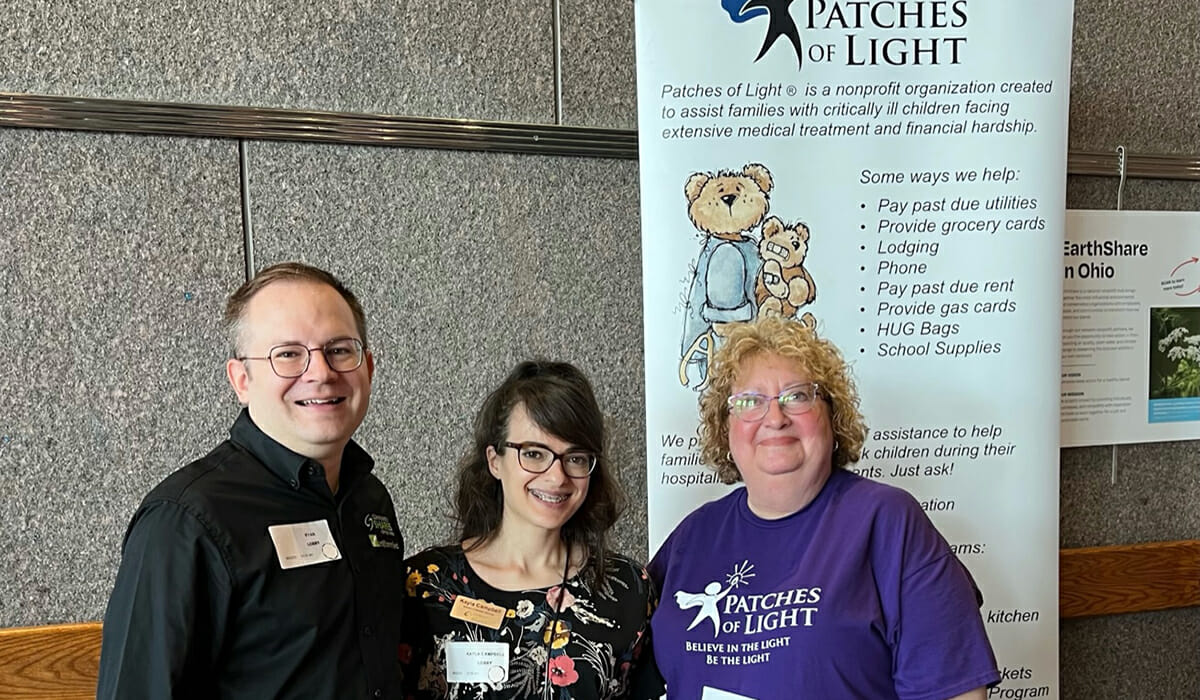
Mindy is the founder and CEO of Patches of Light, a nonprofit organization that assists families with children facing a catastrophic health diagnosis. The organization is based and founded on the personal hardship, heartache and stress experienced by Atwood and her family following her sons’ diagnoses.
“Many years ago, I was a mother of four children,” Mindy recalled. “My son was diagnosed with cancer when he was three. My husband worked two jobs, I worked one job, and my nephew had been diagnosed with cancer at the same time so that really split support in the family. We went through that journey of losing utilities, and my son survived – he’s doing very well now. Then several years after that, my youngest son was diagnosed with a congenital heart defect and had surgery. After we went through that, we were helping people in our community, and it just dawned on me one day, ‘Who helps the families that don’t have anyone to help them?’”
Mindy Atwood is the founder and CEO of Patches of Light, a nonprofit organization that assists families with children facing a catastrophic health diagnosis./Courtesy Mindy Atwood
The Atwoods went to the hospital to see what could be done for these families and heard that fundraisers could be done, but that money could not be allocated wherever it was needed. When a social worker approached Mindy with a family in need of assistance, Patches of Light took off. Now, the organization, which is entirely volunteer-led, is in its twenty-fourth year of helping families.
Each year, thousands of children across the nation are diagnosed with life-changing illnesses, including cancer, heart defects, muscular dystrophy, life-saving organ transplantation and more. Patches of Light helps to cover the high cost of medical bills, travel and family maintenance in order to alleviate stress and keep families together during their critically and/or terminally ill child’s diagnosis, treatment and recovery.
“What we went through, someone else is going through,” Mindy shared. “And when there’s no support, it’s just that much harder. We have an application for assistance, so for instance, we’ll get one from our local children’s hospital and tells us what the family is going through. We verify everything with professionals, and then we figure out what the family needs – whether it’s groceries, gas, transportation to the hospital, to have their utility bill paid, if they’re behind on their mortgage.”
Patches of Light supports families so that they can focus on getting successful treatment for their children and a more hopeful road to recovery. Mindy is amazed by how much need is out there, but the financials vary.
“We have families who need thousands of dollars, and then we have families who come to us for a $63 electric bill,” she stated.
Patches of Light is entirely volunteer-led and helps equip families with everything from utilities to transportation and more./Courtesy Mindy Atwood
The organization gets applications for many things, and Mindy is willing to work to obtain anything the families need to make their journeys easier. Often, these families are facing catastrophic, life-changing situations that happen in an instance, especially in the case of accidents and other traumas that mean children must live with a disability for life.
“We have the children send photos in from across the United States that we display at our local steakhouse,” Mindy said. “I’ve never once asked parents to send photos of their children smiling, yet all the children are smiling. It’s important for these kids to know that they can share their journey. I want people to realize that sometimes helping people is a way to process grief. It’s okay to step out and use your story for good, as you go through the grief process.”
Mindy was honored as a 2022 L’Oreal Paris Women of Worth Honoree. She uses her platform to spread awareness about domestic violence and shares her story to help others speak up. Mindy has founded several subdivisions of Patches of Light, and has also authored three children’s books, with all royalties from book sales donated back to the organization to continue supporting families in need.
Washington Teen Advocates for Research That Accelerates Inclusivity in Sports
Meet Daily Point of Light Award honoree Rakshith Srinivasan. Read his story and nominate an outstanding volunteer or family as a Daily Point of Light.
Through middle and high school, Rakshith “Rocky” Srinivasan was heavily involved in sports, focusing on football and basketball in middle school, and basketball in high school. His main focus was – and still is – to play collegiate basketball; but today, he is making a difference through a new passion for medicine and science.
As the founder of Unlimited Potential (UP), Rakshith raises funds to support research initiatives that help individuals play sports who may not otherwise be able to do so, whether due to a disability or illness. Through his volunteerism, Rakshith is striving to make athletics inclusive to all.
What inspires you to volunteer?
My basketball team’s athletic director saw me as a leader, so she recommended I apply for an internship with the Washington Interscholastic Activity Association (WIAA). I was selected as one of eight applicants out of 500. It was here that I learned about adaptive sports. I met kids with disabilities and learned about the struggles they face. Just hearing what these kids had to say opened my eyes. A lot of people don’t have awareness of how challenging it is to get funding and even court time for adaptive sports, simply because there isn’t much representation of kids with disabilities in school sports. I quickly became passionate about getting these kids equal access to playing sports.
I suffered an ankle sprain while playing basketball, unfortunately close to the playoffs. Being sidelined for several months gave me a glimpse into the lives of people who can’t play sports. I felt their frustration at not being able to play.
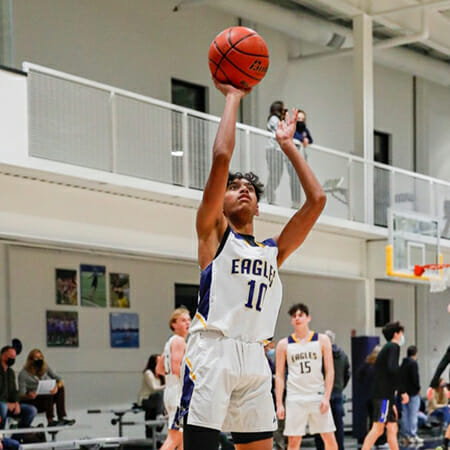
Rakshith Srinivasan playing basketball for his high school, Eastside Preparatory School./Courtesy Rakshith Srinivasan
Tell us about your volunteer role with Unlimited Potential (UP).
I started Unlimited Potential (UP) in 2021 as a 10th grader. My main role is securing funding for the many research initiatives that help people play sports, whether they have a disability or a disease that prevents them from taking part in activities.
My foundation works with hospitals, research labs and professors. I originally started raising funds for orthopedics research, and that evolved over time into supporting muscular dystrophy research, the development of prosthetics and adaptive equipment like wheelchairs, and recently I’ve been raising funds for bone sarcoma cancer researchers.
I have also conducted my own research and published a research paper on the effect of supplements on injury prevention. I have had multiple research internships from the University of Washington, Brown University and University of San Diego in the area of orthopedic medicine, prosthetic 3D printing, mechanobiology and human kinesiology. Along with this, I have published a book, Overcoming Obstacles, which looks to convey sports medicine research in a way that is accessible for all, from the everyday person to elite athletes.
I have also been a keynote speaker and advocate for inclusivity in sports. My passion is doing what I can to help anyone, regardless of their physical condition, live an empowered lifestyle where they can enjoy any activity they want.
All of the money we raise goes directly to the hospital or research facility. I work with the Seattle Children’s Hospital orthopedics research lab, helping them help patients become more mobile.
What’s been the most rewarding part of your work?
Creating new relationships with different people and seeing how the research that we help fund has been helping people, at least giving them optimism for their futures. When I was the keynote speaker at the Special Olympics, I had an opportunity to talk to kids who are physically disabled. I made some amazing connections with them!
What have you learned through your experiences as a volunteer?
I’ve learned a lot of lessons about leadership and determination. Working with hospitals and research organizations, I got a lot of no’s before I got yes’s, so I had to learn to persevere. I also developed an appreciation for science, medicine and research. My old focus on sports was limiting. Now, I have a deep interest, in fact a passion, for medicine. My career goal is to become an orthopedic doctor.
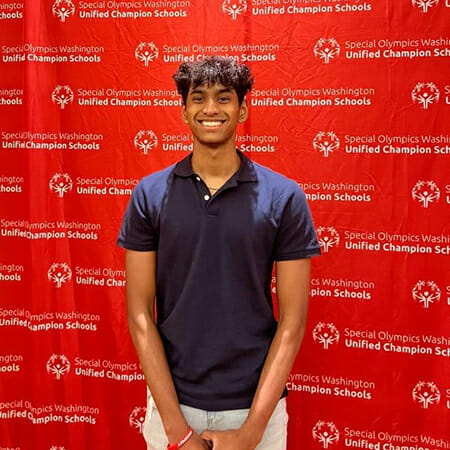
Rakshith Srinivasan, founder of EnableUP, keynote speaker at the Special Olympics./Courtesy Rakshith Srinivasan
Tell us about future partnerships, programs or events that you are excited about.
I’m looking forward to working with the Sports Institute at University of Washington and other large research organizations. The Sports Institute is focused on sports medicine research. They do a lot of things similar to orthopedics, including prosthetics and post injury rehabilitation, basically whatever it takes to get someone back out enjoying a sport.
I also volunteer at the World Relief Organization where I tutor refugee kids and help them to develop their social emotional development through after school sports activities. These activities include sports camps over the summer where kids not only have a fun time, but learn life lessons through sports, such as the importance of teamwork and working hard.
Why is it important for others to get involved with causes they care about?
Volunteering has helped me find an area of passion I wouldn’t have found otherwise. I’m helping other people and at the same time, helping myself grow.
What do you want people to learn from your story?
You can do anything you put your mind towards if you have a goal. Don’t shrug it off or put it off. Teens can learn that they can make a difference in the community if they want to. I am still heavily involved in high school basketball, but I made time to start a foundation and get things done. I didn’t lose my other hobbies, but made an impact and learned a lot about myself. Tap into something you love to do, while helping others who are less fortunate than you. The life lessons and benefits will be amazing!
Amy Lin is 15 years old and a rising sophomore in high school. As a little sister, she is already glumly anticipating the day her brother heads to college next year. Reading and art are her escape from everyday responsibilities, and while she takes art classes in school, she is independently exploring digital media after being inspired by some online images during the 2020 pandemic lockdowns. But that’s not all she did during her self-professed period of boredom.
Amy noticed how students, especially those younger than her, were struggling to learn effectively from home. Joining Princeton Learning Experience International School (PLEIS), she volunteered as an online tutor for underserved students with a mission to narrow the education gap.
Three years later, Amy now spends around 16 hours a month running her own branch with 20+ volunteer tutors, offering a variety of classes for students in grades three through twelve. More than 40 students took advantage of the help in the first session, a number that has doubled in the current summer program and one that she hopes to increase by partnering with other schools and organizations.
What inspires you to volunteer?
I began volunteering for PLEIS as a youth teacher during the pandemic in 2020, because I wanted to help younger students whose learning was negatively affected by the school closings. I continued volunteering over the years and gained some more experience with the organization.
After that, I established the Greater Princeton branch to focus more specifically on reaching schools from low-income families. I realized that some of my friends were receiving expensive tutoring. I knew a lot of other people couldn’t afford it. We’re high school students, so we have knowledge that we can share with younger students. We can help families who can’t afford tutoring by doing it for free.
Amy Lin, head and cofounder of Princeton Learning Experience International School Greater Princeton branch, dedicates her time to narrowing the education gap./Courtesy Amy Lin
Tell us about your volunteer role with Princeton Learning Experience International school (PLEIS) Greater Princeton Branch.
I started off as the teacher and then became the co-founder and head of the Greater Princeton branch. I had to contact a lot of different people to find people who wanted to join our branch and volunteer. I also had to create different templates, for example, curriculum or managing logs, which we have to make sure teachers are getting feedback on how they teach. And I talked to one of our partners, Give Education, another nonprofit that connects economically disadvantaged families to different organizations like ours. They help us by providing students, and so I coordinate with them.
Within the branch, I help organize every single program session and event. I talk to our partners who help us by providing students. And I also help guide every department—outreach, management, curriculum and human resources. Specifically, during class time, I’m present to welcome the students and assign them to their Zoom classes and ensure everything is running smoothly.
How do classes work?
There are different sessions every year. In 2023, we had a four-month spring session, and we have a two-month summer session right now. During each session, we offer different types of classes students can choose from. Each class has two to eight students and meets twice a week. We have teachers teaching reading, math, science, and in the summer, we added in coding, history and art.
Our school has coding classes, but the volunteer teachers are independently interested as well. Our summer program is Python coding, and it’s probably one of our most popular classes right now.
What’s been the most rewarding part of your work?
It’s hearing the feedback from students about how our classes have helped them in various ways. For example, some students have said that their grade has been increasing in school because they’re taking our classes. That made me feel really good, because the goal is to help other students achieve more and learn more.
What have you learned through your experiences as a volunteer?
Making an impact on another’s life can come in different forms. You can volunteer in so many different ways, and it helps different people. Even as a teenager, you can do a lot. You can share your knowledge with younger people or help out your community by picking up garbage. I’ve also learned to be more understanding and patient, especially when interacting with students. I’ve learned how to take responsibility as a leader and be very organized.
Tell us about future partnerships, programs or events that you are excited about.
Our outreach team has been working on partnering with a few school districts around the area. We’ve been exchanging emails with some school administrators. So, we are excited about that for upcoming sessions. And we’re still in the planning process, but we have a school year session coming up in the fall. Our summer session is ending in a couple of days, and then we’re going to be opening up a new session with math, reading classes, and more.
Why is it important for people to get involved in causes they care about?
Everyone only has one life. If you really care about something, then you should do something within that life you have. Your life is a gift, and you should do something about the things you care about, because anyone can make a difference.
What do you want people to learn from your story?
If you’re really passionate about doing something, you should trust yourself that you can do it. I began thinking, “I’m just a teenager. I have very minimal leadership skills.” But as I went on, I gradually developed more and more of those skills needed to lead the branch, and it ended up being successful. Don’t let your doubts pressure you to give up, because you’ll always learn along the way and you always get better.
What are your long-term plans or goals for the organization?
We really want to connect with more school districts and reach more students. We just want to help as many people as we can.
Retired Pediatric Nurse Continues to Support Health and Wellbeing Through Therapeutic Horseback Riding Program
Meet Daily Point of Light Award honoree Janis Childs. Read her story and nominate an outstanding volunteer or family as a Daily Point of Light.
Many kids dream about having a pony at some point or another, and Janis Childs was no different. She loved horses and often begged her parents to get one. With her father in the military, her family wasn’t in a position to bring along livestock every time they moved to a different base. But that didn’t stop Janis from putting a saddle on her bicycle with a tail off the back and a rubber horse head on the handlebars. She also took a few riding lessons both as a kid and–occasionally–as an adult.
While she didn’t end up with a horse of her own, Janis’ caring temperament extended to humans as well. Throughout her career as a pediatric nurse, she touched many lives and loved the work. Imparting knowledge also became a passion. After teaching at the University of Virginia, Janis moved to Maine for the role she eventually retired from, a professor of nursing at University of Southern Maine. Maine has been her home for the last 25 years.
“When I was looking at retirement, I knew that I wanted to do something to be involved with my community,” she said. “And there happened to be an article in the newspaper about Riding to the Top.”
Riding to the Top (RTT) is a 50-acre farm that provides therapeutic riding programs for children and adults with cognitive or physical challenges. The interaction between horse and rider is designed to improve health and wellbeing but, as Janis would soon find out, also provides unbridled joy. The idea of working with horses and young riders seemed perfect, and after an initial visit, she was hooked. Janis has been volunteering there for the last 12 years.
“We almost get more out of it than the riders. They’re such an inspiration, and the horses are just magnificent. It’s really an honor to be there,” she said.
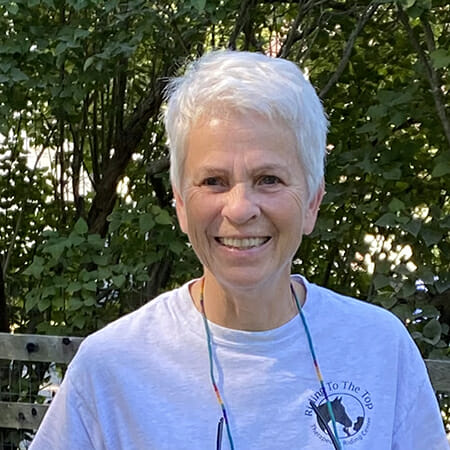
Janis Childs has been volunteering with Riding to he Top for the last 12 years./Courtesy Janis Childs
Her story is similar to many of the staff members and volunteers. Kate Jeton, program director, certified therapeutic riding instructor and equine specialist, started as a volunteer after her son did and eventually became a board and staff member. With a background in teaching riding lessons to people without disabilities, she notes an intangible difference.
“The magic of the place is pretty hard to ignore for all of us who are involved here,” said Kate. “I’m pretty sure my riding lessons were never this joy-filled. It’s pretty infectious, and I think our volunteers feel that all the time.”
With 17 horses, RTT teaches around 75 riders each week, starting at 9 a.m. and going until 5 p.m. or 6 p.m. The horses are chosen for their temperament and tend to be older, so health issues occasionally come up that require a bit of rest time. And, as one might expect, there are many dedicated volunteers. Janis started out helping with lessons, grooming horses, prepping tack, leading horses, walking alongside riders or standing in the ring in case of problems.
“We might have three riders in a lesson that requires two side-walkers and a horse leader. So, it could be six or nine volunteers in a lesson with three horses, an instructor and the riders. It can get pretty busy,” she added.
After about seven years of mucking out stalls and moving horses around paddocks, she’s moving from physical work to administrative work. Today, she conducts seven 45-minute lessons a week, cares for horses and maintains First Aid kits and AEDs. Due to term limits, she will be stepping back from the board of directors in December after nine years. In that time, she’s served as both secretary and vice president. She has also helped develop RTT’s therapeutic carriage driving program and assisted with special events and projects.
“It’s just incredible in terms of working with her and what she gives not only to our organization in everything she does, but in what she does for our clients,” Kate said. “She is there for each individual, regardless of what brings them to Riding to the Top. She is compassionate. She’s kind. She’s patient. She’s just got this huge toolbox of people skills that she brings with her.”
Coworkers say Janis is always willing to lend a hand. If she’s going to be spending extra time on the farm, she’ll send an email asking if anyone needs help. Her love for both the people and the horses leads her to find inspiration in the interaction and support between the two. She recalled one rider, who lives with M.S. symptoms, struggling to walk and who is almost deaf but finds her legs from riding a horse. Janis also remembers working with an autistic child who, if he spoke at all, would speak to his hands. He found his voice by talking with his large four-legged friend.
“Every day, I am astonished at how strong people can be. I’m impressed with horses and their ability to sense what people need, how to be gentle and how to give of themselves. We had a horse the other day with a young boy who was very anxious and upset. This horse put his head in this child’s lap,” Janis reflected. “In turn, it’s given me the strength to live my life the best I can and be grateful for what I have.”
It’s not just the horses in whom riders find support. It’s the volunteers.
“We had a young girl who started riding here a year after a pretty bad accident that left her paralyzed from the waist down. It’s a hard thing to go through when you’re 17 years old, and Janice was one of her volunteers. The difference that she made in that girl’s life was like night and day,” Kate emphasized. “She’s just a hugely important person here to everybody that she works with and to our horses.”
There’s room for everyone in the community to get involved with RTT in one way or another. The creative fundraisers done throughout the year offer wonderful memories for everyone who participates. The largest is called Triple B: Boots, Band and Barbeque. Anywhere from 300-325 people are expected to crowd into the indoor arena in October. Along with a clear theme, lots of dancing and good food, the farm has a mission auction.
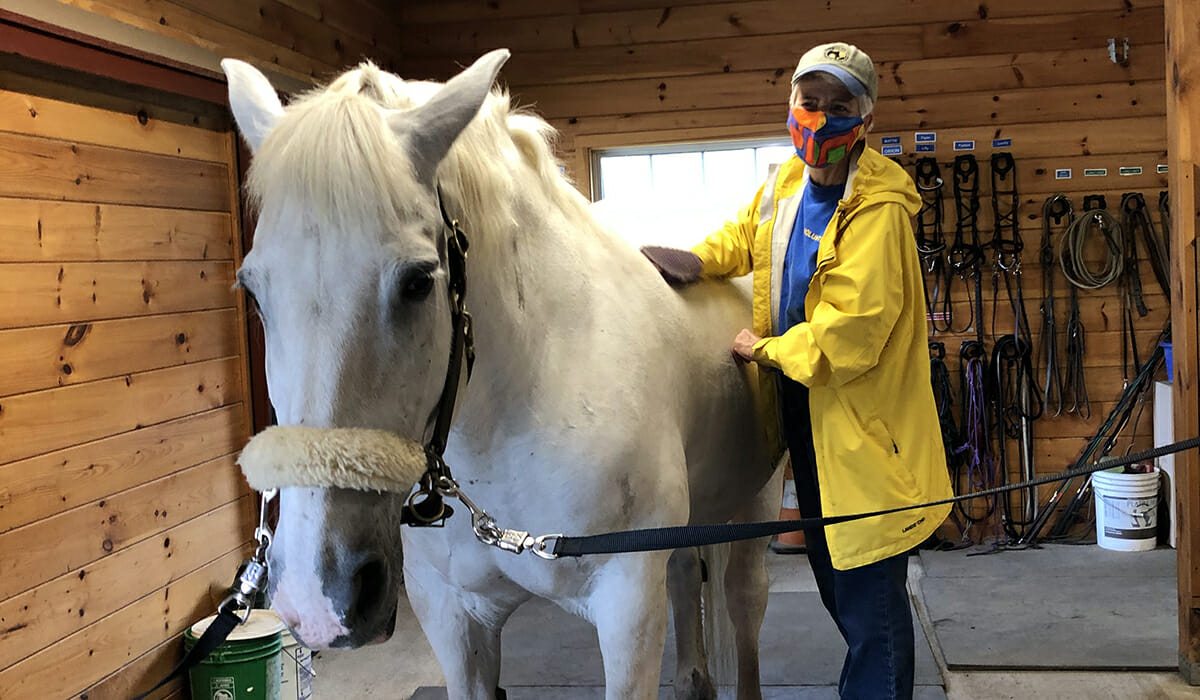
Upon the return of lessons post-pandemic, Janis grooms Abby after a lesson.
“We feed and care for horses from this fund, and the scholarship fund is for scholarships for riders. Eighty percent of our riders are on partial scholarship. They don’t get any insurance for this, unfortunately,” Janis said.
Barn to Beach offers participants a day of riding from a supporter’s farm, through the woods and down to the beach where everyone swims and eats lunch. Another is a 10K run put on by Joanie Benoit Samuelson, the Olympic marathon runner. The board is hoping to raise funds to get a covered outdoor arena, make improvements to the barn and give more horses a place to call home.
“We’ve got a waiting list for riders, and we’d love to expand so that we don’t have a waitlist anymore. So, we can offer our services to anyone who needs them,” Janis explained.
For now, Janis and the organization are doing all that they can with what they have, and it’s making a difference in the lives of everyone involved. As she reflects on her years of service, Janis is reminded of what she herself has gained.
“I’ve learned a lot about horses. I’ve learned a lot about people. I’ve learned a lot about community, and Riding to the Top is my chosen family. It’s just such a wonderful place.”