North Carolina Retiree Helps Residents Stay in Their Family Homes
Meet Daily Point of Light Award honoree Skip Hudspeth. Read his story, and nominate an outstanding volunteer or family as a Daily Point of Light.
Skip Hudspeth likes to roll up his sleeves and get involved. After a lengthy career in aviation, the climate activist and retiree found himself eager to directly make a difference in his North Carolina community. In 2019, he came across representatives from Rebuilding Together of Greater Charlotte, the local chapter of a national organization that goes into area neighborhoods and provides critical home repairs to residents’ properties. Soon, he realized he could put his experience with construction and home remodeling to great use for the organization’s Building a Healthy Neighborhood program, which advances health equity by improving health and housing outcomes for members of the community.
Skiphas dedicated endless hours to tackling projects ranging from swinging a hammer to performing complex electrical work.
Known for his cheerful energy and frequent laughter, Skip also uses his knowledge to educate others. He frequently teaches other volunteers while on the job and is eager to see how the organization can blossom further. A resident of Huntersville, which is north of Charlotte, Skip is working with Rebuilding Together to connect the organization with residents there. But it’s all part of a larger picture, says Skip, who is dedicated to his mission to build climate resilience.
Read on to find out more about how Skip is helping Charlotte residents stay in their homes.
Tell us about your volunteer role with Rebuilding Together Greater Charlotte.
Rebuilding Together Greater Charlotte is part of a nationwide network whose mission is to help people in vulnerable neighborhoods stay in their homes, which they do by making critical repairs. They take care of things that the residents might not be able to afford because of their bills from everyday living. What I do is kind of just show up. What I enjoy most is when we really get into something like plumbing, wiring, electrical work or structural work, or something where there’s some challenge to it.
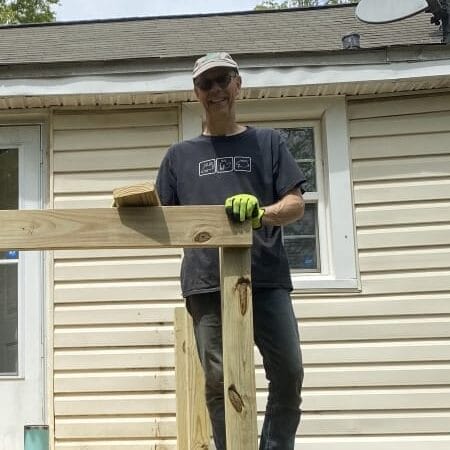
Skip stands in front of a home where he volunteers with Rebuilding Together of Greater Charlotte./Courtesy Skip Hudspeth
What inspired you to get started with this initiative?
I wanted to find something I could do where I can see I’m making a difference locally. I went to a house in a neighborhood in Charlotte and we rebuilt a deck and a ramp for a person to get into their house. I loved it, and so then I just started going back. Each time we go, we get to meet the homeowners and connect with the people who live there. That’s a big part of what I enjoy.
What’s been the most rewarding part of your work?
I think the most rewarding thing is just to meet with the homeowners and see in a short period of time how much we can change things that they were really struggling with, and turn it into a new kitchen, new bathroom or new floor. We were working in this older house in Charlotte, and this gentleman who lived there– I think it was his parents’ house before his – was struggling to keep it up because it had so many problems and leaks. I was working on pull-down attic stairs, and all the other people in the crew went outside. He just looked at me and said, “you know, after you leave I’m going to cry.”
What have you learned through your experiences as a volunteer?
I’ve learned what’s possible when people come together and organize to help others. This group was kind of just starting out when I started, and I’m seeing now how much they grew just by their intention of doing this work and sticking with it. I’ve learned how to work with other people. I’m learning a lot about how to collaborate, how to sometimes slow down, take a breath, talk to others and get their points of view. I’m learning to get the bigger picture and see what the next step is to go forward.
Tell us about future partnerships, programs or events that you are excited about.
They’re planning to work in an older, Black neighborhood in Huntersville originally called Pottstown. It’s really got a lot of energy around that community. They’ve got a wonderful old school they turned into a recreation center. There’s just so much going on there. So I think to show up and help people in a lot of older hubs with their needs there is really good.
Why is it important for others to get involved with causes they care about?
I think there’s going to be more and more need. But the other reason for people to do it is I think it’s really good for their hearts. It’s going to feel really good.
Any advice for people who want to start volunteering?
I think the first step is to look and see what their gifts are – what they’re just naturally good at, and also what they love. And then look at how that connects with the deep needs in the community. If you can bring those things together, I think that that’s the magic. Be willing to try something new, and just be willing to show up. Maybe realize you’re not going to know how to do it at first, but you’re going to learn.
What do you want people to learn from your story?
There are opportunities where you can show up and in a very short amount of time, you can help someone in a large way and have a lot of fun doing it.
Michigan Volunteer Builds Community Through Service and Learning
Meet Daily Point of Light Award honoree Sharon Wade. Read her story, and nominate an outstanding volunteer or family as a Daily Point of Light.
Sharon Wade is spending her 82nd birthday at Taste of OLLI, an annual event hosted by Osher Lifelong Learning Institute at Western Michigan University (OLLI at WMU) to recruit members and introduce instructors of courses offered in the fall. The organization is part of a network of 125 Osher Institutes on college campuses across the United States designed for adults 50 and older who love to learn to volunteer, take classes and socialize with fellow members.
Sharon has been a passionate member and volunteer for OLLI since 2011. After a career as an international legal assistant with the company that is now Pfizer and raising two sons as a single mom, she fills her time with learning, having fun and supporting others. She enjoys having her two grandsons and great-grandson living nearby and gets together with friends at least once a month to play games or go out to eat. But it was her interest in genealogy that initially led her to take a class at OLLI at the invitation of a friend.
“I was an events and travel coordinator for a singles group that had gone by the wayside. It had about 400 members at one time, back when I was still working. That dissolved, I was retiring and I needed something else to keep me busy,” she recalls.
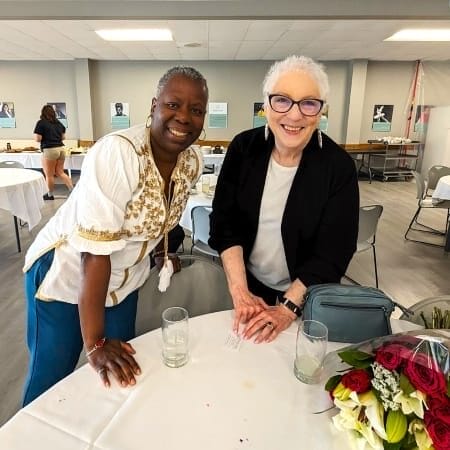
OLLI Director Dr. Toni Woolfork-Barnes joins Events Committee co-chair Sharon Wade at the annual OLLI Volunteer Reception.
One thing led to another, and she volunteered to plan educational trips on the Travel Committee and organize four to six gatherings annually for nearly 900 members on the Events Committee. Now, she serves on the Membership Marketing and Executive Committees increasing membership and visibility, and she has been the chair of the Events Committee for nearly a decade. And she continues to learn.
“The organization itself is about lifelong learning and learning for fun. There are no tests or homework. It’s a lot more fun than it was in school. Our instructors teach their passion and everybody’s a volunteer.”
Sharon notes that she’s taken as many as 10 classes in a semester, bemoaning the ones she can’t take because of conflicts. In short, they’re not short on options, and Sharon stays busy.
“She has impeccable organizational skills, and because of her organizational skills, she can do all the things she does,” Dr. Toni Woolfork-Barnes, director of OLLI, praises. “I think our OLLI members and maybe others are inspired, because as we age, we don’t have to stop living we just have to do things differently. Sharon is an example of that.”
When Sharon started, there were only three events, one of which was a meeting. Today, aside from Taste of OLLI, the largest event of the year, she and her team plan book swaps, game days and recruiting events. Many times, the goal is simply to enjoy being social.
“Socialization is so important for people, especially seniors,” she explains. “There are so many studies that show that socialization has mental and physical benefits.”
Sharon’s committee also coordinates the Senior Readers’ Theater program. After seeing a similar group from South Haven, OLLI members wanted to form their own Senior Readers’ Theater group, and she took the lead in getting things started. Once an actor, she now acts as stage manager accompanying the group on performances around the area. They present relatable issues like dealing with aches and pains and giving up driving with humor and grace. What was originally conceived as an intergenerational tool to help healthcare students better understand older patients has become an entertainment and outreach program as well.
“It’s bringing more visibility to OLLI at WMU, because we have organizations and senior-serving communities that are reaching out to us and inviting us to perform for their residents,” Toni says.
Soon, they’ll also be performing at Lakeland Correctional Facility as part of a new venture with WMU’s inmate degree program. The students there will follow OLLI’s performance with one of their own and end with a group reflection.
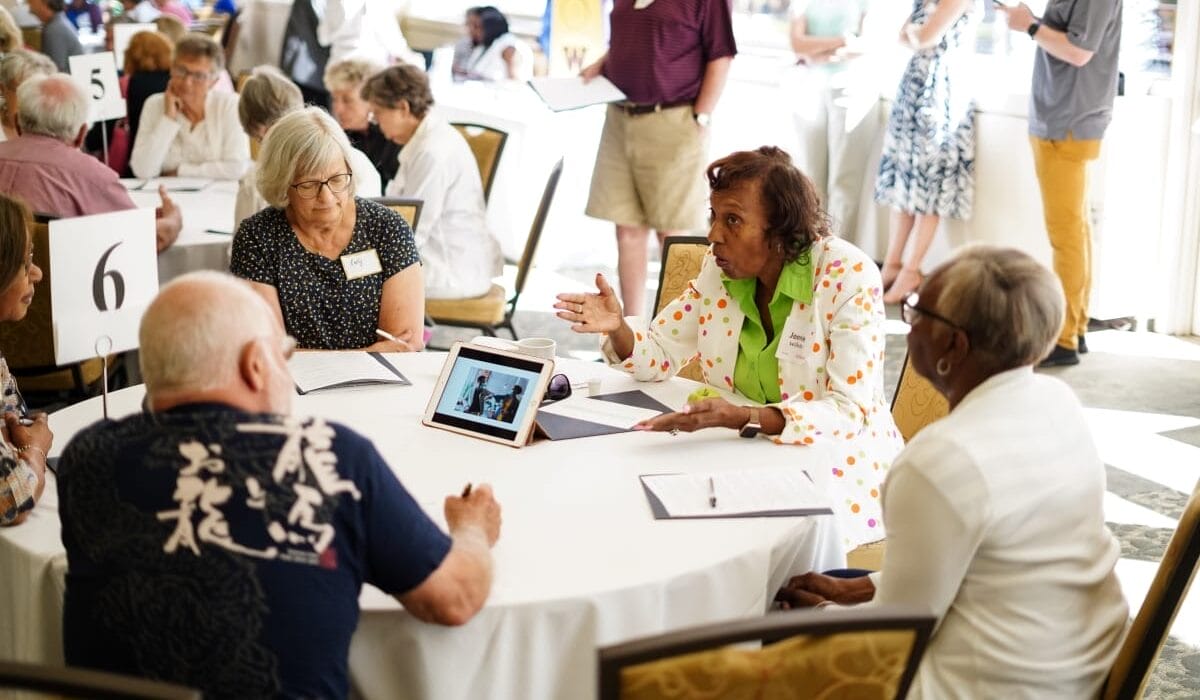
OLLI members learn about upcoming courses, trips, events and outreach opportunities at the annual Taste of OLLI – A Feast for Your Brain.
Early in her tenure, after seeing a list of needed supplies from the Kalamazoo Literacy Council, Sharon offered to collect them at OLLI events. The Council teaches health and job literacy, but they started with teaching adults to read so they could read to their children. It began a long and fruitful alliance between the organizations that earned OLLI at WMU the Literacy Advocate of the Year Award in 2021 and, through Sharon’s leadership, was the beginning of OLLI Cares: Fill a Trunk.
During the pandemic, when people were struggling the most, OLLI Cares parked six cars, trunks open, in a parking lot. They each represented a different community partner people could donate to, including the Council.
“People had been downsizing and cleaning out their homes during COVID anyway, so they had the opportunity to bring all of these donations in a safe way,” Sharon says of what became an annual event.
The COVID-19 pandemic led to a lot of isolation, especially amongst the older community, and while Sharon and fellow volunteers got creative when events couldn’t be held in person, OLLI took a hit. Looking ahead, Sharon hopes to boost membership to pre-pandemic level, a number that continues to increase each year with her efforts.
“A lot of the things we do, we could not do without our members. And Sharon is one who will go out and invite people. She’s constantly engaging people,” Toni adds. “She just has a beautiful personality.”
OLLI is something Sharon is committed to for the long-haul. The last 13 years have led to a deeper understanding of the organization and a seat steering it into the future.
“I’ve gained a lot of wonderful friendships. It keeps my mind active. It keeps me physically active simply because I’m going all the time,” she states. “I just enjoy it. I enjoy being around people. I like parties, and this is like planning parties all the time.”
Sharon knew right away it was something she wanted to be a part of. And even now, on her birthday, she looks forward to celebrating with friends as they contemplate this fall’s classes. She looks forward to celebrating with OLLI.
Young Nonprofit Founder Empowers Other Youth Toward a Food Secure Bay Area
Meet Daily Point of Light Award honoree Aidan Ahmed. Read his story, and nominate an outstanding volunteer or family as a Daily Point of Light.
In 2020, as the world grappled with the COVID-19 pandemic, Aidan Ahmed noticed a troubling rise in homelessness in the Bay Area. At just 11 years old, Aidan was determined to make a difference. Recognizing the challenges faced by unhoused individuals and families, particularly the shortage of food, he decided to take action. With the help of his brothers, Aidan co-founded Kids Kitchen, a community-driven initiative that empowers local youth to support those in need.
Kids Kitchen began as a small project, with local kids making sandwiches and dropping them off, contactless, on Aidan’s front porch. The response from the youth in his community was overwhelming. Inspired by their enthusiasm and dedication, Aidan quickly realized that this initiative had the potential to grow far beyond his initial vision. He reached out to local nonprofits to distribute the meals to homeless camps across the Bay Area, ensuring that the food reached those who needed it most.
Over the past four years, Kids Kitchen has evolved into a powerful community program rooted in the belief that kids can make a tangible difference in their communities. Aidan has forged partnerships with numerous local nonprofits, including the Bill Wilson Center and Hello Angels, to expand the reach and impact of Kids Kitchen. To date, the initiative has provided over 3,500 meals to unhoused individuals and families across the Bay Area.
Aidan’s responsibilities with Kids Kitchen are extensive. He collaborates with local nonprofits, organizes monthly food drives, communicates with the community and personally helps prepare the meals. Beyond providing meals, Aidan is committed to educating youth about the importance of advocating for the unhoused community and destigmatizing homelessness. He believes that by bringing young people together, they can lead the charge in creating positive change within their communities.
Read on to learn more about Aidan’s goal of ending hunger and supporting unhoused individuals throughout the Bay Area.
Tell us about your volunteer role.
As a co-founder of Kids Kitchen, I organize and host monthly meal drives for individuals and families experiencing homelessness in San Jose, California. I collaborate with nonprofits and involve local kids in preparing lunch bags, while parents often contribute hot meals. Each month, I work with our nonprofit partners and youth volunteers to plan and collect the meals, which are then distributed to homeless camps and shelters by our nonprofit partners. Additionally, I research and identify new nonprofits that share our mission to fight food insecurity and may be interested in partnering with us.
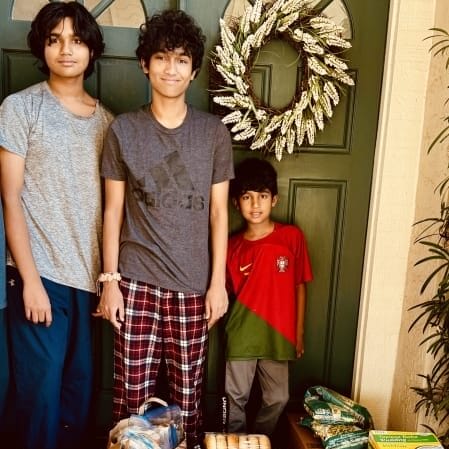
Aidan, 15 years old, with his brothers, Ayaan, age 17, and Noah, age 8, co-founded Kids Kitchen in 2020.
What inspired you to get started with this initiative?
In 2020, my brothers, Ayaan, Noah and I co-founded Kids Kitchen after noticing a rise in homelessness across the Bay Area during the pandemic. Although our family had always been involved in community service, the pandemic presented a new challenge: safe volunteering opportunities for kids became scarce, and we were frequently turned away. So, we decided to start our own initiative, Kids Kitchen, a youth-led effort dedicated to fighting hunger by making quality meals in our own kitchen.
Our mission was to offer kids a safe and straightforward way to address hunger in their community. Since then, the Kids Kitchen community has grown, and together we have provided over 3,500 meals to homeless camps and shelters, supporting at-risk individuals, including runaway youth, pregnant women and families with children across San Jose, California.
Why is this issue so important to you?
This issue is important to me because I believe that youth have the power to drive change in their communities, especially in the fight against hunger. I also see the youth voice as a powerful tool for challenging stereotypes about individuals experiencing homelessness. Together with other youth in the community, I hope to create a more inclusive and compassionate society where no one feels “invisible.” The Kids Kitchen community has demonstrated that youth can be true change-makers, leading change in their communities and beyond, through their actions.
What are your long-term plans or goals for the organization?
My hope is that the Kids Kitchen model inspires other youth to take action against hunger at the community level, creating a ripple effect of change led by youth across the country, and perhaps one day, across the world.
The Kids Kitchen Model includes the central tenets to build the Kids Kitchen community, connect with local nonprofit organizations to form partnerships, organize and manage monthly meal events, collect meals and deliver them to nonprofit partners for distribution, and research and identify new nonprofits and expand the volunteer base.
Through social media, I hope to make the Kids Kitchen model accessible to all youth, motivating them to help alleviate hunger and advocate for the de-stigmatization of homelessness. By encouraging youth everywhere to adopt the Kids Kitchen model, I believe we can contribute to addressing hunger on a broader scale.
What’s been the most rewarding part of your work?
The most rewarding part of my work has been seeing the Kids Kitchen community come together to deliver over 3,500 meals to those in need. We have received heartfelt gratitude from the unhoused community, who truly appreciate the effort and care kids put into preparing delicious, fresh, homemade meals. It’s incredibly fulfilling to know that our work makes them feel valued and cared for.
What have you learned through your experiences as a volunteer?
Through my experience co-founding Kids Kitchen, I have seen firsthand the impact youth can have on their local community. These experiences have taught me how to contribute to solutions, develop leadership skills, and enhance my communication skills by collaborating with nonprofits and the local community.
I have also improved my cooking skills and am always on the lookout for new cuisines to incorporate into our monthly meal drives. Most importantly, I have learned that when a community of youth comes together, we have the power to drive meaningful change!
Why is it important for others to get involved with causes they care about?
It is important for others to get involved with causes they care about because every contribution, no matter how small, brings us closer to addressing the issue. If we don’t take action, who will? Each action adds up, and together, they make a significant difference.
Any advice for people who want to start volunteering?
If you are a young person interested in volunteering, go for it! Don’t let anyone tell you that you are too young to make a difference. What matters is not the scale of your impact, but your willingness to contribute. Your efforts, no matter how small, will make a difference in the world.
Meet Daily Point of Light Award honoree Teri Harris. Read her story, and nominate an outstanding volunteer or family as a Daily Point of Light.
Teri Harris, 56, didn’t always know she would be involved in fire safety. It wasn’t a passion or dream of hers. She also didn’t expect to have cows, but things evolve. Teri moved to Oklahoma after being recruited as a mechanical engineer in college by what would later become Phillips 66. She met her husband, Travis, 14 years ago and now lives on the farm that has been in his family since 1907. Aside from their affection for cows, the couple loves dogs and has fostered 45 or 50 over the years. In fact, their senior dog, Buster, stole their hearts and became a “foster fail.”
Travis has been a volunteer firefighter for nearly 37 years, fire chief for 18. His dedication led to Teri’s own volunteering, starting with completing Ponca City’s Citizens’ Fire Academy before joining the Fire and Life Safety Council. There, she promotes fire prevention and safety and raises money to fund equipment for fire departments with limited resources.
Her interest in the arts has led to years of commitment to the town’s Arts and Humanities Council where she only recently finished her term on the board. This hobbyist photographer and quilter cites the desire to use her right brain for downtime creative pursuits to balance her left-brained job. At that job, she serves on the Volunteer Emergency Response Team where yearly CPR training saved her husband’s life.
What inspires you to volunteer?
When I started to get interested in the arts, I was a single mom, and my kid was going into high school. I knew some friends who volunteered, and I kind of fell into it by accident. They needed some assistance on a production, and I enjoyed meeting new people and being creative. I’ve been blessed, and as a Christian, I believe it’s my responsibility to take the gifts I’ve been given and help other people.
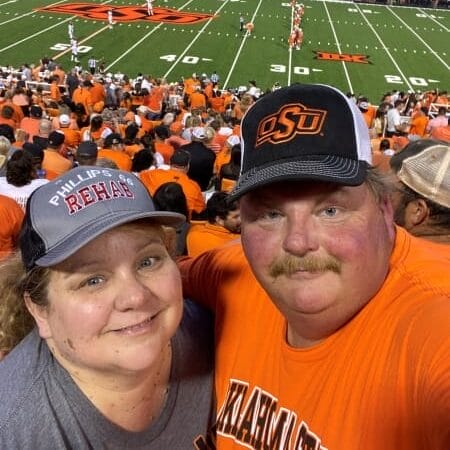
Teri (left) and her husband Travis attend an OSU game approximately 80 hours before Teri had to perform CPR to save his life.
Tell us about your volunteer role with the Fire and Life Safety Council and the Kildare Volunteer Fire Department.
I served as Board Secretary for several years and am currently the Board Vice President for the Fire and Life Safety Council. I’ve also chaired our annual fundraiser for the past few years. I’m responsible for coordination of advertising, ticket sales, sponsorships, etc. We engage three teams of firefighters to grill steak, and our guests try some from each and vote for the best with their cash. It’s great food and an opportunity for the community and the firefighters to get together. We do an auction, too.
It costs around $3,500 to buy a whole set of gear for a firefighter. That’s one of the things that we can fund. Some of our bigger investments recently were three automated CPR devices for ambulances and $75,000 towards the local technology center’s construction of an emergency responder training facility. And we’ve partnered with them to fund auto extrication tools and a simulated mannequin that runs off an iPad to train EMTs.
Our car seat safety check event provides car seats for free or reduced price and shows people how to install them. We also do fire prevention for the elementary schools. We’re hoping to supply some of our county fire departments with smoke detectors to distribute.
Our county only has around 44,000 people, but we have several fire departments, some with full-time paid firefighters and others with a combination of paid and volunteer. Initially, we focused on Ponca City, but we’ve expanded to the county.
At work, I’ve also been volunteering for the emergency response team for 11 years. I’m thankful, because we train at CPR every year.
What are your long-term plans or goals for the organization?
I’d like to see us be more consistent in CPR training for the Fire and Life Safety Council. Anything we can do to educate people on not just CPR but with car seat safety checks and beyond is a success for us.
You had to use CPR on your husband. What happened, and how is it using your training in an emergency vs. a classroom?
My husband experienced sudden cardiac arrest in bed, at 4:30am one morning. I happened to be awake and hit my phone to see what time it was before he started making sounds I’d never heard before. It was pure panic when I realized he was unresponsive. I couldn’t even remember how to unlock my phone.
Once I called 911, it was very matter of fact. It was like, “I have an unresponsive male and he’s this old, and this is where we live,” because our community ambulances don’t all run a paramedic. It’s stuff that I knew from being involved with Travis and the fire service. So, if they know they need a paramedic, they will send one in addition to the ambulance.
Then it was muscle memory. I dragged him to the floor, because you need to be on a hard, flat surface. I started chest compressions. He was getting some oxygen, so I never actually did rescue breathing. It felt like it took forever, but I saw the lights down the road 12 minutes after my call.
He’s one of the 6 or 7% of cardiac arrest patients with no long-term effects. That’s proof that the sooner you start CPR, the better chance of survival that person has.
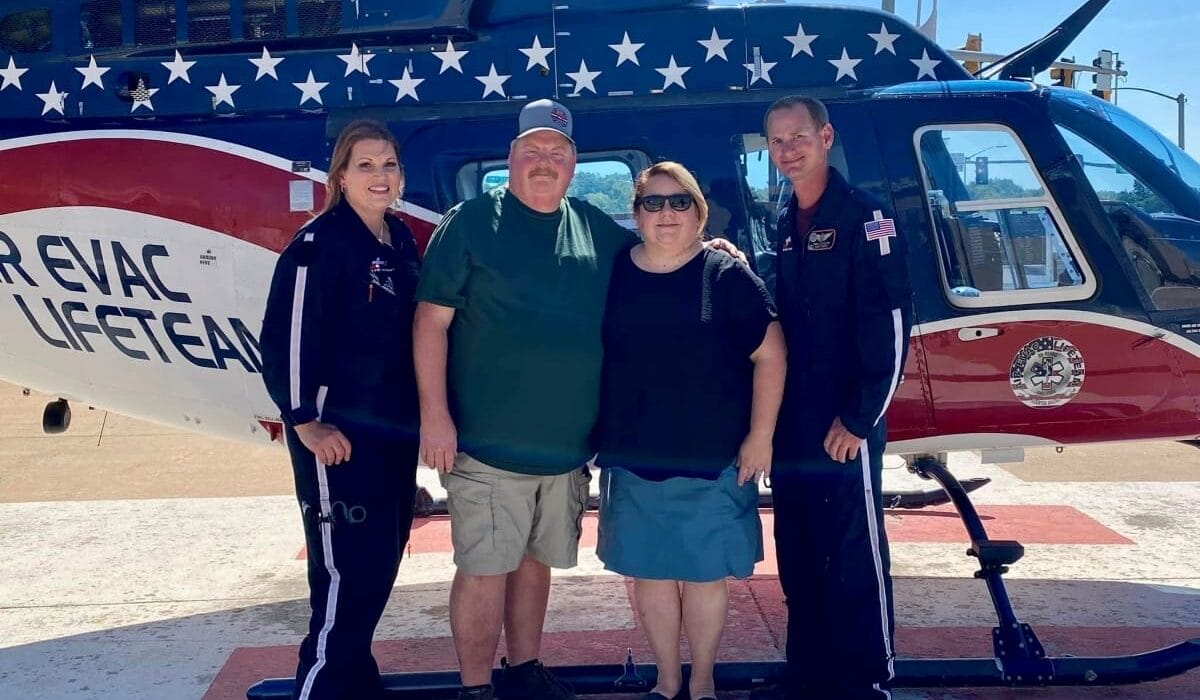
Two weeks after his hospitalization, Travis and Terri Harris (middle) meet the paramedic and flight nurse who supported Travis on his emergency flight to a cardiac care center, helping to save his life.
What have you learned through your experiences as a volunteer?
I admire their dedication. My husband’s been doing this a long time, and I knew what I was getting into when we got married. But there are times when it’s like, I’m really glad we took two cars, because I would have been left behind.
What do you want people to learn from your story?
If you haven’t had CPR, go get it. I would have been a widow if I hadn’t known what to do in that moment. For every minute that CPR isn’t initiated, a person’s chance of survival drops 10%. It was 12 minutes before help got here. Travis didn’t have 120% to give. Even if you’ve had CPR classes, do it again. Just because you did it 20 years ago, it doesn’t mean you would know what to do today. You never know whose life you’re going to save.
Guiding Lives Through a 24/7 Commitment to Raising Service Dogs
Meet Daily Point of Light Award honoree Michael Lawrence. Read his story, and nominate an outstanding volunteer or family as a Daily Point of Light.
Michael Lawrence, originally from Toronto, Canada, now calls Brooklyn, New York, home. His journey into volunteerism with the Guide Dog Foundation began in 2018, but his connection to the visually impaired community stretches back much further. Growing up in Canada, Michael was familiar with the Canadian National Institute for the Blind (CNIB), an organization that provides a range of services to the visually impaired, including guide dogs. However, it was his grandmother, who was legally blind, who deepened his awareness and connection to the community.
In 2020, Michael’s desire to support the visually impaired took a new direction. He was training to be a marathon guide for a visually impaired runner in the New York Marathon, but the race was canceled due to the COVID-19 pandemic. Searching for a way to continue making a difference during such a challenging time, Michael turned to raising guide dogs.
Michael is currently raising his third puppy for the Guide Dog Foundation. His first puppy went on to become an explosives detection dog for a private security firm, while his second puppy transitioned to BluePath Service Dogs, where she now serves as a service dog for a young individual with autism. The Guide Dog Foundation collaborates with other organizations to find alternative careers for dogs that are not suited to be guide dogs, ensuring each dog can still make a meaningful impact.
What makes Michael’s volunteer work even more remarkable is how he integrates it into his daily life. Michael works at Amazon, a dog-friendly employer, which allows him to bring the puppies he is raising to work with him. This not only aids in the socialization of the dogs but also gives his colleagues a chance to interact with and support his mission.
Read on to hear more about Michael’s story and his ongoing dedication to training and socializing future guide dogs.
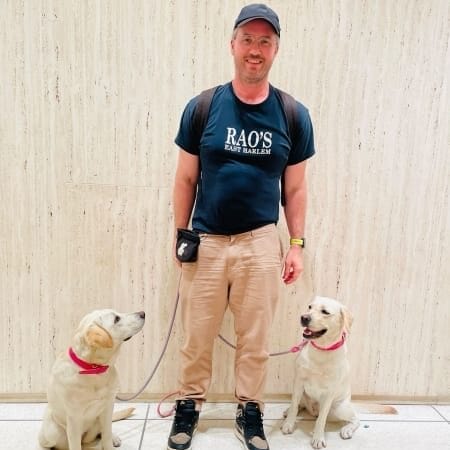
Dogs Chloe and Spliane at Grand Central Station, a stop on the way home to work on training and catch the subway.
Tell us about your volunteer role.
I volunteer with the Guide Dog Foundation, which is also responsible for America’s VetDogs. My role is a puppy raiser. Generally speaking, the dogs need to be of a certain age before they’re ready for their final training with professional trainers. Until then, there’s a team of puppy raisers who take care of the dogs from around 2 months until they’re ready to go into that training at about 16 to 20 months, depending on the dog. Our job as volunteers is to make sure the dogs are well-socialized, have good house manners, have decent obedience skills and are ready for the next step. Then there are professional trainers who teach them all the stoplights and more challenging elements.
What inspired you to get started with this initiative?
I grew up with a yellow lab, which looks like the missing third sister of the two dogs I’m currently raising. I had a blind grandmother but she never had a guide dog, so I didn’t grow up with guide dogs. I was volunteering as a guide for a blind runner who was training for the 2020 New York City Marathon. However that was cancelled because of COVID. But during that training, I’d met some of the blind athletes and their dogs, so I had spent a decent amount of time around guide dogs.
When COVID hit and the race got cancelled, like a lot of people, I wanted a dog. And it seemed like a very natural connection that would allow me to help the same community of people. I reached out to Guide Dog Foundation and was fortunate enough to get my first dog Guinness.
What’s your personal favorite dog breed?
It’s got to be a Labrador Retriever, right?! My first two guide dogs were half Lab-half Golden mixes and they were absolutely lovely. My current dogs are pure labs, which is what I had growing up. I highly recommend Labs or Lab mixes.
Why are guide dogs so important for blind or visually impaired people?
I think visual impairment can be extremely limiting for a lot of people and can create a sense of isolation. And walking with a cane can be pretty unsettling. The fact is that most people who are blind aren’t born blind but become blind, which means there’s often a huge transition and it’s an extremely difficult position to be in. A guide dog is such a magical addition to their life because it gives them a sense of mobility again. It allows them to get out of their house and do more than they normally do.
Guide dogs also provide a tremendous sense of companionship. Not only are they super smart and capable navigators, but they’re also amazingly loving dogs. So it’s twofold for people who receive these dogs: it allows them to expand the world they live in and regain their sense of independence and freedom, and it also allows them to have an incredible companion along the way.
What is the puppy raising process like and how long does it typically take?
It varies by dog. The dogs are in the puppy raiser program from 2 months until they’re ready for training, but they sometimes get transferred around a little. My most recent dog was raised from 2 months to 9 months in a small town at the University of Maryland. Guide Dogs wanted to give her an opportunity to be in a more urban environment since many blind and visually impaired people live in cities. So they transferred her to me in Brooklyn and I’ve been able to take her on the subway and on more elevators, and expose her to more traffic, more crowds, more dogs, more people.
Living in the city and volunteering with Guide Dogs means I’ve gotten several transfers because I have the opportunity to expose them to different things, especially when they’re raised in smaller, more suburban or rural areas.
I work for Amazon and they’re a dog-friendly employer, so I can bring both of the dogs to the office. Of course, everyone loves them. If I come into work and they’re not with me, people come up and ask me where they are. They’re two beautiful matching yellow Labs. I bring them on the subway to work. I’ve taken Ellie and Chloe to Nets basketball games. It’s really fun.
Right before Michael dropped Ellie off for final training (and in between tears). Saying goodbye to the dogs is often the hardest part! Ellie now works as a service dog for a young girl and is living a great life.
What’s been the most rewarding part of your work?
Volunteering with Guide Dogs is very cool because it’s a long-term project. It’s not two hours here or there; it’s all day, every day. You have the chance to watch these dogs grow up from extremely little puppies to life-changing pets for a person. Seeing them achieve their potential and then seeing how transformational it can be for the person, is incredibly rewarding. Also, it’s a puppy! You just got to spend an important, lovely time in that dog’s life.
Why is it important for others to get involved with causes they care about?
It encourages a deeper level of participation. If it’s something that’s near and dear to your heart, you’re going to be more passionate about it than something that isn’t. It provides a different level of connection to an issue, as well a sense of personal reward you get from the work you’re doing.
Anything else you’d like people to learn from your story?
For anyone who’s interested, there’s a documentary called Pick of the Litter that goes through the whole volunteer process, from puppy to the final pairing with the blind person. It does such a good job showing how this process works, how emotional it can be to give up the dogs and how emotional and life-changing it is for the person receiving the dog.
Even now, on Instagram I follow the mom of the young person my second puppy got paired up with. Seeing the ways she’s transformed their life is just unbelievable.
High School Senior Brings Vital Items to Those Who Need Them
Meet Daily Point of Light Award honoree Lesianne Tupas. Read her story, and nominate an outstanding volunteer or family as a Daily Point of Light.
Lesianne Tupas, a 17-year-old rising senior preparing to apply to college, has been focused on the future for a while now. But it’s not just her own future she’s thinking about. In early 2020, the world changed. Unlike some, Lesianne lives with all of her immediate family—her parents, her grandparents and her younger brother—who moved to the US from the Philippines for the opportunities and a lifestyle they preferred. So, when everyone went into lockdown during the height of COVID, Lesianne had more company than most.
When the virus wreaked havoc on people’s health and daily lives, Lesianne became determined to ensure her community was cared for the way that she was. As such, she joined Joshua’s Heart Foundation and is now serving as the head of outreach and vice chair of the Youth Advisory Board.
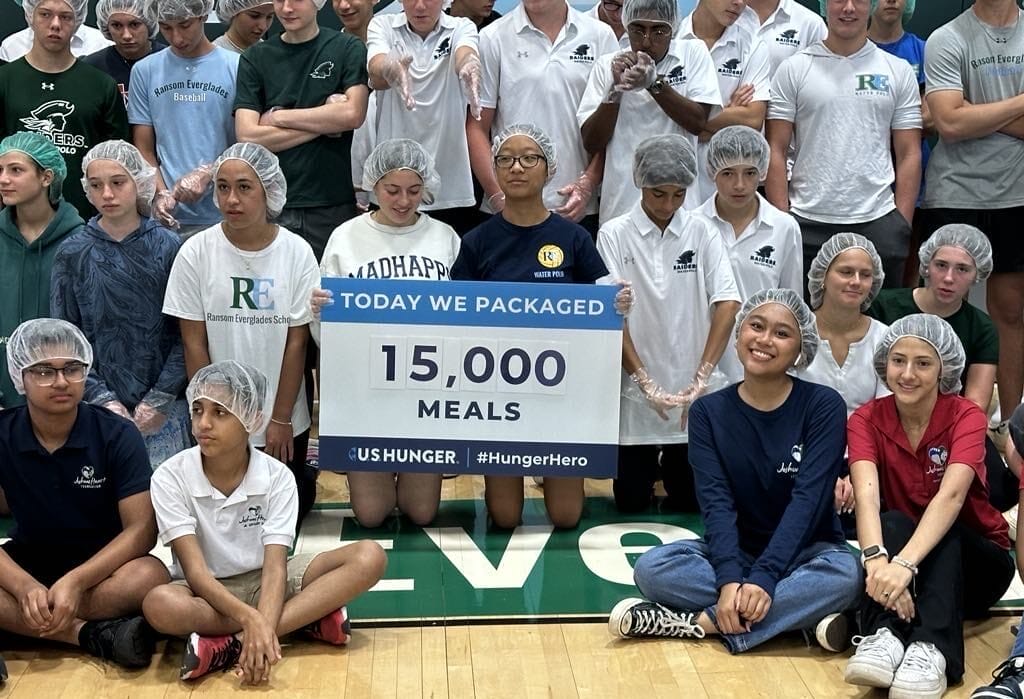
Lesianne has donation drives benefitting hundreds of families and raised $4,725 to help provide 15,000 meals in Miami-Dade Country for Global Youth Service Day. Her work has earned her the Presidential Volunteer Service Award for the past four years, an honor that requires 250 hours of service or more. Joshua’s Heart has also presented her with the Going the Extra Mile Award in 2020 and 2024 for her dedication. Even as she considers her own future, one as a dermatologist, Lesianne thinks of the people whose lives she will improve.
What inspired you to get started with this initiative?
I started with Joshua’s Heart in 2020 during COVID. I was kind of isolated. I didn’t see or connect with a lot of people at the time and realized that it was an ongoing issue, not only with me but with other people in the community. There were people not only struggling with isolation but losing job opportunities. There was a lot of hardship in the community, and I wanted to help. So, I joined Joshua’s Heart. Their goal is to help the community and help with food scarcity, supporting families in need.
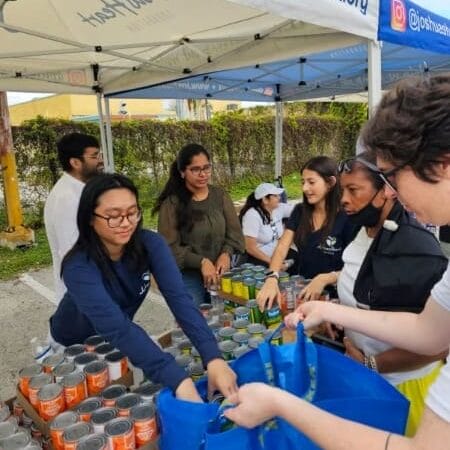
At a Thanksgiving food distribution event in North Miami Beach, Lesianne gives out carrots and corn to those in line.
They are focused on impacting a community, and when I saw the look on people’s faces when they would get the food or general support they needed, it sparked my dedication. There was a strong sense of community, something that really motivates me. I really enjoy meeting and working with like-minded people focused on the same goal.
Tell us about your volunteer role with Joshua’s Heart.
I oversee 50 youth leaders, and I manage all of their projects and volunteer efforts on a weekly basis. I also lead bi-weekly meetings through Microsoft Teams, so regardless of anyone’s location, I can keep track of the organization’s goals and ensure that they’re met. And I meet with the executive director to make sure everyone’s on the same page and our efforts are effective.
I recently implemented my passion project and collected over 1,100 pieces of clothing for native Filipinos in Bataan. The Philippines struggles with poverty, and I couldn’t help with food, but I wanted to have a direct impact. So, I told my friends and family about wanting to donate clothes and collected as much as possible.
What are your long-term plans or goals for the organization?
I hope to expand Joshua’s Heart to not only provide food, but help in other ways like raising money for things that people need to support themselves, like skincare. I’m just hoping to bring attention to other types of support that someone in the community might need.
What’s been the most rewarding part of your work?
It’s the people you meet on the way. Doing these service projects really creates that sense of community and helps you build relationships. It’s a great motivator. All the networking and everyone you meet just stays with you as you volunteer. And there’s a peace of mind that comes with helping someone who is struggling.
What have you learned through your experiences as a volunteer?
Not everyone is able to sustain themselves, and it’s important to not only get involved in your community, but also necessary to be able to adapt in order to lead, organize and effectively communicate.
Why is it important for others to get involved with causes they care about?
It not only heightens your awareness of what reality is for a lot of people, but it helps you strengthen your ideals and morals. And it helps you shape your goals. I think the exposure to so many different people and issues is important. It’s important for people to contribute something to help their community.
Lesianne (front, second from right) and fellow volunteers celebrate packing 15,000 meals for those in need for Global Youth Service Day.
Any advice for people who want to start volunteering?
It’s a great opportunity to get to know like-minded people; it really helps motivate you. I think it’s best to start with something local, so you can not only be more comfortable but also build on something you’re familiar with.
What do you want people to learn from your story?
Your reality might not be someone else’s reality, and it’s best if you help people who are not as privileged. I want people to be aware of what life is like for a lot of people, and find the best way to contribute. Help in any way that you can, even if it’s in a small way with one or two families. It makes a big difference.
Bringing Joy and Comfort to All Ages Through Pet Therapy Across South Mississippi
Meet Daily Point of Light Award honoree Patsy Thomas. Read her story, and nominate an outstanding volunteer or family as a Daily Point of Light.
Patsy Thomas, the founder and president of Visiting Pet Teams of South Mississippi, has dedicated over two decades to spreading joy and comfort through the love of therapy dogs. Patsy’s initial efforts to introduce therapy dogs to hospitals were met with resistance due to strict regulations. However, with determination and support from fellow volunteer Beth, they successfully advocated for the inclusion of therapy dogs at Gulfport Memorial’s inpatient rehab center.
In the aftermath of Hurricane Katrina in 2005, Patsy saw an even greater need for the healing presence of therapy dogs along the Mississippi Gulf Coast. Determined to make a broader impact, she founded Visiting Pet Teams of South Mississippi in 2006. Collaborating with the Humane Society of South Mississippi and the ASPCA’s Joe Elmore, she began recruiting and organizing volunteers to bring the comfort of therapy dogs to more people in need. Their first recruitment event at the “Christmas Pictures with Santa” fundraiser garnered significant interest, leading to their first official meeting in January 2007.
Under Patsy’s leadership, the organization flourished. By 2009, it had grown so large that it outgrew its initial meeting space at the Humane Society and became a standalone 501(c)(3) nonprofit organization. They established partnerships with local nursing homes, launched a reading program and held their first graduation ceremony with Joe Elmore as the guest speaker. Patsy’s dedication and passion attracted numerous evaluators and volunteers who shared her vision, ensuring the continued growth and success of the organization.
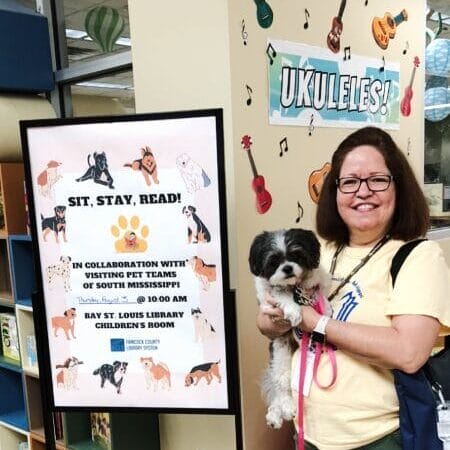
Patsy and Panda at Bay St. Louis Library, getting ready to read with the kids.
Today, the organization boasts 30 registered members and their therapy dogs, who visit local hospitals, including the VA Medical Center, nursing homes, hospice centers and libraries through their “Sit, Stay, Read” program. Patsy’s current therapy dogs, Panda and Sophia, particularly enjoy their time at the libraries, attentively listening to children read aloud.
Read more about Patsy’s journey of growth in leadership with this cause, and why it’s so close to her heart.
Tell us about your volunteer role.
I’m the founder and president of Visiting Pet Teams of South Mississippi. We – myself as well as our 30 volunteers – train our therapy dogs and then bring them for visits to people of all ages, including at the VA Medical Center, an Air Force base, nursing homes, hospice centers, libraries, behavioral care centers and more. I started with a therapy dog who has since passed, but now I have two others, Panda and Sophia, who come to the libraries with me and love the kids.
When I created the group, I was also the coordinator. Then in 2018, I handed that role off to someone really nice who handles that. I do the backend stuff, including the social media, as well as coordinating all the graduation stuff. We had 22 dogs graduate during our last graduation!
Tell us a little bit about the growth of the organization that you’ve seen over time.
You have to have an evaluator to evaluate these dogs, which are evaluated every two years because – like people—they change, they get tired, they get older. We had a woman from Louisiana and she would come all the way over here and evaluate our dogs. She was really awesome; she would schedule her chemo appointments around the evaluations, which was how hard she was trying to help our group. Today, we have four evaluators, so we’re not short of evaluators anymore!
I can’t tell you how many people have gone through our program at this point, but it has to be hundreds. Everyone thinks their dog can be a therapy a dog, so we invite them to our new member orientations. Then, about 50% of those people get registered and help us with the visits. We also have member meetings once a month where we talk about any new rules or regulations as far as pet therapy goes.
Why is this issue so important to you?
Dogs are a great distraction. In a hospital, for instance, everything disappears except for the dog. Dogs are so genuinely affectionate. They don’t care about how someone looks or about their sickness. They are there to uplift the person. And it works 100% of the time. It’s almost a spiritual thing, like their spirits connect. When we leave, you can tell the difference – just how much joy the person has after time with the dog.
What inspired you to get started with this initiative?
My journey began in 2002 when I became a Pet Partner with my first therapy dog, Emma Lou, a sweet and intelligent rescue from the Humane Society. I had been an older student at University of Southern Mississippi, finishing up my degree, when I got a little flyer in the mail about a hospital that was doing pet therapy. I thought to myself, I’m going to do that one day. At the time, I didn’t have a dog, but later I got Emma Lou, a Golden Retriever and Chow Chow mix. She was a little mutt, and she was perfect.
At first, Beth and I were visiting at nursing homes, and they needed all the help they could. Then I was talking to her about the hospital flyer I had gotten, and we both thought we’d love to contribute to the rehab and pet therapy they do. But then Hurricane Katrina came along – we’re coming up on our 20th anniversary of that. Everything was devastated, and our community was so sad and so hurting. We were having food brought in from other states. The children couldn’t go to school. It was terrible. About a year after the hurricane, I wondered how we could contribute in a positive way, and a simple way.
We decided to talk to Gulfport Memorial Hospital, in the second largest city in Mississippi. They’re a hospital; they have infectious control. They were worried about dogs being in there, and they had a lot of pushback. But the lady they had in there said, “let me see what we can do.” I believe her involvement gave us the encouragement to go other places and really expand. The ASPCA sent a person down from their organization to help our local Humane Society, which was overflowing at the time.
We were a grassroots organization to start, and in one of our first events, we had this little room busting with 40 people! We grew exponentially and eventually started to branch out from The Humane Society. We went out on our own and then created a nonprofit, which was such a feat, and I was still working full-time while doing this. But after all the work and paperwork, we were able to do this.
What’s been the most rewarding part of your work?
The rewards are that I’m getting more people involved in pet therapy. It’s not just me – we’re expanding. So many people contact us after they see our graduations on television, and they want to get involved. There are a lot of hurting people, and it’s not just the people we visit, it’s also our members. Sometimes the volunteers need to belong to something, and along with the love of their dogs, they find purpose in the pet therapy role.
What do you think your favorite breed of dog is?
I would have to say Shih Tzu. Every one of them I’ve met so far has been so calm, so gentle and so kind-natured. They just have a loving look on their face toward everyone they meet.
Why is it important for others to get involved with causes they care about?
A lot of people in our group are retired, and they’re looking for purpose in life and pet therapy can give that meaning in life, to serve someone else. A lot of these people love their dogs. They love traveling and doing things with their dogs, so if they can be together and help others at the same time, it can really give meaning to these volunteers, as well as the people we visit.
Any advice for people who want to start volunteering?
Pet Partners is a national organization, so anyone who wants to do pet therapy can go to the website as the first step. I’d encourage people to take a close look at their dog. There are two types of dogs: a personal dog and a community dog. Look deep inside to see if your dog really loves you, or also truly likes other people!
Empowering the Chinese Community with Heart Health Awareness
Meet Daily Point of Light Award honoree Ivy Kam. Read her story, and nominate an outstanding volunteer or family as a Daily Point of Light.
Volunteering with the American Heart Association (AHA) offers Ivy Kam, a former clinical pharmacist in a cardiovascular clinic, a chance to connect with people. Her dedication to promoting heart health within the Chinese community has grown through her involvement with the AHA Chinese Community Cardiac Council. This subcommittee of bilingual volunteers undertakes a range of activities, from visiting senior centers for Chinese language health talks to creating multimedia campaigns for stroke awareness. These initiatives are vital for reaching Chinese immigrants who often miss out on education and outreach developed in English for the general public.
For the past 18 years, Ivy has volunteered with the AHA, serving on multiple health equity councils. She is fiercely passionate about creating messaging that resonates with her specific audience. Her current role with the AHA Chinese Community Cardiac Council, which she once chaired and now actively participates in, involves a range of responsibilities.
One recent example of Ivy’s impactful volunteering is her involvement in the San Francisco Lifeline Program. This door-to-door outreach program, conducted in partnership with a paramedics volunteer group, aims to assist monolingual Chinese seniors in setting up medical information to ensure timely access by first responders during emergencies. Ivy coordinated a group of Regeneron employees from the Asian & Pacific Islander Employee Resource Group and their family members to participate in several distribution days across San Francisco’s Chinatown. Thanks to the efforts of volunteers like Ivy, the SF Lifeline program has reached over 700 seniors in 2023-24, significantly enhancing their safety and well-being.
Ivy’s inspiring work not only educates and empowers the Chinese community but also bridges the gap between healthcare resources and those who need them most. Read on to hear more of her story in her own words.
Ivy Kam is dedicated to spreading heart health awareness in her Chinese community and beyond.
Tell us about your volunteer role.
I’ve volunteered with the American Heart Association (AHA) on various health equity councils serving underrepresented patients, and as a bilingual outreach educator for the past 18 years. Being born and raised in Hong Kong and fluent in Cantonese, I’ve always seen getting involved in empowering the Chinese community on the health equity front as a natural extension of my professional calling.
I started out in my first volunteer activity giving presentations about blood pressure and heart health at senior centers in San Francisco Chinatown in 2006, where there’s an ongoing shortage of bilingual healthcare providers and educators. In 2008, I joined the AHA’s Chinese Community Cardiac Council (CCCC), and served as the chair of this Council from 2016-19, steering efforts closing health inequity gaps in cardiovascular health in the San Francisco Bay Area’s Chinese community, including CPR training, Chinese language media campaigns (TV, print, etc.), senior center outreach and elementary school healthcare career days, translation review and more.
One recent activity that’s very meaningful to me is the ability to engage our Asian and Pacific Islander (API) Employee Resource Group (ERG) members in the Bay Area in a door-to-door outreach program in San Francisco with the paramedics volunteer group for the Lifeline Program, where we visited monolingual Chinese seniors to help set up medical information to facilitate timely access by first responders during medical emergencies. The Lifeline program reached 700+ seniors in 2023-24!
Why is this issue so important to you?
This activity is particularly important to me because during the pandemic, this vulnerable population suffered heavily from the “double whammy” of the COVID pandemic itself as well as rampant anti-Asian hate and violence targeted at the senior Chinese community. Even as they become sick, there’s reluctance to seek care due to the fear of xenophobia. There’s also the common misconception that Asian patients are typically “healthy” and “wealthy” and not as hard hit by the pandemic, but data shows that the impact of the pandemic is extremely varied across different Asian subpopulations, and death rate in these vulnerable seniors who often reside in 10’x10′ single resident occupancy units was high and commonly overlooked. Serving this community while busting this “model minority” myth is core to not just my personal beliefs but part of our API ERG’s mission as well.
What inspired you to get started with this initiative?
My work with the AHA CCCC started out as a way to utilize my language skills to work directly with Chinese patients, something I missed since joining the biotech industry from a clinical job (I was trained as a Pharm.D. and I used to run a clinic at Kaiser.) It evolves into a deeper desire to understand how I can advocate for health equity and address injustices faced by this vulnerable community, which led to a series of events during the pandemic that contributed to me and a few other like-minded colleagues co-founding the API ERG at Regeneron to advocate for our community.
What are your long-term plans or goals for the organization?
The opportunity to bring this volunteering efforts to other API ERG members is very gratifying. Knowing that I have like-minded colleagues who would give their time to serve the same cause and not only help amplify the impact of our volunteering efforts, but also help improve our sense of belonging at work, means so much. My hope is that we can continue to explore opportunities to work with colleagues across the country who are interested in volunteering in the API community to cascade these efforts to other geographic areas and continue to amplify the impact of these efforts.
What have you learned through your experiences as a volunteer?
What I’ve learned through volunteering is that even though you may feel that you’re only one person and your impact may be small, your actions can often serve to inspire and bring others together for a much more impactful movement. For us it’s an employee resource group, but it could be something more informal as well.
Any advice for people who want to start volunteering?
I think one of the keys to having a productive and gratifying volunteering experience is finding other like-minded folks to do it together. Not only do you amplify the impact, I’ve personally found that it’s also fun and fills up my personal cup while doing so!
Meet Daily Point of Light Award honoree Paul Griffith. Read his story, and nominate an outstanding volunteer or family as a Daily Point of Light.
Paul Griffith is a self-described gearhead who enjoys the arts. More than anything, he loves spending time with his family. He drives 40 minutes to visit his mom once a week, something he hopes to increase after he retires from his career in the oil refining industry in a few short weeks.
Another priority for his upcoming free time will be going back to school for a teaching degree. Paul wants to be a junior high substitute history teacher, to use his life experience to add context to the subject that he didn’t enjoy as a kid. He has always cared deeply about children. As well as having three of his own, he has been a Court-Appointed Special Advocate (CASA) for children in the foster care for over 15 years.
CASA is a national nonprofit that pairs volunteers with children in the foster care system under the jurisdiction of the court to help them through challenges associated with living in the system. Paul has been a friendly face and a guiding hand for kids facing highly difficult circumstances. His efforts sometimes end in disappointment or even tragedy, but on the occasions everything goes well, he sets kids up for a successful, independent future.
What inspires you to volunteer?
I’m thankful for all the opportunities I’ve been afforded. I got into the oil industry and was paid very well. I was able to take care of my family. I wanted my children to be good, balanced people who understood the opportunities they had in life. The best way to do that was to teach them, not just using words but by example. I also wanted to give back to my community.
Tell us about your volunteer role as a Court Appointed Special Advocate in Solano County and beyond.
We’re court-appointed for a child and given full rights—the court is their legal guardian—until they are in a permanent situation or turn 18 and are, unfortunately, left to fend for themselves. We work with social workers, educational advocates, medical advocates and the transitional advocate social workers to help these children prepare to become adults.
That includes helping them navigate emotions, trying to find family members who could become guardians and helping them deal with the transition. The top priority of the court is reuniting them with a parent when possible. Unfortunately, a lot of the parents are dealing with drug addiction or mental health issues.
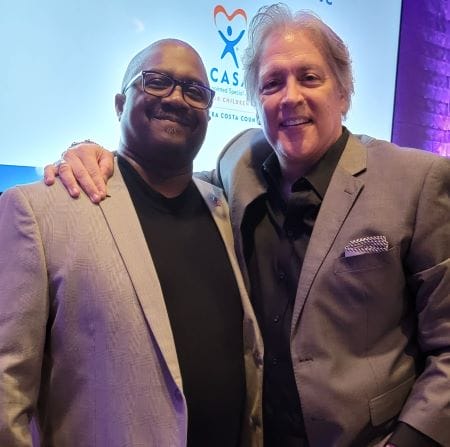
Paul (left) visits with journalist Dan Ashley at a CASA fundraiser.
We typically meet with a child and first spend time trying to break through and make a connection. People they’ve trusted in the past have not done what they should have done. There’s also a lot of abuse that goes on. They have to move a lot, so they learn to adapt and not hold on to the simple things that most children would, like toys. For them, it’s the survival stuff, like socks and underwear.
They’re given maybe an hour to gather all their belongings in a couple of garbage bags and move on to the next location. They’ll change schools, too, so we help them with the social aspect of moving. We also write court reports to advocate on the child’s behalf.
Outside of CASA, I also tutor a couple times a week through my library for non-native English speakers. I help them achieve practical language goals. For example, some want to get a better job or be able to help their children with homework.
What are some of the main ways that your CASA role differs from social workers?
Most of the time, social workers see the children once or twice a month, whereas we are there once a week. Social workers have a caseload of 25 to 30 children. For us, one to two is usually the limit, so we can be more focused and fill the gaps.
Every six months, there is a court hearing called a permanency hearing to find out if we’ve made any progress in finding a relative or friend willing to take the child more permanently. So, part of our job is having conversations and researching behind the scenes to see if there is a viable candidate for guardianship or fostering.
What’s been the most rewarding part of your work?
The most rewarding part is to see them grow to their potential and become self-sufficient adults. Most kids initially think we’re getting paid, and when they find out that we’re not, they’ll be like, “So you do all that just to help me?” Seeing that connection, that bond and then seeing them being able to open up and trust someone, is a great reward.
What have you learned through your experiences as a volunteer?
I’ve seen some of the worst behaviors of people and the scars that have been created for children of generations to come. But I’ve also learned of the resiliency of children, of those who go on to have a normal functioning life. I’ve learned to appreciate what I have.
How can someone sign up for CASA in their own area?
Just about every county has a CASA program, and they usually offer training several times a year. Training takes six to eight weeks, and they try to prepare you for all of the nuances of what it’s going to entail.
Why is it important for others to get involved with causes they care about?
Doing things for others gives us that connection to other people. We need that. We were made to be a part of a community or tribe, and when we don’t have that, it can be traumatic, especially for a child. And it creates adults who are in a lot of need, pain, suffering and silence. I believe the greatest gift that you can give is yourself.
What do you want people to learn from your story?
We need people who are willing to give, especially their time. The things I remember most about my childhood aren’t the gifts I got for holidays. They’re the moments with family. As we get older and wiser, we see how important those connections, experiences and times with family were. Everyone should have an opportunity to have that.
Do you want to make a difference in your community like Paul? Find local volunteer opportunities.
Growing Community Through Gardening
Meet Daily Point of Light Award honoree Caryle Snyder. Read her story, and nominate an outstanding volunteer or family as a Daily Point of Light.
Community gardens have gained popularity over the years. They benefit many people, including those learning about agricultural practices as well as those needing access to fresh produce. It requires a lot of effort, but Caryle Snyder, 80-year-old retired OB nurse practitioner, is used to pitching in. When her grandkids were young, she’d pick them up from school and watch them until their parents came home before leaving to work the midnight shift.
Caryle has also been volunteering with Heart + Hand Outreach Ministries for nearly a decade, doing her part to drive programs like the community garden benefitting the organization’s food pantry. She’s had a hand in creating an heirloom seed library, running their clothing closet and maintaining her church’s landscaping. This grandmother of five knows it takes a village and dedicates her time to helping out hers.
What inspires you to volunteer?
My husband got me started. He got involved and then got me down there. When they bought a new building, I started by helping them paint. One thing led to another, and it went from painting to supplying the store to working with the clothes to working with the food pantry. And we did food baskets for kids in middle school.
Tell us about your volunteer role with Heart + Hand Outreach Ministries.
About 10 or 12 years ago, the church decided to build a little community garden. A few of us decided we wanted to participate, so we got together and put up a fence. Everybody had a basic plot or plots, however many you wanted. Through the years, people stopped. There were plots available, and we were working with Heart + Hand, so we decided to let them have the unused plots. That’s how they got involved.
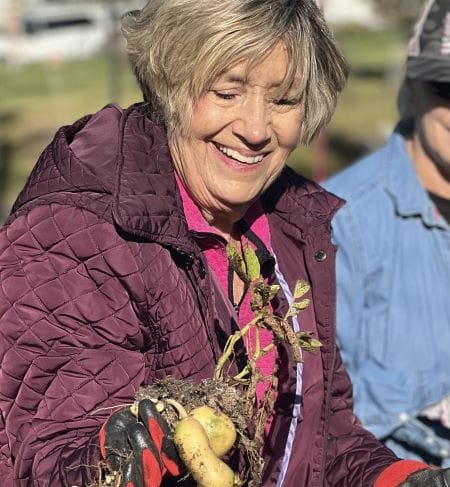
During harvest at the community garden, Caryle (left) and a fellow volunteer dig up potatoes for the food pantry at Heart + Hand.
Now, it’s mostly raised beds on less than a quarter of an acre next to our church parking lot. We just got through digging potatoes, and we have a plot of corn the raccoons have gotten into. We’re getting beans, corn, squash, cucumbers, and we’ll have tomatoes. They’re beginning to ripen now.
We also started a seed library using an old card catalog. In the early spring, we put seeds in, and they are free for anyone who wants them. We just ask that they help keep it replenished by bringing back seeds from what they grow. And I manage the landscaping around our old stone church.
How many community garden volunteers do you have?
We had a lot early in the spring. A group of college students came down on a bus, and we’ve had several groups of high school kids. They dug potatoes for us. All the kids that have come really seemed to have enjoyed it. I think it’s fun for them to see different things grow. Last year, when we were starting, we had kids help us put the raised beds together. We had some stuff growing up there in the late summer and early fall, and they asked, “What’s that?”. They didn’t know what asparagus looked like before being harvested.
What are your long-term plans or goals for the organization?
We’re hoping to put up more raised beds and grow a few more things that we haven’t had this year, but we’re just going to have to try and see. It’s hard to believe when you have a fenced in garden that’s 12 feet high that raccoons can get in.
What’s been the most rewarding part of your work?
People can get what they really need. Heart + Hand even pays utilities for certain people. We can cover just about anything. Right now, we’re getting ready to give out school bags.
In October, we have a Walk for Hunger. The money raised helps buy food for people. We have a store. When someone’s house has burned or something has happened to them where they don’t have money, they can come in and pick out clothes. We sell furniture. We give away furniture. We take old furniture. We’re always picking up furniture or clothing or whatever it is. If somebody really needs something in our area, we can provide it.
Right now, I’m concentrating on the garden, but around October, I’ll probably be doing clothing or school bags. I won’t just quit when growing season is over.
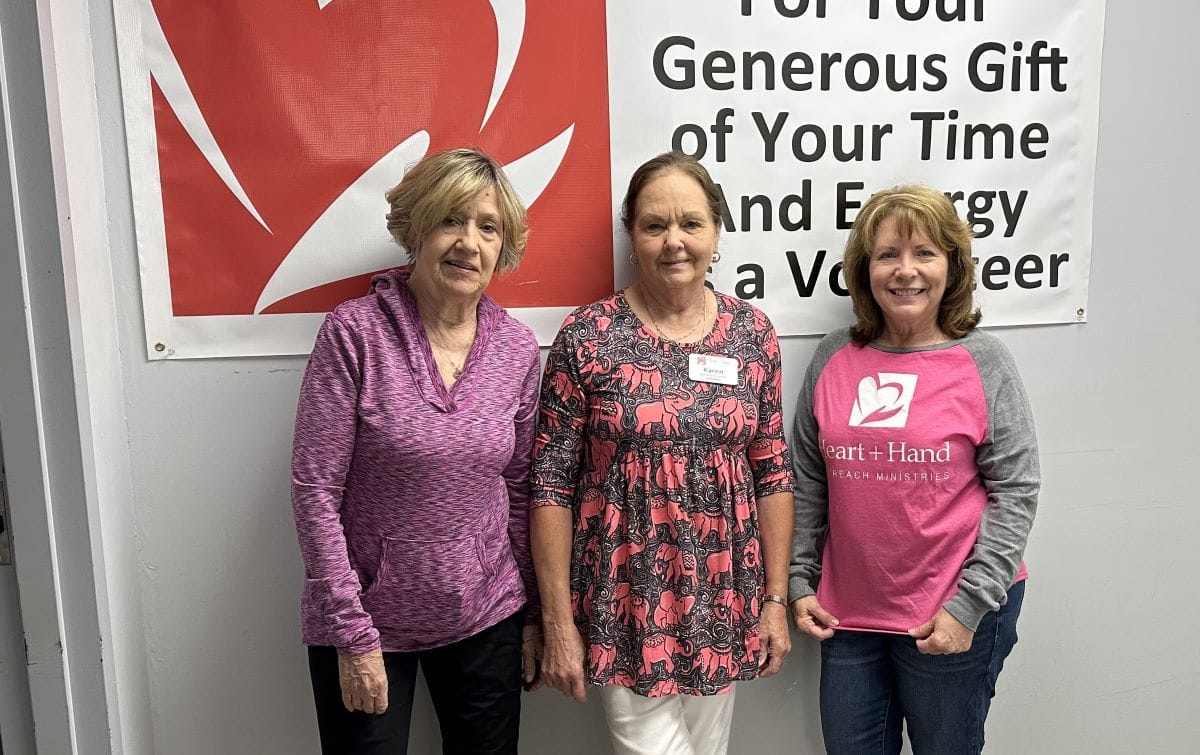
Caryle (left) and fellow volunteers keep Clothing Closet, a program that connects those in need with free clothes, running.
What have you learned through your experiences as a volunteer?
I’ve learned how close people in need actually are. I’ve seen people come from around our church, and you would never dream of it. It surprises me about how people are living. It doesn’t always show outwardly. Working there, I’ve also learned what you can give away and what you can’t.
Why is it important for others to get involved with causes they care about?
It makes the person doing it feel better, but it also helps the person in need.
What do you want people to learn from your story?
In volunteering, you’re volunteering your services, but you’re learning at the same time. And you’re helping lots of different people in many different ways. You’ll be happier for it.
Do you want to make a difference in your community like Caryle? Find local volunteer opportunities.