Advocating for Huntington’s Disease Awareness and Mental Well Being
Meet Daily Point of Light Award honoree Chelsea Roberts. Read her story, and nominate an outstanding volunteer or family as a Daily Point of Light.
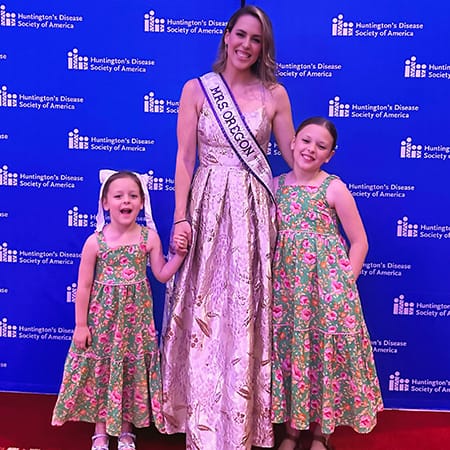
Chelsea Roberts is a mother, non-profit social media manager, award-winning painter and trail runner – not to mention holds the title of Mrs. Oregon International 2024. But with all of these responsibilities on her plate, there’s one cause she continues to devote her time to: finding a cure and raising awareness for Huntington’s Disease.
Chelsea’s involvement with the Huntington’s Disease Society of America (HDSA) shows a fierce dedication to health advocacy. Having personally experienced the impact of Huntington’s disease, with her mother and grandmother passing from the disease and her brother and sister carrying the genetic markers, Chelsea has been a steadfast volunteer with the HDSA for nearly a decade. She served as the vice president for the Board of Directors for the Utah Chapter and now leads the Portland Oregon Chapter as the affiliate head. For the past three years, she has chaired the Team Hope Walk in Portland, dedicating her time daily to securing sponsors, organizing entertainment, advocating for donations and raising awareness through social media.
As an Eco-Warrior and Mental Health Advocate, Chelsea’s impact extends further. She is certified in Mental Health First Aid, empowering her to support others and foster mental health awareness in her community. Drawing from her personal experiences, she actively works to empower women and promote mental well-being.
Read more about Chelsea’s relentless commitment to these causes, devoting approximately an hour of volunteer work every single day.
Chelsea Roberts uses her platform and influence as Mrs. Oregon International 2024 to spread awareness about Huntington’s Disease.
Tell us about your volunteer role.
I have volunteered with the Huntington’s Disease Society of America (HDSA) organization for almost 10 years now after the passing of my mother to this devastating disease. I was the vice president of the Board of Directors for the HDSA Utah Chapter prior to moving to Oregon and now am the “Portland Team Hope Walk” chair. This is my fourth year in leadership for a “Team Hope Walk” and I am so grateful for all the community support and local volunteers to make this annual fundraising event a success.
Why is this issue so important to you?
When I was 8 years old my mother was diagnosed with this horrible disease that is best described as having Alzheimer’s, ALS and Parkinson’s all at the same time. Throughout my childhood, her condition slowly deteriorated and when I was 19 she passed away from complications. To watch someone you love and admire demise to complete dependency was heartbreaking. Since the recent diagnosis of both of my siblings to this genetic disorder, my resolve to support those affected and ultimately find a cure has strengthened further.
What inspired you to get started with this initiative?
The motto for my platform as Mrs. Oregon International and the HDSA is “Family is Everything” and it basically sums up completely why I do what I do daily – for the four generations Huntington’s Disease has affected just my family alone. After my Mom’s passing I chose to test for the genetic marker. My results came back negative; I do not have the disease and cannot pass it on to my children. This news, although wonderful, left me with an immense amount of “survivor’s guilt.” I resolved to use this gift and make a true difference, let my voice be heard and advocate for awareness to find a cure.
What are your long-term plans or goals for the organization?
I have big plans to continue to build the Oregon HD community and establish an official HDSA Oregon Chapter. Thankfully this is already in the works. I also have plans to grow my social media “Let’s Talk About HD” series by partnership and look forward to advocating for this cause on an international level when I compete for the prestigious title of Mrs. International next month in Kingsport, TN.
What’s been the most rewarding part of your work?
There have been some wonderful milestones in my work but most recently my social media videos inspired a family to get tested for this disease. This test, and the news they received, helped answer so many questions. I’m grateful for the ability to advocate for awareness and support to our amazing HD warriors and their superhero caretakers.
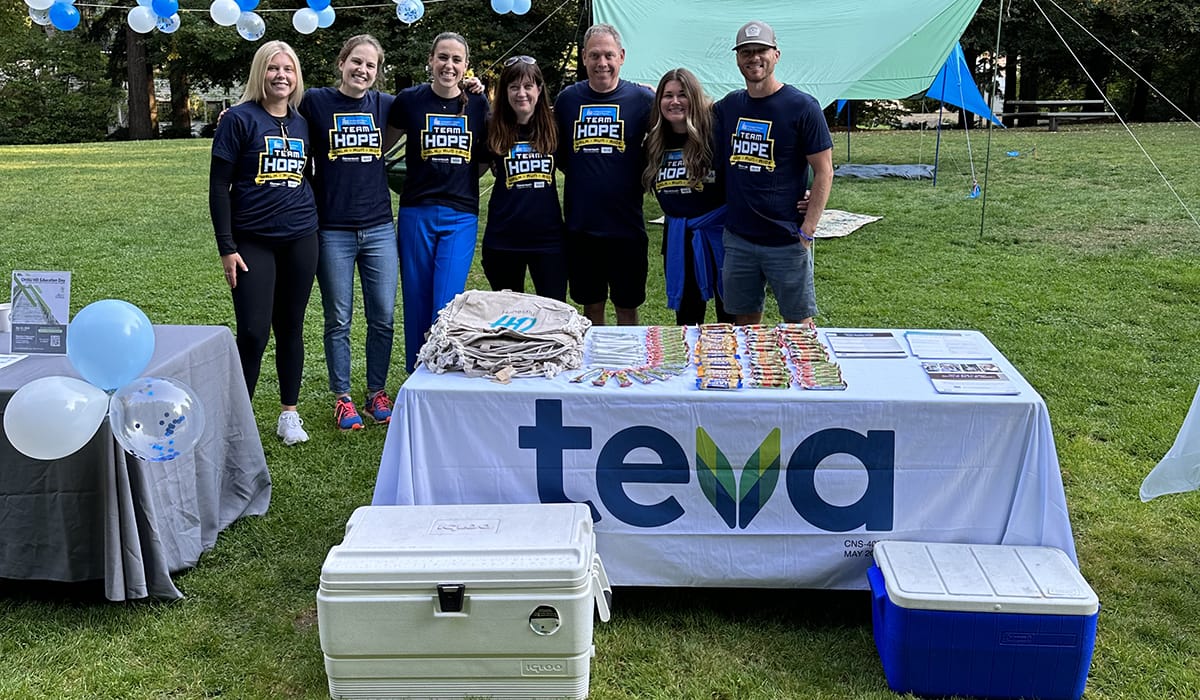
The Leadership Team gathers together at the Portland Team Hope Walk, with Chelsea in the center.
What have you learned through your experiences as a volunteer?
I have learned that small simple acts of getting involved or “trying” to make a difference really do matter and add up to create momentum for change. Never think your sacrifice doesn’t matter.
Why is it important for others to get involved with causes they care about?
If everyone gave just five minutes a week to volunteering or giving back, imagine what this world could accomplish. Imagine all the good, all the collaborations of kindness, all the smiles of gratitude. Volunteering makes this world a better, more beautiful place.
Any advice for people who want to start volunteering?
Just get started. Find something you are passionate about and act now.
Journey from Equine Therapy Participant to Passionate Volunteer
Meet Daily Point of Light Award honoree Tressie Hoffman. Read her story and nominate an outstanding volunteer or family as a Daily Point of Light.
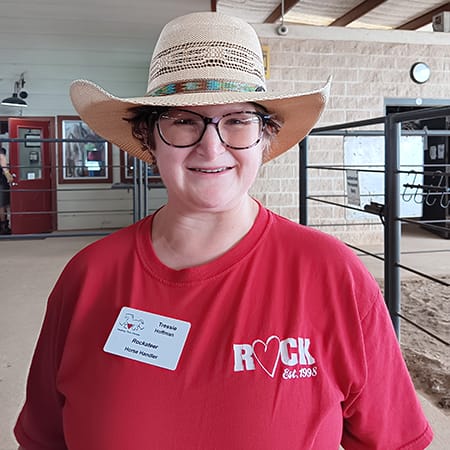
Tressie Hoffman has loved horses for as long as she can remember. Growing up with a learning disability and a rare genetic condition known as Rubinstein-Taybi syndrome, horses provided her comfort.
“I just love being around them,” the 27-year-old said. “They make me calm and happy every time I’m around them.”
This connection with horses led her to Ride on Center for Kids (ROCK), a nonprofit in Georgetown, Texas, that provides equine-assisted therapy to individuals navigating physical, cognitive and emotional challenges. Initially joining as a participant, Tressie’s time spent riding horses became a catalyst for personal growth, nurturing her both physically and emotionally. However, her journey didn’t end there.
As she continued riding, she discovered a profound admiration for the dedicated volunteers who supported her every step of the way, igniting within her a desire to contribute back as a volunteer herself. So, in 2016, she started doing just that.
“When Tressie first started, her goal was to be a horse handler and it was a long journey,” said Susy Turnbull, volunteer coordinator at ROCK. “She started out as a volunteer scooping poop and sweeping the sidewalks, and then she started opening and closing gates. Then she started grooming horses and picking hooves. Now, she independently leads a horse.”
Tressie has been a volunteer with Ride on Center for Kids since 2016 and has dedicated over 1,500 hours at ROCK.
“Tressie, with her goals in life, her willingness to take risks and learn, and the support she gets here, we’ve been able to see her gain a lot of independence and grow,” Susy added.
Volunteering three days a week for roughly six hours each day, Tressie has dedicated over 1,500 hours at ROCK, wearing multiple hats in various roles. As an arena assistant, she ensures the smooth operation of the arena, from cleaning to managing gates. In her role as a pit crew member, she prepares the horses for classes, grooming and tacking them. But her favorite role is that of a side walker, where she provides careful support to riders during their lessons.
“I enjoy all the tasks, but I do really enjoy the role of being a side walker, which is basically the person who goes along with the rider during their lesson to make sure the rider stays on and safe on the horse,” Tressie said. “Volunteering at ROCK has given me the courage to be around people and brighten everybody’s day.”
While Tressie credits ROCK and the horses for her growth, Susy emphasized the vital role of volunteers like Tressie, praising her infectious energy.
“When she arrives, the first thing she does is runs around and gives everybody a hug,” Susy said. “Because of volunteers like Tressie, we’re able to empower children to gain independence by riding horses.”
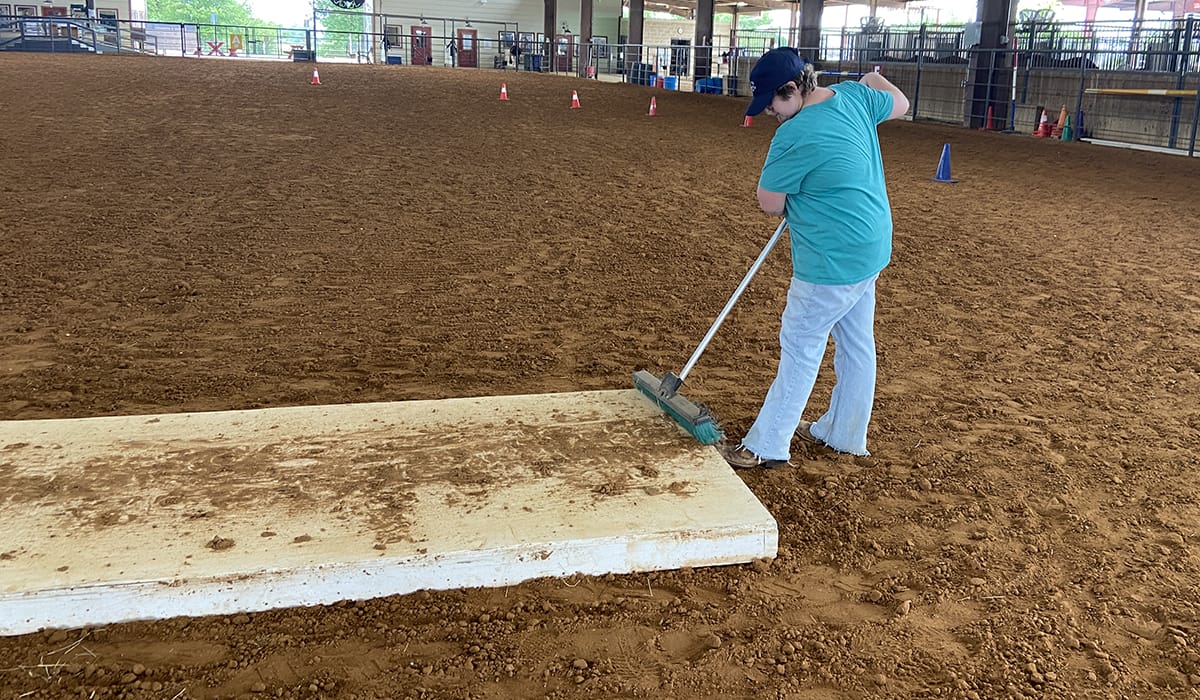
Tressie sweeps dirt off a bridge obstacle inside the horse-riding arena as one of her volunteer duties. /Courtesy Tressie Hoffman
Tressie hopes that her story will encourage people, regardless of their circumstances, to embrace volunteering.
“I hope people learn that anybody can volunteer even if they have a disability. Each person has a unique journey and story to share, just like me. I hope my experience encourages to do the same.”
Meet Daily Point of Light Award honoree Sarah Langland. Read her story, and nominate an outstanding volunteer or family as a Daily Point of Light.
When Sarah Langland and her partner moved to Culpepper, they were seeking the solace of living in the proverbial “middle of nowhere.” Despite her desire to live rurally, Sarah is heavily involved in her community. Her work as the events coordinator for the Culpepper Chamber of Commerce allows her to help support local businesses and nonprofits. And her discovery of Girls on the Run Piedmont has led her on a volunteer journey filled with purpose.
Girls on the Run is a national organization that implements programs for young girls to learn life skills—managing emotions, fostering friendships, expressing empathy, etc.—while building self-confidence and training for a 5K. Sarah has been a coach since 2016 and a board member and chair since 2021. When she’s not building up the next generation of women, Sarah sings in a community choir and lives out her rock star dreams at karaoke.
What inspires you to volunteer?
I come from a family that is big on getting involved in the community, so from a young age, I remember volunteering. I met the executive director of Girls on the Run after her presentation at a nonprofit meeting. I had a difficult time with friends and bullies as a kid, and it sounded like this program really could have helped me out had it been around back then.
Tell us about your volunteer role with Girls on the Run Piedmont.
I started as a Heart & Sole coach for girls in 6th through 8th grade. My job was to inspire, motivate and cheer. We run a 10-week program in spring and fall with meetups twice a week for girls in 3rd through 8th grade. During that time, they train for a 5K. For a lot of them, it’s their first.
While training to run, we teach them life skills when they’re young, so when they get older, they’ve already got them in their tool belt. We help them make healthy choices, both emotionally and physically. They play games, do homework as a team and get to know each other. They have a journal to keep track of laps, so they can see their fitness progress. But it’s also a workbook, so that they can revisit lessons they’ve learned.
I eventually joined the board, and that same year, I became the board chair. Since then, I usually coach the summer camp, a program with five half-days. As board chair, I help with fundraising, outreach and overall strategy. Last year, I had an opportunity to represent Girls on the Run at the Virginia PTA conference. I got to connect with teachers and parents from across the state to talk about the impact we have in schools, and to hopefully get our programs into more of them.
We just had our first Sneaker Soiree, a fundraising gala, and asked one of our first Heart & Sole girls to speak. It was nice to hear how Girls on the Run has helped her. She’s now a college student, but those lessons have stuck with her.
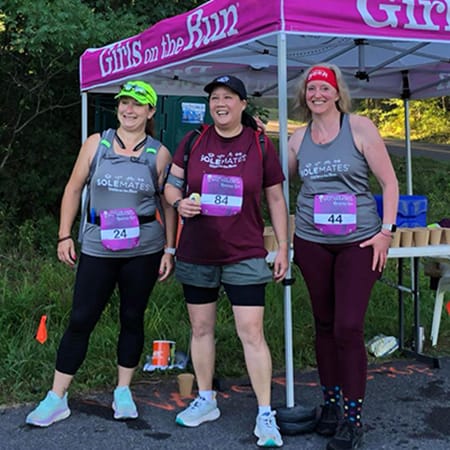
The fundraising SoleMates team–(left to right) Tabitha Riley, a dedicated GOTR volunteer and board members Pam Wons and Sarah Langland–take a water break at the GOTR tent during the 2023 Virginia Wine Country Half Marathon.
Do you often hear from students about how that’s changed their lives?
Many of them. They come back to coach, because they want to pay it forward to the girls coming up behind them. I saw a video that had interviews with girls across the country who have done the program. It was moving to hear their stories of inspiration, because a lot of them may not have come from the best of situations, and it really helped them either navigate their home or school lives, and it still helps them with their relationships today.
What are your long-term plans or goals for the organization?
We just expanded from four counties to seven or eight in the last couple years, so we have plans for expanding ambassador programs and program coordinators to help them facilitate. We can look at the next five years and see what that looks like, but we haven’t come up with that plan just yet.
What’s been the most rewarding part of your work?
We’ve helped so many girls over the last 10 years. Knowing that there are people out there who are like me when I was young, and that we’re giving them those tools to find confidence, is very rewarding. And when I hear their stories, I’m reminded of why we do this.
What have you learned through your experiences as a volunteer?
When you’re coaching these programs, it’s really hard not to absorb the programming yourself, and it’s just always a good reminder of how to express our feelings or how to have confidence in ourselves.
Tell us about future partnerships, programs or events that you are excited about.
We’ll start planning our Sneaker Soiree again next month for March of next year. And our fall 5K is in November. All the girls from all the different schools will be coming together for the 5K they’ve been training for all season. It’s so rewarding to see that, because they start off saying, “I can’t run that far,” to saying, “Wow, I just crossed the finish line!”
Why is it important for others to get involved with causes they care about?
It’s just what I like to do. When you’re volunteering for a cause you’re passionate about, you’re not just sitting back and being unhappy with the way things are. You’re actually a part of the change. You can make a difference for that one person, and it will have a ripple effect that you’ll never see.
What do you want people to learn from your story?
Follow your passion. Being passionate about helping my community has gotten me to where I am with my job as well as board chair of Girls on the Run Piedmont. By doing that, I’ve met some amazing people. I have helped a lot of people. Everybody has limitless potential. You just have to tap into that and remind yourself that you can do whatever you put your mind to.
Retiree Makes a Difference in the Lives of Texas Animals One Paw at a Time
Meet Daily Point of Light Award honoree Shannon Smock. Read her story, and nominate an outstanding volunteer or family as a Daily Point of Light.
To her fellow volunteers and the staff of SPCA of Texas, Shannon Smock is the heartbeat of their community. Smock serves the longest-serving animal welfare agency in North Texas by volunteering in a multitude of roles across three shelters. Whether Smock is orchestrating mobile adoption events or ensuring every pet has access to vaccines and essentials, the retired 68-year-old finds the truest of joys as a SPCA of Texas volunteer.
Smock joined the agency in 2017 when hurricane Harvey resulted in a big need for both volunteers and space to temporarily hold animals in her community. Her previous employer helped house the evacuee’s pets, and Smock never turned back from helping care for all animals.
What inspires you to volunteer?
I’ve always loved animals, since I was a little girl. I worked full time, I had kids and I loved my job; I poured myself into those things. But I would go by the SPCA at its old location on my way from work, and I thought: I’d really like to do that one day. Fast forward to 2017, they put out a shout out for volunteers because of hurricane Harvey. They were going to set up a mega shelter. At the time I was still working, but they contacted my employer to see if they could use some property when they set up the mega shelter; a temporary fencing location to walk these dogs being taken in from Houston.
After setting up, they streamlined the process to be a volunteer. I went ahead and signed up. Getting to watch these people work together was amazing. The evacuees from the hurricane could come stay at the shelter and bring their pets; they stayed at the convention center nearby and we took care of their pets. I gave out treats and helped set up curtains so that the cats would have privacy. We also collected clothes and stuff like that to give to the evacuees. So that’s how I got started, and I’ve been here ever since.
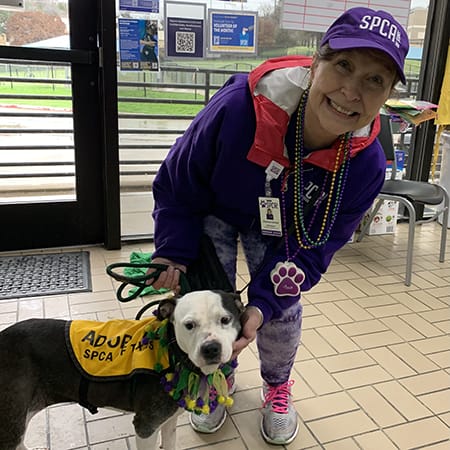
Shannon Smock spends, on average, 29 hours a month with the SPCA of Texas after her retirement in 2019.
Tell us about your volunteer roles with SPCA of Texas?
When I went in for training, I was just blown away. They offered training in everything. I got to be around people who cared deeply around animals like I did, and it was just such a pleasant joy. Back then, I started off doing ten hours of cleaning windows, pods, kitty litter, doing dishes and laundry – stuff that always needs to be done. We did that volunteerism before animal handling. I was trained to handle the happy-go-lucky dogs and the rowdy ones. I also took behavioral training where I could help with the ones who were really fearful and get them ready to be up for potential adoption. I did all of this while still working full time. I loved it. I also joined the sewing group
After 30 years of working at a really wonderful company, I had the chance to retire in 2019. My boss and his wife made a gift to the SPCA and named the adoption lounge for me and my family. It really is the best. Then COVID-19 hit, and the world shut down. The SPCA actually had to close to volunteers just to keep things going with restrictions, how many people could enter the building and keeping space between everyone. Before COVID, I joined the sewing group and we had all sorts of projects. But during the pandemic, we made masks and curtains for the reactive dogs.
My absolute passion is to get animals adopted. I’m also an adoption counselor. That’s really the main thing that I do. I just love it so much. I do counseling, mobile adoption events and I’m also a foster mom. I also help with vaccines and spay neuter clinics. The big thing that the SPCA of Texas does that I’m involved in is the SPCA’s Ellis County Strut Your Mutt – The Race to End Animal Cruelty event. It’s a big fundraiser, and I was asked to serve on the committee. It’s a 3K in a beautiful historic park. Things are given away for animals and for their owners. We also do a big adoption event between Thanksgiving and Christmas, so I volunteer then too. I average around 29 hours a month.
What’s been the most rewarding part of your work?
Honestly, it’s when I can get an animal into a loving home. A lot of our animals come from cruelty cases; we have a whole cruelty investigations team who are amazing. In fact, I adopted our dog Ranger.
What have you learned through your experiences as a volunteer?
So much from my training. It’s incredible. Now I know so much more. When I look back now, I apologize to my former pets for not knowing these things. I’ve learned about dog behavior, cat behavior and heartworm disease; that if a cat gets infected, there’s no treatment and no cure. I learned that people working together can really achieve amazing things, for animals and for people in our community.
Do you have any advice for people who want to start volunteering?
Just go for it. Just show up. If you have a heart for getting involved, it’s the most rewarding thing. It almost feels selfish because of the joy you get out of doing it.
Tell us about future partnerships, programs or events that you are excited about.
We’ve got our Fur Ball in October. It’s a really fun fundraising event. And of course, in November or December, we have the holiday adoption event.
A Look Into the Future: San Diego Teen Seeks to Improve Vision Care Access
Meet Daily Point of Light Award honoree Sydney Zhang. Read his story, and nominate an outstanding volunteer or family as a Daily Point of Light.
Sydney Zhang, 16, was just a kid when he got glasses. As anyone who has been through the experience knows, it’s an important moment, and it changed the way he looked at the world both literally and figuratively.
Today, Sydney volunteers at a local eye care clinic helping patients, many of whom are seniors experiencing vision issues or non-native English speakers who need help translating. He founded a student-run 501(c)(3) called VisionCure in 2023 to prevent common eye diseases amongst seniors and underserved communities through access eye care services and education. They have held 21 learning events so far. Sydney built EyeScore, a specialized app to assist with his mission, raising $3,500 for app development and outreach and garnering multiple national awards in the process.
Along with the 60+ hours a month Sydney spends helping others, he is pursuing an MD-PhD program. He has always been fascinated by science and hopes to combine research and clinical work into a career that uses his biggest passions.
What inspires you to volunteer?
When I was around nine years old, I started experiencing blurry vision and couldn’t see the words on the whiteboard in my class. This is when I started to wear glasses. A lot of my classmates were wearing glasses or contact lenses, too, and I realized how essential vision was to daily life.
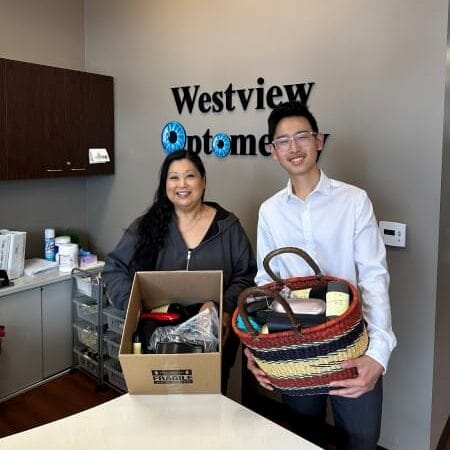
Grace Loyola, Westview’s office manager, and Sydney collect used eyeglasses during a drive he initiated for the San Diego Lions Club. In the end, he donated more than 900 pairs.
In 2019, I started to volunteer at a local eye care center helping patients with vision issues. Our neighborhood has many families with diverse cultural backgrounds, including first-generation immigrants from China and India.
When COVID hit and screen time increased, many of my friends and relatives were diagnosed with eye-related diseases. My mother and grandma were diagnosed with dry eye disease (DED), and at the senior house where my grandparents live, dry eye symptoms became a problem among residents. It’s a common issue. I wanted to help these seniors who have limited access to necessary eye care services.
Tell us about your volunteer role with Westview Optometry and VisionCure.
At Westview Optometry, I started with office cleaning, helping patients check in, paperwork and some Chinese translation. Later, I started helping patients with document scanning and general IT support. I also initiated a used eyeglasses drive and collected more than 900 pairs for the San Diego Lions Club.
I’m the CEO and founder of VisionCure. I lead a dedicated team of 10+ volunteers—students and parents—in outreach to local communities. We host monthly eye care education events, and I work on networking and fundraising.
I also created an app called EyeScore that uses computational algorithms for early dry eye diagnosis from home for free. I published this in a peer-reviewed paper in 2023. Eye doctor appointments can be really expensive. Not enough people get the exams that can be critical, so current diagnosis of DED is often delayed with severe complications. We went to senior centers and demoed it for them as an intergenerational initiative with students.
Can you explain your smartphone app?
Eye blink counts are a proven biomarker for dry eye diagnosis. So, app users take a one-minute video, and then my app calculates their eye blink rates and uses it for analysis along with a questionnaire with their age, gender, contact lenses and where and whether they’re experiencing eye discomfort. The purpose of my app is to produce a single, easily understandable number. It’s called a 10-point scale eye health score. For example, zero to three is healthy, four to six is pre-dry eye disease and seven to 10 is dry eye disease.
What are your long-term plans or goals for the organization?
Based on feedback and observations at our senior center demos, I’ve started to design the 2.0 version of EyeScore to include a multi-language platform to support non-English-speaking families, a better questionnaire and a scaled point system that can better analyze a patient’s responses. I plan to reach out to the broader international dry eye community and publish EyeScore in the Apple App Store.
I also want to continue working with local community organizers serving seniors. My goal is to increase awareness about DED and expand access to the technology patients deserve. In the long term, I hope to grow VisionCure with more volunteers and funding in order to make more contributions.
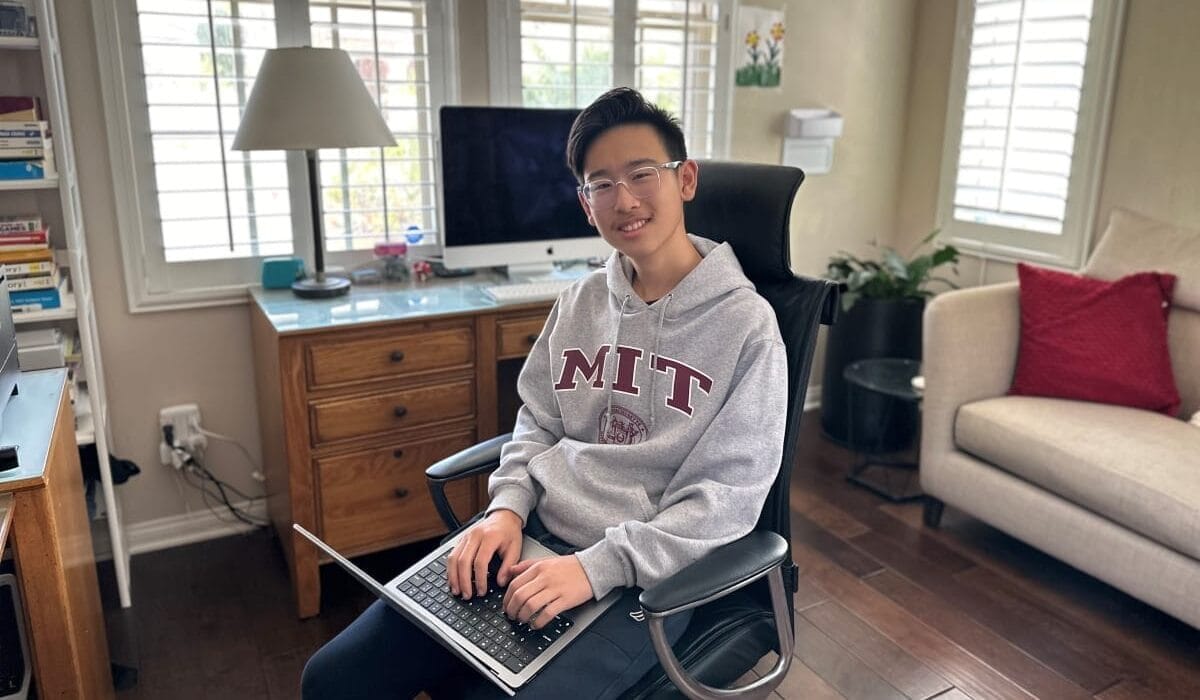
Dedicated to improving community eye care services, VisionCure founder and CEO Sydney Zhang develops smartphone app “EyeScore” for convenient, in-home eye exams.
What’s been the most rewarding part of your work?
Helping seniors. It’s critical for youth to understand how many seniors are in poor health without proper medical services, including eye care. That’s really what pushed me to help.
If you could wave a magic wand and fix something about eye clinics everywhere to make them more helpful for seniors, what would you change?
I want seniors to be able to have the experience of going to the eye doctor. While there, it can take time, and patients are often waiting for the results. If it was one thing, I would just want diagnoses to be fast, so patients can easily understand what they’re going through and get treatment.
I created EyeScore for use at home. There are a lot of issues with health insurance, so not many people actually go to the eye doctor. It’s critical that people get the healthcare they need.
Why is it important for others to get involved with causes they care about?
It was a life-changing experience for me. When people get involved, they realize how impactful their actions can be. For example, when I first demoed my EyeScore app, 20 seniors signed up. They really needed help with their eye health, and my app could do that.
What do you want people to learn from your story?
I want to inspire fellow students to work together for a better world. Start with something small. When you do something small every single day, it builds up to even more meaningful action.
I also recommend working for and learning from seniors. These exchanges can bridge the gap and help benefit society for a more sustainable and brighter future. And I believe that the use of advanced technology, including AI, can be critical tools to address many challenges.
Civilian Thanks Veterans Through His Tireless Efforts at a VA Hospital
Meet Daily Point of Light Award honoree Glenn Hebert. Read his story, and nominate an outstanding volunteer or family as a Daily Point of Light.
Glenn Hebert worked in the Albuquerque, New Mexico broadcasting industry for 20 years before retiring 11 years ago. At that point, he decided he would spend some of that free time doing something meaningful. Although not a veteran himself, Glenn is dedicated to serving veterans to thank them for their service.
The Raymond G. Murphy Veterans Hospital supports veterans in Albuquerque and throughout New Mexico with an all-encompassing list of medical services including psychological care, physical rehabilitation and much more. In addition, it helps get veterans back on their feet through clothing donations, job and housing assistance, and transportation to the facility.
What inspires you to volunteer?
My mother’s oldest brother served in World War I, and two other brothers, two cousins and my father served in WWII, but I had never had contact with the Veterans Administration (VA) prior to retiring. I’m not really sure where the inspiration came from to see if they needed a volunteer. Divine intervention, maybe? When I contacted the Volunteer Services office I found out that they had hundreds of volunteers helping in virtually all departments, but could always use more. It turned out they needed another hand to serve veterans in their men’s and women’s Clothing Closets. Each receives a steady stream of donations of new and gently used clothing.
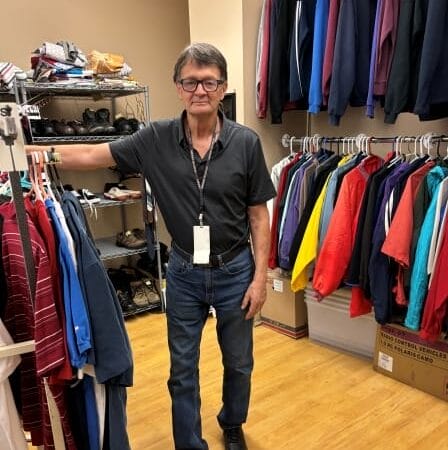
Raymond G. Murphy Department of Veterans Affairs Medical Center volunteer Glenn Hebert inside the Clothing Closet located on the hospital campus. /Courtesy Glenn Hebert
Tell us about your volunteer role at the Raymond G. Murphy Veterans Hospital.
On Mondays, I’m in the Clothing Closet serving the vets. On Fridays, the Closets are closed and I use that time to look for and put out new donations, straighten out the items on the shelves and clothing racks, and sometimes shine the donated shoes to make them look better. I also sweep the floor and mop if needed. We treat the Clothing Closets like they are stores at the mall with even better service along with respect, dignity and always a, “thank you for your service.”
The Clothing Closets are stocked with new and gently used clothing, shoes, blankets, sweaters and more, all donated by civic groups, families of veterans and members of the general public. Veterans who qualify for the program can come twice a month for a calendar year to pick out shirts, pants, brand new underwear and socks, a jacket, shoes, sweatshirts and pants. In the women’s Clothing closet, there are similar items as well. New Mexico is a military friendly state, and the vast majority of what we have on the shelves comes from generous donations. Local service clubs perform clothing drives, and others even knit wool lap blankets for the winter months. Others bring in much needed hygiene items like soap, shampoo and lotions. We’re like the pawn shop; we never know what will come in the door!
Our donors are the real heroes in our efforts to support our veterans who sometimes come in with only what they have on their backs, but leave knowing there are so many people here willing to help. If they still need assistance after their voucher expires, they can ask their social worker who often will approve one for another calendar year to keep their help coming. It is not unusual for a veteran who comes in with little more than the clothes on his back to leave with a complete outfit and the opportunity to return twice each month for a calendar year and beyond, if necessary. It’s not charity. It’s gratitude from donors around New Mexico who want veterans to know they are appreciated.
On Wednesdays, I roll out our brand-new popcorn machine, just like the ones at the circus. I cook the popcorn and my partner handles the money for the next four hours. Such an odd item, but it has turned into a very successful fundraiser that supports the Volunteer Services programs. We often have a line from the machine out into the hallway! Some buy multiple bags for the people in their department. So far, the record is 27 bags! And if any vet comes in and doesn’t have even a dollar, he or she will always go out with a complimentary bag from us or another vet will pick up their tab before we can. Another great spot to be in, as these people love their popcorn, especially when it is doing so much good. We also have a husband and wife who oversee the popcorn duties on Mondays.
At various times I have pitched in on other projects. Last year I helped many others put up 100 American flags along the driveway leading to the hospital on Veterans Day weekend. Seems like there is always something going on and I am fortunate enough to have the free time to lend a hand.
What’s been the most rewarding part of your work?
I love seeing up close how a person’s self-esteem can change for the better with a little help from their friends in the Clothing Closets. Early on, one veteran who needed clothing for his new job and some new clothes for just hanging around got some of both, all in great condition. As he put his new boots on, he said, “Now I feel like a human being again.” That hit me like a thunderclap. How easy it is to take clothes, meals and even vacations for granted. To have even a small part of his transformation really hit home, and gets me out of bed and out to the VA to try to make that happen again.
What have you learned through your experiences as a volunteer?
What a unique tribe our veterans are. And when I thank them for their service, so many willsay, “Best thing I ever did,” or “Wish I could go back,” or “I should have stayed in longer.” I think they miss the camaraderie and the experiences with their buddies. I will never meet a group who is more thankful for anything you can do for them.
Over the years I have met veterans from virtually every branch: from a member of the very first Seal Team in 1962, to submariners and an Army ranger. I even had a customer who was a member of the Cheyenne tribe who was stunned when I asked him, “Northern or Southern?” He had some great stories that are passed down through the generations, even some about General Custer, who might have run into this veteran’s ancestors at Little Bighorn!
Tell us about future partnerships, programs or events that you are excited about.
We have an amazing new program that the Volunteer Services Office is looking to get started. It’s a series of songwriting seminars, where vets pair up with one of our many talented local songwriters to help them express themselves through music. A longtime friend of mine has put these programs on for veterans all around New Mexico pre-COVID and wants to get them going again. What a unique and powerful form of therapy.
Why is it important for others to get involved with causes they care about?
It’s simply good for the soul. Yours, and the people who you help. When someone is going through tough times, it can often take very little to get them over the hump. Is there really anything more rewarding than being someone who is a part of that?
Any advice for people who want to start volunteering?
Ask around! Your friends and family members may know of, or already donate their time for a good cause that needs volunteers. My wife works with a group that hosts incoming immigrants who have gone through the process and have sponsors who pay their costs for permits and other expenses. Her group hosts them in a participating hotel where they stay for the night and then fly out to their permanent location the next day. They also try to have some clothing, especially children’s clothing, to give if needed, and a meal that is donated by local restaurants. Being the grandson of immigrants from Ireland and Quebec, this hits home for me!
Also, if you have a skill or special interest, how about sharing it with a veteran? And of course, you can just Google “local nonprofits needing volunteers” and you’re sure to find some. You could help in their offices or other administrative positions as well as volunteer in positions with face-to-face interaction.
What do you want people to learn from your story?
I consider volunteering at the VA hospital the most rewarding endeavor I have ever been involved with, and want people to know how it can do that for them, too. People often underestimate the value they can bring in just a few hours of volunteer work. When I’m in the Clothing Closets I see people with a need who I can do something for. Veterans are keenly aware when they are being helped or being given the runaround, and when people volunteer their time to help them, they will never forget your kindness and you will never forget how good that feels.
Championing Racial Equity in Education with Inclusive Curricula
Meet Daily Point of Light Award honoree Saawan Duvvuri. Read his story, and nominate an outstanding volunteer or family as a Daily Point of Light.
Having seen firsthand a need in the classroom and working to find a solution, Saawan Duvvuri is making significant strides in advancing racial equity in education. As the founder and executive director of LiteratureDiversified, Saawan has spearheaded efforts to diversify school curricula and address race-based educational disparities in the United States and beyond. His dedication and leadership have transformed LiteratureDiversified into a global organization with a far-reaching impact.
“We’re a youth-led nonprofit that works to diversify curricula in schools to create more equitable environments for underrepresented students,” Saawan explains. “We develop lesson plans across academic fields, like English and History, that retell lessons through the lenses of various marginalized groups. We focus a lot on Black, Asian, Latino, Hispanic, Native American and LGBTQ+, as well as women, sources.”
Under Saawan’s leadership, LiteratureDiversified has achieved remarkable growth and impact, driven by a dedicated team of 340 student members and volunteers spanning 36 states, 11 countries and 18 global chapters. This diverse and committed network has developed an impressive collection of over 450 educational resources, encompassing 55+ lesson plans, workshops, webinars and research collections. These resources are meticulously designed to advance diversity, equity and inclusion (DEI) in education.
The organization’s DEI resources have been implemented in over 245 partner classrooms worldwide, directly teaching more than 11,270 students. This widespread adoption clearly indicates the effectiveness and relevance of LiteratureDiversified’s mission to create inclusive educational environments.
Saawan Duvvuri is the founder and executive director of LiteratureDiversified.
Additionally, the organization has successfully raised over $15,000, combining $6,500 in grant funding from reputable organizations like Prudential, Taco Bell and the Ashoka Foundation with $8,700 in grassroots fundraising efforts. This financial support has been crucial in sustaining and expanding LiteratureDiversified’s initiatives, ensuring continued progress in students receiving a more comprehensive and inclusive education.
“During my freshman year, in English class, we only read stories that centered around the experiences of European white men,” Saawan reflects. “We focused a lot on Euro-centric points of view, perspectives and history. The way that women and people of color were portrayed in those stories was always in subordination to these white men. It created a lot of cultural ignorance and reinforced stereotypes of male domination, Euro-supremacy and the power of colonization as a tool for white supremacy.”
Saawan also noticed an increase in disengagement among fellow students of color when the class was studying these stories. This was when he started reaching out to his contacts far and wide – including many students of color – with the idea of starting an organization addressing inequitable curricula in classrooms. The nonprofit was founded and quickly took off, with chapters established, members gained and materials created.
“Our goal is to bring stories from marginalized communities to the forefront. These narratives are crucial for fostering empathy and understanding among students,” Saawan says. “While AP European history is freely taught in every state across the country, the one course teaching AP African American studies has been banned all across Florida. That is dystopian. It shows how deeply racist our society still is.”
LiteratureDiversified’s initiatives are multifaceted, including the development of diverse curricula in U.S. History, Introductory English, and Financial Literacy. One notable project is the creation of a diverse Young Adult (Y.A.) Novel and Children’s Book list, which includes over 30 stories from marginalized and underrepresented authors. This initiative ensures that students have access to literature that reflects a variety of voices and experiences.
Saawan’s work with LiteratureDiversified has garnered significant recognition. The organization has been featured by NBC, Fox News, Yahoo Finance and Channel 5 News, achieving over 1.5 million impressions. LiteratureDiversified is also backed by prestigious entities like Prudential Emerging Visionaries, the Taco Bell Foundation, the Princeton Prize in Race Relations and the Ashoka Foundation.
“The most rewarding parts of this journey are being able to grow my team and establish such a strong community,” Saawan shares. “I like to say we’re a community focused on advocacy and racial equity, but we’re also really close. A lot of my best friends have been made through LiteratureDiversified.”
Through his unwavering commitment, Saawan and his team are making a lasting impact on education, addressing racial disparities in education as well as fostering a more inclusive and empathetic world. He encourages others to get involved with creating more equitable environments in their communities: “In spaces where historically we’ve had our rights taken, it’s so important that we enact change when we see an opportunity to do so. We need to enact positive change, especially in racial spheres. If we don’t fight for it, nobody else will.”
Championing Accessibility in Education for Blind and Visually Impaired Students
Meet Daily Point of Light Award honoree Crystal Yang. Read her story, and nominate an outstanding volunteer or family as a Daily Point of Light.
Crystal Yang is transforming education for blind and visually impaired students through her nonprofit organization, Audemy. Founded in response to the alarming statistic that over 70% of blind students are at least a grade level behind in school, Audemy aims to increase accessibility to educational resources via audio-based, accessible education games.
Under Crystal’s leadership, Audemy’s innovative platform is now used in schools for the blind and visually impaired across five states. With over $70,000 in grants and resource sponsorships from prominent organizations such as Desmos and Wolfram Alpha, Audemy is making significant strides in bridging the accessibility gap in education.
One of Audemy’s standout events is KatyYouthHacks, a hackathon that inspires youth to create technology solutions for people with disabilities. Last year, the event attracted over 420 participants and featured judges and guest speakers from leading companies like Amazon and VISA. In addition to hackathons, Audemy creates educational videos that have reached more than 150,000 students.
Crystal’s efforts have also been recognized on an international scale; she has published and presented research on conversational interfaces for blind and visually impaired users at the prestigious ACM International Conference on Multimodal Interaction (ICMI) in Paris. Crystal has developed and coded over 15 accessible, audio-based educational games utilizing artificial intelligence.
Read on to hear about Crystal got started with her platform and what she’s discovered along the way.
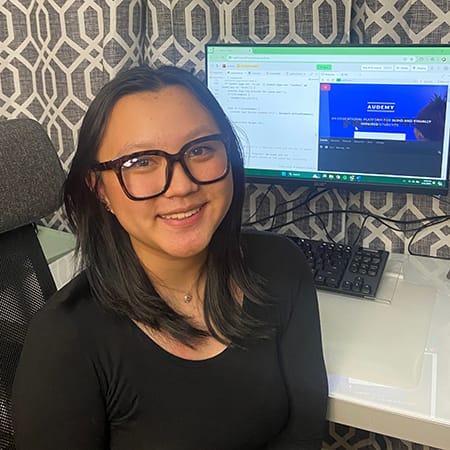
Crystal Yang is the founder and CEO of Audemy, an educational platform for blind and visually impaired students.
Tell us about your volunteer role.
I’m the founder and CEO of Audemy, which is an educational platform for blind and visually impaired students. The platform itself is a collection of, currently, around 15 games. They’re all audio-based, and therefore accessible for blind and visually impaired students. The platform addresses the gap between education and accessibility. Over 70% of blind students are at least a grade level behind in math. There’s a need for tools to bridge this gap. Initially, my role was very technical-heavy. I coded the website and created the games, which use artificial intelligence to understand what the user is saying. As time went on, my role became more community-focused. Now, I reach out to teachers and students too. So I’m balancing making a good product with connecting it with the community.
Why is this issue so important to you?
It’s so important because as technology is growing, people have access to all these new tools. There’s infinite possibility for people to be doing new things. But blind students, in particular, are often left behind in this new age of AI and technology. There are so many resources for blind students to use technology. All students should have the right to education; just because students have disabilities doesn’t mean they should have fewer resources than everyone else. And with the upcoming possibilities that exist with all this new technology, it’s great to see technology used to help people with accessibility barriers as well.
What inspired you to get started with this initiative?
Over the summer, I did some research at Texas A&M University. I published a paper that was about creating an audio-based and accessible version of the game Wordle. While researching that project, I was able to meet a visually impaired student in the lab, and she wasn’t even able to play the game because it was all visual-based. There was no audio or tactile alternative to playing Wordle. That introduced me to the world of accessibility and all that blind and visually impaired people might be missing out on.
I thought, if they’re missing out on this simple form of entertainment, they’re probably unable to access other crucial things, like educational tools and other things that would be greatly beneficial to their lives. So then, I started developing Audemy to help address these issues.
What’s been the most rewarding part of your work?
The most rewarding part is getting to meet all the people and see the impact it’s had on them. There’s a girl in my school. She’s blind; she lost her vision in third grade. She really liked the games a lot – I remember her smiling while playing one of the math games and laughing when she got an answer right. It was great seeing how these educational games were able to impact her. When I show Audemy to teachers around the nation, I love seeing them support the platform and share it with fellow teachers. It’s been really rewarding seeing the use of the platform I’ve developed, and then also seeing how it benefits blind and visually impaired students.
What are your long-term plans or goals for the organization?
Currently, Audemy is used in seven schools for the blind and visually impaired. I hope it will eventually be used as a tool in all the blind and visually impaired schools around the nation. Also, in the future, I’d love for Audemy to become international – expanding the audio-based system into other languages to have a global reach. Then, there’s just improving the educational content and having more collaborations with schools. Overall, my goals include seeing the technology continue to create a really beneficial tool for all blind and visually impaired people around the community and beyond.
What have you learned through your experiences as a volunteer?
As I’ve started volunteering, I’ve realized that everyone can make a big change in their communities. Before, I didn’t have much experience in helping the blind and visually impaired community. But through volunteering, I learned that everyone can make a difference. I was just a little girl who liked creating projects with computer science. Then I realized I could combine this previous interest with social impact, and with a social topic I’m passionate about. It’s great that everyone’s able to apply their own individual skills and strengths into volunteering and helping the community.
Any advice for people who want to start volunteering?
Just start volunteering! There are always people who need support. There are always social issues that need to be addressed. There are a ton of organizations out there addressing the issues you might care about. Don’t be afraid to try to make your own ideas come to life. If there’s an unaddressed issue and you can find a solution that harnesses your own skills, you should go out and try that.
Meet the Young Volunteer Bringing Birthday Joy to Nursing Home Residents
Meet Daily Point of Light Award honoree Anya Talwar. Read her story, and nominate an outstanding volunteer or family as a Daily Point of Light.
Anya Talwar’s remarkable journey in volunteering began when she was in the third grade. Since then, she has consistently brightened the lives of nursing home residents and many other groups of people, through her dedicated involvement with The Birthday Giving Program, where she serves as the event manager. Anya’s enthusiasm and genuine compassion make her an exceptional volunteer, and upon speaking with her, it’s easy to see why her demeanor would put a smile on anyone’s face.
Anya’s primary role involves bringing joy to nursing home residents by organizing monthly birthday parties. These aren’t just any parties; they are lifelines of joy for many residents, particularly those who have no family or friends to celebrate with. Anya not only organizes these events but also ensures that each birthday person receives special attention, complete with balloons, teddy bears and personalized presents. Her dedication extends to providing all necessary supplies, showing a level of responsibility and commitment that is rare for her age.
Anya’s role as the event manager requires her to commit around 15 hours per month to organizing and executing these birthday parties. Her willingness to help others and her innate ability to lead and inspire have not only enriched the lives of many residents but have also set a high standard for what young volunteers can achieve.
Through her work with The Birthday Giving Program, Anya helps those in her community celebrate their special day in a way that they may not otherwise have the opportunity to. Read on to find out more about Anya’s work with The Birthday Giving Program and her hopes for the organization’s future.
Tell us about your volunteer role.
My role in The Birthday Giving Program is event manager. My main role is to organize our birthday parties that we host in-person. I’m responsible for baking cakes when we’re able to do that, and for organizing our birthday bags. I help organize which events we’ll have for our residents. We rely on a majority of fundraising, including a lot of great local donors who contribute to our cause.
What inspired you to get started with this initiative?
My family has always valued birthdays. We’ve always done big birthday celebrations. That was something I’ve always known. When my sister and I were younger, it came to us. We realized that not everyone has the means or resources to celebrate their birthdays. So we started The Birthday Giving Program, because we wanted to start giving that special little gift or cake to celebrate their birthdays.
Why is this issue so important, especially for seniors?
The people we’re working with, in residential programs, nursing homes and shelters, unfortunately don’t necessarily have a lot of visitors. The majority of them don’t have a special birthday celebration with their loved ones. So we wanted to focus on them first, as one of our main populations for our program, because we wanted to make sure they feel celebrated on their birthdays.
What’s been the most rewarding part of your work?
I would say the most rewarding part is seeing people at the nursing home or shelter. I still remember one of our residents from one of our first parties, when I was in third grade, and I still see that resident every time we go back to celebrate their birthday. It’s so rewarding when we get to go back and continue to celebrate these people.
What have you learned through your experience as a volunteer?
I’ve learned that it’s really very simple to put a smile on someone’s face. That’s been rewarding as well, throughout the course of the program. Our parties are not anything very extravagant. They’re more about community and people coming together, and that’s been amazing to see.
Are there any future partnerships, programs or events you are excited about?
For The Birthday Giving Program itself, we’re currently working on expanding. We have chapters in all 50 states and we’re working on chapters all around the world. Then, for the future, my cousin and I just co-founded another branch of the program called The School Supply Project. We’re currently working to bring supplies to schools and teachers who need these items. We’ve been working with the U46 District in Illinois. That’s been really exciting, to expand what we’ve done with The Birthday Giving Program and bring it into another chapter of our work.
Why should others get involved with causes they care about?
I believe it’s important to volunteer just to get involved with your community. It’s such a rewarding experience. It’s something that I was introduced to very young, and I’m really grateful for that. It’s shown me a new perspective on life. I’m really grateful I’ve been able to meet so many new people and have such great experiences through the program. I’d recommend that if you’re able to fundraise and get involved through volunteering, it’s a great opportunity for the future.
Any advice for people who want to start volunteering?
Especially since the pandemic, there are a lot more resources online, and a lot more ways to donate than there were before. For us personally, The Birthday Giving Program has a page on our website to donate. We’re a 501(c)(3) nonprofit organization, so all of those donations go straight to our birthday bags, cakes and celebrations. So even if one-on-one interactions through volunteering may not work for you at the time, donations are always welcome.
Leaving a Legacy of Volunteerism and Equipping Children Through the Arts
Meet Daily Point of Light Award honoree Dana Farrar.Read her story, and nominate an outstanding volunteer or family as a Daily Point of Light.
Dana Farrar’s story is an inspiring one: for two years, she’s been a dedicated volunteer for Theatre Under The Stars (TUTS), lending time and talent in multiple capacities. Her commitment to her work with The River, TUTS’ musical theatre program for students with disabilities, is probably her deepest passion in the realm of volunteering. Through The River, Dana – along with her two daughters – provides in-classroom and student support for 10 Saturdays each semester in both the fall and spring.
“The River is the part of the organization that gives students with disabilities the opportunity to perform, to act, to sing and to dance,” Dana explains, lighting up. “Depending on the day, I’ll be with a group of special needs students and support them as needed. I have so much fun with them. I get to do the dances and songs with them. I get to build relationships with these amazing humans who step outside of their day-to-day comfort zone to become performers.”
Dana Farrar is a passionate volunteer championing artists with special needs at Theatre Under The Stars (TUTS) in Houston.
Dana’s involvement doesn’t stop at The River. She also plays a crucial role during tech rehearsals and throughout the production of the Tommy Tune Awards, TUTS’ annual event celebrating high school theatre excellence. Then, beyond her hands-on volunteering, Dana is also an active member of the Leading Ladies, a group of women dedicated to supporting TUTS’ education and community engagement through volunteering, fundraising and exclusive events. “They’re an amazing group of women who come together and do an incredible job with their philanthropy and fundraising, as well as volunteering their time and their efforts,” Dana shared.
Dana’s commitment to volunteerism is deeply rooted in her family history. She reflects, “I come from a family of volunteers. Both of my grandmothers were volunteers. I would volunteer with one of my grandmothers at a nursing home up in Maine when I visited. My other grandmother felt very strongly about women’s education. She got her master’s and then wanted to give that opportunity to other kids. Then, my mother was what society would call a stay-at-home mom, but she didn’t actually stay at home. I would join her volunteering with the Red Cross. And she got me involved with volunteering with the Iowa Special Olympics in middle school and high school. My father was an industrial engineer, and one of his roles was to create functional tools and mechanisms for people with special needs. He even worked with Maytag to create a kitchen for people in wheelchairs. So I’ve always found a love for helping people, and knowing they’re completely capable of doing everything that non-disabled people can do. They just need to be given the opportunity.”
Sharing her volunteer work with her daughters is one of Dana’s greatest joys. “What’s wonderful is that I get to share this with my two children,” she says. “Both of them also volunteer with The River. Ace helps out with the art studio – she’s a visual artist. Carys volunteers with the teen group and works with them. It’s wonderful to be able to perpetuate the love of volunteering with my kiddos.”
The satisfaction and fulfillment Dana and her daughters gain from their volunteer work are indeed palpable. “We come home from The River and on the drive home we just talk about how wonderful it is – how good we feel,” Dana shares. “The little successes that students have. When we see students do something they weren’t able to do before. There’s really something about looking beyond your own success and seeing someone else succeed.”
Dana’s greatest joy is sharing the love of volunteering with her two daughters, Ace and Carys.
For Dana, the rewards of volunteering are immense and far outweigh the time and effort put in. “The most rewarding part of my volunteer work is seeing these kids perform, seeing them shine on stage,” she says. “They don’t just go through the motions – they shine. They smile, they perform in front of hundreds of people. TUTS also gives them the opportunity to perform on the mainstage, so some of these kids go on to perform in large professional productions. The program itself is just amazing. It’s so inclusive. It gives opportunities to kids who aren’t necessarily given opportunities to perform.”
Dana believes in the importance of looking beyond one’s own world to see and meet the needs of others: “I always think it’s important to look outside of your own bubble. It’s good to be able to see the needs of a community outside your own. Look in unexpected places – sometimes opportunities can come up spontaneously. Then, when you’re volunteering, the joy that I get, and I assume most volunteers get, is this soul-enhancing feeling that I’m actually helping other people. Not just in this moment, but also helping them create a different future, a different opportunity. That is such a rewarding feeling.”
Through her dedication to TUTS, Dana not only supports the arts and students with disabilities but also perpetuates a spirit of volunteerism and compassion within her own family – a legacy passed on from generation to generation. Dana’s dedication to fostering a love for the arts in her community continues to inspire those around her.