Community Health Worker Connects Fellow Residents With Vital Supplies and Information
Meet Daily Point of Light Award honoree Robin Charles. Read her story, and nominate an outstanding volunteer or family as a Daily Point of Light.
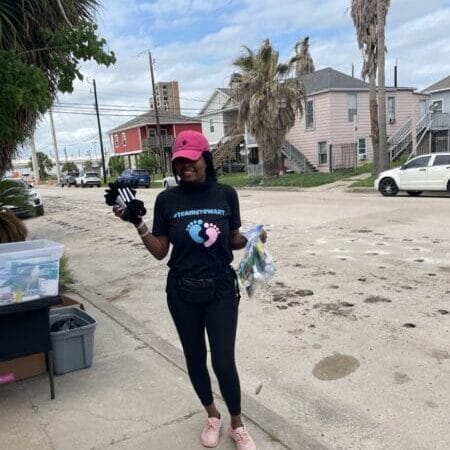
Robin Charles, 42, has long been acutely aware of the gaps that need to be filled in her community. In her role as a senior public health educator for the Houston Health Department, she touts the dangers of lead exposure for children, particularly in low-income communities living in older homes.
Her sister, Ashley, started The Baby Stewart Foundation after losing her son, and Robin quickly joined her in focusing volunteer efforts on connecting individuals and families with basic necessities. Spending time with her own family and making a difference in the lives of those around her is her passion.
Robin also volunteers with Friends of Mayor Keith Bell doing neighborhood cleanups and advocating for community interests with political leaders. She works at food and school supply drives with fellow Texas Southern University alumni, Noche’ Berry’s Salon’s outreach events and local politician Keith Henry’s Thanksgiving turkey drives. Her continued engagement in the community she grew up in is moving residents towards a future where everyone has what they need.
What inspires you to volunteer?
I’ve been a case manager and know that there’s always been a gap in the needs of working-class families. Before The Baby Stewart Foundation, I was helping with Christmas drives for children whose parents are incarcerated and helping with food pantries. People think that just because you have a job that you can afford stuff, but that’s not always the case. You can work until your fingers fall off, and you still may not have enough for daycare, car emergencies, gas and food.
When you see your community hurting and no one really recognizes that, it impacts you. You do whatever you can. Seeing the barriers that my sister went through, I wanted to make sure we were helping as much as possible.
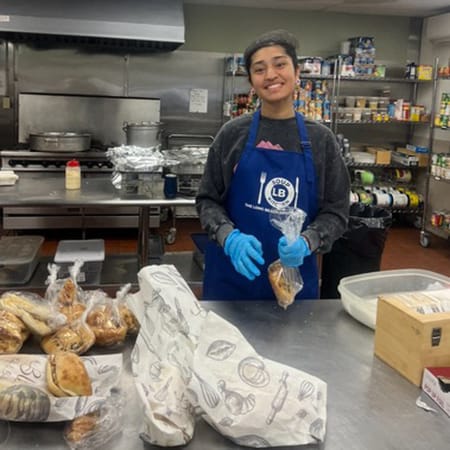
Robin joins Friends of Keith Bell in handing out supplies./Courtesy Robin Charles
Tell us about your volunteer role with The Baby Stewart Foundation and beyond.
I help with contribution management which includes planning and distributing donations—clothes, school supplies, baby necessities, etc.— coordinating support services and taking part in community improvement and cleanup initiatives. I’m the person setting up tabling for events, picking up and storing items and just being there. Sometimes, our volunteers can get overwhelmed, and I’m the peacemaker. I help calm everyone down.
Lately, we’ve been having a lot of storms, so I’ve been trying to connect with partners for people who have been displaced or are without electricity. I’ll make sure they have the hygiene kits that my sister just acquired. We have a lot of things that the community needs, but if they’re not in their hands, it’s a waste.
What’s been the most rewarding part of your work?
I love when people come up and talk to you. It’s interesting to see a smile on a person’s face when you’ve just met them and to spark up a conversation and find a connection, even if they just come to say thank you. Children will hug you.
It’s really connected me to my community. It’s not that I think I’m better just because I have a few more blessings. The most rewarding thing is that my community knows we’re here for them; it’s not about us. It’s about making sure they’re taken care of.
What have you learned through your experiences as a volunteer?
More patience and less talking. Try to understand, but at the same time, have boundaries.
Tell us about future partnerships, programs or events that you are excited about.
There’s a police officer who celebrates his birthday with unhoused individuals instead of having a party. He invites different agencies to come out and do vaccines, haircuts and other services. We’re looking forward to partnering with him.
We just want to let our community know that we’re here to help and to maybe do more cleanups and petitioning for green spaces. My background is in environmental health. If you walk outside and see trash, you can’t take pride in your community. You’re not taking pride in yourself. If you’re in a clean space, you’re more likely to keep it clean. If you see more greenery and it looks like an environment that you can thrive in, you’re more likely to take care of it. We’re doing this now, but we’re hoping to incorporate younger people in order to keep it going.
Why is it important for others to get involved with causes they care about?
This is all we have. If we don’t take care of it, we can’t expect anyone else to come in and save us. How are we going to take care of ourselves? What really motivated me to make small changes was growing up in the 80s. We watched our community go from being a place where you could play outside in the front yard to where you couldn’t go outside for anything unless you had an adult with you. If someone offered you some water or something, you could take it. Now, you have to look down when you’re walking. You can’t even connect with your neighbors. How are we going to make the change to get what we need?
Any advice for people who want to start volunteering?
Just start somewhere, even if it’s picking up trash on your street or in your yard. People are always watching your actions, positive or negative, and you could impact someone. Start and stay consistent.
What do you want people to learn from your story?
Put the time in, even if it’s a few hours. A few hours can change someone’s life or way of thinking. You don’t have to have a lot of money or be a superhero. It’s not easy, because you’re working with populations who have been shunned. Come in and help without taking over. Just try to make an impact any way you can.
Children’s Author Boosts Student Confidence by Helping Publish Their Own Stories
Meet Daily Point of Light Award honoree Melissa Williams Murphy. Read her story and nominate an outstanding volunteer or family as a Daily Point of Light.
Whether it’s a tale of magical wizards, space adventures or wild animals, nothing quite opens a child’s mind to endless imagination like a book. Melissa Williams Murphy takes this a step further, empowering children to publish their own short stories through her nonprofit organization, iWRITE.
As a children’s author, Melissa frequently visited Houston-area schools to read her books to young students. One question she was often asked was, “Can kids be authors too?”
“I thought, ‘Well, sure! Of course!’ At the time, I had a small publishing company, and we had the means to be able to publish children’s work. So I thought, why not start a competition that allows kids to submit their work and see it professionally published?” Melissa explained.
In 2009, iWRITE was launched with its annual publishing contest. Each year, a different theme is announced – this year, it’s fantasy – and students from third to 12th grade across Texas are invited to submit short stories or poems. The top 125 submissions are selected and published in a beautifully bound hardback anthology. After their book is published, these young authors revel in their success at iWRITE’s Book Signing Celebration, signing copies of the anthology for their friends and family.
Melissa is the founder of iWRITE, a nonprofit that promotes literacy among Houston’s youth through a unique writing curriculum, workshops and writing contests. /Courtesy Melissa Murphy
“I constantly hear stories about kids who struggled with mental health or just felt like they never fit in. But when they got this opportunity through iWRITE to be treated like a superstar when they were awarded, all of a sudden, they were empowered,” Melissa said. “I’ll never forget this fourth-grade boy during our first book signing celebration in 2009 where the kids got to read their work on stage. I overheard him say to his mom, ‘This was the best day of my life!’ I’ll never forget that because it made me realize we have to keep doing this for other kids who also need that best day in their life.”
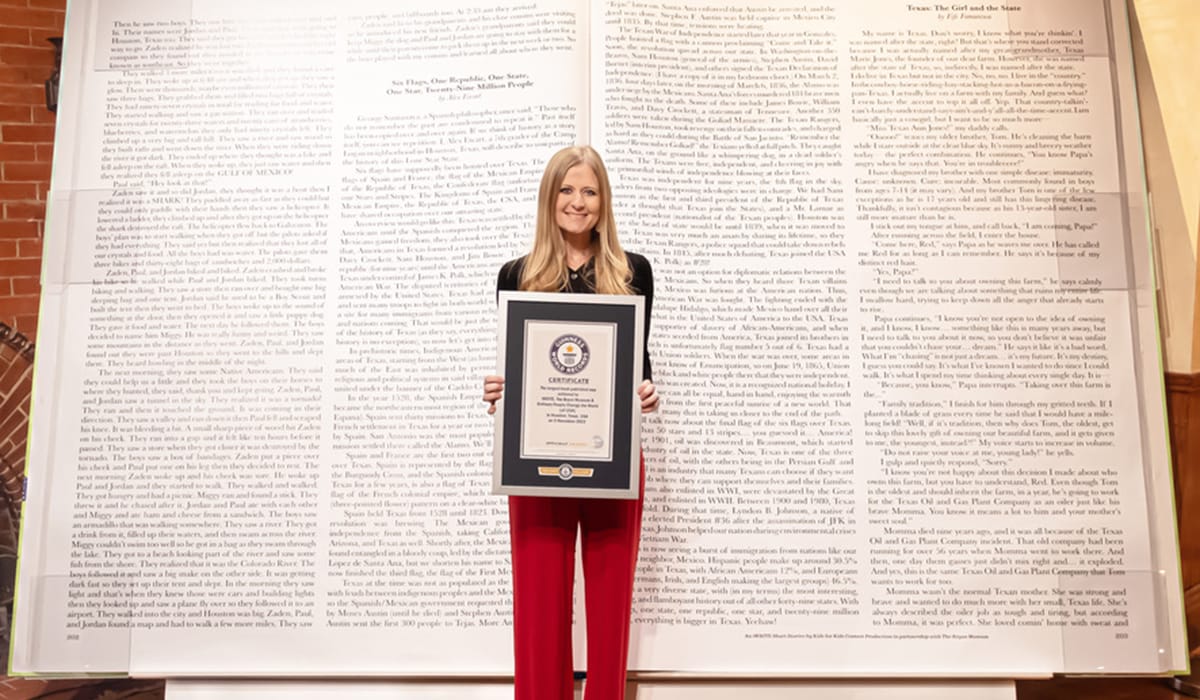
In 2022, iWRITE made history with an extra special anthology. Measuring 7 feet tall and weighing 496 pounds, the book broke the Guinness World Record for the Largest Published Book. Titled “I Am Texas,” the book captures what Texas means to 1,000 students through stories, poetry and artwork.
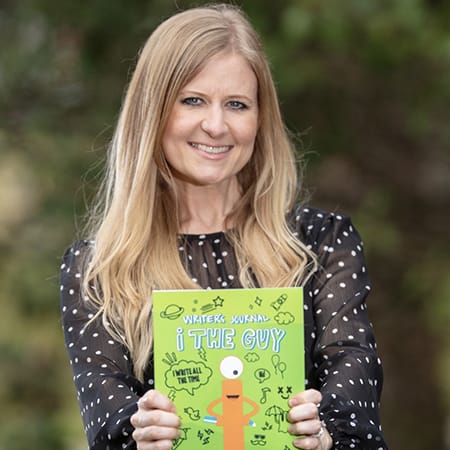
iWRITE’s annual publishing contest may stand out as its flagship program, but the organization goes beyond with a unique writing curriculum featuring its mascot, “I” The Guy. Over 20,000 students in underserved Houston-area schools have benefitted from this curriculum. Combined with writing camps, journals, mentorship programs and an alumni club, iWRITE equips students with vital writing skills, crucial for breaking through economic barriers and achieving their full potential.
Julie Baker Finck, President & CEO of the Barbara Bush Houston Literacy Foundation, finds Melissa’s passion for literacy truly inspiring. “She recognized that writing was more of a chore for students to do in classrooms through simple journaling, rather than tapping into the creative minds of students and sparking their love of reading and writing,” Julie said. “Her dedication and commitment to improving the quality of writing instruction and the student literacy work over the past 15 years is tremendous. She is always thinking of creative ways to reach students and engage educators.”
Melissa stands in front of the “I Am Texas” book, which broke the Guinness World Record of the largest published book. /Courtesy Melissa Murphy
Melissa’s vision for iWRITE continues to expand. This November, iWRITE is transforming its annual book signing event into a literacy festival, featuring writing workshops, author talks, book giveaways and more.
As iWRITE continues to inspire and empower the next generation of writers, Melissa’s commitment to literacy ensures that many more “best days” are yet to come for the children of Houston and beyond.
Beyond the Disability: Producing the Concert That Changes Perspectives
Meet Daily Point of Light Award honoree Dee Dee Dochen. Read her story, and nominate an outstanding volunteer or family as a Daily Point of Light.
Every February for the past 11 years, Houston residents and visitors alike flock to venues around the city for nearly a month of celebrating the talents of people with disabilities through film, art, speakers and music. The ReelAbilities Houston Film & Arts Festival is produced by Alexander Jewish Family Service Houston (JFS) in collaboration with the Mayor’s Office for People with Disabilities and with the support of TIRR Memorial Hermann. It highlights talent, changes perceptions and erases stigma, and one of the most well-loved events is the ReelMusic concert. It spans genres and highlights talented musicians with different abilities—some blind, some physically handicapped, some on the spectrum, etc. While there are 11 ReelAbilities festivals throughout the US—and one in both Canada and Mexico—most are under a week and often focus only on films.
Dee Dee Dochen is largely responsible for turning what was a small jam session into the Houston festival’s most well-attended event. She’s a messaging strategist and crisis management advisor by day but knows the joy of performing herself. After being asked to chair the jam in 2018, she has produced the concert every year since. Dee Dee spends an average of 80 hours a month on concert-related work, and she also serves as a volunteer interview coach with JFS for people struggling with self-esteem and mental health issues.
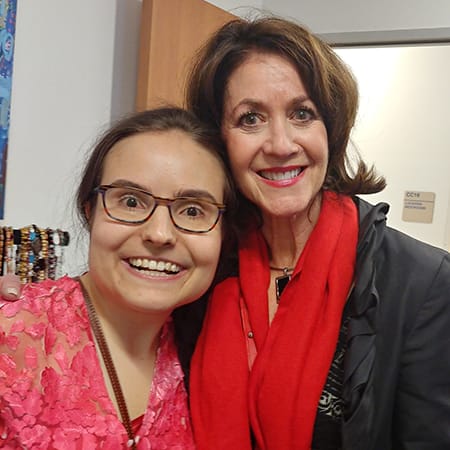
ReelAbilities Festival visiting artist Mara Clawson (left) meets with Dee Dee, the 2020 Festival Chair
What inspires you to volunteer?
Two big influencers were my mother, Janet Dochen, and the Marriott Foundation for People with Disabilities. My mother was all about making sure that those who were the most judged, ignored or cast aside felt valued, accepted and understood. That’s the model we grew up with.
The Marriott Foundation for People with Disabilities runs programs called Bridges from School to Work where they work with employers and schools to take seniors in high school with disabilities and pair them with employers to teach them interview and employment skills. When the Foundation was a client, I observed and met some of these young people and their employers. It struck me that the biggest barrier for people with disabilities is not necessarily their disability; it’s the perceptions and stigmas of others who judge them. That’s when disability advocacy became a passion.
About 28 years ago, when I moved to Houston, I got very involved with an organization called The River, which provides classes in the performing and visual arts for children with disabilities. JFS, the organization responsible for Houston’s ReelAbilities Film & Arts Festival, was connected with them, and in 2017, the then-chair of the festival asked me to chair the ReelMusic jam.
Tell us about your volunteer role with the ReelAbilities Art & Film Festival.
I produce ReelMusic. It started around 2015 as a casual jazz jam in a bar with established local musicians and musicians who had disabilities. Then, I used my music connections to build it up to a full-fledged concert at a scaled up the venue. I hired a house band and started recruiting musicians to be in the concert through music therapists at TIRR Memorial Hermann and word of mouth. We also hire an emcee, and I write the script and do all the messaging. We always talk about the power of music to lift us and connect us, and that’s what we do in this concert.
It’s become a passion to recruit musicians, get to know them and find additional opportunities for meaningful employment beyond the festival. One of my former performers, an incredible guitarist/singer/composer who uses a wheelchair, is now in my house band. I’m also often called on to be spokesperson for the festival as a whole, because I co-chaired it in 2019 and chaired it in 2020.
What are your long-term plans or goals for the organization?
I’d love to help facilitate recording deals for some musicians who don’t have as many contacts but who have talent. I am a bit of a connector, and I want to do more of that.
What’s been the most rewarding part of your work?
I love seeing performers get the attention they deserve. And I love seeing the audience connect and give that attention. We’re facilitating awareness and performance opportunities for talented musicians, but it also transforms audience members. People are moved and excited by what they see on stage. They don’t focus on the disability, and that’s what it’s all about. We transform the way people look at people with disabilities.
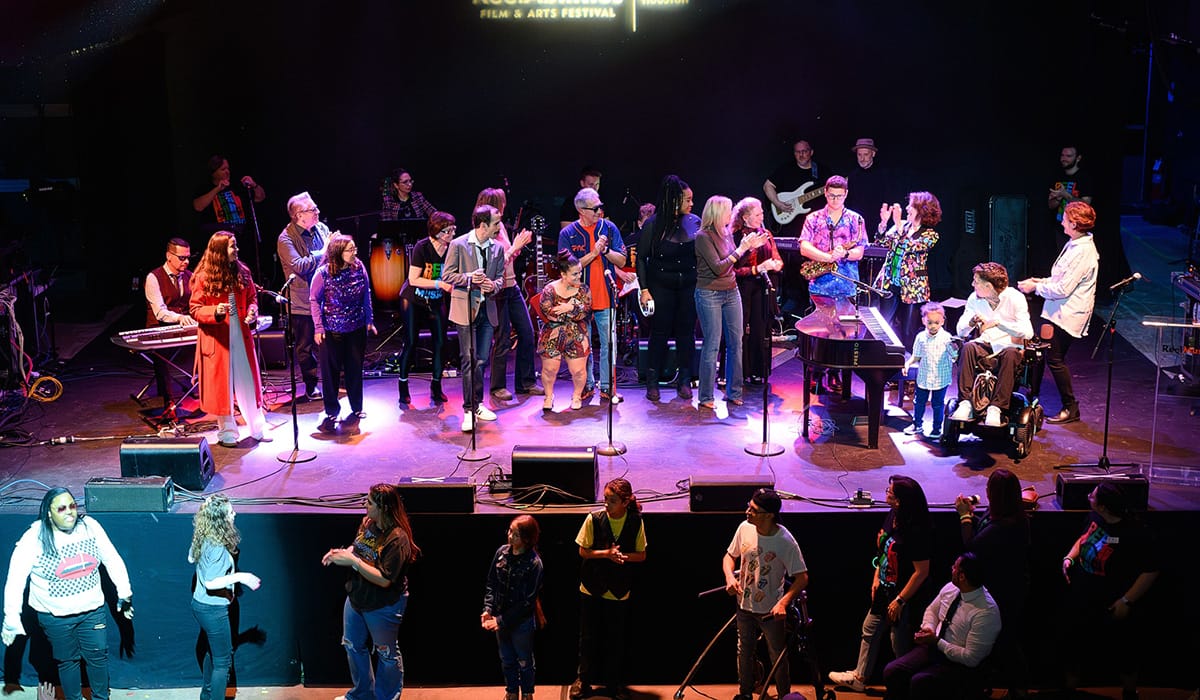
Dee Dee Dochen (back right, in multi-colored jacket) directs “Thank You for Lettin’ Me Be Myself,” the grand finale of the sold-out 2024 ReelMusic convert of the ReelAbilities Houston Film & Arts Festival
What got you into performing and in what context do you perform?
I’ve always sung on the side. I was a shy kid, so I never thought I would, but music is so joyful. I went to University of Texas in Austin and sang in a pop group called Varsity Singers. And then in Dallas, right out of college, I taught school and then sang for a year in a dinner theater before getting into the hospitality industry.
When I moved to Houston about 29 years ago, someone from college connected me with a keyboardist here who’s an attorney and, later, another singer. We all have different day jobs. We had a rock and roll band for years. I’m still affiliated with them, and I’ve grown my musician circle. My favorite music to sing is jazz. I sing with great musicians and do gigs. I also sang for many years in my synagogue.
How can people advocate for more inclusive musical talent where they live?
The first step is finding the talent. I would suggest finding disability-centric organizations and asking questions. Network. Find out if there’s a ReelAbilities Festival in the city. Do they have a concert? To our knowledge, we’re the only ReelAbilities Festival that does. My dream would be to replicate ReelMusic concerts in other ReelAbilities markets. In absence of that, why not create one? Find the people, put them together and put on a show.
What do you want people to learn from your story?
See the person, not the disability. And as my mother taught us, don’t cast them aside, exclude or ignore them. Honor and respect them. Include them. We all have talents and vulnerabilities. Through ReelAbilities, I’ve found my passion, and I can’t wait to see what else I can do with it.
Retired CFO Lends Time to Bettering Lives of People and Animals Across Houston
Meet Daily Point of Light Award honoree Ann Kaesermann. Read her story, and nominate an outstanding volunteer or family as a Daily Point of Light.
Ann Kaesermann, a retired chief financial officer turned figure in Houston’s volunteer community, has dedicated her post-corporate life to serving various causes with a focus on animal welfare, community service and financial governance. Her extensive involvement with organizations such as Houston PetSet and Interfaith Ministries for Greater Houston, among many others, is impressive as she utilizes her talents across multiple sectors.
Since retiring, Ann has transformed her professional expertise into valuable resources for nonprofit organizations. She serves as the volunteer board treasurer for Interfaith Ministries for Greater Houston, where she oversees financial operations and enhances transparency and understanding among board members regarding complex accounting issues.
Next, Ann’s passion for animal welfare shows in spades through her role with Houston PetSet. Since joining the board in 2019, she has been instrumental in advancing the organization’s mission to address Houston’s homeless animal crisis. Ann’s leadership with Houston PetSet helped facilitate significant achievements, such as the provision of over 5,800 spay and neuter services and the transport of 1,500 homeless animals to partners in Minnesota in 2023 alone.
But these are just a few of her active roles and achievements. Ann works with the University of Alabama Alumni Association’s Houston Chapter, Financial Executives International and a variety of others. Read on to hear about how Ann’s contributions make a significant impact across Houston and beyond.
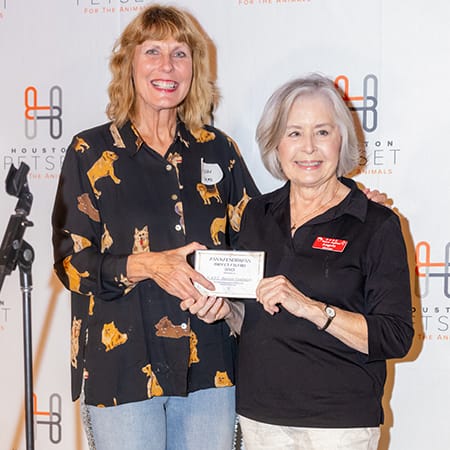
Ann presents the Kaesermann Impact Award, through Houston PetSet, to a recipient working in Houston to help solve the unhoused animal issue with spay-neuter services.
Tell us about your volunteer roles
I currently deliver a monthly Animeals route for the Meals on Wheels area of Interfaith Ministries for Greater Houston. This means I deliver dog and cat food to homebound seniors in the Houston area. Additionally, I serve as the treasurer and finance chair for Interfaith Ministries, where I review financial reports monthly, mentor and work with the CFO and assist in helping other board members understand financial benchmarks and other financial statements. For Houston PetSet, I serve as treasurer and am on the board and executive board. I supervise the finalization of the monthly financials and annual budget and I work with the executive board and full board in setting a strategy to make significant improvements in the unhoused dog and cat population in Greater Houston.
Why are these issues so important to you?
I had a great career as a CPA in the oil and gas business in Houston. Then I retired a few years ago. I knew I wanted to devote the next part of my life to making things better. I’ve been blessed and wanted to share the fruits and leave the world a better place. I’ve loved dogs since I was a little kid. I hate to see them suffer. I was able to affiliate with Houston PetSet. They’re not a rescue; you don’t go there to adopt a dog. What we are trying to do is be a facilitator, fundraising and then pushing those funds to rescue, specifically people on the frontlines. We want to shine a bright light on what they’re doing, and their needs. One of the biggest things we’re trying to do right now is solve this issue in Houston of the unhoused dogs and cats. It’s a significant problem in Houston. We’re trying to be strategic and pull together the city, the county, maybe even the state, as we broaden the mission. And we want to connect all these stakeholders with the rescues to see if all of us together can finally solve this problem.
I want to use my talents to make a difference. And while I always knew I wanted to get involved with the animals, what surprised me was that I got involved as heavily as I am with Interfaith Ministries for Greater Houston. The first month after retirement, I got an Animeals route and started delivering food to seniors. It’s an easy and fun ask; it’s meaningful to other people. But then, in 2021, in the fall, things really changed. I saw photos of the Afghan withdrawal. I still get choked up. I couldn’t sit back. I knew there were going to be settlement issues with refugees and that we were all going to do whatever we could. I reached out to Interfaith Ministries and said, “What can I do?” At that time, I was able to donate with some contributions to set up a youth art project for teenagers of Afghan refugees – for them to use art as a means of trying to process their trauma. Then I got more involved, got onto their finance committee and then pretty soon after that got on the board and then was made treasurer. I had increasing knowledge and increasing responsibility.
Do you have any dogs yourself?
I have a 4-year-old Blue Great Dane. He’s a rescue, a 180 pounds and his name is Boone – named after Daniel Boone. Previously, I’d had two Harlequin Great Danes. Somehow we got hooked on the Great Dane train. They’re a lot of work… he’s the smartest dog I’ve had, which probably is what makes him a lot of work!
What’s been the most rewarding part of your work?
Just seeing the impact I have with others and making a difference is so rewarding. I believe that everyone has a responsibility, to the best of their ability, to leave this world better. You can give your time, talents and treasure – you hear that all the time. I’m fortunate that I’m in a position now where I can give all three. It gives me meaning in life to help make difficult situations better for people.
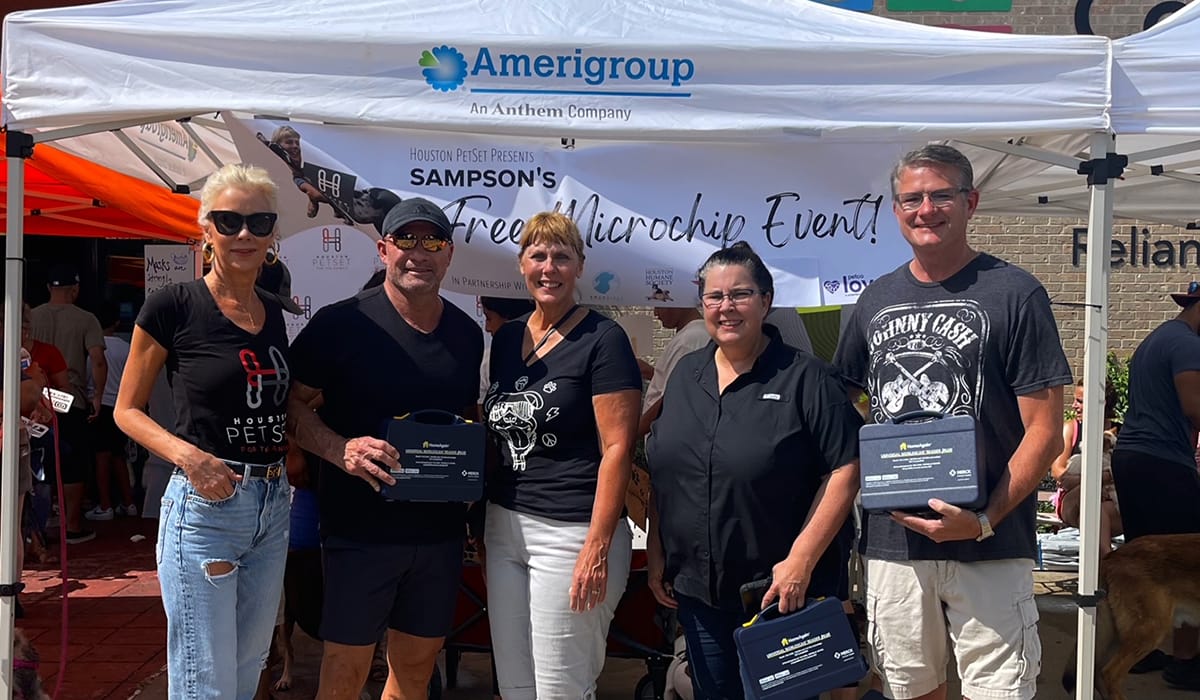
Ann with the Houston PetSet president and first responders at a spay-neuter event, named in honor of her former Great Dane, Sampson. The team spayed and neutered over 85 animals that day, but also distributed chip readers to first responders to help people better find their pets by going to firehouses or police stations.
What have you learned through your experiences as a volunteer?
I’ve learned that people are more alike than different – and you wouldn’t know that if you turned on TV or scrolled social media. But I’ve found that people of all cultures, all races and all economic means contribute to relieve suffering of other people and animals. I see this all over the city of Houston. You can see some people in extremely underserved areas who don’t have a lot to live on or give, and they’re out there every day feeding the animals in their own street. Most people want to contribute to the betterment of all. Those temporarily in need are always so grateful and so thankful for people remembering and helping them out.
Why is it important for others to get involved with causes they care about?
It brings people closer together to work on a single mission. You’re in the trenches. You’re sweating about it! But you can celebrate working on this single mission. You can also focus on how your differences can come together to make an impact for good in the world. And it gives you a great sense of satisfaction. I think people would be happier if they focused on helping others and not just what’s making their own life unhappy.
Any advice for people who want to start volunteering?
Every skill set is valued. When I look back, I’m a CPA. I’m not very mechanical. I’m not great at cleaning, though I’ll jump in and clean up after the animals. The point is that it takes every skill, and every skill is valued. You don’t have to be a veterinarian to help animals. You don’t have to be a lawyer to help refugees. There’s a place for everyone in the areas you feel passionate about.
Dip your toes in. Once you do one or two things with an organization, you’ll either feel that this is it for you and dive deeper, or perhaps you move on. It’s okay to put a couple of hours in here or there until you really find your passion. Because passion is what drives you at the end of the day!
College Student Enhances Emergency Patients’ Hospital Experience
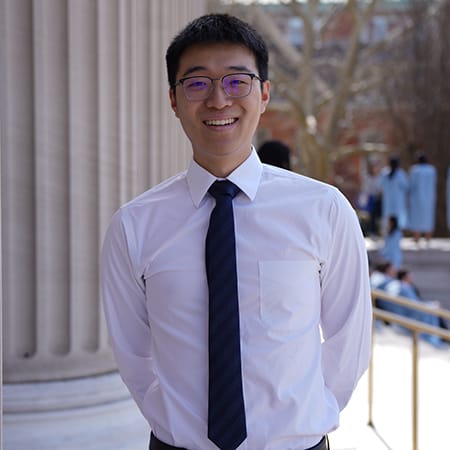
Meet Daily Point of Light Award honoree Harry Xiao. Read his story, and nominate an outstanding volunteer or family as a Daily Point of Light.
Harry was born in California, but moved to China at six years old and completed most of his schooling there before eventually returning to the States to attend college. Harry recently graduated from Columbia University, where he obtained a degree in biomedical engineering. Beyond his studies, Harry enjoys playing tennis and joining fantasy sports leagues with friends. In college, Harry developed an interest in research and worked at a lab where he focused on new treatments for pancreatic cancer. Harry’s focus on biomedicine, however, also led to a strong passion for the hospital volunteer work he pursued.
In our healthcare system, there is often a tug-of-war between the patients’ needs and the ability of nurses and doctors to meet those needs. Due to heavy workloads, nursing staff and doctors are often only able to focus on patients’ clinical needs, such as assessing pain levels and diagnostic testing. However, medical staff aren’t able to see patients for as long as patients want to be seen, and they don’t have the time to offer the necessary level of emotional support.
This is by no means to say that healthcare providers don’t care. They do; and they care a lot. However, they are overwhelmed with a heavy workload. This leads to tension between patients and providers, and often an unpleasant hospital experience.
Harry understood the vital role volunteers could play in helping patients and alleviating healthcare providers’ workloads. If a volunteer could sit with a patient, providing companionship and a caring face, all while addressing their basic needs such as adjusting pillows, getting them a warm blanket or giving them some snacks and a drink, a patient’s experience would dramatically improve.
Harry took on this volunteer role in the Emergency Department of Mount Sinai Morningside. He was also instrumental in resurrecting the Meal Assistance Volunteer Program (MAP) at the hospital. The program focuses on ensuring patients with limitations when trying to feed themselves still receive nutritious meals. For example, these patients may have limited dexterity or may be unable to use their arm(s). MAP aims to alleviate malnutrition, but it’s also a way for patients to have much needed social interaction and to have their emotional needs met during their hospital stay.
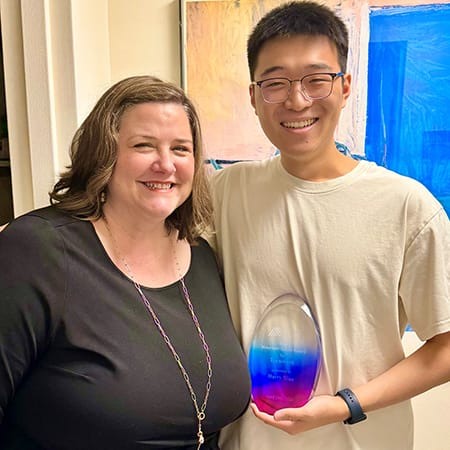
Harry volunteered at Mount Sinai Morningside in the Emergency Department and led the development of MAP. /Courtesy Harry Xiao
What inspires you to volunteer?
My interest in biomedicine developed as a result of personal health challenges and hospital experiences. Many of my own healthcare providers put in a lot of effort for me and this sparked my interest in volunteering. I wanted to find a way to support the healthcare community that helped me. It’s incredibly difficult for doctors and nurses to attend to individual patients because they see so many patients every day. Once I started volunteering, I saw things from both the patient’s and the provider’s point of view. It’s evident that both the nurses and patients need support, and I feel that volunteering is a direct way to meet that need of lightening the load for healthcare providers, and ensuring a better experience for patients.
Nurses are incredibly busy, often juggling six or more patients at once. When they have to sit with a patient who has limited mobility and can’t feed themselves, it’s easy to become frustrated at the amount of time this requires — time that takes them away from caring for the patient’s other needs, as well as their other patients.
I was working with the palliative care team who brought up the idea that a MAP program would be very helpful to them. I took the lead on bringing this program back to Mount Sinai Morningside. Today, in its current form, it’s so much more than feeding patients who can’t feed themselves.
Tell us about your volunteer role with Mount Sinai Morningside.
To launch the MAP program, I filmed and created MAP training materials in collaboration with several departments throughout the hospital. I have put together a training program that includes important information about how to feed patients safely, the importance of nutrition and demonstration videos. I am also currently recruiting volunteers for the program.
In addition to the MAP program, I work with patients in the Emergency Department where my focus is providing comfort support. In fact, working with the Emergency Department was my first volunteer role at Mount Sinai.
On one hand, I assist nursing staff with non-clinical time-consuming duties including preparing new beds, bringing in supplies and taking samples to the lab. Beyond helping nurses, I engage with patients. I talk to them to learn about and help resolve their current needs and challenges. People are often alone for extended periods and may become hungry, thirsty or uncomfortable, but the nursing staff doesn’t always have time to attend to their needs.
Patients also need someone to talk to, especially those who are at the hospital alone. They’re often stressed in the hectic emergency department, and just being there for them helps alleviate some of the tension they feel. I provide companionship when they may not have anyone with them.
Volunteers are not allowed to do anything clinical. The doctors and nurses are occupied with the clinical aspect of patient care which leaves little time for emotional support; this is where we volunteers step in, with a focus on making the patient experience better.
What are your long-term volunteering plans?
I am moving from New York to California this summer, so I won’t be able to participate as a volunteer in the Mount Sinai Morningside Emergency Department anymore. However, I plan to continue working virtually with Amy Bush, our director of Volunteer Services, on the MAP program. I would like to see many if not most of the volunteers at Mount Sinai Morningside be trained in MAP, which means more volunteers would be able to step in and help at any given time.
I also hope to expand the program to other Mount Sinai locations. With more development and streamlining of the training, we could send the program to other hospitals within the Mount Sinai system to expand the impact and benefits of the MAP program.
Once I am in California, I hope to become involved in hospital volunteering as well. I plan on working in a research laboratory and eventually pursuing advanced degree studies.
What’s been the most rewarding part of your work?
Getting to see firsthand how I can make a terrible experience better for the patients has been incredibly rewarding. People in emergency rooms are scared, anxious, in pain and often frustrated by the slowness of attention. Being there when they need something as small as a juice or a blanket is a small gesture that is so meaningful to them.
I love getting to sit with them and seeing them open up. I did a rotation with the palliative care team where I accompanied a terminally ill cancer patient in his room for several hours. We chatted in Mandarin, his native language, which he had not used since arriving at the hospital. The effect was immediate. He felt a sense of cultural familiarity and understood that someone cared. I learned about him, we shared our lives and stories and he could shift his focus to something other than being in a hospital. His favorite food was even the same as mine! After I left, some of the nurses on the unit said that he had the biggest smile they had ever seen on his face. I like to think that my companionship was comforting to him, and that is incredibly rewarding.
Harry (right) collaborates with Director of Volunteer Services Amy Bush (left) and other hospital staff to develop MAP. /Courtesy Amy Bush
What have you learned through your experiences as a volunteer?
All of us have the ability to improve someone’s day. Listening to people and being humble about the interaction is enough to learn how you can help them and how you can advocate for them. It’s so important to advocate for these vulnerable people who are alone in the emergency room, who might struggle to ask a nurse or doctor for help and who aren’t able to voice their concerns and challenges. This is the first step in making a better experience for them.
Any advice for people who want to start volunteering?
There are always people in need, and many don’t have much support. This is of course true in healthcare, but also everywhere else. There are always opportunities to help people. If you’re interested in volunteering, go for it and don’t be afraid to speak up when you think you can help. Speak up in support of the communities you care about, and lend your time, energy and talents to create the changes you hope to see.
What do you want people to learn from your story?
We can be difference makers in the lives of people who are vulnerable. While you provide comfort and support to these people, you also learn about yourself. As a volunteer, you will work with a diverse group of people. In the Emergency Department, I’ve seen patients across the entire socio-economic spectrum. For all their differences though, they’re all connected by the same urgent need of medical help. That creates a very interesting perspective, to think about how the very different backgrounds and life experiences of these individuals affect how they are responding to their situation and hospital stay. By being humble and open-minded towards the people you’re helping, you can take lessons from what you learn about and from them, and apply them, to your life. There is so much room for personal growth in volunteering.
Texas Teen Fills in the Gaps for Those Overlooked in His Community
Meet Daily Point of Light Award honoree Andres Valle. Read his story, and nominate an outstanding volunteer or family as a Daily Point of Light.
Andres Valle, 16, is a six-foot-tall high school junior who likes hanging out with his Chihuahua, Peanut, and reading about the French Revolution and other history. His height isn’t the only thing that makes him visible in his community. It’s his dedication to helping others that really makes him stand out. Andres spends hours each month addressing food insecurity, animal welfare, senior support and mental health education while going to school and holding a part-time job.
He hopes to grow his mental health initiative, Teens Supporting Teens, past graduation next year and has his eye on a couple of California universities as he starts thinking about life after high school. With a simple Google search and a few phone calls, Andres is bound to discover plenty of new ways to impact his new home, regardless of where he goes.
What inspires you to volunteer?
It was just always something I thought of doing. And when I finally got to high school, I started doing more of it. I really got into it. I was like, This kind of cool when you see all the types of people you’re helping. It feels like there’s something bigger than myself.
Tell us about your various volunteer roles.
With El Pasoans Fighting Hunger, I help pack food boxes and then give them to families. I also work with Pet Guardian Angel. That’s fun, because I get to pet and play with animals while helping with their care. I also work with Simpatico Senior Living Center where I lead Bingo games and generally help out. And I do Teens Supporting Teens, an initiative I started where I present at different schools and host workshops about mental health for teens.
What was that process of starting Teens Supporting Teens like once you came up with the idea?
I reached out to one of the counselors at a school and asked about starting this initiative, and she wanted to be part of it. So, I got a team of students from my school, and we started expanding to different schools. I serve two high schools for now, but I’m trying to get more involved with younger students. It’s the end of the year for us, so I’m hoping to do more over the summer and next year.
You’ve also started introducing STEM careers to residents of your housing complex. Have you had a good response?
I think I have. It’s really hard to get engagement. We’ve only hosted one, but I’m trying to do more. I live in Section 8 housing and saw that a lot of careers weren’t really being pushed for lower income people. So, I talked to the housing manager and suggested we host a workshop where we’d show kids different types of fields they can pursue, like engineering and biomedical paths. And I invited the robotics team to show them one of their robots.
What are your long-term plans or goals for these organizations?
I want to focus on Teens Supporting Teens, because I’m passionate about mental health. I want to learn how I can turn it into a nationally-recognized organization like Work2BeWell. Like I said, engagement is hard, especially with the younger community. I want to build a better way to do that.
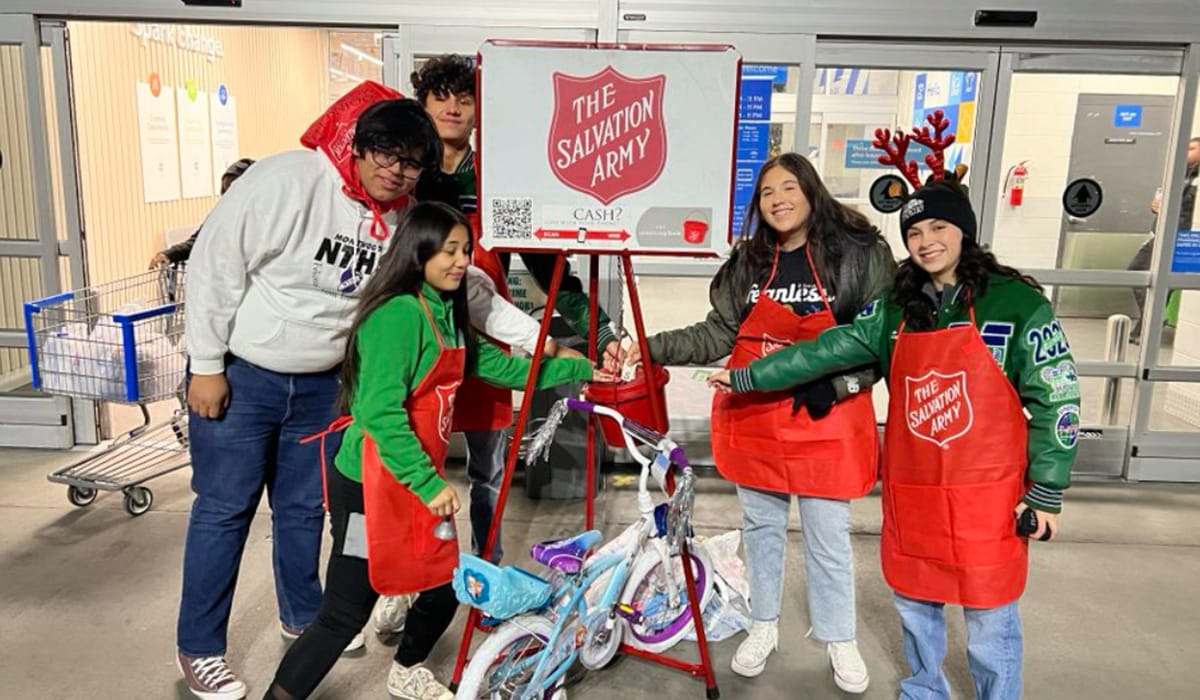
Andrew (left) and other volunteers collect donations for the Salvation Army at a drive they organized to gather essential items and toys for those in the community.
Do you have any tips for caring for your mental health?
Just like everyone has physical health, they also have mental health, and when you don’t talk about it, it can be diminished. It needs to be cared for as much your physical health.
What have you learned through your experiences as a volunteer?
You learn to never judge anyone, because you don’t know where they’re coming from. And you really learn how to collaborate with people from diverse backgrounds. You’re working with all types of people. For example, I work with people who don’t speak English. There’s a language barrier, so I need to learn how to talk to them and how to help them. I’ve learned a lot about diversity and inclusiveness.
Tell us about future partnerships, programs or events that you are excited about.
I’m trying to partner with NAMI (National Alliance on Mental Illness) to get a youth group going. They do projects every month, and I’d love to work together to impact my city. Other than that, I’m trying to find places where we can give talks over the summer.
Why is it important for others to get involved with causes they care about?
When you’re really passionate about something, you want to do it all the time. I’m really passionate about mental health, so I try to post tips as much as I can.
Any advice for people who want to start volunteering?
Get to know your community and who it’s made up of. A lot of times, when you go to places like a senior center, you see that no one goes to visit them or you see, like with El Pasoans Fighting Hunger, that not too many people volunteer. When you get to know your community, you get to know your issues and what steps you can take in order to fix them.
What do you want people to learn from your story?
I want people to know that you can have an impact. You can always help someone and better your community.
Hawaii Teen’s Nonprofit Transforms Recyclables into College Scholarships
Meet Daily Point of Light Award honoree Genshu Price. Read his story and nominate an outstanding volunteer or family as a Daily Point of Light.
With its breathtaking beaches and sunny skies, Hawaii paints the perfect picture of paradise. But behind this postcard-perfect façade, locals like Genshu Price know the real story. Growing up in Hauula, Hawaii, meant facing the harsh reality of steep living costs. When Genshu was 10, his dad proposed an idea: collect and recycle bottles and cans to save for college. At first, Genshu did just that, but he soon saw the bigger picture.
“Because of our high living costs and other problems that we face on the island, a lot of students unfortunately don’t even think about pursuing higher education,” Genshu said. “I recognized the potential of what this idea could be and turned it into what Bottles4College is now, which is a program solely for other students. Our mission is to recycle cans and bottles to not only help the environment but also create college scholarships for local students.”
Initially, Genshu embarked on his recycling mission with a humble pushcart, collecting bottles and cans from neighbors and scouring beaches, parks and even Little League Baseball Games for discarded recyclables, turning them into cash at nearby recycling centers. However, as Bottles4College evolved into an official nonprofit in 2021, Genshu expanded his reach.
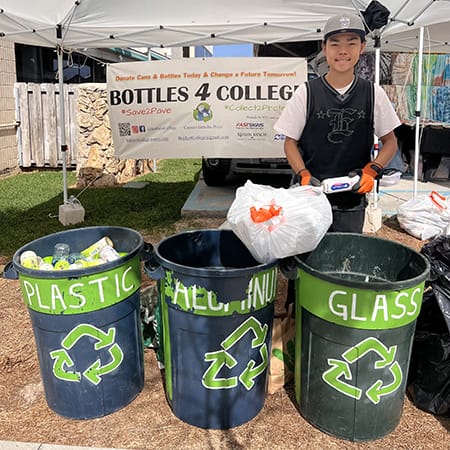
Genshu runs a donation drive for Bottles4College, allowing local residents to drop off their recyclables, which will then be converted into funds for college scholarships.
Collaborating with local businesses and schools, he established drop-off depots at convenient locations. Additionally, partnerships with organizations like Sustainable Coastlines Hawaii, known for their beach cleanups, and Kualoa Ranch, a renowned nature reserve and tourist hotspot, further amplified Bottles4College’s impact.
To date, Bottles4College has recycled over 1.5 million cans and bottles, diverting over 100,000 pounds of trash from landfills. With the funds raised from recycling, Bottles4College has been able to award two $10,000 scholarships and three $500 scholarships to deserving high school seniors in Hawaii.
“One of our scholarship recipients is currently going to the University of Hawaii at Manoa to get her bachelor’s degree in education and math to teach at Title I schools here in Hawaii. Another one of the awardees just won the National Championships for competitive cheer at her college. So not only are we helping these students get their college accolades, but they’re also getting the chance to live out their dreams,” Genshu said.
Genshu’s commitment to his community transcends college scholarships. He spearheaded a disaster relief initiative, orchestrating a successful “Bottles 4 Maui” drive at a local mall. This effort raised $10,000 to aid victims affected by the 2023 Maui wildfires.
On top of his schoolwork as a high school sophomore, Genshu dedicates anywhere between 10 to 40+ hours a week for Bottles4College, communicating with donors, picking up and sorting through recyclables, running recycling drives and participating in different community and speaking events.
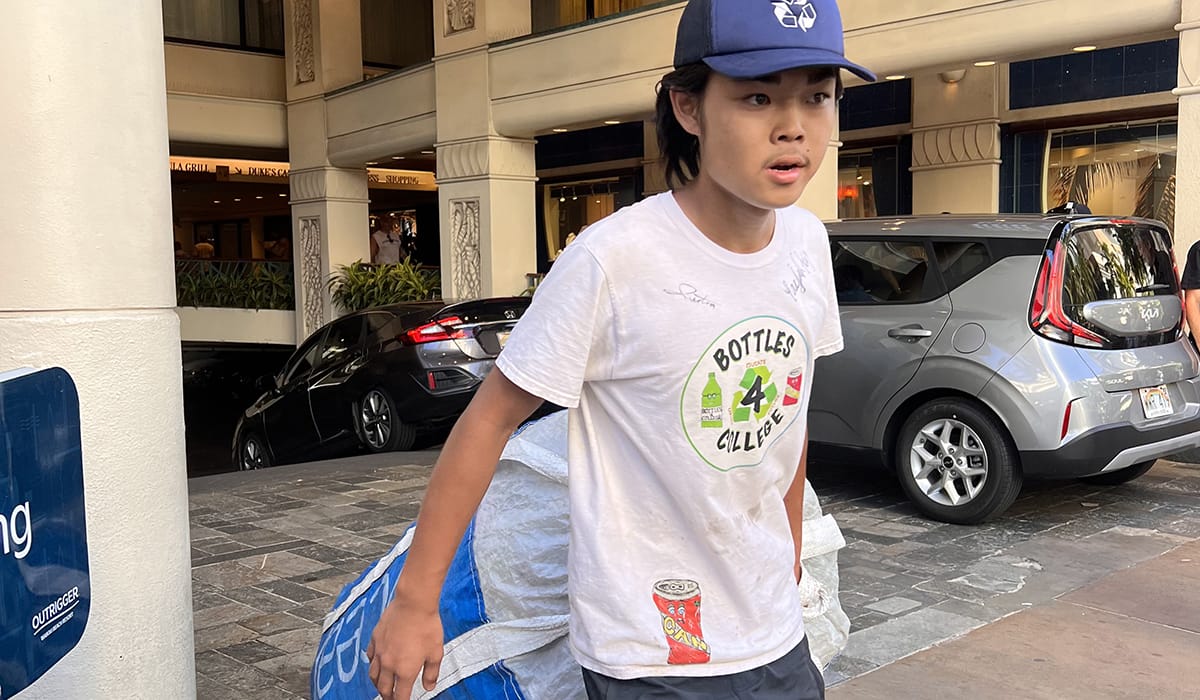
Genshu picks up a bag full of recyclable cans and bottles from a hotel in Hawaii. /Courtesy Genshu Price
But Maria Price, Genshu’s mother, says all of this wouldn’t be possible without the help of their community.
“The donors of Bottles4College and the people that support him are from every background,” Maria said. “We pick up from local businesses, but we also pick up cans and bottles from people in low-income housing. So that really reflects the sense of community we have here where everybody is doing their part to uplift one another.”
Genshu’s vision doesn’t end here; he is working on securing more grants and funding to boost Bottles4College’s impact. In the meantime, Genshu hopes his story inspires others to get involved in the causes they care about.
“As much as we can talk and say that we care, it’s really only effective when we get involved because that’s when the action happens,” Genshu said.
More Than a Decade of Dedication to Tempe’s Threadz Program
Meet Daily Point of Light Award honoree Kathy Stevens. Read her story, and nominate an outstanding volunteer or family as a Daily Point of Light.
In the high school halls of Tempe, Arizona, Kathy Stevens has become synonymous with selfless service and community commitment through her longstanding involvement with the Threadz program. Since its inception in 2009, Kathy has been at the forefront of this pivotal initiative, which aims to ensure that all students have the resources they need to attend and graduate from high school.
Kathy led the creation of Threadz, a program that operates out of a local high school and provides students with clothing, school supplies and hygiene items at no cost. Her leadership over the decade-plus has not only helped sustain the program but also expanded its reach and impact. Kathy’s dedication is evident in her more than 1,000 hours of volunteer service, contributing significantly to the program’s success and efficiency.
Often volunteering for the less glamorous but essential tasks, Kathy is known for her willingness to sort through hundreds of bags of donations and work late-hour shifts. Her commitment ensures that the operations of Threadz run smoothly and effectively. The demand for Threadz’s services continues to grow, with the program supporting 3,440 student visits and providing 12,895 items at no cost since the beginning of the school year.
Kathy’s efforts extend beyond the day-to-day operations. She also engages with the community at local events to accept donations and raise awareness about the program. This outreach is crucial for maintaining and expanding the support Threadz receives, ensuring that it can continue to meet the increasing needs of students.
Read on to find out more about Kathy’s passion for Threadz, particularly in her favorite volunteer act: getting to know the students.
Kathy believes in the students she works with and loves to get to know them. She finds conversations with the students are often the most fulfilling parts of her volunteer work!
Tell us about your volunteer role.
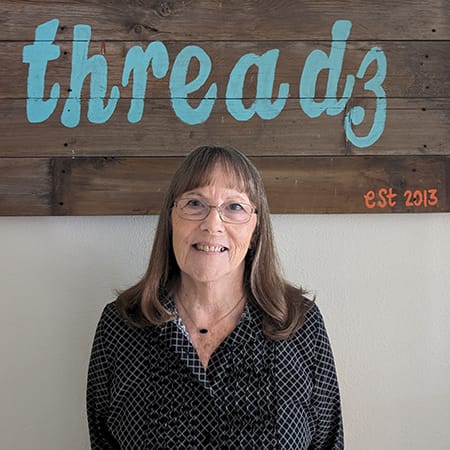
I work as a volunteer at Threadz, which is located at Tempe High School. A classroom has been converted as a shop where students can come and select from donated clothing, new hygiene items and new school supplies. I work every Thursday afternoon during the school year to assist the students with their selections. We also keep a log of how many students visit each day and the number of items they select. This information is needed when the administrators of the program are writing for grants to support the program.
We sort through all of the donations and select the ones that we feel our students would like to wear. We arrange the room to look like a shop and spend time going through the racks and keeping the inventory updated. It is important to us that students feel the items they are choosing are items they would choose if they were purchasing them. We do not ask them to show any proof of need. We want Threadz to be a place where all of the students want to visit.
Why is this issue so important to you?
I know how important it is for high-school aged kids to feel like they can be accepted. The clothing they wear, the backpacks they carry and their personal hygiene all contribute to their sense of fitting in. High school can be a tough time, and anything I can do to help is important to me. Through the year we get to know the students and many of them stop in just to say hello or to offer to help. I enjoy getting to know them and hearing how they are doing.
What inspired you to get started with this initiative?
I was asked to volunteer to help set up the first Threadz location. We painted walls, put up clothing racks and sorted through bags and bags of clothing. After that I was hooked. I have volunteered at two of the sites over the years and it is still one of my favorite volunteer activities.
What’s been the most rewarding part of your work?
When we meet a student who truly needs some help. We see survivors of domestic abuse who have to leave their homes with no clothes except what they are wearing. We have students who need P.E. clothes and don’t have the money to purchase them. We have families come in with several children and they are so appreciative when we can offer them what they need to start the school year. We often have students looking for an appropriate outfit for a job interview.
And just the fun times we have with the kids. Picking out outfits for a play or a dress for the dance, or a group of kids who need the same color shirt for some special presentation. We often meet those making donations and have the chance to tell them how much we appreciate their support.
What have you learned through your experience as a volunteer?
It doesn’t take a great deal of time to make a difference to someone who needs some extra help. Just a few hours a week can result in a positive impact in the community. Sometimes the items of clothing we provide, or the bottle of shampoo isn’t the most important thing we give to our students. Sometimes just listening to them tell you about their latest exam, or the argument they had with a friend, is why we need to be there. I am continually impressed with the students we work with. They are smart, funny, kind and full of promise.
Are there any future partnerships, programs or events you are excited about?
The administrators of Threadz are always looking at ways to better publicize our locations and let all students know that they are welcome to stop in and shop. As we continue to let the community know of our work, we have an opportunity to increase donations and find future volunteers. I look forward to finding new opportunities in the school and in the community to let people know who we are and what we do. As an adult, I look forward to school starting in the fall so we can get back to work!
Why should others get involved with causes they care about?
Many of the volunteers I work with are retired, as I am. I have plenty of time to volunteer and like to think my experience and background can contribute to the success of the organizations I volunteer with. I like staying involved with the community and think my time spent with the younger generation helps me keep me young… at least young at heart. I feel like I get much more back from volunteering than I give.
Any advice for people who want to start volunteering?
Find your passion. Any time spent working for things you care about is time well spent. Try different organizations or causes and decide what speaks to you. It doesn’t matter how much time you have to give. What seems like a small contribution to you can have a major impact on someone who needs some attention or kindness.
Long Island Teen Helps Reduce Food Waste and Hunger
Meet Daily Point of Light Award honoree Misha Gujja. Read her story, and nominate an outstanding volunteer or family as a Daily Point of Light.
Sixteen-year-old Misha Gujja’s main hobby is being a science researcher. She is fascinated with anything related to nutrition, and because science and technology can potentially play a huge role in eliminating global hunger, Misha loves the idea of using STEM to promote sustainable agricultural development and reduce food waste. She is also a national level fencer. Fencing has taken Misha to many places around the country where she can observe different ways of living, food systems and what’s outside of her “New York bubble.”
While Misha is currently focused on solving the last-mile food distribution challenge (a term for when food goes to waste before it even reaches the consumer) through her nonprofit, Fork and Spoon, she is also a science researcher working on finding solutions to increase agricultural productivity and minimize resource waste. Misha plans on pursuing a career related to nutrition and healthcare.
What inspires you to volunteer?
My family comes from rural India and we have a farming background for generations. I’m very close to my maternal grandfather, who grew up farming. He lives with us on Long Island now, but people still work his land in India, and he goes back every few months to check on things. I’ve gone back with him several times. Our family history and personal experiences have given me a respect for the land and the people and communities it sustains.
During the pandemic, I read a Long Island Advocate article about how Nassau County was ranked fifth in the nation for food insecurity. Looking around me, I started noticing the incredible disparity between food waste and hunger. In the city, food insecurity and food waste are “in your face.” You can see it everywhere. It’s very obvious. But when we moved from Brooklyn to Nassau County, I was shocked to see more covert food insecurity and food waste.
What really shocked me was when I discovered that millions of pounds of food are thrown away by restaurants every year while food banks are turning people away because they have run out of food!
I have seen firsthand that sustainable agriculture and farmer livelihoods work in tandem to end hunger and improve food security around the world. I am now focused on ways to support small-scale farms and restaurants and markets in helping to end food insecurity and food waste.
Fork and Spoon founder Misha bagging donated food at Long Beach Soup Kitchen. (Courtesy Misha Gujja)
Tell us about your volunteer role with Fork and Spoon.
Forty percent of our nation’s food supply is wasted every year. That is food that can be used to feed people who are starving in the streets and don’t know where their next meal is coming from. Fork and Spoon partners with Long Beach Soup Kitchen and Pronto of Long Island to facilitate food distribution. We source our donated food from three local Long Island cafes and restaurants. Blé Cafe and Bakery donates pastries, sandwiches, breads, baked goods. Fly Me to the Moon donates baked goods but on the fancier side, such as tarts and specialty pastries. Bosphorus Cafe and Grill donates frozen raw meat. Together, these three establishments donate over 50 pounds of food every week.
We also partner with Aloh Sanitizer, which donates hand sanitizing wipes, and we’re working on connecting with more distribution partners.
Our partners include The Long Beach Soup Kitchen which is a traditional soup kitchen, and Pronto Long Island, which is more aimed at food-insecure people who want to cook at home. Pronto is a combination of food bank, thrift shop and community resource center that offers English and financial literacy classes. What’s unique about Pronto is that they prepare shopping carts for a week’s worth of groceries for families, taking away the stress of shopping from people who already work multiple jobs just to survive.
Through community alliances, Fork and Spoon serves over 15,000 meals annually across Long Island. I spend about 35 hours each month with Fork and Spoon. We have an amazing team of eight high school students from across Long Island.
Currently, I am working on fundraising for food security in the United States and abroad.
What are your long-term plans or goals for Fork and Spoon?
I would love to go international with Fork and Spoon. The core structure can be implemented in many different countries: simply, how to distribute a restaurant’s or a market’s leftover food to feed hungry people instead of wasting all that food. I’m also fundraising for sustainable change. I’ve raised over $10,000 to work with local farmers and Indian research and development organizations to increase agricultural productivity and reduce food waste.
My current distribution does not partner with supermarkets. I am working on an outreach program and partnering with a food distributor in Long Island to help us expand, since many of our volunteers don’t have a driver’s license yet.
There is a tremendous amount of water, nutrient and resource waste in farming, especially in less developed areas. My goal is to make small farms become more efficient so that they can drive sustainability and help end food insecurity.
What’s been the most rewarding part of your work?
I love seeing the smiles on people’s faces when they accept donated food I’ve given to the soup kitchens. It feels good to know that the work I’m doing is affecting individual humans. Through community networks, we make sure our neighbors have access to healthy foods year-round. This is a multi-faceted impact since people living below the poverty level can’t afford healthy food like fresh produce. With the rising cost of groceries, they are forced to choose unhealthy processed food which then leads to obesity and long-term health consequences. We aim to provide them with healthy alternatives to improve not only their food security but their health.
What have you learned through your experiences as a volunteer?
I’ve become more aware of my own food usage and food waste. I’m now more mindful of food waste, and the types of food I buy. High schoolers can make change. While change may seem unreachable, that isn’t the case. Many people want to work with a younger audience.
We are the next generation and making change is important.
Tell us about future partnerships, programs or events that you are excited about.
I would love to partner with Misfits Market and World Central Kitchen to bring the issue of food waste to a larger audience and serve more people
Why is it important for others to get involved with causes they care about?
Volunteering empowers high school students to make change. There are so many age restrictions on what we want to do, so organizations like Fork and Spoon encourage high school students to pursue change in their own communities. We are the future!
Any advice for people who want to start volunteering?
Every small deed counts, and it’s never too early or late to start. Reaching out to local organizations in their area would be a good start. Often, smaller nonprofit organizations may be more in need of volunteers and help, and these are a wonderful jumping off point to start one’s service journey.
What do you want people to learn from your story?
I want people to learn that food waste and insecurity are present all around the world, even in places typically seen as affluent. Raising awareness for and combating these issues is extremely important, and people of all ages can take action.
West Virginia Woman Leads Disaster Relief, Community Support Efforts and More
Meet Daily Point of Light Award honoree Vanessa VanGilder. Read her story, and nominate an outstanding volunteer or family as a Daily Point of Light.
What does a former EMT decide to do with her time? For Vanessa VanGilder, she’s chosen to dedicate her tireless volunteer efforts across a spectrum of organizations in West Virginia. Her diverse roles range from promoting literacy and assisting in disaster relief to advocating for individuals with disabilities – and she remains passionate, enthusiastic and humble along the way.
At the core of Vanessa’s volunteer activities is her work with Heart+Hand Outreach Ministries, where she dedicates significant time to managing book donations. Her efforts ensure that mini free libraries throughout her community are consistently stocked, distributing thousands of books to those eager for knowledge and escape through reading.
Vanessa’s role extends beyond literacy; she is also an active volunteer firefighter with the Pinch Volunteer Fire Department, where she serves both as a firefighter and the secretary of the Board. Her commitment to public safety is paralleled by her involvement with Team Rubicon, a disaster response organization. Here, Vanessa not only responds to disasters but also educates others, teaching classes on site surveys, core operations and safety.
As the president of the West Virginia Behavioral Health Planning Council, Vanessa champions the needs of West Virginians with disabilities. Her leadership helps shape policies and programs that directly affect the quality of life for many individuals. Additionally, her advocacy work spans several boards and councils, including the Appalachian Center for Independent Living, the WV Aged and Disabled Waiver Advisory Board and the Mid Atlantic ADA Advisory Board.
Each position Vanessa holds demonstrates her versatile skills and deep desire to give back to her community in multiple capacities. Read more about Vanessa’s volunteer work and what propels her forward.
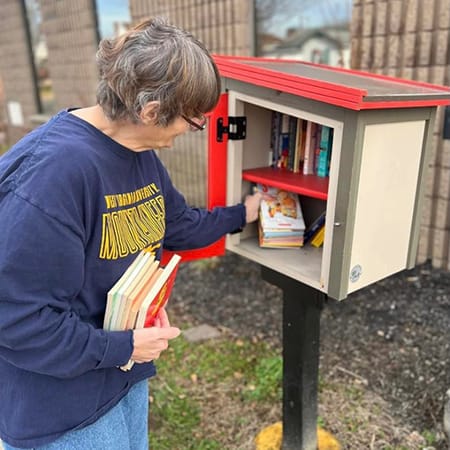
Vanessa VanGilder fills the free little libraries in her community with books from Heart+Hand Outreach Ministries’ Thrift Store.
Tell us about your volunteer roles with Heart+Hand Outreach Ministries and Team Rubicon.
One of my favorite places to volunteer is the Heart+Hand Thrift Store. Not only do I like thrift stores, but they also have a food pantry and they do social services. So the income from the thrift store goes toward helping people feed their families and keeping their lights and gas on – which I really appreciate, having been in that situation before. Years ago, I went to a food pantry, and while I’m sad that that’s a needed thing, I’m so happy I can help.
I do their books, DVDs, greeting cards and gift bags. Those are the niche items I’m responsible for. I love books anyway – my mom was a teacher and I love to read. It’s exciting to see all the different books that come out of the store. Then, Heart+Hand lets me take books and go fill up free little libraries around town. Last year, I filled over 500 free little libraries.
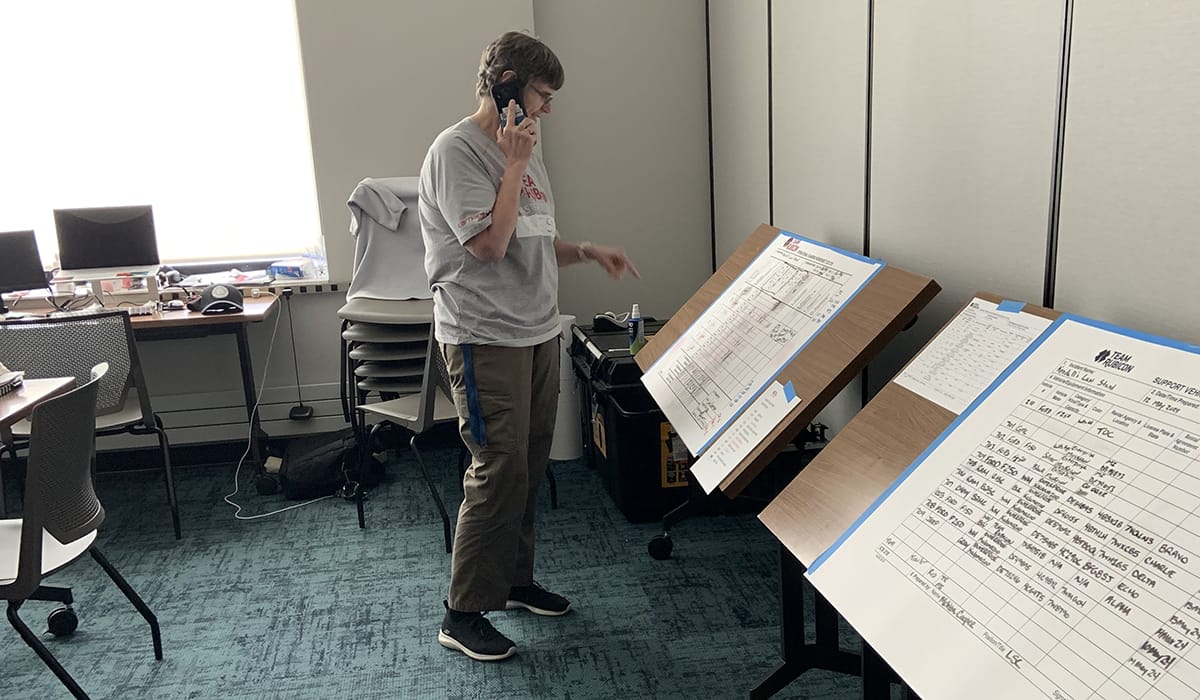
Then, I just got back last night from Michigan. I volunteer with Team Rubicon, which is a disaster response group. And we get mobilized to wherever there’s flooding, hurricanes or other weather events. I was just in Michigan for a tornado they had with a lot of damage. I help determine where the teams will go. Some of the places where our teams were, contractors were citing $50,000 for the work we were offering free of charge. We focus on people with disabilities or who don’t have insurance – people who wouldn’t be financially able to clean up their property and get back in their houses. It is so rewarding to help people who otherwise couldn’t afford to get the trees laying across their driveways cut and removed. It’s really heartwarming when all that gets done and the homeowners and community thank you for what you do.
What inspired you to get started with these initiatives?
I have a background in emergency services. I was an EMT and served in the fire department and was a 911 dispatcher, for many years. We have a lot of flooding disasters in West Virginia, so I got involved in my own community when there’s flooding. I had let my EMT card go and wasn’t working at 911 anymore, and in 2016, we had what we called a thousand-year flood. I was sitting at home not doing anything, and I felt so bad that I wasn’t out there helping. So I found and joined Team Rubicon and my local fire department at the same time, so I could be out there helping people.
Team Rubicon teaches you the proper way to muck out a house or do other response work. We have excellent training before we do anything. We have classes all the time to benefit ourselves so we can benefit the homeowners.
In terms of Heart+Hand, I had been a thrift store shopper for a long time, and a leader at the store put out a Facebook post to see if people wanted to come get books to help fill up the free little libraries. So I did that, then I started helping in the store. I started with adult books, then went to children’s books, then DVDs, then greeting cards… and it just expanded to all these areas.
What’s been the most rewarding part of your work?
Just recently, in Michigan, whenever we were out in the community, people thanked us for all the help that we were providing – even if they weren’t affected personally – they knew we were there helping the community. The businesses around town donated food for our meals and gave us discounts on meals because we were there helping. That’s what it’s all about: helping each other.
Vanessa makes calls and helps figure out where to deploy team members in disaster zones.
Why is it important for others to get involved with causes they care about?
A lot of things wouldn’t get accomplished if it weren’t for volunteers. I’m hoping that later on, when I can’t necessarily do some of these volunteer activities or services, that there will be somebody out there who will step in. This way, service keeps on giving, through the next generation.
Any advice for people who want to start volunteering?
I think the first thing is to find what your passion is. Are you passionate about some kind of sport or some kind of cause? Research what’s out there. There are always people and places needing volunteer help. There are volunteer sports. Church activities. Find something you love, then it’s not really a chore. It becomes something you look forward to doing. Three days a week, I get up really early, I look forward to going down to the thrift store, seeing what books have been donated and getting them organized.
What do you want people to learn from your story?
There’s a volunteer activity out there for everybody! There are things people can do from home – even in disaster response. There’s something for everyone, and you may just have to look a little harder to find it.