Retired Veteran Volunteers Full Time at Sheriff’s Office
Meet Daily Point of Light Award honoree Gary Anderson. Read his story, and nominate an outstanding volunteer or family as a Daily Point of Light.
Gary Anderson left small-town Maine when he joined the Marines and saw the world. Upon leaving the military, he continued his explorations stateside via various jobs—a food and beverage director for a hotel chain in Florida, a branch manager for a financial institution in St. Louis and president of a company in both Massachusetts and New Hampshire that bought and sold companies to name a few—before landing in Texas.
It was here that he eventually retired and found himself seeking a new kind of role, unencumbered by the necessity of a salary. Research led him to Hays County Sheriff’s Office, but before he became a volunteer, Gary spent 15 weeks in Citizens Academy, three hours a week learning about basic Sheriff’s Office responsibilities: the 911 Center, Animal Control, jail, criminal investigations, SWAT operations, etc. He has now been volunteering for more than 12 years, full-time and then some, spending the last six years in the Community Outreach Unit and saving the office thousands of dollars and human-hours. He’s become family to his colleagues and built long-lasting bridges with the community through his outreach.
What inspires you to volunteer?
When I retired, I was thinking I needed to do something. I didn’t really need to make money, so I looked into volunteering. I saw an opportunity with the Sheriff’s Office to go through their Citizens Academy. After I did that early in 2012, one of the lieutenants asked if I’d like to volunteer.
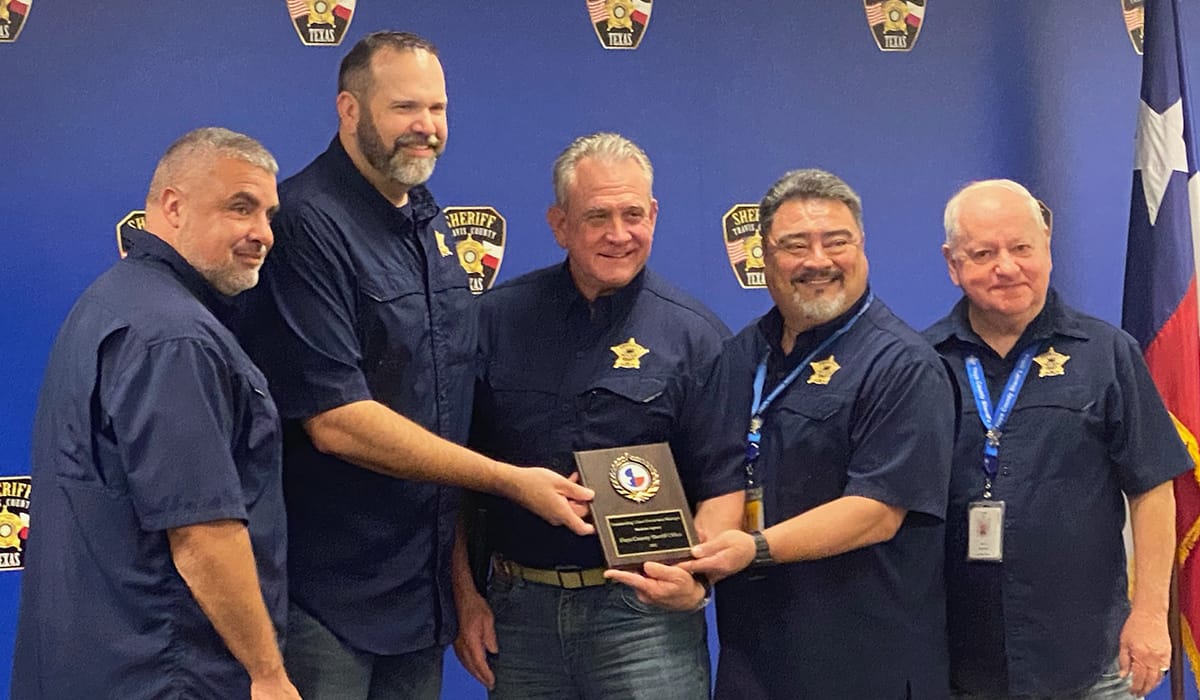
Gary (right) and the Hays County Sheriff’s Office Community Outreach Office receive an award from the Central Texas Crime Prevention Association for their work in crime prevention.
Tell us about your volunteer role with the Hays County Sheriff’s Department and beyond.
I started out working in the Criminal Investigation Division in 2013. I was there for three and a half years, handling juvenile records and doing the uniform code reporting for the sheriff’s department that went to the state and then to the FBI. I went through Kyle Police Department’s Citizens Academy and became an alumni. Then, I moved to community outreach, and I’ve been there since late 2015.
We help with Junior Deputy Academy for kids nine to 12. We give them basics of how 911 and the crisis negotiation team works, Animal Control, etc. They get to look at some of the SWAT equipment and learn about criminal investigations. It gives kids an introduction to police work. Some have gone on and graduated through criminal justice courses before coming back to work for the Sheriff’s Department and in other city departments within police.
I’m the point person for the annual National Night Out program, which is a nationwide program that gets neighborhoods together. Officers go out and talk to HOAs and neighborhoods. I’m also treasurer of the Hays County Honor Guard Foundation and Citizens Alumni Association. The latter is made up of all the people who’ve gone through the Academy who raise money to buy things not funded by the county. The last thing we helped fund was for the SWAT team. It was a high-tech camera for looking around corners and doors to reduce risk for police officers. We raise $20,000 or more a year and spend all of that on things for the sheriff’s office. And I’m a member of the Texas Citizens Academy Alumni Association and Texas Crime Prevention Association.
What’s been the most rewarding part of your work?
It’s just being able to help out. When I’m doing a lot of these things, it frees up a real sheriff’s deputy or police officer to go do things they need to do. It saves them time.
What are some things that people might be surprised to know that police officers do?
They’re surprised at our education and outreach efforts. We go to schools and show them different equipment and everything else. Also, in the fight against fentanyl, we have two deputies who have gone all over the US and even Mexico City to speak at an international conference. They gave a fentanyl presentation. I helped work on that program some.
Tell us about future partnerships, programs or events that you are excited about.
One of my big passions every summer is helping an organization called Sunshine Kids based in Houston. They come here for a trip they call the Hill Country Adventure with kids 12 to 20 years old who are battling cancer. We fundraise through our alumni and support them with food and trips. We throw a big Bingo ice cream social party for them and give away about $5,000 in prizes every year. While they’re here, the Sheriff’s Office does a big barbecue for them and we close the interstate down and take them to the state capitol in really cool cars for a tour.
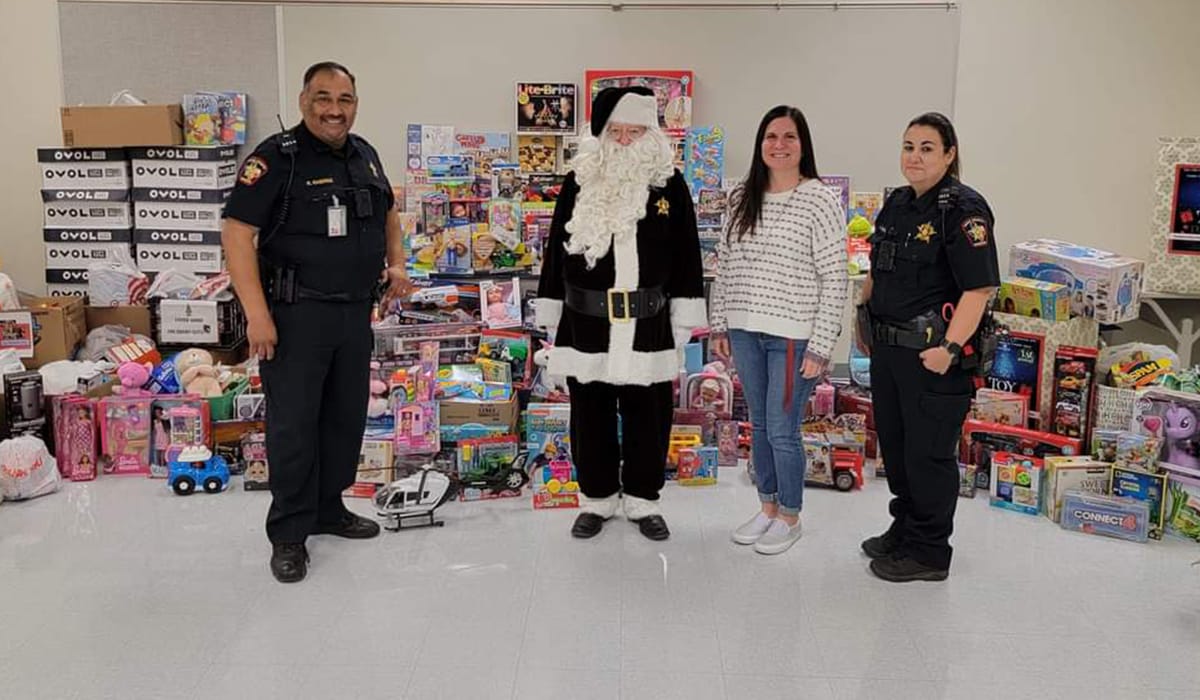
At Christmastime, I dress up as the Sheriff’s Office’s Brown Santa. I go to all the fundraising events and collect toys. Last year we helped 525 families and over 1,500 children in Hays County. Those things are really dear to my heart, because these kids don’t have a lot.
In Texas tradition, Gary dresses up in a Santa suit designed to mimic the brown uniforms of the Sheriff’s Office for a toy drive at Hays High School. The Brown Santa Program gifts toys to local children in need.
Why is it important for others to get involved with causes they care about?
There’s so much need out there, whether it be in hospitals or the food bank. There are many different programs and not enough people to do it all. It’s very beneficial to the community to get these programs working better.
Any advice for people who want to start volunteering?
Whatever you want to get involved with, go learn about it. There are a lot of good people who want to help people, and a lot of them maybe don’t know how or where to do it, but you just have to go out there and look.
What do you want people to learn from your story?
It’s really rewarding. I feel so satisfied that I can help people. I don’t care where you are in your walk of life, there’s always someone that’s worse off than you are, and if you can help make their life better, it should make you feel good.
From Cage to Comfort: Dog-Lover Finds Homes for Thousands of Shelter Pups
Meet Daily Point of Light Award honoree Roman McConn. Read his story, and nominate an outstanding volunteer or family as a Daily Point of Light.
In 2015, Roman McConn was three years old and living with his family in Texas. His passion for animals–dogs in particular–was evident early on, but he was moved to action one day as he and his parents were leaving a local PetSmart. Roman saw dogs in kennels lined up out front and asked his parents why they were there.
“They said that they get them out there to advertise for them, because if they can’t find homes, they have to go to heaven. In my three-year-old mind, I thought, well let’s just get the homes ourselves,” Roman recalls.
That was the beginning of a path that would change all of their lives. For his fourth birthday, Roman asked for donations and gifts for their local animal shelter and began visiting soon after. When he turned five and moved to Washington State, he couldn’t get those Texas dogs off his mind. So, with the help of his dedicated parents, the family founded Project Freedom Ride to advocate for the adoption of unwanted or abandoned dogs and transport them to loving families across the US.
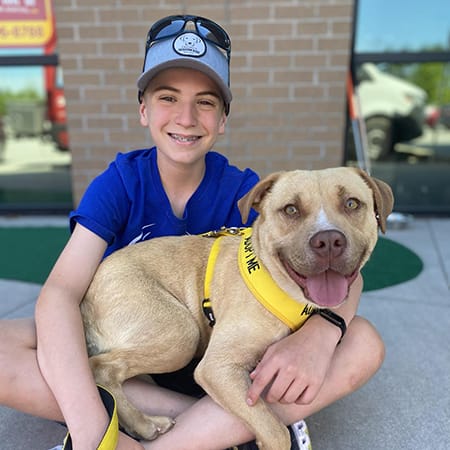
Rowan holds Brooke, a dog from the Edgefield, SC shelter, at an adoption event he helped host at the Hollywood Feed in Augusta, GA.
Roman is the face of it all, but he also makes thoughtful videos with each dog at the shelter, highlighting their best qualities for potential adopters on Petfinder and social media. Jen, Roman’s mom, puts in lots of late-night and early-morning volunteer hours on top of her full-time job to keep things running smoothly.
“I get to do the fun part. My mom has to do all the paperwork and the computer work: the boring business end and adult stuff,” Roman jokes.
After outsourcing the transport portion for a few years, they purchased a van and hired drivers in order to have more control over the treatment of dogs in transit. Once a month, dogs are moved from high-kill areas in Texas and Georgia to northern states with fewer homeless dogs. Jeff, Roman’s dad, and a fellow veteran manned the vehicle for multiple years. Jen tracks the van’s progress with updates for those waiting to meet their new furry friends. PFR is truly a family effort.
Roman, himself, has 10 dogs at home right now. Seven are permanent residents, and three are just passing through as fosters — something that happens on a regular basis. In fact, four of the forever dogs are foster fails.
“We got them with the plan to hand them along to someone else, but they had lived with us for so long, we couldn’t do that to them,” Roman says.
“He’s a very unusual 12-year-old boy in the sense that he’s always been willing to give to the cause,” family friend Brenda McGarr effuses. “He loves the old dog, the sick dog, the three-legged dog, the one-eyed dog. One of his personal dogs is deaf. He just has a heart for the underdog.”
From its inception, Project Freedom Ride has placed nearly 5,000 dogs, and it hasn’t gone unnoticed. In 2018, Roman was named ASPCA’s Kid of the Year. And nearly five years ago, while volunteering in a local shelter, Brenda recognized Roman from his appearance on The Ellen DeGeneres Show. Roman and Jen were handing out ice cream cups to the dogs, so she joined them and has since become close.
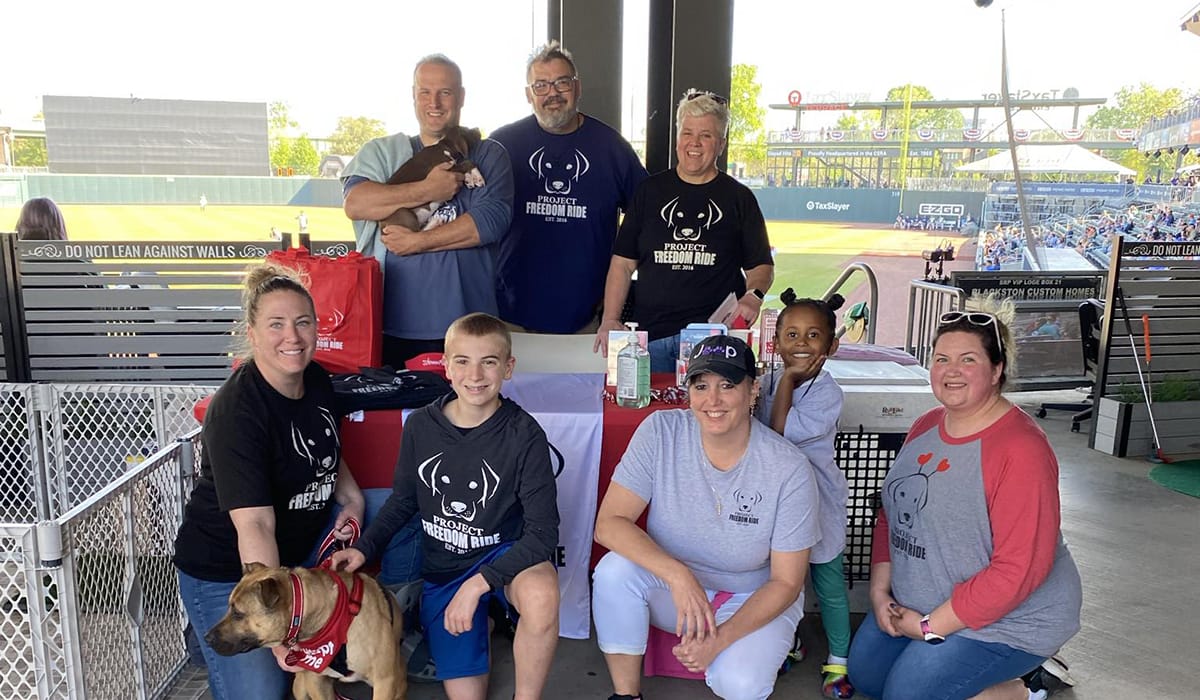
(Back left to right) Jeff, Roman’s dad; Dennis, a PFR driver; Brenda, a board member, foster and volunteer; (front left to right) Jen, Roman’s mom; Friday, a dog waiting for adoption; Roman; Rexanne, a volunteer; Norie, Rexanne’s granddaughter; and Sarah, another PFR driver, to a Bark in the Park Day at the Augusta Greenjackets stadium. On these days, dogs can see a game for free.
“I’ve become more like an aunt to him than anything, because they don’t have any family in this area, and I don’t either. So, we sort of just adopted each other,” Brenda says, noting that Roman and Jen convinced her to remodel a room in her home that has allowed her to foster 29 pups over the last two years.
Roman visits the shelter twice a month and helps with promotional and adoption events. Often, he simply assists with the daily grind.
“Sometimes, we’ll go to a shelter and we know all we’ll be doing is cleaning or bathing or bringing in food that’s been donated, basically trying to help out wherever we can,” he says.
His passion captured more than one television network’s attention. In 2022, Roman and Jen moved back to Texas temporarily to shoot Roman to the Rescue for Disney+, a show that follows him through the process of rescue to adoption assisted by various Disney stars. He’s been featured in many media outlets for his dedication to the work and was even able to return to Ellen during her final season.
All of the accolades have come with increased visibility, a benefit when an organization is run from donations and the occasional big grant or event partnership. Things were moving right along when the COVID pandemic hit and had an unexpected effect.
“A lot more people were adopting because they were at home. But a big problem now—and the last year or so—is people going back to work and realizing that the puppy they got during quarantine is no longer a puppy. He or she is now a two-year-old with bad behavior,” Roman explains.
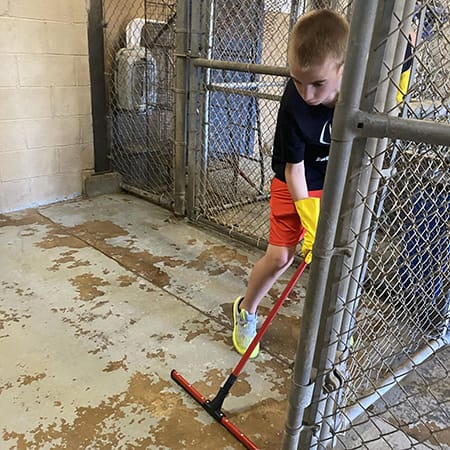
Roman does some deep cleaning at the North Augusta, SC shelter after Project Freedom Ride donated 1400 lbs of food .(
People are returning dogs, and PFR is scrambling to get them placed. To avoid the issues that might cause adopters second thoughts, Roman suggests investing in basic training to eliminate behavior problems. Patience is key.
Like everything, the work has its ups and downs. Sometimes, despite everything, shelters still have to put dogs down.
“It’s really sad, and that definitely can be hard sometimes. But eventually you just have to toughen up so you can try your hardest to prevent that as much as you can,” Roman says.
On the best days, people send pictures of the dogs enjoying their new life. Many of them have come a long way, and Roman finds satisfaction in seeing their happiness.
“Humans are the reason dogs are in shelters, so I feel like we owe it to them to help fix the problems we’ve created,” he states. “They deserve great lives.”
Roman is a hard worker full of compassion. His efforts have brought joy to a lot of dogs and the humans who love them.
Meet Daily Point of Light Award honoree Banks Vadeboncoeur. Read her story, and nominate an outstanding volunteer or family as a Daily Point of Light.
Banks Vadeboncoeur has been a creative writer since kindergarten. Growing up, she would spend hours crafting short stories and novels, which eventually led to a love of journalism. In her middle school journalism class, Banks entered a competition called the C-Span StudentCam Competition. The prompt was to create a documentary focused on a national issue that the President should be concerned about. Since this was during COVID, Banks was not able to do in-person interviews but used C-Span footage as well as Zoom interviews with doctors and other medical professionals to explore the topic of racial inequality in the healthcare system. Her work earned Banks third place and sparked a passion for activism and making a change through journalism and opinion pieces. For several years, she was one of only a few youth contributors to local publications.
Combining her passion for helping and her passion for writing led to the creation of Young Voices for Change (YVC), which she founded at age 15 as an online publication and advocacy group exclusively by and for youth. YVC promotes the development of young activists and writers, especially those whose voices often go unheard, by giving them a space to share their opinions on current events and global issues. In addition to the online aspect of the nonprofit, YVC leads multiple in-person workshops that focus on underserved Florida children as well as other initiatives to drive change in the community.
What inspires you to volunteer?
Volunteering is important because it’s so gratifying; in fact, more so than anything I’ve ever done. It gives my life meaning, especially when I’m working with kids or empowering young people.
Tell us about your volunteer role.
I use storytelling and media to inspire change. I am the founder and executive director of YVC. My primary responsibilities include overseeing our organization’s operations and initiatives including managing our online publication and advocacy group, curating and maintaining our website, leading fundraising efforts, and coordinating YVC projects such as the Young Writers Workshop.
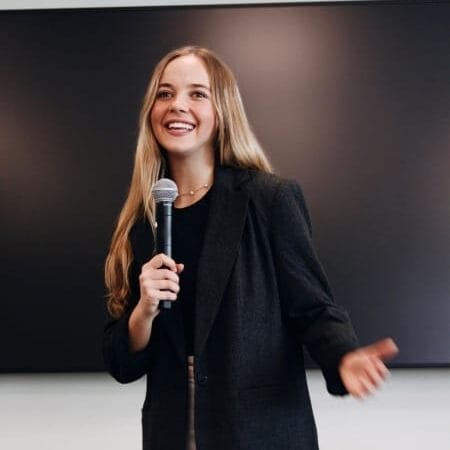
Banks Vadeboncoeur speaks about her organization, Young Voices for Change./Courtesy Banks Vadeboncoeur
I am the sole editor of the YVC platform. Reading entries from around the world deeply moves me, as they showcase the courage and compassion of my generation. Our contributors write about transgender rights, mental health, climate change, gender-based violence, and other current issues. We have featured content from over a hundred young contributors globally. Our reach is significant. We have had 10,000 website visitors and 150,000 social media views.
Outside of YVC, I am a video editor for MediaWise, an organization that promotes media literacy. I have edited several episodes of the “How2 Internet” series for PBS and the Fact-Checking Network’s “Is This Legit?” series. I also conducted and presented research as a research fellow at the UCLA Center for Scholars & Storytellers, where I studied the impact of entertainment media on young audiences.
An important part of my work at YVC is to develop and lead the Young Writers Workshop, catered for underserved first through fifth graders in Jacksonville, Florida. The workshops are held twice every summer, each one week long, with half-day sessions so we can accommodate more students. I create the entire curriculum, inspired by my favorite lessons and activities from my childhood, and I am the head instructor. Other volunteers sit with the students and serve as a helping hand as I teach the workshop. At the end of the program, each child writes and illustrates their own short story, which is then published, printed and delivered to them.
Our kids come from a charter school system in Jacksonville. Due to the city’s demographics, a majority of the workshop participants are African American children living in financially unstable households. Since school is out, most of these kids have to be away from home during the summer so they can be supervised. The Young Writers Workshop is not only a safe space, it’s an opportunity for them to find their voices and shine. The kids have a lot of freedom to explore when it comes to their writing, as my goal is for them to use their imagination and have fun doing so. Many get so invested in creating their short stories that they discover a new love for writing. Many try to come back the next year.
YVC also conducts a Holiday Drive where we deliver gifts and meals to underserved families during the holidays. We have raised over $10,000 with support from community sponsors.
We also hold a Fast Fashion Clothing Swap. This is a fun event where members in the community come together and swap gently-used clothes. It’s also an opportunity to speak about the environmental impact of fast fashion and advocate for sustainability.
As our cultural and political landscape evolves, our YVC projects also adapt, reflecting the ongoing changes in our world.
What are your long-term plans or goals for Young Voices for Change?
Right now, our online publication is fueled solely by global contributors and staff writers.
We have a YVC chapter in both Florida and California, where members meet often and contribute multiple pieces each month. I would love to see YVC expand nationally!
In addition, we continue to host the Young Writers Workshop, which began the summer of 2022. This is a youth-led summer program in Jacksonville, Florida in which each child from an underserved school writes and illustrates their own short story, which is then published. We hold a red carpet publishing event/book signing party where the kids receive their own hardcover books. This is funded by the Riley’s Way Foundation as part of their Call for Kindness competition. So far, we’ve benefitted nearly 100 underserved children in grades 1-5. I would love to see many more kids spread their wings as writers and artists.
At the beginning of 2024, YVC held a scholarship competition called Ink 4 Impact for juniors and seniors from Title 1 high schools. The prompt was to write or create art about global issues and current events. The winner received a $1,000 scholarship to be used for their education endeavors, with the prize money fully funded by YVC’s sustainable clothing line. All non-winners’ works were also published on the YVC website.
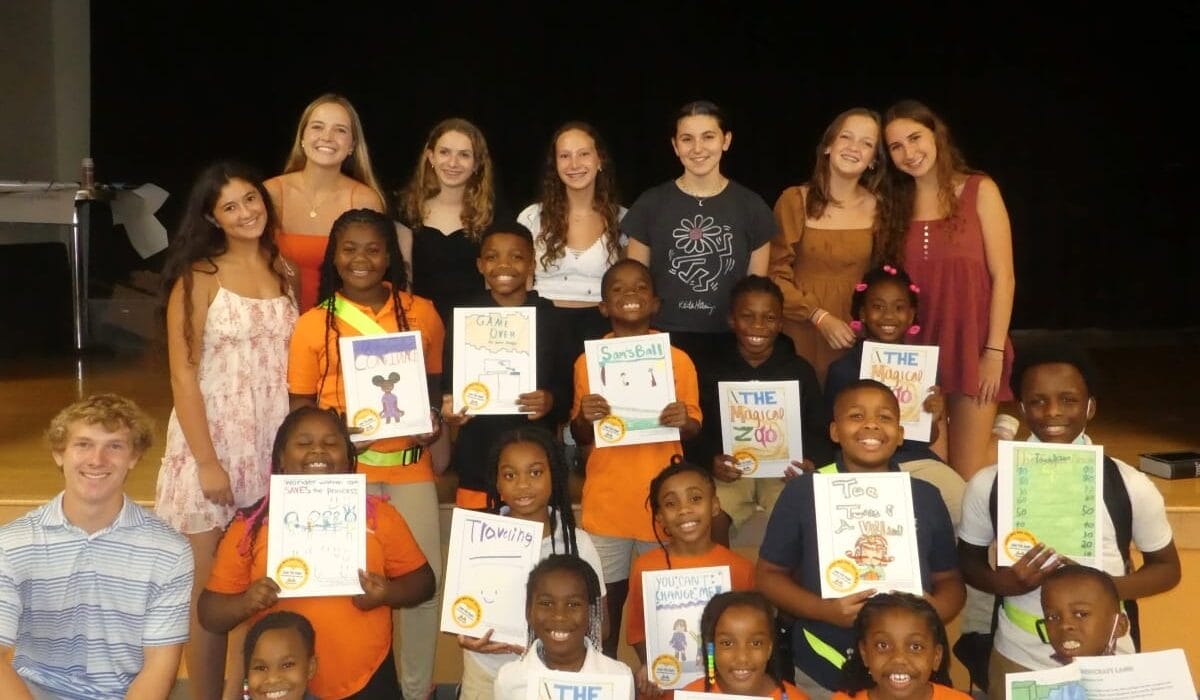
Banks Vadeboncoeur, back left corner, at the book signing party for session three of the Young Writers Workshop./Courtesy Banks Vadeboncoeur
What’s been the most rewarding part of your work?
I am continually awed by the creativity I see in youth of all ages. For example, “Confidence” was written by a Young Writers Workshop student named Mariah, who shared her experience with overcoming bullying; I love to see these kids blossom through writing.
What have you learned through your experiences as a volunteer?
As a volunteer, I’ve learned about the reciprocal nature of helping others and how volunteering has motivated me to be a change-maker. It’s my passion and hobby. I find myself doing a lot less social media scrolling, video games and other typical teen stuff. The nature of giving back grows exponentially. The more I do it, the more I want to do it. I truly see myself doing this for the rest of my life. I want my career to go in the direction of change-making, as I love it so deeply.
Tell us about future partnerships, programs or events that you are excited about.
We have more sessions of the Young Writers Workshop coming up this summer. Since 2022, we’ve hosted multiple summer workshops each year, making this summer our fourth and fifth sessions. We also have another Fast Fashion Clothing Swap coming up on June 5.
Any advice for people who want to start volunteering?
Finding your groove may take starting in an “obvious” volunteering role like working in a food bank or animal shelter. Eventually as you meet people, you will gravitate toward a volunteer opportunity that’s aligned with your passion. Good comes from all volunteering, but once you find a spark, there are a lot of resources online that can help you move in that direction. Look for communities aligned with your interests. For me, it was the journalism community and the change-making community. You can even Google “volunteer opportunities near me.” High schoolers have access to a lot of resources in school, but the community at large can visit their local library where there will be a bulletin board with ways to help locally.
What do you want people to learn from your story?
Age does not hold anyone back. I’m not too young to write a newspaper article, lead a camp or start an organization. The teen years are a time of self-discovery and if you find a passion, go for it. I’ve found amazing people through this journey. I was nervous when leading my first workshop but I was so glad I pushed through and the experience was amazing! Nobody expects perfection. They’re just glad you’re willing to step up and help!
Veteran Cancer Survivor Inspired By Volunteers at Local VA Hospital
Meet Daily Point of Light Award honoree Diana Wong. Read her story, and nominate an outstanding volunteer or family as a Daily Point of Light.
Diana Wong, a three-time cancer survivor, is a testament to perseverance. In 1990, after nine years in the Air Force, a job she loved and a military legacy started by her father’s 26 years in the Army, she was forced to leave due to policy when she began her first battle with cancer. For over 15 years, she relied on the Albuquerque VA Medical Center where, in 2005, she would start volunteering.
Since then, she has branched out to many different veteran-associated roles with Disabled American Veterans Auxiliary (DAV), American Legion Auxiliary, AMVETS, Wounded Warriors, etc. She also started an all-women Color Guard team in 2014. Her decades of services have earned her the Presidential Lifetime Achievement Award for surpassing 4,000 hours of volunteerism this year, the latest in a long line of civic-minded honors.
On top of all of that, Diana works with civilian groups like Navajo Ministries (recently renamed Four Corners Home for Children) and American Cancer Society. While she may not have found herself in uniform for as long as she would have liked, her long-term dedication and strong sense of empathy have made possible the support both veterans and civilians facing battles of their own would be lost without.
What inspires you to volunteer?
When I first got out, I really didn’t want to have any to do with military organizations, because I was mad. But as God would have it, he kept putting me in the VA hospital. I got sick again, and a third time. I was like, Okay, you’re trying to tell me something. I’ve been going to this VA hospital for the past 35 years, and they’ve taken really good care of me. I saw volunteers there and decided that I wanted to serve in that way, because they were there for me.
My parents were also big volunteers. You never said you were bored around them, because they’d find something for you to do, like picking weeds out of the neighbor’s yard.
Diana Wong volunteers her time to many different organizations supporting both veterans and civilians, many of which support her local VA hospital.
Tell us about your volunteer role with your local VA hospital and beyond.
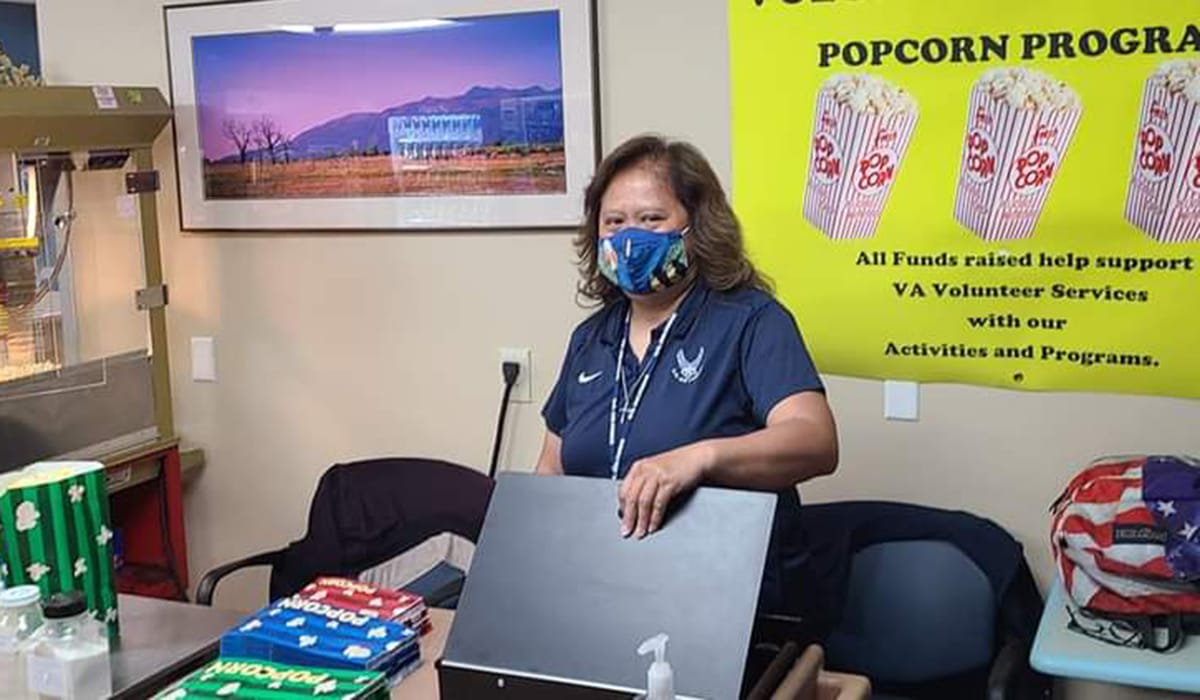
About 20 years ago, they asked me to help with the Women Veterans’ Clothing Closet. We collect clothing for inpatients from the Star Program and the domiciliary. And all the VAs have a Popcorn Program to raise funds. I’ve been doing that for 15 years now.
The VA hospital always needs stuff, and not one military organization can handle it all. So, if you belong to several you can always find ways to help. I belong to the American Legion and the VFW. They have their own programs. For example, on holidays we make gifts and bring them to the hospital for inpatients. It all intertwines.
I’ve also been helping in the VA chapel every Sunday for 18 years now. And I’m a volunteer at the New Mexico Veterans Memorial. I help watch their front desk and teach flag education—flag etiquette, history of Taps, how to retire a flag, etc.—to schools, Girls Scouts, Boy Scouts and others.
We started an all-women veterans Color Guard team back around 2016. We’ve got about 15 women and we do everything from graduations to special events, sports games, funerals, military organization events, etc. We’re going up to Angel Fire here in New Mexico to do a remembrance ceremony this Memorial weekend. They just built a new Walmart here, and they want us to bring the flags for them, too.
I’m involved with another Honor Guard unit, American Legion Post 13. We do funerals in Santa Fe at the National Cemetery. If a veteran passes away, they’ll call us to do the rifle volley and present the flag to the next of kin.
I’m with the DAV here, Post 33, and I’m involved with their auxiliary. Once a month, we do a party for Ward 7, the psychiatric ward. We bring in food and spend time talking with them. We also bring water and snacks to the oncology ward and other units at the VA so patients can have something after finishing with their treatments. And the Albuquerque Fisher House is right next door, so we help out there, too.
In September, we do a suicide prevention ride with the American Legion Riders to raise awareness. We lose 22 veterans per day to suicide. We do our full ceremony for that also in remembrance of those we’ve lost.
I’m also involved with the American Cancer Society. I DJ’ed for the Relay for Life for 18 years. I did 16 cities throughout the state of New Mexico every summer. I couldn’t carry the equipment anymore, so I had to slow down. I was also the ambassador constituent for the State of New Mexico for district one, and we used to go to Washington, D.C. every year to talk about her cancer issues.
As part of a nationwide program, Diana sells popcorn to raise funds for VA volunteer efforts.
You’ve also been on the Tribute to Women in the Military planning committee. Can you tell us about that?
The Tribute to Women in the Military started back in 1985. I was stationed out here at Kirtland Air Force Base at the time and was only 25 years old when I went to my first one. I attended it from ’85 to ’88, and then I came back in ‘96 and started working for the VA regional office. My supervisor asked me if I wanted to represent the office. So, I started going to meetings, and I’ve been involved with the Tribute for about 28 years now. I’m the president. We honor all women veterans’ past, present and future from all branches of the military.
What’s been the most rewarding part of your work?
When we do the Color Guard duties, people are so grateful. It’s an honor to attend veteran funerals and do the rifle volley as that last respect. It’s very human and very humbling.
A friend called me the other day and asked if I knew anyone who needed an electric wheelchair or hospital bed. I went over to the American Legion and started asking around and, lo and behold, a lady had called earlier that morning saying she needed an electric wheelchair for her sister. So, I put them in touch. It’s rewarding to help somebody like that.
What do you want people to learn from your story?
At church this Sunday, the priest was talking about how everybody has a gift. He was talking about one of the women who plays the piano every week for mass. Mass will be mass, with or without music, but she comes every week to share her gift. Everybody has one to give. That’s our way of paying forward.
Grandma Helps Her Grandson Fight Hunger in Florida
Meet Daily Point of Light Award honoree Peggy Graham. Read her story, and nominate an outstanding volunteer or family as a Daily Point of Light.
Joshua’s Heart Foundation started because a four-year-old boy received $20 from his grandmother, Zula (Peggy) Graham. Peggy told her grandson he could spend the money as he liked, on himself. However, while the family was driving to church that same day, Joshua saw an unhoused man and decided to give the money to him after his mother read him the sign held by the man. On the sign, the man had written “I will work for food.” Joshua told his mother he wanted to give the man his $20, but his mother suggested he give the man $1 instead, fearing that the man would spend it on drugs or alcohol. Joshua insisted he wanted to give the man the entire $20. Eventually he won out and gave the man the $20.
Even as a four-year-old, Joshua recognized that hunger was a problem and wanted at that moment to make a difference. After leaving church and going home, he told his aunts that he gave the hungry man his $20. He begged his two aunts and mother to help him feed folks on the street.
Volunteer organizations usually don’t accept four-year-olds, but Joshua was undeterred. Peggy volunteered her kitchen to prepare meals for unhoused individuals. She, along with Joshua’s mom and aunts, prepared complete meals for these people. After two years of cooking for the unhoused in Peggy’s kitchen, Joshua started his own hunger-relief organization called Joshua’s Heart Foundation, which has no age restrictions for volunteers. The foundation is primarily a youth-led organization and relies on youth volunteers, but there is also a lot of community engagement. Peggy continues to be an integral part of the efforts to end hunger, even in her 70s. She is always at the pantry except on weekends.
In addition to providing food and other necessities, Joshua’s Heart Foundation also educates community members on how to end poverty and hunger and how to prepare healthy meals. To date, the foundation has served more than half a million individuals.
What inspires you to volunteer?
I was born in Jamaica. I’ve been living in Florida for over 40 years. Growing up, we had very little. Sometimes we went to school without shoes but we were still always trying to help others. My mother taught us to share. I taught that to my children, too: pray, go to church and help where you can.
We all die and leave the world with nothing so while we’re alive, we should be doing the right thing and sharing. It’s all about sharing.
Tell us about your volunteer role.
I have been volunteering with Joshua’s Heart Foundation since 2005. These days, I’m at the food pantry three or four times a week. We have a few organizations that donate food, so I help track the expected delivery so we can be efficient in distributing the food items to families. We also have a few community volunteers who help us sort, pack and distribute food.
I supervise the volunteers and welcome and onboard new volunteers at the pantry during the week. I help unpack donated food items, I help prepare and distribute groceries and supplies to families who need them. I also assign volunteers to deliver food items and other donated goods, and make sure that enough food and supplies are going to the recipients during the week.
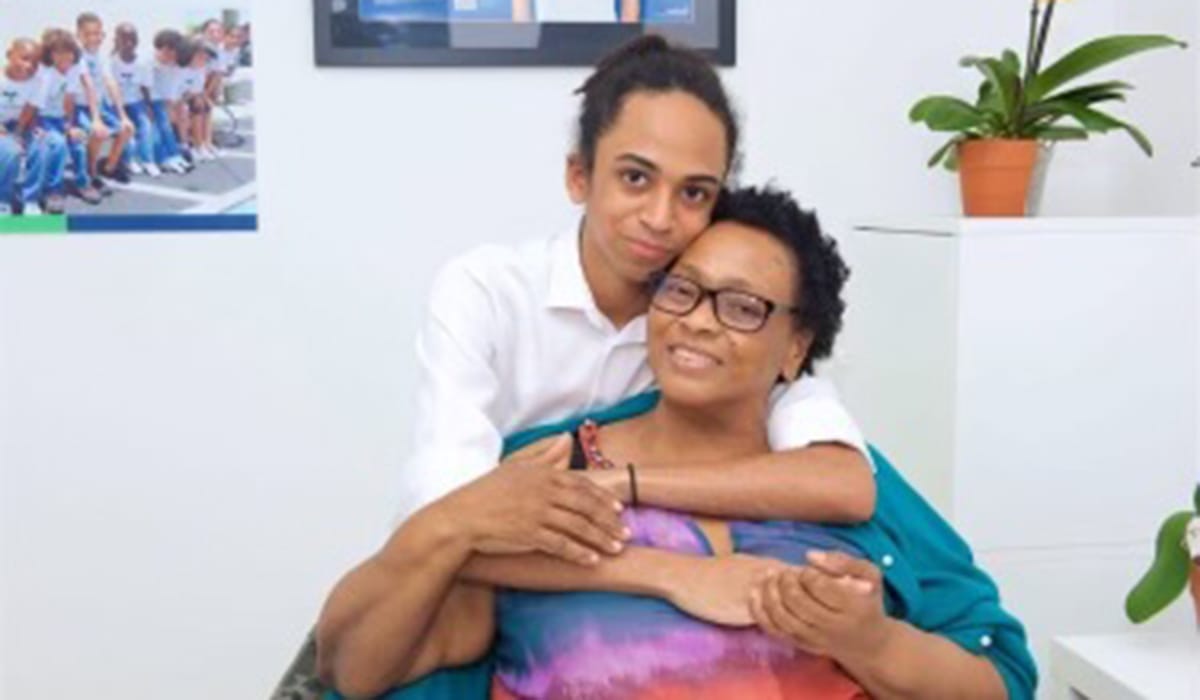
Joshua’s Heart Foundation volunteer Peggy Graham with her grandson, Joshua’s Heart Foundation founder Joshua Williams.
What inspired you to get started with this initiative?
Joshua inspired me! Even as a small child he always loved giving things to people and feeding people. In our family, we try our best in whatever we do. We are behind him 100% when it comes to doing good things for the community. How could we not help? One of Joshua’s favorite quotes comes from Myles Munroe, and it’s something we can all live by:
“True leaders don’t invest in buildings. Jesus never built a building. They invest in people. Why? Because success without a successor is failure. So, your legacy should not be in buildings, programs or projects; your legacy must be in people.”
What are your long-term plans or goals for the organization?
We would love to expand to help more people. God makes the ways for us to help. We have outgrown the space we are in, and we need a larger space. I know that God will provide that space when the time is right.
What’s been the most rewarding part of your work?
I know a lot of our recipients by name now. It just feels good to know I am doing something for somebody. We might be afraid to give somebody money because we don’t know what they will do with it, but we do know what they will do with the food we give them. I know they need food, so we give food, toiletries and household items. So often, people are in tears and overwhelmed with gratitude.
Joshua’s Heart Foundation wants all children to be fed when they go to school. You can’t learn when your belly is empty. When kids are stealing it’s because they are desperate. I pack up extra food for kids who might otherwise be tempted to steal because they are hungry. I give them extra. I help them feel that someone is here for them, someone cares and someone loves them.
I never turn anyone away. I don’t want anybody to go hungry.
What have you learned through your experiences as a volunteer?
God wants us to help each other. God wants us to share. When you see a need, just help.
Any advice for people who want to start volunteering?
Find a volunteer organization you’re interested in, get some information, and see if it’s something you want to do. People there will help you and guide you. You don’t have to figure out what to do on your own. Most people who volunteer with Joshua’s Heart Foundation love it and want to come back again and again
What do you want people to learn from your story?
We are all God’s children. When you see someone in need, help. I inspire others to help. There are so many people in need. We can all share. Everybody has something. Be kind to each other. Help each other. We have to be beautiful from the inside and always remember to pray.
Atlanta Volunteer Supports Social Justice and Hunger through Volunteerism
Meet Daily Point of Light Award honoree Emily Chatlen. Read her story, and nominate an outstanding volunteer or family as a Daily Point of Light.
Amidst the hustle and bustle of Atlanta, Emily Chatlen has carved out a significant role as a champion of community service and social justice. Since 2021, Emily has participated as a part-time member of the Repair the World Service Corps four times, amassing over 200 hours of volunteer service. Her involvement is deeply rooted in weekly dialogues with her cohort where they address vital local issues such as food insecurity and housing injustice. These discussions are not just theoretical; they directly inform the type of service work Emily and her peers engage in, ensuring their efforts are responsive to the most pressing needs of their community.
Additionally, Emily currently serves as a Service Ambassador for Repair the World. In this capacity, she designs and leads service programs aimed at encouraging her peers to actively participate in community service. Each month, she organizes events that last between three to four hours, drawing more volunteers into meaningful action that supports a variety of justice-oriented initiatives.
A significant portion of Emily’s volunteer hours has also been dedicated to Concrete Jungle, an urban farm that plays a crucial role in improving food access in Atlanta. At Concrete Jungle, Emily’s tasks go beyond basic gardening; she is involved in nurturing the plants, preparing educational documents and lesson plans for community members, and sorting and distributing produce to those facing food insecurity. Her work helps bridge the gap between abundant city resources and the populations most in need of fresh, nutritious food.
Read on to find out more about how Emily’s efforts are making a tangible difference in the lives of many Atlantans.
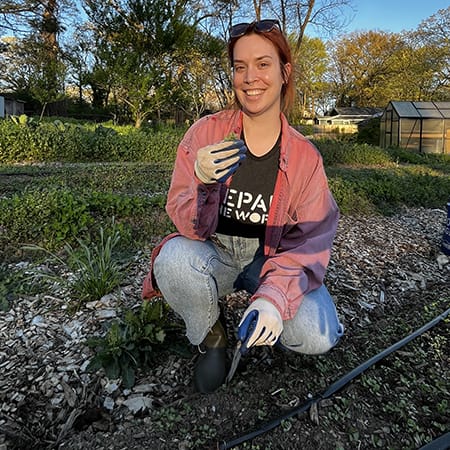
Emily Chatlen is a passionate volunteer working with multiple organizations to end food insecurity and housing injustice across Atlanta and beyond.
Tell us about your volunteer role.
I serve as a service ambassador for a nonprofit organization called Repair the World. Repair the World engages Jews and their communities in a lifelong commitment to service through meaningful volunteering experiences. As service ambassador, I host one volunteer event per month. The events are centered around a variety of justice areas such as food justice or environmental justice.
I also serve as a pick lead during the spring season with another nonprofit organization called Concrete Jungle. Concrete Jungle transforms underutilized fruit trees and land into a healthy food source for communities in need.
Why are these issues so important to you?
Food justice is so dear to my heart for many reasons. One of the reasons being that I live in what is known as a “food desert” here in Atlanta. A food dessert is an urban area in which it is difficult to buy high-quality fresh food. Volunteering with both Concrete Jungle and Repair the World has allowed me to help in providing healthy food to communities in need.
What inspired you to get started with these initiatives?
I first heard about Concrete Jungle after moving to Athens, GA – a college town in which I did not know many people. I was looking for opportunities to get to know others in my community. After my first pick with Concrete Jungle, I was hooked! It was through Concrete Jungle that I then heard about Repair the World. I participated in two summer programs until eventually being appointed a service ambassador position in their new program.
What’s been the most rewarding part of your work?
The most rewarding part of my work is when I get to see and interact with the people in my community! I love getting to know fellow volunteers. And it is such a joy to talk to the families and individuals that our produce goes to!
What have you learned through your experiences as a volunteer?
My experience as a volunteer has strengthened my ability to work with others. During our picks, it is best to work as a team and try to solve problems together. For example, if the fruit is really high on the tree, we must work as a team in order to get it. Volunteering with others has also strengthened my leadership skills.
Through Repair the World, Emily organizes monthly events that draw volunteers into meaningful action that supports a variety of justice-oriented initiatives.
Tell us about future partnerships, programs or events that you are excited about.
I am excited for my next monthly program with Repair, which is happening in May! We are partnering with Free Minds Book Club. Free Minds is a nonprofit that uses books, creative writing and peer support to help incarcerated individuals. We will be joining them for their virtual write night held once a month. I am also looking forward to the summer season, in which Concrete Jungle gets very busy harvesting a variety of fruits around our city such as serviceberries, mulberries, etc.
Why is it important for others to get involved with causes they care about?
It is important for others to be involved with causes they care about because we must always seek to participate in our passions. My passions involve helping others, helping our environment and strengthening our communities.
Any advice for people who want to start volunteering?
If you would like to start volunteering, I suggest educating yourself on local nonprofits and organization within your city. Even if your time is limited, there are plenty of service opportunities online such as virtual meetings or phone banks. Your strengths can always be used when it comes to service!
Highschooler Revives Hundreds of Broken Computers to Donate to Community
Meet Daily Point of Light Award honoree Sam Nadol. Read his story and nominate an outstanding volunteer or family as a Daily Point of Light.
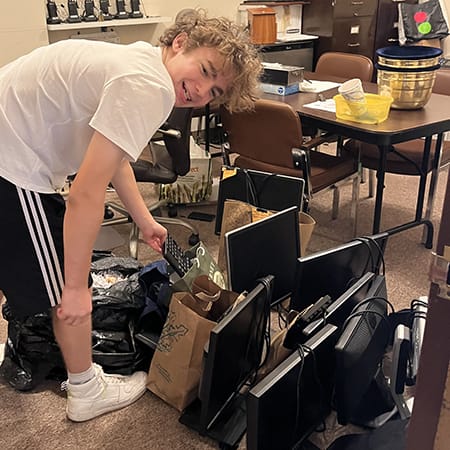
Sam Nadol’s journey into computer repair started when he was just in sixth grade. Guided by YouTube tutorials, he began by fixing an old computer at home and then advanced to rescuing discarded units from a local recycling center. Selling these refurbished computers on Craigslist for $25 to cover parts costs revealed a significant demand.
“Whenever I posted one of these computers, it would only be five, ten minutes until someone would message me asking to buy it,” Sam, now a high school senior, recalled. “That’s when I realized there was a clear need for low-cost computers out there and that this hobby I have could really make a difference in the world if I expanded it into way more computers.”
So, with the support of a grant from his high school in 2020, his nonprofit RebootPC was born.
When donations of old, used and/or broken computers come in from members of his community in Westchester County, New York, Sam repairs each one, addressing everything from broken keys on the keyboard to replacing cracked screens and installing new batteries. He also wipes all the data on each computer and installs a solid-state drive to make the computers faster. He no longer sells them but provides the computers free of charge to those who need them most via a request through his website or local organizations such as Ossining Padres Hispanos, which supports the Hispanic immigrant community, or Home Run Against Drugs, which teaches youth to avoid illegal alcohol and drug use.
Sam drops off a batch of computers he fixed to a local organization, which will then distribute them to community members. /Courtesy Sam Nadol
Roger Battacharia, a local business executive who helped connect RebootPC with these organizations, has seen Sam’s impact firsthand.
“With the computers, Ossining Padres Hispanos was able to train roughly 1,200 people on how to search for jobs, how to use programs like Microsoft Excel, build a resume and manage their money. It’s been transformative to a lot of people in the sense that it’s helped them to get types of jobs that they would not have otherwise,” Roger said.
The impact of RebootPC has extended beyond Westchester County as he has provided computers to organizations supporting Ukrainian refugees who fled the war and settled in New York. Additionally, international organizations received computers to support education initiatives in Haiti and Nigeria, further amplifying reach and influence. To date, RebootPC has donated 470 computers, preventing a staggering 9,400 pounds of e-waste from ending up in landfills.
“Every so often I get thank-you letters from recipients who say, ‘I found a job with the computer’ or ‘I’ve been able to keep in touch with my family,’” Sam said. “While my motivation behind doing all this was because fixing computers is my hobby, being able to make an impact in other people’s lives is really the most rewarding part of it.”
With Sam heading off to college in the fall to major in electrical engineering, running RebootPC might be a bit trickier, but he hopes to keep it going and one day, expand it to more cities across the country.
California Educator Leads Youth Mentorship Programs
Meet Daily Point of Light Award honoree Marquita Grenot-Scheyer. Read her story, and nominate an outstanding volunteer or family as a Daily Point of Light.
When Jean Egan founded Better Learning for All Students Today (BLAST), she was on a mission to help the most under-resourced youth of Long Beach with academic and social development. That was nearly 25 years ago. In 2011, when Jean asked Dr. Marquita Grenot-Scheyer to join the board, it didn’t take much convincing. Marquita herself, dean of the College of Education at CSU Long Beach at the time, is a lifelong educator. She’d started out in a Los Angeles public school classroom and would eventually retire from the role of assistant vice chancellor for Educator Preparation and Public School Programs in the California University System Office, the largest four-year public university system in the nation.
With her oversight of two BLAST programs that help youth prepare for college or the transition to the workforce, Marquita helps provide others with mentorship that was a pivotal part of own her journey. She has used her vast experience to guide the organization ever since. These days her number one student is her new granddaughter—her first—though she continues to serve as president of the board and make a difference in the lives of young people all across Long Beach.
Dr. Marquita Grenot-Scheyer, president of the BLAST board of directors, guides staff in implementing two mentoring programs for Long Beach youth.
What led you to go into education?
I had the good fortune of having some practicum and internship opportunities early on as a college student. I was also able to do some volunteer work in schools. When I volunteered with a teacher named Jackie who worked with a group of students with significant disabilities, I was in awe of her and the magic that she worked. I decided that was what I wanted to do. All along, I had amazing mentors and role models which led me to this extremely fulfilling career.
What inspires you to volunteer?
It comes from my parents and their spoken and unspoken words about how we sit in a seat of privilege and, therefore, have a responsibility to support our community. They did that and encouraged us do the same. It seemed to be a natural part of my work as a student and then as an educator.
Can you tell me a little more about BLAST’s programs and their impact?
We have two primary programs. The first is the Academic Mentoring Program (AMP), which provides one-to-one and small group mentoring for K-12 students. The second is the Bridge to Success program (Bridge), which helps equip middle and high school students with knowledge, skills and experience for their next step, whether that become college or career.
In both programs, the primary focus is on improving the academic and social success of K-12 students, but a secondary goal is to support college mentors as they’re going through their college programs. The opportunity to provide mentoring and support leads many of our mentors to careers either in teaching or social sciences. So, the benefits are not only for the K-12 students but also for our college mentors. Some of our pairs have developed relationships that have lasted years.
Tell us about your volunteer role.
I’ve been president of the board since 2016. I lead our volunteers in supporting a strategic plan and the work of our staff. I support the executive director and our small but mighty staff in developing and implementing our programs. A couple of years ago, when we had a series of interim executive directors, there was a period of time where I was providing direct support, which I really enjoyed. Our staff and executive director are the heart and soul of the work we do.
How many mentors do you have?
It varies. COVID-19 had an impact on us, because we had to move to virtual mentoring. AMP has about 150, and our goal is to get back to our pre-COVID total of 300. Bridge has continued to grow, because those are group vs. one-to-one mentoring. In that program, we have around 600 middle and high school students involved.
What’s been the most rewarding part of your work?
Hearing the stories of the mentors and the mentees at our annual breakfast fundraiser will make you cry. These children and youth come to school with a lot of challenges, and having the opportunity to work with a college student has changed their lives. Over the last 25 years, we’ve impacted almost 25,000 youth. If I can provide strategic leadership and development to make that happen, it’s well worth my time.
What have you learned through your experiences as a volunteer?
I’ve learned a lot about how you lead a nonprofit and about funders. I knew how to raise money for my college and to support faculty to develop programs for educator preparation, but the nonprofit world was really different from my academic world. I work closely with another organization called The Nonprofit Partnership. Their executive director and staff have been so helpful to me as I have come to understand the nonprofit world. And we have a group of really dedicated board members, some of whom have been committed to this work since the very beginning.
Why is it important for others to get involved with causes they care about?
There are so many needs in our communities, and to close your eyes and focus on your own family seems selfish. I’m a first-generation college student, and my parents were hardworking lower middle-class folks who figured out ways to support their community. Now I’m in a place of privilege, so I need to get involved.
It’s also fulfilling; I enjoy this work. We have two adult daughters, and they accuse both me and my husband of failing retirement, because we’re just as busy as we ever were before. But it feels good to continue to make a contribution. I do this work because it’s important, it’s necessary and it brings me satisfaction.
Meet Daily Point of Light Award honoree Gaurangi Gupta. Read her story, and nominate an outstanding volunteer or family as a Daily Point of Light.
In 2020, when the world went into lockdown, searching for hobbies that could be done alone, ten-year-old Gaurangi Gupta was thinking about others. Of course, as a classical pianist and avid basketball player, she had plenty of time to practice her skills. But aside from spending quality time with her little sister, her favorite thing to do is read. It was while considering the latter that she began to worry about the kids who, with the library temporarily closed, wouldn’t have the opportunity to do the same.
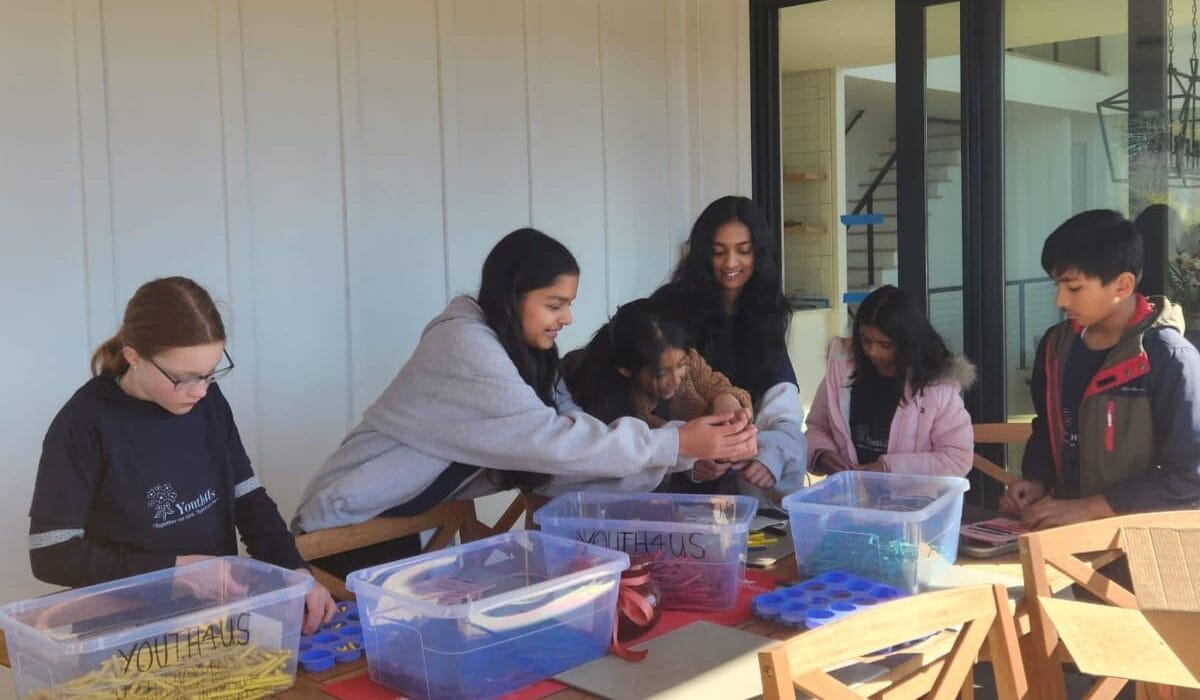
It was this realization, combined with her search for ways to stay connected with friends while school was online, that lead Gaurangi to create Youth4Us. Her organization promotes literacy, entrepreneurship and community engagement by finding and creating fun opportunities for kids to volunteer. Hundreds of kids have joined her in doing kind things and looking for ways to improve the lives of others as well as the planet.
This fall, Gaurangi will be starting high school ahead of the curve with experience coordinating volunteers and planning projects and events. Her work is inspiring young people to help other kids in their community and setting them up to become lifelong volunteers.
What inspires you to volunteer?
My journey of service started when I was around eight years old. I volunteered to read to kids at my sister’s school. I loved when they asked questions and hugged me after I finished a story, so I started visiting more frequently. It ignited my interest in reading and gave me confidence.
Tell us about your volunteer role with Youth4Us.
I’m the founder. When I learned that so many organizations needed our help, it felt right to get involved and to raise awareness among other kids. I want to build kids up and create leaders with empathy.
Guarangi (left) with Annie Criss, camp director of Chestnut Hill Academy, where students worked on a snack pack donation project during Winter Break Camp/Courtesy Guarangi Gupta
We have many programs, for example, the Bookaid Drive where we collect gently-used books and distribute them to underprivileged kids in the USA and India. We’ve donated more than 2,000 books in the past four years. I also do the Children’s Business Fair every summer. More than 50 booths participate, and 100 kids get hands-on entrepreneurship experience for free. They learn how to draw in potential customers, manage customer requests, work around things when they break or don’t go as planned and other skills that can be used later in life.
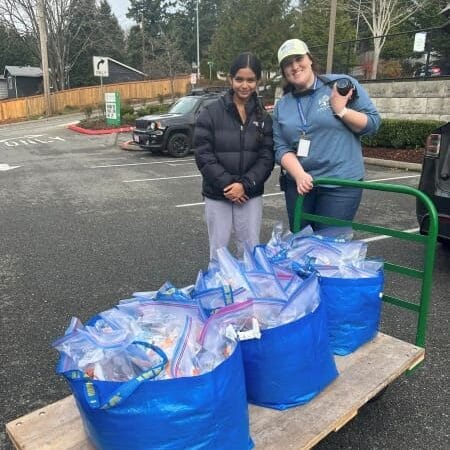
We also do the Three R’s–reduce, recycle and repurpose–Crayon Initiative. We work with BJ’s Restaurant and the Family Pancake House to collect used crayons from kids’ meals that would have otherwise ended up in landfills and donate them to hospitals, schools and other organizations.
A few months after we launched, there was an overwhelming response. Now, over 400 active members from preschool to age 17 participate in volunteer activities and improve their skills at the same time. I organize community outreach events with the assistance of my seven Youth4Us ambassadors.
What inspired you to get started with this initiative?
The pandemic hit, and it was a very lonely time for children accustomed to being in school with friends. Our daily activities ranging from participation in school clubs to visiting the library were suddenly taken away from us.
I used my lockdown time to address gaps in the community. It started with a book drive for kids who had been missing out on the joy of reading while the library was shut down. Then, I ventured into creating opportunities for kids by tutoring and giving virtual drawing classes to younger students.
I set up a shared library in the neighborhood with my dad’s help and started a weekly virtual book club. It made my friends and me happy when we couldn’t talk to each other as much. I also decided to write a book and donate as much as I could to promote literacy. Little Vara Wants a Puppy is inspired by my seven-year-old sister, Varalika (Vara) and the experience of wanting a dog we’ve had together. All of these experiences propelled me to channel my love of art and reading into Youth4Us in 2021.
What’s been the most rewarding part of your work?
I think the most rewarding part is just seeing progress. I was the first person to do the kids’ business fair a few years ago, and now there are many. It’s so rewarding to see people taking initiative, because that was my goal. Many of them have been inspired to start their own initiatives and nonprofits. Seeing them go out into the community and spread kindness has been amazing.
Guarangi’s organization now has over 400 active members who participate in volunteer projects, from preschool to age 17./Courtesy Guarangi Gupta
Have you run into any major challenges and if so, how did you get through those?
It was not easy to start during the pandemic. Everyone was worried about COVID, and the challenge was in how to unite kids safely, without exposing them–or myself–to the virus. So, I started a porch pickup with the necessary material to complete an activity at home and then drop off to be donated. This took extra effort, because I had to make sure everything was being sanitized.
My biggest champion and mentor is my mom. She was confident that my idea would create an impact and has been continuously helping me overcome obstacles along the way.
You work with a lot of younger kids who might be first-time volunteers. Do you have any advice for people who are new to volunteering?
Find a friend and sign up for a project. Volunteering doesn’t have to be an activity do by yourself. You can absolutely have fun volunteering with your friends. For younger kids, just enjoy the process instead of thinking about it as an obligation. And think about how many people you’re making happy.
What do you want people to learn from your story?
Anyone can make an impact on the world, regardless of age. I started this initiative when I was just 10 years old. I hope I can inspire kids to start volunteering early on. You can absolutely start when you’re older, but imagine the years you’re missing out on.
From Survivor to Inspirational Leader: One Woman’s Impact on Cancer Patients
Meet Daily Point of Light Award honoree Sarah Lister. Read her story and nominate an outstanding volunteer or family as a Daily Point of Light.
Sarah’s own struggle with leukemia and a life-saving bone marrow transplant transformed her into a force for compassion and change. Not content with just overcoming her illness, she went on to found The Zinnia Project, an initiative born out of her personal experiences and her desire to ease the journey for others battling cancer at the Markey Cancer Center.
Sarah’s journey into philanthropy began in the most personal way possible,a bone marrow transplant the day after her birthday, facilitated by a selfless donation from a college student. The profound impact of this experience, coupled with her friendship with the donor, fueled her commitment to get involved. The project is dedicated to delivering care packages to cancer patients, particularly those facing their battles alone.
Launched with a simple act of kindness — delivering 16 small pails filled with items that Sarah found invaluable during her treatment — the response from nurses and patients alike inspired her to expand her efforts. Over the years, The Zinnia Project has grown significantly. Zinnia Project Patient Baskets has grown to the size of a laundry basket and are now filled with over $100 worth of items that patients need for a long hospitalization.
In 2023, The Zinnia Project saw considerable growth, necessitating a partnership with Kentucky Cancer Link and the acquisition of a new office space to handle the inventory. This expansion enabled the introduction of “miniZinnies,” smaller, more portable care packages given to every hospitalized patient on the oncology floor as they arrive. These zip-pouches are stocked with essentials like eye masks, earplugs and toiletries — small comforts that make a big difference.
To date, The Zinnia Project has delivered over 200 Patient Baskets and 150 mini-Zinnies, with plans to continue as long as the need exists. Read on to find out more about Sarah’s inspiration and dedication to this project.
Sarah has increased the sizes of her Zinnia Project baskets over the years and now has a laundry basket-sized offering.
Tell us about your volunteer role.
It’s a role I created for myself to help manage the profound sense of gratitude I had after having so much support during my own cancer journey. Over the years, I’ve gotten three, four, then five volunteers to help me assemble the baskets. I’ve recently expanded the program to have an office outside of my house! When I created my Amazon Wishlist, people were so kind and jumped right in to help fill my house with boxes, but that was unmanageable for me and the others living in my house! I was so grateful when an organization here in Lexington opened their doors and let me use an office to build my baskets, put together tote bags for patients during the holidays and more. We are expanding to the best of our ability!
What inspired you to start The Zinnia Project?
I was completely floored to learn in 2016 that I had acute myeloid leukemia. I thought I had the flu – it was right after the holidays and everyone was exhausted, so I figured I was too. My boys were ages 3 and 8. I went to the doctor to see why I was feeling so sluggish. They called me at 10 pm, and he gave me about 12 hours to prepare to go into the hospital for a 30-day stay. I was completely unprepared, and my husband didn’t even know the passwords to our bank accounts – there was so much to do to be ready for a long leave of absence. It was like being abducted by aliens; one minute I was there, the next minute I was getting a picc line in my arm.
I did two rounds of those 30-day chemo stints because the first one didn’t get me in remission, so we had to do it all over again. Then there were about four or five week-long hospital stays just to maintain that remission while we waited for a bone marrow transplant. I spent about 127 days in the hospital. As bad as chemo is, it’s nothing compared to the fact that I was not able to see my children. They were too young to be allowed to visit, but they were little and needed their mom. I felt helpless, and I’m still making up for that, every day.
In all that time I spent in the hallways of the hospital, I had my husband or my mother or a friend with me. But I saw so many people in those hallways, and they had no support. I asked the nurses, how is it possible that people are here with no support, no caregiver, no family or no friends? They told me they saw it all the time. I was devastated thinking of going through this process without people. I was lying in bed one night and I started thinking about all the things I didn’t pack that I was able to ask for later from my family members and friends: a chapstick, an emory board. Little things. My husband brought me a real box of Kleenex, a real toothbrush and real toothpaste.
I saw a need and I saw an opportunity for me to meet that need. In 2017, after all the transplant drama was over – you have to stay home for 100 days after you get a transplant – I remembered the people in that hospital who didn’t have caregivers. I went to the Dollar Tree and bought 15 metal buckets, and I put toothpaste, toothbrushes, a nail file and some hand lotion in them. I took them over to the hospital and the nurses thought it was the greatest thing ever. I wanted to keep going, so I got bigger baskets and jumped on social media letting people know they could chip in. People recommended I start an Amazon Wishlist, which was brilliant, so we did that.
I was re-hospitalized in 2022 for a side effect from chemo. You’re never through the looking glass with cancer. You’re always looking over your shoulder. In the hospital, you’re responsible for doing your own laundry, and I got the idea to make the baskets the size of a laundry basket. I included items like a journal – anything I could dream up that I wanted. The basket got full pretty fast. I brought the basket to the nurse manager to emphasize that it was unscented, had no parabens and the least amount of chemicals possible. The nurses blessed my basket and I’ve been doing laundry-sized baskets since then!
Next, I reflected on my journey and thought about what I wish I’d had on day one. A toothbrush, toothpaste and a hand mirror. I started making “miniZinnies” last year. They’re made up of those immediate things you need in the first couple of weeks of your stay. They’ve been such a hit. I give them to every patient on the floor, not just the transplant patients. The whole project centers on the idea that you want to bring something beautiful and bright to patients. You can’t underestimate the power of keeping something joyful, even humorous.
Sarah’s sons help her distribute the baskets to patients who need them.
Why is it important for others to get involved with causes they care about?
There’s almost nothing more important to a nonprofit organization than a volunteer. They’re at the heart of whatever program or project they choose to work with. I was the executive director of Ronald McDonald House Charities here in Lexington, and it’s a small staff with a mighty force of volunteers. The mission can’t be done without volunteers!
Any advice for people who want to start volunteering?
My advice is to do your research and understand what the expectations will be. Make a phone call to the volunteer coordinator, if they have one, and ask them what the job duties will be. Then, just dive in! Show up and you will find – within minutes or hours – the thing that lights you up and brings you joy. That could be cleaning toilets or mailing out invitations to a gala. It runs the whole gamut!
What do you want people to learn from your story?
One of the most important things is for people who have a “gratitude attitude,” is to not wait for something to come to them. If you see something, do something. Start small. A lot of people think they have to serve on the board of directors to be a meaningful volunteer. You can start small, you can dream big and you can make an impact.