A Mission of Promoting “Community Serving Community”
Meet Daily Point of Light Award honoree Anne Keane. Read her story, and nominate an outstanding volunteer or family as a Daily Point of Light.
Anne Keane has been working at Prudential Financial as a relationship manager in the records management department. The company’s volunteer program introduced her to Valley United Way (a chapter of the global organization United Way Worldwide), whose mission is to “close gaps and open opportunities so everyone can thrive.”
United Way connects people who need help with the people and resources they need. The organization’s network spans over 1,100 communities in 37 countries and leverages the caring power of communities around the world to support community members.
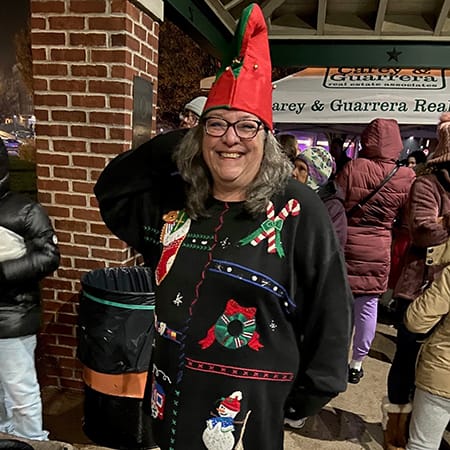
Anne volunteers 10-15 hours per month with Valley United Way, in addition to working a full-time job. This past December, Anne volunteered over 30 hours, even dressing up as an elf to collect toys at local tree-lighting and community events.
Anne says, “The purpose of life is derived from what we do for others, not what we do for ourselves. This is why we’re here. We’re not here to be selfish and spoiled. The purpose of our being is to make the lives of others better, whether it’s family, friends or complete strangers. It’s not about me, it’s about ‘we’. It’s about what we can do as a community.”
Anne Keane, Santa’s little helper, collecting toys for local Toys-4-Kids program. / Courtesy Anne Keane
What inspires you to volunteer?
I am blessed. I feel the need to help everyone. My father’s parents were involved with the Salvation Army and my father was generous with his time, talents and financial resources. We used to have deep philosophical conversations including discussions about the meaning of life. My philosophy of doing for others came from those conversations and from watching my father.
Tell us about your volunteer role with The Valley United Way.
I sit on the Valley United Way board, attend board meetings, participate in training sessions and community events. Additionally, I am the chairperson of their Community Volunteer Council, run monthly meetings and help coordinate volunteer initiatives in support of community partners with local companies and organizations.
The Valley United Way is a small chapter of the United Way with a designated geographic area that we focus on for our community engagement work. We connect folks in the community with community partner organizations that can support them. Resources include food banks and organizations that help people make ends meet with rent and utility assistance.
It’s important to note that many of our recipients are working families. The people may be working two or three jobs each, and they still can’t make ends meet. Some recipients moved to the area recently and aren’t familiar with local resources. One of our biggest focuses is food insecurity, particularly for families who are employed but can’t make ends meet.
I hold monthly meetings with the Community Volunteer Council members, comprised of individuals from community partner organizations, mom-and-pop businesses, mid-sized companies and large corporations throughout The Valley.
I like to say that it’s “community supporting the community.” My focus is getting more people involved through networking and introducing them to what we do. Many hands make light work!
Recently, the Community Volunteer Council helped build a toy store in the basement of a local building as part of a community partner’s annual Toys-4-Kids program (TEAM, Inc.) Families apply for the program and if they qualify, the family receives toy vouchers per child based on age. The family comes to the toy store and shops the shelves. Parents get to pick out items their child will love! The value of the toys ranges from $5.00 items all the way to bicycles outfitted with helmets and knee pads. This experience offers so much dignity for the parents who otherwise can’t afford to buy their children any toys. We want all people to feel supported and cared about. We want to help them in as dignified and consistent and reliable manner as possible, so they don’t feel shame in their situation.
My goal is simply to make their life as normal as possible. The towns in Valley United Way’s region have tremendous numbers, more than 60% of the population, designated as “ALICE” families. ALICE is a United Way acronym that stands for Asset Limited, Income Constrained, Employed.
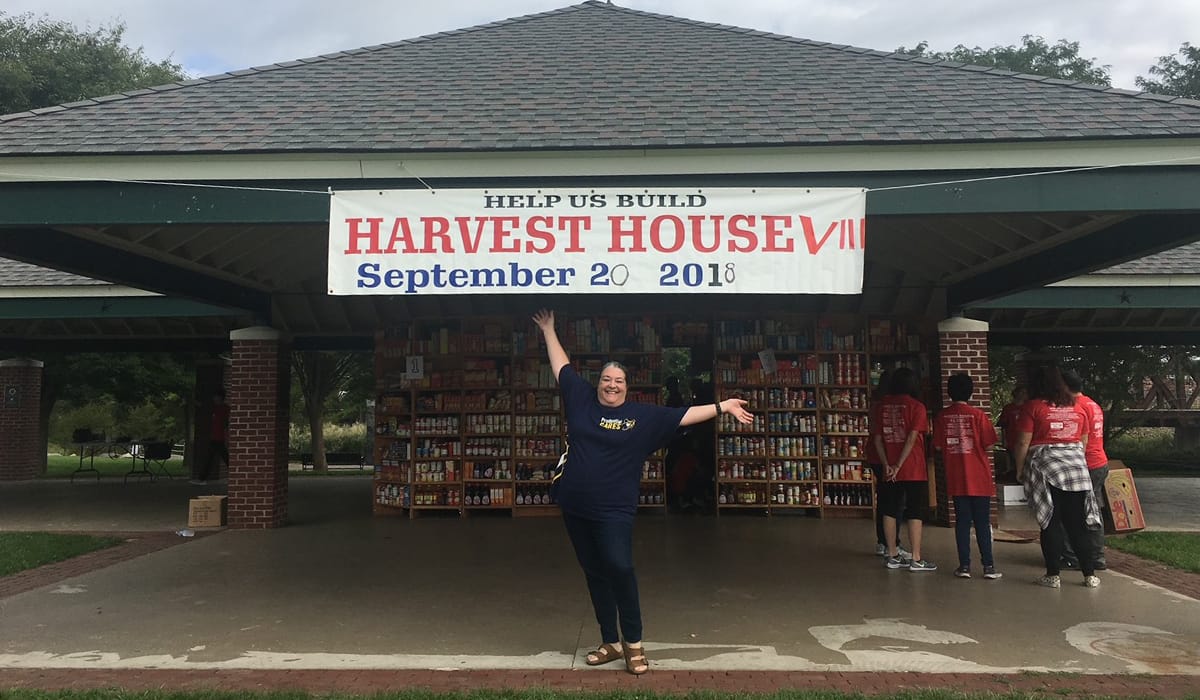
I help coordinate numerous volunteer events and activities in conjunction with Valley United Way’s various community partners. We work with a local farm to create community gardens to help educate local residents how to grow food at a local hospital and other locations throughout The Valley. These gardens also help provide fresh vegetables to local residents. We serve as a bridge, letting people know that there are resources available, where they are and how to find them. I help support local food drives and find support for five food banks in the Valley through financial contributions (via the Harvest House website) as well as donations of non-perishable items.
We also help with various refresh projects. One refresh project I am working on now is the cleanup of Ansonia Nature Center, a beautiful community park. We’ve also done community garden cleanups, plantings and maintenance including painting.
I am always reaching out to local companies to get more volunteers. Volunteering can be a wonderful team-building event where employees work together outside of their jobs and support the community.
We organize a back-to-school event every year. This supplies local schools and organizations with filled backpacks for students and miscellaneous supplies for teachers’ and nurses’ closets. We will be working with Ansonia Elementary Schools this year, which is the town next to ours. I have seen firsthand the ripple effect of this program. If kids have new clothes, attendance on the first day of school increases dramatically. The kids in Ansonia are 70% economically challenged. Supporting that 70% is so important for the families and the kids themselves. If we can take the need to worry about the kids’ first day of school away, we can free up precious financial resources for other needs like food, rent, utilities and transportation and the kids themselves feel good about themselves and have a great start in education. We also hold care package build events where we assemble hygiene packs, snack packs for students and care packages for senior citizens.
What inspired you to get started with this initiative?
I got involved with Valley United Way through my job at Prudential. Prudential is a supporter of United Way, and employees are given opportunities to volunteer. Unfortunately, many initiatives had to stop during the pandemic, but I’m working on increasing volunteerism in my company’s location and other local companies involved with the CVC. It’s not always easy to get people on board because we don’t see each other. People are no longer tied to being at the office five days a week and we never see the number of people in the office that I can gather together as a group and encourage volunteerism.
Anne Keane at Valley United Way Harvest House event. / Courtesy Anne Keane
What’s been the most rewarding part of your work?
I love seeing the faces of those that I’ve helped, especially the children. I’ll never forget the look on the face of a 6th grader who pulled out a winter jacket from her donation bin, knowing she would be warm that winter. She was so appreciative. Other kids are so happy because they got a backpack that was their favorite color. What seems trivial to us is monumental to them.
What have you learned through your experiences as a volunteer?
When I bring people together to volunteer, amazing things happen. When I can educate someone about the need and see that lightbulb go off in their mind — if I can inspire them, they tell their friends, those friends tell their friends, and the next thing you know, I have all these extra hands that I wasn’t necessarily expecting. Also, it’s a lot of fun! It’s hard work sometimes, but knowing I’ve accomplished something meaningful with a group of people is so rewarding.
Tell us about future events that you are excited about.
My goal for this year is to “blow up” some of our initiatives, with more volunteers, more help. Many people donate/help around the holidays but people need to eat year-round.
Everyone in Connecticut needs to know what 2-1-1 is. We all know to dial 9-1-1 in an emergency but 2-1-1 is a hotline where you can call and say, “I need assistance.” It could be food, it could be basic necessities, or housing. Many people don’t know about it. It’s our job to spread the word.
Any advice for people who want to start volunteering?
Reach out to local schools, food banks or local volunteer groups like United Way if it’s in your community. Most of the time, there’s a lot that can be done in every community. Whenever you volunteer, there will always be someone to help you. Don’t be afraid to put yourself out there.
You are needed. It doesn’t take much but trust me, every little bit makes a big difference.
What do you want people to learn from your story?
Anybody can do it. Anyone can make a difference in the lives of others just by giving a little of themselves.
We can’t know what someone is going through. We don’t necessarily know who’s thriving or who’s barely surviving. Be kind and caring. Give of your time, your talents and, if possible, your financial resources, to the best of your ability. It doesn’t have to be volunteering, if you can’t manage that right now. Holding the door open for people, giving someone a compliment or a smile helps us become more caring, more compassionate. I feel fulfilled if I can make one person’s day a little better!
Ohio Professor Trains Therapy Dogs, Bringing Comfort One Paw at a Time
Meet Daily Point of Light Award honoree Lesley Sinwald. Read her story and nominate an outstanding volunteer or family as a Daily Point of Light.
When a massive fire ravaged a home in northern Ohio, first responders worked tirelessly to contain the flames and rescue everyone in the family. Despite their best efforts, tragedy struck as a young child lost their life in the blaze. With such devastation rare in this small town, the aftermath left first responders reeling, particularly those with young families of their own. It was then that the therapy dogs of Riley’s Angels and their handlers came to their rescue, providing much-needed comfort and support to ease their shock and trauma.
This situation is just one of many where Riley’s Angels therapy dogs have made a profound impact. Whether comforting a young girl terrified of needles in the emergency room or providing solace to hospice patients in their final days, these dogs and their handlers have been beacons of relief for many in northern Ohio. And at the helm of this effort is the driving force behind Riley’s Angels, Lesley Sinwald.
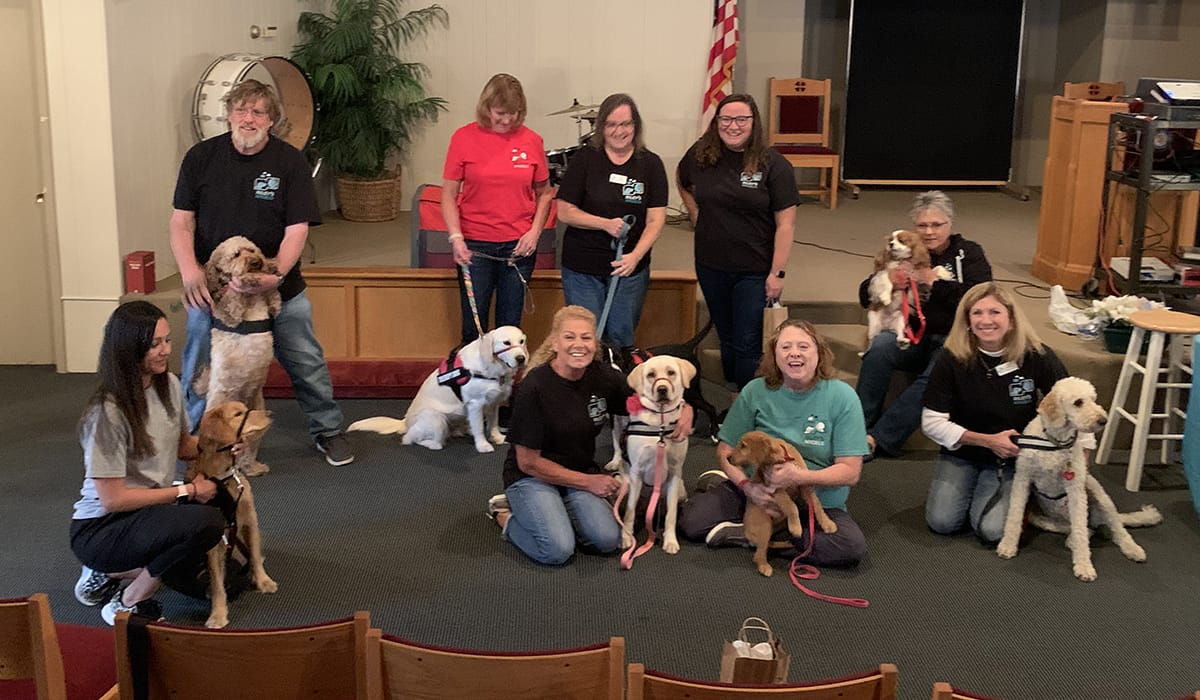
For nearly three decades, Lesley has dedicated countless hours to training and providing therapy dogs to northern Ohio, while balancing her job as a business professor. It was five years ago that she formalized this passion into Riley’s Angels, named after her first therapy dog. Thanks to Lesley’s tireless efforts and volunteer work, Riley’s Angels now boasts nearly 100 fully certified therapy dog and handler teams, which provide comfort and joy to local schools, hospitals, nursing homes and community events. Five of those teams are certified in Critical Incident Stress Management (CISM) training, ready to respond in times of crises like shootings and fires.
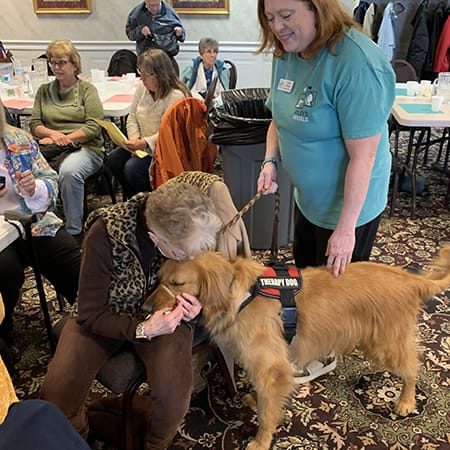
Lesley watches as a woman hugs therapy dog Charlie after her presentation on the impact of therapy dogs for an association of retired teachers. /Courtesy Lesley Sinwald
One of the most memorable times she saw the impact of therapy dogs was when she brought her first therapy dog, Riley, to a nursing home.
“There was this one gentleman who was in a wheelchair just sitting in a hallway. He was bent over, not even sitting up. Riley kept going over to him and he wasn’t responding at all,” Lesley recalled. “It was kind of awkward because he wasn’t engaged. So, we visited a couple other people, but Riley kept pulling me to go back to him. When we went back to him for the fourth time, he finally lifted his hand and started petting her. Still wasn’t sitting up, still wasn’t speaking.
“But then after we visited some more people, Riley pulled me one more time to go back to him. And when we did, he started petting her right away. He sat up and started telling me about his dog and we had this really nice conversation,” Lesley continued. “We finished up and I went to the nurse’s station and one of the nurses said, ‘You know that gentleman your dog kept pulling you back to? He hasn’t spoken in over a year.’
“Research has shown that dogs impact cortisol levels. There’s been studies done where patients report less pain when they are visited by therapy dogs,” Lesley said. “They have this magic dust to them. It’s truly amazing how dogs can reach people in ways sometimes we can’t.”
Despite the relentless workload and financial challenges of running a nonprofit, Lesley said she finds immense fulfillment, knowing that she’s fulfilling her purpose with Riley’s Angels.
A group photo of Lesley with a cohort of recently graduated therapy dog and handler teams. /Courtesy Lesley Sinwald
“Lesley is Riley’s Angels front and center, seven days a week, 24 hours a day,” said Sandy Hovets, board chairman and handler at Riley’s Angels. “Her whole life is built around what she does for Riley’s Angels, and she never gets a penny. This is all given from her heart.”
At 65 years old, Lesley hopes her story resonates as a testament to the adage, “You’re never too old to follow your dreams.” Looking ahead, she envisions a future for Riley’s Angels where even more therapy dogs and handlers are trained, ensuring that anyone in need of a furry shoulder to lean on or paw to hold has one.
One Man’s Dedication to Volunteering Across Spheres of His Community
Meet Daily Point of Light Award honoree Sean Sheppard. Read his story, and nominate an outstanding volunteer or family as a Daily Point of Light.
Since May 2023, Sean Sheppard has dedicated his time and energy across a wide spectrum of volunteer activities in his community of South Hampton Roads and beyond, touching the lives of many with his generosity and commitment. Sean’s volunteerism shines brightly at the YMCA of South Hampton Roads, where he has served as a volunteer coach and referee for the Youth Sports Leagues since September 2023.
Week after week, Sean devotes his evenings to coaching and teaching kids the fundamentals of basketball and soccer, as well as embodying the spirit of teamwork and fair play. His dedication extends to refereeing games every Saturday, where he ensures that the young athletes not only compete but also learn valuable life lessons through sports.
At the BBBC Military Ministry, Sean spends time offering sailors and marines spiritual conversations and a comforting environment. This ministry provides not just spiritual sustenance but also tangible support through free transportation to services and meals, creating a warm and welcoming space for service members stationed at Damneck and NAS Oceana.
Working with the Coalition of Sailors Against Destructive Decisions (CSADD) since September 2021, Sean’s efforts span organizing cleanups, assisting animal shelters and fostering community spirit through events like the Barracks Olympics. His commitment to the environment is further evident in his work with First Landing State Park from December 2023, where Sean has been instrumental in beach cleanups, adopting trails and engaging the community in preserving the natural beauty of the area.
In over two and a half years, Sean has amassed 307 hours of volunteer service across 36 different events. Read on to find out more about what inspires him.
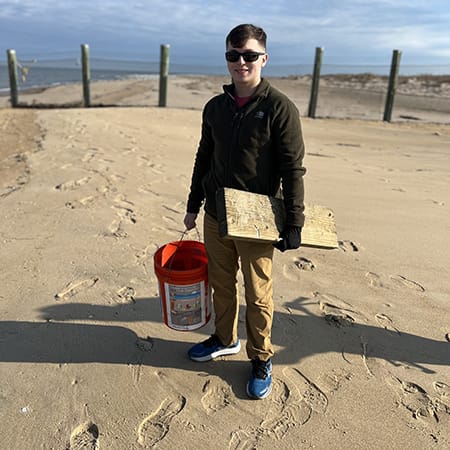
Sean organized a beach cleanup in February 2024, where he and 15 others cleared 1.5 miles of beach.
Tell us about your volunteer role.
At the YMCA, I attend one or two practices a week and teach kids how to play basketball and soccer. We also play games and I referee on Saturdays. Then, for the BBBC Military Ministry, I assist every Saturday with door-to-door evangelism and speak with sailors and marines about God. We offer free transportation to service and back, and home-cooked meals to provide a “home away from home” environment for these service members. This ministry usually takes place on Damneck and NAS Oceana.
I also volunteer with the Coalition of Sailors Against Destructive Decisions, and the First Landing State Park, which has allowed me to assist in beach cleanups, adopting trails and more.
Why is this issue so important to you?
This issue is so important to me because as Americans, we have a LOT to give, a lot of us just don’t know it. Volunteering for stuff like this has made me realize what kind of impact one can make.
How did you get started with this initiative?
Funny story: getting out of high school, I didn’t involve myself in anything. I didn’t play football, didn’t help organize events, didn’t do band, nothing like that. When I joined the Navy, I promised myself I would get involved and enjoy doing the nice things in life. Not only has it been fulfilling for me, but it’s impacting other people too!
What’s been the most rewarding part of your work?
The most rewarding part has been setting an example for my peers – the friends, family members and coworkers I know who have laughed at the idea of volunteering, and then, later on, have gotten interested. And they realize how great it is.
Why is it important for others to get involved with causes they care about?
It’s important because, like I said earlier, we all secretly have a lot to give. Be that guy or girl. Get out there and make a change. Don’t let anything unimportant get in the way.
Any advice for people who want to start volunteering?
Start with one organization, and don’t overwork yourself. Get your foot in the door and just be sure you have a good heart about it. Understand the impact you are making for others, because from a short-term standpoint, it’s not going to seem like you’re doing much, but you are. Understand your value!
Community Leader Builds Network of Hope Mentoring Kids, Providing Resources and More
Meet Daily Point of Light Award honoree Anthony Curtis. Read his story, and nominate an outstanding volunteer or family as a Daily Point of Light.
Like many, Anthony Curtis was deeply affected when he saw the video of George Floyd’s murder in 2020. Anthony is a 35-year-old, married father of four with a deeply held desire to help those in his community overcome challenges and achieve, changing the narrative of Black culture. He has been active in his community for many years as the executive director of the Youth Violence Prevention Network and as a volunteer at his church. But in response to the call for change, he founded the Black Equality Coalition (BEC) to address the needs of underserved communities and to empower Black youth through mentorship and community engagement.
Five years later, his work — and that of many dedicated volunteers — creates a sense of ownership and pride in the community. And his Bridging the Gap programming brings people of different backgrounds, ethnicities, cultures and beliefs together to create positive change, just as Anthony intended it.
What inspires you to volunteer?
It always just seems right. There’s always a need in this world. I grew up in the Southside of Chicago where the community is littered, and there’s gang violence and police sirens. Those things had a direct impact on my life. I wanted the kids of this generation to see something different, to be the solution instead of the problem.
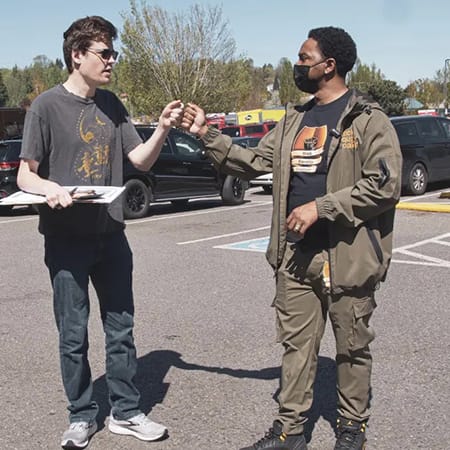
A community member fist bumps Anthony after asking if he could help collect signatures from Renton residents supporting wage increases. BEC volunteers drew his attention cleaning up the Safeway parking lot and handing out food and essentials.
Tell us about your volunteer role with the Black Equity Coalition.
I’m the founder. We started the Black Equality Committee at my job — I’m a supervisor at UPS — in response to George Floyd’s murder. That really hit me hard. When I saw George Floyd’s face being pressed against the cement, I saw my face. I saw my brother’s face, my neighbor’s face. And then you’ve got to go into corporate America and be handled as if these events didn’t just happen, following Breonna Taylor and others.
Something had to be done. I didn’t know what, but I allowed myself to be expressive. We started having heartfelt conversations as supervisors and formed a committee. I introduced managers in the warehouse to the community in order to build a bridge of unity. Without the support of the community as your consumers, you don’t have a business. I wanted to get involved in the community that’s locked out of a lot of resources.
We got out there and cleaned up the Safeway. We went where gun violence was happening and served food and gave away clothes and hygiene products. We brought people out to show what the day-to-day life looks like for individuals growing up in a community with poverty and violence. We started serving schools with heavy BIPOC populations and low-income households. I wanted to be specific that we serve Black families. That didn’t mean that we weren’t going to serve anybody else. We were just going to make sure Black families were at the front of the line with everyone else.
What is Bridging the Gap?
It’s made up of five programs: the “I am Unstoppable” mentor program; Lori’s Closet, which is the all-inclusive program for free clothes, hygiene products and other essential items; “Adopt a Family”, which provides Christmas gifts for underserved families; and annual Back-to-School Supply and Thanksgiving Food drives.
How have you seen your mentoring program affect kids?
This is our second school year. The first year we had 25 kids, grades three through five. This year, we have 35-40. I didn’t want to start off at middle or high school. That’s hustling backwards. We want to prevent the kids from making bad decisions and ending up somewhere they don’t want to be. So, we start at the earliest age possible and follow them through high school to ensure their success.
We have data proving that kids are better with mentors, specifically mentors of similar cultures who look like them. The chances of them graduating and excelling in life is much higher when they have mentors and people they can look up to and ask questions about different careers. That helps combat the school-to-prison pipeline. We can help them stay in school.
A lot of them are in poverty. Times are hard, and these kids see drug dealers and hear about people doing bad things to make money. School and the corporate world seem far off to them. We change their perspective by bringing in experts and top-earners in their field to tell them about other possibilities. There are plenty of opportunities; they’re just not being displayed in our community. And if they are being displayed, it’s by individuals who don’t look like them, so it doesn’t seem real.
What’s been the most rewarding part of your work?
I got a video recorded from two young girls when I was at the school the other day. I let them use my phone while I was playing basketball with the boys. When I got it back, I had recorded video about how BEC is like the family they never had and where they were when they started versus where they are now.
It’s also great hearing from teachers and my team saying I’ve created a platform for them to maximize their service. It’s rewarding for me to see other people doing something that they love and making a real impact.
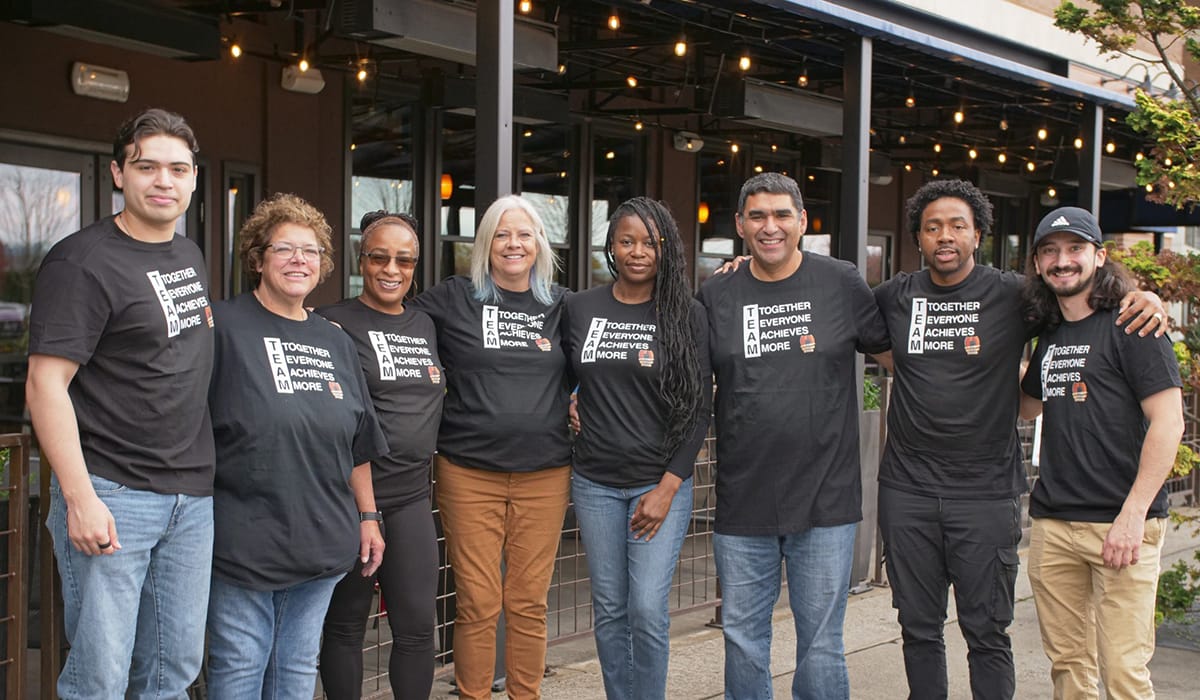
The Black Equality Coalition team joins Anthony (second from right) for a team bonding moment.
Tell us about future partnerships, programs or events that you are excited about.
We have a partnership with an organization made up of currently and formerly incarcerated people. They’re teaching elementary school kids about civic engagement, politics and the criminal justice system. They explain how to peacefully protest and how laws work.
We have a career exploration fair coming up April 26. We have civics training for our team and educators at the school where we have the mentoring program. And we’ve got a mock legislative session happening with the kids. They’re going to argue for more recess time and no homework and things of that nature.
What do you want people to learn from your story?
Don’t limit yourself. Go after everything that you desire. I desire to serve people. I have dreams to help as many people as I can before I transition from this world. If you have a similar desire, go after it. It’s hard, but everything is hard. You just choose your hard. Stay consistent and keep moving.
Volunteer Provides Meals, Hygiene Products and More to People Experiencing Homelessness
Meet Daily Point of Light Award honoree Megan Giambrone. Read her story, and nominate an outstanding volunteer or family as a Daily Point of Light.
After volunteering mostly in animal rescue, Megan Giambrone unexpectedly found herself helping the pets of people experiencing homelessness in Kalamazoo, Michigan. She discovered a new passion for this community, and developed a plan with other zealous volunteers to create a new organization dedicated to filling the immediate need to help the unhoused of Kalamazoo County.
She co-founded United for the Unsheltered of Kalamazoo in February of 2022 and now serves as the CEO and president of the Board of Directors. Giambrone wears many hats and fulfills a multitude of roles at United for the Unsheltered of Kalamazoo, and even though every day is different, one thing remains for Giambrone: she will never stop advocating for this community.
What inspires you to volunteer?
I started probably 20 years ago doing animal rescue. Over the years it specialized into what we call the “derpy cats”. Those are cats that either have behavioral, social or medical issues that make them less likely to be adopted. We would take them in and we did foster hospice for elderly aging and medically fragile pets until they were ready to pass. They stayed with us and they were part of our family.
We did that for many years, my husband and I, and then about three years ago I got a call from a friend that was also very active in animal rescue. She told me there had been a Parvo outbreak at one of the homeless encampments and asked me if I wanted to come down and help test and vaccinate dogs. I said sure.
That was the first time I had ever seen homelessness to that degree in my city. I had always seen it, you know, downtown, I’d see folks outside the Gospel Mission. But I knew there were two encampments in town just based on what we were trying to plan out for this Parvo outbreak. There were probably 100 people that had set up almost a village of tents and tarps. We were there to help take care of the animals, but I got to several of the people and just kind of talked. I started getting more and more active, I started initially cooking for them. I’m Italian, I like to cook big meals. So I started cooking and talking to the people at the encampment with some friends and started becoming very active protesting the way my city was treating the unhoused folks, until finally the encampments were being torn down.
We got a call from a person who was active with the unhoused community who called everybody she knew and said that we need as much help as possible getting folks out and getting their belongings out. There was heavy equipment and bulldozers. People were scrambling, pets were running everywhere. We all showed up at the encampment that we were the closest to and we spent the next probably 14 hours until very, very late into the night trying to help people get their belongings together and act as intermediaries between them and the police.
We all started working as a group. But we just had a different vision for how we wanted a group to be and so we were all sitting around one day and we said you know what, we could do this. We all thought about what it would entail and how starting an organization would work. We went ahead and after several months of feeding unhoused folks out of our own pocket and taking care of them we incorporated and got recognized by the IRS and are now a legitimate 501c(3) nonprofit. Now we still do what we did before, but it made us eligible for grant money, and a lot more support from organizations in the community.
Tell us about your volunteer role with United for the Unsheltered of Kalamazoo.
Something that makes us very different, and we’re very proud of, is that we still go to the camps. Even though there are no longer the two large encampments, there are dozens of tiny ones that are routinely moved. We go to those camps and we take cooked meals and we provide hygiene products. We also are very proud of the fact that we always, always have BIPOC — black, indigenous, and other people of color — friendly skin care because Black and Brown skin requires different care than white skin. We’ve branched out to provide a lot of gear. In the winter, we’ve done dozens of tents, hundreds and hundreds of sleeping bags, socks, coats and shoes.
I’m usually available seven days a week. I’m the primary point of contact for any other organization. I work really hard to try to build partnerships within the community and we’ve been extremely blessed that we have some amazing partnerships. I also go out to the camps, I fill out paperwork with our folks if they’re trying to get housing vouchers, I cook, I drop off food and more. If I get a call that someone needs dog food, I try and either find it through our organization or another organization will agree to purchase some. I’m kind of just a jack of all trades.
I also just want to make it clear that there’s no way I could do what I do without our volunteers. There are so many moving pieces that are so crucial. Volunteers willing to step in, when somebody is sick or out of town, I’ll call one of my volunteers and go. It really does take a village and I’m so lucky that I’m surrounded with just amazing volunteers.
What’s been the most rewarding part of your work?
These folks. We call them unhoused because when a lot of them worked, COVID-19 happened. That was disastrous for these folks and divorces happened. We’re all literally a couple of paychecks away from what these people are experiencing. But the fact that they trust us enough to call and go, they’re basically letting us know their spot that they’re trying to keep secret so that they don’t get evacuated. They trust us to tell us what their needs are. And building that trust with them is amazing.
I’m also so blessed because our board of directors is amazing. Our volunteers are amazing. Everybody feels safe talking to any one of our volunteers about anything. We hear a lot of life stories. We hear a lot of the details. They aren’t really willing to share with a lot of folks, so that’s huge. It’s all about the trust that they put in us and we are very careful to never mistreat that.
What have you learned through your experiences as a volunteer?
I won’t lie, growing up my parents had a very narrow-minded view on people who were unhoused. Because in the small town that I was from, there really wasn’t a crisis of homelessness or people being unhoused. It was incredibly small. I grew up just assuming that what a lot of society still assumes, unfortunately, that they must be lazy, they must be criminals or they must have done something wrong. As I got older, I started to understand that it wasn’t true. I think in the last two to three years of doing this, it’s become terrifyingly real. That it really can happen to anybody. You don’t have to have done anything wrong; you can do everything perfectly and it can happen to anybody. I’ve come to understand that this is a much bigger problem than I think a lot of the community even realizes.
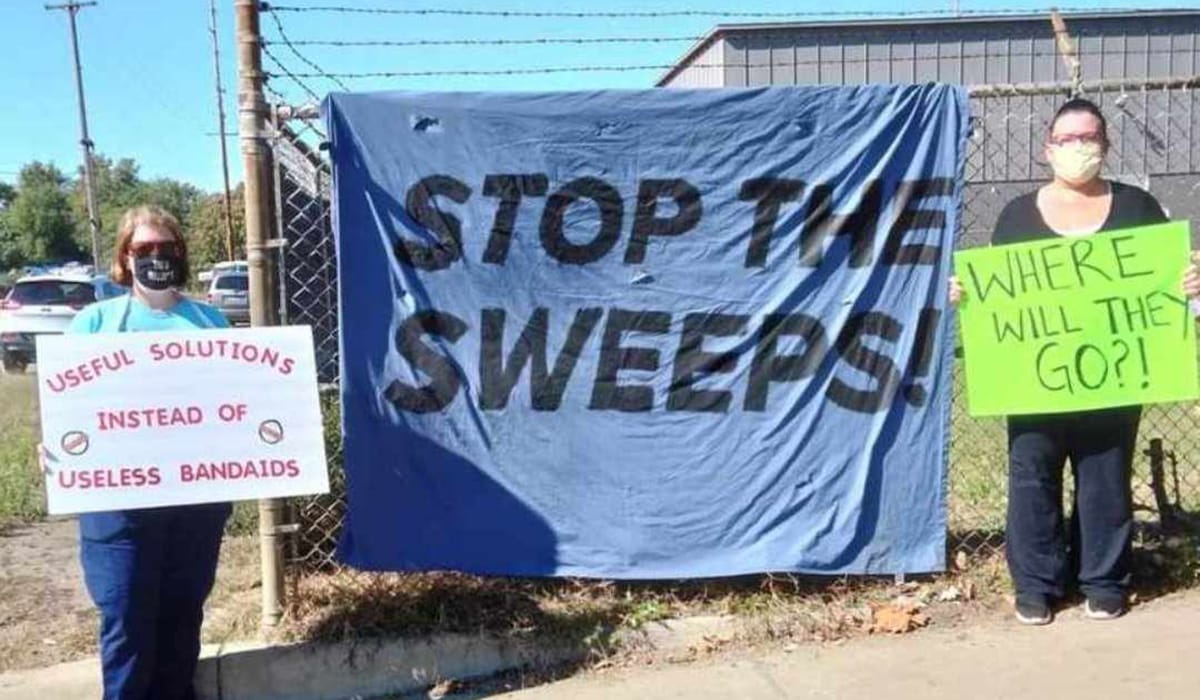
Megan advocates for the safety and rights of people experiencing homelessness alongside volunteers of United for the Unsheltered of Kalamazoo.
Any advice for people who want to start volunteering?
Just do it. Not a lot of volunteers can go, or feel comfortable going, to the encampments. But there are a lot of people behind the scenes who get the supplies ready. We have one woman, she can’t stand very long, but she loves to bake. So she bakes every week at least once and somebody picks up the most amazing cookies. Our folks have come to expect them and are very excited about them. I have another volunteer who loves the paperwork; spreadsheets are her love language. They’re not mine. There’s always going to be a place and an organization for any talent.
What do you want people to learn from your story?
We need to stop looking at homelessness or houselessness like it’s a disease. There needs to be more compassion. None of us ever really knows what’s going on behind the scenes in anyone’s life. Yes, there is a very small portion of the population that prefers this kind of lifestyle; they feel it gives them a certain kind of freedom. But most folks want help if they can get it. But to fill out paperwork for housing, you have to have identification. To get identification, you have to have a social security card and a birth certificate. To get a birth certificate or social security card, you have to have identification, right? So it’s a snake eating its tail. When you couple that with the fact that phones are stolen, funding runs out, people have to move hurriedly for either personal reasons or because the police have moved them or their paperwork gets lost in the system and they get dropped — they have to start all over again. Folks don’t have that kind of access. So I wish people understood more that there really is a cycle that does hold a lot of people back from getting the support that they need. I wish people would just give the same compassion they would want to get if the shoe was on the other foot.
Tell us about future partnerships, programs or events that you are excited about.
We partner with a lot of local agencies. One always holds a resource event. A lot of organizations come together. It’s almost kind of like a job fair of sorts, but it’s for resources, food, medical care, shower and haircut opportunities, getting clothing and supplies and more. Really, we don’t necessarily operate on big events, we just tried to just keep the pace of the day-to-day. It’s just a little bit harder to try and do big events just because there’s never necessarily a good time to do it. We just we try to focus on what’s needed each day.
One Woman’s Dedication to History, to Veterans and to Her Community
Meet Daily Point of Light Award honoree Marjean Neve. Read her story, and nominate an outstanding volunteer or family as a Daily Point of Light.
At the George H.W. Bush Presidential Library & Museum, Marjean Neve’s commitment shines brightly. Since 2016, Marjean has devoted over 1,400 hours of service, embodying the spirit of volunteerism and community engagement. Her dedication not only enriches the experiences of visitors to the museum but also honors the legacy of President George H.W. Bush.
Marjean’s warm demeaner, as well as her knowledge and enthusiasm, offer visitors a unique and informative experience, deepening their understanding of President Bush’s administration and the historical significance of his presidency.
Marjean also volunteers with a variety of other organizations that allow her to show appreciation for community members, from supporting veterans and their families to engaging in community improvement projects.
Read on to find out more about what inspires Marjean and how she got started with the initiatives she volunteers so passionately with.
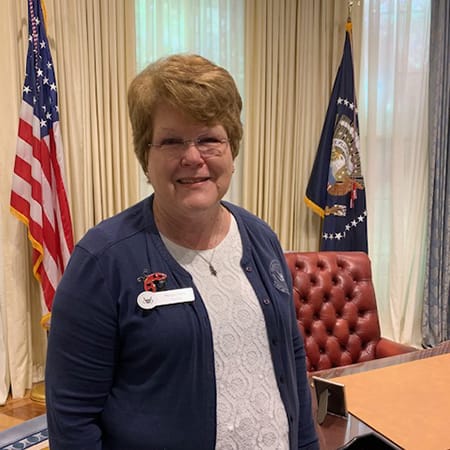
Marjean in the Oval Office of the George H.W. Bush Presidential Library and Museum.
Tell us about your volunteer roles.
At the George H.W. Bush Library, my goal is to greet visitors, answer any questions, direct them to exhibits, be there to offer any help, chat with them if they want to chat and thank them.
I also help with taking pictures in the archives of some of the artifacts there. Another woman writes a description of them and I photograph them. It’s to keep a record of all the artifacts. There are so many tie tacks and little buttons!
I also volunteer with Quilts of Valor. It’s a national volunteer organization where we make quilts for military personnel and veterans. We gave out nine about a month ago. Next month we’ll be giving out six more. I have a list of places that have veterans who they want quilts to go to. The organization is picking up speed, becoming a lot more work than I anticipated, but I really enjoy it.
Why are these issues so important to you?
I had visited the Library several years before I moved down here. I took my grandsons to it and I was fascinated! I was really impressed with the docents there that day who answered questions and helped us out. When I moved here, I put in an application to volunteer. I’ve been here eight years now. I enjoy it, there’s always something to do. You get to meet people from all over.
As far as Quilts of Valor, I sew, I don’t quilt, so I ask for volunteers to do the quilting. But I enjoy putting the tops together. I also do more of the paperwork and organization. When we have the presentation of the quilts, the faces on the fellows when you say “thank you,” it’s really something. I had one gentleman who we were going to give a quilt to, he said he didn’t want it. He felt others had done so much more than him and deserved it more than him. I told him, it doesn’t matter. You gave up your life for four years. You still deserve a quilt. He was adamant, and I told him if he ever decides he wants one, we’ll have one for him. My mother and father were both in the military, in 1949 and 1950. They got married when they were both stationed in Japan for the Korean War. My mother was discharged when she was pregnant with me. My two brothers and my sister both served in the military too, so it holds a special place in my heart.
What’s been the most rewarding part of your work?
That’s a tough question. I want to do something for people, and if this is a small little way to do something, I can do it. We didn’t volunteer as a family when I was a child, but when I got married, my husband joined the Lions Club, and that was something he was very passionate about. So we as our little family, we would help him and volunteer with him. I’m still a Lions Club member. I also did Girl Scouts with my girls for 14 years. I was a troop leader, and then cookie mom. That was an experience – I had a room full of cookies!
What have you learned through your experiences as a volunteer?
I think through all of this, I’ve become a more patient person. You have to deal with so many personalities from so many different people. Patience has definitely been a big takeaway for me.
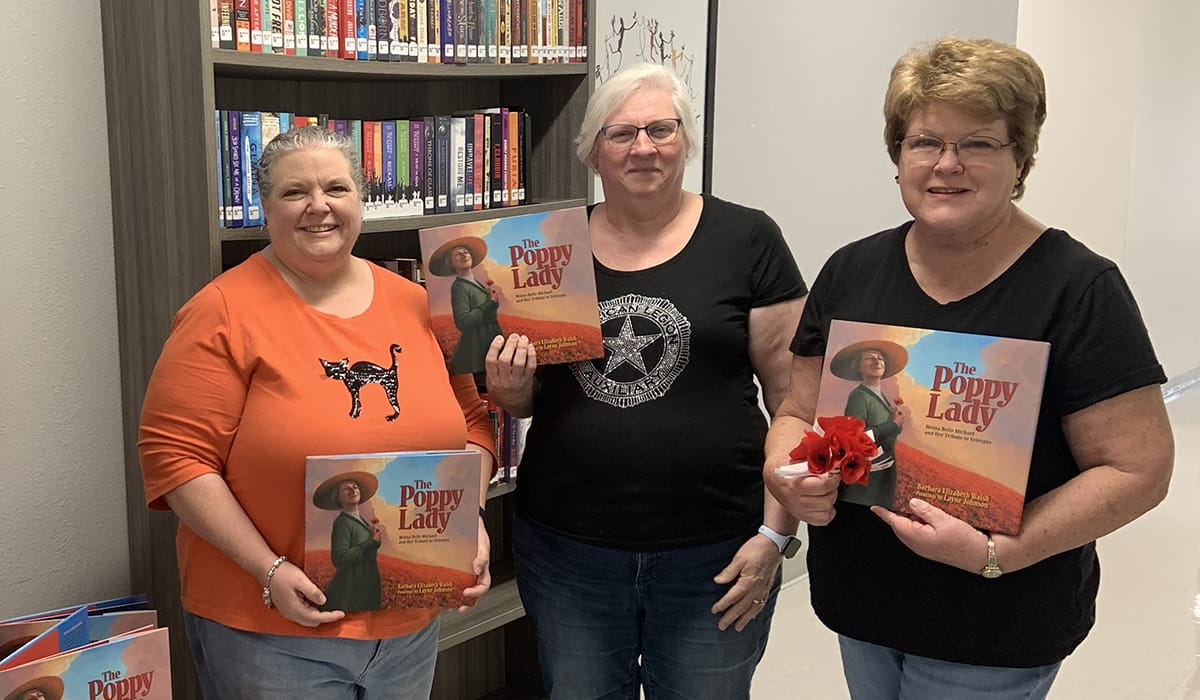
Marjean at an event with the Women’s Auxiliary of the American Legion.
Why is it important for others to get involved with causes they care about?
I think it’s our responsibility to create a better world, a better future for all of us. I just hope I’m setting a good example for my grandkids to follow.
Any advice for people who want to start volunteering?
Just do it! Just take that first step and do it. When I moved to Texas, I didn’t know anybody. I had to step out of my comfort zone. There were a couple places I went that weren’t for me, and then a few I did feel comfortable with. You just have to make that first step.
What do you want people to learn from your story?
There’s a quote from Barbara Bush that means a lot to me: “I don’t want the light to shine on me, but if it does, I want it to shine on someone or something else too.” This says a lot about how I feel about things. I always feel like I want to be in the background. Sometimes, I do have to step up, but I also think that any honor I get should reflect on others. So many people are doing more than me.
Empowering Individuals with Disabilities Through the Art of Ice Skating in Central Florida
Meet Daily Point of Light Award honoree Terri Miskiv. Read her story, and nominate an outstanding volunteer or family as a Daily Point of Light.
In sunny Central Florida, inspired by her son and the volunteers on her team, Terri Miskiv passionately serves in leadership with Gliding Stars, a program designed to harness the power of ice skating for the physical, social and emotional growth of individuals with disabilities. For the past seven years, Terri has not only served as the driving force behind this impactful initiative but also profoundly touches the lives of dozens of athletes and volunteers each season.
Terri’s journey with Gliding Stars began out of a desire to share a piece of her northern upbringing with her son, who has an autism diagnosis and showed an interest in sports. Terri grew up in Wisconsin and moved to Florida. It was there that she casually stumbled on figure skating. This personal connection to the sport and her son’s enthusiasm laid the groundwork for her commitment to ensuring the program’s continued presence in the local community.
“My original inspiration was my son, who has an autism diagnosis,” Terri shared. “We were looking for athletics that he could participate in, and it was really challenging to find an inclusive environment. He’s a boy. He’s busy. He wants to do things. Finding sports that could accommodate him, especially five years ago or more, when there wasn’t necessarily the same level of conversation around diversity, equity and inclusion, was difficult.”
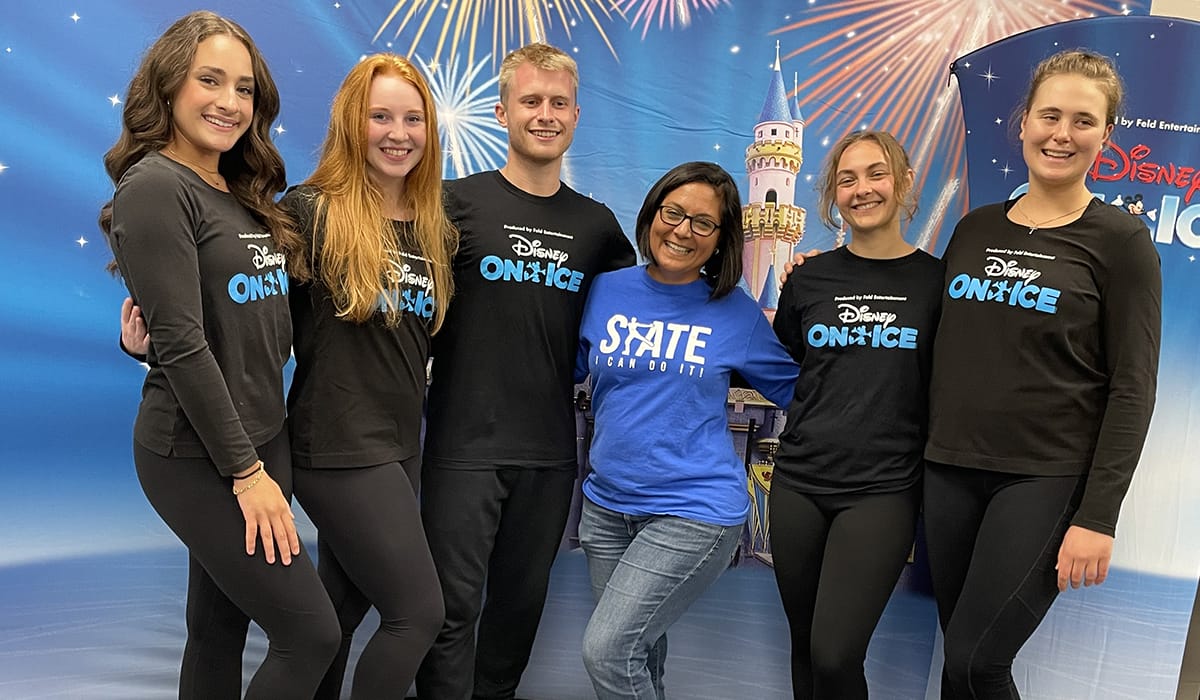
Terri Miskiv passionately volunteers with Gliding Stars, a program designed to harness the power of ice skating for the physical, social and emotional growth of individuals with disabilities.
Once Terri found Gliding Stars, she knew that she had unearthed a perfect fit for both her son’s athletic inclinations as well as her own level of involvement with a nonprofit. “It was an easy match-up for me to support the organization and also support my son,” she said. “My whole family participates in the volunteering, and it’s really become a family journey.”
As the director and president of Gliding Stars of Central Florida, Terri’s responsibilities are vast and varied, ranging from the organization and planning of the six-month season to leadership training and development. Her dedication ensures that each athlete receives training tailored to their experience level, fostering a safe and nurturing environment on the ice. These days, she is particularly passionate about volunteer appreciation.
“In the state of Florida, ice skating is not a typical sport,” Terri admitted. “Thus, there’s a smaller percentage of volunteers to draw from. So, it’s even more important that what we’re able to give to our volunteers – whether that be training, accolades, support – is valuable. We need them so specifically and we need their expertise so specifically. My highest focus right now is really our volunteer value and retention.”
Gliding Stars of Central Florida serves approximately 22 athletes per season, with a core group of 11 to 15 recurring athletes annually. The program also benefits from the support of 35 to 45 volunteers within the Central Florida area, providing them with valuable experiences and volunteer hours. Despite the significant cost of ice time and the lack of support from the ice rink facility, Terri’s leadership has steered the program towards sustainability and growth.
Still, Terri loves interacting with the families in the program. “Honestly, the most rewarding part of what we do as a group is the education for the parents that were in our program prior to or since the beginning, before myself,” she reflected. “Educating them that their athlete is able to move beyond just learning how to ice skate, that they can participate in competition, that they can participate with the United States Figure Skating Competition, at any rink or facility outside of ours… giving parents and athletes hope that there are options beyond the ice, is so rewarding.”
Terri is grateful to her team of volunteers and seeks to provide them with valuable training, recognition and accolades.
Beyond her work with Gliding Stars, Terri also leads the Central Florida HomeSchool Best Buddies group, fostering social engagement among individuals with disabilities. This collaboration extends the social component of the Gliding Stars mission. Through showcase events, fundraising initiatives and strategic partnerships, Terri continues to champion the cause of adaptive athletes, making figure skating an accessible and transformative experience for all involved.
“Everyone has a push for diversity, equity and inclusion,” Terri said. “I’m not sure people understand the effort that goes into it and making it a reality. I would encourage people who aren’t sure how to help: you don’t have to give an hour of your time every week. You can write a review on Google. Ask someone at work about a matching gift program. There are so many ways to support these causes.”
Terri’s volunteerism with Gliding Stars and beyond is a true testament to her passion, leadership and unwavering dedication to making a difference in the lives of athletes with disabilities. Her efforts not only provide unique opportunities for physical activity and social growth but also cultivate a supportive and inclusive community in Central Florida, setting an inspiring example of how sports can be a vehicle for positive change.
Leading the Charge in Community Service and Veteran Support in Boston
Meet Daily Point of Light Award honoree Jill Clune. Read her story, and nominate an outstanding volunteer or family as a Daily Point of Light.
Serving in the armed forces is a noble sacrifice, but for some, service goes beyond their time in the military. In the bustling city of Boston, Jill Clune dedicates her time to volunteering as the Boston platoon leader for nonprofit organization The Mission Continues. Jill leads a formidable team of veterans and volunteers, channeling their skills and energies into serving under-resourced communities.
Mission Continues is a national nonprofit organization that empowers veterans to find new purpose through community service. Jill’s role is pivotal in mobilizing a platoon of service-minded individuals – both veterans and non-veterans – to support volunteering in the local community. Under her guidance, the platoon engages in various projects aimed at improving educational resources, tackling food insecurity, fostering neighborhood identity and more.
Jill’s leadership extends beyond organizing; it involves connecting with community partners in Boston’s under-resourced areas to pinpoint where volunteer efforts can have the most significant impact. Her dedication to recruiting veterans and non-veterans for community service projects is a testament to her ability to unite diverse groups around common goals.
From food distribution at the Greater Boston Food Bank to donation sorting at Cradles to Crayons to serving food to unhoused veterans at the New England Center and Home for Veterans, each initiative is chosen with care and executed with precision. With an average of 20 hours a month devoted to planning and executing community service projects, Jill’s dedication is a source of inspiration. Read on to find out more about how and why she volunteers.
Tell us about your volunteer role.
I’m the Mission Continues Boston platoon leader. That means that I lead a team of service-minded veterans to do volunteer projects in the local community. I like to make sure I have continuity between the veterans’ engagement with regular service projects as well as social events, to really give us a sense of connection. I also connect with community partners in under-resourced areas in the city to plan projects and bring our volunteers out to work alongside them.
The Mission Continues is not only located in Boston; it’s in over 40 other cities throughout the country.
As a veteran herself, Jill knows the power of having a sense of purpose, as well as camaraderie within the veteran community.
Why is this issue so important to you?
First, the importance of veterans getting connected with other veterans. As a veteran myself, I know it’s really crucial to have a sense of purpose, to feel like you matter and to help other people feel like they matter. Also, we’re out there in the community engaging in volunteer work with our community partners, which is really helping to improve educational resources or tackle issues like food insecurity or helping to foster neighborhood identity.
How did you get started with this initiative?
In addition to us working in the local community, The Mission Continues also offers leadership programs. I first got involved with the organization through the Women’s Veterans Leadership Program – a program that helps women veterans to hone in on their leadership skills and work on specific challenges unique to women veterans. The program helped me build a network of women veterans, gave me a sense of connection in that community where I had previously felt disconnected and supported my growth and confidence as a leader – which allowed me to then serve as the platoon leader for
The Mission Continues in Boston.
What’s been the most rewarding part of your work?
There have been manyrewarding moments. Last year, a small group of us had the opportunity to provide meals at the New England Center and Home for Veterans. The center provides free meals, housing assistance, training programs, healthcare and other things to veterans in Boston. This was a really great opportunity for our small group to work side-by-side, veterans serving veterans. It helped us to see the purpose, understand the bigger picture and get involved in our own community of military veterans.
What have you learned through your experiences as a volunteer?
One of the lessons I’ve learned is that there are so many ways to serve and help out in the community, whether that’s packaging food, building planters for a community garden or doing a neighborhood cleanup. I’ve learned that support is needed all around. Progress and impact does take time, so sometimes you have to be a little patient!
I’ve also learned through my work as the platoon leader and serving in the city of Boston, I’ve seen my own sense of purpose grow. Serving alongside others has helped me to restore that sense of camaraderie that I was missing from my time in the military.
Why is it important for others to get involved with causes they care about?
As a military veteran, I have a sense of duty. I think a lot of us in our group do. I feel like it’s part of our duty, as part of a community, to get involved where we can.
Any advice for people who want to start volunteering?
Just start! Everybody is welcome. Don’t be afraid. All skill sets and all capabilities are needed. So don’t let fear hold you back. Come as often as you can, as often as your schedule permits. Just show up.
Starting a Legacy: Chicago Family Instills Volunteerism in Next Generation
Meet Daily Point of Light Award honoree the Mehta/Madison Family. Read their story, and nominate an outstanding volunteer or family as a Daily Point of Light.
As The Honeycomb Project website says, “volunteering runs in the family.” Volunteering builds strong bonds and engaged citizens, and Kiran Mehta and her two children have done exactly that. Kiran, a lawyer for the State of Illinois Department of Health Care and Family Services, is a lifelong volunteer who enjoys being active, cooking and reading.
Her daughter Lucy, a fourth grader, recently turned 10-years-old and has a passion for ice skating and sewing, the latter a talent that served her well stitching quilts for pediatric patients. Her son Cooper, 12, plays tennis and has established an interest in particle physics and computer science. He’s also an avid cat fan which undoubtedly made volunteering at an animal shelter a big draw.
Together, they’ve volunteered nearly once a month with The Honeycomb Project since 2016—45 projects for Cooper and 40 for Lucy. The Honeycomb Project provides service opportunities for kids and their parents around Chicago. At a young age, Lucy and Cooper built skills, learned about problems facing city residents and met people from all walks of life. It’s these experiences that Kiran has worked hard to see her children acquire and hopes continue with into adulthood.
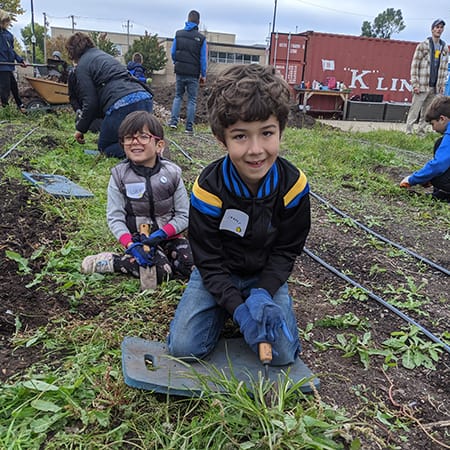
Through The Honeycomb project, Lucy and Cooper help at an urban farm that provides fresh produce and job training to community residents with Heartland Alliance, a leading anti-poverty organization
What inspires you to volunteer?
Kiran:When Cooper was younger, I was looking for volunteer-related things that we could do as a family. I’ve volunteered since I was a teenager, and it’s something I wanted the kids to have in their lives.
Lucy:When we’re going shopping and we see people on the streets asking for things, it makes me feel sad. But then when I do Honeycomb, it makes me feel better knowing that I’m helping them.
What inspired you to get started with the Honeycomb Project?
Kiran: I found the Honeycomb Project on Google. A lot of organizations don’t have opportunities for really small kids. Honeycomb allows them to start volunteering when they’re five, so we started doing that when Cooper was six and Lucy was three.
I want this to be second nature for them. There are many different opportunities every month, you can see which kind of activity works best for your family. As they’ve gotten older, they seem to really enjoy the projects where they can actually see the people they’re helping.
What are some of your favorite projects?
Lucy: Probably Nourishing Hope. They started a new thing where they give me labels to write on. I can say things like “Enjoy your food!” or “Have a good day!” and stick it on the boxes of food. It makes me feel happy seeing the people that I’m delivering them to.
Kiran: For this particular project, we go to Nourishing Hope, and they give you a list of people. Then, you load up your car with boxes of groceries and deliver them to their homes. Lucy’s always writing inspiring notes on the boxes for people.
What have you learned through your experiences as a volunteer?
Kiran: Volunteering has always been important to me because it builds community. I think everybody in this world is connected to one another, and I see that on a deeper level when I see our impact on people who really need it. We all need help at some point in our lives in varying degrees.
It’s been really special for me to be able to see that in my kids. When they were five, they didn’t understand the impact they were making as much as they do now. It’s extra special as a parent to watch your kids grow up with this, learning from different people and really appreciating their own lives.
Cooper: I’ve learned that anyone can make a difference just by doing something right.
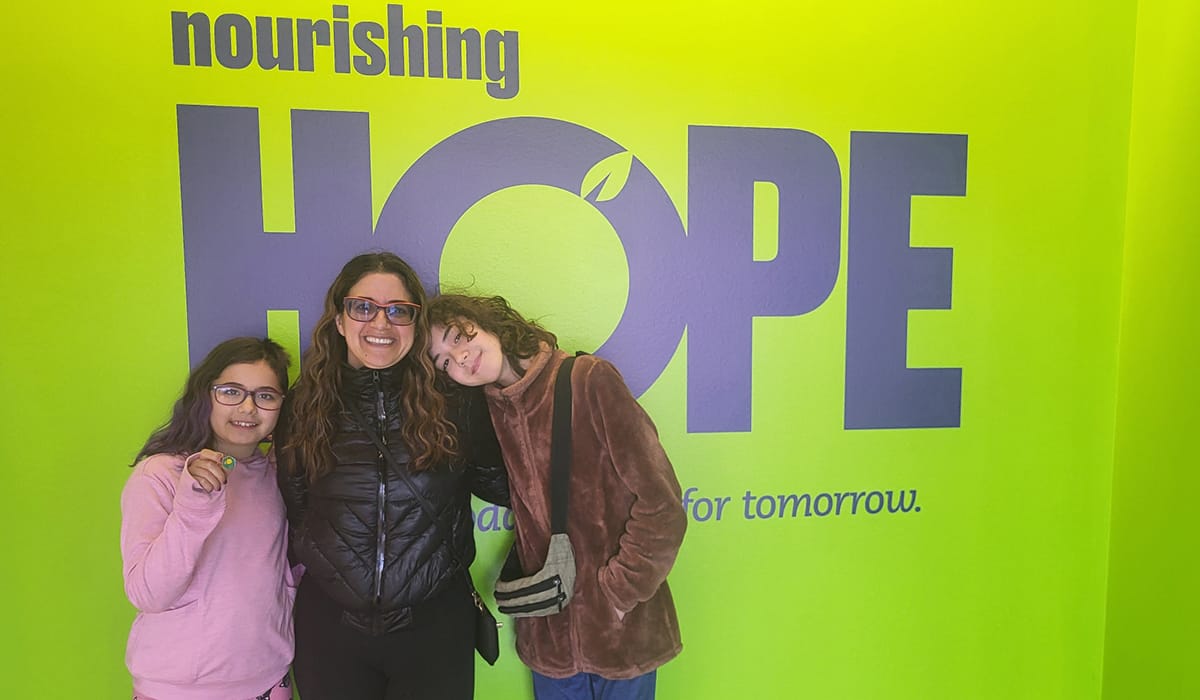
Kiran (middle) celebrates with Lucy and Cooper as they received their 40th and 45th project pins from Honeycomb. Their qualifying activity was at Nourishing Hope, a food pantry where all three delivered boxes of food to organization clients
Tell us about future programs or events that you’re excited about.
Lucy and Cooper: Brunch and Board Games!
Kiran: They’re doing Brunch and Board Games at the Illinois Medical District Guest House this month with their dad. My kids are both very into being in the kitchen and cooking, so they feel skilled and productive, and they get to have fun with the patients and their families.
Cooper:It’s really nice making food for people and watching their happiness. Other people being happy makes me happy.
Do you have any advice for people who want to start volunteering with young kids?
Kiran: I think it’s really important to make that time. You might not see those rewards and benefits to your kids in the beginning, but have patience and keep at it. Even if they’re older, they might not have that immediate concept of what they’re doing, but I’ve really seen how it’s affected them over the longer term. I truly believe that, at this stage, if I stopped signing them up for it, they would want to keep doing it. I think volunteer service will be a part of their lives forever.
It’s also something I see even when we’re not volunteering. There are a lot of people experiencing homelessness in our community. When we go to Trader Joe’s, my kids will say, Hey, let’s get some food for that family. Lucy had a $5 bill in her wallet, and she gave it to a family. I’ve seen both of my kids do that. It’s just it’s something they know is the right thing to do.
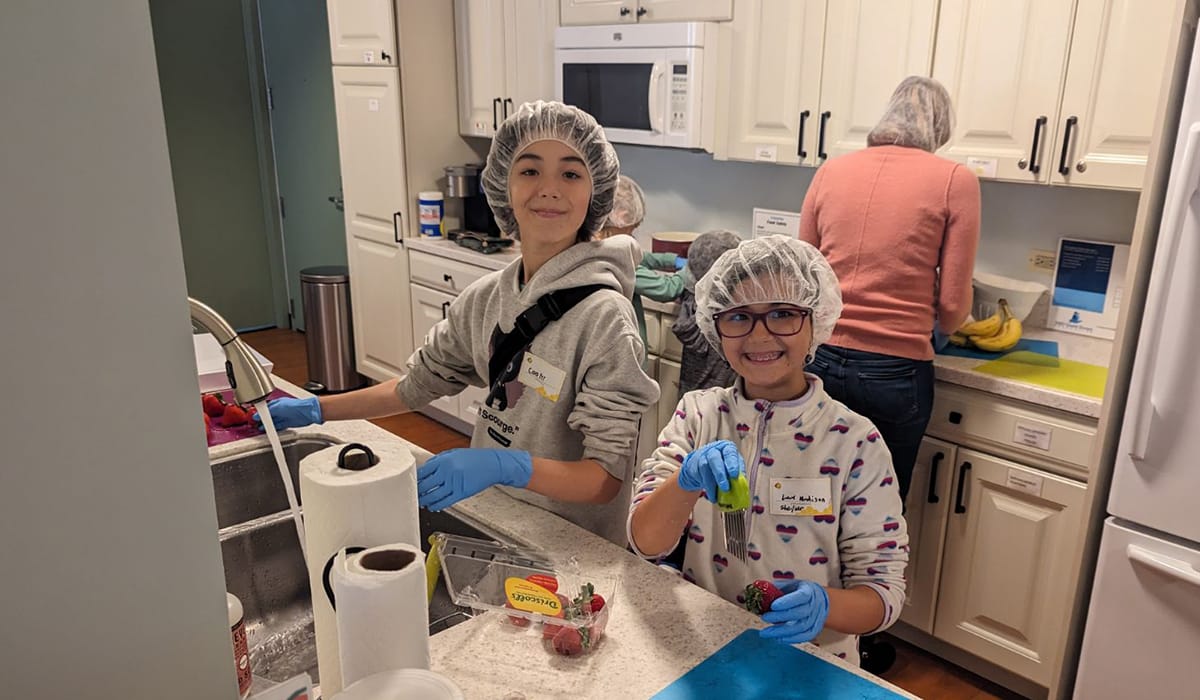
(Left to right) Cooper and Lucy serves breakfast and play board games with families for Guest House, an organization that provides temporarily housing to patients and families receiving medica treatment in Chicago
What do you want people to learn from your story?
Cooper: If they want to volunteer because they like helping people, they should volunteer. And anyone who’s reading this should get a cat.
Lucy: It’s important to be a part of a community and that we should always help others, no matter what situation they’re in.
Kiran: And for people in Chicago, I really can’t say enough about the Honeycomb Project. It’s a great organization for families. I know it can be hard to get started. The Honeycomb Project does all of that mental work of putting everything together. You just pick something that sounds like your family would enjoy and show up. It’s never too late to start volunteering.
Maryland Teen Makes the World a Little Easier for Alzheimer’s Patients and Raises Funds to End the Disease
Meet Daily Point of Light Award honoree Arya Paghdal. Read her story, and nominate an outstanding volunteer or family as a Daily Point of Light.
Arya Paghdal, a driven 16-year-old who loves to hike and cook, has also found a passion for volunteering and spotlighting young people’s voices. While her time is dedicated to many projects, one of which involves weekly English lessons for Ukrainian students, her interest in science and medicine leads her to dedicate time to the Alzheimer’s Association focusing on dementia awareness, decreasing stigma surrounding it and helping those diagnosed. She is the chair of the Youth Committee and serves as a team captain for her Walk to End Alzheimer’s team. Last summer, working directly with the residents of an assisted facility, she even designed and led an educational program that included things like exercise, meditation and an ice cream social.
Arya’s recent “Dementia Friends” project has brought hundreds of fellow students together to complete a national certification preparing them to recognize signs of and interact appropriately with people suffering from the disease. Recruiting a large group of young people to learn to engage with older adults with a memory disorder is no easy feat, but Arya’s compassion and enthusiasm shines through, her excitement motivating everyone around her to get engaged.
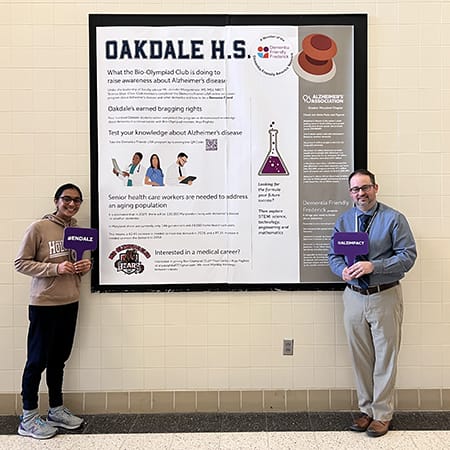
Arya and her school principal celebrate their school’s new designation as a nationally certified “Dementia Friends USA school” thanks to Arya’s Dementia Friends project and the 600+ students who participated.
What inspires you to volunteer?
Volunteering has been deeply rooted in me since childhood. I grew up seeing my parents volunteering at the temple. We would be there from 8 am to 5 pm on Sundays. It showed me how much impact one can make on somebody else’s life. You’re able to light up people’s day and make them smile.
What inspired you to get started with this initiative?
I started my work with the Alzheimer’s Association in eighth grade. I came across a Walk to End Alzheimer’s “Be a team captain” ad. At the time, there were hardly any youth team leaders, so I took it on. Knowing that I want to go into science, it’s a great way to contribute. I’m a true believer that where we are today—technology and beyond—is because of the work the senior population has done, and I want to give back.
Tell us about your volunteer role with the Alzheimer’s Association – Greater Maryland Chapter.
I started as a member of the youth council for Walk to End Alzheimer’s where we plan the fundraiser walk each fall, which takes place in four to five locations across Maryland. We coordinate with about 10 youth on ways to raise money and recruit people to participate in activities for Alzheimer’s patients like coming to nursing homes and greeting them or hosting activities.
A year and a half ago, I became the chair of the committee, and now I lead meetings and generate new ideas. One new thing I implemented is care packages for nursing homes and patients with Alzheimer’s with basic essentials like toiletries and games to exercise their brain and stress balls so they have something to look forward to throughout the day. For the past four years, I’ve also been serving as the team captain, and we contributed $2,000-3,000 to the nearly $300,000 raised throughout Maryland this year.
What is the “Dementia Friends” project you’re leading?
It involves recruiting people to complete training to be able to help people in the community with dementia. An individual at our neighboring school had done this prior with 100 students, and I’m competitive. I have no social media, so my mouth is the most powerful tool that I have. I asked my friends who do have social media to spread the specific link to get to the certification on their platforms.
I’ve emphasized that you literally could be saving someone’s life by just consenting to help somebody with dementia, if and when needed. I gave the analogy of a CPR course. We’re not going to be doing CPR every day, but when and if needed, you’re able to. I think that stuck with a lot of the students who did it. We got 600 participants from my school in a month and a half and have been officially recognized as a “National Dementia Friend USA school”. Our goal is to get 1,000 of our school’s 1,700 students by the end of this year.
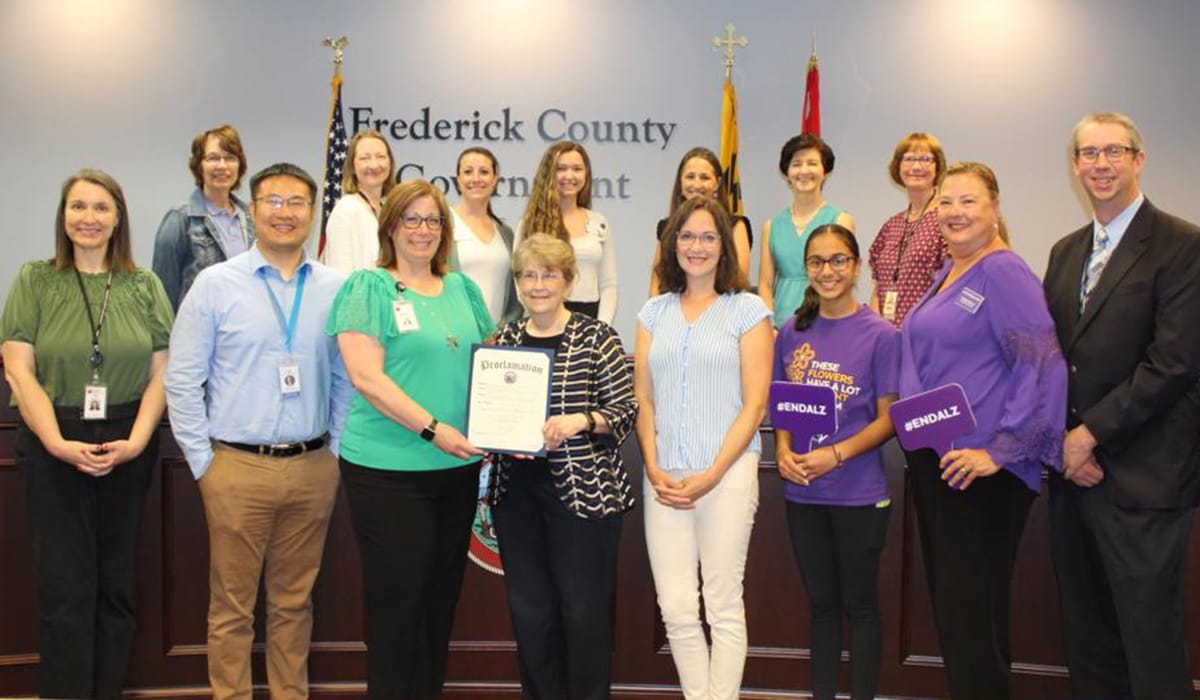
(Front, fourth from right) County Executive Jessica Fitzwater recognizes Arya (front, third from right) and key community figures for their work fighting Alzheimer’s and helping the elderly population.
What are some things people should keep in mind when interacting with someone with dementia?
For one, keep in mind that it’s not necessarily going to be a fluid conversation. It might be awkward at many points, but try to stick with it. These seniors are still human with things to offer to society. I think a lot of times, they’re disregarded as not really able to contribute much. They need help with many things, but they’re very skilled people.
There are various stages of dementia. It can be really frustrating on their end to communicate sometimes. Be involved, but when some signals are being thrown around, take a step back and have their living assistant help with whatever situation is at hand.
What’s been the most rewarding part of your work?
If I had to choose, I would say when we went to an advocacy day for patients with Alzheimer’s at the county council. I was the youngest advocate at the meeting, and I was able to talk to the county executive and get her perspective on the work I’ve been doing. It’s rewarding to see that people appreciate the work I’m doing with my team.
What do you want people to learn from your story?
If you have something that you’re willing to go after, go after it. A lot of times, it’s a difficult journey, but if you’re willing to put in the effort, the results are going to show. Don’t get caught up in the obstacles that come along, because I guarantee they will come. Push forward and know that there’s something bigger than yourself out there.
Also, implement love and passion into whatever you’re doing. Keep in mind that there are people counting on you. The more of an impact we make, the more problems we can solve in this world.