Meet Daily Point of Light Award honoree Erica Kerr. Read her story, and nominate an outstanding volunteer or family member as a Daily Point of Light.
Erica Kerr is a 41-year-old mother of two who lives on Long Island, New York. Erica volunteers with CholangioConnect and Cancer Hope Network.
CholangioConnect is a peer-to-peer mentorship program of the Cholangiocarcinoma Foundation that allows mentors to give families and friends the necessary support for loved ones struggling with cancer diagnoses. Erica also mentors through Cancer Hope Network. She has matched with spouses, adult siblings or adult children of cancer patients through email, text and phone calls to help them navigate a difficult time.
She started volunteering at CholangioConnect in 2017, and for the past seven years, she has personally mentored 25 caregivers, providing them with compassionate support and life-saving resources.
After her father’s diagnosis of Cholangiocarcinoma, a rare cancer that develops in bile ducts, and her sister’s diagnosis of brain cancer, Erica has channeled her grief into caring for others. and values the deep and meaningful relationships she has developed with mentees worldwide.
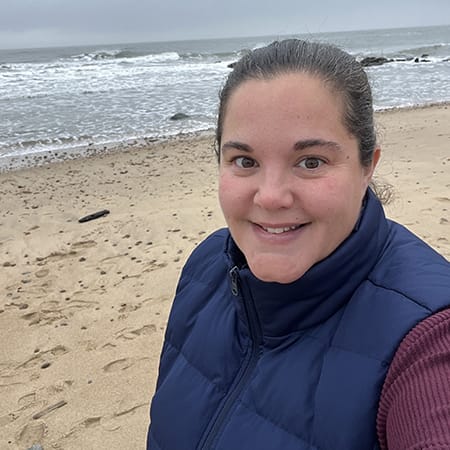
Erica Kerr walks on the beach in Montauk, New York. / Courtesy Erica Kerr
What inspires you to volunteer?
When I graduated from Maine Counseling, I got a job at Memorial Sloan-Kettering Cancer Center in Manhattan.During that time, a recent study dealt exclusively with terminal patients and their families, so I became passionate about that. Then it became my reality in 2012.
In December 2012, my dad was diagnosed with Colangiocarcinoma, which is a rare cancer that affects the bile ducts.
I comforted my family through the process until my dad passed in March of 2018. My daughter was three when my dad died, and my son had just celebrated his second birthday.
Once I had considered coping with my grief by taking some time for myself, I decided to volunteer as a mentor through the Cholangiocarcinoma Foundation. It’s been a great experience ever since.
How did you begin volunteering with Cancer Hope Network?
At age 39 my sister was diagnosed with brain cancer, and I kind of had to go through the same experience again with my family as when my father was diagnosed. Although she’s doing excellent now and raising her daughter, my sister has had to give up a lot because of her diagnosis. But throughout it all, she started mentoring through Cancer Hope Network approximately three years ago. She asked me if I wanted to volunteer, and here I am.
What’s been the most rewarding part of your work?
Meeting families face-to-face is the most rewarding part of my volunteer service.
I mentored a woman for two years. We met one day, and I took our kids to the zoo together. It was just so lovely to spend time with her, hug her and feel her. Just knowing that neither of us was going through this alone was amazing.
Unfortunately, everyone knows somebody who has breast cancer – an aunt or sister or grandma. When I say the word Cholangiocarcinoma, nobody’s heard of it. So having someone who’s seen and dealt with it makes a difference.
What have you learned through your experiences as a volunteer?
Cancer sucks.
It affects the entire family unit, not just the patient. When I talk to family members, they say they’ve never had anyone to speak to. It feels like the family gets left behind. So, filling in those gaps is essential.
I don’t do anything miraculous. I listen. I don’t cure anything. I don’t fix anything. I just listen and relate to people so they don’t feel alone. It doesn’t matter your background. I am in contact with an American citizen born in China and her sisters in China. It doesn’t matter where in the world they are; if they can be heard, it helps a lot.
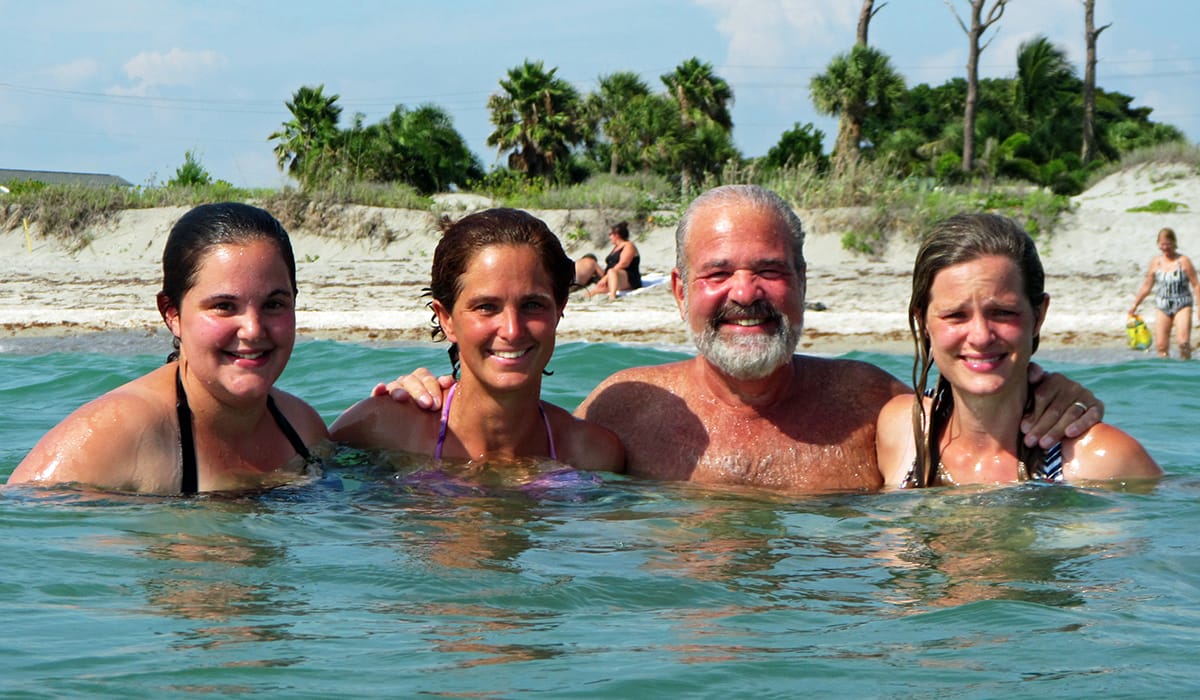
Erica Kerr (left), her sisters, and her father visit his favorite place, where his ashes eventually rest. / Courtesy Erica Kerr
Why should others get involved with causes they care about?
If you don’t, who will?
There are organizations and causes that have many volunteers, but they can always use more. Many organizations don’t get funding, and people can’t afford to see a therapist. People must find somebody to talk to and relate to; it makes a huge difference.
People sometimes feel they don’t have the time or don’t know what to do, but everyone I’ve ever spoken to is always so grateful for any time I have.
Any advice for people who want to start volunteering?
When it feels right, just do it. It’s not always going to feel right. When my sister was diagnosed with cancer, I took a break from volunteering to focus on her health and diagnosis. I called my program leader and said I could not mentor right now.
And when I was ready to go back, I went back. So when it’s your time to do it, do it. And if it doesn’t work out, that’s okay. But just give it a try.
What do you want people to learn from your story?
I want people to know that cancer isn’t as scary all the time as it may seem.
I find a lot of great stories from people about their fights or their family fights. Yes, it’s sad when the patient dies, but there can be so much good that comes out of it. The most important part is learning how to grieve and spending time with your loved one before the time runs out.
I don’t want people to be scared when they or their loved ones get diagnosed. It’s a universal experience. Based on my experiences, I think it’s important to know it’s not all bad and that there can be good things during the life-changing experience. It’s okay to laugh, joke and have fun, even when something so serious is present.
Half a Century of Impact: Changing Lives with Summer Camp Experiences
Meet Daily Point of Light Award honoree Theresa O’Bryant. Read her story, and nominate an outstanding volunteer or family as a Daily Point of Light.
When Agassiz Village celebrates its 90th anniversary in 2025, it will also mark a monumental milestone for Theresa O’Bryant: 50 years of unwavering dedication to the camp and its mission. Theresa’s journey with Agassiz, an overnight residential camp, began in 1975 when she attended as a 13-year-old camper. Like many of the children Agassiz serves today—23% of whom are unhoused or in foster care—Theresa sought a space to feel safe and free.
Unlike most campers, however, Theresa never “moved on.” Instead, she “dug in,” making Agassiz Village a lifelong commitment. Her passion stems from her own transformative experiences at Agassiz and her belief that every child deserves the opportunity to explore their potential in a supportive environment.
“I’m an Agassiz kid. And after I spent a summer as camper, I returned to The Village to work as a counselor in training,” Theresa shares. “I was just a 15-year-old kid learning to help other people. As a counselor, I worked there for nearly a decade.” Today, as the board chair of Agassiz Village, Theresa’s leadership ensures the camp continues to serve its diverse and vulnerable population effectively. She plays a key role in recruiting and onboarding new board members, mentoring them to channel their talents for the benefit of the organization.
“Home life can be stressful. But at camp, kids get to be kids, and that means a lot,” she reflects. “To have an opportunity, as a kid from the city, to walk on soft dirt roads and breathe clean air, that’s a valuable experience. I had that experience, and now I get to help others have that experience when they’re teenagers and young adults.”
Theresa’s impact extends far beyond the boardroom. She’s an attorney. She has a master’s degree in business. She serves as the general counsel at Massachusetts College of Art and Design. And she is a hands-on volunteer who participates in alumni and volunteer weekends at Agassiz, rallying groups for campus work projects and offering support to camp staff.
Theresa O’Bryant had a life-changing experience at a Maine summer camp when she was a youth. Today, she pays it forward./Courtesy Theresa O Bryant
“I’ve spent a meaningful amount of time at camp when there are children there, because it’s so important to see your efforts in action. In some ways, the kids look a little different, but they also look so much the same as I was when I was just a little kid trying to find my socks,” Theresa says. “They leave the city and they go to a rural camp in Maine, on two miles of a pristine lake waterfront, for a two-week period. They go without their electronics. It’s hours away from Boston or New York. Sailboats, canoes, sprawling acreage: they get to experience things they just don’t get to do in the city.”
Theresa works tirelessly to ensure the camp remains a place of hope and opportunity for families who might otherwise be unable to afford such an enriching experience. Under her leadership, Agassiz Village has embraced Justice, Equity, Diversity and Inclusion (JEDI) principles to better serve its campers, 92% of whom qualify for federal assistance. “The problem is that there aren’t a lot of summer camps that will take kids whose families can’t afford to give them a quality camp experience,” Theresa shares. “Agassiz is one of only three camps in Maine that will take kids whose families can’t afford to send them to camp, and give them what I call a ‘rich kids’ camp experience.”
Theresa’s professional interests and volunteer efforts largely focus on eradicating poverty. “It should be a civil right, to play in a place that’s safe where there’s fresh air. That’s not a right, guaranteed by law. I’d like to make that right the case, despite the law,” she says. “One of the things we haven’t been able to do over 90 years is stay steadfastly focused on making sure the facilities are entirely up to par.” So now, Theresa is co-chairing Agassiz Village’s upcoming Capital Campaign, working to secure the organization’s future and expand its capacity to serve even more children. Her efforts have already resulted in critical funding and infrastructure improvements, ensuring that Agassiz Village remains a transformative space for decades to come.
As a legal counsel, Theresa also sponsors campers annually, ensuring they can attend without financial barriers. Her personal and professional contributions exemplify her deep commitment to the Agassiz mission. She inspires her fellow board members to “work harder for the kids,” ensuring that every decision made serves to uplift the campers and their families.
Theresa’s half-century of service to Agassiz Village is a testament to the life-changing power of opportunity, compassion and community. “I know the children we serve have tremendous potential,” she says. “I was one of these kids. And I know firsthand that you don’t have to finish the way you start. If I can get an opportunity to do something that doesn’t take much—just some time or some money—to help change the trajectory of a kid’s life, that is personally enriching work.” Her enduring dedication continues to shape Agassiz Village, making it a place where kids can just be kids, and where dreams take root.
“No one goes through this life alone. Everyone has had someone in their world who has helped them, supported them or encouraged them,” Theresa says. “Sometimes, that isn’t a formal family relationship. Sometimes that’s an organization, a nonprofit or just an event. Should you have space in your life—and I believe everyone does—give what you can, whether it be time or donation. The value you can bring is far more than you can ever imagine.”
Meet Daily Point of Light Award honoree Madhavi Menon. Read her story, and nominate an outstanding volunteer or family as a Daily Point of Light.
Madhavi Menon co-teaches an English Language Learner beginner class at Johnson County Library in Overland Park, Kansas. Since September 2022, Madhavi has taught these classes each Saturday alongside her co-teaching partner, Jessica Kueker.
The duo has served over 200 hours while creating lesson plans and facilitating classes.
As a naturalized U.S. citizen, Madhavi understands the challenges of being an immigrant in a new country. From her experiences, she finds joy in helping other immigrants learn the English language and integrate into American culture. Madhavi enjoys challenging her students with consistent coursework to help them achieve their English dialogue goals.
Read on to learn about Madhavi and her volunteer service.
Madhavi Menon teaches students in the Johnson County Library. / Courtesy Madhavi Menon
What inspires you to volunteer?
For a couple of years, I looked for different ways to get engaged within the community through various programs and volunteer opportunities. This program resonated with me because I’m an immigrant myself, and I could understand how difficult it must be to come to a new country that is not only culturally different but also unable to speak the language. This was one way I could contribute: to help everyone learn English and acclimate to the United States.
Tell us about your volunteer role with Johnson County Library.
I am a volunteer teacher with the English Language Learners program. Two of us teach this class together on Saturday mornings for an hour and a half. During that time, I meet with 12 to 15 students a semester averaging approximately 48 to 60 students a year. Before each class, we develop a teaching plan that allows me to put together slides and other materials we want to cover.
What does your weekly curriculum entail?
The teaching involves many exercises. We cover different topics, such as things that would be helpful in everyday life: schools, the city, the doctor’s office, the post office, the function of a hospital and others.
At times, I put students into pairs and say, “Okay, let’s pretend that you’re a pedestrian on the street and you’re just passing by someone, you need directions to someplace and you have a conversation.” This helps them build on filling in the blanks and also reading comprehension.
What are some challenges you have faced while teaching the English language?
One of the challenges I faced was developing a teaching plan. I don’t have a background in teaching, but with practice, I learned how to develop a plan and execute it, and I have gotten better at that over time. We improve our teaching styles and techniques by practicing and receiving feedback from students.
It’s getting people to a place where they’re accepting and comfortable with their learning. It can be challenging, but it’s ultimately rewarding. My job is to learn how to better serve our students, which happens over time.
What benefits do you feel your students have gained from your lessons?
One of the short-term benefits is more confidence in speaking. It’s amazing to hear how they have improved in sentence construction and in their ability to read and understand.
In the long term, it’s also just about feeling like you belong and have a group. You know, you’re coming together with a group with the same goal, objective and purpose and feeling more settled.
A benefit of teaching is forming connections with our students, especially those who have been with us for a long time. Teaching helps build a community in the library, not only for the students but also for other community members.
What are your long-term plans or goals for teaching the English language, and what else would you do in addition to this?
As of now, we will continue doing what we’re doing. We’re getting an excellent response from the community. We have sessions focused on the English language class every semester, broken into different semesters. I plan to continue volunteering to build momentum and engage more people with the program.
The hope is to spread the word and encourage people to come in, learn and participate.
If I had the time, I could work with kids on storytelling and reading in the community. I would want to join a larger community reading group and watch as the community continues to develop. But it would be nice to be able to include a lot of kids who may not necessarily have access outside or may have very busy parents.
What’s been the most rewarding part of your work?
The most rewarding part of my work is engaging with adults from different places, watching someone learn something new and express themselves. Observing them transform from being unable to construct sentences to seeing them speak very well is remarkable. Also, meeting people from so many different countries and places, learning more about their cultures and understanding why they’ve come here helps build that community locally.
Why should others get involved with causes they care about?
There’s something to be said for that human connection; it’s a lot of fun. We have a lot of fun in the classroom while we build a small community, and so by adding that human element to it, you can make a big difference. Being able to make a difference in a collaborative environment is lifechanging. If anyone feels like they want to do something and volunteer, they totally should and not worry about it.
Any advice for people who want to start volunteering?
Do it. Just do it. Don’t worry about whether you have the background or skills needed. People will be so grateful that you’re just there, doing it because there’s always a need.
MENTORSHIP PAVES THE WAY TO A BRIGHTER CAREER PATH
Meet Daily Point of Light Award honoree Eileen Levinson. Read her story, and nominate an outstanding volunteer or family as a Daily Point of Light.
Eileen Levinson has a background as a nursing manager, but these days she’s focused on helping the healthcare heroes of the future.
As a mentor with iCouldBe, a program that provides high school students with an online community of mentors, Eileen uses her background in the healthcare industry to inspire high school juniors who are interested in the field to achieve their goals. During the year-long program, Eileen meets with her mentees online and provides them with assignments that will help them thrive professionally. While Eileen never even meets her mentees or learns their real names, the bond between them is strong. Each week, Eileen guides each student as they take on tasks that will help them grow. Whether it’s working on their resume, joining a club at school or practicing their networking skills, Eileen provides each mentee with the guidance they need to have a brighter future.
With 13 years as an iCouldBe mentor under her belt, Eileen has helped countless young people navigate the challenging path to high school graduation and a brighter future. But in addition to steering them toward professional success, Eileen’s greatest responsibility is instilling a sense of confidence within each of her students. By preparing them for the obstacles they’ll face in the future, Eileen is building the next generation of healthcare workers. As for her favorite part of the role, Eileen says it’s the students’ thank yous that “warm her heart.” Her dedication to mentorship shows the transformative power of reaching out and helping someone else.
EILEEN LEVINSON HEADS OUTSIDE FOR A WALK WITH A RESCUE DOG. :/COURTESY EILEEN LEVINSON
What inspires you to volunteer?
In a different volunteer role, the group’s outgoing president said “You’re giving, but you get more than you give.” That’s not the reason to do it, but it’s sort of a side benefit. It makes me feel so good to have some sort of impact. Also, we need young people to go into nursing. I like to share my excitement about it. You work very hard, but you leave each day knowing that you made a difference in people’s lives. Yes, you’re going to work very hard, but you’ll come home and know that you really made a difference.
Tell us about your volunteer role with iCouldBe.
Each year I get four to five students, all of whom are in 11th grade. They have been selected by their schools because they show potential and have the ability to go on to college, but need some help and some direction. They have assignments each week all about career development, career networking and other things like that that help them build social capital. Because I have a nursing background, the students who are interested in healthcare will choose someone like me to help them develop skills and confidence. I help guide them toward a career path and help them learn how to make connections and look for other people who can help them.
What inspired you to get started with this initiative?
In 2012 I went part-time as a nurse manager because my mom was getting older and needed me around more. I think I chose iCouldBe because I strongly believe that wasted potential is preventable. But especially human potential! To have so many kids who are smart and maybe just don’t have what they need to go through the college application process, and then for them to go to college and have a career just makes me very happy.
What’s been the most rewarding part of your work?
Watching them grow. Sometimes they start and they don’t see very much. But then they deepen their thought and widen their lens to see the world and the possibilities a little more broadly. So just to see when they tell me what colleges they’re applying to and see them go through that whole process. They still have one more year of high school, but they know what they have to do. They know how to write their essays. They know how to network. They’ve thought and narrowed down the field they want to study, and they figured out which schools will specialize in it, and figure out which ones are right for them. They’re ready to go for 12th grade.
What have you learned through your experiences as a volunteer?
You can be really wise at 17, and you can think really deeply at 17. They’re open to learning and developing themselves. Many of them come from families where no one’s gone to college, so they want to be the first. They say how proud their family is of them. It’s heartwarming.
Why is it important for others to get involved with causes they care about?
The world needs a lot of help. The world is a wonderful place, but there’s a lot of good people can do. There are people who need help. Some people aren’t as fortunate as other people have been, and you can help. You can share something that you developed your whole life, like your little treasure chest. You can take that wisdom that you’ve gleaned through the years of raising a family, doing your job, or just going through life, and you can share that wisdom.
Any advice for people who want to start volunteering?
Volunteer doing something that you know that you’re comfortable with. Especially at my age, a lot of my peers are retiring. This is such a good thing to do because you have expertise and you do it on your own time. At iCouldBe, you can do it at one in the morning if you want. It doesn’t matter, because it’s all online. Anybody could do this. You want to take your knowledge, experience and wisdom and share it.
What do you want people to learn from your story?
It feels good to be involved. You receive the gratification of watching something happen. My students grow and get ready for college. Whatever it is– maybe you receive the gratification of watching hungry people have a meal. When you’re tutoring, you’re watching people learn and be able to move ahead in school. It’s a connection. You’re partaking in the world.
Cooling Newark: Aspiring Environmental Engineer Tackles Urban Heat Island with Tree Cover
Meet Daily Point of Light Award honoree Julianna Dail. Read her story, and nominate an outstanding volunteer or family as a Daily Point of Light.
Julianna Dail, an 18-year-old aspiring environmental engineer, is particularly intrigued by sustainable housing and curbing the effects of urban heat islands. It’s the latter of these interests that moved her to create Trees for Equity to address associated environmental, health, social, economic and infrastructure issues these regions are afflicted with. To do this, she increases the tree canopy and educates the public about the problem and practical solutions.
So far, Julianna has reached more than 800 students between her virtual course and in-person workshops emphasizing the importance of tree canopy coverage. She has participated in over 200 tree plantings in collaboration with partners, often giving speeches at the events. Her website has garnered 1,000+ tree request referrals, through which private residents are connected with organizations like the New Jersey Tree Foundation for planting. The process is free, but the requester is asked to practice consistent watering until the tree can live independently. Trees for Equity has also created an opportunity for Julianna to practice her nature photography, a creative pursuit outside of the scientific logic she deploys in her educational and nonprofit work.
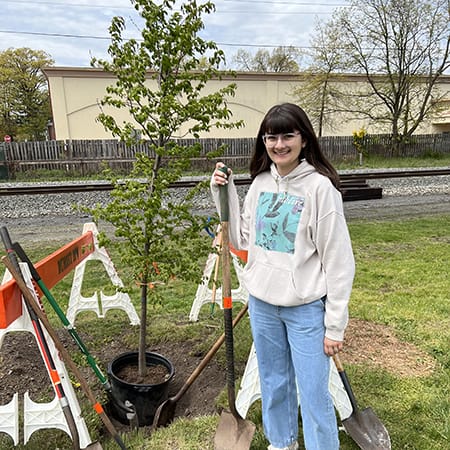
After giving a speech and handing out saplings, Julianna plants a tree for an Arbor Day event at Dumont Shade Tree Commission, a local environmental organization./Courtesy Julianna Dail
What inspires you to volunteer?
I’ve grown up volunteering. I go to an all-girls Catholic High School, and we do a lot of service. It’s always been a huge part of my life.
A few years ago, I took a class on environmental science through SUNY-Canton, and I read up on air pollution and extreme heat. Sadly, a lot of underrepresented communities are disproportionately affected by these issues, so I did a lot of research to learn more about urban heat islands. I’ve always loved engineering, and this was an issue where I could use engineering to help.
What is an urban heat island?
They’re urban areas that are much hotter than surrounding regions due to a variety of factors including human activity, a high population density, a lot of tall infrastructure and factors of industrialization. These communities are often underserved or BIPOC populations. Due to the historical practice of redlining, they were denied financial assistance and weren’t able to help themselves in terms of environmental issues, because they couldn’t afford air conditioning or air purifiers. As a result, these regions have become pockets of heat and air pollution. My initiative focuses on Newark, New Jersey, an urban heat island with a heat index of 8.0. It’s one of the worst in the country.
Tell us about your volunteer role with Trees for Equity.
I’ve looked at many different solutions. Cheaper options were not as sustainable, but their sustainable counterparts were much more expensive. For low-income communities, costly solutions aren’t feasible. Planting trees is simple but effective. In large numbers, trees are highly effective at cooling down areas through evapotranspiration, which is essentially when they release water through their leaves.
Through my organization, I do a combination of spreading awareness about urban heat islands and environmental injustice as well as offering practical solutions. As the founder and president, I oversee all of our activities including tree plantings, workshops and partnerships.
Describe your heat island research with Dr. Mike Alonso’s lab at American University and how you used it to help your community.
I joined his work in Baltimore, Detroit and Boise. Those are also urban heat islands, though not as extreme as New York. We used Google Earth imagery to take 500 random data points and classify them based on their land cover–water, concrete, impervious surface or tree canopy. Using those classifications, we could determine what percent of these cities were tree canopy.
Once I’d finished my research with him, he mentored me through my own project in which I focused specifically on Newark. I used the same techniques but calculated the percentage of tree canopy and pervious surface, which is grass or areas that trees can be planted on, to analyze tree canopy trends over the past 20 years. Then, I sent that information to local environmental organizations to inform their work on how many trees need to be planted and where.
What’s been the most rewarding part of your work?
I enjoy the workshops. I have a virtual one on my website that people can share, but I’ve also gone to local libraries and the Tenafly Nature Center. Additionally, I teach elementary school students, many of whom haven’t been introduced to environmental issues yet. They become passionate quickly. It’s amazing to see young students inspired to make a difference in the world.
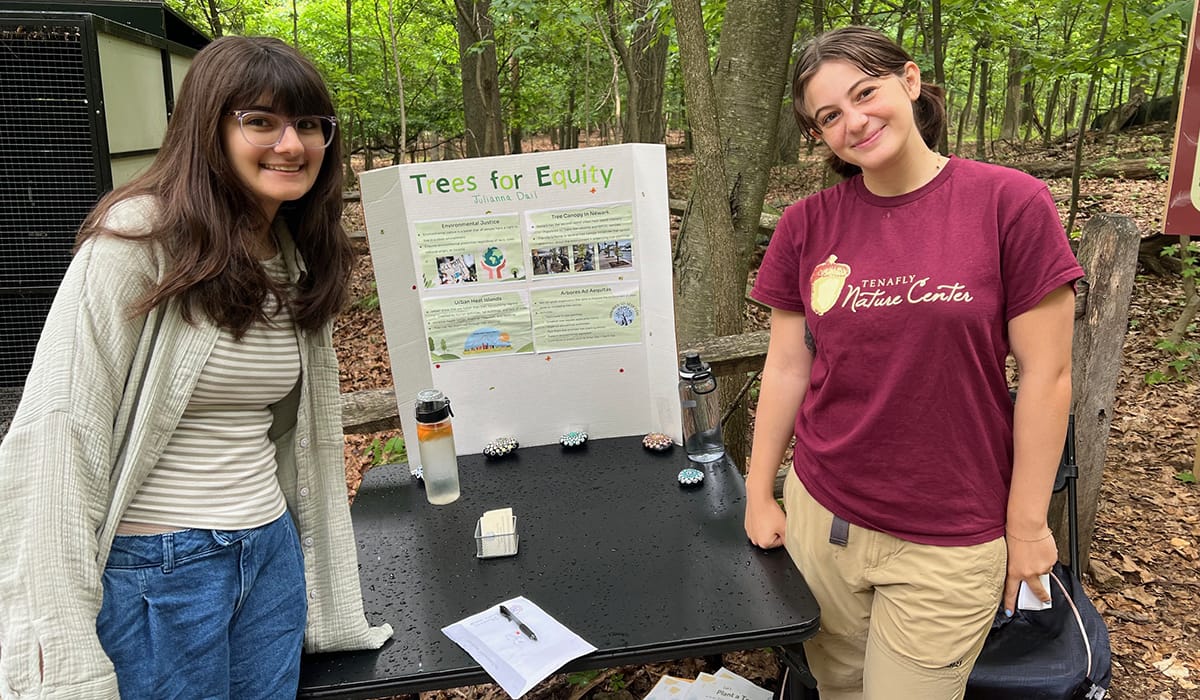
Julianna Dali (left), founder of Trees for Equity, and a staff member at Tenafly Nature Center’s Arbor Day event inform visitors about her organization and the benefits of increasing the tree canopy in urban areas./Courtesy Julianna Dail
What have you learned through your experiences as a volunteer?
I’ve learned how supportive people are. When I first started this organization, I thought it was going to be hard to spread awareness and form partnerships, but there is a community out there that shares my passion. Once I found it, the work became even more enjoyable.
How can readers take steps to address heat island issues where they live, whether or not they have space for an extra tree?
First, they can show up to tree plantings. The New Jersey Tree Foundation runs many that are open to the public. You can sign up and help plant trees. I also have links on my website for people to donate time, equipment and money. And I have tree referrals on my website. Even if people don’t have space in their backyard, asking for a tree referral for your town can be helpful. Sometimes trees can be planted on a sidewalk, so if you’re near one, you can technically still plant on your property.
What do you want people to learn from your story?
I’m just one person in one organization, but I can already see the difference that I’ve made in the communities that I’ve worked in and in the students I’ve taught. It’s really just important to pursue your interests and to do something you’re passionate about, and it will pay off. Sometimes, people don’t realize that environmental issues affect all of us. It’s a pressing issue, and people are starting to realize that.
A SAVING GRACE FOR FURRY FRIENDS WITHOUT A PLACE TO GO
Meet Daily Point of Light Award honoree Diana Stafford. Read her story, and nominate an outstanding volunteer or family as a Daily Point of Light.
For nearly 30 years, Diana Stafford has made saving the lives of dogs and cats her life’s mission.
The Montana animal lover noticed there was a lack of care for animals that needed a little bit of extra attention. From bottle babies and post-surgical pups to dogs that needed rehabilitation before adoption, these furry friends were left without a place to get healthy since they couldn’t be cared for in traditional shelters. An advocate for saving animals since she was a teen, Diana decided to do something about this gap. In 1995, she and her husband co-founded Tiny Tails K-9 Rescue, a small dog breed and puppy rescue, to directly assist this underserved population. Since then, Diana has found homes for endless puppies with unique needs, placing them in foster situations until they can find their forever home. Adoption day is Diana’s favorite moment for these animals, as it serves as both an end to their challenging start in life and a bright new beginning.
At 68, Diana has no plans of slowing down. In fact, she’s gearing up for the future. The Tiny Tails team is hopeful that they can eventually acquire a facility of their own, providing space to temporarily house animals who come from a diverse range of challenging situations. But no matter their origin story, Diana is there to care for these dogs, cats and other animals in need. All creatures big and small have benefitted from Diana’s generosity and willingness to lend a hand.
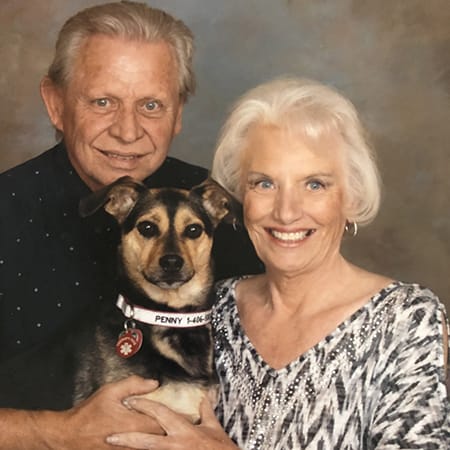
DIANA STAFFORD (RIGHT) SMILES FOR THE CAMERA ALONGSIDE HER HUSBAND AND A TINY TAILS RESCUE DOG NAMED PENNY. /Courtesy Diana Stafford
What inspired you to get started with this initiative?
There were a lot of animals that were being euthanized unnecessarily, especially litters of puppies and kittens that just needed to be bottle-fed. There wasn’t anything wrong with them. They were too young to be in a kennel-type facility. They needed 24-hour care, and the facilities didn’t have the manpower to take care of them. These puppies have to be fed every two hours around the clock. We started growing our group, and now we handle the entire state.
Tell us about your volunteer role with Tiny Tails K-9 Rescue.
I’m kind of a chief cook and bottle washer or poop picker-upper! I am usually the first person somebody calls if they need assistance. We get specialty animals that are going to be in a kill-type environment, or due to contracts with the county, are not able to be in a kill environment. We teach animal first aid and CPR to first responders, Girl Scout troops and 4-H projects.
We have an outreach for the homeless community since it gets bitterly cold here in Montana and a lot of the homeless are not allowed to take their pets into warming centers. Our group has also expanded our services to include a dog food bank. We also have a Purple Leash Program that will do emergency housing for animals if families need to flee from domestic violence and need a place to put their animals so they don’t have to leave them behind.
What are your long-term plans or goals for the organization?
We are in the process now of looking at the possibility of getting a small facility. We work from foster homes, and that works out really well with the animals that we’re rescuing. But in the Purple Leash Program, we are using other people’s facilities. We’re paying for emergency boarding when space is available. We take them into our own homes when space is available, but when we take those animals in, then we don’t have space for the animals that are in danger of being euthanized, and that is our primary goal. So we’re looking at maybe in the next five years having a small facility that can do temporary emergency housing.
What’s been the most rewarding part of your work?
Seeing the animals get into a forever home. Adoption Day is literally our pay day. Also, we are a 100% volunteer organization, and we have volunteers who have worked within this organization for 20-plus years.
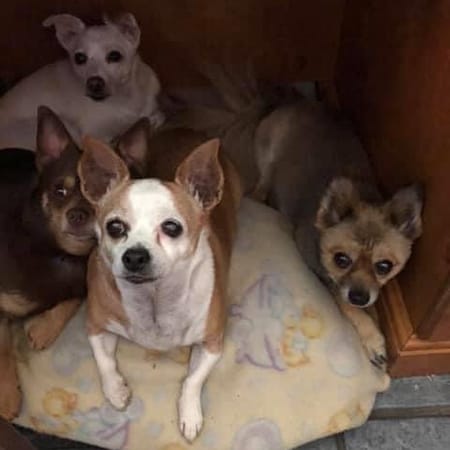
A GROUP OF SANCTUARY PUPPIES THAT LIVE WITH TINY TAILS VOLUNTEERS PEER AT THE CAMERA./Courtesy Diana Stafford
What have you learned through your experiences as a volunteer?
There are a lot of very kind, generous people out there. People who don’t have the means to provide a home for an animal but are very kind and patient. For example, we had a security breach in March of 2022 and all of our bank accounts were taken over by a hacker. All of our donation accounts, checking accounts and savings accounts– They had it all and we had to get the FBI involved. When people in the community found out we were in dire straits and there was a good possibility that we weren’t going to recover from it, people that aren’t even involved in the animal community came by my house and dropped off checks for $50 or $75. We were able to get back what this individual stole from us from our community. I learned that individuals will reach out and assist.
Why is it important for others to get involved with causes they care about?
Not only is it good for your soul, but it gives other individuals in the community the ability to see that in their worst of times, there are people who are caring and loving and willing to reach out and assist and resolve issues that they might not otherwise have the ability to do.
Any advice for people who want to start volunteering?
Contact whoever is the CEO or the person that is managing the group you think you would like to volunteer for. Go to a couple of their fundraisers, talk to their other volunteers, find out what it is that they’re doing and see if that hits a chord with them. Extend a hand and start slowly.
What do you want people to learn from your story?
There is a purpose for every person on the planet. Even though you may not have all the skills needed, you may have that one absolutely needed skill that makes a project, program or rescue work. For example, we have volunteers that do bookkeeping for us. They never see an animal, but they are as important and allow us to be able to do the work that we are passionate about.
Meet Daily Point of Light Award honoree Kathyrn, Steve, William, Vivian and Caroline. Read their story, and nominate an outstanding volunteer or family as a Daily Point of Light.
Kathryn and Steve Konrad grew up in the northwest suburbs of Chicago but didn’t meet until college at University of Illinois. Kathryn grew up in a predominantly Mandarin-speaking family as the daughter of two entrepreneurs originally from Taiwan. As a middle schooler, she started volunteering as a way to engage with the community and explore outside of her culturally traditional household.
“I did well in school. I had friends, but in hindsight, I think I was looking for a sense of connection. And maybe belonging,” Kathryn recalls.
In the process, she found it to be fun, rewarding work, so after meeting Steve, they volunteered as a couple. After graduation, Kathryn joined the Junior League for several years, eventually taking on the role of head of community. She and Steve participated in several projects together, including assembling Thanksgiving food baskets for distribution. Then, William and Vivian came along.
In 2021, when the kids were just three and five years old, Kathryn discovered The Honeycomb Project. Through her job as managing director at J.P. Morgan Private Bank, she embarked on the board-matching process to find a new volunteer home, and decided to join the board of Honeycomb.
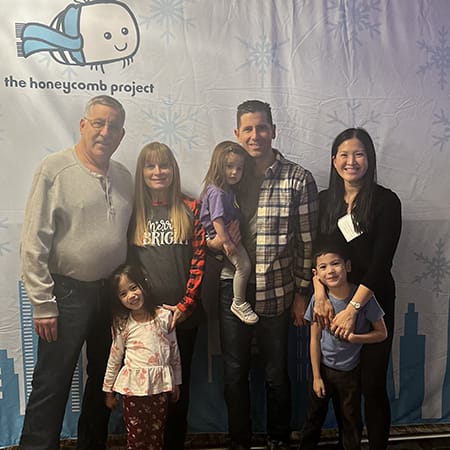
The Konrad family joins in the fun at the 2023 Honeycomb Cheer Challenge – Left to right back: John, Debbie, Caroline, Steve, Kathryn; left to right front: Vivian and William.
“I help Honeycomb drive the strategic mission,” she explains. “Kristina [the co-founder] and the team created this wonderful platform for families like myself to participate in. My role is just to grow awareness.”
The Konrads have done many projects since then as a family, though the first is still a favorite.
“I was pregnant, sweating with heat exhaustion. I was so nervous to bring the kids. They were so young,” Kathryn remembers. “I thought it might be too much, but they fully embraced it and still talk about it to this day.”
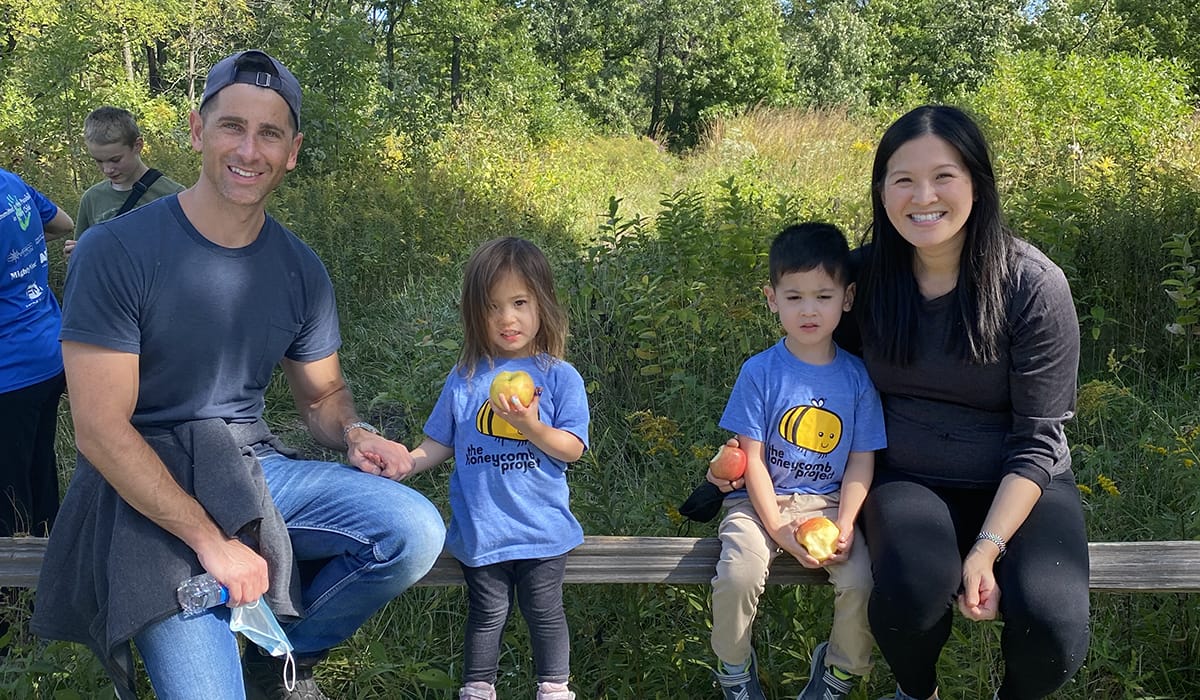
Together, they cleaned up the Ted Lechowicz Woods, a nature preserve. The kids’ abundance of energy came in handy during a day of walking and weeding.
“They remember that,” she says. “So, whether we’re at the beach or walking down the street, if they see litter or clutter, they think about that act of kindness to make it better. It’s very small, but it’s very sweet.”
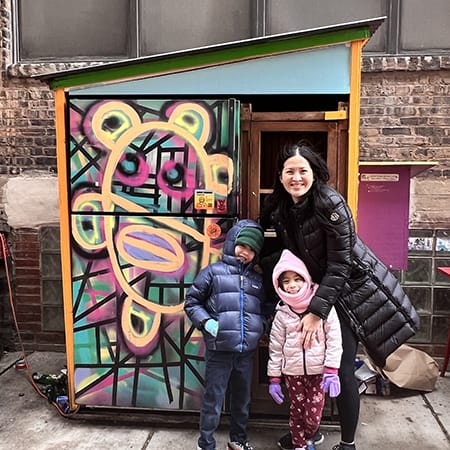
The family cleaned and stocked a Love Fridge, a community resource for those experiencing food insecurity. Unsurprisingly, it brought up serious conversation with the kids that Kathryn and Steve embraced.
“We talked about who it’s for, why it’s for them, and why people come there,” Kathryn says of building ownership over the task. “I think it’s been instilled in them that this sense of giving back is something that is expected in our household. I hope it stays with them as they grow into young adults.”
Kathryn also specifically recollects clarifying who the fridge was for. With impressionable young children, she made sure to explain that not everyone who needs food or other support is unhoused.
“I try to teach them not to make assumptions or stereotype the people who might be benefiting from an activity, and I think they’ve become more aware that things are for the whole community and for anyone who needs it.”
This summer, after doing a snow cone fundraiser, the kids decided to open a lemonade stand at a local park with the express intention of donating 50% of their profits to Honeycomb.
“I had no idea what to expect of this, but they totally rocked out and embraced it. They were using their sales skills. They were excited. When people said no, they tried to explain why and what Honeycomb is,” Kathryn mentions with pride.
For their first Honeycomb project, the Konrads—(left to right) Steve, Vivian, William and Kathryn—clean up the woods by pulling weeds and picking up trash.
Will, Vivian and Caroline–now 7, 5, and 2 respectively–raised around $70 before their donation. The experience already has the family planning a hot chocolate stand for the future. Kathryn emphasizes that families who have a hard time getting to formal events can easily take ideas from Honeycomb and incorporate them at home, like making a meal to donate. There are endless ways to participate.
“We’ve used the same grabbers that we used at that walk in the woods to walk around our block and pick up trash on Earth Day,” she says. “Do something local. Make it easy. And if it feels doable and exciting, then there are a lot of different organized opportunities.”
She suggests starting small with toddlers. While it can feel overwhelming, Honeycomb really does organize opportunities with families of all ages in mind.
“What I hope families take away is that it doesn’t have to be where they’re perfectly capable, because they are capable,” she adds. “Don’t stress if it’s not perfect.”
Kathryn is excited by the new projects her family will be able to do as the kids get older. She looks forward to friends being able to participate with them more as well.
Kathryn, William and Vivian stock a Love Fridge for a project that addresses food insecurity.
“I really look up to a lot of the existing board members, our co-founders in particular. They have young adult children now, and they’re such good stewards of the community,” she notes.
Next month, Kathryn is co-chairing the Honeycomb Cheer Challenge fundraiser and hopes to bring in new prospective families and increase engagement. The Konrads and several families from the kids’ school will be joining them in the annual scavenger hunt this year. The kids have been wearing their Honeycomb shirts and enthusiastically spreading the word about the event, too.
“It’s very fun and gratifying and rewarding to watch as a parent, to see them have those values,” she smiles, noting that the kids now independently inquire about what projects are happening and when they can help out again.
At the end of the day, Kathryn’s goal is to inspire people to get involved. The Konrads volunteer once a month doing large or small acts of kindness. One doesn’t need to commit 10 hours a week to make an impact. And the results have uplifted both the community and their family.
“I see the buzz that Honeycomb has created, and the impact it has in the community. The ability to have something like this, that’s turnkey for families to participate in, has been really fun to watch come out in my actual network and my community.”
Building Brighter Futures Through Empowerment in Tech
Meet Daily Point of Light Award honoree Shrey Shah. Read his story, and nominate an outstanding volunteer or family as a Daily Point of Light.
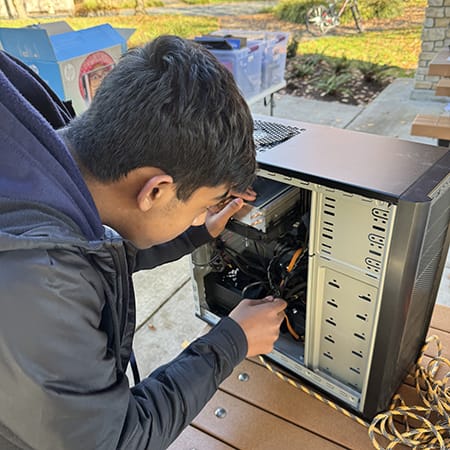
Shrey Shah, a high school student with a vision for change, is transforming his community one coding lesson and e-waste drive at a time. As the founder and executive director of the Redmond Code Association (RCA), a 501(c)(3) nonprofit, Shrey leads an initiative that combines education, sustainability and innovation. Founded to address computer illiteracy in the Pacific Northwest, RCA has hosted 90 events, teaching over 15 coding languages to more than 6,500 students in the greater Seattle area. Shrey’s leadership has not only empowered students with valuable coding skills but also created a unique model for integrating environmental sustainability into education.
RCA’s groundbreaking “waste-to-education” program exemplifies Shrey’s innovative approach to problem-solving. Through two successful e-waste recycling drives, the organization collected over 2,800 pounds of old technology. These discarded devices are repurposed for computer literacy education, allowing RCA to host engaging online computer hardware events. The program has garnered significant attention, raising over $6,000 and earning coverage from major outlets like USA Wire and the Seattle Times.
Shrey’s leadership extends beyond logistics and programming. He manages a sprawling team of volunteers and mentors, including university students from institutions like UW and Berkeley, who assist in delivering RCA’s impactful programs. Under his guidance, RCA has educated over 6,000 students in hardware and software concepts while raising significant funds through partnerships with tech giants like Google and Microsoft. Shrey’s efforts have earned him accolades such as the Gold Presidential Volunteer Service Award and recognition in 425 Business’s “40 Under 40.”
Shrey Shah exemplifies how young leaders can create lasting change through passion and ingenuity. With RCA’s unique model of integrating sustainability and education, Shrey has built a movement that equips students with the tools they need to thrive in a tech-driven world. As RCA continues to grow, Shrey’s leadership is paving the way for a more informed, connected and sustainable future.
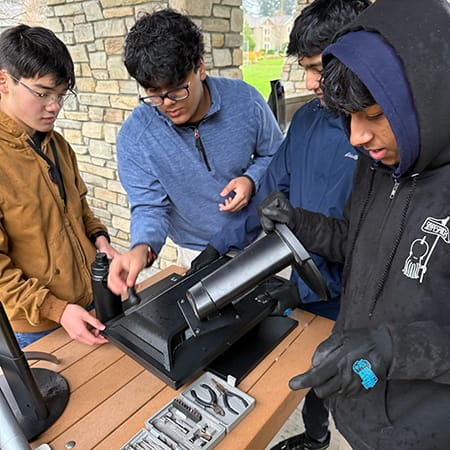
Shrey, Eric and Pranav removing usable components from monitors to use in hardware events./Courtesy Shrey Shah
Tell us about your volunteer role.
As the founder and executive director of Redmond Code Association, I manage the entire volunteering team, communicate with the board of directors and help the other vice presidents in their respective roles of marketing, technology, operations or finance. From developing the design of the organization to writing the business plan to building the website, I have been in the forefront of each influential decision for RCA.
Over the course of the organization’s existence, I have managed and directed over 40 volunteers. RCA, with its volunteer efforts, has hosted over 90 coding events, many of which I have personally taught. To date, we’ve impacted over 6,500 students in the greater Seattle area.
Why is this issue so important to you?
No matter the industry, profession or career path, computer science will play a role in shaping the future. It is important to ensure equitable access to up-to-date, high-quality computer science education and resources. Coming into high school, I wish there was a community where I could find support and learn more about computer science competitions (like USA Computing Olympiad). RCA is that community.
What inspired you to get started with this initiative?
Well, it’s paid. Coming into high school, I was eager to learn competitive programming, but quality resources were either locked behind subscription walls or priced beyond reach. I sought guidance, but found no platform that offered free resources, mentorship and hackathon tips all in one place. I decided to solve that. Even though friends and family set low expectations of success, I founded Redmond Code Association, a 501(c)(3) organization that provides accessible, free computer science education/career opportunities.
What are your long-term plans or goals for the organization?
The entire board is composed of high school seniors, meaning we will be graduating this year. However, rather than stepping down from our position and leaving the organization, we all hope to step up and take our parents’ positions in the Board of Directors. I hope to continue guiding major decisions of the organization and keep expanding RCA to become the largest coding organization in PNW.
What’s been the most rewarding part of your work?
Beyond all the awards and news recognition, I personally feel the most rewarding part of my work is the work itself. Every step of the organization is full of meetings, planning and decision making with all the board members, but all these members are my friends. Meetings no longer feel like work anymore; instead they have become fun social events where we all are having entertaining conversations while productively contributing to the community.
Shrey rewiring used desktops in order to obtain main hardware components to use in Computers 101 Series./Courtesy Shrey Shah
What have you learned through your experiences as a volunteer?
Don’t let others define you. Starting RCA came with a lot of negative expectations from both friends and family, but pushing through all those comments allowed this organization to come into fruition. Everyone around me thought RCA would be a short-term project that would dissolve in months, but I didn’t take that advice to heart. I continued to follow my gut. If you have the passion and drive for something, take the risk and make it happen. It just takes time.
Why is it important for others to get involved with causes they care about?
We only live life once. Do you want to be remembered for playing video games or scrolling TikTok? No. I believe everything in your life should have an end goal of making a positive contribution in this world, and ultimately leaving the world a better place. Get involved in the causes you care about, as you can truly revolutionize the work of the organization with unique thoughts and perspectives. You have the potential to change your community, state, nation or even the world.
Any advice for people who want to start volunteering?
Get started. Don’t overthink all the “what if’s” in joining an organization or becoming a volunteer. Personally, volunteering has brought greater joy to me than any other activity in my life. Helping students while connecting with others has led to so many memorable experiences that I will cherish for the rest of my life. I think you’ll find the same if you start volunteering today.
On a Mission to Minimize the Gender Gap in Mathematics
Meet Daily Point of Light Award honoree Michelle Han. Read her story, and nominate an outstanding volunteer or family as a Daily Point of Light.
Michelle Han is leading the charge for greater gender equity in STEM fields as the executive director of INTEGIRLS, a global nonprofit dedicated to empowering gender minorities in mathematics. Under Michelle’s leadership, INTEGIRLS has blossomed into an international force, with over 33 chapters across 60 countries. Through math competitions, workshops and community events, the organization has reached more than 8,000 participants, fostering an inclusive and encouraging environment for young people to explore their passion for mathematics.
Michelle’s commitment to this mission goes far beyond traditional leadership. She dedicates approximately 25 hours per month to overseeing INTEGIRLS’ global operations. Her responsibilities are vast and include managing finances, ensuring compliance with nonprofit regulations and leading a team of nine executives and over 200 officers worldwide. She also spearheads community-building initiatives like Discord fireside chats, organizes speaker talks and mentors chapter leaders to maintain high-quality programming across all chapters.
One of Michelle’s standout contributions has been coordinating biannual math competitions and puzzle hunts. These events are meticulously designed to challenge participants while fostering collaboration and inclusivity. From developing competition problems to managing registration and social media outreach, Michelle ensures every event is a success. Her grant writing and strategic outreach efforts have helped secure resources that sustain the organization’s global impact, empowering thousands of young people who may have felt uncertain about pursuing STEM opportunities.
Through her tireless work with INTEGIRLS, Michelle Han is not only closing the gender gap in mathematics but also inspiring a new generation of leaders to break barriers in STEM. Her leadership and vision demonstrate the power of combining passion with action to create meaningful change on a global scale.
Tell us about your volunteer role.
I serve as the executive director of INTEGIRLS, an international 501(c)(3) nonprofit dedicated to bridging the gender gap in mathematics through inclusive and community-driven events. INTEGIRLS is made up of 33 chapters across nine countries, supported by a team of nine executives and a network of over 250 members, all of whom I oversee and support in their roles.
In my role, I coordinate competitions, raise funds and work to ensure resources are accessible, especially for chapters in underserved areas where access to STEM opportunities is limited. I also spearhead partnerships with organizations that share our mission, helping us expand our reach and amplify our impact.
Beyond logistics, my role is about fostering a supportive community where students of underrepresented genders can explore math alongside peers like them and rediscover their confidence and passion. From creating new programs to brainstorming with chapter heads, every aspect of my work focuses on empowering others to find their place in math.
Why is this issue so important to you?
I’ve been the only girl in math spaces too many times to count. In my freshman year, I was the only girl in my IT pathway, and I’ve often felt isolated in competitive math environments where it’s hard to find people who understand or relate to your experience. I know how discouraging it can be to feel like you don’t belong, and I’ve seen others walk away from math and STEM for the same reason. Through INTEGIRLS, I’m working to create the kind of community I wish I’d had—a space where people can explore math with others like them and feel supported. It’s about being the change I want to see and building opportunities for others to feel welcome in a field that so often feels exclusive.
What’s been the most rewarding part of your work?
It’s definitely seeing the ripple effect of the work we do. I remember one chapter leader from a small town telling me she started her chapter because she wanted to give younger girls the opportunities she never had growing up. Hearing how INTEGIRLS inspires others to create their own spaces of belonging is incredibly rewarding. And seeing participants light up during “aha!” moments—whether it’s solving a tricky puzzle or realizing they’re capable of so much more than they thought—makes all the late nights worth it.
What have you learned through your experiences as a volunteer?
I’ve learned the importance of flexibility and understanding in leadership. Each chapter and event comes with its own challenges, and listening to different perspectives has helped me make better decisions. For example, a few chapters shared that their participants didn’t feel confident in their problem-solving skills going into competitions, which held them back from sharing their ideas. To help, we introduced weekly interactive problem-solving sessions where participants could collaborate, ask questions and strengthen their skills in a supportive environment before the main event. These sessions not only boosted their confidence but also helped build stronger connections within the community.
Tell us about future partnerships, programs or events that you are excited about.
I’m very excited about our upcoming INTEGIRLS Puzzle Hunt we’re hoping to re-launch in spring/summer 2025. We wanted to redefine what a math event can be, one that’s rooted in just fun, creativity and teamwork, rather than a traditional competition. Participants work in teams to solve unique puzzles that combine math, logic and problem-solving. In past hunts, we’ve had everything from cryptography challenges inspired by Caesar ciphers to matrix encryptions.
Our team put a lot of thought into creating puzzles that were engaging for both beginners and seasoned problem solvers. One of the most rewarding moments from our previous hunts was hearing how many participants say that the event helped them rediscover their love for math in a unique way and feel more confident in tackling complex problems.
Why is it important for others to get involved with causes they care about?
Because change starts with people who care. Getting involved with a cause means contributing to something bigger than yourself. You’re helping to solve problems, create opportunities and inspire others. For me, working with INTEGIRLS has been about creating opportunities I wish I’d had, but it’s also taught me how powerful a shared mission can be. You don’t need to have all the answers or resources, just being willing to try and take the first step. That’s sometimes all it takes to inspire others to do the same.
Any advice for people who want to start volunteering?
Start with what you care about and take one small step. It doesn’t have to be perfect, and you don’t need to have everything figured out—just show up. Whether it’s joining an event or helping with a specific task, every contribution matters. If you can’t find an opportunity that fits, create one or reach out to youth-led initiatives already doing work you admire. We’ve collaborated with various nonprofits and organizations, like Society for Science, Women in STEM and Non-Trivial to share resources and ideas, and those collaborations have strengthened INTEGIRLS in ways I couldn’t have imagined.
What do you want people to learn from your story?
I want people to see that change starts with small steps and a willingness to take action. When I first got involved with INTEGIRLS, I didn’t have all the answers, but I cared deeply about building a community where people could explore math with others like them. Over time, I realized that by listening, learning and working with a dedicated team, we could build something far bigger than any of us imagined. I hope my story shows that you don’t need to be perfect or have it all figured out to make a difference. All it takes is passion, persistence and a belief in the impact of community.
A Cancer Survivor Uses Diagnosis to Guide His Fellow Travelers
Meet Daily Point of Light Award honoree Jim Hoofnagle. Read his story, and nominate an outstanding volunteer or family as a Daily Point of Light.
When Jim Hoofnagle’s daughter told him his skin was yellow, he knew something was wrong.
After undergoing a series of tests with his physician, Jim was diagnosed with cholangiocarcinoma, a rare but aggressive bile duct cancer. Luckily, a quick diagnosis proved to be the key to Jim’s survival. After intensive chemotherapy and a successful liver resection, Jim was able to count himself among the small percentage that is cured of the aggressive form of cancer. However, his journey was far from over.
While Jim has a clean bill of health these days, he holds his experience with cholangiocarcinoma close.For the past three years, Jim has volunteered his time with the Cholangiocarcinoma Foundation, an organization with the mission to find a cure and improve the quality of life for cholangiocarcinoma patients. As a mentor to others dealing with the disease, Jim answers questions, offers emotional support and shares his personal experience. No matter their location, Jim takes a seat at his desk, picks up his phone and allows those with cholangiocarcinoma to have an outlet. For those handling the ups and downs of a complex diagnosis, Jim’s willingness to offer up his time and energy is a tremendous demonstration of the power of volunteering.
In contrast to referring to people dealing with cholangiocarcinoma as “patients” or “mentees,” Jim prefers to call these kindred spirits “travelers.” It’s an appropriate term, particularly considering that each person with cholangiocarcinoma is navigating a cancer journey that often comes with many questions and concerns. From finding suitable treatment to dealing with the emotional weight of their diagnosis, Jim’s strength and positivity is a true gift to his fellow travelers.
Tell us about your volunteer role with the Cholangiocarcinoma Foundation.
I serve as a mentor for cholangiocarcinoma patients. But I call them travelers, not patients and not mentees. Mentee sounds too clinical to me. I think travelers is more appropriate because we’re all on a journey. I stay in touch with all my travelers, whether they’re undergoing treatment or past treatment. Folks will email if they have a question. But really, it’s just like talking to a friend that you’ve had since high school, and you get all kinds of answers. They want to know about the different medications that they’ve been prescribed. Of course, we’ve got to be careful that we don’t start giving medical advice, but we do have a list of doctors who have seen a lot of cholangiocarcinoma patients in hospitals around the country and the world.
What inspired you to get started with this initiative?
I’d started to become aware of the Cholangiocarcinoma Foundation, and they sent out an urgent need for mentors. The hardest thing to find is mentors who are alive, so I started mentoring.
What are your long-term plans or goals for the organization?
My wife and I own a couple of small companies so I’m still working. But as we start to wind down some of those, the organization has research advocates. Some mentees call with questions I don’t have the answer to, so I go to some of our research advocates who have time to track down new clinical trials. For instance, there are clinical trials that come up all the time. There are new drugs that come up all the time. So the next step for me would be to become a research advocate. I would still mentor through the process because I really enjoy doing that.
What’s been the most rewarding part of your work?
The connection with so many different people coming from so many different perspectives. About six weeks ago, my doctor called me and said ‘Jim, I remember your mentoring, and I’ve got a lady here about to undergo the same surgery. Can she call you?’ Just the idea of somebody who has had cancer wanting to talk to somebody who’s surviving it is rewarding.
What have you learned through your experiences as a volunteer?
The different ways people accept or understand a diagnosis. Some are very strong and determined to do anything possible to beat this, and others take a very passive role and are just going to do what their doctor says. I’ve had to learn that whatever their perspective is is right. It’s theirs, and that also helps me understand how I can still help them. You can help when they ask for help, and you can make suggestions, but you’re not going to change who somebody is.
Why is it important for others to get involved with causes they care about?
There are so many people with a lot to give in this country and I don’t think they recognize how much they have to give. I didn’t do anything heroic. I just got lucky. If you look around, so many people give their time and their money. Whatever time you have to give, there are plenty of people out there who are just waiting for somebody to reach out to them, whether it’s a veteran or a sick person. Everybody can volunteer to do something.
Any advice for people who want to start volunteering?
The first thing is to decide what you’re interested in, whether it’s animals or music or the library. Figure out what you’re interested in, and then find an organization and ask four words: ‘How can I help?’ Somebody will answer. Somebody will find something for you to do.
What do you want people to learn from your story?
Volunteers get as much or more back in the process than the people that they’re mentoring or helping. It is not just giving your time and giving you answers to questions. It’s a relationship. It becomes a relationship where a volunteer gets so much satisfaction with just a simple idea that you’ve helped somebody just a little bit. A mentor or volunteer gets so much in return.