Meet Daily Point of Light Award honoree Alyssa (Alie) Plouff. Read her story, and nominate an outstanding volunteer or family as a Daily Point of Light.
After graduating from high school, Alyssa Plouff wasn’t sure on which area of study she wanted to pursue in college. She decided to stay home and commute to Rhode Island College. As fate would have it, her mother became ill during this time, so Alyssa was able to study full time while being a caregiver to help her mother battle cholangiocarcinoma (CCA), a rare bile duct cancer. Alyssa’s mother died after battling the disease for nearly four years.
Although it’s a rare disease today, new diagnostic techniques and knowledge mean that this disease is on track toward becoming more well known and less misdiagnosed. It is projected to become the second leading cause of cancer deaths by 2040.
Alyssa knows firsthand how challenging it can be to step into the role of caregiver to a loved one battling the disease. Her experience with her mother’s diagnosis and subsequent health battle led her to become an engaged volunteer with CholangioConnect Mentor, giving care to caregivers.
What inspires you to volunteer?
I grew up being service-oriented. I volunteered with the community youth commission, working on projects such as obtaining heating assistance for local families, among other service projects. I volunteer because I find joy in helping others. My mom did the same and never expected anything in return. It was contagious.
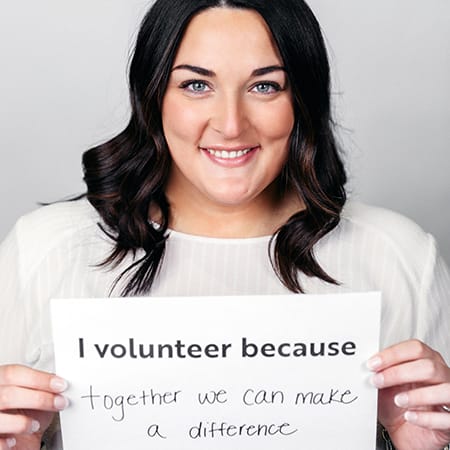
Alie Plouff, Cholangiocarcinoma Foundation volunteer. “Together, we can make a difference.” Courtesy/ The Cholangiocarcinoma Foundation
Tell us about your volunteer role with CholangioConnect and the C.A.R.E. Team.
I have been very active in volunteering since my mom’s passing. Since 2017, I have volunteered for CholangioConnect Mentor. Here, I mentor other caregivers. Having had the experience of being my mom’s caregiver, along with my family, I understand firsthand how important it is to support caregivers. I give them an opportunity to vent to someone who has shared their experiences. I help them be advocates for their loved ones because navigating the healthcare system is hard enough without the emotions associated with watching a loved one suffer. I teach them the questions to ask, I counsel them on the importance of getting second opinions, I provide advice on reducing or avoiding burnout and most importantly, I help them feel they’re not alone.
In 2019, I began volunteering for the C.A.R.E Team (Cholangiocarcinoma Awareness Research Education). This took a pause during COVID, but I have since resumed volunteering. Here, I work on advocacy projects for the Cholangiocarcinoma Foundation. These projects involve local hospitals, patients and other caregivers. The original C.A.R.E. Team was based in Chicago. The goal is to share CCF resources with local patients, caregivers and medical professionals. I had attended several conferences and found them extremely helpful. Through the conference, I was able to meet fellow volunteers in the New England area who share the same goals. Recently, Dave Fleischer has spearheaded the revival of the New England C.A.R.E. Team. He recruited a team of former caregivers like myself as well as an oncologist who specializes in cholangiocarcinoma at Massachusetts General Hospital.
I received my doctorate in Occupational Therapy in 2022. My capstone, or my thesis project, was based on how an [occupational therapist] intervention could fill the gap in the research or healthcare system related to caregiving. I focused on creating a caregiver program specifically for cholangiocarcinoma caregivers. Research has always been something I love so, after graduation I joined the Research Advocates which is a part of CCA foundation. Our monthly meetings include presentations by experts in the field. This helps me stay on top of new innovations and research on the disease. It broadens my knowledge and helps me be a better mentor to other caregivers. Since 2018, I’ve volunteered at the annual CCF conference.
I was recognized with the Mark R. Clements award for Excellence in Volunteerism at the 2023 conference, which was a huge honor. I take pride in my volunteer work with the foundation and have donated a minimum of 100 service hours every year since becoming involved.
What inspired you to get started with this initiative?
In 2016, my parents attended the CCF conference in Salt Lake City. My mom, who was a nurse, was always very active in her own treatment. This was the first time that my mom was able to meet other CCA patients. My parents, sister and I attended as a family again in 2017. My mom was already on hospice care at the time, but we were still hopeful for a miracle. I loved everything the foundation stood for and decided to stay involved.
What are your long-term plans or goals for the organization?
I plan on staying with CCF long-term because it makes me feel I’m being proactive. I would love to build off my capstone project and create a resource for caregivers, educating them on burnout, tips and tricks, and helpful other information. While being a caregiver is an honor and a role of a lifetime, people don’t realize how challenging it is. It’s extremely hard work physically, mentally and emotionally. I’ve found that patient information is often abundant, but not much attention is given to providing resources for caregivers.
What’s been the most rewarding part of your work?
The most rewarding part is definitely the connections I’ve made with other caregivers, patients and volunteers. I’ve met and bonded with people I would otherwise never have met. We understand each other and are able to share knowledge, resources and emotional support. Specifically, as a caregiver mentor, I find value in the relationships I have been able to build. They’re not necessarily looking for the perfect solution or even for answers. They just need to feel heard and that someone cares.
What have you learned through your experiences as a volunteer?
I learned that no task is too big or too small. Whatever you can handle in the moment is great. People’s capacity varies and that’s okay. Remind yourself why you’re volunteering. For example, being a mentor is hard aside from navigating the practical aspects of caregiving. You also are addressing grief. It has helped me work through my own grief and find my purpose.
Tell us about future partnerships, programs or events that you are excited about.
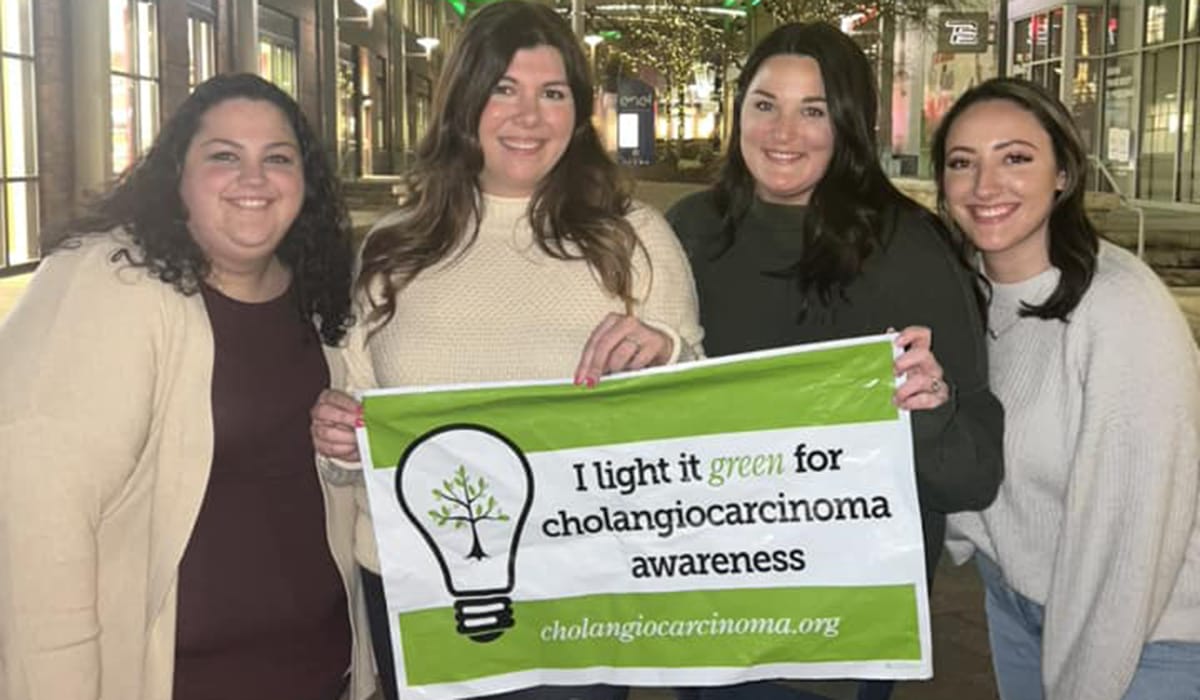
World CCA Day is coming up in February. Rhode Island has signed a proclamation for World Cholangiocarcinoma Day as an official day in our state for the last two years and many other states (now a majority of states) have likewise declared World CCA Day as a day of awareness. We are hoping that Gillette Stadium will “light it green” again in 2024 as part of our CCA awareness campaign.
Today, CCA is still rare but research is vital. We need doctors, clinicians and researchers to get interested in this. We need to support people who have been diagnosed.
I am also looking forward to the annual CCF conference and its inspiration and connections. I help out with conference logistics. I also attend the presentations, but my main role is to help in any way that’s needed.
Alie Plouff, center in green sweater, on World Cholangiocarcinoma Day 2023 at Gillette Stadium who “lit it green” for awareness, pictured with family. /Courtesy: Alyssa Plouff
Why is it important for others to get involved with causes they care about?
We are capable of making change. If you care about something, doing something about it is the next step. No step is too big or too small. Choose a cause you’re passionate about and use your passion to fuel your activities. Whatever you choose to do will be worth it.
Any advice for people who want to start volunteering?
Find something you’re passionate about. You may not be able to give a lot of time or money, but other ways to help are important too. When I was working full time on my doctorate program but still wanted to volunteer, I realized that I had to be gentle with myself and find other ways to help. If you’re anxious about not having time, your commitment doesn’t have to be elaborate. It could be as simple as taking one single task off someone’s plate. Even talking to other people about a cause is volunteering.
You can also create your own opportunities. My sister and I started a nursing scholarship in my mom’s name. She was an incredible nurse and we wanted to honor her legacy. Now that scholarship is endowed and we’re able to help by bringing more people into healthcare.
What do you want people to learn from your story?
Bad things happen to people. Some people allow adversity to define them. Some choose to let it go. And some choose to do something about it, turning their pain into something that will help others. Doing something, even a little, can help you overcome grief. You can be sad but at the same time learn from it and even improve the lives of other people. Life isn’t easy but you can take advantage of shared experiences. Volunteer in any capacity. As long as you’re passionate about it, you have power to make change, whether you feel it’s significant or not. It is. Even small actions can be extremely meaningful.
Cancer Survivor Delivers Care Kits to People Battling the Disease
Meet Daily Point of Light Award honoree Sonia Su. Read her story, and nominate an outstanding volunteer or family as a Daily Point of Light.
Five years ago, Sonia Su was diagnosed with an aggressive form of non-Hodgkin’s lymphoma. She was a 24-year-old grad student who had studied journalism and was working on a master’s in Asian Studies at Georgetown University. As a Chinese American, she had dreams of telling the stories of fellow Asian Americans, but then everything got derailed.
“That experience, especially as a young adult, was devastating and very difficult for not only me but also my loved ones,” she states.
One semester into her program, Sonia took a leave of absence to begin treatments before picking back up with an originally-planned fellowship in Taiwan that summer. Unfortunately, life had different plans, and due to a relapse, she returned to the States for further care.
During an emotional low point, physically wrecked and feeling hopeless, Sonia walked into her final treatment to find a care package on her bed.
“That care package came at a really great time, because it was a complete surprise, and it was put together by a former patient who was treated in that unit one year prior who was doing well again,” she recalls. “As soon as I received that and saw that, I just felt so inspired to not only keep going but also to pay that kindness forward.”
A year later, in May of 2020, she founded Kits to Heart to do exactly that, provide care and hope to those battling cancer or supporting someone who is. After the promise she made to herself to help others and explore entrepreneurship during her last semester at Georgetown, she had found a new path forward.
With the onset of the pandemic, things weren’t always easy, but she persisted. While many in-person volunteer opportunities were shut down due to COVID concerns, Sonia’s budding organization offered an easy way for people to contribute from the comfort and safety of their homes.
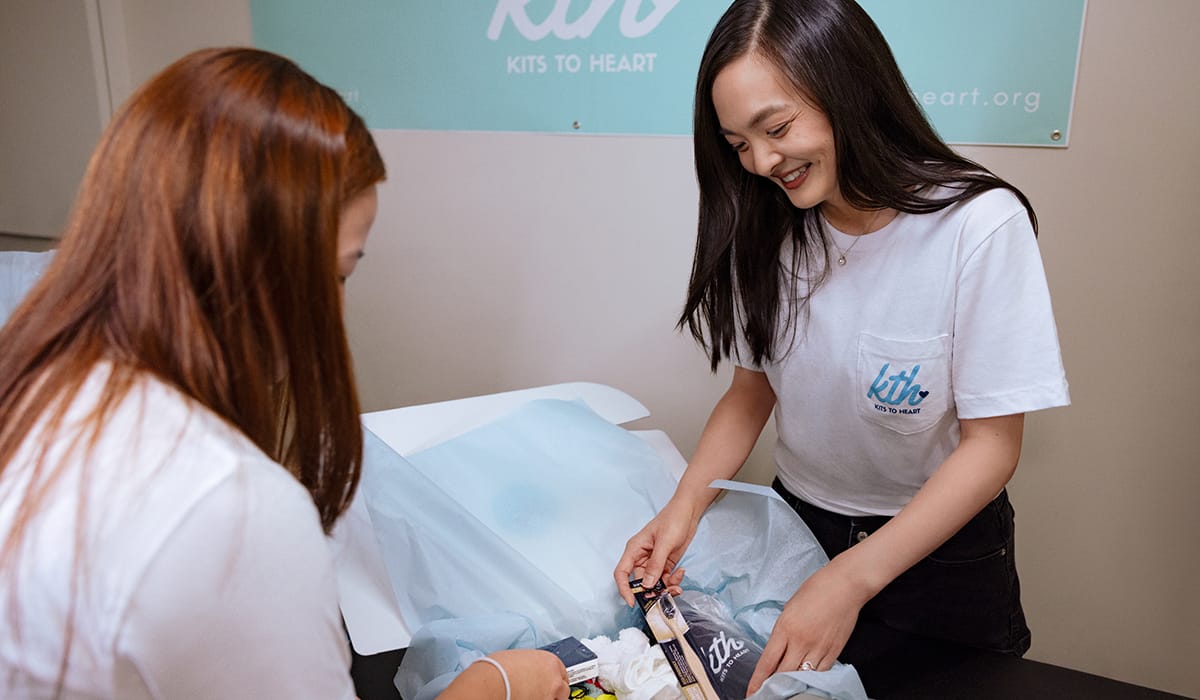
Sonia and a volunteer thoughtfully choose what to include in each care package.
“If anything, the pandemic exacerbated the loneliness that patients felt, especially since they couldn’t have visitors for what could be a very long day of treatments, or even nights,” she says. “[Our care kits] started with handwritten letters. Then, some volunteers knew how to fold beautiful origami that symbolized hope. And then, it turned into a lot of sewing projects since, especially around this time, people were just picking up how to sew masks for the pandemic.”
Today, Sonia serves as executive director managing the day-to-day operations, raising funds and mobilizing volunteers. So far, 5,000 people—both virtually and in-person—have filled and distributed more than 7,000 cancer care kits in all 50 states. One volunteer is a high school senior from Clarksville, Maryland. Sanjana Jain has been assembling kits for a year and half and sometimes donates handmade cards and bracelets.
“The organization is so genuine in their mission, and so is Sonia and all the volunteers. It truly makes a difference in what they’re doing,” she says. “The issue with a lot of larger scale volunteer organizations is that you’re dedicating a lot of time, but you don’t get to see the impact it has on your community, whereas Kits to Heart is local for me. Even though they operate on a national scale, I can see the impact that they’re having on my direct community.”
In 2022, with the help of United Way of Central Maryland, Sonia also launched Art for Cancer Wellness. The program offers virtual art therapy workshops to address loneliness and provide patients, caregivers and oncology healthcare workers with tools to heal and cope. It expands beyond the local community to provide comfort to anyone with an internet connection. And Sonia, who now runs the organization full-time while being a full-time mom to her new baby boy, couldn’t be happier.
“March will be my five-year cancer-versary, as they say. That’s from when I received my last treatment. Five years is an incredible milestone for cancer survivors,” she adds. “I’m just very grateful to be alive and for the advances in medicine that saved my life.”
Her husband and German Shepard, no doubt, agree. Sanjana credits Sonia’s tireless dedication during the pandemic as an inspiration for herself and others.
“She’s very welcoming. She has an incredibly sweet personality, and she’s very kind. She draws people in,” Sanjana explains.
Sonia’s ability to connect with and inspire others has led her to help students start their own organizations and develop leadership and entrepreneurial skills. She encourages them to consider the resources available to them through their school or local businesses and then to jump in. Her belief is that even if they don’t become sustainable, the effort is worth it, and helping people is always a good thing. In her own experience, she was never afraid of failing.
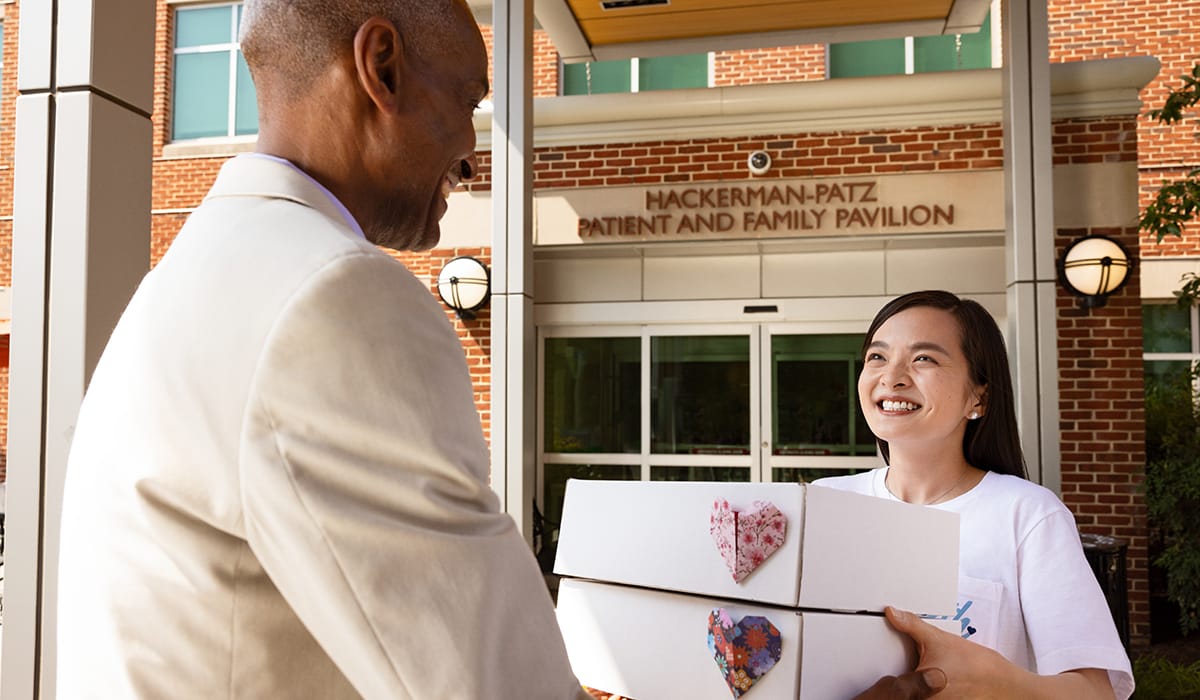
Sonia drops off care kits at the Hackerman-Patz Patient and Family Pavilion at Johns Hopkins Hospital in Baltimore, Md.
“Even if we didn’t have enough funding to grow it into a national or international thing, I would always find the time and opportunity to do this, even on a smaller scale,” she insists. “It’s so meaningful to me as a cancer survivor, and it’s something that I know really helps.”
Additionally, she acts as a patient advocate for the University of Maryland Greenebaum Comprehensive Cancer Center Patient and Family Advisory Council and is a First Connection volunteer for the Leukemia and Lymphoma Society. She is also an ImmunoAdvocate for the Cancer Research Institute and was a speaker at the 2021 annual patient summit and featured as part of its 2022 10th Annual Cancer Immunotherapy Month.
Looking ahead, Sonia hopes to continue to cover more ground by creating branches in other cities where operations can be replicated, and more hospitals reached. As things stand, the organization can physically drop kits off en masse but also ships kids to individuals upon request via their website.
“Even though it may be something as simple as a care kit with some handwritten letters, it really helps to lift people’s spirits and give them that hope and joy that they really need. It lets them know that they really aren’t alone in this, that people are rooting for them, because it can really be a lonely journey,” she emphasizes.
Sonia’s is a story of resilience. It’s a lesson in kindness, and it’s a reminder that hope and encouragement are gifts that anyone can—and should—give.
“Whether it’s going through a serious health condition or going through something really difficult otherwise, it’s really important to persevere and stay strong,” she declares. “And just to know that the human spirit is much more resilient than one might think.”
Twin Forces of Change Make an Impact Locally and Globally Through Consistency in Volunteerism
Meet Daily Point of Light Award honorees Luke and Jake Salman. Read their story, and nominate an outstanding volunteer or family as a Daily Point of Light.
Identical twins Luke and Jake Salman from Plantation, Florida, are a striking duo in their remarkable commitment to community service. With an impressive tally of 2,300 combined community service hours earned in just three years of high school, these young men are redefining what it means to be community activists. Their dedication to various causes through four different nonprofit organizations has not only made a significant impact on their community but also inspired their peers to follow in their footsteps.
The Salman twins have immersed themselves in a range of activities, each contributing to the welfare of their community in unique ways. At Craig’s Pantry, they spend their weekends delivering food to homebound seniors, a task that combines compassion with action. Their involvement with Food Rescue U.S. South Florida sees them rescuing perishable food from grocery stores to deliver to food pantries, simultaneously addressing food waste and hunger.
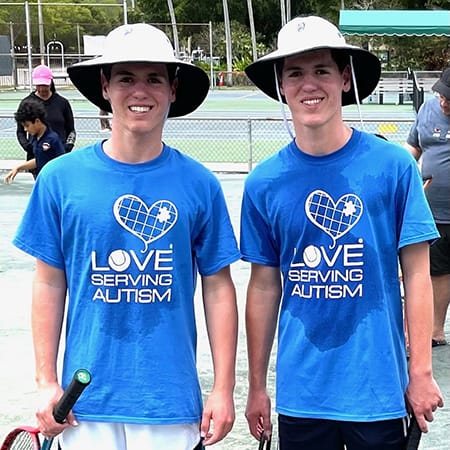
In their work with Love Serving Autism, Luke and Jake coach autistic children in adaptive tennis and life skills, an endeavor that goes beyond physical activity to impart crucial life skills. Additionally, they have played a pivotal role in expanding the charity, from maintaining its digital presence to helping secure a substantial $18,000 grant for the organization.
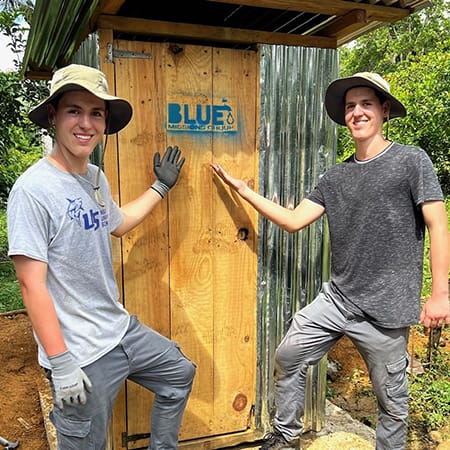
Luke and Jake helped build latrines for a remote village in the Dominican Republic as part of a group with Blue Missions.
Luke’s initiative in launching Love Serving Autism’s Student Leadership Ambassadors program as co-president showcases his leadership skills and his commitment to scaling the organization’s impact. Jake’s extensive work in environmental conservation includes leading the “Green Sharks” environmental club and conducting independent research on climate change. These endeavors, among others, earned the twins a nomination for the prestigious and competitive Silver Knight Award.
Beyond their local community, Luke and Jake have also made an international impact. In July 2023, they dedicated a week to building latrines in a mountain village in the Dominican Republic with Blue Missions. This effort not only provided essential sanitation and privacy to the villagers but also demonstrated the twins’ willingness to extend their service globally. The twins have also both been recently accepted, early decision, to Cornell.
Read on to hear more of Luke and Jake’s inspiring story as they share what it means to create sustainable and meaningful change.
Tell us about your volunteer roles.
We have a lot! We have some pretty big leadership roles: Love Serving Autism and Food Rescue U.S. South Florida. We were their first paid interns, and we were tasked with expanding the organization in Broward County, in South Florida. We really got to see the organizational side of things – manage their website, screen new volunteers, direct them to different rescues around South Florida. We also got more donors – Costco and Sprouts Market. It was a really amazing experience.
For Love Serving Autism, we teach kids with autism tennis at a local park. As the weeks went by, they really improved in their tennis skills and social skills, and we’ve built relationships with them.
Why are these issues so important to you?
Love Serving Autism really appealed to us because we love tennis and we love helping people, so it’s a blend of both. For Food Rescue U.S. South Florida, my brother are I are into sustainability and helping the environment. We want to try to limit greenhouse gas emissions, so one of the ways we do that is to “rescue food” local grocery stores, food that’s on the verge of expiring. We pick up food and take it to shelters and other organizations. It just makes sense, to feed people instead of landfills.
What’s been the most rewarding part of your work?
In addition to coaching, we also helped establish the Student Leadership Ambassador program. We work with Legacy Leaders, which are young adults or kids on the spectrum. We organize through gala events and other events. Basically, we compete – there’s a bunch of legacy leaders and ambassadors, and it all culminates in this event called the Matchpoint Gala. We share our experiences and one of the kids gets nominated for Legacy Leader of the Year. It felt like it was all paying off.
Additionally, this past summer, we did a really unique experience with a missions group called Blue Missions, based out of Miami. This trip was to a remote village in the Dominican Republic, and we went with a bunch of kids from Miami Public Schools. We helped build 16 latrinesfor the people there so they could have a designated place to use the bathroom. Otherwise, they’ve been going in the woods or the river. We used wood and sheet metal for the roof so that the rain would stay out. The latrines give them privacy.
The most impactful part was being immersed into their culture and their way of life. We tried raw cacao straight from the tree. We tried Dominican pineapple. We played baseball with the kids and adult villagers too. They taught us how to use tools, and some of them helped us build the latrines. One of the most impactful moments on the trip was when we were playing outside and it started raining, then pouring. We all took cover for a little bit, but then we all ran out and started playing out there. Giving the kids piggyback rides. Dancing in the rain. Just being in the moment. Even though these people don’t have all the material things, but rather just the essentials – and sometimes not even that – they have love and family and faith.
Luke and Jake Salman are shining examples of service, particularly in their involvement with Love Serving Autism.
Why is it important for people, especially youth, to get involved with the causes they care about?
Taking our example, we love tennis. We were initially trying to start our own charity. But along the way, we found Love Serving Autism. We started by donating racquets, and then we got more involved, then started coaching and the rest is history.
There’s a bit of a misconception that you need to start your own nonprofit. You can do that, but you don’t have to. Through our persistent service and commitment, we were noticed and offered more opportunities to lead and expand organizations, reaching more people. Volunteering puts your own situation in perspective. It helps you appreciate the little things but also the big things you may take for granted.
Any advice for people who want to start volunteering?
Think first, what are you passionate about? Then use that hobby or interest to branch out and find ways to help others. If an organization doesn’t exist, maybe you create your own. I would say just be open to anything – don’t be afraid to take on a community service opportunity or a chance to help people. Over the course of the missions trip, we had some really profound mindset shifts. Try new things, don’t be afraid to step up to help people.
There’s never really a limit to the impact you can make through service. Find a cause you care about and try to lead that cause or open new sub-divisions of it to help expand those operations. Once you start helping people, you can find more and more people to help and more and more reasons to stay motivated. We think about the villagers in the Dominican Republic. Those homebound seniors who can’t afford to put food on their tables. Those autistic children we help to develop their social skills. We want people to thrive and succeed in the world, and that is what motivates us to keep coming back and doing more.
Grace C. Liu was born in Thailand but has spent most of her life in Syosset, New York. She is currently a high school student with diverse interests including reading, writing, drawing and running. Her research focuses on behavioral economics, gender economics, decision-making under uncertainty using artificial intelligence, entrepreneurship, gender digital divide and the history of gender disparities in sports.
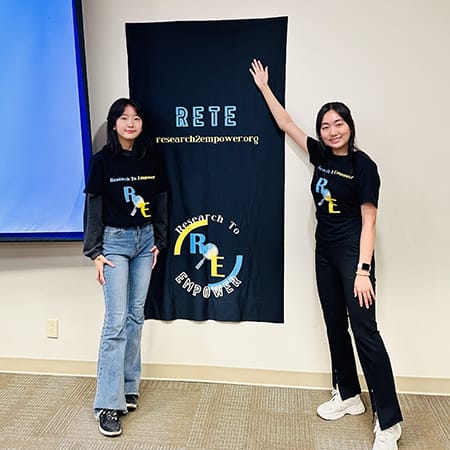
Grace founded Research to Empower (ReTE) as a way to encourage and support the next generation of aspiring young researchers. Grace’s younger sister, Jessica, is ReTE’s director of design and marketing, using her artistic talents to enhance visual teaching elements to make them appealing to kids.
What inspires you to volunteer?
As a first-generation immigrant, I witnessed, firsthand, the power of education to transform lives. In 7th grade, I was selected into a research team where I was the only girl. This is where I discovered that research resources are not as available to certain people. There are many research programs, but most are either extremely expensive or have a less than 10% admittance rate, which puts them out of reach to all but a small portion of the student population. People who can’t afford these programs, often girls, people of color and people from low-income families, can’t access these resources as easily. I believe that there should not be racial, gender, cultural or socio-economic reasons holding you back from doing research.
Grace C. Liu (right) and Jessica C. Liu (left) at the Syosset Public Library, New York, for a ReTE workshop. /Courtesy Grace C. Liu
Tell us about your volunteer role with Research to Empower.
My role as the founder is to bring a dedicated team together, look for networks and resources and partnership opportunities such as an event at Syosset Public Library workshop for kids to learn to research. I also look for national and global level connections. For example, I am on the Youth Advisory Council for the National Youth Leadership Council which has opened the door for me to connect with many like-minded people who might support my initiative.
I have applied for a number of scholarships and grants for high school students that have helped me fund and sustain ReTE. I also help oversee student volunteers around the world. Our board assigns them the role they’re best suited to. We also have academic advisors including my own mentor who has been incredibly supportive not only in my own research but also of ReTE.
I am an ambassador for the Davidson Institute, which provides support for Gifted and Talented students. The ambassadorship program is for students like me who have a passion project and need advice on how to implement it. I also design and produce videos and courses. I spent two years developing a research guidebook that will be published by Post Hill Press on Jan 30, 2024. My goal is to inspire more students, educators and parents to empower students with the ability to research. I applied for and received an annual grant from Google which helps me manage ReTE marketing including creating and placing ads that generate awareness and interest. Locally and through our website, I provide classes, podcasts, videos and other free research resources.
Speaking of teaching how-to research, I provide students a list of databases where kids can gather data. I teach them how to do proper online searches using search engines. I also teach students how to reach out to mentors. Many students get tripped up in finding a research mentor, especially kids in middle or high school. Most schools don’t offer courses on how to conduct research so finding a mentor can be the difference between continuing to fuel a student’s passion for a subject and giving up.
Mentors are in high demand and often unavailable and many aspects of the research process can be discouraging. Not having guidance can lead to frustration. Students who find mentors can learn how to conduct research, but many students who have no idea where to find a mentor or resources often become discouraged.
They may have great questions but don’t know who to ask or what methods to use in finding information. For example, many studies and articles published online are behind a paywall which can make them inaccessible to kids. There are information gaps, and that’s part of where I can make a bridge. Overall, I teach students to become critical thinkers, lifetime learners and innovators by sharing the fundamentals of quantitative and qualitative research and the related skill sets.
ReTE presents research tools that are colorful, engaging, vibrant and fun, encouraging both avid researchers and novices.
What inspired you to get started with this initiative?
I found from personal experience that as a person of color and a female, I felt like I didn’t belong, like I was an outsider. The environment wasn’t as welcoming to women of color. I came up against a lot of discrimination and biases. I felt like I didn’t have a voice. This threatened to diminish my motivation and will to aspire to reach higher.
But, I persevered. I found a mentor who inspired me and helped me access the resources I needed, and this in turn inspired me to start ReTE so I could help other kids gain access to research resources and teach them how to conduct research. I recently received the author copies of my book, Research To Empower. I’m excited to have it published soon.
I founded Research to Empower after I recognized there is a huge demand for students to learn how to conduct research, but not every student has access to resources and there’s still a feeling of exclusion for females, people of color and students from low-income families.
What are your long-term plans or goals for Research to Empower?
Thinking big and long-term, I want to reach a million people globally, whether it’s students or educators, who will find our resources useful. I want to travel around the world to hold workshops and live events. I envision hosting one large annual conference with speakers to celebrate the importance of student-led research. I also want to do a book tour for my book, which will be published soon.
What’s been the most rewarding part of your work?
I am fueled by the excitement in the kids I talk to. It reinforces why I’m motivated and inspired to do this. I was once that kid wishing there was someone who could reach out to me with the treasure chest of resources that ReTE can provide. I love seeing that kids genuinely want to do more research.
What have you learned through your experiences as a volunteer?
Throughout this journey, I’ve learned to love volunteering. This is why I would love to and am determined to devote more time and effort to it. Through experience, I have improved my teaching techniques and sharpened many critical skills like writing, public speaking, presenting, conflict resolution and time-management.
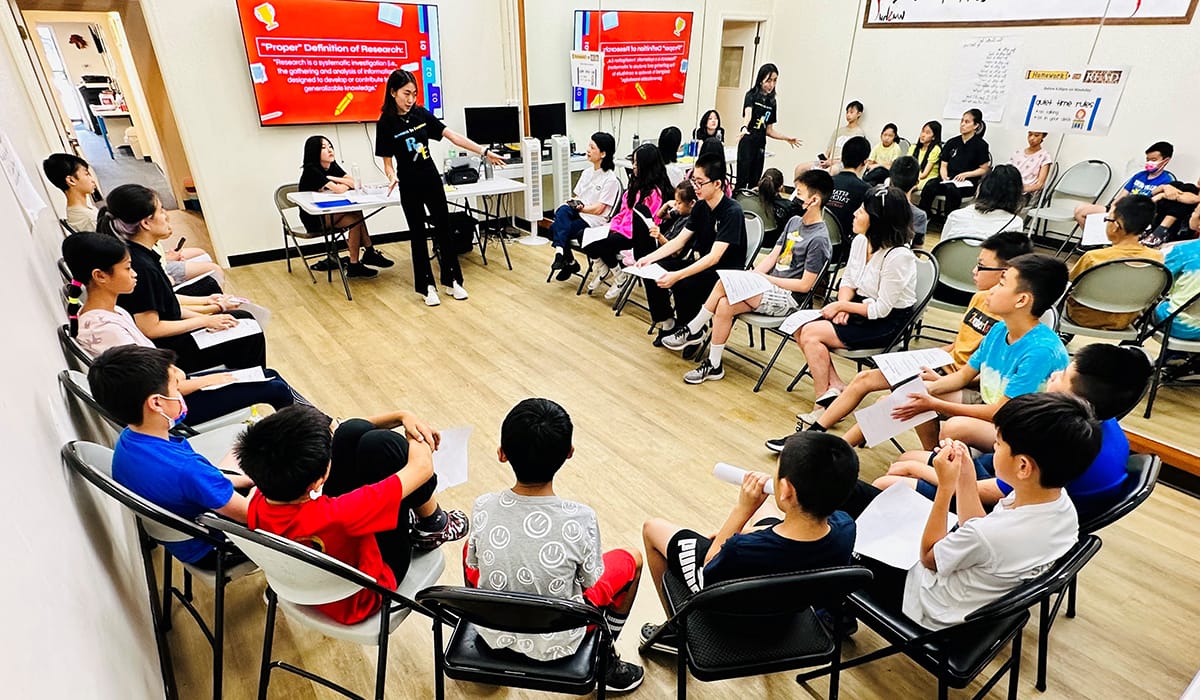
Grace offers a free in-person masterclass to teach students (grades 6-9) effective tips, in an engaging way, how to start their research projects at New Energy Education Center, Syosset, New York. /Courtesy Grace C. Liu
Tell us about future partnerships, programs or events that you are excited about.
Short-term goals include planning more local in-person events, expanding our Ambassador Program, integrating AI-based software to allow students access to their personalized AI research tutor and open resources. I have a lot of scheduled events taking place in the next few months. These talks are virtual since I speak to students all over the world. Recently, I spoke with students in Kazakhstan, China, Nepal, Zimbabwe, Thailand, Austria and the Netherlands. I have found that these students are extremely engaged and eager to learn. Through classes, podcasts, videos, talks and publications, our impact extends to 81,000 people in 140 countries.
Why is it important for others to get involved with causes they care about?
You get so much joy from solving problems. My key takeaway is that it’s so important to take action on issues that are important to you. Talking about an issue is important, but diving in and getting your hands dirty is even better. I want to be a role model who can inspire other people to take action.
Any advice for people who want to start volunteering?
First, take time for reflection. Know your why. What direction do you want to go in? What topics hit home for you? What have you cared about your whole life? What problem do you want to spend your time solving? That sets the direction for your actions. Then, take time to explore volunteer options. You can join an existing organization or start something on your own.
As you get into volunteering, don’t be afraid to adjust your role according to your skills, passions, time and feelings. It has to be sustainable. It has to be something you genuinely want to do, something you’re passionate about.
What do you want people to learn from your story?
I once wanted to do something but thought I was too small, too inexperienced, but I went ahead and did it anyway. Through my story, I hope more people will be motivated to start their passion volunteering projects to solve real world problems in their own communities. I also find it is important to focus on what is meaningful for you and what you are passionate about.
How One Teen’s Nonprofit Tackles Domestic Violence
Meet Daily Point of Light Award honoree Rhea Makkuni. Read her story, and nominate an outstanding volunteer or family as a Daily Point of Light.
Rhea Makkuni is currently a junior at Walter Payton College Preparatory high school. Her hobbies include singing, dance, gardening and judo. Rhea founded nonprofit organization Safe&Aware four years ago when she was in eighth grade to raise awareness and support survivors of domestic violence.
What inspires you to volunteer?
Volunteering is an opportunity to grow personally and develop important skills. In this process, I have also become more empathetic to the people I’m working with and more connected with the community.
Tell us about your volunteer role with Safe&Aware.
I wanted to help people with the emotional distress of being a survivor of domestic violence. I also wanted to help them heal, recover and get their lives back. The main theme is to provide support and resources to help survivors to break free of harmful, abusive relationships.
I create awareness through community outreach and education. I spend about 10 hours each week empowering survivors through self-defense classes, writing blog posts and posting on self-defense forums. We have also held community expos where we’ve had 1,500 attendees on average. At the community expos, we raise awareness about domestic violence as well as sexual violence and dating violence. It’s important to help people recognize when they’re in an abusive relationship because many don’t see the signs until they’re deeply entrenched and by then it’s hard to break out of that relationship.
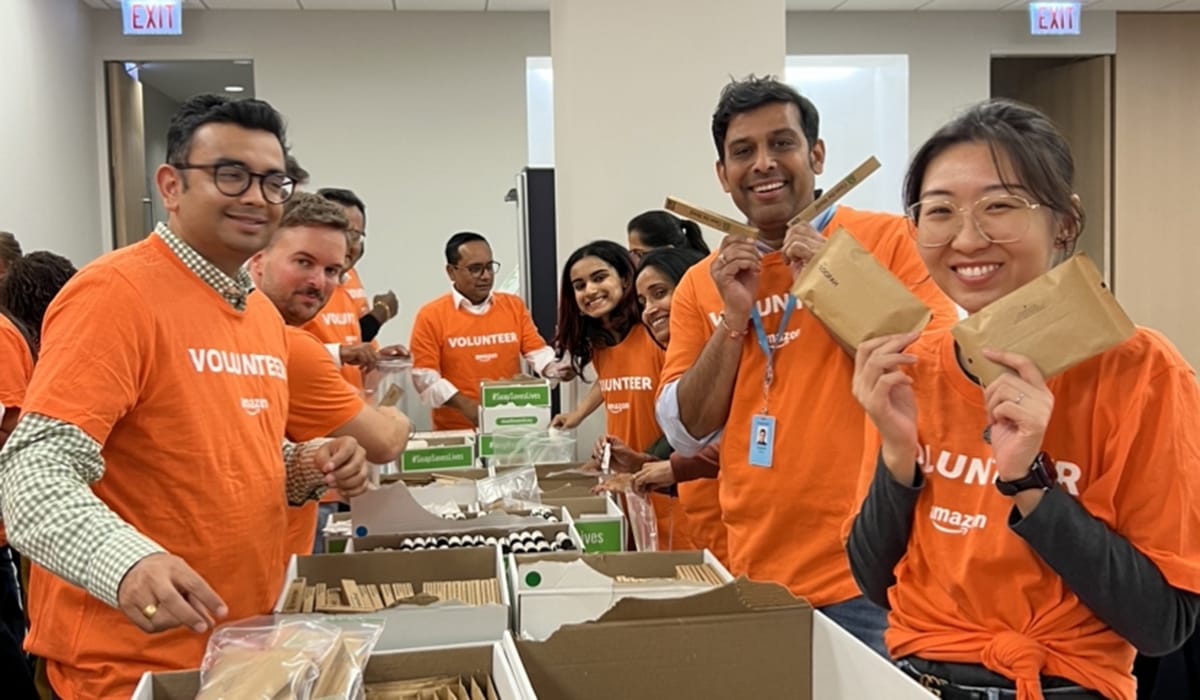
I have also partnered with various organizations, including Amazon and the Cleaning the World Foundation. With corporate sponsorship, I have led a team with 30 individuals to pack 150 sustainability hygiene kits amounting to over $6,000, for survivors at Sarah’s Inn and Mujeres Latinas en Acción.
People who leave an abusive relationship take very little when they leave, to prevent alerting the abuser. Often, they leave with nothing but the clothes on their backs. These hygiene kits are simple but much-appreciated necessities. We are working on distributing these kits to other Chicago-area domestic abuse shelters as well as internationally.
In addition, as a member of Sarah’s Inn Youth Committee, I provide crucial advocacy and support to domestic violence survivors. The committee helps survivors navigate the complex legal system, accompanying them to court hearings, providing emotional support and advocating for their rights.
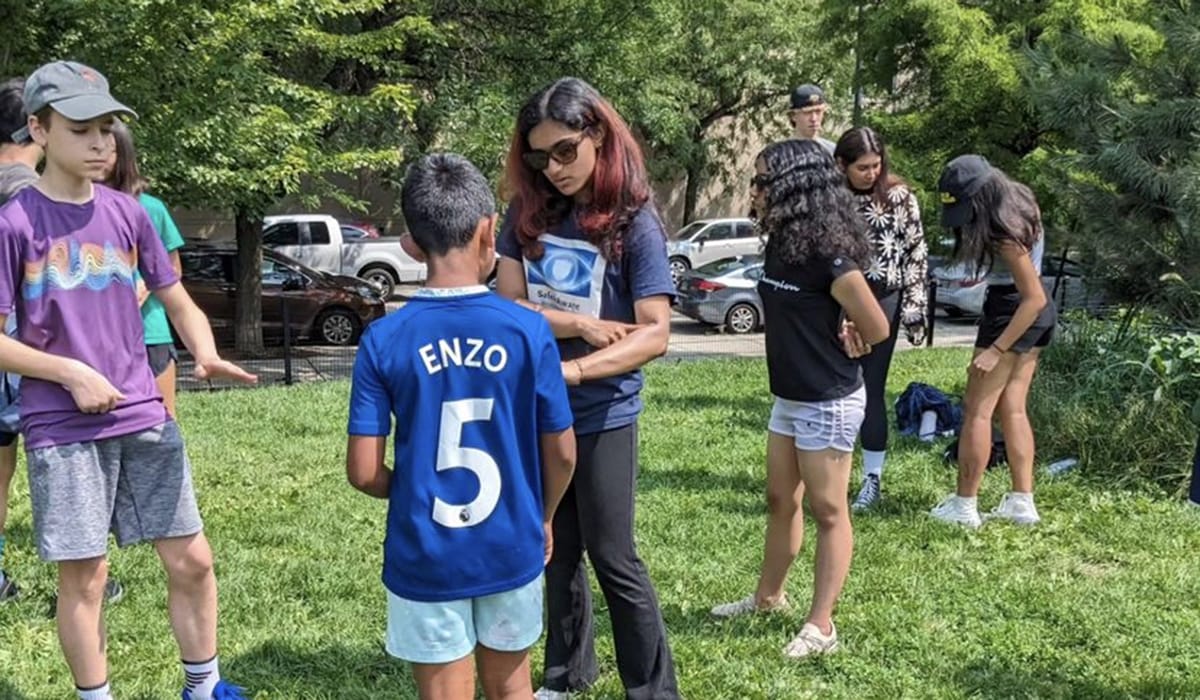
Rhea Makkuni (right) teaching a student a self-defense move at Mary Bartelme Park in Chicago. /Courtesy Ramya Vijay
What inspired you to get started with this initiative?
I have witnessed domestic violence in my extended family in India. I saw the pain, suffering and long-term consequences, especially in the mental health of the survivors. I saw the impact of the fear and the isolation experienced in an abusive relationship on the survivors and their families.
What are your long-term plans or goals for Safe&Aware?
My aspirations for the future revolve around promoting awareness, prevention and providing support for those affected by this devastating issue around the world. I plan to double the number of kits I have assembled (to date, over 300 kits) and distribute them to the International Foundation for Crime Prevention and Victim Care. I am currently in India to establish a Safe&Aware chapter for the International Foundation for Crime Prevention and Victim Care.
What’s been the most rewarding part of your work?
One memorable experience has been witnessing the positive change in an individual when they broke free from an abusive relationship. They inspired me. They moved from a place where they felt ashamed, weak, afraid and hopeless and then they made the decision to leave the relationship. They went through a metamorphosis finding strength and autonomy in their lives. These are astonishing changes and I feel so blessed that I helped play a small part in this. It has been very fulfilling.
What have you learned through your experiences as a volunteer?
I have gained hands-on experience with community outreach, advocacy, case management and problem-solving abilities. Volunteering has also helped me gain a deeper understanding of the cause I’m working on. Above all, it has led me on an exciting journey of self-discovery and personal growth where my emotional intelligence has been strengthened and nurtured over time.
Tell us about future partnerships, programs or events that you are excited about.
I have recognized the importance of education and information in preventing domestic violence. I plan to partner with Chicago Public Schools to develop comprehensive educational resources and materials that can be shared in schools, community centers and online platforms.
Why is it important for others to get involved with causes they care about?
One of my most memorable experiences is seeing the positive impact of my work. When you see positive results, you’re inspired to do more and hasten the process of creating a collective effort. Volunteering fosters a culture of empathy and compassion. It strengthens your commitment to your community. It’s also an opportunity to grow personally.
Rhea Makkuni and her team assembling 150 sustainability hygiene kits in partnership with Amazon and Cleaning the World Foundation. /Courtesy Ramya Vijay
Any advice for people who want to start volunteering?
I founded Safe&Aware because I saw a need. If you want to volunteer, ask yourself why. What are you passionate about? Where do you see the need? What do you want to get out of this? What’s going on in your community now and how can you support it? Recognize your own strengths & limitations.
For example, some of my volunteers are really good at designing campaigns for social media, but they may not be as comfortable when talking to a survivor about their emotional and mental challenges. There’s a need for every skill and every background, so don’t compare yourself to others. You bring something valuable to the table,
What do you want people to learn from your story?
In the context of Safe&Aware, domestic violence doesn’t discriminate based on race, gender, sexuality or socio-economic status. Our mission is to create a safe space for survivors including the resources and support they need to break free of abusive relationships. We empower survivors, and help them heal emotionally such as self-defense classes, and give them the tools and practical assistance such as sustainability hygiene kits to help them take control of their lives.
This is my passion. Wherever your passions lie, there’s a way for you to help improve people’s lives.
Retiree Helps Connect Her Community to Food and Health Resources
Meet Daily Point of Light Award honoree Nancy Stevens. Read her story, and nominate an outstanding volunteer or family as a Daily Point of Light.
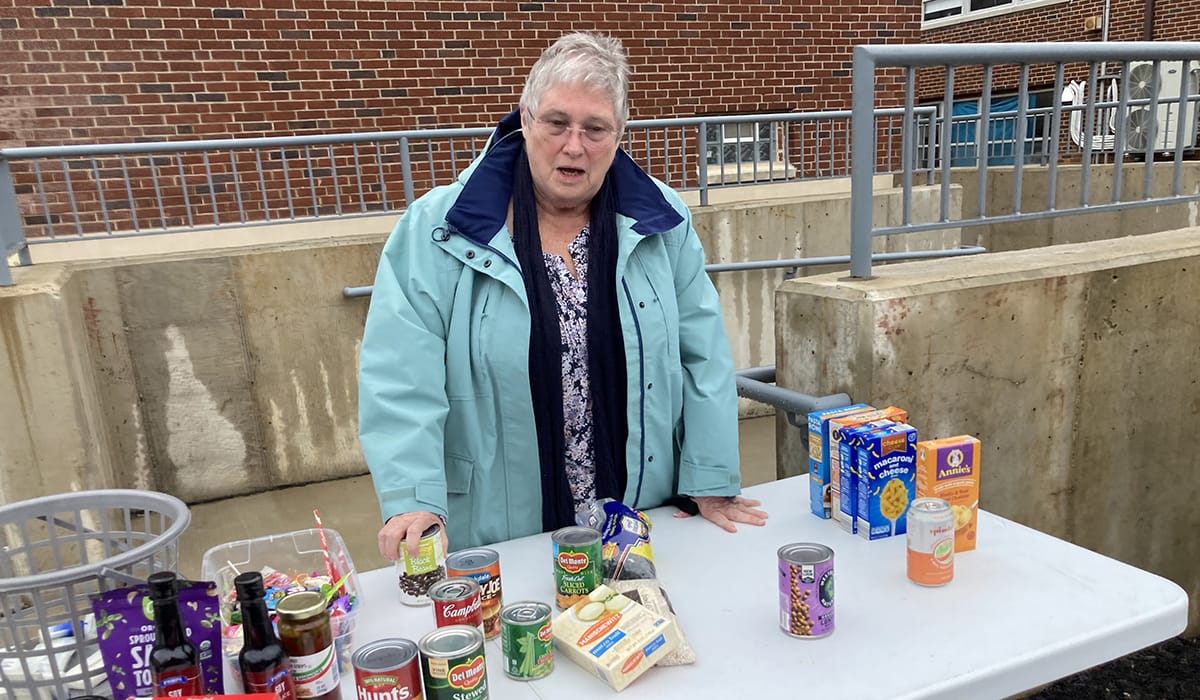
Nancy Stevens spends every Thursday with her local Glenside, Pennsylvania, food pantry, Family Promise Food Pantry, to help meet the most basic needs of providing food and health to her community. In August of 2020, the 78-year-old began giving back as an intake volunteer who helps each client get food or personal care from the pantry. Nancy also helped open a community library across the street from the food pantry and connects pantry staff with translation resources in order to translate intake documents for non-English speaking clients.
Outside of the food pantry, Nancy helps her church apply for grants on behalf of the Food Pantry Summer Snacks for Kids program at her church.
What inspires you to volunteer?
I started volunteering when I was 16 years old in high school. I was a candy striper at our local hospital; that was a long time ago. I don’t know whether they even have candy stripers anymore, but we delivered food trays to patients, helped transport patients down for X-rays and other important stuff like that. I don’t think hospitals dare let teenagers do that now. I did that for about two or three years, and then, after I graduated high school, I was an adult volunteer in the evenings at the hospital. We carted around different juices to the patients that were on specific diets. It was wonderful, I really liked it.
I grew up and got married and didn’t have a whole lot of time to do in-person volunteer things, so I eventually volunteered at a suicide prevention center and did that for several years while my husband was in college. That’s basically how my volunteerism all started.
Nancy Stevens retired during the COVID-19 pandemic to volunteer at Family Promise Food Pantry and Food Pantry Summer Snacks for Kids at St. Paul’s Lutheran Church.
Tell us about your volunteer roles with Family Promise Food Pantry and Food Pantry Summer Snacks for Kids at St. Paul’s Lutheran Church.
I started working at the Family Promise Food Pantry in 2020. I saw a post on Facebook about promoting the food pantry. I contacted them and asked what they needed — they said volunteers. They desperately needed volunteers since people who had been volunteering were burned out from the intensity of the pandemic. I’ve volunteered on Thursdays since.
With Summer Snacks for Kids, my church offers members the chance to use grants to apply for different opportunities that would help our church community. I’ve applied for grants for as long as the program has been in existence. I asked them a couple of years ago if I could pursue a grant for $1,000 in laundry detergent because that’s something that people at the Food Pantry always ask for and they can’t get it with food stamps at the grocery store. And I received the grant. And this summer I asked the director of the program what she wanted me to apply for, and she said that since the kids are out of school for the summer, we should focus on providing free lunches, breakfasts and snack bags to give to families over the summer.
What’s been the most rewarding part of your work?
I think knowing that we’re helping to meet the most basic need. People can’t do anything else if they’re hungry.
What have you learned through your experiences as a volunteer?
Things aren’t always what they seem. One time we had someone pull up to the food pantry in a BMW, and a few of us looked at each other like what’s going on here. It turned out that this family had been living close to the edge for a while, and then somebody lost a job. So, that was very surprising and eye opening.
Nancy spends every Thursday with Family Promise Food Pantry and helps her community access the most basic needs of food and health.
Any advice for people who want to start volunteering?
Yes, in fact my girlfriend was just asking me about this the other day. She just retired and is on the verge of volunteering. She wanted to volunteer with a specific organization really bad, and they told her they didn’t need volunteers that month. Now she doesn’t know where to go. I told her that I couldn’t tell her exactly what to do or where to go; you must discover for yourself what it’s going to be. It has to meet one of your basic principles. She wanted to take care of animals, and that’s a great thing, but now she has to discover if there’s another way or shift entirely.
What do you want people to learn from your story?
Any place that I’ve ever volunteered and anyone that I’ve ever served has always told me thank you, and they had no idea that it really should have been me saying thank you to them because helping just feels so good.
Tell us about future partnerships, programs or events that you are excited about.
I’ll continue volunteering and doing the work I do at the food pantry on Thursdays. None of us really knew each other before we started working there, and we all became a really solid group of friends at this point. So, I’m excited to continue to work alongside them.
Physical Therapist Enriches Lives Through Equine Therapy
Meet Daily Point of Light Award honoree Cynthia Williams. Read her story, and nominate an outstanding volunteer or family as a Daily Point of Light.
Cynthia Williams majored in Exercise Science at Furman University. During her studies, she was assigned to work with a child with a physical disability: and so began her journey of helping people. She became a physical therapist and enjoyed working with pediatric patients. She has two sons, and the older was diagnosed with autism at the age of 4.
While Cynthia was working weekends at a local hospital, a neighbor told her about Riverwood Therapeutic Riding Center, which offered the perfect opportunity to use her skills and experience. The Riverwood mission is to provide equine-assisted activities for children and adults with disabilities and improve their physical, mental and emotional well-being.
What inspires you to volunteer?
I always feel blessed when I get to help people. I like to make a difference, especially with people with physical and mental challenges. Instead of getting upset about something that should be trivial, I can refocus on helping others.
Some people get overwhelmed when they see people in wheelchairs; sometimes they’re nonverbal and you have to figure out other ways to communicate. Even though I had zero experience with horses, I had plenty of experience with people with special needs. In my years of volunteering, I’ve learned a lot about horses. Some volunteers have a lot of horse background but not as much experience with the riders, so I think we have a great blend of people with diverse backgrounds and skills.
Cynthia Williams, long-time volunteer at the Riverwood Therapeutic Riding Center. /Courtesy Riverwood Therapeutic Riding Center
Tell us about your volunteer role with the Riverwood Therapeutic Riding Center.
I have been volunteering at Riverwood since 2007 and have participated in two to three Riverwood classes each week since then. I appreciate having the flexibility to be a mom while still using my background as a physical therapist and community advocate. I still maintain my PT license in both Florida and North Carolina.
I often work as a side walker. As a side walker, I walk alongside the horse and rider, interact with the rider and ensure their safety. Sometimes I act as the leader who handles the horse. I also clean stalls, help riders mount and dismount, help riders untack the horses and put the tack away. Sometimes, I help with grounds work and gardening to beautify the facility before a fundraiser or horse show.
What inspired you to get started with this initiative?
After I found out about Riverwood and started volunteering there, I met another volunteer who was also a physical therapist. This helped reaffirm why I’m there. I don’t have to have a paid job as a physical therapist to make a difference.
We have about 70 riders every week and 10 therapy horses. Not all participants ride in every session.
Sometimes we hold ground lessons including grooming. I help wherever I’m needed. We always begin sessions with enrichment activities set up in the arena. These involve teaching language and motor skills as well as riding. We help our riders use their weaker side if appropriate and work on verbal skills. For the last part of the lesson, we take riders on interactive trails we call the alphabet or hippo trail. Most of our riders are children, but we do cater to some adults as well.
I also assist at the Coop at Riverwood, where we sell used tack as well as arts and crafts from local artisans. Riverwood riders participate in this and develop vocational skills like cleaning tack, preparing items for sale and helping customers.
What are your long-term plans or goals for the organization?
I plan to stay at Riverwood indefinitely. I even came back to Riverwood after I had major surgery 10 years ago.
What’s been the most rewarding part of your work?
It is so rewarding to see what the riders can accomplish. Maybe they had been told, or they believed, that they couldn’t do something, and we help show them that they can. They are empowered and their self-esteem gets a huge boost when they learn a new skill.
Sometimes nonverbal kids with autism or other developmental delays will say, “Walk on” or “Whoa” which might be their first words spoken. The whole Riverwood community is making a difference in people’s lives. But it goes both ways. Riders, families, volunteers, staff, horses… we all help each other to thrive.
What have you learned through your experiences as a volunteer?
Whenever I’m intimidated, I ask for help. I’m a perfectionist and I hate to make mistakes. Working at Riverwood has helped me get out of my comfort zone and learn what I need to learn. I’ve learned to keep things in perspective. It’s important to be grateful and recognize the small achievements and not take for granted all the blessings and abilities that I have.
It’s so nice to have a community of resources like this, filled with people with different backgrounds and strengths. We all contribute based on our own gifts. I’m a parent of a child on the autism spectrum, so it’s so important on a personal level to have the support of this community. It helps me deal with challenges that come with having a son who is differently abled.
Tell us about future partnerships, programs or events that you are excited about.
The annual horse show is coming up in May, I hope to contribute and be part of that. I look forward to watching the students show how much they have learned over the past year.
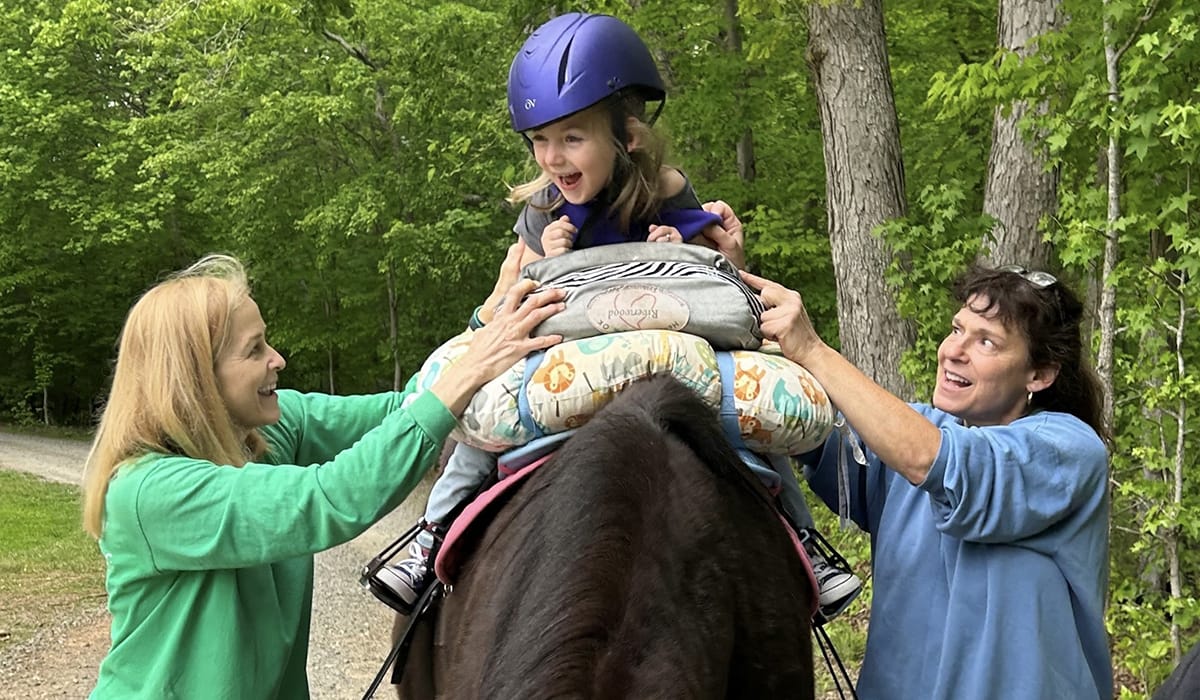
Cynthia Williams, in green on the left, volunteering as a side walker on a trail at Riverwood. /Courtesy Riverwood Therapeutic Riding Center
Why is it important for others to get involved with causes they care about?
Everyone can contribute something. It is important to use our gifts and abilities to help each other. The benefits don’t just end at the recipient. We volunteers also experience personal growth and satisfaction from doing something for others.
Any advice for people who want to start volunteering?
I understand about being nervous and not wanting to mess up. I encourage you to start with doing something you’re comfortable with and gradually branch out to things you aren’t familiar with. Take the first small step outside your comfort zone. Stepping out of the comfort zone becomes easier with practice. We are all constantly learning. I’ve found that people are willing to help, and they won’t be upset if you mess up. We might fail, but that’s how we learn, and we’re supported every step of the way.
What do you want people to learn from your story?
What a blessing it is to be able to provide support to others and help them reach their potential. Don’t be afraid to try new things that seem intimidating. There’s so much joy in watching others reach their goals and enjoying the simple things. It’s important to play games and have fun, too. I’m very task-oriented and my experiences at Riverwood have made me slow down and appreciate the joys of being a “human being” not always a “human doing.” Focus on love. The negativity we hear in the news won’t have such an impact when we choose to see the good in people and help each other.
No One Goes Hungry: Chicago Resident Tackles Food Insecurity
Meet Daily Point of Light Award honoree Catherine Cox. Read her story, and nominate an outstanding volunteer or family as a Daily Point of Light.
Around 40 years ago, Catherine Cox fell in love with Chicago while visiting a friend and made it her home. Her career there has been varied – at first working for an alternative newspaper, then opening her own craft supply store and eventually landing in product development. Then, at the onset of the pandemic, she left the corporate world for a social enterprise. Currently, she seeks out other social enterprises that practice fair trade and give workers a fair wage to represent and sell goods for, like a group she found in India who turns trash into beautiful fabrics for things like purses. Her company also creates products by employing people with barriers to fair wage employment.
In short, Catherine cares about people and her community. A decade ago, even before she aligned her job with her advocacy interests, Catherine began volunteering with Chicago Cares, an organization that connects volunteers with their many community partners who need manpower. Among other things, Catherine has dedicated time to multiple programs addressing food insecurity over the years including the Greater Chicago Food Depository, Oakley Square apartments and, most recently, the Hyde Park Kenwood Food Pantry.
What inspires you to volunteer?
I went to a small high school, and we went with a public health doctor on his rounds once into areas of Washington, D.C., I’d never been before. Seeing that was eye-opening, and it drove me to want to help people.
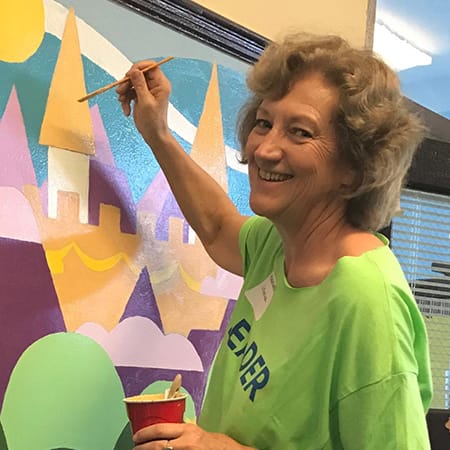
Channeling her inner artist, Catherine paints a mural at a Chicago Cares Servathon.
Tell us about your volunteer role with Chicago Cares.
In 2017, I was invited to train to be a volunteer leader as part of a pilot program. When I finished, I took a role planning and cooking dinner in a shelter for unhoused youth. I’m not a cook, so my friends thought this was pretty funny. I had to plan the menu for around 30 people, buy the groceries and work with volunteers to engage the young people who were there.
When you’re cooking with these kids, they teach you things. Every time I chop a red pepper, I think about a kiddo who showed me a good way to do it. Another kid got a ceramic mug, turned it over and said you can sharpen a knife by using the bottom of a ceramic mug.
That had to end when the pandemic hit. One of the best – and safest – places to volunteer after that was the Greater Chicago Food Depository, so I led a lot of groups there. You never know if you’re going to be sorting apples or getting corn off a truck. Or you can pack beans. It all goes so fast. It’s like that I Love Lucy episode in the chocolate factory where everything’s falling off the conveyor belt.
When things started opening up again, I ended up at the Hyde Park Kenwood Food Pantry on the South Side. I do that as often as I can with a group of about five Chicago Cares volunteers and another really committed group that comes through the managing church. I work with individual families—neighborhood residents, new immigrants, etc.— to help select and gather fresh and packaged food they need.
What inspired you to get started with these food-based initiatives?
When I came to Chicago, I volunteered for Planned Parenthood for a long time. After that, I did stuff with my kids’ schools. Ten or 12 years ago, I was at a crossroads. I was getting divorced and was looking for change, so I started doing lots of different things: Habitat for Humanity, The Humble Design— they furnish homes for people emerging from homelessness — and served some cooked breakfasts in a shelter for homeless teens and an emergency shelter run by the Night Ministry Architecture Foundation.
Then, I stumbled on Chicago Cares. That’s been my volunteering home ever since. It’s got a robust website of opportunities. It’s a wonderful way to learn about the city, meet new people and broaden your horizons. I think it’s criminal that people in this country are hungry, so I gravitate towards projects that address food insecurity. Even while I’ve been with this church pantry, I’ll jump in to help with one-off opportunities that come up like public art projects.
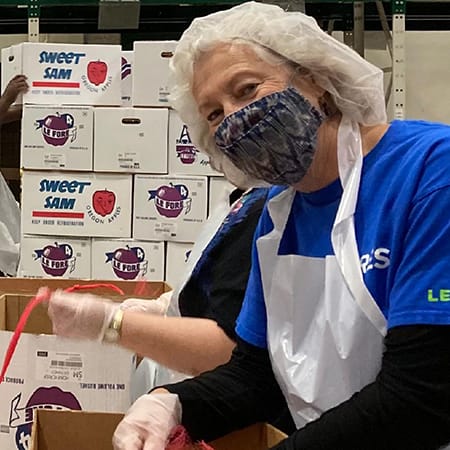
Catherine Cox, a longtime volunteer with Chicago Cares, bags apples at the Greater Chicago Food Depository.
What’s been the most rewarding part of your work?
It has expanded my horizons and made me more empathetic to my neighbors. Once, I was making breakfast through the Night Ministry at an overnight emergency shelter for kids. One morning, somebody’s alarm was that Lion King song, “Hakuna Matata,” and all the kids started singing. It was moving. Seeing the resiliency of people gives me hope.
Any advice for people who want to start volunteering?
It doesn’t have to be a major commitment, especially not at first. There’s so much need. And you probably can offer more than you think, whether it’s construction or tutoring. What’s really great is when people figure out what needs to be done and just jump in.
For many years, Chicago Cares did a Servathon. They brought thousands of volunteers downtown for a rally before sending them to assigned locations. In the course of a five-hour day, an entire school could be repainted or a park replanted. Groups got so much done, and it saved the city millions of dollars.
What do you want people to learn from your story?
I hope I can encourage people to join Chicago Cares or do whatever volunteering they want, because it’s so enriching. Sometimes, I think I get more than I give.
There’s a lot of need out there, and it doesn’t take a lot to help. One of the fun things in life is putting together little moments like an interaction with someone at the grocery store or someone saying something funny to you walking down the street. When I’m volunteering, and someone teaches me that you shouldn’t put the onions in the potatoes because the gases will rot them, it makes my day. If you extend yourself, you never know what wonderful little moment will happen.
Embodying the Spirit of Servant Leadership in Honor of MLK Day
Meet Daily Point of Light Award honoree Jason Thomas.Read his story, and nominate an outstanding volunteer or family as a Daily Point of Light.
In the spirit of Dr. Martin Luther King Jr.’s enduring legacy of service and leadership, Jason Thomas stands out as a beacon of hope and community engagement in Atlanta. His 15-year journey as a volunteer with multiple organizations, including Hands On Atlanta and The King Center, exemplifies a deep commitment to servant leadership, a value that Dr. King himself championed.
“In 2023 alone, I had the chance to serve 12 different organizations in a variety of roles,” Jason shared. “I’ve served in several food pantries. I’ve helped to provide pajamas for kids in the foster care system. I’ve worked with youth who have incarcerated parents. I’ve provided basic necessities for single mothers. I’ve served unhoused men and women in my city. I’ve also provided administrative support with The King Center, specifically recruiting volunteers for the Students with King program as well as MLK Week of Service. Regardless of the organization that I serve, I give my all and love every chance that I get to help people.”
Jason’s involvement with various Atlanta-based organizations highlights his dedication to addressing some of the most pressing needs in the community. From fighting food insecurity with Urban Recipe and Second Helpings Atlanta to delivering hope and support with Hugs and Hope and the Westside Future Fund, his work impacts many lives. His hands-on role in assembling and delivering food boxes is a direct response to the challenge of hunger in the metro Atlanta area, reflecting his commitment to making a tangible difference.
“Food insecurity is such a huge issue in Georgia and I have been fortunate to connect with many organizations working to fight it,” Jason said. “Nearly 10% of our state’s population identifies as being food insecure and nearly one in eight children struggle with this issue. Food is a basic human right and I’m grateful to do my part to work towards solving it.”
Jason Thomas is a passionate volunteer carrying the vision of Dr. Martin Luther King throughout Atlanta./Courtesy Jason Thomas
Jason’s partnership with The King Center is particularly significant as he aids in volunteer management for various projects, including the Martin Luther King Jr. Day and King Observance Holiday planning. His involvement in these events is more than organizational; it is a tribute to Dr. King’s vision of a “beloved community.” By supporting the Students with King program, he helps foster a new generation of leaders who are educated and inspired by Dr. King’s teachings and legacy.
Jason’s ongoing efforts in community service and his role in coordinating The King Center’s observance activities shine a light on the importance of continuing Dr. King’s mission in our modern world. He feels strongly about individuals getting involved in their communities to help better the world.
“My father introduced me to the teaching of Howard Thurman at a young age,” Jason recalled. “One of his famous quotes sums up my thoughts about this perfectly. He was quoted as saying, ‘Don’t ask yourself what the world needs. Ask yourself what makes you come alive, and go do that, because what the world needs is people who have come alive.’ It’s easy to do things that you’re passionate about. It’s like a cherry on top when you can find the sweet spot where your passions and opportunities meet.”
Beyond his community work, Jason’s role as a baseball coach with the Brookwood Baseball Association showcases his commitment to mentorship and youth development. His involvement in Camp Hope and Hope Heals, alongside his three boys, underscores the importance of instilling values of service and leadership in young minds. These summer programs offer a platform for him to teach and demonstrate the principles of teamwork, perseverance and community responsibility.
Jason’s wide array of volunteer activities embodies the essence of Dr. King’s message of servant leadership. His commitment to serving others and improving his community aligns seamlessly with the ideals celebrated on MLK Day. Through his actions, Jason not only honors Dr. King’s legacy but also keeps the flame of service and leadership burning brightly in the heart of Atlanta.
For those who are considering volunteering, Jason encourages, “Start somewhere. Find a need and meet a need. Wherever you are, with whatever you have. Even if it’s not necessarily your passion, start somewhere doing something for someone. If you’re able to find something that you’re passionate about, that’s great. What’s most important is to jump in and help, no matter how large or small it may seem. You never know the impact that you’ll make and the lives you can change by serving others.”
As this day of service reminds us of the impact one person can have on the world, Jason Thomas stands as a living example of this truth. His dedication to serving his community, nurturing future leaders and coordinating commemorative events for Dr. King reflects an unwavering commitment to the ideals of equality, service and community. In celebrating MLK Day, we recognize not just the monumental legacy of Dr. King, but also the ongoing efforts of individuals like Jason Thomas, who continue to forge paths of service and leadership in their communities.
Cybersecurity Engineer Brings Medical and Educational Resources to Sierra Leone
Meet Daily Point of Light Award honoree Martina Taylor. Read her story, and nominate an outstanding volunteer or family as a Daily Point of Light.
At 2 am, 28-year-old Martina Taylor starts her day. As a PhD student in business administration, she tackles her reading list before her full-time job as a cybersecurity engineer starts two hours later. On good days, she’s done by noon. On others, she can work a 12-hour shift. It’s a schedule that would have anyone ready to relax when Saturday came around, but Martina doesn’t rest. Her weekends are dedicated to improving the lives of those living in her native country, Sierra Leone.
Martina was nearly a teenager when she moved to the U.S. with her family from the small African nation. Her access to resources that aided her academic and professional success were a stark contrast to what she saw on her visits home as she got older. The lack of resources there convinced her to enact the change she wanted to see, and in 2019, she founded Breaking Boundaries with Innovation (BBI).
As president of the organization, Martina leads a team of 11 between the U.S. and Sierra Leone on a mission to provide education and healthcare resources and, eventually, initiating technology programs as part of school curriculums. Though starting in her hometown of Freetown, Martina intends to expand BBI through West Africa and beyond. For now, she connects students with technical professionals for mentorship and partners with hospitals and clinics. Her Sponsor a Child initiative provides scholarships, supplies and laptops to schools and laboratories. And the more than $20,000 in cash and donations she raised in 2022 has gone to launch the BBI Cares program.
What inspired you to get started with this initiative?
The more I went back home, the more I realized the amount of help that was needed there. I’ve always been interested in business and technology, but the country that I come from isn’t so tech savvy. When I went back in 2017, I realized that more healthcare was needed, not just technological programs. Mothers were dying giving birth to children. Children were dying, because they didn’t have the right care. When a mother gives birth in the U.S., they have access to some basic things that the baby needs. In Sierra Leone, they didn’t have any of that.
I reached out to some friends who were born in Sierra Leone or who are first-generation Americans. In 2019, we were officially able to start BBI as a nonprofit. Encouragement from family members who have worked in nonprofits really helped. We had to go through the whole process in both countries, because there are certain things you can’t do in another country as an international organization unless you partner with a local nonprofit.
We got donations from American organizations, and in Sierra Leone, we partnered with a local orphanage that we were already sending resources to. We were able to sponsor 50 kids to go to school for a year among other things. In December 2022, we launched our own nonprofit in Freetown and started the very first BBI Cares program that supplied more than 100 mothers at two hospitals in Freetown with the basic things needed for a newborn. We were also able to donate supply-filled backpacks to more than 100 kids from primary and secondary schools. We’re currently funding a housing project with our original partner and are making sure their kids are staying in school.
Tell us about your volunteer role with Breaking Boundaries with Innovation.
I’m the chief executive officer. One of my tasks includes coordinating fundraising and donor communication to raise funds for the organization’s annual BBI Cares donation drive. While I’ve been doing my doctorate, a lot of the work has shifted to my team leads. I also have an assistant who checks in with them on a daily basis. I do what I need to do as the head of the organization: meeting people, making strategic decisions and things like that.
When we get invited to events, we try to split it across team members in the U.S. Sometimes, I go. Other times, my V.P. or treasurer will go. Everybody’s a BBI representative, and people need to see different faces.
What are your long-term plans or goals for the organization?
We’re working towards getting our technology program started. The long-term goal is for the schools and the country to make technology a part of the curriculum so that kids take it seriously.
Another thing is our mentorship program. I became an engineer not because I was necessarily interested in engineering but because I had the right people to mentor me. My interest grew when people encouraged me. We want to do that. There are a lot of kids in Sierra Leone who can be great engineers or leaders in STEM with the encouragement, mentorship and coaching to challenge them to greater heights.
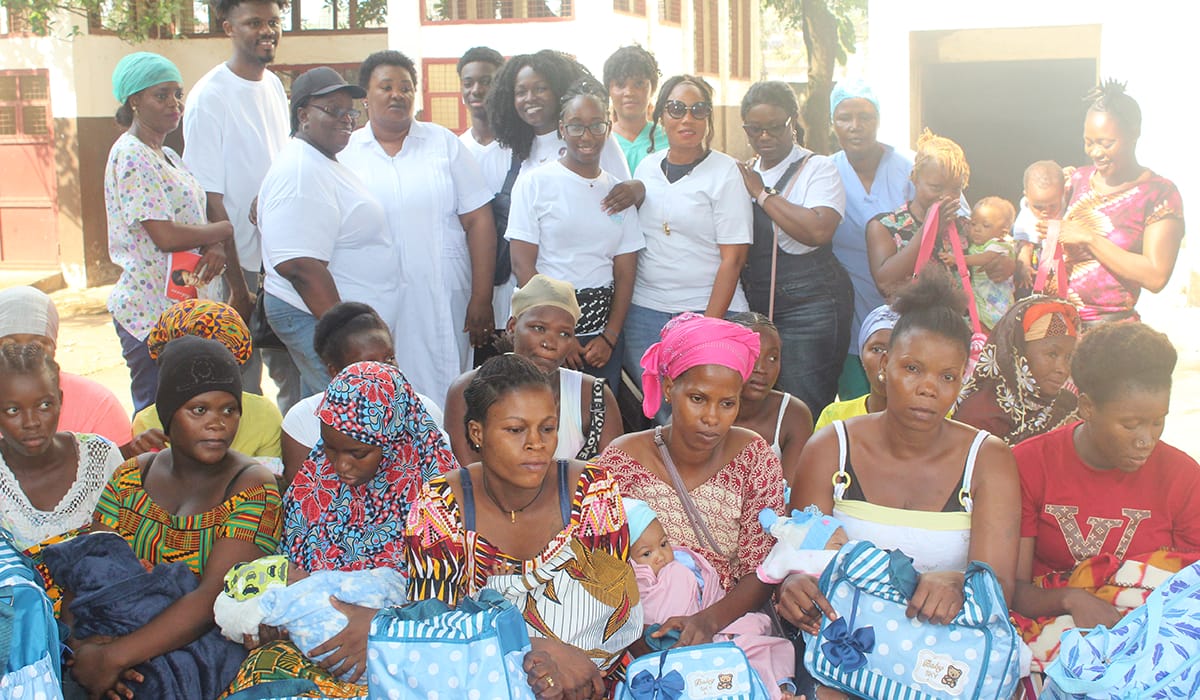
BBI volunteers send new moms home with supplies at a BBI Cares Mother and Child donation event at the Macaulay Street Maternity Hospital in Freetown, Sierra Leone.
What’s been the most rewarding part of your work?
It’s seeing the results. The impact that we’re creating has been my biggest motivation. Last year, when we launched our BBI Cares event, it was heartwarming to see how appreciative people were. Some people were in tears. You could see that they were thankful for the basic things they couldn’t afford themselves. Up to the point that we were leaving the country, there were still people still thanking us.
What have you learned through your experiences as a volunteer?
I’m always looking for a way to be a blessing to others, and volunteering is one way I can do that. When you give your time and energy to people, there are rewards that you don’t even anticipate. It has absolutely nothing to do with money or title or any of that. It’s just an amazing feeling.
What do you want people to learn from your story?
Do what you love and love what you do. Always make sure that for every blessing received, you be a blessing to somebody else. If you’re confused about doing anything, do some research. See what’s already out there. See how you can be of help, because help is always needed everywhere.