Pioneering Sustainable Change With Community Composting
Meet Daily Point of Light Award honoree David Liebowitz. Read his story, and nominate an outstanding volunteer or family as a Daily Point of Light.
At a young age where many are just beginning to form an understanding of environmental issues, David Liebowitz, at just 14, started a community-wide composting program that has since transformed the way his community handles waste. David’s journey began with a simple yet impactful idea: to introduce a composting program within his community. Recognizing the many benefits of composting, including waste reduction and soil enrichment, he approached a centrally located house of worship to host a compost bin. His persuasive discussions with the clergy and the Board about the environmental and community benefits of composting led to the successful placement of the bin.
Understanding the importance of education in fostering sustainable habits, David created an educational program for K-5 students. His approach was both fun and engaging, focusing on teaching children about the importance of composting, which materials can be composted, and how to effectively participate in the process. Beyond his local community, David extended his advocacy efforts to the political arena, lobbying Sen. Rick Scott (R-FL) on the benefits of composting and the need for broader environmental initiatives in Florida.
In less than two years, David’s composting program has led to more than 6,000 pounds of waste being diverted from landfills. This remarkable achievement earned the location the title of “Commercial Client of the Month” in July 2023. David’s vision continues to grow as he engages with a large commercial catering company and a private school to encourage their participation in composting. Furthermore, he is exploring the possibility of expanding the program by adding another compost bin in a different area of his county.
David’s initiative demonstrates the power of youth activism in environmental conservation and highlights how small, local actions can lead to significant, tangible outcomes in waste reduction and sustainability. Read on to find out more about David’s volunteerism.
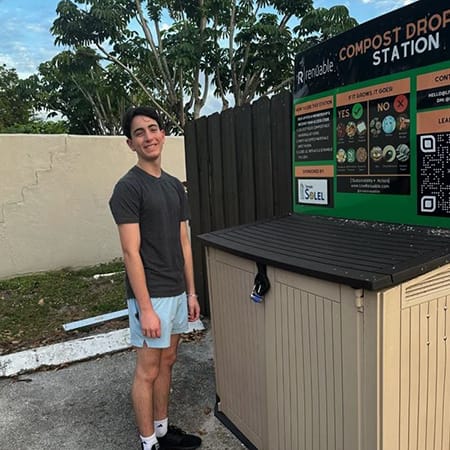
David received approval to set up a compost bin in his community, and through his composting initiatives, he has helped divert more than 6,000 pounds of waste.
Tell us about your volunteer role.
I have been volunteering for many years for different causes. One day, I attended an event at Renuable, a community compost site. I had known about the benefits of recycling – and do it at home – but I did not know anyone who composted, and I had never done it before. That day, I learned about the benefits of composting and was inspired and fueled to do more. I approached a centrally located house of worship and asked for permission to place a compost bin on their site. After much back and forth regarding the location, what it would look like and why I wanted to do this, I received permission.
Now, my role is to educate people and to convince them to compost their scraps. I’ve created flyers and social media ads. I also attend community events, where I sit at tables and discuss composting with attendees. I organize games about composting and teach children what they can and cannot compost.
I am proud that in less than two years, over 6,000 pounds of waste have avoided landfills thanks to my compositing efforts. I’ve recruited families to compost in their homes and to bring their compost to our drop-off location. Currently, I am working on bringing more bins to even more locations. I am also extending beyond individual homeowners and working with larger organizations like a catering company and a school, to bring larger amounts of food waste for compost. I’ve enjoyed my journey so far and can’t wait to expand it even more.
Why is this issue so important to you?
According to the Environmental Protection Agency, more food reaches landfills than any other material in our everyday trash. When food scraps go to the landfills, there are many negative consequences like the release of methane which harms our environment, bad odors and harm to wildlife. The food scraps also take up a lot of space.
People can easily reduce food waste by composting their scraps instead of throwing them in the garbage. Composting is a process that allows organic food waste to decompose into nutrient-rich soil. This soil then nourishes other plants. It’s quick and easy to compost. Composting is very much needed to reduce our trash, reduce our costs and help our environment by reducing carbon emissions. I care about leaving a healthier and better planet for my generation and others. All of this is very important to me.
What’s been the most rewarding part of your work?
The most rewarding part of my work has been teaching others about composting in engaging ways. I created a game where children guess whether certain items are compostable or not. I enjoyed creating the game, picking the biodegradable items for the game and then playing it with the children. I add a couple of tricky items, which are always educational and fun. For example, did you know that although K-Cups aren’t compostable, the leftover coffee grounds inside are? Even better, you can buy biodegradable pods. I enjoy teaching others about composting and getting more families to compost their food scraps and other biodegradable items.
What have you learned through your experiences as a volunteer?
In addition to the composting initiative, I volunteer at my local library, for my city’s education advisory committee and at my school. On weekends, I also organize athletic activities for children in foster care. Volunteering keeps me busy and engaged, and I have learned to manage my time wisely. Between my schoolwork and volunteering, I’ve had to prioritize and juggle responsibilities.
I have gained a better understanding of the challenges people might face in adopting an initiative. For example, cost is an issue for some to compost, so I worked with the composting company to create a discounted community rate. I learned how to communicate more effectively, especially when I have to get approval for placing compost bins on private property. I have gained a sense of purpose, as this is an initiative that I think is easy to do and very beneficial.
Volunteering also makes me a happier person. I enjoy meeting new people at events, creating events for children and getting information about how much waste we have helped divert from landfills. And volunteering reminds me of my power and responsibility to get involved in my community.
Why is it important for people to get involved with the causes they care about?
Volunteering can help the community. Many nonprofits have small budgets and rely on volunteers. A volunteer can make a big difference. Being a volunteer can make others more empathetic and understanding of what’s going on around them. Volunteering has also been very rewarding. Knowing that I am saving our environment makes me feel good. I always come home fulfilled, and I think others will as well.
Any advice for people who want to start volunteering?
People should volunteer with causes they think are fun or interesting. There are so many different organizations and causes that can use a volunteer, and volunteering shouldn’t feel like a chore. There are volunteering opportunities outdoors, indoors, locally, internationally, virtually, short term and long term. If someone doesn’t know where to start, they should research reputable organizations, and find out if there are opportunities to help and the time commitment. The Points of Light website is also a great resource. I encourage people to start with one cause and commit to it for a few months. If they don’t like that cause, they can always choose something else.
What do you want people to learn from your story?
People should know that composting is one of the easiest and most impactful ways to help the environment. If you have a garden, adding compost to the soil enhances the soil and reduces the need for chemical fertilizer. If someone can’t compost their food, some companies come to the home to collect compost, and there are compost sites for people to drop off their compost. I encourage people to do an internet search on, “composting sites near me.” I’d love to see more people incorporate composting into their lives. I’d also love to see more people start volunteering for a cause that is important to them.
Young Gardener Shares Harvests With Those Facing Food Insecurity
Meet Daily Point of Light Award honoree Te’Lario Watkins II. Read his story, and nominate an outstanding volunteer or family as a Daily Point of Light.
When Te’Lario Watkins II was 7 years old, he came home from his first Cub Scouts project, a first look at the magical world of gardening, inspired to grow something of his own. His parents bought a few kits for him to start his first mushroom crops, a venture that would soon become Tiger Mushroom Farms as his skills—and his harvests—grew.
“Eventually we had too many mushrooms to eat, so instead of letting them go to waste, we decided to sell them at farmers’ markets, and that snowballed into having my own mushroom farm business,” Te’Lario recalls. “Right now, I’m working on my seasoning, so I don’t have any mushrooms, but before COVID, I had about 100 pounds per week.”
Te’Lario’s parents retired from teaching to help in the early stages as things began to take off. It was at a farmers’ market when they met Ava Johnson, a fellow gardener and health department administrator by day, who became one of his mentors when they decided to expand beyond mushrooms.
“I grow a lot of brassicas or greens. They were interested in the type of kale that I was growing and sustainable agricultural practices. His mother calls me the ‘fairy garden mother,’ teaching him things like watering from the base, making sure that you’re fertilizing—that sort of thing,” Ava says.
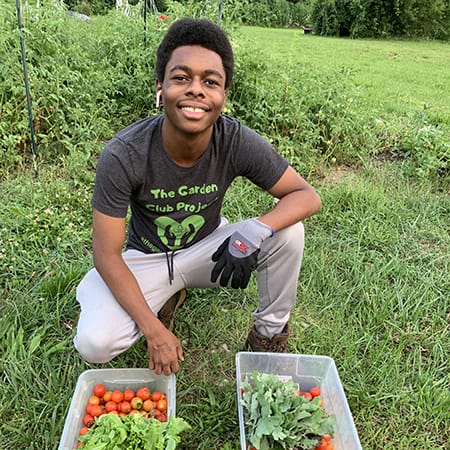
Te’Lario looks over his harvest of fresh cherry tomatoes and arugula.
It was also at the farmers’ market where Te’Lario found his second source of inspiration. Among the patrons, he noticed some people using wooden coins with the dollar sign on them as currency.
“When I asked my parents, they explained to me that some people don’t have enough money to buy food or fresh produce for their family or for themselves,” he recounts. “I wanted to help somehow, so I applied for a grant, and I grew carrots and cucumbers. Then, I donated them to a local food bank. That’s how I started rolling produce and donating to local food banks in my community.”
What was once a small plot in the backyard became two large community gardens—one acre donated by a supporter and the rest rented from a church—that continue to feed people facing food insecurity. It was March of 2020, and The Garden Club Project had begun.
“He is persistent and he’s consistent. And with farming, or even gardening, you have to be able to be resilient. If things don’t work out, you have to be able to say, ‘Okay, what else can I do?’ You have to be a problem-solver,” Ava expounds.
Te’Lario’s main roles include recruiting and coordinating volunteers and tending to the crops: picking up litter, watering, weeding, seeding, planting, harvesting and preparing produce for donation or sale. But he’s not alone.
“They do things as a family. It’s not just Te’Lario,” Ava adds. “He has his partners, which are his parents and his sister, right along with him.”
With strong family support, Te’Lario has made it his mission to give back to the food system and teach others about it in the process. He educates kids about healthy eating and how to grow produce, and he was asked to help a local school create a school garden.
“Gardening can be kind of tedious, but it’s also really rewarding. We only started with a small garden bed or two, and then we expanded. I would say start small, be patient and make sure that you have everything that you need before you start,” he advises anyone looking to start a garden of their own.
In his spare time, Te’Lario has also published a children’s book about gardening and his experiences as an entrepreneur called Amazing Mushroom Farm to teach kids to be determined and kind. He does readings at schools and speaks about setting goals, encouraging them to dream big. As a panelist with the OSU School of Business and the local Center of Science and Industry, he has shared his knowledge with business leaders as well.
“I’m hoping to create a place where there are fewer food deserts. I’m going to be an advocate for food justice, and I want people in and around my community to be able to get fresh produce easily and safely,” the young speaker emphasizes.
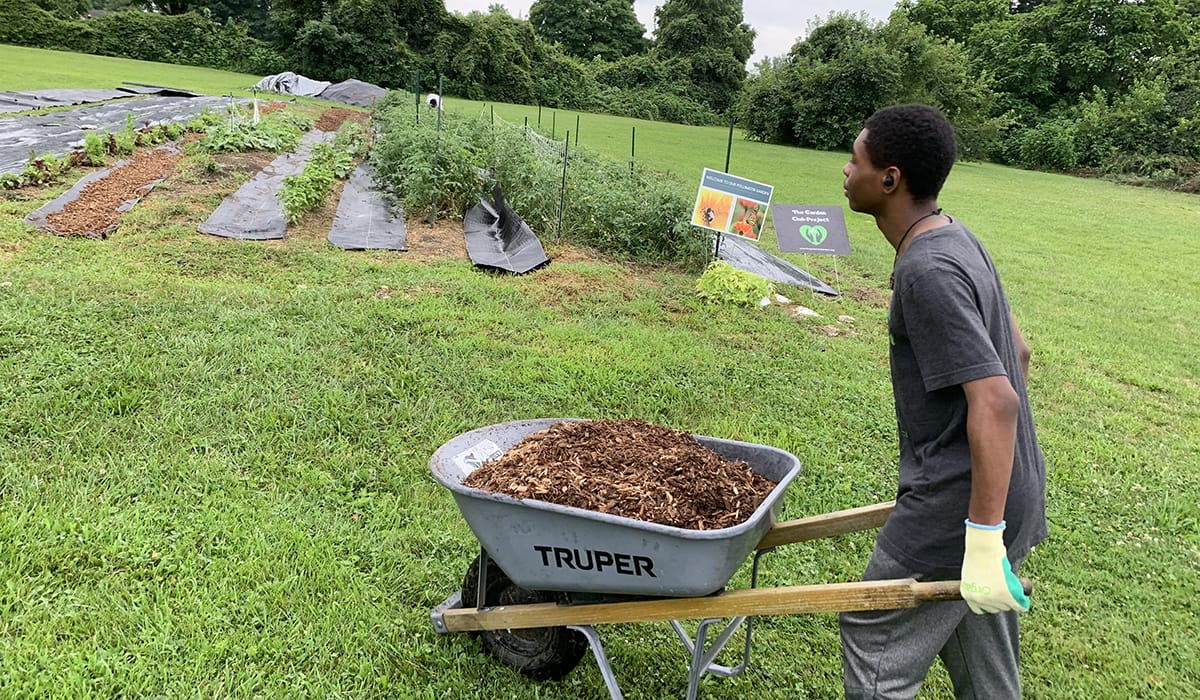
Te’Lario passes his pollination garden as he hauls mulch to his vegetable plot.
He’s well on his way. Since the beginning, Te’Lario’s community gardens have produced more than 2,000lbs of produce serving hundreds of families through local food pantries. Eight years after he started, his mushroom business provides food to local stores, restaurants and community groups. He has inspired others with his story and by supplying hundreds of seed kits to schools and community groups.
“Te’Lario doesn’t let anything stop him. If he puts his mind to something, he’s going to definitely see it through,” Ava states.
He has also raised money to combat childhood hunger and worked with Food Rescue retrieving food from restaurants for those in need that would otherwise go to waste. At the farm, he recently hosted at-risk teen groups to talk about gardening and what he’s learned about perseverance and staying positive.
“Sometimes you have to be patient. Sometimes things don’t work out. And that sometimes you have to reach for your goals with more than you think you have to and work a lot harder than you might have expected to,” Te’Lario says. “Don’t give up.”
Aside from being a gardener, Te’Lario is a sprinter on his school’s track team, a Boy Scouts senior patrol leader and an aspiring food scientist, all before he’s gotten his driver’s license. With growing expertise and resources, compassion for others and strong initiative, he is already making a big impact on his community.
Meet Daily Point of Light Award honoree Lumina Zhang. Read her story, and nominate an outstanding volunteer or family as a Daily Point of Light.
Lumina Zhang’s family immigrated to the United States from China. Growing up Asian American, Lumina didn’t see herself represented amongst activists, but now, as a student leader, she is proud to lead by example and train others to become leaders.
Lumina was shy as a child. She didn’t speak up and wasn’t interested in leadership. Her passion was music. As a 5th grader, Lumina auditioned for the school play and got the lead role. This was a turning point in her life. She realized she loved being on stage and enjoyed public speaking, which led to a change in attitude. In 6th grade, Lumina ran for student government, and while she wasn’t elected, she didn’t let that stop her from trying again. She was elected to student government in the following year and has been in student government since then, now serving as the elected Treasurer of the Maryland Association of Student Councils, the Maryland state-wide student government.
Lumina is also very passionate about environmental advocacy and wanted to create a space to combine environmentalism with leadership development. Aside from founding and running the environmental activism organization Eco MoCo, Lumina gives free piano lessons to elementary school students.
Lumina has inspired her 11-year-old brother to join Eco MoCo and the Montgomery County Junior Council.
What inspires you to volunteer?
I am inspired by the people I interact with. I love the small moments with people and seeing how my work positively impacts the community. I started Eco MoCo’s Elementary Committee, one of the only leadership opportunities for elementary schoolers. At our first Elementary Committee meeting, seeing young students starting to advocate for the environment was so inspiring.
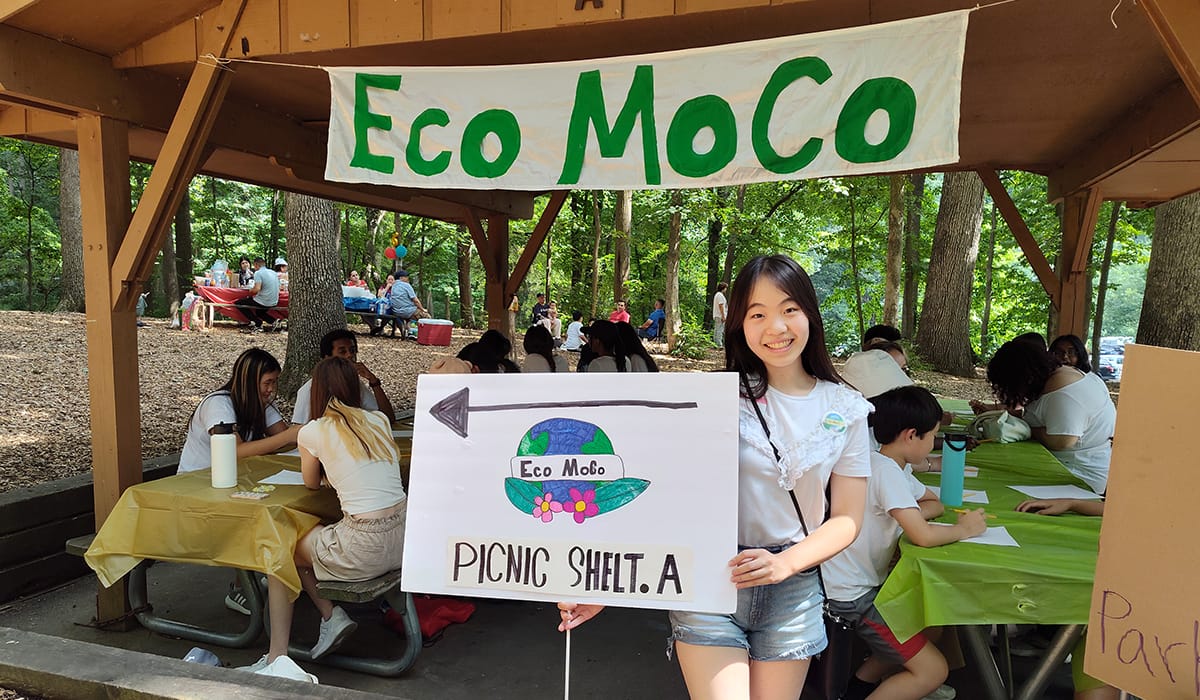
Lumina poses at Eco MoCo’s Summer Kick-Off after leading her Executive Board in an icebreaker activity. /Courtesy Lumina Zhang
Tell us about your volunteer role with EcoMoCo.
I co-founded Eco MoCo in 2022, when I was 14. Eco MoCo raises awareness about environmental issues while providing valuable leadership opportunities to students. Our entire organization is made up of students. The main team, which we call the Executive Board, has 60 students. Within that there are six departments, and many departments also have committees. This kind of structure mimics that of a corporation which makes students familiar with a professional setting. In addition, we have about 40 Eco Ambassadors who help at events.
Currently, I serve as co-president. My primary roles are fundraising, outreach, event hosting, project coordinating and grant writing. This includes planning meetings, communicating with my Executive Board, collaborating with other organizations, designing initiatives and more.
We started Eco MoCo in Montgomery County, Maryland. I have since developed a National Chapters program to inspire students all over the country. Students can create Eco MoCo chapters in their own area, create their own environmental projects and work with Eco MoCo on our No More Trash campaign and sustainability presentations. We give each chapter resources and pre-made sustainability presentations that are presented to middle and elementary school students. I lead my National Leadership Team to conduct outreach, recruit chapter leads and support chapters.
The Executive Board is a part of Eco MoCo Headquarters, which focuses our impact on Montgomery County, since this is where we started. I have supported and led department projects such as an environmental education panel that featured speakers on various environmental topics, fundraisers, newsletters, environmental art contests and more. I have also trained students to be workshop facilitators for our annual Winter Workshop Series.
For Eco MoCo’s very first event in 2022, I coordinated with Montgomery Parks and led recycled art tables where students teach participants to make upcycled projects. “One man’s trash is another man’s treasure” goes the old saying, and people love to see the creative ways they can use trash to make something beautiful.
Part of our operations includes staff development and team building events. We celebrate the moments and the people. It makes the organization a family and fuels everyone’s passion.
Recently, a major policy project advocated for Bill 13-22 which is a bill in Montgomery County that seeks to electrify all new buildings. We collaborated with many organizations on this and helped the bill pass unanimously.
Recently, we have been developing Eco Kits. These kits include LED light bulbs, recycled pencils and other materials that inspire people in the community members to live greener lives. So far, we have created and distributed around 50 Eco Kits.
I dedicate around 60 hours each month towards the organization and have impacted over 3,000 people through Eco MoCo.
What inspired you to get started with this initiative?
I started getting passionate about the environment around age five when my class went on a field trip to a recycling center. There, I learned how a single plastic bag thrown into the recycling bin can damage the recycling equipment and create a dangerous situation for the workers. I started using the arts to convey my message of loving our planet. In middle school, I started an environmental club. The teacher, who was our club sponsor, told me I could completely lead the club and design all of the projects and meetings. This was so inspiring! Before, there had been no adult who gave me the support in planning and following through on projects. Because of this club, I learned how to lead people and create environmental projects.
Later, as part of the Montgomery County Junior Council, I gained even more experience when I led a department of middle schoolers in creating an environmental website and workshops. As I got more involved in leadership, I noticed that the opportunity I had in the environmental club was rare. Many students aren’t provided that opportunity. That’s why I founded Eco MoCo, to give them a way to help as well as a way to become not just the leaders of tomorrow, but also the leaders of today.
What are your long-term goals for EcoMoCo?
I envision Eco MoCo spreading our impact across the nation and eventually across the world. If we have hundreds and thousands of local hubs, we can make a global impact. Every community has students who can potentially lead in making change. I want to create a sustainable organization where each chapter always has resources, project ideas and support from Eco MoCo headquarters. We have created many resources and project ideas that each chapter can use. We have a living document that’s always evolving. It gives ideas on workshops topic, events, projects and policy campaigns. We incorporate ideas from each chapter, and each chapter gives us feedback through an impact report form that helps us create better resources for other chapters.
What’s been the most rewarding part of your work?
It’s rewarding to see the changes I’m making. I remember our very first event when we partnered with a local park and set up recycled art tables. Each station had a student volunteer who helped kids turn trash into art. So many students participated, and we spread environmental awareness. One parent asked if we held weekly recycled art classes. She said this was the first time she’d ever seen an environmental awareness event in the community. Environmental education is practically ignored in schools and she was happy to see this. This inspired me to reach out to other communities, especially to areas that are historically underrepresented.
Our team is absolutely amazing. They are so proud to be in Eco MoCo, so passionate about it and they support it in any way they can.
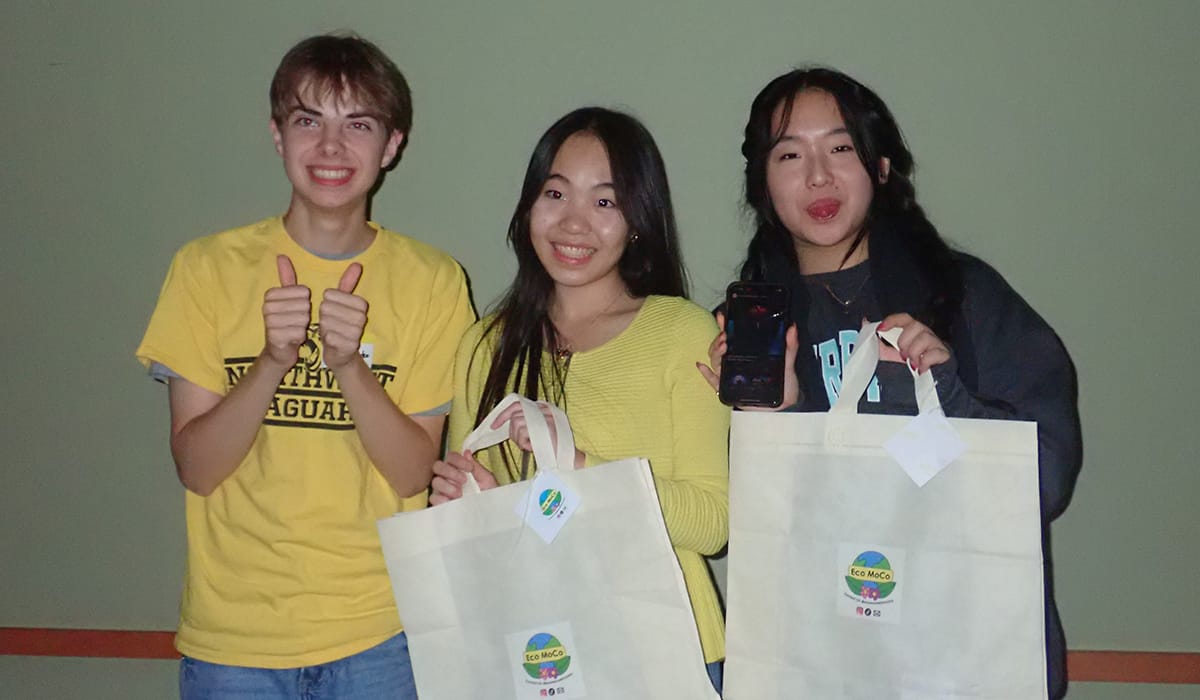
Lumina Zhang (middle, yellow shirt) holds a newly created Eco Kit filled with a LED light bulb, recycled pencil, brochure and other sustainability resources at Eco MoCo’s October Executive Board meeting. /Courtesy Vaniala Andriamalala
What have you learned through your experiences as a volunteer?
As treasurer of the Maryland Association of Student Councils and co-president of Eco MoCo, I developed an understanding of finance and leadership which helped me overcome some of the challenges I’ve faced.
As a young advocate, I’m up against a lot of obstacles. It’s hard to canvas businesses because of my age. Most businesses brush students off. For example, last month I was canvassing. I visited 10 businesses one day and every single person said, “I’ll get back to you later” but they never did. I have learned that perseverance and follow-up is necessary. I also learned to better communicate the value of the impact that my organizations are making and the value of being part of it. In the future, I want to start a company that supports student-led initiatives by helping them obtain funding.
Tell us about future partnerships, programs or events that you are excited about.
Currently, a main project is developing the National Chapters program. We are also in the planning stages of starting international chapters. Middle and high school students can start a chapter and learn more about the opportunity here.
We are also looking forward to creating more Eco Kits.
Our winter workshop series for elementary through high school students is coming up in January. We are currently training workshop presenters. Any student can sign up to attend a workshop here.
Why is it important for others to get involved with causes they care about?
Youth are the ones who are most affected by climate change, emissions and pollution. It’s important we start getting kids passionate about the environment now, before it’s too late.
Having the experience of volunteering and leadership in an area you’re passionate about helps you become a better person. You develop crucial skills, learn more compassion and form better connections. Overall it makes you happier. When you make someone happy through helping, that’s two people who are happier and this also has a positive ripple effect on the community.
Any advice for people who want to start volunteering?
Go for it! For me, there were a lot of challenges so I had to develop the courage to continue doing what I do. Mustering the courage is the most important step. I believe that we are our worst enemies. We talk ourselves out of action but I’ve learned through trying to find my own confidence that you need to take action. Confidence comes one step at a time.
What do you want people to learn from your story?
Your age is not a barrier to making change. Often, people don’t take you seriously, but you have a special power. If you’re young, you are the future. Speaking up about an issue shows power. Kids have a unique perspective. I believe it’s important to involve more youth, to listen to their voices and help them develop life skills like leadership that will help them in the future.
Researcher and Nonprofit Founder Is a Beacon of Hope in the Fight Against Breast Cancer
Meet Daily Point of Light Award honoree Dr. Lopamudra Das Roy. Read her story, and nominate an outstanding volunteer or family as a Daily Point of Light.
Dr. Lopamudra Das Roy’s transition from a distinguished cancer research professor to the full-time founder and president of Breast Cancer Hub (BCH) marks a significant shift in her life’s mission. Her decision to resign from the University of North Carolina at Charlotte in 2017 to dedicate herself to BCH, a GuideStar Platinum Certified, top-rated 501(c)(3) nonprofit organization, demonstrates her unwavering commitment to making sustainable, impactful changes in the fight against breast cancer and all types of cancer globally.
Working primarily in the U.S., Asia, Africa, Turkey and globally through her hybrid model, Dr. Das Roy’s initiatives extend far beyond her home base of North Carolina. Her work involves collaborating with educational institutes, diverse ethnic groups, fellow NGOs, healthcare centers, companies, shelters, refugees and immigrant communities. She hosts powerful workshops and seminars, community awareness outreaches and offers tailored creative messaging and resources. Her commitment to providing scientific medical guidance to each suspicious case or cancer patient is a testament to her dedication.
Dr. Das Roy’s approach is deeply personal. She provides analysis of cancer diagnoses and treatment, assisting patients and caregivers in navigating the complex journey of cancer. This includes supporting the uninsured population in North Carolina, connecting them with vital resources. Her support groups, involving patients, survivors, oncologists, nurses and caregivers from across the U.S., India, Africa and other countries, foster emotional bonding and shared expertise.
Dr. Das Roy also involves students in her mission, inspiring them to create handcrafted cards for cancer patients. These cards, along with the items made by the BCH team, are delivered to local hospitals, bringing joy and comfort to those undergoing treatment.
Read on to find out more about Dr. Das Roy’s inspiring journey.
Tell us about your volunteer role.
I’m a cancer professor by profession, but in 2017 I resigned and started Breast Cancer Hub as a full-time, pro bono volunteer organization. So, it’s humanitarian work with 100% free services. Its inception was primarily because over the years, I realized how so many lives are taken to breast cancer and also other types of cancer due to taboo, ignorance and lack of awareness leading to late detection, lack of access to healthcare facilities, proper diagnosis and treatment management.
All this has motivated me to start the organization, which is all volunteer work. We primarily work in the U.S., India, Turkey, Africa and then globally through a hybrid model.
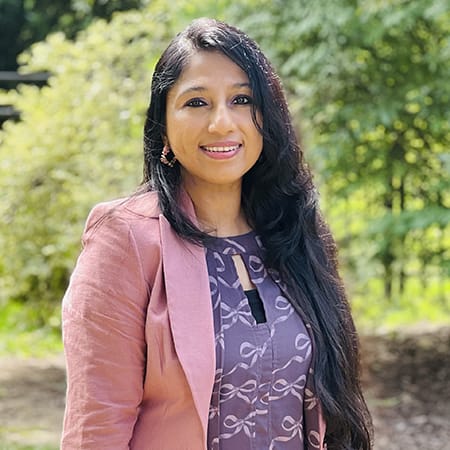
Dr. Lopamudra Das Roy is a former cancer research professor and the founder of the nonprofit Breast Cancer Hub.
Why is this issue so important to you?
My family on my maternal side was affected with cancers of various types – my grandmother passed away from cancer. My father was a pediatrician, and he always spoke to the babies’ moms about breast milk. When I was 12 years old, one of my friend’s mothers passed away. At her funeral, when I went, no one wanted to discuss the cause of death. I was always a curious child, and when someone mentioned she had passed from cancer, I asked where. Her best friend didn’t want to say it aloud. She whispered, “breast cancer” in a very hush-hush way.
At that point, I realized there was a taboo that exists with the word “breast,” and it affected me so much. This was the type of respect we were extending to a mother – that we couldn’t even discuss the disease that cost her life. So, on the one hand, in my household, we were talking about it, and outside of my house, there was this taboo. I thought, if breast milk is so important and we are openly talking to mothers about it, why wouldn’t a woman want to speak about something going wrong in this same part of the body?
Where I’m from in India, cancer became a household name and often meant a death sentence. In the U.S., I was a scientist-reviewer for the Department of Defense Breast Cancer Research Program, and I would meet breast cancer fighters and advocates who were diagnosed as stage 4, even in the United States, because the mammograms had missed their cancer. The next year, when I would go back, these same people wouldn’t be there. It would just be her obituary. So, this became a burning issue for me. I was in the lab as a principal investigator, having grants from everywhere, and I felt that we were not striving toward fundamental changes that could really help save lives.
Providing simple solutions at a grassroots level and really tapping into the community – that’s where we could make a change. So, one day I decided, as I thought about my career, that I needed to do something that would make a change. It was like a calling from inside to start the nonprofit. And for me, “nonprofit” has to be real nonprofit – 100% volunteering. It’s not just about spreading awareness – it’s about end-to-end care.
What are your long-term plans or goals for the organization?
We are trying to spread awareness about male breast cancer, which is why, in our logo, we have a touch of blue.
I live in Charlotte, North Carolina, and we’ve already started tapping into some of the underserved areas here. Focusing on different ethnicities, shelter communities, immigrant populations, the Black community and Hispanic community. There are needs here for awareness and education, so I want to expand that outreach throughout the U.S. through our ambassadors.
In the developing world, we’d like to adopt more villages. We currently have adopted around 20 villages in India. In Africa, we’re often working with the patients. So, we want to find ways to expand more in these developing regions and how we can help more people with our grassroots solutions. As we expand our work more and more, we want to get involved in untapped areas that may otherwise have cancers go undetected.
What’s been the most rewarding part of your work?
It’s not the awards, but rather the smiles and the hugs from people whose lives were saved. All across the U.S. People attended my sessions and learned about mammograms missing their cancer. Men getting detected because we are one of the first to develop a screening process for men. People telling me that our work saved their lives – hearing that is my greatest reward. Even in the developing world, when they’d just give me a hug. Bringing smiles to the families. These are my biggest achievements.
Why is it important for people to get involved with the causes they care about?
I feel that if you really want to work for a cause, motivation should come from within. Students all across the U.S. reach out to me because they want to volunteer. I tell them, “Please do not come to me if your parents are forcing you to do this.” I want them to feel for the cause. I know they need volunteering for college applications, but I want them to get involved in a meaningful way. Become thought leaders. We can support all the organizations, but a volunteer role must come from the heart.
Any advice for people who want to start volunteering?
One day, we all have to leave, but what we leave behind is not our fame or name, but the impact on the lives we touch. This effort is typically selfless at first – I did not get immediate rewards when I started, and now I have many grants and publications. So, if someone wants to gain that experience, I’d say to count the blessings, not the material aspects of the work.
What do you want people to know about taking charge of their own health in regards to breast cancer screening and prevention?
Early detection is the key to saving lives. This starts with a screening protocol. In the case of breast cancer, screenings start after the age of 40. Screening means that there are no concerns, and so anyone 40 or over should go for a screening mammogram each year. But mammograms may also miss cancer. So now I’m telling everyone to opt for 3D mammograms, which uses higher-resolution technology. These can catch more in the way of denseness concerns.
Additionally, young people – women, men or any other gender – can get breast cancer. So, we have to go for clinical breast exams from early on. That means doctors or healthcare professionals should be checking our breasts at our exams. Very importantly, we’ve developed breast exam cards, for the first time, for both her and him. We have these available in 24 languages. Leverage our resources. Start from the age of 17 or 18 and complete this self-exam every month. Everything is mentioned on the card, including how to do this. We have to be able to understand the look and feel of our breasts to detect any abnormality. That’s applicable for all genders and ages.
For those who are at high risk for breast cancer, meaning people with a family history of it, they should go for screening mammograms earlier than the recommended age of 30. There’s a lot of resistance, even in a very advanced U.S., to screenings. I have patients reach out to me at very advanced stages of cancer solely because of the resistance to the healthcare system that they’ve had or grew up with. So, these are ways we can take charge of our health – to break the breast taboo and the cancer taboo and go for our screenings.
Teen Raises Money for Causes Around the World Through Writing
Meet Daily Point of Light Award honoree Sanjith Sambath. Read his story, and nominate an outstanding volunteer or family as a Daily Point of Light.
Sanjith Sambath started volunteering at a young age, and when he was in 8th grade, the COVID-19 pandemic hit. Through his grandparents, the now 16–year old heard about children in his home country of India struggling to continue their education without the technology or internet connection that’s needed for virtual learning. For the past three years, Sambath has conducted writing and reading workshops and tutoring and has raised money for kids around the world with his organization Writing for a Cause.
So far, Sambath has raised thousands of dollars for causes he cares about. He also joined Key2Finesse, a student-run nonprofit, to contribute to $300,000 of charity work.
What inspires you to volunteer?
I’ve spent a lot of time volunteering and getting involved in my community. Me and my family have benefited a lot in the past from service and my parents would not be in the place where they are today if not for the actions of the community. Giving back and allowing people to have that same journey that I have been so fortunate to have really keeps me inspired with Writing for a Cause.
Specifically with my fundraising efforts with my second nonprofit, which is Key2Finesse, it’s a passion for me to just be able to not only spread the message but also make such an impact on people who are willing to give up funds and donations and contribute tangibly to the cause itself. So I guess being able to be as convincing as possible, spreading the message, getting involved in the community and then being able to see a tangible representation of the impact that you’re making in other people’s lives are the biggest deals to me.
Sanjith Sambath conducts workshops, tutoring sessions and has raised money for kids around the world with his organization Writing for a Cause.
Tell us about your volunteer roles with Writing for a Cause and Key2Finesse.
Writing for a Cause is the organization that I started in the summer of my eighth-grade year and this was in the middle of the COVID-19 pandemic. I was stuck at home with virtual school and I know for us it wasn’t the biggest issue since we were just staying at home. It was an inconvenience but my grandparents kept telling me stories about kids in the villages who were struggling to go to school and adapt to this new lifestyle. Here in the U.S., we have the capabilities to adapt to this lifestyle but in other places around the world it was a lot harder. Our schools could afford the wifi and the tablets. I just really wanted to do something about students being restricted in going to school. In a lot of places education is the one way to get out of poverty and make a better life for themselves. It’s the gateway to a better life.
In the beginning of Writing for a Cause, I tried to raise money through a variety of ways by just asking for donations and stuff like that, but I thought that being able to do something in exchange for money could have a bigger impact. I decided to use one of my skills that I was working on for a long time, which was writing. I’ve always loved it from a young age. I thought I could use this skill and passion to raise money for students in need. I ended up having one writing contest and a writing workshop. I also do one-on-one workshops. So far, I’ve done around 150 hours with 50 individual students. I’ve had kids from multiple U.S. states, U.K. and Singapore. I’ve raised around $3,000 for charity so far to go to twelve different causes like schools and students who need tuition — things like that. Most recently we were able to fund the purchase of desks and tablets for students in India.
Around the same time, I joined Key2Finesse and every year we host different writing competitions, readings, different classes and workshops. I started off as a participant in one of the competitions and then became a volunteer with the organization.I worked throughout eighth and ninth grade to raise money for causes in my local community. Now I’m an executive board member for the Key2Finesse team. Every year we focus on fundraising for a different charity of choice. In the past, we’ve supported families impacted by cancer, food banks and more. Each year our fundraising goal grows, and we reach out to big businesses in town.
What’s been the most rewarding part of your work?
I think, obviously, doing the actual work behind the organizations is always great, like actually doing the tutoring or raising the money. But the most fulfilling or the most rewarding part of these experiences for me at least is seeing the impact that is actually being made and seeing the kids who we’re helping to fund. It’s always amazing that at Writing for a Cause we’re able to get a video of the children who are jumping for joy because of the desks and the tablets. People just light up when I talk to them about the causes that I’m working with and why I’m so passionate about them. And even seeing people get so invested in helping me fundraise for different causes — I think that’s definitely the most rewarding part.
What have you learned through your experiences as a volunteer?
In the very beginning, when I started with Writing for a Cause I was very reluctant to start reaching out to people asking for donations and for them to hear what I had to say. But what I learned is that people will listen to what you have to say if you have a mission that you truly care about. So, because I have a passion for the organization, I learned how to pitch myself in a way that people wanted to listen. And because of that, I learned that people are much more open to the idea of supporting me through enrolling in my writing classes or enrolling in the competitions that I was hosting. And really they were open to the idea of helping and they’re open to the idea of helping me in supporting these different causes.
What do you want people to learn from your story?
I think the biggest thing is just to go for it. You never know what kind of impact you’re going to make in someone’s life until you start. I had no idea that I’d be able to raise the money that we were asked to raise or that I had no idea that we would actually be able to reach out to businesses and have them agree to give a portion of their proceeds towards this incredible cause.
If you truly believe in something, if you truly believe in the cause that you’re supporting, then there is no such thing as rejection. There’s only learning opportunities and you will find success a lot more than you might first expect.
Chicago Resident Reaches Out to Support Troops Through Letters of Comfort
Meet Daily Point of Light Award honoree Nam Nguyen. Read his story, and nominate an outstanding volunteer or family as a Daily Point of Light.
Nam Nguyen is the embodiment of the American dream. Nam could be the poster boy. Immigrating from rural Vietnam in 2013, he was 16-years old and, with minimal English skills, new to Washington state. His last two years of high school—and concurrent ESL program—was challenging, but he became the first in his family to graduate high school and go to college.
After struggling through the application and financial aid process on his own, he graduated with a degree in business administration with a concentration in international business and marketing while setting a school record as the first and only student in the university’s history to study abroad on all seven continents. Continuing to excel, he started to work full-time while earning his master’s degree from Johns Hopkins University.
Nam now lives in Chicago and works for BP. He has never forgotten the support he found along his journey and dedicates thousands of hours to helping others. His volunteerism has earned him the President’s Volunteer Service Award from the last three administrations as well as the prestigious Diana Award and Starbucks Community Champion Award for his community impact. His work spans tutoring at local libraries, helping those in mental health crises as a counselor for Crisis Text Line, and most recently, writing letters to deployed servicemembers with Soldiers’ Angels. This year alone, Nam has spent more than 1,000 hours writing 1,921 letters with Soldiers’ Angels, an organization designed to provide aid, comfort and resources to military members, veterans and their families.
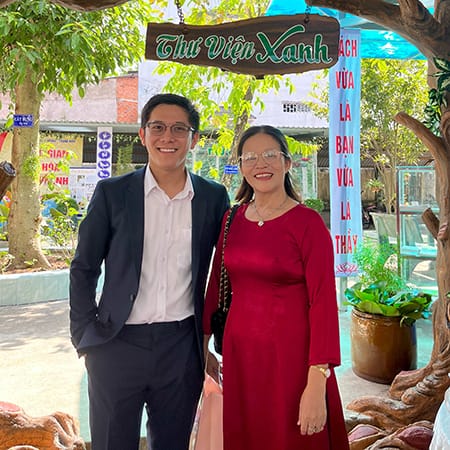
Nam Nguyen {left} and a middle school teacher from rural Vietnam stand in front of the Green Library initiative, a project he endowed to establish an open, flexible and nature-centric library space benefiting nearly 1,500 students at her school.
What inspires you to volunteer?
When I first came to the U.S., I experienced some discrimination and bullying in school. There was a time that I was really depressed and anxious, but I received a lot of support from nonprofit organizations, the school advisor and counselor. Volunteering is the way I can help people in similar situations.
I was first introduced to volunteering because we were required to have a few hours to graduate. I completed that but fell in love with the feeling of being able to help people and make an impact. I’ve been involved ever since, about 12 years now.
I still remember my first volunteer positions. The first was the King County Library System in Washington. I was a K-12 tutor for one of their programs and helped students complete their homework and understand their lessons. My second opportunity was as tutor with Neighborhood House, a nonprofit where we taught English and citizenship classes to immigrants and refugees, helping them realize their dreams of becoming U.S. citizens.
Tell us about your volunteer role with Soldiers’ Angels.
I’m an active volunteer with the letter writing team. We write and design postcards and write letters to send to deployed service members. I have been with them for about a year and a half now.
What are your long-term plans or goals with the organization?
My company provides financial support to eligible organizations that we volunteer with, including Soldiers’ Angels. For every hour that I volunteer with them, the company will match that with financial support. Over the past two years, I’ve helped raise $7,000 through that match. I’ll continue to support them understanding that they not only need people volunteering their time but also financial support for sending out other things like coffee and socks to service members.
What’s been the most rewarding part of your work?
Sometimes, I get a letter back from a deployed service member that basically says that my letter really touched them. We forget that a lot of soldiers don’t have anyone who communicates with them from home, so it can feel lonely. Those letters serve as the boost of emotional support that really lets them know they’re not forgotten. I find it extremely rewarding to be able to do something for people who serve the nation.
Do you ever carry on back and forth with people, or is it usually just one or two exchanges?
I do keep in touch with some of them, yes. I’ve only gotten back a few responses. Sometimes people just see a letter and read. For the people who actually respond, they write me back on a postcard of where they are located. Like, if they are deployed to Germany, they would send me back a postcard of Germany, and then I respond back and keep in touch.
Nam virtually joins follow nominees and young leaders from around the world in accepting the prestigious Diana Award, named after the late Princess Diana, for their humanitarian work in 2022. He was one of 20 to receive the honor from the United States.
What have you learned through your experiences as a volunteer?
The first thing is the sense of contributing time, energy and effort into serving a higher purpose. I’ve become a more compassionate and empathetic person. I really immerse myself in the experience and have learned more about myself, too.
Why is it important for others to get involved with causes they care about?
Volunteering and engaging in community service is really a good thing. We all have something to contribute. And when we are involved in service, our collective effort will make the world a better place. We can’t just sit back and ask for the world to change. We have to actually be the change.
It’s also a really rewarding experience. Whenever people ask me what my hobbies are or what I enjoy doing, I say I enjoy volunteering. And putting that into the context of my own story as an immigrant who came here and received a lot of support is really emotional to me, and now I try to pay forward.
What do you want people to learn from your story?
I really hope that my story inspires others and motivates them to get involved in volunteer service. That would be beautiful.
Meet Daily Point of Light Award honoree Jack Dalton. Read his story, and nominate an outstanding volunteer or family as a Daily Point of Light.
It’s not often that a 13-year-old goes on speaking engagements around the world. It’s even less common that he has written a children’s book, but Jack Dalton is a rarity. The child of a nurse and a teacher, Jack grew up moving around a lot. It was a stint in Memphis, however, that changed everything. Jack was 8 years old. He and his mom had a membership to the local zoo. They would walk over a couple of times a week.
“The orangutans were always my favorite. In particular, Rowan the orangutan, who was a baby at the time. I just fell in love,” Jack recalls of his fellow redhead.
Lexi Yang, now caring for primates at Utah’s Hogle Zoo in Salt Lake City, was the zookeeper at the time and a passionate conservationist. As a fan of the orangutans and their mischievous, puzzle-solving ways herself, Lexi was determined to teach visitors about why they’re endangered and how people can help.
“I threw a birthday party for Rowan, who was turning 3 […] and made it Dr. Seuss themed, because he has a lot of really good conservation quotes,” she says. “I made a lot of signs and messaging about palm oil and orangutan conservation.”
Palm oil, a product derived from the oil palm tree, grows exceptionally well in Sumatra and Borneo, Indonesia, which are the only places in the world orangutans live naturally. In order to plant more palm oil plantations, people cut down rainforest vegetation, causing orangutans to lose their natural habitat. Lexi recommends using an app called Palm Oil Scan to ensure you only buy products using oil from farms that use good practices.
“If you use it while you’re shopping, you can easily scan a barcode, and it will tell you if the product that you want to buy has sustainable palm oil in it or not,” Lexi states.
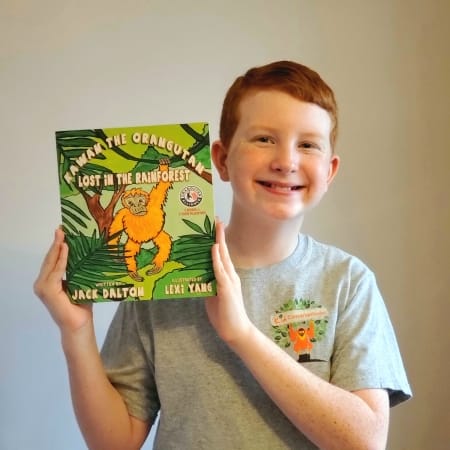
Jack Dalton, the “Kid Conservationist”, dedicates his time to raising awareness about how to get orangutans off the endangered species list, including by writing a book, Kawan the Orangutan, Lost in the Rainforest./Courtesy Jack Dalton
Needless to say, Jack learned a lot at the birthday party that day and was spurred into action to save his furry friends’ species.
“I decided to write letters to three companies about their palm oil usage,” he recollects. “And ever since then, I’ve just been doing more and more conservation work in the name of getting orangutans off the endangered species list.”
Jack then asked his parents to film him for an educational video to put on the YouTube channel he later named Kid Conservationist to reflect his new venture and differentiate himself from the crowd. It took off from there, especially after the COVID-119 pandemic hit. Parents and teachers were thrilled to have educational material, and people have viewed his videos more than 1 million times in 100 different countries.
Orangutan Alliance, an international conservation organization, saw one such video and asked him to be a youth ambassador. That’s when the presentations and fundraising events began. Using his longtime hobby of designing PowerPoint presentations made preparing fun. Jack was excited to be able to have purpose beyond designing a “Welcome home, Mom!” slideshow and jumped at the chance to speak at schools, museums, zoos and beyond. He expanded his reach through documentaries, podcasts, blog articles and emceeing fundraisers.
“[Jack] has so much passion and enthusiasm for it as well as being a phenomenal public speaker. I would have never been public speaking when I was 8 years old. He speaks to very large crowds and does it extremely well,” Lexi asserts.
Jack has since acquired similar responsibilities at Orangutan Republic—where he raises money to send conservationists to college in Indonesia—Borneo Orangutan Survival USA and Plastic Coalition. He’s grateful for these partnerships that have amplified his impact. He has also independently raised more than $20,000 for animal rehabilitation, education and reforestation.
A couple of years later, at age 10, Jack wrote Kawan the Orangutan, Lost in the Rainforest when he reconnected with Lexi for a YouTube interview. Jack considers Lexi one of his biggest inspirations and mentors and asked her to do the illustrations. Lexi, a self-taught artist who has sold pieces for conservation fundraisers in the past, modeled the characters after Rowan and his mom. It’s a heartfelt story that does more than educate readers.
“For every book sold, a tree is planted in the Indonesian rainforest. It’s one of my proudest accomplishments as the Kid Conservationist, and it’s sold over 3,000 copies,” Jack says.
The duo has stayed in touch through various projects, and last year, Jack invited Lexi to join him on a trip to Indonesia with Orangutan Alliance.
“We started in Borneo and spent the first three days on a river boat floating downstream looking for wild orangutans and other wild animals,” Lexi reminisces. “That was the first time we got to see orangutans in the wild.”
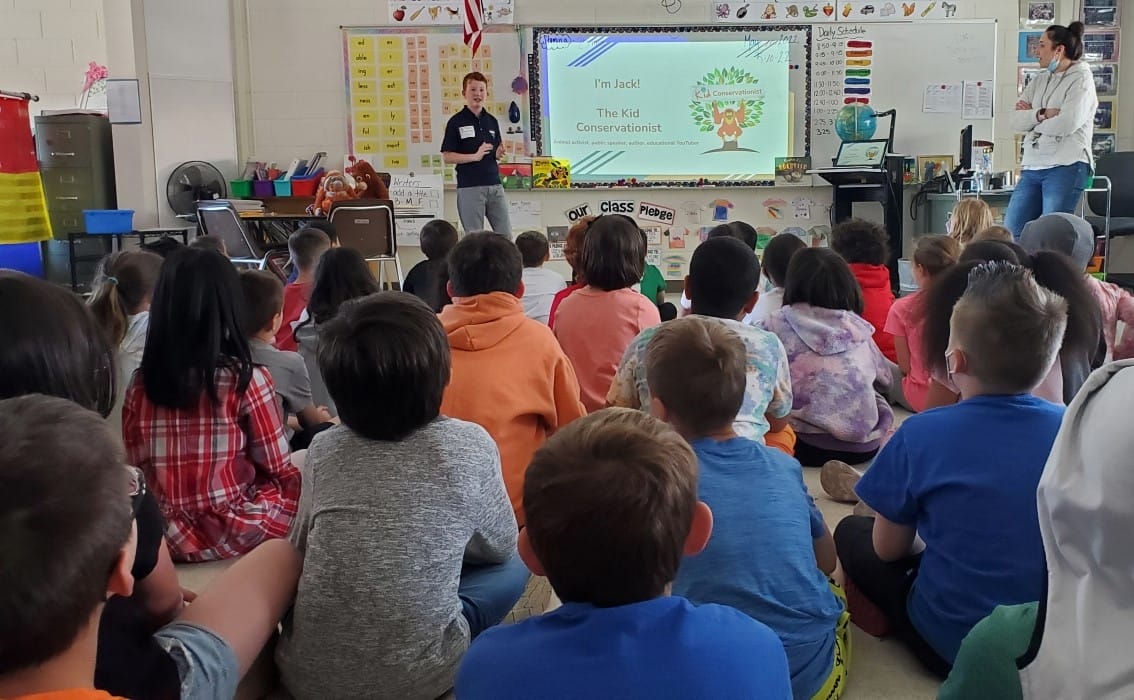
Jack leads a presentation for students at a New Hampshire school including information on orangutans, the rainforest, deforestation and what they can do to help./Courtesy Jack Dalton
Jack was struck by how they test their weight on the branches before they swing on them. With substantial body mass—females weighing up to 150 lbs and males nearly double that—they are cautious movers.
Along with their expedition into the rainforest, they spent a day with a Dayak tribe and visited a wilderness-based school where students learn from the outdoors. They donated copies of the book and provided funds for the school to purchase some much-needed, locally-sourced furniture.
“It was really neat getting to meet people my own age, who I couldn’t really communicate with because they spoke another language but who were learning English,” Jack adds.
One of their final stops was to personally plant some of the trees that their book proceeds funded. It was an experience that reinvigorated Jack’s motivation.
“Jack says that I was his inspiration, but now, he inspires me,” Lexi says. “As zookeepers, we’re passionate about animals and wanting to teach people how they can help save them, but we never really know if that’s going to go anywhere. The fact that this one person listened to me, and he’s taken it so far, has been more than I could have ever imagined.”
Aside from caring deeply, Jack says he’s an activist because it’s fun. He loves making videos, writing and talking to people about orangutans, though it’s the last of these that he finds most rewarding.
“When you go in [to a speaking event] and see these kids, they look pretty bored. And once you start presenting, you see their faces light up with excitement,” he says.
Once, after he presented at a school and donated copies of his book, he got a package with thank you notes and hand-drawn pictures from each of the kids. Inspired and grateful, he felt like he had planted a seed that would one day lead the students to take action.
“No matter how old or young you are, you can start making a difference. Now is the best time to make a change. Some experts say orangutans could be gone within the next 10 years. If we want to help them, we better help them now, before it’s too late.”
Brother/Sister Duo Brighten the Lives of Forgotten Seniors
Meet Daily Point of Light Award honorees Colette and Anthony Gentile. Read their story, and nominate an outstanding volunteer or family as a Daily Point of Light.
As a high school junior, Colette has a passion for the arts, piano, theater, photography and writing. Aside from being a motivated student, she leads many clubs, volunteers at a museum and started an anti-bullying committee for middle school students at her school. Her 8th-grade brother, Anthony, is interested in sports, coding, technology, mixed martial arts and piano. The pair has taken these passions to a new audience: seniors who are often lonely and disconnected from their families. Their nonprofit, Siblings for Seniors, is a way for generations to come together and bring meaning to life.
What inspires you to volunteer?
We have always felt a void since we only know one of our grandmothers, who lives with us. Both grandfathers passed away and our other grandmother lives across the country, so we do not get to spend much time with her. In addition, we saw how happy our great aunts and uncles were when we visited them. Not only did it bring them joy, but it warmed our hearts as well. Since the simple act of visiting and showing we cared made such an impact on our extended family members, we realized we could touch the lives of our community’s senior citizens by volunteering.
Tell us about your volunteer role with Siblings for Seniors.
Most of our time is focused on spending quality time with seniors living in senior care facilities. We do crafts, play trivia games like Jeopardy or Name That Song, and sometimes we play the piano for them, but mostly we sit and talk. We have conversations about when they were younger. They share their experiences and they’re curious about ours. Some of these people don’t have family or other visitors so it’s a special time for them to spend a couple of hours with us.
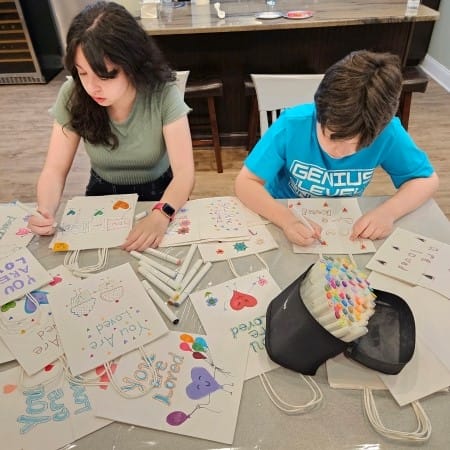
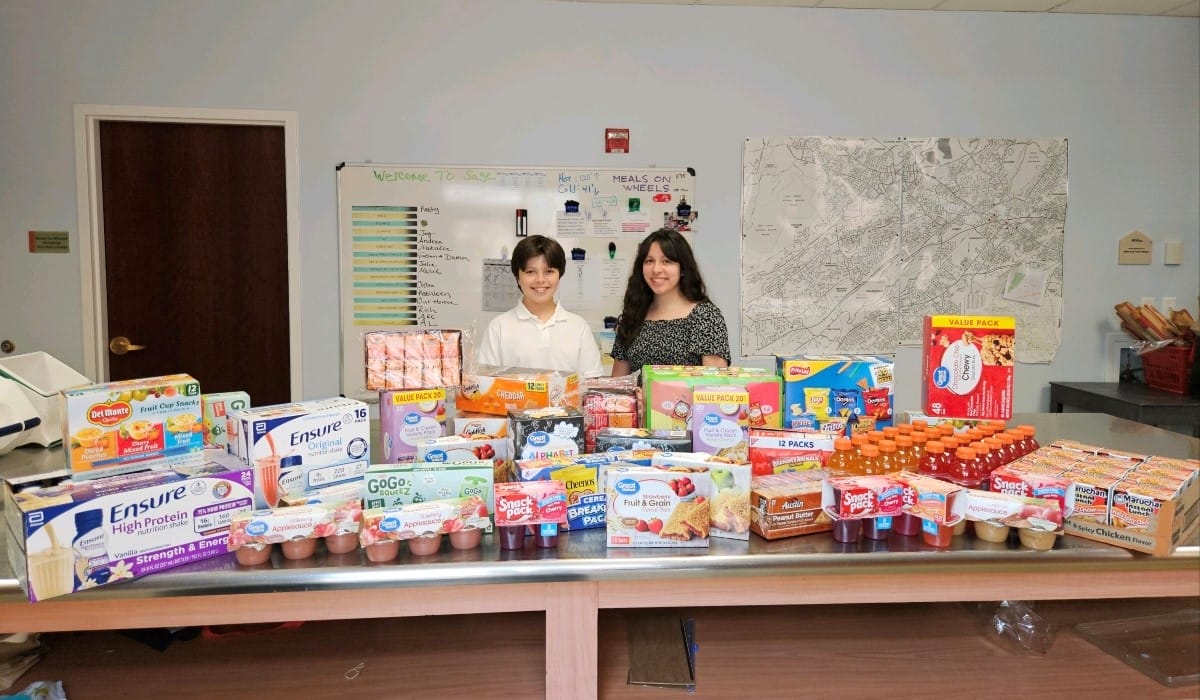
Colette and Anthony decorating gift bags filled with pantry items for a Meals on Wheels fundraiser./Courtesy Colette Gentile
Our goal is to visit a senior facility almost every weekend. We spend about two to three hours at each visit. We volunteer about 10 to 12 hours each month. We fit it in around school and other activities. If you really want to do something, you’ll find the time.
We wanted to do something else besides spending time with the seniors. We realized there are many seniors who are food insecure. We found a local Meals on Wheels and wanted to help them with this issue. Since we cannot help deliver meals because they only do it during the week when we are in school, we came up with the idea to raise money for Meals on Wheels by doing simple bake sales. My brother and I bake cookies, cupcakes and other treats and then sell them to friends, family, and colleagues of our parents. We then take 100% of the proceeds and either present a check to Meals on Wheels, or we purchase much needed pantry items for them.
We’ve also made care packages that are delivered with each hot meal brought to the seniors. We purchased plain white gift bags that my brother and I decorated with inspirational notes and drawings. The gift bags contain goodies like granola bars, fruit cups, instant soup and other shelf-stable items.
We held a bake sale this past October which funded the purchase of puzzles, yarn and games for the adult day care center affiliated with the local Meals on Wheels chapter. To date, we have raised over $2,000 from our seven bake sales. Beyond the bake sales, we recently canvassed for donations from local businesses, something we had never done before. Our original goal was to raise $2,500 by the holidays. We have already donated $1,500 from that fundraiser and with checks still coming in each week, we expect to reach our goal.
What inspired you to get started with this initiative?
I [Colette] attended a girl’s leadership camp the summer before entering seventh grade. For the conclusion of the program, we had to develop an action plan that would have a positive impact on the community. I knew immediately that I wanted to work with seniors given my personal experiences with my elderly relatives.
I put an action plan together and was hoping to get it off the ground within a few months, but it was halted by the pandemic. During that time, my brother Anthony expressed his interest in joining with me to make a difference and in 2021 Siblings for Seniors was born.
What’s been the most rewarding part of your work?
Our motto is, “Two hearts, one mission.” Forming relationships with the seniors we see weekly is so amazing. We’ve known most of them for two years. They will often say that we brighten their day. It is very rewarding to know we are making them smile and bringing them joy by simply showing them we care.
Anthony and Colette dropping off pantry items to Meals on Wheels from a late summer fundraiser./Courtesy Colette Gentile.
What have you learned through your experiences as a volunteer?
Getting to volunteer with seniors was something we had never done. Being with them has taught us the value of having empathy toward people of all ages, cultures, and backgrounds. We see how many of them are so lonely and depressed and it has helped open our eyes. We’ve also become great listeners and have learned the importance of patience.
Tell us about future partnerships, programs or events that you are excited about.
We always try to do something special for holidays. We usually wear elf hats or festive attire during our winter holiday visits and hope to visit more often during our school break. My brother came up with the idea of a “Cozy Feet” fundraiser, where we took the proceeds from a bake sale and purchased warm socks and slippers for all of the residents of one of the assisted living facilities we visit most often. The seniors were so surprised and excited. We couldn’t believe how such a small gesture really made a difference. Looking ahead, we are excited to present the last few donations which are still coming in from our fall fundraiser. In the new year we will surely plan another bake sale as well.
Why is it important for others to get involved with causes they care about?
A small group of people can change the world if they do their part. If everyone did a little, it would build so much momentum. Volunteering also has a lot of personal value. When we reflect on our values and passions and do something around them, the whole community benefits.
Any advice for people who want to start volunteering?
We didn’t have many opportunities to volunteer because of our ages. Many organizations won’t accept kids younger than high school. When we first became interested in volunteering, we were 12 and 9, which is considered too young, so we started our own initiative. Whatever you are interested in, there’s a way to help. Reach out to organizations and if you’re too young for that, start something on your own.
What do you want people to learn from your story?
Be kind to your elders. Have empathy and express gratitude to them for paving the way. Remember, they came before you. They deserve to be respected and to be remembered. You’re never too young to start something that can make a difference.