Empowering Future Innovators by Expanding Computer Science Education
Meet Daily Point of Light Award honoree Sanjit Kakarla. Read his story, and nominate an outstanding volunteer or family as a Daily Point of Light.
Recognizing a critical gap in computer science education in his community, Sanjit Kakarla launched a movement to spark interest and accessibility in coding for students of all ages. Beginning with a school coding club to assist peers with their computer science coursework, Sanjit expanded his outreach to elementary school students, teaching CS fundamentals and improving digital literacy outside the classroom. His early efforts laid the foundation for larger-scale initiatives, including summer boot camps with local library systems that reached 240 students over just 10 weeks.
Driven by the success of these programs, Sanjit founded The CodeConnect Foundation, now known as Student Code Alliance, a nonprofit organization with branches in 50 states and global reach in countries like Rwanda, Bangladesh and Kenya. Through in-person and online workshops, the organization has educated over 4,300 students, providing $19,000 in free tutoring since its inception. The nonprofit also collaborates with community groups like the Indian American Cultural Association to offer personalized tutoring, ensuring that computer science education is accessible to diverse populations across the United States and beyond.
One of Sanjit’s standout contributions is his development of an open-source curriculum available in both English and Spanish. Covering five programming languages, this curriculum equips students to learn foundational coding skills and pursue passion projects that address real-world social issues. Sanjit’s innovative teaching approach not only builds technical skills but also inspires students to think critically about how technology can drive social change. From app development to data-driven solutions, these projects empower students to harness coding for meaningful impact.
As the president of Student Code Alliance, Sanjit oversees 68 branches, leads a team of over 300 tutors and managers, and dedicates 20-30 hours each month to tutoring and organizational growth. His vision and dedication have transformed computer science education into an inclusive and dynamic field for thousands of students. By bridging educational gaps and fostering creativity, Sanjit is paving the way for the next generation of tech innovators.
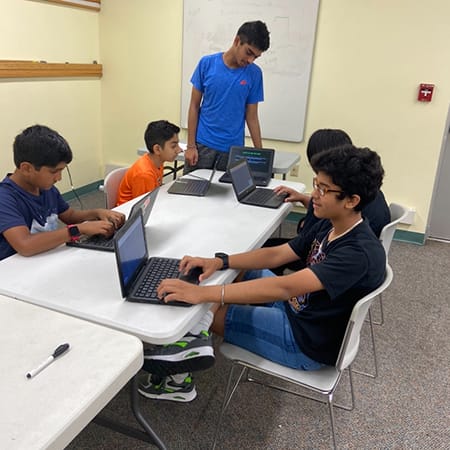
Sanjit Kakarla facilitating a hackathon preparation meeting./Courtesy Sanjit Kakarla
Tell us about your volunteer role.
My volunteer role consists of founding and leading the Student Code Alliance (formerly CodeConnect Foundation) community organization, motivating students of all ages and backgrounds to create socially impactful code projects and mobilizing multilingual code education. As someone always passionate about STEM and computer science, throughout my academic career, I’ve sought opportunities to learn about these fields from online lecture videos led by professors. Although I thought these videos were helpful, I quickly recognized that for students aiming to learn to code, the difficult jargon, lack of personalization and applicability to a learner’s life – plus the fact that most of these resources were paid – made it clear that youth programming education needed an upgrade.
Upon spearheading this organization and serving as the founder and president of Student Code Alliance, I have worked alongside a team to develop a socially-focused curriculum with over 50 lessons in five programming languages in English and Spanish. The specialty of our organization is that rather than teaching students to code to eventually pass a test, we teach over a period of 10 weeks, allowing students to gain a love for specific programming languages and develop a project that meaningfully impacts society at the end of the session.
Initially, I worked with libraries through school clubs to organize free, in-person summer coding camps for passionate students township-wide. As these camps began to gain traction and many other high schoolers statewide began to recognize this issue behind code education, our organization began expanding to over six cities within New Jersey. Within a year, we have seen significant expansion with branches in all 50 US states and five countries including Bangladesh and Rwanda, ultimately impacting 4,300+ learners.
Why is this issue so important to you?
This issue is so important to me because I’m a strong believer in the idea that education needs to become more accessible to individuals of all backgrounds. As someone who’s seen the difficulties of traditional computer science educational resources and their inability to effectively teach students, I’ve recognized that educational equity must be made a priority for everyone. I want anyone who is interested in learning how to code and understanding how the technology that governs their daily lives works, to have the opportunity to broaden their horizons and learn for the sake of learning!
In second grade, I personally attended numerous tutoring programs at school and at local libraries, and I was amazed that these volunteers were high-school students. I’ve always admired how these volunteers dedicated their time to sit down with me and help me answer homework problems I was initially struggling on. Reflecting on it, these experiences taught me the impact of volunteerism in fostering educational equity.
What inspired you to get started with this initiative?
Once I joined high school, I was very fortunate to take advantage of the numerous computer science courses my high school offered in VisualBasic, Java and Python. Taking the introductory CS course as a freshman, I quickly recognized that despite these courses, there was no place where students could receive mentorship and join a larger community of computer science enthusiasts. I wanted students to understand the larger implications of what they were learning in class and have the opportunity to innovate outside of the classroom alongside peers and friends. The CS classes at my school helped me learn a variety of ways to effectively teach STEM topics, and eventually, I formed educational mentorship student-led organizations leading outreach activities that eventually grew into the Student Code Alliance organization.
What are your long-term plans or goals for the organization?
Currently, we are in the process of hosting a significant hackathon, MindfulnessHacks, which will allow students passionate about CS to collaborate and build software to boost student mental health, such as chatbots that lead mindfulness breathing exercises. In the future, we hope to host larger coding competitions surrounding other socially relevant topics, teaching students that what they are learning truly matters.
Our open-sourced curriculum can be simply requested from our organization. We hope to use our curriculum to assist and form partnerships with other computer science nonprofits just starting up. In many states, we are now looking to start multiple branches to create a greater network of Student Code Alliance globally. With topics in ethical-AI becoming more and more relevant in our digital world, we are developing additional courses to our curriculum on navigating AI ethically, alongside topics such as Blockchain and Machine Learning.
What’s been the most rewarding part of your work?
Two years ago, I led a summer camp as part of this organization, inviting K-8 members of my local community to learn very basic computer science skills. As I worked with a highly driven team of tutors to lead this summer camp, I was surprised to see these students presenting unique games, such as a basic PacMan recycling-promoting game after only 10 weeks of weekly camp. This experience taught me that students will go the extra mile to innovate when they are taught in a way that encourages creativity.
What have you learned through your experiences as a volunteer?
My experiences as a volunteer have taught me to take initiative as I’ve collaborated with numerous organizations such as libraries and other computer science nonprofits. Working with these organizations has taught me the importance of carefully planning logistics before a collaboration and effectively communicating.
Why is it important for others to get involved with causes they care about?
Everyone must recognize that they can make a serious positive impact on causes they care about as long as they break that initial barrier of hesitance. Working in the community helps individuals learn their skill sets and what they truly care about, which will lead to improvements in various skills including communication. On top of fostering personal growth, getting involved with causes locally helps individuals create positive, empowering communities.
Any advice for people who want to start volunteering?
Start small with your time commitments and learn what you are truly passionate about. Many people think of volunteering as something very difficult to get into and find. Honestly, try to make volunteering a part of your daily life when you can. There are so many organizations around you that are looking for volunteers to serve and aid their growth. Take advantage of every opportunity – no matter how minor you think these opportunities are – because your efforts truly add up. Finally, volunteer as a way to explore academic fields you are interested in with a community-centered lens.
Beacon of Hope Lighting the Way in Hawaii and Beyond
Meet Daily Point of Light Award honoree Cheyann Smith. Read her story, and nominate an outstanding volunteer or family as a Daily Point of Light.
Cheyann Smith’s life is a testament to service – to her family, her country and her community. A proud mother of three and an active-duty United States Air Force member stationed at Joint Base Pearl Harbor-Hickam, Cheyann has spent 11 years safeguarding lives. Her volunteerism extends beyond her military service, including serving as a combat volunteer firefighter and founding Beacon – Be the One to Light the Way, a nonprofit organization addressing food and housing insecurities.
Beacon has indeed become a beacon of hope for many, thanks in large part to Cheyann’s leadership. Just weeks ago, she spearheaded an event that delivered $4,500 worth of essential items to 250 residents of Pu’uhonua o Wai’anae, Hawaii’s largest houseless encampment. This effort followed her remarkable two-month donation drive for Lahaina residents affected by the Maui Wildfires – an initiative she led while eight months pregnant. Under Cheyann’s guidance, Beacon has positively impacted thousands of lives, proving the power of compassion and action.
Beyond her nonprofit work, Cheyann uplifts young women through the Cheyann Smith Prom Grant. This annual $1,000 grant ensures an underserved high school senior at her alma mater can fully experience prom, covering costs for everything from dresses to tickets. With a master’s degree in psychology and ongoing doctoral studies, Cheyann’s dedication to supporting others is deeply informed by her academic pursuits and personal experiences.
Recently crowned Mrs. Hawaii America, Cheyann has embraced her platform to further her commitment to community service. From leading impactful donation drives to creating opportunities for young women, she dedicates approximately 90 hours a month to those in need. Read on to see how Cheyann Smith exemplifies the power of resilience, generosity and leadership, lighting the way for countless individuals across Hawaii and beyond.
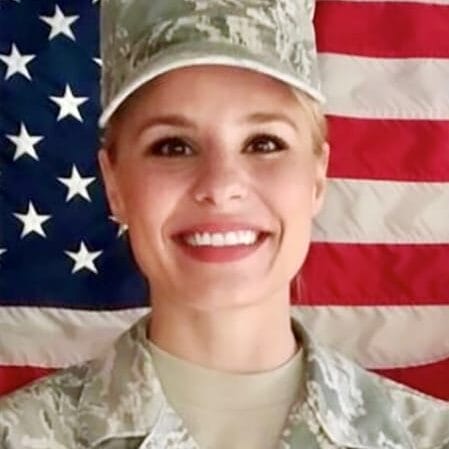
Cheyann in uniform.
Tell us about your volunteer role.
While I am an active-duty member serving in the United States Air Force, I am also the founder and executive director of a 501(c)(3) nonprofit organization called Beacon – Be the One to Light the Way. At Beacon, our mission is to provide necessities to individuals with housing or food insecurities.
Why is this issue so important to you?
As a child, my brothers and I struggled with housing and food insecurities. One night, when I was about 16 years old, I remember laying on a couch my parents had pulled out of the dumpster. I had no bedroom or bed, so this was where I slept. It was the middle of winter, and I was freezing. I looked at the moon through a crack in the window and said a prayer. I asked God to get me out of that environment. I promised that if he did, I would never forget. He got me out, and now I’m just holding up my end of the bargain.
What inspired you to get started with this initiative?
My upbringing inspired our mission, but the company name and logo are a different story. Both came to fruition because my brothers were still unhoused and trying to break the cycle when I created the organization. To pay homage to them and the hardships they were facing living out of their vehicle while going to college, I named the company Beacon – Be the One to Light the Way. The name and logo are derived from a song I dedicated to them called “Brother” by the band NEEDTOBREATHE. In the song, it says: “Everybody needs someone beside them shining like a lighthouse from the sea/Brother let me be your shelter/Never leave you all alone/I can be the one you call/When you’re low/Brother let me be your fortress/When the night winds are driving on/Be the one to light the way/Bring you home.”
From struggling to break the cycle to shattering the glass ceiling and being well on their way to becoming the family’s first medical doctors, I couldn’t be prouder of how far they have come. Today, they are heavily involved with Beacon’s initiatives and are two of our biggest supporters.
What are your long-term plans or goals for the organization?
I know Beacon will one day be my legacy. But for now, while I’m still serving my country, I just work on it on my own time, a little bit every single day. One day it will be big. I don’t know how big, but I do know it will help thousands, if not millions, of people throughout our nation.
What’s been the most rewarding part of your work?
The most rewarding part of my work is the relationships I build with those in need. It’s more than just providing necessities; it’s improving lives, breaking generational circumstances and changing lineages.
What have you learned through your experiences as a volunteer?
I’ve learned to be the change you want to see in the world.
Why is it important for others to get involved with causes they care about?
I think people should get involved with causes they care about because when it’s an endeavor that hits close to home, it allows for real change to occur.
Any advice for people who want to start volunteering?
Find what you’re passionate about and start building from there.
A Student’s Mission to Empower Others Through Art and Music
Meet Daily Point of Light Award honoree Bella Cho. Read her story, and nominate an outstanding volunteer or family as a Daily Point of Light.
High school sophomore Bella Cho loves to step on stage and play her flute for eager listeners. But as the co-president and co-founder of Empowering Arts, an organization founded to positively impact the community and environment through music and the multidisciplinary arts, Bella is sharing that love of music with those who normally might not have an opportunity to hear it.
At just 15 years old, Bella’s mission to bring a love of art and music to the masses is a passionate one. Whether she’s playing the flute alongside her older sister Hannah at a senior center or crafting maracas out of empty water bottles and rice, Bella finds a way to bring the music to the masses. Her love of the arts doesn’t stop at music, however. Bella frequently hosts art classes for seniors in rehabilitation centers, helping them find a therapeutic outlet by using recycled materials to express their creativity.
In addition to helping others find their inner artist, Bella actively encourages her fellow students to volunteer their time. At her high school, Orange County School of the Arts, Bella used her network to recruit 50 other students to participate in volunteer work. Her willingness to encourage others to embrace the spirit of volunteering is an inspiring message for all ages.
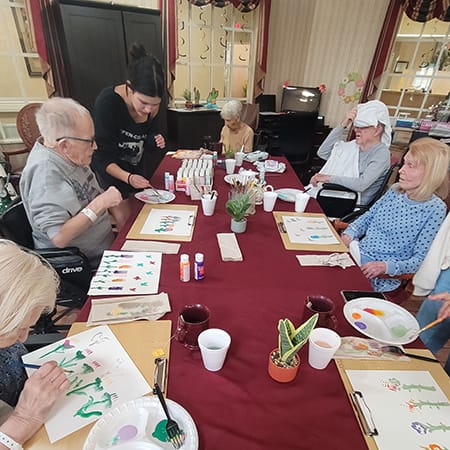
BELLA LEADS A PAINTING CLASS OF SENIORS AT A REHABILITATION CENTER./COURTESY BELLA CHO
What inspires you to volunteer?
I really enjoy seeing the impact it has on different people. Not everyone is as fortunate as others, so bringing this light to them makes me feel so happy. I feel like I’m doing good for the entire community.
Tell us about your volunteer role with Empowering Arts.
I volunteer most with my sister. She’s the president of Empowering Arts and I’m the organization’s co-president. We bring music and visual arts to seniors and children with disabilities. I introduce our organization and perform music on my flute. I have also led art classes where I teach them how to do it using recycled products. Sometimes, we’ll make musical instruments and go to senior homes to play music with them or make paintings with reusable materials. We’ve gotten a lot of positive feedback. They all say they have a lot of fun at the art classes.
We also do this with children. I go to a place called Gigi’s Playhouse, which provides programming and support for people with Down syndrome and their families. We’ve done art with the kids there as well. For instance, we’ll make maracas with rice and water bottles.
What are your long-term plans or goals for the organization?
I really want to grow internationally. Right now, we have a chapter in Georgia, but I really want to spread it all over and share this goal that we have to bring the arts to everyone.
What’s been the most rewarding part of your work?
When seniors say that they feel healed. For example, there was this one woman who said she felt like she was touched by God when she heard our music. I feel like that’s so rewarding for me to know that I’m spreading that joy. It just feels so good when I hear stuff like that.
What have you learned through your experiences as a volunteer?
I’ve learned a lot. I would say I’ve learned compassion through art. Before I started volunteering with Empowering Arts, I kind of played music just to play. I didn’t actually think I could ever make a big change in anyone through music or through art. I learned that art and music can really evoke emotions in other people and spread change.
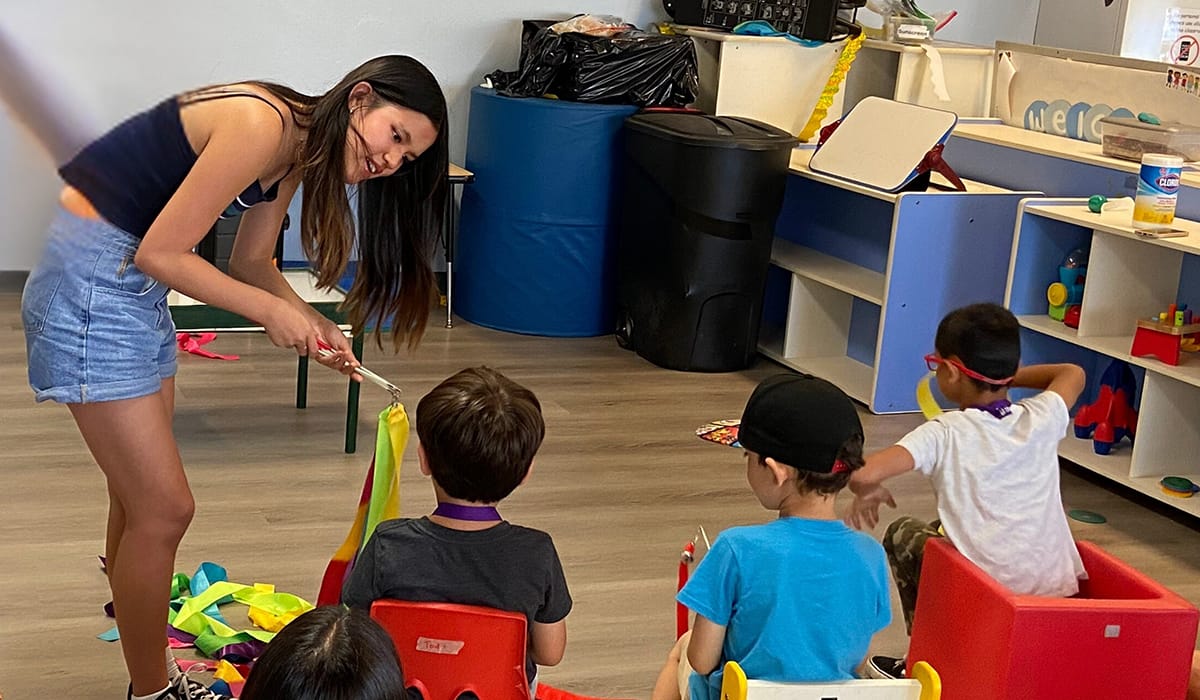
BELLA (LEFT) LEADS A GROUP OF VISION-IMPAIRED CHILDREN IN A RIBBON DANCE AT SUMMER CAMP./ COURTESY BELLA CHO
Why is it important for others to get involved with causes they care about?
If you’re not doing something that you care about, there’s no way to share your passion and make a real change. If you really love doing something, that’s the only way you can truly make an impact. That’s how you spread your love. If you don’t have any true love for what you do, you’re not going to create something big.
Any advice for people who want to start volunteering?
Most schools have clubs for nonprofit organizations. I am the club president at my school for Empowering Arts, and I would recommend going to Club Rush if your school has that. Look into your passions. Expand your horizons. Outside of school, social media has become a really big thing for us. I know a lot of different organizations that are on social media. I would advise going on there and looking for different organizations. It’s pretty easy to find those that are looking for help.
What do you want people to learn from your story?
I hope people learn to really go for what they want to do. When my sister started Empowering Arts, we didn’t really have an idea about what we wanted to do for our passion project. Then we came up with performances, because my sister and I both love to perform with our musical instruments. Go after the thing you love and make that into something big.
Meet Daily Point of Light Award honoree Vick Tan. Read his story, and nominate an outstanding volunteer or family as a Daily Point of Light.
Vick Tan’s passion for promoting mental health through fishing shines in his role with Fish Hut, a nonprofit dedicated to helping youth, one fish at a time. Over the past year, Fish Hut has engaged more than 20,000 children, raised over $19,000 and partnered with 35 corporate sponsors. Vick plays a crucial role in organizing large-scale events, including the upcoming Fishing Festivals in New York and Minnesota, creating opportunities for kids in underserved communities to experience the joy of fishing.
Recently, Fish Hut’s community events at Mamaroneck Marine Education and Van Cortlandt Park, Bronx, brought together over 200 participants, including guest speakers like Senator Mayer and Council Member Dinowitz. Beyond fishing, Vick helps lead the Fish Hut Builder Program, an initiative where young students design personalized fishing huts. This program has become a beloved activity in local schools, fostering creativity and community engagement.
Vick’s efforts extend far beyond events. He dedicates approximately 76 hours each month to Fish Hut’s operations, contacting sponsors, securing partnerships and ensuring smooth event execution. His dedication has helped Fish Hut provide thousands of kids with fishing gear, mentorship and opportunities to connect with nature.
Under Vick’s leadership, Fish Hut is proving that fishing is more than just a pastime – it’s a therapeutic tool for improving mental health, growing confidence and building community. Read on to hear more of Vick’s story of tireless commitment to inspiring young people to cast their lines toward brighter futures.
Tell us about your volunteer role.
Fish Hut was founded almost two years ago now, with the goal to allow every single youth to go fishing, no matter the cost. That’s what we’ve based the organization on, and then we’ve built on that mission. We host three types of key events. The first is fishing contests – sometimes online, sometimes in person. Participants can join, for fun, and win amazing prizes like boat rentals and ice fishing suits. The second type of event we host are fishing lessons. In these events, kids will gather together in places like Central Park in New York City. We have 50 to 100 kids and tons of volunteers who teach the kids how to fish.
The third and final way is through our fishing festivals. These are online festivals where youth can take photos of fish they’ve caught and submit them to our website, then redeem a prize. Recently, we partnered with Nothing Bundt Cakes, so once kids submit a photo of a fish they’ve caught, they can show it to a team member at Nothing Bundt Cakes and get a free item.
As for me, my work within the organization is to be at every single event, organize volunteers, organize sponsorships and co-run the website with my brother, William. We really work to make Fish Hut the best it can be. We’re always expanding, while ensuring that our quality remains. There’s no point in hosting more events if the quality of the events starts to slip, or if we’re not fully sure that a kid is taking away something from the event. We want every event to be of value and ensure that kids are truly taking something away – whether it be a piece of new knowledge about fishing or a rod they’re able to use to fish on their own.
What inspired you to get started with this cause?
Nobody else in my family besides me and my brother goes fishing. When I was 4 or 5 years old, I saw a couple people fishing on a bridge over the Hudson River. It seemed really cool, and I wanted to try it. The first fishing rod I got didn’t even have a hook, but casting it gave me so much joy, even at that young age. Fishing transitioned into something that was not only a hobby, but a great way to de-stress. And that’s the whole point of Fish Hut.
Fish Hut was started to help youth develop better mental health habits. Fishing has been proven to help promote better mental health in youth. There have been many studies conducted on the mental health benefits of fishing, by the National Institute of Mental Health and by the Harvard Research Center. I’ve been able to see how much mental health issues have grown, not only in my community but also across the entire United States. And I wanted to help with that, through sharing fishing.
Youth are only going to go to an activity they like participating in. I haven’t met a single youth who wasn’t intrigued by fishing, by catching their first fish, by seeing what’s under the water. Youth love going fishing! It’s all catch-and-release for Fish Hut. It’s a great way to de-stress and alleviate some of their anxiety.
At the start, as a new nonprofit, it was pretty difficult to get permission. But once you’ve shown the true impact you can have, I think that really shines through. We’ve got a lot more expanding to do, but the support has been incredible. Before each event, we get permission from the park to host each event.
Recently, we’ve been talking to the New York State Department of Environmental Conservation about putting fish huts in parks. Fish huts allow youth to fish whenever they want. You place a box in a school, a library, a park or somewhere similar. The box includes bait, tackle, everything they need. It’s based on an honor system, with kids using the materials and putting them back the way they found them, for the next person to use. We’ve found fish huts to be very successful and the kids love them.
What have you learned through your experiences as a volunteer?
I think one of the biggest things I’ve learned is patience. I’d say I’m a very patient person, but you need to be really patient when you’re working with younger kids. At each event, we bring out 30 or 40 rods, and at least 15 to 20 of them get tangled. It’s super important to have the patience to untangle those rods, one by one, or to touch the bait when little kids don’t want to. Patience is just something that’s required.
One other thing I’ve learned is to go into every situation with a game plan. When I’m calling parks or potential partners or sponsors, it’s so important to go into each situation with a goal, or something we want to accomplish. Being prepared is crucial.
What are your long-term plans or goals for the organization?
We want to ensure that all kids take away something from our events, so we actually don’t want to expand as fast as possible, at the expense of quality. Over the next one or two years, we’d like to expand Fish Hut to over 10 states, aiming to influence over 100,000 people in 2025. We want to expand, we want to keep our quality high and we want to ensure that each kid can take something away from each event.
In a couple of months, we’ll have our largest ever free ice fishing event in Minnesota. We have tents, giant ice houses, all the materials kids could need to fish, hot coffee, hot chocolate and more. It’s an incredible event that really brings the community together and we’d like to grow that event year over year.
What’s been the most rewarding part of your work?
The most rewarding part is seeing kids being able to learn how to fish for the first time and use the fish huts we’ve placed out. One day, I was sitting down at a bench in front of one of our fish huts just to see whether anyone would use it. A kid came up, took out the rod and put on the bait, and went fishing all by himself. That wouldn’t have happened without the fish hut placement. It’s really been my inspiration.
Another aspect is during the events. It’s really incredible to see that not only are we helping youth but helping families in general. Parents come with kids sometimes. Sometimes one is teaching another. I love to see families working together, showing each other how to cast a rod, grabbing the fish for each other. At every single event, it’s fulfilling. The feeling never gets old.
Why is it important for others to get involved with causes they care about?
I want to begin by saying that for Fish Hut, without volunteers, none of the work we do would be possible. I think it’s the same for every single nonprofit around the world. Volunteers really are the backbone of any organization. As much as I can do for Fish Hut, I can’t singlehandedly run an event with 50, 60, 70 kids by myself. It can’t just be a one-man show, or a two-man show with me and my brother. Volunteers are critical to our events.
Volunteering is such an important thing to do, in general. It’s so encouraging to see the impact that you, as one person, can have. Many, if not all, nonprofits thrive on volunteers, and it’s so rewarding for the volunteers themselves.
Any advice for people who want to start volunteering?
Most organizations, like Fish Hut, don’t require a ton of skills in order to be able to volunteer. If you show up and you’re enthusiastic, we’re happy to have you! Many nonprofits have been struggling with not having enough volunteers recently. Whatever you’re able to do – even if you can only come out for 10 or 15 minutes at an event – we’d appreciate it. Every nonprofit would appreciate it.
There are also remote opportunities. We host webinars with mental health experts. So if people can’t show up to in-person events, they can donate time by coming on to talk about their own experiences. You don’t need to have that much time – just a positive attitude and growth mindset – and you can volunteer.
What do you want people to learn from your story?
Look after those you care for personally, as well as those you don’t know. Seeing the impact that mental health can have in your own family or community – not just through fishing, but another sport, or reading or just talking to them. Every day, if you can give three compliments to three people, it’s a successful day. Going into 2025, being kind to other people and showing them that they matter, and that you care, is so important.
Mom and Daughter Duo Teams Up to Help Chicago Community
Meet Daily Point of Light Award honoree Felicia and Amara Johnson. Read their story, and nominate an outstanding volunteer or family as a Daily Point of Light.
Many people rode out the COVID pandemic doing hobbies at home they’d never previously had time for–DIY renovations, gourmet baking and rewatching favorite ‘90s sitcoms. Felicia Johnson, a pediatric nurse at Comer Children’s Hospital in Chicago, dove headfirst into teaching her 13-year-old daughter Amara about community service in a time when people were struggling the most.
“Amara was younger when COVID started, so I was just trying to instill some empathy in her,” Felicia says, noting the desire to find something hands-on for a kid who grew up connected to the internet. “I was feeling disconnected at that time. When we started, it made us feel like we belonged to a community.”
The Honeycomb Project, an organization she found through an online mom group, made it easy to volunteer for families to volunteer together at a variety of kid-friendly places across the city.
“You don’t have to think about what you’re going to do. You get a big list of great activities, and you could pick a different one every week,” she says.
Together, they’ve cooked an entree to drop off for 30 teens experiencing homelessness with Ignite. They’ve bought and packed food for a church to distribute. Amara added some extra cheer with her decorations on the bags. They’ve also sorted and packed kitchen items, like pots and pans, at the Chicago Furniture Bank.
“Amara really loved The Sewing Project where we stuffed an Ottoman and sewed it together for people who were unhoused and newly housed, so that they could have something special in their home,” Felicia notes, lamenting the distance from home making it difficult to do often.
The Love Fridge was another favorite. For a month, the duo was responsible for cleaning, organizing and stocking an outdoor community fridge in Hyde Park. People can leave food to share or take what they need.
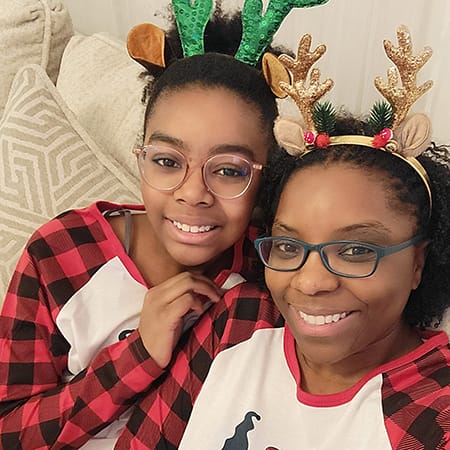
Amara and Felicia celebrate Christmas and plan their next volunteer opportunity with The Honeycomb Project.
“My dad, who passed in June, was with us when we did that,” she smiles. “He was there to drop us off, but he got down and dirty and put on gloves to clean out the fridge.”
Felicia often shares her and Amara’s experiences with her longtime friend, nursing colleague and fellow volunteer Nicole Walton.
“It’s something she’s always talking about, the community and giving back. Like for Christmas, she adopts a family and helps with their basic necessities, toiletries and things like that,” Nicole says. “She definitely has a passion for these things.”
Felicia finds herself particularly drawn to initiatives that help people living with food insecurity.
“I grew up very poor on the south side of Chicago. It was hard to get food. It was a difficult childhood,” she says.
Felicia’s volunteer work began in college, after Hurricane Katrina. There was an influx of displaced people where she was living in southern Illinois, and she wanted to help.
“I was so torn up about it that I used my own money–and I had to work like three jobs in college–to buy toothbrushes, toothpaste, towels and whatever to bring to United Way.”
Today, she hopes to alleviate people’s struggles and teach Amara that she’s able to contribute. Their most recent project was Grow Your Groceries, an initiative near their home that supplies local schools with supplies for students to grow fresh produce with their families. Being in their own community motivates them to encourage others to get involved.
“I put out information on the mom websites. I recruited family and friends to pack boxes,” Felica recalls. “A lot of people have to choose between buying food and buying medicine or buying food and getting on the bus, so this project really helps.”
Dill and okra are currently growing in their own house, but Felicia leans on her mom’s green thumb. Once a month for four or five months, they helped pack around 200 boxes to distribute. Felicia even became a project leader this year and overcame her fear of public speaking by addressing large groups multiple times during each event. While Amara prefers being out of the spotlight, she picked up the extra responsibilities involved in ensuring things went smoothly.
“I’ve known Felicia for a long time, and this is the kind of project and the work she really enjoys doing. She really enjoys educating people and showing them, ‘This is something that we can all do,’” Nicole states.
As the holiday season approaches, the Johnsons are preparing for an event they look forward to–and recruit for–all year, the Honeycomb Holiday Cheer Challenge. The duo has been both volunteers and participants over the last three years this downtown scavenger hunt has been on their radar, but this year, they’ve opted to work on the committee and participate in the festivities.
“We get to carry flowers and candy to take to police officers or to bus drivers. It’s random acts of kindness mixed into a scavenger hunt. It’s also a fundraiser,” Felicia explains.
Felicia was this year’s Arthritis Foundation medical honoree for her research on children with lupus and arthritis. She and Amara also volunteer at health fairs outside of Honeycomb.
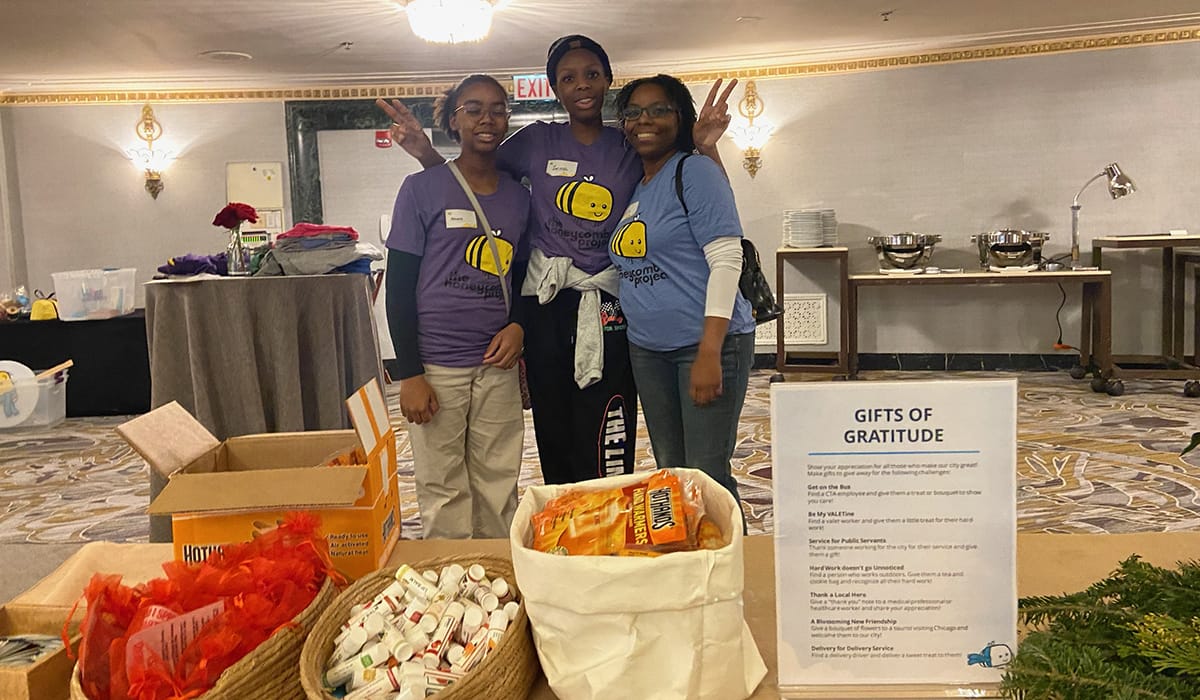
(Left to right) Amara, fellow volunteer Zarinah and Felicia man the flower station at the Honeycomb Holiday Challenge 2023.
“It brings her and Amara together, because she’s showing her, When people are struggling, this is a place that they come for help and resources,” Nicole emphasizes. “I think it’s teaching her not to take things for granted.”
When it comes to learning, Felicia describes Honeycomb as a great place for Amara to practice team building and leadership skills in a safe place with peers. It’s also community-building and eye-opening.
“Get involved. You’re going to be teaching your child skills that they can’t learn anywhere else,” she suggests. “Introducing your child to these types of projects, you’re introducing them to the world.”
Amara has mentioned that it makes her feel good to help other children out. Felicia wants her to understand the different struggles people have and how she can help. More importantly, she wants to show her why she should.
”For me, it’s healing because of how I grew up. There is healing through helping other people,” Felicia reflects. “I get to be a part of giving something to people so that they won’t have to have the same struggles that I had, even if it’s just for one day.”
A Big Heart: High Schooler Helps El Paso’s Community
Meet Daily Point of Light Award honoree Belen Martinez. Read her story, and nominate an outstanding volunteer or family as a Daily Point of Light.
Belen Martinez is a 16-year-old high school student who volunteers in her El Paso community at the UMC Foundation.The University Medical Center Foundation of El Paso provides funding, direct services, and fiscal management for a variety of programs that benefit the people of the Paso del Norte region.
As a volunteer, Belen dedicates 15 hours monthly to the UMC Foundation. She supports events, pitches initiatives and coordinates occasions during this time. But beyond her title, she finds joy in the stories she hears from members of her community.
Belen has been a pillar of her community throughout the years, demonstrating her commitment to increasing the health, safety and well-being of her community members. As she hopes to pursue cardiology in the future, she continues to find joy in working with the UMC Foundation. She found her way to UMC’s foundation through her passion for understanding the heart and its functionalities.
Belen Martinez (left) and other community volunteers cleaning their local highway. Courtesy/Belen Martinez
What inspires you to volunteer?
While growing up, I watched how simple acts of kindness transform someone’s day. My family always believed that if you can help, you should, and that shaped who I am. When I joined the UMC Foundation, I felt like I was stepping into something bigger than myself. I find joy in helping people and the feeling of giving while seeing the relief on their faces is powerful. In those moments, I realized that if I could help bring even a tiny amount of peace and comfort to families like them, I knew this was precisely what I was meant to do.
Tell us about your volunteer role with UMC Foundation.
My service with the UMC Foundation has primarily focused on fundraising and community outreach, and we’ve supported millions of families. We also make little cards and notes about our trips to the hospitals. I recently wrote a little book for them about the heart and how it works. I’m interested in cardiology, so that was something I enjoyed doing and making. We’re also creating a space where families feel less alone, and we take this opportunity to remind them that they have an entire community rallying behind them in some of their most challenging moments.
What are your long-term plans or goals for the organization?
I am a junior in high school with plans to graduate next year. Even after leaving my community, this is not where I will end. Absolutely not.
Since starting in 2018, I have immersed my entire community in the UMC Foundation. I want to continue to make an impact and help better my community. When I go to college, I want to continue a subgroup of the foundation, in another area.
What’s been the most rewarding part of your work?
The most rewarding part of my work has been making family and community smile. There’s nothing better than knowing that you helped someone. When you give, you’re giving more than just the material itself. It helps to remind people that they are not alone and they do make an impact.
What have you learned through your experiences as a volunteer?
Well, I have learned a lot. When I was little, I didn’t understand how things worked, so they just put me on the sidelines to watch. Over the years, I watched as people began to step up and help; it genuinely began to inspire me. It’s been amazing watching my transformation from a mentee to a mentor. This has been an instrumental learning path, and now I am completing tasks independently.
Tell us about future partnerships, programs or events that you are excited about.
I founded a club school called the Hispanic Student Union. We have many members right now. I want to begin putting other foundations together because if you don’t see the initiative making that much of an impact, then we can have other high school students allow us to make a further impact.
Belen Martinez smiles in 2018 while starting her journey as a UMC Foundation volunteer. Courtesy/Belen Martinez
Why should others get involved with causes they care about?
It’s important to know that when someone is there, they do it because they care not to receive kudos. They are there to help you, and in their eyes, it is all done out of kindness and from their heart.
You must realize that, and you have to replicate the same energy that others are putting in because, at the end of the day, it’s a question of what if this happens to your family? What if no one was there for them? You have to replicate that energy.
Any advice for people who want to start volunteering?
Volunteering is a very broad word. Where do I start? What do I do? Just picking up trash from your school premises makes a difference. My interest group would clean up trash in the driveways. As we collected trash, we would hear people honking to thank us for our service. Doing this service would make me feel so positively impacted and it would make my day.
Any advice I would give would be to start small and get bigger. Once you start getting the formula, the rest will come quickly.
What do you want people to learn from your story?
I want people to know that anyone can make an impact. I am a 16-year-old high school student, but I’m still trying to make an impact. The UMC Foundation has led me to make a significant impact in my community and in my future professional career. The work I do with UMC has more than positively impacted my life. From a youngster in 2018 to all I am doing now, anyone can make a significant impact within their community; just put your mind to it.
Teaching Others to Be Prepared Is a Way of Life for This Volunteer
Meet Daily Point of Light Award honoree Susan Casdorph. Read her story, and nominate an outstanding volunteer or family as a Daily Point of Light.
Susan Casdorph takes being prepared to a whole new level.
Growing up in West Virginia, Susan experienced food insecurity. After moving out of state for several years, she found herself facing financial troubles after a divorce, but this time with children to support. Upon returning to West Virginia and flourishing professionally as a legal secretary and transcriptionist, Susan swore she’d be ready for anything that came her way, and that meant becoming an expert in emergency preparedness.
For the past three years, Susan has served as a volunteer at Heart + Hand Outreach Ministries, a community-based organization that supports neighbors with their emergency basic needs. She offers fellow West Virginians guidance on everything from planning a garden and crocheting a hat for winter to building a 72-hour kit, filled with the supplies a family would need for up to three days in the case of a natural disaster or emergency. Offered free of charge, Susan’s classes are a means of building community, sharing knowledge and helping someone else who might not be ready to go through a difficult time.
Susan’s favorite moment is when someone in one of her classes shares that they now feel ready to take care of themselves no matter what happens. A leader in the Heart + Hand community room, Susan’s efforts have empowered hundreds of her neighbors over the years to live better lives. Her unwavering dedication to community service is truly inspiring.
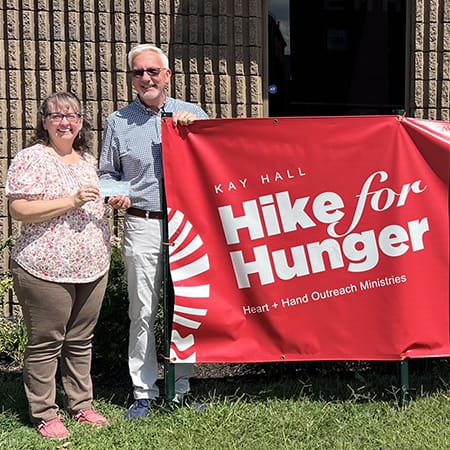
SUSAN CASDORPH PRESENTS A DONATION CHECK FROM BOWLES RICE LLP TO HEART + HAND OUTREACH MINISTRIES IN SUPPORT OF THE FOOD PANTRY. /COURTESY SUSAN CASDORPH
What inspires you to volunteer?
I think some of this is rooted in when you’re a child and your family struggles to put food on the table. That food insecurity made its way into my adult life. I was married for five years and I had two children, and then we divorced. I was a single mom and I was always struggling to give them what they needed. We always ate, but sometimes it was just beans and rice. When my youngest was 11, we moved back here to West Virginia. Once I got here and I got working, things got a little bit better.
Our church is very excited for people to be as self-reliant as possible. I started learning about this stuff, and I started doing it myself. I wanted to be the type of person who had food on hand so that I never had to worry about going hungry.
Tell us about your volunteer role with Heart + Hand Outreach Ministries.
I teach a two-hour seminar about all different kinds of emergency preparedness, and just being prepared in general. But it’s not just that. Some of the classes that we’ve taught over the last couple of years have been about what to do if you have to evacuate your area. Here in our valley, we have a lot of chemical companies, so everybody who lives here always has that in the back of their mind. You can learn how to cook over a fire or how to cook with a Dutch oven. We also do sewing, canning and crocheting classes.
What inspired you to get started with this initiative?
Young people are just really not interested in preparing for disasters. A disaster isn’t just a hurricane. All it would take would be a three-day trucker strike. We learned that when COVID hit, and everything closed down for two or three months. Within a week, you couldn’t get toilet paper. What you find is when you have storage at your home and you have enough stuff stored up, you never miss a beat. Being prepared ourselves helps us be able to help someone else who is not able to be prepared. There are a lot of reasons why you want to prepare yourself.
What’s been the most rewarding part of your work?
I love to hear someone say they feel like they can do this. This is something they can accomplish and they feel safer because they know that no matter what happens, they’re going to have what they need. When I see somebody who has taken a class about building up their pantry, and they say they never knew you could do that, it makes them feel like they have some control and can anticipate what may be coming down the line. I love to help someone else be excited about taking care of themselves.
Tell us about future partnerships, programs or events that you are excited about.
We’re going to get a crochet circle involved in making hats. We’re going to teach you how to crochet hats of different sizes, especially to use up that extra yarn that you have around the house. Then we’ll be able to give those out in the wintertime to those who can’t afford them, or to unhoused people. We’re also going to do a quilting class next spring, and we’re going to teach people how to make a quilt. Then we’ll donate that quilt to Heart + Hand and do a silent auction for the food pantry.
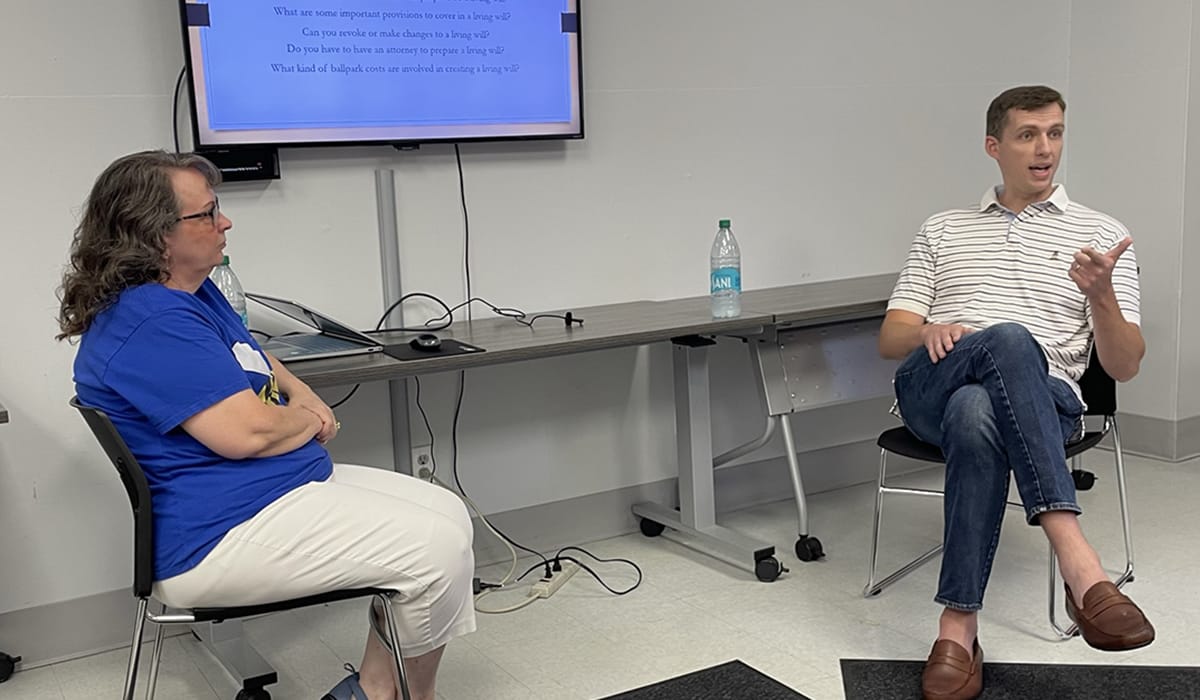
SUSAN CASDORPH (LEFT) AND ATTORNEY THOMAS FRANCKE TEACH A SEMINAR ABOUT FINANCIAL AND ESTATE DOCUMENTS. /COURTESY SUSAN CASDORPH
Why is it important for others to get involved with causes they care about?
If no one gets involved, nothing will get done. Maybe you’re a retired plumber and you installed pipes all your life. You can get involved with a place that needs people to tell them how to change out a faucet or how to stop a leak. People don’t always know that. If you know how to do something, it’s important to share it. That’s what we’re here for on this earth.
Any advice for people who want to start volunteering?
There are all kinds of volunteer websites, and all you have to do is go online and say you want a volunteer opportunity in your area, and I guarantee you’re going to find somebody who’s looking for people to volunteer. You can always ask if nursing homes always need volunteers. If you’ve got a food pantry in your area, call them up and tell them you have a couple of hours a few times a week and ask if there is anything you can do to help. I guarantee you they will find something for you to do. Look for people who serve others, because they’re always looking for folks to join them.
What do you want people to learn from your story?
Anybody can do it. I don’t have a higher education. I got my GED and went through 11-and-a-half years of schooling. I never went to college. I’m a legal secretary now and was a transcriptionist for years. These are things I learned how to do. Anybody can learn anything. If you want to learn it, you can learn it. I think what’s most important to know is that everybody has worth. Everybody has skills and abilities that they can offer to help someone else who hasn’t learned them yet. It is so easy; you just have to look for it.
Accessing the Inaccessible: One Student’s Mission to Share the Arts
Meet Daily Point of Light Award honoree Jasmin Rossi. Read her story, and nominate an outstanding volunteer or family as a Daily Point of Light.
When Jasmin Rossi was a child, her mom signed her up for classical ballet classes, and the indescribable joy Jasmin felt expressing herself through the medium of dance quickly ignited her passion for it. Fourteen years later, a high school senior, she trains around 17 hours a week. She can’t imagine letting it take a back seat in college, where she plans to study political science and is scouting for a club to join.
Her love of ballet has not only inspired her to mentor younger dancers but to assist with the biggest hurdle to the sport, finances. Jasmin’s organization, Tutu & Tulle, has raised more than $5,000 to assist 40+ low-income dancers through studio scholarship programs.
While ballet holds a special place in her heart, her desire to increase access extends across the arts. This focus drove Jasmin to join the Miami-Dade County Youth Commission and, subsequently, to work with the Department of Cultural Affairs to do just that. She has coordinated efforts with 200+ cultural organizations to bring arts programming to underserved communities. Dedicating 80+ hours each month, Jasmin’s passion has and continues to enable young people across the county to enjoy, participate in and pursue education in the arts.
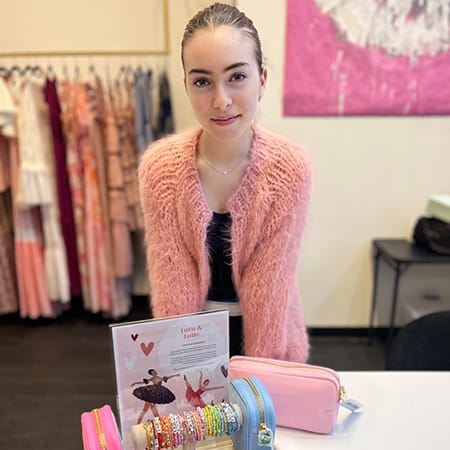
Jasmin Rossi, founder of Tutu and Tulle and member of the Miami-Dade Youth Commission, sells bracelets at The Poolclub Monaco boutique./Courtesy Jasmin Rossi
What inspires you to volunteer?
I developed Tutu & Tulle my sophomore year of high school, but I got started with the concept in the midst of COVID. A friend had just gotten into an awesome ballet summer program. She was super excited about it, but the associated costs were an impediment for her family.
We used the friendship bracelets I’d been selling at my mom’s retail store to fundraise, and she was able to purchase two pairs of pointe shoes. It was small but really meaningful. Now, we work with three dance schools as well as my mom’s boutique to sell bracelets and fund dance education.
The Youth Commission was also a product of my COVID experience. I was watching the City Commission’s live-streamed meetings from home and found them interesting, so when the opportunity arose, I applied to join the Youth Commission in an effort to become more civically engaged.
Tell us about your volunteer role with the Miami-Dade County Youth Commission and Tutu & Tulle.
There’s a committee within the Youth Commission–the Cultural, Arts and Community Engagement Committee–that’s dedicated to expanding access to cultural opportunities in the county. Last year, I served as vice-chair of that committee, and this year, I’m the chair.
We’ve put forward a lot of policy proposals and implemented multiple initiatives. For example, our cultural arts newsletter goes out to over 30,000 students. We’re working on a Miami-Dade Public Library system arts mentorship program connecting young artists with professionals and supporting career development.
Another major project is our interactive cultural arts map that allows students to learn about opportunities available near where they live or go to school. It catalogs events available after school, organizations that have free or low-cost events, after-school programs centered on the arts, etc.
This summer, I also worked on building a volunteer program for Tutu & Tulle, so there are now volunteers in eight states helping out. I send them supplies. They make bracelets and send them back for distribution.
What have you found to be the biggest hurdle to accessing the arts?
For ballet specifically, cost is a real impediment. It costs over $100,000 to raise a pre-professional dancer–tuition, summer programs, leotards, pointe shoes and the like. For most families, that can’t be incurred without support.
For other art forms, some of it has to do with simply raising awareness about available opportunities. What we found in the Youth Commission is that Miami-Dade has, for example, many organizations for young musicians, but not all of them are widely known. The idea behind the cultural arts map is to spotlight those organizations both with that and our newsletter so that more young people can use them to advance their interests in the arts.
What are your long-term plans or goals for these organizations?
As the volunteer community expands, one of my main goals for Tutu & Tulle is to create a youth advisory board and to eventually have co-presidents. I want this to remain a Miami-focused initiative led by young adults as I transition to college. Bringing more awareness and increasing student involvement are my two goals for both areas of my volunteer work.
What’s been the most rewarding part of your work?
It’s in the conversations I’ve had with people I’ve been able to impact. When I was able to help my friend purchase her pointe shoes, it was very meaningful to me, and I’ve seen that replicated with other young people and other friends.
It’s been wonderful to see that I have the power to make an impact. It’s fulfilling. And I think the other students on the Youth Commission feel the same way. The fact that we’re able to inspire and strengthen our community is the most rewarding aspect of the work.
What have you learned through your experiences as a volunteer?
Working as a group helps everyone realize their potential, dream big and do more to achieve collective goals. I’ve learned to lean on and learn from those who have experience, similar interests and great ideas. Listening is very helpful.
Tell us about future partnerships, programs or events that you are excited about.
It’s not a formal partnership, but this year, I became engaged with Culture Shock Miami, an offshoot of the Department of Cultural Affairs. We work to provide $5 youth tickets to top cultural performances and events throughout the county. I’m excited to combine our efforts with the Youth Commission to expand our impact.
What do you want people to learn from your story?
Reflect on how you can share your passion with others. There are many ways to get involved, no matter your interest. Hopefully, my work can serve as an example for what you can do when you work with your peers to help advance the things that you care about in your community.
Feeding the Houston Community and Beyond, One Meal at a Time
Meet Daily Point of Light Award honoree Alex Cai. Read his story, and nominate an outstanding volunteer or family as a Daily Point of Light.
Alex Cai, a sophomore at The Kinkaid School in Houston, has been a force for good since co-founding The Food Lounge in seventh grade. Over the past three years, this nonprofit has grown to 10 locations with over 500 members. Through his leadership, The Food Lounge has delivered 60,000 hot meals and distributed 350,000 supply boxes, reaching 380,000 people in need.
Alex’s volunteerism goes beyond logistics. Averaging 10 hours a month, he organizes Houston-area events, including fundraisers, food bank sessions and soup kitchen initiatives. So far, he’s spearheaded 40 events this year alone, working with local organizations like the Houston Food Bank and Loaves and Fishes. His hands-on leadership fosters teamwork and inspires peers to take action.
The Food Lounge has also had a broader impact, earning 60 student members the President’s Volunteer Service Award last year. Alex is focused on long-term goals: tackling Houston’s food deserts and expanding partnerships to fight food insecurity on a larger scale. Under Alex’s guidance, The Food Lounge is more than a nonprofit – it’s a growing movement of young changemakers committed to creating a more equitable, food-secure future.
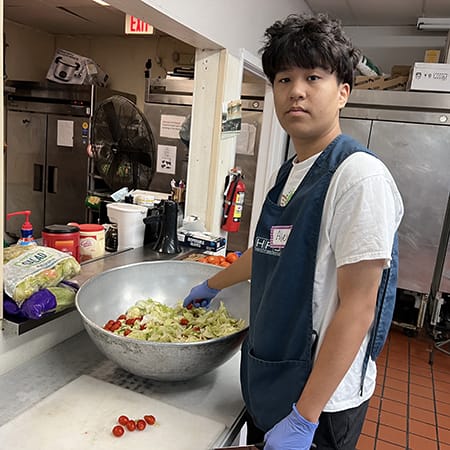
Alex mixes a salad to serve to the Houston community for lunch as part of a larger goal to reduce food insecurity.
Tell us about your volunteer role.
I’m the vice president for the headquarters and manage a lot of the website. Where I live, for the Houston chapter, I organize and attend events, do membership recruiting and chapter formations, where I look to expand our organization to more cities so we can have a wider impact across the country. We’d originally started the organization as two chapters, in Dallas and Houston, but we now have 10 chapters all over the country, including Oklahoma, New Jersey and more, where I’ve worked with other people interested in these issues and give them the opportunity to voice their concerns and make an impact on the community.
Why are you inspired to get started with this initiative?
When I was a kid in elementary school, I went to a refugee center in Italy, which was my first experience volunteering and my first exposure to some of these issues. I donated a few thousand dollars with my brother, which went toward helping refugees. I saw a lot of kids my age, which surprised me, how many my age were struggling with food insecurity. This experience inspired me to help others my age, as I’m fortunate enough and have the privilege of not having to deal with food insecurity. I wanted to use the resources I had to help those who do live with food insecurity. That’s been my goal from a young age.
For the past few years, I’ve really gotten to accomplish some of those things in our community and across the country. But we’re hoping to expand even further with our efforts. While most of this originated when I was a kid, my inspiration also grew during COVID when a lot of people were home. In the news, I could see that people who needed food couldn’t go out and get it, couldn’t leave their homes and prices were going up. So that drove me toward this cause even more. I felt like it was an opportunity to make a difference in my community.
What’s been the most rewarding part of your work?
When I go out and volunteer at different food banks, donation centers and fundraisers, getting to see the smiles on people’s faces and hear their thanks is what keeps me going. It feels like I’ve actually made a difference in someone’s life. I really want to have a broader impact in our community, and it is rewarding when you’re able to see that tangible impact around you. The impact is one of the most rewarding things – seeing how much we can improve what’s around us, even as high schoolers.
What have you learned through your experiences as a volunteer?
I’ve learned not to take anything for granted and to be grateful for what I have. I didn’t grow up with food insecurity but many people in my community did. I want to stay grateful, and doing this work has really allowed me to get a different perspective on how other people live. Many of these individuals are very similar to me; they just don’t have the same access to food.
Tell us about future partnerships, programs or events that you are excited about.
We do partnerships with local restaurants around Houston. We partner with them to get gift cards or hot meals, and we’re looking to expand that even more around Houston. We’re also hosting new events. In the past, we’ve raised money by selling cookbooks and we hope to expand that further as well. Beyond that, we recently had some events that aren’t necessarily food-related, like community concerts, events to raise awareness about breast cancer and more. Our organization is not just focused on food insecurity, but also responds to health issues, natural disasters like hurricanes and more.
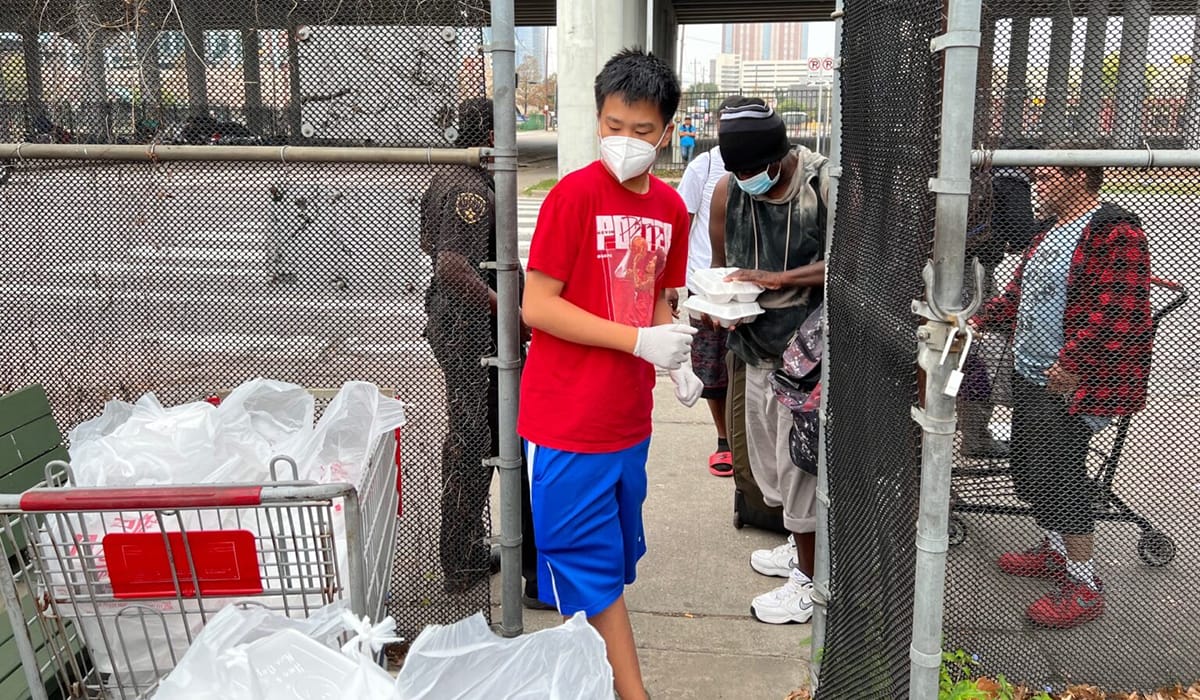
On New Year’s Eve, Alex Cai distributes 200 hot meals donated by a local restaurant at a soup kitchen.
Why is it important for others to get involved with causes they care about?
You never know when you can make someone’s day. Volunteering gives you the opportunity to make lasting change. It also helps give you a new perspective of what you enjoy. Whether it’s policy making, food insecurity, environmental issues, being able to volunteer with causes gives you a new perspective on what people go through. It also shows you what’s being done about the issues, what other cities are doing and what we can possibly do as a city to help.
Any advice for people who want to start volunteering?
You can begin anywhere. Volunteer one time at a shelter or food bank and see how you like it. The hardest part is getting into it, so try different things and see what you enjoy. Finding ways to volunteer in the areas you’re passionate about matters. Whatever issue you’re fighting for, no matter whether you think you’re making an impact, know that you are directly benefitting people, animals, the environment or whatever the cause area is.
What do you want people to learn from your story?
Food insecurity is one of the largest issues our community faces, especially with rising climate change and more droughts. Around 16% of people in Houston are food insecure. There are food deserts across this area. And every year in the U.S., we waste over 1 billion pounds of food. I really believe that everyone can play a part in coming together, reducing waste, donating food or time through volunteering and helping our communities.
Retired Navy Vet Offers Fellow Veterans Cab Rides and Conversation
Meet Daily Point of Light Award honoree Kelly Cook. Read his story, and nominate an outstanding volunteer or family as a Daily Point of Light.
Kelly Cook, now 68, grew up in Southern California and joined the Navy in 1973. He spent the majority of his 20-year military career in San Diego when he wasn’t at sea on one of 10 ships he would call home.
After his retirement, his desire for a lower cost of living and random chance landed him in Greensboro, NC. He had never been there and didn’t know a thing about the place, but that was where he met his wife.
It was also where his second career began at Lowe’s Home Improvement Store. When he bought his first home, he ended up going there so much as he was learning how to do residential home construction, he got a job in management that he kept for another 18 years. And when his second retirement didn’t stick, he wound up working for a fellow veteran with the City of Rocky Mount. Two years ago, his third retirement lasted. Working with veterans did, too.
Kelly found himself in a position to help and, thankful for his own health, decided to give back to those who served who weren’t as lucky. As a driver with the VA and Disabled American Veterans (DAV) Volunteer Transportation Network. He dedicates 72-84 hours each month driving patients to doctors’ appointments at VA hospitals in the area, ensuring our nation’s heroes get the healthcare they deserve.
Kelly Cook, a retired Navy veteran, drives patients to doctors’ appointments with the DAV Volunteer Transportation Network (VTN).
What inspires you to volunteer?
I married after I retired from the Navy, around 40 years old. My wife and I decided not to have children and financially found ourselves in a position to support some causes that we believed in. I’ve always been healthy and consider myself extremely fortunate in that regard. I wasn’t aware of the challenges vets with disabilities face on a daily basis. Not more than a month or two after I retired, a friend approached me about driving, and I’ve been doing it ever since.
It’s a way to thank these guys, because they were nowhere near as fortunate as I was. They don’t have the ability to get back and forth to simple doctors’ appointments, and many of them don’t have a significant other or another person who can provide that assistance. When I show up at their house to pick them up, there’s nobody there. It’s me for them. And it can be tough at times.
I like being able to provide an ear for people, one that went through some of the same things that they did. I can also make a call to get information they may not be aware of or struggle to access.
Tell us about your volunteer role with Disabled American Veterans.
We drive four days a week, Tuesday through Friday. We have the VA hospital in Durham, which is about 90 miles away, and the outpatient clinic in Greenville, North Carolina, about 45 minutes. Tuesday and Wednesday, we go to Greenville. And Thursday and Friday, we go to Durham.
I let my area coordinator know my availability, and he’ll email me a passenger manifest. Driving schedules might, for example, look like this: I’m up at 6:00 am and out the door around 6:30 am. I go to downtown Rocky Mount to get the van and start picking up passengers at 7:00am. I’m in Durham by 9:30am, and I wait for their appointments to finish up. Then, I make sure they get home, and I’m done around 4:45 pm.
It’s a nine-passenger minivan partially funded by the VA and partially by a local dealership that we got post COVID. We’ve only had it for two years, and it’s already got almost 50,000 miles on it.
You also helped a patient build a ramp at one point. How did that come about?
We had a patient who lived by himself in a small apartment. The apartment was such that his walker barely fit through the door, and the steps up the back were poorly built. It was, in no way, in the best condition for him to get in and out. I talked to Doug Starr, the other driver at the time. He contacted some folks with his church, one of whom was a contractor, and we built a ramp on the back of the house.
What’s been the most rewarding part of your work?
Being able to provide the service is rewarding. I know they’re appreciative. But there’s just me and one other driver in this district covering two counties and part of a large third. He drives one day a week. I drive one or two.
The DAV relies on volunteers. Many chapters around North Carolina don’t have any drivers and can’t provide the service. One of our biggest challenges is finding volunteers. It’s not an easy thing, because the VA requires a background check, an annual DOT physical, badges and annual safety training. All that stuff you’d expect of somebody who’s a professional driver.
Why is it important for others to get involved with causes they care about?
We could all go home every night after work or spend our days believing that somebody else will take care of it, that we don’t need to get involved. But nobody else is going to do it. For anyone with empathy or sense of compassion, it’s absolutely the most rewarding thing you can do. It doesn’t cost anything except time.
What do you want people to learn from your story?
Somebody asked me to do this, I said yes, and I enjoy doing it. I’m just another guy out there doing my part. There are literally hundreds, if not thousands of people just like me across the country who are doing this on a daily basis for the VA. For me to be specifically recognized is humbling to say the least.