SERVICE IS SECOND NATURE FOR THIS NEW HAMPSHIRE VOLUNTEER
Meet Daily Point of Light Award honoree Mark Lester. Read his story, and nominate an outstanding volunteer or family as a Daily Point of Light.
Volunteering is a way of life for Mark Lester. A New Hampshire resident, Mark gives his time to work with a diverse range of organizations, whether it’s providing volunteer counseling at his church, Grace Bible Fellowship, or refereeing wheelchair basketball games for Granite State Independent Living, which helps people with disabilities live independently. But it’s Mark’s ability to encourage others to get out there and volunteer that’s truly inspiring.
As an employee of Eastern Bank, Mark works as a portfolio development officer. Eastern Bank avidly encourages its team members to pursue volunteer work, and Mark takes them up on that. The company offers a VTO, or Volunteer Time Off policy, a type of paid leave where employees can take time off to volunteer with approved organizations while still receiving their regular pay.
Mark frequently recruits his colleagues for volunteer roles. In the last two years, he has organized three blood drives sponsored by Eastern Bank. For the past eight years, he has spearheaded a wheelchair basketball team for Eastern Bank for the Hoops on Wheels Tournament, with the money going to GSIL. He’s going on nearly a decade of leading a team for the annual “Walk A Mile” event for the Crisis Center of Central New Hampshire, now known as Thrive Survivor Support Center, which serves survivors of domestic violence, sexual violence and human trafficking. In whatever volunteer project he pursues, Mark encourages those around him to get involved.
Mark’s dedication to volunteer work hasn’t gone unrecognized by those around him. He has been in the top 20 volunteers of the bank for seven years, contributing over 800 hours last year alone. But Mark is quick to say that he doesn’t need special recognition for helping others. Instead, he points out how much he loves what he does. Mark’s view of helping others as second nature is an inspiring example of how volunteerism can revolutionize a community.
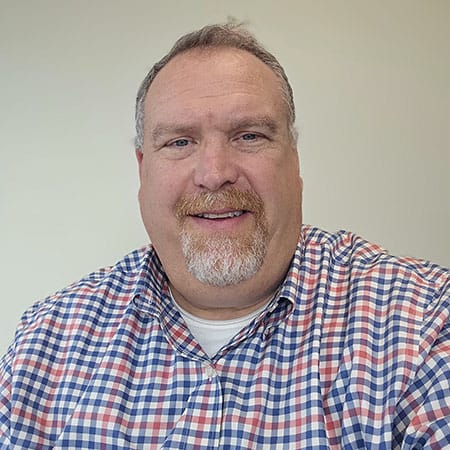
MARK LESTER, WHO LIVES IN NEW HAMPSHIRE, IS A FREQUENT VOLUNTEER WITH A VARIETY OF ORGANIZATIONS. /COURTESY MARK LESTER
Tell us about your volunteer role.
I work with a variety of organizations. I work with the Child Evangelism Fellowship of New Hampshire. I’m the board chair of that organization. I’ve been with them, off and on, for 30 years, but I’ve been the board chair for the past five. I’m also on the board for the Kiwanis Club of Concord, New Hampshire. I’m on the board of the Red Cross of Northern New England. I also volunteer with Granite State Independent Living, which helps individuals with disabilities be able to stay in their homes. Every year for the past eight years, I’ve spearheaded a wheelchair basketball team for them.
What inspired you to get started with these initiatives?
I’m a pastor, and it’s part of who I am. My faith has compelled me to get out there to help others. Eastern Bank has encouraged us to get involved and volunteer, and they want us to help our community. These community nonprofits keep coming to us at the bank to get donations. We have this amazing foundation at Eastern Bank that wants to do that. I may not be able to give exactly what they want, but I’m always able to give. When I find out about these nonprofits, there is so much they need help with, not just finances. They just need help with a variety of things, whether it’s helping people get rides, or just getting the recognition of what they do, like getting on the radio.
What’s been the most rewarding part of your work?
To see the impact when someone cares. You don’t have to be wealthy. You don’t have to be a savant, you just have to be willing. When you do those kinds of things, people are so grateful for the help that you provide. When I volunteer, I’m not looking for anything. But the reality is to see some of these individuals rising above whatever has come across their path, whatever situation they find themselves in, is incredible.
What have you learned through your experiences as a volunteer?
Just because somebody looks like they’ve had a difficult experience, doesn’t mean you should judge the book by its cover. Sometimes we’ll see people, and you begin to make judgment calls. Sometimes you get up in the world, and you think life is so bad, until you meet someone else who’s been struggling a little bit more. It’s taught me to be more appreciative and more content with where I’m at, but also because I’ve been giving so much.
Does your employer have a Volunteer Time Off policy that you make use of to do any of your volunteer work? Tell me about your experience using VTO.
They do. It’s usually eight hours. Because I’m a manager, I don’t have to track my hours. A lot of my volunteer time will be after hours, but a lot of volunteer time happens during the work day. For instance, there’s this place called Camp Mayhew, and their sole focus is at-risk boys on an island in Bristol. We’re going to do a work day getting the camp prepared for the end of the season, and we’re going to do that during the work day.
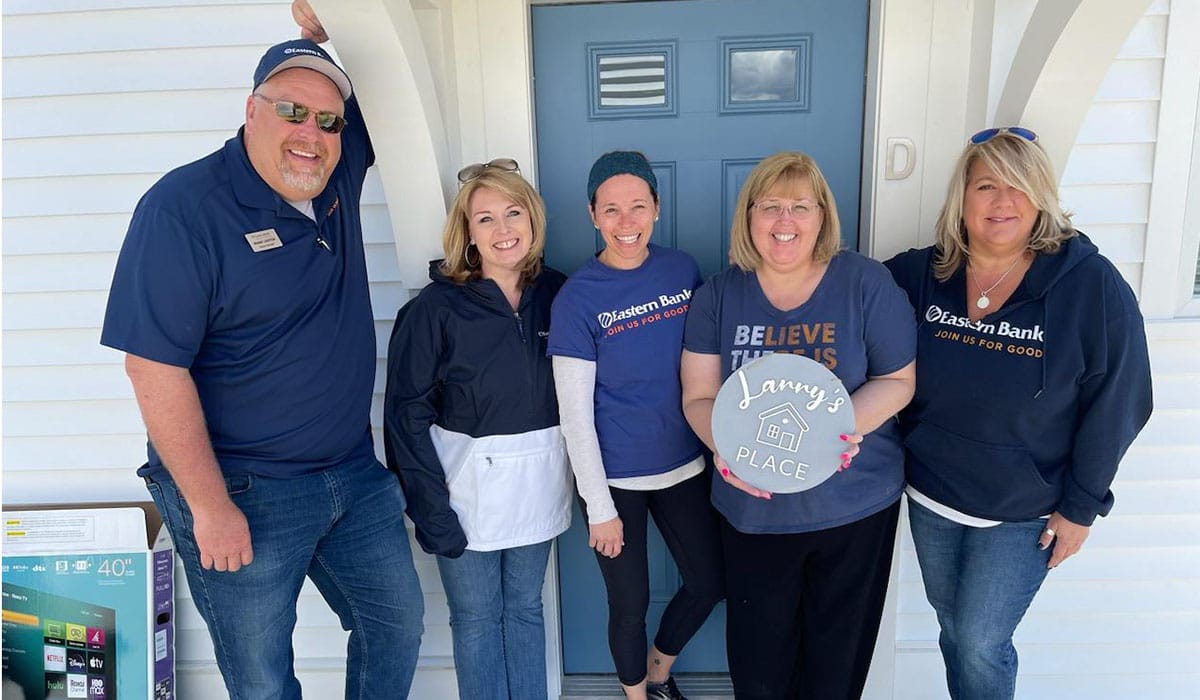
MARK LESTER (LEFT) VOLUNTEERS ALONGSIDE FELLOW EASTERN BANK EMPLOYEES IN NEW HAMPSHIRE. /COURTESY MARK LESTER
Why is it important for others to get involved with causes they care about?
It’ll make you a more well-rounded individual. It’s amazing if a few people would just gather together to help one another out. A lot of times, I think I’m helping out somebody, and in the long run, I feel they’ve helped me out more than I have helped them, because it gives me a new perspective. I don’t take myself as seriously. Again, I love that aspect of empathy and compassion.
Any advice for people who want to start volunteering?
Find something you’re passionate about. Just pick up the phone or send an email. They’ll be so thankful for the hour you can give. Most of the time, they’re not looking for money. They’re looking for somebody willing to give up their time. Just pick up the phone and put yourself out there, and you’d be shocked how little a real investment could pay off. The return on your investment of time is far greater than what you invest.
What do you want people to learn from your story?
Don’t sell yourself short. You have so much to give. We all have so much to give. Don’t to afraid to put yourself out there. Be bold, and just take that step. It’ll change your life.
Carolyn Dundee always made sure her two young daughters got lots of volunteer experience. But when it became clear that many of their elementary school peers had never volunteered before, Carolyn knew it was a prime opportunity to get all ages involved in helping others.
In 2012, Carolyn founded Small Acts Big Change, an organization whose mission is to create a better world through volunteerism. Using a community-centered approach to social responsibility, conservation and activism, volunteers learn how significant even the smallest acts of kindness can be. From young schoolchildren to seniors, everyone is encouraged to participate in acts of kindness, building self-esteem throughacts of service and developing compassionate leadership skills.
While her daughters are now 20 and 25, Carolyn’s passion for finding ways to engage the community hasn’t waned one bit. She dedicates around 70 hours a week to her role as president and executive director of the organization, for which she is not compensated. From developing and running the volunteer programs to recruiting and training volunteers, Carolyn spearheads each initiative with passion and purpose. But she also sees Small Acts Big Change as a bridge to working in tandem with other organizations, and building strong partnerships with schools, nonprofits and shelters is an essential component of her role. Boasting a collaborative spirit, Carolyn frequently works alongside other organizations like the Living Beauty Cancer Foundation and the Los Angeles Department of Children and Family Services.
Each job the SABC team tackles may seem small, but they amount to great change. Over the years, Carolyn has hosted events that removed more than 200,000 pieces of trash and fed meals to 18,000 shelter pets. She’s planted 4,000 trees and provided 8,500 meals to food-insecure individuals. Last year, the Small Acts Big Change team made 16,000 Valentine’s Day cards that were distributed to seniors in care centers. Carolyn devoutly believes that compassion isn’t measured by size. Instead, she believes that it’s measured by small acts that have the power to change a life. Her faith in the ability to help others through small acts is a strong example of volunteerism’s spirit.
I’ve always been a person who’s aware of what’s around me. If I see someone who seems hungry, I will help them get food. If I see litter, I’ll pick it up. If I see an animal that’s injured, I would never walk away. We help the animal. I feel strongly that if everybody can just be aware of what’s going on around their area and do their small part to help, the world will change.
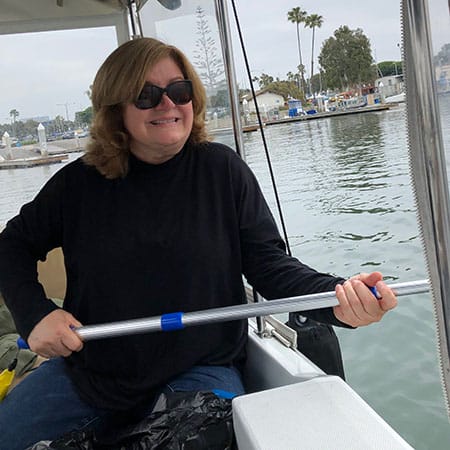
SMALL ACTS BIG CHANGE FOUNDER CAROLYN DUNDEE RIDES A BOAT IN MARINA DEL REY TO CLEAR LITTER FROM THE BAY. /COURTESY CAROLYN DUNDEE
What inspired you to get started with this initiative?
Our family used to vote every year on a volunteer project. We’d have a family meeting in December, and then we’d vote on what kind of project we’d work on. By the time they got to elementary school, the kids were quite well-versed in volunteering. My youngest daughter, who was 7, was talking about volunteering at school. She marched into the headmaster and said she wanted to bring the project to school. I think we planted flowers for seniors at a local nursing home. Then we did another project the next month, and before we knew it, we had a school-wide initiative. We decided, as a family, to start this nonprofit in 2012. We started in the schools doing projects to help animals, to help the earth or just anything that would get the kids excited and volunteering. It just grew from there.
Tell us about your volunteer role with Small Acts Big Change.
I’m the founder and executive director, which is a volunteer role that’s about 70 hours a week. I’m fortunate to be able to do this. I’m doing everything from community outreach to coordinating any in-kind donations. We coordinate with the community center and with donation partners to get the supplies donated. We make sure events are publicized and get volunteers signed up. I also handle fundraising, donor relations and day-to-day operations to ensure long-term sustainability and impact.
What are your long-term plans or goals for the organization?
Our mission is to make sure that everybody has an opportunity to volunteer. No matter your age, your ethnicity or your socioeconomic background, everybody has opportunities to volunteer. We’ve grown to about 100,000 volunteers right now from a grassroots organization. The long-term goal would be to make sure that we become an organization worldwide where people have an opportunity to help others.
What’s been the most rewarding part of your work?
The most rewarding part is seeing people who didn’t have an opportunity to help others get the chance to do so. You take these children when they’re very young, and the empathy and the compassion become a part of their lives. The goal would be, as they move into professional positions, that they take this empathy and this learning that they’ve had and make decisions based on that, so it’s not all based on the bottom line, the money. You’re making executive decisions with compassion and people in mind. These children come back and have such great awareness, and then they feel so good about themselves that they want to continue to do it. It’s getting that one person to help with what’s in front of them. If we can just continue to grow that, the world changes.
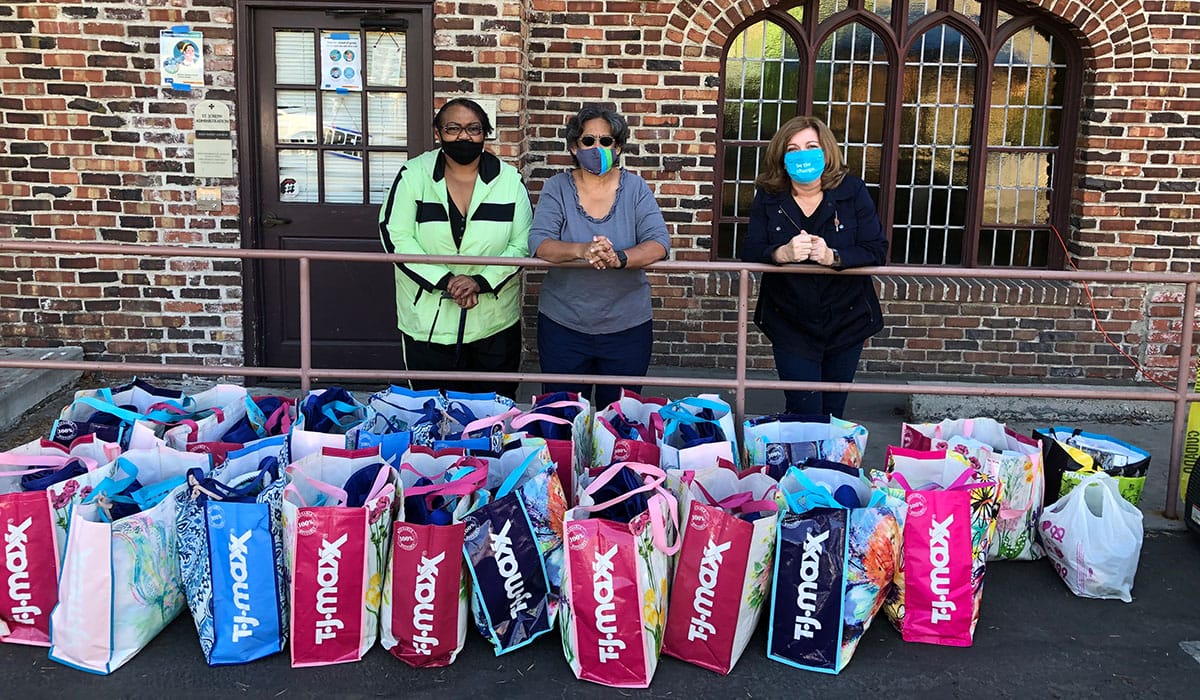
SMALL ACTS BIG CHANGE FOUNDER CAROLYN DUNDEE (RIGHT) JOINS UP WITH OTHER VOLUNTEERS TO PASS OUT BOOKS, BAGS AND BLANKET SETS TO PEOPLE LIVING ON THE STREET AT A SHOWER OF HOPE EVENT. /COURTESY CAROLYN DUNDEE
What have you learned through your experiences as a volunteer?
There are just so many good people out there. It goes back to what you see on the news every morning. While people are hungry and unhoused, there are so many good people out there. Everybody, for the most part, really wants to help and make a difference. They just may not have the tools or the way to do it. It doesn’t have to be massive. You don’t have to solve world hunger. You just have to take a step to help what and who is in front of you.
Tell us about future partnerships, programs or events that you are excited about.
We have so many fun things coming up. We do at least one major event each month, and we have stuff scheduled for the rest of the year. One of my favorite projects we do is partnering with the Living Beauty Foundation, which supports women who have cancer. It’s one of our biggest projects. We do it in December, and we bring people in from all over to pack kits for the women. It’s a wonderful project that brings people together.
What do you want people to learn from your story?
I think anybody can do it. You don’t have to do something huge or monumental to make a difference to change a life. Kindness starts within. Volunteering starts within. Just do one moment or one act. I strongly believe that’s how real change begins.
Meet Daily Point of Light Award honoree Rushil Kukreja. Read his story, and nominate an outstanding volunteer or family as a Daily Point of Light.
On a clear night, are you able to step outside your home and see the stars? If not, you are probably living in an area with high light pollution, and it could be affecting your health as much as its affecting the local wildlife.
Two and a half years ago, Rushil Kukreja, now a 16-year-old high school senior, found out his aunt had breast cancer. With research, Rushil discovered that there is a 23% increase in risk of the disease in American nighttime workers–30-50% worldwide–due to light pollution. His aunt is a nurse who works long night shifts.
“It’s not something that’s really in the environmental conversation right now,” Rushil laments, adding that other topics, like climate change and air and water pollution, are often covered in school curriculums.
Light pollution, defined as excessive outdoor artificial light, also increases the risk of things like obesity, heart disease and diabetes. But humans aren’t the only ones suffering. Entire ecosystems can be disrupted.
“Light pollution causes the deaths of 600 million birds every year because of disorientation when they’re migrating as well as collision with lighted-up structures,” he highlights.
Talking to his peers, he recognized that when people understood the consequences, they wanted to engage in preventing them. Princia, Rushil decided, would fill in the gap. As founder and president of this student-run 501(c)(3) nonprofit, Rushil designs campaigns and awareness events, organizes research, onboards new members, manages social media strategy and builds partnerships. One of his biggest goals is to make light pollution part of the mainstream environmental conversation.
“We’re pursuing that through advocacy and education. We’re working with schools across the country and the world to incorporate light pollution curriculums,” he explains, pointing out the 750+ teachers involved across 300 schools. “The next step is actually making changes to people’s lifestyle. If people see an excessive light around town, or if they have extra lights turned on outside their home, they might try to get some of them turned off, and do the same at a commercial and government level.”
If education inspires individual action, congressional action inspires commercial movement. To assist, Rushil recruited Princia’s former director of government advocacy and friend from Model UN, Om Sharma, to create policy based on the scientific work he had done. Om led a team of interns in researching effective legislation across the country and the world. Then, collaborating with the science team, they drafted policies.
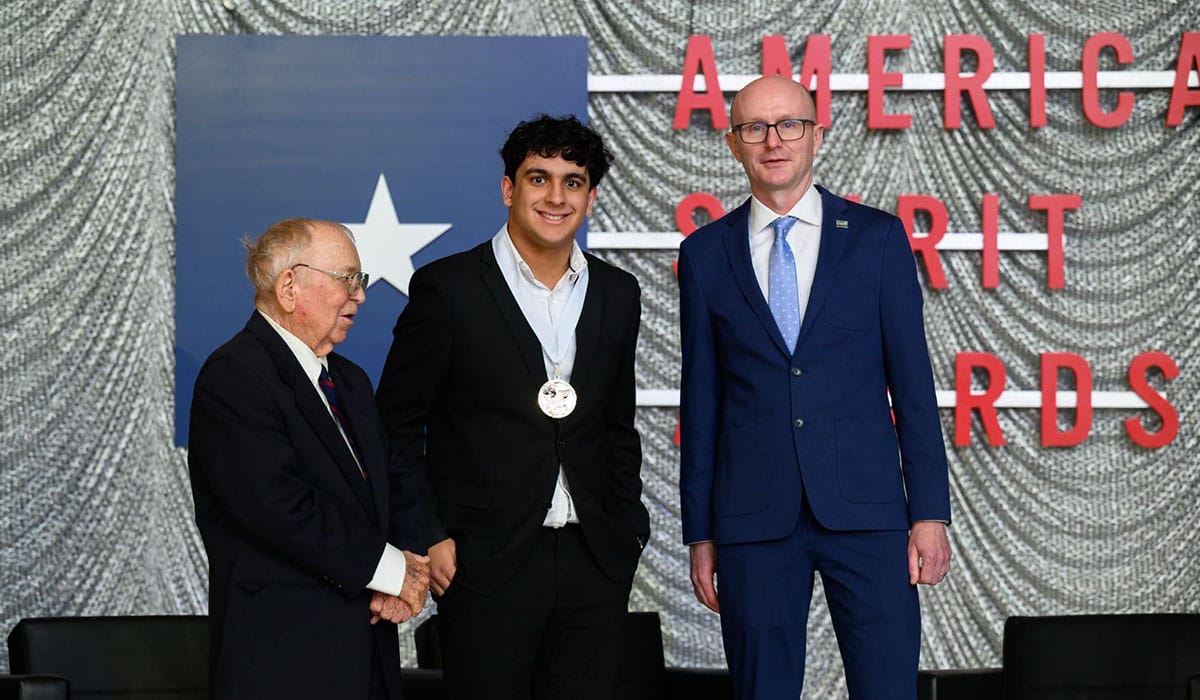
Rushil (center) represents Virginia at the American Spirit Awards Gala in New Orleans.
“We looked at things like what number of lumens or possible wattage could we put in a light bulb to limit the potential amounts of light pollution that would occur from that light,” Om recalls. “We also took a look at what hours we should turn off lights so that we aren’t disturbing natural ecosystems.”
Rushil took individualized results to lawmakers in eight different states as well as his own. In Virginia, he hopes to get a piece introduced and passed early next year, one of the first of its kind in the area.
At the same time, Rushil spoke at the United Nations General Assembly to raise awareness and advocate for international action. Many leaders approached him after his presentation to follow up on how to do more in their own countries.
“He’s incredibly personable and knowledgeable, so you can carry on a conversation with him,” Om states. “A lot of people may be turned off by how dealing with light pollution is so scientific. The fact that Rushil is able to connect with everyone on a personal level and is able to explain the situation to them, I think, is extraordinarily helpful.”
Om also lists Rushil’s ability to think on his feet and connect solutions the policy team was drafting to things that already exist as key to their success. The work is undoubtedly paying off. Already, Rushil has mobilized more than 250 volunteers in six different continents. Their work has shielded 1M+ lumens of light.
“No one else is going to fix these problems for us,” Rushil says. “Getting involved is how you build the kind of world that you actually want to live in.”
It’s also personally rewarding. But for Rushil, it’s not the big events that touch him the most.
“Some of my favorite moments are the smaller ones, where a volunteer tells me, for example, that they were able to shield all the street lights in their community, and they’re able to see the stars much better than before,” he smiles.
As a young person, Rushil was initially unsure if he could garner the kind of attention necessary for the collective action necessary to have an effect. Even climate change issues that have been plaguing the world for decades are sometimes met with doubt, pushback or indifference.
“I wasn’t sure if people would listen or believe me. But even young people, when you’re passionate and persistent, can make a change. You don’t need to wait to be an expert in order to take action,” he emphasizes. “If someone cares about an issue deeply, they should try to address it in any manner they can.”
Princia has garnered trust and grant money from several organizations. The Animal Welfare Institute gave $15,000 to further identify ways in which light pollution impacts wildlife. Cornell University is supporting the development of technology that took top prize at the Junior Science and Humanities Symposium.
“The Cornell grant is for another project we’re working on, which is a smart window that harvests solar energy and then uses it to help mitigate light pollution at night,” he details
Most of Princia’s research is being conducted by passionate high school volunteers—many of whom are collaborating with processors at local universities—and even middle schoolers. They’ve been inspired by the work Rushil continues to do towards building the world he wants to live in.
As Rushil applies to colleges, he is considering studying physics or astrophysics to help him do the same in his career. But in the meantime, he’s working on upgrading his driver’s permit, because everything he’s accomplished so far has been done before he’s been licensed to drive.
Inspiring and Expanding Youth Volunteerism in North Carolina
Meet Daily Point of Light Award honoree Aneel Gupta. Read his story, and nominate an outstanding volunteer or family as a Daily Point of Light.
Aneel Gupta is a standout youth leader who has transformed volunteerism into a driving force for community impact across western North Carolina. As president of the South Piedmont Junior Optimist Club—the only junior chapter currently operating in western North Carolina—he’s taken on the challenge of inspiring civic engagement among youth in his region. Whether organizing local events or advocating for the expansion of Junior Optimist Clubs, Aneel is helping build a stronger foundation for community-based leadership among his peers.
Under Aneel’s leadership, the club has coordinated a wide range of impactful service projects. From roadside trash cleanups and sneaker recycling drives to hosting the “Most Improved Student Awards” party and the festive “Breakfast with Santa” event, the club is making a tangible difference across Union County. Aneel helps plan and manage each initiative, working alongside other young volunteers to bring energy and organization to every project. One of their standout efforts, the GotSneakers drive, collected over 600 pairs of shoes, benefiting both environmental sustainability and individuals who needed them.
Aneel’s contributions extend well beyond the Optimist Club. He serves as a peer and math tutor at his school, is an active member of the Monroe City Youth Council and volunteers regularly with Aceing Autism, helping children on the spectrum build confidence and coordination through tennis. He also sits on his school’s Parent Teacher Student Organization (PTSO) as a student representative, further demonstrating his commitment to building community from the ground up.
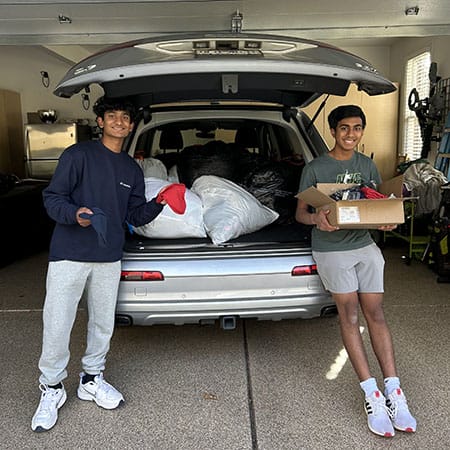
Aneel and fellow SPJOI member packing up approximately 300 coats to deliver to Union County Sheriff Department. These coats were then distributed to families in western North Carolina that were affected by Hurricane Helene.
In addition to organizing projects, Aneel has taken on the role of advocate, recently speaking at the Western NC Regional Optimist Conference to encourage the formation of more Junior Optimist Clubs in the region. His vision for broader youth engagement is matched by his ability to lead through action and mobilize others with enthusiasm and compassion.
With a monthly time commitment of over a dozen volunteer hours and growing, Aneel is setting an example of what it means to serve others with intention and dedication. His leadership is not only enriching his community today but laying the groundwork for a future where more young people are empowered to step up and make a difference.
Tell us about your volunteer role.
My journey with the South Piedmont Optimist Club began when I was in 9th grade. I was one of the founding members, serving as the treasurer in our first year. In this role, I collected dues and was responsible for keeping track of our funds. I worked with the Treasurer of the Weddington Optimist Club, our parent organization, to fulfill these duties. I also worked closely with the other officers to organize service projects. As the club was in its infancy, the first few months were spent establishing our organization and recruiting members. The following year, I was elected as president of the SPJOI. I led meetings, worked with other officers to coordinate events, and organized community service efforts.
These initiatives included Santa’s Breakfast, where we encourage kids of all ages and families to join us to engage in an event featuring crafts, food, activities and a visit with Santa. We also had the GotSneakers drive where we collected over 600 used sneakers for reuse or recycling. This avoids landfills, saves hundreds of thousands of gallons of water and displaces over 5,400 pounds of carbon dioxide. Additionally, I helped initiate a winter coat collection in response to Hurricane Helene. We worked with the American Red Cross and the Union County Sheriff’s Department to collect over 250 coats in one week. Coats were delivered to areas affected by the hurricane.
Beyond that, our club regularly participates in community highway and roadside trash cleanup events. And the SPJOI also hosts a “Most Improved Student Awards Party” honoring students selected from elementary schools across the county. Kids receive free entry for bowling, food and a gift bag, which includes candy and a book of their choosing.
What inspired you to get started with this initiative?
One of the students at my high school floated the idea of a junior chapter of the Weddington Optimist Club. He shared his idea with a few of us, and we were all enthusiastic about the possibilities. Although many of us were already members of other service-based organizations, this was different, because we had control over which projects we could pursue. This was important to us because we weren’t limited in any way. For example, when Hurricane Helene hit, we could quickly shift our priorities to launch a winter coat drive before temperatures started to drop in the mountains.
Why is volunteering so important to you?
Growing up in Weddington, North Carolina, I have been blessed to be able to attend excellent schools, have strong mentors and have many opportunities available to me. As I’ve grown, I’ve become more aware that not everyone is as fortunate. It was important to me to be able to get involved in the community that has given me so much.
What are your long-term plans or goals for the organization?
We are the only established junior chapter in western North Carolina. I was recently asked to speak at the Western NC Regional Optimist Conference to advocate for the expansion of Junior Optimist Clubs in this region. This fall, I will be attending the North Carolina School of Science and Mathematics in Morganton, North Carolina. My plan is to start up a new chapter of the Junior Optimist Club in this region. Because I remain close with the SPJOI, we can work together to expand our efforts across our region of the state, and beyond.
What’s been the most rewarding part of your work?
My favorite part of working with the SPJOI is seeing the immediate impact of our efforts. Waking up early on a Sunday morning is not fun, but joining your friends for donuts and heading out to pick up trash off the highway can be, especially when it leaves your community cleaner for all to enjoy. We take a lot of time to plan our service events, and sometimes it can get tedious. However, when the day arrives and we get to see our efforts come together, seeing the joy it brings to our community is very rewarding.
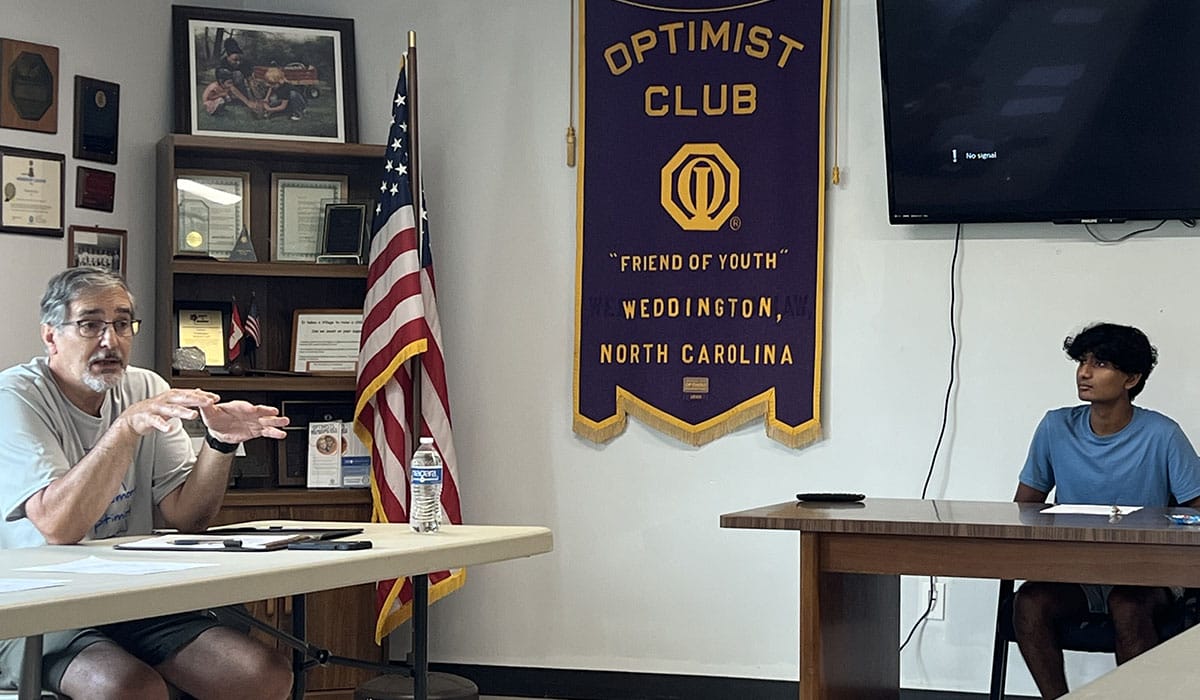
Aneel Gupta, president of SPJOI, conducting monthly club meeting, alongside Mr. Dave Arone, the club supervisor.
What have you learned through your experiences volunteering?
Volunteering has taught me that it is possible to make a real difference in people’s lives, even if you are just a student. And serving in an officer position has also helped me build leadership and communication skills and supported personal growth.
Why is it important for others to get involved with causes they care about?
It is important for everyone to contribute to causes that they care about. Any effort, big or small, can bring about meaningful change in your local community. Taking one step forward to better your community also inspires others to help out.
Any advice for people who want to start volunteering?
I would say just do it! Find an organization that does work that is meaningful to you. When it’s something important to you, it won’t feel like work. In fact, you may realize you’re getting back even more than you are giving.
On a Mission to Dismantle Stigma and End Period Poverty
Meet Daily Point of Light Award honoree Chloe Kim. Read her story, and nominate an outstanding volunteer or family as a Daily Point of Light.
Half of the population of the world has had or will have a period, so why is it still so hard for many to talk about? And what happens when people can’t afford or access period and hygiene products? Two years ago, 16-year-old Chloe Kim started The Wellness Box Foundation with her older sister, Caitlyn, to tackle issues surrounding period poverty and ending the stigma surrounding the topic.
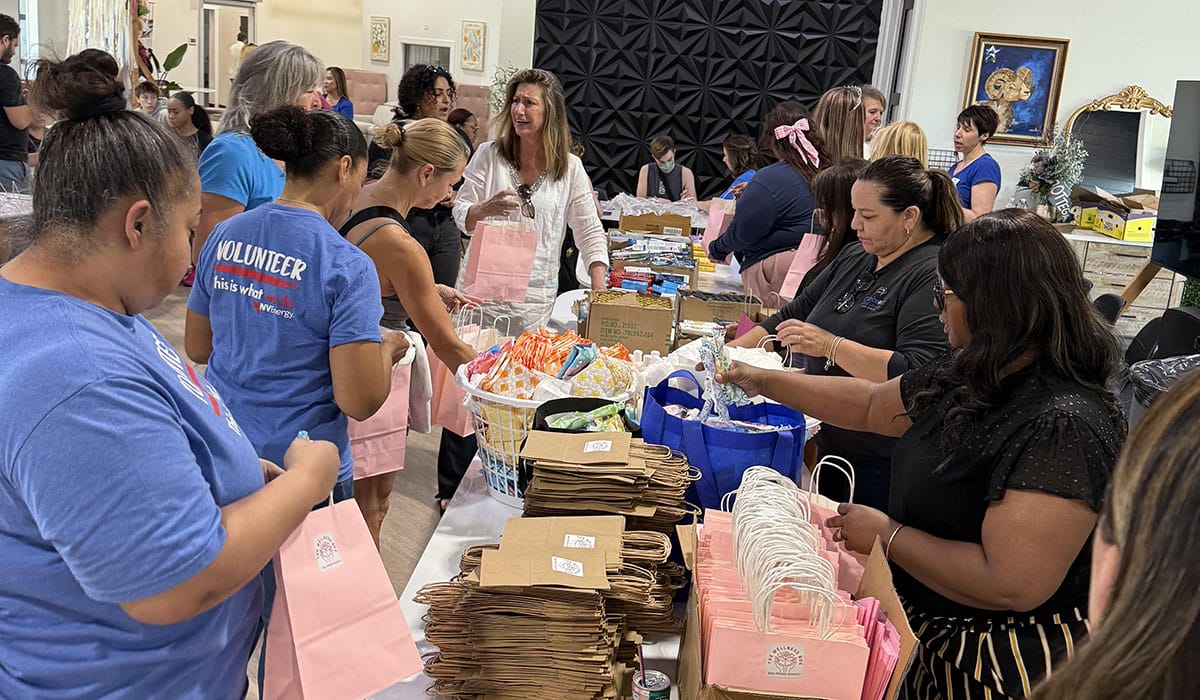
In her menstrual health workshop, she teaches elementary school students about the bodily function and provides a safe place for discussion, effectively breaking down the social taboo. Her call for donations has resulted in the packing and distribution of over 15,000 product-filled wellness boxes to shelters, schools, anti-trafficking organizations and unhoused individuals. Through fundraising, she’s raised over $35,000.
Today, the organization has chapters in five U.S. states and Switzerland. Chloe’s school club has over 50 volunteers helping with packing parties and the Las Vegas Chapter, over 500. As she turns her attention towards college applications, Chloe remains excited to start one wherever she attends. And who knows? Perhaps the youngest Kim sister will one day take over the original.
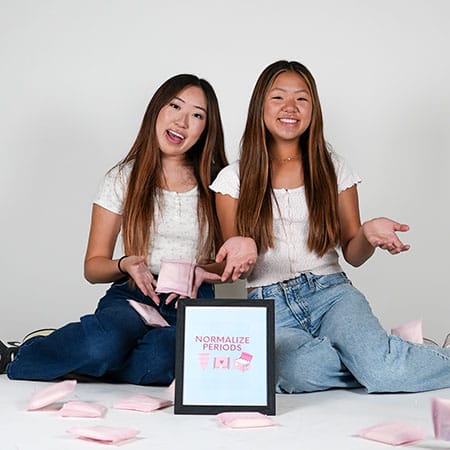
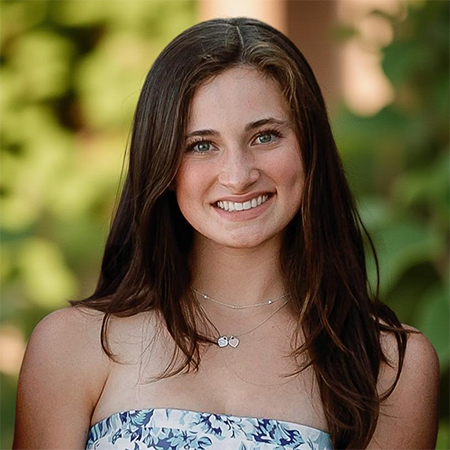
Chloe (right) and her sister Caitlyn Kim (left), founders of The Wellness Box Foundation, fight period poverty and educate young girls on the menstrual cycle./Courtesy Chloe Kim
What inspired you to get started with this initiative?
The Wellness Box Foundation was pretty much my first time volunteering. As my sister and I were starting to learn what it was like to be a teenager, we realized that there was an issue with period poverty in our community, which is when there’s a lack of access to menstrual products and menstrual education. And it’s something that not many people tend to address.
One in five teens are unable to afford products, and many have to miss class during their cycles. Many women have to miss work. They resort to using socks instead of proper period products. The more I learned, the more I felt the need to do something about it.
What should people know about period poverty?
It’s a huge issue in our community. And it’s okay to talk about periods; it’s not something to be embarrassed about. Most women live with menstrual cycles, but the stigma is still there.
I also want people my age to know that you’re never too young to make an impact. When the community comes together on an issue, it can make a big impact. Even a little help goes a long way. And from what I’ve learned, people love to help out.
Tell us about your volunteer role with The Wellness Box Foundation.
At first, there were a lot of calls to local shelters to see what the need was. Now that we’re more familiar, many accept drop offs. At this point, much of our work is organizing packing parties. We partner with various student-run organizations, nonprofits and small businesses. Volunteers put together wellness bags with period and hygiene products that provide women with dignity and self-confidence. Most of our products come through supply drives, but when we host parties, a lot of the volunteers bring some to add.
We’re usually able to make a couple hundred kits. Sometimes I just do drop offs, and other times, we stay for hours to hand them out and hear people’s stories. I’ve recently been focusing on distributing boxes to nonprofits supporting survivors of human trafficking. Nevada ranks number two in the country for human traffic incidents. Not many people know that.
We also go to schools and educate young students about their first period. Many of the girls tend to laugh. But when you tell them it’s normal, they start to take it seriously. A lot of them don’t know what it’s like and don’t have people to educate them about what’s going to happen. They’re extremely curious and love to ask questions. Someone once asked if her autism would affect her period. It’s great that I get to be the one to teach them and ensure they feel prepared.
You’ve been working with state legislators. What are some of the changes you would like to see?
I’ve worked to advocate for an end to taxes on tampons and supplying free products in public school restrooms. At one point, I went to the legislature in Carson City and got to experience the democratic process firsthand. I watched people figure out issues and talk about what needs to be done and how.
The Wellness Box Foundation packs over 500 bags with United Way to distribute to human trafficking survivors./Courtesy Chloe
What’s been the most rewarding part of your work?
One of my favorite things is when we actually get to hand out the bags to young girls and women. It always puts a smile on their face when they know that they’re going to be okay for the week with products to help. Little girls get excited about the gift. It’s heartwarming.
What have you learned through your experiences as a volunteer?
If you just sit back and watch things happen, the problem is not going to magically fix itself. You need to take the initiative to organize packing parties, get the community out and talk about periods. Even in high school, many people don’t feel comfortable talking about them. It’s important to influence your peers, to recognize that it’s okay to talk about and help with. Get the community involved.
Why is it important for others to get involved with causes they care about?
No matter what you’re doing, if you’re helping the community, it’s going to make you feel good about yourself. The first time I distributed wellness bags, I felt good for the rest of the day. That’s what kept pushing me to keep expanding and do what I was doing.
What do you want people to learn from your story?
It’s important to use your time to do something great. It’s important to make an impact, because there are so many different groups of people that need help. Period poverty is just one of the many issues in our community, and the more people who hear about us and reach out to help, the more I’m inspired. I hope others are, too.
Wearing Many Hats, Volunteer Keeps Therapeutic Riding Program Strong
Meet Daily Point of Light Award honoree Tom Giannini. Read his story, and nominate an outstanding volunteer or family as a Daily Point of Light.
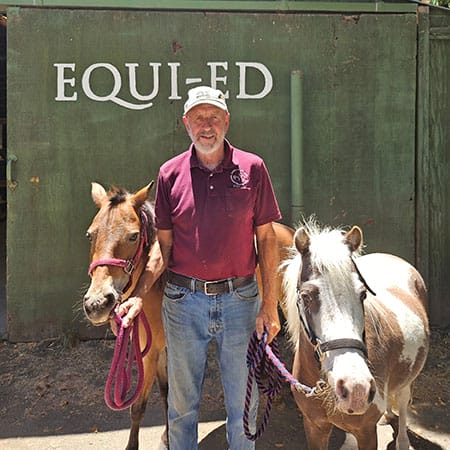
For the past 15 years, Tom Giannini has been a quiet force behind the scenes at Equi-Ed, a therapeutic riding center in Santa Rosa, California. Having been around horses since he was a child, Tom first showed up thinking he might lend a hand with basic barn chores.
What followed was a deep and lasting commitment that’s seen him take on just about every role imaginable—horse handler, sidewalker, repairman, evening feeder, manure manager, public event helper and substitute for fellow volunteers when needed. With more than 7,800 hours of service and 1,200 miles walked beside students and horses, Tom is the kind of volunteer who makes the entire operation run more smoothly.
But what keeps him coming back isn’t just the horses—it’s the people. Before Equi-Ed, Tom had little experience with individuals with disabilities. Now, he’s the steady presence riders count on, whether they’re climbing into the saddle for the first time or building confidence with each ride. He doesn’t seek recognition, but his impact is clear: in the barn’s day-to-day rhythm, in the repaired gates and tools he’s quietly fixed, and especially in the lives of the students whose small victories he celebrates every week.
What inspired you to start volunteering with Equi-Ed?
I had just moved to Santa Rosa from the Bay Area, and most of my friends and family were still down there. I wanted something to do and remembered hearing about therapeutic riding. I’ve been around horses most of my life, so I thought maybe I had some useful ranch skills. I found Equi-Ed online and met with Maxine, who founded the program. After seeing the barn and getting to know Max and the horses, I thought, “Why not give it a try?” That was in 2010. And now, 15 years later, I’m still doing it.
What does your volunteer role involve?
A little bit of everything. I help out during lessons as a horse handler or sidewalker, feed horses on Tuesday nights and fill in when other volunteers can’t make it. I also do barn chores and fix things around the property—gates, fences, equipment, you name it. I even help when we’re out in public, like local parades or presentations to promote Equi-Ed. I guess you could say I’m kind of the handyman and go-to support guy around the barn.
Tom Giannini stands with two therapy horses at Equi-Ed, where he supports lessons and daily barn care as a longtime volunteer. /Courtesy Tom Giannini
What’s your favorite part about volunteering?
Just being at the barn, really. I enjoy the environment and the people. And it’s also seeing what this program does for the students—watching them improve physically and emotionally. We had one rider, James, who often comes in hunched over, but once he gets on the horse and has a good ride, you can see him sitting up straighter. It really does something for him. That kind of progress makes it worth it.
Is there a student whose progress really stuck with you?
Yeah, there’s a boy who started recently—probably around 9 years old—and he’d never been on a horse before. The first lesson, we barely got him mounted, and he just cried the whole time. Same thing the second time. He was terrified. By the third lesson, we got him to take a few steps on the horse. And then the fourth time, he just climbed right up onto the mounting block, got on the horse, and was ready to go. It was like night and day. Now he’s excited to come to lessons, and it’s just great to see that kind of change.
What do you get out of volunteering?
It’s rewarding to see how much the students benefit from riding. But it’s also the camaraderie at the barn. We all pitch in—volunteers, instructors, students’ families. Whether it’s doing lessons, fixing things or being in a parade together, there’s a strong sense of community. I enjoy being part of that.
What do you think makes therapeutic riding so effective?
I’ve heard that the movement of a horse stimulates the same muscles as walking, so it’s really good for physical therapy. But it also seems to have an emotional effect. Some students get excited just knowing they’ll be riding their favorite horse that day. You can see it in the way they greet the horse, like putting their forehead against its face.
What advice would you give to someone thinking about volunteering, especially later in life?
I’d say just give it a try. If you’re interested in helping people with physical or mental disabilities, programs like this are a great place to start. You’ll get a lot out of it, and so will the students. And if it’s not the right fit, that’s okay too. You can move onto something else.
Why is volunteering for a cause you care about important?
Because there aren’t a lot of programs like this. Especially in our area, there are only a few therapeutic riding centers around. So it’s something special, and it really makes a difference in people’s lives.
What do you hope people take away from your story?
That if you’re looking to volunteer and don’t know where to start, just go visit a place, talk to people, watch what they do. If it feels like a good fit, give it a try. You never know—you might end up staying for 15 years like I did.
Meet Daily Point of Light Award honoree Mallory Fischer. Read her story, and nominate an outstanding volunteer or family as a Daily Point of Light.
Seventeen-year-old Mallory Fischer has always been fond of reading, so when she realized that not everyone had the same access to books, she dedicated her effort to changing that. This passion for connecting kids with books motivated her to start Book Buddies for Kids in 2021.
Now, a rising high school senior, she has collected around 3,000 books through drives and individual donations and distributed them across Massachusetts, Missouri and California. She makes a particular effort to search for and feature books with diverse characters so all readers can experience stories about people who look like them.
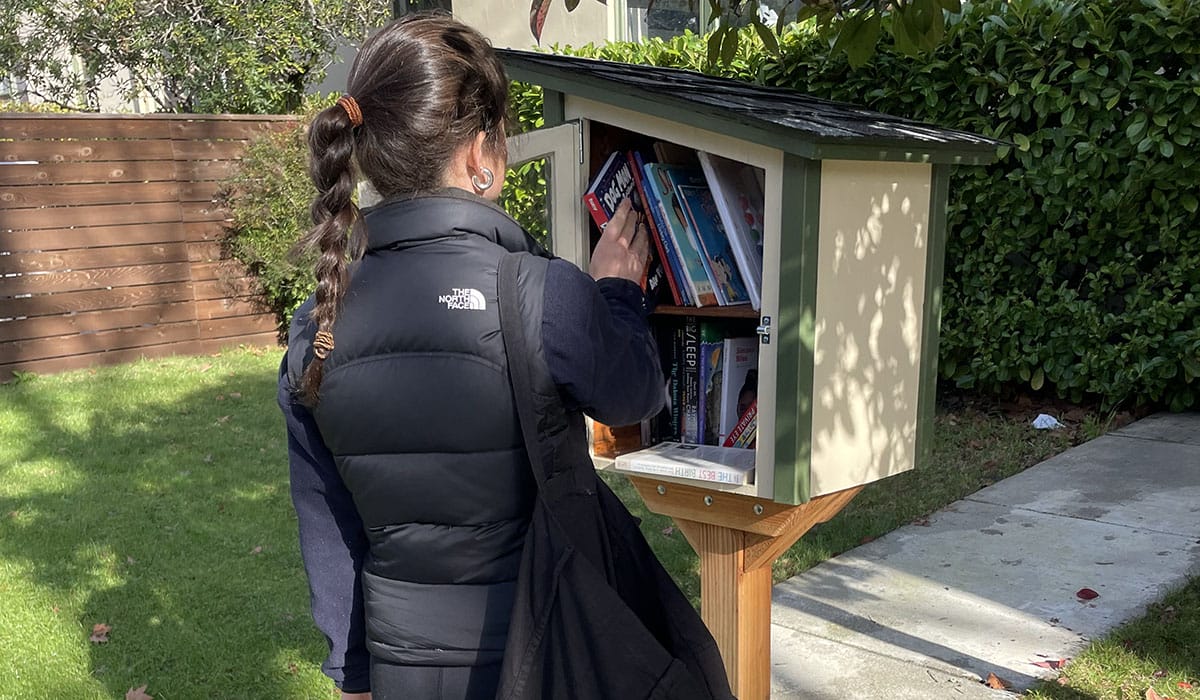
Mallory has filled over 20 free little libraries with books for both kids and young adults and is working on setting up more in underserved areas. Her classmates also enjoy the opportunity to earn service hours by dropping off books and refilling libraries. Any overflow is delivered to The Global Book Exchange, an organization that gets books to children in need and promotes literacy.
What inspires you to volunteer?
I’ve grown up with the privilege of being able to help other people, and the idea that helping people is a key part of life. I’m a volunteer and ambassador for Project Glimmer, an organization that helps underserved girls nationwide get makeup and access to things that can boost their confidence. And I volunteer with my school. It’s a great thing to do. Everybody should help their community in one way or another.
Mallory Fischer, founder of Book Buddies for Kids, installs and maintains little free libraries with books for kids and young adults in underserved areas to increase literacy.
What inspired you to get started with this initiative?
I started Book Buddies my freshman year. I’ve always had a passion for reading, and I noticed that the free little libraries I came into contact with had few children’s books in them. This was especially heartbreaking when I read how few children in underserved communities had access to books in their homes, let alone children’s books. A lot of kids don’t have the same opportunities, so I wanted to address that.
It started out with me and my friend, but when she started rugby, I took over. There’s a school club, too, which allows me to do drives there and recruit classmates to ask their families for books. I run all of the accounts and worked on the website with a friend of mine. We translated it into Spanish, too. But it’s usually just me dragging my little brother along from time to time.
Tell us about your volunteer role with Book Buddies for Kids.
We’ve been raising money over the years, and my next goal is to plant eight to 10 little free libraries around the Bay Area, specifically in San Rafael. Public libraries are a little sparser there; books aren’t as accessible. I’m also trying to put one in St. Louis at the Contemporary Art Museum, especially because of the tornado that was there recently. Many people lost a lot.
I recently saw the statistic that 92% of kids say they read two times more often when there is a little free library in their community. Convenience is a huge part of accessibility. I’ve been wanting to put in more, but they’re expensive, especially if you want one of the official ones with the charter label.
My family converted a newspaper vending machine into a little library that sits outside my house. It’s spraypainted bright red, and I probably replace four or five books every week.
Tell us about your collection events.
I work with my middle school a lot and the general community of Marin County. There’s a lot of money there, and a lot of people have books sitting in their houses. In eighth grade, through the local public middle school and my middle school, I organized a massive book drive and got those school libraries to donate as well.
I’ve held two or three drives at my middle school, and I’ve worked with the community and parents who contact me. Not only is it helping people declutter, but it’s giving the books a second opportunity to be appreciated. Our online presence helps us collect books throughout the year as well.
What kinds of things do you do for fundraising?
I’ve done some bake sales at school. You can’t collect large amounts of money if you’re not a 501(c)3, and becoming one is difficult. I hope to do that one day.
What are your other long-term plans or goals for the organization?
I’m hoping to do more fundraisers so that I can put down as many little free libraries as possible. I’d love to eventually collaborate with the actual Little Free Library Organization. I’d also like to expand more nationally, including wherever I go to college. A big part of sustaining this is refilling libraries, which is why it’s great to go to neighborhoods with kids, where there’s an active fluctuation of books and people refilling them.
Mallory visits a local little free library on a weekly refill trip.
What have you learned through your experiences as a volunteer?
I’ve learned a lot about organization and time management. A really big part of this was learning how to manage emails and communicate with book centers, how and what I was going to drop off, and how I could run drives at my school and get sufficient publicity. My mission to continuing the organization has been really satisfying but my dedication is also something that I’ve grown as a skill over time.
How can people address children’s literacy in their own areas?
There’s an app that maps the closest little free libraries. If they’re registered with Little Free Library, they’ll have the locations. That’s one way to help in your community; go out and do that. Another thing we’ve been trying to work on is reading to little kids in the area. You can usually find those opportunities at public libraries.
What do you want people to learn from your story?
I think the takeaway is to appreciate the things you have and realize how you can help other people, even in little ways.
CHICAGO SHINES THANKS TO THIS VOLUNTEER’S HELPING HAND
Meet Daily Point of Light Award honoree Brooke Brown. Read her story, and nominate an outstanding volunteer or family as a Daily Point of Light.
Brooke Brown caught the volunteerism bug at the height of the COVID-19 pandemic.
Her employer teamed up with Chicago Cares, an organization that mobilizes volunteers to build a stronger, more unified Chicago, to create a mixed-media mural out of broken glass. Inspired by the organization’s ability to create something unique during a challenging time, Brooke wanted to learn more. Looking to make a greater impact on the city, Brooke went to the Chicago Cares website and started researching volunteer opportunities. It was then that her journey began.
Fast forward to the present day, and Brooke now serves as a volunteer leader for Chicago Cares, spearheading initiatives that are incredibly diverse. She volunteers two to three times a week, tackling assignments that often require physical labor and an ability to manage others. On Mondays and Tuesdays, you might find her doing text banking, where she recruits people from the neighborhood to get involved with short-staffed projects. On the weekends, you can find her cleaning up trash on Lake Shore Drive or respectfully guiding clients through their food selections at the local food pantry. She has even participated in creating haunted houses for the neighborhood children, so they can have a safe environment to enjoy Halloween. In 2024, Brooke led over a dozen projects with community partners across the city. When help is needed, Brooke is ready and willing to lead the charge.
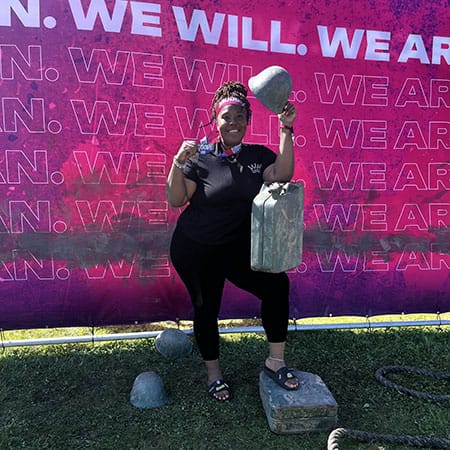
BROOKE BROWN, A VOLUNTEER WITH CHICAGO CARES, COMPLETES THE MUDGIRL RUN. /COURTESY BROOKE BROWN
Ezekiel Alexander, a volunteer relations coordinator at Chicago Cares, has known Brooke for about a year. He describes her as a problem solver who always takes the initiative to get things done, but still manages to make everyone laugh.
“One thing about Brooke is that she’ll go out into the field and just bring a lot of smiles to people’s faces. She does a lot of outdoor work, which can be very grueling and dampen spirits. But she’s going to get it done, and she’s going to get the mood lifted,” explains Ezekiel. “She’ll be volunteering for a couple of hours somewhere with a lot of sidewalk heat, even with people who may not have volunteered before. She has a great impact on people.”
In 2024, Brooke completed around 100 hours of volunteer work across 44 projects. When asked what inspires her to dedicate her free time to helping others, Brooke is candid about her motivation.
”At some point in everybody’s life, you’ll need some type of help, whether it’s financial, emotional or otherwise,” says Brooke. “I just think it’s important to do your part, because you never know when you may be on the receiving end of that.”
Whether it’s washing clothing at local shelters or gardening at a nearby farm, Brooke is always willing to dedicate her time to make Chicago a better place. However, she’s not seeking special recognition. In her own words, Brooke says she’s always looking to “show up, get the job done and go home.” But with that hardworking attitude, Brooke has made a significant difference in her community. Brooke’s dedication to both the city of Chicago and her mission to help others is a testament to just how powerful volunteering can be.
Meet Daily Point of Light Award honoree Aditi Motha. Read her story, and nominate an outstanding volunteer or family as a Daily Point of Light.
Aditi Motha is a rising senior at North Allegheny High School in Mars, Pennsylvania. She volunteers with Cancer Awareness Research and Education (CARE), a global nonprofit dedicated to increasing cancer awareness, supporting research and educating communities. CARE has 40 local chapters across the country.
While Aditi is involved in many organizations at her school, CARE holds a special place in her heart. Alongside fellow volunteers, Aditi has helped raise over $27,000 through the dedication of more than 500 members committed to service.
Read on to learn about Aditi’s story and what she has learned through volunteering.
What inspired you to get started with this initiative?
I joined a club at my local high school, initially called Community Cancer Outreach. It was a small, cancer-focused group I joined after a few of my friends got involved. As I began participating, I quickly saw this club’s potential to make a meaningful impact. One of our first events was a field trip to Hillman Cancer Center in downtown Pittsburgh. That visit was eye-opening. It gave me a firsthand look at the incredible research being done and inspired me to think more deeply about community service. At that moment, I realized how much a student-led club could truly contribute to something bigger than ourselves.
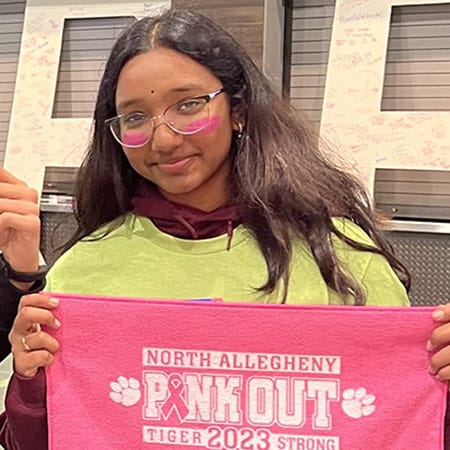
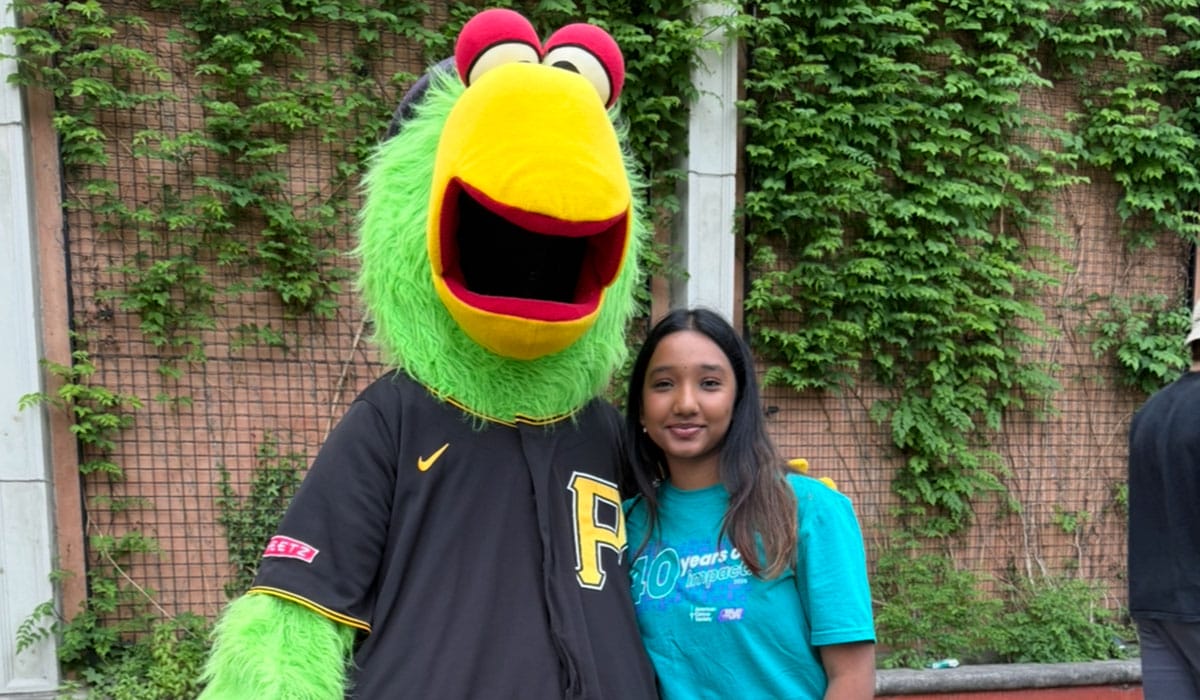
Aditi Motha hosts the 2023 Making Strides Against Breast Cancer event. / Courtesy Aditi Motha
Tell us about your volunteer role with CARE.
I have served as the chief operating officer at CARE for the past year and will take on the role of chief executive officer in my senior year. In this leadership role, I coordinate events and ensure that all our chapters have the support and resources they need to succeed. I regularly contact each chapter through group chats, checking in monthly to help them stay on track with hosting events, fundraising in their local communities and forming meaningful partnerships.
If a chapter is unsure how to get started or needs guidance, I schedule one-on-one calls to walk them through the process. This can be brainstorming ideas, finding nearby opportunities or connecting them with local organizations. Many of our chapters participate in events through the American Cancer Society, including Relay for Life, Making Strides Against Breast Cancer and Daffodil Days. In March of this year alone, we collectively raised over $3,000 across all our chapters.
What’s been the most rewarding part of your work?
Joining CARE in my first year gave me tremendous exposure and growth. Like many students, I explored different clubs, but CARE stood out because I immediately saw the potential for impact, both in what I could contribute to the organization and how it could shape me in return. Being part of an organization that has grown to over 40 chapters worldwide and now includes 500 to 600 members has been life-changing. It’s been inspiring to help lead CARE from a small group of about 10 members into something so expansive and meaningful. As high school students, I’m incredibly proud that we’ve raised over $30,000 for cancer-related causes.
Often, you join a club or get involved in something, but don’t always see the tangible results of your efforts. In this case, the impact is clear, whether through the funds raised, the growing number of members united by a shared mission or the moments spent delivering gifts to patients. Watching that transformation and knowing I played a part in it has been one of the most rewarding experiences of my high school journey.
What are your long-term plans or goals for the organization?
I want this organization to continue growing and impacting, even after I graduate. I’ve been a driving force behind it for the past two years, and as one of the last remaining founding members still involved, I feel a deep responsibility to ensure its future. Many original leaders will be graduating soon, so my goal for the upcoming year is to create a sustainable foundation, training our current officers to manage such a large and active organization. I want to see it maintained and expanded, reaching more communities and raising greater awareness.
Aditi Motha attends the 2023 Butler Relay for Life raising funds to support cancer research and patient care. / Courtesy Aditi Motha
What have you learned through your experiences as a volunteer?
I’ve learned that it doesn’t matter how much time you spend or the size of your contribution; any effort can make a meaningful impact, no matter how small. Whether you raise $1,000 or simply show up to support a cause you care about, taking the initiative as a high school student proves that you’re never too young to make a difference. Being in high school doesn’t limit your ability to effect change; it shows just how much potential young people have when they’re passionate and committed.
That said, leading such a large organization has come with its challenges. Managing a wide team, many juggling academics and extracurriculars, has pushed me to grow significantly as a leader. Balancing school with overseeing an international network has tested my time management and organization skills. But through it all, I’ve become more disciplined, adaptable and confident in my ability to lead and sustain something meaningful.
Any advice for people who want to start volunteering?
My biggest advice is to find a cause you’re genuinely passionate about. Before I joined CARE, I had no personal connection to cancer; no one close to me had been affected by it. But I learned that you don’t need to have direct experience with an issue to care deeply about it or to make a difference. You can become involved simply because the mission inspires you and you want to help.
I recommend joining various clubs and organizations, even if you’re unsure what you’re passionate about. Through that process, you’ll discover what truly resonates with you. For example, many students join clubs that align with their future career goals. But I’ve never been interested in going into the medical field. CARE has shown me that you don’t need to tie your extracurriculars to your career plans. Instead, you can and should pursue service simply because you care. Getting involved in the community has been my most meaningful motivator, and that’s what keeps me committed.
Meet Daily Point of Light Award honoree Nicholas Song. Read his story, and nominate an outstanding volunteer or family as a Daily Point of Light.
For many, playing sports brings some of their fondest memories from childhood: the close-knit friendships with teammates, the thrill of winning a game, the satisfaction of personal accomplishment. That’s certainly been the case for Nicholas Song, a 17-year-old who is on his school’s water polo, swim and volleyball teams. It’s an experience he wants everyone to be able to have and the driving force behind The Sole Project, a 501(c)3 he founded in 2022. Partnering with various gyms, Nicholas collects high-quality athletic shoes to give to young athletes who might otherwise be unable to afford them.
In under three years, his organization has donated more than $50,000 worth of gently-worn shoes to communities across Orange County. He has helped more than 900 young athletes get in the game, whatever that game may be. And his penchant for supporting young people doesn’t end there. His dedication to the Link Crew leadership program helps incoming freshmen acclimate to high school, and his enthusiasm for science inspires local elementary school students where he performs engaging experiments with the Science for Kids Club.
Was this your first volunteering initiative?
I started the summer after eighth grade. My first volunteering opportunity was at an elementary summer camp, chaperoning the kids and teaching them about certain subjects. I’ve done that for three years. I’ve also volunteered at our local library for three years. I’ve organized and shelved books and helped staff organize events for kids. I’ve also been involved at a food pantry. I help sort, package and distribute food to families that need it. I really like paying it forward in my community, so I try to focus my volunteer efforts in my area.
Tell us about your volunteer role with The Sole Project.
My role as president is to oversee operations. I coordinate with our partner organizations like 24-Hour Fitness and Orange Theory Fitness and make sure there are no problems with the shoe donations. Essentially, we have a poster board with our mission and our contact information along with a bin that we place at the front of each location. Anybody can donate. Our website has a Google form for people who wants to donate shoes that way as well.
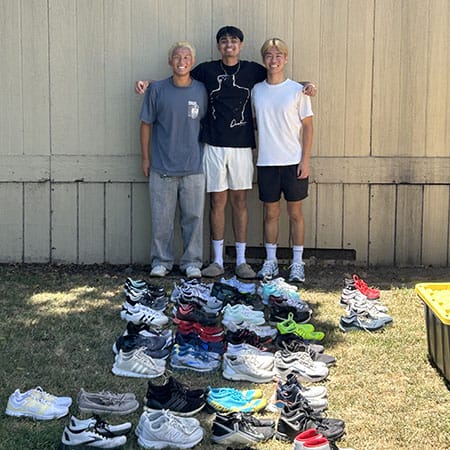
Nicholas (right) with fellow members of the Sole Project./Courtesy Nicholas Song
I work with nonprofits like the Thomas House Shelter to set up events to distribute those shoes throughout the community. My whole team—formerly 10, now six people—cleans the shoes together when we get them. We take the bins of shoes and give them a soak and disinfect. When they dry, we look for pairs that need extra conditioning. The goal is to make them as new-looking as possible. If they’re not up to a certain standard, we don’t donate them. We’ll hold on to the rest for distribution events.
What inspired you to get started with this initiative?
I’ve been an athlete my whole life. I started out playing baseball, soccer and basketball. To play baseball, for example, you need cleats. You can’t run the bases in tennis shoes. When I went to tournaments, sometimes I’d see kids who didn’t have all the equipment that I did. They didn’t have bats or helmets. They didn’t have the proper shoes, or they were really worn. So, when I got to high school, I started thinking about how I could help, because through sports, I’ve made lifelong friends and memories I’ll never forget.
What are your long-term plans or goals for the organization?
One of my goals is to expand outside of Orange County, to reach L.A. It’s hard to do that now, because my team and I are in school. We have a limited range that we can go to every day. We all drive now, but it was hard early on, because our parents had to take us to a lot of these places.
What’s been the most rewarding part of your work?
It’s always great when a kid finds a pair of shoes they like, especially when they fit perfectly. Their excitement is something I always look forward to.
What have you learned through your experiences as a volunteer?
I’ve learned how to communicate efficiently and work well with my team by listening to their ideas and promoting an environment where everyone feels like they can contribute. I also learned that there are many more kids in need of equipment and shoes than I originally thought.
Tell us about future partnerships, programs or events that you are excited about.
We have an event scheduled for late July with The Higher Ground of Santa Ana. Most of our team has volunteered there before, so we know the kids, the area and what they’re all about. We’re really excited to have the opportunity to have a donation event there.
Why is it important for others to get involved with causes they care about?
We should be grateful to the communities we grew up in and get involved so that others feel the same kind of support that we did. Community plays a big role in who you become in the future.
Any advice for people who want to start volunteering?
Don’t be afraid to reach out to organizations; they want to help the community just as much as the next person. Take the initiative. If you want to get involved, find what you want to do and contact organizations who align with that interest. A lot of people would be surprised by how helpful everyone is in playing a part in shaping the community.
What do you want people to learn from your story?
I want people to learn how valuable their upbringing is and how important their communities are in shaping their lives. And I don’t want people to be afraid to take that next step to start getting involved, however big or small it is.