Virginia Teen Champions Inclusion Through Sports and Service
Meet Daily Point of Light Award honoree Hunter Churchill. Read his story, and nominate an outstanding volunteer or family as a Daily Point of Light.
For Hunter Churchill, sports have always been more than just a game. They’re a source of joy, teamwork and purpose. Whether he’s on the soccer field, basketball court or football field, the high school sophomore from Arlington, Virginia, thrives on competition and camaraderie. But what drives him even more is the chance to share that passion with others. Determined to make sports more inclusive, Hunter volunteers with Special Olympics Virginia and Best Buddies, creating spaces where athletes of all abilities can feel seen, supported and celebrated.
Beyond his work with individuals with disabilities, Hunter also serves on Arlington County’s Teen Network Board, where he’s part of the Drug and Alcohol Abuse Committee focused on youth education and intervention. He further supports his community through Aspire Afterschool Learning, tutoring elementary and middle school students from disinvested neighborhoods.
Tell us about your volunteer role with Special Olympics.
I’ve loved sports for as long as I can remember. I mainly play soccer, but I also play some basketball and football. I’ve always felt that sports should be for everyone, including those with disabilities. I’m now in my second year volunteering with the National Special Olympics. Last September, I refereed soccer games, and this winter, I helped as a time and score keeper at basketball tournaments. It really warms my heart to see the athletes play because it reminds me of my own experiences growing up. My dad used to coach a lot of my teams, and thanks to him, I had so much fun getting to compete. Seeing Special Olympics athletes have that same experience means a lot to me.
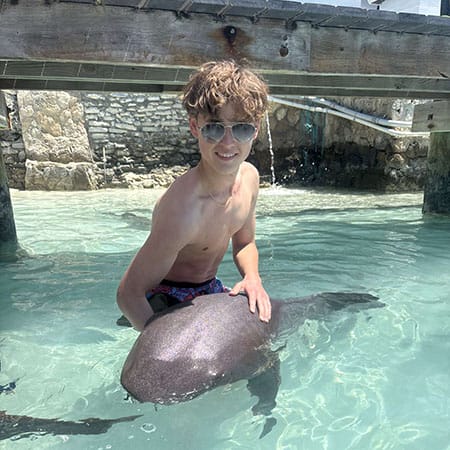
Hunter enjoying one of his favorite activities – interacting with marine life – this time meeting a nurse shark./ Courtesy Hunter Churchill
What other organizations are you involved with?
I’ve been part of the Best Buddies program at my school since the start of the year. My favorite event so far was the soccer tournament. I helped coach the kids to try to help them win the tournament.
I also serve on the Teen Network Board’s Drug and Alcohol Prevention Committee. We meet every other week to plan events and discuss policies that can help reduce teen drug and alcohol use in the community. This weekend, we’re visiting local drugstores and places like 7-eleven to talk about the dangers of selling to underage youth and ask them to put up signs saying they won’t sell to minors.
And with Aspire Afterschool Learning, I get to work with kids from at-risk communities in Arlington. I help them with reading, homework and fun activities. Today, for example, I got to play sports with them and help them get some exercise.
What’s been the most rewarding part of your work?
I’d say the most rewarding part isn’t about volunteer hours or getting an award like this because that’s not why you do it. You do it to build real connections and make a difference in your community. So when I actually see the impact of something I’ve done, it motivates me to keep going and to do even more.
What have you learned through your experiences as a volunteer?
I’ve learned that every kid is different, especially when working with kids with disabilities. You really have to connect with each of them on a personal level—what works for one might not work for another. Everyone is unique in their own way, and it’s important to take the time to understand and connect with them individually.
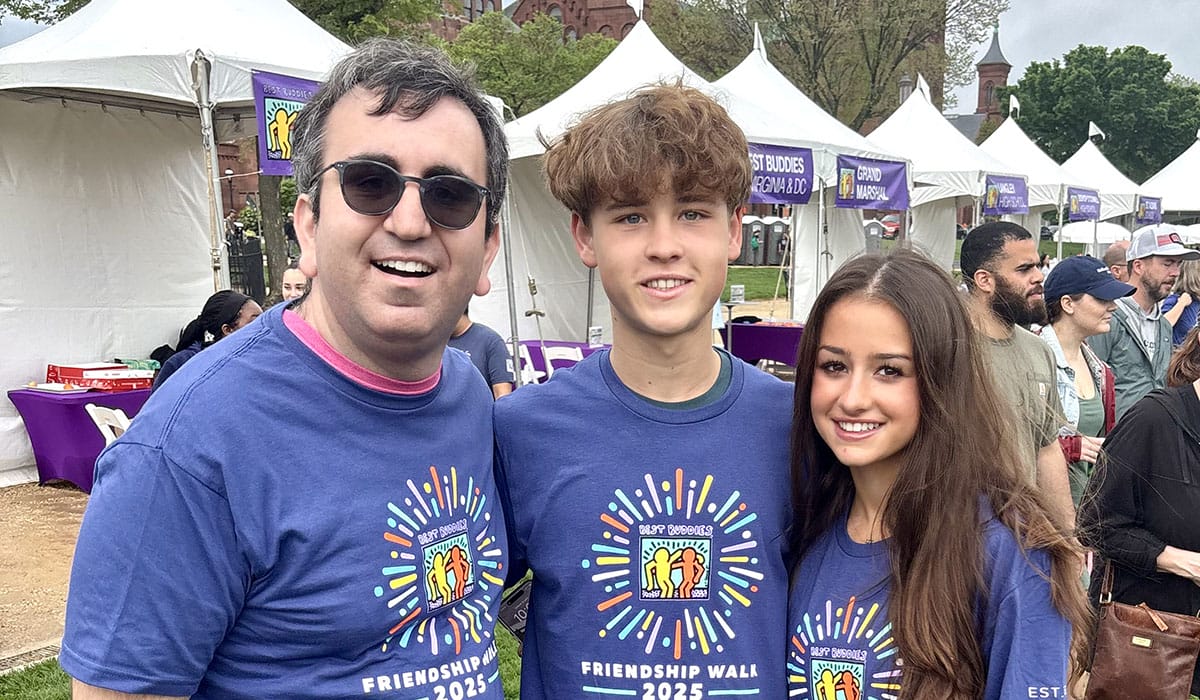
Hunter at the 2025 Best Buddies Friendship Walk on the National Mall with a Buddy, Conner, and a fellow Yorktown High School volunteer./ Courtesy Hunter Churchill
Why is it important for others to get involved with causes they care about?
For me, it’s about giving kids the same opportunities I was lucky to have growing up. No child—whether they’re from an at-risk community or have a disability—should miss out on the experiences others get to enjoy. Volunteering helps make sure they can be part of those moments. I’m really grateful for what my parents were able to give me, and I want to help pass that on.
Any advice for people who want to start volunteering?
I’d say find what motivates you. Look at your personal interests and then find a way to use those to help your community.
What do you want people to learn from your story?
I hope people see that no matter how busy you are with school, sports, or other activities, it’s important to stay involved in your community.
Doing something that helps others can have a real impact and create positive change. The impact you make helps build a better place for everyone.
Teen Skater Volunteers to Help Seniors Rebuild Strength
Meet Daily Point of Light Award honoree Madison Xaphakdy. Read her story, and nominate an outstanding volunteer or family as a Daily Point of Light.
Madison Xaphakdy shines on the ice as a five-time Minnesota state champion, but her impact extends even further in the quiet halls of a hospital. Despite a demanding schedule filled with figure skating practices, competitions, extracurriculars and schoolwork, the high school junior carves out time each week to volunteer at Capitol View Transitional Care Center in St. Paul, Minnesota. There, she helps senior patients recovering from surgery or hospital stays—guiding them through exercises, measuring their progress and offering encouragement every step of the way.
Her time at the physical rehab center isn’t just an act of service—it’s a glimpse into the future she envisions for herself. Madison dreams of becoming a doctor one day and sees each volunteer shift as a step toward that goal. Whether she’s restocking supplies or helping someone take their first steps after surgery, Madison is already embodying the compassion and dedication of a future physician.
Tell us about your volunteer role with Capitol View Transitional Care Center at Regions Hospital.
I started volunteering there last June, and I usually volunteer about six hours a week. A big part of my role is helping patients with mobility. Sometimes I follow them with a wheelchair in case they get tired, walk beside them for support or play ball games to help improve their brain-body coordination and strengthen injured arms.
One of my favorite tasks is measuring how far they walk. The farthest a patient I worked with has gone was 60 feet, which was really exciting! It helps the therapists track progress, and it’s so rewarding to see patients improve little by little. I also help with restocking towels, refilling the water station and even making beds so patients have a clean, comfortable space to do their exercises.
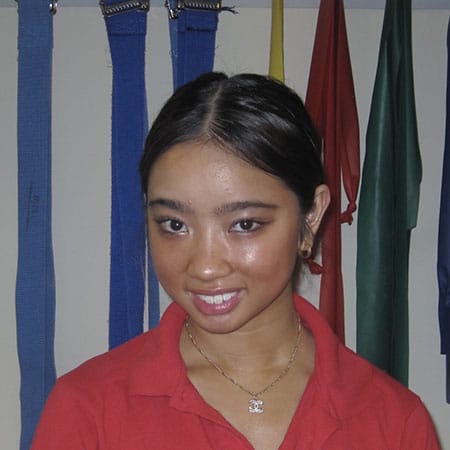
Madison Xaphakdy volunteers in the physical therapy gym at Capitol View Transitional Care Center, assisting therapists to help elderly senior patients rebuild strength. /Courtesy Madison Xaphakdy
What inspired you to get started with this initiative?
I wanted to expose myself to a healthcare setting because it’s something I’m really interested in pursuing as a career. I plan to go into the pre-med track in college. My passion for healthcare really started because of my grandpa. I was very close to him. He would stay with us from time to time and tell me stories about his life. He felt like a best friend.
But he was diagnosed with type 2 diabetes, and I watched him take insulin shots every day. I was so curious about why he had to use syringes in his arms. It seemed so serious, and I hated seeing him go through that. It was hard watching someone I loved struggle like that, and I think that was the moment I knew I wanted to go into healthcare. Ever since I was young, I’ve wanted to make a difference in the world through medicine.
Outside of volunteering, what other activities and organizations are you involved in?
I’m definitely busy with a lot of different things! One of my longest-standing extracurriculars is figure skating. I’ve been skating since I was 8 years old. One of my proudest moments was placing silver at Midwestern Sectionals in my age group, which qualified me for the U.S. Figure Skating National Development Camp. It’s an incredible opportunity where the top four skaters from each section train with Olympians and world-class coaches.
At school, I’m involved in the East Ridge Newsletter medical club, where I write articles about global health issues and explore possible solutions. I’m also a member of HOSA—Health Occupation Students of America. I serve on the educational outreach committee, helping to bring in physicians I’ve met through skating or networking to speak to students. It’s a great way to help my peers learn more about medical school and what it takes to pursue a career in healthcare.
What’s been the most rewarding part of your work?
The most rewarding part is helping therapists guide patients through their exercises—especially when I get to add a bit of a challenge, like using a resistance band. Most of the patients at Capitol View are recovering from injuries, so seeing them gain the strength to use their injured body parts again is incredibly fulfilling. It’s amazing to watch someone go from struggling to lifting their arm all the way up, even if it seems like a small movement. We cheer them on for those tiny wins, saying things like, “Great job, you got all the way up!” It might look simple, but for someone older and healing, it’s a big deal—and being part of that progress is really meaningful to me.
What have you learned through your experiences as a volunteer?
One of the most important lessons I’ve learned through volunteering is how to be patient. Especially in the healthcare field, you really have to take the time to be patient with people. Many of our patients are seniors, so it can take them longer to process things or complete certain tasks. Volunteering has taught me to slow down and be more patient with everyone I come across, both inside and outside the hospital.
Why is it important for others to get involved with causes they care about?
I think volunteering is important because it helps you grow as a person—it builds compassion and empathy for others. Every time I do community work, I feel a genuine sense of goodness knowing I may have made someone’s day a little better. Even small actions can have a big impact and being part of something bigger than yourself is really fulfilling.
Any advice for people who want to start volunteering?
One tip I’d recommend is bringing a small journal or notebook with you. During breaks or downtime, write down three things you learned that day, whether it’s something you observed, a meaningful interaction with a patient or just how you felt. Especially if you’re in high school and interested in healthcare, these notes can be really helpful later when people ask you questions like “Why medicine?” or “What did you learn from volunteering?” Having those reflections written down makes it so much easier to remember the details and express your experiences clearly.
What do you want people to learn from your story?
I hope people see that volunteering helps you grow into a more compassionate person. It really does change you in the best way. It teaches you to care more about others, to listen better and to see the world from a different perspective. You don’t have to do something huge to make an impact. Just showing up, being kind and being there for someone can make a real difference.
TOMORROW’S GUIDE DOGS HAVE A HOME WITH THIS VETERAN
Meet Daily Point of Light Award honoree Nathan Gardner. Read his story, and nominate an outstanding volunteer or family as a Daily Point of Light.
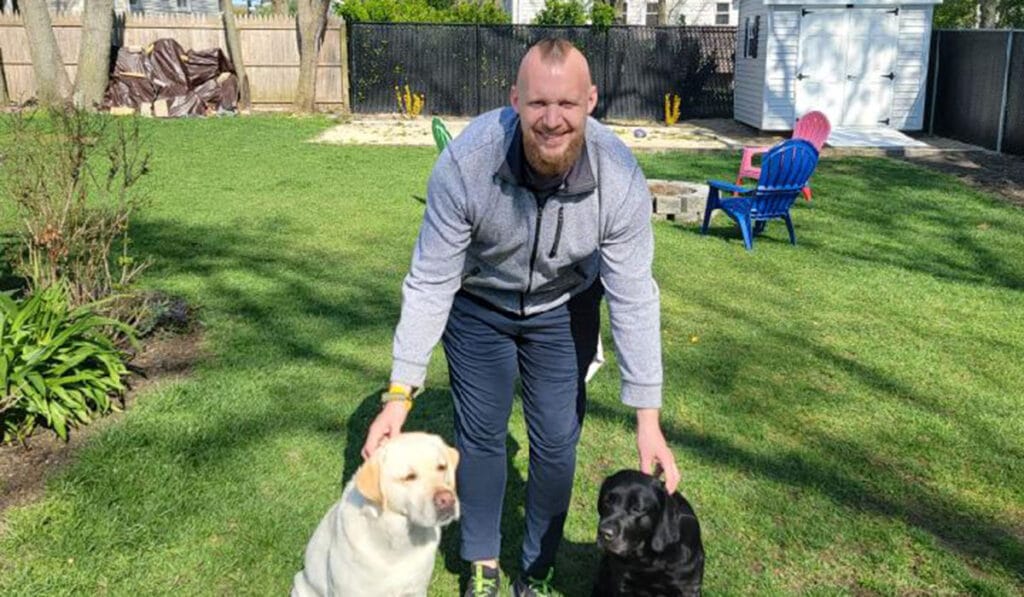
NATHAN GARDNER ENJOYS A SUNNY DAY IN HIS BACKYARD WITH HARPO, HIS BREEDER DOG, AND KENZO, HIS SERVICE DOG. /COURTESY NATHAN GARDNER
When Nathan Gardner applied for a service dog from the Guide Dog Foundation/America’s Vet Dogs, he had no idea that the experience would transform his life.
As a former member of the Air Force, Nathan spent years working at a nuclear weapons facility. Every day, he wore full battle gear, including a plated vest, two weapons, ammunition and several other heavy items. While he loved the role, the job was incredibly taxing on his body. He suffered two herniated discs, sciatic nerve damage and an atrophied calf muscle. He was also diagnosed with cancer about a year after separating from the military. Despite waking up in pain every day, he didn’t qualify for reconstructive surgery, and feared he would suffer in silence for the rest of his life.
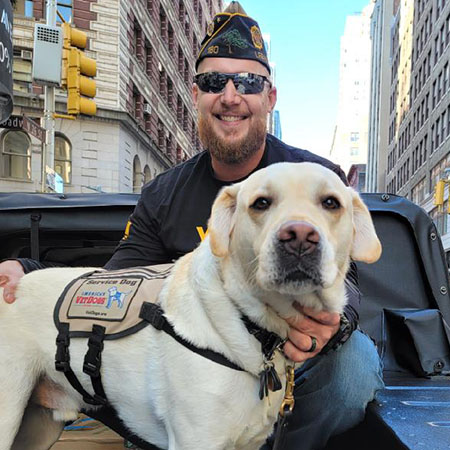
While studying at Suffolk Community College, Nathan visited the school’s office for veterans’ services and discovered a pamphlet from the Guide Dog Foundation/America’s Vet Dogs. The Guide Dog Foundation works to improve the quality of life for people who are blind, have low vision or have other disabilities, while their sister organization, America’s Vet Dogs, provides enhanced mobility and renewed independence to United States veterans, active-duty service members and first responders with disabilities through their service dog program. Depressed and in significant pain, Nathan realized a service dog could help him. In 2022, he was paired with Kenzo, a Yellow Labrador Retriever, and never looked back.
NATHAN GARDNER AND KENZO, HIS SERVICE DOG, VOLUNTEER TOGETHER IN NEW YORK CITY AT THE VETERANS DAY PARADE. /COURTESY NATHAN GARDNER
“Kenzo personally changed my whole life and perspective on life from where I was at,” says Nathan.
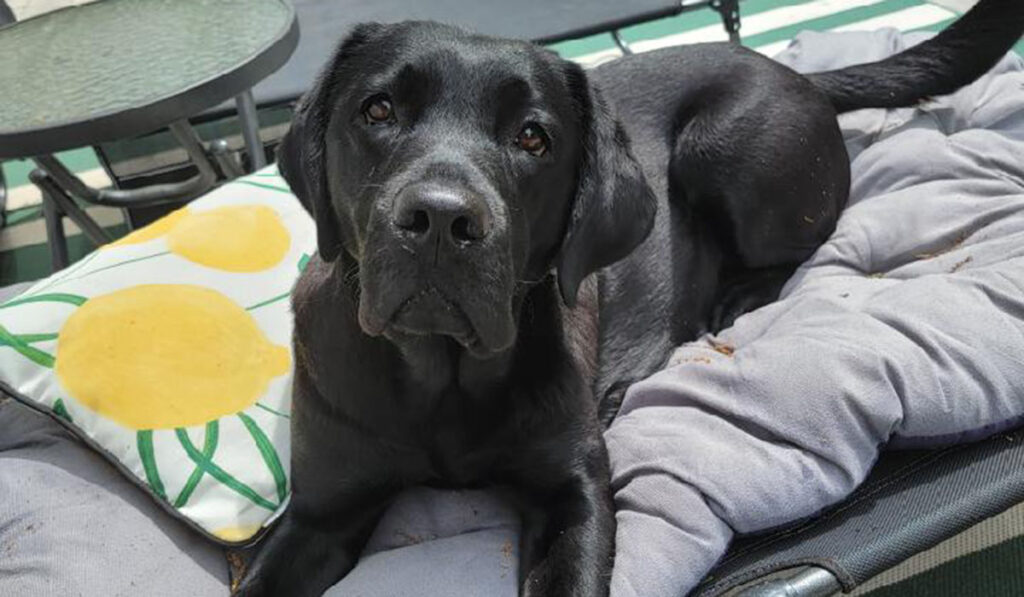
When he heard the Guide Dog Foundation was looking for volunteers to care for breeder dogs, he jumped at the chance. Harpo, a Black Labrador Retriever, came to live with Kenzo, Nathan, and his family, who are responsible for keeping the pup in pristine health and giving her a loving home as she breeds the service dogs of tomorrow.
But Nathan’s volunteer work doesn’t stop there. As a volunteer public speaker for the organization, he represents the Guide Dog Foundation and America’s Vet Dogs at various conferences across the country.
A couple years back at a Student Veterans of America conference, Nathan shared his journey with the crowd.
“It was the first time that an individual with a service dog spoke to fellow veterans at the Student Veterans of America conference,” says Mike Rosen, chief marketing officer at the Guide Dog Foundation and America’s Vet Dogs. Nathan’s speech was so influential that the organization had two new individuals come through their doors and get service dogs. “He not only volunteers his time as a breeder caretaker, but he also volunteers his time as an ambassador to help encourage other veterans who may see their own story and Nathan’s story to get the help that they’ve earned and that a service dog from America’s Vet Dogs can provide to them.”
Nathan says seeing things come full circle is the most rewarding aspect of his volunteer work. After Harpo gave birth to her first litter, one of the puppies was paired with a veteran who needed assistance.
HARPO, NATHAN GARDNER’S BREEDER DOG, ENJOYS A QUIET DAY IN THE BACKYARD. /COURTESY NATHAN GARDNER
“When you get to see that come to fruition, it’s hard to put into words. It’s such a great feeling knowing that this is what I got involved in,” says Nathan.
Eternally grateful for the gifts that his service dog has given him, Nathan is steadfast in his belief that doing volunteer work helped reintegrate him into society. By caring for a breeder dog and sharing his experience as a veteran, volunteering connects him with people.
“It is something that has made my life better and given me more joy, more positivity and all the things that I was kind of lacking before,” says Nathan. “It’s all because of volunteerism.”
Paying It Forward with Every Return: 15 Years of Volunteer Tax Service
Meet Daily Point of Light Award honoree Charles Labahn. Read his story, and nominate an outstanding volunteer or family as a Daily Point of Light.
For over 15 years, Charles Labahn has turned his professional expertise into a powerful force for good. As a retired CPA, Charles now volunteers through the IRS VITA program, dedicating his time and talent to help individuals and families in Morgan and Limestone Counties confidently navigate the complexities of tax season. With over 500 hours of volunteer service annually, he not only simplifies taxes for thousands but also empowers people with financial clarity and peace of mind.
Serving as the site coordinator for the VITA tax service at the Decatur Public Library, Charles is the linchpin of a program that returns more than $1.1 million in federal refunds to the community each year. That’s real, spendable income going back into local households—money that can help pay bills, fund education or cover critical healthcare costs. His team of 14 tax counselors is a well-oiled machine, thanks to Charles’s leadership, which includes recruiting new volunteers, overseeing training and managing complex filing operations.
Charles brings deep knowledge, patience and an ability to explain tax law in clear, practical terms. This is a rare gift—and it’s one that benefits over 1,500 taxpayers each year. But Charles’s contributions begin long before February 1. Each November and January, he leads rigorous tax law update training for all 32 volunteers spread across three RSVP-sponsored sites in Ardmore, Athens and Decatur. He’s the kind of leader who makes sure others succeed, offering not just expertise, but mentorship and support.
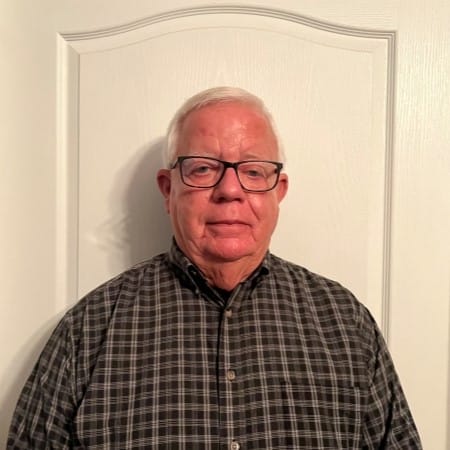
Charles brings his expertise and decades of experience in accounting to his current volunteer work./Courtesy Charles Labahn
Then, once tax season is in full swing, Charles spends 30 hours per week preparing tax returns, reviewing IRS rejections, transmitting filings and ensuring that every detail is correct. His thoroughness, especially when it comes to assisting low- and moderate-income households, means that clients get the best outcome possible—without the stress or expense of commercial services. His impact is especially profound for seniors, immigrants and those unfamiliar with tax codes. By making services accessible and completely free, Charles plays a critical role in financial stability across the region.
Tell us about your volunteer role.
My volunteer role is the site coordinator for the VITA tax program sponsored by the IRS and located at the Decatur, Alabama Public Library. The site is sponsored by RSVP/Hands On Athens. I am also available all year long to help individuals who have filed their tax returns through our program with any correspondence that they receive pertaining to their returns. I also prepare and teach two classes to our volunteers about tax law changes and our software updates.
Why is volunteering so important to you?
We are able to save our clients tax preparation fees and deliver a professional service free of charge.
What inspired you to get started with this initiative?
I was a partner in a CPA firm in another state and after moving to Alabama I saw an article in the local newspaper about the VITA site. I love helping people, so when I saw the article, I immediately called them to volunteer my 30 years of income tax work.
At first, they said that they had all the volunteers that they needed for the year, but after I told them my background, I got a call the next day to come in and pick up the materials and pass the IRS test. That was 15 years ago and I am still volunteering.
What are your long-term plans or goals for the organization?
I hope that we can keep the program going for the years to come. The VITA program has been around for years, but in this time of unsettled spending by the government, I hope this program will continue on.
What’s been the most rewarding part of your work?
The reward of getting a big thank you from our clients, and hearing them say that they can’t believe that I volunteer all of my time and don’t get paid!
Any advice for people who want to start volunteering?
Just get in and volunteer in an area that you have an interest in. Remember that maybe your past work experience could be of help somewhere.
What do you want people to learn from your story?
When I retired, I was worried about what I would do, because I didn’t have any real hobbies, but I do like to travel the world. When I saw the article about the VITA site, which was right down my line, I jumped in and volunteered my time and knowledge back to the community.
Cultivating Community and Leading in Service All Across Chicago
Meet Daily Point of Light Award honoree Markus Giolas. Read his story, and nominate an outstanding volunteer or family as a Daily Point of Light.
Markus Giolas has become a familiar and deeply trusted presence across Chicago’s south and west sides, where his dedication to volunteerism has blossomed into a leadership role that continues to make a lasting impact. As a volunteer leader with Chicago Cares, Markus brings an infectious energy, a learner’s mindset and a fierce commitment to building stronger, more connected communities. Whether he’s leading service events, mentoring others or stepping in to support wherever needed, Markus exemplifies what it means to lead with compassion and curiosity.
Over the years, Markus has cultivated meaningful relationships with partner organizations and residents alike, becoming a bridge between volunteers and the communities they serve. His leadership goes beyond logistics—he creates space for dialogue, connection, and healing. During Chicago Cares’ Power of Service program, he facilitated thoughtful conversations around public safety and racial equity, encouraging honest reflection and ensuring that all voices were heard. His thoughtful approach, especially in conversations that center BIPOC experiences, reflects a rare and powerful kind of leadership rooted in empathy and active listening.
Markus’s service doesn’t stop with Chicago Cares. He regularly volunteers at FarmWorks, an urban farm operated by Heartland Alliance that grows fresh produce for local food pantries. There, he digs in—literally—to help combat food insecurity and support sustainable, community-centered agriculture. At New Hope Church, he’s a dependable face at the food pantry, where he helps provide groceries and dignity to neighbors navigating tough times.
Markus at a Logan Correctional in prison business coaching event.
His commitment to supporting new neighbors is just as strong. Markus recently completed training to become an ESL tutor, with a desire to grow his impact and meet people where they are—linguistically and culturally. He’s also a regular volunteer at Palenque LSNA’s citizenship workshops, where he helps immigrants on their journey toward becoming U.S. citizens. These efforts are especially important in immigrant-rich communities, where access to educational and legal resources can be scarce.
In addition to his work on the ground, Markus volunteers as a career counselor for Defy Ventures, a nonprofit that supports formerly incarcerated individuals with entrepreneurship training and second chances. In these settings, his authenticity, patience and belief in human potential shine. Read on to find more about how Markus shows up—not just to complete a task, but to connect… with open ears and an open heart.
Tell us about your volunteer role.
The main organization I volunteer with is Chicago Cares, and they’re kind of the fulcrum of everything I’ve done. During the pandemic, and after the George Floyd incident, I just thought, what can I do and how can I help? Volunteering was it. Whatever my role is, however small, I feel better if I’m doing something. I went online and just searched for volunteering. I didn’t realize it was going to be so easy. I went to the Chicago Cares site, and they have a calendar. There are things to do all over the city.
I just started volunteering. I was volunteering at a farm called Growing Home Inc. in Englewood. That was important to me – going to underserved neighborhoods. In Chicago, the Englewood neighborhood is completely maligned by the news. If you hear the news, you’d think that if you go to Englewood, it’s raining bullets. It’s not like that at all. I got to spend a lot of time there through volunteering and now I actually have friends there now.
Which cause areas tend to be the most important to you?
At Chicago Cares, they made me a volunteer leader, so I lead groups for different partners. One of them was a church in the Hermosa neighborhood. They developed a food pantry, and the way they did it was really cool: instead of handing people bags of food, they set up a grocery store and give people carts. I feel like that gives them agency. They can take what they want, we pack it up for them and help take it to their cars.
Palenque, an organization in Logan Square, sponsored a workshop for people who are applying for citizenship. We sit at tables, people come up and hand us their citizenship forms and we’ve been trained to help them navigate the process. I speak Spanish, and my very experience there was with a man about my age. I helped him fill out this form, all in Spanish, and when it was over, he gave me a keychain that he made out of a parachute cord. It was the coolest thing. That’s extremely rewarding. That’s relevant to what’s going on right now with immigration and ICE. The other thing we did was walk around that particular neighborhood and hung door knockers about immigration rights, so that everyone in the neighborhood knew what their rights were. That they can’t come into your house just because you don’t speak English. Things like that.
Another organization I really like is one I discovered by volunteering through Chicago Cares, and then I started volunteering directly with them. It’s called Defy, as in “defy the odds.” It’s an organization that develops programs with people in prison who are nearing the end of their incarceration term and helps get them ready to reenter the world. It’s a long day. We go out on the bus, and we show up with these young men and women who have been in school. We help them with their business pitches and their resumes. We spend the whole day with these men and women. And it’s just so profoundly rewarding. I can’t even express it. The way it’s organized is so empathetic. You just make friends with everybody.
So, it’s not one thing. It’s just this community I became a part of. I didn’t expect it. I just thought, I’ll help myself by helping others. But I’ve met so many people and do all these different things. I have a bit of ADD and prefer not to stay in one place too long, but to move around. Still, I establish relationships. I go back and volunteer with them.
What inspires you to volunteer?
What keeps me going is people. I love hanging out with people. And now I have friends from all different age ranges and economic backgrounds. It’s something I hadn’t had much of, and now when I go to a charity event, I see people I know. I’m proud of that, that I’ve ingratiated myself into this army of people out there doing the same thing: helping each other, and helping the community.
What have you learned through your experiences as a volunteer?
It sounds cliché, but we’re all just people. We worry about the same things. I feel like I’m more part of the world now than I used to be. When you look at some of these people, the lives they’ve led, the hardship they face… it’s something I can’t even fathom. Even during my challenges, I’ve remembered over and over that I’ve really had a pretty good life compared to a lot of people.
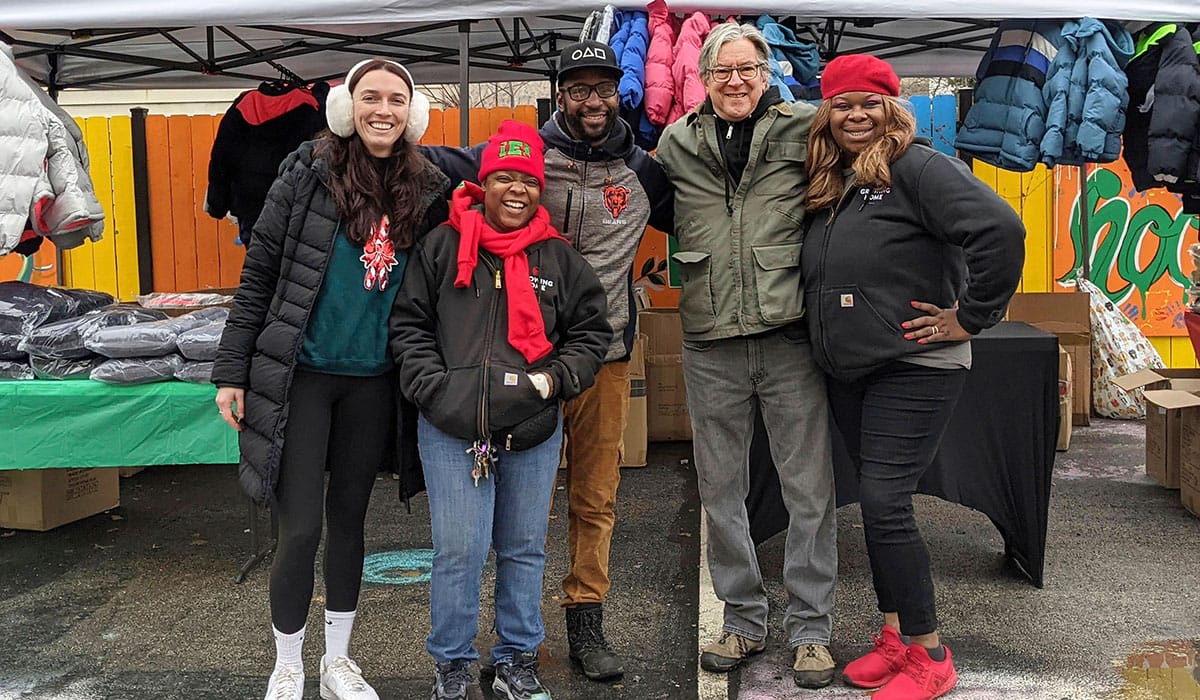
Growing Home distributing warm clothing at Englewood Winterfest in Chicago.
Why is it important for others to get involved with causes they care about?
People want to know that there are people out there who care about them. Get involved. And if you’re upset about an issues, then do something. Even if it’s picking up trash on the street.
Any advice for people who want to start volunteering?
I say, two hours a week. Or three, or four. You can spare that. Chicago Cares made it really simple for me. They list events. They have these ice breaking group activities. Everyone introduces themselves. Most organizations have a volunteer liaison, which can help you get acquainted with things. Just find an event or cause area and get involved.
What do you want people to learn from your story?
I just want to set an example. Getting an award for volunteering? I’m not doing this for recognition. But I do try to lead by example. One of my favorite quotes is from Dr. Askhari Johnson Hodari: “If everyone helps to hold up the sky, then one person doesn’t get tired.”
A Vital Lifeline for LGBTQ+ Youth: 18 Years of Service at The Trevor Project
Content Warning: Points of Light is proud to share the following uplifting and inspiring story. However, we acknowledge that it may be difficult for some readers. We encourage you to please care for your own well-being above all.
Meet Daily Point of Light Award honoree Caroline Bird. Read her story, and nominate an outstanding volunteer or family as a Daily Point of Light.
For nearly two decades, Caroline Bird has provided strength, compassion and advocacy for LGBTQ+ youth through her volunteer work at The Trevor Project—which operates the largest suicide prevention and crisis intervention organization specifically for LGBTQ+ young people, offering 24/7 support through its phone, chat and text services.
Since January 1, 2006, she has served on the frontlines as a Trevor Lifeline volunteer, offering crisis counseling and emotional support to young people navigating some of the most vulnerable and critical moments in their lives. Her commitment has spanned hundreds of shifts, each one grounded in her belief that every young person deserves to be heard, supported and seen.
“Young people need and deserve to not only be listened to, but also to be heard,” Caroline shares. “Validation from an affirming adult significantly reduces risk of suicide. Many youth don’t get this in their immediate communities, but to know there is an enormous ‘chosen’—as opposed to biological— family who love and support these lonely and often isolated young people confirms that they matter, that their happiness matters and that there is a place for them in this world.”
Caroline’s role on the Lifeline goes far beyond answering calls. With empathy and clarity, she actively listens to youth in distress, helps de-escalate moments of crisis and gently guides callers toward safety and hope. “I cannot overemphasize the power of offering support and validation to somebody who is isolated, afraid, rejected, persecuted or closeted out of fear,” Caroline says. In each conversation, she embodies the core mission of The Trevor Project—affirming life and offering a sense of belonging to those who may feel alone. Her dedication has made her the longest-serving Lifeline volunteer in Trevor’s history, a testament to her enduring compassion and resilience.
“At risk of sounding terribly clichéd, my volunteer role at Trevor is genuinely the most rewarding work I’ve ever done. As the product of a stable and happy upbringing, I was able to provide the same to my (now adult) children but am very well aware that my family ‘norm’ is far from that of many of the youth who reach out to Trevor,” Caroline reflects. “To begin a call with a young person who cannot speak because they are frightened to do so, or are crying too hard, and to bring that same call to a conclusion having de-escalated risk, figured out a safety plan and often to have changed the very negative viewpoint that the caller had of themself and their place in the world… well, who wouldn’t be motivated by that kind of work? Yes, the conversations are difficult and sometimes draining but the rewards for me are immense.”
Caroline also serves on The Trevor Project’s Board of Directors, offering a crucial voice on behalf of the volunteer network. In this role, she ensures that the experiences, challenges and insights of frontline counselors are brought into the organization’s leadership conversations. Her dual service bridges the gap between direct support and high-level strategy, enhancing the effectiveness of Trevor’s mission on both individual and organizational levels.
Caroline’s ability to balance these two roles—both deeply human and deeply strategic—sets her apart as a changemaker. Whether she’s on a call helping a youth through a moment of crisis or in the boardroom shaping policy, her perspective is grounded in lived experience and authentic connection. This unique vantage point allows her to advocate for policies and resources that truly meet the needs of the LGBTQ+ young people she has spent years serving.
“Trevor’s resources are more vital than ever, given the current climate with increasing threats to the safety and liberties of LGBTQ+ young people,” Caroline says. “The organization strives to be the most trusted, reliable and comprehensive suicide prevention network for young LGBTQ+ people and will continue to do so.”
In every space she enters, Caroline leads with integrity and care. Her fellow volunteers and Trevor staff describe her as a calming presence, someone whose steady support and thoughtful mentorship lift others up. Her longevity with the organization has made her a source of continuity and wisdom—someone newer volunteers look to for guidance and inspiration. Through it all, she remains humble and focused on the people at the heart of the work.
Caroline’s contributions reflect a rare blend of heart and leadership. She doesn’t just answer calls—she changes lives. She doesn’t just sit in meetings—she amplifies voices. Her presence at The Trevor Project is one of deep commitment, tireless advocacy and profound love for the LGBTQ+ youth she serves. In every moment of connection, she offers something invaluable: the reminder that someone is listening, someone cares and someone believes in their tomorrow.
To LGBTQ+ youth, Caroline emphasizes: “The Trevor project exists because your place in the world, your safety and your happiness matters. You are loved by an enormous community, and you deserve to find peace and fulfillment as your true, authentic self. Stay strong, keep fighting and reach out to The Trevor Project because we are always here for you.”
If you or a young person from the LGBTQ community who you know may be considering suicide, contact The Trevor Project at 1-866-488-7386 or text 678678 to talk to a trained crisis counselor. It’s anonymous, free and available 24/7.
Retired CPA Builds Environmental Legacy
Meet Daily Point of Light Award honoree Richard Brightman. Read his story, and nominate an outstanding volunteer or family as a Daily Point of Light.
Richard Brightman spends 40+ hours each week working for cleaner waterways and safer wildlife, but that wasn’t always the case. Prior to retirement, he was a CPA and a Rotary Club and YMCA volunteer but always had an interest in environmental causes. He and his wife started recycling before it was common and easy. They eventually left New Jersey for the coast of North Carolina, and since 2012, Richard has been a dedicated board member with the Keep New Hanover Beautiful (KNHB) and is currently serving as the executive director.
One of his biggest projects involves a partnership with TerraCycle which, among other things, recycles unusual items into compost and safe ingredients for plastic products. Richard and KNEB have been facilitating the cleanup and prevention of cigarette butt litter for many years. They have become one of the top recyclers of that kind in the country.
Richard’s work protects the area’s ground and marine life while inspiring environmental stewardship in people of all ages. He works closely with a local sea turtle group so as not to disturb nests on the beach and finds his role on the board of Cape Fear River Watch, another nonprofit committed to cleaning and protecting local waterways, overlaps.
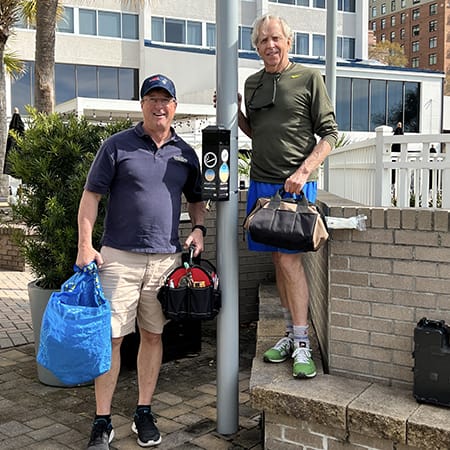
Richard (right) and a fellow volunteer install cigarette butt receptacles in the New Hanover area.
What inspired you to get started with this initiative?
When we moved here, I was in contact with someone who spent some time with Keep America Beautiful (KAB) corporate in Connecticut. He and I got to talking about environmental work in Wilmington, and as it turned out, he was the treasurer for what was Keep New Hanover County Beautiful at the time. He convinced me to start coming to the cleanups, and the rest, as they say, is history.
Describe your cigarette butt litter prevention and recycling program.
In 2017, we started our campaign. We partnered with TerraCycle and started funding cigarette litter receptacles for local organizations, including Wilmington International Airport. Our program collects and recycles cigarette litter directly with TerraCycle. Since then, we’ve installed over 350 receptacles that we continue to service and distributed around 150 to other organizations. We’ve collected and recycled 2,589,000 cigarette butts just in New Hanover County. We’re 1000 pounds away from two tons of cigarette butt litter making us the number one KAB affiliate out of 700+ also participating. We’re very proud of that.
Around eight of our terrific volunteers are currently responsible for cigarette butt litter receptacle cleaning routes. This campaign is what led us to be recognized by KAB and awarded a BeBot in 2023.
What is a BeBot?
There are only about 11 in the US and 50 worldwide. BeBots are battery-operated, beach-cleaning robots that pick things up one to four inches below the sand, small litter overlooked in traditional cleanups. It’s environmentally safe and supports erosion prevention, wildlife protection and sand preservation.
They operate similar to drones using a handheld device with paddles on it. It’s extremely safe in that it only goes three miles an hour tops while we’re raking the sand, so we can stop it very quickly. Each time we sift through areas–about 32,000 square feet as per the battery capability–we capture between 400 to 500 items of non-marine debris.
Why are cigarette butts, in particular, such a problem?
If they end up in our landfills, they take a couple of years to break down, and during that time, they let off toxic chemicals. When someone litters, animals can pick them up. Birds can ingest them. And they end up in waterways, affecting marine life.
Tell us about your volunteer role with Keep New Hanover Beautiful.
We are one of very few KAB affiliates who are non-funded, so we have to seek funding. That, in itself, is a full-time job. For example, we want to create a PSA to tell folks about the non-marine litter left behind at the beach that the BeBot collects. 90% of the stuff we pick up, you can’t see. So, I’m trying to get funding to develop PSAs to flash on billboards.
I spend a lot of time instructing volunteers and looking for places we might be able to take some of our programs. And we do monthly cleanups in partnership with Cape Fear River Watch. Around 40 volunteers come out on a regular basis, though one event had 80 people, including some school groups, University of North Carolina Wilmington (UNCW) students and environmental groups.
Tell us about your trip to New Horizons Elementary School robotics class.
The STEM teacher of a small private school reached out to us and said she has a robotics class with about 12 children, 10- and 11-year-olds interested in the BeBot. We jumped at the opportunity, and that led to the principal of the school organizing a field trip to Carolina Beach with three third-, fourth- and fifth-grade classes. It was the best event we’ve done.
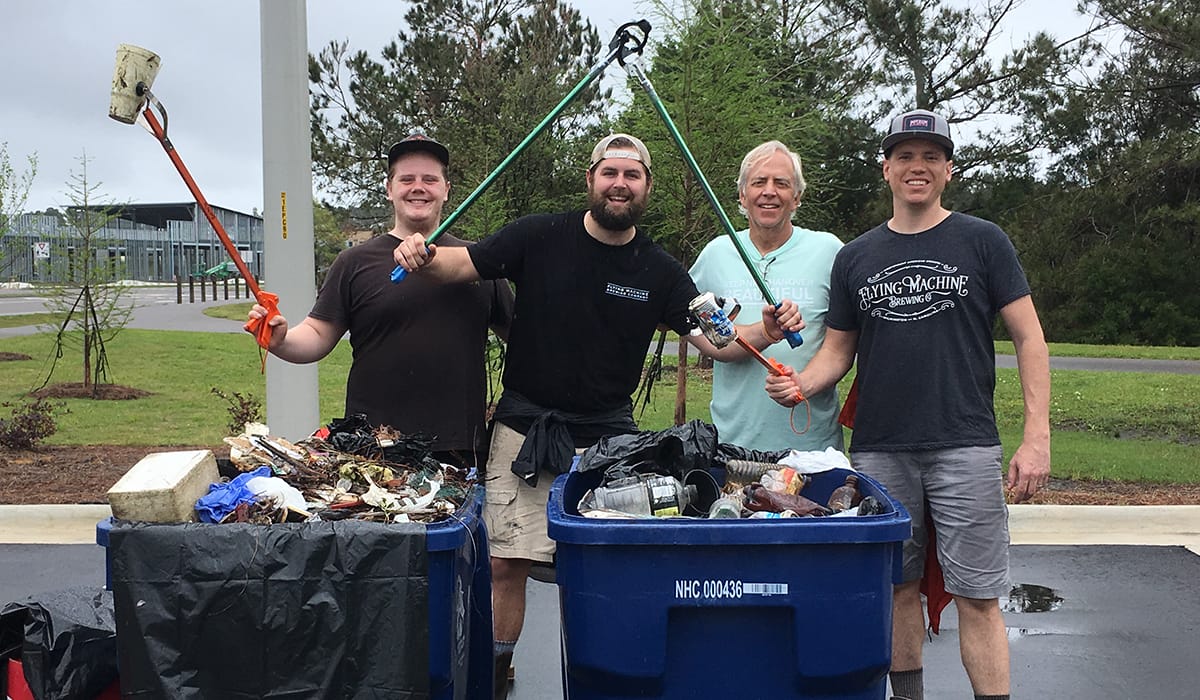
Richard Brightman (second from right), volunteer executive director and board member of Keep New Hanover Beautiful, and fellow volunteers finish up a successful cleanup.
What’s been the most rewarding part of your work?
There are many rewarding moments working with volunteers and helping to educate youth through the cleanup projects. We’ve worked with UNCW interns, primarily in environmental science programs, and we’ve gone on to help many of them go to graduate school or get jobs tied to environmental matters. A few have even become board members, like our VP. But when we get to work with grade school children like with New Horizons, those kids go home and tell their parents about what’s going on and, perhaps, that they should be recycling more or more efficiently. To me, that’s the reward.
What have you learned through your experiences as a volunteer?
I’ve learned never to give up.
Tell us about future partnerships, programs or events that you are excited about.
April is Earth Month, and our biggest event of the year is our Earth Day festival on the 26th at a local park. The BeBot will be there to display some of the non-marine debris we’ve captured.
What do you want people to learn from your story?
Recycle. Don’t litter. And beautify the area around you. Leave it cleaner than when you arrived.
Meet Daily Point of Light Award honoree Harini Senthil. Read her story, and nominate an outstanding volunteer or family as a Daily Point of Light.
Harini Senthil is only 18 years old but is already thoughtfully addressing matters of life, death and the moments in between that can change a person’s course. She is the chair of the Tulsa Opioid Informed Affected (TOIA) Youth Advisory Board where she uses her skills to advocate for more effective substance use prevention education. She even presented the group’s research and how it has changed over time to professionals in relevant fields. Her heavy involvement in speech and debate club has increased her ability to effectively advocate and share important messages with the larger community.
Separate from her work on the TOIA board, Harini has run “deaths of despair” research identifying the correlation between socioeconomic conditions and overdose rates in all 77 of Oklahoma’s counties and published an op-ed in Tulsa World, a local newspaper, about safe medication disposal practices. She even built an app that helps users track medication expiry dates and facilitate drug take back events that was named the 2024 Congressional App Challenge winner for Oklahoma’s 1st district.
She also coordinates free tutoring sessions with her high school’s Math Club and delivers flowers and helps patients navigate the hospital at Oklahoma State University Medical Center’s ER. As a violinist with local youth orchestra Sistema Tulsa, she volunteers to lead rehearsals and lessons for younger musicians who might not otherwise have access.
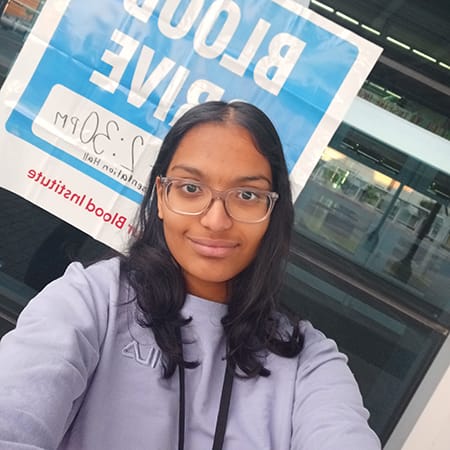
Harini volunteers at a local blood drive.
What inspires you to volunteer?
My grandfather has always been a source of inspiration for me. He’s always taught me to do what I can to make the world around me a better place. I’ve really taken that on as I look for ways that I can make an impact, finding the hidden issues and trying to address them.
Tell us about your volunteer role with Tulsa Opioid Informed Affected Youth Advisory Board and beyond.
I advocate for effective substance use prevention curriculum. We’ve really transitioned from fear-based to fact-based messaging, but there’s still so much more to be done to cultivate authentic youth engagement.
I serve as the chair, and lead discussions with a group of about 10 youth from across the county about prevention curriculums and discuss what’s effective and what can be improved in coordination with our local health department. We share our learned insights with the local community at different forums and events with parents and people who work in public health.
Through that, I’ve also advocated for safe medication disposal practices. People tend to hold on to expired medications because they’re not sure how to dispose of them safely. Some flush them down the drain, which isn’t ideal for our wastewater systems or the environment. But if you hold on to them, you might accidentally take them. It’s a major contributor to accidental overdoses. So, working with another high school student, I decided to create an app called Crisis Averted to help people figure out ways to track medication expiration dates and figure out where safe disposal options are. I had no previous coding experience, so I watched a lot of tutorials.
With the SAFE Project Youth VOICE Council, I’m creating a nationwide map of Naloxone availability based off of 200+ community visit surveys. Volunteers write about ease of obtaining it, barriers to access and free sources, like vending machines. I also advocate for evidence-based youth substance use prevention education nationally.
What inspired you to get started with these initiatives?
I got involved with opioid crisis advocacy when I realized how big of an issue this was in my local community. We tend to think of the “deaths of despair” concept as primarily affecting white, middle-aged communities in the Rust Belt, but it’s so much more widespread. Many overdoses are related to fentanyl, especially among youth.
You advocate for “an empathetic, person-centered approach towards substance use prevention education.” Could you give us an example of that and explain why that’s important?
Person-centered language is crucial, because there’s so much stigma surrounding addiction. It makes it harder for people to access help when they need it, because it’s shrouded in silence. A person-centered approach is essential in substance use prevention education, because we need to understand the lived experiences of so many youth, and that starts with acknowledgement. A one-size-fits-all approach doesn’t work. This is a diverse issue.
What are your long-term plans or goals for the organization?
I recently joined the National Opioid Affected Youth Initiative that deals with grant funding for local youth advisory boards. Through this, I want to expand my advocacy and community engagement. I hope to pursue a career in addiction psychiatry after studying public health at Brown on the pre-med track.
What have you learned through your experiences as a volunteer?
As we saw throughout the COVID-19 pandemic, transitioning from in-person meetings to virtual, flexibility is crucial, especially with community engagement. Things need to change when they need to change, and it’s important to always keep the why of the issue at heart.
Tell us about future partnerships, programs or events that you are excited about.
Through my work on the National Opioid Youth Advisory Board, we’re going to be working with different youth advisory boards across the country to lead trainings on authentic youth engagement for youth-serving providers, people who work in behavioral health, mental health, social services and even youth themselves. We’re creating a tool kit for that, too.
How can people reading this take steps to address this where they live?
Safe medication disposal is one of my passions. Be aware of when your medications expire, and figure out ways to dispose of them safely, in a way that doesn’t harm the environment. There are medication take back days twice a year with local health departments and pharmacies.
What do you want people to learn from your story?
You don’t have to be a certain person or a certain age in order to be an advocate. I started my work as a teenager, and it’s been awesome to see the impact I can have. I really hope that more people can get involved.
How One Leader Has Spent Two Decades Empowering His Community
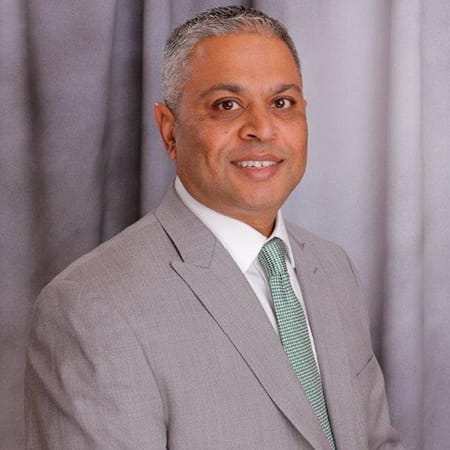
Meet Daily Point of Light Award honoree Harnish Parikh. Read his story, and nominate an outstanding volunteer or family as a Daily Point of Light.
For more than 20 years, Harnish Parikh has been a driving force behind countless community service efforts in Jacksonville, Florida. As the site lead for the Prudential Jacksonville Office’s Community Engagement Council, Harnish has turned passion into purpose—organizing, leading and participating in volunteer events that bring colleagues together for the greater good. His steady dedication has not only strengthened the company’s culture of service, but also inspired others to take a more active role in getting involved themselves.
His journey began with simple acts of participation, but Harnish quickly rose to become a leader in the council, known for his ability to build strong partnerships with nonprofit organizations and mentor fellow council members. Through his years of service, Harnish was selected to participate in Leadership Jacksonville, a prestigious program that helped him expand his impact beyond Prudential. He developed skills that led to his role as a nonprofit board member for HandsOn Jacksonville, where he eventually served as co-chair before reaching term limits. Even after stepping down from the board, his commitment to service didn’t slow down—if anything, it expanded.
In addition to corporate-led initiatives, Harnish frequently volunteers on his own or with his family. Whether it’s cooking meals for unhoused individuals or helping clean local temples, he embodies the spirit of selfless service. Some months he logs four hours; others, up to 50. Regardless of the number, it’s the consistency and heart behind his work that makes the biggest impact. For Harnish, volunteering isn’t about recognition—it’s about remembering your roots and lifting others along the way.
Harnish volunteers with the Prudential Jacksonville Office for Community Engagement and is responsible for coordinating, leading, participating in and executing on local volunteer events for Prudential employees.
Tell us about your volunteer role and your work at Prudential.
At Prudential, I’m a director of Strategic Sourcing in our Global Sourcing & Procurement Organization and I work in our Enterprise Vendor Management Business Unit. On the philanthropic side, I am also currently the site lead for the Prudential Jacksonville Office for Community Engagement and have responsibility for coordinating, leading, participating in and executing on local volunteer events for Prudential employees. This has been ongoing for 25+ years.
I was an active board member of a local nonprofit before rolling off after I reached term limits. I participate regularly in volunteer activities independently and with family, such as cooking meals, serving meals and cleaning up for those in need or at the local temple.
Why is volunteering so important to you?
Volunteering is important to me for many reasons. I value having the ability to choose an important cause and being able to contribute to it by lending a hand to help a local nonprofit or an organization that is doing things to better the lives of others. I tend to gravitate to the helping underserved populations or children—I was blessed to have what I have today and want to do what I can to help others achieve their goals or through difficult times as we all deserve the opportunity to flourish! Additionally, getting involved in my community by helping with the local temple or by helping clean areas within our communities is important to me.
What inspired you to get started with these initiatives?
Prudential had a Community Engagement Council when I first joined the company, and the varying volunteer events got me hooked—from cooking at local shelters to helping with building homes with Habitat for Humanity. The importance of getting involved in my community was seen in what Prudential did. The program allowed me to regularly attend volunteer events and ultimately led me to become the site lead for the local council at Prudential. Just seeing the end product and knowing I helped with that was pure satisfaction. But what inspired me most was the matriarch of our family. My grandmother instilled values in us and two of them were to “never forget where you came from” and to “always try and make the lives of others better!”
What are your long-term plans or goals for the organization?
I want to get back into board service. I’d like to serve on a board that continues to drive results that are aligned with my values and important to me personally. I want to continue to lead the local Prudential Volunteer Council as well, as we are now getting back into a groove of regularly volunteering and see this growing. Many of my peers onsite are awesome volunteers who love to give back as well and want to continue to provide options to make our community even stronger.
What’s been the most rewarding part of your work?
Just knowing I have the ability to make positive changes in the community or in the lives of others is the most rewarding. This is what my grandmother wanted us to do. I have the ability to pay it forward, so am going to use that ability to do just that.
Why is it important for others to get involved with causes they care about?
We all have something that is important to us—children, the environment, education, literacy—so why not take that energy and drive what is important in the community where you live? If we all contributed to each important cause, can you imagine how much of a difference it would make in our lives and the lives of others? And, I promise you, you will end up going back to further enhance that cause.
Any advice for people who want to start volunteering?
Start out at a small event that interests you and give it a try. You will then know what it takes and can decide how frequently you want to contribute your time and effort, whether it’s a few hours out of your week or a few hours out of your month to make a change. As the Nike slogan goes, just do it.
What do you want people to learn from your story?
We all have a keen interest in making our communities and the lives of others better—let’s act upon it and make a difference!
The Keys to Connection: Bridging Intergenerational Gaps
Meet Daily Point of Light Award honoree Nicole Han. Read her story, and nominate an outstanding volunteer or family as a Daily Point of Light.
“Filial piety” is a term in Chinese culture that places high value on showing love and respect towards one’s parents, elders and ancestors. Nicole Han, a 17-year-old second generation American, has taken this to a new level with Heritage Bridges, the nonprofit she founded to bridge linguistic divides by developing and coordinating free intergenerational classes and events with a focus on empowering and celebrating senior immigrants.
As the executive director, she develops and oversees programs. She has also been teaching English for four years. Not only does her work reduce social isolation, but it can be vital to everyday functions.
Since its formation, the organization has garnered five global partnerships, with 600+ AAPI event attendees. Over 30 volunteer staff members run 18 chapters in eight different states, all overseen by Nicole, and have registered over 10,000 hours of service. Nicole’s chapter has over 150 current English students.
Nicole also heavily advocates for equitable access to language services as a board member of the Massachusetts Speaks Coalition, a governmental advocacy coalition for Bill H.3384/S.1990, An Act Relative to Language Access and Inclusion. This was, in part, inspired by an internship with a state representative that sparked her passion for advocacy and social justice.
What inspires you to volunteer?
Creating community change and reflecting on current events is motivating. I really do believe that youth volunteerism and youth power have the capability to create social reform.
What inspired you to get started with this initiative?
My grandma is Mongolian Chinese and emigrated to the United States in her late 70s. I recognized the devaluation of senior immigrants. There are few resources available to them. This drove my advocacy, because they hold the foundation of our identities, and it’s crucial for us to preserve and pass down their cultural legacies.
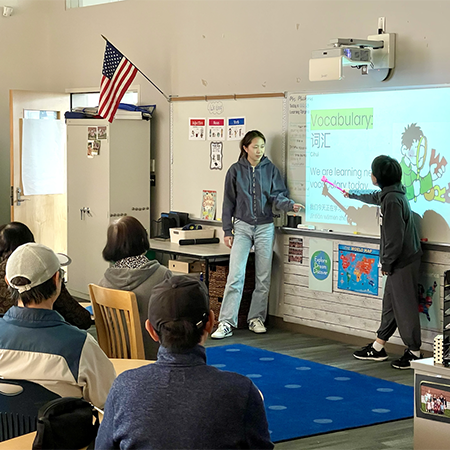
Nicole Han, founder of Heritage Bridges, empowers senior immigrants through new language exercises in one of many English classes her organization offers.
What are some of the challenges people face as they immigrate?
When someone immigrates to a new country, they often encounter the challenges of cultural assimilation–learning new social standards, adjusting to different community values and sometimes erasing long-held cultural practices or beliefs. Many experience social isolation due to the sudden change of setting and limited language proficiency that restricts their ability to interact and form new relationships. The sense of cultural loss is a huge problem. Finding a community where they feel acknowledged and known can be hard, and due to limited social networks and social opportunities, they ultimately have lower visibility.
Tell us about your volunteer role with Heritage Bridges.
In 2021, I started to teach English online. My grandma was my first student. I asked her if she had any friends who wanted to learn. Then, she asked people from her nursing home, and they contacted their friends. It started to reach multiple counties and, eventually, across the U.S. and Asia. I found volunteer staff to teach and established the in-person beginner English class and then the online beginner and advanced classes, using student input to inform lesson topics.
Besides the English program, we offer multiple public AAPI celebration galas and performances to celebrate and build pride in our identity. Right now, we co-host the events in the local community, but we’re looking towards expanding online. Anyone can join. I really like the lion dance at the annual Lunar New Year gala. A lot of children and seniors participate in the gala, and every time they see it, they all applaud and scream with joy.
We also offer empowerment workshops on things like Chinese calligraphy and confidence. Our only source of fundraising is selling red socks at AAPI celebrations and occasional pop-up events in downtown Boston, Chinatown. In multiple cultures, including Chinese, red signifies good luck. We’ve raised over $350.
What is Bill H. 3384, and how are you involved with that?
I interned with Massachusetts State Rep. Michael Day and attended hearings and briefings. I saw how people speak on behalf of a bill’s impact on communities. While there, I encountered Bill H. 3384, which would require public-facing state agencies to offer competent language translation. It would have a huge impact on senior immigrants dealing with the language barrier. One of my English students brought in prescriptions and asked me to help translate them into Mandarin. Going to the pharmacy is difficult without on-time translation services, and it can be fatal if someone misreads a prescription. I was so moved, I went to State Rep. Adrian Madaro, a co-sponsor of the bill. He said I could join the Massachusetts Speaks Coalition, which works directly with the bill. Now, I’m a board member and can openly advocate for people like my students. Right now, we’re collecting personal testimonies and quotes to schedule a hearing.
What’s been the most rewarding part of your work?
Seeing people smile when they finally grammatically structure a sentence correctly is the most rewarding thing. I love seeing our students improve their English.
Tell us about future partnerships, programs or events that you are excited about.
Our team is working on “Dear Elderly Immigrants,” a pen pal program inspired by the one in my elementary school. Senior immigrants will be able to connect with other senior English learners around the U.S. or abroad. We’ll take pictures of participants and have them write a few sentences about their hobbies, interests, where they’re from, etc. and create matches based on that. The goal is to create an exchange where people can exchange stories and lived experiences, and hopefully, alleviate perpetual isolation. We’re currently collecting a list of nursing homes, senior and English centers interested in collaborating.
Why is it important for others to get involved with causes they care about?
Heritage Bridges is part of my identity. I think you should advocate for your own particular needs or interests, because it could aid hundreds or thousands of other people in the same situation. Initially, it can feel daunting, but time spent researching and supporting a cause fuels passion and drive which, in turn, can yield profound effects on both local and broader communities.