Meet Daily Point of Light Award honoree April Surac. Read her story, and nominate an outstanding volunteer or family as a Daily Point of Light.
April Surac wants to live in a world where art is for everyone. Growing up, April always wanted to impact her community positively. Not sure how to go about that, she started getting involved with volunteer work as a young teen. Through forging connections with mentors that encouraged her dreams, April was motivated to start a project that carried out her goals in her own community. After thoroughly considering what type of project would be personal to her, April founded NeuraSensa in June of 2024.
The organization works to expand sensory-accessible art for neurodiverse individuals, including those with autism and Alzheimer’s disease. Through workshops hosted by NeuraSensa, with organizations like United Cerebral Palsy of Central Florida and the Brevard Achievement Center, neurodiverse participants can engage with sensory-friendly art created by April. They can explore textured materials, weighted fabrics and interactive surfaces in a way that enhances focus, self-regulation and creative expression. As a result of this opportunity to interact with the materials, their cognitive engagement and emotional well-being receive a greater sense of support.
April’s work with NeuraSensa has also allowed her to create the Sponsor-a-Kit program. She has assembled and distributed over 100 therapeutic kits containing custom tactile swatches, fidget textiles and interactive tools, all of which are strategically designed to support cognitive development at home and in therapeutic settings. A unique fusion of art, technology and health, April’s work creates accessible sensory experiences for an audience that is often left behind.
At just 17 years old, April’s accomplishments as a volunteer are astounding. Encouraged by her mentors to get out there and better her community, she’s multiplying that impact several times over. Her journey shows just how powerful the act of volunteering can be.
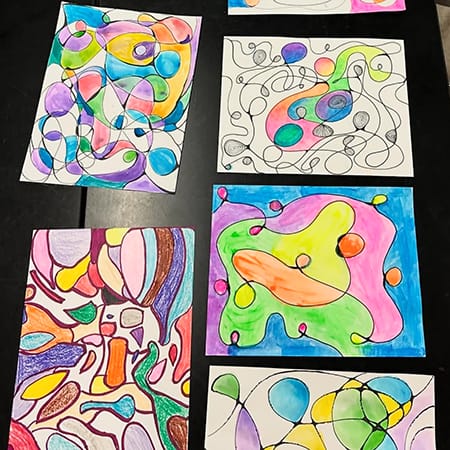
ABSTRACT ART CREATED DURING NEURASENSA’S COMMUNITY WORKSHOPS HELP CHILDREN EXPLORE EMOTIONS AND SENSORY PROCESSING THROUGH COLOR AND MOVEMENT. /COURTESY APRIL SURAC
What inspired you to get started with this initiative?
Almost a year ago, I noticed how people with autism, Alzheimer’s and other sensory challenges in my community are often left out in creative or public spaces, whether in the classroom, museums or art galleries. I grew up around my family’s furniture shop, so I’ve always been hands-on with textiles and knew the importance of design and making it human-centered. I wanted to use that background to make art that people can interact with, especially those with sensory sensitivities. I create textile-based art that responds to touch, motion or sound, and I use layered fabrics, embedded sensors and vibrations.
Tell us about your volunteer role with NeuraSensa.
I combine engineering and art to create installation pieces at galleries. I also run workshops with my school and nonprofits locally, like United Cerebral Palsy of Central Florida and Brevard Achievement Center, where I host sensory art activities with students with disabilities. I try to create art pieces every month and engage with galleries. Typically, I spend around 20 to 40 hours designing each piece. Then I have to engage with educators to develop the sensory art sessions.
What are your long-term plans or goals for the organization?
I hope that I can reach beyond my local community. I want NeuraSensa to go statewide, hopefully by next year. I hope to be in bigger museums and galleries across Florida, especially in Orlando. Also, I want to do more solo exhibitions. I’d like to do more specific programming, like a sponsored program for kids where we can include these interactive therapy sessions.
What’s been the most rewarding part of your work?
Through this work, I’ve gotten to engage with pretty amazing people, especially artists. At one of the galleries, I engaged with a textile artist from MIT Media Labs. That lab was super interesting, because she’s a textile artist, so she did some pretty cool research work with textiles. She combined textiles with technology in her research. It was amazing to connect with her. Finding out about these amazing people, especially neuroscientists, is great. Another mentor I connected with worked at the University of Central Florida Brain Lab. I connected with him through the gallery, and he was very interested in my work. Getting to have these connections is extremely valuable for me.
What have you learned through your experiences as a volunteer?
That the world is not always created with people in mind. Especially in my work, I realized that when it comes to design and the tools we use in classrooms or public spaces, we should be more human-centered. Our spaces aren’t always created with humans in mind, so we should instead strive to create more sensory-friendly environments that are less overwhelming or challenging for people who may experience the world differently. That way, we can be more welcoming and more inclusive in design.
Why is it important for others to get involved with causes they care about?
Getting involved in causes that I care about brought me more confidence and made me realize that even though I originally thought I couldn’t make a difference, you can often create your own opportunities with volunteering. I want people to realize that sometimes just looking locally, or reaching out to people, is beneficial. Even if you don’t have that initial confidence, just starting out or just trying can make a difference.
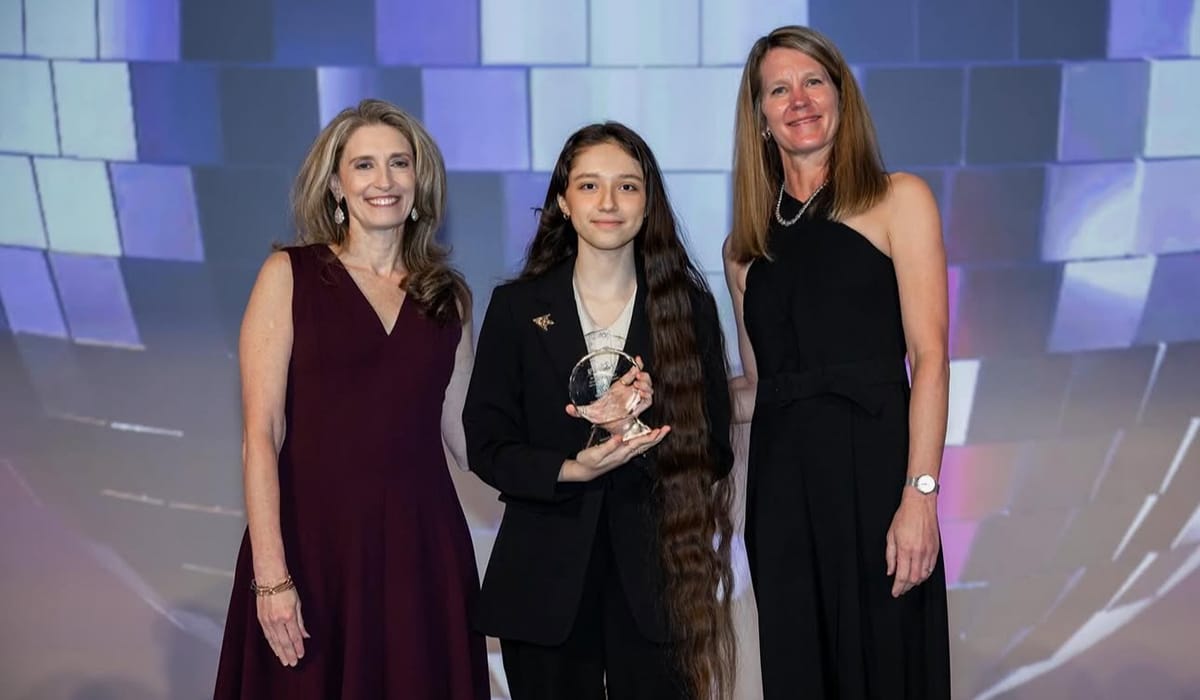
APRIL SURAC (CENTER) APPEARS AT THE NCWIT ASPIRATIONS IN COMPUTING NATIONAL AWARD CEREMONY, WHERE NEURASENSA WAS RECOGNIZED FOR ITS IMPACT ON ACCESSIBILITY AND NEURODIVERSE INCLUSION THROUGH ART AND TECHNOLOGY. /COURTESY APRIL SURAC
Any advice for people who want to start volunteering?
There are usually events to help out with in your community. They are always looking for volunteers, especially if you’re in high school. I would recommend starting very locally. Get connected to that, whether it’s the Red Cross or any sort of established organization. Get that experience on how a volunteer organization is structured. If you are in hopes of creating something one day of your own, then I would say it’s essential first to work in a volunteer organization and get that local experience.
What do you want people to learn from your story?
When it comes to volunteer work, it can be anything. Think about how you can approach a community problem that you see. From my perspective, it’s interdisciplinary work combining technology and art. Even that can be volunteering. Hopefully, people can realize that you can be imaginative and creative with your volunteer work and find something that speaks to you.
The Joy of Cooking: Feeding Folks Across the Community
Meet Daily Point of Light Award honoree Emily Liao. Read her story, and nominate an outstanding volunteer or family as a Daily Point of Light.
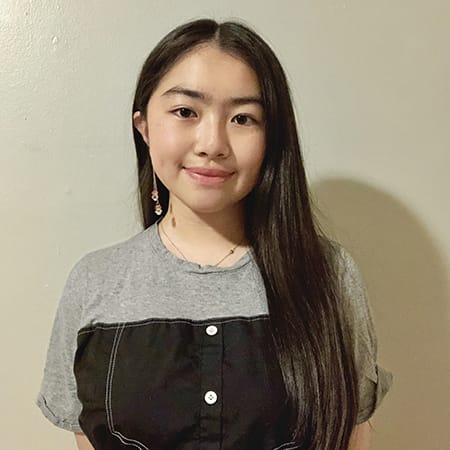
Emily Liao, a high school junior, loves to bake. Her two younger siblings undoubtedly reap some of the benefits of having a cook in the house, but so does the surrounding community. Emily employs her skills for multiple organizations in San Francisco, where she bakes for fundraisers and school events. Her ability to make macarons and cheesecake tells of her talent and a testament to her aunt’s dedication in teaching her.
Less than a year ago, Emily joined HandsOn Bay Area, an organization that, like Points of Light, connects motivated volunteers with opportunities to address issues in their community and help people in need. Making use of her passion, Emily spent last summer cooking for and serving food to those facing food insecurity at Martin de Porres for 20 to 25 hours a week. At the Homeless Prenatal Program, she began helping connect low-income parents and families with necessities, including food.
Combined with short-term and event-based opportunities like garden projects and neighborhood cleanups, Emily has dedicated more than 200 volunteer hours to these programs in her first seven months with HandsOn. In addition to volunteering during school breaks, Emily works as a tutor to help kindergarten through 8th graders with math and English.
I started one day when my friend asked me to go with her. At first, I wasn’t excited, because I didn’t know what to expect. We went to a food bank, and I enjoyed it a lot. They were often really short-staffed without volunteers and would struggle to operate fully. Being a volunteer makes me really happy, because I’m helpful. People need help. My friend and I often still volunteer together, but it depends on our schedules.
Emily Liao, volunteer for HandsOn Bay Area, spends many hours assisting with different community service initiatives. She has volunteered over 250 hours in the last eight months.
What inspired you to get started with this initiative?
HandsOn was an organization I found really interesting that had a lot of opportunities for me to volunteer in lots of places. You can find roles that align with your skills and interests.
Tell us about your volunteer role with HandsOn Bay Area.
I chose to work at Martin De Porres, because I enjoy cooking and baking. They often need people for that when they feed the unhoused and food insecure, and that is where I spend most of my volunteer time. I go whenever I get a chance.
The Homeless Prenatal Program is also a food bank, so I help package food. They also offer a lot of necessities for people with children or low-income families. I organize and package things like diapers and socks that families need.
Outside of HandsOn partner programs, I also volunteer for Marin Food Bank where I organize fresh fruit and vegetables and pack food into bags. And at Bakes and Smile, a youth-led baking organization, I make baked goods for other clubs and organizations throughout San Francisco and manage orders. I also volunteer for California Scholarship Federation, an honor society at my school, where I tutor students in Algebra and Chinese. I speak Cantonese at home and take Mandarin and Spanish classes at school.
Do you get to meet the people you’re helping?
Yes. Sometimes, when I’m giving the packages of items to them, we get to talk. It’s really nice to talk to people who come from different backgrounds. I’ve also met a lot of fellow volunteers.
What are your long-term plans or goals for the organization?
I hope to continue volunteering with HandsOn, because it feels nice to volunteer and help others. I couldn’t really find any opportunities in the beginning, because I didn’t know what to search for. But HandsOn aligns with what I want to do, things I’m interested in.
What’s been the most rewarding part of your work?
Working at Martin Des Porres and the Prenatal Center has taught me that even simple acts of kindness can make a big impact, because they’re about helping others. I enjoy serving food and following my passions.
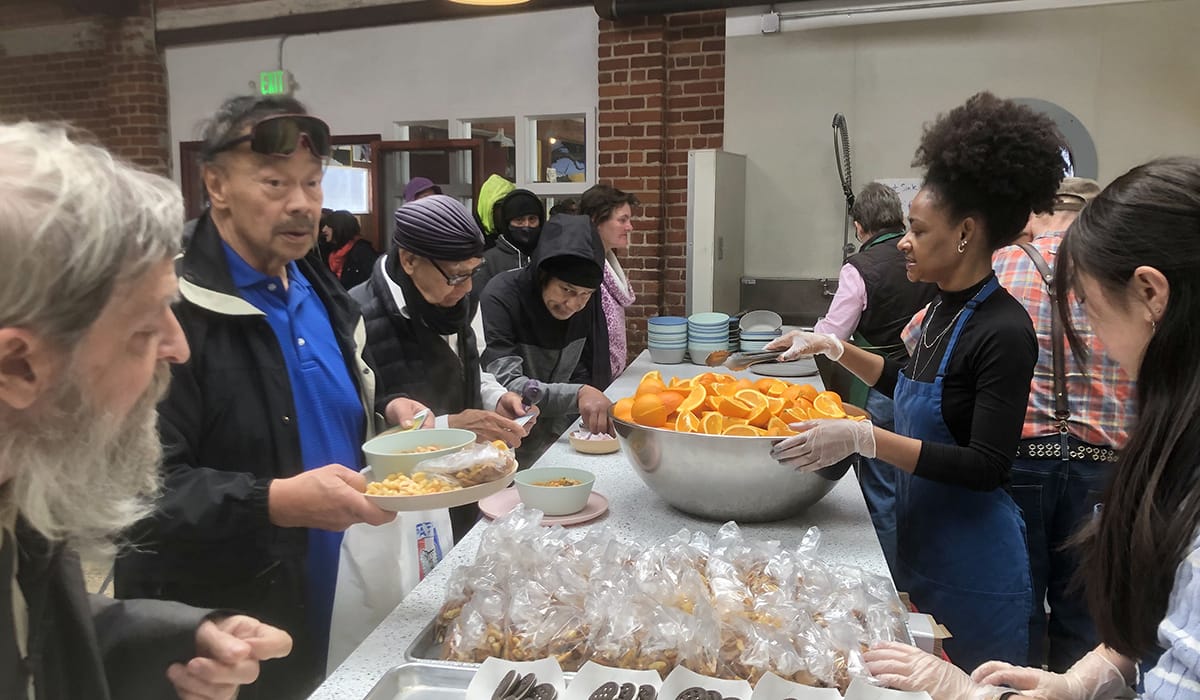
Emily serves packets of snacks at Martin De Porres House of Hospitality.
What have you learned through your experiences as a volunteer?
I’ve learned about a lot of different people’s backgrounds. And because I do a lot of cooking, I’ve also learned new ways to cut vegetables. It’s so fun to get to know the other volunteers, too. Some of them are from other parts of the U.S. and some are from abroad. Sometimes we have kids from Girl Scouts or Boy Scouts come help us. I also enjoy talking with them, because kids are fun to talk to!
Why is it important for others to get involved with causes they care about?
Volunteering helps people see outside of their own perspectives.
Any advice for people who want to start volunteering?
Try it! You don’t know what it’s like until you’ve tried it.
What do you want people to learn from your story?
Volunteering is really rewarding. It’s an experience you’ll never forget, because you’re helping others and making a meaningful impact in the world.
A Place for Everyone: How One Couple Built an Inclusive Park from the Ground Up
Meet Daily Point of Light Award honoree Tamara Schwarz. Read her story, and nominate an outstanding volunteer or family as a Daily Point of Light.
When Tamara Schwarz saw a glaring gap in her Colorado community—namely, the lack of inclusive spaces for individuals with disabilities—she didn’t wait for someone else to step in. She took action herself. What began as a dream to create a single recreational space has since become a transformative community project, impacting over 13,500 families, including 3,000 with a loved one who has a disability.
The vision for Trinity Community Park first took root in 2021. “My husband and I were getting COVID relief fund checks from the government. We didn’t need the money, and we felt that that we should be paying it forward. We put it into a separate account until we knew what to do with it,” she said. With that single act, Tamara began laying the groundwork for what would become the region’s most inclusive play space—a park designed not just for fun, but for equity and belonging.
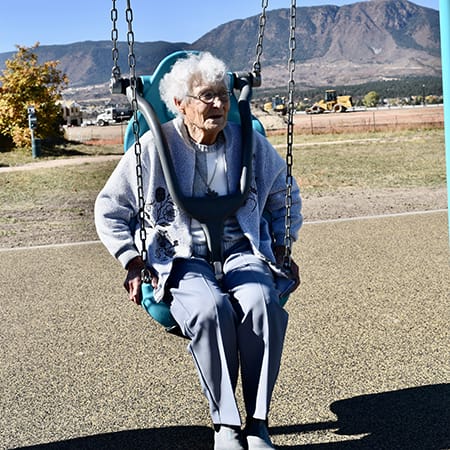
Marie, a 102-year-old WWII veteran, thinks the park’s rubber surfacing is the best thing ever!
“Thirty years ago, two couples in our congregation lost children in the same year. It was devastating. They took their memorial funds and paid for a playground, a wooden structure. Fast forward 30 years later and it was falling apart,” Tamara reflected. “Where there were once fields surrounding our church, there are now houses. And kids were playing on the outdated equipment, which wasn’t safe. We had to tear it down. So then, we decided to invest those COVID relief checks in a new playground for the church and surrounding community. Within a month, we received $50,000. I thought we were going to build the Taj Mahal with that money. But then we saw the price of commercial equipment—which was shocking. So, we built Phase I, fully open to the community.”
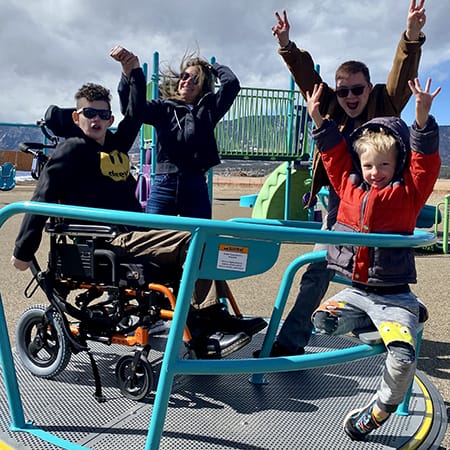
Soon came Phase II, an ADA-compliant park completed in 2022, featuring specialized safety flooring, an in-ground trampoline, a wheelchair-accessible merry-go-round and a shaded pavilion. This part of the park eventually came to life thanks to Tamara’s ongoing leadership. Instead of asking the congregation for more, she launched a public fundraising campaign—and within months, raised $300,000 to bring Phase II to fruition.
This phase expanded the park’s reach and accessibility even further, making it a model of inclusive design for other communities to follow. One regular visitor is a 102-year-old woman who comes just to enjoy the fresh air and community while using her walker—something she can do safely thanks to the park’s level, sensory-friendly flooring. Others who benefit from the design are children with special needs, including some of Tamara’s friend’s kids.
“From there, it just kept going. For Phase III, I learned that many people—those who are elderly, medically challenged or have special needs—are on medications that make them more sensitive to sun,” Tamara explains. “So, Phase III included pavilions, with tables and benches, around the park to provide shade and allow these folks to be outdoors. Phase IV was a small dog park, led by a Girl Scout Gold Award. It was an Eagle Scout who wanted to add a ga ga pit. Rotary International wants to help build a meditation garden. It has truly become a place where community comes together.”
A family experiences being together at a park for the first time. One child has not felt movement except limited walking or in his chair. Here, he gets to feel the trampoline, merry go round, swing and so much more.
As executive director of the project, Tamara wears many hats. She’s been the visionary and the builder, the grant writer and the community connector. From researching contractors to writing detailed grant proposals and negotiating costs, she has left no stone unturned in her quest to build a place where every child and adult in the community, regardless of ability, can play and thrive. Her work has raised $600,000 in grants and donations, and her persistence has paid off in tangible, joyful ways.
But Tamara isn’t done yet. She continues to expand and enhance the space, leading new phases of development based on community input and evolving needs. Every piece of the park is designed to support accessibility while fostering connection—something often lacking in traditional public spaces. “When people with different abilities people play together in the same spaces, there’s education and awareness that naturally happens,” Tamara says. “It creates opportunities for children and adults to talk openly about special needs, and it ultimately makes people more empathetic.”
During the busy construction phases, Tamara often volunteers over 50 hours a week. On average, she still puts in between 10 to 25 hours weekly, overseeing a team of volunteers, managing upkeep and cultivating relationships with local groups and corporate sponsors. She frequently speaks at events to advocate for inclusivity, organizes scout and community service activities, and invites families to engage with the space she helped create.
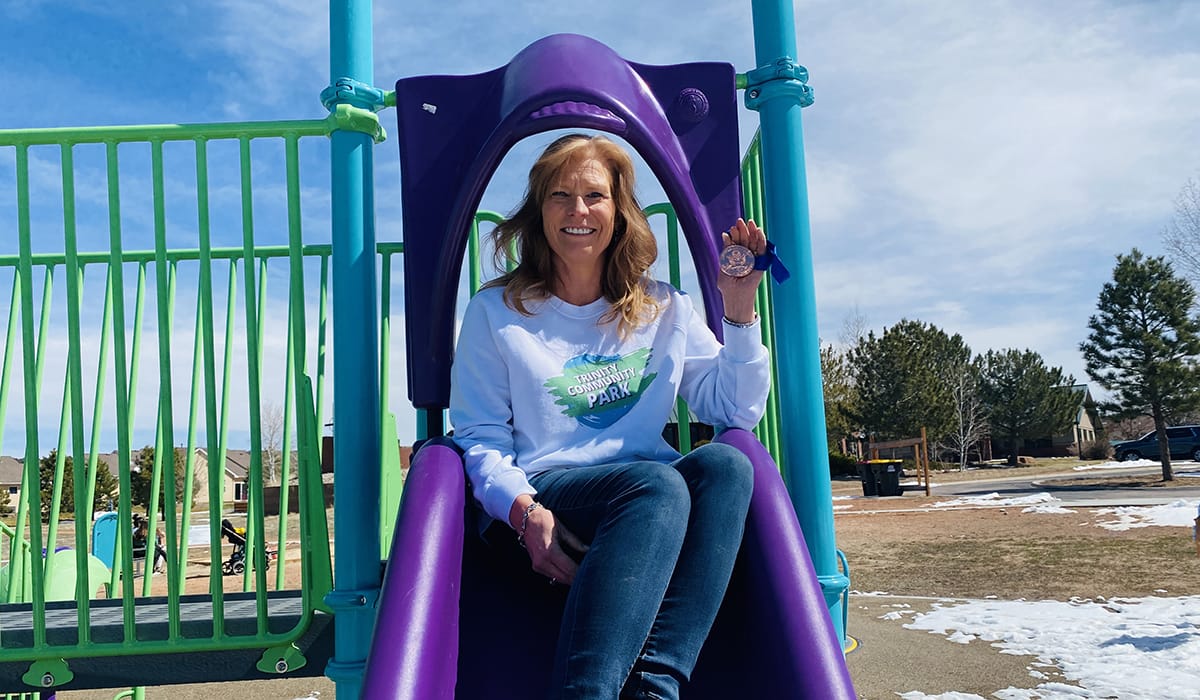
Tamara Schwarz, is the executive director of Trinity Community Park, an inclusive park in Monument, Colorado.
What sets Tamara apart isn’t just her ability to raise funds or organize volunteers—it’s her heart. “The biggest thing is listening to the community—what they are wanting and needing,” she shares. Tamara responds deeply to the needs of her community, building a park not just with materials but with empathy. By ensuring every decision is rooted in accessibility and connection, she’s built more than just a park; she’s created a beautiful hub of acceptance and support.
Tamara’s work proves what’s possible when one person sees a need and acts on it with unwavering resolve. Trinity Community Park is a reminder that impact begins with listening to the community’s needs, believing in the power of inclusion and showing up—week after week—to make it a reality. Through her tireless leadership, she’s not only changing lives. She’s changing the landscape.
A Lifesaving Mission, From Baseball Fields to Breast Cancer Screenings
Meet Daily Point of Light Award honoree Michelle Stallone. Read her story, and nominate an outstanding volunteer or family as a Daily Point of Light.
While working as a mammography technologist at Boca Raton Regional Hospital, Michelle Stallone noticed an alarming trend—far too many women were skipping critical breast cancer screenings simply because they couldn’t afford them. These weren’t women who qualified for traditional grants or aid; they were uninsured or underinsured, falling through the cracks of the healthcare system. Determined to bridge that gap, Michelle took action. With a group of equally passionate baseball moms, she founded Pinkball, a nonprofit organization dedicated to funding breast imaging for women in need.
What started as a grassroots initiative has grown into a community-powered movement. Pinkball’s mission is clear: ensure that no woman in South Florida has to choose between paying bills and getting a mammogram. Over the past 15 years, Michelle and her team have helped more than 3,200 women receive life-saving breast imaging—mammograms, ultrasounds, MRIs and biopsies. Their efforts have led to the early detection of 41 breast cancers.
The Pinkball name may sound playful, but the work is serious and constant. Michelle juggles her full-time job at the hospital while dedicating about 40 hours a month to fundraising and operations for the nonprofit. When it’s time to prepare for their largest event of the year—an annual banquet and baseball game now featuring retired MLB players—her time commitment spikes to 80 hours a week for months at a time. It’s a labor of love that rallies local businesses, community members and volunteers to come together for a cause that affects countless families.
Michelle’s commitment to breast health isn’t just about tests and scans—it’s about empowering women. Her foundation makes sure every recipient is also connected to care and support throughout their journey. Beyond fundraising, she helps navigate women through next steps after their screenings, providing a compassionate hand when they need it most. Fifteen years in, she continues to be a force for good, reminding her community that one person’s vision can save lives when backed by heart, hustle and a whole lot of teamwork.
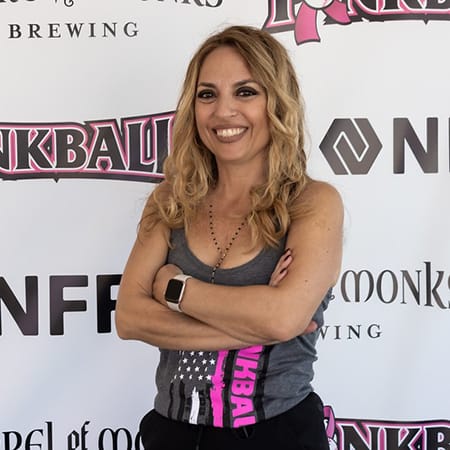
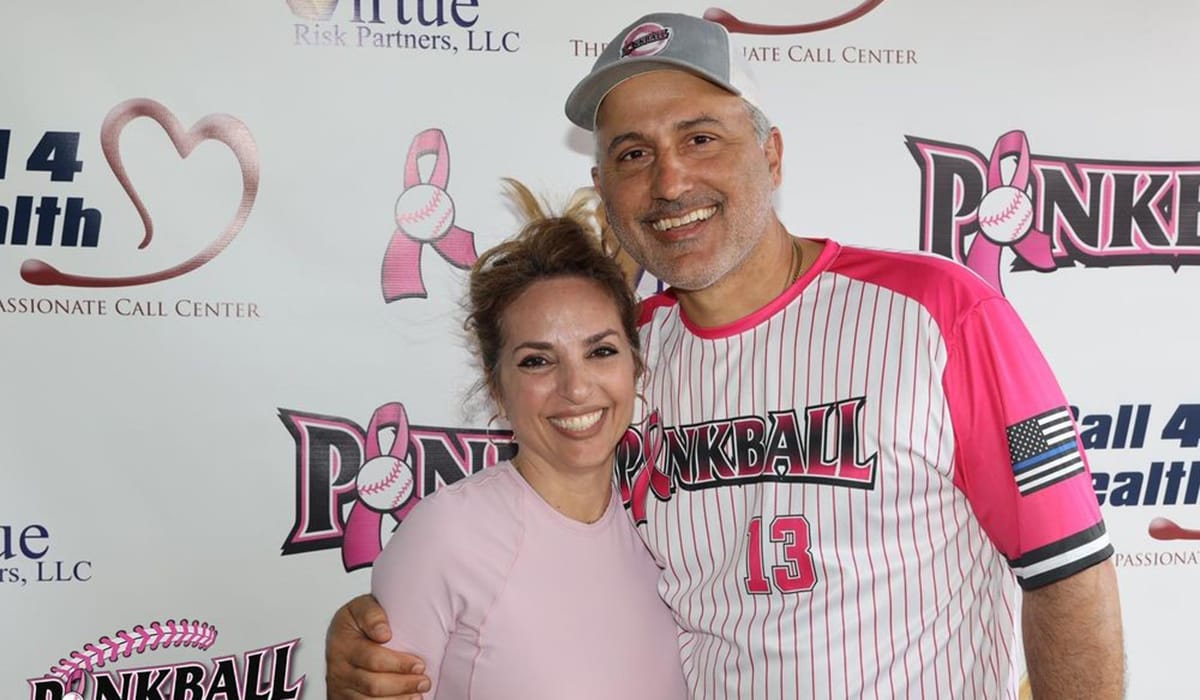
Michelle Stallone at the Annual Pinkball “Striking Out Breast Cancer” Fundraiser.
What inspired you to get started with this initiative?
Being employed by Boca Raton Regional Hospital Women’s Institute, where I’m a mammographer and navigator for women who have abnormal mammograms. I also coordinate the mobile mammography unit that goes throughout Palm Beach and Broward Counties. In that role, I kept coming across women who weren’t coming in for follow-ups after abnormal mammograms because they couldn’t afford the out-of-pocket because they didn’t have health insurance. It really bothered me. These are working women who didn’t have access to healthcare through their employees. Maybe they’re self-employed, or, when the recession hit, they or their spouses might be losing a job with insurance benefits.
I was really involved with my son’s baseball league at the time. I wanted to do something fun with the kids. I had this idea of mimicking Major League Baseball, where they wear pink on Mother’s Day for breast cancer awareness. I just wanted the boys to wear pink wristbands, baseball bats and gloves, to help raise awareness and a few dollars for patients in the community. The boys were all wearing these wristbands on Mother’s Day when they were playing baseball and selling them for $5. It just organically grew. Someone on the baseball board said, “Why don’t we do a little home run derby this weekend?” We did that as well. And then we got a few raffle prizes. Next thing we knew, it ended up being a whole family fun day on Mother’s Day weekend, just from these boys wearing pink wristbands. We raised a few thousand dollars that year.
It was really well received by the local baseball organization too. In turn, I brought back to the funds we raised to the center where I work and said, ‘How can we help the patients who don’t have health insurance?’ We had some funding through big national organizations, but what I found was that patients had to be 200% under the poverty guidelines, and a lot of the patients I was encountering were above that. They aren’t necessarily the underserved community, but rather the underinsured community. That’s where conversations started with the hospital about the women in this bracket. I created my own fund, and we ended up naming the fund Pinkball. The event grew every year. The first year, I had seven teams, even parents who signed up to play. Here we are, 15 years later, where I have 36 teams signed up, Major League Baseball players who come out to support us and a dinner the night before our big games. We’ve raised over $1 million. All of that money stays right here in the community, and it’s all volunteer based.
Michelle and her husband, co-founder Bobby Stallone, at their annual Pinkball fundraiser.
Why is this issue so important to you?
I was always around the radiology world because my parents worked in that field. And from a young age, I’ve loved helping people. I’ve had two family members who were affected by breast cancer and both passed. Seeing their struggle resonated with me. But helping the underinsured also resonated with me. I saw my parents working two or three jobs to make ends meet.
There’s not a lot of help through government or county programs to help the underinsured. There’s the gap of the middle class who just don’t have that help. My husband and I also own our own business – a small family restaurant. And I’ve been in the place where I had to pay for my own health insurance. It’s very, very expensive. If I had to make a choice between paying my bills or my health insurance, I’m going to pay my bills and take my chances with health. On paper, when you’re looking for government or county programs to help you, you often may make too much money to qualify. But you are still just trying to make ends meet. And the women I meet often make the choice to feed their families before taking care of themselves with health insurance.
What are your long-term plans or goals for the organization?
Right now, the funds we raise can take a patient up to biopsy. A goal would be to raise enough money to start helping more women pay for surgeries and treatment, even reconstructive surgery. I’d also like to take it further than our community – growing the program into our state and into the country.
What’s been the most rewarding part of your work?
I get to encounter these women on a daily basis. Hearing their appreciation and knowing I could be a part of their journey. Taking a little fear out of their journey, especially the financial fear they encounter when they’re told they might have breast cancer. Being able to navigate with them is so rewarding. They are so grateful. They often don’t know help is available to them until we bring it to them.
Why is it important for others to get involved with causes they care about?
Jumping in has just always been part of me. It fuels me and feeds me to help people, especially empowering people to navigate their own care. A lot of people just don’t know how. They don’t know where to turn. Being all in is so important, no matter what the cause is. I love that my children can see that it’s important to be invested in your community, your friends, your neighbors, your family. You might be in that situation one day, and really hoping that someone can lend a hand to you. It’s even more beautiful when you’re not even looking for it – when help just comes to you.
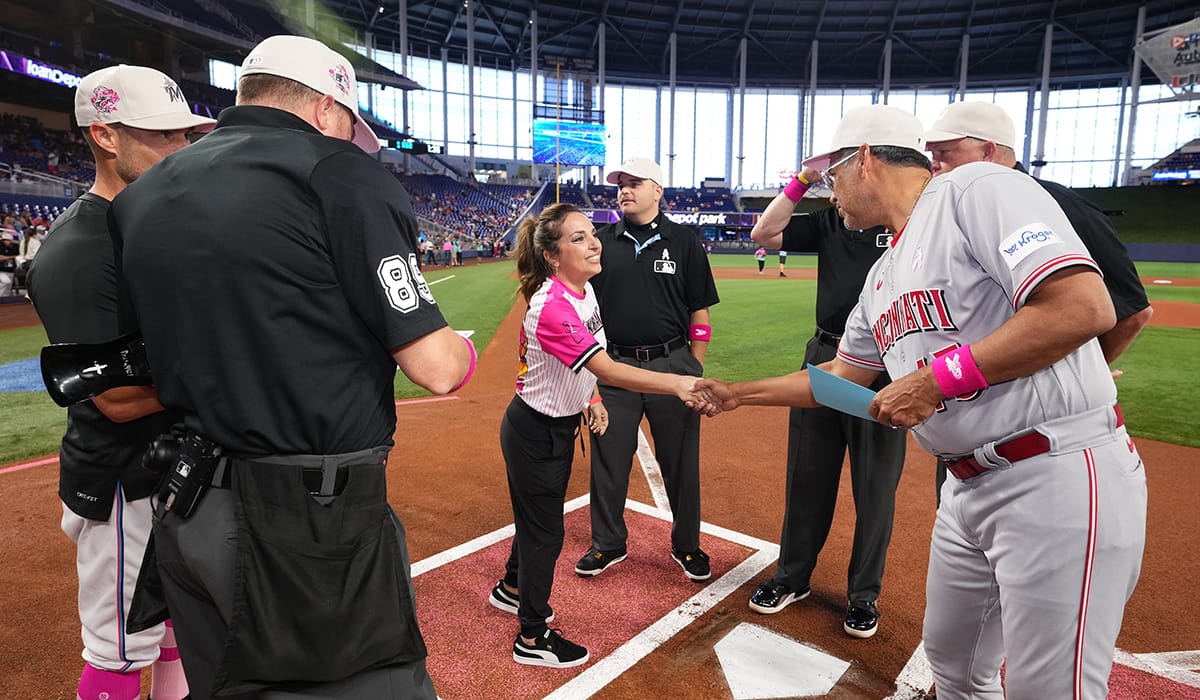
Michelle fundraising at Marlins Stadium with the Miami Marlins.
Any advice for people who want to start volunteering?
Start small. See where your passion is. Get a little uncomfortable. I promise, when I started this, it was very uncomfortable. It wasn’t easy. But the more I did it, and the more positive response I got from people, it became contagious. Then, it becomes easier. So allow yourself to be uncomfortable at the beginning.
Everybody has their gifts and strengths, so see what your areas are. We all take a different role. When I first started this, I never imagined I’d be able to ask the asks I do now. I was mortified to walk into a gift shop and ask for a gift card for a raffle basket. Now it’s just second nature to ask. When they say no, I can be respectful and be okay with that, because not everyone can give something to every cause all the time. It’s not personal – people get asked all the time. And the timing isn’t always right.
Any final encouragements for people to know?
I work with this every day, and screening mammograms definitely save lives. When you find early-stage breast cancer, the survival rate is so high compared to finding it at a later stage. It’s so important to support women to get screening mammograms so that they can find cancer at an early stage and live as a survivor. And nobody should go without access. No matter where they are or where they come from, everyone should have access to good healthcare.
VOLUNTEER ADVOCATES FOR CHILDREN WHO NEED A CHAMPION
Meet Daily Point of Light Award honoree Lisa Farthing. Read her story, and nominate an outstanding volunteer or family as a Daily Point of Light.
Lisa Farthing has worked in roles ranging from college career advisor to accountant. But it’s her volunteer work as a court-appointed special advocate that truly drives her.
A program that started back in 1988, Parachute CASA is a nonprofit agency dedicated to providing trained community volunteers to children who are in the juvenile court system due to abuse, neglect or abandonment. After undergoing an intensive training program, volunteers are appointed by a juvenile court judge to represent the best interests of an abused or neglected child in court. But in addition to attending court and writing reports for the judges and magistrates, Lisa’s work as a CASA takes her everywhere from classrooms to doctors’ offices, where she serves as an advocate for these vulnerable children who need someone to have their back.
A member of the inaugural training class of volunteers at Parachute CASA, Lisa has seen it all throughout her many years of dedicated service. While she took several years off to raise her own children, Lisa ultimately felt called back to her work as a CASA. Now thriving in retirement, Lisa is as dedicated as ever to advocating for the children she works with. While most cases require about 10 hours of volunteer work a month, Lisa puts in anywhere between 10 and 30 monthly hours as a CASA, all with the goal of helping each child find a safe, permanent home where they can thrive.
Now 70 years old, Lisa has no intention of stopping her incredible volunteer work as an advocate for vulnerable children in the court system. However, her time commitment may slow down for a bit, because she’s about to become a grandmother. Lisa’s wholehearted dedication to making a better life for children who need a trusted advocate shows just how powerful the role of a volunteer can be.
What inspires you to volunteer?
It’s heartwarming. It sounds crazy to say it this way, but it’s emotionally satisfying because you know you’re helping. I learn so much. It’s also very intellectually stimulating to understand how the court system and foster care work. Until you actually do this kind of work, you might only have a passing notion of how these things work. Ultimately, it’s helping the kids find a safe place.
Tell us about your volunteer role with Parachute CASA.
Every case is different, whether it’s abandonment, or there are drugs or sexual abuse involved. When we have new training classes, we ask people to commit to 10 hours a month. My increased time right now is largely because the kids I work with are in crisis. We visit them regularly, whether it’s in a foster home or a kinship care. We can go to the school or we can go to their doctor. I visit their teachers. In my current case, I take the boys to their therapy sessions because it’s my way of being their safe person. We play games or we draw–just doing kid stuff with them.
What inspired you to get started with this initiative?
A friend of mine was kind of drafted to be part of the first group of people trained for the program. She knew I loved kids and social justice, so I was in the very first training class in 1988. I did it for seven years while working full-time and having two children. That was a little much, so I took a break until 2013 when I officially retired and came back. I went through the training again, and the organization was well embedded in the way juvenile court works in our county. We always joke in the Parachute office that I’m the oldest volunteer–not by my age, but by my tenure. It’s 19 years I’ve been doing this, and it’s my way of helping the kids who don’t have a consistent adult watching their backs. I’m their safe person. I stay with them until they land either back with their biological family or in permanent custody, and they get adopted.
What’s been the most rewarding part of your work?
It’s so rewarding to know that I’ve made a difference in their lives. For instance, I worked on a permanent custody case where there were five kids with no dad and a mother with substance abuse problems. It did go to permanent custody, and the kids all landed. One went back to a biological family member, and the younger four were adopted by their foster parents, who were teachers, so they stayed together. They’re healthy and happy. They have a family now that watches out for them and takes care of them. To me, it’s that good ending that I get the most joy from.
What have you learned through your experiences as a volunteer?
One of the things that they talk about in training is whether you can articulate what your values are. My value system is being able to set aside what my value system is. You’re going to go into dirty houses, or you’re going to see parenting styles that don’t match with your parenting styles. And I think that I am more patient now. I’m able to see other people’s perspectives. In some of the cases, those who are parenting young kids didn’t have healthy parenting role models of their own. Sometimes just being a resource to the parents involved has been very rewarding too. I’ve helped try to get them to rehab or helping them with housing resources. I think I’ve learned that sometimes you’ve just got to go with it.
Why is it important for others to get involved with causes they care about?
You get more than you give. That’s not the right way to convince somebody that you want them to do this work, because you have to go into this knowing that you’re going to see and hear disturbing things. But if you can navigate your way through that, you realize what impact you can have. Of all the cases that go through our Butler County Juvenile Court, we are staffed in a very small number of them. We don’t have that many volunteers. I try and encourage my friends to just go to that first session. You’re not making any commitment. Check it out and see whether it’s something that you can picture yourself doing.
Any advice for people who want to start volunteering?
Do your research. Talk to people within the organization. It doesn’t ever hurt to make a phone call to ask what it entails. Maybe some people are worried that they can’t make a lasting commitment. You just have to try it. Some people do it for a while and then take a break. You’re not obligated to stay for any length of time. You can stop doing it. But the people who do it tend to have some longevity because they get so much from it.
What do you want people to learn from your story?
I want people to consider doing this work. It’s so good for the kids. It’s so good for you as an individual. Do your research and try it on for size.
Meet Daily Point of Light Award honoree Marley Kotroba Read her story, and nominate an outstanding volunteer or family as a Daily Point of Light.
Last summer, 17-year-old Marley Kotroba founded Kids for the O, a nonprofit that engages teenagers in a variety of community service initiatives in the Orlando area. She recognized the need for youth involvement through her previous efforts at local nonprofits and now encourages her peers to take leadership roles, empowering them to take initiative when it comes to making change.
The organization’s 30+ members have contributed nearly 10,000 volunteer hours since its launch. Together, they raised over $7,000 through their fundraiser in December and collected 1,000 toys to donate.
Marley is wholly dedicated to the mission and is already making plans for the next school year while eyeing her younger sister, a freshman board member, to step into her role when she graduates.
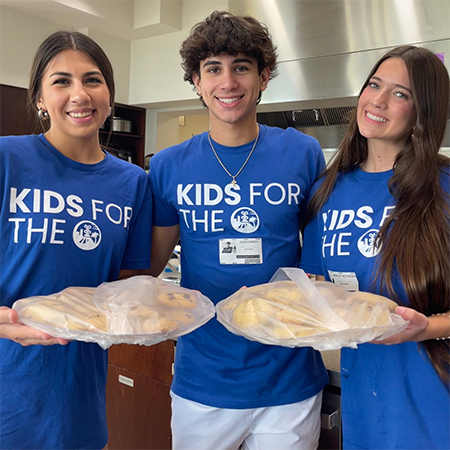
(Right) Marley Kotroba, founder of Kids for the O, and organization members bake for Ronald McDonald House families.
What inspires you to volunteer?
It’s the impact that you can make. I used to go to this toy drive in middle school and my early years of high school. That led me to want to start a nonprofit. I really enjoy working with kids and families in the community, so a couple of friends and I decided to cater the organization towards youth services. We worked together to look up the requirements, and within a few months, we were able to get our official documents to become a certified nonprofit.
Tell us about your volunteer role with Kids for the O.
I’m the president. I keep things running and organize day-to-day events. We have meetings once every month with our full organization and every Monday with our board members. We try to plan an event once a month after meeting with board members to determine the needs of the community. Usually, it’s just our members getting together. At our last event, we made cards for hospitalized children.
We also assist other local nonprofits like Clean the World. They essentially take bar soap you might get from hotels and clean and refurbish them. They put them in machines that remold them. We’ve helped them repackage soap boxes before they donated them to developing countries. We’re also doing some after school tutoring. Recently, my vice president and I started STEM tutoring at community centers for fourth and fifth graders for an hour every Thursday after school.
What has been your favorite project so far?
My favorite project has been the Athlete Connections toy drive in Orlando. Since freshman year, my best friends and I have gone, and it’s my favorite day of the year. My dad’s the president of the Athlete Connections nonprofit. That’s what got me into volunteering. He works with a lot of nonprofits like the Sheriff’s Foundation and the Police Foundation.
My friends and I had never experienced service like that, interacting with the kids and their families. You walk them through the event and help them shop. You’re basically the elves. When we were able to donate more than just our time, it was amazing.
What are your long-term plans or goals for the group?
I would love to continue working with kids as long as they can. I don’t know if I’ll be able to take on the responsibility of president in college, but I always want to be a part of it. My younger sister is on the board. She’s a freshman in high school, so I’d love to pass it down to her.
What’s been the most rewarding part of your work?
Volunteering, even as required service hours or stuff that you do with your school, takes a backseat much of the time. I think that, like me, being able to get into hands-on service and being able to see your firsthand impact on people’s lives is what makes it so valuable. It makes me want to share it with my peers, so that they, too, can see the impact that they can make.
How have you seen the organization empower your peers?
My favorite thing to see is people who you wouldn’t normally see helping others getting excited about it and making it a regular practice. People who weren’t interested in the organization at all and just joined to be with their friends are now like, “When is the next event? What can I do to help?”
What have you learned through your experiences as a volunteer?
I’ve learned a lot of things, especially by leading. When I was in middle school, I used to be closed off and shy. I didn’t like speaking in front of people. Starting the nonprofit and becoming president really pushed me out of my comfort zone. My first time speaking in front of a crowd, I was so nervous, I barely could stand up. I rehearsed a whole script. Now, when I speak at an event, I just wing it. I don’t get that nervous.
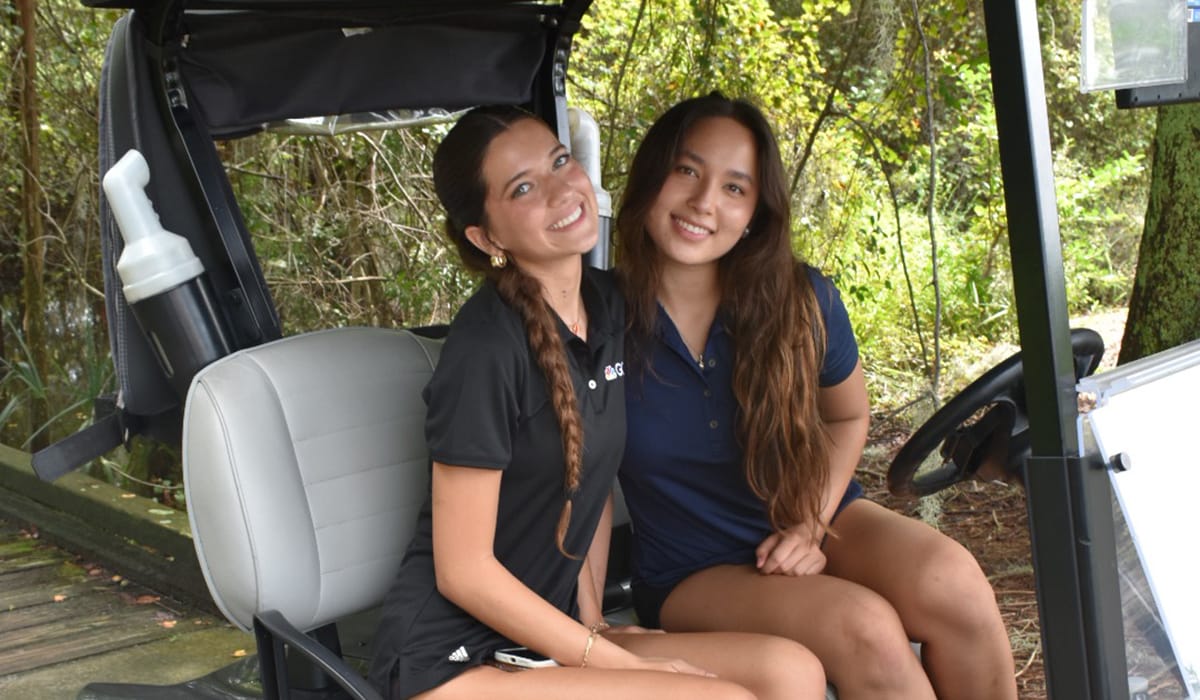
Marley and Kids for the O vice president, Jontae Nice, help out at the Athlete Connections charity golf tournament.
Tell us about future partnerships, programs or events that you are excited about.
Next month, we’re partnering with Kendra Scott for a Give Back event. And this summer, we’re planning a school supply drive for the next school year. We’re thinking of doing a pickleball tournament.
Any advice for people who want to start volunteering?
In the beginning, I was nervous, because it’s hard to know where to start; it’s intimidating. But you have to go all in. Just start researching, filling out the forms, sending them in, getting with a team and figuring out who really wants to do it. Just go for it. I spent a lot of time contemplating if I should do it, if it was really worth it. In the end, it really was.
What do you want people to learn from your story?
You can make a difference and empower people. If you’re thinking about doing something, and you have the time and ability to do it, just do it. There’s no reason to overthink and waste time not starting an organization like this and helping others. There are so many things you could do without even starting an organization in which you can make an impact and change someone’s day or year.
How Teen’s Nonprofit Is Advancing Mental Health Policy and Access
Meet Daily Point of Light Award honoree Sanjana Kavula. Read her story, and nominate an outstanding volunteer or family as a Daily Point of Light.
Sanjana Kavula is transforming the way communities think about mental health—one policy, partnership and outreach initiative at a time. As the co-founder and leader of Project Pink Foundation, she’s spent the last three years advocating for better mental health resources, particularly for women and students, through legislation, education and community action. What began as a local initiative has grown into a nationally recognized movement, earning her honors such as Coca-Cola Scholar, NHS Scholar and FEF Scholar, and taking home awards from HOSA and the Substance Abuse and Mental Health Services Administration (SAMHSA).
At the heart of Project Pink’s mission is the fight for stronger mental health access through policy change. Sanjana has led advocacy efforts at the Texas Capitol and the Frisco City Council, pushing for a higher counselor-to-student ratio in public schools and greater mental health education. Now, Sanjana and her team are taking their campaign to the national stage, engaging federal lawmakers in hopes of transforming how mental health is supported in schools across the country.
But Sanjana’s impact goes far beyond the halls of government. She’s spearheaded global initiatives to bring mental health education to underserved students in Thailand and China, and worked with Save Shine Africa to create culturally relevant mental health guides for refugee populations. Back home, Sanjana continues to cultivate a strong local presence through events like walkathons, mental health breakfasts and hospital volunteer days.
With nearly every corner of the globe affected by rising mental health concerns, Sanjana’s leadership provides a blueprint for youth-led change that is inclusive, culturally aware and rooted in evidence. Read on to find out more about Sanjana and the work of Project Pink Foundation.
Tell us about your volunteer role.
I’m the co-founder of Project Pink Foundation, a 501(c)(3) nonprofit organization that ensures mental health resources are accessible, especially for women and girls, after we noticed a major gap in low-income communities. We started in 2021. My co-founder and I were in Dallas, and we read an article about Dallas being one of the worst cities for mental health. We were shocked by that, as we’d lived in Dallas for a while. We were shocked by the lack of mental health service that were provided.
At first, we started as a host of community projects. We’d go directly to nonprofits, schools and more. We just wanted to talk to them. We spoke to mental healthcare professionals about what could be done and what could be changed. Eventually, we gave some presentations, and then we compiled all of our data into a research report and pitched to SAMHSA. The data that we had compiled helped us get the funding to turn our movement into a nonprofit. From there, we started initiatives like Mental Health Mondays, mental health breakfasts, bringing in speakers from SAMHSA, partnering with other nonprofits and more.
Why is this issue so important to you?
Growing up, especially as a South Asian female, I learned that talking about mental health is pretty taboo in a lot of communities. It’s seen as a weakness and something that hinders people, especially in workforces. We noticed this in clinical research especially. A lot of this research also leaves women out. Much of the time, the claims are around women having “hormonal imbalances.” Sadly, that leaves them out of mental health research or clinical applications that actually do apply to them.
This applies with public health, with stigma and more, especially with women of color, and especially with young girls. We really wanted to create a community that not only normalizes mental health issues and includes women, but also equips them with tools to get help.
What are your long-term plans or goals for the organization?
Currently, we’ve switched into more of a policy route, so we want to continue hosting advocacy days. We have two scheduled in April, and we’re bringing in high schoolers and college students to talk about issues they’re passionate about. A lot of times, young people aren’t necessarily getting a seat at the table to discuss the things they care about. And if they are invited to the table, it’s often an honorary role given to check a box of youth representation. We want to change that. We want to bring a lot more young people to the capitol and make their voices heard on issues close to them. We want representatives to hear from them directly, especially in this current political climate.
We’re also passionate about hosting a grant fund. We’re looking to start a fund and gather donations from people who are passionate about the cause. I spoke to students who are part of Project Pink and have some amazing ideas for workshops and resources, but don’t necessarily have the funding to execute those ideas. We want to provide that funding.
Another long-term goal we have is hosting more mental health mobile days. We want to ensure we’re reaching the right audiences. We’re looking to spread mental health services and resources to more rural areas. We’d like for mobile services to be distributed directly to these populations.
What’s been the most rewarding part of your work?
Getting to speak with partners daily. Working on the policy side of things, which has happened over the last year or two. We’ve advocated for mental health curriculum and Title IX changes. We’ve spoken at the city and state capitols. This is exciting to me, because a lot of change starts directly in policy. There’s a lot that can be done by speaking to representatives. The organization is doing a lot in terms of changing the script that surrounds mental health, and that’s what I’m really passionate about.
Why is it important for others to get involved with causes they care about?
Start from the ground up. If something’s impacting you directly, do something about it. Often, it starts with going to a council meeting and sharing about your personal experience with an issue. Going and volunteering with an event related to that cause. We’ve recruited student workers and volunteers by going to mental health conventions, where people are really passionate. Get involved in the space, and you’ll find the right people.
Any advice for people who want to start volunteering?
Get involved in a cause that’s related to you and that you’re passionate about. I’ve seen a lot of people trying to check a box, but if you want to see change – whether it’s with literacy or environmental policy or anything else – reach out to both grassroots organizations and large organizations. Ask if there’s any way you can get involved. From the nonprofit perspective, we will always take any help we can get. We’ll always find a position for people to serve if they’re interested. Don’t be afraid to reach out.
What do you want people to learn from your story?
The biggest thing I’ve learned is that youth voices are powerful drivers of change. Some of these people are still in high school or college, but these are the same people who will stay up until 2 or 3 a.m. trying to help you finish an application for a grant, or write out the code for your website. Youth are so powerful. Their voices need to be heard more and they need a seat at the table. They’re the ones building the future.
Senior Couple Devotes Their Time to Helping Animals in Need
Meet Daily Point of Light Award honorees Brenda and Marty Winnick. Read their story, and nominate an outstanding volunteer or family as a Daily Point of Light.
They say a dog is a man’s best friend, but for Marty and Brenda Winnick, it’s cats—and each other. Married for 41 years, the couple, both 82, share a bond that shines through their tireless volunteer work. Since 2016, they’ve dedicated themselves to Best Friends Animal Sanctuary, taking on countless roles to help animals in need. Their journey with Best Friends began while they were still living in Florida. One visit to the sanctuary in Kanab, Utah, and they were hooked.
“Every two months, we’d come and visit, stay for about two or three weeks, go back to Florida for a couple of months, and then come back again,” Marty recalled. “Until we finally decided, ‘Yeah, it’s time to move.’”
After settling in Kanab four years ago, their volunteer work ramped up. Now, they devote over 45 hours each month to a variety of roles—from preparing frittatas for Wild Friends sanctuary residents to baking desserts for human visitors at Angel Village Café. But their most impactful work is with the Best Friends mobile clinic, which provides much-needed veterinary care to pets in the Navajo Nation, an area with limited access to pet services.
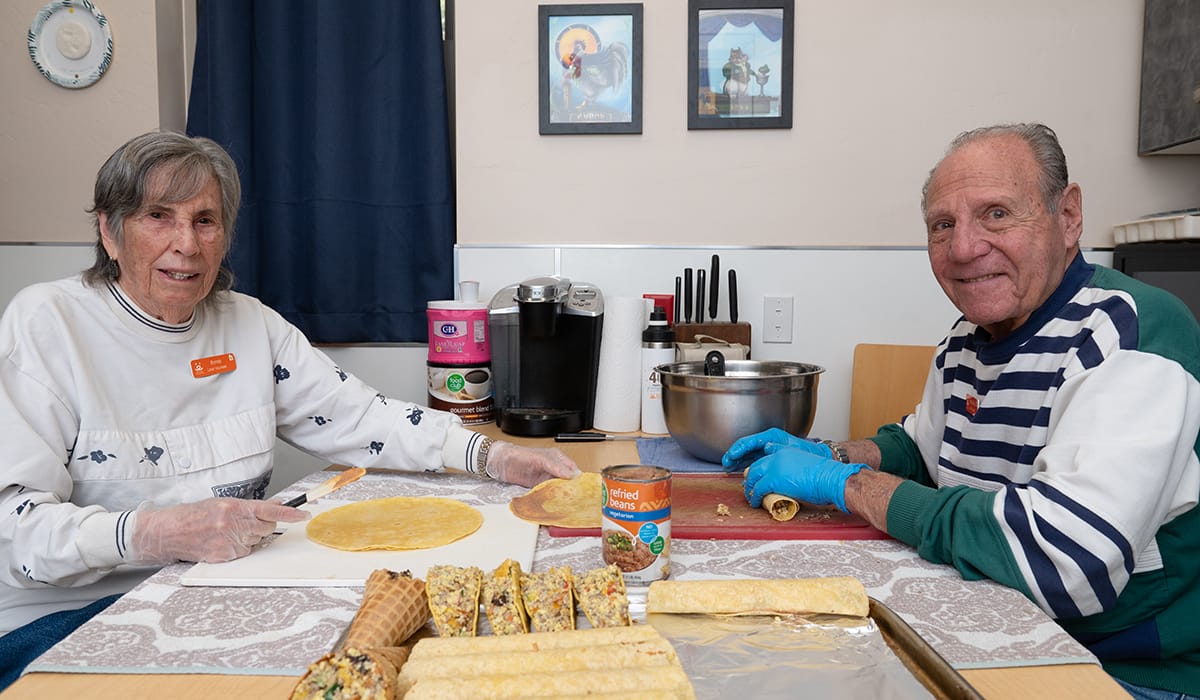
Brenda and Marty prepare nutrient-packed frittatas, served in cones, tacos and tortillas, adding enrichment to mealtime for the animal residents of Wild Friends sanctuary./ Courtesy The Winnicks
The mobile clinic, which runs once a month for a weekend, offers free or low-cost spay and neutering, vaccinations, and wellness exams. Brenda manages check-ins, ensuring everything runs smoothly, while Marty helps sterilize surgical instruments for surgeries. “I’ve seen them do things like remove tumors and amputate a leg on a dog—and there’s no bill for it,” Brenda said.
“When we go there, we usually bring two or three vets so we can knock out 120 spay and neuters in a weekend,” Marty added. “It’s long hours, but by the time Sunday night rolls around and we’re getting ready to go home, we look at each other and say, ‘Yeah, we did good.’”
Michelle Weaver, director of Sanctuary Outreach at Best Friends Animal Society, praises the Winnicks’ dedication: “Brenda and Marty have supported these mobile clinics from the beginning,” Weaver said. “The clinic days are long, and you’re working in a place with limited resources, but they’ve been incredible at problem-solving and making things run smoothly.” And even when they’re not physically at the clinic, they’re still helping. “They come in beforehand to prepare paperwork and medical supplies,” Weaver added. “They truly care about this work, and they’re just amazing people who are so generous with their time and energy.”
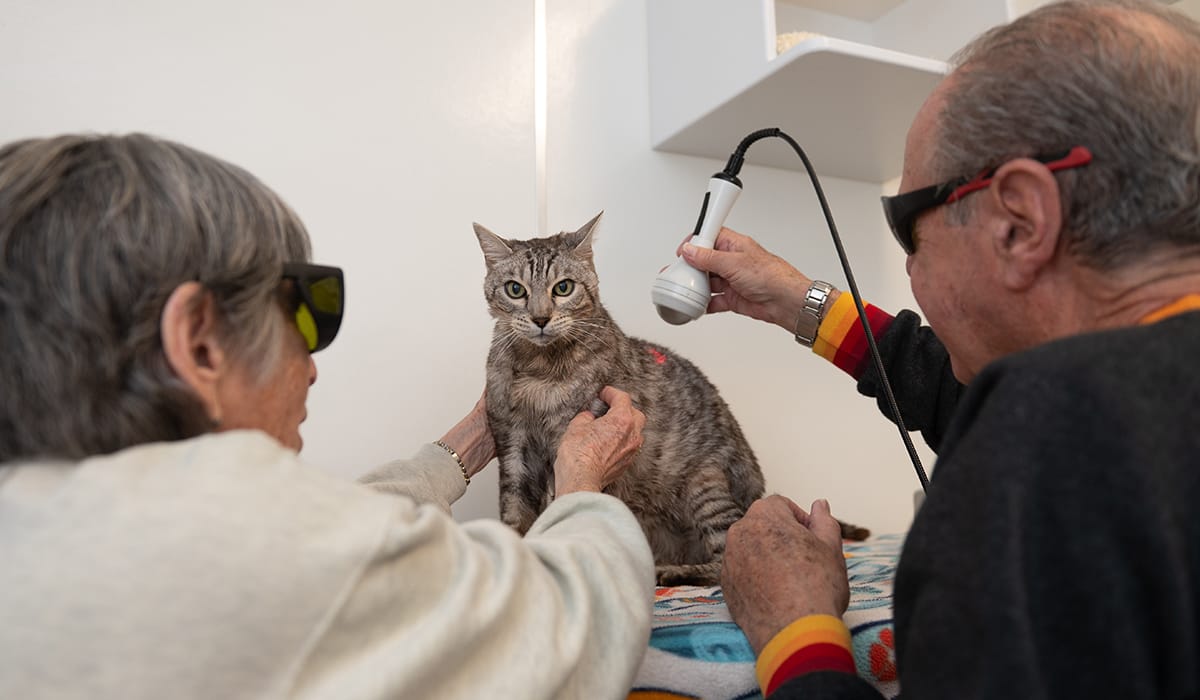
Brenda and Marty laser a cat named Chibi, one of their most affectionate patients./ Courtesy The Winnicks
Beyond their work with the mobile clinic, the Winnicks also dedicate time to another vital role—laser therapy for cats. Every week, they administer treatments to about 11 cats at Cat World, helping ease pain from arthritis, wounds and trauma. Most of their patients are incontinent and have limited mobility, but laser therapy brings them relief.
Despite their packed volunteering schedule, the Winnicks show no signs of slowing down.
“Don’t sit around,” Marty said. “It’s satisfying to go out and help without expecting anything. That’s what volunteering means to us.”
USING SCIENCE TO IMPROVE THE LIVES OF INCARCERATED PEOPLE
Meet Daily Point of Light Award honoree Emily Cho. Read her story, and nominate an outstanding volunteer or family as a Daily Point of Light.
Emily Cho sees everyone’s potential, no matter their circumstances. While she’s only 18 years old, Emily’s dedication to helping the lives of incarcerated people started several years ago. Along with a group of her middle school classmates, Emily visited detention facilities and provided mentorship and hands-on learning opportunities to the people there and their families.
In 2019, she founded Juvie for STEM to resolve the growing issue of educational disparities in prisons, specifically aiming to help the youth in juvenile detention and children of the incarcerated by fostering an interest in STEM. Lessons in math, coding and science prepare students to obtain GEDs and subsequently decrease recidivism and increase prospective career and academic opportunities. Past students have gone on to bright futures where they pursue higher education and enter the working world.
As the founder and CEO of Juvie for STEM (also referred to as J STEM), Emily has a lot on her plate. Now a first-year engineering student at Cornell University, she still volunteers with Juvie for STEM anywhere from 150 to 200 hours per month. But Emily has also passed the torch to teach others how to carry the message, as well. With 36 chapters on six continents and over 7,000 volunteers in the mix, Juvie for STEM is the largest youth-led technology organization that endeavors to bring STEM education to correctional facilities.
While its influence is undeniable, Juvie for STEM wouldn’t exist without Emily’s original idea to simply get out there and volunteer with her classmates inside detention facilities. Her journey from young student with a bold idea to thriving founder and CEO is a strong example of how volunteering can transform the future.
EMILY CHO IS THE FOUNDER AND CEO OF JUVIE FOR STEM, THE LARGEST YOUTH-LED TECHNOLOGY ORGANIZATION THAT SERVES TO BRING STEM EDUCATION TO CORRECTIONAL FACILITIES. /COURTESY EMILY CHO
What inspires you to volunteer?
I think the biggest gift that I have as a middle-class American from an immigrant family with really good access to education is being able to pay it forward to the community through service. That’s kind of the model that I like to follow. That’s why I always motivate myself to volunteer.
What inspired you to get started with this initiative?
Growing up, I was interested in the psychology of people in the criminal justice system. I started volunteering in prisons during middle school, and I met a lot of people who I thought had a lot of potential but lacked the opportunity and access to quality education. Because I grew up in a household where education is really important, and in an immigrant family, I’ve experienced how education is so important for changing one’s life. It’s almost non-existent in these prisons or detention facilities. I also saw a lot of kids, especially the children of incarcerated people or kids in juvenile detention centers, who didn’t have any educational opportunities. I wanted to create a little spark in them to get them intrigued by studying the sciences.
So that’s kind of why I created J STEM– to get them interested in science.
What are your long-term plans or goals for the organization?
In an ideal world, our goal is to eliminate educational disparities. We have a chapter in almost every state in America. Right now, we’re kind of working toward going international, but the biggest issue that we’re having is finding a director to add to our board who is both fluent in English and the other country’s native language.
What’s been the most rewarding part of your work?
Seeing how students get excited about science is fun for me, because I had that experience when I first started learning how to code. When I see someone really interested in the sciences or math or whatever they’re doing, it’s exciting and truly rewarding.
What have you learned through your experiences as a volunteer?
The biggest thing is that the negative stereotypes surrounding these facilities are false. It’s over-generalizing them, because every individual in there is very unique, and you don’t know what circumstance led to them getting there. The second thing is probably that everyone has potential, but it’s the lack of opportunities that makes a difference.
Tell us about future partnerships, programs or events that you are excited about.
We’re excited about working with brands, such as calculator companies, school supply companies and other nonprofit organizations that are trying to help us be able to bring in laptops. We’re also in talks with labs where some of their kit and tools aren’t functioning for their research, but are working to the point where we can still use them in our programming.
Why is it important for others to get involved with causes they care about?
Once you care about something, there’s a passion you have that other people who aren’t interested in just can’t replicate, even if they try. I think passion is the one thing that truly differentiates a successful person. I think the people who are passionate about it should act as the leaders, even if they don’t feel like one, because that passion will come out on its own.
Once you give this passion back to the community, you can see a noticeable change. If everyone did this, society in itself would just be so much more advanced.
What do you want people to learn from your story?
I think I want people to understand the importance of education and that it is a powerful tool to break incarceration and poverty patterns. Just because a child is in a correctional facility doesn’t mean that they’re a lost cause. For example, once they get the guidance and opportunities that they need, then they can truly be one of the most successful people that you’ll ever meet.
Spreading Literacy in Louisville, One Yard at a Time
Meet Daily Point of Light Award honoree Mary Sullivan. Read her story, and nominate an outstanding volunteer or family as a Daily Point of Light.
Mary Sullivan grew up with a family legacy of volunteerism. She, herself, was a candy striper in high school. So, it shouldn’t come as a surprise that after becoming the first female intern for the United Way of America, she spent much of her 42-year career at Metro United Way (MUW) engaging volunteers in service. Around ten years ago, nearing retirement, Mary co-founded and built MUW’s Little Free Library (LFL) program and has led it as a volunteer ever since. The program places small boxes in residents’ yards filled with donated books for people to take home for free. They’re strategically placed in under-resourced neighborhoods to promote literacy and encourage families to create their own home library.
The program has become a community affair–in part due to Mary’s recruiting efforts–drawing Boy Scouts, University of Louisville architecture students and various companies to build libraries and the local carpenters’ union to repair them as they age.
As one might imagine, LFLs are only one of numerous volunteer efforts Mary is involved in. She is a member of the Junior League of Louisville and also distributes food at the Dare to Care Food Bank and builds houses with Habitat for Humanity, the latter of which she has been doing for over 30 years.
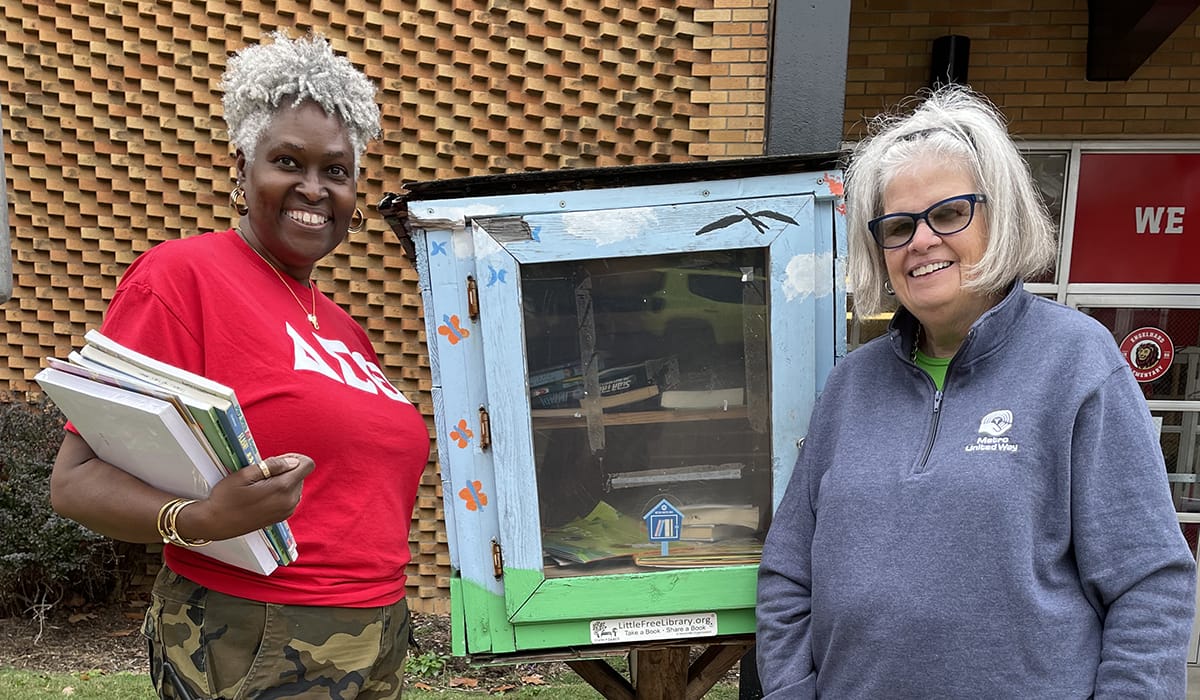
Mary Sullivan, retired Metro United Way employee, leads her former company’s Little Free Library program, putting books into the hands of neighbors who live in underserved areas.
What inspires you to volunteer?
My parents were active volunteers, so it was just a natural thing in our family. My dad was an active volunteer behind the scenes with local politics. The first volunteer opportunity that I remember is going to a campaign’s headquarters to help stuff envelopes when we were 7 or 8 years old. They had lots of food–popcorn and candy and donuts–and the older women volunteering kept asking us, “Would you like something to eat?” A couple of weeks later, my dad asked me if I wanted to go volunteering again, and I said yes. We went to the American Lung Association, and again, we were stuffing envelopes. I said, “Where’s the food?” I like to joke that’s why I volunteer.
Tell us about your volunteer role with Metro United Way.
I coordinate the donation and distribution of 45 to 50 books in each of our 36 libraries twice a month. Our volunteers pick up the books that I have boxed for them according to age–preschool through second grade, youth and adults–and put them in LFLs along seven different routes. Any books left from the previous two weeks are cleared out. The national tagline is, “Take a book, leave a book.” But we believe that in the neighborhoods that we’re in, there are very few books in the home. So we encourage readers to keep the books, because we don’t really need them back. We have great donations. In the 10 years since we started, we have distributed over 257,000 books.
I follow up when people call United Way with donations and work with corporate groups who want to do a project like a book drive. We have “Dear Reader” labels that they can either write a message to future readers or add a quote about education or reading.
Half-Priced Books, Barnes and Noble and the Louisville Free Public Library are two of our wonderful partners. We also get around 5,000 books yearly from individuals, i.e., someone cleaning out the house of a loved one who has passed or who is downsizing. They either bring them to United Way, or we go get them. When they have 100+ books, I’ll pick them up in the van. It takes a bit of time to keep the book room of donations organized as well. And finally, every three years, I help organize a thank you reception for volunteers and those who host libraries in their yard.
(Left) Regina Jackson-Willis and Mary (right) refill the library at Engelhard Elementary School.
What inspired you to get started with this initiative?
I started at Metro United Way in Louisville as a generalist doing planning, allocations and campaigns, before managing the volunteer center, an in-house program. Though the job changed a few times, I was always engaging people or employee groups to volunteer.
Any time we had a Day of Caring, numerous corporate groups wanted to build things. In 2014, I was online and discovered Little Free Libraries (LFLs). There was a story about the LFL founder Todd Bol, who started it to honor his mother, a librarian.
When I was growing up, we had books in the house. My sister was an avid reader. I’d have rather gone outside to play, but when Nancy Drew books came out, I got hooked on mysteries, and have liked them ever since. We could ride our bikes to our library. Like food deserts, there are a lot of book deserts in Louisville; libraries are few and far between. One of Metro United Way’s major focuses is ensuring that children are ready for kindergarten. I thought LFLs would be a great project for companies wanting to build something, so I went to my boss and said, “I’ve got something for UPS and GE to build.”
What’s been the most rewarding part of your work?
LFLs help achieve three of Metro United Way’s goals–thriving kids, strong households and equitable community. They increase reading skills with stories that about characters who look like the people reading them and their neighbors. The highlight is when I’m out distributing books, and I see somebody at a library. That’s what it’s all about.
Why is it important for others to get involved with causes they care about?
I wouldn’t be the person I am today without volunteering. Some people who have said they’ll never volunteer don’t realize they’re already doing it. That’s the American way. Help your senior neighbor rake leaves or shovel snow. It’s something that everybody can and should do. I try to always remember one of my dad’s lines: “We could accomplish anything if we don’t care who gets the credit.”