Meet Daily Point of Light Award honoree Saasthra Bojja. Read her story, and nominate an outstanding volunteer or family as a Daily Point of Light.
Saasthra Bojja has lived in Delaware her entire life, attending school in Wilmington and fostering a strong connection to the city. Her love for the environment, coupled with an interest in policy, economics and government, drives her passion for service and leadership.
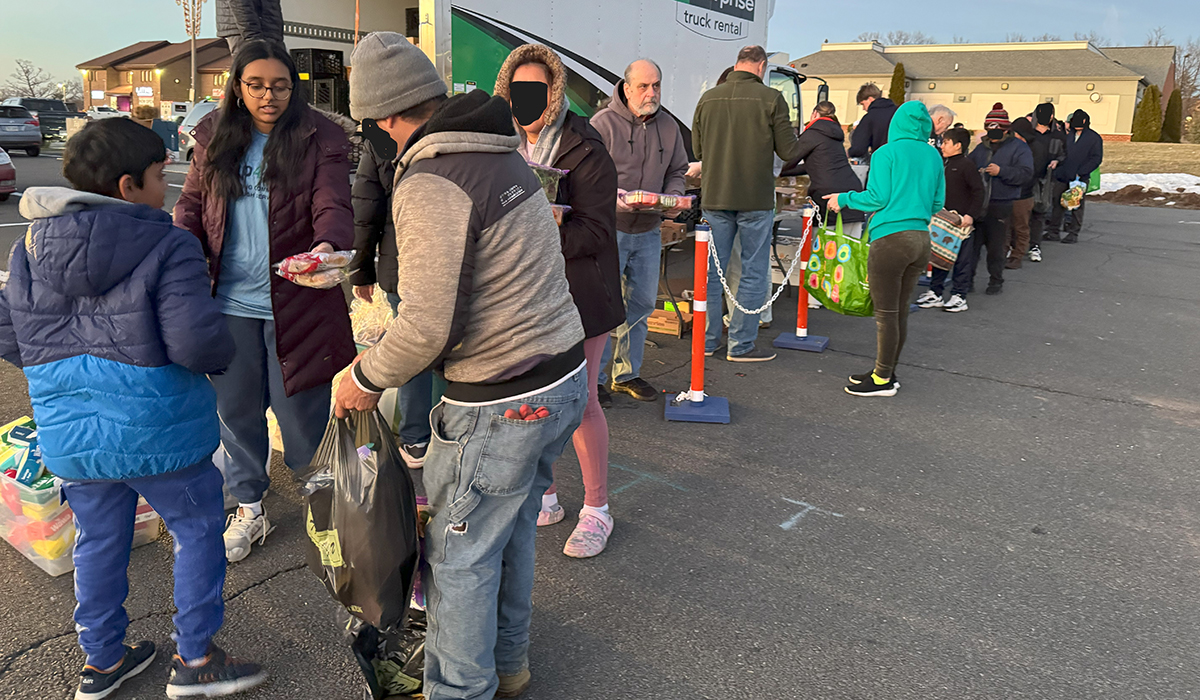
One of Saasthra’s most impactful experiences has been volunteering with Charity Crossing, a nonprofit that collects donations from large companies like Walmart and Amazon—items that would otherwise go to landfills due to returns or minor issues—and repurposes them for those in need. This initiative reduces environmental waste and supports underserved communities in Delaware and the surrounding tri-state area.
Saasthra’s story exemplifies the significant impact young people can make in creating positive change, fostering a healthier, safer world.
What inspires you to volunteer?
In elementary school, I never considered the differences between my classmates and me. We were all just kids, sharing lunches and playground games. I had no idea that some of them lived at or below the poverty line.
One day in third or fourth grade, my mom and I volunteered at a local food bank, packing food bags for children. The following day at school, I noticed some classmates receiving those same bags. It was a moment that shocked me—I had never realized that the people I saw every day were struggling in ways I couldn’t see.
That experience stayed with me. It taught me that you never really know what someone is going through and how small acts of service can make a real difference. Later in high school, I joined Charity Crossing, where I continued volunteering and distributing resources to those in need. It reinforced what I learned years before: helping others can have an immediate, personal impact, often closer to home than you think.
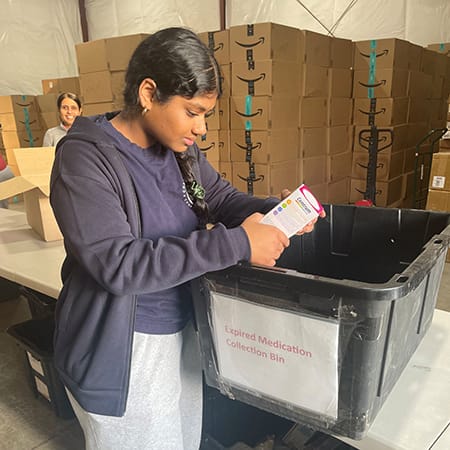
Saasthra Bojja carefully sorting expired medications before delivering them to the designated collection site. Courtesy/Saasthra Bojja
What inspired you to start volunteering with Charity Crossing?
When I first got involved with Charity Crossing a year and a half ago, I was rowing with the Wilmington Youth Rowing Association. During runs for conditioning, I often saw people in my community struggling without enough resources or support. Witnessing this made me realize how much need existed right around me.
I later learned that Charity Crossing held regular serves on Front Street—the same street where my boathouse was. It felt full circle. I spent six days a week there rowing, and now, on Sundays, I was volunteering on that same street.
What is your role with Charity Crossing?
One of my key efforts focuses on the safe disposal of expired and hazardous medications. I am the creator and lead of the Expired Medication Disposal effort. This initiative started unexpectedly. While volunteering at a donation sorting event, I came across items that concerned me—specifically, what appeared to be steroids or weightlifting supplements, potentially hazardous substances. Though we never distributed anything unsafe, the standard procedure at the time was simply to throw questionable items into a regular trash can.
That didn’t sit right with me. I wondered how even basic medical waste at a doctor’s office is disposed of securely. It made no sense that something potentially dangerous could end up in a landfill, which might leak into the environment or harm wildlife.
I began researching proper disposal procedures and contacted several pharmacies across Delaware to learn more. Through those conversations, I realized the importance of partnering with registered disposal centers equipped to handle hazardous materials safely.
As part of our sorting process, we carefully separate any expired medications or hazardous donations and deliver them to certified pharmacies authorized to dispose of them properly. This extra step ensures we’re protecting the people receiving donations and safeguarding the environment from potential harm.
Where do you see yourself in the future as Charity Crossing continues to grow?
One of my main goals moving forward is to expand our medication disposal effort. Just as Charity Crossing operates across three states, many similar organizations could benefit from adopting safer disposal practices. Protecting the environment isn’t something one person or group can handle alone—it requires a collective effort. I hope to share what we’ve developed with others to create broader, lasting change.
What have you learned from your experience as a volunteer?
Volunteering with Charity Crossing has taught me that life is unpredictable and everything we have can change instantly. Many of the people we serve may have once been in better financial or life situations, and seeing their struggles has made me profoundly grateful for what I have. It’s also taught me not to judge others, as we can never truly know what circumstances led them to their current position. Life’s challenges aren’t always within one’s control, and I’ve learned the importance of empathy, respect and understanding.
Why is it important to get involved with causes they care about?
I believe in the saying, “Be the change you want to see in the world.” It’s easy to wish for change, but the real difference happens when someone takes the first step. Waiting for others to act can lead to a cycle where no one does anything. By taking action, you become a catalyst, inspiring others who share the same passion to follow suit. The power of being a change-maker is that your efforts can spark a movement, encouraging others to step up and make a difference, too.
Any advice for people who want to start volunteering?
My most significant advice is to focus on things you’re genuinely interested in and make sure they’re manageable for you. It’s easy to burn out by committing too much, so find something you’re passionate about that you can realistically keep doing over the long term. Whether volunteering once a week or every other week, choose something that excites you enough to stay dedicated to it for life.
Fighting Food Insecurity in California, One Lunch at a Time
Meet Daily Point of Light Award honoree Landon To. Read his story, and nominate an outstanding volunteer or family as a Daily Point of Light.
At just 12 years old, Landon To helped launch The Lunchmakers, a youth-led initiative to fight food insecurity and homelessness in California. What began as a small project during the COVID-19 pandemic—packing bagged lunches for those who needed them—has since grown into a thriving movement under his leadership. Now, as the organization’s president, Landon has expanded The Lunchmakers to 13 chapters across four counties, inspiring over 100 youth volunteers, ages 3 to 17, to participate in service. Together, they have provided more than 32,000 meals to six nonprofit organizations dedicated to helping unhoused individuals.
Landon’s passion for service goes beyond organizing volunteers—he has worked tirelessly to secure funding so that any child who wants to help can do so without financial barriers. Through grant writing, crowdfunding efforts and strategic outreach, he has made it possible for schools and families to engage in meaningful service without the burden of covering food costs. Thanks to his efforts, three schools have integrated The Lunchmakers into their programs, providing a consistent opportunity for students to engage in hands-on community service.
Beyond meal-making, Landon has also stepped into the role of a mentor and advocate. He has organized and funded multiple service events for local preschools, helping young children learn the importance of giving back. He has also presented The Lunchmakers’ impact to audiences of all sizes, including more than 800 schoolteachers, demonstrating how youth-led service can be both effective and inspiring. His leadership has proven that kids of all ages can make a real difference when given the opportunity.
As he prepares for his next chapter, Landon remains committed to ensuring the long-term sustainability of The Lunchmakers. He is actively mentoring the next acting head of the organization, ensuring that the values of accessibility, community and service remain at the heart of the initiative. While Landon attributes the organization’s success to its members, his dedication to building a structured, stress-free and meaningful service experience has made it easier than ever for young volunteers to step up and make an impact.
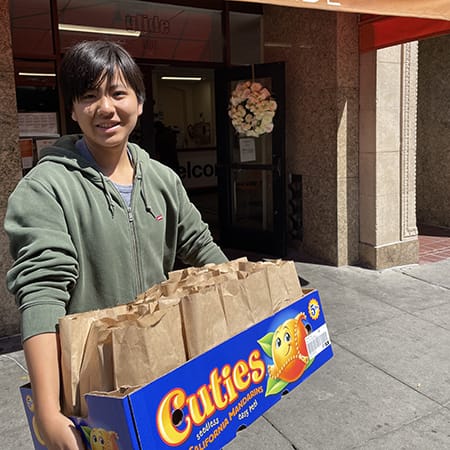
Landon with packed lunches.
Tell us about your volunteer role.
As the acting head, my more specialized roles include outreach to potential partnerships, like schools and youth cohorts, that are interested in joining. I am involved in fundraising to help make Lunchmakers an accessible project to all youth. This fundraising has included doing a GoFundMe, writing grant proposals and being interviewed. I’ve taken a role in spreading service education and values of service to many of our youth participants, giving small speeches in front of kids and more.
I also help organize lunchmaking events where many volunteers come together and bag lunches. Organizing usually consisted of reaching out to families and sometimes school staff, and coordinating dates that work with everyone. I’ll also be giving a light mentorship to the next acting head of Lunchmakers once I leave for college. On a more basic member level, I help lead an ongoing bimonthly Lunchmakers group in my own school, and I often just pack lunches during our lunchmaking dates. It varies month to month based on whether there are any events or grants that I’m writing.
What inspired you to get started with this initiative?
I wasn’t the one who actually started The Lunchmakers. It was my younger sibling and his cohort of elementary school friends. My mom eventually phased me in and I kind of just naturally assumed the role of acting head. I first really started to get involved in fundraising. Lunchmakers is a completely donation driven, out-of-pocket organization, so there is an aspect of a financial burden on our participants to buy all the foodstuff to package and donate.
Although it was a functional system, I didn’t really feel right about it. Paying to do service work seems like a bit too much to ask our volunteers, and I also felt that we were turning away potential participants who were deterred by buying lunch materials. That was the main reason I started fundraising, and being the person in charge of that, I naturally assumed more responsibilities and I eventually wound up as acting head. My main goal is still to make service work as accessible and user-friendly as possible, getting rid of deterrents like paywalls and monotonous vibes.
Why is this issue so important to you?
I live in San Francisco, which is a great city, but it is also infamous for our issues surrounding homelessness. For most residents, it’s expected that you’ll see a couple of unhoused people almost every day. After the pandemic, when many people were unable to sustain themselves and were forced out to the streets, the rates of homelessness got worse. I believe that as residents of San Francisco, we should chip in a bit to help our city thrive. In my case I think food is a basic right and happiness that every resident living here should be afforded.
What are your long-term plans or goals for the organization?
Next year I’ll be applying for colleges and the year after that I’ll be gone. Naturally, there will be a gap that someone needs to fill once I’m gone. My hope is that even when I’m gone from the role as acting head, I’ve laid enough groundwork and scaffolding for whoever takes the role next to perform my duties to an extent better than what I could do.
One thing I’m working on right now is writing a small service curriculum targeted towards preschoolers and elementary schoolers, and we’re hopefully going to run a couple of schools once that’s done. The main goal is that Lunchmakers can become a self-sufficient organization, maybe even a small subsidiary nonprofit at some point, but that’s a lot of paperwork.
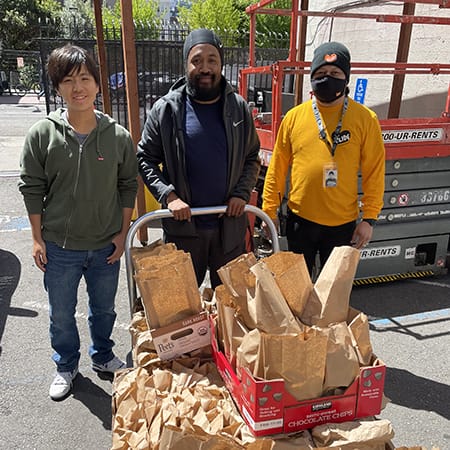
Landon To handing lunches off to Glide staff.
What’s been the most rewarding part of your work?
I think for me it’s the knowledge that my efforts have resulted in tangible change and excitement in service work in youth cohorts and communities. A lot of younger kids and students are interested in starting Lunchmaker clubs at their own schools, which is always nice to hear.
Why is it important for others to get involved with causes they care about?
In general if there’s something you’re unsatisfied with, you can always hope that the person in charge will accommodate your needs and listen to you, but that isn’t always the case. The best way to see a satisfactory result that you want is to take control yourself. In the context of service and volunteering, if there’s something in your community or world you’re unsatisfied with, the best way to make local change at least is to take action yourself or rally people behind you. Eventually local change becomes more widespread, and before you know it your impact has grown much farther than you could’ve imagined.
Any advice for people who want to start volunteering?
No need to go all in at the start. Just dabble a bit, see what works for you. There are a lot of different things you could do. You could do 100% interaction when serving in a food shelter, or you could do 0% interaction and pick up trash and help out at your local park. Just find something that you’re comfortable with that doesn’t stress you out.
What do you want people to learn from your story?
Even if you feel like you don’t have any ambition or maybe any drive for service work, there’s always small things you can do to help out your community. You don’t need some big position or need to go to your local food shelter every week. Sometimes service just means picking up the trash your friend left behind, holding the door open for strangers. Just do whatever you’re comfortable with. Another one of my personal beliefs is that service shouldn’t be a required experience that feels monotonous or like a hassle, we should do whatever we can to make it engaging, interesting and educational.
The Young Changemaker Transforming Food Insecurity with Meals That Matter
Meet Daily Point of Light Award honoree Prakhya Koya. Read her story, and nominate an outstanding volunteer or family as a Daily Point of Light.
Prakhya Koya has always believed in the power of action. As the founder of Leap4u, a nonprofit dedicated to reducing food waste and combating food insecurity, she has turned this belief into a movement that has helped thousands of individuals across the Washington, D.C. metro area. Through her leadership, Leap4u has rescued over 12,700 pounds of food and provided more than 67,300 meals to people experiencing homelessness and poverty. But for Prakhya, the mission is about more than just food—it’s about restoring dignity and hope to those in need.
“I have witnessed firsthand the immense struggles individuals and families face when they lack access to basic necessities like food and clean water,” Prakhya explains. “At the same time, I’ve seen an overwhelming amount of perfectly good food go to waste. My goal is to bridge this gap—rescuing surplus food and delivering it to those who need it most.”
Her journey began at a young age when she started volunteering at local shelters, where she saw the harsh realities of food insecurity. She also became aware of how much food was discarded by grocery stores and restaurants daily. This realization led her to take action beyond occasional volunteer work.
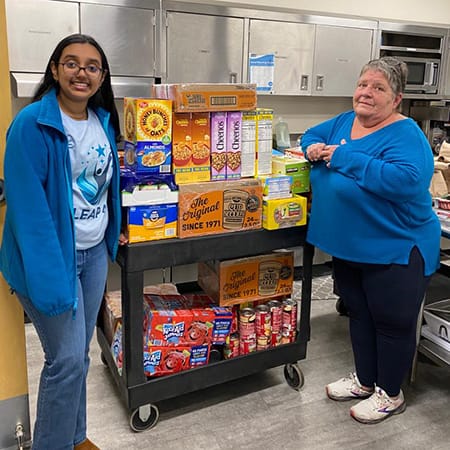
Prakhya and team organizing a breakfast drive to provide nutritious items for unhoused children.
“From a young age, I volunteered at a local shelter and saw how children, families and adults struggled with unstable housing and food insecurity—especially during brutal winters when hypothermia and seasonal illnesses posed even greater risks,” she recalls. “Realizing the severity of this gap, I felt compelled to do more.”
Leap4u operates seven days a week, coordinating food rescues from businesses like Wawa, Chick-fil-A, Pizza Hut and KFC. The recovered food is distributed to 18 unhoused communities and local food pantries, ensuring that no edible food goes to waste. Beyond food recovery, Prakhya also organizes food drives, brown bag lunch distributions and breakfast events to keep her community engaged in cultivating more food security in the area.
Her impact isn’t just measured in numbers—it’s seen in the lives she touches. “The most fulfilling moments come from seeing the smiles and gratitude on people’s faces when they receive a warm meal and the reassurance that someone cares,” she says. “Receiving handwritten notes from shelter directors and community leaders expressing the impact of our work is incredibly moving and serves as a constant reminder of our responsibility to keep going.”
Prakhya is an ambitious leader, envisioning expanding Leap4u’s partnerships and incorporating mental health initiatives into the organization’s services. “Currently, we support 18 unhoused communities and work with multiple local restaurants and food chains to ensure that no edible food goes to waste. Moving forward, we plan to expand our network of partners and shelters to maximize our reach. Additionally, we aim to introduce mental health initiatives—such as counseling sessions and wellness workshops—to provide more comprehensive support.”
For Prakhya, one of the most rewarding aspects of her work is seeing how it inspires others to take action. “Bringing together volunteers from diverse backgrounds and uniting them under a shared purpose has been truly inspiring,” she says. “Dedicating time and energy to a cause you believe in not only makes a tangible difference but also brings a profound sense of fulfillment. It strengthens communities, fosters empathy and reminds us of our collective responsibility to care for one another.”
Her advice for those who want to make a difference? Start small, stay consistent and involve others. “Start with something that truly resonates with you—whether it’s fighting hunger, protecting the environment or advocating for mental health. Reach out to local nonprofits and community groups to see where your help is needed, and don’t hesitate to involve friends and family. Consistency is key—even a few hours a week can make a meaningful impact.”
The team at a food distribution event supporting underserved families.
Beyond direct service, Prakhya is deeply committed to raising awareness and mobilizing others to take action. She frequently speaks at community events, schools and local gatherings to educate others about food insecurity and food waste. By highlighting the interconnectedness of hunger, environmental sustainability and social justice, she encourages individuals and businesses alike to think critically about how they can contribute. “Even small acts—like donating excess food instead of throwing it away—can have a ripple effect,” she explains. “We need to change the way we approach food waste and hunger, and that starts with education and awareness.”
In the future, Prakhya envisions Leap4u becoming a nationwide model for food rescue and redistribution, with chapters in other major cities across the U.S. She hopes to strengthen collaborations with policymakers to advocate for better food waste regulations and expand Leap4u’s initiatives into areas like job training and financial literacy programs for underserved communities.
“Food insecurity is just one part of a much larger issue,” she notes. “By providing holistic support, including career development and mental health resources, we can help break the cycle of poverty and empower individuals to build sustainable futures for themselves.”
Ultimately, Prakhya hopes her story shows that anyone—no matter their age or resources—can create meaningful change. “You don’t need vast resources—just the willingness to take that first step and work alongside others. Progress happens one action at a time, and when you stay committed, everything falls into place.”
Through her leadership, compassion and relentless dedication, Prakhya is not just rescuing food—she’s restoring hope, one meal at a time.
A San Diego Resident’s Decades of Dedication to Balboa Park
Meet Daily Point of Light Award honoree Kathy Hunyor. Read her story, and nominate an outstanding volunteer or family as a Daily Point of Light.
When you live in a place for a long time, there are certain parts of it that become as much a part of your home as your house itself. That is that case for Kathy Hunyor, a nearly lifelong resident of San Diego, the home of Balboa Park.
Kathy’s parents, both WWII veterans, were in Southern California when they were released from the military and met on a blind date. By the time Kathy came along, they had moved to the city that would capture her heart. Kathy eventually followed in their footsteps—her dad a fireman paramedic, her mom a nurse—into the healthcare field. And for 40 years, she did cancer research, physical therapy aid and patient advocacy at one of the major hospitals in the city.
Throughout her childhood, visiting 1,200-acre Balboa Park was a source of great joy, one that continued into adulthood and throughout her life. It’s her love and appreciation that has led her to spend over 24 years volunteering her time there hosting free concerts, tending to the rose garden, providing information to visitors and sharing her extensive knowledge through tours of the grounds.
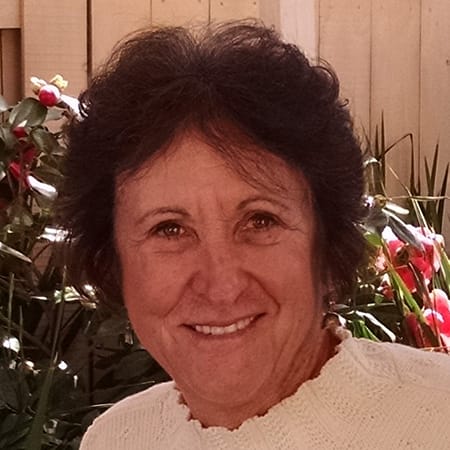
Kathy Hunyor, a San Diego resident, spends her free time volunteering in Balboa Park educating and entertaining visitors and maintaining the beautiful rose garden.
What inspired you to get started with this initiative?
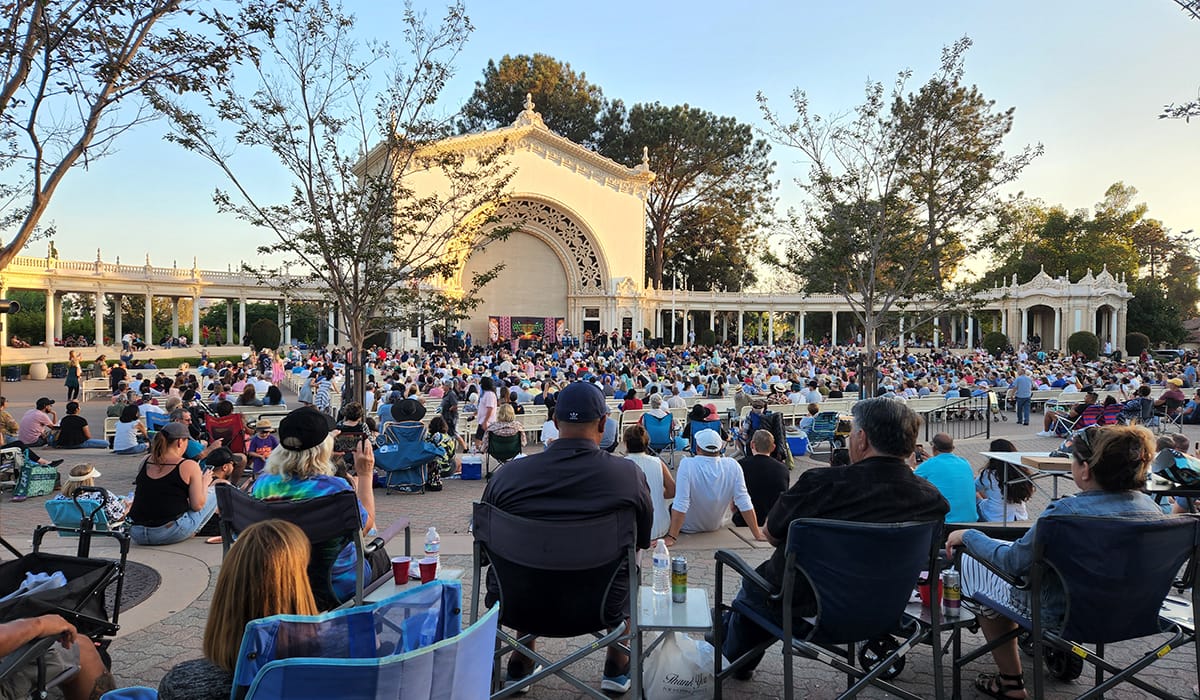
While I was still working, a friend of mine started volunteering with the “Twilight in the Park” series. That’s where I started. We had three concerts a week: Tuesday nights, Wednesday nights and Thursday nights during the summer. We gave diverse local bands and entertainers an opportunity to perform on our beautiful 1915 Oregon Pavilion Stage in the middle of the park, and we gave the community free entertainment.
Why is Balboa Park important to you and your community?
In 1915, when the federal government opened the Panama Canal, San Diego became the first city in the U.S. to have tall sailing ships delivering goods. They decided to build a city on the hill that was, at the time, just sand, dirt and scrub brush.
The city only had 40,000 people and a fishermen- and cowboy-type atmosphere. Kate Sessions, a UC Berkeley grad in the 1880s, came to San Diego to be a teacher and a principal but loved horticulture. She used maybe 30 acres on top of the hill to start a nursery of 100 plants and trees from all over the world, which became Balboa Park.
All of that made Balboa Park what it is today, as well as the museum infrastructure built for the 1915 Exposition, which is commonly known as the World’s Fair. San Diego now has 3 million people, so it’s a refuge. We have a free tram that takes people around, but walking is easy anywhere. Our museums–predominantly operated by volunteers–are in about one quarter of the park, and the San Diego Zoo is in one quarter of the park. The other half is all trails for hiking, pools, tennis courts, a golf course and picnicking space.
People of all ages settle in for one of the “Twilight in the Park” concerts at the Spreckles Organ Pavilion in Balboa Park.
Tell us about your volunteer roles with Forever Balboa Park.
I volunteered to help with the Twilight Concerts for over 24 years without any major funding source or corporate backing. I really enjoyed the outdoor experience, the music and the people from the community. They’d bring their kids and sometimes their dogs to enjoy for an hour or two as the sun was going down. Volunteers audition performers, advertise, usher and collect donations. I was secretary, treasurer, vice president and president for a number of years, particularly the last five, but I stepped away last year. I loved it, but it was maybe 40 to 50 hours a month. The one other fellow and I, who both started in 2000, decided to let the younger folks take it over.
There are at least 300 or 400 volunteers from Forever Balboa Park who help plant young trees when needed and take care of gardens, one of which is the Inez Grant Parker Memorial Rose Garden. I’ve been volunteering there for about 10 years between March and December. These days, I’m in the garden one day a week for three to four hours at most. We manicure roses, pull weeds, clean raised beds and walkways and, if needed, eradicate disease. Occasionally, we train new volunteers, plant and fertilize. And once a year, we prune. There are 1,700 rose bushes. It’s beautiful. I also spearheaded a one-day rose care seminar for the public with master rose garden speakers.
I’ve had to slow down a little bit, and in the last two years I’ve become more involved with the visitor center as an ambassador outdoors and a tour guide. I do architecture and history tours. And, about a year and a half ago, we started a women’s tour to show how women like Kate Sessions were and are important in the development and ongoing success of the park. I give that tour also.
Where did you learn your gardening skills?
I didn’t start gardening until I was in my 50s. I found it to be relaxing. My husband and I live on a canyon, so we have a nice yard. That was partially why we selected this house.
Also, my mom loved roses. When she was away from healthcare, to enrich her soul, she loved gardening. That was the impetus for me to get involved with the Balboa Park Rose Garden. I knew something about roses. They also train you for about three visits. And I joined the San Diego Rose Society, which has ongoing classes, lectures and rose shows. I’ve judged at shows occasionally.
What do you want people to learn from your story?
People need to be a little bit social. They need to learn new things for their own health and enjoyment. No matter what your age is, you can get out there and enjoy your environment, your neighbors and your community. You can have fun and help others. Balboa Park is the jewel of San Diego. It’s a pleasure to volunteer there and see so many happy people from around the world.
CARRYING ON THEIR DAUGHTER’S LEGACY BY HELPING OTHERS
Meet Daily Point of Light Award honorees David and Tammy Dube. Read their story, and nominate an outstanding volunteer or family as a Daily Point of Light.
Tammy and David Dube are turning the tragic loss of their daughter into a beautiful legacy. Their daughter Addison was born with Smith-Lemli-Opitz, a rare genetic syndrome that required countless procedures, surgeries and hospital stays throughout the child’s life. When Addison’s younger brother was born in 2013, the logistics of daily life while Addison received frequent care proved to be enormously challenging. Addison passed away in 2019, just shy of her 11th birthday. David and Tammy established the Babygirl Foundation, creating a legacy of helping others in her honor.
The Babygirl Foundation directly funds the Parents’ Closet at Barbara Bush Children’s Hospital in Portland, Maine, where Addison received exceptional care during her life. When parents or caregivers arrive at the hospital, they receive a “menu” of items to choose from, ranging from toiletries like shampoo and toothpaste to comforts from home like a phone charger or cozy pajamas. The closet is available to family members and caregivers with children staying in BBCH’s Pediatric Intensive Care Unit, Neonatal Intensive Care Unit and Pediatric Emergency Department, and David and Tammy are hopeful to expand their reach to additional venues throughout the region in the future.
Despite the tragedy of losing their daughter, Tammy and David have found tremendous strength in knowing that they created a powerful and specific resource that’s greatly needed. When asked, they point out how great the journey of running the organization has been thus far and that they’re looking forward to creating an even more lasting legacy that will impact more families. Their mission to help others is an important reminder of how powerful volunteering can be.
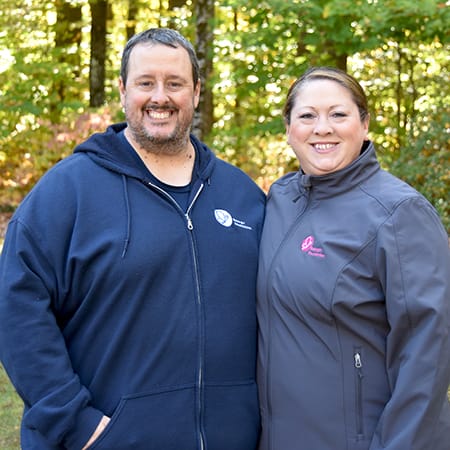
DAVID AND TAMMY DUBE ESTABLISHED THE BABYGIRL FOUNDATION TO PROVIDE FAMILY MEMBERS, CAREGIVERS AND PARENTS WITH RESOURCES TO IMPROVE THE FAMILY’S EXPERIENCE DURING A CHILD’S HOSPITAL STAY. /COURTESY DAVID AND TAMMY DUBE
What inspired you to get started with this initiative?
Tammy: Our daughter Addison was born with a rare genetic syndrome called Smith-Lemli-Opitz, which basically meant she had a lot of health problems. Sometimes, we felt like we were in the hospital more than we were home. After our son was born, the complexities of that became more difficult.
David: We found we had to divide and conquer an awful lot because one of us needed to be at the hospital with Addison, and then we needed to have our attempt at giving our son a normal life.
Tammy: Fast forward a couple of years, things started to really kind of take a downward slope for Addison. She spent a lot more time in the hospital and those days were increasingly longer. There was one stay in particular when my son had the flu. Addison also had the flu, so she had to go straight to the hospital from a doctor’s appointment. My husband didn’t have a charger or clothes, so we met up in the hospital parking garage. It was during that stay that we realized that there needs to be something for parents to help them. Barbara Bush Children’s Hospital does an amazing job with the kids, and we just felt like the parents needed to feel supported.
David: The goal of the parents’ closet was to try to make it easier to get some of those comforts from home that you wouldn’t have otherwise.
Tell us about your volunteer role with Babygirl Foundation.
Tammy: It’s a lot of emails, trying to bring donations over to the hospital and lots of setting up events. Also, trying to find sponsors for bigger events, networking and dropping off supplies at the hospital. We also volunteer on a board for the hospital. We have a lot that we do.
David: Try to spread the word as much as we possibly can. A lot of the daily activity is just trying to communicate, blast things out on social media, get people aware of who we are and what we’re doing, and trying to raise funds or products if people want to donate the actual goods that we would purchase instead of a cash donation. The day-to-day is trying to raise funds in support of supplying the closet or getting supplies directly from folks who donate.
What are your long-term plans or goals for the organization?
Tammy: Right now, our parents’ closet resource supports the pediatric intensive care unit at the Barbara Bush Children’s Hospital, which includes the NICU, their continued care nursery and also the pediatric emergency department. Our goal would be to increase that to the entire pediatric footprint at the hospital. Also, we are talking with one of the clinics for palliative care that played an instrumental role in Addison’s care, in the hopes of reaching out and supporting them as well.
We’d love to expand this to other hospitals in our region.
What’s been the most rewarding part of your work?
Tammy: Hearing from families that we’ve helped. We’ve had a couple of close friends who have been in the hospital with their children who have reached out and seen Addison’s picture on the parents’ closet menu. It’s been very rewarding to hear from people we know who personally reach out and say that because of this, their state was more manageable. It’s just a really good feeling to get involved, pay it forward and know that Addison’s memory lives on in what we’re doing.
David: That’s the biggest thing for me: helping the families and knowing that it’s all in her name. She was pretty unforgettable and I think a lot of people remember her smile and her quirky personality. Keeping that alive and trying to make something positive out of a tragic situation is very rewarding.
What have you learned through your experiences as a volunteer?
David: Despite all the differences of people and cultures and families and all the different situations, we’re all the same in that sometimes you just need help. The stress level brought on by a child going through a medical situation is real, and it’s similar, essentially, for everybody. We’ve learned that there are people out there who are less fortunate than us, there are people out there who are more fortunate than us and that everybody has a similar experience regardless of their situation. Any help that we can provide is good for everybody.
Tell us about future partnerships, programs or events that you are excited about.
Tammy: This year will be the sixth annual Babygirl Foundation fundraiser, an in-person event with live music, food trucks and an awesome mobile art bus for the kiddos. It’s on September 21 at the Kennebunkport Conservation Trust. We have other events that you can stay updated on if you follow us on social media, but we’re still looking for sponsors for our big event in September.
David: I want to underscore the looking for sponsors part, because what we’re talking about and what funds the parents’ closet is not an incredible amount of money. A corporate sponsor, who could do more than the $50 or $100 that we would get from individuals, could go such a long way.
What do you want people to learn from your story?
David: I think the thing that we would like people to understand is that it’s okay to ask for help. We always shied away from that and tried to do it all on our own. We knew that while we were going through something, we were still very fortunate in a lot of ways, so we always hated to ask for help because our mindset was that other people were worse off than we were. It took a lot for us to break down and ask for help. If we could get any message out there, it would be to tell people it is okay to need a change of clothes or a comfort item like a blanket or a journal to document things.
Tammy: Obviously, losing a child is extremely tragic, no matter the circumstances. But something for people to learn is that we’re turning something that’s a sad story into something that’s going to be a beautiful legacy. That’s important. It’s helped us heal.
Meet Daily Point of Light Award honoree Aarushi Mehrotra. Read her story, and nominate an outstanding volunteer or family as a Daily Point of Light.
Young people are often told to reach for the stars. Aarushi Mehrotra, a high school junior, is doing exactly that—and helping others do the same. She crochets and performs with her school’s Indian dance club, but she’s also passionate about math, computer science and astronomy. The last of these was originally inspired by the film Hidden Figures about three highly intelligent Black women who navigate racism and misogyny while helping launch the first American astronaut into orbit. Now, Aarushi does research in the field.
In fact, scientific research has become a big focus for her in the last two years since joining Talaria, a nonprofit founded by Nora Sun in 2019. The organization is dedicated to supporting female and genderqueer students in science and their research efforts. Many students who go through their programs have gone on to become established researchers at universities. Aarushi is empowering the next generation of researchers to reach for stars, too—whether it be studying the solar system or engineering a prosthetic.
What inspires you to volunteer?
I started volunteering as a math tutor a few years ago through some Chicago-based organizations. I enjoyed seeing how fast my students were progressing, and I was eager to help more people.
As my passion for science was growing, I began to see challenges that women face in STEM. When I started participating in more competitions, I found that there’s a big gap between men and women in STEM. I want to mitigate that by reducing roadblocks and helping students reach their fullest potential.
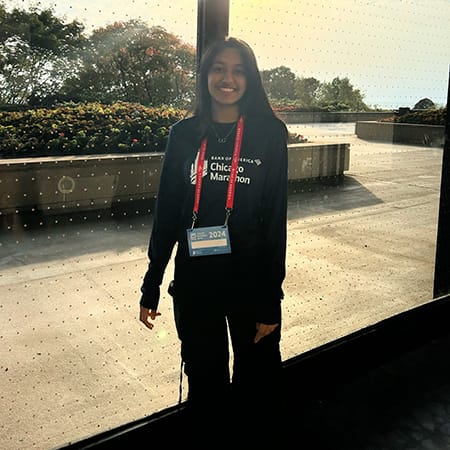
At the Chicago Marathon, Aarushi volunteers to distribute race packets.
What are some things that are creating gender inequities in science, and what needs to change?
Just looking at younger students, the percentage of male participants in competitions and research symposiums is extremely high. Statistically, there are about 25% more men in STEM-based fields, and this really comes from inequitable access and support early on, which is what we’re trying to change.
By giving women and genderqueer students more accessible opportunity, we hope that some of the stigma and the inertia needed to start research can be reduced. The support that they need can be hard to get early on, and that’s really what causes a discrepancy between men and women.
Tell us about your volunteer role with Talaria.
I lead the Talaria Academic Year Programs: the Talaria clubs, the ATHENA Research Workshop and Conference and the Envision Research Proposal Competition. The Talaria clubs are a network of clubs throughout the U.S. and Asia that we started this year. We reach out to female and genderqueer students, and they teach students at their school how to write research proposals. Through our curriculum, which I helped develop in collaboration with research professors, we mentor aspiring scientists and support them as they start their research journeys.
If they’re comfortable, we support them as they reach out to local professors. Then, students can actually do research in university labs, gaining experience and developing skills. We’ve reached over 100 students this year. The ATHENA Conference and Workshop is twice a year. I reach out to scientific researchers around the country to present their work and experiences to students in middle and high school. These researchers give participants a window into academia and the research world and introduce them to new scientific fields while workshopping their research ideas and projects. Our first conference this past fall had 40+ participants.
And finally, I help organize and host the ENVISION Research Proposal Competition. It’s an opportunity for female and genderqueer students to gain recognition for their scientific ideas. Many science competitions place importance on finished science projects which, as a student, can be intimidating. Hence, we created a research proposal competition. I coordinate with judges to evaluate submissions.
What’s been the most rewarding part of your work?
Meeting aspiring research students and seeing them move forward with their research and goals as a result of Talaria’s programs has been the most rewarding, especially during our fall 2024 ATHENA Conference. I met students from around the world, and I was so happy when they asked questions to the researchers and left with more knowledge than they came with. Helping them learn something that could help them in their journeys has been so rewarding.
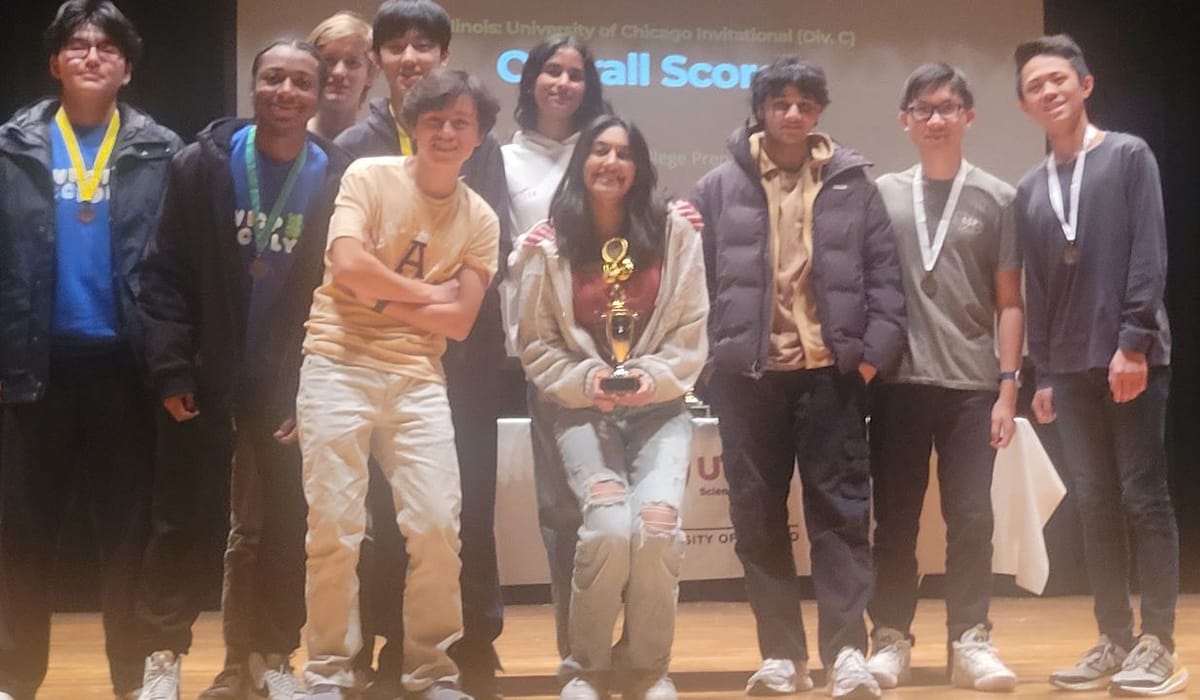
Aarushi (4th from right) competes in Science Olympiad.
What have you learned through your experiences as a volunteer?
I’ve learned how to build connections with people from diverse backgrounds. A big part of our programs is reaching out to researchers and incorporating them into our conferences, competitions and clubs. I reach out to them through email and then form real connections with them. This helps me create lasting relationships. Similarly, building a team with like-minded students to progress Talaria’s mission has helped me foster more accountability, compassion and teamwork skills within myself and within the team.
Tell us about future partnerships, programs or events that you are excited about.
The spring ATHENA Conference is our next event. It’s a three-hour conference held over Zoom. That’s how we get participants from all over the world. We want to make it as accessible as possible. We’re excited to bring in more researchers from more diverse scientific fields. Last year, we had representatives in chemistry, physics, biology and computer science, and we hope to bring in more universities to gain more perspectives and help our students with niche interests.
Any advice for people who want to start volunteering?
They should see what they’re interested in and how they can best serve other people. Starting a new initiative just requires an idea and action. While doing something new or starting a new initiative can be really intimidating, approaching these seemingly large projects in a systematic manner sets you on a path for future success. Put yourself out there. You might be surprised just how well you do.
Maintain your motivation and remember that something really small, something trivial to one person, can be something transformative to someone else. So don’t hesitate. Help someone, if you can.
Meet Daily Point of Light Award honoree Donna Pohl. Read her story, and nominate an outstanding volunteer or family as a Daily Point of Light.
Donna Pohl may be retired from her career as a librarian and a schoolteacher, but her role in promoting literacy is more important than ever. In 2012, Donna became a member of the board of the Friends of the Bryan and College Station Library System, an organization that works to promote the public library and encourages all citizens to use the diverse offerings provided by the system. She furthered her role in 2017 by becoming the manager of membership and book sales. Whether she’s encouraging community residents to sign up for their first library card or designing a comprehensive floor plan to ensure the library’s book sales run efficiently, Donna’s mission is always tied to encouraging community members to find a love for learning.
While Donna’s passion for reading is powerful, she also follows a mantra that “libraries are not a luxury, but a necessity.” In addition to providing the community with timely reading material, the Bryan and College Station Library System gives residents access to essential services and information, no matter their financial status. These services could include free access to daily newspapers to catch up on the news or the opportunity to attend or host events in community spaces that focus on learning and connection. Her work in getting the 1,000 Books Before Kindergarten program up and running is a particularly powerful initiative that will establish a love of reading in children before they ever step foot into the elementary school system.
Donna Pohl is a beacon that lights the way for literacy in the Bryan and College Station community. Her dedication to demonstrating how public libraries are essential components of any community is a strong example of how powerful volunteerism can be.
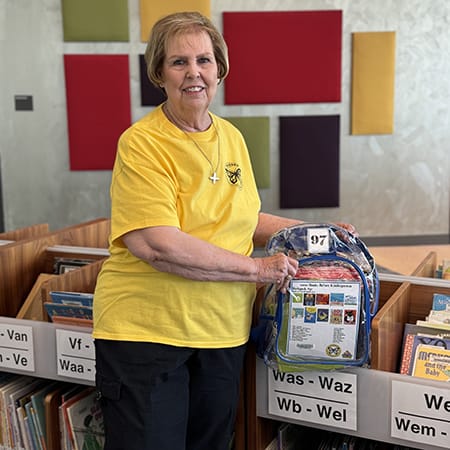
DONNA POHL HOLDS A BACKPACK THAT’S PART OF THE 1000 BOOKS BEFORE KINDERGARDEN PROJECT, WHICH WORKS TO INSPIRE A LOVE OF LITERACY IN CHILDREN BY READING THEM 1,000 BOOKS BEFORE THEY HEAD TO ELEMENTARY SCHOOL. /COURTESY DONNA POHL
Tell us about your volunteer role with the Friends of the Bryan & College Station Library System.
My role started by just going to the book sales, and eventually, I joined the board of Friends of the Library. That has grown into my being in charge of the membership database, receiving those memberships, money and membership forms, and getting that in the database. The other part of my job is to get our floor plan ready for our sale. We have three sales a year, so I have a floor plan that I design according to the number of books that we have in each genre, and then I help other volunteers unpack those books and get them in the right order on the tables. I’m in charge of the book sale, and I have a co-person who helps me with that. And then, of course, all the other volunteers work the book sales as well.
What inspired you to get started with this initiative?
I’m a librarian and a schoolteacher. Literacy and books have always been a big part of my life. I’ve taught elementary and I’ve been a librarian from elementary up to college. I was an educator for 42 years, and I think that’s just something that you don’t turn off. There’s always that need inside to do something in that area. I retired. I didn’t quit, and that’s my avenue now for continuing to be active. I think it’s very important that when you retire, you don’t just quit. I had a friend who was a member of the board at that time, and she nudged me into it slowly, but once I get into something, I usually jump right in.
What’s been the most rewarding part of your work?
Just hard work. Doing three book sales a year is a lot of hard work, and many people help. It’s not just me, but I feel so finished after each book sale because so many people come. Our room is packed, and we make a nice sum of money with each book sale, which goes right back into the library system. That hard work pays off and that makes me feel good.
What have you learned through your experiences as a volunteer?
That there are many personalities involved, and we are all volunteers. Usually, when you’re a volunteer, you don’t do it because you have to. You want to be there. So that’s a whole other avenue of respect that comes with being a volunteer.
Tell us about future partnerships, programs or events that you are excited about.
Right now, we have a project called 1,000 Books Before Kindergarten that is up and running in a ringer library in College Station, but we haven’t been able to support it financially yet in Bryan. Overall, Bryan is a community of historically underserved people, and that need is there for those children. What we do is put 10 books in backpacks, and right now, I think there are about 50 backpacks. Those books have to be replenished. The families check those out, they read those 10 books and bring the backpack back to the library and check out another one. The goal is to read 1,000 books before kindergarten, and the board is very supportive of getting it up and going.
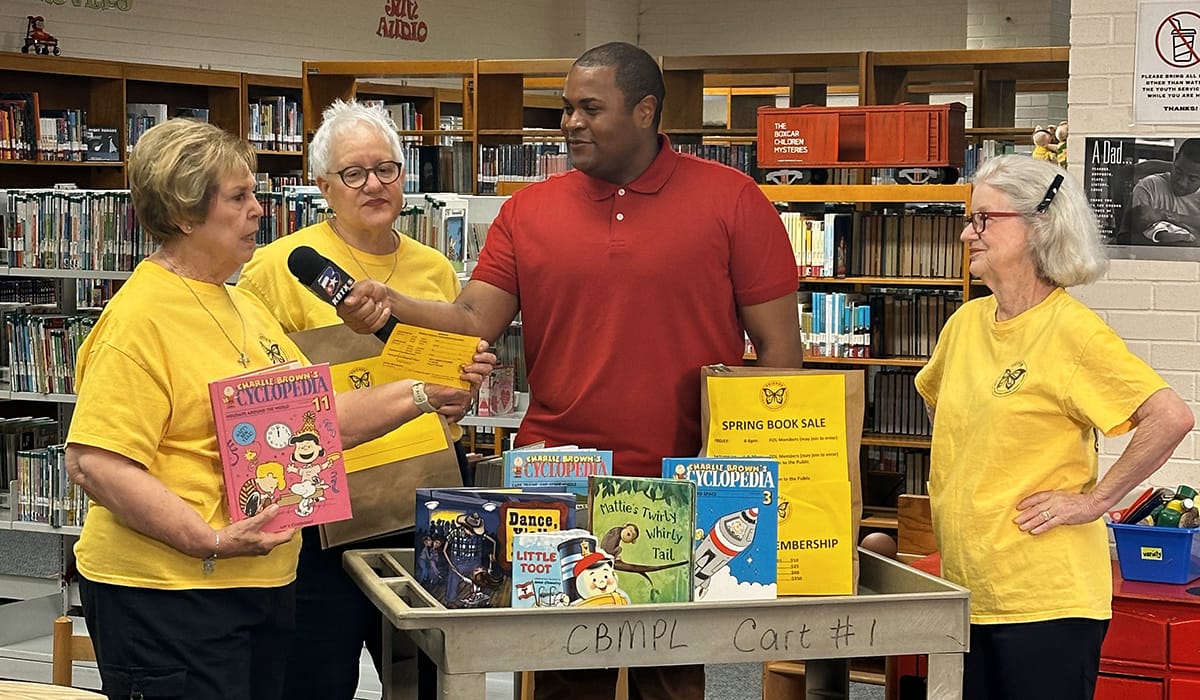
DONNA POHL (FAR LEFT) APPEARS IN A LIVE PUBLICITY STILL FOR A LOCAL TV NEWS STATION IN WHICH SHE DISCUSSES THE BOOK SALE. /COURTESY DONNA POHL
Why is it important for others to get involved with causes they care about?
I was brand new when I came here 15 years ago. Part of my reasoning was to get to know the community. Like I said, I’m involved in other activities with the community as well, but I think that it is so important to get to know different people in your community in different ways, as well as to support your community. So that was my main reason: the support of the community and to keep myself active.
Any advice for people who want to start volunteering?
We have had people at the book sale inquire about how they can help. Right away, we give them a job to do, and they can always come and help us sort books into the right genre because everything we get is donated. So that’s usually how we get people started. From there, if they want to know more, they will ask about the board, and we are certainly always willing to tell them.
What do you want people to learn from your story?
How important it is to recognize the needs of your community. Our goal is to always be mindful of what the needs are. With the funding that we have, we provide lots of different things to the community. We support all of the summer reading programs and we do things for all individuals in the libraries, like supporting the wireless printing. We buy the printers and computers, and we pay for the printers and the copiers in the library. It’s more than just literacy; it’s other activities that other members might come in and need to use in the library.
Using Technology to Make Sustainable Change in Uganda
Meet Daily Point of Light Award honoree Deborah Plotkin. Read her story, and nominate an outstanding volunteer or family as a Daily Point of Light.
Uganda in the early 1990s to 2000s was an exceptionally dangerous place. Joseph Kony and the Lord’s Resistance Army (LRA) were leading a rebellion without clear motivations, and they were committing atrocities against civilians across the country. Going from village to village, they often targeted parents of children they would then abduct and turn into child soldiers to perpetuate the violence. Nearly 2 million people were displaced by LRA actions and the government’s forcible resettlement plan into internally displaced persons (IDP) camps.
Meanwhile, on the other side of the world, Deborah Hoffman-Plotkin, a woman who would eventually become a figure of hope to the abducted children, was dedicating her life to kids with autism as an education consultant and advocate. Her journey began as a teenager befriending institutionalized children with autism and volunteering for her school’s special education class. She eventually went on to work in the field.
Years later, Deb and her husband, Dr. Ron Plotkin, first heard horror stories of the LRA War from a Ugandan speaker at University of San Diego. Moved to help, Deb and her family committed to raising funds for the school fees of 24 orphaned children.
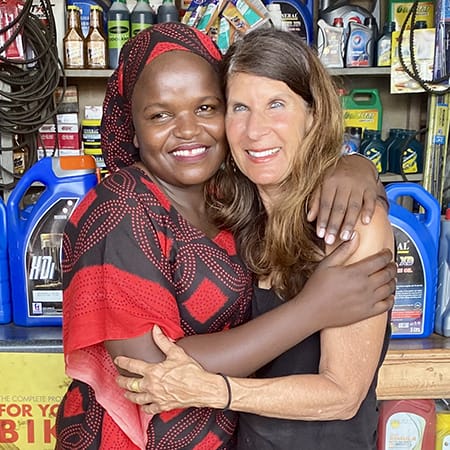
Deb Plotkin (right), founder of U-TOUCH, visits Annet, an Information Communications and Technology (ICT) and Women’s Empowerment Training (WET) graduate, at her auto-parts shop.
“[In 2007], we went to Uganda to see if the money was actually reaching the children,” explains Ron.
The schools they saw left them in shock. Children were in the required uniforms their funding paid for, but they were barefoot on mud floors. There were no writing implements or books.
The family also visited IDP camps where over a million people were corralled for safety, mostly cut off from basic necessities.
“They don’t have running water,” Deb describes. “No flushing toilets, no showers. They shower out of a 12-inch bucket, the same bucket that they would wash clothes with.”
Disease was rampant, but despite conditions, there was also joy.
“My daughter was playing ‘Ring Around the Rosie’ with the children. This dichotomy of pain and joy gave me such inspiration that even in this extraordinary hardship, life goes on.”
Later, while listening to the children tell stories about the war and the death of their parents, Deb discovered her calling. When she was just four months old, Deb’s father was killed during a robbery while trying to protect the shop owner’s wife. Helping the orphaned children of Uganda would be a way to honor him.
“She relates to people so deeply,” Ron muses. “She has such a deep capacity for love and compassion, particularly for those who have suffered trauma and loss.”
Given the circumstances, he wasn’t immediately convinced her idea to scale up education initiatives by introducing them to computers would work.
“The idea that these people could sit in front of a computer screen when they didn’t even have electricity…” he reflects. “She was able to create a vision that went beyond their immediate needs and see not just what they needed but what they were capable of doing given opportunity and resources.”
Deb returned home and collected unwanted computers before returning to Uganda in 2009 to open three tech hubs. They started by inviting people from schools in the area who walked miles to access the internet and learn digital skills. And in 2010, U-TOUCH the World (Universal Technology Outreach Community Hubs) was official.
Deb’s goal was to engage kids who weren’t in school to teach them employable skills and invited everyone 15 and older to learn digital literacy along with life skills, job skills, entrepreneurship skills and women’s empowerment skills. At the first meeting, there were 75 men and one woman, so she told the men to each come back with a woman. She told the woman to bring every one of her friends. And it worked.
“The women crashed the door the next day, smiling and dancing like you’ve never seen before. They said they didn’t think they would ever see a computer, much less touch one or take technology classes,” she recollects.
U-Touch has since certified over 7,000 students in digital skills via multiple technology hubs that move around the country. They have sponsored 50 students’ educational goals. Deb also hosts “voluntourism” trips each year where foreign volunteers bring business skills to the hubs to mentor students beyond computers.
The success stories are endless. Graduates have been selected for merit scholarships and to represent Uganda at conferences in New York City and India. They have found meaningful work as software developers, graphic designers, tech business owners and more in NGOs, the government, tourism, education, healthcare and beyond.
Many U-TOUCH graduates become the first in their families to be employed. They can then pay for their kids or siblings to go to school and provide food and healthcare, necessities that are out of reach for many. In short, the lives of everyone around them are sustainably transformed.
Annet broke the glass ceiling as the first woman to own an auto parts store in Mbale. Michael, a survivor of abduction during the war, studied computer science at college where he was named Uganda’s Google Student Ambassador for his Google Docs editing tool innovation, which is now used by millions. He got a master’s degree in China before returning home to become an AI professor. Some grads even come back to the hubs as staff.
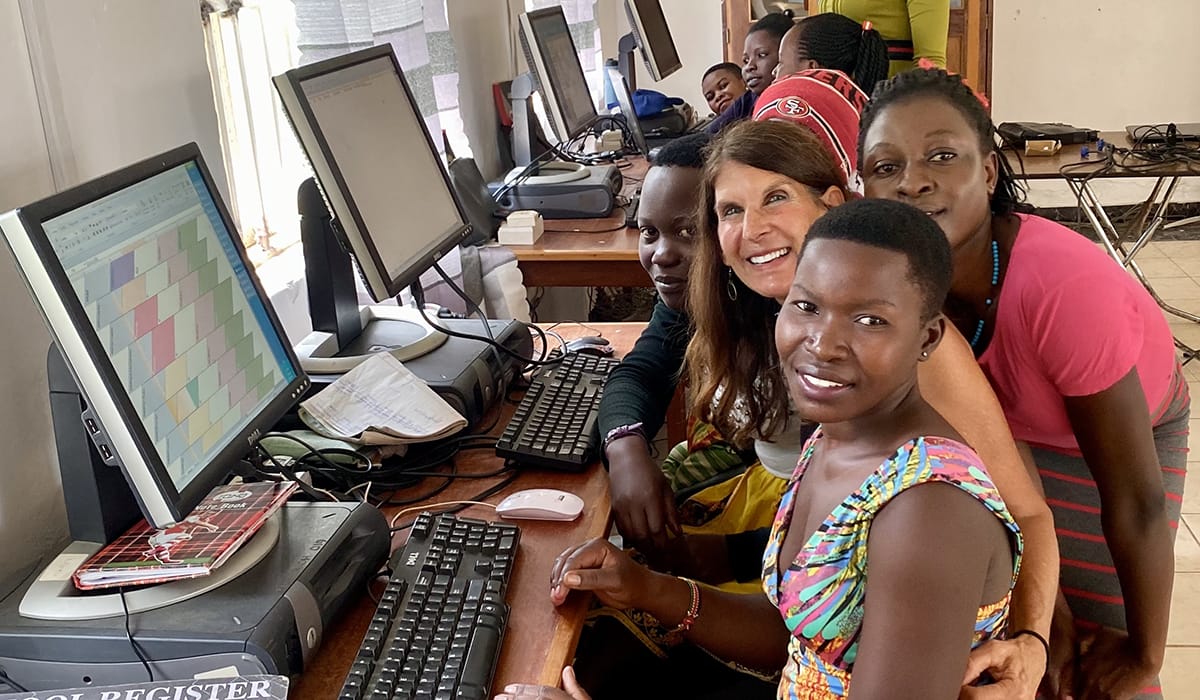
Deb (second from front) checks in with U-TOUCH ICT students learning highly-desired computer skills to advance their employment prospects and support their family’s basic needs.
Deb has helped develop U-TOUCH clubs at San Diego schools and consistently works on fundraising and grant writing efforts that support the programs. She has also developed internships for high school and university students in both countries.
Deb’s family is also involved. Her son lives in England, where he is connecting schools there with those in San Diego and Uganda. Ron is a longtime board member.
Looking ahead, Deb hopes to make the tech hubs she’s built self-sustainable and expand employment and business opportunities that increase the economic development of the country. She is working to expand the donor and volunteer base to spread the benefits of U-TOUCH beyond Ugandan borders.
“To change the conditions of how someone else can live, to transform their lives by giving time, talent and treasure is immeasurable,” Deb states. “By embracing the powerful heroic spirit of my father, through his legacy I can share my abundance of love through service.”
Growing Change and Cultivating Community in Chicago
Meet Daily Point of Light Award honoree McKenzie Closen. Read her story, and nominate an outstanding volunteer or family as a Daily Point of Light.
Since 2017, McKenzie Closen has been a dedicated volunteer with Chicago Cares, bringing her passion for community service to one of Chicago’s most cherished green spaces: the Lincoln Park Conservatory. Her commitment to environmental stewardship and community engagement led her to take on a leadership role in 2021, where she has since led over 20 projects and guided more than 100 volunteers. Through her work, McKenzie is not only preserving a vital urban oasis but also cultivating a culture of service and sustainability.
Each month, McKenzie spends three hours leading a team of volunteers who support the Conservatory staff with various greenhouse maintenance tasks. From tending to plants and assisting with upkeep to ensuring the space remains welcoming for visitors, her efforts help sustain the programs that make the Conservatory a valuable resource for the community.
Beyond her hands-on work, McKenzie recognizes the broader impact of investing in green spaces. The Lincoln Park Conservatory is more than just a greenhouse—it’s a space for physical, mental, emotional and spiritual wellbeing. By maintaining and preserving it, McKenzie helps provide a place where individuals can find peace, reconnect with nature and engage in meaningful learning experiences.
Read on to find out more about why McKenzie is passionate about bringing people together through shared service and how she’s helping to reshape how individuals perceive their city and their role in its future.
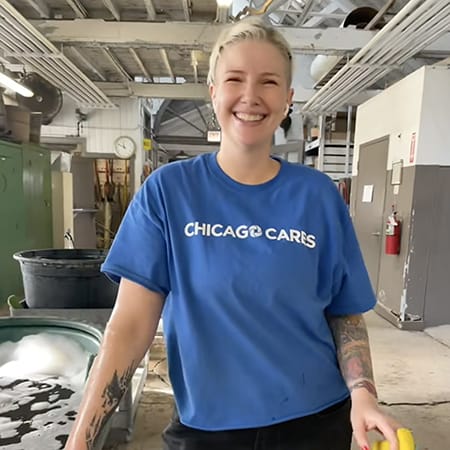
McKenzie washing pots with the volunteers she leads through Chicago Cares.
Tell us about your volunteer role.
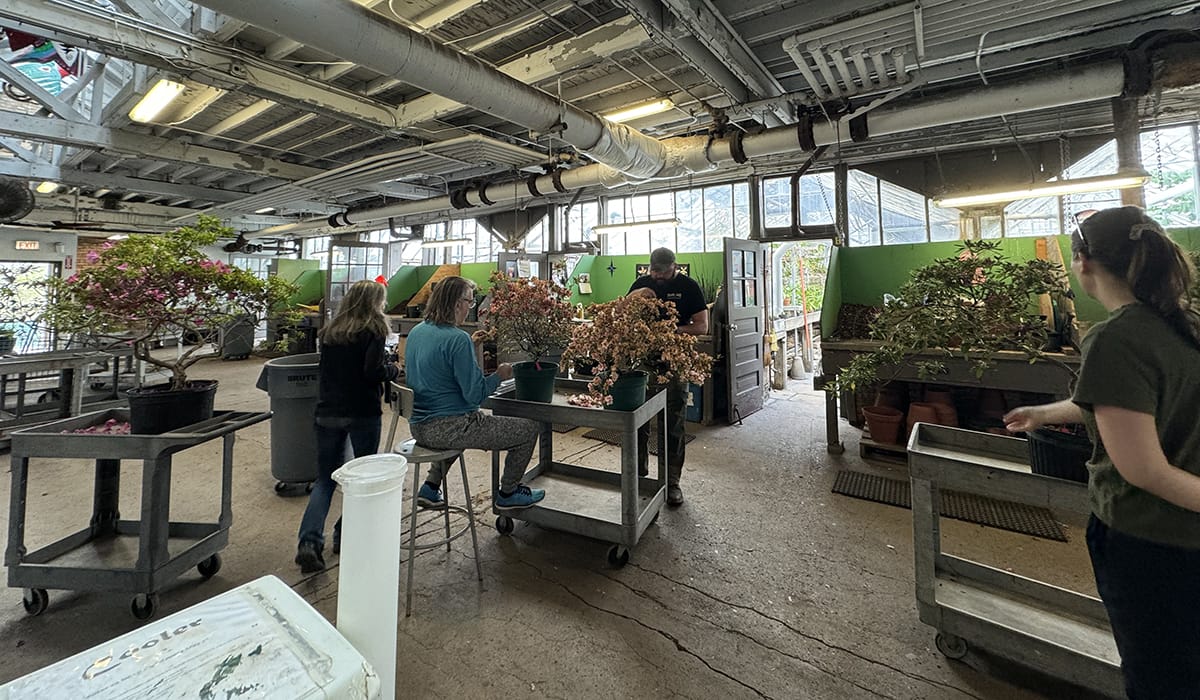
I’m a volunteer leader through Chicago Cares, and each month I lead a group of 10 to 15 volunteers at the Lincoln Park Conservatory (LPC) in Chicago. It’s such a beautiful space, and it requires a ton of hands-on work to keep the plants thriving for the community to come and see. Having these larger groups of volunteers is essential for supporting the small but mighty LPC staff that maintains the community-facing spaces and behind-the-scenes greenhouses. We help with everything from pruning to washing pots to making art installations for their seasonal flower shows. The plants are constantly in transition to mimic the changing seasons, moving from greenhouses to the outdoors to a dark, refrigerated cellar to hibernate for the winter, so we also help to move large numbers of plants during these phases.
What inspired you to get started with this initiative?
About eight years ago, I experienced a devastating loss and was searching for ways to find connection and community. I knew that supporting others would put things in perspective for me, so I found Chicago Cares, an organization that supports volunteerism by connecting volunteers with projects that need them. I tried out several different projects, but once I found LPC, I found my place. I’ve always loved nature, and having the opportunity to serve the community while getting to be around plants and other plant-loving volunteers was just what I needed.
Why is this issue so important to you?
For many people, myself included, being in nature and around plants is so important for mental health and wellness. Especially in a city where green space is limited and in a climate with long periods of cold and grey, having a warm, green, blooming space can be very therapeutic. Also, the more that the community can learn about plants, the more we hope they will care about conserving green spaces and be aware of environmental issues like climate change.
What’s been the most rewarding part of your work?
The most rewarding part of my work is after each volunteer day, seeing the amount of progress we were able to make on the project we were given that day. With large groups, we’re able to accomplish days’ worth of work in just three hours. The LPC staff is always so appreciative, and the volunteers leave feeling like they really made a difference—because they did!
Volunteers pruning plants to keep them healthy and thriving.
Why is it important for others to get involved with causes they care about?
There are so many reasons to get involved. Volunteering benefits you and the community you’re serving, and there’s a huge ripple effect of positive impact. Like my story, in times when you feel lost or hopeless, volunteering can give you a sense of purpose. Dedicating time to a cause you care about can also help you find meaning and build connections in unexpected places. It can remind you of the bigger picture and you’ll feel good about doing something positive for the world around you!
Any advice for people who want to start volunteering?
Don’t worry about finding the “perfect” volunteer opportunity. Just pick one and get started! It’s okay to try out a bunch of different ones until you find the one that feels right for you.
What do you want people to learn from your story?
I want people to see that volunteering isn’t just about giving—it’s also about receiving. When I first started, I was looking for connection and healing, and through service, I found both. I hope my story shows that even in times of personal struggle, stepping outside of ourselves to support others can lead to unexpected joy, purpose and community. No act of service is too small, and when we come together, we can make a meaningful impact—not just for the cause we support, but in our own lives as well.
DEDICATED VOLUNTEER SWEARS BY HIS MISSION TO SERVE
Meet Daily Point of Light Award honored Sai Shyamsundar. Read his story, and nominate an outstanding volunteer or family as a Daily Point of Light.
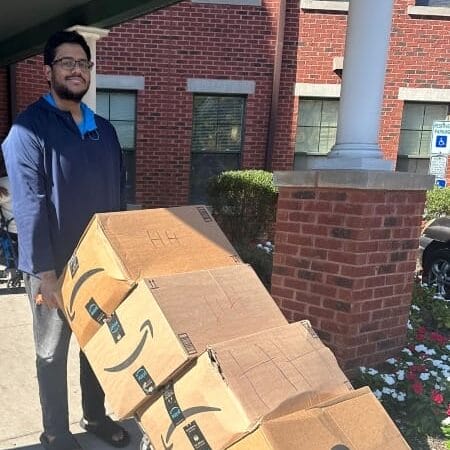
With every box he unloads, Sai Shyamsundar is driven by a mission to serve.
When Sai saw the work his brother was doing as a volunteer with Charity Crossing, an organization that provides basic needs to community members, he knew he wanted to be a part of their mission. Sai instantly jumped in and hasn’t looked back. Each week since 2022, Sai has headed out on what he calls a “serve,” an opportunity to distribute goods ranging from food and clothing to hygiene items and toys to people in communities throughout New Jersey. It doesn’t matter if the mission requires a long drive or several hours of work unloading boxes. No matter what, Sai is there, dedicated to helping others.
While Charity Crossing’s mission is to help others, Sai is steadfast in his belief that his volunteer work has taught him significant lessons, as well. It doesn’t matter if he’s dealing with a busy work week or navigating personal problems. Sai is inspired by Mahatma Gandhi’s words that “The best way to find yourself is to lose yourself in the service of others.” He also says one of the greatest lessons he’s learned through his experience is the power of collaboration. While each volunteer is very different, everyone finds the ability to come together and achieve the common goal of helping people in the community.
Sai’s mission to bring people together in the name of helping others is a powerful reminder of how volunteering can change the world. Creating meaningful change like Sai does in his community can come in a variety of forms, but each one is worthwhile.
SAI UNLOADS AND DISTRIBUTES SURPLUS ITEMS LIKE HOUSEHOLD GOODS AND HYGEINE ITEMS DONATED FROM AMAZON. /COURTESY SAI SHYAMSUNDAR
Tell us about your volunteer role with Charity Crossing.
Charity Crossing receives a wide variety of donations such as clothing, household items, hygiene products and monetary contributions that go to individuals and families going through difficult times. Charity Crossing is headquartered in Delaware and we receive most of these donations in New Jersey. Every week, we have several different “serves” from animal shelters, senior assisted living facilities, shelters, churches and places like that. We sort and distribute these items into different boxes that come for delivery. We take these items, load them up into our cars, and go to the individual serves in different parts of New Jersey. We bring these supplies there, and these serve the community members in that area.
What inspired you to get started with this initiative?
My brother was the one who volunteered with Charity Crossing first. I came to drop him off at one of the volunteering serves, and I was deeply moved by their mission to support communities and create lasting, positive change. Something about this organization’s mission to help struggling communities and embrace humanity resonated with me. I’ve always believed in the power of collective action to make a difference, and Charity Crossing just happened to offer that platform where I could directly contribute my time and skills to causes that I’m passionate about. Just having that ability to create a tangible impact on people’s lives inspired me to be part of this organization. I knew that I wanted to be part of this, and it’s been an amazing journey.
What are your long-term plans or goals for the organization?
The organization is currently active in Delaware, Maryland, Pennsylvania and New Jersey. One of the key goals that I hope to help with is to expand its reach beyond its serving locations and bring the impactful mission it has to other states where communities can benefit from its support. I feel like by broadening the footprint, we can help a lot more individuals and families access these resources that they need to thrive. We could also improve our partnerships with other organizations that might have a lot of surplus items like clothing, food or household goods. We could also look into partnerships there.
What’s been the most rewarding part of your work?
I would say the most rewarding part would be witnessing the tangible difference that our efforts are making in the lives of others. I remember when I was volunteering one day, I met this individual, a Vietnam War veteran, who had been struggling with severe leg pain. He shared with me that every time he woke up, he would struggle to get out of bed because of the immense pain. One of the serves that we participated in had a bunch of surplus pillows and I handed him one. His entire face just lit up with a smile. It was just a simple gesture, but that pillow made that world of a difference. Something as small as a pillow could ease his pain and improve his quality of life. It reminds me of the impact that the smallest act of kindness can have on someone’s life. It has been fulfilling to know that my time and contributions are helping to create an impact.
What have you learned through your experiences as a volunteer?
One of the most important lessons I’ve learned is that the smallest act of kindness can have a profound impact. I used to believe that only big gestures or big things could make a real difference. But through my work with Charity Crossing, I’ve seen firsthand how even the smallest contributions can create meaningful change, whether it’s bringing pillows or blankets to someone in need or being there in the moment and listening to what someone is going through. Something small is just listening and being empathetic, and that goes a long way. It’s a small step, but it’s a big step towards a brighter future.
Why is it important for others to get involved with causes they care about?
Volunteering allows us to embrace our shared humanity, especially during uncertain times. Offering our time and support to others fosters a sense of connection and reminds us that we’re all in this together. Through acts of kindness and selflessness, we find purpose and strength. It’s not just for ourselves but for those around us. Volunteering helps bridge divides. Even in a world that might seem divided, volunteering is a way to reaffirm our commitment to one another towards the greater good and solidifies the power of empathy.
Any advice for people who want to start volunteering?
My advice for anyone who wants to start volunteering is to take that first step and be open to the experience. I know it can feel intimidating at first, but it doesn’t require a huge commitment or a specific skill. You can start pretty small. Volunteering is about growth and learning because it allows you to learn about yourself. It’s a two-way street. You not only give your time to others, but you also grow.
What do you want people to learn from your story?
I would say that even the smallest gesture, no matter how small it is, can have the biggest impact. Whether it’s a donated pillow or blankets or kind words, these acts of compassion can bring immense comfort to anyone in the community who’s going through a difficult time. It’s a reminder for me that we all have the power to make a difference. No matter how small or insignificant we may think it is, these actions have immense power. We might be living in a world where challenges feel overwhelming, but we all have the power to create meaningful change by simply showing up for others, being present in the moment and offering whatever we can to help. Connection is, especially with human beings, very powerful.