Finding Calm Through Creativity: How One Veteran Is Healing with Art
Meet Daily Point of Light Award honoree Gary Walker. Read his story, and nominate an outstanding volunteer or family as a Daily Point of Light.
Gary Walker’s journey from military service to healing through art is one of resilience, innovation and deep commitment to helping fellow veterans and first responders. After serving for seven years in the U.S. Air Force and sustaining injuries during an undercover international drug operation, Gary faced the immense challenges of PTSD and traumatic brain injury (TBI). His struggles with mental health led his mother to encourage him to revisit an old passion—painting. What started as a personal coping mechanism soon evolved into a transformative program that now helps hundreds of veterans find peace through art, mindfulness and meditation with Monkey Brain Art.
As the executive director and lead instructor of the program, Gary has crafted a unique approach that blends artistic expression with therapeutic techniques to help those affected by PTSD regain a sense of calm. Over the past four years, he has worked tirelessly to provide these services at no cost to participants. More than 500 veterans, first responders, caregivers and nurses have completed the program, experiencing firsthand the mental clarity and relief that creative expression can bring. The overwhelming demand for his classes has led to a significant expansion, with additional offerings such as photography and wood burning, ensuring that more individuals can benefit from this innovative healing method.
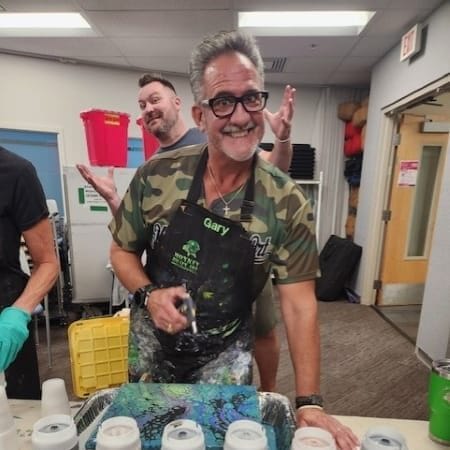
Gary and Matt Moyers cutting up during class for fluid art.
Gary also plays a critical role in managing the nonprofit’s operations. He collaborates with the VA Medical Center to schedule class dates and secure spaces, recruits volunteers and students, and spearheads fundraising initiatives to sustain and grow the program. His dedication ensures that those who have served their country and communities receive the support they need to cope with the invisible wounds of trauma. His work has garnered immense positive feedback from participants, their families and the VA, further validating the program’s impact.
The success of Gary’s program is evident in the number of repeat attendees, many of whom find solace in the artistic process and return for additional classes. His work is not just about teaching art—it is about building a community of support, understanding and healing. With each brushstroke, photograph and wood-burned design, Gary is giving America’s warriors a way to process their emotions, calm their minds and rediscover hope.
What inspired you to get started with this initiative?
When I was 15 and in high school, I was really becoming a pretty good artist. I was winning blue ribbons and state titles. I thought, this is my path! My brother was an artist, so I thought it was in my DNA. Then at 16, I met my wife, Trish. Life changed dramatically. We decided at 16 that we wanted to get married. We got engaged at 17. To provide for us, I joined the military. I took from age 15 to 50 off from art.
I was injured in the military and medically retired at 25 years old. I’ve had 14 back surgeries and a hip replacement and a PTSD diagnosis. At this time, we had our son Zach. We started a janitorial company and I stuffed all my PTSD into that, into being incredibly busy all the time. We grew the business to 250 employees cleaning 147 buildings, and the stress had gotten so intense that it was starting to seep out everywhere. The doctor told me I was going to have a stroke. So after 25 years of being self-employed, Trish and I made the decision to sell the business.
Unfortunately, when Trish was on a business trip and we had an empty nest, the PTSD was raging. I was in a state of drinking, self-medicating and doing all the things you shouldn’t do. It was getting dark. My mom happened to call me, and she said, “Honey I know you’re struggling. Could you paint, like you did when you were 15?” I painted all the ugliness and darkness and everything else, for about 13 hours on my feet. And I slept for hours, like I hadn’t slept in years.
When Trish got home from her trip, I told her what happened and since she could see art was helping me out, she encouraged me to pursue it. Around that time, she got her yoga teacher certification, and she started teaching me yoga, mindfulness and meditation. After several months of that practice, I was starting to find my calm—which was painting abstract and listening to jazz. I escaped all that stuff that was going on in my head all the time. Fast forward, a friend loaned me some space and I could paint all I wanted.
Tell us about how the organization got its start.
We reached out to the program I went through for my PTSD, and said, “Listen, we have to share this. We can’t keep this to ourselves.” Trish and I felt like art, meditation and mindfulness was going to be a tremendous help to veterans, first responders, caregivers and nurses. That’s who we chose to approach because of the amount of trauma that occurs in those career fields. The program held a spot for us. Who starts nonprofits during pandemics? Trish and I did.
We had done an exhibit at The Battle Within, which was the veteran nonprofit that brought us under the wing. The VA happened to come to a meeting there and saw our exhibit. They asked about us, and they asked to meet us. When we met with them, they told us to send a wish list of what we needed to get the program off the ground. We did, and they did. They even found us a free space for our classes.
The reason we called it Monkey Brain Art was from the Buddhist teaching that an unsettled mind is a “monkey mind.” The first class had three veterans show up. But we kept pushing on. Slowly, veterans started to come and paint with us. It kept growing and growing. Now, here we are, four years later, and I just had class last night at a VA facility with 26 students. We have intro to art, photography and wood burning—which we just added this year. The way the class starts is that Trish will come in and do a mindfulness piece, and then she’ll do a three- to five-minute meditation. Then one of us veterans will lead the art class. Now, students tell me they need to meditate in order to paint.
To date we’ve had over 500 students go through our courses. It’s now become mostly through word of mouth. Other veterans and first responders are telling each other about the classes and courses. They’re showing up. It’s been a phenomenal experience. Trish and I now have a son, a daughter and two granddaughters. We’re getting to see people’s lives change.
What’s been the most rewarding part of your work?
It’s the clients, the students. Seeing people I worked with four years ago and how much they’ve grown. People from our program have ended up going to Kansas City Art Institute. Seeing people’s lives change. Seeing those “lightbulb moments.” We have a very diverse group of people – Vietnam veterans, veterans from Desert Storm. We’re veterans. We’ve walked in their shoes. We have PTSD. And we give them the toolbox. We give them ways to stop and breathe. We do tapping. We give them mantras. When we started four years ago, when I asked who had meditated that week, zero people raised their hands. Now, all the hands in the room go up.
And to think that the way this all started was trying to get myself better! Trish and I, high school sweethearts, are both going to be 60 this year. We’ve been married 41 years. We’re truly blessed with what we have.
Why is it important for others to get involved with causes they care about?
It truly is so important. It feeds your soul. It creates a legacy. Trish and I have always been philanthropic—we’ve raised over $1 million for Kansas City nonprofits. Taking that into the latter stages of our lives, I can’t imagine not doing something. There are so many rewards in it. I just had breakfast with a veteran who told me he’d been lost for 50 years. He had no transition coming back from war and we’ve helped him.
At our age, volunteering keeps us young. It gives us purpose. My dad retired and two years later, he was gone. We value the activity and connection of volunteering—you’re not lonely when you’re volunteering. There’s always someone to talk to and something to do.
Any advice for people who want to start volunteering?
Fortunately, a lot of corporations have groups within their business – doing a volunteer day. That’s a great place to start. I would always lean toward picking something I have a passion for. Explore your passion. The great thing about the internet is that you can search and find so many places and ways to get involved now. As a city, Kansas City is very philanthropic, so there’s a ton of opportunity there. Start to investigate what your passions are. You never know. You may start your own nonprofit.
Empowering Communities in India with Health and Education
Meet Daily Point of Light Award honoree Rishitha Maraka. Read her story, and nominate an outstanding volunteer or family as a Daily Point of Light.
Rishitha Maraka is changing lives through The Maraka Foundation, an initiative she founded to bring healthcare, education and essential resources to underserved communities in Southern India. With a passion for social impact, Rishitha has raised over $37,000 to fund medical camps, scholarships and infrastructure projects, making a tangible difference in the lives of thousands. Her commitment to health equity and education has led to the establishment of eye care centers, health awareness programs and essential school improvements for rural students.
One of Rishitha’s most impactful projects is the medical eye center initiative, which has provided free eye checkups, glasses and health education to nearly 11,000 villagers and students in Talamarla and surrounding communities. By partnering with organizations like Sankara Nethralaya, she has helped ensure that those who previously lacked access to vision care can now receive essential treatment. Beyond healthcare, The Maraka Foundation has also launched digital classrooms, provided scholarships and improved school facilities to support students’ educational journeys.
In addition to her work in healthcare and education, Rishitha’s foundation has also taken steps to support orphans, seniors and families in crisis. She has led menstrual hygiene drives, provided funding for clean water projects and donated sports equipment to schools. Her holistic approach ensures that entire communities, not just individuals, benefit from long-term sustainable development.
Read on to learn more about Rishitha’s leadership and what drives her to dedicate 30-40 hours per month to organizing donation drives, coordinating with local leaders and managing logistics for healthcare and education projects.
Rishitha Maraka is the co-founder of The Maraka Foundation, serving communities in Southern India.
Tell us about your volunteer role.
Throughout my entire childhood, you’d find me every weekend at my local soup kitchen, food bank, pet shelter and beyond. Volunteering was something I’d bring my family and friends into every second I had the chance to because I was able to grow my personal relationships while bettering the surrounding community I grew so close with.
My volunteering experiences over the past few years blossomed even further as I channeled my efforts towards a larger scale of impact—I now, at the age of 17, serve as the founder and director of The Maraka Foundation, an organization dedicated to promoting health resources, education and community development in rural India.
My role involves planning and managing initiatives such as merit and need-based scholarships, hosting medical awareness camps, supporting rural families with access to healthcare and partnering with local organizations to build sustainable infrastructure like libraries, digital classrooms and irrigation systems. I also lead fundraising efforts, which have raised over $39,000 to date, and work directly with the communities we serve to ensure our projects address their needs.
Why are these issues so important to you?
Growing up, I witnessed firsthand the extreme inequalities in access to education and healthcare in rural parts of India, especially in my father’s hometown village. Neighboring families often couldn’t afford basic necessities, let alone adequate medical care or resources to support their children’s education. I also saw how a lack of opportunity in rural areas forced young people to leave their hometowns for work, which affected both families and communities. I wanted to change that reality by creating opportunities where they live so that no one is left behind due to where they were born.
What inspired you to start a nonprofit?
During visits to my hometown in India, my brother and I were deeply affected by the level of poverty and the struggles of families, including our own, who were unable to access healthcare and education. We spoke with children our own ages who couldn’t attend school because their families needed them to work, and I heard stories of seniors unable to afford necessary medical treatment. It became clear to us that we couldn’t just stand by—we wanted to do something to create lasting change. That’s when we founded The Maraka Foundation, together. What started as a small effort has since grown into a community-supported organization making a tangible impact.
What are your long-term plans or goals for the organization?
Our long-term goal is to create self-sustaining communities where access to healthcare, education and clean resources is no longer a barrier to opportunity. We aim to expand our health initiatives by establishing primary healthcare centers, organizing regular hygiene product drives and ensuring access to preventive care resources.
Additionally, we plan to build more digital infrastructure in rural schools and create vocational and technical training programs to empower students to secure jobs in urban areas without having to leave their communities. Ultimately, we want to ensure that every person in these communities has access to dignified healthcare and support systems.
What’s been the most rewarding part of your work?
The most rewarding part is seeing how our efforts change lives. For example, providing scholarships to rural students not only gives them access to better education but also opens doors to opportunities they never imagined possible. Hearing families express their relief after receiving prescription glasses through an eyecare camp we hosted, that would have otherwise been unaffordable, reminds me why I started. These moments, where I see lives genuinely transformed through community collaboration, give me the motivation to continue working toward long-term equity.
Why is it important for others to get involved with causes they care about?
We each have a unique perspective on the world and the ability to create change. If we wait for someone else to solve the issues we see around us, they might never get solved. When people work toward a cause they are passionate about, not only do they make a difference for others, but they also become more connected to their communities and develop a greater sense of purpose. Small actions can create a ripple effect, and the more people who get involved, the greater the impact we can have on solving large-scale issues like healthcare inequities and poverty.
Any advice for people who want to start volunteering?
Start small and find an issue that truly resonates with you. Volunteering doesn’t require grand gestures. It can be as simple as lending your time to a local organization or offering your skills to a cause. Be willing to learn from the people you serve and build relationships in the community. Stay patient. change takes time and persistence, but your efforts will eventually add up. Most importantly, remember that success isn’t measured solely by numbers or milestones. It’s about the lives you’ve touched and the trust you’ve built with those you are trying to help.
What do you want people to learn from your story?
I want people to understand that change starts with empathy and courage, and anyone can make a difference in the world if they are willing to act on what they believe in. You don’t have to wait for the “perfect time” or ideal conditions to begin—start with the resources you have and learn as you go. My hope is that my journey with The Maraka Foundation inspires others to identify problems in their communities and work toward solutions that promote opportunity, and equity for all.
From Fear to Fun: Opening Opportunity Through Swim Lessons
Meet Daily Point of Light Award honoree Danielle Hodge. Read her story, and nominate an outstanding volunteer or family as a Daily Point of Light.
When Danielle Hodge was around 4 years old, she nearly drowned in the pool of her Florida home. Luckily, her brother pulled her out, but it was a traumatic event that has stuck with her, despite eventually learning to swim with the help of neighbors. She learned to love the water. It wasn’t until years later, after learning that the Black and Hispanic communities have the highest rates of drowning, she recognized how close she came to becoming a part of that statistic.
Just as the pandemic hit and brought her work in event production to a halt, she leaned on her enjoyment of aquatics to relax. It was a stressful time.
“I was looking for a pool inflatable online to just chill out in the backyard,” she recollects, noting that what she found was dull and generic. “I started googling Black-owned pool inflatable companies, and nothing came up.”
In that moment she decided to launch a line of inflatables, and Alma Ocean was born. But the statistics still nagged at her. Danielle didn’t want to sell pool toys to a population that was drowning. She understood the many reasons for the Black community’s hesitancy to learn to swim—historical segregation laws, previous generations passing down fear, lack of access and more—that has led to the gap in diversity in the pool.
People simply weren’t learning to swim, even for basic survival, and Danielle wanted to change that. A year later, she launched Alma Swim Foundation to offer free and subsidized swim lessons and to host aquatic events that bolster confidence in and around the water. In 2024, the organization provided 500 lessons to BIPOC people by raising money and partnering with community pools. This year her goal is to double that.
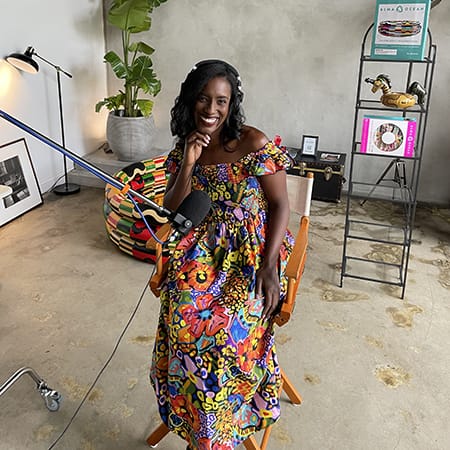
On set after a podcast interview with Amanda Seales discussing Alma Swim Foundation and Alma Ocean Danielle takes a beat.
“When we teach people how to swim, it may seem like a small thing, but it opens doors for other things,” explains Shydonna Tossie, a flight attendant and swim instructor with Alma Swim. “We’re giving people the tools to not just survive but to enjoy their lives, to take chances and go on these excursions they plan without fear.”
Danielle’s role as director involves overseeing administrative details, managing event logistics, securing funds to subsidize lessons and coordinating volunteers and swim instructors. She’s also always on the lookout for partnership opportunities.
“If I’m stuck or frustrated in life, volunteering has always helped that,” Danielle explains, adding that meeting people and connecting with the community is a bonus. “People always say they don’t have time, but you always can have at least an hour or two. You will walk away feeling that much more motivated to navigate through life.”
She often fed unhoused individuals while living in New York and had just returned home from a trash cleanup before this interview.
“Danielle is so charismatic and encouraging to people,” Shydonna emphasizes. “She wants to see everybody win.”
Alma Swim programs are based in Eatonville, FL. Not only is the town primarily made up of the target demographic, but Danielle has been welcomed with open arms by the community pool’s aquatics director, Darius Washington. Because she runs so many programs there, locals often jokingly call it “Danielle’s Spa and Resort.”
She brings people to the pool with events like April Pools Day and the World’s Largest Swim Lesson, the latter of which brought out 75 to 80 people, including the Boys and Girls Club and elementary school students. She also offered seniors lessons last summer, the oldest of whom was over 80, and water aerobics.
“Some of them were in tears trying to do this thing that they’ve been afraid of their whole lives or just didn’t have the opportunity to do. It’s incredible watching their friends get beside them and say, ‘You can do this. We’re doing this together,’” Shydonna describes.
One woman, who came with her husband of 40 years, mentioned that he’s been trying to teach her to swim since they got married. It was a celebration when, in under 30 minutes, she was gliding across the length of the pool.
“She had made sure all of her kids and grandkids could swim, but the entire time, she hadn’t been able to do it. Then she got to go show them she could,” Shydonna boasts.
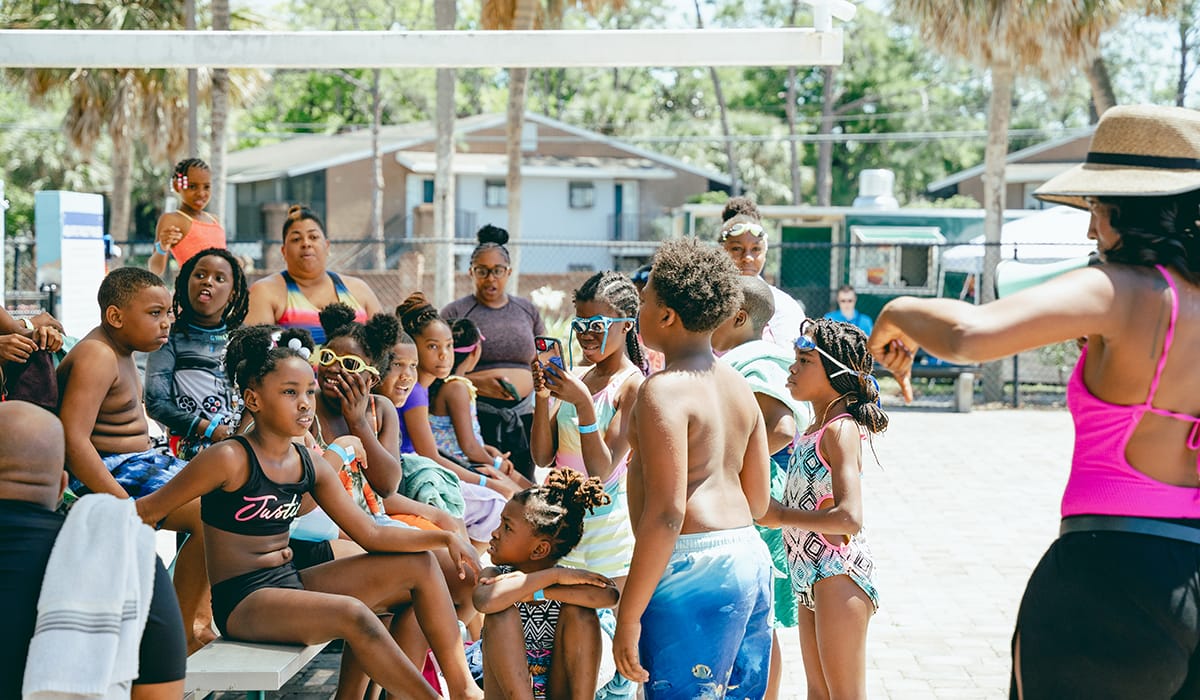
Swimmers at April Pools Day 2024 listen closely as Danielle speaks to them about their stations.
The city of Orlando has also supported the mission with grants and a proclamation for April Pools Day to be an official day for the foundation.
Looking ahead, Danielle is hopeful about expanding her reach. She recently earned her Water Safety Instructor certificate that will enable her to keep things running smoothly.
“I want to make sure that I’m good to go, in the case, like right now, I’m needed to fill in. I don’t want to miss potential students because we’re short on teachers,” she says, explaining that teachers are a mix of volunteers and paid experts.
In the meantime, she keeps things positive on social media. Instead of posting alarming drowning statistics, she highlights Black people learning, lifeguarding, surfing and generally having fun in the water. The goal is to help people past their fears and view swimming as a life skill that everyone should have.
“I hope every Black person, when they’re meeting somebody, asks if they know how to swim. Just talk about it, because we go on vacations, and we don’t know how to swim. We go to pool parties, and we don’t know how to swim,” she articulates. “I just hope that the conversation becomes more of a norm with actionable steps afterwards.”
One of her most rewarding moments of the last few years came after meeting the Howard University swim and dive team and their coaching staff in her capacity as a Rosen Aquatic Center board member. She looked out over the 20+ lanes and was struck with the rarity of what she was seeing.
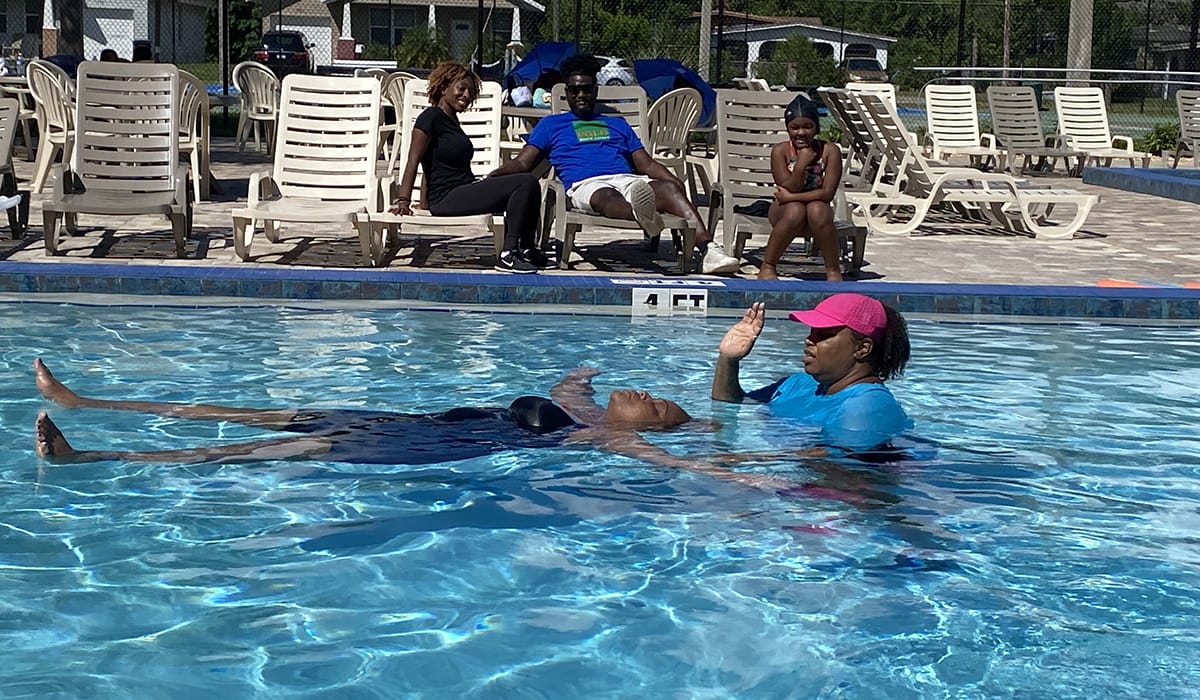
Shydonna Tossie, a flight attendant and swim instructor also known as the Chocolate Mermaid, teaches seniors to float at the Eatonville community pool.
“I just thought this is a crazy image that I’m looking at right now, because it’s the first time I’ve seen a majority Black swim team. They’re the first HBCU to have a swim team,” she says.
Two days later, after connecting with the team and telling them about her work, she facilitated a historical trip to Eatonville, one of the country’s first self-governing Black municipalities, to learn the history and to receive a key to the city.
As Danielle strives to save lives and create joy through swimming, these are the role models who will help pique interest in the sport. But she herself is making a difference in the way BIPOC individuals relate to the water. Her impact will not only be seen in the skills people learn in the pool but will be felt through future generations as those skills are passed down.
UNITING WOMEN AND GIRLS WITH DISABILITIES THROUGH SPORTS
Meet Daily Point of Light Award honoree Danelle Umstead. Danelle was recognized as a 2024 Women of Worth honoree by L’Oréal Paris. These nonprofit leaders each receive $25,000 to support their cause, mentorship from the L’Oréal Paris network and a national platform to tell their stories. Nominations for 2025 are now open through March 8, 2025. Nominate an inspirational leader today!
As a celebrated para-alpine skier, Danelle Umstead knows a thing or two about overcoming challenges.
At 13, Danelle was diagnosed with Retinitis pigmentosa, a disease that causes progressive vision loss and blindness. Her parents taught her to hide her disability, which led to a childhood of living in the shadows. By 27, Danelle had lost all her usable vision. However, this didn’t stop her from defying the odds.
Danelle discovered para-alpine skiing and went on to become a four-time Paralympian and Paralympic medalist. Off the success of her athletic career, Danelle is now on a mission to empower and unite women and girls with disabilities. She founded the Sisters in Sports Foundation, which works to give strength to other girls and women by providing them with the same empowering experiences that taught her to rise up and take hold of her potential.
Girls and women who participate in the Sisters in Sports Foundation’s efforts are given an opportunity to thrive. Whether it’s through wellness programs, grant opportunities or mentorship, participants can build connections and support. Some participants learn to hit the slopes just like Danelle did and are provided with the guidance of sports psychologists who help the athletes navigate the pressures of competition with confidence. Others participate in virtual roundtables, taking advantage of initiatives like breathwork and improv comedy that build community.
However, the participants also learn how to take their experience and use it to help others. Through mentorship programs, the girls and women are taught that the best way to tell their unique stories is by passing them on to someone else.
Danelle’s journey from a difficult childhood to 53 World Cup podiums is an incredible triumph, but her mission to pass that triumph on to the next generation is a testament to the power of volunteering.
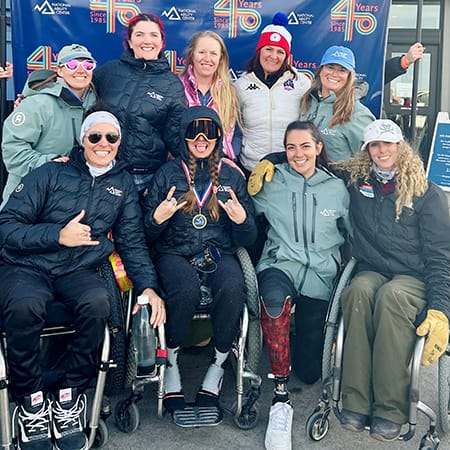
SISTERS IN SPORTS FOUNDATION ATHLETES SMILE FOR THE CAMERA AT THE NATIONAL ABILITY CENTER IN PARK CITY, UTAH. /COURTESY DANELLE UMSTEAD
Tell us about your volunteer role with the Sisters in Sports Foundation.
My day-to-day responsibilities run from one extreme to the other. From bookkeeping to mentoring to running our programs, I do it all, you name it. We have round tables, like a mental self-advocacy workshop. We just finished one last week where we brought in coaches to teach the girls about learning how to tell their stories authentically. We have breathwork round tables, positive body image workshops and mentorship workshops so that you can pay it forward. That’s the big thing. We always say that once you’re in, you’re in for life, and we hope that all the women and girls that go through our program want to pay it forward to the next generation, so that creates a movement.
What inspired you to get started with this initiative?
I was a young girl growing up with a disability and never felt like I found my space or place in life. When I was growing up, disability was not socially acceptable. Even my parents taught me to hide my disability, which is really awful looking back now. I found sports in my thirties, and when I found sports, I found a new life and new beginnings. I found the ability to believe in myself and all the great things that come from sports.
Through my experiences, I did not want any other woman or girl to feel what I did, like they were in the dark or not seen. I founded the Sisters in Sports Foundation to highlight and amplify the lives of women and girls with disabilities through the love of sports and help them achieve whatever their dreams may be, either in sports or in life. I want to ignite a new movement where girls with disabilities are seen.
What inspires you to volunteer?
I would say that the feeling I get from helping the community and seeing people’s lives change. It pushes me to help even more and makes me want to affect more lives in the same way. Just being able to make a difference is huge. Helping others is more rewarding than I ever thought was possible. Being selfless is the best thing you can do.
What are your long-term plans or goals for the organization?
Our long-term plans for the Sisters in Sports Foundation would be to help as many girls as possible. We’re not a huge organization yet, and we don’t want to bring in women and girls and not be able to help them thoroughly with the program. The greater part would be to provide that for every woman and girl with a disability, and for this to impact all lives.
What’s been the most rewarding part of your work?
I would say we’re now at a point where we can see our athletes who have been with us since the beginning wanting to pay it forward and mentor the next generation while succeeding on their own. Seeing them blossom, whether it’s telling their stories or being proud of the women they are. When we met most of these athletes or women, they didn’t know how to tell their stories. Being proud and empowered by their own story is a beautiful thing.
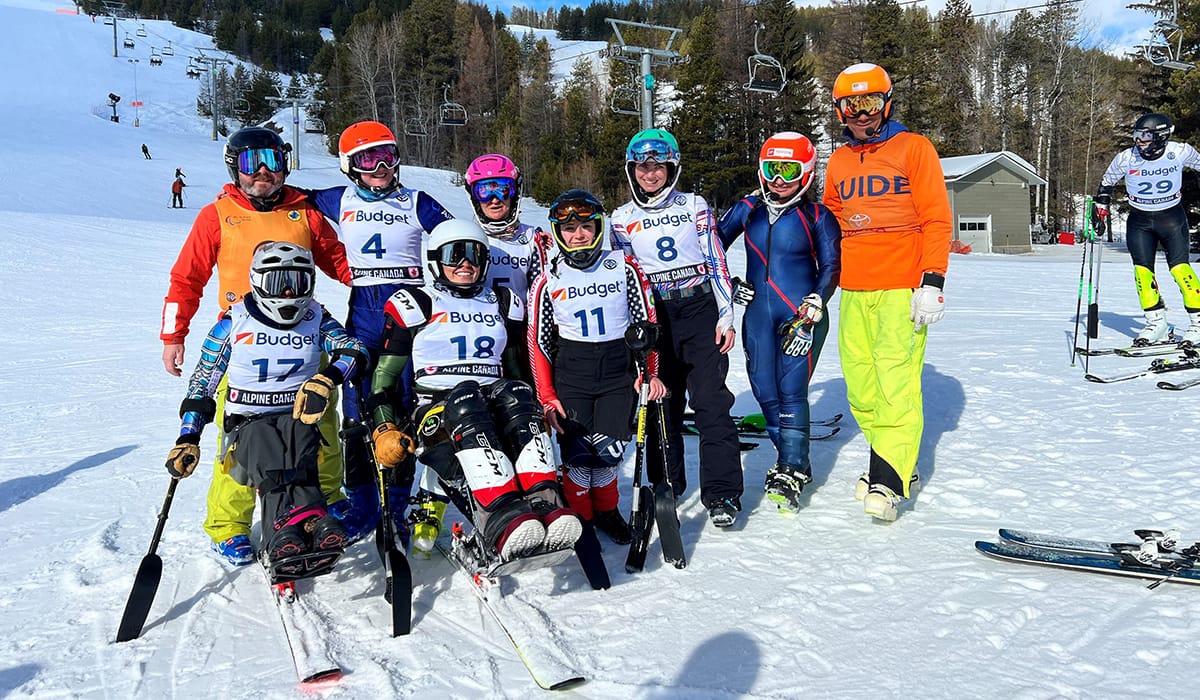
SISTERS IN SPORTS FOUNDATION FOUNDER DANELLE UMSTEAD (SECOND FROM RIGHT) IS AN PARA-ALPINE SKIER. HERE, SHE SMILES ALONGSIDE FELLOW SKIERS AT THE BASE OF A MOUNTAIN. /COURTESY DANELLE UMSTEAD
Tell us about future partnerships, programs or events that you are excited about.
We hired an amazing woman to do improv classes with the girls. We’re constantly trying to evolve in our programs. Sometimes it’s trial and error. Sometimes we’re like, oh, that didn’t go as well as we planned, and the girls are the ones who give the voice back. Sometimes it’s like, oh, my gosh, that is amazing. So yes, we have improv coming up, and then breath work will be our new journey too that’s coming up in the next couple of months. Also, the girls started their own book club. Building connection and building support, where they’re connecting and supporting one another, and just having that collaboration– that’s the most empowering thing to have.
Any advice for people who want to start volunteering?
I would just say, reach out and ask. Start talking to people and finding out what is the best match for you. Find out what would make you happy and where you can help support any foundation. I asked tons of people. I asked a lot of questions. I did a lot of research and felt the need for Sisters in Sports was there. There was nothing else out there like this for females with disabilities, so I wanted to make sure to fill that void that was out there.
You also have a full-time job. How do you balance that with being a founder and president of SIS?
I do a lot of speaking and traveling for work. You just learn to adapt like anything in life. My priorities are the foundation, my public speaking and what I do for work, so it’s kind of on equal ground to make it happen. They both bring me happiness and both bring value to my life.
Wisconsin Teen Volunteer Supports Local Community, One Meal At a Time
Meet Daily Point of Light Award honoree Wyatt Ehrhardt. Read his story, and nominate an outstanding volunteer or family as a Daily Point of Light.
Wyatt Ehrhardt is a senior on the varsity hockey team at Middleton High School and has been team captain since his junior year. Outside of his passion for sports, he is president of his school’s Key Club, a student-led service organization for high school students. Since becoming a member during his freshman year, Wyatt has led the club’s growth from 100 to 300 members and created hundreds of hours of new volunteer service opportunities.
Through his experience with Key Club, Wyatt has seen first-hand the impact volunteers can have. Together with his co-founder, Wyatt launched their student-led nonprofit, Middleton Meals Matter, an organization to address food insecurity in the local community, with a vision of creating a place where everyone has access to nutritious, wholesome meals.
Over the past seven months, Middleton Meals Matter has collected and donated over 26,000 pounds of food and raised nearly $20,000. Their goal is to instill volunteerism in the community, especially among Middleton’s youth, so they can all make meaningful change.
What inspires you to volunteer?
My grandpa was part of the local Kiwanis Club in Beaver Dam, Wisconsin. He always had several pairs of eyeglasses in his basement. As kids, my siblings and I would wear them and make funny faces. As I grew older, I began to wonder about those glasses. Eventually, I learned they were all donated to people in South American countries needing prescription eyewear. This sparked something inside me.
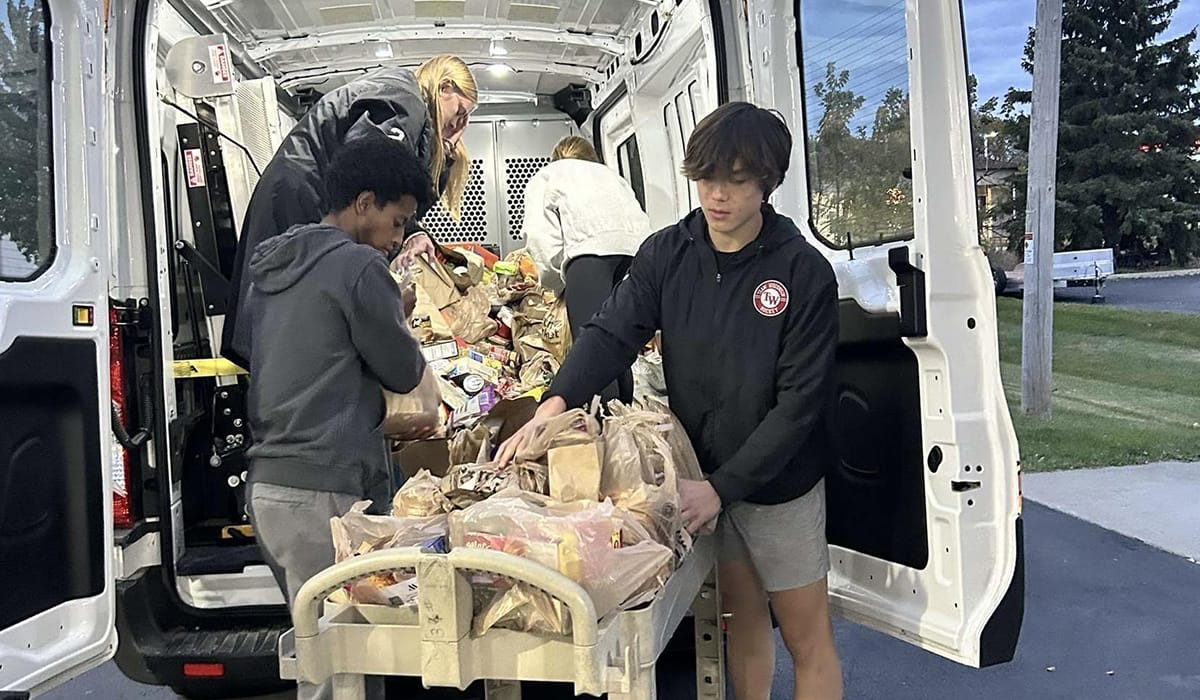
Wyatt, right, and fellow volunteers unload food donations ready for distribution./Courtesy Wyatt Ehrhardt
I immediately realized the importance of getting involved. I began collecting eyeglasses too, and still collect them to this day. During my freshman year, I began volunteering at Key Club, a student-led service organization for high school students. During this time, I volunteered at a local elementary school watching the kids play as their parents learned English. Then, in my junior year, I decided to bring the Lions Club mission to Key Club.
It’s amazing to see how we’ve created several new service opportunities for people and witnessed this change firsthand. Knowing that your service is paying off and people are being helped is a rewarding feeling.
Tell us about your volunteer role with Middleton Meals Matter.
I’m the co-founder and co-CEO of Middleton Meals Matter. I always try to find new things that Middleton Meals Matter can do to contribute to the community. One of our biggest projects is our monthly food drives. We do holiday-themed events, to get donors and volunteers engaged. For example, during Halloween, we think of creative ideas for ‘trick or treating,’ but for food. A week before Halloween night, we went around in various neighborhoods and laid out brown paper bags with slips of paper on them requesting food items that maybe people are willing to donate to the community. On the night of Halloween, we drove throughout neighborhoods and it was like Christmas morning, seeing the presents on everyone’s porch. All these people had laid out their grocery bags full of food on all their porch doorsteps.
It was a historic night. That Halloween night set a record for our biggest food drive. We raised 4,400 pounds of food.
What inspired you to get started with this initiative?
Food insecurity in our local community was discussed during a Kiwanis International meeting. I learned that Middleton has been facing significant food insecurity for the past 30 years. As a result, the Middleton Meals co-founder and I sat down with the former Mayor of Middleton and the former president of Kiwanis International to brainstorm further ways to impact our community.
At first, our goal was to solve problems on a global scale. However, they helped us realize that the problem we needed to focus on was in Middleton. This was when I discovered the best way to see the change happening firsthand and make an impact yourself. That sparked the creation of Middleton Meals Matters, which has since taken off.
What are your long-term plans or goals for the organization?
Of course, Middleton Meals Matter will continue to thrive long after I graduate. However, we have also been working on creating a new nonprofit called Meals Matter International. This organization is similar to Middleton Meals Matter but more overarching.
We want to start Meals Matter in different schools. We would share a blueprint for contacting local food drives and connecting with local grocery stores to start food drives in their local areas. From there, they could donate food to their local food pantries, and we will continue to expand this outreach.
Ultimately, we want Meals Matter to spread across the state and the country. As it expands, we hope our reach will continue to broaden as our name emerges. Every year we try to set new records that we want to break.
What’s been the most rewarding part of your work?
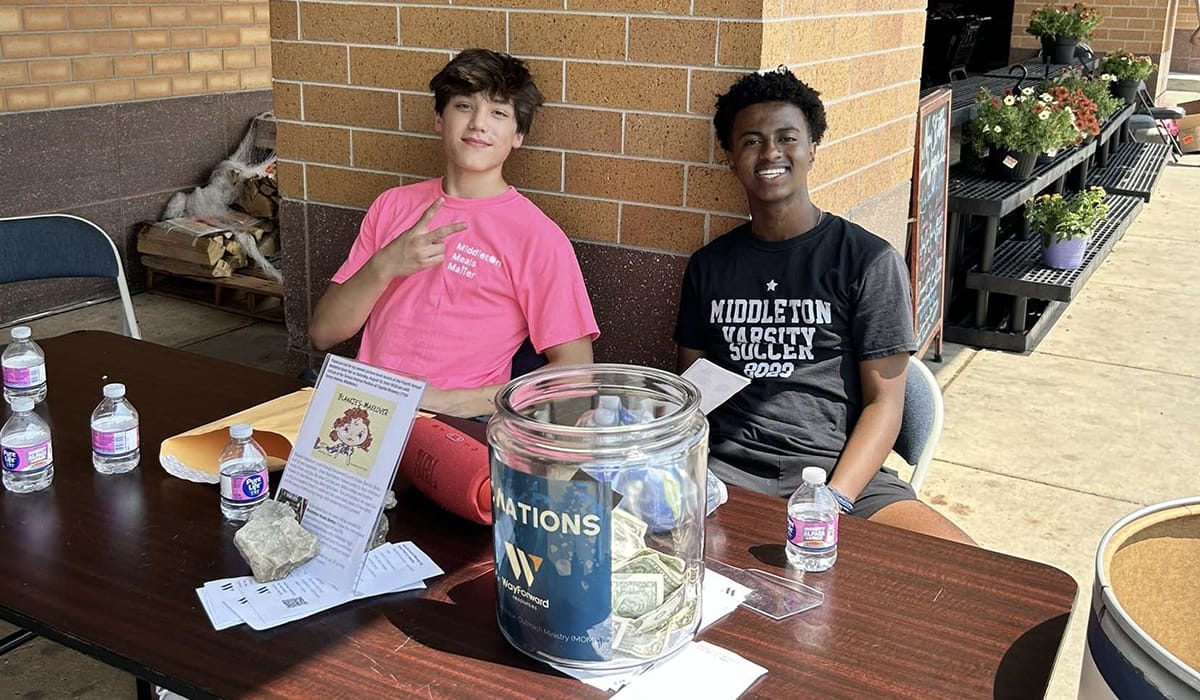
The most rewarding part is all the different food drives we host and the happy memories I get to keep from them. Customers come up, we’ll hand them the receipts, they shop for items and as they are putting items in their baskets, they kind of just have smiles on their faces. They’re looking at us, or sometimes they even compliment us on our work by saying ‘This is amazing! Thank you so much.’ And that’s just great because knowing they’re happy and donating to the community is a fulfilling feeling. Knowing that the community members are willing to get involved and that they’ll gladly do it motivates us to keep going and striving for this change.
What have you learned through your experiences as a volunteer?
I have learned a lot. As a volunteer, observing and practicing patience is fundamental. Sometimes people won’t donate. Of course, you want successful food drives, but ultimately it takes patience. You may not always have the most successful food drive, but there’s always the next one. There’s always a possibility for a great outcome.
However, the main focus is not always the physical success attained but the feeling and experience. Small actions create significant change. At first, collecting food seemed simple, but I quickly realized how small contributions can change lives. Seeing families benefit from our donations, no matter how small, has reinforced my belief in the importance of collective efforts.
Tell us about future partnerships, programs or events that you are excited about.
As mentioned, we typically hold monthly food drives at a local grocery store. Nowadays, we spend one day conducting double food drives at two locations simultaneously. Our goal for the future is to hold three food drives simultaneously within the next month or so.
For future partnerships, we’re looking to partner with other nonprofits. Expanding our reach always helps. We even organize fundraisers with other nonprofits to raise money for our cause. While our primary focus is food insecurity, we would love to help the community any other way we can.
Any advice for people who want to start volunteering?
I suggest going for it. You don’t realize how rewarding and great volunteering can be until you start. We have fun with our friends at these food drives, passing out slips and collecting food donations. Ultimately, our friends always ask when the next food drive is and how they can get involved with our organization. My advice is to just volunteer. I promise you won’t regret it.
What do you want people to learn from your story?
Small actions and small steps can create a huge impact. And many people don’t realize the extent of food insecurity in our community. Thankfully, Middleton Meals Matter has begun educating people and spreading awareness to encourage community members to take action. Anyone can do this; it’s not something you need special qualifications to do. And most importantly, you don’t need to have money. You can start at any time. Just reach out and take that leap of faith, and I promise everything will work out.
Teen Volunteer’s Mission to Open Conversation About Changing the American Prison System
Meet Daily Point of Light Award honoree Ruchi Mangtani. Read her story, and nominate an outstanding volunteer or family as a Daily Point of Light.
What would prisons look like if they were designed to rehabilitate rather than punish? That is the question Ruchi Mangtani is asking. Her initial interest in social justice and community service evolved from seeing her parents, both immigrants, struggle. Her mom’s story was particularly central to discovering her core values and desire to work in civil rights law. But her interest in alternatives to the prison system was innate and inspired her to hold book drives which led to donations of 1,000+ books to prisons in eight states.
In 2022, as participation in her work expanded, she founded JusticeBound in 2022 to encourage youth conversation about prison reform and the effectiveness of the system. She now has a team of around 20 volunteers and strong organizational partners that take on a wide variety of projects, research and educational initiatives. Both Ruchi and her organization have won multiple awards and grants, one of which took her to Norway on a prison research trip. After returning to the US, she presented her findings at a conference at Columbia University, where she plans to attend college next year.
What inspired you to get started with this initiative?
The need for prison reform was always very apparent to me. When I was around 14, I did a lot of research on the prison system, specifically during the 1970s and 80s. It was a niche interest I had. I read Are Prisons Obsolete? by Angela Davis and Discipline and Punish by Michael Foucault. That transformed the way I thought about the prison system and inspired me to go out and do something.
I started off with book drives for prisons at my high school and nearby schools. My research showed that reading—and education in general—can help reduce recidivism and was essential during the Prisoners’ Rights and Black Power movements.
Book drives are accessible and kept people interested in a way that didn’t ask too much of them. But many wanted to get more involved, which is why I ended up creating this organization, so we could all work together. I don’t see myself as the leader. Everyone works together, shares their ideas and pursues whatever is most important to them.
JusticeBound volunteers sort donated books for prisons and chat with representatives from Wisconsin Books to Prisoners and Inside Books Project.
Tell us about your volunteer role with JusticeBound.
The book drives are still what we’re most known for. We set up the box and, a week or two later, we get together to sort for what’s allowed in prisons. I often try to have speakers come or prepare some discussion questions. We donate books that aren’t allowed in prisons to local libraries who often exchange them with books that they’re not using anymore.
We also do educational workshops and international webinars with criminal justice experts. I’m close with our partners, and we love to have them speak. For instance, when I had the privilege of going on a grant-funded research trip to Norway, I made contacts who will discuss what a prison system can look like that isn’t purely punitive.
We do a lot of research and use social media to inform and call attention to important issues or innovative programs. For example, with the L.A. wildfires, many firefighters were people in juvenile hall who were able to participate in a program to become firefighters. They’ve done immensely dangerous work that we should all be grateful for.
Last year, I was also the vice-chair of membership for the Juvenile Justice & Delinquency Prevention Commission. My role was to search for people to apply for the commission, read applications and interview them as part of the membership committee. The goal was to ensure the commission is informed by a variety of voices, including those who have been through the system themselves. Additionally, I initiated a project to replace strip searching in juvenile facilities with scanning technology, inspected juvenile halls and helped create voter education curricula for systems-impacted youth.
What’s been the most rewarding part of your work?
It’s the relationships I’ve built and mentors I’ve found. I’m coming into this role from an inevitably ignorant perspective, because I haven’t been through the experience myself. When you’re in that position, you need to know when to step back. There’s a lot you don’t know, like the actual feelings and experiences that these kids are having. I’ve appreciated not just leading, but listening.
Are there any upcoming projects, partnerships or events you’re excited about?
We supported 52 youth in San Mateo County juvenile halls with Project Phoenix with $3,000 seed money awarded through a school competition. We were able to purchase hygiene products, clothes, bus passes and more to help them get back on their feet. We also worked with the organization Jobs for Youth. We’re currently partnering with them to start free workshops in juvenile hall facilities on how to apply to a job, create a resume and search for a job.
Why is it important for others to get involved with causes they care about?
In our culture, when we see a problem, we have a tendency to avoid it. The prison system is a drastic and draconian manifestation of that. We think we can just lock up the problem and it’ll just go away. This individual is “bad.” They’re morally deviant in some way and intrinsically different from those who don’t commit crimes. It only makes the problem worse when we ignore the root causes and the person’s humanity. We see it in our extremely high recidivism rates, which is why I call the system paradoxical. What is the point of the prison system if the vast majority of people released are going back a few years later?
What do you want people to learn from your story?
I hope young people aren’t deterred by restrictions. If there’s something they’re passionate about, they can find a way. They can find some small area to fit into. For me, it was book drives, and then it branched off into many amazing, beautiful things. Trust the process. You can do great things.
ADVOCATING FOR UNHOUSED PEOPLE ON AND OFF THE COURT
Meet Daily Point of Light Award honoree Sean Nguyen. Read his story, and nominate an outstanding volunteer or family as a Daily Point of Light.
Sean Nguyen knows just how hard it is to be unhoused.
Growing up, Sean watched his father struggle with homelessness for several years. By the time he hit high school, Sean was determined to make a change. A passionate tennis player, Sean decided to combine his favorite sport with his mission to help others. During his sophomore year of high school in 2017, Sean founded the Forty Love Organization, whose mission is to raise funds that are then distributed to other Kansas City organizations working to eradicate homelessness. By hosting tennis tournaments, Sean could channel the profits into groups like the Uplift Organization, which provides food, clothing and supplies to 250 to 400 unhoused individuals in Kansas City nightly. With every swing of the racquet, Sean saw the power that volunteering could have in his community.
These days, Sean is quite busy. In addition to serving as the founder of Forty Love, which requires him to plan and execute fundraisers and events, he volunteers at other organizations in Kansas City that are working to end homelessness. Sean is also a third-year medical student.
Despite his jam-packed schedule, Sean is still raring to go.
Forty Love recently established branches at New York University and Columbia University, working to empower the students to come together and take a stand against the homelessness crisis. They’ve established a national board, and younger students are establishing their own chapters of Forty Love across the country. In total, over 500 people have participated in Forty Love events and more than $10,000 has been raised for Uplift. Sean’s passion for organizing young people to make a difference shows just how strong the will to help others can be.
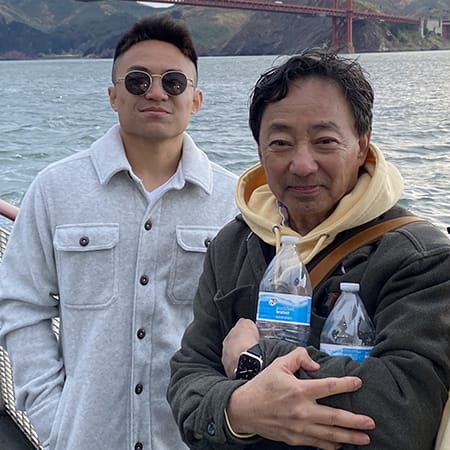
SEAN NGUYEN (LEFT) IS JOINED BY HIS FATHER, WHO EXPERIENCED HOMELESSNESS, IN FRONT OF THE GOLDEN GATE BRIDGE IN THEIR HOMETOWN OF SAN FRANCISCO. /COURTESY SEAN NGUYEN
Tell us about your volunteer role with Forty Love Organization.
It changes day by day. In the beginning, I would go out to local businesses and explain the cause. The fundraisers started as tennis. I would hold a tennis tournament and people would sign up, and all those funds or fees that people would use to book, things we auctioned off or sold, all those funds would go towards a homelessness charity. We’ve expanded into pickleball and volleyball and more, but I started with tennis just because I played a lot of tennis back in the day. I just use my voice to try to get more people to believe in the cause.
In the beginning, I did a lot of the manual work by myself, selling things like T-shirts and water bottles. As we got more traction, we started trying to delegate more to other students. As we expanded, we were able to run more tournaments. My role is coordinating between branches. We have a research division that is educating the public on the effects of homelessness on human health. We have other teams like the podcast team and the volunteering team. I devote a couple of hours every day to managing all that.
What inspired you to get started with this initiative?
I started my sophomore year of high school in 2017 when I wanted to do something in honor of my once-unhoused dad, who was unhoused for four to five years. I found this nonprofit to help those like him, using something that I love, the game of tennis. So I started running very small tournaments at my local high school and got a bunch of members who were also passionate. They were young voices like me.
We didn’t have a lot of support in the beginning, but as time went on, we ran more tournaments, did more volunteer work and got the media involved. We got a lot more people joining our team and believing in our cause. We were able to raise more money and attract more people to our events. Now we’re expanding nationally with people holding tournaments and creating their own chapters of Forty Love.
What are your long-term plans or goals for the organization?
My long-term goal is to expand our outreach nationwide and get people educated about destigmatizing homelessness, which has a negative stigma around it. A lot of people out there think that you can just get a job, but there are a lot of mental health components to that. Homelessness is a growing problem across America. We want to be able to reach those areas with the organization.
One of our recent goals is to empower younger voices, especially those who are underrepresented, and help them take a stance that they’re passionate about. Some of these younger voices who are 15 and 16 are taking an active role, taking leadership roles, forming their own chapters and actively doing things in their community with this organization. One of our goals is to not only educate and raise funds for homelessness but to also empower young voices to take part in the change.
What’s been the most rewarding part of your work?
I’d say the people that I’ve gotten to impact and those I’ve met along the way. Every time that I’ve held one of these fundraisers, the smile on people’s faces when they’re being helped is amazing. There are not a lot of events where people come together in unison. Little moments like these, where we can find a reason for the community to come together, are beautiful.
Also, when we’re able to see the direct effects of our impact, especially in the winter. I can see that our money is being used to supply these trucks with food, clothes, medicine, water and essentials. Those are the people you do it for. Every time we go into the streets, we see how grateful unhoused individuals are when they’re given supplies and necessities. It’s truly beautiful. My father was unhoused, and it was like helping my dad. It brings a light to my day.
What have you learned through your experiences as a volunteer?
And as you get deeper into the work, people start believing in your cause and it starts to get easier. But the mission that you have, the original meaning of why you came in to volunteer to do the things that you do, as long as that stays constant, then you’ll keep doing what you’re doing because you love it. The most important lesson is to always keep to your mission and hold it strong. No matter who’s behind you, you keep doing what you’re doing because you truly love it.
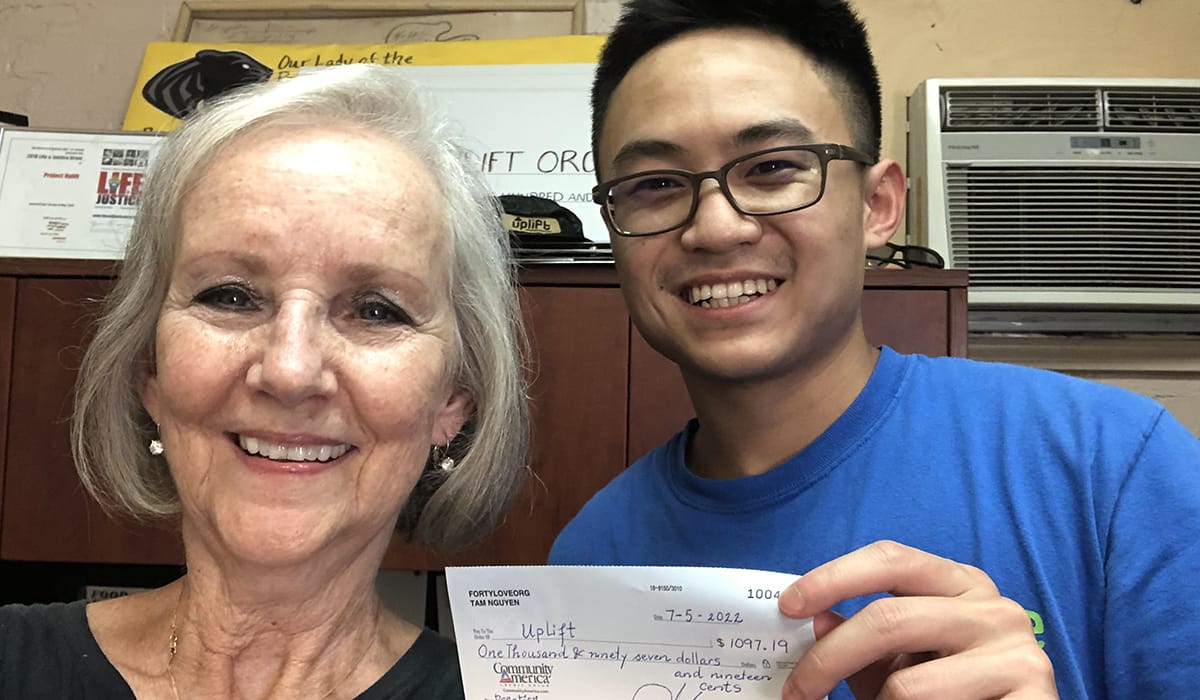
SEAN NGUYEN (RIGHT) AND KATHY, THE FORMER PRESIDENT OF UPLIFT ORGANIZATION (LEFT) CELEBRATE A SUCCESSFUL FUNDRAISER. /COURTESY SEAN NGUYEN
Why is it important for others to get involved with causes they care about?
Young voices standing up, taking a stance and doing something they’re passionate about shape them for their entire life. It shapes the whole community. Change starts with the young, in my opinion. Not only does that help form their character, but it also builds leadership skills and affects other parts of their life. Every time I volunteer, I feel that I’m more empathetic. I feel more fulfilled in other parts of my life. Helping these young voices have leadership skills is equally important, because as they apply to jobs when they’re older, having leadership skills is super important. The best way to do that is by helping others. That’s the most fulfilling way to go about life.
Any advice for people who want to start volunteering?
Find your why. Any volunteering is very good. But finding your why is the reason why people don’t stop volunteering. I feel like I did find my why early in my sophomore year of high school. Even earlier than that, I remember my dad would take me to volunteer at local charities, even when I was 7 or 8 years old. Think about why you’re doing this, and how you can continue doing it. That’s how you don’t get burnt out and how you’ll keep expanding and continuing your work.
What do you want people to learn from your story?
I think I want them to learn that young voices can do anything, as long as they put in the hard work and you’re not afraid of how many people stand with you or against you. I believe that you can do anything no matter what age you are. If you’re willing to put in the work, and you have a clear vision, you can inspire change. Everybody starts at different levels, but if you have what it takes there are no limits.
FEEDING BELLIES, MINDS AND HEARTS IN MARGINALIZED COMMUNITIES
Meet Daily Point of Light Award honoree Aarush Sudamalla. Read his story, and nominate an outstanding volunteer or family as a Daily Point of Light.
Aarush Sudamalla will never let his age be an obstacle to helping others.
A 16-year-old high school student, Aarush first experienced the satisfaction of helping others through his work feeding unhoused people. Inspired by his father, who avidly helped the community, Aarush wanted to take his dad’s vision even further. He formed his own nonprofit organization, Give with Love (GWL), at age 14, working to hand out boxed meals on the street and serve up plates to hungry people at his local shelter.
His accomplishments were noticed by Sussex Health and Environmental Network (SHEN), a local organization that works to create positive solutions to environmental and public health issues. Through GWL and his involvement with SHEN, Aarush works to empower marginalized communities through events and grants. He also handles an extensive amount of networking, reaching out to people at school and connecting with local organizations to spread awareness of GWL’s work. He, along with his GWL volunteers, can frequently be found serving up meals to the community members or searching for grant funding to bolster the residents of communities SHEN assists through education and sustainable solutions.
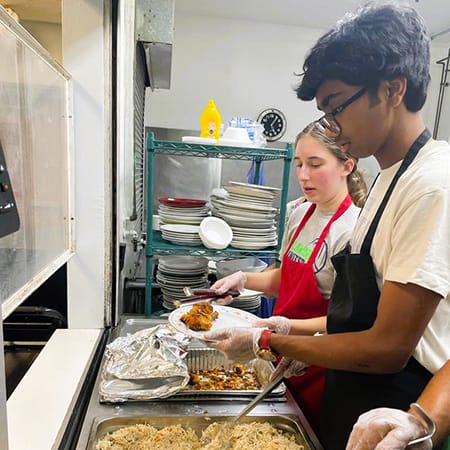
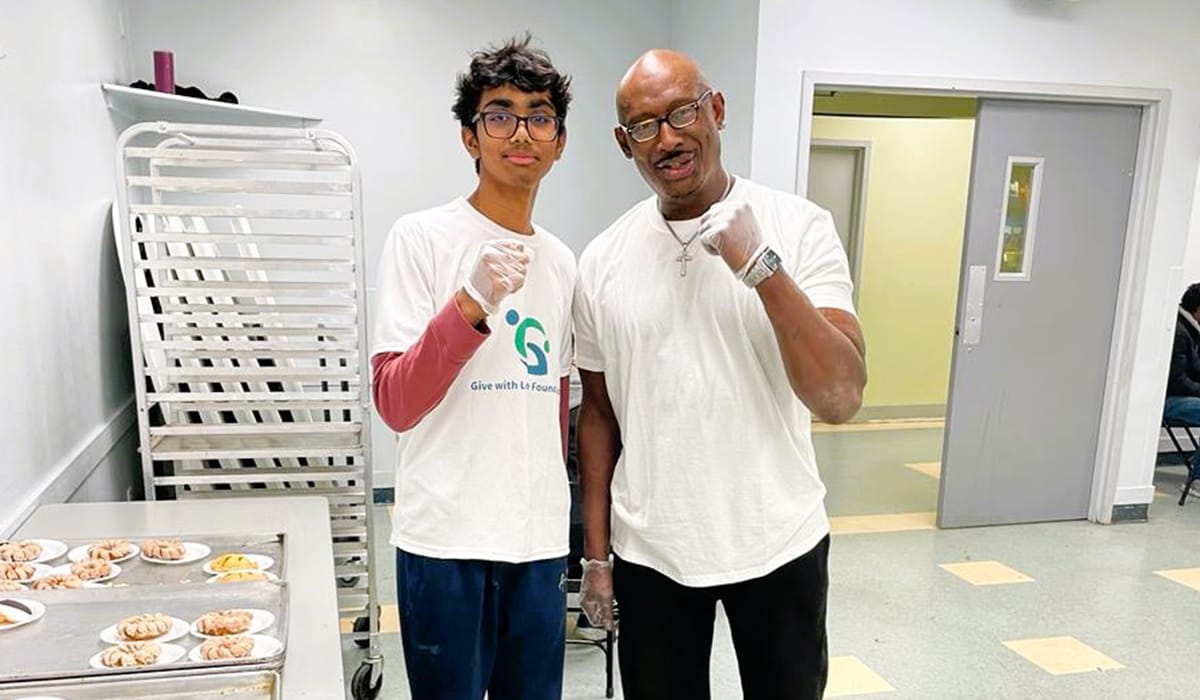
AARUSH SUDAMALLA SERVES RICE AND CHICKEN ALONGSIDE OTHER VOLUNTEERS AT THE SUNDAY BREAKFAST MISSION. /COURTESY AARUSH SUDAMALLA
While it’s a tremendous amount of work for a high school student, Aarush says his hectic schedule all comes down to time management. While he admits he’s no stranger to sleepless nights, the fulfillment he feels at the end of the day is worth all the stress.
“The most rewarding part for me is seeing how much of an impact I can create just being a 16-year-old. It just makes my heart all warm and fuzzy. I’m helping people out there. I’m making a difference. I’m doing as much as I can,” says Aarush. “I would say that’s probably my biggest takeaway.”
One of Aarush’s greatest triumphs with GWL in collaboration with SHEN was his mission to reach out to a linguistically isolated community of 275 residents to notify them about the proposal to construct a biogas facility nearby. As a result of his outreach in the area, there was a Title VI complaint to the Environmental Protection Agency for violating their civil rights. This ensured all notices to the residents were published in Haitian Creole and Spanish, which they could then understand.
“This was a big deal. He probably lives a good 90 minutes from this area,” recalled Maria Payan, executive director of SHEN. “It was a big deal for him to get transportation out and back. They cooked amazing, healthy food for all these folks and talked to all of the residents there.”
Aarush’s hopes for the future are extensive. He’s eager to expand his volunteer work beyond the boundaries of Delaware, working to assist people with food and environmental justice initiatives across the world. He also has significant personal goals for life after high school, including aspirations to pursue a career in medicine.
AARUSH SUDAMALLA (LEFT) MUGS FOR THE CAMERA ALONGSIDE QUINCY, A FELLOW VOLUNTEER AT THE SUNDAY BREAKFAST MISSION. /COURTESY AARUSH SUDAMALLA
“He’s just an amazing young man,” Payan continued. “He just really has a passion for connecting with people, especially those that are underserved.”
While Aarush is still a teenager, his ability to create change through volunteering is an inspiration to people young and old. Through his passion for helping others, Aarush has made the world a better place for all.
Global Perspective Fuels Student’s Volunteer Mission for Educational Equality
Meet Daily Point of Light Award honoree Oorja Munot. Read her story, and nominate an outstanding volunteer or family as a Daily Point of Light.
Due to her dad’s job and his desire to raise kids with a global perspective, Oorja Munot grew up in Belgium, India and the US. Now a high school junior, her international experience has left her with the ability to speak multiple languages—French, Marwari, English, Hindi and Marathi. Her journey has shaped her personality, her plans for the future and even her leisure activities. She takes classical Indian singing lessons and often has her nose in an Adam Grant book when she’s not spending time with friends. It also showed her that when it comes to learning, not everyone is getting an even start—an injustice that led her to create Equality Through Education (ETE) as a freshman.
In under two years, the organization has torn down barriers to education by building 20 Smart Classrooms in partner schools, providing 2,000+ Essential Kits to students learning English and developing an offline app offering more than 500 volunteer-made presentations and life skills resources with $15,000 they’ve raised. Oorja has helped establish 35+ chapters and partner schools around the world while attracting 1000+ volunteers. If learning is a privilege, Oorja insists it be one that everyone has.
What inspired you to build Equality Through Education?
Growing up in multiple countries gave me exposure to various types of education and ways that people learn. It also showed me that resources are not equal everywhere. Privilege has an upper hand over a student’s merit.
I founded ETE in 2023, but I’d thought about it for a year before that. I attend a magnet high school, and when I applied, I used an essay I wrote about ETE. Originally, I named it Montgomery County Equality Through Education, or MoCo ETE, but within a couple of months, it was very clear that this could be bigger. So, I dropped MoCo from the name.
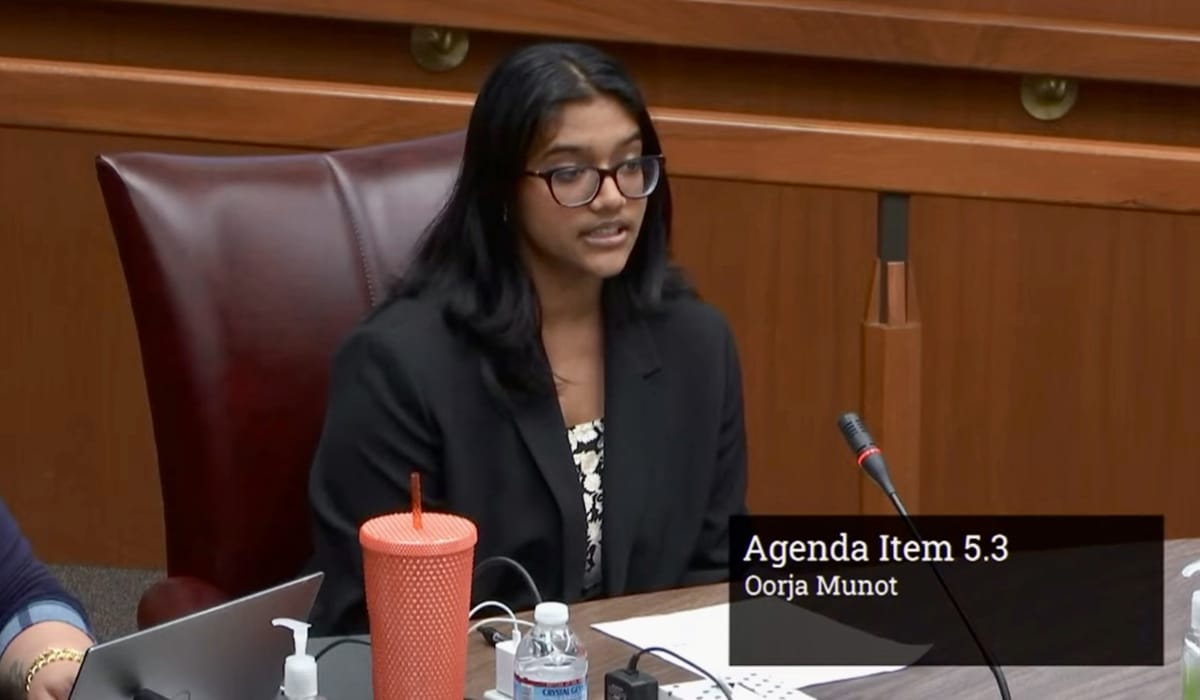
Oorja delivers testimony to the Montgomery County Board of Education to bridge the gap between students’ standardized testing scores at various high schools.
Tell us about your volunteer role.
As CEO, I lead my executive board team, engage in outreach and fundraising, ensure projects are impactful on the community we aim to serve and provide long-term strategic planning. This is something I want to do beyond high school, so I’m making sure we’re sustainable.
My day-to-day involves a lot of team meetings about initiatives and, every few months, how we can improve them based on feedback we receive. I also develop partnerships and oversee all of our departments.
I’ve connected with many international nonprofits focused on the same thing. We don’t have to reinvent the wheel. There’s a lot of great work already being done, and it’s important to build off that or build together.
Several months ago, I led a sub-group of 75 people called the Menstrual Equity Education Coalition that developed a five-unit, doctor-certified curriculum on menstrual hygiene and menstrual health. Many schools in, for example, India don’t have this kind of curriculum.
We had to ensure it was culturally sensitive before implementing it in schools, because many of the areas we were targeting aren’t very open to this stigmatized conversation. That’s part of the narrative we’re trying to change. We also had it translated into five languages.
What are Essentials Kits?
The Essential Kits are personalized kits mostly aimed towards elementary and early middle school students in the US who don’t speak English as their first language. When I moved, it was fairly easy, because I’d been learning English in India and Belgium. But a lot of people don’t have that experience.
We include language games and charts, basic school supplies and motivational cards. Sometimes, we put in a printed version of online resources. It’s also really helpful for parents. When they walk in the International Admissions Office to register a student in Montgomery County, they can grab one.
What was it like to expand globally, and what have you learned along the way?
Initially, I did everything and didn’t feel the need for a team. But I realized that when you want to make a big impact, collective effort goes a long way. I also discovered a lot of gratitude and enjoyment finding people who shared my vision.
I recently talked about team development at a conference hosted by a group that serves as an incubator for student leaders called Youth Creating Change. I graduated from their program. They taught me about three things you need to grow your project—fundraising, outreach and a solid vision and mission. You need a strong sense of purpose and community when doing this kind of work. That’s how you grow and push yourself to dream bigger.
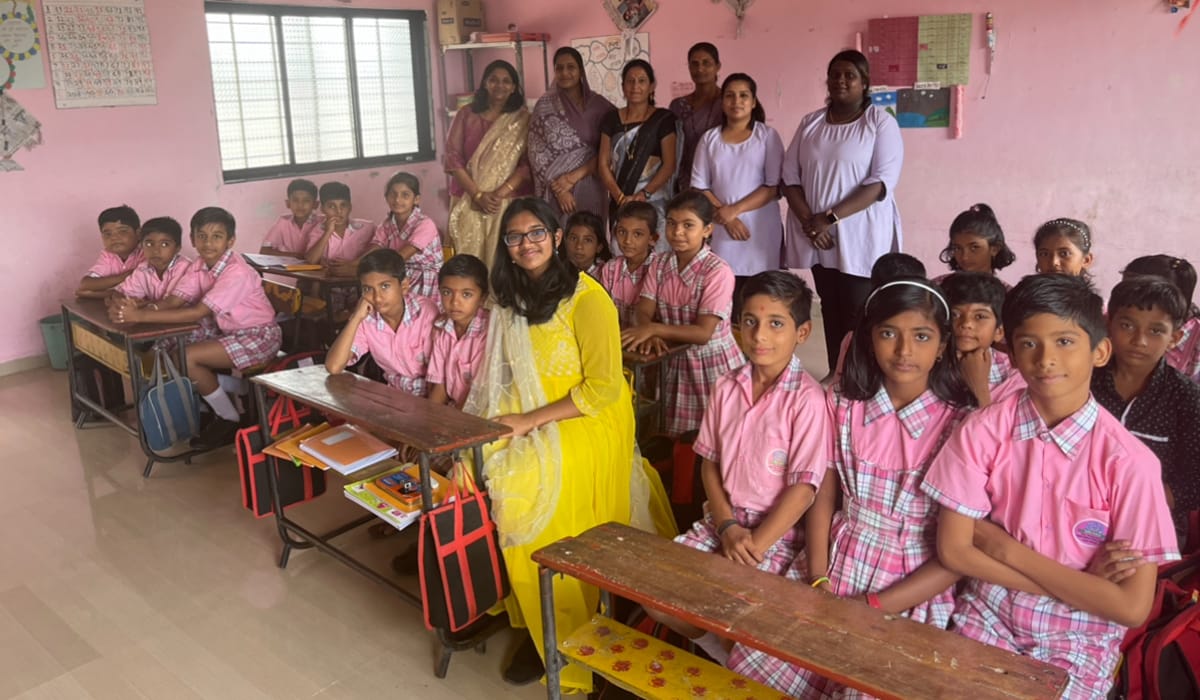
Founder and CEO of Equality Through Education, Oorja Munot (in yellow), visits a partner school.
Tell us about future partnerships, programs or events that you are excited about.
We’re on week two of a six-week program called Advocacy Academy. A big thing that I missed out on early in my own journey was learning how to advocate for myself, and that’s the goal of this program. We want to give these students the essential skills they need, like leadership and communication, and embolden them to bring their own impact to the world.
What can people do in their own area to contribute to education equality?
First, empower yourself, and then find a small problem that could be solved. For example, when I was first starting out, I noticed that the AP and IB exams in our county were very expensive, especially the associated books. So, I went to the Montgomery County Board of Education and gave testimony advocating for free AP and IB exam books for all students.
That didn’t end up happening, but they made exams free. Start small; it can make a big difference. And collaborate with other people and organizations.
What do you want people to learn from your story?
There’s no perfect time to start making a difference. You can be a middle schooler or a senior. No one has a roadmap to success, not even for nonprofit work. You have to take the first step on your own. After that, there are a lot of people to help you. Don’t be afraid. Most of the time, it’ll turn into something bigger than you could have ever imagined.
Providing a Lifeline of Escape for Domestic Violence Survivors
Meet Daily Point of Light Award honoree Laura Pahules. Laura was recognized as a 2024 Women of Worth honoree by L’Oréal Paris. These nonprofit leaders each receive $25,000 to support their cause, mentorship from the L’Oréal Paris network and a national platform to tell their stories. Nominations for 2025 are now open through March 8, 2025. Nominate an inspirational leader today!
Content Warning: Points of Light is proud to share the following uplifting and inspiring story. However, we acknowledge that portions of this story mention domestic violence and may be difficult for some readers. We encourage you to please care for your own well-being above all.
Laura Pahules is on a mission to break the cycle of domestic violence by providing immediate, life-saving assistance to survivors in crisis. As the founder and president of Control Alt Delete, a nonprofit dedicated to empowering individuals escaping abusive situations, Laura ensures that those in danger have the resources they need to start over safely. Inspired by her own journey as a survivor, she recognized the urgent gaps in crisis response and took action, creating a support system that prioritizes immediate intervention.
Under Laura’s leadership, Control Alt Delete has expanded its reach and impact, now facilitating an average of 50 life-saving escapes every single day. By providing essentials such as transportation, emergency shelter and personal safety resources, the organization has assisted thousands of individuals in their journey toward independence. What sets Laura’s work apart is the sense of urgency—help is provided exactly when it’s needed, ensuring survivors don’t have to wait for bureaucratic processes to secure their safety.
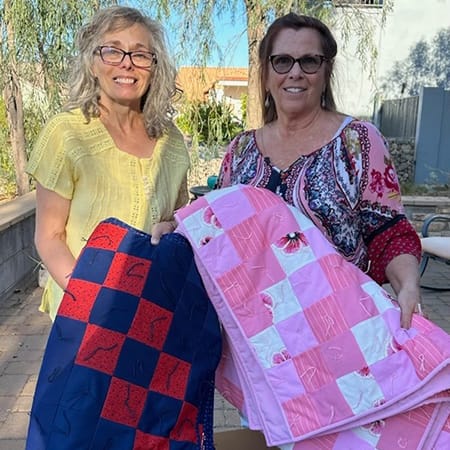
Laura Pahules with a volunteer who donates quilts./Courtesy Laura Pahules
Laura’s background in technology and nonprofit work has been instrumental in streamlining crisis response. She has created an efficient, resource-driven organization that operates swiftly and effectively, collaborating with shelters, law enforcement and advocacy groups to provide rapid assistance. Her tech-savvy approach has also helped raise awareness and increase funding, allowing Control Alt Delete to expand its services to more communities.
Beyond logistics, Laura’s work is deeply personal. She knows firsthand the fear, uncertainty and isolation that survivors face, which is why she is committed to bringing hope to those who need it. By turning her personal struggles into a force for good, she has given countless individuals the opportunity to reclaim their lives.
Tell us about your volunteer role.
I founded the organization in September of 2019, because I noticed there was no agency helping someone trying to escape domestic violence in their immediate time of need, other than the police, whose funding is often tied to geographical constraints. I wanted to be able to help. I’ve worked in the nonprofit field for years and knew that I wanted this to be a volunteer position, with the largest impact I could have.
On a day-to-day basis, I process every escape that comes in. On average, we facilitate about 50 escapes every day, although we get about 300 requests a day. About 50 of them fall within the scope of our mission, which is referral based – meaning a request comes in from the police, prosecutor’s office, crisis response teams and victim advocates. We’re one-time assistance only, so we verify name and date of birth. Then, using some of my technology and some of the world’s technology, we can facilitate the escape in less than a minute.
Most times, a survivor needs to leave right away. This is why we have a referral process. A lot of times, for instance, a mom can’t just put her kids in a car and leave. There are legalities around that. So the referral process ensures that certain steps have been taken and they can safely leave, within minutes of our getting that information.
Right now, the key for us is Arizona, where we’re based. These survivors are either in Arizona, are staying in Arizona to escape their abuser or are coming to Arizona, from another state, to reach safety. As funding increases, that demographic may change.
We have what we call “mega escape days.” We have one coming up – one of the largest escape days that exist, which is the Superbowl. We go from 50 escapes per day to hundreds of escapes that day. Anytime there are holidays, celebration days or large sporting events, there’s always a spike in the request for help from domestic violence. I encourage people to be aware of this in their own communities. If you see something, say something. Don’t knock on the door; call the police. Ask for help.
Can you tell us a bit about your personal journey with surviving domestic violence?
I grew up in an abusive household, full of domestic violence. At a young age, I married an abuser because that was the life I know. I didn’t realize there could be life outside of abuse. It wasn’t until I had children and they were a couple years old that I realized I didn’t want my kids living in fear and walking on eggshells, and all the other things that come with living in an abusive home. That led me to escape my abuser. That’s the very simplified version of what happened.
It took me many years afterward to heal and find that I could be independent and find happiness in life. And it took a lot of volunteer work too, because I realized one of the best things I could do for myself in healing and recovery was volunteer work, as well as having my kids volunteer too.
Then in 2010, I started working in the nonprofit field, and saw a lot of things I liked about nonprofits and a lot of things I didn’t like. When I set out to create my own organization, I used that knowledge base to create Control Alt Delete, which is 100% volunteer-run, with no state of federal funding at all and saving lives every single day.
What’s been the most rewarding part of your work?
Honestly, it’s being able to facilitate these escapes and knowing that we’re integral to survivors’ safety. We just hit our five year anniversary in September. Since our founding, we’ve facilitated 38,717 escapes from domestic violence, and that includes 74,232 children. Domestic violence impacts so many people. National statistics say 1 in 4 women and 1 in 7 men are affected by domestic violence. Someone you know is being abused and needs help escaping. And that’s what we do.
Laura and a volunteer loading a truck to help a survivor move./Courtesy Laura Pahules
Why is it important for others to get involved with causes they care about?
Everybody can make a difference. When you identify an issue that’s happening in your community, remember that it doesn’t have to be a big, coordinated effort to fix that problem. Just take the first step to do it. The reward of knowing, I’m changing our community, I’m getting people to safety, is unparalleled. It’s such a good feeling.
Any advice for people who want to start volunteering?
There are always agencies that need help with volunteering. Find what resonates with you – that’s the most important thing. If a cause doesn’t resonate with you, you’re not going to be the best volunteer for that agency. There are nonprofits to address nearly every issue out there.
In all the different nonprofits I’ve worked with over the years, there are always ways for volunteers to get involved. The time commitment can be a half hour a month. It can be whatever you can give. It doesn’t have to be a huge effort to make a difference.
What do you want people to learn from your story?
There is life after abuse, and it is beautiful. I knew there was a need for Control Alt Delete; I just didn’t realize how great that need was going to be.
The impact of domestic violence is touching everyone in our community’s life. There are ways we can help fix that.