Turning Pages, Changing Lives: A Multi-Year Book Drive’s Impact
Meet Daily Point of Light Award honoree Anushka Godambe. Read her story, and nominate an outstanding volunteer or family as a Daily Point of Light.
Since 2019, Anushka Godambe has been on a mission to bring the joy of reading to underserved communities through an ongoing book drive partnership with BookSpring, a Texas-based nonprofit dedicated to promoting literacy. What began as a modest goal of collecting 100 books has blossomed into a monumental effort, resulting in the donation of over 50,000 books to build home libraries for low-income students. Anushka’s remarkable commitment to literacy has earned her recognition across Austin, Texas, and inspired countless individuals to contribute to this meaningful cause.
Anushka’s book drive has not only grown in scale but also in its ability to adapt to challenges. During the COVID-19 pandemic, when her local library ceased accepting community donations, Anushka took the initiative to redirect those donations to her drive. She partnered with the library and expanded her efforts to include schools, bookstores and neighborhood groups – ensuring a steady stream of books for BookSpring’s Re-Book program. Her innovative approach created a network of support that allowed her to reach thousands of children.
Dedication has been a cornerstone of Anushka’s volunteerism. While balancing her responsibilities as a high school student, she committed two hours each week to collect, sort and pack books for donation. By providing students with access to books, she is fostering a lifelong love of reading and supporting educational equity. Her book drive has brought hope and opportunity to countless children.
Even now, as she attends Stanford University, Anushka is continuing her book drive, ensuring that her passion for literacy and service endures. Read on to find out more about how she’s changing lives, one book at a time.
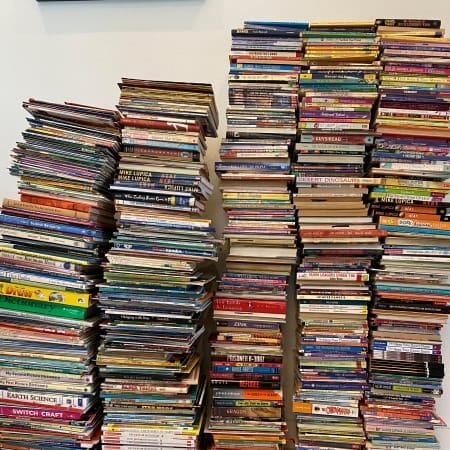
A stack of books, donated through Anushka’s book drive via BookSpring, awaits future owners.
Tell us about your volunteer role.
I began volunteering in June 2019 with BookSpring, a nonprofit in Austin, Texas. I specifically started a book drive in partnership with BookSpring as part of their Re-Book program. That’s a branch of the organization that accepts gently used books from around the community to give kids in low-income districts. They let these students “shop” for these books, letting them pick out the books they want and take them home. Essentially, the purpose is to provide underserved kids with enough books to build their own home libraries, promoting more reading at home.
What inspired you to get started with this initiative?
I started within about a year of moving to Austin. I’m originally from California and I wanted to get to know the new place I was living in a bit better. I was already conducting a book drive in California when I saw a flyer for BookSpring, and I decided to reach out to them. I wanted to continue my service work as well as get involved in my new community. I asked if they did book drives, and they said yes.
I went from there. Over the years, I started partnering with local schools, teachers, book stores and libraries to collect donations and scale the book drive. I recently surpassed 50,000 donated books, so the drive has come a long way.
Tell us a bit about the process of procuring the books.
A lot of them come from local neighborhoods. I joined local neighborhood groups to get the word out about the book drives. I noticed that during certain seasons, notably the spring and summer, people are cleaning out their homes and especially their book collections. That’s when a lot of donations come in from members of the local community.
I would give them my address and they would drop off the books to my house. Then, when I started driving in tenth grade, I started driving around Austin to collect book donations as well. My first goal was to get 100 books, which took me about a month to do through word of mouth. But I started gaining greater numbers of donations when I started partnering with local organizations.
I partnered with a local library when, during COVID, they stopped taking donations from the community. Members would donate their books to the library, but once the library stopped accepting them, I reached out and asked, ‘Would you mind deferring those donations to the book drive?’ I wanted those books to still go to a good cause and give library members the option to donate. Not only did the library agree to this, but they promoted my book drive. And that summer, I gained 2,000 donated books. That’s when I realized the power of reaching out to organizations to get the word out.
What are your long-term plans or goals with the book drive as you attend school?
I’ve decided that I absolutely still want to continue doing the book drive. I’m home a lot during holiday breaks. While at school, I’m still coordinating with community members. I ask them if they would mind holding onto the books until I come home. They’re happy to oblige! Now, every holiday break when I’m home, I have a list of people and organizations to pick up books from.
What’s been the most rewarding part of your work?
Seeing the power of perseverance. Especially during dry periods when books wouldn’t come in as often, I started losing motivation, asking myself if I’ve collected all the books I possibly could from the Austin area. But I knew it was really meaningful work, and with patience and waiting for more long-term impact, I saw more results. In times I’ve asked myself, ‘Should I end this drive?’ I’ve chosen to continue it, and I’ve seen the power of that perseverance.
More importantly, watching the impact that these books have made on the students has been immensely rewarding. I’ve received donations in different languages and from different cultures, which is wonderful for the bilingual students who now get to read books in, say, Spanish and English. The increased diversity in book donations has been really cool to see.
Any advice for people who want to start volunteering?
I would recommend creating a small goal that you’re comfortable with, and try to attain that goal first. Again, my first goal was 100 books. I’d just moved to Austin. I had no idea who I’d reach out to. So my first goal felt more attainable. That goal would allow me to ask my neighbors, get to know them better, ask my friends at school. Start with a small goal, and then slowly expand the goal. You’ll slowly increase your confidence as well. You don’t have to create an exceptional goal from the beginning – as your confidence grows, expand the goal.
What do you want people to learn from your story?
I’d like people to know the power of courage and perseverance. Putting yourself out there can be very scary. I was in eighth grade when I was reaching out to these organizations, thinking, would they ghost me? Would they respond? Would they even care? The thing is, you have nothing to lose by asking. You can only help out your community and gain more self-confidence along the way. Just start.
WHEN HELP IS NEEDED, TEEN VOLUNTEER IS READY TO LEND A HAND
Meet Daily Point of Light Award honoree Maelyn Garcia. Read her story, and nominate an outstanding volunteer or family as a Daily Point of Light.
Maelyn Garcia may only be 16 years old, but her passion for service started even earlier.
As a young child, Maelyn learned how much need for assistance there was in her community. By the time she entered high school, she was ready to devote her free time to helping others. She got involved with SaLT (Service and Learning Together), a student-driven, adult-supported organization that addresses food insecurity and migrant needs. On Saturday mornings, Maelyn helped with SaLT’s Shop N’ Drop program, which provides groceries and personal items to over 100 families dealing with food insecurity. From the beginning, she loved her involvement. Just a couple of years later, Maelyn is leading the charge. Fluent in Spanish, her ability to communicate seamlessly with migrant families is an example of leading with compassion.
Maelyn has taken on a leadership role with SaLT’s Take Care Initiative, which began as a mission to help migrants in the Chicago area. Since then, the program has expanded tremendously and is currently working to assist firefighters battling the Los Angeles-area wildfires. Each package that’s distributed is filled with self-care items and notes of compassion, sharing a message of support and solidarity to the recipient. With each note Maelyn writes, her passion for being of service touches the life of someone new.
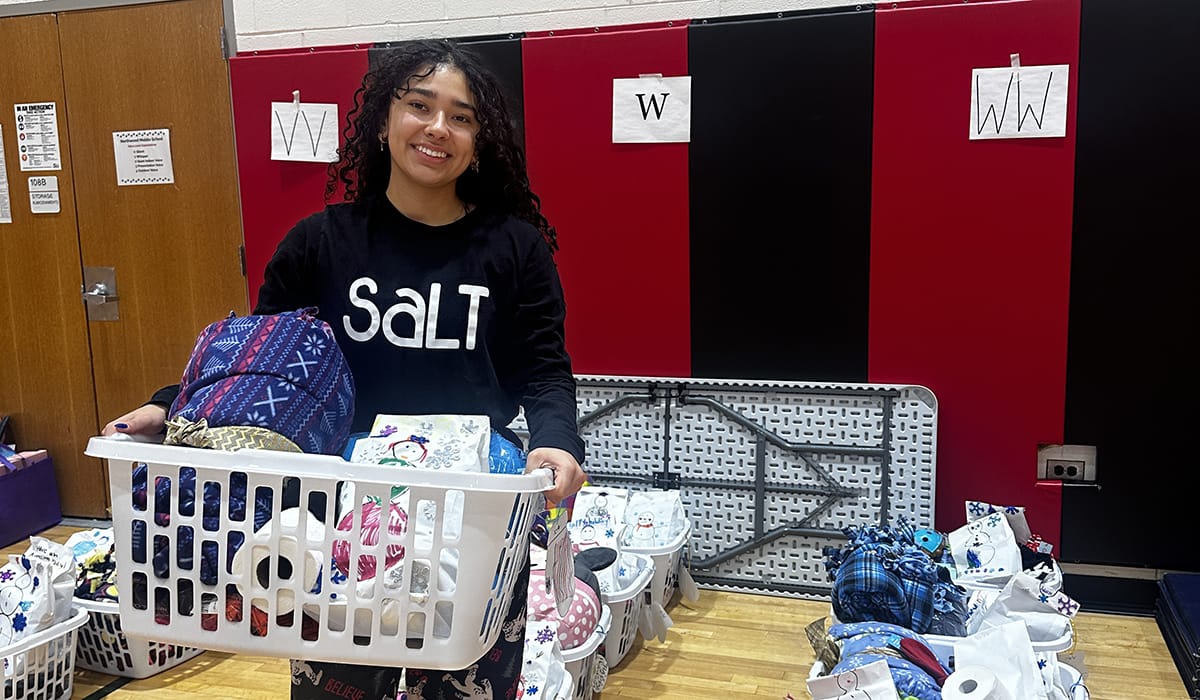
MAELYN GARCIA TOTES A LAUNDRY BASKET OF WINTER ESSENTIALS FOR LOCAL FAMILIES ON THE 2024 DAY OF GIVING. /COURTESY MAELYN GARCIA
Tell us about your volunteer role with SaLT.
Our main project is Shop N’ Drop, which we’ve been doing since the start of COVID-19 in 2020. Every two or three weeks, we’ll get together on a Saturday morning and prepare grocery, toiletry and snack bags full of things that families who fight food insecurity need and aren’t able to provide for their children. The mission started with families who couldn’t get the food they would usually receive that was provided by the schools before COVID-19 began. Since kids wouldn’t be going to school, families reached out. The Shop N’ Drop program began so we would be able to give food to those families.
What inspires you to volunteer?
Building the connection with families and seeing that they keep coming back. We have such a personal connection with our families. We have their phone numbers. They text us daily with things that they need. They know they can come to us for support and they know they can tell us what they need if they’re having a tough situation. They are always so grateful. They send blessings to us every week because they’re just so grateful for everything we do, and that just makes me happy to keep coming back and giving my time.
What’s been the most rewarding part of your work?
It’s moments where people show their gratitude. When I was in New Orleans for a SaLT trip, there was this man whose house was affected by hurricanes and natural disasters. He was so grateful. The look on his face when he told us how our work restoring his house made such a difference was so touching. He was just really grateful, and it’s people like that who show their gratitude who make my day.
What have you learned through your experiences as a volunteer?
I think I’ve learned that it takes time to see a big change, but little by little, you will eventually see that change – even if it doesn’t feel like it at the time. If you take a step back and look at what you’ve done, there is a change there.
Why is it important for others to get involved with causes they care about?
I know it’s scary to begin, even if you go to volunteer one day and you don’t know anyone there. But you will always make a connection with someone there. It doesn’t matter whether you know someone with whom you’re volunteering, because you know that you’re helping the people around you. After a day of service, I usually get the feeling I just want to come back, and that feeling is really great.
MAELYN GARCIA VOLUNTEERS IN NEW ORLEANS DURING A SaLT TRIP, HELPING TO RESTORE HOUSES DAMAGED IN RECENT HURRICANES. /COURTESY MAELYN GARCIA
As a busy high school student, how do you manage to balance your studies with your volunteer work?
It’s definitely time-consuming, but there’s a point where you understand that you have to prioritize your homework and your service work. You find a balance, because it’s more stressful to overload yourself with everything. When you prioritize different things, you understand how much you can take on. Even if you’re doing service once a week, you’re still putting in service. And even if you have to minimize the time you put into service and prioritize other things, your service is still there.
Any advice for people who want to start volunteering?
Jump at the chance. Even if it’s the most simple task, there are always organizations that need it. By doing one thing, you’ll most likely find out other opportunities and events that you can go to. Jumping at anything you can do will always open more doors.
What do you want people to learn from your story?
It doesn’t matter what age you are. People of any age can learn that service is important and there are ways that they can help. We’re always involved in the local elementary schools. For instance, they’ll make drawings for the families we have to help. At any age, there’s always something you can do to help.
Throwing Lifelines of Hope to Those Seeking a Fresh Start
Meet Daily Point of Light Award honoree Babita Jagnanan. Read her story, and nominate an outstanding volunteer or family as a Daily Point of Light.
Babita Jagnanan is an excellent example of taking selflessness and determination to new levels in the nonprofit world. Dedicated to improving lives and uplifting communities, Babita founded Phoenix Family Resources, a nonprofit resource center providing meals, clothing and critical support to individuals looking for a fresh start – whether they’re moving out of homelessness, navigating recovery, detox and treatment programs or facing stigma in society.
With 85% of textiles going to landfill, Phoenix Family Resources is committed to putting gently used items to good use for underserved populations in particular. With her efforts, Babita not only addresses immediate needs through helping provide tangible resources, but also offers dignity and hope to those in crisis, ensuring they feel valued and supported on their journey to healing.
Phoenix Family Resources has become a sanctuary for thousands, creating a sense of belonging and community for those who often feel marginalized. Babita’s work extends beyond basic resources; it is rooted in compassion and respect for the individuals she serves. Her holistic approach goes beyond physical aid, touching hearts and fostering resilience in those she helps. Read on to hear more about her leadership and boundless energy toward meaningful change.
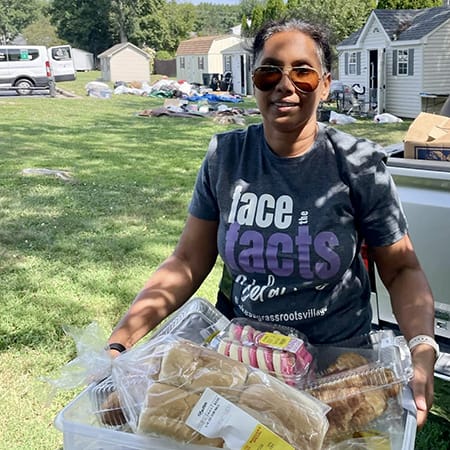
Babita Jagnanan delivers a food donation.
Tell us about your volunteer role.
As executive director of Phoenix Family Resources, I lead our mission to provide essential support to underserved communities across Delaware. Our organization serves individuals with substance use disorders, reentry populations, veterans, the unhoused, LGBTQ+ individuals and pregnant moms. I am proud to oversee programs that empower lives, from offering harm reduction and hygiene kits to workforce development, résumé-building and job training services.
Under my leadership, Phoenix Family Resources has expanded its reach, serving over 16,000 individuals monthly with essential items like clothing, food and household goods. Our free resource center ensures dignity by allowing individuals to select items based on their unique needs, fostering self-respect and hope.
Collaboration is central to our impact. I work closely with community partners, donors and volunteers to maximize resources, ensuring we address gaps in care effectively. I am passionate about breaking barriers, advocating for equity and creating opportunities for personal and professional growth.
In addition to overseeing operations, I spearhead initiatives to secure funding, build partnerships and enhance programming, ensuring long-term sustainability. I also mentor volunteers and participants, fostering a supportive environment where success stories like Joan, a program graduate thriving in her new job, are possible.
At Phoenix Family Resources, we are more than a resource center—we are a place of hope, empowerment and transformation. Every day, I am inspired by the resilience of those we serve and the dedication of our team to make a tangible difference in Delaware communities.
Why are these issues so important to you?
The mission of Phoenix Family Resources is deeply personal to me because I have witnessed the transformative power of compassion, support and second chances. Throughout my life and career, I have seen how systemic barriers, stigma and lack of resources can prevent individuals from reaching their potential. Whether it’s someone struggling with addiction, a returning citizen rebuilding their life or a family facing financial insecurity, I believe everyone deserves access to the tools and opportunities needed to thrive.
This work is important to me because it goes beyond providing basic necessities; it’s about restoring dignity and hope. Seeing someone walk into our free store and leave not just with clothing or food, but with a renewed sense of possibility, drives me to do more every day. I am especially passionate about serving those who are often overlooked—whether it’s the LGBTQ+ community, veterans or pregnant moms—because everyone deserves to feel valued and supported.
Leading Phoenix Family Resources allows me to create pathways for empowerment and equity. I’m honored to play a role in helping individuals transform their lives, knowing that even small acts of kindness can ripple into lasting change for families and entire communities.
What inspired you to get started with this initiative?
The inspiration for my involvement with Phoenix Family Resources stems from a lifelong commitment to helping others and a deep understanding of the barriers many face when trying to rebuild their lives. While studying criminal justice, I witnessed the challenges individuals in recovery and reentry, as well as underserved communities, face. These experiences ignited my passion for creating programs that offer tangible support and foster lasting change.
My work began with a desire to build something meaningful—a place where everyone, regardless of their background, could access the resources and support they need to succeed. I was inspired by the stories of resilience and courage from those who’ve overcome addiction, homelessness or systemic obstacles, and I wanted to ensure no one felt alone in their journey.
Phoenix Family Resources is rooted in the belief that dignity and respect are essential for recovery and personal growth. From providing basic necessities like clothing and hygiene kits, to offering job training and workforce development, we aim to empower individuals and help them reclaim their lives.
Seeing the transformative impact of our programs and the unwavering resilience of those we serve inspires me to continue this work and grow our efforts to uplift Delaware communities.
What are your long-term plans or goals for the organization?
My long-term vision for Phoenix Family Resources is to expand our impact, ensuring that every individual in Delaware has access to the resources and support needed to rebuild their lives with dignity. A key goal is to open additional resource centers across the state, particularly in underserved areas, to better serve vulnerable populations.
We aim to enhance our workforce development programs, partnering with local businesses to create more job opportunities and skill-building initiatives for individuals in recovery, reentry populations and others seeking a fresh start.
I also plan to strengthen community partnerships and secure sustainable funding to expand our offerings, including housing assistance, mental health resources and comprehensive support for families.
Ultimately, I want Phoenix Family Resources to be a model of holistic care, fostering resilience and empowerment while addressing systemic barriers. Our mission is to not just meet immediate needs but to create lasting, transformative change.
What’s been the most rewarding part of your work?
The most rewarding part of my work is witnessing the transformation in the lives of the individuals and families we serve. Seeing someone regain their confidence, secure employment or rebuild their life after facing significant challenges is incredibly fulfilling.
Hearing stories of resilience and success, like a program participant thriving in a new job or a family finding stability, reminds me why this work is so important. Moments where individuals express gratitude for feeling seen, supported and respected motivate me to continue making a difference.
I’m also inspired by the dedication of our staff, volunteers and community partners, who work tirelessly to create positive change. Knowing that our collective efforts provide hope and empowerment to thousands of Delawareans is truly the greatest reward.
Tell us about future partnerships, programs or events that you are excited about.
We are constantly seeking opportunities to grow and expand our impact through meaningful partnerships, programs and events. One of the initiatives we’re most excited about is collaborating with local businesses to strengthen our workforce development programs. By partnering with employers across Delaware, we aim to create hands-on job training opportunities for individuals in recovery, reentry populations and underserved communities, equipping them with the skills and confidence to thrive in the workforce.
We’re also working to expand our partnerships with healthcare providers and community organizations to integrate more comprehensive services. This includes offering mental health resources, harm reduction programs and workshops that address financial literacy, parenting and life skills. By taking a holistic approach, we hope to empower individuals to achieve lasting stability and independence.
In addition, we’re thrilled to host larger-scale community events, such as our upcoming Recovery Month celebration. These events not only raise awareness about recovery and mental health but also bring the community together to celebrate resilience and hope. We are also exploring opportunities to host resource fairs and clothing drives in rural areas, ensuring our services reach those who need them most.
Ultimately, we are excited about creating deeper connections with organizations and individuals who share our vision. These partnerships and events are critical to breaking down barriers, fostering inclusion and providing every Delawarean with the tools they need to succeed. The future is bright, and we’re committed to continuing this important work together.
Any advice for people who want to start volunteering?
For anyone considering volunteering, my advice is simple: start where your heart leads you. Find a cause that resonates with you—whether it’s supporting individuals in recovery, helping unhoused populations or mentoring youth—and connect with organizations making an impact in that area.
Volunteering doesn’t require special skills, just a willingness to show up and make a difference. Be open to learning and embrace opportunities to step outside your comfort zone. Every contribution, no matter how small, can have a meaningful impact on someone’s life.
Consistency is key, so commit to a schedule that works for you. Building relationships and trust with the community you serve is incredibly rewarding. Most importantly, approach your work with compassion, empathy and an open mind—you’ll grow just as much as the people you help.
What do you want people to learn from your story?
I want people to learn that no matter where you start in life, you have the power to make a difference in your community and the lives of others. My journey is proof that a genuine desire to help, combined with hard work and collaboration, can create meaningful change.
I want people to see that challenges are not insurmountable. The individuals we serve teach us that resilience and determination can lead to transformation. Their courage inspires me daily and reinforces the idea that everyone deserves a second chance and access to resources that help them rebuild their lives.
I also want to highlight the importance of compassion and community. None of this work would be possible without the support of dedicated volunteers, donors and community partners. It’s a reminder that change happens when people come together with a shared vision of creating a better future.
Most importantly, I want people to know that small actions can have a ripple effect. Whether you’re donating time or resources, or simply offering kindness, every effort matters. I hope my story inspires others to get involved, take initiative and believe in the power of community-driven change. Helping others isn’t just about providing for their immediate needs—it’s about restoring hope, dignity and empowerment. Together, we can create lasting change, one life at a time.
Empowering the Staten Island Community Through Multifaceted Volunteerism
Meet Daily Point of Light Award honoree Gina Ottrando. Read her story, and nominate an outstanding volunteer or family as a Daily Point of Light.
Gina Ottrando embodies the spirit of service in every way she can, dedicating her time and professional expertise to empower small businesses and uplift underserved or overlooked community members. As a certified mentor with SCORE Staten Island, Gina offers invaluable guidance to aspiring entrepreneurs and small business owners.
Drawing from her extensive background in business planning, management and strategic development, she helps clients refine their tools and skills to build successful ventures. In her role as co-chair of the Staten Island chapter, Gina amplifies SCORE’s reach by representing the organization at business conferences, improving its online presence and boosting its visibility through social media.
Gina’s commitment to community service doesn’t stop with SCORE. Every week, she takes on another crucial role with Meals on Wheels, delivering medically tailored meals to 10 to 12 homebound seniors. Beyond providing nourishment, Gina conducts wellness and safety checks during her visits, offering companionship and reassurance to individuals who may feel isolated. Her presence is a source of comfort and care, ensuring these seniors feel seen and supported.
Finally, for the past four years, Gina has also devoted her time to Project Hospitality, working in both its food pantry and soup kitchen. Here, she helps provide sustenance to hundreds of individuals each week, including asylum seekers, unhoused individuals and more. Gina’s service is a lifeline for many who struggle to secure basic necessities, also fostering a sense of dignity and hope for those navigating these challenging circumstances.
Gina’s efforts reflect a more holistic vision of community care – where both economic empowerment and social support are key to creating a thriving society. Her impact resonates far beyond the services she provides. Through her work, she inspires others to join in building stronger, more inclusive communities.
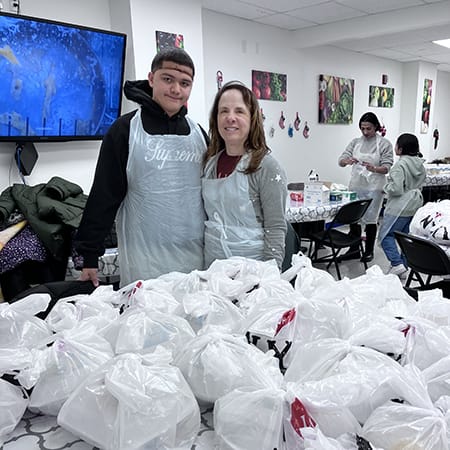
Gina Ottrando and step grandson Michael Lopez at Project Hospitality soup kitchen.
Tell us about your volunteer role.
Since 2019 each week, my husband and I deliver meals to those in need through Meals on Wheels.
Additionally, I assist at a local food pantry and soup kitchen with Project Hospitality. Most of my time,
however, is dedicated to being a certified mentor and co-chair of SCORE Staten Island.
Helping others—whether it’s ensuring access to basic necessities like food or providing guidance to aspiring entrepreneurs—is deeply fulfilling and aligns with my belief that we all have a role to play in
supporting our community.
What inspired you to get started with this initiative?
Feeding those who need food is fundamental; I firmly believe that no one should go hungry when we have the resources to prevent it. My involvement with SCORE, however, grew out of a desire to leverage my professional skills in a way that directly benefits my community. It was a perfect fit. In 2021, I became a certified mentor and, in 2023, stepped into the role of co-chair for the Staten Island Chapter.
What are your long-term plans or goals for the organization?
Our goal for 2025 is to expand educational workshops, focusing on supporting existing businesses.
Statistics show that while 80% of small businesses survive their first year, only 50% make it to year
five and 35% to year 10. Additionally, Staten Island’s community demographics have shifted in recent years, as seen in the diversity of new businesses. Strengthening our connection to these diverse communities and providing tailored support is a priority.
What’s been the most rewarding part of your work?
Meeting and working with entrepreneurs is incredibly rewarding. I’ve had the privilege of mentoring over 75 clients and holding more than 300 sessions to educate and guide them. In the process, I’ve learned so much as well as expanded my own professional skills. For instance, I might not have explored AI as deeply as I have if not for my volunteer work.
Tell us about future partnerships, programs or events that you are excited about.
We are fortunate to collaborate with several local organizations. One partnership I’m particularly excited about is the THRIVE EXPO series we participate in with JCC. This event, now in its fourth installment, aims to empower women. And I truly believe has made a tangible impact on our community.
Any advice for people who want to start volunteering?
Many people hesitate because they think they lack the skills or don’t know where to start. My advice is simple: find something that interests you. Opportunities are everywhere – you just have to take the first
step.
What do you want people to learn from your story?
When you give of yourself, you receive so much more in return. Volunteering has enriched my life in countless ways, and I hope to set an example for my sons and grandkids about the importance of getting involved in your community.
Meet Daily Point of Light Award honoree Cheyenne Klapper. Read her story, and nominate an outstanding volunteer or family as a Daily Point of Light.
It takes a certain kind of patience and persistence to be an advocate for systemic change. It’s the kind Cheyenne Klapper, 19, has in droves. Cheyenne is a freshman at the University of Virginia who lives a life reflective of her principles. She’s six years into being vegan, and she advocates for environmental justice, animal rights and food policy. Her other primary focus is criminal justice reform. If all goes well, she intends to go to law school to continue the fight for change.
Much of Cheyenne’s contributions to criminal justice reform has been through the Center for Youth and Family Advocacy’s (CYFA) Youth Restorative Diversion Initiative (YRDI). CYFA is a nonprofit founded five years ago by two defense attorneys determined to address the inequities and imbalances they saw amongst their caseloads. The YRDI includes programs designed around restorative justice, the practice of keeping juvenile offenders from going through the court system and, as is often the case, carrying the consequences of their mistakes for the rest of their lives.
“One of the misconceptions is that these kids deserve punishment. Obviously, we want kids to think about their actions critically, but it’s not punitive,” Cheyenne explains. “Time and time again, when studies are put out about restorative justice measures, it shows that it creates thriving communities, and punitive measures create higher recidivism rates. That’s not what we want for the country.”
One such initiative is Youth Peer Court (YPC). In YPC, an offender’s case—a misdemeanor or nonviolent felony—is heard and adjudicated by other youth without burdening them with a criminal record or added trauma. The consequences are designed to address the root cause of the crime and often include volunteer service, education modules, apologies and/or letters of acknowledgement. In short, it’s a second chance.
“We’ve had 100% compliance. We’ve received 70 plus cases at this point, and all of the young people that have been referred to us have decided to willingly go forth and complete our programs,” emphasizes Zipporah Baldwin, director of programs for CYFA.
If anyone dropped out, they would then be referred back to the police. In reality, the program is so successful, offenders often come back after making amends to volunteer as YPC ambassadors.
In 2023, Cheyenne completed her high school’s capstone internship with CYFA, joining during the launch of YRDI. As part of the work experience for course credit, she volunteered around 350 hours during her senior year, starting with training and participation in Youth Peer Court roles as well as Promoting Empathy through Equitable Resolution (PEER). The latter brings both parties in a dispute together to discuss a restorative agreement vs. just the offender. Cheyenne also served as one of the first Youth Advisory Board (YAB) members.
“She had a huge hand in forming how things were going to work, and working out the most effective approaches and how to work with these teens who come through our program,” Zipporah adds.
Zipporah describes her as a natural-born, dynamic leader with charisma that people are drawn to and look up to, even those her own age. In her role advising the YAB, Cheyenne realized meeting and discussing what is important to young people and reporting back wasn’t enough. Making change was essential. Last summer, with the help of student volunteers, she completely overhauled the program.
“I created the new rules for the Youth Advisory Board. I created the committees, and I looked at people to intern,” she recalls. “We based it on the idea of student self-governance. I was inspired by UVA, where the clubs there are all student led.”
Now, over 20 students, many of whom are also Peer Court ambassadors, are organized into four committees. Each committee has a specific purpose and is overseen by Cheyenne. They identify issues in the community or the nation as a whole and come up with steps for actionable change. Her goal is not to give orders but to inspire others to take initiative and ownership.
“She’s willing to listen. And I think that’s truly what makes a beautiful leader,” Zipporah states. “She has so much to offer. She has had so many diverse experiences. But in spite of all that, she’s always willing to open up the floor for people to share their thoughts, to share their concerns.”
Cheyenne also served as the inaugural program committee chair through which she led the organization of CYFA’s first Listen Learn Lead Summit, a public event for students to learn about issues critical to their well-being and become agents of change for healthier, more equitable communities. CYFA also aims to teach young people their rights and how to interact with law enforcement.
Today, despite being away at school, Cheyenne serves as the YAB Coordinator through which she mentors new ambassadors, is planning the second Summit and actively brainstorms events and initiatives that advance the mission.
Systemic change is almost always difficult and slow-moving. Advocates doing the work can spend a lifetime pushing things forward and only see incremental change, but Cheyenne has advice for limiting overwhelm or burnout.
“I just try to remember how important it is that I’m using my passion and empathy to create change. I focus on what I can do versus what might be further out of reach at the time. Any movement toward the goal is a step in the right direction,” she suggests, adding that small steps add up over time.
Changing the way things are done takes compassion and passion, both of which Cheyenne exemplifies daily as she has grown more comfortable using her voice. It’s the part of her personality that allows her to face challenges with the courage and the fortitude necessary to persist.
“The main message that I would give young people is to think about those difficult things that you maybe don’t want to think about,” she says, suggesting that motivation is found in empathy.
Perhaps, during challenging times, it is something everyone could use a bit more of.
“She is a marvelous human being, and in my years of work in the nonprofit sector and social services, I can’t say that I’ve run into a young person as passionate and as driven as Cheyenne,” Zipporah concludes.
A Shining Light: Volunteering in Communities From the U.S. to India
Meet Daily Point of Light Award honoree Arjumand Juweria. Read her story, and nominate an outstanding volunteer or family as a Daily Point of Light.
Arjumand Juweria is a dedicated community activist in Jersey City. For 12 years, she’s been actively involved in various nonprofit organizations in New Jersey and across India.
She has volunteered with organizations that provide meals, backpacks and other essentials to senior citizens, unhoused individuals and underserved children in her community and abroad. Arjumand believes in getting involved and helping others, and she does this through sponsored medical bills, school fees and other expenses for those in need.
Arjumand has worked with several nonprofit organizations, which have prepared and delivered more than 20,000 meals to those in need. During annual turkey drives, she has helped these organizations distribute over 4,000 turkeys and thousands of non-perishable items. Simultaneously, she distributes tons of fresh produce to 100 to 150 residents monthly.
Her volunteer efforts also include delivering hundreds of turkeys, coats and essential supplies to community members. Through the Leave of Love program, which she works with, they have provided food, beverages, scarves, warming essentials, hygiene kits and hats.
During the festive season, her volunteer efforts extend beyond providing meals. For example, on Valentine’s Day and Thanksgiving, she distributed over 2,500 backpacks for children and 200-250 goodie bags for senior citizens.
As a woman empowerment coordinator and general advisor, she supports and celebrates senior birthdays, Mother’s Day, Father’s Day and Women’s Day in many ways, including facilitating bingo events.
In addition to her work within the United States, Arjumand has also distributed 600 blankets to the people of Telangana. During Ramadan, she volunteers to cook and pack halal meals for individuals in prison. During the other months of the year, she also arranges and distributes books in prisons.
Arjumand’s efforts don’t stop there. She plans to start a nonprofit organization that works with youth and senior citizens. She hopes to inspire people to get involved in community service one day.
Arjumand Juweria cuts vegetables with the Let’s Share a Meal program and prepares 10,000+ meals to distribute to shelters across the tri-state area. Courtesy/Arjumand Juweria
What inspires you to volunteer?
While studying to become a pharmacist, I was returning from university when I saw a lady with her kids, approximately 1 and 2 years old. I noticed she was searching for food in a garbage can. Immediately, I helped her to get whatever she needed. We purchased anything possible to make her feel as comfortable as possible.
From that day onward, I decided I needed to help at least one person daily. Islam teaches the importance of giving. When I was a pharmacist, I worked as an outpatient pharmacist. I used to take prescriptions and medicines, pay for them out of my pocket and give them the medication.
I could go on about how I started this journey, but suffice to say that today, my husband and I are very involved. My husband is also generous; we never expect anything in return, only blessings. We don’t need anything from anybody, but it’s a fantastic feeling to see the smiles on the faces of people who need food and to know that I can help nourish them.
What are your long-term goals or aspirations for your legacy?
At the start of every year, I ask myself, “Where do you want to be in five years?” Then, I make plans accordingly. I want to start my nonprofit organization this year to help more people. Now that people are watching and familiarizing themselves with me, they want to contribute. They are inquisitive and acknowledge all my work for our community. So, we want to help as many people as we can reach.
I plan to open a nonprofit organization to work with specific youth and senior citizens they wish to volunteer and spend time with willingly. I don’t believe in just focusing on one population or one specific cause.
I want to spread happiness so that at least one person can see me and think, she’s doing good for our community, why can’t I? Then I do. I want to get inspired. I want other people to get inspired by my actions, by my thinking and by my motivational team.
What’s been the most rewarding part of your work?
I always believe that if I spend time and energy on one person, God will give back to me in multiple ways.
As I said, whenever I see their happiness, those smiles on their faces make me happy inside, and I know what I “buy.” If I make one person happy, it’s a blessing. And that person can make other people happy. That smile can spread to different people.
What does it mean to you to volunteer?
I used to think I was wasting money month after month. I began taking $100 from my monthly salary, and now I spend it on people without housing instead of on clothes for myself. Since I started contributing $100 monthly, you won’t believe how much my life has changed. Now, God blesses me with even more.
Never again will you think you are wasting $100 by giving that amount. Giving $100 a month is another way to consider investing in your future. If you cook for yourself, you can cook for five more people. The feeling I receive when distributing to people without housing and those in need is indescribable.
For example, I installed water facilities, particularly in Telangana’s villages with a significant female population. The water installation eliminated their journeys to the mountains to fetch water. I saw this as a problem and tried my best to rectify it. Now, almost 100 people across the north area are getting water daily.
What have you learned through your experiences as a volunteer?
I had to learn that every person has a need. Even if I’m a millionaire, there will always be help I would be willing to accept.
Any advice for people who want to start volunteering?
I always encourage people to get involved however they can. It is not only impressive but also crucial for the community.
If you see your parents struggling, and then all becomes well, you go to school and college, and then you start working and having a family, then that is your opportunity to pay it forward in whatever ways you can.
When you get involved, any negativity in your life will return to you in many positive ways. Just get involved, and you will see the blessings pour in. It may not be immediate, but you will see it. You are doing good for the community.
I have been doing this for 20 years and in the 21st year, I started to see blessings in my own life pour in.
I always encourage people to participate. If you are a good cook, you can prepare and distribute meals to those facing hunger. In return, you will receive blessings.
What do you want people to learn from your story?
When I started, I was very new to this country. My former employer didn’t pay me my salary for three months, and I was very naive. I had only $50, and my credit card limit was about $2,000. For three months, I survived, and from there, I never stopped helping people. Even when I didn’t have the money, I spent about $10, $15, and $20 weekly for three months. I survived like that.
If you have $5, spend it. If you have $1, spend it and see how it will come to you in a few months or years.
Houston Entrepreneur Gives the Unhoused a Leg Up During Difficult Times
Meet Daily Point of Light Award honoree Neekeita Cooksey. Read her story, and nominate an outstanding volunteer or family as a Daily Point of Light.
Neekeita Cooksey, 41, is highly empathetic to the struggles people face when things just aren’t going their way. She faced challenges of her own when she became a single mom after her husband passed due to COVID. Sixteen years ago, it was he who helped her find her entrepreneurial side. That confidence and resourcefulness has gotten her through the ups and downs with her staffing company, but it’s helping people find jobs that keeps her motivated.
In 2016, she decided to go beyond jobs to support the unhoused and underserved by establishing Society of Champions. Together, she and her team connect people with resources, food and education. They hold Back-to-School drives, community baby showers, food distribution events, award scholarships and more. Neekeita’s love of travel has also led her to provide resources abroad.
Now a mother of five and a newlywed, she is more community-focused than ever. Spending time with her family, including her mom, fills her with gratitude while moving her to continue enthusiastically extending a hand to others.
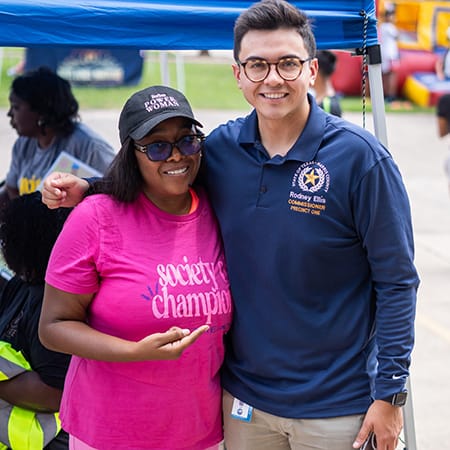
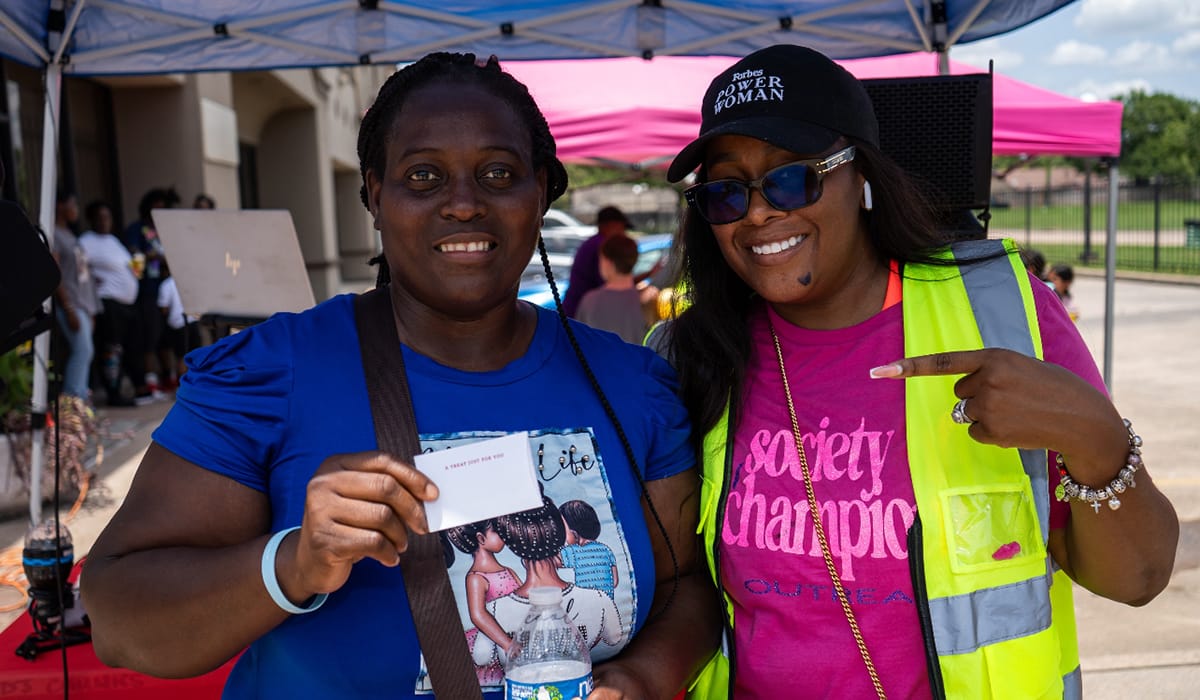
Neekeita Cooksey, founder of Society of Champions, brings volunteers together to support the unhoused and underserved.
What inspires you to volunteer?
It’s something I’ve done my whole life. As I got older, the passion heightened. I wake up every day trying to figure out how I can put a smile on someone’s face.
My organization is Society of Champions. We call them champions, not unhoused, because no matter what hardships they may face in life they’re still champions. We feed them, but we also try to rehabilitate them back into society.
It started when my mom, my brother and I would go downtown and feed them. I saw things in the community that were needed and wanted more ways to give back. That’s how we started to create our programs. This year, we started my food pantry in partnership with Houston Food Banks. It’s a big milestone for us.
Tell us about your volunteer role with Society of Champions.
I find new partnerships, do community outreach and brainstorm ways to fundraise. We sell fish dinners and hamburger baskets. We run capital campaigns. Whatever is needed, we’re going to do the work.
On the day-to-day, I start out meeting with our team to go over goals and metrics. We try to meet those marks that we set at the beginning of the year.
I have eight people on my immediate team, but I have 60 or 80 volunteers. Our food bank has a food line twice a month, and we see anywhere from 160 to 240 families. I have to have 15 to 20 volunteers. High school students and different corporations will have employees come out. I can’t do what I do without my team, my board members and my volunteers. I’m so appreciative of all of them.
What other kinds of programs do you run?
We designed Peas in a Pod for single parents facing hardships like buying food or finding a job. We provide startup packs for new moms, and we have community baby showers.
In 2019, we went to Haiti and Honduras to provide resources for orphans there and met some young ladies who were graduating from high school. To earn an associate’s degree In Haiti’s education system is only $560, so we were able to provide scholarships for them to go to nursing school.
We hosted a lunch for pandemic first responders in cooperation, and it has become an annual event. My brother is a police officer, so we kind of knew how it felt to be in the field during that time. Even though the pandemic is over, they still deal with a lot of challenges.
We also help kids prepare for college—Boys to Kings for the boys and Crown University for the girls. We teach them lifelong skills, introduce them to trades and go on college tours. We teach PSAT, SAT, hygiene, anti-bullying and more. Around 32 girls and 15 boys meet quarterly.
What are your long-term plans or goals for the organization?
We haven’t gotten a grant yet, so I’m working on that. In the long term, we would like to purchase an apartment complex so we can provide housing for families in need, as well as the champions that are on the streets trying to rehabilitate. We want to be able to house them while, for example, they’re looking for a job.
What’s been the most rewarding part of your work?
Peas in a Pod is near and dear to my heart, because I was once a single mom. Before I got remarried, it was just me, and I had three kids at the time. Even though I had the finances, it was a struggle. I know how hard it may be for single moms—and dads—who don’t have the resources, so I do my extra best to make sure that program succeeds.
What have you learned through your experiences as a volunteer?
It easily could have been myself with no place to stay, no food, no family. So, I try to be thankful for everything that I have, every opportunity I’ve been blessed with.
Neekeita gives a parent a gift card to Chick-Fil-A at the organization’s Back to School Bash 2025.
Why is it important for others to get involved with causes they care about?
You never know the impact you can have on someone’s life until you get out there and start doing it. Nothing is too small—no idea, no resource and no donation.
Do you have any advice for people who want to start volunteering or to start their own organization?
I tell my mentees to find their ”why.” Why are you here? What are you created to do? Then, find your niche. You’ve got to do the work. You can’t be scared. For people starting their own initiative, find someone like myself to partner with who can help bring your vision to life.
What do you want people to learn from your story?
I want people to see the work that I do, not to brag, but to inspire. So that they can see the vision and how they can make an impact. There is a great need, no matter where you are.
This Special Olympics Volunteer Sees Something Special In Everyone
Meet Daily Point of Light Award honoree Gary Pierre. Read his story, and nominate an outstanding volunteer or family as a Daily Point of Light.
Growing up, Gary Pierre saw how his sister’s disability didn’t stop her from achieving her goals.
Though she was visually impaired, Gary’s sister went on to get her law degree. When Gary was looking for a nonprofit organization to collaborate with years later, he gravitated toward the Special Olympics New York, which provides inclusive opportunities for athletes with intellectual disabilities. Like his sister, the Special Olympics athletes don’t look at their disabilities as something that hinders their potential.
Bolstered by their optimistic viewpoint, Gary took action. At his day job, Gary serves as a business control officer for Bank of America. But in his spare time, Gary uses that professional network to source Bank of America employees and their friends and families to volunteer with the Special Olympics.
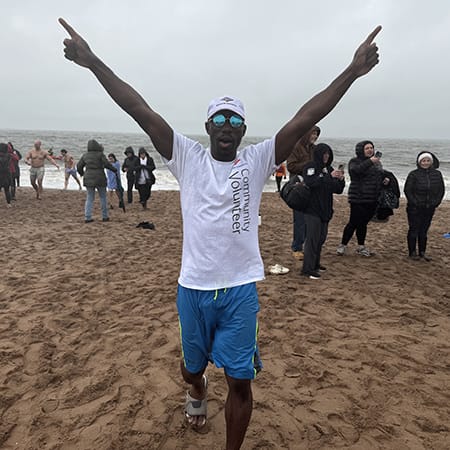
Gary Pierre holds his hands up as participants brave the cold water during a Special Olympics Polar Plunge. /Courtesy Gary Pierre
He creates events for the Special Olympics New York, ranging from basketball games to Polar Plunges. While each track and field meet or soccer game may only last a couple of hours, each event requires hours of administrative work, whether it’s paperwork or sourcing new volunteers. No matter the amount of work that goes on behind the scenes, Gary is there to get it done. In fact, many people even mistake his volunteer work for his full-time job.
“When I look at the amount of time that he puts into these events, that’s when I see his passion and his enthusiasm come through,” says Michela Micheletti, a Bank of America colleague who volunteers with Gary.
Gary is also helping the Special Olympics New York take their programming to the next level. While they do emphasize athletics, Gary also assists the organization in teaching their participants other important life skills, like maintaining healthy financial habits. He also joined the board of the Special Olympics New York this year and is working to avidly recruit other financial institutions to participate like Bank of America does. While Gary is very grateful for the sponsorship of large institutions, he also sees the power in a single individual donating their time to a cause they care about.
“I think it’s really the time and commitment of the individuals who come to these events and talk to the volunteers. That’s what is most impactful for me overall,” says Gary.
One of the most rewarding aspects of Gary’s volunteer work is when he shows up at one of the Special Olympics events and the athletes know him by name. He says the experience of knowing that he’s impacting the lives of others brings him the most joy.
“I think that’s the most positive thing. You look at the time commitment, but it’s just something you just love to do,” says Gary. “By doing that, it’s not work.”
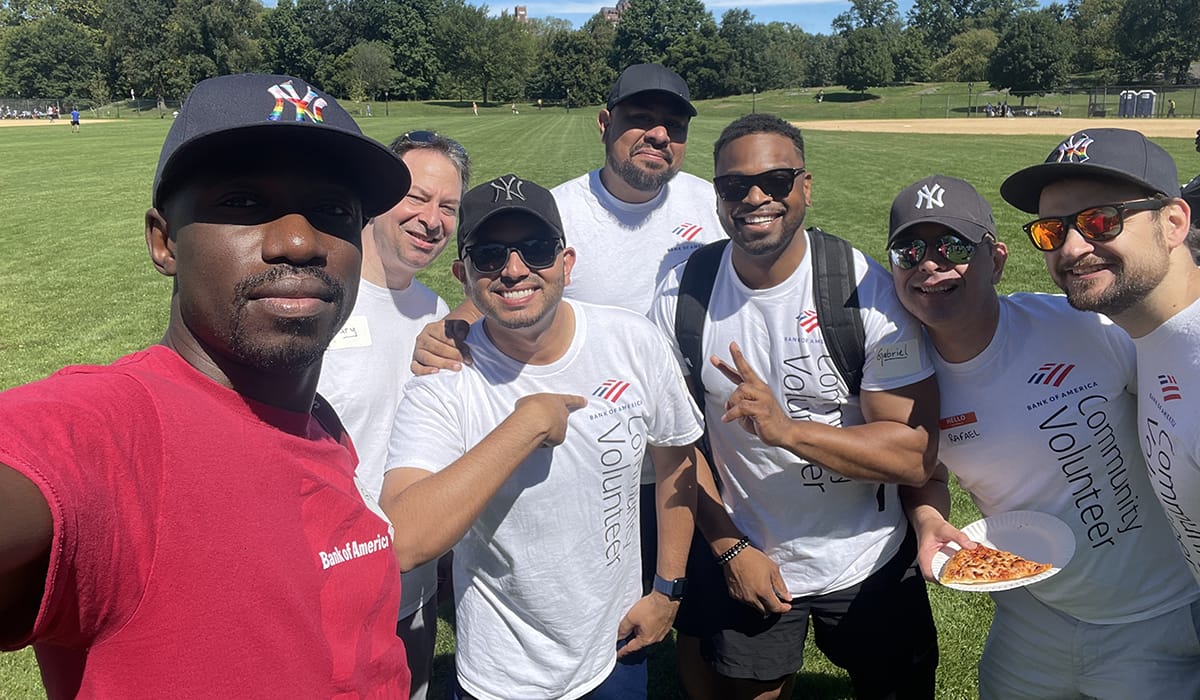
Gary Pierre (left) is joined by a group of fellow Bank of America employees for a day of volunteering. /Courtesy Gary Pierre
Gary advises aspiring volunteers to research potential organizations and speak to someone who is already involved to gain a greater understanding of their mission.
“Your time is precious, but giving your time makes such an impact on a person’s life,” Gary concludes. “As long as you bring your positive energy and your willingness to help others, you’re going to have a great time volunteering.”
Meet Daily Point of Light Award honoree Dev Sharma. Read his story, and nominate an outstanding volunteer or family as a Daily Point of Light.
Dev Sharma found his voice. Now, he’s helping others to find theirs.
When his mother was diagnosed with breast cancer, it was a hard time for the entire family. Feeling sick and exhausted, Dev’s mom lacked the energy to express her passion for learning. However, Dev decided to help her out. While Dev was overflowing with creativity from an early age, he was particularly introverted in his younger years, lacking the confidence to express himself.
However, he decided to take his creative spirit to the next level and constructed a journal for his mom from cardboard, fabric and paper found around the house. Seeing how his creative endeavor affected his mom for the better, Dev decided to take that artistic spirit outside the home and show the world what he was made of.
In November of 2022, Dev established the Raksha Foundation, an organization that builds community through creativity. While the scope of their work is wide, so is the number of lives they impact. Raksha’s initiatives are diverse, ranging from food and winter clothing drives to their Self-Discovery Program, which helps refugee children learn about future career options through games and activities. Thus far, Raksha’s 450 members have partnered with 27 different organizations from Chicago to India. The various branches of Raksha’s service tree have created a global impact.
While he may be a 17-year-old high school student, Dev isn’t letting his age hold him back. Instead, he’s actively planning for Raksha’s expansion. He hopes to reach new demographics in the future, showing every corner of the world the power of creativity and volunteer work.
What inspired you to get started with this initiative?
My main drive is to help people understand how even the smallest things on a day-to-day basis can truly impact others. I understand the impact that creativity and art can have on a person. I’m driven to inspire other people to do this so they can see how simple things can impact and shape others. On a global level, I’m driven to expand this so people in different countries can understand how they can leverage their resources and skills to impact others and use creativity to redefine service.
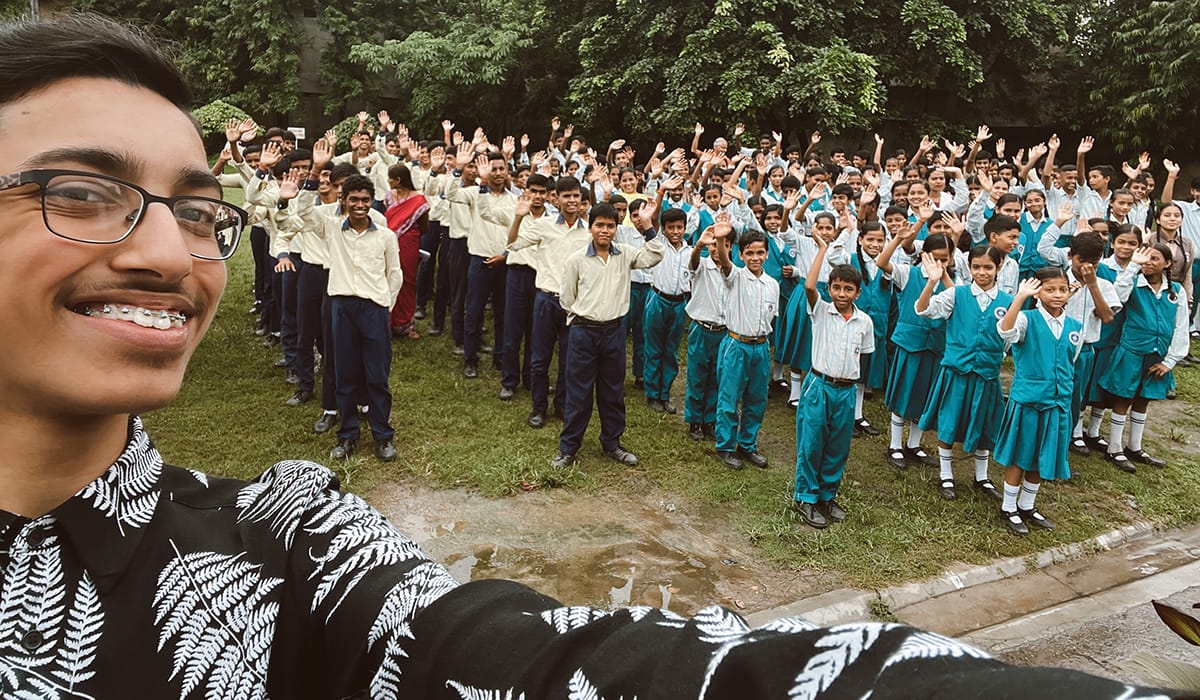
DEV SHARMA (LEFT) SMILES FOR THE CAMERA IN FRONT OF A GROUP OF SCHOOLCHILDREN. THE RAKSHA FOUNDATION WORKS TO PROVIDE EDUCATIONAL AND TECHNICAL EQUIPMENT FOR UNDERSERVED SCHOOLS AND SHELTERS IN JAMSHEDPUR, INDIA. :/COURTESY DEV SHARMA
Tell us about your volunteer role with the Raksha Foundation.
I work with a team of around 10 to 12 board members. The main thing we do daily is branch out to different organizations around the Chicago area. We have partnered with many different organizations, including World Relief, which was one of our biggest partnerships in the first year.
We worked with them to branch out through certain drives for different demographics, such as refugees and families dealing with food insecurity around the Chicago area.
Alongside partnerships and outreach, we advertise ourselves, focusing on targeting youth with creative minds. Our main goal right now is to establish ourselves by branching out to different organizations that focus on different demographics and different missions so that we can share our idea of helping youth make a global impact.
What are your long-term plans or goals for the organization?
The long-term goal is to branch out to different demographics within the Chicago area and Latin American countries. We do have a connection to Latin American countries through our Lake Forest branch, but I wanted to establish new branches in different countries to build more of a connection. We have established ourselves in India and try to address the needs of small cities there. I want to leverage our branches in Chicago to reach more demographics in Latin America and different countries worldwide.
What’s been the most rewarding part of your work?
The most rewarding part would be the memories we make from our initiatives’ impact. One of those initiatives was the self-discovery program, which helped us make a personal connection with the refugees we tried to help in the Chicagoland area. This program was tailored to helping them understand their different career options through play because we feel that implementing games can help us help youth understand the different complexities of life more thoroughly. We were able to connect with the refugees, and they were able to create a more personal connection with us.
What have you learned through your experiences as a volunteer?
I understand more about myself. When I was a freshman in high school, I was introverted. I never was able to express myself through my art. I would always use art as a way of having fun or expressing myself within the realms of my own home. Through Raksha, I’ve been able to express myself through art on a global level or with people I work with. This has helped me be more outspoken and confident in myself. This also helps me to reflect that growth on the people I work with and the youth I try to target. Using art to interact with people in need is a great way of helping youth become more confident in themselves.
Why is it important for others to get involved with causes they care about?
By getting into causes that they care about, it can be incredibly impactful. It can help people to see changes within themselves. As I said, I became much more confident and outspoken through the community service I had done. People can grow from volunteering. People need to do community service because it defines them as a person and helps them understand their goals in life. It also helps them to feel really good inside like I usually do whenever I do Raksha.
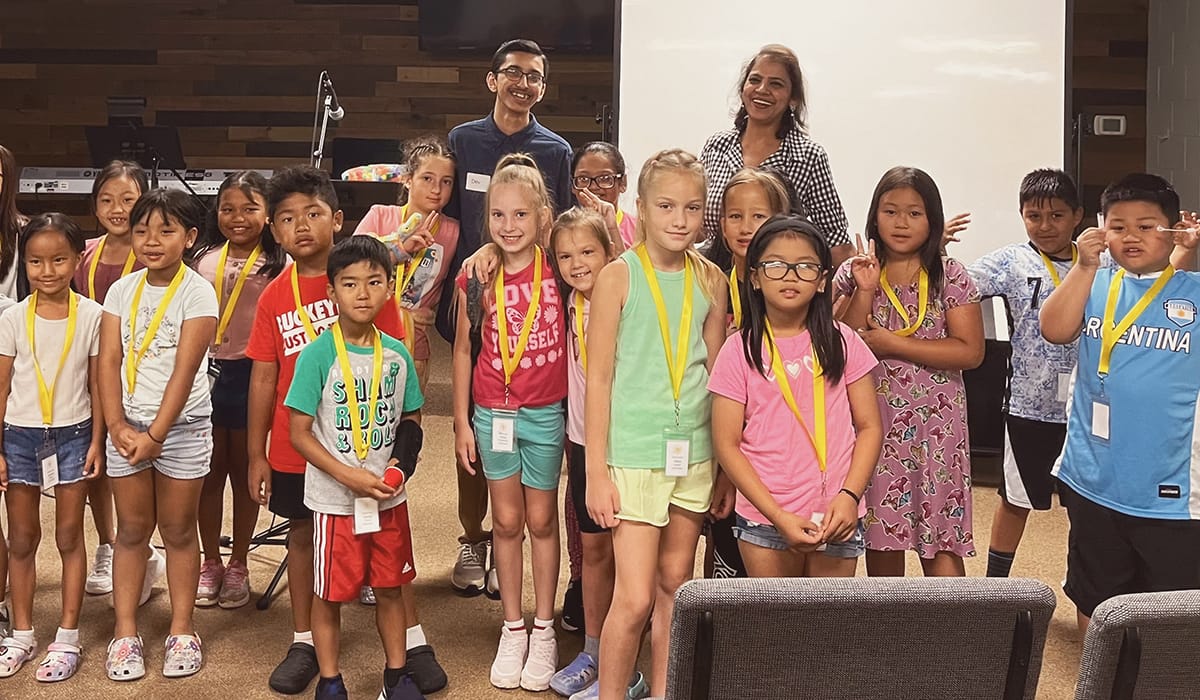
DEV SHARMA (BACK LEFT) APPEARS WITH A GROUP OF CHILDREN WHO PARTICIPATE IN THE RAKSHA FOUNDATION’S SELF-DISCOVERY PROGRAM, WHICH USES CREATIVITY AND INTERACTION TO INTRODUCE REFUGEES TO VARIOUS CAREER PATHS. /COURTESY DEV SHARMA
Any advice for people who want to start volunteering?
For organizations like ours, we have this program allowing people to start volunteering through simple card-making. One of our branches has a card-making program where volunteers make cards and send them to hospitalized children or seniors with dementia. My advice on getting into community service is that it could be through simple things you can do at home or within the community.
What do you want people to learn from your story?
People should understand how community service is a way of cherishing every moment and using it to its full potential. We’re not only shaping ourselves but we’re shaping people around us. It can even be done by making small things for others or just interacting with them. Just saying hi or trying to be inclusive of different people in your community can be impactful. Anything can be considered community service when you’re putting your time toward making an impact on other people.
A Survivor’s Mission to Light the Way for Cholangiocarcinoma Patients
Meet Daily Point of Light Award honoree Kathy Virgallito. Read her story, and nominate an outstanding volunteer or family as a Daily Point of Light.
In November 2021, Kathy Virgallito received a life-altering diagnosis: cholangiocarcinoma (CCA), a rare and aggressive cancer. While undergoing treatment in 2022, Kathy faced the harsh realities of this disease. But instead of retreating, she found purpose in paving the way for others navigating similar challenges. With determination to light the way for others, Kathy began volunteering with the Cholangiocarcinoma Foundation. She aims to be a voice of understanding, encouragement and empathy to others going through this difficult diagnosis.
As a patient mentor, Kathy provides personalized support to patients across the United States. Through phone calls, texts and emails, she offers a listening ear and practical guidance. Her efforts help patients feel less isolated, more hopeful and better equipped to advocate for themselves. One mentee remarked on how Kathy’s mentorship inspired her to embrace self-affirming activities and take charge of her medical journey.
Kathy’s impact extends beyond one-on-one support. As the team leader for the Greater Seattle CARE Team, she spearheads local efforts to build a supportive community for CCA patients and caregivers. In September 2024, Kathy helped organize the first-ever Greater Seattle Patient and Caregiver Gathering, which drew 27 attendees, including patients, caregivers, medical professionals and researchers. The event elevated the need for and importance of local connections and up-to-date information on treatments and research, also leaving participants eager for more gatherings. Kathy is now planning the next event for February 2025 and working to distribute educational materials to healthcare providers and at health fairs.
Kathy’s advocacy also reaches national levels. As a member of the Cholangiocarcinoma Foundation’s Key Communicators group, she is dedicated to influencing policymakers to secure additional funding for CCA research. Kathy is preparing to meet with legislators and share her personal story to advocate for advancements in treatment and care. Read on to learn more about Kathy’s dedication to making a difference, ensuring that no one facing cholangiocarcinoma feels alone in their journey.
Kathy (left) with Greater Seattle CARE members, Kathy Harger (center) and Duncan Foley, who met to plan last September’s Patient/Caregiver Gathering.
Tell us about your volunteer role.
I have several different ways that I volunteer with the Cholangiocarcinoma Foundation. I first became involved as a patient mentor as part of a program that aims to connect patients with other patients, caregivers with other caregivers and so on. It’s a way to provide some support and empathy for those who are impacted by this cancer. Right now, I’m mentoring two other patients.
The second way I volunteer with the foundation is that I’m the team leader for the Greater Seattle CARE Team. This acronym stands for caring, advocacy, research and education. It’s a way to connect people who are impacted by this disease with a more local support system. This is a rare cancer. There are about 10,000 people who are diagnosed with bile duct cancer, or CCA, every year. You just don’t run into people who also have it. For this team in particular, our responsibility is to connect people with local resources and also to educate medical professionals with information about CCA and the foundation.
And then, the third and newest way I volunteer is through the Cholangiocarcinoma Foundation’s Key Communicators group. We’re continuing the advocacy work but expanding it to national legislative leaders as well. This group is newer, and it was formed to educate legislators at the national level about this disease in order to advocate for increased research funding.
Can you tell us a bit about your personal journey with cholangiocarcinoma?
I was diagnosed with CCA in November of 2021. I’d been feeling great, but some wonky bloodwork led to some additional tests, and I was diagnosed with stage 3 CCA. I was on a regimen of chemotherapy, and had some radiation, which I finished up in November of 2022. Like anyone else who goes through chemo and radiation, I was impacted with some side effects. Since that treatment has been over, I’ve been lucky enough to be stable. That means there’s no progression of the disease.
In 2023, I started to get back to feeling like my old self. I thought, what else can I do? I discovered the Cholangiocarcinoma Foundation’s website and saw that I could ask for a mentor. I got connected with somebody who was great in helping me sort through my experience as a patient. As a result, I thought, I’d like to do that. Maya Angelou has a quote, that seems to me the perfect way to describe why I got involved. She said, “As soon as healing takes place, you go out and heal somebody else.” I didn’t think I’d do great things, but I thought I was the type of person who could do patient mentoring, which I started at the end of 2023. I knew I could provide that type of support, kindness and empathy to somebody else. It’s been a great experience.
Later, I ended up going to their annual conference and found out that there was even more that I could do. That’s what led me to try to do something locally with the Greater Seattle CARE Team. I wanted to let other medical professionals in the area know about the foundation. There are so many resources for the oncologists and patient navigators and nurses. As a result, I connected with two other patients, and last September, we held our first Greater Seattle Patient and Caregiver Gathering. The majority of the attendees were patients and caregivers – most of whom had never met anyone else with this diagnosis. When you bring people like that together, you have an immediate bond. It was a success, and now we’re going to continue that work, because there are more people to reach, more people to educate, more people to connect to the foundation.
Then finally, the foundation asked me to be part of the new Key Communicators group. They’re very conscious that volunteering takes up time, but it’s been very meaningful for me to volunteer with this foundation.
What inspires you to volunteer?
For me, there’s an emotional healing that I’ve seen. When I was first diagnosed, the doctor who gave me this diagnosis told me to go home, get my affairs in order and call hospice. This was three years ago. So many people who get this diagnosis hear that. However, rather than a few months to live, here I am, doing very well three years after diagnosis.
You can imagine that when you’re first diagnosed with something as aggressive and rare as this – and the aggressiveness is what’s so impactful – you have to turn inward for a while, in order to come to grips with the fact that your life could be ending, sometimes even soon. While that didn’t happen for me, what I did emotionally was reach a point where I was able to look beyond myself and try to help others facing something similar. I want my life to be meaningful. I want my life to have a purpose. That’s why it seemed important to volunteer. It gave me a purpose. The people I’d be reaching in my volunteer work might be suffering from anxiety, fear, isolation and loneliness – all the things that can come if they don’t have a support community to help them deal with this diagnosis. Helping provide that is what inspires me. Volunteering was an easy decision to make and an easy shift of my priorities.
What’s been the most rewarding part of your work?
Meeting other patients and caregivers, getting to know them as people, sharing their successes and being with them when the news isn’t so great. That’s it; it’s all about the people.
Most of the mentoring I do is by telephone. These are people who could be anywhere in the country – I don’t often get the chance to meet them one-on-one. This summer, I got the chance to go back to my home state of Ohio. One of my mentees lives there and I got to meet her in person. It was like meeting an old friend. The bond that you make when you talk to other patients, when you have these shared experiences and a similar journey, is a joyful event!
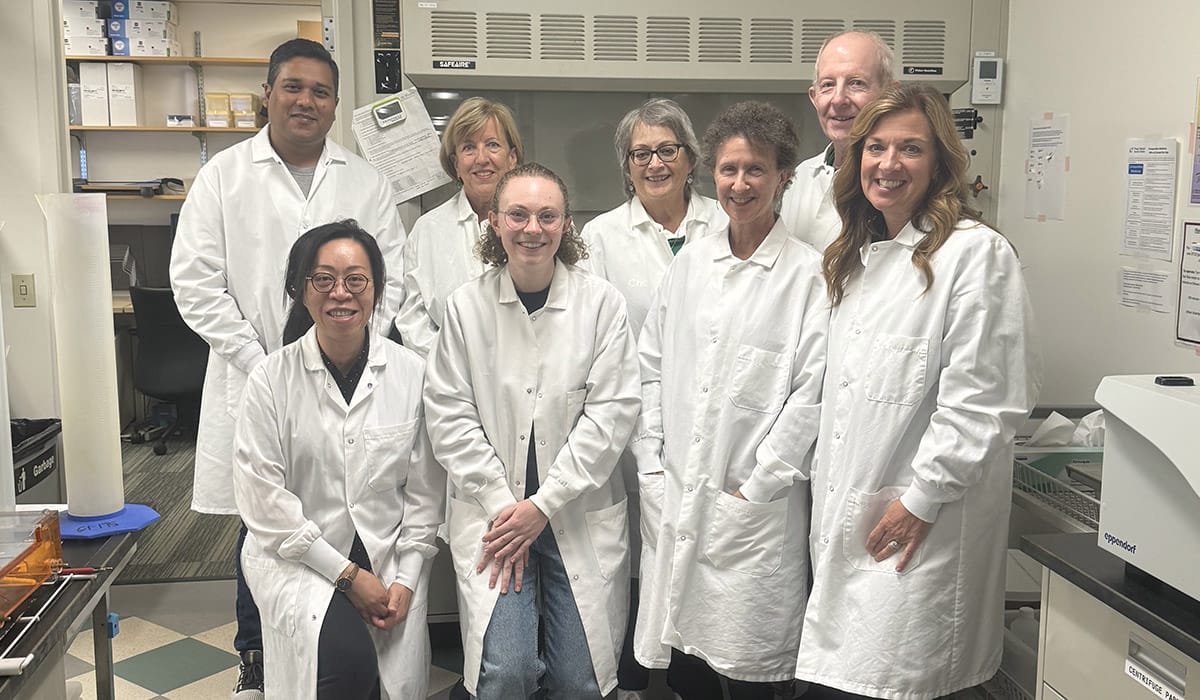
Kathy (back row, third from the left) on a tour of a Fred Hutch Cancer Center lab with other patients and caregivers met with researchers.
Why is it important for others to get involved with causes they care about?
There are many benefits to volunteering. It has health benefits. It gives you a social outlet. It helps you meet people. When people are volunteering for a cause they believe in, it gives them that sense of purpose. It gives their life some meaning. Especially when people are going through difficult times, at the point they’re able to reach out, it actually helps balance those difficult times with some positivity. When you go outside of yourself, the benefit comes back to you. Many people say they get as much as they give.
Any advice for people who want to start volunteering?
First of all, I think it’s important that people identify a volunteer area that they’d be interested in, that they’d like. It has to be the right match. If you’re volunteering for an organization you don’t have much connection to, eventually you might lose steam. But it’s much better if there’s a good fit with your passion areas. Most organizations are happy to welcome volunteers. My advice is to contact them and ask how you can help, no matter how much or how little time you have to give.
What do you want people to learn from your story?
This cancer is rare so often people feel very isolated and struggle on their own. Navigating diagnosis and treatment can be confusing. By providing information and support, we can empower patients and caregivers as they learn to advocate for themselves.
Also, I want people to see that it doesn’t take much, in terms of time or effort, to make a difference. It takes a little bit of kindness and a little bit of empathy. What you have to offer can make a difference in somebody’s life. I hope that my story can inspire others to consider volunteering some of their own time.