Bringing Comfort and Joy to Families Facing Pediatric Cancer
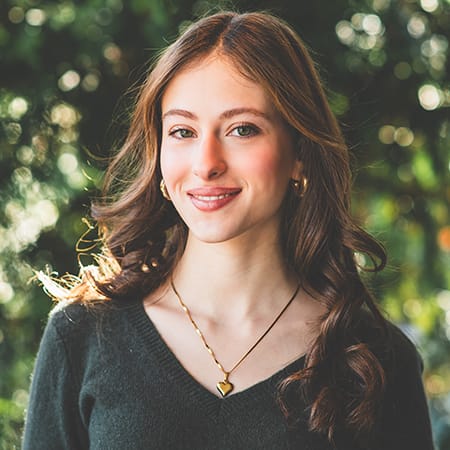
Meet Daily Point of Light Award honoree Emma Justus. Read her story, and nominate an outstanding volunteer or family as a Daily Point of Light.
In 2018, at just 11 years old, Emma Justus faced the life-altering diagnosis of her father’s glioblastoma, a terminal brain cancer linked to his volunteer work at Ground Zero after 9/11. Instead of succumbing to despair, Emma was inspired to turn her family’s personal tragedy into a mission of hope. She founded Club Care, a charity organization that supports pediatric oncology families, and later enrolled in a junior therapy training program to deepen her commitment to helping others.
Club Care began with a heartfelt project: Emma and a friend, who had also lost a parent to cancer, created nearly 100 care packages for pediatric oncology patients at a local hospital. This simple but impactful gesture has since blossomed into numerous initiatives. From organizing mother-daughter outings for families affected by brain cancer to connecting with single moms balancing the challenges of cancer treatments and parenting, Emma has shown an exceptional dedication to spreading joy and relief to those in need.
Emma’s leadership extends beyond her local community. She developed a manual to help other students start their own Club Care chapters, which now span across her city and reach as far as Miami and Paris. These chapters follow Emma’s model of compassion, raising funds, organizing events and offering support to pediatric cancer patients and their families. Over the years, Emma has raised more than $15,000 for Club Care, hosted countless fundraisers and personally overseen 10 global chapters, fostering a network of young changemakers who continue to amplify her mission.
Emma’s ability to transform personal loss into a movement that touches lives worldwide is a testament to the difference one young person can make when driven by a desire to care for others.
Emma Justus is the passionate founder of Club Care, born from her experience losing her father.
Tell us about your volunteer role.
When I was 11 years old, my dad was diagnosed with glioblastoma, a brain cancer. My family is very philanthropic on the whole and raised me to help others in situations where I am able to provide help, and to always see what I can do with what I have.
When my dad was diagnosed, I knew I wanted to do something for my community, and one of the most important things you can do in volunteer work is draw from your own life experience. So when I was 12, I founded an organization called Club Care. We hosted one event, and then another. It grew from there. I’m the founder and I have a whole team of volunteers, who are incredible. It’s been growing since 2019 and has been really amazing.
What inspires you to volunteer?
My own personal experience of losing my dad inspires me. Your perspective shifts when you have empathy. You have a whole different mindset when you see someone going through the same experience you were once in. One thing that my organization really puts in a lot of effort to do is not just to work with the child who has cancer, or the parent who has cancer, but the entire family unit. Pulling from my personal experience, cancer impacts the entire family. We make sure to include siblings and other family members. My goal, when I do any of our events, is to create a loving, supportive environment.
What do some of these events look like?
We have all different types of events. We do fundraising events, like our auctions and bake sales. We host some virtual events. We partner with Mt. Sinai and do events with the pediatric oncology ward, as well as the older oncology patients
We have games. We host live cooking tutorials. We do hands-on experiences. One time, we took a family to the American Girl doll store, and gave them a gift card for a shopping spree. For another family, we did a makeover. We had volunteer hair stylists and makeup artists who offered a glam transformation. We’ve taken families to sporting events. We like hands-on events that we can attend, in order to establish a connection with the families. Some of my favorite events are working with families we previously worked with, reestablishing our connection with them. We like to stay in contact with them to create that lasting relationship.
What are your long-term plans or goals for the organization?
Something we’ve started doing over the past few years is a chapters program. Others interested in starting a Club Care chapter – for instance friends who’d volunteered with me in the past – can start Club Care chapters in their own high schools. There are some in New York, where I live, as well as in Pennsylvania, in Miami and even in Paris. It doesn’t matter how big the events are. Just knowing that there’s a collective community and reinforcing that sense of community for people is so powerful.
Another part of my mission with Club Care is reinforcing the belief that young people really can make a difference. If it’s something you’re passionate about and you have the ability, you can do it. There aren’t a lot of resources for young people, and I hope my experience can help inspire other young people. Then those people can inspire others, and so on. I really want it to be an effort demonstrating what young people can do with what they’re passionate about.
What’s been the most rewarding part of your work?
Those established relationships with the families. Seeing their progression from when you first meet them. Seeing their gratitude. The best part is how I feel afterward. iIt is such an incredible experience knowing you can take your own experience and you have the power to make a difference in someone else’s life. That feeling is indescribable – it’s the best feeling in the world to see someone light up based on something you did. I want everyone to have that experience.
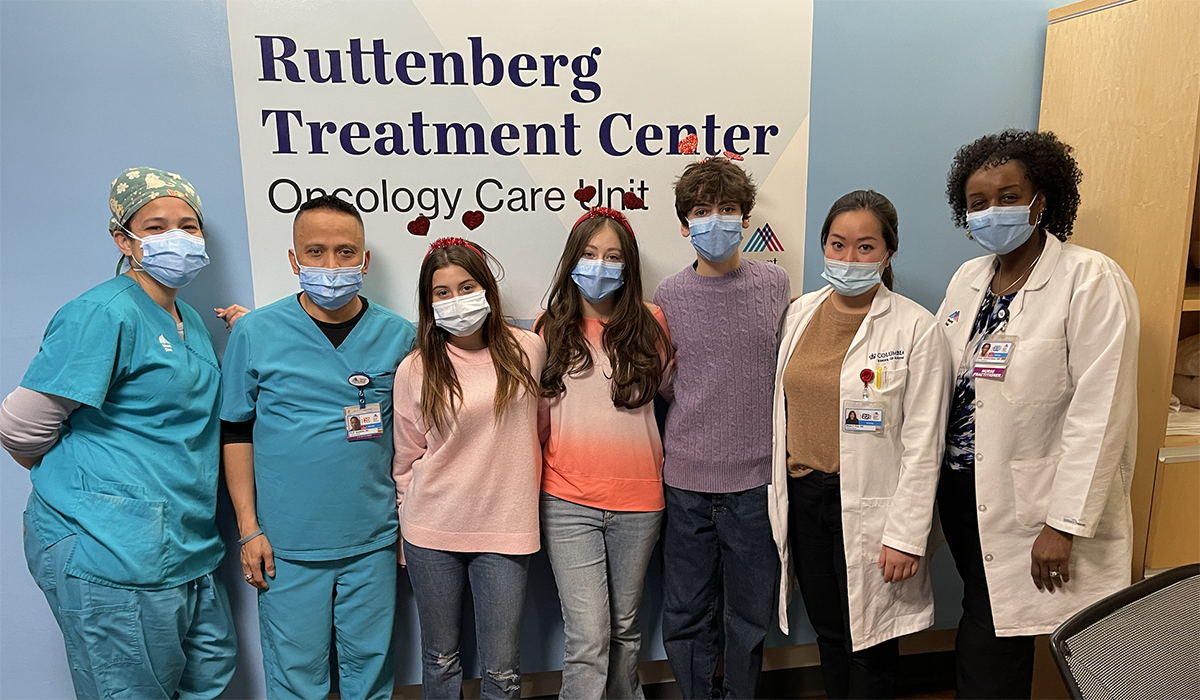
Emma (middle) at the Mount Sinai Oncology Care Unit
Why is it important for others to get involved with causes they care about?
It’s so important because they’re passionate about it and because they know what it’s like. I hope that people don’t always have personal experience with a cause to become passionate about it. But if they do, knowing that they can use that circumstance to make a difference is so important. You can take a negative experience and make something positive out of it.
Any advice for people who want to start volunteering?
My biggest tip is that volunteering is volunteering – no matter the scale. We’ve planned huge fundraisers with tons of families and kids. But we’ve also made cards and mailed them to the hospital. Volunteering on any scale makes a difference.
Start small, see how that feels and then work your way up. Something that’s also really helpful is finding people who also have a mutual commitment to the passion. It can be intimidating doing it alone, but with others, it can be a little less scary.
What do you want people to learn from your story?
Nothing is so bad that something good can’t come out of it. Of course, I wish my dad was here. My experience is so upsetting. It was a huge event in my life. But now, I’m able to take that experience and positively impact others’ lives. If something bad has happened to you, how can you make something positive from it, even in a small way? No matter how bad something is, there’s always a little bit of positivity that can come from it.
FIGHTING CLOTHING INSECURITY WHILE BOOSTING SUSTAINABILITY
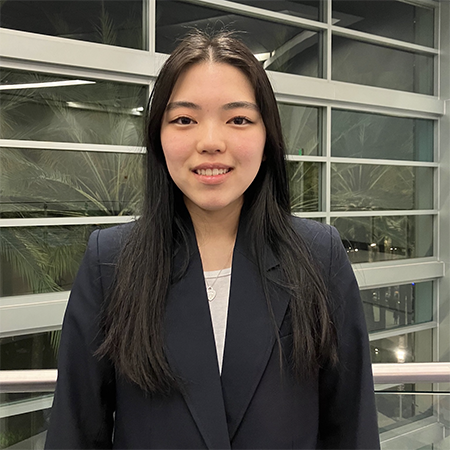
Meet Daily Point of Light Award honoree Hannah Sim. Read her story, and nominate an outstanding volunteer or family as a Daily Point of Light.
Hannah Sim’s inspiration to start The Mitten was forged by a desire to help others.
As a child, Hannah realized that not everyone has the items they need to survive. While some people have closets filled to the brim with clothing, others lack the simple necessities to stay warm on a daily basis. In an attempt to bridge the gap between the two, The Mitten was born. A student-led organization, The Mitten provides support to under resourced communities by distributing clothes and hygiene products.
The Mitten’s work to battle clothing insecurity is also a tremendous effort toward sustainable practices. Since clothing and textiles are a significant chunk of the waste that sits in global landfills, Hannah is also tackling the problem of overconsumption. Through each clothing drive she hosts, items that likely would have either sat in a closet or found their way to the garbage are given new life as a piece to keep someone warm and healthy.
As a 17-year-old high school student, Hannah has a lot on her plate these days. Still, she says continuing The Mitten’s mission comes naturally to her, particularly since she enjoys doing it so much. With every clothing bin that Hannah places in a library, church or school, she is demonstrating her passion for helping others. Her spirit for volunteering should serve as an inspiration to anyone around her.
HANNAH SIM IS THE CO-FOUNDER OF THE MITTEN, AN ORGANIZATION THAT WORKS TO COMBAT CLOTHING INSECURITY WORLDWIDE. /COURTESY HANNAH SIM
What inspired you to get started with this initiative?
I first gained inspiration to start my nonprofit when I visited New York City. I moved to New York in 2017 and when I first visited New York City, I was shocked by the number of unhoused individuals who were living in the city. That was something that I wanted to make a change in. I wanted to help these people in some kind of way, and one way that I found that I could help these people was through clothing and bridging the gap between the privileged and the underprivileged by repurposing the clothing that people don’t need and cycling it back to people that require them as an essential commodity.
Tell us about your volunteer role with The Mitten.
We host monthly clothing drives. Every month we get in contact with a new organization or an organization that we’ve already established a partnership with. We place bins and collect them when they’re full as part of our monthly process. Then, we get in contact with a local shelter and donate the items.
We also stay in contact with all the different organizations. We send out monthly emails to every organization that we reached out to and worked with in the past, and we kind of keep them updated in our statistics and make sure that if any future clothing donations are coming up, we make sure to update them on those.
What are your long-term plans or goals for the organization?
I think right now we just want to expand our organization more. Currently, we have eight chapters around the world, but we want to create more chapters, even just within the United States. Also, we’d like to bring in more volunteers for each chapter so we’re able to help more people. At the same time, we’d like to reduce the amount of clothing that is going to landfills, which really helps with our sustainability goals.
What’s been the most rewarding part of your work?
I think just seeing individual stories that we sometimes receive back from the shelters that we donate to. We sometimes get information about how the lives of the people who received our clothing were changed and how they were impacted by the donations that we were able to provide them. And I think that’s just really inspiring and helps us keep going—just seeing how much change we were able to bring in these individual’s lives.
What have you learned through your experiences as a volunteer?
Volunteering is rewarding. Even though the process itself is not meant to help you, since it’s meant to benefit other people, just knowing how much other people’s lives could be affected by it just helps me keep going. I think I learned about the importance of helping other people and putting their lives in front of my own comfort, even if it’s more difficult.
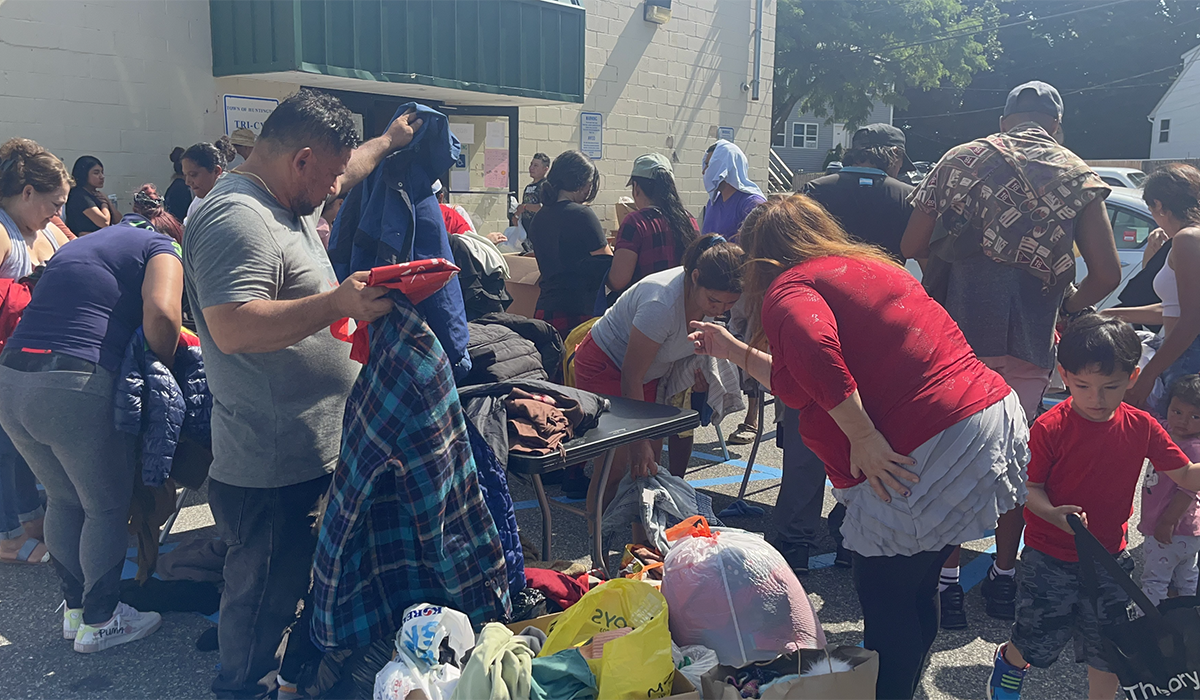
COMMUNITY MEMBERS BROWSE CLOTHING AT AN EVENT HOSTED BY THE MITTEN, HANNAH SIM’S ORGANIZATION, AT THE TRI CYA. /COURTESY HANNAH SIM
Why is it important for others to get involved with causes they care about?
I think stepping out and being the first one to start an initiative is difficult, but I think it’s through these individuals who step out of their comfort zone that real change can be made. Without these people, the world wouldn’t be the same. We have to be the change that we want to see or nothing else is going to happen. I think we have to step out and that will also inspire others to do things that they want to see changed in the world.
Any advice for people who want to start volunteering?
Try to focus on what specific areas you really want to address. For me, that was both the environmental aspect of it and also the humanitarian aspect of helping people. If they have clear goals set on what exactly they want to accomplish, then they’ll be able to follow others who’ve done similar things in the past and create their own form of helping people in these specific areas.
What do you want people to learn from your story?
I think something I want people to learn is these are things that I never thought that I could accomplish as a teenager. But I think everyone, as long as they have their mind set on what changes they want to see in the world, no matter how old they are, can accomplish things that they never thought they could. Inspiration is so important and having your goal set is important. I want to tell everyone that it’s possible, even as a young student, to make the change you want.
One Peace Corps Volunteer’s Ripple Effect in Mongolia
Meet Daily Point of Light Award honoree Christopher Wizda. Read his story, and nominate an outstanding volunteer or family as a Daily Point of Light.
Christopher Wizda, a Peace Corps volunteer in Ulaanbaatar, Mongolia, has made significant contributions to education, community development and cultural exchange – with 3,000 hours of volunteer work with the Peace Corps under his belt.
Christopher is no stranger to getting to know new places. As a military kid, he moved throughout his entire life, and with one exception, never spent more than three years anywhere. He attended six different schools and earned a master’s in international business development. He considers Alaska home, as well as parts of the American South and New Hampshire. And for most of his last three decades, he’s been actively serving others.
“Service has always been a big part of my life,” Christopher reflects. “I was in Boy Scouts and made it all the way to Eagle Scout, which instilled in me a spirit of community service. After Scouts, I was involved in the Special Olympics, as a delegation liaison during the World Games. After my university days, I got back into the Red Cross, working with refugees, while volunteering at a museum for the arts. At the time, I was also working at a school as an English teacher. Then, in my free time, I was doing a lot of volunteering at the U.N., which was almost a full-time job in itself!”
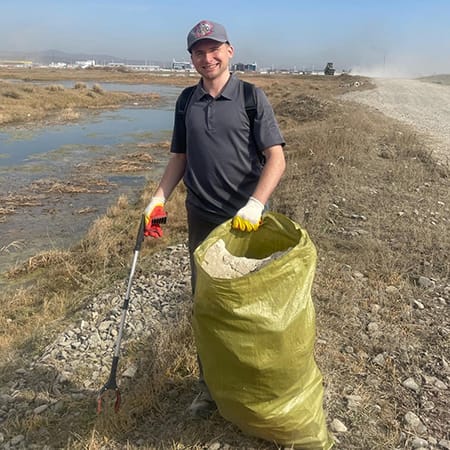
Short-term projects, such as tree planting or park cleanups, and long-term partnerships, like facilitating SDG-focused programs, allow Christopher to combine his professional background with community-driven goals. Here, he participates in a wetland cleanup, picking up trash.
Around this time, Christopher decided he wanted to shift focus, working with one American organization that combined education and community development. The Peace Corps was the perfect avenue. And as the Ulaanbaatar community can attest, his dedication to his role is evident in numerous contributions. First and foremost, he has co-taught English classes, mentored students and collaborated with local teachers to enhance the quality of education for nearly 27 months.
“As a Peace Corps volunteer, our work is comprised into two parts: English education and community development,” Christopher shares. “About half my day is spent at a school, teaching English, working with clubs and teachers, and facilitating education as a native English speaker.”
Beyond the classroom, he has also actively engaged with the community, implementing initiatives like digital literacy training and supporting social enterprises.
“On the community development side, that’s up to me – it’s whatever I’m interested in,” Christopher says. “Personally, I’m really interested in business and arts. I try to find organizations that exhibit both the business side and creative side. One of them is the Mongolian Quilting Center, one of my favorite initiatives to work with. It combines art, creativity and Mongolian culture, and also empowers women coming from hard economic circumstances as well as people with disabilities.”
To date, Christiopher has helped to increase the Mongolian Quilting Center’s sales by 7% and engaged over 200 participants in its 20th-anniversary event. Additionally, he has developed a framework for a 12-acre innovation hub, involving stakeholders from the U.S., Taiwan and Mongolia.
Christopher has also played a crucial role in promoting digital literacy in Mongolia. He has distributed over 36,000 Wikipedia guides, conducted workshops for students and teachers, and secured a $45,330 grant for educational programs. His efforts have benefited hundreds of individuals and contributed to the overall development of the country.
“The fact that I’m seeing results and I’m seeing interest is so rewarding,” Christopher says. “There haven’t been any cases of stagnation. People keep coming back for workshops. One of my mentees for one of the college clubs got a full-ride scholarship to university. Seeing the kids at the school getting excited and using their English more. It’s been wonderful to see these tangible results.”
As a Peace Corps brand ambassador, Christopher has actively promoted a better understanding of Mongolia and volunteerism in the United States. He has engaged with over 400 individuals through social media, outreach events and public speaking. By sharing his experiences and insights, he has inspired others to consider volunteerism and international service.
“Mongolia is a very unique place,” Christopher shares. “The culture itself is like a giant village. They’re very proud of their culture, and have a very deep connection to the land, their environment and their own Mongolian heritage. People are really open to development, education, new knowledge and new experiences. It’s very refreshing. I find it inspiring.”
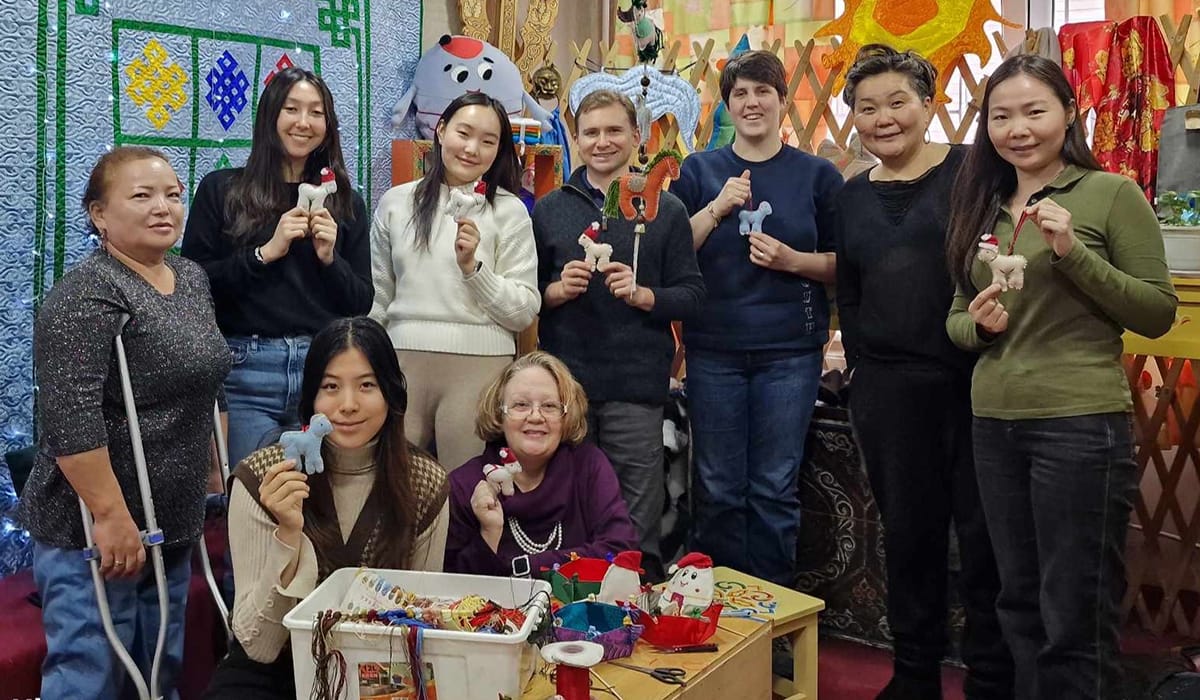
Christopher enjoys collaborating with organizations like the Mongolian Quilting Center, which empowers women and individuals with disabilities. This photo was taken after they finished their winter workshop, making ornaments from upcycled materials.
Christopher’s dedication to his work has earned him recognition from the Mongolian government. He was awarded the Teacher’s Sign Award for his contributions to the country’s education sector. There is no doubt his impact on the lives of the Mongolian people will be felt for years to come.
Christopher encourages anyone interested in volunteering to start by creating a personal identity map. “What makes you you?” He asks. “What are your likes and dislikes? What member of the family are you? Who are your friends? What are your hobbies and interests? Then, do a neighborhood map. See what’s around. There might be someone or something in your area that can be utilized. Personal and physical – as well as social – resource utilization is crucial.”
Indeed, getting to know oneself is a central theme of Christopher’s story. With all the volunteer opportunities out there, he urges people to find their niche – something they can really put their heart and soul into.
“And even if one thinks they have a restriction – physical, mental or otherwise – there are always ways to work around that,” he states. “Anything that may feel like it’s holding you back, remember that you have other skills that have developed, and those can be just as valuable in service work.”
Meet Daily Point of Light Award honoree Aadit Bontha. Read his story, and nominate an outstanding volunteer or family as a Daily Point of Light.
Everyone has things in their closet they are no longer using—sweaters they’ve grown out of, books they’ll never read again, a sourdough kit that was wishful thinking at best. Aadit Bontha, a 16-year-old competitive fencer, discovered his extra stuff in the realm of school supplies. Armed with the knowledge that kids who lack things like notepads, pencils or textbooks are more prone to have poor attendance or to drop out of school entirely, Aadit decided to redistribute his surplus—and others’—to kids around the world.
In 2022, before starting high school, he founded School Essentials Drive. Aadit’s mom drove him to pick up and drop off donations before he got his driver’s license, happy to lend a hand to the cause. Partnering with one library for supply drives has expanded to seven, and as the organization’s reach has grown, so have the contributions.
He now also coordinates with his local YMCA and funnels a portion of items through international partners like Develop Africa. Their people on the ground have helped facilitate the donation of nearly 300 pounds of supplies to places in West Africa and Bangladesh. Aadit has even donated part of his summer internship earnings for shipping costs.
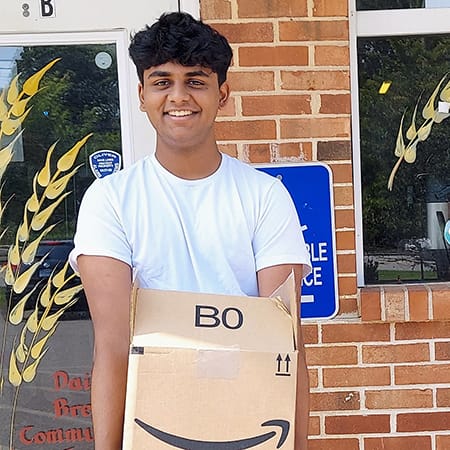
Aadit Bontha, founder of School Essentials Drive, donates supplies to the local Daily Bread Pantry.
What inspires you to volunteer?
I’ve been volunteering for around six years, and I really like making an impact on the community. I feel like I was born with good fortune, but that your economic status shouldn’t impact your future. So I want to help those who need it more than me.
What led you to get started with this initiative?
I had lots of extra school supplies from over the years. I thought that if I had that many, my friends and family members likely would, too. I reached out to a local library, and they agreed to set up a donation drive.
What does your day-to-day look like as the founder of School Essential Drive?
After school, I usually check our email and social media for people requesting to donate or asking about the fund. Then, we drive over to our local libraries or YMCA to see if any donations have been made that day. If we collect enough, we go to the UPS Store to get a shipment label and send those supplies to people who need them.
I reach out to new local libraries periodically to widen our outreach and drive to community shelters, churches, etc. to donate supplies locally. I also run fundraisers at school and among local friends and family to raise money for shipping costs for our international partners.
Did you run into any challenges finding your following?
In the beginning, a lot of people didn’t trust my organization, as I didn’t have my 501(c)(3) status yet. That was the main thing I could work towards to become more trustworthy. Getting that was a pretty big accomplishment for me.
Tell us about the Android app you developed.
I made an app in order to streamline the process for School Essentials, so people could see where they could donate and view our partner locations. It was also to be more transparent. They can see where everything goes and how it works. We have a detailed spreadsheet of past donations and when we donate. It’s another tool for people to learn more about School Essentials and to verify its authenticity. I update it once a week.
I learned to code by watching YouTube videos for the most part. I didn’t really have any experience, though I did have some basic classes in school.
What are your long-term plans or goals for the organization?
Looking ahead, when I’m in college, I want to expand nationally and make a bigger impact. I’m also looking into donating in more countries, like Sri Lanka and the Caribbean, where there’s some economic inequality and social tension. Or places, like Ukraine, currently affected by war.
What’s been the most rewarding part of your work?
It’s seeing people who really have a need for something that I deliver, and that even if it’s a small impact, knowing that I changed their lives for the better in some way. Our shipping providers have contacted us with some handwritten letters and pictures of the kids receiving the items abroad.
What have you learned through your experiences as a volunteer?
It’s really important to connect with people who might know more or who have been volunteering or hosting events longer than me. They’ve given me a lot of valuable information. I’ve also learned to be hands-on and talk to as many recipients as possible.
Additionally, it’s important to advertise on social media and build an app. Those are some of the main drivers of awareness. Without those things, I wouldn’t have been able to make such a big impact, because people wouldn’t have known about the drives.
Why is it important for others to get involved with causes they care about?
I don’t think it’s fair that some people don’t get the same opportunities as other people. If you have the ability to help someone, it’s always best to do it. You can make an impact on their life, and everyone benefits.
Any advice for people who want to start volunteering?
For someone who wants to start their own initiative, the most important thing is talking to a lot of people, because it gives you a lot of new information that you can use to come up with ideas for your initiative. If you’re trying to find an initiative to help, look for opportunities that use your hobbies or interests. Connect with something you already know about doing and help other people out at the same time.
What do you want people to learn from your story?
Anything is possible. Even at a young age, you’re able to start donating and making a big impact on the world. You don’t need to be well-known to start an organization. Anyone can do it.
FIGHTING MENTAL HEALTH STIGMA ONE BRUSHSTROKE AT A TIME
Meet Daily Point of Light Award honorees Gabby Wong and Joshua Ferriere. Read their story, and nominate an outstanding volunteer or family as a Daily Point of Light.
While their journey may have been sparked by tragedy, Gabby Wong and Joshua Ferriere are creating something beautiful.
As high school students in the San Gabriel Valley, Gabby and Joshua witnessed the effects the horrific 2023 Monterey Park shooting had on their community. To ameliorate the mental health crisis in the school system, the duo formed Therapicasso, a youth-led organization that uses art as a strategic tool to forge a sense of community through creativity. Art workshops focus on mental health-related topics, like healthy coping mechanisms and minimizing stigma. Student programming serves as a platform for healthy, open discussions, providing young people with a safe space to discuss their journeys while also expressing their sense of individuality. With every art workshop, open mic session and community event, the Therapicasso team works to empower the youth around them. Whether they’re raising funds to host more events, growing their community on social media, or creating program partnerships that have affected over 14,000 students within the Alhambra Unified School District, the healing power of Therapicasso’s work is clear.
Gabby and Joshua’s dedication to turning a horrific tragedy into a force for good is an inspiring call to action for anyone looking to make change within their own community. Through the creation of Therapicasso, these powerful youth advocates have created something special that serves as a testament to volunteering’s ability to enact change.
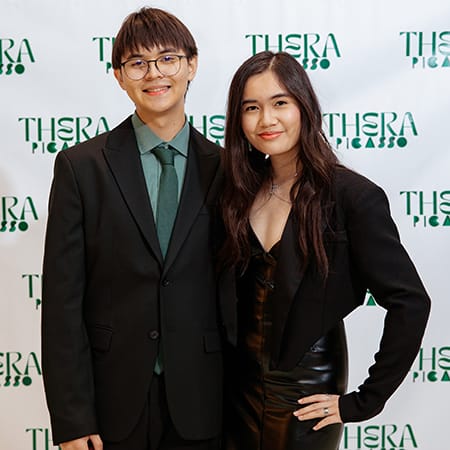
THERAPICASSO CO-FOUNDERS JOSHUA FERRIERE AND GABBY WONG POSE TOGETHER AT THEIR INAUGURAL GAMA. /COURTESY GABBY WONG AND JOSHUA FERRIERE
What inspired you to get started with this initiative?
Joshua: In 2023 January, we sat down together at a cafe right after the Monterey Park tragedy that happened at the Star Ballroom Dance Studio shooting in our community. We were talking about how we could let our perspective be known. Gabby and I realized that we had a lot of free time. We had a shared passion for art and mental health, and we decided to co-found Therapicasso.
Gabby: We knew we wanted to address mental health and intergenerational stigma because, within our community, we realized that both the cause and the effect of the Monterey Park shooting was intergenerational stigma. When I say the cause and the effect, I mean the fact that we were not conversing with the older generation, who were the main victims of the shooting. Then the effect was that a lot of the younger generation, a lot of our peers, and a lot of the student body, struggled with the blowback of the shooting. They struggled with the effects that were not so obvious.
Tell us about your volunteer role with Therapicasso.
Gabby: For me, I’m more on the legal and logistical side of things. I do a lot of the planning and the scheduling. I do everything related to writing emails, responding to and reaching out for new partnerships, and anything monetary.
Joshua: As the COO, I manage the programs and the workshops that we do. It all comes through directing our board, which we kind of are always working with. And basically, I just work to create these new programs and make sure that they run smoothly on workshop days. On top of, of course, helping out Gabby with any of the necessary things we need to do, such as the monetary stuff, or any of the programs or future ventures that we’re going to be doing.
What are your long-term plans or goals for the organization?
Gabby: When it comes to plans, we have been working to create our ambassadorship program. And so we have an ambassador program for sixth through eighth graders who will be able to, when they get to high school, continue the work that we are doing in the community. We will stay in our positions as CEO and COO. However, we want to allow them to step into the role specifically in this part of the community. Then eventually, once we have safely settled our roots here, we’re going to take this modality wherever we respectively go to college and bring it to the local school districts.
What’s been the most rewarding part of your work?
Joshua: For me, it’s just seeing the change that we’re making in the students’ lives. Before Therapicasso, I always thought that saving someone’s life or changing someone’s life was specific to being a doctor or saving someone from a legal case. But after working with these children, I’ve realized that what we’re doing–these workshops, art in general, and the opportunity we’re giving them–can do so much for them.
What have you learned through your experiences as a volunteer?
Gabby: I would start with the more funny things, like how to call the IRS! But when you’re 17, these are things you have to learn. We had to reach out to a lawyer and partner with a lot of people in our community who wanted to support us. I not only learned about grassroots fundraising and community organizing but also how to make long-term connections with people in the community who want to see change happen.
Joshua: I think something that I learned specifically was a new sort of leadership style. A leadership style of empowerment. Instead of making it a clear-cut, black-and-white sort of situation, which a lot of companies do, we took it as an approach to entering a conversation. If our youth board has something to bring up, we’ll let them bring it up. We are opening this conversation, and we bring that to any collaboration. We bring that in our workshops, bring that everywhere and we bring that into our leadership style. And it was new to us, and there was a bit of a learning curve. But eventually, we found our groove.
Why is it important for others to get involved with causes they care about?
Joshua: Not only are people cultivating their passions, they’re enriching themselves in what they want to do. Taking their passion and growing it to help others. I think that the skill of being able to take something that you are passionate about and bring it to a community level, where you’re helping others, is something that I feel everyone should be able to cultivate within themselves. Everyone has a story to tell. Everyone has a narrative, and volunteering is a great medium. It’s a great way vehicle to kind of push that narrative.
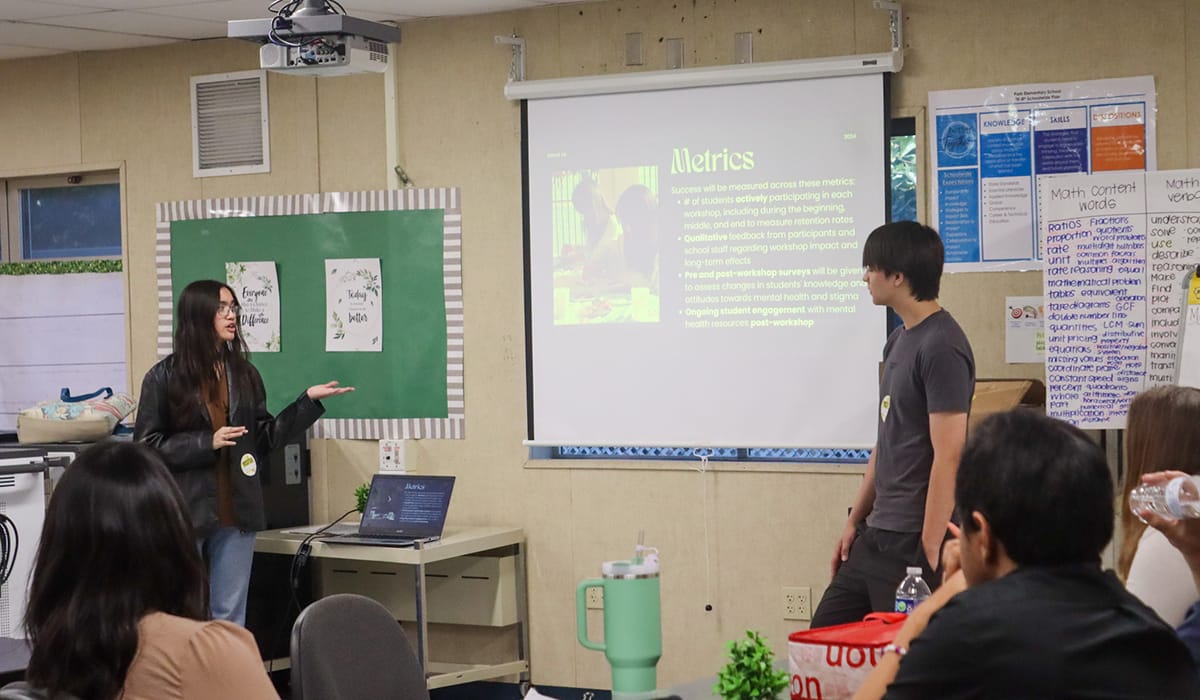
GABBY WONG AND JOSHUA FERRIERE PRESENT THERAPICASSO WORKSHOP PLANS TO STAFF AT THE PARK ELEMENTARY SCHOOL. /COURTESY GABBY WONG AND JOSHUA FERRIERE
Any advice for people who want to start volunteering?
Gabby: Volunteering helps you find like-minded people. You don’t have to start your own organization. You can volunteer with others and then by meeting those other people you find your community. You find people who are aligned with you in that goal, in that volunteer work and then that it’s in and of itself, will naturally create a community of people who want to help one another and help and look to the mission that they’re doing. When you’re finding your voice, when you’re identifying your passion, also identify what need in the community you’re addressing.
What do you want people to learn from your story?
Gabby: I want people to learn how to reclaim their power. I feel like in the society we’re in today, and with social media, we feel helpless. We feel like we are one small voice in a crowd of billions of people. But the truth is that that one voice has so much power. When you yell fire into a crowd, that’s a bad thing. The whole crowd will come with you. Differently, you can use that same power of your voice in that one room to be able to create a cause and yell fire. But it’s not fire in a bad way. It’s fire as in the fire inside of you.
Joshua: Wherever you are and whatever walk of life you’re at, there’s always an opportunity out there. Doors are open. And if you don’t see any doors, you can make the door. And in our case, we made that door with Therapicasso. You can find your local hospital. You can find where a door wherever you are passionate about, and wherever your voice takes you. It always stems from what you want to do with your time, because time is valuable. Your time is valuable, your passion is valuable and your voice is valuable. So take into consideration all those things. But with time, passion and clarity, that’s when your volunteering can make an impact.
Concerts for a Cause: Houston Teen Build Connections and Raises Funds with Music
Meet Daily Point of Light Award honoree Tanya Mahesh. Read her story, and nominate an outstanding volunteer or family as a Daily Point of Light.
Whether one listens or performs, there is a healing power to music. To connect with the notes can lift the spirits, bring back memories or simply help a person find a moment of peace. 17-year-old Tanya Mahesh knows that better than anyone. She has been a pianist for more than 12 years and a classical opera singer for the last few. She is also a former competitive figure skater who recently tested into the top level of United States Figure Skating Moves in the Field, a standardized series of skills and elements of control.
It’s the latter of these talents, and her desire to help a skating nonprofit, that led her to plan her first fundraising concert with her sister. Six years ago, they used those same skills to create Chords for a Cause, an organization that uses music to improve lives and connect with the community. More than 225 musicians from around the world have put on almost 246 live and virtual concerts. Some have been to combat loneliness in over 35 nursing homes and senior living facilities across the US. Others have raised a combined $29,525 to support people with disabilities, impoverished children, education and relief in Ukraine.
Tanya continues to coordinate and play in concerts as well as mentor volunteers and bring classical music to elementary schools in underserved areas. Chords for a Cause brings joy to many and, if Tanya has a say, will do so for a long time to come.
What inspires you to volunteer?
I first started figure skating when I was three years old. When I turned 11, an organization called Skate Therapy came to my rink that helps those with physical and developmental disabilities learn skills. I started working with them, but I was too young to become a coach, so I planned fundraising concerts for them. My sister and I would play piano. We called it Rhythm on Ice, and it became an annual concert that continued even after I became a coach for them.
Later, when my grandfather was diagnosed with Parkinson’s disease and had to stay in a nursing home, we realized that there was a lot of loneliness there, especially during quarantine. So, my sister and I, again, decided to play music for him and the other residents. Eventually, we decided to expand to multiple nursing homes, but we couldn’t do it alone. We started inviting our friends, and eventually, it became a big network that we needed to manage in a more organized way, so we started Chords for a Cause.
Tell us about your volunteer role with Chords for a Cause.
As the head member, I keep track of all of the chapter heads. I make sure that they’re planning concerts and are able to get members together for them. I manage our website and blog, and I perform every month or two at the nursing homes near me. During Christmas, we’ll do more Christmas carol-type songs, but we often do pop or older music so that residents can recognize and relate to it. And then we do a lot of classics and classical music as well.
Because Chords for a Cause started during the COVID pandemic, we started virtually. We reached over 1,000 people through Zoom concerts or posted compilations of recordings people would send in on YouTube. Recently, we started in-person.
How did you go from an idea to having international chapters?
It started locally, just in my high school. I organized with our band, orchestra and choir. A couple of us would go out every couple of weeks, but once we started posting on YouTube, we got a lot more traction. Instagram also really helped market us. Eventually people started messaging us about joining, and it spread rapidly after that. There’s a huge network of other nonprofits on Instagram that shares each other’s messages with their own followers. We build each other up.
What are your long-term plans or goals for the organization?
I want to start a chapter wherever I go to college. I’m hoping to keep in touch with the team leads and continue the work that we’re doing. We’re already spread across the United States and abroad. Now it’s more about focusing on maintenance and ensuring residents don’t get left behind.
What’s been the most rewarding part of your work?
A lot of patients are experiencing dementia, and the music helps bring memories back. One time, I was singing “Somewhere Over the Rainbow,” and there was a resident who started singing with me, and eventually, all the residents joined in. It’s really sweet to see how much music can do. It’s not just about bringing back memories but bringing them joy and the knowledge that they’re not alone.
What have you learned through your experiences as a volunteer?
I’ve learned a lot about communication. When I first started, it was difficult for me to convince people to support my cause. It’s not just about being able to direct people but being able to spread your message and help them understand the importance. Our biggest challenge was convincing people to join and consistently show up. Communicating better helped with that.
Any advice for people who want to start volunteering?
People are often scared to jump in, because they think that it might not be for them. But some of our most consistent members are people who were originally hesitant to join. Just go for it. Get involved, and you’ll find what you really like.
What do you want people to learn from your story?
Our first Rhythm on Ice concert started with my sister and me in my living room. Since then, it’s grown to many members across the world. You can start from nothing as long as you have a mission and a purpose. And again, communication part is really important. As long as you have that message, you can do whatever you put your mind to.
Wellness Across Generations: How One Volunteer Champions Senior Mental Health
Meet Daily Point of Light Award honoree Areen Hashemi. Read her story, and nominate an outstanding volunteer or family as a Daily Point of Light.
Areen Hashemi is changing lives through her heartfelt dedication to improving mental health for seniors. As the co-founder of Generation Union, or GU, a 501(c)(3) nonprofit organization, she has established a robust network of volunteers committed to creating connections with often-overlooked senior citizens. By partnering with 14 senior living facilities and managing over 250 volunteers across 26 chapters, Areen has turned her vision into a powerful movement that transcends generations, offering companionship, joy and meaningful engagement to residents.
Generation Union’s impact extends beyond mere visits; it brings warmth and thoughtfulness into the lives of seniors through creative events and activities. Whether it’s organizing a catered Mother’s Day luncheon for residents whose families couldn’t be with them or hosting game nights featuring Bingo and UNO, Areen and her team ensure every interaction is filled with care. These efforts foster an atmosphere of inclusion and creates lasting memories for both volunteers and residents alike.
Areen plays a crucial role in the organization’s growth and success. She dedicates around 20 hours a month to a wide array of responsibilities, from buying supplies and organizing events to recruiting and managing volunteers. Under her leadership, Generation Union has raised approximately $4,000 to support its mission and has hosted over 30 impactful events. Areen’s ability to inspire others is evident in the way Generation Union continues to grow, now with 18 chapters across the nation, all united in their commitment to enhancing the lives of senior residents.
Generation Union is more than a nonprofit – it’s a testament to Areen’s belief in the power of connection and compassion. Through her tireless efforts, she has created an intergenerational bridge that not only uplifts the spirits of senior citizens but also educates and empowers younger generations to make a difference. By transforming ordinary moments into extraordinary memories, Areen has demonstrated the profound impact one person’s vision and determination can have on an entire community.
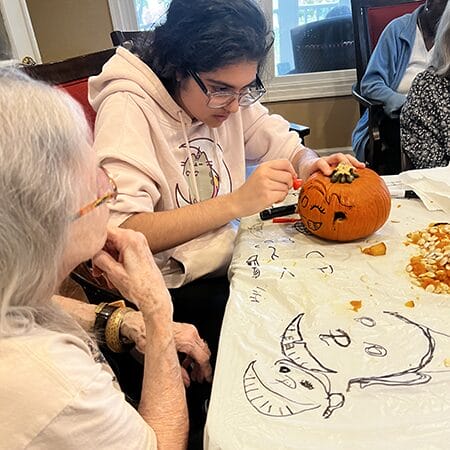
Areen and a resident designing and carving “Hope,” the name of the resident’s daughter, on a pumpkin. /Courtesy Areen Hashemi
Tell us about your volunteer role.
I’m the co-founder and co-executive director of Generation Union, and I’m mostly responsible for recruiting and fundraising. I lead the social media pages, I’m the self-designated event photographer, and I lead fundraising campaigns like our bake sales and our door-to-door handmade soap sales. I also love to volunteer, so alongside my executive role, I’m a hands-on volunteer with the organization. That’s the best part!
Why is this issue so important to you?
It started with my grandma. Both my grandma and I have obsessive compulsive disorder, or OCD. It’s a condition that might seem strange to neurotypical people. Because of this strangeness aspect from the outside, she and I related to feelings of loneliness and not belonging in society – especially during hard times. Her sense of isolation worsened when she moved to a residential home, because she was separated from her family, even with our frequent visits.
I know it’s not just my grandma. I know many residents in senior homes who experience that same sense of loneliness, regardless of any conditions. Many of them feel depression, maybe even thoughts of suicide, so I started volunteering with them.
What inspired you to get started with this initiative?
I wanted to found GU with my co-founders, Emily and Rachel, who I met through volunteering and school, because they are passionate about the same things. Initially, we wanted to start a club. People were asking about it and wanting to join in on it. But I ended up moving schools, so we couldn’t connect a club to a school. We needed to form an external organization, and that’s how GU was born in 2021.
What are your long-term plans or goals for the organization?
I want to scale the chapters program and turn GU into my full-time career. For context, our chapters program is an opportunity for anyone to start a branch of Generation Union. They can volunteer at senior homes, fundraise in their local communities and recruit local volunteers. Right now, we have 30+ interested chapters, including globally. It’s exciting to see people in places like Malaysia interested in starting a chapter. Our New York chapter just launched, and it’s really amazing to see those events on Instagram and see how youth care about seniors everywhere.
I really want to scale GU and make sure that the nonprofit is thriving as best as it can. The Mothers Day picnic or the Pink and Red Hat Party are our biggest events. But this spring, we also want to implement food drives to help feed unhoused seniors around Washington D.C. We’re excited about scaling our current work and expanding it too.
What’s been the most rewarding part of your work?
During our Mother’s Day event, another volunteer and I were truly overwhelmed by how much a simple luncheon could impact senior residents. We had no idea how many amazing mothers couldn’t celebrate their special day with their families. Both this other volunteer and I are immigrants, and we are distant from our own grandmothers. Being able to spend the day with those who were distant from their own children and grandchildren was extra meaningful to me.
One resident was talking to the other volunteer, and their conversation was really comforting. They drew in strength. They knew they weren’t alone in their experience of being away from their loved ones. It reassured me that distance doesn’t negate the fact that someone is loved and remembered by their family. It doesn’t matter if you’re 7,000 km or a couple of blocks away. Love has no geographical bounds.
What have you learned through your experiences as a volunteer?
Big picture, I’ve learned that the gap between generations can be filled with a conversation or a smile. It doesn’t take much. Gen Z tends to engage in a lot of “Boomer humor” and judgment toward senior generations. I don’t understand that mindset. If you seek relationships with people outside of your age group, you can learn a lot from them. A lot of times, these seniors – these Boomers – are not close-minded, or whatever the sentiment is around them. They are wise, they have so much lived experience and they’re so interesting to talk to and even be friends with. I wish more people my age would seek them instead of dismiss them.
Why is it important for others to get involved with causes they care about?
Everyone has a duty to their community. Community gives you so much – whether physical, like your neighbors helping you mow the lawn, or emotional, like your friends or classmates helping you with your homework. No one has to do that. If you ask for help, they don’t have to help you, but often they do.
That obligation to do something good should apply to everyone. Everyone should volunteer – whether it’s small and local or big and remote. You should always have an obligation to get involved, because others are continuously giving to you. It’s a responsibility.
Any advice for people who want to start volunteering?
Find what you’re passionate about. When you find something that matters to you, you’ll find the time and effort to put into it. Remember, it doesn’t have to be personal for you to be passionate about it. Someone once said, “It doesn’t have to happen to you for it to matter to you.” I think that’s wonderful. You don’t have to be affected by homelessness to care about unhoused people. You don’t have to have OCD to care about mental health.
What else do you want people to know?
Shoutout to my grandma and shoutout to the GU team! They’re amazing. None of this would have happened without our incredible volunteers.