Meet Daily Point of Light Award honoree Ruth Gelaye. Read her story, and nominate an outstanding volunteer or family as a Daily Point of Light.
Ruth Gelaye isn’t waiting for others to solve big problems; she’s tackling food waste and hunger one meal at a time. This dedicated young woman founded NoVasta, a youth-led organization with a powerful mission: rescuing surplus food from local restaurants and delivering it directly to nearby shelters. What started as a local initiative has blossomed into a global movement, now spanning over 25 chapters worldwide. Through strong, organized partnerships with restaurants, cafes and shelters, NoVasta has already donated over 8.5 thousand meals, helping to create a more sustainable and equitable food system.
Ruth’s passion for environmental justice is the driving force behind NoVasta’s success. It was first evident in her role on the Mayor Youth Council, where she spearheaded a citywide project on water access in schools, raising crucial awareness about environmental equity. Now, she’s applying that same energy to food systems. Ruth actively tracks bills related to environmental equity, volunteers her time to policy action and has formally submitted public comments to major bodies like the USDA, FDA and FSIS, as well as legislative bodies such as the Maryland General Assembly. Along with her co-founders, she leads policy and advocacy efforts as a participant in the Zero Food Waste Coalition, working to inform food waste policy at federal, state and local levels.
Beyond the logistical challenge of food rescue, Ruth uses her platform to educate and inspire. She highlights the role of youth leadership – most notably through her school TEDx talk – which explored the interconnectedness of climate change, food justice and climate displacement. Ruth has also co-hosted a global webinar with environmental experts and presented at numerous virtual events, like the Global Innovation Field Trip, to teach other young people about the link between food systems and climate. The food drives she’s conducted across her school district have also outputted over 300 meals to local food pantries.
Ruth has mobilized over 400 youth across the globe through NoVasta, creating a network of passionate young volunteers committed to real-world change. She’s driven by the clear belief that environmental issues are not abstract problems, but crises that affect real people every single day. By linking the excess of food waste with the desperate need of hungry bellies, she provides a practical, scalable solution that offers both a full plate and a brighter, more equitable future for all.
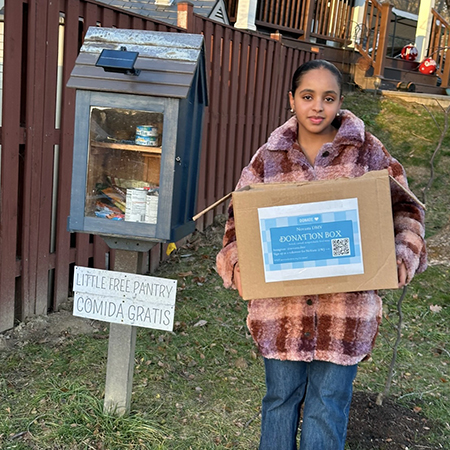
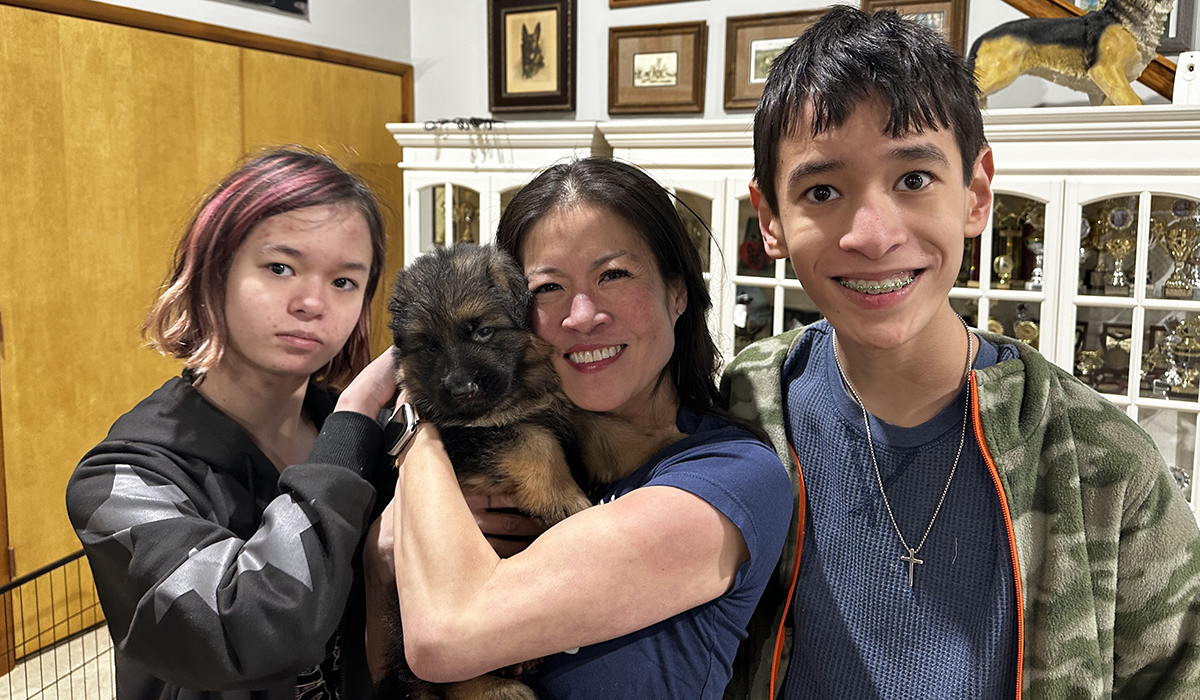
Ruth drops off local school food drive donations to a community Little Free Pantry.
Tell us about your volunteer role.
NoVasta is an organization I co-founded in early 2024 that focuses on promoting environmental awareness, reducing food waste and mitigating food insecurity. In my role, I coordinate volunteers to organize food rescue donations within their communities, facilitate food drives and lead fundraising efforts for local causes. I also lead our advocacy and policy initiatives, working to push for legislative change that supports sustainability and hunger relief on a broader scale.
What inspired you to get started with this initiative?
Honestly, I love everything about NoVasta and am so grateful to have helped build an organization that embodies all my core values. Specifically, my inspiration arose from my work on the Environment, Energy and Open Space Committee on the Boston Mayor’s Youth Council, where I saw firsthand how policy and local action can drive change. I wanted to help form a mission that not only helped the earth around me, but also supported people in my community. Seeing how small, consistent actions could lead to meaningful change was definitely what inspired me to get started with NoVasta and work towards tackling food waste and insecurity through a collaborative lens.
Why is this issue so important to you?
I’ve always cared about the environment and the wellbeing of those around me. Many social issues, including hunger and poverty, are connected to human-caused environmental challenges. Environmental sustainability affects everyone and so I believe we can care for both people and the planet at the same time. Through NoVasta, we do exactly that by transforming excess food into access for those in need.
What are your long-term plans or goals for the organization?
We want to expand NoVasta’s reach throughout the Greater Boston area and beyond, increasing our donation capacity and launching more sustainability and education projects. We really hope to build stronger partnerships with local businesses, schools and environmental organizations to create a network that promotes sustainability. We currently have over 8,500 food rescue meals donated in over 25 different chapters across the globe, and hope to continue increasing that impact through continued youth led environmental and social advocacy.
What’s been the most rewarding part of your work?
Definitely seeing the tangible impact NoVasta has made in communities through delivering meals to families, hosting events at my school to reduce food waste or even just inspiring others to take sustainable actions. Being able to see the direct results of our efforts as an organization unfold, and witnessing our work bringing both relief and to members of our community has been endlessly fulfilling.
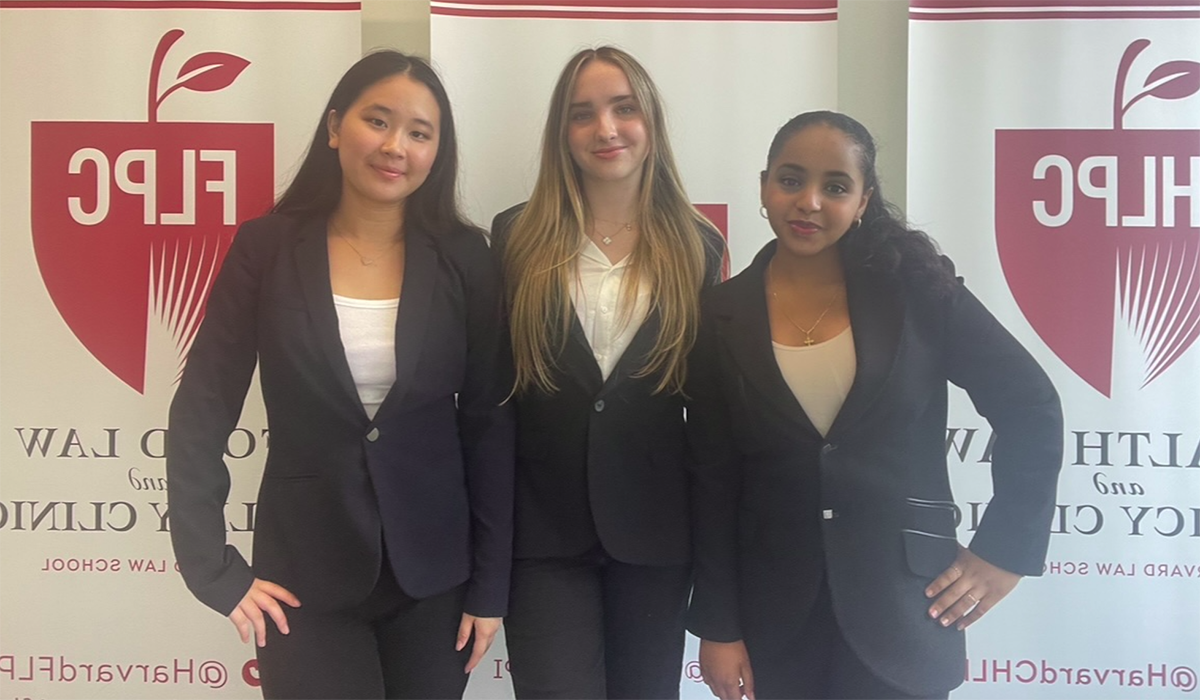
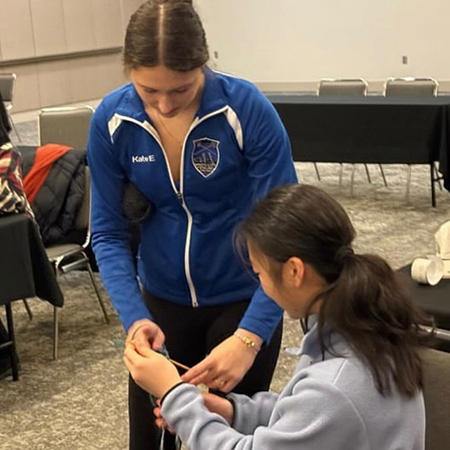
(Left to right) Arianna Sun, Sofia Hennessy and Ruth Gelaye attend the Harvard Food Law and Policy Clinic.
What have you learned through your experiences volunteering?
One huge lesson I’ve learned through experience is that meaningful change often begins with small steps that lead to a greater footprint. Teamwork is so vital when you are working towards large causes, and NoVasta merging together with other youth-led organizations to host both educational and action-based events has reinforced this principle. Compassion drives all the volunteer work that I do, and so I also think it’s an incredible reminder to the importance of having purpose in all that you do, and letting that guide the impact you make.
Why is it important for others to get involved with causes they care about?
Because it helps build towards a stronger community. Everyone’s voice truly does make a unique impact, and to create policies that are reflective of the voices around us, we must get involved and contribute to diversifying perspectives. When we come together around a shared goal, the collective impact is undoubtedly incredible.
Any advice for people who want to start volunteering?
My advice is to identify your values and look for local organizations, like NoVasta, whose missions may align with those values. There are so many clubs, organizations and nonprofits out there who want to help the community, and need your voice in order to make a real change. Even a quick Google search can connect you to a world of opportunities. I really encourage you to just get yourself out there!
Inside the Wisconsin Foster Closet, Where Hope Is Always in Stock
Meet Daily Point of Light Award honoree Tammy Wood-Garr. Read her story, and nominate an outstanding volunteer or family as a Daily Point of Light.
The journey into foster care is often marked by upheaval and uncertainty for a child, but thanks to people like Tammy Wood-Garr, that transition is being softened with dignity and care. Tammy is not just the director, she’s also the dedicated founder of the Wisconsin Foster Closet, a 501(c)(3) nonprofit organization born from a profound personal understanding. The Closet’s mission is powerful: to provide essential items like clothing, hygiene supplies, diapers and school supplies to children entering the foster and kinship care system—all at absolutely no cost. This ensures that children, during their most vulnerable moments, feel valued, supported and cared for.
The inspiration to create this essential resource sprung directly from the lived experience of Tammy and her husband, Joshua, as foster parents. They witnessed firsthand the immediate and often overwhelming need for basic necessities when a child arrives in a new home. This personal insight fueled a determination to fill that gap. Today, Tammy shoulders the responsibility for the entirety of the organization’s day-to-day operations. Her workweek often stretches from 40 to 60 hours, sometimes more during the busy Christmas season, dedicating herself to tasks that range from the high-level (like searching for funding, grants and sponsors, and speaking at community events) to the everyday practical (like personally washing, sorting and organizing clothing and other donations.)
The reach of the Wisconsin Foster Closet is impressive, serving children across the entire state, but maintaining a concentrated effort on families within 14 surrounding counties including Dunn, Eau Claire, Chippewa and St. Croix. Tammy is the main point of contact, consistently meeting with foster and kinship families to offer direct support. This aid goes beyond material items; it’s a critical support system that helps social workers maintain placements and relieves significant stress and financial burden on the families opening their homes.
Ultimately, Tammy’s dedication allows caregivers to spend less time worrying about acquiring necessities and more time doing what truly matters: bonding with and loving the children they take in. Her tireless efforts ensure that every item, from a fresh outfit to a Christmas gift, helps restore comfort and dignity.
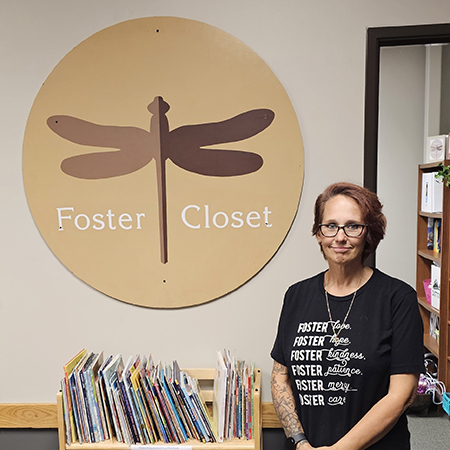
A foster parent herself, Tammy is passionate about alleviating the emotional and financial burdens on foster and kinship families.
Tell us about your volunteer role.
I started this organization out of my home in 2013 with the hopes of helping a few local children. Eventually, we found the need was much bigger. We had some amazing volunteers who came together and helped us grow it significantly. In 2018, we officially became a nonprofit with our 501(c)(3) status and acquired what we call a “storefront,” where children can come and “shop” for their clothes. Everything here is 100% donated and 100% volunteer-run. Nobody, including myself as the director and founder, is paid a salary. It’s an amazing blessing. We thought we’d only help a few, and we’ve ended up helping thousands of children.
Foster families, kinship families or social workers can reach out to us, and people can donate to get what they need. We receive donors and sponsors that deliver new or gently used clothing. If it’s used, we wash it to ensure it is ready for the children to wear. We are available 24 hours a day. If we get a call at two or three o’clock in the morning, we’ll meet the families to give them at least a week’s worth of clothing, personal hygiene items, a brand-new blanket, a stuffed animal and anything else they can use going into the foster and kinship care system. As well as our regular services, we do a Secret Santa program where children from all over sign up, and we match them up with a sponsor so they get a little extra Christmas love.
What inspired you to get started with this initiative?
I’ve been a treatment foster parent for many years now, and my husband and I discovered that most of the kids who come into care arrive only with what they’re wearing. Sometimes, in certain situations, they can’t even keep those items because they may come from a home with drugs or other hazards. So, they’re forced into a traumatic situation, leaving everything they have. Whether the memories are good or bad, they still leave with nothing. They go into a home where they know nobody and have nothing, and that just adds more and more trauma. Opening this program was our way of ensuring that children would be met with compassion and love, and know that they are seen and valued. They receive something tangible of their own that they can take from place to place. We make sure every child has a suitcase as well.
This situation is also hard for the foster and kinship families. They are taking on one, sometimes two, three or five kids who are new to their house, and they have to buy completely new wardrobes, toys and other items. It’s economically stressful on them as well. Most families don’t receive a clothing stipend, and if they do, it’s a maximum of $250 per child, one time in their lifetime. If they’ve been placed in care multiple times, they don’t get that help again.
What are your long-term plans or goals for the organization?
We’re going to be opening up a support group for foster families. They’ll be able to come in and have a network of families that truly understand what they’re going through. It will be a safe place to talk, communicate, get resources and have childcare available so they can just have that necessary decompression time. We would also love to be able to buy our own, larger building. A bigger space would allow us to provide extra beds, mattresses and dressers—things that are urgently needed when we get that last-minute sibling placement.
My personal dream is to someday open up a transition home for young adults who are aging out of the foster system. This would prevent them from being thrown onto the streets or ending up in our prison systems. They could actually have a house to go to where they’ll have mentors and sponsors who will teach them essential life skills: how to set up appointments, how to apply for jobs and how to fill out college applications. Crucially, they’ll have that family connection—a place they can go for the holidays. That’s my ultimate dream.
Tammy organizing clothes that will be washed and sorted by size so children feel they are “shopping.”
What’s been the most rewarding part of your work?
It’s seeing the stories that come in. You know, the child who has never been to a store and says, “I can’t buy anything. I can’t afford this,” and then being able to let them know, “You pick out whatever you want.” They come in, heads hanging low with tears in their eyes, and then after that interaction, you can see this look of pure joy wash over their faces. When they leave, they have a suitcase, a backpack, school supplies—a whole new reality is taking shape just in those few minutes they are there. They’re successful, they’re smiling and you see that ray of hope in their faces, and the relief in the foster families’ and kinship families’ faces.
It’s those moments that we look back on when we’re struggling for sponsors and donors, when we’re wondering, “Oh my gosh, are we going to make it through next month? Are we going to be able to afford this?” Even though all of us work for free, we still have to pay for rent, utilities, laundry supplies and other unmet needs. But looking at those stories and being able to see those faces in our heads is what gets us through the day.
What have you learned through your experiences volunteering?
You have to trust and rely on your volunteers and your board to help carry the weight. You don’t have to do everything yourself. Put that time aside for your family; always put your family first.
Even on those days where you feel like you’re losing faith in humanity, that’s when it’s going to hit you the hardest, but you’re also going to see amazing support.
You know, right now, with kinship families losing their SNAP benefits, we have so many people worried about food. We’ve had people set up food banks and pop-up clothing shelters and reaching out, asking, “How can we help?” Bringing in grocery gift cards. It’s just amazing to see. There are so many people out there who want to help. They just need to know what resources are out there to be able to do so.
Why is it important for others to get involved with causes they care about?
I think everybody has a cause they care about, whether it’s children, substance abuse, animals… Volunteering makes you feel good, and it brings a sense of community. It opens doors for meeting new people that you would never meet in any other way. You’re doing so many good things. You can only better yourself by bettering other people.
Any advice for people who want to start volunteering?
My advice is to reach out to an organization that shares your beliefs, do some research and set up an appointment to volunteer. Or start by just walking in and talking to the people who work there. Sometimes people just go in and volunteer for a day. Sometimes you can make it a regular thing. Our organization doesn’t survive without people like you who are donating, sponsoring and volunteering. We truly have the best volunteers and board that I could ever ask for.
Meet Daily Point of Light Award honoree Shaan Yu. Read his story, and nominate an outstanding volunteer or family as a Daily Point of Light.
Shaan Yu always wanted to build something. Now he’s doing it every single day. The 16-year-old high school student always had big dreams. In his freshman year of high school, he learned how to program computers and was quickly on his way. However, he soon learned that his age would be a roadblock to being taken seriously. Already trying to start companies at a young age, he discovered that investors were insecure about getting involved with him because he was only a teenager. Knowing that he was just as capable as anyone, Shaan was determined to make it clear that his age wouldn’t hold him back. But he also wanted to help other young people with big dreams get beyond those age-related roadblocks.
So Shaan and another high school student founded the Constellation Foundation, an organization dedicated to providing mentorship to student-led businesses. Shaan provides guidance and resources to fellow high school students and young leaders who want to start businesses, giving them the foundation to build those big dreams that can change the world. Thus far, Shaan’s work with the Constellation Foundation has helped student organizations throughout the U.S. and Europe raise over $150,000.
Shaan is also a volunteer with Research to Empower, an educational initiative aimed at addressing the lack of research support, courses, mentorship and information for aspiring researchers at the elementary to middle and high school level as a supplement to the K-12 curriculum. He built an application that provides resources to research, as well as mentorship, using artificial intelligence. A UNESCO-endorsed organization, Research to Empower has raised over $200,000 and reached more than 200,000 students in 140 countries. Whether he’s teaching others to write code or design apps, Shaan is helping the next generation build their dreams. His willingness to share his time to educate others while still navigating his own busy high school career is a powerful testament to how volunteerism can change the world.
What inspired you to get started with this initiative?
When I was in my freshman year of high school, I was trying to start companies. I found out very quickly that it’s very hard because people will doubt you when you’re young. I went to New York with my co-founders, and we were talking to investors, and were getting rejections because they were worried about my age. This was really disheartening and disappointing to hear. That’s how I started working with the Constellation Foundation, which is a nonprofit founded by me and one other high school student. We wanted to make it normal for students to be able to start businesses and gain traction. Nowadays, we need more people to build companies, build organizations, build software and build social good. The problem is that there is a really high bar in terms of age. Anybody under a certain age can be doubted in terms of their capability. There are a lot of other components, but that’s a big thing that I’ve experienced and I’ve seen around me. It’s something that I want to change.
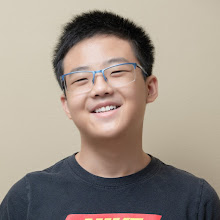
SHAAN YU IS THE COFOUNDER OF THE CONSTELLATION FOUNDATION, AN ORGANIZATION DEDICATED TO PROVIDING MENTORSHIP TO STUDENT-LED BUSINESSES. /COURTESY OF SHAAN YU
What inspires you to volunteer?
Life is short, and I want to make the maximum amount of impact I can on the world around me before I go. I don’t want to be stuck working some job that lacks much meaning, or doing something that isn’t really impactful. I want to make sure that I touch as many people as possible, and I think that these kinds of initiatives I’ve been working on really diligently for the past couple of years have really helped me achieve that goal. I don’t plan to stop anytime soon. For example, with Research to Empower, which provides scientific research, resources and teaches underrepresented students the scientific method, we have reached around 200,000 students.
Tell us about your volunteer role with the Constellation Foundation and Research to Empower.
I’m primarily on the technical side. So my focus is on building technology and programming things that will help other people. For example, with Research to Empower, I built an application that provides our resources to research, but also provides mentorship using artificial intelligence with ready-to-access, really fast resources. With the Constellation Foundation, I provided direct technical mentorship to these organizations, specifically ones that were building technical products or technical software.
What are your long-term plans or goals for the organization?
I hope to follow my goal of trying to impact and help as many people as possible around the world. I think that the more people who start building things, the better. Right now, we have this problem in society where a lot of people feel like they’re trapped in working corporate jobs, working with large companies, and they have dreams and aspirations and ideas that are just not being brought to fruition, and I don’t like that. My big goal is to touch as many people as possible, and also to inspire more people to start building.
What’s been the most rewarding part of your work?
The most rewarding part of my work is seeing the impact that it has created. I’ve inspired several people to start building through my work. I’ve talked to people. There are a large number of people whom I’ve encouraged to follow their dreams. I think that the more people who are following their dreams of building new things that will help society and help everybody in the world, the better. Right now, we’re kind of stuck ihaving a few very large companies that build a lot of software. I think that it really should be decentralized. Every single person should build what they think is ideal and build out their dreams. The more applications, the more products, the more nonprofits and the more organizations out there, the better.
What have you learned through your experiences as a volunteer?
I’ve definitely learned a lot. When I started freshman year, I didn’t know anything. I didn’t even know how to program yet, but I started working and was really hoping to get into this kind of space. After a year or two, I did, and I think I’ve come a long way since then. I think I’ve learned that even if you think what you’re working on is minor, it really does largely affect other people around you. When I started, I was worried that what I was doing wasn’t important enough. But then I finally started seeing actual results and actual impact stories, and people were inspired by my work. I think it was really inspiring.
Why is it important for others to get involved with causes they care about?
I think people should always follow their dreams. It’s always important to follow your dreams and build the ideas you come up with. I think that if everybody in the world started building the ideas that they had and started following their dreams, I think we’d be a lot further along than we are now.
Any advice for people who want to start volunteering?
Go online. Find an organization you’re interested in. Go email everybody and see what you can do. The thing about nonprofit organizations is that they’re always looking for more people who can help out. I think that you should put yourself out there. It’s really easy to work with these organizations and make an impact. It’s easier to get started than I originally thought when I got into all of this.
Meet Daily Point of Light Award honoree Celine Dumitrascu. Read her story, and nominate an outstanding volunteer or family as a Daily Point of Light.
Celine Dumitrascu, a young woman from Scottsdale, Arizona, is already making big waves in her community and beyond. Her most impactful venture is the founding of the Oral Health Primer nonprofit, a 501(c)(3) organization driven by a mission to combat oral disease among underserved youth. Through partnerships with schools and social centers, Celine has delivered essential oral health education to over 400 underserved children, creating awareness and promoting prevention. So far she has spent a remarkable 650 hours on the creation, printing and delivery of health educational materials and posters tailored for varied age groups. Now, as the founder and president, she continues to dedicate about 10 hours a month to creating bilingual materials and conducting monthly presentations for 20-30 new children, constantly refining the program with hands-on activities, quizzes and take-home flyers based on participant feedback.
Celine’s compassion extends deeply into the healthcare sphere, particularly for sick children. At Phoenix Children’s Hospital, she has volunteered 300 hours, demonstrating a multifaceted approach to support. A key member of the teen council, she has raised $2,500 for cancer research and art therapy. Beyond fundraising, she provided direct comfort by hand-making and donating 70 blankets for hospital use, as well as monthly items for the Mobile Medical Unit. She still devotes about three hours a month to the teen council, participating in various fundraising events and coordinating the collection and donation of items to shelters, proving her consistent dedication to their mission.
This young volunteer’s effort is also a fixture in her local library and an assisted living home. At the Arabian Library, Celine volunteered 200 hours for initiatives like the Summer Reading Program. For the past three years, she has taken on the crucial role of social media coordinator, spending an average of three hours a month planning, filming and editing Instagram reels to promote the library and the Teen Advisory Board. Her efforts help plan and host events for different age groups, increasing community engagement. Simultaneously, she has invested 650 hours at Hayden Villa Assisted Living Home, where she offers vital, hands-on support.
Celine’s volunteering at Hayden Villa included participating in 150 arts and crafts sessions and leading 250 enrichment and physical activities, bringing joy to residents. She now dedicates 10 hours a month there, assisting caregivers with taking vital signs and feeding residents, and continues to lead enrichment and physical activities for a group of 10 residents. Her total hours spent in service—hundreds in multiple locations—and constant willingness to get involved make her an extraordinary example of outstanding volunteerism. Read more about why and how she founded her nonprofit organization.
Tell us about your volunteer role.
I volunteer to make a difference in children’s lives by improving their oral health literacy, and, indirectly, their overall health and self-confidence. Based on feedback on what different age ranges already know or don’t know, I create and update bilingual educational materials like large wall office flyers, small bathroom home flyers and PowerPoint presentations on the importance of oral health, common oral diseases, preventive measures and accurate oral hygiene measures. I reach out to and coordinate with schools, libraries and social centers to organize monthly educational, entertaining and engaging activities for children of various age groups. I give presentations and provide hands-on sessions to illustrate how to perform oral hygiene correctly using dental plastic models. At the end of our sessions, I give the children samples and flyers for further reference so they can continue to use the oral hygiene techniques they learn, daily.
Why is this issue so important to you?
Good oral health grants individuals not only essential functions like pain-free eating and breathing, but also the ability to socialize and work with confidence—all things that contribute to their overall well-being. Oral diseases are considered one of the most widespread diseases of humankind, with a prevalence that is greater than any other non-communicable disease. It is known that higher levels of oral health literacy are associated with improved oral and general health. I decided to increase oral health literacy through education, targeting the populations with the greatest need: children and teens from underserved communities.
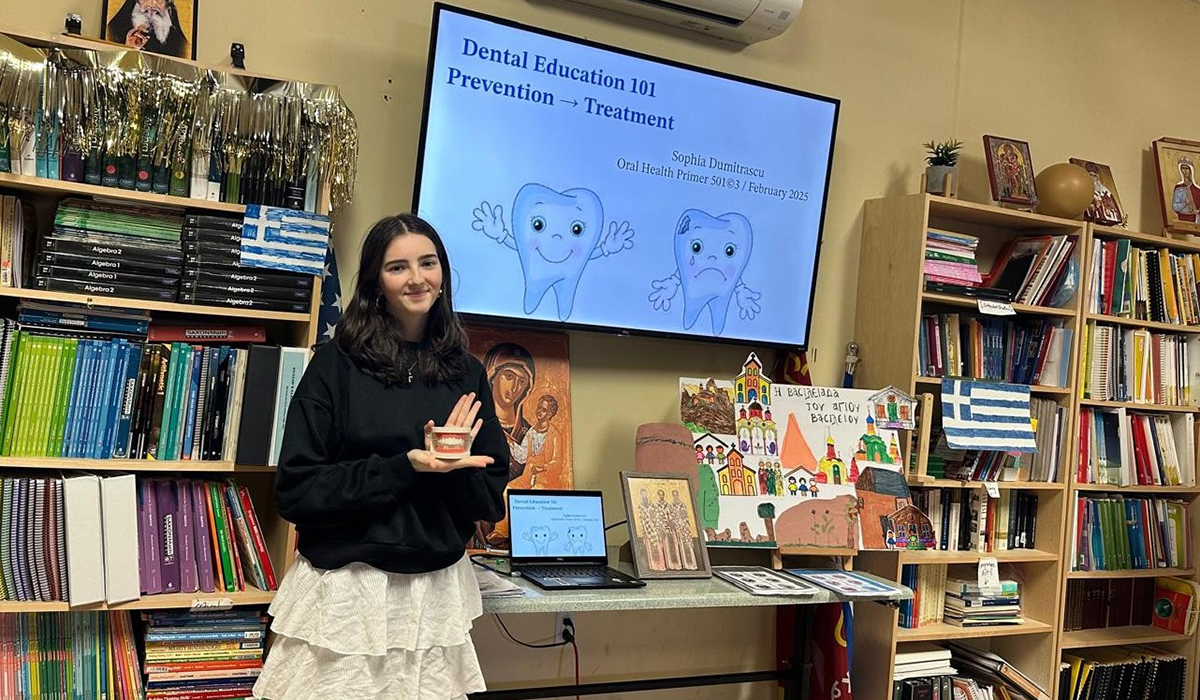
Celine setting up a dental education session at a school in Florence, AZ.
What inspired you to get started with this initiative?
In the summer of 2023, after my freshman year of high school, I participated in Johns Hopkins University’s Global Health Leaders Conference. There, I learned about prevalent topics in public health, epidemiology and global health. Inspired, I chose to give a presentation, in a portion of the conference called the “Student Speaker Series”, on global disparities in regard to oral health. When crafting my presentation, I learned that oral diseases were recognized as both a major global health burden and a public health challenge. It turns out that 45% or 3.5 billion people have oral diseases globally, and three out of every four people affected live in low- and middle-income countries. They are very prevalent in my family’s home country, Romania, where 75% of children have dental caries and 64% are untreated.
Thankfully, oral diseases are very preventable, especially with proper and early education. To assist in these efforts, I launched a pilot study to improve oral health in underserved communities, aiming to decrease the burden of oral diseases and other non-communicable diseases in Arizona and Romania. Oral Health Primer was born from that! I have founded and expanded a grassroots non-governmental organization that educates underserved youth about oral health and oral disease preventive strategies.
What are your long-term plans or goals with the organization?
Next, I plan on partnering with pediatric offices that serve uninsured or low-income populations to routinely and consistently proliferate dental education on a larger scale. In the near future, I will start fundraising activities and events to make oral hygiene supplies available year-round for those residing in shelters and community centers. In college and beyond, I plan on joining advocacy groups and volunteer organizations that work to create affordable dental care for all children.
What’s the most rewarding part of your work?
I always start my educational activities by assessing the children’s basic level of knowledge, and I re-evaluate it at the end. It is extremely rewarding to see how children improve their level of knowledge on oral health and oral hygiene measures, and how empowered they feel at the end. I especially love connecting with the children at our sessions and learning about their previous dental knowledge as well as their aspirations, family and, occasionally, insecurities. Being able to form relationships with our audience members is incredibly rewarding.
What have you learned through your experiences volunteering?
I’ve learned that giving is more powerful than receiving. I improved my capacity to listen deeply, communicate effectively, connect with others and understand different perspectives. I believe that volunteering has also made me significantly more empathetic and confident in my leadership abilities, qualities that I will carry through my future endeavors, career in the dental field and entire life.
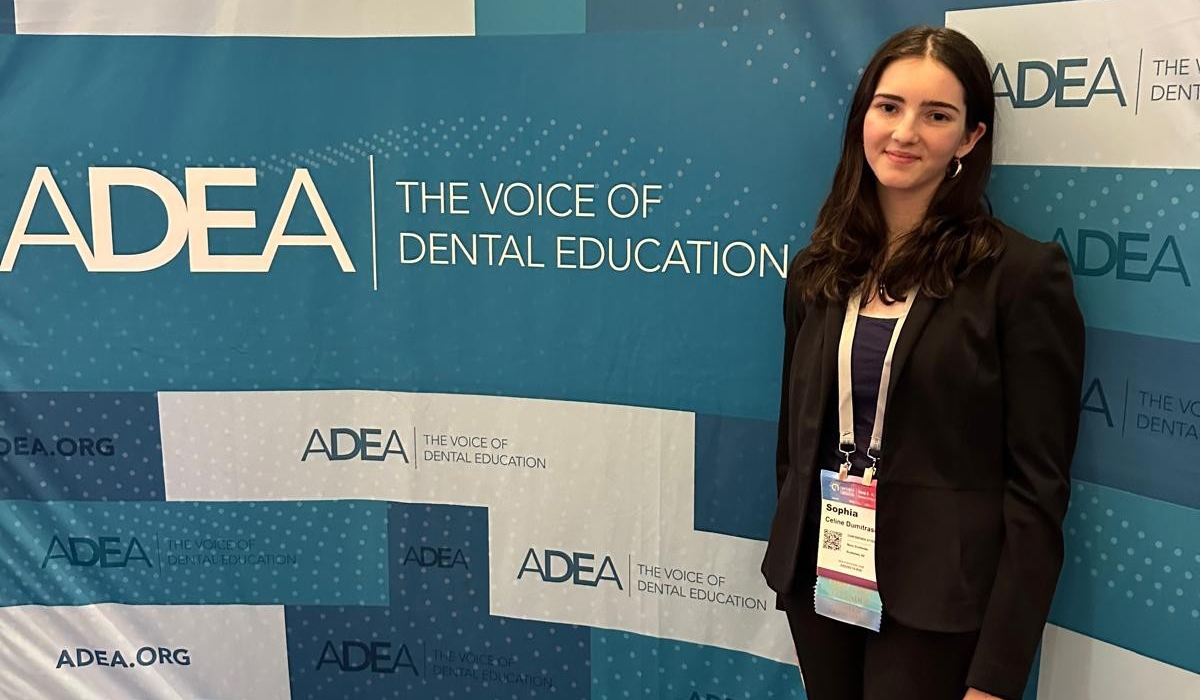
Celine presenting the short-term impact of oral health educational activities in social centers at the 2025 American Dental Education Association national meeting.
Why is it important for others to get involved with causes they care about?
Change grows from ordinary people choosing to act; even small efforts turn into visible results. When you get involved with a cause you care about, you learn more about it, meet the people affected and see where your skills can make a difference. You also gain practical experience, like coordinating events, fundraising and advocacy—all of which strengthen the communal effort. All of this will benefit not only yourself, but also people directly involved and the greater community. Progress depends on many people contributing their time and energy, and you can be the first to prove that your cause is an important one.
Any advice for people who want to start volunteering?
Begin by identifying a cause or issue that genuinely interests you. In my case, it was the prevalence of oral diseases. Think of what you can do to assist with and mitigate these issues. A great first step is researching already-existing organizations that you can join. Consider your availability, age, location, transportation and other important factors. Then reach out to community centers, schools, libraries, food pantries, donation centers, hospitals—anything you can think of—and ask how you can help. Start with clear, small commitments that you can keep, and then build from there.
Meet Daily Point of Light Award honoree Arav Chand. Read his story, and nominate an outstanding volunteer or family as a Daily Point of Light.
As an amateur programmer, food waste is one glitch Arav Chand couldn’t wait to debug. A Long Island resident, Arav frequently visited New York City and saw bakeries throwing away perfectly good food at the end of the day. That was a direct contrast to the people Arav would see on the streets living with food insecurity. A computer whiz, Arav described the dichotomy as being like a glitch in the code. To bridge the divide between the two situations, he founded Sweet Surplus, a youth-led nonprofit that donates surplus baked goods to shelters for unhoused populations.
Along with several friends, Arav built a network of bakery partners and shelters where he could pick up the uneaten food and redistribute it to the shelters where it could be put to good use. While many bakeries are nervous about giving away uneaten food, Arav works with them to help them build strong relationships and even created tax incentive documentation to help partner businesses boost their annual revenue by 7.5%.
Arav is now a senior in high school with a busy class schedule, but he still dedicates around 15 hours a month to making deliveries, reaching out to new bakeries and growing the Sweet Surplus network with new students and volunteers who can be brought into the mix to help even more people. Thus far, he’s redistributed over $40,000 worth of goods to people in need. When Arav goes off to college next year, he’s not too sure yet what he’ll study. However, he knows that it will likely be related to the lessons he learned in making an impact through his volunteer work. His mission to help others is an example that anyone can carry forward in their own community.
What inspired you to get started with this initiative?
If you take a walk in Manhattan around 4 pm, you’ll see something that’s super contradictory. Some bakeries will be throwing away trash bags that are brimming with perfectly good food while there are hungry people on the sidewalk holding signs asking for a New Yorker’s kindness to provide them with sustenance. This is just silly and wrong. It felt like society around me had a glitch in its code. I’m a programmer, so I kind of felt like this could be something I could debug. Sweet Surplus became a patch for the problem, in some sense, taking good food that’s unnecessarily headed to the trash and instead rerouting it to people who need it.
What inspires you to volunteer?
What motivates me every time I make a delivery or redirect the food is the sense of knowing that I’m helping someone. Each meal that I deliver, each stomach growl that I can help satiate is personal fuel to keep going and to keep pushing against setbacks. I want to find any alternate routes to bakeries that would not like to hand their leftovers over and would rather just throw them out. Basically, each time that I’m able to do a volunteer act, it motivates the next one.
Tell us about your volunteer role with Sweet Surplus.
I serve as the co-founder and the NYC branch manager of Sweet Surplus. It’s something that I started with some friends that I met at an International Science Fair in Belgium, Canada and China. Day-to-day on the organizational side, I build the network of bakery partners and shelters, as well as coordinate volunteers and handle the communication, scheduling and delivery logistics. Specifically, I’m reaching out to new bakeries. I’m learning about their surplus routines, how much they have at the end of the day and then match their available food with shelters that can use it that same day, so nothing is wasted. I also am on the front lines, acting as a delivery runner and doing regular pickups myself, going to the bakeries at closing times, collecting surplus bread and bagels, and delivering them directly to the shelter. It kind of lets me see both sides: the logistical challenges of running that effort, but also the human impact.
What are your long-term plans or goals for the organization?
I’m a high school senior, so I know there’s a concern because it’s being run personally. However, I am making sure its longevity persists after I go to college. I will not let this organization halt. I already set up future leaders to continue organizing and heading this volunteering beyond personally being able to manage it myself while I’m in college. I plan to definitely continue mentoring and helping, but I think it’ll be more fruitful to ensure there’s a group of people that are directly in place at the time to hold it.
What have you learned through your experiences as a volunteer?
I’ve learned that meaningful change usually starts small, with one redirected meal bag or box of food or one partnership between a bakery and a shelter at a time. Through Sweet Surplus, I’ve seen how much food is wasted simply because there isn’t a system to redirect it. Overall, I think volunteering has taught me the power of persistence and the importance of listening to community needs. Also, establishing a connection with each member, and with the homeless shelters and bakeries that are throwing out these goods. That leadership isn’t just about doing everything yourself; it’s about building that network of people who believe in the same mission.
Why is it important for others to get involved with causes they care about?
Change won’t just happen by accident. Somebody has to start to care enough. When we step up for a cause that we believe in, it’s actually turning empathy or feelings into action. That ripple can inspire others to do the same and work alongside you. While one person can make a difference, a community of people who care can solve problems at the root. I think that through working with a dedicated group of people, you not only gain more from different perspectives, but you can also make a significant impact that satisfies a need.
Any advice for people who want to start volunteering?
Don’t overthink it. Give whatever time that you can and be willing to learn along the way, because there are definitely parts that I wasn’t expecting or that I encountered along my own journey. Volunteering isn’t about being perfect; it is about being present, being in the moment. You don’t necessarily make that same impact every day. But the real win is how you can just deliver bagels and a smile and follow through with it.
What do you want people to learn from your story?
I think the main thing is to consider the everyday activities that we consider normal or take for granted, and really analyze what the situation or circumstances are around them. The most basic human need is food, and that should not be barricaded by financial limitations or other circumstances, especially in a city as densely populated and resource-rich as New York City, but also across the country and globe. It’s just heartbreaking that people could go hungry while perfectly good meals are thrown away at closing time. I think it’s important to take away how you can make a change to what is the norm and make an impact for people who aren’t being helped by that traditional system.
HELPING OTHERS IS A WAY OF LIFE FOR THIS CHICAGO FAMILY
Meet Daily Point of Light Award honorees, the Choi family. Read their story, and nominate an outstanding volunteer or family as a Daily Point of Light.
Soo Choi always wanted her twins to know just how lucky they are. She knew volunteerism was the answer.
In 2016, Soo was looking for a volunteer project that she could participate in alongside her 5-year-old twins. Traditionally, it’s rather hard to find volunteer opportunities for children, and Soo was doing some searching on the Internet to see how the family could volunteer despite the twins’ young age. She struck a goldmine when she came across The Honeycomb Project, a Chicago-based organization for family volunteering. In the early days of their volunteer work, Soo, Andrew and Sophia made cozy blankets for children at a shelter and wrapped holiday toys at a local community center. Though they were just five years old, the twins learned the meaning of taking the time to help others. Now 14 and on the cusp of young adulthood, the family’s involvement with Honeycomb has only grown.
In the last nine years, the family’s volunteer projects with Honeycomb have truly run the gamut. From serving meals at temporary housing for families affected by domestic violence to having dinner at a firehouse and assembling cookie packages with thank-you notes for the firefighters, each project has allowed the twins to interact with different people and learn about a world outside their own.
Soo aims to participate in at least one Honeycomb Project event a month, but often gets involved with two to three. She’s also hopeful for both herself and the twins’ progress in the future. She’s hoping Andrew and Sophia will participate in the Honeycomb Project’s program for high school students, which will allow them to take on more of a leadership role in volunteer projects. But no matter what direction they go in, Soo,
Andrew and Sophia’s story is a testament to the concept that volunteering can be a family affair. No matter the age of everyone involved, a family that’s dedicated to the mission of helping others can create great change within their community.
SOO CHOI IS A VOLUNTEER WITH THE HONEYCOMB PROJECT, A CHICAGO-BASED ORGANIZATION FOR FAMILY VOLUNTEERING. /COURTESY SOO CHOI
What inspired you to get started with this initiative?
A lot of my passions in terms of volunteer work have been things that I’ve cared about for as long as I can remember. A lot of things relate to those that are caused by socioeconomic inequality. I consider myself extremely lucky. I have a wonderful family and two really wonderful parents. We live a comfortable life. The kinds of things that I know so many people have to worry about, my kids have never had to worry about. It’s always been important to me that, as soon as I thought they were old enough, they start to comprehend that not everybody lives the same life. It’s been important for me, raising them as a parent, for them to appreciate what they have. I found out about Honeycomb through basic research, because I was online looking for volunteer opportunities and they had projects that spanned so many different age ranges.
Tell us about your volunteer role with the Honeycomb Project.
We have done so many different things. When they were younger, it was a lot more engaging with families. For example, several places in Chicago provide temporary housing to families in transition because of domestic violence. There would be a group of our families from Honeycomb who would bring in breakfast or lunch and serve that, and then do some kind of project together. We’ve done other things like sorting clothing or toy donations. I like to try and diversify it, and I feel like we always meet some really great people. They always seem very happy after we finish up.
What are your long-term plans or goals for the organization?
Get more involved in the organization itself. The kids are 14, and the Honeycomb Project has a program for high school kids, where they’re essentially acting as ambassadors. They take a team leader role in a lot of the projects that are done. It’s really trying to continue to cultivate a commitment to public service. I’m really hoping that next year they’ll start doing that great.
What’s been the most rewarding part of your work?
It’s the little moments that stick out in my memory. It can be a really daunting experience, especially if it’s new to you, to engage with somebody so different from you that it feels like they’re from a different world. We did a project a few months ago where it’s a temporary housing for women who are in transition, either because of domestic violence or loss of a job. The first part of the project was to cook a full dinner and serve it, but at some point, when people are eating, you’re encouraged to come out and talk to the women. I wasn’t sure how my kids would react to that, because it’s not something they’ve really been exposed to before. And I was really surprised because they came out there and they were in deep conversations, getting to know these women who were really surprised that someone that young was interested in hearing about their lives and asking questions. For me, it’s just those moments that I hope are indicative of what I know my kids to be, which is extremely kind and compassionate at their core.
What have you and your children learned through your experiences as a volunteer?
I think that as they’ve gotten older, they recognize that it’s so easy to take for granted what you don’t have to think about. They have pretty much whatever they need. They’re lucky. They’ve recognized how lucky they are, and I think they appreciate that not everyone lives the same life. I think it’s so much more meaningful to give time and effort versus just donating money, and I think that they consider that to be a more fulfilling experience as well, because it’s something that they’re doing that they can talk to their friends about, and it’s memories we build together as a family.
SOO CHOI (CENTER) AND HER KIDS, SOPHIA (LEFT) AND ANDREW (RIGHT) SNUGGLE UP WITH GATSBY, WHO WILL BE PARTICIPATING WITH THEM AT A PUPPY LOVE EVENT SOON. /COURTESY SOO CHOI
Why is it important for others to get involved with causes they care about?
I think causes flourish when you have human involvement. We live in a really, really tough time. But even before, it’s the awareness. It’s that infectious feeling of gratitude and joy that comes from doing this and being able to share stories and talk about organizations and cultivate more supporters, whether it’s in the form of time or donations. You have corporations that have money to give, and you have people who want to donate time. Organizations want to host events to help. There are so many different ways people can help.
Any advice for people who want to start volunteering?
Sometimes it’s as simple as just Google searching. That’s really how I find out. If you know there’s something you’re passionate about, then you can focus a search on that. I think talking to other parents at school, I was able to get a few families involved with Honeycomb because they saw it on social media. Sometimes schools are a great way because they often have a lot of information. Sometimes they host organizations, but they are also in contact with a lot of organizations. There are a lot of different ways. I think it’d be nice if it didn’t require so much proactive work, but it does require a little bit.
What do you want people to learn from your story?
When I think about what matters the most, and I think about my children and what I want most for them, what’s most important for me is who they become as people as they grow up, and what is the core of their being and their character. Yes, things like education are important, but at the end of the day, I think what matters more to me is how they go about life. How do they handle difficult situations? How do they view the world? For me, volunteer work is one way that helps tether them to those values. It’s not competitive; it isn’t about school. It’s not about achieving anything. This is something that you’re doing because you genuinely want to do it.
Meet Daily Point of Light Award honoree Kate Elterman. Read her story, and nominate an outstanding volunteer or family as a Daily Point of Light.
It’s not every day that a broken leg leads to the creation of an organization, but that’s Kate Elterman’s story. Back in 2022, Kate was looking for a mitzvah project, or community service project, to work on leading up to her bat mitzvah. Originally, she was baking cookies and handing them out to unhoused people on the street. After breaking her leg during a game of tag on Halloween, it became clear to Kate that maneuvering around the kitchen would be impossible. Her grandma had recently taught her how to knit, and she realized she could put her newfound love of the craft to work by knitting scarves for unhoused people to weather the frigid Chicago winters.
Kate started by teaching her friends how to knit and slowly expanded her circle at school. Demand soon grew, and even more people got involved. A competitive fencer, Kate used her time within that community to teach fellow fencers how to knit scarves. Wanting to take the group to another level, she established Knit Knot Knoop, an organization that aims to educate young people about the homelessness epidemic in a creative way through knitting. From hosting knitting events in nursing homes to running scarf drives where she teaches people the ins and outs of knitting, Kate’s mission is to share her love of the craft while also bettering the lives of others.
As Knit Knot Knoop grew, so did the number of people that Kate could help. She partnered with Ezra, an interactive cafe for unhoused people in Chicago, which works with the Jewish United Fund. Now they’re the official distributor of Knit Knot Knoop’s scarves, so Kate doesn’t have to walk around outside and hand out the scarves one by one. Instead, they can be distributed more efficiently.
The establishment of Knit Knot Knoop not only bettered Kate’s community but also helped the teen grow into herself. Previously uncomfortable speaking to strangers and talking in front of large groups, her volunteer work has served as a platform that has built a sense of confidence in Kate. Now a frequent public speaker who goes into new situations with ease, Kate has found a stronger sense of self through her volunteer work. Her dedication to bettering the lives of her unhoused neighbors and the positive ways it has affected her life is a strong example of just how powerful volunteerism can be on each of us.
KATE ELTERMAN IS THE FOUNDER OF KNIT KNOT KNOOP, AN ORGANIZATION THAT AIMS TO EDUCATE YOUNG PEOPLE ABOUT THE HOMELESSNESS EPIDEMIC IN A CREATIVE WAY THROUGH KNITTING. /COURTESY KATE ELTERMAN
What inspires you to volunteer?
When I first started doing this, I was a little girl. I saw unhoused people while I was walking to school and when I would drive to figure skating. I’d see unhoused people sitting outside in the cold. As I grew older, I learned more about the issue and how complex it was. Now I’m a young adult, I’m more interested in public health and homelessness, so I see how much of an issue this is and I just try to help as much as I can.
What inspired you to get started with this initiative?
This started as my mitzvah project for my bat mitzvah. I was baking cookies and handing them out to people on the street. Then I broke my leg, so I couldn’t really move around my kitchen as much. I wanted to think of something else that I could do, and my grandma had recently taught me how to knit. She suggested that I start knitting scarves for the unhoused instead. I really liked the simplicity and meditativeness of sitting down and knitting scarves. I could watch TV or even read a book. I began teaching my friends how to knit scarves and I thought about how this could help the greater community.
What are your long-term plans or goals for the organization?
I plan to do this for the rest of my life. It’s something that I can take with me anywhere I go through college, or when I work and when I fence, too, because it’s meditation. It’s very relaxing for me, and it’s also something that I could pass along to my kids eventually. I have chapters all over the world now. I have a few across the United States and one in Israel.
What’s been the most rewarding part of your work?
I would say it’s seeing the smile on people’s faces when they get a row of stitches done when I teach them how to knit or seeing how genuinely happy people are to help others who are in need. It’s not just me or my friends. It’s so many more people than I thought, and they’re very happy to help anyone, even if they’ve never even seen the person that they’re helping. It’s seeing how excited people get and how they’re curious to learn more new stitches. There are many different ways they could knit a scarf. They get very excited. Also, how they show their friends, even after our session has ended.
What have you learned through your experiences as a volunteer?
I would say volunteering goes beyond the actual act of helping. You have to be able to talk to people you don’t know, promote your case, be patient and speak in front of big audiences, which was something that I struggled with before starting Knit Knot Knoop. It’s also something that I didn’t fully realize that I would have to do when I began doing it. But it’s helped me a lot and I think it’ll continue to help me with my future in any future career that I have. It’s also helped me in school when it comes to speaking in front of big audiences. Now I feel more confident when I speak to people and I can talk about it more freely.
KNIT KNOT KNOOP FOUNDER KATE ELTERMAN (STANDING) TEACHES A FRIEND TO KNIT AT A FENCING COMPETITION. /COURTESY KATE ELTERMAN
Why is it important for others to get involved with causes they care about?
I think the world only gets better if each one of us does our part, no matter how little it is. We can only change the world by doing one good thing at a time. If you don’t do it, and you think someone else is going to do something good for the world, no one’s going to end up doing it, because everybody’s just going to think that someone else is going to. I think if we do our own thing in the world, no matter how small it is, the world is going to be so much better.
Any advice for people who want to start volunteering?
Ask for help if you need it. Don’t be afraid to help others if they’re asking for help too. A lot of people are also probably struggling to begin. I asked my sister to help me with my website, and I asked my parents for help and my grandma to help me learn new stitches. I would just say people will be more willing to help than you think they are. If you want to start volunteering, and you don’t know where, try one thing and then try another until you find something that you absolutely love. The more passionate you are about something, the greater impact it’ll have on others. You shouldn’t feel like the very first thing you try you have to commit to. You can try as many times as you want.
What do you want people to learn from your story?
I definitely struggled at the beginning to get my organization to where it is right now. I asked a lot of people for help, and I was very nervous at first. You should feel really passionate about what you do, because it will make an impact on people, even if you don’t think it will.
Scammer Shutdown: Stopping Fraud Through Education
Meet Daily Point of Light Award honoree Aayush Gandhi. Read his story, and nominate an outstanding volunteer or family as a Daily Point of Light.
Seventeen-year-old national level Lincoln-Douglas debater Aayush Gandhi is a passionate reader. Reading and research is a large part of what draws him to debate. So, when his grandparents, who immigrated from India, started getting targeted for scams, he leaned on his skills to figure out how to help. What he learned was astounding, not only about the wide variety of scams but the complexity of the tactics used.
Last year alone, $13-14B in losses were reported due to scams, a number drastically underestimated, andmore than 80% of cases go unreported. Determined to protect others in his community, Aayush started a fraud awareness campaign that later became FraudStop, a national organization designed to educate people about the types of fraud, safeguards against them and available legal resources.
Today, Aayush leads a three-person team and has partnered with more than 24 organizations in multiple states to do that. He has hosted 20+ events and distributes resources in multiple languages. As he continues to debate government policy at tournaments across the country, he empowers people to protect themselves from those with unsavory designs.
What inspires you to volunteer?
I’ve always been drawn to the idea of helping people. The primary way I’ve channeled that is through teaching. I’m a tutor at my school’s Academic Resource Center and a former hospital volunteer. From my experience, I realized that I love talking to people, helping them out and seeing the moment they figure a new problem out or learn something new.
Tell us about your volunteer role with FraudStop.
FraudStop has several programs, but the biggest is the presentations. I’m always working out where the next one will be, who we can partner with and how we can educate more community members. Our approach has been to work with organizations and people across the prevention ladder to target people affected and bring in relevant guest speakers.
I’ve hosted a table at U.S. House Representatives Eric Swalwell’s and Lateefah Simon’s senior resource fairs and brought guest speakers from those offices to my events. I’ve worked with certifying agencies like the SF Association for Certified Fraud Examiners, law enforcement like Alameda County Sheriff’s Office, Adult Protective Services, senior centers and many more.
At every event we host, we share our resources. We’ve distributed them in California, Pennsylvania, Texas and Wyoming so far. We’ve also hosted podcast episodes with companies like TRM Labs, who are doing cryptocurrency fraud tracing.
What inspired you to get started with this initiative?
When my grandparents immigrated, they got a new email account, phone number and so forth. I saw them get hundreds of unknown calls, spam text messages and emails, and they struggled to figure out real from fake. As I was helping them, I realized I could do more to help other seniors avoid fraud.
Luckily, I was enrolled in a criminal justice class, and my teacher was a former law enforcement officer. Together, we designed a 120-slide presentation that covered every aspect of fraud. We had five or six participants at our first one and learned a lot about how to market, present and organize subsequent events.
FraudStop founder Aayush Gandhi (middle) greets two guest speakers, an Alameda County Sheriff’s Office detective (right) and a former law enforcement officer (left), at a presentation in Pleasanton.
Can you tell me about the growth process and how you got involved with these different partnerships?
We hosted a couple events, and then I began cold emailing hundreds of local organizations and calling them during lunchtime at school. As we got one partnership, the next one came. For example, at Representative Swalwell’s senior resource fair, he featured me on his Instagram page.
It got around 20,000 views and led to a partnership with UNCLE Credit Union. At an UNCLE Credit Union event, we got more partnerships with other financial institutions as well as law enforcement agencies, and we’ve continued to grow.
Can you give us one or two tips for people trying to protect themselves against the most common schemes?
Telephone scams are the most common. Scammers have technology that allows them to change how their number appears on your end. Their number may be XYZ, but on your end, it’s your granddaughter or the IRS. If you don’t recognize a number calling, or if the number belongs to someone you know but the person on the other end is saying they’re in an emergency, hang up. Do the same for any number calling about an emergency or an unexpected event, like your taxes not being filed. The only way to combat telephone scams is to hang up the phone and redial the official number from your contacts list or, for example, your bank’s website.
What are your long-term plans or goals for the organization?
I’m hoping to expand FraudStop to young adults, because fraud is increasingly targeting people my age and younger through social media and online platforms. I’d also like to explore other avenues, like policy.
What’s been the most rewarding part of your work?
It’s been listening to other people’s stories, giving them advice and seeing them smile; that’s what really drives me. I’ve modeled my presentations and table hosting events to be about giving personalized advice. For example, at Berkeley, one lady complained about getting a spam call from her doctor’s office, so we walked through how to block unknown callers who are maybe not her doctor.
Why is it important for others to get involved with causes they care about?
Community is all that we really have. Interacting with the community builds bonds between neighbors and beyond. It’s vital, particularly in this digital age. I enjoy connecting with others, listening to their stories and helping them. If you’re motivated by a similar purpose, you should look to service as the means to do that.
What do you want people to learn from your story?
At all of my events, I’ve been the only high school student talking about fraud amongst a wide array of professionals. I learned about fraud all by myself. No matter how old or experienced you are within a particular field, you can always get involved.
Meet Daily Point of Light Award honoree Arianna Sun. Read her story, and nominate an outstanding volunteer or family as a Daily Point of Light.
Arianna Sun is still in high school, but she’s already creating a revolution. Growing up, Arianna would sit at the dinner table and hear her grandfather’s stories about growing up during the Great Famine in China. Already shocked by the level of starvation he survived, Arianna was amazed to discover the amount of food waste that occurs in her own community. Already a frequent volunteer serving meals to hungry people at her local church, she saw how local restaurants would throw out untouched food at the end of the day. The fact that people were hungry right in her own neighborhood, while good food was being thrown away, planted a seed inside Arianna. She decided to take action.
Arianna founded NoVasta, a youth-led organization that focuses on direct donations through food rescue and food donations alongside policy advocacy. Originally a club at her school, the group has blossomed tremendously. Arianna forged relationships with local restaurants, collecting their unsold food and pastries at closing time and delivering them to nearby shelters or directly to people on the streets. This is no small feat, as many restaurants are concerned with laws restricting them from giving away uneaten food. But Arianna didn’t stop pursuing these relationships, and she ultimately succeeded. As the organization grew, it expanded across the country and eventually went worldwide. Since its establishment in Arianna’s sophomore year of high school, NoVasta has donated over 8,500 meals that would have otherwise gone to the landfill.
Now a high school senior, Arianna manages her busy school responsibilities while running NoVasta. But she doesn’t mind doing so much; Instead, she says being so passionate about something allows her to make time for it in her daily schedule.
Arianna’s work with NoVasta is also informing her future. Already a member of Massachusetts Governor Maura Healey’s Anti-Hunger Task Force, Arianna is looking to study policy when she graduates high school next year. When she goes to college, she hopes to learn more about how she can help create solutions to food waste and food insecurity, and the role the government can play in changing these issues. Arianna’s hard work is a great example of how volunteer work can build a tremendous foundation that ultimately serves as a building block to our future.
NOVASTA FOUNDER ARIANNA SUN SMILES AT THE MASSACHUSETTS STATE HOUSE, WHERE SHE SERVED AS A MEMBER OF GOVERNOR HEALEY’S ANTI-HUNGER TASK FORCE. /COURTESY OF ARIANNA SUN
What inspired you to get started with this initiative?
A huge part of the reason I founded this organization was because of my grandfather. Growing up, he always told me about his experience growing up during the Great Famine in China. At the dinner table, he would tell me not to waste a single thing. That shaped how I view the systems in this world, and also a lot of the inequities. I can recognize the food waste that goes on, and I’m able to see a lot of food insecurity in our community.
Also, a huge part of it came from volunteering. We used to spend hours upon hours making meals for people. Then, on my way home, I’d pass restaurants and I’d see them throwing away bags and bags of food. It felt really wrong to me, because I saw so much need in one place and then so much waste right next to it. That really inspired me to try to bridge that disconnect.
What inspires you to volunteer?
I think volunteer work is really, really important. A huge part of it is how it connects the community. Especially in this day and age, a lot of our interactions have been limited to online platforms. I think it’s more crucial than ever to get involved in organizations and volunteer work that you care about, because through those organizations and experiences, you’re able to not only find people who care about the same thing as you, but you also learn so much about the community as well.
Tell us about your volunteer role with NoVasta.
With NoVasta, we started in Boston as a club. Since then, we’ve expanded to an organization spread across the United States and a lot of different countries. A day-to-day of what my role looks like is overseeing around 20 chapters across the world and coordinating over 400 members. I help organize a lot of food rescue operations and connect volunteers with their local shelters. We help lead a lot of advocacy efforts through the Zero Food Waste Coalition. Another huge part of the work I do is local community work within Boston. I’m involved and partnered with a lot of the restaurants in my community, and I’m able to bring that excess food to local shelters. It’s been really rewarding being involved with my community.
What are your long-term plans or goals for the organization?
Once I go to college, I want to bring the mission of NoVasta there. I think a huge part of our long-term goal is bringing this to a lot of different cities. Food waste and food insecurity are definitely not problems that are unique to Boston. I think it’s something that exists in every city around the world, and if we’re able to bring that to more communities, that would be really, really great.
What’s been the most rewarding part of your work?
One of the most rewarding parts has been seeing the interactions that our volunteers can make, and also my interactions with people. One huge accomplishment has been my being invited to serve on Governor Healey’s Anti-Hunger Task Force. I felt that was a huge recognition that young people and youth can have a seat at the table and solve a lot of statewide challenges. I would say the daily rewards that come from the people I meet are what’s most rewarding, because I’m able to talk to restaurant owners who start to donate regularly or a community member who’s able to receive a meal from us.
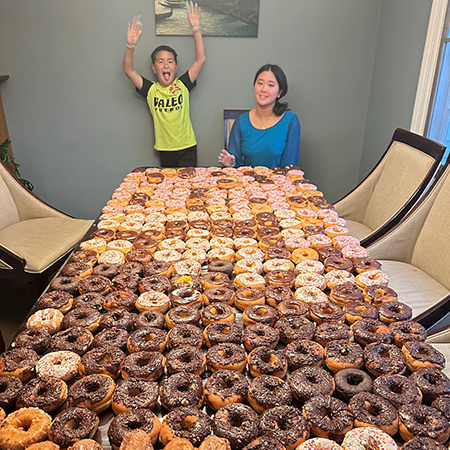
ARIANNA SUN (RIGHT) AND HER LITTLE BROTHER DILLON (LEFT) POSE BEHIND DONUTS SHE SAVED FROM BEING THROWN AWAY. THEY WERE THEN DONATED TO THE STACY KIRKPATRICK HOUSE. /COURTESY OF ARIANNA SUN
What have you learned through your experiences as a volunteer?
What goes on behind one issue and how interconnected direct service and policy really are. Through NoVasta, I’ve learned the logistics of moving food efficiently. Through the Anti-Hunger Task Force, I’ve learned how government and community partners can collaborate to make that work sustainable. I’ve learned that progress requires a lot of persistence, especially in building these partnerships. It’s not enough to just rescue the food. In the long term, we have to change a lot of the systems that are in place that create the waste in the first place.
Why is it important for others to get involved with causes they care about?
Being able to see and identify a problem in your community and being able to actually be a part of that solution is really meaningful work. I think if our organization is anything, it’s a testament that you can truly make a change with just the willingness to change something.
What do you want people to learn from your story?
How powerful collaboration can be between restaurants, volunteers, shelters and your local policy makers. Another thing I hope people can take away is that there is definitely a disconnect in our communities. Sometimes, waste and need are right next to each other. But what I want people to take away is that by being a volunteer, you can be the bridge between those issues, and you’re able to solve so many things that you see wrong in a community.
Spreading Smiles Among Seniors, One Card at a Time
Meet Daily Point of Light Award honoree Aditi Dewangan. Read her story, and nominate an outstanding volunteer or family as a Daily Point of Light.
Aditi Dewangan saw a need for connection and, inspired by the memory of her own grandfather, decided to fill it with heartfelt warmth. Her vision blossomed into Senior Care First, a nonprofit dedicated to brightening the lives of older adults in residential homes. Aditi’s simple but profound idea—personalized, handmade cards—has grown into a global movement of compassion. She recognized the isolation many seniors face and created a tangible way for the community, especially young people, to bridge that gap.
To grow Senior Care First, Aditi successfully recruited a massive network of over 3,000 volunteers—including more than 1,600 high school students from around the world—and built a dedicated executive board to sustain their efforts. This impressive volunteer base, alongside her core team of 10 individuals, has become the engine for delivering joy. They don’t just make cards; they carefully process and hand-deliver them, ensuring the effort is efficient and that the impact continues to increase. The organization’s outreach has been massive, spreading awareness to over 1 million people on social media.
Through diligent work, Aditi and her peers have delivered an astonishing over 10,000 cards and crafts to more than 45 senior homes. Through creative door-to-door advertising and fundraising campaigns, they’ve also been able to pay it forward in multiple ways, raising $1,350 for critical Alzheimer’s research and contributing $6,000 worth of items and crafts to the residents. Each personalized card, each donation, represents a moment of connection that combats loneliness and reinforces community ties.
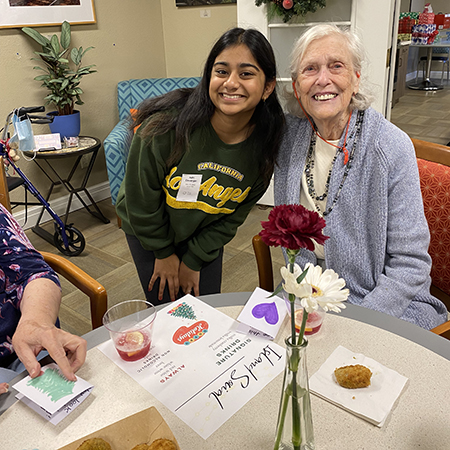
Aditi with a smiling senior after Aditi handed her a card.
Aditi saw an empty space—the lack of personalized attention for some of the nation’s most deserving citizens—and filled it with a simple yet deeply meaningful solution. Her work ensures that thousands of seniors around the nation know they are loved and cared for. Her initiative proves that a little bit of sincere effort can have a tremendous impact, fostering a sense of belonging and reminding seniors they are valued and remembered.
What inspired you to get started with this initiative?
My organization is called Senior Care First Foundation. When I started it, there were a lot of things going on in my life. One, I was volunteering at a senior home, which was a huge part of my life. At that time, I volunteered every weekend, sometimes over the week as well, just playing bingo and doing movie nights, or helping out with the caretakers there, specifically the engagement manager. Also at that time, my grandfather died. I think having him gone, having a grandfatherly presence gone in my life, and then also spending a lot more time with the seniors made me realize how much I really enjoy being around seniors. I think then I was going through a pivotal moment in my life where I really wanted guidance from a mature person who I could just talk to, someone who could just talk back with me. So that got me thinking.
Then, one night at the senior center, I was turning on a movie and making some popcorn, and I saw a new face. I sat down, and this guy told me about how his family, his kids, left him at the facility earlier that day, and he probably wasn’t going to see them for a while. And he was really sad. He was very down about that, and I tried to comfort him as much as I could, but it was very clear that this was going to be something in his head for a bit. I think that was the main moment that made me realize that maybe the community should be more a part of senior homes, that these seniors deserve people in their lives who want to engage with them.
The person who helped me start the organization, she and I wrote a couple of cards, and we went to a few senior homes around our area and delivered them. And then I think just with that, it just kept going further and further. We talked about our organization with other people, with a different youth community service group we were both part of, and it kind of just grew from there. I brought it to my National Honor Society, which is very community service heavy. And then it just grew to where it is now.
What inspires you to volunteer?
I’m super happy to have so many volunteers working with me. And honestly, I see myself on the same level as them. There’s no difference because I founded the organization. We all just want to make a senior citizen’s day better. Something that I like to note that is different about our organization compared to others, because I know there are others, are that we handmake our cards and we also hand deliver our cards. So, unfortunately, as much as people ask, we do not take any online cards or digital cards and print them out, because we want to have that crafty part of our cards and also make sure we interact with the seniors when we deliver them. It’s either the volunteers themselves or some of our leadership members who take them to senior homes. There’s more of a human connection being brought when giving the cards.
Tell us more about why it’s important for seniors and younger people to spend time with each other.
I think seniors get a lot out of just talking to people, because they get really bored at the senior homes. There are just a couple of people they see every day, and it’s very repetitive. Repetition and routine is really good for senior citizens, especially those with dementia, but not so great for them socially. So bringing something new to their lives, and showing them that other people care about them and are thinking about them is really important. It just brightens their days. There has been feedback that we’ve gotten from some of the caregivers like, “Oh, I’m really happy you came by. This certain person was having a really hard day, and this visit really brought happiness and turned the day around.”
I think for kids – well, our volunteer base is actually all ages, so there are people 40 years old or more – but for people in general who volunteer, I think they mainly get the ability to be compassionate. A lot of people these days, in their leisure time, they’ll watch TV. But volunteering for any organization gives them time to be thankful for what they have and meet people they normally wouldn’t.
What are your long-term plans or goals for the organization?
At the moment, some of our longer-term goals are simply to expand. We want to reach as many people as we can. We are really close to reaching a million people on social media alone, which is great. And I think other goals would just be getting more outreach in news outlets and other media that helps advocates for the organization itself.
We also want to give people help with making cards or making crafts. Currently, for those who don’t have the ability to ship the cards, we help them with that. We want to be able to provide more for those who don’t necessarily have art supplies in their homes. But whenever we get funds from grants or anything, the number one priority is making this thing more approachable for all volunteers.
What have you learned through your experiences volunteering?
I did not know how many logistics go into a nonprofit. Being 15 and figuring out how to register a 501(c)(3) is a lot in itself. Then, forming an executive team and building our volunteer base… there are just so many logistical details.
On the other hand, I’ve learned more about myself and how I like to lead. Our executive team is very collaborative. I don’t treat this team as if it’s a tree, with me at the top and everyone else beneath. It’s our organization. We’re all helping it work.
What’s been the most rewarding part of your work?
I think the most rewarding part is going to the senior homes and actually seeing the reactions when they get a card and a chocolate. They love chocolate, and they’re not supposed to have a lot of that! So seeing their faces when they get to have that. And also rewarding is seeing other volunteers having that experience too. On the rare occasion when I do get some of those photos back, I really enjoy seeing the joy in the aftermath of their volunteering.
Why is it important for others, especially youth, to get involved with causes they care about?
I think it’s super rewarding. Not only for them, but the people they’re impacting. Being around the people or places you want to impact is powerful. Being involved is very rewarding. You get to see the impact you’re making.
Any advice for people who want to start volunteering?
Just do it. Just apply for the volunteer role. Put yourself out there. Volunteering is fun; it’s rewarding. You’re not going to regret it.