Meet Daily Point of Light Award honoree Molly Harrington. Read her story, and nominate an outstanding volunteer or family as a Daily Point of Light.
From the time she could join a T-ball league, 16-year-old Molly Harrington has enjoyed playing softball. Then, a year before the pandemic, she started playing volleyball. Being on sports teams has been an important part of her life, but it’s not always an option for everyone.
Youth sports participation has been on a downward trend, and for many families, costs are a big factor in whether or not their kids can play.
Even basics like a baseball mitt or a pair of basketball shoes can be out of reach, especially when those costs come on top of participation fees, travel expenses, uniforms and other pop-up costs.
Molly’s older sister Katie founded Play It Forward in 2018 to remove financial barriers to sports by collecting and giving away used gear so no kid has to sit on the sidelines. While she’s been a volunteer from the beginning, Molly took over as community director in 2023 after Katie graduated. She’s still on a driver’s permit, so she appreciates the help and dedication their dad has shown the initiative over the years as well.
It’s a family affair. Aside from the occasional assistance of friends when they need extra help, it’s just the two of them. Since the beginning, the organization has facilitated the donation of around 10,800 items that have equipped more than 1,500 kids across 10 towns. Game on.
What inspires you to volunteer?
It makes me feel good to contribute to the community, because the community does so much for me. Kids sometimes can’t afford necessary equipment for sports, and being able to give it to them for free is really nice, because they get an opportunity to play. It just makes me feel really good about myself.
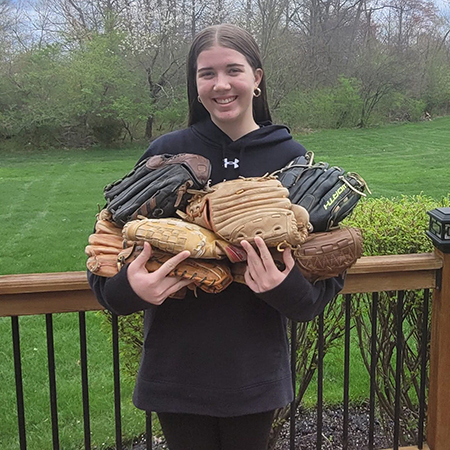
Molly Harrington, leader of Play It Forward, gets a bag full of gloves donated by a local college softball team to give to kids who can’t afford gear.
Tell us about your volunteer role with Play It Forward.
We have an equipment shed at our local baseball and softball fields, and once or twice a month, we’ll clean it out and make sure donations are organized. People have keys to the shed, and if children need equipment, they can access it. There are sections for cleats, catchers’ gear, bags, socks, clothes, softballs and baseballs.
When people need it, they can get it. If people want to donate–if they’ve grown out something or they don’t play the sport anymore–we have a bin outside of the shed to leave things in when we’re not doing a donation event. Then, when we come to organize the shed, we clean and add it. If people want to give anything back because they’ve either grown out it or they no longer play the sport, we accept the donations back as well.
I promote donations on social media and to friends in sports. It mainly spreads by word-of-mouth. A lot of friends have donated equipment, and they keep donating, because they have younger siblings. They always find equipment. I also schedule and run donation drops and times for kids to pick up their new gear.
You’ve been participating in sports for a long time. What have you gained, and why do you think sports are so important for young people to participate in?
It teaches you a lot of life lessons, and you build a lot of relationships. I’ve been on a bunch of sports teams. I’ve played other sports like basketball and soccer, and it’s given me some of my really close friends. It also teaches you what it means to be part of a team and how to work together. That’s one reason I started getting interested in studying hospitality. I want to work with people. I like working as a team.
What’s been the most rewarding part of your work?
As years go on, it gets more expensive to play sports as equipment costs go up. We’ve met many of the families who have benefitted from Play It Forward, and I really enjoy seeing kids have the opportunity to play the sport they love. Many times, younger kids are just trying out a new sport and may or may not like it. Giving kids the opportunity to try something without a price barrier feels great, too.
What have you learned through your experiences as a volunteer?
I work mostly with my dad, but I’ve also worked with local coaches. It’s taught me a lot about communication skills and connecting with families. Sometimes, we’ll meet up with families to give them equipment, and it’s really nice to meet them.
Why is it important for others to get involved with causes they care about?
It brings people together for a good cause, and it helps people in the community connect. Currently, the softball and baseball fields are being renovated, so it’s hard to connect with people. When my sister and I did it together, we would set up tables and were able to get to know everyone and see how other people’s lives are.
Do you have any advice for people who want to start volunteering or even how they might be able to take steps to address this issue where they live?
When my sister started, it wasn’t a big program. But with promotion and time, the impact has grown. Start small. Every little thing makes an impact on the community.
If you have space in your community to hold equipment, promote ways to donate. One person’s trash is another person’s treasure. And talk to your local Little League and sports programs. A lot of people throw out old equipment other kids might need. It’s wasteful, and it could be making an impact if you explain that to people.
What do you want people to learn from your story?
A small step in your community can make a huge impact, and it makes you feel good about yourself. It’s always good to help other people out, especially if you can relate to the situation they’re in. If, as a kid, you didn’t have a certain opportunity, help out other kids so they don’t have to experience that.
Reaching for the Stars: Making Space Education a Universal Right
Meet Daily Point of Light Award honoree Brandon Chang. Read his story, and nominate an outstanding volunteer or family as a Daily Point of Light.
A fire was lit under Brandon Chang in middle school – a defining moment that transformed a fleeting frustration into a lifelong mission. When a STEM staff member dismissively suggested he “pick a more stable career” than one in space, Brandon didn’t just walk away; he came home furious and declared his ambition to bring space education to every school. That audacious goal was the genesis of GalaxSea Explorers, an organization he founded to ensure no other student felt deterred from their dream to work in space. Now, his passion project has grown into a powerful network of several hundred supporters, achieving an astounding impact on 262,000 individuals with just $17,000 in seed funding.
GalaxSea Explorers’ programming goes far beyond textbook technical skills. While its flagship weeklong summer camps, workshops and popular Space DIY Kits (the next iteration of which Brandon is currently developing) provide tangible ways to engage with astronomy, the organization also focuses on broader life skills. Subinitiatives dedicated to soft skill growth, such as public speaking and budgeting, ensure that students are prepared for any career path, not just one in aerospace. Brandon is also currently overseeing the international chapters’ first long-form camps and designing new curriculum content, putting in 20 to 40+ hours a month of active volunteer time. His commitment to inclusivity is further evidenced by the upcoming Girls in Space program, ensuring everyone gets to dream big about a future among the stars.
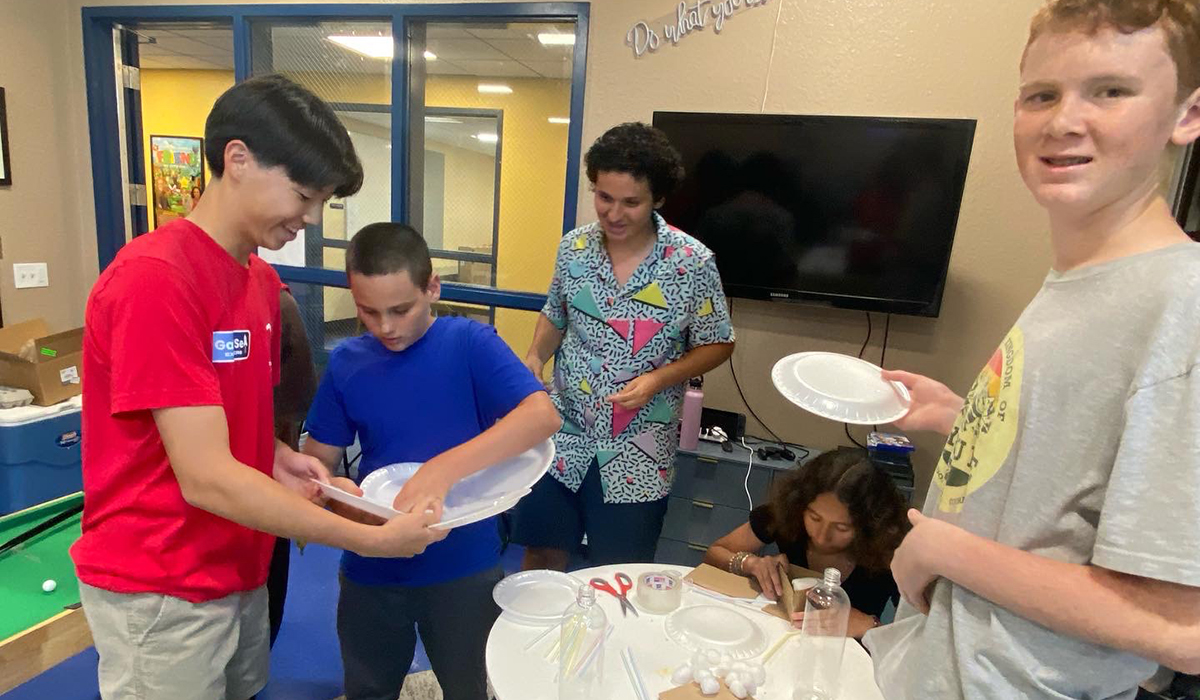
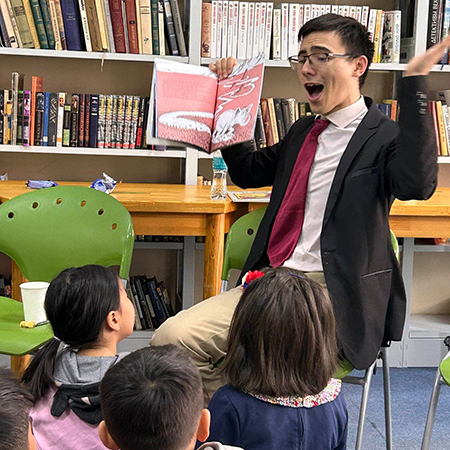
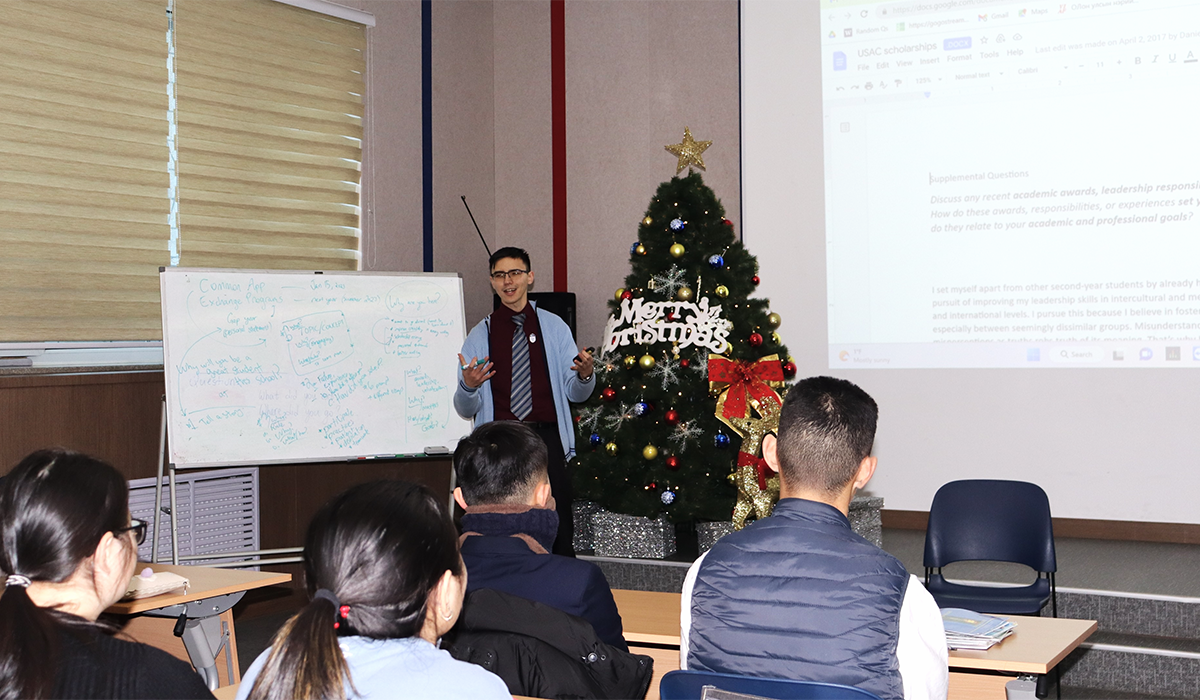
Brandon taking questions at the end of a camp slideshow at Rancho Pico Junior High.
Brandon’s daily duties demonstrate his dedication to the cause, extending to everything from curriculum design to developing improved versions of their video tutorials and the organization’s accessible one-pagers and in-class educational materials. His biggest accomplishment for 2025 has been standardizing the central curriculum used across all GalaxSea Explorers programming. He’s now looking ahead, with plans in early 2026 to distribute this standardized curriculum to educators and districts throughout California and beyond.
As he spreads the hopeful message of an internationally unified effort in space, his work has earned him significant recognition from institutions like the Princeton Prize, and major media outlets, including CBS and The Kelly Clarkson Show. His hopeful mission is clear: to make the vast expanse of space an accessible, achievable future for all.
Tell us about your volunteer role.
As the founder of GalaxSea Explorers, my role spans from designing summer camp curricula to filming silly YouTube videos to reach students from regions we cannot physically hold programs at. On the ground, I lead free astronomy and space science programs for students in grades K–12 with a focus on Title I schools and under-resourced communities. I hand-pack and distribute educational space kits, run workshops that connect scientific ideas to hands-on experiments and work directly with teachers, administrators and local and state-level policymakers to bring our programs into classrooms.
Beyond teaching, I coordinate outreach logistics, manage a team of passionate volunteers and build partnerships with nonprofits and industry leaders in the private space sector to expand our impact. I also oversee content creation and curriculum development for several of our international chapters, making sure our materials stay engaging, accurate, high-quality and accessible to students who might otherwise have limited exposure to STEM.
Why is this issue so important to you?
As someone absolutely fascinated by all of aerospace engineering and astronomy’s unsolved questions, the concerning levels of educational inequality that persist to this day hits very close to home. Growing up, I noticed far too often that students – myself included – were being indirectly told that such “nonessential” areas of study were unfeasible pathways. However, noticing the importance of self-belief just as much as the education, I am proud to be able to redefine what space exploration means for the rising generation of future astronauts and aerospace engineers. I believe space to be the epitome of childhood creativity, and even if students might not ultimately end up pursuing the field, limiting their access to it directly stifles their ability and desire to imagine.
What inspired you to get started with this initiative?
Having been raised in a low-income, single-parent household, I have direct experiences of barriers surrounding space education and access to learning opportunities as a whole. Upon seeing that only 11% of high schools offer any space related coursework and that the void is particularly pervasive in low-income communities, I created GalaxSea Explorers so that no child’s ability to dream of pursuing this field is limited due to their zip code or family situation.
What are your long-term plans or goals with the organization?
By late 2026 or early 2027, I hope to expand GalaxSea Explorers to all 50 states, while launching specialized subprograms like “Girls in Space” and expanding internationally to Malawi. In the long-term, by staying involved as a board member after going to college, I hope to implement math modeling techniques to break ground in the statistical research of space education, particularly its concentration patterns. Establishing data-driven research models for BIPOC education and transitioning from temporary camps to permanent institutional reform, I hope to blend curriculum with advocacy in creating change that lasts beyond GalaxSea Explorers’ lifetime.
What’s the most rewarding part of your work?
Seeing the unrestrained joy on kids’ faces… whether it’s the 10 seconds before bottle rockets blast up, the moment a student finishes the Mars crossword puzzle from my K-2nd grade curriculum, or a girl telling me “Get my autograph, I’m going to be the first Asian woman on Mars!”… the sheer excitement that education can bring inspires me to come up with more of such experiences. I’ve had the distinct honor of witnessing a failed solar system model reshaping a student’s career path or an IEP student taking the lead for the first time in school – seeing those individual transformations with my own eyes is most rewarding.
Brandon introducing the DIY Make-a-Planet activity at Illumination Foundation’s Carnival-for-Kids for unhoused students.
What have you learned through your experiences volunteering?
Ironically, even in my role as teacher, I myself have gained tons of additional astronomy knowledge, whether by reviewing past concepts or finding exciting new advancements to share with students. Further, I’ve grown as an educator, practicing the ability to develop lasting engagement even beyond the limited time we have with students. Lastly, I’ve learned to embrace flexibility in education, knowing when to creatively adapt to unexpected scenarios (especially considering we work with kids most of the time) rather than rigidly sticking minute-by-minute to the pre-planned schedule.
Why is it important for youth to get involved with causes they care about?
When we all begin expecting the person next to us to step up for issues we personally care about, everyone becomes a bystander. Voicing concerns with the unique worldview you bring leaves much greater impact than simply borrowing others’ voices. By choosing to become deeply involved in service as a whole, I’ve personally gained immense insight into the underlying systematic barriers to education that aren’t easily seen from the surface. I’ve gained more from service than I’ve given. I’m a strong believer in the notion that by serving actively, not vicariously, volunteers experience the irreplaceable satisfaction of changing someone’s day – or life – no matter how small.
Any advice for people who want to start volunteering?
Don’t look for excuses to wait until later, look for reasons to start today. Staying proactive has opened GalaxSea Explorers up to so many unexpected opportunities that have become a fundamental part of who we. Secondly, while daunting challenges are more common than progress in the world of service, remember that any volunteering work – no matter how small – has the power to influence those around you. We just choose the kind of influence we want to leave.
Meet Daily Point of Light Award honoree David Valdez. Read his story, and nominate an outstanding volunteer or family as a Daily Point of Light.
David Valdez, former White House photographer for President George H.W. Bush, has spent a lifetime capturing moments through the lens… but his most inspiring work is done off camera. After years of documenting the daily life of a presidency, Valdez transitioned his focus to community service, dedicating his time, talent and treasure to a multitude of causes. From serving as the vice president of the Williamson Museum board to championing the arts as chair of Georgetown Arts & Culture Board, his impact is broad, empowering youth, honoring military families and preserving history across Texas. His diverse commitments, which often consume over 20 hours a week, are driven by a powerful inspiration: the spirit of service he witnessed working alongside President Bush for nine years.
A true believer in the power of art for connection and healing, Valdez founded the Texas Photography Festival, which last year inspired over 1,200 photographers. He currently mentors and educates aspiring artists through the festival and his work with the Williamson Museum. Additionally, he volunteers his photography and sponsorship for ROCK Ride On Center for Kids, an organization that provides therapeutic horse training for children and veterans with disabilities. His commitment to the arts has not only opened the Georgetown Art Center but also launched the South Main Arts Festival, providing a showcase for local creatives. Valdez’s dedication to service stretches back over four decades with Habitat for Humanity, and every Monday, he can be found washing dishes at Crestview Baptist Church, helping to feed 650 Southwestern University students for free.
More than just a photographer known for his iconic images of President George H.W. Bush, David Valdez is a mentor, public servant, educator, and advocate for beauty and healing through art. Whether preserving history at the museum, feeding students or using the lens to inspire the next generation, Valdez continues to capture and create moments of hope and connection in every community he touches.
Valdez’s volunteerism is inspired by the spirit of service he witnessed working alongside President Bush as White House photographer./Courtesy David Valdez
Tell us about your volunteer role.
I’m kind of a lifelong volunteer and my work is wide-ranging. Currently, one of my most active roles is at my church, where four other guys and I serve as dishwashers for over 600 students from Southwest University every Monday morning for an event we call “chunch” (church and lunch). I often utilize my photography skills with volunteer roles, which I’ve had since I was 18. My photography has been 90% of my volunteer work with Habitat for Humanity Williamson County, a commitment that has taken me to Africa and Canada. My past work includes eight years with my photo office at the Walt Disney Company partnering with Give Kids the World, where I served meals, bused tables and worked the ice cream truck for children visiting from all over the world.
More recently, I finished a term as chairman of the Georgetown Arts and Culture Board, a volunteer position where we created the Georgetown Art Center, started an art festival and brought muralists and sculptures to the town. I’m also the vice president of the Williamson Museum.
Currently, a very exciting role is with ROCK (Ride On Center for Kids), a therapeutic horseback riding facility for children with disabilities and soldiers with PTSD. I mentor their marketing person in photography, and they use my photos for everything from murals to mailing lists. I’ve even “adopted” a horse named Sneakers. Finally, I founded the Texas Photography Festival, where I mentor younger and older photographers. I don’t do just one thing; I juggle multiple organizations, inspired by my years with President Bush.
What inspires you to volunteer?
I’m inspired by the people with disabilities I work with, and by watching the positive effect I have on the lives of the people I’ve mentored.
Why are these issues so important to you?
It’s fun for me to be able to get involved and pay it forward to people. My desire to help is heavily influenced by my time working with President Bush. I was with him the very first time he publicly talked about Points of Light, and I saw firsthand how he treated other people and always gave credit to someone else. This example helped build my approach to service. I like to get involved however I can; sometimes, juggling all my commitments feels like a full-time job, but I enjoy being a part of it.
What’s been the most rewarding part of your work?
What truly motivates me is seeing the success of other people. I don’t personally need recognition; I prefer to see others get credit for the things I may have helped them accomplish. For instance, when the state of Texas recognized me as trustee of the year recently, I was totally surprised, because I don’t do what I do for awards. I do it simply to help people with their careers or their lives in general.
I believe in giving credit to the other guy and saying thank you. It’s the simple things, like engaging with someone or dropping them a little note, that go a long way. Throughout my career, including my time as the President’s photographer—I was the fifth of only 13 in that role in U.S. history—I’ve been fortunate enough to help a lot of people move forward, and seeing their success is my greatest reward.
What have you learned through your experiences as a volunteer?
I’ve learned that when you volunteer, you’re often interacting with people you don’t know, so it’s essential to treat everybody with respect and to be kind. It’s the simple principle of “do unto others as you’d have them do unto you.” I believe in being an example without being boastful, bullying or seeking attention, like saying, “Look at me and how great I am.” I’ve always preferred to give credit to the other guy, especially since I’ve been so blessed in my life and career. For example, regarding a book currently being written about my life, and a film adaptation that has been discussed, I plan to donate any profits that come from those projects. I don’t need the money, but I know a lot of organizations that could greatly benefit from that financial gain.
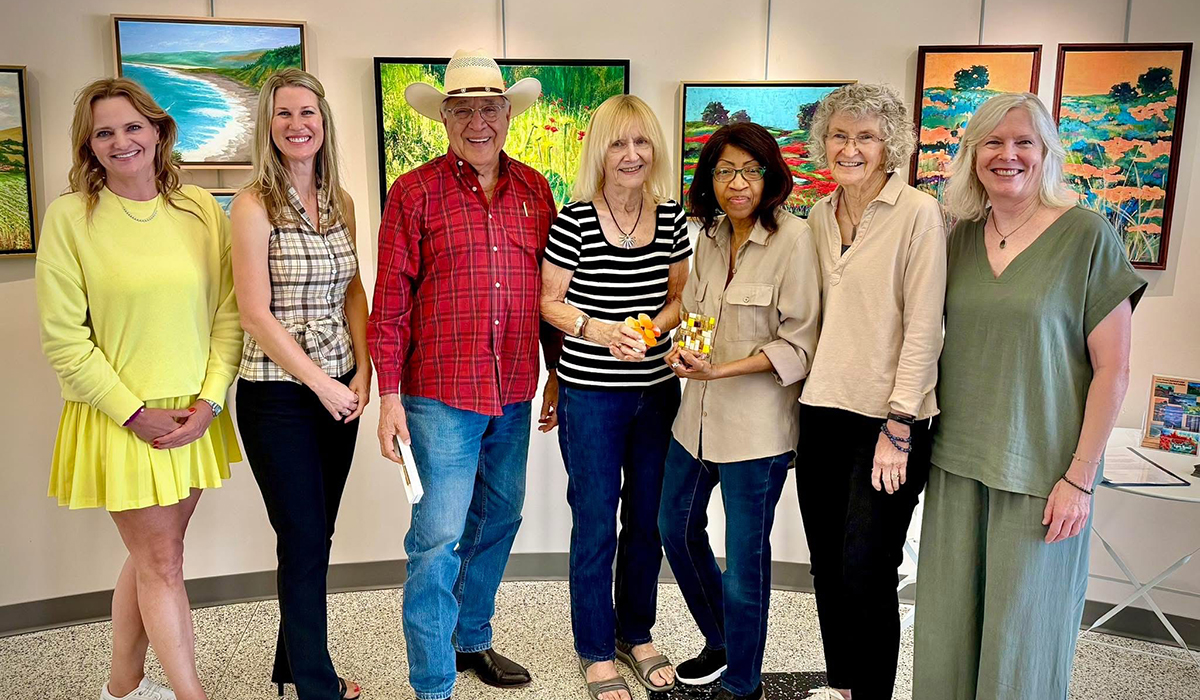
Valdez (third from left) and other members of the Arts and Culture Board, providing art and culture to the city of Georgetown Texas./Courtesy David Valdez
Why is it important for others to get involved with causes they care about?
It’s important for people to get involved because they can literally witness lives being changed, which is incredibly inspiring. When you see the work at ROCK, you understand the impact. I recall a young girl born with Down syndrome who started riding horses there when she was only two years old. Due to her condition, she lacked muscle control and doctors doubted she would live more than a few months. However, 15 years later, she’s still riding at ROCK, and her doctors noted she developed unusually good muscle control. She is a true inspiration.
This kind of progress is deeply important to me because I believe in helping people with disadvantages move forward. This stems from my time at the White House, where I saw President George H.W. Bush sign the Americans with Disabilities Act (ADA) into law. Seeing him sign that bill, knowing it would change lives by mandating handicapped-accessible buildings, curb cutouts and parking spots, gave me a soft spot in my heart for this cause.
When you get involved, you are directly contributing to that kind of life-altering change. We can see the results in people like a woman at ROCK—now in her 40s—who, having started there as a child, has been recognized by the state as a top advocate for people with disabilities in Texas. Witnessing these individuals overcome obstacles and thrive makes it clear why giving your time and effort is so necessary.
Any advice for people who want to start volunteering?
My advice is simple: Go for it! Don’t let fear or the thought that you don’t have enough to offer stop you. The truth is, all of us have something to give, and we can all help others. You’ll find that you get far more rewards coming back your way than you ever put in. It’s an incredibly fulfilling experience. You might think it’s too difficult or too exhausting, but those feelings quickly pass once you see the impact of your actions. For example, when I finish washing dishes for 600 students—carrying around those big, hot pots and pans—I’m often exhausted, but the feeling of accomplishment and connection is always really rewarding. I’m blessed that, even at my advanced age, I can still get out there and contribute.
In some cases, your actions can speak louder than any words. Regarding my service at the church, for instance, there is zero religious aspect to the lunch program, yet many students have been so moved by the community and the kindness they experienced that they’ve chosen to get baptized later on, without anyone ever pressuring them. They simply saw the positive example and were inspired. Just by showing up and doing the work, you’re offering a meaningful contribution.
Peace Corps Volunteer Bridges Cultures Through Education
Meet Daily Point of Light Award honoree Daniel Lindbergh Lang. Read his story, and nominate an outstanding volunteer or family as a Daily Point of Light.
When 28-year-old Daniel Lindbergh Lang first heard about the Peace Corps as a college freshman, he never imagined it would define his path. Years later, that early curiosity led him to Mongolia—twice—where he became not just an English educator, but a cultural bridge-builder, mentor and lifelong advocate for global understanding.
A two-time Peace Corps Volunteer fluent in English, Mongolian and Chinese, Daniel served in Mongolia from 2019–2020 and again from 2022–2024. There, he strengthened English education, mentored hundreds of students and teachers and helped revitalize Peace Corps operations post-pandemic. Now, as executive director of the National Peace Corps Association’s Friends of Mongolia affiliate and co-founder of the LinYL Foundation, Daniel continues to champion education, service and connection across cultures.
What first inspired you to volunteer with the Peace Corps?
I first heard about the Peace Corps during my freshman year of university, but it wasn’t until a few years later—when I was abroad on a U.S. State Department program—that it really stuck. A friend and I were talking with high school students studying Mandarin, encouraging them to keep going, and their resident director happened to be a returned Peace Corps volunteer.
When I got back to campus, I realized two of my professors were also Peace Corps alums. Suddenly, I was surrounded by people whose lives had been shaped by service abroad. Their encouragement pushed me to apply. I was very fortunate to receive an invitation to Mongolia. I had to pack up, spend two years in a country I’d never been to and learn a language that I’d never learned before.
Daniel reads to children at a local public library in Mongolia./ Courtesy Daniel Lindbergh Lang
For those who may not know, what is the Peace Corps’ mission, and what was your role in Mongolia?
The Peace Corps has three main goals. The first is to provide skilled volunteers to communities that invite them. I worked in English education and community development.
The second is cultural exchange. As a volunteer, I wasn’t just there to teach English—I was there to learn from the people around me, to understand Mongolian culture and to become part of the community.
The third goal is about bringing those experiences back home. Now that I’m back in the U.S., I see that as my ongoing mission—sharing stories about Mongolia, the people I met and everything I learned.
What did a typical day look like for you while serving?
It’s hard to describe a “typical” day, but one of my favorite parts of the week was working at the Teacher’s Development House in Ulaanbaatar, the capital city. I had a desk next to my main counterpart, the foreign language methodologist who oversaw English instruction for about 300 schools. Together, we conducted teacher development activities—consulting with teachers, organizing monthly workshops and helping improve classroom techniques.
Outside of that, I led creative writing sessions at the American Corner, a section of the public library where students and professionals came for English help. I especially loved helping people with their personal statements because I enjoyed getting to read people’s stories, but also help them tell it in the best way that can help them apply to universities or jobs. I also spent time working with students with special needs and collaborating with local schools and community centers.
Was there a particular person or project that left a lasting impact on you?
Oh, goodness, so many great memories. The main person I worked with was the foreign language methodologist, Nyamsuren Sainjargal. We started at the education department around the same time, figuring things out together and supporting one another through new challenges.
In our second year, the mayor of Ulaanbaatar initiated a city-wide English competition, and our department was tasked with leading it. Together, we launched what became the first annual English language contests for students and teachers—public speaking, book debates and teaching methodology competitions.
We also helped Mongolian teachers present at international English conferences in South Korea and Japan. Seeing my colleague continue those initiatives after I left—sending more teachers abroad and sustaining those programs—was incredibly rewarding.
You’re now executive director of the National Peace Corps Association Friends of Mongolia group. What does that involve?
I’ve been in the role about a month, and I’m definitely doing my best to make the most of it.
This organization brings together the nearly 30 years’ worth of volunteers who have served in Mongolia. After the pandemic, a lot of those connections went quiet, so my goal is to revitalize the network—bring in the newest returned volunteers while reconnecting with the earliest ones.
I’m building a small team, including some Mongolian Americans, to help organize socials, promote cultural events and share information about Mongolian studies here in the U.S. The hope is that when someone finishes their Peace Corps service in Mongolia, they’ll know exactly where to find community and continue engaging cross-culturally.
Tell me about the LinYL Foundation, which you co-founded with your siblings.
The LinYL Foundation started after our mother passed away. We wanted to honor her legacy in a way that would keep her spirit alive, and education felt like the most natural choice. She grew up in China during the Cultural Revolution, a time when education was limited. But she worked her way into one of China’s top universities and chose to pursue English—a rare path in the 1980s. She later became an English professor, which eventually led her to the United States to study international relations.
Her story shaped our family’s belief that language and education open doors. So, my siblings and I decided to pay that forward. We began offering scholarships for high school students going to college and later added a fund for students studying abroad.
Five years later, we’ve awarded more than $28,000 in scholarships to 36 students. Some of our first recipients have now graduated and are mentoring the newer ones, which is incredibly special. We recently celebrated the fifth anniversary of the foundation and what would have been my mother’s 60th birthday. Getting to reconnect with our scholarship recipients was really special. It was humbling to see them impart wisdom to each other and I felt my mom’s presence there in those times.
Daniel conducts an English writing workshop for students in Mongolia./ Courtesy Daniel Lindbergh Lang
What’s been the most rewarding part of your volunteer work?
I really like the random thank-yous and connections that you could never predict. Those moments — the serendipitous ones — really feel great. Before I left Mongolia, there was a student who helped me co-facilitate the writing program I mentioned earlier. After she graduated high school, she found an opportunity to study abroad in the United States. When she returned to Mongolia, she continued teaching writing workshops to other students in the community. It amazed me that she kept up that same drive, that same passion we had started together.
And it’s not just her. I still hear from colleagues and students — little updates about what they’re doing, what opportunities they found through the things we worked on. Just this past weekend, one of my colleagues from the education department came all the way to Washington, D.C., for a conference, and one of my former students messaged me that she was also in the U.S. for a program. It just reminds me that we’re all part of this wonderful web — we don’t always know what impact we might have, but when it comes back to you in these unexpected ways, it really does put a pep in your step.
What advice do you have for others interested in volunteering?
Start local. My first service experiences were in Key Club and National Junior Honor Society. From there, I joined Kiwanis and other service groups. Even now, I volunteer with the Knights of Columbus at my parish in D.C.—sometimes that just means stacking chairs after an event, but it all matters.
And for anyone drawn to international work, the Peace Corps is still alive and thriving. Two years might sound like a long commitment, but even two hours a week can make a real difference. Service doesn’t have to be grand—it just has to be genuine.
What do you hope people take away from your story?
I hope they see kindness. That’s how I’d want to be remembered.
Whether it’s smiling at a neighbor, sharing your time or stepping outside your comfort zone, kindness goes a long way. My faith and my upbringing taught me to live with gratitude—and I believe gratitude is where service really flows from. The ease with which we can give comes from knowing how much we have received.
Meet Daily Point of Light Award honoree Emme McDonald. Read her story, and nominate an outstanding volunteer or family as a Daily Point of Light.
For some people, there’s never enough time in the day to participate in their passion for the hours it could engage them. Emme McDonald is one of those people, and her passion is programming. She fell in love after an introductory computer science class in elementary school but has garnered the bulk of her knowledge from online resources in her spare time. She often tests her skills by competing in hackathons and coding personal projects like websites and games.
Last November, she began using those skills for mercuri.world, an organization addressing global mental wellbeing using digital solutions, and is currently the director of app development. Emme’s work building innovative tools and maintaining a multilingual resource library empowers people to be proactive about their mental health. CareerQuest, a highly technical project using machine learning to match users with jobs that offer various accommodations, helps people find employment that fits their needs and will be the first of its kind.
Emme volunteers an average of 30 to 60 hours a month and leads a team of around 10 programmers across time zones. Middle-of-the-night meetings with colleagues in India and Nepal have only made her more appreciative of her role and the community she has built around the world. It is a community she hopes to expand even further as she applies to bachelor’s programs in computer science. After all, who says passion projects are just for after work?
What inspires you to volunteer?
Service is one of the most rewarding things you do. Someone from my school recommended mercuri.world. I was intrigued by their mission, so I applied right away. It was nice to find a place where I could put my programming skills to work in a way that would help people.
As chief technology officer for mercuri.world, Emme McDonald aims to increase access to multilingual mental health resources and offer technology-integrated support to those with mental health conditions.
Tell us about your volunteer role with mercuri.world.
I’m the lead developer. At first, I was on the mobile app development team, then I transitioned to web development. Now, I head up most of the organization’s tech projects. I code and maintain our main websites. That involves making new, exciting tools to make mental health resources more accessible like our online library of multilingual options, which is constantly being updated and expanded.
My main focus is coding CareerQuest, software that connects people with mental health conditions to job opportunities that can provide accommodations. Users fill out a profile of how many hours they would prefer to work, accommodations they’ll need and stuff like that. We store that away from personally identifiable information. Then, we can train an AI model on their needs and job data that we find online to generate a compatibility score out of 100. Higher scores are recommended to the user. We had an initial pilot, and it’s been really special to see anecdotes and feedback.
Where do you see the use of AI being beneficial to mental health in the future?
Our director of AI is working on using AI to help translate mental health resources that aren’t accessible in many languages. I think that will be really helpful in the future. And also, things like machine learning models that can help match people to jobs they need. I think there’s a lot of promise in the field to make things more accessible to people, no matter what location they’re in or language they speak.
What’s been the most rewarding part of your work?
I love knowing that the tools I make are helping people in such a unique way. And it’s been really rewarding to be a part of the community of people I’ve met volunteering. I’ve made a lot of great connections all around the world.
What have you learned through your experiences as a volunteer?
For everything, but especially with coding, the best way to learn is by doing. Working on large-scale projects for mercuri.world has taught me so much about web development and programming best practices. Beyond hard skills, I’ve also learned about communication and how teamwork can combine new perspectives and skillsets to make something incredible.
Do you have any tips for either people dealing with mental health issues, or for employers trying to make roles more accessible?
For employers, the biggest thing we’ve seen is having access to quiet spaces where there is less sensory overload and having flexibility to take days off for mental health. For individuals living with mental health challenges, the most important thing is to build a support system for yourself. It can be hard, depending on your situation, but that’s where online resources can really help.
We also have a program called Little Talks that encourages people to connect with each other over social media in a genuine way and check in on people who might be struggling. Community building, whether in-person or online, is really helpful.
Why is it important for others to get involved with causes they care about?
One person can make a huge difference, whether it’s to one person or 1,000. And by getting involved with a cause you’re passionate about, you learn and grow while allowing others you meet to do the same. It’s an exchange of ideas, experience and compassion, and it’s one of the most worthwhile things you can do.
What do you want people to learn from your story?
Don’t be afraid to put yourself out there. Everyone has their own unique skill set, and you can do a lot with it. Programming might not be the first thing someone thinks of when they think about community service, but it can make a huge difference. You can do a lot more than you think you can, and your community will be grateful for it.
Meet Daily Point of Light Award honoree Anthony Suppa. Read his story, and nominate an outstanding volunteer or family as a Daily Point of Light.
Anthony Suppa spent six years in the U.S. Marines before going into the restaurant business. Not long after, drawn to helping kids, he hosted his first donation event for Toys for Tots at the restaurant he was managing. He was immediately hooked, and things took off from there.
In 2024, over a decade into fundraising and organizing large-scale toy drives for the organization, Anthony founded Slice of Charity to expand his work and dedicate himself to helping veterans and families in need as well as children. These days, he owns the Italian pizzeria he spent years managing and uses it as a volunteer hub.
He spends 80 to 100 hours a month volunteering on anything he defines as “human-related.” In 12 years, he has collected and delivered more than 25,000 toys, provided thousands of meals to families in crisis, raised tens of thousands of dollars for causes and supported countless fellow veterans with training and resources. And with big plans for the future, he’s just getting started.
What inspires you to volunteer?
I was working as a manager at Frantoni’s, and I wanted to collect some toys for the kids. There were probably 30 to 40 people—mostly family and friends—there, but it grew a little bigger each year. I realized that I thoroughly enjoy making a difference. It eventually grew so big we weren’t able to host it at our restaurant. So, we found Oheka Castle. Last year, we had 1,400 people and raised over $6,000. When I started Slice of Charity, I felt like I could do so much more.
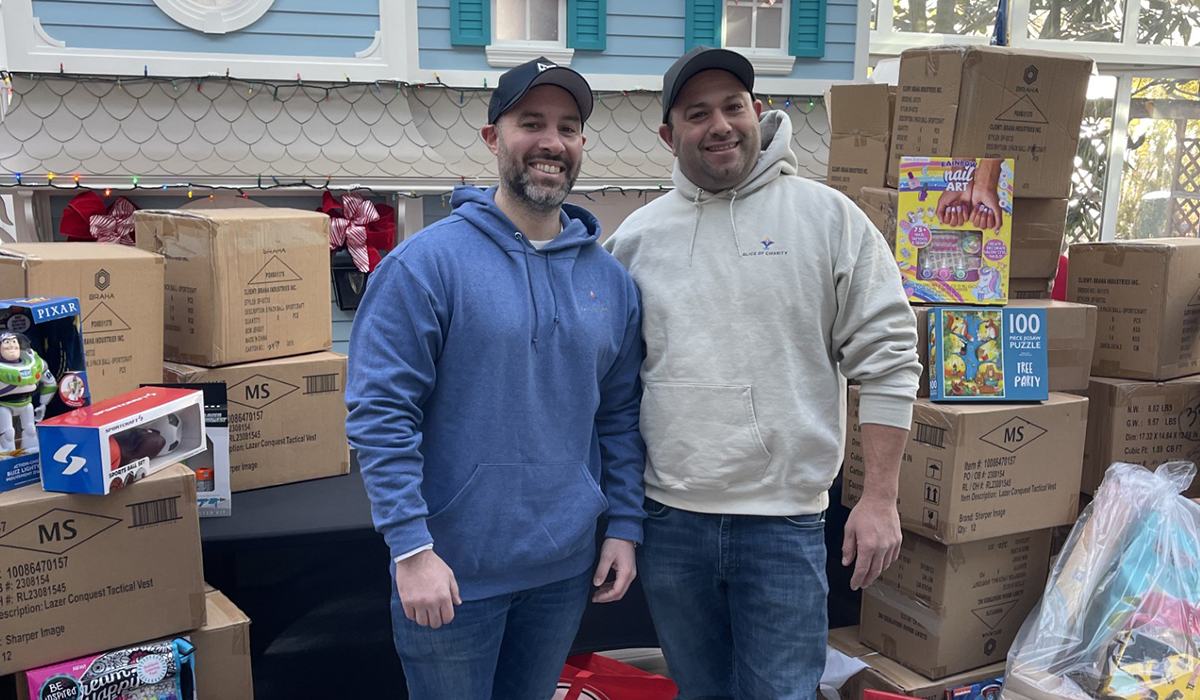
Anthony Suppa (left) and board member Danny Scoca deliver meals and toys to the Ronald McDonald House.
Tell us about your volunteer role with Slice of Charity.
I’m the founder, the organizer, the everything. I have a board, but we just do what we need to do—meeting and voting–to keep the 501(c)3. The planning, coordinating, partnership development, fundraising and event execution is on me. There are no other volunteers. I have a lot of big projects with the Department of Veteran Affairs and work with different companies to do events on-location.
I’m trying to build a training facility for veterans and entrepreneurs to work and train at our restaurant. They’ll learn what it takes to open and run a restaurant. I went to culinary school, but it doesn’t compare to hands-on training. I’ve also started a wellness company that will be launching soon called Aluvia. I’ll be donating 100% of the profits to Slice of Charity and its mission.
Describe a couple of your initiatives.
We do events and fundraisers at for-profit businesses, including many restaurants, where a portion of the sales goes to whatever we’re trying to achieve. A year ago, we held an event to raise money for a 3-year-old boy whose father is in the Army and whose mother passed away shortly before he was diagnosed with a brain tumor and autism. The father was really going through it, and we were able to write him a check for around $15,000.
At one of the restaurants, we hosted an event and gave the proceeds to the Ronald McDonald House. We got a freezer donated and, after the event, we delivered several thousand dollars’ worth of food over the course of a month. We were able to raise a couple thousand dollars, then Frantoni’s covered the rest of the food they needed.
We also got a Porsche for ride-alongs. We’re going to go to hospitals to visit sick kids and veterans to take people out of whatever bad situation or moment they’re in for a short amount of time. It’s important for mental health.
What are your long-term plans or goals for the organization?
With the training facility, we’re trying to reinvest in veterans. We want to help them–financially and with guidance–open their own restaurant.
It’d be like a franchise; part of the sales would go back into Slice of Charity to support its mission.
We’re trying to feed veterans through the restaurant itself. The training center will also be an emergency response kitchen. God forbid anything ever happens like another Hurricane Sandy, there will be a safe, dry place that can hold and feed 1,000 people.
What’s been the most rewarding part of your work?
It’s taking somebody out of a situation for a while. Seeing a kid smile who’s not doing well or whose parents can’t buy gifts for Christmas. Once, an organization reached out about a little boy who is blind and had some health issues. He’d written to them because he really wanted this Buzz Lightyear toy, so I bought it and sent it to him. They sent a picture back of him holding it with a handwritten letter that was also in Braille.
What have you learned through your experiences as a volunteer?
One of the biggest things is not to feel so bad about myself, because there are bigger problems that I could have. My problems might feel huge, but to somebody else, they’re tiny. This work really puts things into perspective.
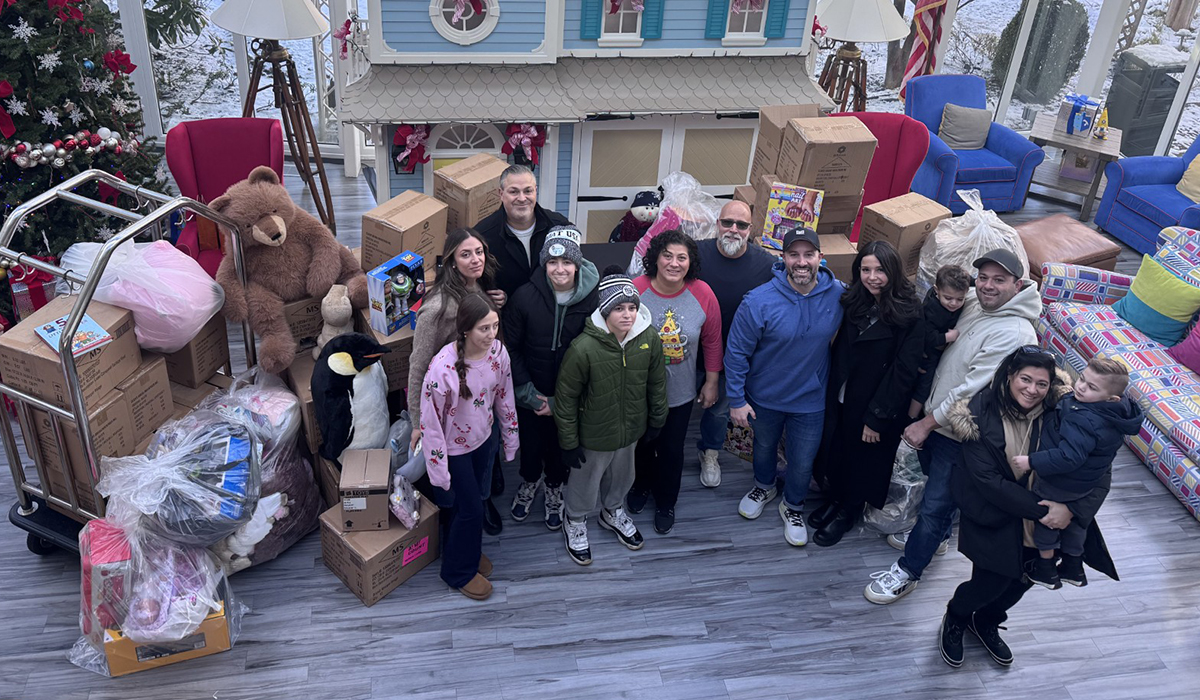
Anthony (third from right, white shirt) and members of Slice of Charity donate toys to Ronald McDonald House in Deceber 2024.
Tell us about future partnerships, programs or events that you are excited about.
I have a trunk-or-treat event this month. We’re blocking off an entire block and have around 50 exotic cars coming. They’re going to hand out candy from the trunks for Halloween. The kids will be dressed up. It’ll be a block party with a DJ, and everything’s free. We just ask people to come hang out.
Any advice for people who want to start volunteering?
Everybody likes to make excuses, but for anything in life, you have to stop waiting for the perfect time. Just do it. And don’t be afraid to be told no or to not get a response.
What do you want people to learn from your story?
It’s not that difficult to make a difference. Something small to you could be huge to somebody else. And it doesn’t always have to mean time or money. It could be sharing an organization’s story on social media, leading a person who sees it to get involved.
From Hoops to Helping Hands: Teen Leads Food Pantry Volunteers
Meet Daily Point of Light Award honoree Findley Gardiner. Read his story, and nominate an outstanding volunteer or family as a Daily Point of Light.
Seventeen-year-old Findley Gardiner of Maplewood, New Jersey, is a high school senior, balancing homework, his social life, drums and basketball practice with something that’s become a core part of who he is – volunteering. Despite his busy schedule, Findley has devoted more than 250 hours to serving his community through Jersey Cares spending most weekends at food pantries stocking shelves, serving families and leading volunteer teams.
As one of the youngest project coordinators in the organization’s history, Findley helps events run smoothly and keeps volunteers motivated, all while finding ways to fight hunger and homelessness in his community. What began as a simple way to fulfill a school service requirement has become a defining part of his life.
What inspired you to start volunteering with Jersey Cares?
I go to a Jesuit Catholic high school, and every year we’re required to complete a certain number of service hours. At first, I honestly just wanted to get it out of the way. But my perspective really changed during my sophomore year when I went on a weeklong service trip to Los Angeles.
We worked in some of the most underdeveloped areas like Skid Row and Boyle Heights, where we met people who were trying to rebuild their lives after experiencing homelessness, incarceration or immigration challenges. We volunteered with Homeboy Industries, which helps people recently released from jail reintegrate into society. Meeting people who had been through so much but were still finding ways to get involved was really powerful.
That trip gave me a lot of perspective. I realized that people experiencing homelessness aren’t that different from us—they’ve just been unlucky or faced obstacles most of us don’t think about. When I came home, I wanted to make an impact in my own community, so I started volunteering locally with Jersey Cares.
Findley prepares lunch at a food pantry in New Jersey, where he volunteers regularly with Jersey Cares./ Courtesy Findley Gardiner
What kind of volunteer work do you do through Jersey Cares?
Most of what I do focuses on food insecurity and homelessness. I help stock shelves at food pantries, organize distribution tables and serve people directly. In 2024, I started volunteering at several food pantries near my home in Maplewood, and that led to me become a project coordinator.
As a project coordinator, I’m responsible for making sure volunteer events run smoothly. I communicate with volunteers before events, take attendance, coordinate with pantry staff, and make sure everyone knows what to do. It’s not the hardest job, but it’s a meaningful one. You’re kind of the point person between the organization and the volunteers. Most of the time I lead about eight to 15 volunteers, but sometimes it’s as many as 25.
It’s taught me a lot about leadership and responsibility, especially since I became a coordinator at 16, a year earlier than the minimum age. Technically, I had to do it alongside my mom at first because of my age, but it’s been great to grow into that role and be trusted with more responsibility.
You and your brother also started a neighborhood food drive. Tell me more about that.
Yeah, that started when a new food pantry opened near the top of my street. My mom and I realized a lot of our neighbors probably had unopened cans and extra food they could donate, but they didn’t always have time to go drop them off. So we started a doorstep donation program. We’d go door to door once a month, collect items from people’s porches, and bring them to the Maplewood Community Fridge.
It started with just our street, but it grew to cover four or five blocks. Other people saw what we were doing and started doing the same thing in their neighborhoods, which was really cool.
What do you find most rewarding about volunteering?
The people I’ve met—both the volunteers and the people we serve—have been the most rewarding part. You learn so much just by hearing their stories.
One moment that really stayed with me was back at Homeboy Industries. Our tour guide there was someone who had been in jail, been shot multiple times and struggled with gang involvement. But after someone helped him, he turned his life around and started helping others who were in the same position he once was. Hearing his story made me realize how one act of kindness can create a ripple effect that changes lives.
Even when I’m just handing someone a sandwich at a food pantry, I think about how something that small can make their day a little easier. It’s made me see that what might feel like a small effort can mean everything to someone else.
indley gets ready to serve food to his local community before a Jersey Cares volunteer event./ Courtesy Findley Gardiner
What have you learned through your experiences as a volunteer?
Volunteering has completely changed how I see the world. I’ve learned that people who are struggling—whether with housing, work or anything else—are often just one unlucky break away from a very different life. It’s not as simple as “just get a job.”
It’s also taught me that every bit helps. Even if I’m only volunteering for an hour, I’m still handing someone food they might not have had otherwise. That’s a small act, but it’s making a real impact.
What advice would you give to someone who wants to start volunteering?
I’d say just go for it. A lot of people are nervous because they don’t know what to expect or they worry it might be unsafe or uncomfortable. But honestly, everyone I’ve met through volunteering has been so kind and welcoming.
You don’t have to do something huge to make a difference. Even small actions—one hour, one event, one donation—can have a big impact. And once you start, you’ll realize how rewarding it is and probably want to do more.
What do you hope people take away from your story?
Where you start doesn’t matter as much as what you do next. I didn’t start volunteering because I had some big plan to change the world. I started because I had to. But after seeing the impact I could make, I kept going because I wanted to.
SEALED WITH A SMILE: SENDING LETTERS TO ELDERS BRINGS JOY
Meet Daily Point of Light Award honoree Jacob Cramer. Read his story, and nominate an outstanding volunteer or family as a Daily Point of Light.
As a teen, Jacob Cramer was known as the “Bingo Boy.”
That’s what the residents called him at the senior community where he volunteered, calling out the bingo numbers to the seniors who enthusiastically played the game. But it was also the place where he forged deep relationships with some of the elders and realized how much it meant when he wrote them handwritten letters.
After forging those bonds through the written word, Jacob was just 13 years old when he founded Love For Our Elders, an organization whose mission is to alleviate social isolation among older adults through handwritten letters and intergenerational connections. In the 12 years since then, Jacob has grown the mission from a grassroots endeavor into a global movement. Under his leadership, Love For Our Elders has sent more than 900,000 letters to people across 27 countries, established Letter to an Elder Day, created 90 high school and college campus chapters and been featured on The Kelly Clarkson Show.
Jacob has seen the tremendous influence that the letters have had on their recipients. One woman had an hour to pack before evacuating her home due to a hurricane warning, and chose to bring her letters along with her because they gave her the most comfort. Another man who had recently experienced the trauma of a mass shooting said he wanted to be buried with his letters when he dies, because he feels like they saved his life. Across the world, the power of the pen gave these elders the love and appreciation they deserve in a world where connection is scant.
One of the organization’s latest endeavors is its mailbox program. Inspired by Little Free Libraries, there are already 40 letter collection and drop off boxes in coffee shops, libraries, cafes and schools where anyone can go and grab a free handmade blank card and envelope. In just a few minutes, they can write a letter, which is then delivered to the local senior community. While one letter may not seem like something major, the impact it has can be huge. Like a handwritten letter, Jacob’s volunteer work demonstrates how a small action can have a tremendous impact on the world.
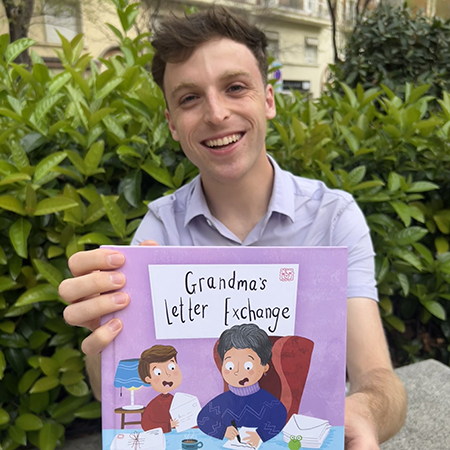
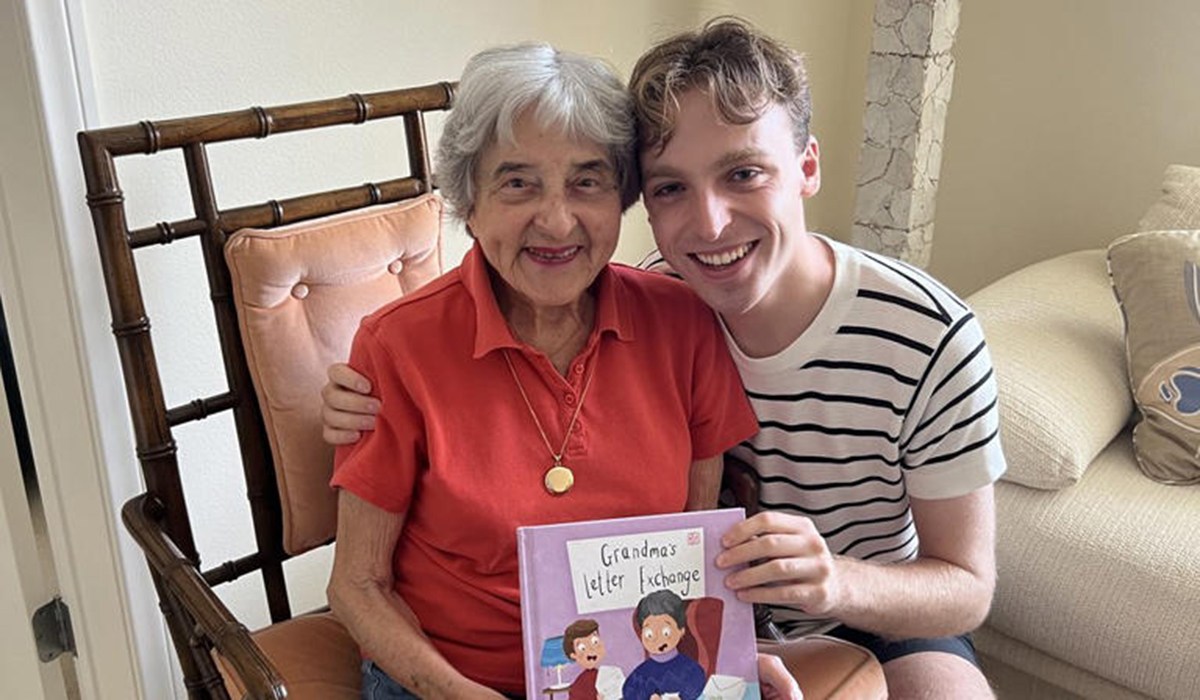
LOVE FOR OUR ELDERS FOUNDER JACOB CRAMER SHARES GRANDMA’S LETTER EXCHANGE, HIS PICTURE BOOK THAT TEACHES LITTLE ONES HOW TO SEND A FRIENDLY LETTER./COURTESY JACOB CRAMER
What inspires you to volunteer?
I think my volunteering is really grounded in the values that my grandparents taught me. My grandma and grandpa are Jewish, and there are values like Tikkun olam, which means repairing the world, and Gemilut hasadim, which are acts of loving kindness. These are things that we would talk about. At the temple, we would do service projects. It’s something that I carry with me every day.
Tell us about your volunteer role with Love For Our Elders.
Every day, I am helping to facilitate letter requests. The first of every month, we post new letter requests from family caregivers, neighbors, loved ones or older adults. I facilitate those letter requests with my co-pilot in all of this, Jamie, who’s also a volunteer. I am spearheading new initiatives. We just launched our Dear Elder mailbox initiative, so we’re sending out physical mailboxes to volunteers who want to collect letters in their communities. I am organizing our campus chapters, supporting them with in-person volunteering at local senior communities, providing them with learning toolkits, managing our team of interns and running corporate and school volunteer events, where we’ll do anything from letter writing to read-alouds of my book.
What inspired you to get started with this initiative?
I started volunteering at a senior community, and they called me the Bingo Boy. I would enthusiastically shout out letter and number combinations and it was beyond fun. I became like a best friend with a woman named Cynthia, and I would go into her room and talk to her about politics and how annoying my brother was. It was a time when I was really lonely. I was 13, and I found someone who really made me feel loved, and over time, I learned that she didn’t feel loved, and that was crazy to me. This woman, who made me feel so loved, was lonely and didn’t even get anything as simple as a letter in the mail. I realized I should write her a letter, and so I did. What I didn’t expect was for her to break down crying when she received it. I wrote some more letters to more residents, and since then, I’ve been on this mission to alleviate a growing loneliness epidemic, which to date has sent more than 900,000 handwritten letters of love to older adults.
What are your long-term plans or goals for the organization?
I think a lot of people have focused on loneliness during the COVID pandemic, but we’ve been trying to address the fact that loneliness is an epidemic that’s existed long before COVID and will exist long after, and the health risks are very dangerous. We want to be talking about the loneliness epidemic and facilitating in-person activity as much as possible. In the future, one thing that I’m excited about possibly doing is opening a connections fund so that anyone could run in-person events that we could fund. For instance, say that you want craft money for your community. Well, we’ll provide you with the yarn. It’s to encourage regular, in-person connection. A letter is so, so powerful, but we all need more in-person human connection.
What’s been the most rewarding part of your work?
It’s the stories from people who just had no idea what this influx of love would feel like. It makes me really emotional to hear some of the stories. Imagine you’re really lonely. You only get some bills in the mail, and you don’t have many visitors. Your family lives far away. Then you’re delivered a letter written by strangers around the world talking about the dog that you’re thinking of getting. This actually happened. A letter recipient was inspired to get a dog because he had been thinking of fostering one, and then he decided to just adopt one. He said the letters encouraged him to and they suggested a name, and he named his dog after one of the suggestions in the letters. Hearing these stories of impact is what has kept me going. I started this when I was in eighth grade. I’m fully an adult now. I never thought I’d be doing this, and I am, because not only do I feel a deep duty and obligation, but I would never want to step away. I love the impact that’s shown me how kind the world is.
JACOB (RIGHT) SMILES ALONGSIDE HIS GRANDMA DORIS, WHO ALWAYS WROTE HIM CARDS AND INSPIRED HIS BOOK, GRANDMA LETTER EXCHANGE. /COURTESY JACOB CRAMER
Tell us about future partnerships, programs or events that you are excited about.
Yes! Letter to an Elder Day is February 26, 2026. It’s my grandma’s birthday. Grandma Doris. It started in 2020, and it’s in most national holiday calendars. It was recently featured on The Kelly Clarkson Show. The way you participate is just by writing a letter. Currently, we’re trying to get as many folks as possible to participate around February 26, 2026, so mark your calendars.
Why is it important for others to get involved with causes they care about?
It’s important to do something you love. I’m the biggest believer in following your daydreams because you’re making your life. If you can do that in a way that is inspiring others and leaving a positive mark on someone’s life or the world, then why not?
What do you want people to learn from your story?
It doesn’t take something big to make a difference. It all starts small. One small idea, one spark, one single letter. A letter has the power to change the world, change someone’s day, life, day, week, month or even life. So find your letter, find your spark, that one thing that excites you and that inspires you. Because if you’re excited about it, I think the world will be too.
TEEN VOLUNTEER HAS THE COURAGE TO TACKLE TOBACCO ABUSE
Meet Daily Point of Light Award honoree Nysa Banerjee. Read her story, and nominate an outstanding volunteer or family as a Daily Point of Light.
Nysa Banerjee loves to breathe the fresh air.
The 17-year-old high school student didn’t get that opportunity every time she walked into the school bathroom, however. A hotspot for tobacco and vaping, the school bathrooms became a place Nysa would avoid walking into because of the clouds of smoke. When she saw a flyer for CourAGE, a youth-led coalition focused on substance abuse prevention in Contra Costa County, she thought maybe it would help make a difference in her school.
Fast forward a few years, and the impact of Nysa’s volunteer work with CourAGE is immeasurable. A tireless advocate for tobacco use prevention, Nysa works tirelessly to educate other young people about the dangers of substance use. That means creating lively media campaigns like “Under (Peer) Pressure” and “Let’s Tackle Tobacco and Vanquish Vaping!” Students submitted videos, campaigns and artwork featuring refusal strategies, providing creative ways to stay healthy. Nysa has also taken her experience to the city level, working to advocate for a tobacco retail license ordinance at city councils in Brentwood and Hercules. The Brentwood effort was so successful that a law was passed banning tobacco retail stores from operating within 500 feet of youth-oriented establishments, therefore helping to prevent them from selling to underage people.
One of Nysa’s favorite events is speaking at the annual Teens Tackle Tobacco Conference, where the organization hosts an interactive workshop for middle and high school students from a variety of Bay Area counties about tobacco and other substance-related issues. Nysa provides advice and help to the kids and trains them to go back to their own schools and educate their own friends about tobacco use prevention. Wherever she goes, she gives her time to spread the message about the dangers of tobacco and other dangerous substances. Through her volunteer work, Nysa has blossomed into a leader in her community, and she’s teaching the next generation how to do the same thing.
NYSA BANERJEE is A VOLUNTEER WITH COURAGE YOUTH COALITION,
What inspired you to get started with this initiative?
In middle school, my school had a really big issue with tobacco and vaping. It was a huge issue with the bathrooms. I would avoid going into the bathrooms because of how bad it was. Then freshman year, I saw a flyer about the CourAGE Youth Coalition, and they mentioned something about the bathrooms that resonated with me. I was like, okay, let me see if this helps make an impact at my school. So I researched it a bit. CourAGE is a group that talks about tobacco, alcohol, prescription meds and marijuana. I decided that volunteering with it could make a difference, so I joined.
What inspires you to volunteer?
I think it’s the idea that it actually makes an impact, and that I know that I’m making my community better. It’s different when there’s an actual problem that you know you can solve. I think it’s important when there’s an issue that’s apparent in your community, and that’s what it was for me: there’s a problem that I could help solve in my high school career before I leave for college.
Tell us about your volunteer role with the CourAGE Youth Coalition.
I’m participating in different events and creating presentations to give to freshmen, middle schoolers and other high schoolers, educating them about the dangers of tobacco and other substances. I also help run events such as county-wide media contests that promote tobacco prevention. I also speak in front of city councils. We choose one mission we want to do. Recently, it was getting a tobacco retail license. I went to Brentwood and Hercules, and talked in front of the city council, asking them to do that. It worked for Brentwood. I believe that a law was passed banning tobacco retail stores within 500 feet of youth-oriented establishments, directly preventing them from selling to underage people.
What are your long-term plans or goals for the organization?
I want to continue with this tobacco retail license mission, and hope that everywhere, every city can have the idea that people should not be selling to underage students. I also want to continue presenting at the Teens Tackle Tobacco Conference every year because it reaches so many people, so many students in middle and high school, and gives them refusal strategies and educates them on how dangerous it is. These people go back to their own schools to help make this difference.
What’s been the most rewarding part of your work?
When I hear about results, or I think it’s super cool when kids feel super passionate about what they’re doing. For example, when we have a media contest, I get to review the submissions. It makes me so happy to see young people, even just like 13 to 14-year-olds, already so educated about the issue and already passionate about making a change in their community. When I see them knowledgeable about all this information, I feel really proud, and I feel like the younger generation is starting to realize the negative effects.
What have you learned through your experiences as a volunteer?
I learned that change doesn’t come fast. It’s actually pretty slow, but it’s important to stick with it because in the long term, it will make a difference. You have to remember the general mission. I’m aiming for all bathrooms that are filled with smoke and people vaping will eventually be reclaimed. It’s okay if that’s a slow process, as long as it’s one bathroom at a time.
Any advice for people who want to start volunteering?
The key is to start small. If you want to start volunteering, start thinking about what you want to volunteer for. What are you passionate about? Volunteer work never has to be a huge thing. It never has to be immediately moving mountains. You can just start by starting small. Maybe join a club or see who needs help with anything. The smallest impact still matters. Starting is just the hard part. If you’re passionate about it and you start doing it often, it just goes from there.
What do you want people to learn from your story?
I want people to learn that a small goal can take you far. It’s important to have goals for what you can do for your community. I think I want people to know that any change or service creates a real impact, and any community service is something that should be really valued.
From Service to Sidewalker: A Volunteer’s Healing Ride
Meet Daily Point of Light Award honoree Jim Dougherty. Read his story, and nominate an outstanding volunteer or family as a Daily Point of Light.
After serving his country as a military veteran, Jim Dougherty began a new chapter in his life – one that would lead him to ManeGait, a therapeutic riding program for veterans and people with disabilities. He originally joined as a volunteer, a way to occupy his retirement years. But it wasn’t long before he also became a participant in the veteran’s program. There, he found a renewed sense of purpose and healing through the calming rhythm of a horse’s gait, a feeling he now helps others discover every time he’s at the ranch.
Over the last eight years, Jim has become an indispensable member of the ManeGait community, dedicating over 1,100 hours to the organization. He’s often the first one to arrive and the last to leave, showing up three to four times a week to serve as a horse leader and sidewalker. His calm and reassuring presence brings comfort to the children and adults he works with, helping them feel safe and supported as they grow in confidence and ability. He is also known for brightening everyone’s day, whether with a kind word or a box of sweet treats and coffee for the staff and his fellow volunteers.
Beyond his direct work with riders, Jim has also leveraged his expertise to strengthen the organization itself. With his background in IT, he has played a key role on the Volunteer Committee, helping to improve the systems and processes that manage ManeGait’s extensive network of volunteers. This behind-the-scenes work ensures that the program runs smoothly, allowing the organization to continue its vital mission.
Jim’s dedication to ManeGait is also personal. He shares that volunteering with children with disabilities has unexpectedly strengthened the bond he shares with his own granddaughter, who was born with a disability. Volunteer work has become so much more than a way to fill his time; it has become a way to connect with the world on a deeper, more meaningful level. Read on to hear more of his deeply moving and inspirational story.
Jim helping with warm-up before the ManeGait Horse Show.
Tell us about your volunteer role.
I’m primarily a leader and a side walker. I also assist with fundraisers and events. ManeGait is a therapeutic horseback riding center for special needs children and adults. It serves the North Dallas area. We also have a GaitWay to the Brain program, which I actually participated in for about 18 months, with some of the other disabled veterans. This program incorporates brain-building exercises into the framework of equine therapy to increase outcomes for riders.
There are hundreds of riders, with several hundred more currently on a waiting list. We’re in the middle of a $12 million expansion of the facility, which looks like it might be completed this year. MainGait also helps other equine centers around the country. Part of our expansion is a big conference facility, so that they can do more work with centers that are just starting up.
What inspired you to get started with this initiative?
I live only a mile away from MainGait, so I used to see it regularly driving down the main road in and out of my community. But where I really found out about it was from my employer’s site. I worked for Raytheon company, and they really encourage volunteering. I looked on the MainGait website and signed up for a training session. I started off as a barn buddy, which is mucking stalls, moving horses to the pasture, feeding them. I’m older, so the barn buddy work was pretty heavy for me. Next, I got into sidewalking. I help train new sidewalkers and horse leaders too. It’s amazing work.
Tell us more about why equine therapy works.
From a physical standpoint, one important note is that a horse’s gait is extremely similar to a human’s gait. So for riders who can’t walk, or can’t walk well, just being on the horse can help move their hips in such a way to stimulate the nerves and the muscles that help them walk. And there’s the steering the horse, starting and stopping the horse; these riders are going through patterns, negotiating weaving patterns between cones.
There’s also a lot of camaraderie between the riders. While we’re getting the horses lined up, the riders have a little bit of time to communicate with one another, so they’re building friendships, which can be difficult for special needs children and adults. We have a horse show every year, and some of them go on to compete in bigger horse shows in the greater DFW area. For those involved in the GaitWay to the Brain program, that’s a different kind of therapy. Having gone through it myself, it helped me with attention span and focus, and mood stabilization. Five years after my time in that program, I still do the exercises at home.
What’s been the most rewarding part of your work?
I have an 11-year-old special needs granddaughter. Part of this was to know how I could help provide therapy. I can tell you, it’s had an extraordinary impact on my relationship with her. Earlier this year, she started having problems with balance. She was terrified of stairs, escalators, elevators. It got so bad that she would crawl out of the car onto the sidewalk because of the step. The last time we were out to visit her, we went to the playground and I was told she probably wouldn’t do any of the swings or the slides. Initially she didn’t want to go up to the playground equipment. At first, she was very reluctant. But I got on the swings, and invited her to join me. And she did. She hadn’t done this for months. Next, I said, “Why don’t we go up the slide?” She was scared of the steps, and she didn’t want to do it. I was patient, and then encouraged her. And she climbed up the metal steps. Soon, she was not only doing these things, but doing them on her own.
I’ve learned both how to encourage, and how to have patience. Both are important. Equine therapy requires continual encouragement and patience. But when you get positive responses from the riders, it’s so worth it. Sometimes it’s hand over hand, to help them with the steering, or helping them up out of the saddle. But then you work with them, and then they can do it. Or sometimes they don’t want to do it, and you encourage them and they do it. So seeing that and knowing what I’ve learned at ManeGait has helped my granddaughter and my relationship with her.
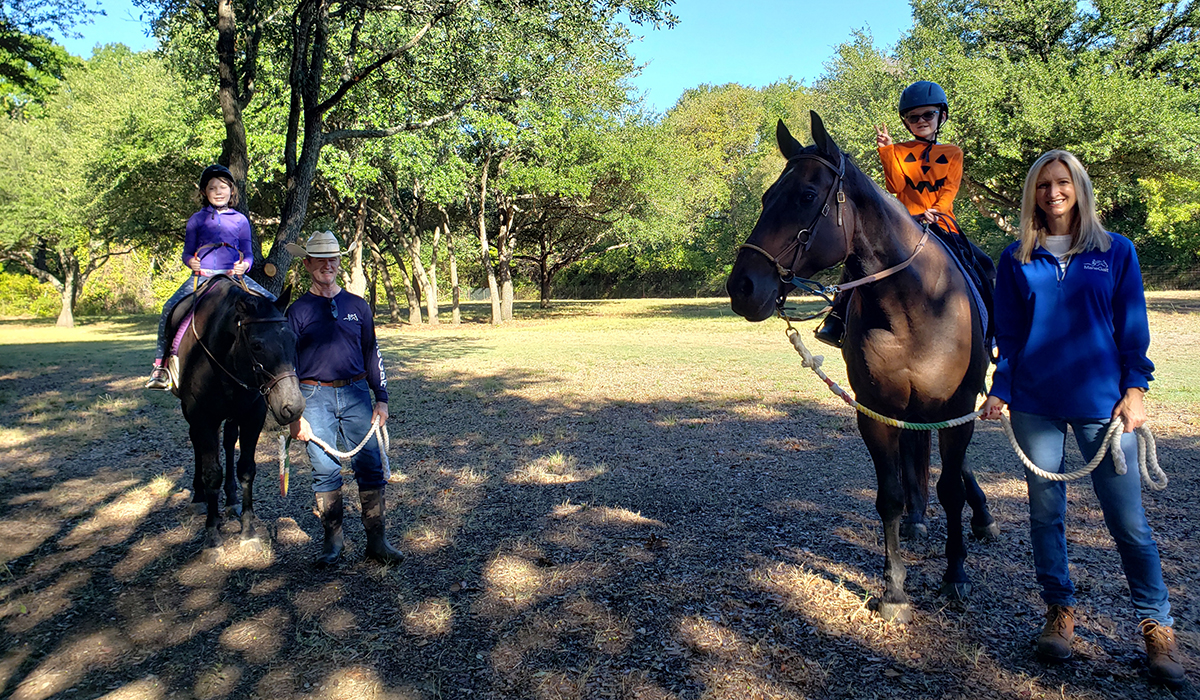
Jim on a trail ride with Kennedy and Mosie.
What have you learned through your experiences volunteering?
One thing I’ve learned is a little bit more about disabilities, and how to be able to relate to people with disabilities – not just at ManeGait but at an airport or grocery store. Sometimes it’s just a little, “Hi, how are you doing today?” to brighten their day. Even with my 5-year-old grandson, it’s helped me interact with him. He’s not special needs, but the same patience, encouragement and understanding are needed when he gets upset.
Why is it important for others to get involved with causes they care about?
The thing is that you can actually have a big impact on somebody else’s life. A lot of people out there don’t know that they can go out and do that, help other people who need help. I’ve realized that I have all these talents I didn’t notice before, and I learned that through volunteering.
Any advice for people who want to start volunteering?
What I notice in the ManeGait community is that these individuals are extraordinarily encouraging, not just to their clients, but also to the volunteers and the staff members. The camaraderie between staff and between the volunteers is almost like a close-knit family. We’re all volunteering, so we already have a lot in common.