Meet Daily Point of Light Award honoree Tom Blake. Read his story, and nominate an outstanding volunteer or family as a Daily Point of Light.
Tom Blake rode horses a bit growing up. But even he had no idea how much of a role they’d play well into his seventies.
When Tom and his wife retired, the duo got an RV and traveled around the country, taking a horse ride in every national park that offered the opportunity. A frequent volunteer ever since he graduated from college, Tom had recently settled into a new home in a community for active adults and was looking to get involved in the area. He didn’t have to look far. Right across the street, he found ManeGait, an organization that allows children and adults with disabilities to move beyond their boundaries through the healing power of horses.
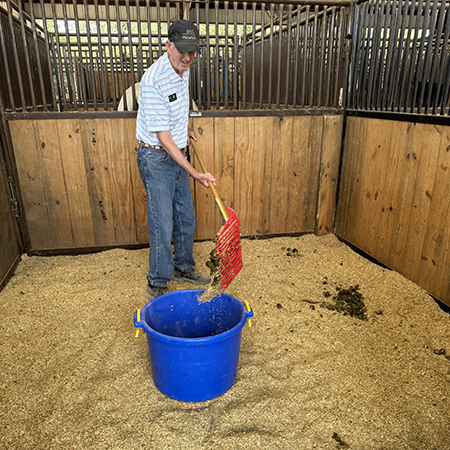
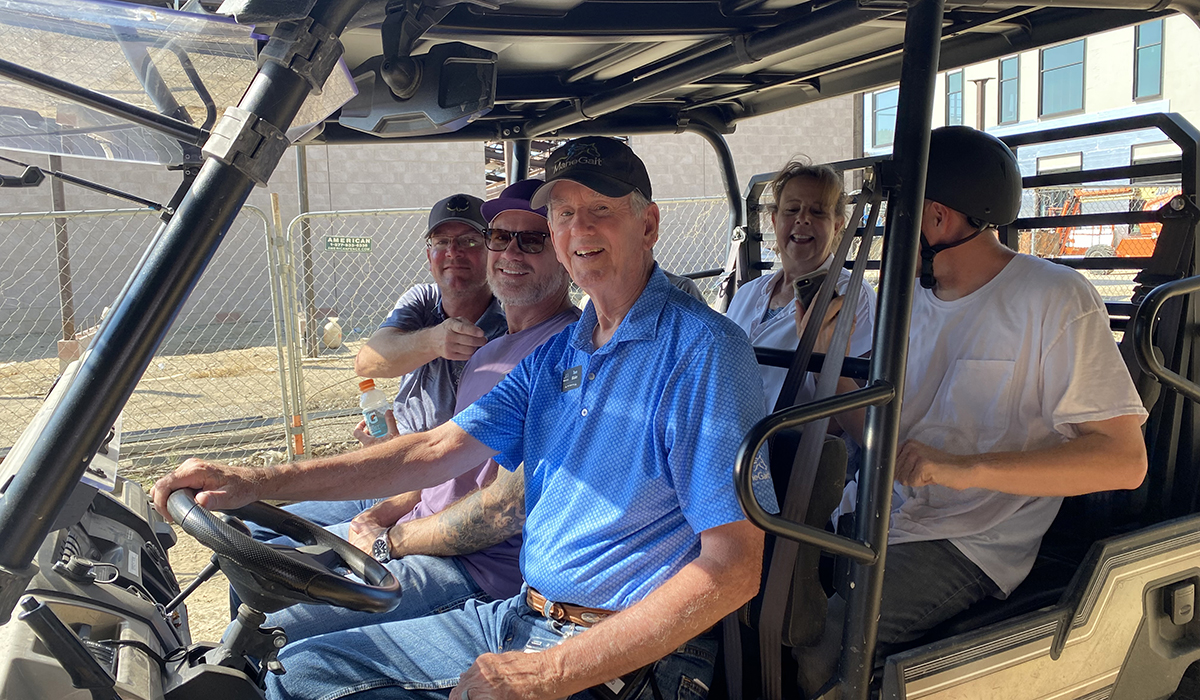
In January of 2024, Tom started volunteering with the organization as a sidewalker, or the person who walks along the side of the horse that maintains safety awareness and supports the rider as they trot along. Quickly, his role began to expand. A veritable jack of all trades, Tom tackles a variety of tasks on the ManeGait property, and he does them with a smile. Tom’s duties include everything from driving riders and staff around the 24-acre ManeGait property, which is currently undergoing a massive renovation, to assisting the CEO and president of ManeGait with the annual financial audit. He even subs in to clean the barns so each horse can have the type of home they deserve. He averages over 30 hours a week of volunteering at ManeGait, sometimes clocking in over 40.
In just 18 months, Tom has dedicated over 1,000 volunteer hours to the organization, which he refers to as “his happy place.” One of Tom’s most recent endeavors for ManeGait is initiating a donation campaign in his neighborhood to raise $2,500 for the annual care and feeding of Calvin, a member of the therapeutic horse herd. Tom raised a total of $5,450, which will be matched by a ManeGait sponsor for a total of $10,900.
While Tom didn’t start volunteering at ManeGait until he was 77, he wants to make it clear that there’s no age limit on helping others. His journey as a volunteer should inspire the rest of us to embrace our potential to help others on a daily basis.
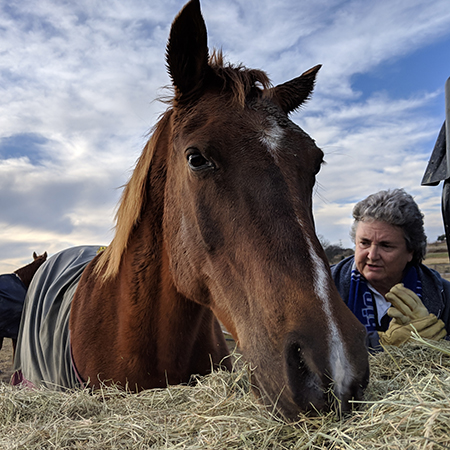
TOM BLAKE HELPS OUT AS A BARN BUDDY BY MAINTAINING A CLEAN AND SAFE ENVIRONMENT IN THE BARNS FOR STAFF, VOLUNTEERS, RIDERS AND HORSES. /COURTESY TOM BLAKE
Tell us about your volunteer role with ManeGait.
I initially started as a sidewalker. Physically, you may have to support their back or hold on to their heel if they’re gripping the horse too tightly. Because of the construction that’s going on there at ManeGait due to the expansion, it’s unsafe for people to be walking around the job site, so I was asked to be a driver. I drive the riders, volunteers and staff around the site to keep everything as safe as we can. Then, before the holidays last year, I became qualified as a barn buddy. A barn buddy takes care of the stalls and the barn, refilling water buckets, putting in new hay and just other general barn duties. In January of this year, the CEO asked me if I would help her with the financial audit since I’m a retired CPA. I am also a volunteer for the finance committee and I do photography.
What inspired you to get started with this initiative?
When I first moved to Prosper, I was looking for a place to help others. We had moved from Richardson, Texas, which is about 45 minutes from here, to a 55-and-over community. We were looking for a place to get involved and get immersed in the new community, and ManeGait was across the street, and my love for horses drew me in. What I didn’t expect was how quickly it would become such an important part of my life. The ability to work with the horses as a sidewalker and be involved with the riders is very, very special. Some of them have cognitive disabilities, some have physical disabilities and some have both. The staff over there is probably the best group of people that I have ever been around.
What are your long-term plans or goals for the organization?
The best I can tell you about my goals over there is to serve the ManeGait staff, riders and volunteers to the best of my ability and just try and make their day a little better. That staff is an amazing group of people, and I try to make their day a little easier. For example, if they forget their water bottle, I’ll go back and get it for them.
What’s been the most rewarding part of your work?
I’ve got a lot of individual memories of things over there that have been rewarding, but ManeGait is my happy place. When I drive through the gate over there, the outside world just fades away. It doesn’t exist. You drive in there and you smell the pastures and you see the horses grazing, and you start getting around the riders and it’s pretty special. The volunteers are there for the same reason I am. They’re just trying to make the riders and the staff enjoy their day more.
What have you learned through your experiences as a volunteer?
I’ve become a little more flexible and patient than I used to be. When I first started, my class was supposed to begin at 10 o’clock. Well, the class doesn’t always begin at 10 o’clock. All the riders might not be there just yet, or they might not be organized. Maybe they had trouble with a horse. I quickly learned that it doesn’t run like an airplane schedule. Because the daily challenges are so complex, you’ve got to be flexible.
The light-hearted moments that you have with the volunteers and the riders are the things that make the day. The staff is so committed to the riders’ safety and progress. Are they improving? Are they able to ride better today than they did six weeks ago? They have goals set for the riders and they’re measuring against those goals all the time.
TOM BLAKE (FRONT CENTER) A VOLUNTEER AT MANEGAIT, HELPS OUT AS A SHUTTLE DRIVER TO TRANSPORT VOLUNTEERS, RIDERS AND STAFF AROUND THE CAMPUS THROUGH THEIR RENOVATION PERIOD. /COURTESY TOM BLAKE
Why is it important for others to get involved with causes they care about?
I’ve been reminded that volunteering is one of the most rewarding things that you can do. I think volunteering helps others, strengthens communities and enriches your own life.
Any advice for people who want to start volunteering?
I would say you’re never too old. I started over at ManeGait when I was 77 years old, and I’m having the time of my life. There’s always something that you can be passionate about, and you should find out what it is and share it, because when you share that passion, you do make an impact.
What do you want people to learn from your story?
Through your efforts as a volunteer, you will never understand the impact that you make. I get feedback from time to time from the kids who make me feel good with what they say about me. It’s kind of a funny feeling, but it is so rewarding. You don’t think about it, but then you hear about it and you realize how important it is to those children. The more positive things that you can do to help them, the better lives they’re going to have.
The Seed Exchange Revolution: A Grassroots Solution to Nutrition Insecurity
Meet Daily Point of Light Award honoree Barkha Bishnoi. Read her story, and nominate an outstanding volunteer or family as a Daily Point of Light.
Barkha Bishnoi, a high school student with a deeply rooted passion for community well-being, is the founder of Food to Flourish , an organization dedicated to tackling nutrition insecurity head-on. Her inspiration blossomed from time spent volunteering at local food pantries, where she recognized the persistent challenges families faced in accessing nutritious food. Rather than feeling discouraged, Barkha decided to take action and cultivate a solution, driven by the belief that healthy eating shouldn’t be a luxury. Her commitment to breaking down socioeconomic barriers has led to a hopeful, grassroots initiative that’s making a tangible difference in communities.
At the heart of Food to Flourish is the “Plant It Forward” initiative, a brilliant concept that leverages the community power of public libraries. Barkha began establishing seed exchanges in these libraries to provide free access to gardening materials for everyone. This simple yet profound idea empowers families to grow their own food, directly addressing food insecurity and promoting long-term health. The initiative is built on the hopeful idea that change starts with planting a single seed, a first step that all families, regardless of income, can take toward greater self-sufficiency and better nutrition.
Barkha’s vision and dedication have yielded remarkable results. Through Plant It Forward, she has already contributed to seed exchanges in public libraries across an impressive 25 states in the United States. Her efforts have directly impacted almost 6,000 families by providing them with free seed packets, significantly increasing gardening access. Beyond the seeds, Barkha also leads educational events, including webinars featuring USDA experts, to share knowledge about nutrition and sustainability. To support her mission, she has also successfully raised $4,000 through grants and fundraisers.
Barkha also authored and co-published a book featuring 60+ sustainable recipes, aiming to share the importance of nutrition and reducing food waste with other youth. Spending approximately 20 hours a month on her various projects, with a focus on Plant It Forward, Barkha Bishnoi is helping to create a healthier future for thousands of families across the nation.
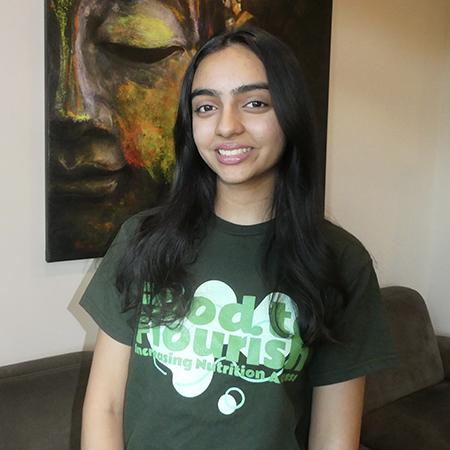
Barkha Bishnoi, founder of Food to Flourish.
Tell us about your volunteer role.
I’m the co-founder and president of my organization, which is called Food to Flourish. This is a youth organization that’s dedicated to addressing both nutrition security as well as food sustainability. I lead a team of entirely youth volunteers, coming from several states including Maryland, New York, Pennsylvania and others. Our main goal is to develop community-based projects to promote our goals of nutrition, security and sustainability. Through my volunteer role, I oversee all of these departments, which include advocacy and policy outreach and social media.
And lately, I’ve also been focusing especially on our “Plant It Forward” project, which is our flagship project to establish seed exchanges in public libraries across the country. Seed exchanges involve people both taking and donating seeds, for free, to make home gardening more accessible to everyone.
Tell us more about why nutrition security and sustainability is so important to you.
I’ve been vegetarian my whole life, so from a young age, I realized how limited food options can be for people with dietary restrictions, especially in schools. I noticed in school lunches, particularly, there was really a lack of access for people who had these restrictions. Many of my classmates relied on school lunches, but didn’t really have healthy or inclusive choices that they could eat.
Later, I spent a lot of time volunteering in food banks as I entered high school, and I noticed that a lot of the donated food was really heavily processed and didn’t really have much in the way of nutritional content. The most common item I saw was Ramen. Food banks, of course, do incredibly important work, but I realized that the quality and nutritional value of what’s available created a gap between food access and food quality. That gap is what inspired Food to Flourish.
What are your long-term plans or goals for the organization?
Overall, going beyond just food access and addressing the nutrition security and food security overall is a big part of our mission. I want to expand Plant It Forward across all 50 states. Currently, we have established seed exchanges in 25 states across the country, but I would love to reach all 50, and we definitely want to continue all of our local, community-based initiatives as well.
We’ve already published a book on sustainable recipes, which have included youth creations, youth contributions and creations. We want to continue doing work like that, and we host a lot of webinars where we hear from experts in this field. We’re also trying to take excess waste from restaurants and redirect that to homeless shelters. We want to continue reaching out to our community through ways like that, as well as working toward new ways to increase access to fresh produce.
What have you learned through your experiences volunteering?
Taking that first step was something that I learned was incredibly important. When you commit to a cause that you care about, you not only have to contribute to the solution, but also inspire others to do the same. I think gathering that team around this effort was a huge part of this, and getting all of our youth volunteers passionate about it and engaging them as much as we can is so, so important in getting our work done and spreading our mission too. I definitely learned not to be afraid of taking those initial steps and getting our project off the ground.
I would also say that it’s important to try to achieve things that you may not at first think you can do. When we first started, just a little less than two years ago, I wouldn’t have thought we would expand it so far around the country, especially considering much of our team is based on the east coast. So being able to have a seed exchange all the way in California, for example, was really great for us, and it kind of showed me how far you can go if you have that dedication and if you really want to work toward it.
What’s been the most rewarding part of your work?
Seeing impact firsthand. When a public library shares their stories about families coming in to take the seeds or just sharing pictures of their project, that’s honestly incredibly rewarding. I love it whenever we get an email from a library that’s requesting more seeds and updating us about the project going on. That makes me really happy, because it shows that these seeds are actually being put to use in these communities, and they even want more.
Why is it important for others, especially youth, to get involved with causes they care about?
Youth bring a different dimension of passion to causes because often they’re seeing things firsthand. My first experience was seeing school lunches, and that kind of sparked my own interest. And I know a lot of other youth see other inequalities within their schools, within their communities, and I think this firsthand experience really gives them another aspect to solving the problem.
Plus, having youth involved is inspiring for a lot of people. I know when I’ve been working with people, I always have great conversations with adults. They love having a youth voice in it. Oftentimes you might think that your voice won’t really contribute. But when actually getting out there talking to these people, I see that they value it a lot more than I would have ever thought.
Any advice for people who want to start volunteering?
Start with seeing where your interests intersect with a need. Think about issues that genuinely matter to you and see if any organizations in your area are already working towards that mission. Even if you can’t find an already existing organization, don’t be afraid of starting something new. Passion is really contagious, so you’ll be surprised how many people want to help once you take that initiative. Think creatively, and experiment with different things to see what works best.
What do you want people to learn from your story?
You shouldn’t ever feel like you can’t make an impact – whether it’s resources, age, whatever factor it is. All our projects we started from the ground up. We got grants. We worked with libraries that were already there. We reached out to a bunch of people we didn’t know before. Seeing a problem, caring enough to do something about it, actually doing something about it and bringing others along with you really does create change.
Meet Daily Point of Light Award honoree Niyathi Girish. Read her story, and nominate an outstanding volunteer or family as a Daily Point of Light.
Niyathi Girish wants to make a difference in her own community and across the globe.
Three years ago, Niyathi witnessed the stigma around bodily functions when a girl in her science class unexpectedly got her period and bled through her white sweatpants. Surrounded by students who aspired to be medical professionals one day, the response was one of shame and embarrassment. Seeking to smash the stigma of periods, Niyathi and a group of friends formed Every 28 Days, an organization that strives to donate 500 million sanitary pads to underserved populations while promoting menstrual health education and destigmatization campaigns related to menstruation.
In the last three years, the Every 28 Days team has created a movement that’s moved far beyond the walls of their high school. Niyathi has led donation drives, educational workshops and corporate fundraisers to support underserved women locally and globally. She devotes significant time to organizing important partnerships with organizations, gathering products and distributing essential supplies to schools, shelters and underserved communities to make period poverty a thing of the past. Extremely passionate about the partnerships that make nonprofits successful, Niyathi has worked tirelessly to raise funds for Nyaka Global so girls at a school in Uganda can have the menstrual supplies they need to continue their education without disturbance. Along with her team members, Niyathi has raised over $30,000 and distributed more than 100,000 hygiene products to communities in the U.S., India, Uganda and South Africa.
Currently a senior in high school, Niyathi works hard to balance her rigorous academic career with her volunteer work and extracurricular activities. But her work with Every 28 Days has also informed her potential future career. When she starts college, she’s hoping to major in pre-med and eventually become a doctor. She’s leaning toward neuroscience, but is also interested in exploring women’s health, which ties into her work with the organization. While helping people find access to menstrual supplies and products may not seem like a major endeavor, it’s an important component in the mission to improve healthcare accessibility at all levels. Niyathi’s determination to help young women in her community and abroad not only started a movement but also potentially forged her future career path. Through volunteerism, Niyathi found her life’s purpose.
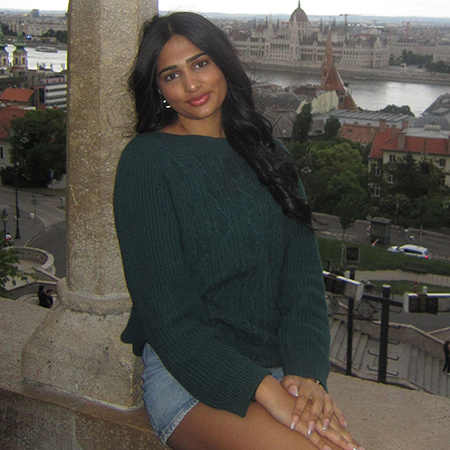
NIYATHI GIRISH IS THE COFOUNDER OF EVERY 28 DAYS, AN ORGANIZATION THAT STRIVES TO DONATE 50 MILLION SANITARY PADS TO UNDERSERVED POPULATIONS. /COURTESY NIYATHI GIRISH
What inspired you to get started with this initiative?
I co-founded Every 28 Days almost three years ago with three of my peers. Initially, it began as a small initiative with a few high school students trying to collect menstrual products for local shelters, but it’s grown into a global nonprofit that we’ve dedicated to ending period poverty and breaking the stigma around menstruation. For me personally, the spark came during my freshman year. I was in biology class, and one of my closest friends unexpectedly got her period and bled through her white sweatpants, and she was incredibly embarrassed. I immediately tried to comfort her and find her a pad. But what stood out was how the boys and the other kids at our lab table reacted. These kids who claimed that they wanted to be the future surgeons of the world turned red and muttered to themselves as if periods were something disgusting. At that moment, it really made me realize how deeply ingrained in us the stigma around menstruation is. When I began talking with my peers and my fellow co-founders, I realized that we had all lived through such experiences where menstruation was treated with silence, shame or ridicule, and that mutual understanding really bonded us.
Tell us about your volunteer role with Every 28 Days.
As a co-founder, my role is primarily focused on fundraising, outreach and partnerships. Together, my team and I have spearheaded many of our campaigns, and our largest event to date was our 5K. Behind the scenes, I primarily work on reaching out to potential partners so we can spearhead campaigns like our 5K, for which we partnered with Teeem, which is The Empathy and Entrepreneurship Equity Movement. Additionally, we’ve also partnered with companies like HERE Technologies. I have reached out to all of these businesses to start these partnerships. In addition to that, we also have to determine where we want the money to be donated. We’ve worked with a lot of smaller shelters, women’s shelters and food pantries in our own community, but also in India and Uganda. Locating those specific organizations we really believe we can help the most is also one of my bigger roles.
What are your long-term plans or goals for the organization?
Our long-term vision has multiple layers. We remain committed to our ambitious goal of donating 500 million menstrual products, because that is the number of women who lack access to menstrual products every year. This number alone won’t solve this issue, but that is one of our primary focuses at Every 28 Days. That’s why we’re also focusing on sustainable solutions, like trying to see if we can find opportunities for lower-cost reusable pads for rural or underserved communities.
We’ve started youth-led chapters in Colorado and Texas, and we want to expand this model so that students everywhere feel empowered to take on leadership roles in fighting period poverty. Another key part of our long-term vision is education. In elementary school, we were first shown the video about menstruation, and the girls and the guys were separated. It was really outdated and awkward and surrounded by stigma. That shouldn’t be the introduction young kids have to something so natural. I want Every 28 Days to create a modern, inclusive, empowering and educational tool that can normalize menstruation from the very start and de-stigmatize it in children so that it doesn’t become an issue in adulthood.
What’s been the most rewarding part of your work?
Without a doubt, it’s seeing the look on people’s faces when we’re able to donate products to them and help them out. As I mentioned before, our 5K fundraiser has been one of our most rewarding fundraisers. We partnered with Teeem, which I mentioned earlier, and were able to raise nearly $10,000. This event brought together hundreds of people from our communities, and the energy on the race day was so high. It was proof that when we were able to create this platform around such a stigmatized issue, and we were able to get people to rally around us and help us out.
What have you learned through your experiences as a volunteer?
Primarily, I’ve learned that persistence matters more than perfection. At our first fundraiser, we raised around $25. If we had stopped there, Every 28 Days wouldn’t even exist. Instead, we analyzed what worked, what didn’t, and we tried over and over again, and that persistence eventually led us to raise tens of thousands of dollars and distribute over 100,000 products worldwide. Like I mentioned before, I’m also surrounded by a wonderful team that I work with, and so I’ve learned the power of teamwork. I know it sounds a little bit cliché, but every success we’ve had has been because of my co-founders, our volunteers and us all working together. Leadership isn’t about doing everything yourself. It’s about creating an environment where everyone’s strengths can shine. I think perhaps the biggest lesson that I’ve learned is that the stigma thrives in silence. The more we speak about it openly, the more people are willing to join the conversation and break the taboo.
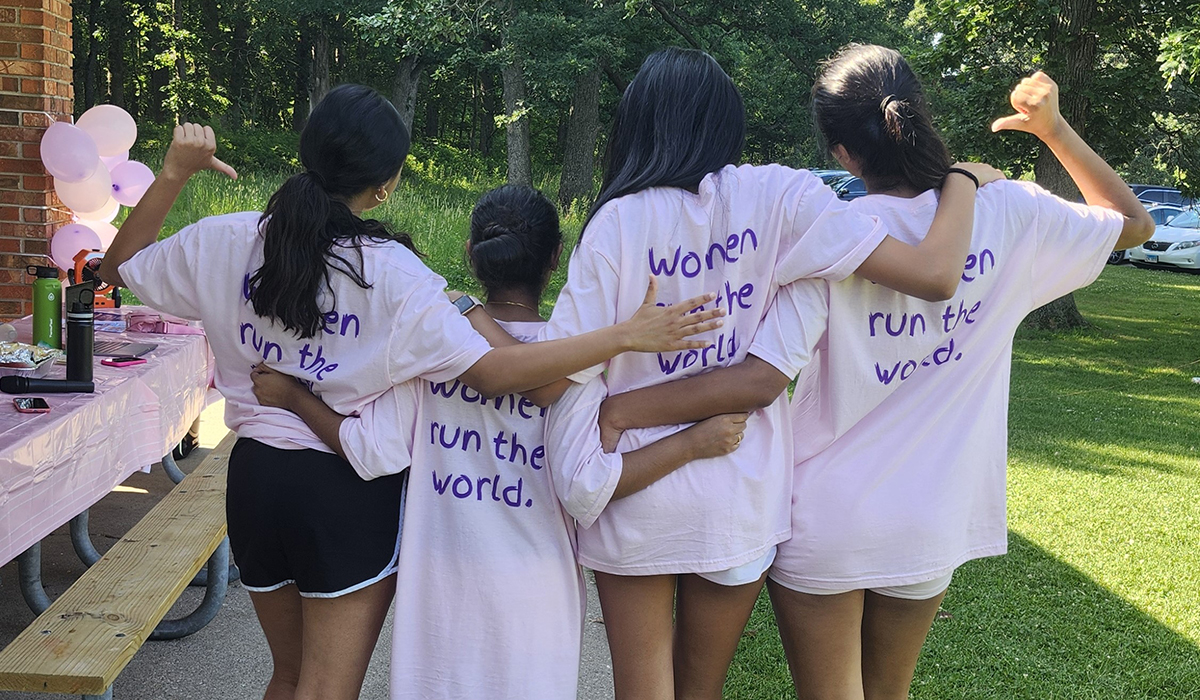
NIYATHI GIRISH AND THE 3 OTHER FOUNDERS OF EVERY 28 DAYS CELEBRATE AT THE ORGANIZATION’S FIRST ANNUAL 5K EVENT. /COURTESY NIYATHI GIRISH
Why is it important for others to get involved with causes they care about?
None of us were experts on this issue when we started, but the more we’ve worked with it, the more we’ve learned about this topic. If you’re a passionate student, I think getting involved with something like this can really broaden your horizons and expose you to something that they don’t teach you at school. It is a nonprofit, but there are so many like business aspects to it. If you surround yourself with people who share your vision and have peers and mentors who support you, you can really make a difference and impact the people around you. I’ve built such strong connections through Every 28 Days.
Any advice for people who want to start volunteering?
Don’t wait until you feel ready. None of us were experts when we started. We were just passionate students who shared a frustration. If you begin small and accept that you’re going to make mistakes, you can grow so much through this experience, and your small beginnings can evolve into really big movements. The biggest difficulty with starting something like this is the starting itself. My second piece of advice would be to surround yourself with people who share that vision. If you find something that lights a spark and you’re really interested, follow it and go for it, because you never know where it could take you.
What do you want people to learn from your story?
This involvement creates a ripple effect far beyond just one person. Our small actions have turned into such a big initiative. Our main goal with this was to destigmatize menstrual health, and obviously, we’re far away from that. But if people could take the time out of their day to understand our mission, I feel like everyone would begin to understand that we need to have a mindset shift. I’m an Indian girl, and growing up in a household where it is seen as something that’s rather gross, there is a lot of stigma surrounding it. I think if someone could take anything away, I think it’s to break that stigma. I think you have to be the first person to speak up about it and take that step, because otherwise, it’s just going to thrive in silence. It’s only broken if we speak about it openly.
Retired Teacher Helps Riders Discover Freedom on Horseback
Meet Daily Point of Light Award honoree Donna Coley. Read her story, and nominate an outstanding volunteer or family as a Daily Point of Light.
When longtime educator Donna Coley closed the classroom door for the last time, she already knew where she was headed next. After 37 years of teaching high school English, Donna drove straight from her final day of school to ManeGait, a therapeutic riding center in McKinney, Texas.
Passing by the ranch every Sunday on her way to church, Donna had long admired the horses grazing in the pastures. In 2016, retirement opened the door to something new: she signed up as a ManeGait volunteer. Eight years later, Donna still drives 45 minutes each way from her home in Sherman, Texas, dedicating thousands of hours to support the nonprofit’s mission of serving children and adults with disabilities through equine therapy.
Though she had no ranching experience, Donna embraced every role she could—sidewalker, horse leader, barn buddy, mentor, and tractor-loving groundskeeper. Over time, she has contributed more than 4,000 hours, even earning “honorary staff” status during the COVID-19 pandemic for her tireless care of ManeGait’s herd of 30 therapy horses. Every task, from barn chores to therapy rides, is fueled by what Donna considers the most rewarding part of her service: sharing in the riders’ joy as they discover confidence, freedom and connection on horseback.
What inspired you to begin volunteering with ManeGait?
I’ve always loved being around horses. Every Sunday morning, I would pass ManeGait on my way to church and see those beautiful horses in the pasture. The day I retired, I literally drove straight from my school’s parking lot to ManeGait, pulled into their lot, and asked for information.
Once I went through training and learned about their mission—helping children and adults with disabilities experience therapy through horseback riding—I knew I had to be part of it. That was in 2016, and I’ve been with them ever since.
Donna takes hay to the horses in the pasture./ Courtesy Donna Coley
Tell us about your volunteer role with ManeGait.
One of the first things I learned was that the work never ends. With around 30 horses, their health and well-being are essential to the riders’ success. A lot of the tasks require skills or strength I don’t have, but there are so many things I can do.
I clean pastures, mow grass, clean stalls, groom horses, and keep the utility vehicles running. In my earlier years, I was very involved with horse-leading during therapy classes and sidewalking alongside riders. As time passed and the physical demands increased, I shifted to the work I can do safely and comfortably.
Out of all the tasks you’ve done, what has been your favorite?
I’d say two things. First, feeding the horses. I feel like the guy driving the ice cream truck—pulling the Gator utility vehicle full of hay into the pasture, and the horses come running like I’ve got a million-dollar check in my pocket. It’s pure joy.
The other is horse-leading during classes. When a young rider is on the back of a horse and you hear their laughter, see their faces light up—it’s magic. Many of these kids struggle to walk or participate in sports, but on horseback, they’re just like everyone else. I once worked with a girl who was deaf and nonverbal. During her ride, she kept making a hand motion I didn’t understand. I asked her mom what it meant. She said, “She’s saying more. She wants more.” That kind of joy is unforgettable.
Is there a moment that stands out as especially memorable?
Yes. I worked with a young girl starting when she was about 10. She was in a wheelchair and nonverbal. Communication was difficult, but through eye contact and presence, we tried to comfort her.
After years of therapy—including equine therapy—her legs grew a little stronger. I’ll never forget the day I looked up and saw her walking from her car with assistance, but not in a wheelchair. Watching her walk into the arena for the first time was nothing short of miraculous. That image will stay with me forever.
What’s been the most rewarding part of your work?
It’s about sharing joy. When a child or adult is on horseback, they experience freedom, sometimes for the first time. The disability that keeps them from walking or speaking disappears in those moments. They communicate with the horse through the reins, and the joy spreads—to parents, instructors, other riders. To share in that joy is the greatest reward I’ve ever experienced.
You spent 37 years teaching. Do you see a connection between teaching and volunteering?
Absolutely. If you do teaching right, it’s not just a job—it’s a service. You have to look at it as serving the student in front of you, one by one. That attitude carried over into volunteering.
At ManeGait, I approach it the same way: find the need, find what you can do, and give it everything you’ve got.
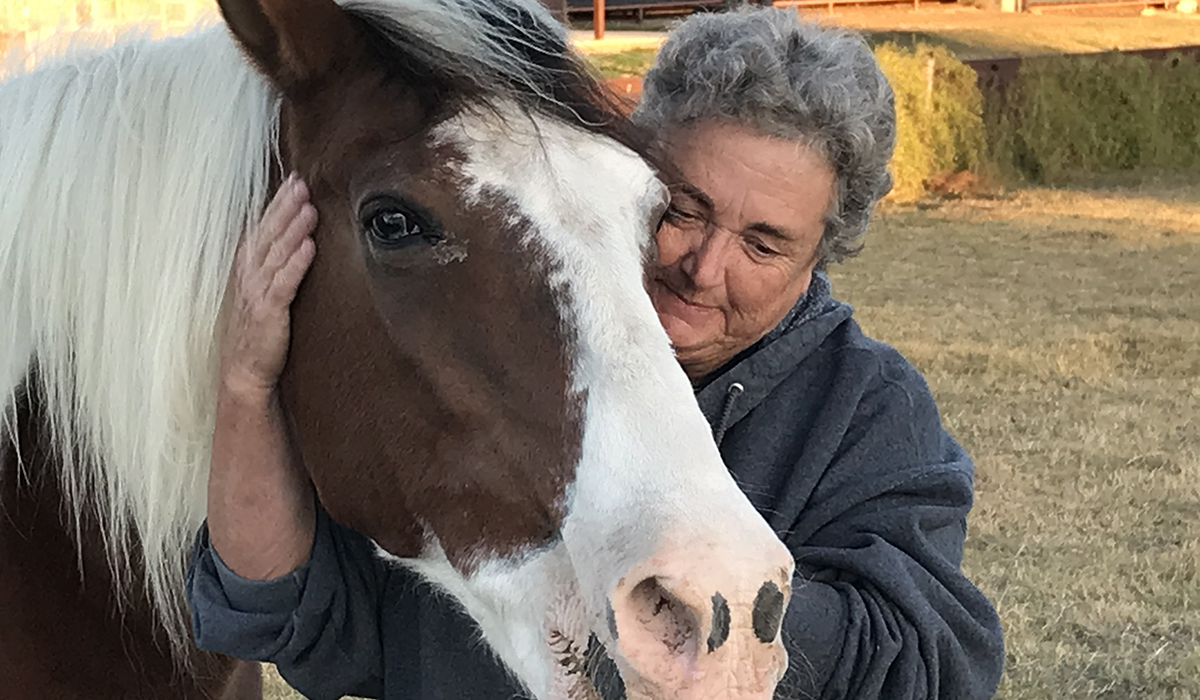
Donna shares a quiet moment with George Henry, one of the therapy horses at ManeGait./ Courtesy Donna Coley
Why is it important for others to get involved with causes they care about?
Because everyone has something to give. If your love is cooking, find a food bank. If it’s sewing, find an organization that provides clothing.
Find a mission that aligns with your passion, and give what you can. President Bush once said everyone has something to give, and I believe that’s true. It benefits both you and the organization.
What do you want people to learn from your story?
That you’re never too old to make a difference. You don’t have to be rich. Just give what you can.
Meet Daily Point of Light Award honoree Chris Fitzsimmons. Read his story, and nominate an outstanding volunteer or family as a Daily Point of Light.
Chris Fitzsimmons did a bit of teaching after college, but it’s as a volunteer tutor in retirement that he really shines.
Growing up with seven brothers and sisters, helping others was a way of life for Chris and his family. After retiring from a long career as a corporate trainer, Chris wanted to channel his free time into helping people learn. He inquired at his local library about potential tutoring opportunities and began working with children who struggled with reading. Eager to get involved in San Francisco’s public school system, Chris started working with the San Francisco Education Fund, an organization that advances equitable education by providing quality learning programs, community support and transformative financial resources to teachers, students and schools. He was placed in a third-grade classroom and has spent the last five years developing a meticulous tutoring system that has helped countless young people improve their reading skills.
Chris tutors over 50 students each week, spread across four mornings. He developed a comprehensive evaluation system that reviews which students need the most assistance, so he can focus on giving them the most attention. But he also puts in work outside the classroom. His extensive record-keeping program provides teachers with a helpful way to track each student’s progress and stay informed of their challenges. The teachers enjoy working with Chris so extensively that they have nominated him multiple times for the San Francisco Education Fund’s highest honor, the Distinguished Service Award.
While Chris loves to see the children expand their literacy skills, he makes a note of pointing out that he also loves to see them grow in their confidence and knowledge. He makes it clear that he loves watching people learn and hopes to simply be a means of helping them get from point A to point B. His willingness to channel his retirement into an experience of helping others is a powerful example of how volunteering can change the world.
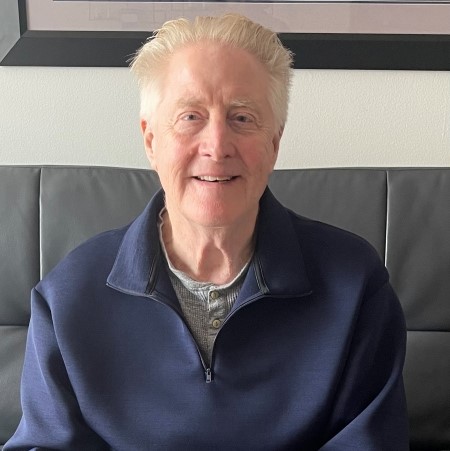
CHRIS FITZSIMMONS IS A VOLUNTEER WITH THE SAN FRANCISCO EDUCATION FUND /COURTESY OF CHRIS FITZSIMMONS
What inspired you to get started with this initiative?
I was interested in tutoring after I retired, so I inquired at the San Francisco Library, and they had a program for teaching kids who are having trouble reading. I worked one-on-one with students to help them from the very ground up. I had a lot of success doing that. Then, I was interested in working in the San Francisco Public Schools, and so I inquired there. There’s an organization called the San Francisco Education Fund that manages volunteers, so I got trained with them, and got a placement at the Cleveland Elementary School in San Francisco, and I started there. I’m in my fifth year working with third graders.
Tell us about your volunteer role with the San Francisco Education Fund.
I work with two third-grade classes in Cleveland Elementary School. There are 43 total kids in the two classes. I do an informal reading evaluation for each of the kids and then put them into groups that I call red, yellow and green, like stop lights. Kids who are in the red group need the most help, and are maybe just beginning to read English or are reading at a first-grade level. Kids in the yellow group are reading at a second-grade level, and the kids in the green group are reading at a third-grade level or above.
I really concentrate on the red and yellow groups, since they need the most help. In this class of 43, there are 24 kids that I’ve identified who need help getting caught up to grade-level reading. I work individually with each of these kids, 10 minutes a day, twice a week. One big thing is that the school has lots of reading resources, so I’m able to pinpoint where the kids are and work on their particular reading issues. The more they progress, the harder the materials I give them. I’ve actually seen kids move from the red to the yellow group, or from the yellow to the green group.
What are your long-term plans or goals for the organization?
They’re pretty modest. I just want kids to read better by the end of the school year, no matter where they happen to be. But I also want them to have more confidence in reading. I think confidence just makes such a difference, and so for them to feel that way and to actually read better than when they started, those are my goals.
What’s been the most rewarding part of your work?
When I see one of the kids finally get it. For example, a really simple thing is that working with a difference in vowel sounds between Spanish and English. Most of the kids are Spanish speakers to begin with, but their vowel sounds are very different from English vowel sounds. As we’re reading, I keep on emphasizing the sound of the English vowel. After lots and lots of practice, they finally start to get it.
That, to me, is very worthy and I think that they feel better and more confident that they can actually read in a second language.
What have you learned through your experiences as a volunteer?
The third grade is a terrific grade to work with because they have matured quite a bit and can responsibly take on tasks, and yet they’re still young enough to be very pliable and adaptable – they learn quickly. I think it’s the perfect age to work with. I read that the third grade is a critical year. The saying they use is that in the third grade, you learn to read, and in the fourth grade, you read to learn. It’s just a really critical point.
Why is it important for others to get involved with causes they care about?
It gives a lot of life. Especially for retired people like myself, who may not have a lot going on, when they get involved in volunteering, and especially in my case, working with kids, they just give a lot of life enjoyment. I think that’s really, really worth it. I’ve heard a couple of tutors say that the kids saved us, and I can say for me too, it just brings so much life to my life.
Any advice for people who want to start volunteering?
If someone wants to work in a service job or volunteer position, like working at a soup kitchen or working to provide for the needs of the unhoused, I find that those organizations don’t require a lot of training. They just require that you show up and help out. Even taking that step is a big step for some people. I think it takes a little bit of courage and a little bit of determination to get over that hump. But once they do, they’ll find it’s very rewarding. They’ll be glad that they stepped out and tried something, and I think they’ll be quite rewarded because of it.
What do you want people to learn from your story?
Thinking of older adults like myself, it just makes a big difference to be involved in helping others. You don’t have to have a particular set of skills. You need to show up and show interest. In my case, the kids will respond very well. And I think that in other services, too, people will respond when you show interest and you’re consistent.
SAN DIEGO BLOSSOMS UNDER THE CARE OF THIS NATURE-LOVING VOLUNTEER
Meet Daily Point of Light Award honoree Jan Peterson. Read her story, and nominate an outstanding volunteer or family as a Daily Point of Light.
Jan Peterson’s knees may not be in the best shape these days, but her commitment to volunteering will stop at nothing.
When her husband and mother died at the end of the pandemic, Jan found herself isolated from the outside world. Unable to visit with friends due to COVID, Jan knew that the way to brighten her spirits when restrictions were lifted would be to get outside and engage with others. She started volunteering with Forever Balboa Park, San Diego’s organization dedicated to the care and enhancement of Balboa Park, the large urban cultural park known for its gardens, historic buildings, museums and other iconic destinations that draw people from near and far.
She started as a garden steward, dedicating 12 hours per month to beautifying the expansive destination. Her time was so successful that she progressed and became a garden steward lead. Four years later, Jan’s knees have given her a bit of trouble. However, she is still a frequent presence on the Forever Balboa Park volunteer roster. A master of the administrative tasks required to keep Balboa Park functioning properly, she recently helped create a database listing for each plant and its characteristics in the newly restored Botanical Building, a horticultural and architectural landmark built for the 1915 Panama-California Exposition. She has edited three interactive garden maps and is currently at work on a fourth. As a member of the park’s Volunteer Leadership Council, she even helps plan special events and advocates for the volunteers.
At 77, Jan isn’t slowing down anytime soon, dedicating 15 to 20 hours per month to Balboa Park’s livelihood. When she isn’t hanging out with her Labradoodle, Marigold, she’s bringing in new volunteers. She recently recruited her daughter to join the Forever Balboa Park volunteer team. But Jan doesn’t take much credit for her incredible dedication. Instead, she said she’s simply grateful that they consider her worthy of being included at the table. Her willingness to tackle any task and adapt to ongoing change is exactly the type of volunteer that any organization would be eager to have.
What inspires you to volunteer?
It gets me outside of myself. With our weather, it’s very nice. I think I get more out of it than I give, honestly. I have really good friends, and the park looks more beautiful all the time. I must say, my knees are giving me problems, so I am no longer a garden steward, but I kept begging them to let me do something because I don’t want to quit. So now they’ve created an administrative position for me, where I bounce around from department to department and do administrative stuff. We just opened up the Botanical Building, which has been restored, and it’s just beautiful. It’s back to its 1924 splendor when we had the World’s Fair. I also got involved in creating the plant book.
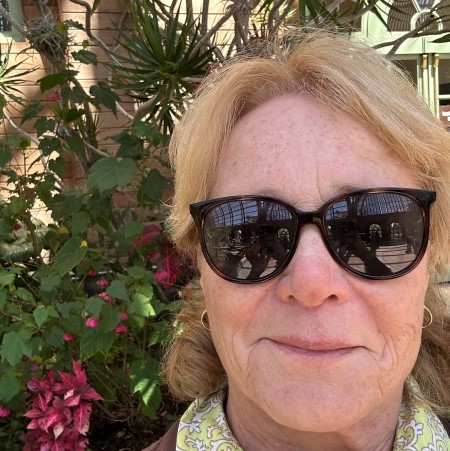
JAN PETERSON, A VOLUNTEER WITH FOREVER BALBOA PARK, SNAPS A SELFIE IN THE NEWLY RENOVATED BOTANICAL BUILDING AT BALBOA PARK. /COURTESY JAN PETERSON
What inspired you to get started with this initiative?
It was the end of COVID, and I had just lost my mother and my husband. I needed to get outside and do something. At Balboa Park, they were just starting to create the garden stewards, a group that volunteers to clean up the park, deadhead plants, put in mulch, pull weeds and that kind of thing. It’s nothing glamorous but it’s great fun. They were putting the group together at that time, and those of us who were regulars had a feeling of creating something really nice. A lot of times when you’re doing that, people will stop and ask questions about trees and plants, and thank you for your hard work. Now it’s more cosmetic. We’re keeping up with things.
Tell us about your volunteer role with Forever Balboa Park.
Right now it’s administrative work, like filing, creating a database and that kind of thing. Before, it was gardening. But Balboa Park is the jewel in San Diego’s crown. It’s actually a privilege to contribute to how important it is to the city. I think a lot of people take it for granted, but we plant trees all year. We have a rose garden, a Botanical Building and a cactus garden. People love it. When I’m in the Botanical Building and talking to people, they come from all over the place. Europe, Asia, and locals, of course, but it’s so well-known that it’s so fun to talk to them. Everybody always asks about the plants, so we created a plant book with the pictures and names of the plants, including the botanical name, common name and characteristics. That took a while, but it was very fun. Now, sometimes I help out with filing in the visitor center, or whatever they have to throw at me. I think they’re grateful to have somebody do this kind of stuff. I wanted to stay involved.
What’s been the most rewarding part of your work?
The satisfaction that I have every time I go. It doesn’t matter how menial the task is. It is very, very satisfying. The other thing I liked about it at the beginning was that it wasn’t quite the well-oiled machine it is now. We were creating it as we went. Staff had a vision in their mind, but I loved how they just kind of let us go, and then they solicited our input. It very much felt like we were helping to create the program.
What have you learned through your experiences as a volunteer?
Patience. That I’m not in charge. I’m used to being in charge. It’s wonderful. I like to offer my two cents, but I can sit back. I’m ready for the next generation to take the stage. It’s wonderful in that regard.
Why is it important for others to get involved with causes they care about?
I keep reading these days that people are lonely and depressed. The answer to that is get out and do something. Mingle with people, get on a board and show up for book sales. Like I said, it gets you out of your head. It doesn’t make you feel good if you sit around too much. You think dark thoughts. You start to wonder why you lost that person or why the world is on fire.
Any advice for people who want to start volunteering?
I kept trying to think about what I liked. I thought about something very basic, like gardening. I like books, so I’m also on the library board. I would suggest people look around and see if they see what they like to do and what gives them joy. You can start so simply. Just show up, and they’ll give you a task, and you can do it. Make it grow, or stay as small as you want it to.
What do you want people to learn from your story?
When I lost my husband and my mother, it was an extremely sad time for me. Because it was the COVID-19 lockdown, nobody could come over and hug me. Well, a few people came over and gave me hugs. After that, I got a dog and started volunteering. It’s just the way to get over sad things. They don’t go away, but it helps you keep things in perspective. It gives you a positive feeling.
Meet Daily Point of Light Award honoree Elizabeth Stanton. Read her story, and nominate an outstanding volunteer or family as a Daily Point of Light.
Elizabeth Stanton first noticed the pressing need for food assistance in her community through her service with her church’s community pantry, the Blessing Box. For three years, she committed herself to stocking the pantry, an experience that offered a direct view into the lives of those struggling with food insecurity. Her quiet, consistent action revealed a stark truth: while the Blessing Box provided a vital lifeline, the need was far greater. Texas, she learned, ranks second in the country for food insecurity, a statistic that fueled her resolve to do more.
Recognizing that many families were unaware of the resources available to them, Elizabeth took it upon herself to create a personal service project. She meticulously compiled lists of her town’s blessing boxes, food pantries, clinics and shelters, organizing them into easily accessible binders. She then distributed these binders to churches, schools and libraries, ensuring that anyone in need could find help quickly and with dignity. This initiative caught the attention of A Hopeful Harvest Food Pantry, who, inspired by her passion and organizational skills, asked her to join their board of directors. Now, with more than 500 service hours under her belt, Elizabeth’s work with the organization is making a measurable difference, helping to feed hundreds of families each week.
Elizabeth’s volunteer duties are as hands-on as they are strategic. Every weekend, she dedicates her time to A Hopeful Harvest, where a “shopping-based” process allows families to choose their own food. In monthly board meetings, she helps shape the pantry’s future, discussing improvements, food items and safety protocols. Beyond her work with the board, she is leading a new project that will connect her school’s students with the pantry, allowing them to use their Spanish language skills to serve families.
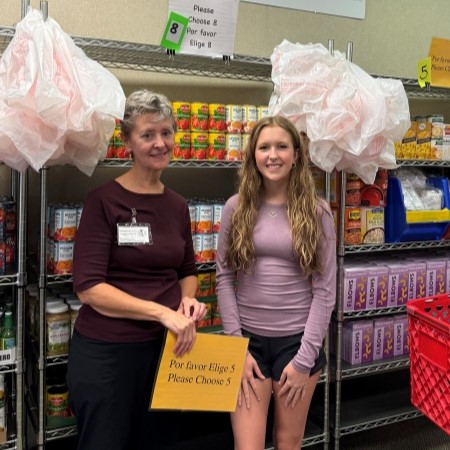
Elizabeth and Mary Johnson, a founder of A Hopeful Harvest, stand in front of stocked shelves in the pantry for families to shop from.
Despite her expanding responsibilities, Elizabeth remains dedicated to the project that started it all. She continues to keep her resource binders updated and distributed, and every week, she shops for and stocks her church’s Blessing Box. This simple act remains a tangible way to provide a meal and a little bit of hope, no questions asked. Read more about how Elizabeth is nourishing her community.
Tell us about your volunteer roles.
I’m a member of A Hopeful Harvest board, so I contribute in meetings as we discuss how we can make things better at the pantry, planning out our food budget and more. I personally reach out to organizations for fundraising as well, including at the grocery store. And every Saturday during our 2-5 pm volunteering time, I’m there and helping with the shelves and the deliveries. Once a month, I shop for the pantry with the funds we’ve received. I love that experience because I can see what people have been taking from the pantry, what we need more of and less of.
My main role is also in the nursery/play area. I love that we have this. It’s for smaller children to have someone watching over them and engaging with them while their parents and caregivers and shopping. It gives the families a bit of a break and gives the kids something to do. And then for the Blessing Box, which is through my church, every Monday, I go fill up the box with food and personal hygiene items.
What inspired you to get started with these two initiatives?
The Blessing Box has been part of my life for as long as I’ve been going to my church three or so years ago. It’s one of the ways I really got started in service. And then one of the members of A Hopeful Harvest board also goes to that church, and he recommended me for that role. I went to a meeting to try it out and never looked back. I love the people and love what they stand for. My role has continued to evolve from there.
Why is battling food insecurity so important to you?
It’s an issue close to my heart, since Texas ranks second in the nation for food insecurity. It’s a prevalent issue in our immediate community. It’s often overlooked. I’ve become really passionate about it. I’m able to be really connected to it. Food insecurity can happen to just about anyone at any time, and it’s so important to have these services and resources available to people in their times of need. It’s so prevalent, and having a pantry is so impactful for people when they’re going through that.
What are your long-term plans or goals for the organization?
I mentioned that A Hopeful Harvest has grown a lot, from being part of another food pantry to being their own organization with its own brick and mortar building. We’ve been giving out food on Saturdays, and our goal is to feed 100 different families each week, for a total of 400 families each month. So we’re focused on expanding our reach and absolutely filling our quota. Our numbers are growing more and more as the organization grows.
As for The Blessing Box, I’ve seen how necessary it is for our community. As I was filling it yesterday, someone drove up to grab food from it. There are no questions asked, you can take whatever you need and leave what you can. I’d like to install more locations and more boxes. For my personal service project of distributing binders, I’d like to expand that out a little more to more locations as well.
What’s been the most rewarding part of your work?
Service is so important to me. Seeing the fruits of my labor is so rewarding. Seeing the impact, and seeing that this isn’t a one-and-done thing. We do this every week, so I get to see real-time impact on people. My favorite thing is going into the pantry and meeting all these people.
I love the nursery too. The kids are so enthusiastic, and I like working with children. It’s so rewarding to grow this relationship with people and know that we’re positively affecting their lives through the resources we’re providing.
What have you learned through your experiences as a volunteer?
I’ve learned that there’s a lot of trial and error. Service isn’t easy. A lot of times, there’s a struggle to map it all out. It’s a constant process and flow. You’re adjusting to people’s needs. A really big thing is being aware of what the people you’re serving actually need, not just what you think they need. Maybe they don’t need 12 palettes of apple sauce you got. It’s noticing what the community actually needs and continuing to work toward the goal of meeting them.
Why is it important for others to get involved with causes they care about?
Food insecurity can happen to anyone. I’m part of 4H, I’m part of Model United Nations. Knowing that I could start in a smaller area in my community, before branching out and taking steps up to bigger things on the state level, national level and international level, has been helpful. You make relationships and connections. One of my team members in the group said it was her dream to volunteer in a food pantry, and she’s never had that opportunity before. You have to look for it.
Any advice for people who want to start volunteering?
If you’re passionate about something, start by taking an active role. Ask other people. You may make friends in the process. Don’t be afraid to start small – it all starts with getting connected with people. If you’re passionate, why not put those feelings into action?
ONE MENTOR’S VISION IS CREATING THE LEADERS OF TOMORROW
Meet Daily Point of Light Award honoree Aneisha Hughes. Read her story, and nominate an outstanding volunteer or family as a Daily Point of Light.
Aneisha Hughes has been on a 17-year journey to build Big Sister Little Sister, and she’s just getting started.
Aneisha founded the organization, a national mentoring program with a global impact that promotes life skills, wellness and principles of self with a focus on personal and professional development, in 2008 when she was just a young student herself.
Knowing she had the type of dynamic personality to reach others and make an impact, campus leaders approached Aneisha because they recognized her potential. On her campus, Aneisha saw how a lack of community affected other students.
Loneliness and isolation hurt the academic performance of other young women and led them not to finish school. As a result, they weren’t able to take hold of the professional opportunities an education would provide them. Aneisha identified those negative consequences as the ripple effect that not having a sense of community can cause. She established BSLS to offer mentorship, mental health support, leadership training and community service opportunities for other young women to keep them in the pipeline to a brighter future.
Flash forward to 2025, and BSLS has grown exponentially. The group has expanded from a school campus initiative to a national organization that has 30 chapters across 14 states and Washington, D.C., and continues to grow, reaching over 15,000 youth and women. But no matter where the chapter is located, Aneisha is at its core. She maintains a full-time career outside of her founder role, using her primary career to personally fund many of BSLS’s initiatives, so she can ensure that mentees and members receive opportunities that transform their lives. Still, she volunteers over 100 hours a month with BSLS, tackling responsibilities that include everything from recruiting and interviewing new volunteers and organizing large-scale events to leading national and board meetings and plotting the organization’s plans for the future. And she certainly has plenty of plans. Despite the tremendous growth of BSLS over the last 17 years, Aneisha’s vision for BSLS’ future is still incredibly bright. She hopes to establish a brick-and-mortar location in the future that will serve as a place for members to study and live.
Aneisha believes her volunteer work is about lifting others while building lasting systems of change. Her passion for helping others find community is a testament to the power of connection.
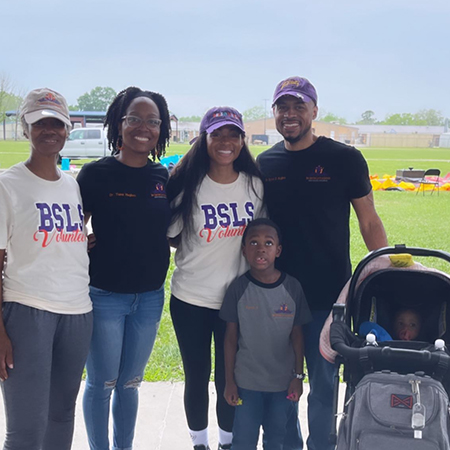
BIG SISTER LITTLE SISTER FOUNDER ANEISHA HUGHES (SECOND FROM RIGHT) SMILES ALONGSIDE FRIENDS, FAMILY AND GUESTS GATHER AT THE ANNUAL BIG SISTER LITTLE SISTER COMMUNITY FAIR. /COURTESY OF ANEISHA HUGHES
Tell us about your volunteer role with Big Sister Little Sister.
I would say everything from the operations, like our day-to-day functions, to managing our programs and making sure our membership volunteers are onboarded. They get assignments that I oversee and help with. We have a social media and graphic design team, but I help with leading and approving that as well, in addition to reviewing our members’ surveys and their applications to see what they’re looking for. I’ll review those and implement programs, and I collaborate with other volunteers to create curriculum, and work with compliance and legal. I help with the donor management, program management, operations, compliance, legal, marketing, graphics and apparel.
What inspired you to get started with this initiative?
I was a teenager when I first got started with BSLS. The Student Government Association on campus reached out and asked me to do something that would make an impact. I saw on my campus how so many young ladies were starting school but not finishing. They didn’t have any community. They were very lonely. They were experiencing depression and loneliness, which was impacting the way they showed up academically, and which ultimately impacts them professionally. I realized the ripple effect that not having a community can have on people, both personally and professionally. That was what inspired me to help people.
What inspires you to volunteer?
I would say my faith. I think I’m called, and I have a responsibility to do this work. I think helping the next generation of global change makers. I say my faith and my calling are one. On a larger scale, I would say knowing firsthand how this work addresses the gaps in systems that are often overlooked when it comes to wellness, leadership and education. I feel like this organization continues to make the world a better place. From a purpose standpoint, I know that this work creates lasting changes, and it gives people an opportunity to feel seen, valued and heard. I think it connects us to our differences and reminds us that shared humanity creates ripples of impact.
What are your long-term plans or goals for the organization?
We just started this plan called Operation Orange. Operation Orange has not only been helping us fill in gaps within the organization, but it has also been showing us where we want to grow and scale BSLS in an impactful way. Some of that has been through our pillars: Mentorship, public health, mental health, education equity, career readiness and housing stability. We found out that many of our members, especially the ones who are around 18, are experiencing a lot of financial hardships. So one of our long-term initiatives is to have a brick-and-mortar site for BSLS to host our programs and events, but also a place for our members to study and live. This will be a place where they live, work and grow.
What’s been the most rewarding part of your work?
If I had to choose one, it would be the people. From the members and the people we serve to the people who volunteer with us. If it weren’t for our volunteers, we wouldn’t be able to sustain this organization. Some of our volunteers have been serving on the volunteer level for more than five to 10 years. I asked them what helps them continue to stay, and they say it’s when they meet the members and hear their stories. Just seeing the work that this organization does really fuels me. I would say definitely the people. If you don’t have people to serve and people to do the serving, that can take away from the entire organization. Everything we do in life matters because we’re doing it together and alongside one another.
Big Sister Little Sister is a national mentoring program with a global impact that promotes life skills, wellness and principles of self with a focus on personal and professional development, founded by Aneisha Hughes.
What have you learned through your experiences as a volunteer?
I’ve learned that people don’t just need programs. They need your genuine presence. People don’t want to know that you’re just checking off some community service box of getting hours. Your genuine presence means a lot. I’ve learned that you can transform lives in ways that you can’t even measure. I’ve also learned patience and resiliency and humility because of this work. It’s unpaid. I show up because I love what I do, and sometimes doing this work with little to no capital can be very, very taxing.
Why is it important for others to get involved with causes they care about?
I feel like it’s fulfilling. It’s fulfilling personally when you can get involved in causes that matter to you. It’s also important because it connects us in a bigger way outside of ourselves. If life were all about ourselves, then the population wouldn’t look the way it does. We all have a calling to serve one another. Our calling may be different when it comes to how we serve, because we all have different skills and capabilities, but I think that we’re all meant to serve. We just have to figure out what that looks like for each of us. I think we’re all, in a way, servant leaders, and when we use our gifts and passions to make a difference, we not only change the lives of the people we’re serving, but we also find meaning and fulfillment within our own selves as well.
What do you want people to learn from your story?
The world changes when people decide to care. I can’t remember if it’s Maya Angelou or someone else, but I always think of the saying that mentions how people don’t remember what you said or what you did, but they will remember how you made them feel. When you show up in a way where people know that you genuinely care, they’ll remember that. You can save a life by just showing up.
Meet Daily Point of Light Award honoree Selina Curnutt. Read her story, and nominate an outstanding volunteer or family as a Daily Point of Light.
When 16-year-old high school senior Selina Curnutt realized her good fortune in life, she rededicated herself to helping those who couldn’t claim the same. Living with supportive parents, two brothers now in college and a labradoodle named Griffin, she has always been surrounded by love. Whether she’s on the court or field playing one of her three sports or in the classroom, they champion her success. As a result, Selina has become a champion for others, particularly in education.
In the summer of 2022, the year Selina graduated from middle school, she and her brother started MacroMinds’ Junior Board to help raise funds for organizations that support educational equity. Neither was old enough to participate on the official board. Today, they continue to be the youngest people at events and the only two on the junior board. As president, Selina spends around 30 hours each month in her role.
Outside of MacroMinds, Selina is helping launch a peer tutoring program for math at her all-girls high school. She also volunteers with two of the school’s summer programs–Camp Greenwich Academy, an immersive craft and sports camp, and Greenwich Academy Talent Enrichment Camp, or GATE, an educational program for girls from underprivileged backgrounds with high academic promise.
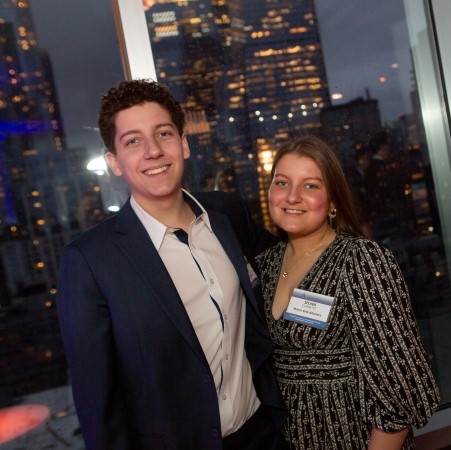
Selina Curnutt and her brother Liam, founders and members of MacroMind’s Junior Board, enjoy MacroMinds’ cocktail party in 2025.
What inspires you to volunteer?
Some of it is related to my community. I also took an online class on positive psychology with units about the psychology of happiness. Through that, I realized how lucky I am and decided from then on that I would dedicate a lot of time to helping others who are not as fortunate. That was something of a mental change for me.
Additionally, one of my faculty advisors from GATE told me a story that made me cry. During the first years of GATE, they asked all the families to pack a lunch for their girls, and almost half of them showed up without one, because they didn’t have anything at home. That’s when we, as a school, decided to supply lunch.
There’s so much need for such bright, incredible people, some of whom live five minutes from me. It’s not a foreign thing; it’s right down the road. That anecdote has stayed with me and made me want to champion volunteering.
Tell us about your volunteer role with MacroMinds.
I found out about MacroMinds through my parents’ colleague. As I’ve gotten older, my involvement has become more significant. We raise money for three to four education-focused charities each year through symposiums. We have speakers and celebrate these organizations. I help plan and fine-tune those. We raise about $400,000 a year that is split between organizations.
I run social media and do research on potential awardees. I reach out and start a relationship. There’s a lot of correspondence leading up to the symposium, where we’ll meet in person.
What’s been the most rewarding part of your work?
It’s been so rewarding to be able to interface with the point people for these charities. It’s not extraordinary in how we come up with these funds, but what is extraordinary is seeing how beneficiaries have been able to transform their programs with them.
One example is the Mount Pleasant Blythdale School. It’s the only school in the country that is a hospital built into a school for children whose bodies are healing and who can’t attend a normal school. We had a ceremony to dedicate the space that they used the funds to create. It’s a hospital room next to the library so that if a student has a medical emergency, no time wasted in accessing care.
During the ceremony, one of the children needed the room. She’s ok, but it was frightening. She was able to get immediate care because of that space. That made me feel special, because I saw what was possible because of our efforts. I love seeing the tangible impact that we’ve had on so many organizations and, consequently, so many lives.
What have you learned through your experiences as a volunteer?
When you’re the youngest person at an event, you learn to network and make small talk with everyone. Beyond that, it’s opened my eyes to the need for quality education everywhere. I‘ve also learned to manage social media and organizational stuff.
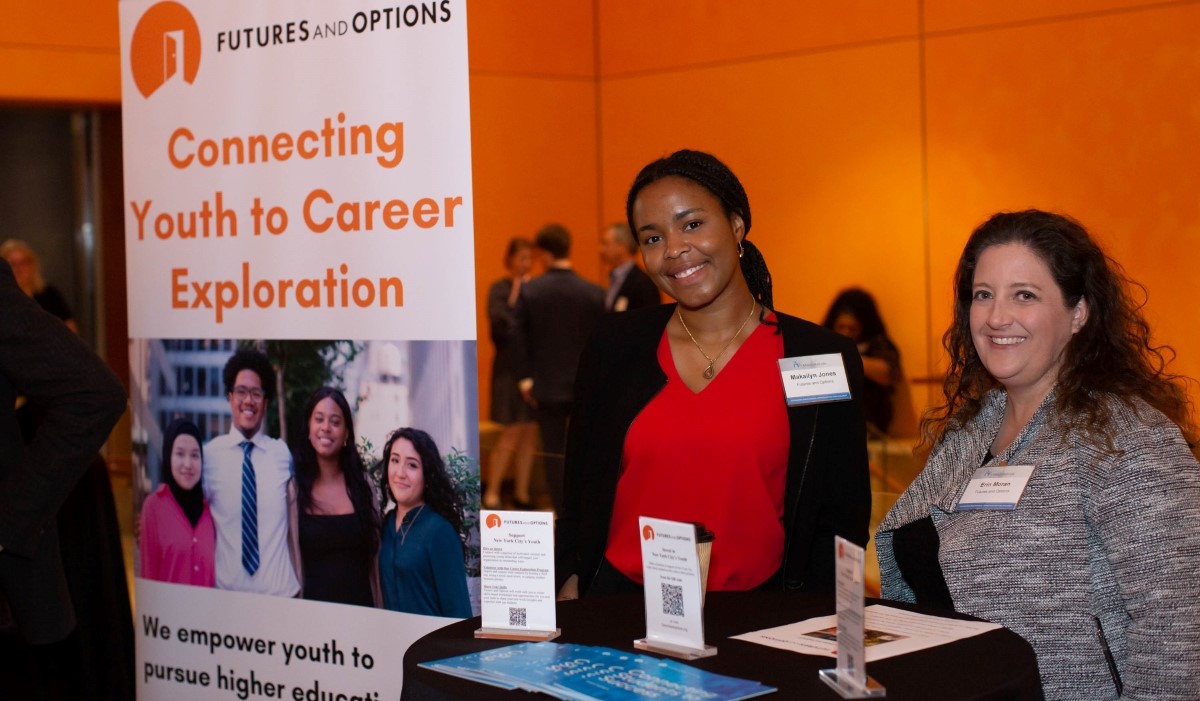
Volunteers represent MacroMinds’ Beneficiaries @ Futures and Options at the 2024 symposium.
Why is it important for others to get involved with causes they care about?
It strengthens the quality of your community and adds richness to your life. It makes you feel more connected. Every time I do something to help my community, I feel better throughout the day. Everyone should know the joy they could be feeling. My grandmother is an animal lover, and she fosters dogs. If you know your natural hobbies or passions, seek them out, there will be plenty of opportunities.
Any suggestions for how readers might address this issue in their own communities?
A month and a half ago, I took many trips to Target to get crayons, colored pencils and other things to fill backpacks for kids in my community. School supplies are expensive.
Even if you do one, which is like $30—or whatever you can afford—it’s a relatively low cost with a big impact. If I can help just one child have a more seamless transition back to school without having to worry about supplies, that’s a win.
What do you want people to learn from your story?
I started doing community service in seventh grade on a trip to Costa Rica for that purpose, but I wish I’d started earlier. I wish I’d been five years old at a beach cleanup. People should get involved as early as they can and instill a life of service in someone, because it changes the way you feel about helping others.
I also hope people take a moment to think about their own community—I can’t imagine there’s a single neighborhood that doesn’t have need—and see if there’s one thing they could do to help a child, an animal or a nonprofit.
Making a Difference in OKC, One Volunteer Hour at a Time
Meet Daily Point of Light Award honoree Heather Treaster. Read her story, and nominate an outstanding volunteer or family as a Daily Point of Light.
At a time when many of us are trying to find our purpose, Heather Treaster, a first vice president at IBC Bank, has found hers in the quiet, purposeful act of volunteering. Over the last year, she has dedicated over 515 hours of her time to causes, including Positive Tomorrows and the Civic Center Foundation. Her journey began with a simple goal: to earn the President’s Volunteer Service Award. But, as often happens with true leaders, her motivation runs far deeper than a pin or a title. It is a genuine commitment to her community.
Heather’s work with the Civic Center Foundation is one example of her hands-on approach. She serves as a volunteer usher for a variety of performances – from Broadway shows and concerts to ballet recitals and graduations. Her specific duties include welcoming guests, taking tickets and helping patrons find their seats. She is also a friendly face for those who might be new to the theater, answering questions and helping to resolve issues that may arise.
By providing a team of dedicated volunteers like Heather, the foundation eases the financial pressure on the performing groups who would otherwise have to pay for ushers. Heather’s compassion is also evident in her interactions with patrons, both regulars and first-time attendees. She finds joy in helping people, whether it is showing them how to find a ticket on their phone or simply engaging them in conversation. She understands that a little help and conversation can make a big difference in a person’s experience.
Heather’s journey to achieve all three levels of the President’s Volunteer Service Award is a testament to her dedication. She earned the bronze pin for 210 hours of service, the silver for nearly 300 and the gold for over 500 hours. Even after learning the award program was paused, she never wavered in her commitment. Her dedication is a consistent drumbeat, volunteering three to five times per month and even more during the busy dance competition season.
Heather Treaster working the doors during intermission at the Civic Center Music Hall in Oklahoma City.
Heather shows us that true leadership and service are not always about grand gestures. Instead, they often shine in the quiet moments of consistency and compassion.
Tell us about your volunteer role.
I volunteer for the Civic Center Foundation, which manages the Civic Center Music Hall in Oklahoma City, as well as the Rose State Performing Arts Center in Midwest City Oklahoma. The Civic Center Foundation mission is to provide culturally rich performing arts experiences to the greater Oklahoma City community.
As a volunteer with this organization, we serve as ushers or ticket takers. As a ticket taker, we assist guests with finding the box office and scanning their tickets. We are the first faces the guest sees and provide a warm welcome as they enter the facility for what might be the first time. Other volunteer jobs include greeter and usher. As a greeter, I welcome guests in the lobby after their tickets are scanned and assist them with finding the correct location for their seats as well as concessions or bathrooms. As an usher, I am responsible for working inside the theater to help guests find their correct seats, provide programs and monitor all show policies such as if photography is prohibited.
All of these roles aid in the welcoming and comfort of our guests. We are there for any questions or needs, such as where to go, how to get booster seats or Kulture City bags. We also volunteer as ushers during dance competitions, recitals and graduations, supporting families as their loved ones compete or celebrate the end of a successful season of life such as in dance or graduation.
What inspired you to get started with this initiative?
I’ve always been into volunteerism and theater from a young age. I participated in choral singing throughout my K-12 education, as well as volunteering for various theater performances at the same time. The bank I work for, IBC, values volunteerism and I have been involved with the community in a variety of ways through that connection. When my friend Betty asked if I wanted to start volunteering at the Civic Center it seemed like a very logical fit for me. Two things I love: performing arts and volunteerism.
Why are the performing arts so important to you?
The performing arts are important to me because they provide different perspectives to consider, as well as entertainment and social opportunities. The Civic Center Foundation hosts many different types of theater within their locations – opera, ballet, orchestra, Broadway shows, comedians, graduations, speeches and seminars. There truly is something for everyone in a variety of genres. The Oklahoma City Philharmonic provides a preshow talk for all their performances of the classics, which explains the history of the music, the time period the music comes from and what was going on in the world and in music at that time. The opera does the same thing. So there is much learning to be had as well as entertainment.
What are your long-term plans or goals for the organization?
My long-term plans with the organization are to achieve lifetime volunteer status at a young age (4,000 hours) and also to volunteer with this organization for 30+ years. It is so inspiring to me when volunteers are with the same organization for such a long time. Starting in my 30’s gives me a great leg up for a long career of volunteerism.
What’s been the most rewarding part of your work?
The most rewarding part of the work is the human element. I have made so many friends with other volunteers, Civic Center staff and season ticket holders. We share book recommendations and life stories, and that human connection is so important. I am also rewarded with the gratitude of helping others, with even the most seemingly minor things such as when a patron was scared to walk across a bridge in our building. I was able to show her a way to her seat that avoided the bridge. Another man had two drinks to carry to his seat but needed to use the handrail, so I was able to carry one for him.
These small acts of kindness make me feel useful and make the patrons feel seen and valued. One of my favorite stories is a woman who comes to every Broadway performance and brings her own purple seat cushion. She left it in her seat, and I found it but not in time to give it back to her. I turned it in to lost and found, and then asked her about it at the next show where I saw her. She had not retrieved the cushion yet and I was able to return it to her. She was so grateful to have it back and that I remembered her.
What have you learned through your experiences as a volunteer?
I have learned to be patient and flexible in my volunteer role. Patience is required because not all volunteers or patrons move at the same speed or do things the same way. Flexibility is required because depending on the show and the needs of the patrons, I might be more involved or less involved. Season ticket holders know where their seats are and maybe just need to be greeted and need that human connection but don’t need a lot of help. Patrons who are new to the theater, nervous or seniors might need a bit more hand-holding. In those cases, I walk them all the way to their seats or to a different area of the theater as needed to make sure they get there. Late arrivals receive similar treatment because it is often dark, or it is necessary to walk them to their seats so they don’t get lost or trip and fall.
Why is it important for others to get involved with causes they care about?
Because that is how we improve the organizations and services offered in our world. Everyone gives their own special touch to the things they care about and it increases the diversity and inclusivity of the offerings. If you are truly passionate about what you are doing you will do it with a level of enthusiasm and a sense of ownership that someone who is not so passionate about that thing wouldn’t. Volunteers keep costs down and keep organizations offering high levels of service so anything that you can do to advance a cause you care about is never a bad idea.
Any advice for people who want to start volunteering?
Find something you are passionate about and sign up. You will receive all of the training and support you need and the organization you sign up with will be so happy and grateful that you are there!