Meet Daily Point of Light Award honoree Kim Hodges. Read her story, and nominate an outstanding volunteer or family as a Daily Point of Light.
Kim Hodges, a native small-town Illinoisian, has lived in New York City for almost 30 years. She works in a field-based marketing role at a pharmaceutical company and plays softball in Central Park. But leading the Ulla Farmer Meal Program has become an inextricable part of her story, and she wouldn’t have it any other way.
Kim took the reins during the COVID-19 pandemic when she and her twin daughters—high schoolers, at the time—covered for the over 65 crowd that couldn’t safely volunteer. She reorganized the program to function with safety protocols and nearly tripled the number of people fed. Guests are appreciative to have a reliable meal each week and look forward to the experience as much as the volunteers do. Adding events and special touches to the program, she continues to honor the memory and legacy of the program’s creator after her passing.
What inspires you to volunteer?
I grew up in a family restaurant, so service was really ingrained. Everyone in my family is hardwired for it. It feels great when you do things for other people.
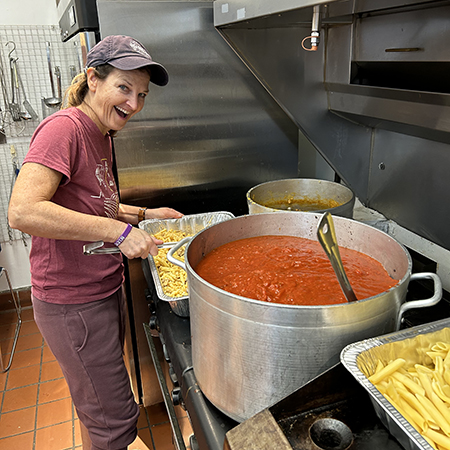
At a monthly meal prep event during the winter, Kim cooks large amounts of pasta.
What inspired you to get started with this initiative?
I was a deacon in my church, and one of the initiatives we have is this Thursday meal program. Ulla Farmer started it 40 years ago, and it had grown and blossomed. As she was starting to step back from it in 2018, I was asked to coordinate volunteers. So, I started by organizing who was going to work each week.
When COVID hit, recommended precautions kept our volunteers, all of whom were over 65, from helping in-person. So, as we were trying to figure out how to continue, my daughters and I met one other person from the church and took over. It was such a great thing to be involved with, especially during COVID. It gave me purpose.
Tell us about your volunteer role with the Ulla Farmer Meal Program.
For many years, people would have a sit-down meal and a movie. Then, in the pandemic, we shifted to grab-and-go meals. Now, each week, five to seven of us pack sandwiches and healthy snack bags. In winter months, we add a hot meal. During those months, I organize a Saturday where we cook enough for the month. I still coordinate volunteers and manage Costco runs for hot meal ingredients and online supply deliveries for everything else.
We went from feeding around 55 people to around 160. Every week since the pandemic, it’s grown. We also add special touches. At Thanksgiving, for example, we’ve invited guests to either take the bag to go or sit down for a meal. At Christmas, we’ll organize a gift bag with things like socks, hats, gloves and sweet things.
We also made the third Thursday of every month Teen Night. Most of the guests are seniors, and it brings them so much joy when the kids are the ones handing out the bags. In May, we even worked with a clinic to have a health truck come and offer services. I’m constantly trying to think of ways we can do more.
Are guests typically the same each week?
A large portion of guests we see every week are. We may be the only people they talk to that day, so I remind volunteers to say hello and ask how they’re doing. We get new people every week as well. With all the immigration stuff going on, we’ve started seeing more young families, and that’s really heartbreaking. When our teens are handing out a meal to another teenager, that’s tough.
What are your long-term plans or goals for the organization?
We have free community programs on Tuesdays that aren’t part of the church. They use the space for things like chair yoga and improv night. I’m trying to tie some of that into our Thursday meals. Once, we had a concert for guests while they ate in the sanctuary. Another goal is to provide a warm and dry environment for them to enjoy their meal during extreme weather.
Tell us about Ulla Farmer.
Olla founded the program with tea and cookies and grew it into a hot, sit-down meal. She wanted it to be an experience, so volunteers waited tables and used real plates. I don’t think we could go back to that, because we would only be able to serve 50 people. But by adding programming, I’m trying to keep that aspect going in honor of her.
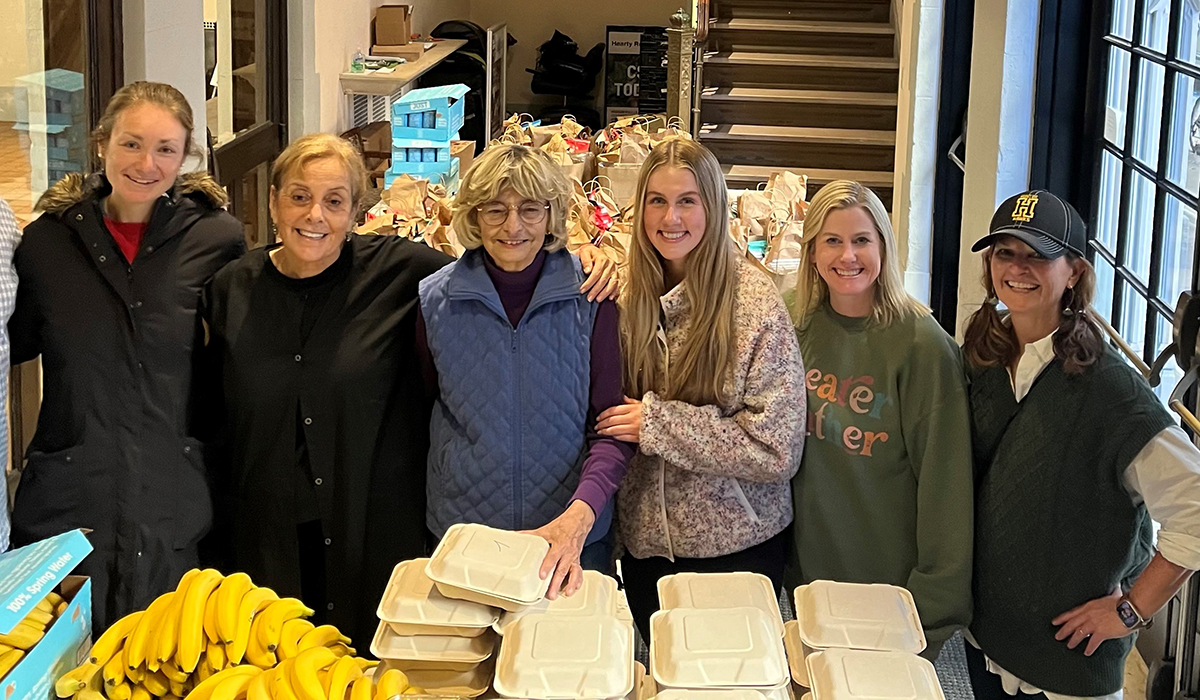
Volunteers join Kim Hodges (far right) leader of the Ulla Farmer Meal Program, to serve meals to those in need and create an experience to remember.
What’s been the most rewarding part of your work?
My dad was a chef, so when we’re cooking these huge volumes of food, I’m always thinking of him. It’s a way to feel connected to him. I also love the connection between youth and seniors, and amongst the volunteers and guests we serve. That’s one of the most rewarding things about the whole program. It’s so important. With everybody’s face in a computer or phone today, this is a way to really have a human connection.
What have you learned through your experiences as a volunteer?
One of the Boy Scouts from the church interviewed our guests for an Eagle Scout initiative. When he gave a speech about it, he talked about how much he learned and how important it is to be kind, because you never know what somebody’s story is.
That resonated with me. This program is such an easy way to show kindness and to carry that with you all week. When you see somebody on the street who isn’t behaving in a way they should be, you don’t know what’s behind it. So, I’ve learned to be kind in every action.
What do you want people to learn from your story?
Even a small act of kindness can make a big difference in the world. When people come and help, they’re touched by how meaningful the experience is. I love doing this. Taking time to find that thing–whatever it is–when you volunteer will be more rewarding than you can imagine.
From Idea to Impact, with a Team of Youth Ambassadors
Meet Daily Point of Light Award honoree Mark Li. Read his story, and nominate an outstanding volunteer or family as a Daily Point of Light.
When the world seemed to be turning inward during the COVID-19 pandemic, a different kind of call to action was heard by a young man named Mark Li. Witnessing the painful rise in anti-Asian hate, Mark channeled his own experiences and empathy into a powerful force for good. He didn’t just see a problem; he saw an opportunity for connection and change. This vision led him to co-found the AAPI Youth Ambassadors Program, a nonprofit organization built on the simple yet profound idea that young people can be the architects of a more inclusive and compassionate community.
As the co-founder and executive director, Mark is deeply involved in the day-to-day work, dedicating an average of 40-50+ hours each month to a wide range of activities. He’s not just an organizer; he’s a participant, whether it’s tutoring young AAPI children in reading and music, coordinating monthly donation drives for books and school supplies, or getting his hands dirty in the nonprofit garden that has harvests and distributes fresh vegetables to families in need. This direct involvement ensures that the organization’s mission remains rooted in the needs of the community it serves.
Mark is a skilled advocate who has secured funding from both local and state governments to expand critical programs. His commitment to civic engagement is evident in his coordination of translations of political campaigns, ensuring documented immigrant families are informed and empowered at the ballot box. This work, alongside his leadership in training fellow young advocates who have gone on to testify before government hearings, is based on his belief in building long-term capacity for youth leadership and civic engagement.
For Mark, it’s about more than just immediate relief; it’s about empowering a new generation to find their voice and use it for good. From a simple idea born during a time of crisis, he has built a powerful platform that ensures not only immediate relief but also a long-term future of leadership and dignity for immigrant, senior and low-income communities. Read on to find out more about Mark’s story.
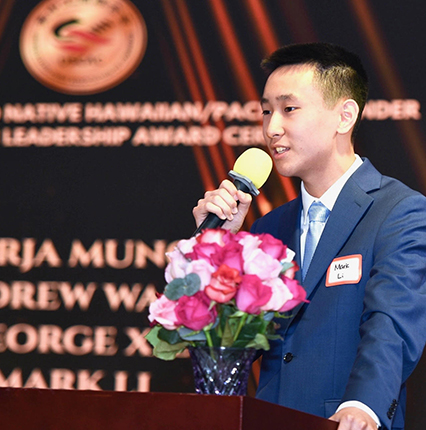
Mark Li speaking at USCAC AANHPI Youth Leaders Award Banquet in front of the Maryland Secretary of State on youth leadership, inclusive politics and the value of community service.
Tell us about your volunteer role.
My organization is the AAPI Youth Ambassadors program. I founded this organization with a group of other students who are very, very passionate about equal rights, and not just rights pertaining to race, but rights pertaining to age, gender identity and other demographics that we think are often overlooked. During the COVID-19 pandemic, when we started it, I experienced racism. I experienced marginalization because I was Chinese. There was a sense of division that I felt between my friends and my peers at school, at the store, whatever I would get these weird glances. All in all, I just want to say that this organization was birthed from a desire to have other kids not experience that experience of hatred, that experience of feeling lonely. Everyone was vulnerable during the pandemic, and it was a time when especially our youth had to feel secure, safe and grounded in community.
Why is this issue so important to you?
Our belonging isn’t defined by what others think we are. It’s defined by our very own dedication, our very own sweat, our very own effort toward bettering our community. We started originally making organic soaps, organic health kits for those who were experiencing this pandemic but didn’t have natural ability to help themselves, to take care of themselves. And then after that, after the COVID-19 pandemic passed, we moved into policy work. We moved into environmental work. We had a wide array of kids passionate about different things, but we were all committed to the same overarching mission of reducing inequality through service.
Right now, as the co-founder and executive director, besides overlooking and facilitating the function of the organization, I do spend most of my work on the policy and legislative side as well as the environmental side. I think these two areas tie into a lot of how our youth see the world, see the future and see the nation that we will inevitably inherit. For better or for worse, we will inherit this nation… that’s inevitable. So my goal, really, is to ensure we as youth have the best world possible, and to continue to make it better, combating the systemic inequalities that we face.
What are your long-term plans or goals with the organization?
Currently, I’m proud to say we have made many progresses here locally – I live in Maryland. We have initiated the changes in legislation in the Maryland General Assembly. Our work does focus on the AAPI community. AAPI stands for Asian American Pacific Islanders. We really focus on things like making sure that our curriculum is included into the public school history curricula. It’s so important to recognize not only Asian Americans, but all types of Americans in this beautiful melting pot of a nation, and recognize that we are all cornerstones. That has been an initiative that we have seen success in that we are continuing to push in the state and local legislatures.
Long term, we are seeking to prepare our youth to lead a life of service, to lead a life of fulfillment through helping others. And I think all of my work has been driven by my lived experiences. I don’t feel comfortable speaking on behalf of others, but I think that this work is valuable, because when you focus on one specific marginalized demographic, such as the AAPI community, it shows what we can do for the other demographics that are often marginalized. We set an example for what we can do. In a world of so much division right now, obviously the headlines dominate a lot of what our youth perceive the world to be, whether that’s in politics, sports or the healthcare system, whatever it may be. I operate with this mindset as I design these goals for the future. What’s the most tangible, what’s the most effective way we can get our youth on the ground and running and not just being performative.
People power is the greatest power, in my opinion. Currently, we are fundraising a lot. We have raised funds from federal grants, county grants from the government. We are a nonprofit, so, anything that comes to us, we are absolutely ready for. We conduct water quality tests for our neighbors with wells. We conduct road cleanups on our roads that we have through the Adopt a Road program here in Maryland. We host national AAPI conventions for our youth, for our high school students or college students. We’re always ready for more collaboration with government institutions and with NGOs as well. It’s really been a pleasure to work with these amazing people. And I think it’s the stories that make me proud of the work that we’ve done.
What’s one rewarding story from your work?
There have been so many moments over time. If I had to pick one, it would be when we harvested fresh produce from our garden. We donate produce in collaboration with these amazing organizations that help people who need it. This one day, it was early in the morning. We had just worked hard. We dug all the vegetables out of the ground. We approached the Crisis Intervention Center, and there was an older man there. He told me that he was super grateful for us giving him his dinner that day. The Crisis Intervention Center is incredible, but it isn’t Superman. No organization has unlimited resources. Seeing the impact we made on this one man helped all of us understand the importance of extending helping hands.
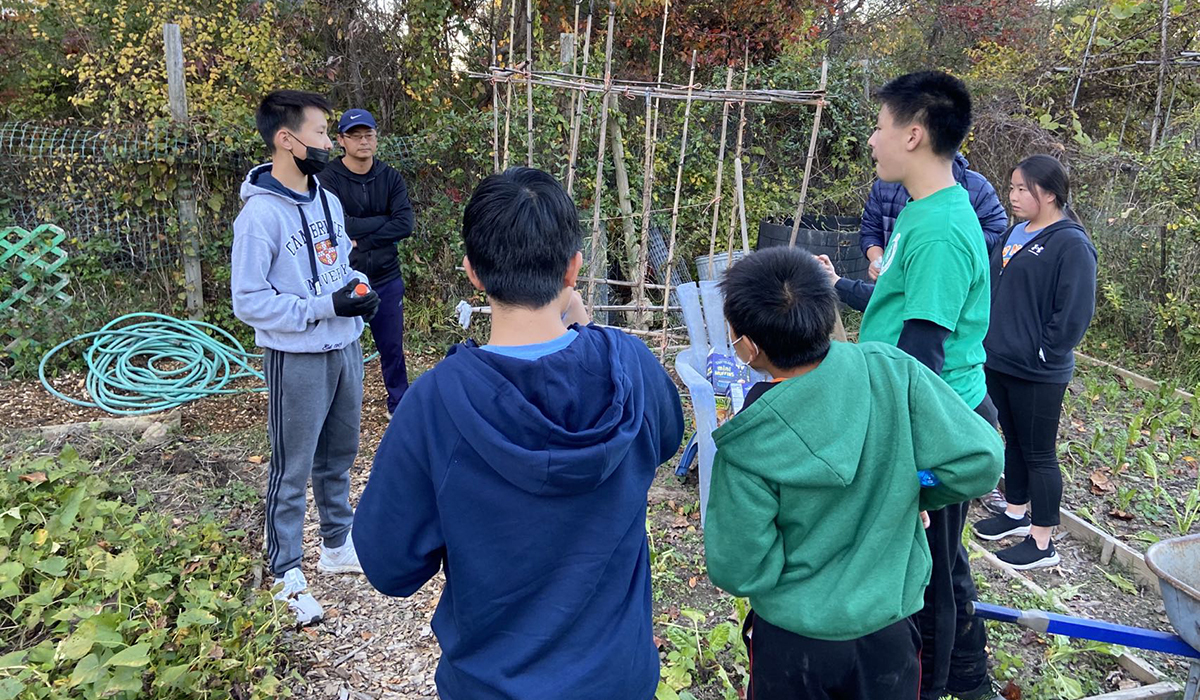
Mark Li gives seminar to youth ambassadors in gardening practice for environmental sustainability and vegetable harvest for charity donation.
Why is it important for youth to get involved with causes they care about?
Ignorance is rampant in our communities. It’s up to youth like myself, like the peers that I work with, to re-engage our communities and remind them why people like us, nonprofit workers, healthcare professionals or teachers volunteer our time to help others. I think that’s the best way to remind us of our own humanity. It’s tempting to crawl up in our in our beds, stay in our rooms, let our parents do what they do, earning their incomes, while we just live life. But throughout my experiences, I’ve learned that being passive is no way to go about changing things. American is a democracy where we can advocate for ourselves, but you are only being a responsible citizen by actively advocating for not only yourself, but those who are often voiceless too.
What have you learned through your experiences volunteering?
Leadership isn’t about being the loudest or even being about the most proud. It’s about being consistent, about being present every time. Starting an organization isn’t easy, because you are responsible for engaging other people who might not understand the importance of what you’re trying to do. Right off the bat, you have to really communicate the value that you see, the vision that you see. Service has taught me that impact really isn’t defined by how much visibility you get. It’s about how deeply you can listen, how deeply you can then take what you listen and then convert that into improving your own service and thus serving more effectively.
Any advice for people who want to start volunteering?
I was motivated by my own lived experience. If I hadn’t witnessed and experienced those marginalized, I wouldn’t have started this organization. But we want our work to be sustainable. So if you’re chasing these big accomplishments in service right off the bat, you’ll burn out. It’s not the right reason to serve. Instead, anchor yourself in the small parts of the journey first, whether that’s just reaching out to a teacher that you’ve appreciated or helping an elder in your in your community with their groceries. Ask, ask, ask, ask. If you never ask, you’ll never learn what the needs in your community are, and how you can help respond to them.
Turning Pages: Redefining Literacy and Empowerment Across Africa
Meet Daily Point of Light Award honoree Krish Nachnani. Read his story, and nominate an outstanding volunteer or family as a Daily Point of Light.
Krish Nachnani’s journey into service began with a deep love for books and a sharp awareness of what happens when access to them disappears. When the pandemic shuttered his local library, he was struck by how this temporary inconvenience mirrored the daily reality for students in underserved communities worldwide. This realization propelled him into action through the African Library Project (ALP), where he began organizing book drives to help establish school libraries in Africa. His initial efforts resulted in five new libraries and laid the groundwork for a much larger vision.
In 2024, a pivotal service trip to Kenya deepened and refines Krish’s focus to the cause. While there, he witnessed a student production about female genital mutilation—a stark reminder that some traditions persist despite legal bans. The performance advocated for access to accurate, empowering information, especially around women’s health and gender equality. Krish realized that books could do more than teach reading; they could shift cultural norms and open conversations that lead to long-term change.
With this insight, Krish founded the African Literacy Club (ALC), an initiative that fuses education with advocacy. Through ALC, he expanded his mission beyond general literacy to include curated collections focused on women’s health and social empowerment. In just its first year, the club raised $12,500, shipped over 15,000 books and helped build 10 libraries. His model ended up reaching more than 20,000 students across five sub-Saharan African countries.
Krish’s leadership has inspired a network of student volunteers to take on the cause. He mentors peers at his school in organizing their own book drives, sharing strategies for fundraising and community outreach. The impact is measurable: ALP surveys show a 90% improvement in reading skills and a 10% boost in academic performance among partner libraries supported by ALC.
Read more about Krish’s journey of opening new chapters for thousands of students who now see books not just as tools for learning, but as keys to a more just and inclusive future.
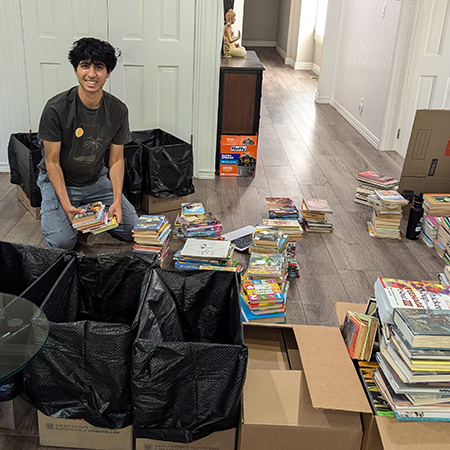
Packing boxes of gently used books, Krish prepares a shipment for a school library in Malawi.
Tell us about your volunteer role.
I joined ALP in 2020 as a book drive organizer, responsible for collecting 1,000 gently used books, raising $750 for shipping and preparing and labeling the boxes for shipment. I continued this role for five years, organizing a drive every summer.
In 2024, after attending the ALP Partner Summit in Kenya, I launched the African Literacy Club at my school to encourage more students to become book drive organizers. I now mentor peers through every step of the process, from collecting and sorting books to fundraising and coordinating with container managers. Together, our club has collected 10,000 books and raised $7,500, supporting libraries in Kenya, Botswana, Malawi, Lesotho and Ghana, and reaching more than 20,000 students.
What inspired you to get started with this initiative?
At the ALP Partner Summit in Kenya, I shared my experience as a book drive organizer and listened to librarians and African partners describe their challenges. They explained how schools apply for libraries through a careful process, but sometimes there simply aren’t enough U.S.-based organizers to collect and ship books. That’s when I realized my role shouldn’t stop at running a single drive each year; rather, I should mentor new organizers to help build a steady pipeline of support.
Why is this issue so important to you?
My grandparents fled Karachi during Partition and grew up with almost no access to books. My parents were the first in my family to change that cycle, working hard to pursue education even without many resources. I, by contrast, grew up surrounded by books.
When the pandemic closed my local library, I briefly experienced what it felt like not to have books within reach. That absence motivated me to help ensure that students elsewhere, especially in Africa, could access books consistently. From my family’s story, I’ve seen how literacy can open doors and shape opportunities.
What are your long-term plans or goals for the organization?
I’m preparing our current officers to take over leadership when I graduate, while also launching a chapter at our middle school campus so younger students can get involved earlier. Looking ahead, I hope to start a similar club in college.
What’s been the most rewarding part of your work?
Seeing photos of students reading in the libraries we helped create is always a highlight. Just as rewarding has been watching peers I mentored run successful book drives of their own.
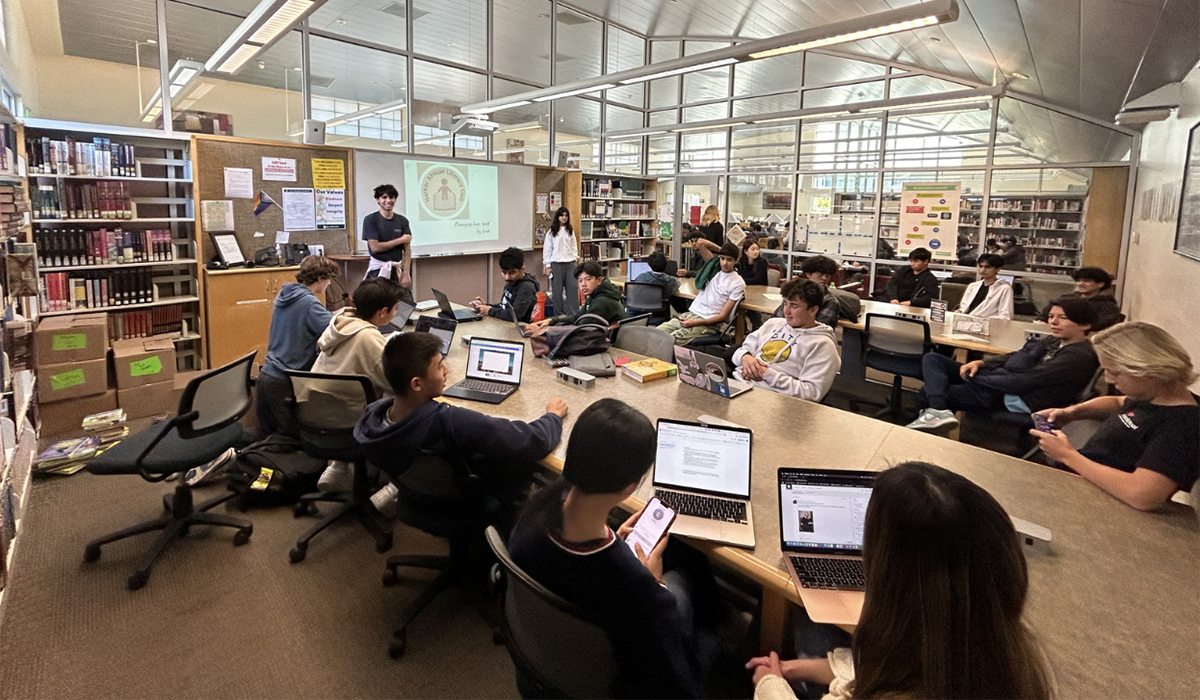
Speaking to new members at an African Literacy Club meeting, Krish introduces the club’s mission and activities.
What have you learned through your experiences volunteering?
I’ve learned to listen to the people I’m serving. Conversations with African librarians and partners showed me that no two schools are the same, and book needs differ across regions and contexts.
I’ve also learned to think more deeply about the power books can carry.
While in Kenya, I watched a play performed by girls at a school that had received an ALP library. Their performance addressed female genital mutilation (FGM), a practice that strips away young girls’ bodily autonomy. In response, I began packing books on women’s health, bodily autonomy and rights and encouraged my club members to do the same so students can learn about their rights, find resources and, over time, challenge harmful norms in their communities.
Why is it important for others to get involved with causes they care about?
You become part of a community of people who share the same commitment. That community helps you grow by offering feedback, support and opportunities to learn from one another.
Any advice for people who want to start volunteering?
Choose a cause you genuinely care about. Start small, but be consistent. Bring friends with you, learn from those who came before and enjoy the process. Volunteering is less about one big moment and more about showing up again and again.
Meet the Compassion Companion for Hospital Patients
Meet Daily Point of Light Award honoree Derald Peters. Read his story, and nominate an outstanding volunteer or family as a Daily Point of Light.
Since 2013, Derald Peters has been a volunteer patient companion at Bergan Mercy Hospital, bringing smiles and comfort to hospital patients. With a simple greeting and a wish to make people smile, he’s been a consistent presence in people’s lives when they need it most. Derald has a remarkable ability to connect with patients, helping to ease their anxiety, share in their grief and offer them a reason to be hopeful. His dedication is so well-known that hospital staff frequently request his visits, recognizing the therapeutic impact he has on their patients’ healing journeys.
Even a personal health crisis couldn’t stop Derald’s mission. After a severe injury that required 21 surgeries, he spent two years as a patient himself. During this time, he logged over 10,000 phone calls to other patients from his hospital bed, ensuring they had someone to talk to who wasn’t a masked hospital staff member. Once he regained the ability to walk, he returned to the hospital, using a walker to visit patients. Now, at nearly 78, he navigates the hospital corridors on a three-wheeled electric scooter, allowing him to continue his valuable service without tiring out.
Derald’s volunteers eight hours a week and is on call for medical staff. He also serves on the Patient Family Advisory Committee, where he advocates for improvements and helps identify opportunities for a better patient experience. In addition, he participates in the Volunteer Focus Group, working to address the ongoing challenge of recruiting new volunteers. His dedication has even caught the attention of medical students who have shadowed him to learn how to build rapport with patients.
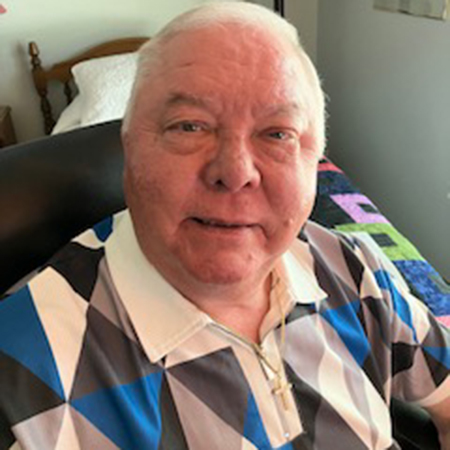
Derald Peters, avid volunteer with the Bergan Mercy Hospital.
For Derald, volunteering is more than just an activity; it’s a calling. As he says, he hopes to continue his service for as long as he can, and for the countless lives he’s touched, that’s a wish we can all be thankful for. Read more about what inspires Derald to keep volunteering.
Tell us about your volunteer role.
The organization is the Bergan Mercy Hospital, which is part of the CHI Health Hospital system. I’ve been volunteering there for over 10 years. My volunteering vocation is to knock on doors and visit with people, help ease some of their anxieties and loneliness. So many people in hospitals don’t have families nearby, so I try to fill in the gaps when those situations happen. My wife also volunteers while I do, holding premature babies in the NICU.
Occasionally, medical students follow me. We have teaching at the hospital, and they sometimes have medical students who have never met a patient before shadow me to learn how to meet and greet a patient. One or two follow me in, and I tell them before we go in that a patient is not a condition, they’re not a diagnosis and they’re not a room number. They’re a person. Go in and visit them like you would your mother or your grandmother. A lot of these students thank me for that, because they had never been into a situation where they had to meet a patient in the hospital other than trying to diagnose something.
How did you keep volunteering even when you yourself were hospitalized?
For three years, I was not able to be there in person to volunteer, but I continued to volunteer. I’ll tell you how. I’d injured my leg in a fall, and I went through 21 surgeries, plus rehab facilities and endured some infections. It was a long ordeal, but I never gave up volunteering. While I was immobile, I was in a different hospital in Omaha having my surgeries, and every day a coordinator at Bergen Mercy Hospital, which is the largest Catholic hospital in the state, would send me a list of all the patients on one or two floors. Just their names and their ages. I would lay in my hospital bed at one hospital and call them and do phone visits with them. It was during COVID, where they had no visitors, and I had no visitors, so we all had free rein of time.
Over the three-year period, my coordinator had logged that I made over 10,000 phone calls to visit patients. And after I regained some ability to return in the physical presence at the hospital, I started coming with my walker. After going up and down the halls so much, I would get fatigued. So I purchased an electric scooter that comes apart in five pieces and fits in my trunk, and now I put it together, and I ride through the hospital. I got a three-wheel one so that I can spin around on a dime! I can go into rooms and around patients’ beds – it makes it so easy for me. I do that two days a week, on Mondays and Thursdays, for about four or five hours each day.
Why is connecting with people so important?
It’s not just in times of need. I think people need to be connected all the time, but especially when they have no one else to talk to. I see patients that say, “Well, I do have family visit me, but it’s only for a couple hours each week.” The rest of the time, they see white coats and they count ceiling tiles. Look out the window, wish and wonder. I went through that process while I was in rehab in the hospital for three years. I was only home for 15 weeks in one year period, and it was all during COVID. I sat there and looked out the window, and I couldn’t have any visitors. And it was very difficult, but it’s so important that people be able to reach out and talk to others. It helps their mental condition, and it also helps their physical condition.
I’m a retired pharmacist and so is my wife. We practiced for 50 years, and we have this feeling of compassion towards other human beings, which we always had while we practiced. In pharmacy, you’re always dealing with sick people, and we wanted to continue that after we left the practice of pharmacy. And this is the niche that each of us individually and collectively found, and it’s been working really well.
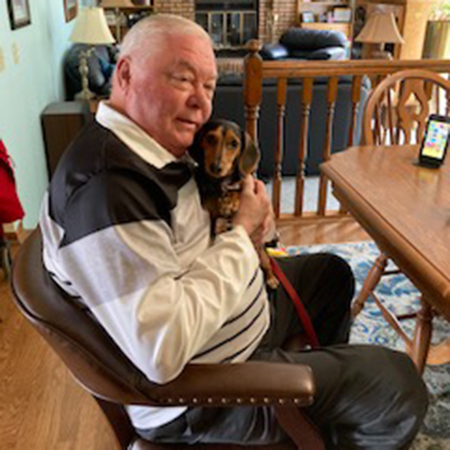
Derald relaxes with his best four-legged friend, Millie.
What are your long-term plans or goals volunteering with the hospital?
I hope to do this until the day I pass on. I’m 78 now. I just hope my health can stay as stable as it is, so I can continue until I can’t do it anymore.
What’s been the most rewarding part of your work?
Thinking about the people I’ve visited during the day and about the conversations that I had with them. I have a special prayer process that I do for the patients to help them heal, to improve and to return to their families or to their former life. The reward is at the end of the day, just thinking about the people that I visited during that day. It’s beautiful.
What have you learned through your experiences as a volunteer?
I had my first experience of volunteering when I was a freshman in college. I was teaching prisoners how to read and write, and I found out how rewarding volunteering can be. I brought an inmate from first grade to fourth grade over one semester, and I was elated by the fact that he had learned that much.
There’s no way to describe the joy of bringing joy to another person. The most important thing that I’ve learned is to learn is to listen. Listening is the key, and I try to start conversations with an open-ended question. Everybody has a story, every life has story and people are willing to talk about their lives if you give them time.
Why is it important for others to get involved with causes they care about?
In my faith, we are asked to visit the sick, to visit the imprisoned. I try to follow that creed. Visiting people not only uplifts their mood, but it’s been shown to help them physically heal. I’ve visited people that had total turnarounds, who have said they’ve never felt so good in their lives. People have gone from being ready to give up to being in such a better place with visits. Every patient that I see is a person like me, with problems, issues, handicaps, broken bones. I relate to that. So it’s like they’re visiting me, too. It’s like looking in a mirror.
Meet Daily Point of Light Award honoree Aarush Reddy. Read his story, and nominate an outstanding volunteer or family as a Daily Point of Light.
With just over a year of volunteering with Heart of America Humane Society, 16-year-old Aarush Reddy has spent more than 130 hours trying to find new families for dogs without homes. He spends four hours nearly every Saturday working at adoption events, and he doesn’t even have his driver’s license yet. Aarush originally volunteered with his dad. The arrangement fulfilled age-based requirements while providing a way to connect with family.
These days, he volunteers independently both for the shelter and a local food pantry. He also fills his time with school clubs, honor societies and his new job as a math instructor at Mathnasium, a learning center designed to help K-12 students in the subject. While he will always love caring for dogs, Aarush plans to pursue human medicine after graduation.
What inspires you to get started with this initiative?
I have a 6-year-old English golden retriever, and I love to hang out with him. That’s why I’ve always wanted to volunteer with dogs–taking care of them and convincing customers to adopt them. I’m really passionate about that.
Tell us about your volunteer role with Heart of America Humane Society.
I’m a dog handler. There’s a van that comes to PetSmart, and we wait outside to pick a dog. After we let it do its business, we go inside the store to an area where we can sit down. There are dog beds for dogs to sleep or lay down and play with toys. Our objective is to get customers to adopt them.
There are many stray dogs in Kansas, specifically, the Greater Kansas City area, and our organization partners with an animal shelter. We get the dogs from there. I learn about their history and how they behave. When someone decides to adopt, we give them that information as well as their medical records. And if they have any questions, we answer them to the best of our ability.
You’re working towards the Congressional Award bronze medal, which requires 100 hours of voluntary public service and targets in three other categories—personal development, physical fitness and expedition/exploration. Why is that goal important to you?
For each category that I complete, I gain experience. For the personal development category, I can shadow or teach. It improves my mental health, and helps me learn skills in the real world.
The physical fitness component motivates me to practice more for a sport that I’m passionate about—golf—and I get exercise. I get better every time I practice. This award helps me improve myself, and it’s satisfying seeing the progress and reflecting on how much I’ve worked on these goals.
What’s been the most rewarding part of your work?
It’s getting to see the dogs get adopted, especially the ones who have been in the shelter and at PetSmart attempting to get adopted. I had a dog who’s been here for three years, and they finally got adopted by a loving family, which made me so happy. They get to stay with their new family forever. That’s rewarding. It makes me feel like I’ve done something good.
What have you learned through your experiences as a volunteer?
I’ve learned how to approach any dog I see, regardless of their size or behavior. I’ve also learned how to be responsible. For example, I’ve experienced my dog getting off of his leash and running away. It was a very scary experience because I didn’t want him to leave the building. I’ve also built faster reaction times because the dogs sometimes run away. I can catch up to them in an instant now, because I’ve built more stamina.
Do you have any tips for the general public on how to approach a dog they’re unfamiliar with?
My first tip is to put your dominant hand out towards their nose area, like you’re gesturing to call someone over with your palm up. If they sniff it, they’ll know that you’re not a threat. If you just go up and pet them, they’re going to be scared. They’re not going to want to come to you.
If a dog is trying to bite or attack you, I put my index finger out and tell them to stop, because they’ll feel that you’re more powerful than them.
It’ll keep you safe from injuries, especially from dogs you don’t know who could have rabies.
Why is it important for others to get involved with causes they care about?
It’s fun, and it develops you as a person. You improve yourself with the experience. It’s kind of like a job. You get to experience what working is like or even learn skills for a future career.
Any advice for people who want to start volunteering?
Don’t feel nervous about volunteering. I was like that, too, when I started volunteering at Heart of America. If you follow their rules and be the best person you can be, you’re going to enjoy it. You’re going to enjoy working with the people who are always there at events. You’ll make more connections, and you’ll gain lots of experience that can be applied in the real world.
What do you want people to learn from your story?
Not every species on the planet is doing well. Dogs in my community are, in some cases, abandoned. They’re not being adopted. By volunteering at the animal shelters, you’re showing care to the animals and people you work with. You’re making yourself a more trusted, thoughtful person.
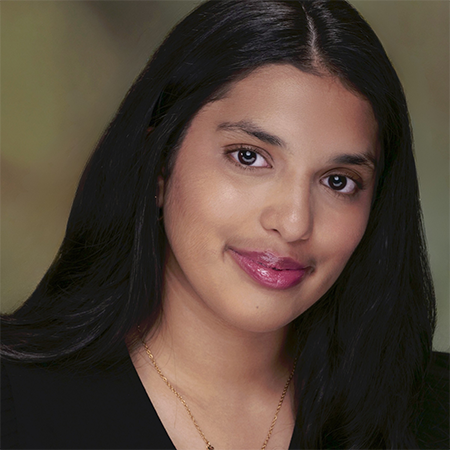
Meet Daily Point of Light Award honoree Saanvi Peri. Read her story, and nominate an outstanding volunteer or family as a Daily Point of Light.
For Saanvi Peri, a young leader and visionary, what started as a personal effort to help others has blossomed into a full-fledged international youth-led nonprofit. Saanvi was inspired to act after watching the conflict unfold in Ukraine. She used her sweet sixteen money to help and then led a campaign that raised around $20,000. These funds helped purchase two minibuses, which are currently transporting over 13,000 displaced people, including women and children. This effort alone has had a profound impact.
To help others understand the human cost of the conflict, Saanvi amplified the voices of Ukrainian teens, interviewing them and sharing their stories in local newspapers and podcasts from The Telegraph that reached more than 30,000 people. She also started a U.S.-Ukraine peer program which brings local students and Ukrainian students together to foster understanding and support. She is currently working on new exchanges with schools in Syria and Vietnam. Saanvi even created a toolkit to empower other young people to begin their own humanitarian initiatives.
Saanvi’s work has directly impacted thousands of youth and inspired global youth action. The minibuses she helped fund have been a lifeline, transporting displaced single mothers and wounded servicemen, including 46 people with disabilities. According to United Forces for Aid to Ukraine, the bus will also help 2,451 children from surrounding villages attend school. Her nonprofit, Save Children from War (SCFW), now has over 10 active chapters in the U.S. Europe and Asia. Her innovative and compassionate leadership earned her the Congressional Award Gold Medal.
Saanvi’s vision continues to grow. She is currently drafting a global declaration to be signed by youth around the world, advocating for the integration of youth-led support systems into humanitarian response and education plans for youth affected by conflict. She is also developing an app called Aluma to provide support systems for young people. This is based on the idea that youth understand each other best. Saanvi also serves as a chief technology officer for the Indian nonprofit Lakshitha, where she is helping to expand educational opportunities for underserved children by developing digital platforms and a mentorship portal. Her dedication to serving others, whether close to home or on the other side of the world, is an example for us all.
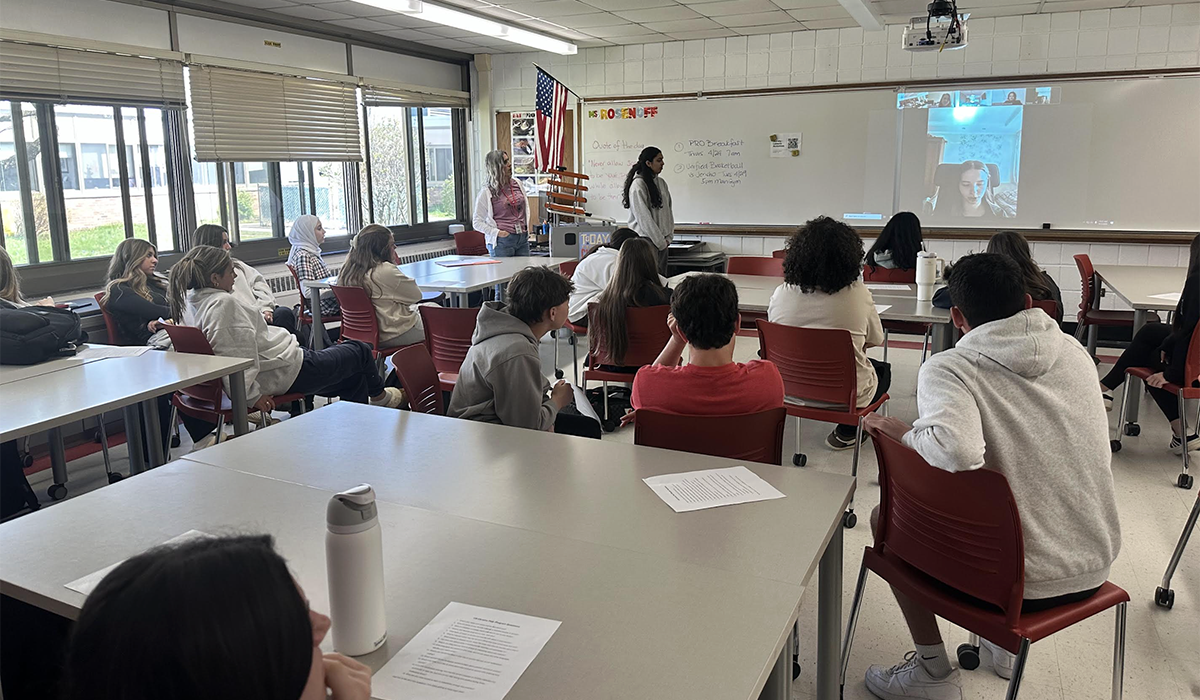
Saanvi Peri, founder of Save Children From War, dedicated to protecting and empowering youth living in conflict zones.
Tell us about your volunteer role.
I am the founder of Save Children From War, a nonprofit dedicated to protecting and empowering youth affected by war. My role includes leading fundraising initiatives, designing programs that provide relief and support, and building partnerships with local and international organizations to maximize reach and impact.
I work closely with a network of ambassadors who mobilize volunteers in their own communities to raise funds and collect aid, as well as a team of dedicated mentors who provide guidance and support to help us grow sustainably. Our most notable initiatives have resulted in procuring minibuses that are now transporting families and wounded soldiers to safety and bringing children to school and providing critical resources and financial support to orphanages caring for vulnerable children.
Why is this issue so important to you?
Children should never have to bear the consequences of conflicts they did not create. War strips away not only their safety, but also their education, their sense of security and sometimes their dreams for the future. My perspective on this became personal when I interviewed Ukrainian teens for an article I was writing. Speaking with kids my own age about our similar interests but also hearing about how the war affected their life, not because of anything they had done, but because of where they were, made me want to take action. I feel a responsibility to stand with them and amplify their needs, because too often, youth are an afterthought in conversations about war and recovery. Supporting them is about ensuring they grow up with hope, dignity and opportunities to thrive despite the hardships they’ve endured. To me, protecting children in war zones is both a moral responsibility and a way to invest in a more peaceful, compassionate future.
What inspired you to get started with this initiative?
My inspiration came from listening to the stories of children during war on a podcast. I was struck by their resilience and courage, but also by the profound losses they had endured: losing their homes, schools and in some cases, family members. I realized that while I could not stop the war, I could take tangible steps to help these children feel safer and more supported. What started as a small effort to raise money for minibuses to transport displaced children quickly grew as I connected with journalists, community leaders and organizations that believed in the cause. Their support showed me that one idea, even from a teenager like me, could grow into something much larger. That was the spark that became my nonprofit, Save Children From War.
What are your long-term plans or goals for the organization?
Thinking long-term, I hope to expand Save Children From War’s reach to youth in other conflict-affected regions that could benefit from our services. My vision is to create a global network that combines emergency relief with long-term empowerment initiatives like scholarships, mentorship and community programs. I also want to focus on giving youth platforms to share their own voices and stories so they can advocate for themselves and shape their own narratives. Ultimately, my goal is to build sustainable programs that not only address immediate needs but also break cycles of trauma and poverty and help more youth rebuild their lives and reclaim their futures.
What’s been the most rewarding part of your work?
The most rewarding part has been witnessing the direct impact of our work. I will never forget seeing the children’s faces light up as they boarded the minibuses we helped provide. Those smiles remind me why this work matters. It has also been deeply rewarding to connect with youth across cultures through our peer programs in three continents and watch empathy grow between communities that might never have crossed paths otherwise. Knowing that something I helped start can bring both practical relief and emotional hope is the greatest reward of all.
Saanvi raises funds at a Ukrainian cultural festival to support children impacted by war.
What have you learned through your experiences volunteering?
Through my experiences, I’ve learned that real change begins when you step outside your comfort zone and act, even if you don’t feel fully prepared. I’ve learned that leadership is less about giving directions and more about listening, especially to those who are directly affected.
I’ve also seen how powerful community can be. Whether it’s people donating, volunteering or simply spreading the word, collective action is what turns small ideas into movements. Finally, I’ve learned that resilience is not something you read about in books; it’s something you see in the faces of children who, despite everything, still dream and smile. That lesson has shaped me not just as a volunteer, but as a person.
Why is it important for others to get involved with causes they care about?
When people get involved directly with a cause, they become part of a bigger story of change. No one person can solve every problem, but every person can make a difference in their own way. Getting involved allows individuals to transform their compassion into action, and it often creates ripple effects; one act of kindness can inspire others to do the same. It’s also important on a personal level as volunteering also gives people a sense of purpose, perspective and connection. By working for something larger than ourselves, we not only help others but also grow in empathy and understanding.
Any advice for people who want to start volunteering?
My advice would be to start small and start now. You don’t need to have a perfect plan or a huge network to begin making a difference. Sometimes it’s as simple as offering an hour of your time, using a skill you already have or supporting an existing organization. Don’t be afraid to reach out and ask how you can help; most nonprofits are eager for extra hands and fresh ideas.
If you feel strongly about an issue, follow that passion, because your energy will be contagious. And remember, you don’t need to change the whole world at once. Focus on one step, one project or one person at a time, and you’ll be amazed at the impact you can create.
Expanding Access to Books: From Dusty Shelves to Eager Readers
Meet Daily Point of Light Award honoree Sahana Srikanth. Read her story, and nominate an outstanding volunteer or family as a Daily Point of Light.
Sahana Srikanth, 17, has always been an avid reader with a fascination for words, so when she started competing in spelling bees in third grade, it made sense. She had no way of knowing the outsized impact these bees would have on her life, but after several years of competition, her passion for language led to a passion for literacy and education equity. Then, at 13, she launched Young Learners Foundation.
By the end of October, Sahana will have rerouted nearly 18,000 books to children in book deserts in 26 locations within the U.S.—mainly Title I schools and Boys & Girls Clubs—as well as Kenya and Trinidad & Tobago through book drives and donations. She’s expanded significantly, partnered with the World Literacy Foundation and received $3,500 through grants and musical performances fundraisers. Most funds have supported shipping of books abroad, including approximately 1,350 collected through local middle school classrooms to a Kenyan orphanage via the African Library Project.
Sahana is also an advocate working with multiple organizations to prevent eating disorders and address equitable access to healthcare through policy. Reading remains one of her biggest hobbies.
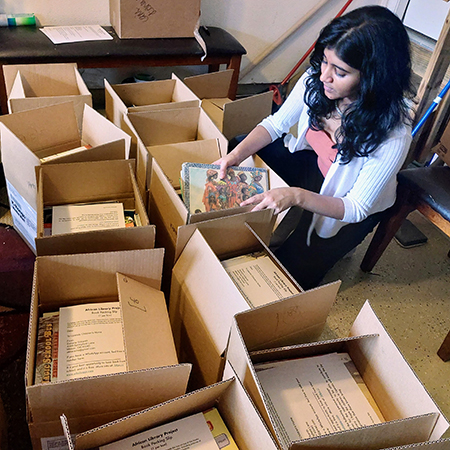
Partnering with the African Library Project, Sahana boxes up 1,000+ books to ship to the Upendo Children’s Home in Kenya.
Tell us about your volunteer role with Young Learners Foundation.
As the executive director, I dedicate around 10 hours per week to organizing book drives, donating books, hosting community events and developing youth literacy programs. Our books come from individual donations as well as local educators with unused stockpiles. We have a form system for the latter and coordinate volunteer pickups. I also oversee a 12-person executive team and mentor our state directors with whom I work to develop book drives in their own communities.
What inspired you to get started with this initiative?
In 2022, I competed in the Scripps National Spelling Bee in Washington, DC., meeting many people who were as passionate about language as me. I placed in the top 10 in the country and came home motivated to get more involved in the literacy space. I wanted to mentor other spellers, especially those without access to the resources that I had. Spelling bee mentorship can be very expensive.
So, I worked with the Boys & Girls Club to host a spelling bee vocabulary workshop targeted to third through sixth grade. They were having fun, but I noticed kids struggling with words that were significantly below their grade level. After talking to them, I realized that not all of their schools had books, and that was unique to me, because my district has classroom libraries for virtually every teacher.
In the U.S., alone 32 million kids are living in book deserts with limited access to books. That’s about three times the population of the state of Ohio. Studies show that having books at home is one of the biggest predictors of future literacy success. That inspired me to do something about it. Growing up, I spent the majority of my time immersed in books. So, I started hosting book drives and donating to organizations like Boys & Girls Clubs and Title I schools.
Ms. Jill Hartsock, a former teacher, has also been an inspiration. Her support of my work means a lot. She taught me what a growth mindset is when I was in third grade, and I’ve carried that with me for the past 10 years.
What are your long-term plans or goals for the organization?
A few schools have requested bilingual or Spanish books. The majority of our books are in English, so we’re trying to build a stronger system for acquiring those in order to serve Spanish-speaking communities and inspire bilingual learners. We recently acquired a grant from the Matt Kurtz Kindness Foundation for that purpose. I want to collaborate more with schools that serve marginalized populations so we don’t exclude anyone.
A second goal is deepening our partnerships with Boys & Girls Clubs, because they serve youth after school. We’d love to set up libraries at clubs we’ve collaborated with in the past so that when kids are hanging out, they can pick up a book.
What’s been the most rewarding part of your work?
It’s fulfilling to see kids run to our table at events to pick books. It makes me so happy, because if they haven’t been able to choose a book based on what they’re interested in and not based on money, this might be the first time they’re picking books they truly want to read.
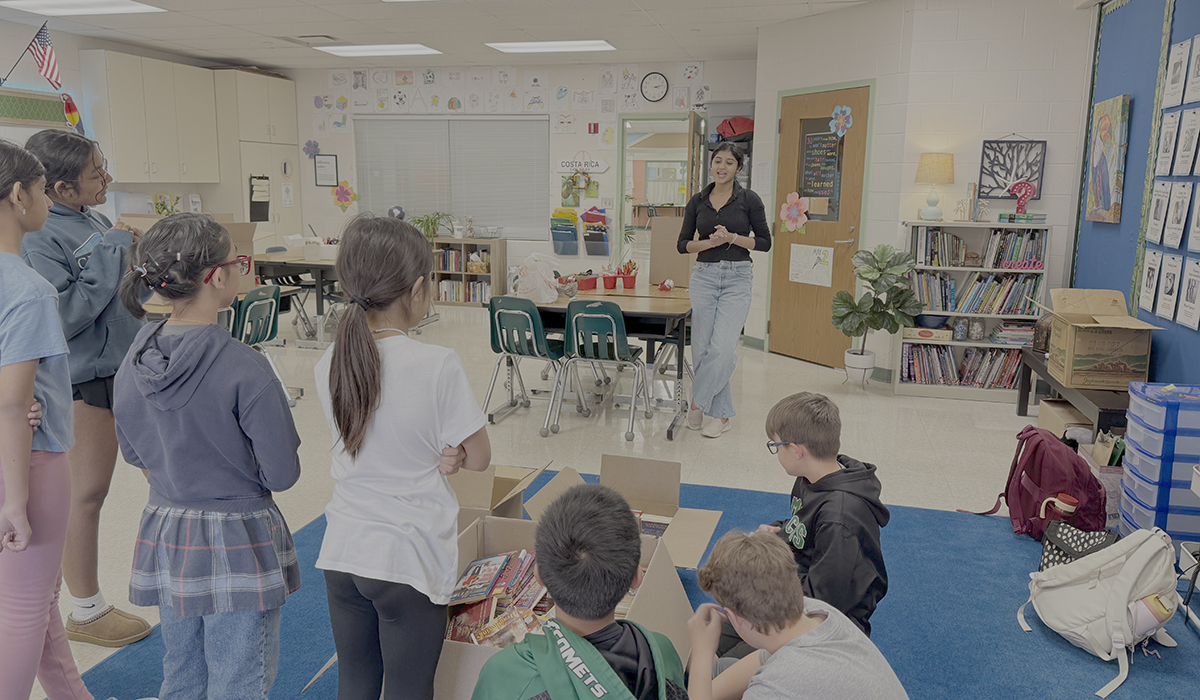
Sahana (background) presents background information on illiteracy and book deserts to a group of Young Learners Foundation youth volunteers support the organization’s Global Youth Service Day Project. Together, they packed 700 books for donation to Boys & Girls Clubs in the US.
What have you learned through your experiences as a volunteer?
Positive feedback from our recipients has convinced me that youth-led work can be just as impactful as work led primarily by adults. I am so proud of everything that we’ve been able to do. We’re all 16 or 17 years old, but even younger volunteers have been able to do so much—sorting and packing books, calling organizations, emailing, creating resources…
I’ve also learned about literacy as an environmental concern. Every year, around 10 million trees are wasted for the production of unread books, and 320 million books get dumped in landfills. That fact has reinforced our motivation to find homes for gently-used books.
Any advice for new volunteers?
Illiteracy isn’t just an issue for people living in far off locations like Sub-Saharan Africa. It’s a problem right here, two hours away from where I live. Similar things can be said for other issues. To youth leaders looking to advance their service, look locally. Figure out what’s an issue for people a few minutes or hours away from where you live. Those are often the people who will need your help the most because you’re so close by.
What do you want people to learn from your story?
If you have a goal, you can fulfill it with passion, hard work and persistence. It took us so long to acquire the resources, the momentum and the system, to be able to acquire books, find recipients and get them there. It took a lot of patience, but our team really wanted to see this happen, and we achieved it in the end.
Meet Daily Point of Light Award honoree Chris Qian. Read his story, and nominate an outstanding volunteer or family as a Daily Point of Light.
According to the National Center of Education Statistics, 17% of American students lack reliable access to personal computers. As a volunteer for an online tutoring program Chris Qian sees why this matters firsthand; many of his students have difficulty attending lessons.
“Education is such a fundamental right for children, yet the reality for millions across the globe is that their lack of technology is hampering it,” Chris says. “Even an old $300 laptop can open up a world of opportunities.”
In 2024, inspired to address the digital divide, Chris founded ReTech for Kids and started collecting devices companies and individuals were replacing with newer tech or throwing out. Then, he refurbished them to give to students in need via partner nonprofits and schools.
Chris isn’t a Google engineer or a computer science student—yet. He’s a 17-year-old high school junior who built his first computer in 6th grade when he used his pandemic downtime to teach himself through online tutorials and public forums.
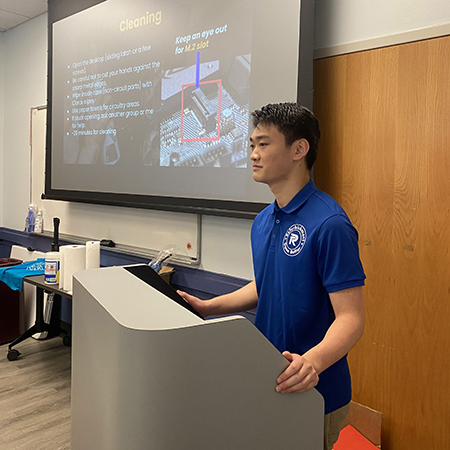
Chris delivering workshop presentation on how to properly deep clean a computer.
These days, he has a team of 30 student volunteers helping him fix and upgrade everything from desktops and laptops to phones and tablets. With more than 30 partnerships, every device is useful. Some volunteers arrive with prior knowledge, but many learn valuable technical skills through Chris’ monthly refurbishment workshops while contributing to the social good. Together, they’ve revamped 1,100 devices valued at $103,000 for students across 7 states and two countries.
“One of our goals is to mitigate educational disparities,” Chris emphasizes. “But the other goal is to reduce electronic waste, the fastest growing solid waste stream in the world. So many people throw away their old devices, when in reality, there’s a lot of life left in them.”
ReTech for Kids has kept over 3,000lbs of electronic waste from landfills.
Aside from organizing and leading workshops, Chris plans fundraisers to cover the costs associated with necessary tools and shipping devices. So far, they’ve raised $4,500 by partnering with Virginia Commonwealth University to host campuswide campaigns and events like bake sales—Chris is a big fan of cooking. They’ve even sold food at big events around Richmond, like the Lunar New Year Festival with over 2,000 attendees. But that’s not all.
“I also recruit high school volunteers to expand our organization,” he notes.
Juanjuan Xue, a teacher at Central Virginia Chinese School where Chris has been learning Chinese for nearly six years, has been a volunteer and mentor since the organization started. She lends behind-the-scenes and logistics support along with advice.
“I never did that kind of work when I was Chris’ age,” she recollects. “What really motivated me [to help] was seeing young people taking the lead in solving such a big challenge. I was really inspired by the work they were doing. They spend the weekends refurbishing laptops and helping the community.”
With hard work and dedication—about 10 hours a week—Chris is changing lives. Put simply, he finds the results rewarding.
“I’ve been able to see the impact my work has had on people firsthand, and it’s made me more appreciative of the things that I have. It’s also just a great way to connect with people,” he says.
One beneficiary who won a ReTech for Kids writing contest made a particularly strong impression. Chosen from 50 submissions, a ninth-grader named Chase won a $1000 laptop. He had always wanted to be a programmer, and this device is helping him pursue that.
“Sometimes, it can be really easy to get sucked into your own bubble where you go to school, come back home and live in an environment removed from the rest from the world,” Chris admits. “But we exist in a much larger community, a much larger society, and people have vastly different experiences and circumstances. Volunteering broadens your perspective.”
Looking ahead, Chris hopes to increase ReTech for Kids’ geographical reach.
“We’ve expanded to seven states and two countries, but the digital divide is much more prevalent in other nations. In Haiti, for example, the majority of students do not have reliable access to technology,” he states.
Currently, workshops are only in Richmond, but he’s also considering implementing a chapter model where interested students could lead them in their own communities. It would reduce shipping costs, too.
“I hope ReTech for Kids becomes a model for schools in other places across the US to address digital equity,” Juanjuan muses.
Part of Chris’ success stems from his ability to get others to join his mission. He has found many eager volunteers to help lead the organization and ensure its survival.
“I’ve come to realize just how willing people are to help. Originally, I was unsure this was something other students would be willing or excited to dedicate their time to. But I’ve come to realize how generous people are with their time and effort,” he says with appreciation.
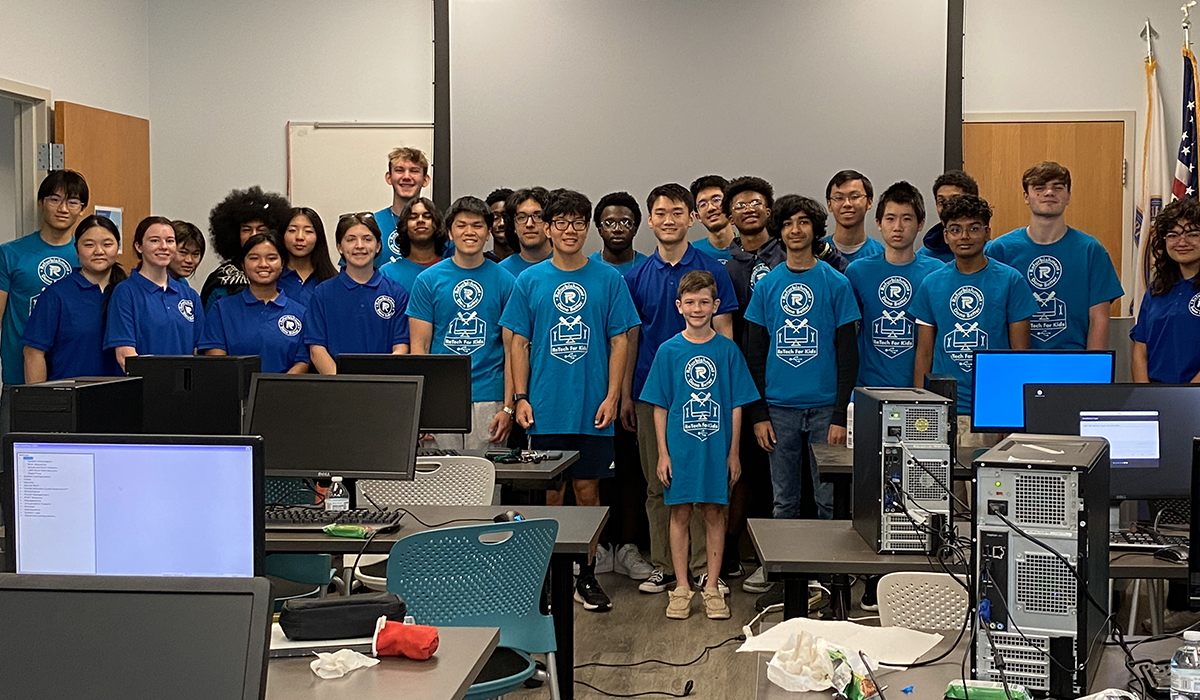
Group photo with volunteers after refurbishment workshop; Chris wearing dark blue shirt in the center.
Chris is thinking about his own future, too, and is looking for a way to combine his computer skills with environmental science. He’s already leveraged his skills to code an app that helps people identify what trash is recyclable and what isn’t.
“Chris is a very kind, responsible and organized young man. He’s become a natural leader in his community,” Juanjuan highlights. “Outside of ReTech for Kids, he’s also an Eagle Scout. He’s done a lot of eco projects. He’s actively involved in other service activities, like food banks.”
With innovative ideas and the initiative and know-how to implement them, his future is full of possibilities. Something he will carry with him is his willingness and enjoyment of helping others along the way.
“As technology continues to innovate at a rapid pace, it’s easy to focus on the newest and most exciting developments,” he empathizes. “However, I urge people to think about the ones left behind by that progress, people who can’t afford the latest and greatest. My story is about bridging that gap by rethinking how we can use what we already have, and reminding people that anyone, no matter their age, can make a difference.”
Meet Daily Point of Light Award honoree Dustin Sergesketter. Read his story, and nominate an outstanding volunteer or family as a Daily Point of Light.
Dustin Sergesketter is no master craftsman, but he can help assemble a bed with the best of them.
Already a member of his local Kiwanis Club in 2020, Dustin heard about an organization called Sleep in Heavenly Peace from another member. Upon hearing that the organization builds and delivers beds to children and families in need, Dustin was eager to get involved in establishing the local chapter in his Indiana community. The team goes out and gets lumber from Lowe’s and partially constructs the beds in their space. Meanwhile, other team members purchase sheets, comforters and pillows. On construction day, the SIHP team shows up to the recipient’s home and assembles the bed onsite. With the blankets and pillows added, each child is given the chance to sleep restfully, maybe for the first time.
With five years of volunteering with Sleep in Heavenly Peace under his belt, Dustin is realistic about his hopes for the future. Even though he and other volunteers build and deliver nearly 50 beds every month, there are still many children in his area who are eagerly awaiting a bed of their own. Dustin estimates that there are nearly 300 to 400 children on a waiting list, still hoping to have a place to rest their heads every night.
Until those names are crossed off the list, Dustin and his team will be hard at work. They even had an exciting endeavor planned for earlier this month. Due to a bit of a backlog of inventory, they delivered 100 beds on September 13. It was a tremendous challenge to take on, considering the amount of construction, driving, assembly, and time management it required.
While the number of children eagerly awaiting a bed of their own can be overwhelming, it doesn’t take away from the tremendous accomplishments of Dustin and his team. Thanks to his leadership, Dustin’s chapter of Sleep in Heavenly Peace has provided over 2,000 kids with new beds thus far. They’re not stopping there, however: the organization has secured funds to sustain building beds through 2026.
Dustin’s determination to better the lives of local children is a powerful testament to how volunteering can make a genuine change within a community.
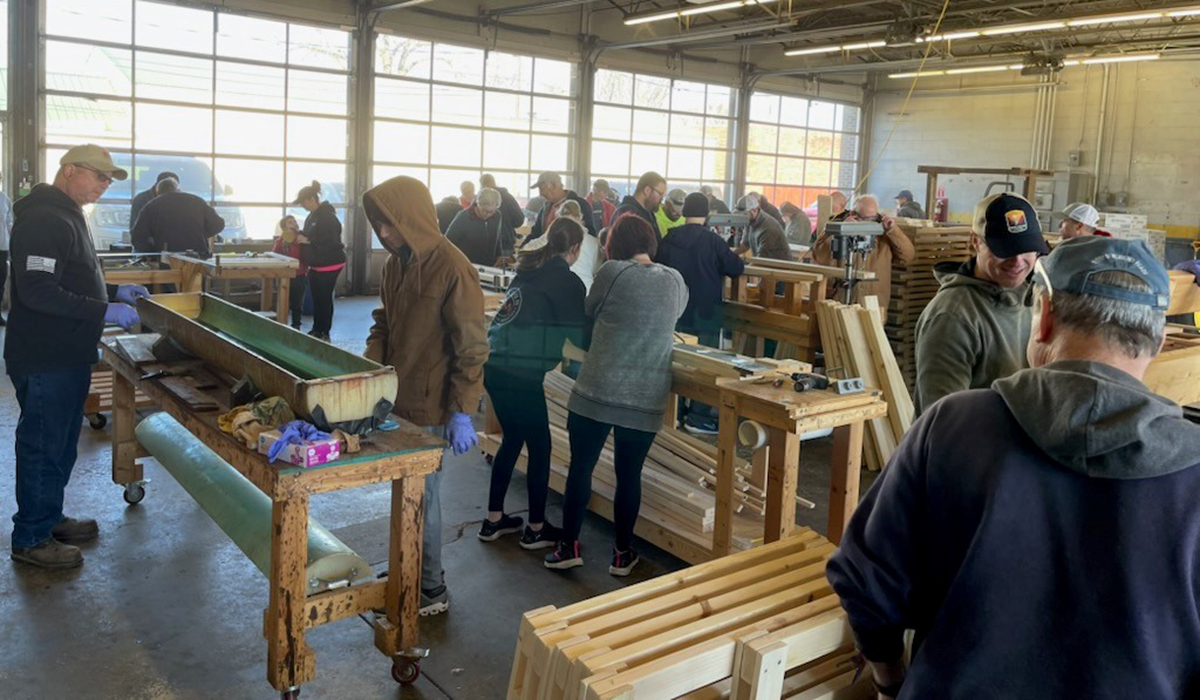
DUSTIN SERGESKETTER, A VOLUNTEER WITH SLEEP IN HEAVENLY PEACE, VOLUNTEERS ALONGSIDE OTHER TEAM MEMBERS TO BUILD BEDS FOR CHILDREN IN NEED. /COURTESY DUSTIN SERGESKETTER
What inspired you to get started with this initiative?
I became a volunteer through the Kiwanis Club. There was a gentleman who was also a member who mentioned Sleep in Heavenly Peace, and I wanted to know more about it. This guy was building beds and delivering them to kids around town, and he was starting the chapter for Evansville, Indiana. I thought it was a great way to have something tangible to give our community, especially with kids. I can’t imagine being a kid sleeping on the floor, and I can’t imagine the parents having kids sleeping on the floor, sleeping with them or whatever the case may be. I also liked that it was local and that I know where my money and time are going. I also found meaning in how it is extremely tangible, because not only are you building it, but delivering it on the spot.
Tell us about your volunteer role with Sleep in Heavenly Peace.
Originally, we were there every second Saturday of the month when it started back in September of 2020. We were doing everything from building the beds to delivering them the same day. We have had such an outpouring from the community and sponsors that we’ve generated core teams. My team is doing logistics. I call recipients who have applied for a bed, and I ask if they’re available on Saturday between eight and noon. That takes a few hours throughout the week, leading up to getting everything scheduled. I go in early on Saturday mornings, and I make sure everybody calls all the delivery drivers. A lot of times, I will accompany volunteers who have not been there before to do it. I could be the lead of that particular delivery, where we may go out to three or four different homes and assemble five or six beds.
What inspires you to volunteer?
I feel like our family has been blessed, and if I can be a blessing, whether monetarily or with our physical abilities, I just think it’s something we should do to help others. Being a good role model for our children is also important, so they have accompanied us on some of these deliveries too.
What are your long-term plans or goals for the organization?
I think my goal is to keep it going until we don’t have any more applications for beds. It’s unfortunate. In Evansville and the surrounding area, which probably has roughly 200,000 people, we have been going for five years. Yet I bet we still have a backlog of 300 or 400 beds that are needed.
What’s been the most rewarding part of your work?
Seeing the kids and the families’ faces when you’re actually doing the delivery and you assemble the bed in their home. Just seeing that joy, and the blessing it is on that family and knowing they’re going to be better off than they were that morning.
What have you learned through your experiences as a volunteer?
Doing something for others can truly bring a community together. You can just see it snowball from within the community, with all the different sponsors and companies. There are so many repeat volunteers. I think it’s because it’s tangible. It’s something they can actually see instead of sending money to other great causes.
Tell us about future partnerships, programs or events that you are excited about.
We’re doing an extra special one this time. We have a surplus of beds, and we’re going to deliver 100 beds on the 13th, so it’s a bigger delivery because we have a little backlog of inventory. It’s more than what we would normally do. But sometimes we put those types of events together.
Any advice for people who want to start volunteering?
I would say don’t wait, because there is no perfect time. If you’re waiting for the perfect time, you’re probably too late. I don’t know how to say it. There’s no perfect time. You just have to show up.
Seeing Needs and Empowering Communities with Solutions
Meet Daily Point of Light Award honoree Rose Cappa Rotunno. Read her story, and nominate an outstanding volunteer or family as a Daily Point of Light.
Rose Cappa Rotunno has spent her life as a powerhouse of service, dedicating her talents and time to advancing a wide range of charitable causes. With a track record that spans decades and over 175 organizations, her efforts have helped raise millions of dollars and drive awareness for issues including domestic violence prevention, healthcare and senior care. Whether organizing high-impact events or guiding nonprofits through critical challenges, Rose approaches her work with a rare blend of passion, strategy and heart.
Currently, Rose serves on the Board of Directors at TRA Group, Inc., where she leads marketing and fundraising efforts to support life-saving transportation for older adults and individuals with disabilities. Her role involves developing campaigns, crafting communications and working with fellow board members to shape policies and programs. The goal: ensure vulnerable populations can access essential services safely and reliably.
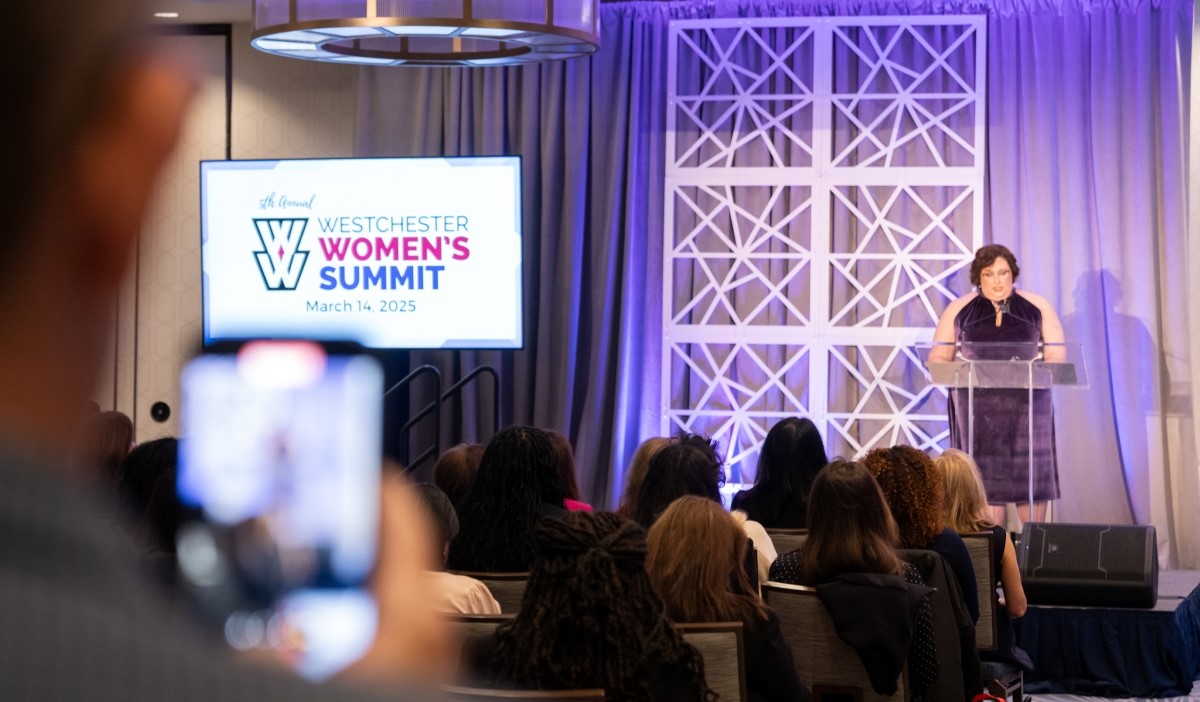
Rose’s impact continues in her founding of the Westchester Women’s Summit, a premier area conference created to uplift, empower and connect women leaders. Now in its fifth year, the event attracts hundreds of attendees and features workshops, keynote speakers and meaningful networking opportunities.
In addition to her leadership at TRA and the Summit, Rose volunteers with Suboumi’s Children, an organization dedicated to advocating for young people in schools and communities. She helps guide programming and supports initiatives that help children to become engaged, productive citizens. Through every project she touches, Rose remains grounded in her belief that sustainable change is driven by informed, inspired individuals.
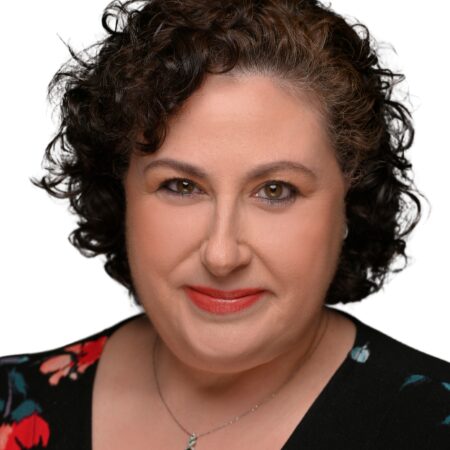
Rose Cappa Rotunno is a tireless advocate for women, underserved populations, and other communities./Courtesy Rose CAppa Rotunno
Tell us about your volunteer role.
There are a few. My passion project is the Westchester Women’s Summit. That’s an all-day conference to uplift, inspire and empower women. We’re going into our sixth year. It’s a complete grassroots movement, so it’s not affiliated with any particular organization. It was me and a couple of women deciding we needed a space like this. It takes a whole year to put together and we’ve had as many as 500 people attend. It’s been an amazing experience.
Additionally, TRA is free medical rides service for seniors and people who need transportation to procedures and doctors’ appointments. It collaborates well with what I do for my day job. I work at an adult community that provides continuum of care – everything from independent living to rehab to adult day care to assisted living to memory care. Volunteering with TRA was a nice way to find some continuity. It also takes things to the next step, because TRA has an advocacy and education arm, so people can call for directions and information, just to make their lives easier, age in place with dignity and health.
I’m also on another board for Suboumi’s Children, which was started by a woman from Nigeria originally. She uses African fables to tell stories to kids to help them to feel empowered and learn lessons. It’s a really interesting way to build individuality and self confidence amongst kids by embracing a culture that’s very different but that they can relate to. It’s just amazing how these things can transfer into empowerment. And that’s the theme in just about everything I’m involved with: it’s about allowing people to take back their power.
Why is this issue so important to you?
Regarding the women’s summit, I really felt like there needed to be a place where women could come together in a judgement-free zone to fill their own cups. We’re so used to constantly nurturing or giving and there’s not often a space that we can go to that doesn’t come with strings of some kind – a fundraiser, or networking. This is completely about focusing on women’s health, mental and physical health, financial health, community health, career health. We include speakers and workshops and vendors and activities that people could come in and enjoy, take for themselves. It’s really about encouraging women to just take some time to think about themselves. Many people resonated a lot with it and wanted it to happen again, so the success of that event proved to me that it was really needed.
It’s costly to do, and it has a lot of stress in the eleventh hour, but it always comes together. It’s so important that there’s a space for people to come together, and now especially, it’s crucial that we’re informed about our rights and our autonomy. It’s important for us to create a place where truth can be shared.
For TRA, Westchester is a huge place. Not everyone has access to public transportation. Things are spread out. Not everyone has Uber money. A lot of people end up losing their freedom and their autonomy. They end up isolated and alone, and TRA offers a great opportunity for them to get out, get to their appointments, stay healthy.
What inspired you to get started with this initiative?
About 10 or 12 years ago, I saw that there was a conference that Maria Shriver put together in California called “WE” (women’s empowerment.) It was a seven-day conference and what I liked about it was that it wasn’t just one topic. It wasn’t just financial wellness or women’s health. It was everything. “I’m 50 and I lost my job, what do I do now?” And also, “My closet in the 80’s, how do I bring it into the 2000’s?” I thought it was an interesting concept I’d never seen done before. I told everyone, “We should do something like this.” And they all said, “When you do it, let me know!”
And so about six years ago, I put on a reception called “Wine, Women and Chocolate.” I invited all the women I admired or wanted to meet, and 90 people came. By the time they all left, 60 people were signed up to help me put on a women’s summit. It grew from there. Now, it’s a lot easier to get sponsorship. People are coming to me, and they understand what it is now. It’s not a nonprofit; it’s a movement, just a place to bring people together. I love seeing how the community has embraced it. Our first year was during COVID, and we made it a virtual event. All 500 people registered, as well as every speaker and sponsor, came with us. We didn’t lose anyone when we went virtual. That was a sign to me that it needed to happen.
Once upon a time, I had my own event planning and development company, and TRA was one of my clients. The executive director there reached out to me after our contract and said, “Since you’re no longer working for us, maybe you could come be on the board.” And that’s how I started working with them, specifically on marketing, thinking outside the box and finding creative ways to fundraise. We created a webpage where you can build a car with your donation. It gamified the donation process altogether – the bigger your donation, the bigger the car gets. We have another interactive opportunity called “TRA Tunes” where people can make a donation to make a playlist that’s played while people are driven around for their rides!
Rose speaking at the Westchester Women’s Summit./Courtesy Rose Cappa Rotunno
What are your long-term plans or goals for the organization?
I’d love to make the women’s summit bigger, actually hold it in different counties across New York and maybe even expand it across the country one day. There are lots of places where women don’t feel heard or supported, and it’s awesome to be able to bring this forum to them. Short term, I’d like to just be able to do it next year!
What’s been the most rewarding part of your work?
I’m a connector. I like to be the one who makes things happen. I get a thrill when I see a resource and a need that meet each other. There’s a personal satisfaction in that, seeing something making a difference. It’s why I got involved in nonprofit. I studied international business, and started working for March of Dimes Walk America. I was shocked that I could actually help somebody instead of give more money to a stockholder. And I’ve been in the nonprofit world for the last 30 years.
What have you learned through your experiences volunteering?
One thing I’m thrilled to have learned is that people will rise to the occasion; they’ll rise to your expectation. The minute before we went live for the women’s summit, I thought, “Oh my god, what have I done? If this doesn’t go well, I’m done for the rest of my life!” But it turned into a place that people wanted to be a part of. They wanted to help. I’ve found if you put the positive out there and dwell on that, people will rise up to that expectation when given the opportunity.
Why is it important for others to get involved with causes they care about?
It personalizes the issue. It makes you more aware of the actual people that are affected by the issues, rather than just hearing about the statistics. It also helps in your understanding of the need and your own impact on it. Boots on the ground is firsthand experience. Platitudes and donations are nice, but unless you actually volunteer or are face-to-face with the issue, I’m not sure you can actually fully understand it.
Any advice for people who want to start volunteering?
I think that you have to give yourself grace. You don’t have to be the president or a top volunteer at the time you first start with a cause. Start small. My kids will tell you that they’ve been “volun-told” to do a lot of things. It’s part of our family culture; we volunteer. It helps everyone understand that there’s a bigger world out there. It expands your borders a little bit. You don’t have to necessarily go to places that make you uncomfortable. There are organizations that help you find the right organization and the right role for you.