Transforming Her Own Passion Into Widespread Collective Action
Meet Daily Point of Light Award honoree Morgan Somerville. Read her story, and nominate an outstanding volunteer or family as a Daily Point of Light.
Morgan Somerville found her passion with a hammer in her hand and a blueprint in her mind. For more than 15 years, her commitment to volunteerism has taken her across the country with SBP, performing intense, hands-on disaster-recovery work to rebuild homes and restore hope for families struck by catastrophe. Her ability to organize chaos into community also led her to co-found Mission: I’m Home, creating a university alternative break program that has since engaged more than 700 people in disaster rebuilding while raising $40,000 annually. And she serves as a founding board member for FROM: Baltimore, where she leads a civic engagement accelerator empowering local youth.
Morgan’s belief in service perhaps shines brightest in her leadership as a board member for Business Volunteers Maryland, a Points of Light global network affiliate. In this role, she helps forge sustainable partnerships through skills-based volunteerism. She is currently helping to steer the organization through an exciting expansion, using the results of a long-term research project to articulate the profound economic and social value of corporate-nonprofit alliances.
While her nights and weekends are dedicated to grassroots boards and coordination, Morgan has also aligned her professional life with her personal mission. She is the supervisor of all volunteer mobilization for CareFirst BlueCross BlueShield, leading large-scale activations, team events and board matchmaking across Maryland, Washington, D.C. and Northern Virginia. Morgan believes that personal service is magnified when you inspire others to stand beside you. As an alum of the GIVE Fellowship who has supported civic engagement among Baltimore professionals for 15 years, leading by example is her only way forward. Read on to hear more about Morgan’s work and what keeps her inspired to volunteer so widely and frequently.
Tell us a little bit about your volunteer work.
As a board member with Business Volunteers Maryland, I help to support the connection of companies across our region with nonprofits building sustainable partnerships through service and skills-based volunteerism. We are excited to expand our work beyond the greater Maryland region through committed relationship building, as well as sharing the results of a long-term research project articulating the importance of this work. I strongly believe in the impact we can collectively have in our communities and appreciate the ability to support the corporate and nonprofit partners coming together for common goals.
I also currently oversee all volunteerism for CareFirst BlueCross BlueShield creating hundreds of opportunities for my colleagues to serve the communities across Maryland, D.C. and Northern Virginia. Last year 58% of my colleagues, 3,446 individuals, logged 110,716 volunteer hours resulting in a $9.1 million economic impact across our region. I support large scale volunteer activations and team volunteer events, as well as matching individuals to nonprofit boards and everything in between.
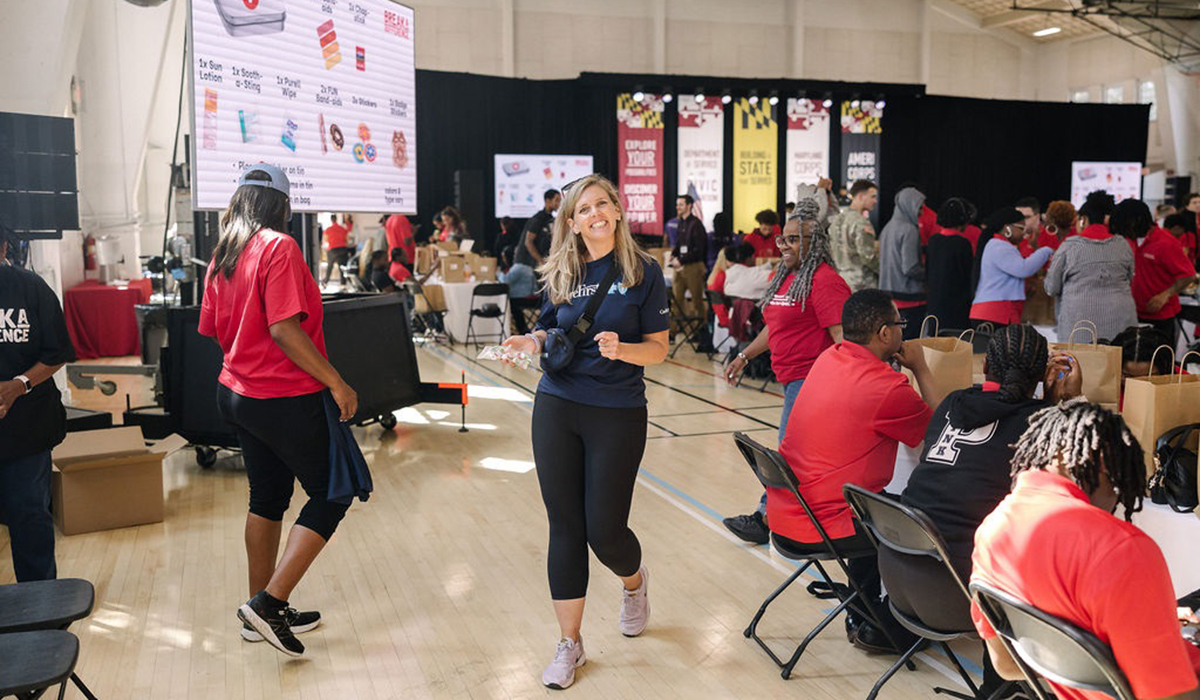
Morgan at a 9/11 Day of Service Event with the State of Maryland and Break a Difference.
What inspired you to get started with this initiative?
My family members will tell you serving and getting involves has always been part of my personality. I was fortunate to be raised by a family of givers and went to schools where service wasn’t just a mandatory requirement; it was embedded in the culture. I found my true calling for serving the community when I was younger, but how I act on this calling has shown up in a variety of ways over the course of my life.
One of the most impactful volunteer opportunities of my life happened just outside of New Orleans after Hurricane Katrina. I was completely shocked by how much devastation occurred and the immense amount of loss. I was equally struck by the strength of the families and their commitment to rebuild not only their homes, but their community. This volunteer trip resulted in me creating an Alternative Break Program at Stevenson University where I was working at the time. Over the next 10 years, over 700 students, faculty, staff and alumni participated in rebuilding trips to five communities devastated by natural disasters.
After I left Stevenson and began my career at CareFirst, I continued to volunteer personally with SBP, formerly St. Bernard Project, and Rebuilding Together NOLA. I have served as a leader for corporate and university trips throughout Louisiana to not only personally help homeowners move back home, but to guide and lead teams of volunteers to align with this important work.
Why is volunteering so important to you?
Being an active member in the community has been a lifelong theme and how I approach my work professionally and personally. I’m committed to not only serving my community as an individual, but how can I help inspire, motivate and connect those around me to serve the community in ways that are meaningful to them. In order for our communities to truly thrive, we need everyone to do their part in making their corner of the world a bit brighter.
What are your long-term plans or goals for the organization?
I plan to continue to serve in the communities where I live and work! I’m privileged to align my personal passion with my professional career and to create opportunities for folks to serve the mission and programs they are passionate about.
What’s been the most rewarding part of your work?
It’s truly difficult to pinpoint the most rewarding part, since there are so many incredible ripple effects to volunteering. But I think being witness to the “ah ha” moment of individuals when they unharness their personal potential of making an impact and understanding the power of their two hands on a project. Collectively, it’s extremely rewarding to see the surge of energy when a team deploys on a volunteer project and makes a huge difference for a nonprofit in a matter of moments. Whether that is removing invasive species from a park, packaging thousands of medically tailored meals to be distributed to critically ill neighbors or hanging drywall in a home devastated by a natural disaster. When volunteers can walk away from an event realizing they made a difference either as an individual or as part of a team and are inspired to volunteer further… that is the best reward!
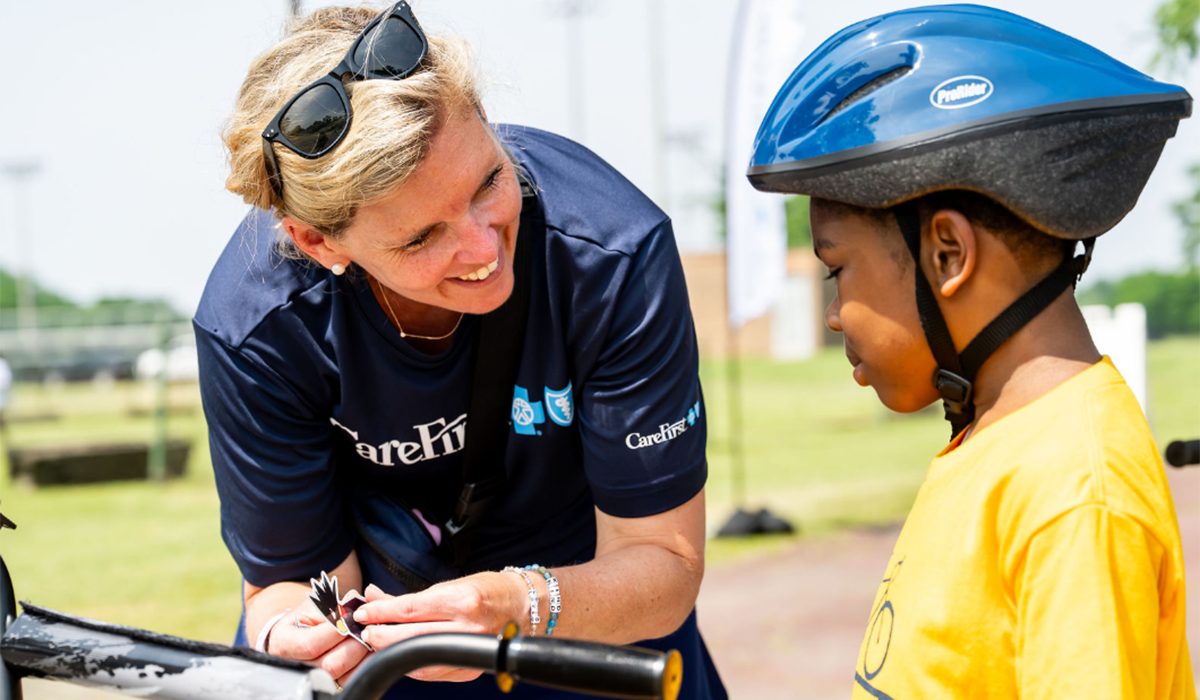
Morgan at a bike distribution event in Washington, DC.
What have you learned through your experiences volunteering?
That truly everyone can make a difference. It might sound cliche, but everyone has the power to do good in their community. It may look different from one individual to the next, but we all have light within us that can help brighten our community.
Why is it important for others to get involved with causes they care about?
I believe firmly in the power of the community, and that at one point or another, we will all need help and will need to rely on one another. The impact of volunteering might not be seen right away, but it should be known that the actions you take today will impact those around you tomorrow. Small actions build upon one another to make large differences.
Any advice for people who want to start volunteering?
As my 103-year-old Grandmother would say, “Just keep going!” If there was an organization that inspired you, check out their website to get involved. See what’s happening within your own neighborhood association, school network or house of worship.
The easiest way to support your community is to simply walk outside and see what your two hands are capable of improving. It could be as simple as picking up trash, planting a community garden or driving a neighbor to doctor’s appointments. There’s no shortage of need in the community, but there is also no shortage of ways to get involved!
Teen Triathlete Builds Free Bike Program for Kids in Georgia and Beyond
Meet Daily Point of Light Award honoree Jonathan Thai. Read his story, and nominate an outstanding volunteer or family as a Daily Point of Light.
Jonathan Thai’s parents came to the United States as refugees from the Vietnam War, starting from nothing in a completely new country. As they raised Jonathan, they passed on a simple lesson: help others, because they knew firsthand what it meant to need it.
Jonathan took it to heart. The 17-year-old rising senior from Alpharetta, Georgia, is the founder and executive director of Pedal Forward — a 501(c)(3) nonprofit that provides free bike training camps and equipment to children who might otherwise be unable to learn to ride.
The spark came in January 2025, when REI shut down its Experience program, eliminating the bike training classes many families in his area relied on. Jonathan saw a gap and filled it. Since hosting his first official camp in June 2025, Pedal Forward has held 12 clinics, trained more than 350 children, raised over $30,000 and donated 400 bikes and 500 helmets thanks to partnerships Jonathan has built with the National Charity League and the Young Men’s Service League. The organization has since expanded to chapters in Tennessee and New York, and Jonathan is now preparing to take Pedal Forward global — leading a humanitarian trip to donate 300+ bikes to children in rural Vietnam.
What inspired you to start Pedal Forward?
Growing up, I volunteered with my parents, and it showed me how little actions can have a big impact. Something like biking might just look recreational at first glance. But it can have such a big impact for a family that doesn’t have access to transportation — getting to school, getting groceries, getting to a job. And then there’s just letting kids be kids. Staying active and playing outside are things a lot of people take for granted. When REI shut down its training programs and those families lost access to safe bike instruction, I knew I could help.
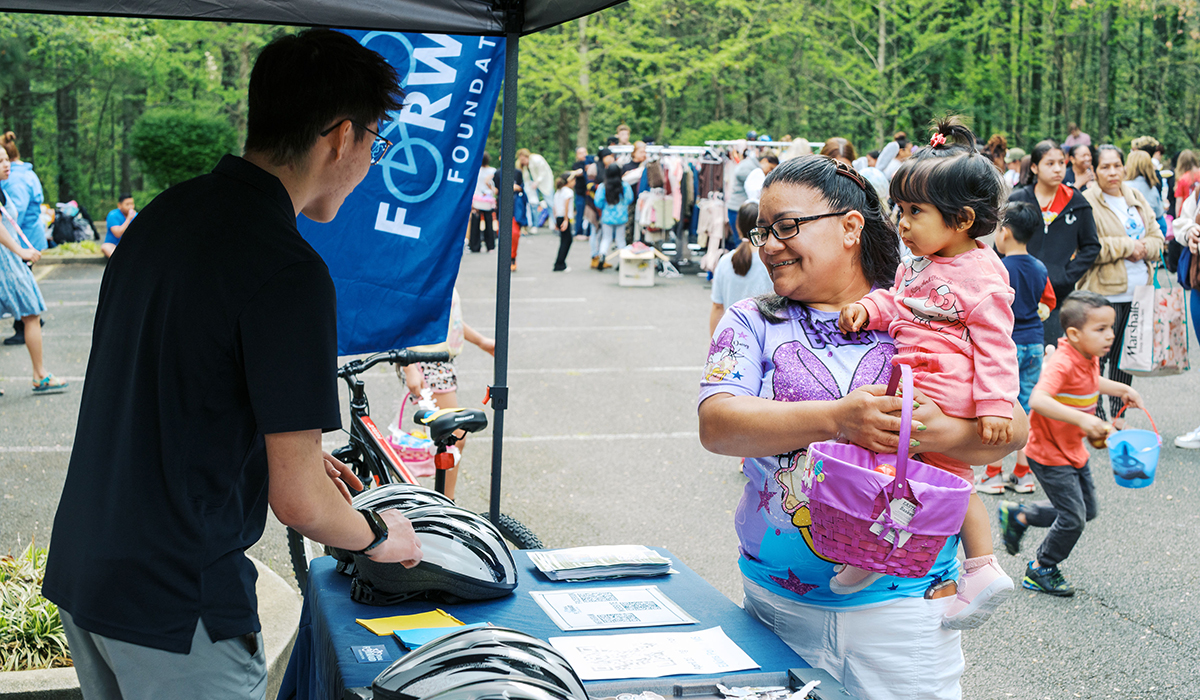
Jonathan (left) connects with families and provides helmet safety education as part of Pedal Forward’s community outreach./ Courtesy Jonathan Thai
Why is biking so personal to you?
Outside of my volunteer work, I’m very involved and passionate about sports. I race internationally for triathlon with Team USA and I’m the captain of both my high school’s swim and cross-country teams. And cycling has always been a big part of my life, especially because it was a place where my dad and I could bond. We’d go on rides together on the Greenway Trail — the same trail where I now hold my bike camps. If you asked me to describe the feeling of learning to ride a bike for the first time, I’d say freedom, or empowering, or boundless. I wanted to give that feeling to as many kids as I could, especially those who might be held back by financial circumstances or other barriers.
What happens at one of your bike training camps?
We have about 35 to 40 kids at each camp, and we try to maintain a one-to-one ratio of kids to volunteer. When kids register, they note their experience level and whether they have a bike. If they don’t have one, we provide it — and either way, we fit every child to a properly sized bike and helmet. Kids who don’t know how to pedal yet start with the pedals removed, so they can focus on balance first. Once they’ve got that, we put the pedals back on. The more experienced riders get taken out on the Greenway Trail with our lead instructors, many of whom are my teammates from my triathlon team. The last hour is games — red light green light for braking, cone weaving for bike handling and bike limbo with pool noodles for spatial awareness. At the end, every child who came without a bike and helmet gets to take them home.
Is there a child from one of your camps who has stuck with you?
There was a boy named Jesse who came to a camp we held for Hispanic Heritage Month in partnership with the City of Roswell. There was a language barrier, so I couldn’t communicate with him as well as I usually would. By the end of the camp, I honestly wasn’t sure how it had gone for him. I felt a little guilty, like maybe I hadn’t done enough.
Then I read the testimonials. His mom had written one — in Spanish, so I had to translate it — and she said that right after the camp ended, Jesse went to the park and kept riding for hours on the bike he’d received. That really sparked something in me. Even in the moments where you feel like you came up short, there’s impact happening that you can’t always see.
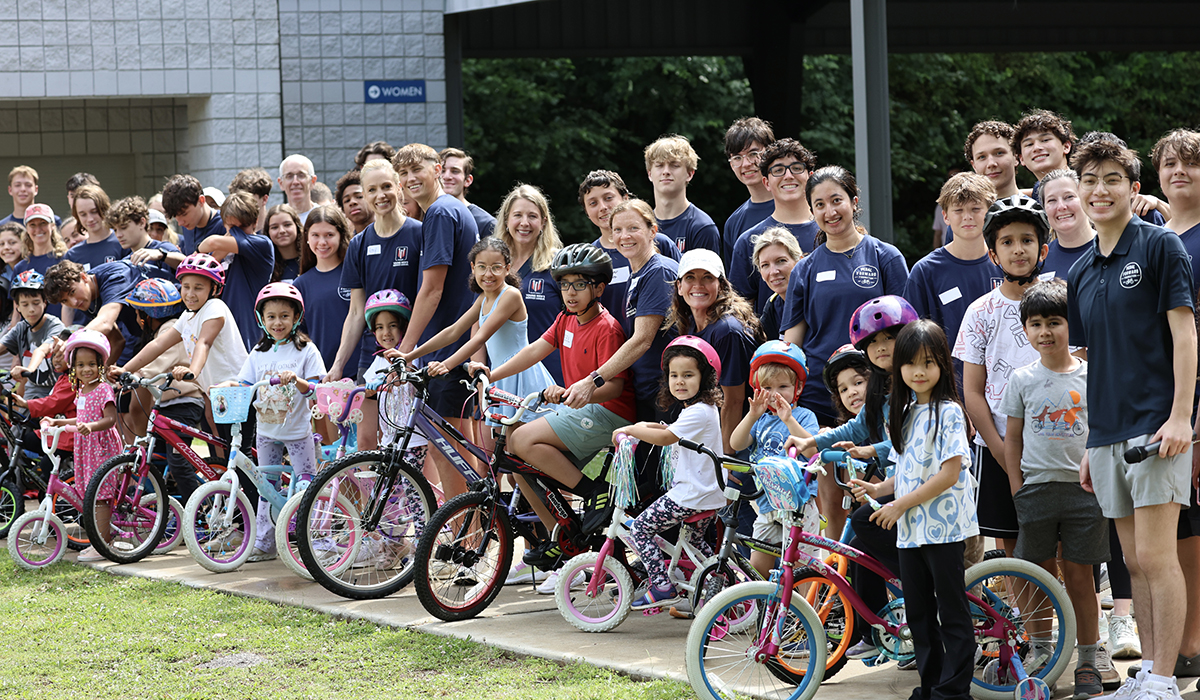
Jonathan (right) stands alongside 90 volunteers and participants at Pedal Forward’s 12th free bike training camp, where every child learned to ride and received a free bike and helmet./ Courtesy Jonathan Thai
Tell us about Pedal for Vietnam.
This is the biggest thing Pedal Forward has taken on so far. In June, we’re traveling to Vietnam to donate 308 bikes to children across four villages in rural areas. We’re working with the Vietnam Foundation of the USA and Australia and a nonprofit called Care2Share to purchase and distribute the bikes within Vietnam. A lot of these kids walk four to seven miles to school every day through mountainous terrain, including during rainy season. So, if we can help these students access education easier, imagine the impact that these kids will have on society.
What advice would you give to someone who wants to start their own nonprofit?
Start small, get out there and connect with the people you serve. The food pantries and distribution organizations I volunteered with as a kid with my parents are the same ones I partner with today through Pedal Forward. Those early relationships led to connections with NCL, YMSL and community leaders who had the resources to help bring my dreams to life.
What do you hope people take away from your story?
The small things that you might not think have much effect have more impact on families and communities than you realize. If you teach one kid how to ride, maybe they go on to teach other kids. Maybe they start something of their own. Everything has a ripple effect. If you do what you’re passionate about — and you do it authentically, for the betterment of society — it’ll have more impact on the world than you might ever expect.
Meet Daily Point of Light Award honoree John Carl Tilghman. Read his story, and nominate an outstanding volunteer or family as a Daily Point of Light.
John Carl Tilghman was just 10 years old when his mission to protect Florida’s wildlife began. While enjoying a cross-country trip with his family, John Carl discovered the national park they visited was covered in trash. Horrified by the litter and its negative effects on wildlife, he and his brother decided to take action.
They founded Conservation Brothers, an organization dedicated to hands-on conservation and long-term preservation of natural resources. Several years later, the duo hasn’t looked back.
Now a rising high school junior, John Carl has become a steward of environmental activism in his community. In his job as a deckhand on a charter boat, John Carl constantly finds animals like fish, sea turtles and pelicans entangled in fishing line, which is often fatal. He works diligently to detangle each animal and set them free, and builds monofilament fishing line receptacle bins that are placed at marinas and docks to help prevent harm to fish, birds and marine wildlife before it starts.
He also plans and implements all of Conservation Brothers’ service activities, whether it’s teaching fishing clinics, building duck nesting boxes or hosting shoreline cleanups. One of his proudest achievements is the annual construction of wood duck boxes in the local wetlands. Since each nesting box can produce up to two broods of 12 to 15 eggs each Spring, the Conservation Brothers team can contribute to the birth of up to 360 hatchlings annually. John Carl’s diligence is directly helping the Florida wildlife population thrive.
While John Carl is still in high school, his passion for volunteering with Conservation Brothers has already begun to inform his future. Because of his love for the outdoors, he’s considering exploring a career as a biologist or environmental engineer. Through his example, other young people can see how a mission to help others from a young age can catapult someone into the future exploration of their passions. No matter his age, his example is a great one for anyone to follow.
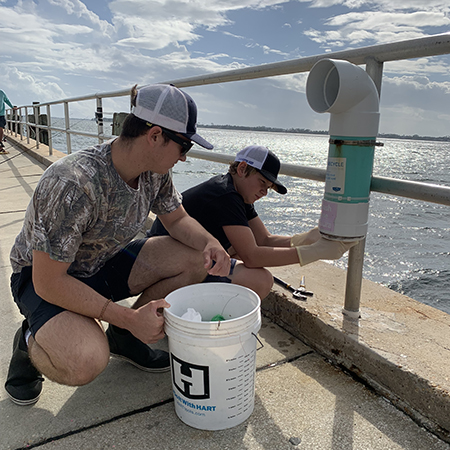
JOHN CARL TILGHMAN AND HIS BROTHER EMPTY MONOFILAMENT COLLECTION BINS THEY INSTALLED TOGETHER. /COURTESY JOHN CARL TILGHMAN
What inspired you to get started with this initiative?
My family does cross-country trips to all the national parks in the United States. On our first cross-country trip in 2017, we went on a hike, and all over the park, there was trash. My brother, the other founder of Conservation Brothers, and I came home and started talking about something we could do, and we came up with this idea for this nonprofit. My sister had a nonprofit as well, so we were already familiar with how to set it up. We decided to start Conservation Brothers.
Tell us about your volunteer role with Conservation Brothers.
Every day during the summer, I work offshore as a deckhand on a charter boat. Oftentimes, we’ll reel up fish that have gotten tangled and need to be thrown back. We’ll untangle them and get them back to health before we release them. I’ve had to assist in sea turtle rescues before at the dock. There was a massive sea turtle that had come inshore after being tangled up, and it was completely entangled in fishing line. They hoisted him out of the water and untangled him, and that’s what I see on a daily basis. I’ve rescued pelicans that were tangled in fishing line almost every single day at the dock. When I get on the boat, I’ll see pelicans standing on the dock that have fishing line wrapped around them. We’ll grab them, unhook them, take all the fishing line off them and set them free.
What are your long-term plans or goals for the organization?
Once I move on to college and begin the next chapter of my life, I have two little cousins, and they’re just involved with the outdoors as I am. I would like to move the duties of our nonprofit over to them for them to take over and carry out our mission.
What’s been the most rewarding part of your work?
I think the most rewarding part has been building wood duck nesting boxes. We have four of them in our backyard, and every spring we get to watch them hatch. We had a category five hurricane hit us in 2018, and that was the year after we started Conservation Brothers. It wiped out all the trees and nesting habitats for the wood ducks in our area. We researched and built four wood duck boxes, put them in our backyard, and every spring we will have more than twenty wood ducks in our pond raising their young. They can hatch up to 360 babies a year. We have a property in northern Florida, north of Panama City, and we put five out on that property in a cypress swamp. There’s a huge population of wood ducks that we have raised there from only maybe a dozen. Every time we look into that swamp, 50 or 60 ducks are swimming around.
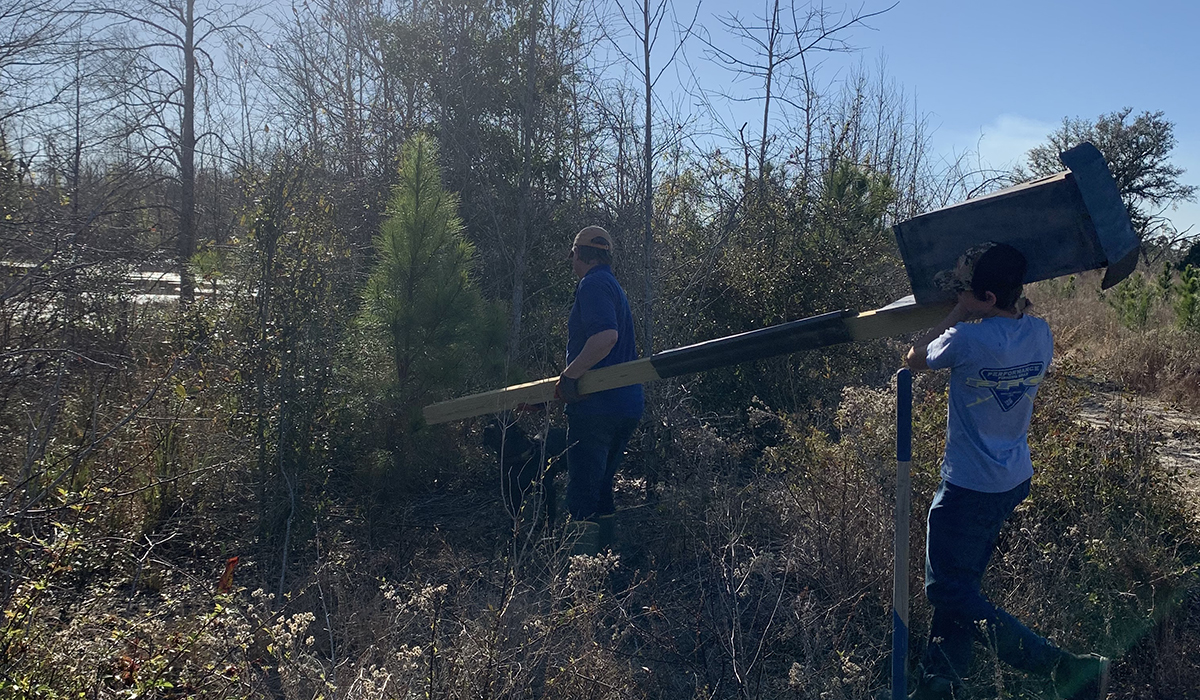
JOHN CARL TILGHMAN (RIGHT) ASSISTS HIS FATHER AS THEY PUT OUT WOOD DUCK BOXES FOR WOOD DUCKS TO NEST IN. /COURTESY JOHN CARL TILGHMAN
What have you learned through your experiences as a volunteer?
I think I’ve learned the most about just how much effect humans have on wildlife. Between the discarding of fishing line into the waterways and littering, and what it means to do that. That’s what I’ve learned. It’s really brought me to the reality of what I do, and how much it affects, and how much I can help if I try to stop these things.
Why is it important for others to get involved with causes they care about?
I think everybody needs a passion that they should pursue in life. What’s your calling in life? I think everybody needs to have something that they pursue that can assist with their day-to-day life. For me, it was helping wildlife, because on a daily basis, I experience wildlife in the outdoors.
Any advice for people who want to start volunteering?
I think the best thing you can do is go online, do a quick Google search in your area and find out what your opportunities are in that area. Conservation Brothers hosts beach cleanups once a month. We clean out all our monofilament bins, and we post about that stuff frequently. We hold fishing clinics annually. If somebody around here has a passion similar to ours, they can search for something along those lines, and our information will pop up, and they can come get involved.
What do you want people to learn from your story?
I think everybody needs to learn the impact they have. Their influence is what I want people to realize from this. Everybody can make a difference. It seems like you might not be able to assist at all, but I’ve seen firsthand how much I have helped our wildlife around here with my brother.
An Enduring Spirit of Service and A Lifetime of Dedication
Meet Daily Point of Light Award honoree Marcia Bullard. Read her story, and nominate an outstanding volunteer or family as a Daily Point of Light.
For decades, Marcia Bullard has woven service into the fabric of both her professional life and her personal commitments. Her journey as a civic leader began to take monumental shape in 1992 when, as president & CEO of USA WEEKEND magazine, a publication reaching 22 million readers, she connected with Points of Light. This partnership birthed Make A Difference Day, a national day of volunteering held on the fourth Saturday of October. For nearly 20 years, it stood as the largest day of volunteer service globally. The ripple effect of this effort is still felt today, as many volunteer organizations and cities continue to honor the tradition.
Marcia’s dedication is rooted in the consistent, impactful contributions she has made through strategic leadership and personal mentorship. Over her 40+ years of service, she has generously shared her expertise on numerous boards, including a long tenure on the Points of Light board and as chair of America’s Charities. Her commitment to supporting underserved communities is further evidenced by her work as a board member of Heart of America since 2001, where she served as chair from 2016 to 2023, helping to renovate schools. Her dedication to civic duty is truly a lifelong pursuit.
Perhaps the most heartfelt illustration of Marcia’s impact is the deep personal commitment she has made to mentoring young people in Philadelphia. For over 10 years, she has dedicated herself to a student, Xier, who immigrated from China at age 9. Marcia met Xier while volunteering at McCall Elementary School and has been a steady presence in her life ever since. Because Xier’s parents run a restaurant and work six days a week, Marcia stepped in to handle all school needs, including parent-teacher conferences, homework, SAT tutoring and the intensive college application process. Through this effort, Marcia secured multiple college grants, including one from the Philadelphia Foundation, helping Xier start her freshman year at Northeastern University this semester.
This incredible dedication continues today, with Marcia meeting with Xier two to three times a week to help with her studies, and also mentoring her younger brother, Jeffrey. Marcia’s story is a shining example of how a volunteer’s journey can span from creating a massive global movement to offering the intimate, personal support that changes a single life forever. Her enduring commitment—from the boardroom of national organizations to the kitchen table of a single
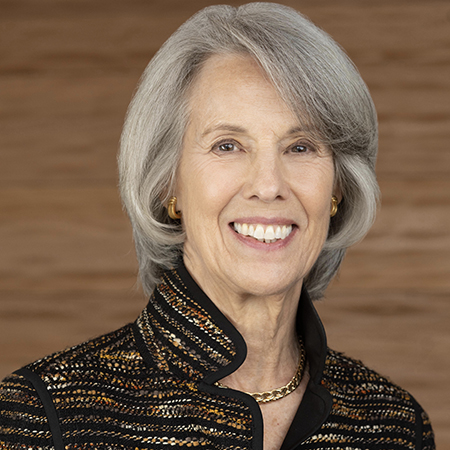
Marcia Bullard has volunteered in a variety of ways, personally and professionally, for most of her life.
student—shows that the most significant acts of service are those given consistently and with the whole heart.
Tell us about your volunteer role.
My current volunteer activities involve serving on a number of boards. I’m on the board of Heart of America Foundation, which renovates libraries in schools in underserved communities. Education is an area that’s close to my heart, and I think it’s important for the country. Working for a nonprofit that provides educational materials and good spaces for children to learn is a huge value to society, and it’s inspiring, which is why I got involved.
I also serve on the advisory board of the Fund for Investigative Journalism, which I chaired for a couple of years. What I’ve learned about my volunteer service is that having worked in corporate America, my entire career gave me a lot of tools and learning that I can offer to nonprofit organizations that typically don’t have a lot of resources. Generally, nonprofits don’t have the funds for an HR department, a big finance operation or extensive marketing and communications. I’ve learned that I can provide significant value to them by lending expertise in the areas I developed during my career. I think a lot of corporate executives find the same thing: you can make a big difference in a nonprofit organization just by lending some of your specialized knowledge.
I’ve devoted a lot of my time over the past 10 years to serving as a mentor and tutor to a couple of students in Philadelphia. I first got involved with one student, Xier, when she was in fourth grade. I met her at the elementary school where I was volunteering as a tutor, helping the teachers, shortly after she came to the U.S. from China. She is now a freshman at Northeastern University in Boston. Her parents don’t speak fluent English and felt overwhelmed by the school system, so they didn’t feel they could adequately support their children. For Xier and her brother, Jeffrey, I became their substitute go-between.
I attended their parent-teacher conferences, helped them with their homework and took them places to show them a little bit of the world, as their parents were busy running two restaurants. For Xier, I helped her with the entire college application process, including those tough essays and the FAFSA forms. Her parents trusted me enough to send me all their necessary tax forms and materials, which was an honor. I’ve been with them so long that I’m an extension of the family. I helped her with all of that, took her on college tours and even took her to college orientation. This has taken a lot of time over the past few years, but it makes me really happy. I enjoy it. I work with Jeffrey now, too, on those same things.
What inspired you to get started with these initiatives?
I guess there were a couple of beginnings. In my family, my parents were always active in the community and in church. My mom made us visit nursing homes when we were kids, so I think the idea of helping other people has always been part of my family life. As an adult, I think I got involved when I first moved to Washington D.C. to help start the newspaper, USA Today. I think the appeal of journalism is that you feel like you can help people by giving them information they need to live better lives, and that you can shine a light on people’s problems or on communities where help is needed.
When you work at a local newspaper, you’re constantly connected to the community. You’re out meeting people, reporting on events and going into neighborhoods. But when you work for a national paper, you have no connection to the local community, and I felt that was a big lack when I got here. So, I started volunteering, first in adult literacy, and then I migrated to volunteering in schools with kids. Those experiences were really great for me, because I learned so much. They always say that as a volunteer, you get more than you give, and I think that’s really true. When I tutored adults in literacy, I assumed I was going to help them read the newspaper or their important mail, but what they often wanted to learn was how to understand how to play the lottery or read the Bible. That was a real light bulb moment for me. It never occurred to me that those were the drivers for some people.
The same thing happened when I started tutoring kids. I remember waiting with one girl after a Saturday morning session because she was waiting for her mom. I asked what kind of car her mom drove, and she said, “Oh, we don’t have a car.” I suddenly realized, “Duh.” Her mom was going to take a bus to pick her up. Later, when the mom was late, I asked if we could call her, and the girl said they didn’t have a phone. These kinds of things gave me an insight into the issues a lot of people face that I didn’t encounter in my fairly middle-class life. It’s been an important realization for me.
Then, when I was at USA WEEKEND magazine, we started a national day of volunteering called Make a Difference Day. It was a leap year one year, and we had the idea: “What should we tell people to do with their extra 24 hours?” We said, “Do something good for your neighbor and your community, and write to us about it.” With the help of Points of Light, we established an 800-number so people could call to find out how they could help in their community. We published it in the magazine and got thousands of letters and videos back. We published a special issue telling some of those stories and decided to make it an annual event. We started Make a Difference Day in 1992, and that is what connected me to Points of Light and really brought me into the world of nonprofits, which has led from one thing to another over the years.
Why is education, in particular, so important to you?
Reading and writing, being able to understand what’s going on around you, and knowing how to participate and have your voice heard—being able to operate effectively, whether as a worker or as a leader in your community—it all comes down to education.
A lot of kids don’t have access to great schools, or to the kind of support at home that I had, where parents are focused on your education and make you do your homework. I simply believe you have to have an educated populace in order to make a democracy work. Otherwise, how will people know what their opportunity is to have a voice in their government and their place in the world? I think education is just the key to a good life and to a good country.
What’s the most rewarding part of your work?
Certainly, seeing my student graduate from high school with close to a 4.0 GPA was very rewarding. Seeing her go to college is really exciting for me. It’s not easy for her right now; being a freshman in college and being away from home for the first time is tough, so it’s rewarding to me to be able to provide the support she needs. I’m sometimes the first person she calls when she needs help or has a hard question, whether it’s a personal problem or a question about her academic path, like, “Should I have a double major, or a single major and a minor?” When she taps me and tells me that I’m the person she turns to first, that is super rewarding.
Every year, even though Make A Difference Day is no longer nationally supported, I still Google it and see that people are still making it happen in their communities, in places like Green Bay, Wisconsin and elsewhere around the country. That’s really rewarding. I think we stopped doing it too soon. I think now more than ever, we need something like Make A Difference Day that’s not politically affiliated—it’s not Democrat or Republican—it’s just a nation coming together and helping each other. You see that need and reward in the wake of every natural disaster, when people find it unifying and important for our country to have that kind of common feeling that they share values together.
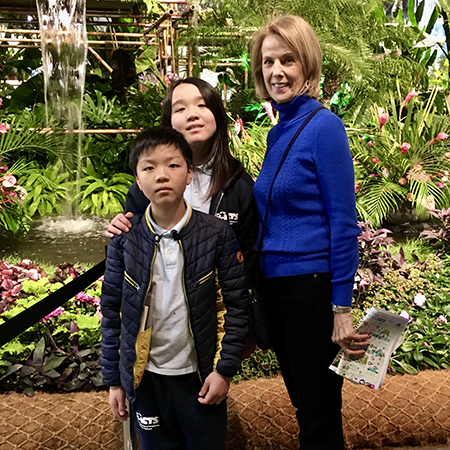
Xier Lin, her brother Jeffrey and Marcia at the Philadelphia Flower Show 2018.
What have you learned through your experiences volunteering?
I’ve learned that I really do enjoy feeling like I’m helping to solve a problem. That was one of the appeals of Make A Difference Day. Sometimes people feel that the world is a little chaotic or that you can’t make a difference. But you learn that even by doing something simple, like picking up trash on the street or helping a kid read a book, you do make a difference. You make that child happy. You make them feel like they succeeded at something, and you may give them hope that they could do more. You make the neighborhood look a little better than it did before. I think that’s a really nice feeling of accomplishment. I’ve realized that I enjoy that; it makes me feel good.
Why is it important for others to get involved with causes they care about, through volunteering specifically?
I think that one-on-one connection with people is super important. During the pandemic, we couldn’t get out and volunteer together, and I think that was a loss, because you just don’t connect with people in the same way. As great a tool as Zoom is, it’s not the same as being there in person, being in a different surrounding where other people are having a shared experience.
It really is important to get out, whether in the community or with a nonprofit that’s committed to a cause you care about. You’re going to find people with like values, and you’re going to learn more. It’s like going to an office to work—you learn as much from the people around you as you do from reading books. That interconnection with people is really important.
Any advice for people who want to start volunteering?
As with all things, start small. Do something simple. If you feel like you want to reach out and try something, maybe start with a friend and do something together. Find an event you can go to or a way that you can help. It can be overwhelming to think about how to take that first step. There are resources, of course, but sometimes those can be hard to find if you don’t know where to look in the first place. Schools, churches and communities that you already belong to are really good sources of places where you can find other people who might also be looking for ways to reach out and do something.
I think these days, too, even though I’m not a big social media person, if you’re a younger person and on social media, there are ways of connecting to events and opportunities. You might just have to put yourself out there and try something once and see where it gets you. That was one of the appeals of Make A Difference Day, or any day of volunteering that exists now, where a lot of things going on are being publicized. That gives you more access and knowledge about where you might be able to help. It’s hard, especially if you’re shy or unsure if you’d be accepted, but just trying to take that first step is the big challenge.
Meet Daily Point of Light Award honoree Shailen Fofaria. Read his story, and nominate an outstanding volunteer or family as a Daily Point of Light.
True leadership is defined by consistency and empowerment: a commitment to showing up, and lifting others as you climb. For high schooler Shailen Fofaria, service is a fundamental part of his daily life. As the Student Board Chair of Youth Ambassadors of Service, Shailen dedicates 30 to 40 hours each month to volunteering. Peers, educators and nonprofit partners have come to deeply rely on him because he champions a leadership style that listens first and always follows through.
During his tenure, Shailen has spearheaded two major initiatives that have trained over 750 students to support underserved populations in their communities. His hands-on approach spans leading the organization’s Student Leadership team, advising the Board and acting as the primary liaison for critical community partnerships. Beyond organizing supply drives and mentoring programs, Shailen has single-handedly taken charge of fund development. Over the past four years, his dedicated grant-writing efforts have raised more than $50,000 for operational sustainability.
This blend of strategic execution and deep compassion has earned Shailen distinct regional and national recognition. He stands as the youngest-ever recipient of the Association of Fundraising Professionals (AFP) Triangle Young Philanthropist Award, celebrating his sophisticated approach to nonprofit development. Additionally, his thousands of hours of dedication have been recognized with the prestigious Gold Presidential Volunteer Service Award. Read on to hear more of Shailen’s inspiring story.
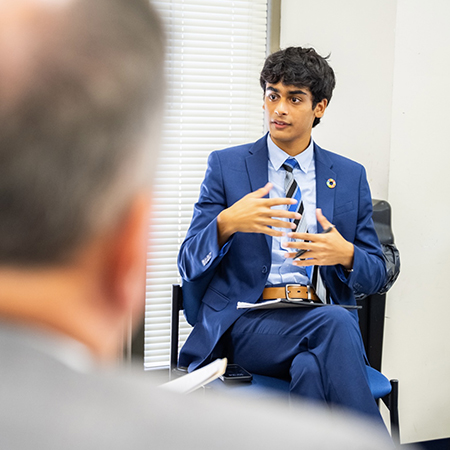
Shailen Fofaria serving on the Governor’s Advisory Council for Student Safety and WellBeing, sharing student perspectives to help inform policymakers across North Carolina.
Tell us about your volunteer role.
Youth Ambassadors of Service, which we call YAS, is a completely youth-founded, youth-led and youth-focused organization, so of course we bring the youth flair to it. YAS has been a part of my life for the past four years. We’re a nonprofit that works to mobilize students to create real impactful change in their communities past just one-time volunteerism. We know students have the desire to volunteer and make an impact, and sometimes they just need the resources and the knowledge, especially from their peers. That’s where we step in.
My first couple of years I got to know the nonprofit really well. I served as our grant writer for the first two years, as well as participating in our program. Not only was I able to continue to do my work with causes that were important to me, like food insecurity and youth advocacy, but I was also in the background and learning what it means to run a nonprofit. These past two years I’ve gotten to take on a more senior leadership role, and get to run our day-to-day programs, do a lot of mentorship—which is the most special part to me—and just continue to build out my repertoire of nonprofit management. It’s amazing to get to impact my community in the way that I get to do every day.
What inspired you to get started with this initiative?
In the summer after my eighth-grade year, I joined a webinar. My mom had told me, “You need to find something to do this summer and in high school, so why don’t you join this service webinar and see what kind of opportunities you can find?” Of course, I grumbled and I groaned, and I decided, “I’ll just join for a little bit, not too long. She’s at work, she won’t know, so let me just check it out for a little bit.”
I joined, and I met our amazing executive director, Sonali, who I now work with, and we hit it off. Her big thing was, “We can make service fun, just check us out and see if you like it.” So I did some more research. I went to an event. It was one of our early events in 2022, and I got the opportunity to learn more about the organization, and just fell in love. From there, everything that I did, I did because I wanted to, and not because someone else made me, which was really special. That’s how I knew I wanted to work in the sector that I had chosen.
Why is service so important to you?
When I grew up, my dad had told me from the beginning, “Service heals the soul.” That was his big thing. When you are dealing with everything around you, when you’re dealing with hardship outside, when you don’t feel satisfied, you don’t feel fulfilled, service will always get you to where you need to be. I had grown up on that mantra. When I found YAS, that was the initial thing. Service was what I was looking for.
As you grow up, people find the things they’re interested in. My brother was really interested in homelessness and animal care; others are interested in medicine. I just had this idea of serving in general in mind. So, when I learned about Youth Ambassadors of Service, and I learned about a nonprofit that helps with youth advocacy in this space, they tell students, “You have a voice, let’s use it to make this real impactful change.”
It can be in any cause area; you don’t have to specialize in just food insecurity, or housing insecurity, or clothing insecurity, you can do it in whichever fashion. I fell in love because youth advocacy was one issue that was important to me. It can reflect so many other issues. You don’t necessarily just have to affect one demographic or population of people, and so that has spilled into other nonprofit and philanthropic work that I’ve done, and other advocacy work that I’ve done. It was a catalyst for all that.
What’s been the most rewarding part of your work?
It might be a little cliché, but I think it would have to be the students that I’ve gotten to meet along the way. A lot of them, especially from the beginning, are learning alongside like-minded students. It really does change the way you think, and it changes the kind of person you are. At the beginning, that was the coolest part.
Now, as a more senior person in this space and within the nonprofit, getting to mentor and give advice to these other students is so incredibly invaluable. Sonali—I keep mentioning her name—but she has been such an incredible mentor to me, and to be able to pass that down to students who I was just in their place two or three years ago, or who strive for the things that I’ve had the amazing opportunity to do, being able to work with them and say, “Hey, we have the same dreams, and I can help you get to your next step, and we can do it together.”
What’s the point of knowledge if it’s not to be shared? Getting to mentor students and learn about everyone’s different journey, and see why they like to serve, is my favorite part of it all.
What have you learned through your experiences as a volunteer?
Number one: my dad was right; service does heal the soul. You will never get back from volunteering or the opportunity to mentor students and feel down. These things are things I look forward to. I’ve spent hundreds of hours working, and most of the time it doesn’t feel like work. It feels like I came to help someone else, and it left me feeling more fulfilled.
Number two is that everybody carves their own path, and they all come from different backgrounds, and it’s so amazing to just understand where everyone is coming from. I know through YAS we serve a wide demographic of people, and sometimes it seems that service can be inaccessible because it’s something you have to have the luxury of time for, or the luxury of resources. But we have had so many students that may not have had the same financial means that come through the program and feel so deeply about serving that they make it work, and we try to meet them in the middle and make it work for them as well.
The third thing, which is one of the biggest things to me, is that service is incorporated into every aspect of our life. I feel like a lot of students, when they start to understand the impact that they can make, they understand how it affects everything around them, and it gives them a new perspective of thinking. Through my work at YAS and my grant writing, I learned the term “lived experiences,” because grant makers love to put that phrase into these grants. Lived experiences and understanding people and situations from a different perspective has been incredibly cool to me. When I go into these new spaces and I meet new people, I’m able to think what the community has done for them, and how they help their own community in their own way.
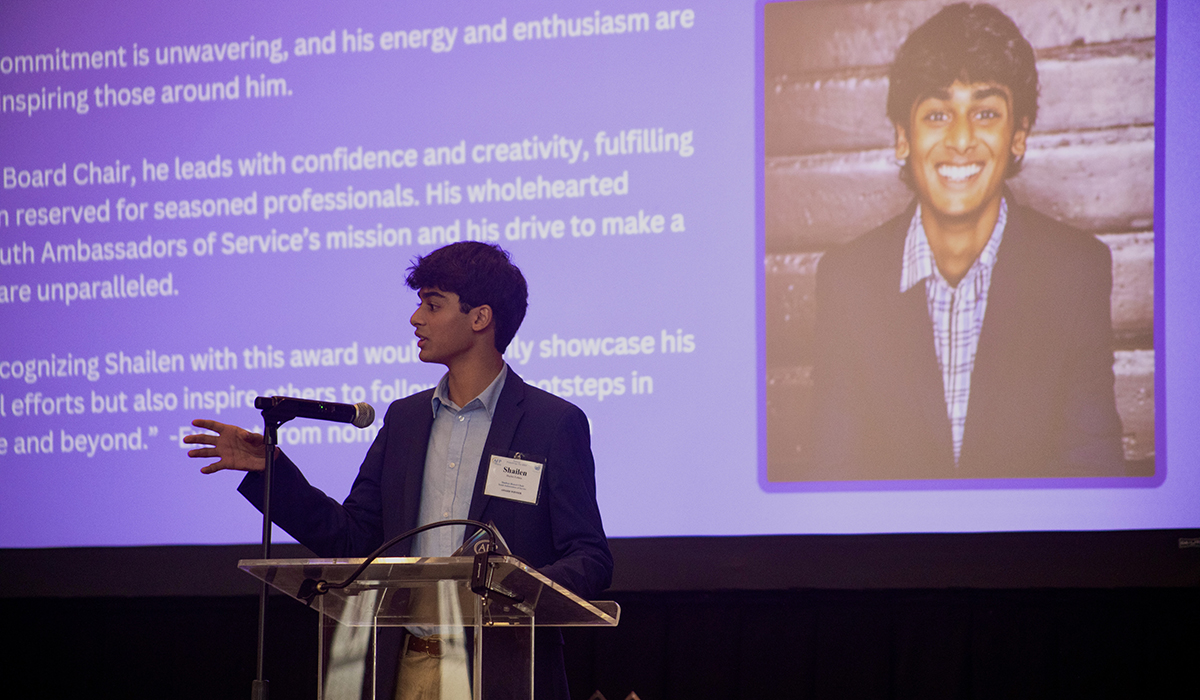
Shailen receiving an award from the Association of Fundraising Professionals Triangle NC Chapter for his grant writing work, which helped raise over $50,000 for Youth Ambassadors of Service (YAS).
Why is it important for others to get involved with causes they care about?
Everything is intertwined and everything has a way of coming back to you. Somebody poured into your cup when you were younger, somebody poured into someone else’s cup that then poured into you when you were at a formative age, or when you were trying to learn or navigate a new space. I believe it’s up to us as people to then go pour into other people’s cups.
Any advice for people who want to start volunteering?
My biggest piece of advice would be just to get started. You’ll find your niche in some way. The coolest thing about volunteering is, like I said before, you can never do it wrong. Number two, the only way to find exactly a cause you love or a nonprofit you really want to work with is to go and try it out, have that experiment. There are so many opportunities in people’s cities or just in people’s resources, but also reach out to those in your network. You might be surprised at who you know, in their free time, volunteers at an animal shelter or at a food bank because that’s something important to them. Tag along, see what you like. Volunteering is always more fun when you do it with other people you love, too, which I think sometimes people don’t think about. It doesn’t have to be that you just have to go and do this alone—bring a couple of friends, go with your family, make that difference and feel the warmth and that fulfillment together.
What do you want people to learn from your story?
Number one, for all the youth out there, use youth to your advantage. People love to hear the ideas of youth. People love to include new perspectives and lived experiences into their work and into their new way of thinking. Use that as a youth, really make your difference, and the world is your oyster with the incredible opportunities that we’re given now. There’s almost nothing you can’t do, or nothing you can’t set out to do.
Number two, I know I’ve said this, but service really does heal the soul. I hope people do really understand that serving others and pouring back into people’s buckets and into people’s cups is just one of the reasons that all of us were put here on this earth.
Do you want to make a difference in your community like Shailen? Find local volunteer opportunities.
Clothing New England’s Kids with Dignity
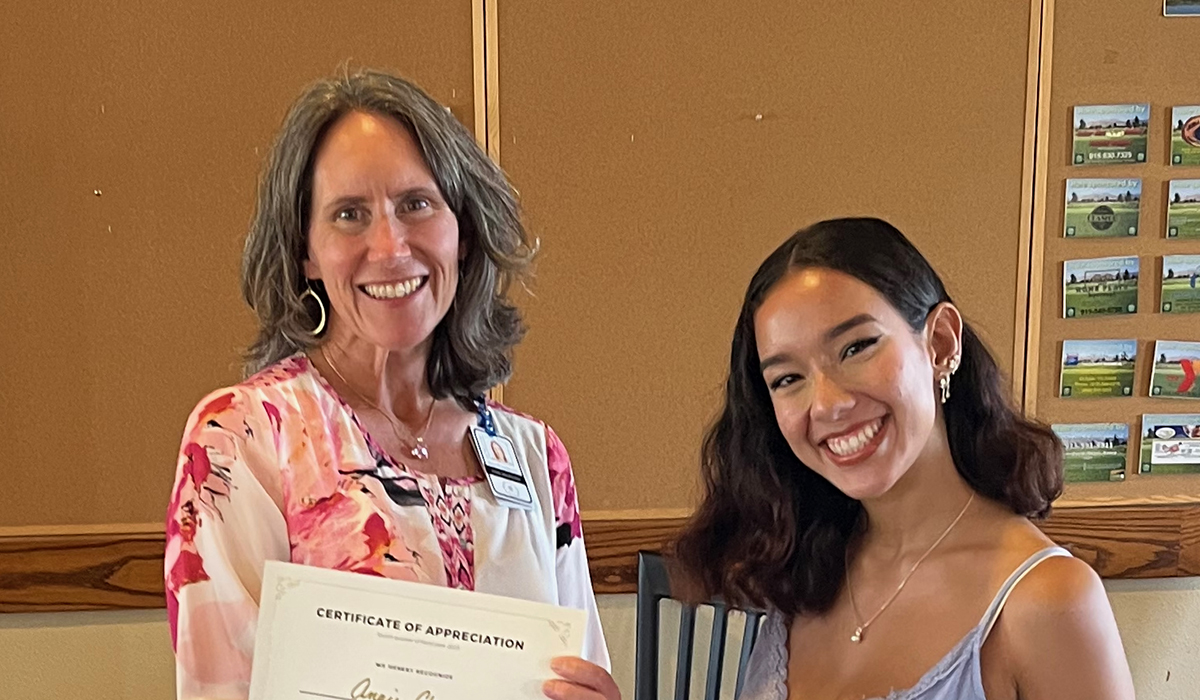
Meet Daily Point of Light Award honoree Anastasia Gross. Read her story, and nominate an outstanding volunteer or family as a Daily Point of Light.
For unhoused children or those in low-income, basic items like a warm coat or sturdy shoes can make all the difference. That’s why the Massachusetts nonprofit Cradles to Crayons exists: to provide children with the resources they need to feel confident at home and school. High school student Anastasia Gross is a key part of this mission. Dedicating 16 to 20 hours each month as a weekend volunteer, Anastasia helps turn clothing donations into essential packs for local families at the C2C Giving Factory.
Inside the warehouse, Anastasia sorts garments by type, size and style so that every child receives a properly fitting outfit. She cleans and organizes donated shoes, assembling complete take-home bags. Her attention to detail extends to sustainability as well; she identifies unwearable items and redirects them for textile recycling. Cradles to Crayons serves hundreds of thousands of children annually, a scale that relies directly on volunteers like Anastasia.
Her impact grew in the fall of 2025 when she joined the Teen Leadership Corps. In this role, Anastasia collaborates with local student councils to organize seasonal clothing drives across multiple schools. From rallying peers for winter coats and boots to gathering spring layers, she manages the logistics from the initial school donation bins to the final delivery at the Giving Factory, turning local schools into active hubs of community support.
Anastasia’s hard work, friendly spirit and commitment make her a joy to work with. Read on to hear more of her story.
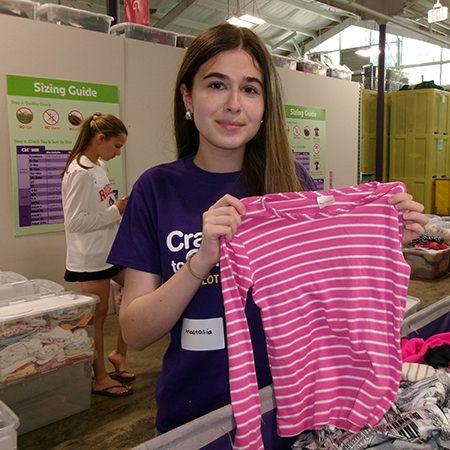
Anastasia with a shirt she has sorted that a student will soon confidently wear to school.
Tell us about your volunteer role and organization.
The organization is Cradles to Crayons, and I volunteer in the Boston branch. I’m a member of the Teen Leadership Corps, so that means me and a bunch of other teens work together, and we each host clothing drives. I volunteer every weekend for about two hours at the warehouse that they have with all the clothes, which is called the Giving Factory. I fold clothes, I organize them I put them into outfits, I sort them by size and by type. Another part of my job is to go around and empty out all the bins that have all the clothes that they can’t use, and then bring them across the warehouse to recycle them.
For the clothing drives I do, my mom is a teacher, so I go to her school, and then I host a bunch of clothing drives there. At the end of every season, I take all the clothes from the lost and found, I bring them home and I wash them, and then bring them over to Cradles to Crayons.
What inspired you to get started with this initiative?
My school is right near the organization. My school has volunteer groups that go over during some of the weekends, so I just started going over, and it was pretty fun. Then I applied to be a member of the Teen Leadership Corps, and I got in.
Why is this issue so important to you?
I can’t understand what it feels like not feeling confident going to school because of lack of resources or not being able to get the clothes that I need. I really feel for the kids that can’t do that, who feel insecure about going to school, and don’t feel confident themselves because they don’t have the right clothes or they don’t have enough clothes. I think that we should all be able to donate and help out for this cause.
What are your long-term plans or goals for the organization?
I’ve just been kind of playing it by ear, where I’m just hosting clothing drives at the end of every season, cleaning out the lost and found, doing stuff like that. It’ll be difficult for me to continue this when I go to college, which is going to be after next year, because I’m a junior now, but I hope I’ll come back and try to keep volunteering whenever I can help out.
What have you learned through your experiences as a volunteer?
It’s helped me with my perspective, because I feel like everyone lives separately in their own lives, and I feel like I’m just so detached from people who live different lives or have different opportunities. At Cradles to Crayons, I meet all these new people, and then I get to help so many other people, and it just makes me feel really connected to the community. It makes me really happy to do this.
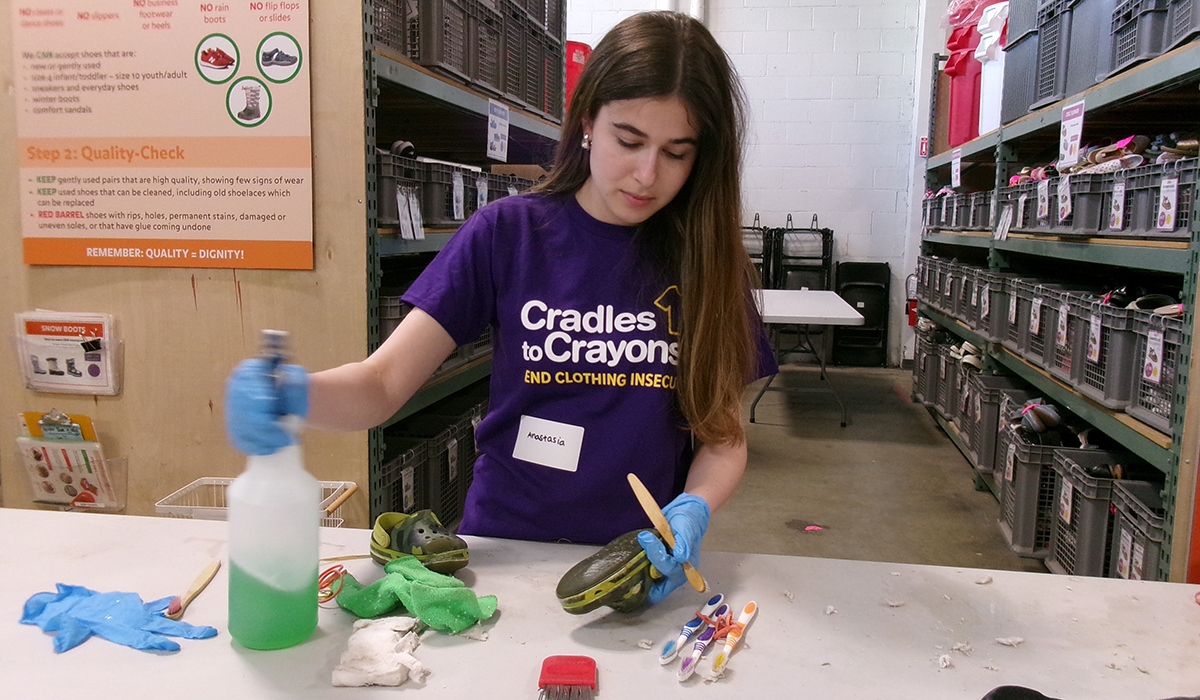
An inside look at the Cradles to Crayons shift options, with Anastasia cleaning shoes.
What’s been the most rewarding part of your work?
Because of confidentiality, I’ve never been able to meet the actual children that I help, but it’s been really rewarding when I can do a clothing drive and then see how many clothes I have and think, “Wow, this will help 50 kids get the clothes they need to go to school,” or “Wow, this number of coats will be enough for 30 kids to be able to stay warm this winter.” That just makes me really happy.
Why is it important for others to get involved with causes they care about?
It doesn’t cost you anything except your time. I feel like most people can definitely spare two hours a week. But I feel like now people are always on their phones. I know I can spare two hours a week to help someone, and help many people who are real and have their own lives, and who just need some help.
Any advice for people who want to start volunteering?
There are a lot of different places that you can volunteer with, and a lot of different roles you can have. It’s okay to start small, and then you can move your way out from there, or try a bunch of different places. Before my current volunteer role, I volunteered putting care packages together for soldiers in the Middle East. I also volunteer at my school all the time with the toddlers that we have, who are really cute. I feel like Cradles to Crayons is a really good place for people to volunteer, because you can quantify how many people you’re helping, which is just really rewarding.
Meet Daily Point of Light Award honoree Rex Dover. Read his story, and nominate an outstanding volunteer or family as a Daily Point of Light.
Music, tennis and volunteer service. Those are the things 17-year-old Rex Dover is focusing on as he enters his last summer before graduation. There’s always music playing when he’s around, either a favorite artist’s or his own. He plays the guitar, piano and now the carillon, and he writes and sings his own lyrics.
Tennis has been in the mix since he was 4 years old, when his parents discovered clinics for kids at a nearby court and enrolled their three sons. They loved it, and during his sophomore year on the school team, Rex and one of his brothers won the state doubles tournament. He made it to the finals with another partner just this year.
Rex also likes helping people, which is why in 2021, after losing a family friend, the brothers decided to combine the interests they shared to create Belmont Abilities Tennis, the only teen-led chapter of the organization in North Carolina. Every Sunday, Rex and volunteer coaches lead one-to-one, hour-long adaptive tennis sessions for around 20 athletes with intellectual disabilities of all ages. They stretch, play games, run drills, build friendships, etc. And since his brothers went to college last year, Rex has been running things solo.
He has recruited and trained more than 50 student volunteers and inspired tennis organizations from surrounding Hickory and Charlotte to replicate his program model in their own chapters. In the summer, he has also given free private lessons at the request of enthusiastic athletes, further demonstrating how meaningful inclusivity is to those often left sitting on the sideline.
What inspires you to volunteer?
I was a little boy when I started with Meals on Wheels with my mom. It was my first venture into service. We’d drive around and deliver meals to homebound senior citizens and other homebound people. I always saw the impact that had on other people.
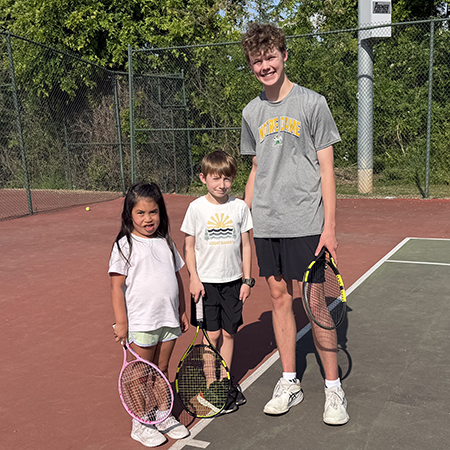
Rex (right) finishes practice with Bradley Willcox (middle) and Everleigh Kavanaugh.
What inspired you to get started with this initiative?
My brothers and I played tennis with a friend named Matthew Lu. In 2019, we were at his birthday party at a trampoline park, and he fell off the rock-climbing wall and hit his head. He died the day after. After that tragedy, we nominated him for the USTA Sportsmanship Award, and he ended up receiving that posthumously.
At the banquet where we were accepting the award on his behalf, I met Lou Welch, who is the Executive Director of the Abilities Tennis Association of North Carolina. She told me all about her program, and we thought it would be a great thing to do in Matthew’s honor, because he was always so caring for others. We wanted to carry on his legacy.
Tell us about your volunteer role with Belmont Abilities Tennis.
We hold two eight-week sessions per year, one in the fall and one in the spring. I help find athletes with intellectual disabilities to come to our clinics by conducting outreach to organizations like the Special Needs Community Initiative of Gastonia. My main role is as a coach. I’m also there to maintain a safe, inclusive environment for everyone to play in, because a lot of people with intellectual disabilities have a hard time feeling included socially.
I teach volunteers how to coach before sessions begin. We usually have around 12 volunteers on the court with different jobs. Some pick up balls. Some coach, and some are just there to give the athletes a safe space to thrive socially.
I have some help, but I do most of the organizing work myself—securing court reservations, writing grant proposals, coordinating with city parks and recreation staff, managing our Facebook pageand other tasks. We post a signup to enlist volunteers before each session, and it fills up quickly.
How have you seen the program benefit athletes?
The main thing is the social aspect. They’re so excited to come out. They’ll sprint from their cars out onto the tennis court. That’s the best thing to watch.
It also gives them an outing for some exercise, which many don’t have. Everyone is very invested and loves playing. One of our athletes was even selected as manager of the high school team.
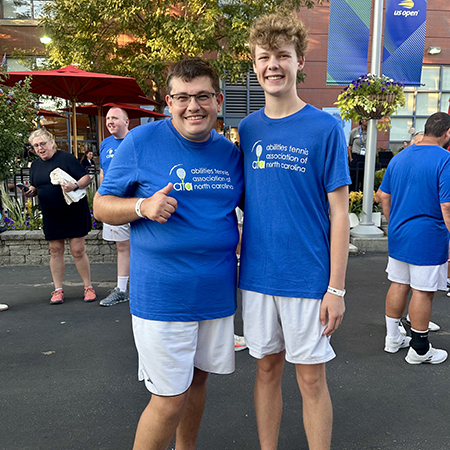
Aron Davison (left) and Rex prepare to play on Arthur Ashe Court at the 2025 US Open in New York.
What’s been the most rewarding part of your work?
The most rewarding part has been hearing from the parents and athletes how much they adore our program. Some of the athletes have asked me for private lessons in the summer. I’ve done that a lot, and we’ve gotten to connect on a deeper level.
One of the most memorable moments was the US Open’s USTA Net Generation Experience. Each year, the USTA sends an organization that is serving the tennis community to the US Open. Abilities Tennis of North Carolina was selected last year, so each chapter in the state could nominate one athlete, and 25 would go.
My athlete was chosen, so he and I were able to go to the US Open for a day. We went to all the matches, and then he got to play at Arthur Ashe Stadium on the center court. It was such a fun experience for everyone involved. It was very rewarding to see his excitement.
What have you learned through your experiences as a volunteer?
I’ve learned how to train people with intellectual disabilities. I’ve also realized that people with intellectual disabilities are a big part of the population, and they’re very underrepresented. There aren’t many opportunities for them to do things that people without intellectual disabilities would do, so it’s important to create them.
Why is it important for others to get involved with causes they care about?
It’s important to get involved because of how underserved a lot of people are. It’s hard to see how little others have until you go out and try to help them.
What do you want people to learn from your story?
I want people to know how fulfilling service is. It’s so rewarding seeing how much joy this brings to people.
Meet Daily Point of Light Award honoree James Gunn. Read his story, and nominate an outstanding volunteer or family as a Daily Point of Light.
James Gunn remembers what it’s like to be a kid with a disability. That’s why he’s helping children with disabilities find a space that lets them feel seen. An avid runner with cerebral palsy, James was introduced to Fast Feet, an organization that provides adaptive running programs for children and young adults with developmental differences and physical disabilities by partnering with schools and communities. From his first day volunteering, James knew he was in the right place. The group works with kids aged 5 up to young adults, allowing them to get some exercise and build a sense of community on the track. As an adaptive coach, James provides support to more than 200 athletes of all ability levels. But fellow volunteers have noted that he goes above and beyond for the participants, delivering medals to athletes who miss final practices, creating special awards to make them feel special and personally purchasing adaptive equipment that could help them thrive even further.
Off the track, James is always advocating for Fast Feet’s well-being. To expand the Brooklyn program into the winter months, he secured an indoor space and donated the rental fee himself. He worked with the NYC Parks Department to ensure equitable track access during an expansion to Staten Island and reached out to the NYPD to resolve safety issues at a local track. It’s no surprise that James recently joined the organization’s board.
James is exceedingly proud to know that over 80% of Fast Feet’s athletes return each season. That number is likely due to the accepting and motivational environment that James and his fellow volunteers have curated, which allows a wide range of children to participate in athletics. Overall, James says one of the greatest lessons of his story is that you don’t have to be a professional at whatever you’re volunteering for. In the same way that you don’t have to be a runner to be a track coach, you don’t have to be the best at whatever you are volunteering to do to get started and volunteer. His story is a powerful example of how a little bit of willingness can create a world full of good.
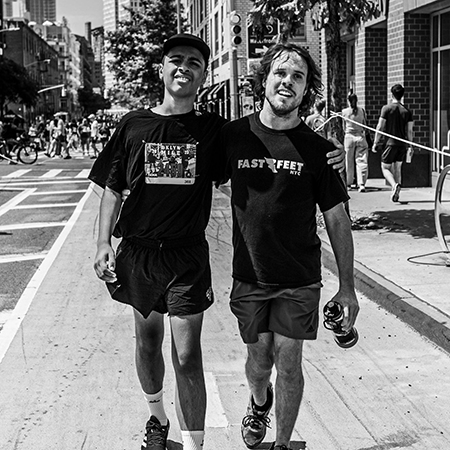
FAST FEET VOLUNTEER JAMES GUNN (RIGHT) SUPPORTS AN ATHLETE AT THE BROOKLYN MILE RACE. /COURTESY JAMES GUNN
What inspired you to get started with this initiative?
I have a disability myself. Growing up, I didn’t really have a space to do team-sanctioned things, so when I heard about this through a friend whose son was participating in the program, I went down and I volunteered. I thought it was so cool. That was five and a half years ago.
What inspires you to volunteer?
I think recognizing that whatever spot you’re in, there’s always somebody out there who could use help or support. If you have the resources, or the time, or the energy, or whatever it is to help somebody else along on the journey, that’s worth the time.
Tell us about your volunteer role with Fast Feet NYC.
Each week, we lead a track program at a local high school. We’ll work on some running skills, a lap around the track or two laps or a mile. We work on some agility drills to get kids using muscles and body parts that they’re maybe not accustomed to, and then we’ll adapt it based on that child’s specific needs. If they don’t have the range of motion to do XYZ, we will find a creative way to have them do a similar activity. At the end, there’s a stretching circle. We have kids volunteer and show off stretches or skills that they’ve learned and then we do a team cheer. We are actually year-round, because we started a winter program. This gives kids an opportunity every Wednesday to just come out, learn a little bit about track and being a part of a team, but it’s also a great social opportunity for them, and they’re able to make friends and connections with folks outside of just the kids in their class.
What are your long-term plans or goals for the organization?
I just joined the board in January, and we’ve been thinking about how to successfully scale beyond just New York. We have a couple of pilot programs in Boston, Los Angeles, Detroit and Miami, but obviously, there are kids with disabilities in all 50 states. What we’ve created with Fast Feet is a pretty low-budget, easy-to-replicate kind of programming in terms of curriculum development. It’s really just finding a space that will host you. With the people, it’s kind of like the “if you build it, they will come” expression. All of our newer programs now have a wait list, because there are so many folks who are interested in participating, which is a great problem they have. We know we’re crushing it with parts of New York, but there’s a whole country out there that could benefit from a pretty scalable model of inclusive athletics.
What’s been the most rewarding part of your work?
I think for me, it’s the fact that there’s a good cohort of kids who started the program when I started five years ago, and they keep coming back. Part of it is because they’ve started to enjoy running, which is great, but they’ve also made meaningful friendships. I think that’s the combination of those two.
What have you learned through your experiences as a volunteer?
I would say number one is don’t be afraid to volunteer. Put yourself in a role that you’ve not been in before. I never coached anything, but you learn as you go, and there are folks along the way who will help you in that journey. So don’t be like, ‘Oh, I’m not super great at this.’ I would say, in the course of the five years, there have been moments where I really didn’t want to go out to the track because it’s cold and I’m tired of wearing sweats. Just reminding myself what it’s all about at the end of the day and how much the kids appreciate it, so that I don’t lose the true meaning behind why I’m doing what I’m doing.
Why is it important for others to get involved with causes they care about?
I think there’s just really so much need in the world outside of people’s little bubbles, whether that’s food insecurity or mental health support or our space to be physically active. Everybody, even myself, needs support along the journey of life. Everybody knows somebody, and there’s a way that you can help that person. Everybody needs a little help.
Any advice for people who want to start volunteering?
I would say to find things that you’re interested in and then find people who are in that space. Learn how they got there and make those connections. For instance, I got plugged into Fast Feet through a church organization. There are a ton of community-based organizations or groups that are doing work. In New York, we have a program called NYC Service, which actually does volunteer matching for folks who are interested in serving New York. That’s a great tool that I think also some other larger cities have.
From Meals on Wheels to School Murals, Retiree Volunteer Does It All
Meet Daily Point of Light Award honoree John Leskovec. Read his story, and nominate an outstanding volunteer or family as a Daily Point of Light.
John Leskovec had always been a volunteer throughout his life. But when COVID hit in 2020 and Activate Good held a virtual town hall connecting him to Meals on Wheels, something shifted — and his commitment to community service took on a new level of purpose.
The 70-year-old Cary, North Carolina resident retired last year after a long career in finance — first at IBM, then with the state of North Carolina — and now devotes much of his time to serving others. He delivers meals to homebound seniors every Monday morning, wraps diapers for families, reads to kids at a Title I elementary school three times a week, tends a community garden that donates food to a local pantry and shows up to Habitat for Humanity builds and Activate Good service projects whenever he can. On top of all of that, he sits on the board of Activate Good — a Points of Light Global Network affiliate serving the Raleigh-Durham area — and chairs its community engagement committee.
John has logged nearly 100 hours of volunteer service with Activate Good alone this year. He shows up to projects with his own tools — a pitchfork for mulching a school campus, a drill for building birdhouses with teens. For John, every need he encounters is an opportunity to pitch in.
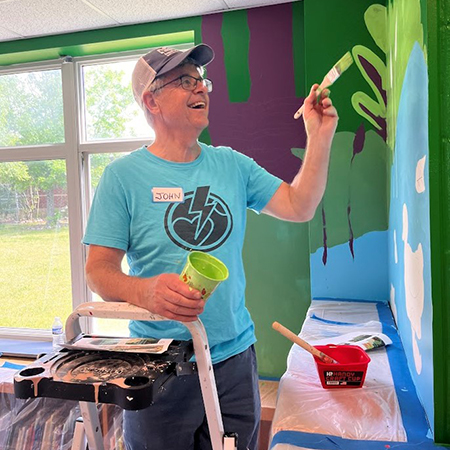
John paints a mural in the library of a Title I school in North Carolina./ Courtesy Activate Good
What inspires you to volunteer?
I feel a need to help others. I feel good when I do, and I think volunteering has allowed me to extend that help further into the community than I could have done on my own. It’s a great opportunity to figure out how to provide that help — and to get the satisfaction of doing it.
One of the activities that I did for 10 years was to run a Christmas tree lot at our church and the proceeds went to the Appalachian Service Project, which is an organization that rehabilitates houses for people in Appalachia.
Volunteering has always been a main priority in my life, but it accelerated during COVID. Like everyone else, I was sitting around, isolated from others. Activate Good held a virtual town hall meeting and introduced me to Meals on Wheels. The representative there said they really needed drivers, and since you can deliver meals without being in close contact with people, it seemed like a good fit. I’ve been delivering every Monday morning since 2020.
What are those Monday morning deliveries like?
I do two routes — about 23 people total — and I see many of the same clients every week. Over the years, some have passed away, but what I’ve come to appreciate is that this work helps people stay in their homes right up until the end. Many of them live alone and don’t have the means for outside care. Sometimes they ask me to open their food for them. One client had a car run into his mailbox, so I put in a new post and got it back up for him.
These are small things, but they matter. They’re always happy to see me, and I try to give them the best smile and greeting I can every week.
What are some other volunteer projects you’ve participated in?
At Brooks Elementary School, a Title 1 school, I donate my time three times a week in reading to kids through their Partner Read Program, distributing donated books through their Book Stop and assisting the media center teacher in organizing book shelfs, preparing for student classes and checking in books.
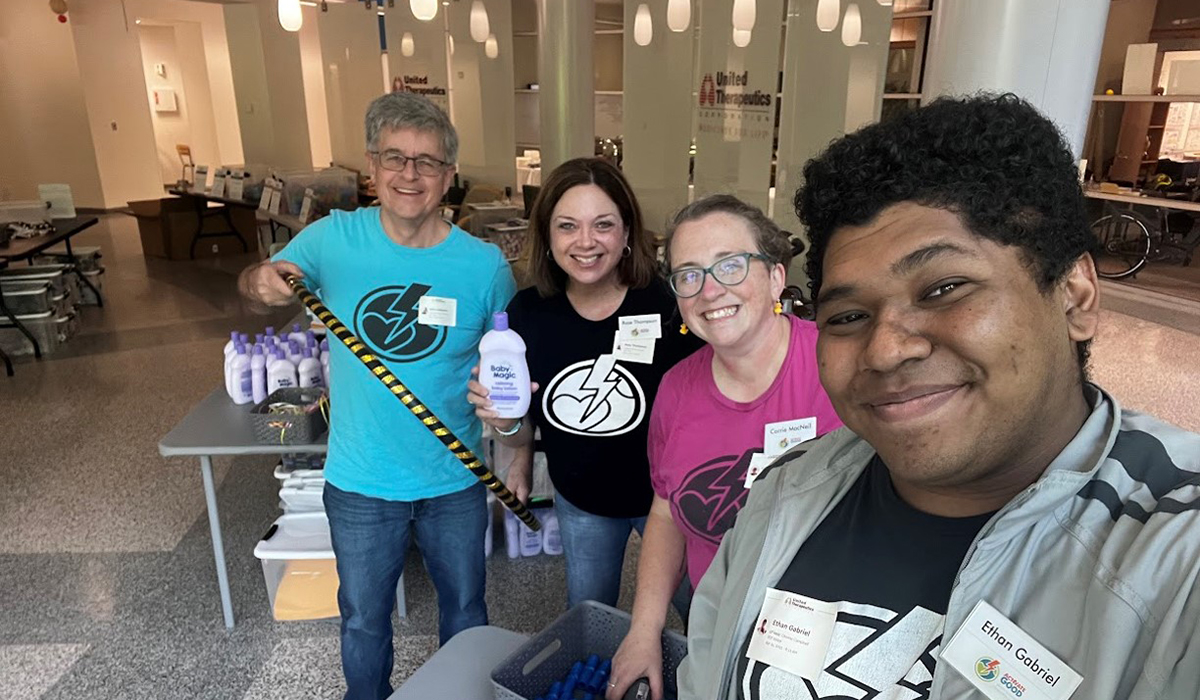
I also learned about the Diaper Bank of North Carolina through Activate Good, which holds diaper-wrapping sessions at their location. Kids were missing school because their families couldn’t afford period products. And diapers aren’t covered by Medicaid, so families end up reusing the same diaper over and over again.
So, I just felt that they had a good service that they were providing to people who lack access.
Is there a volunteer project that is most memorable to you?
I really thought that the painting of the mural in the media center of a Title I school was cool. The principal at a Title I school told us she was struggling to get kids excited about reading. The mural we painted showed bear cubs — the school’s mascot — reading books in a jungle setting. It really improved the appearance of their media center and thinking that it could inspire kids to read was fulfilling to me.
John stands with other volunteers during a knitting project at a school in North Carolina./ Courtesy Activate Good
You’re also on the board of Activate Good and chair its engagement committee. What are you working on there?
My goal is to expand Activate Good’s reach. We currently serve five cities in the greater Triangle area, and I want to grow that footprint and bring in more volunteers and sponsors. I’ve joined the Cary Chamber of Commerce and sponsored a booth at their annual business expo. I’ve also joined the Rotary Club in Apex and organized festival appearances for Activate Good so we can get in front of the general public and tell people about the volunteer opportunities we offer.
With so many commitments, what keeps you going?
Honestly, it becomes obvious pretty quickly that I can’t do it alone. I can do a little piece, but there’s a much greater need than any one person can handle. The nonprofits I work with can take on a much bigger piece of the problem. And even then, they’ll tell you: we need more volunteers, we need more funding, there’s still a backlog.
What do you hope people take away from your story?
Volunteering gives you the opportunity to broaden your focus. Most of us move through life within our work, our family, our neighborhood. That’s important and good. But volunteering also gives you a window into the wider community — you start to see where the needs really are, and you realize you might have something to offer. I hope people who haven’t considered it before might give it a try.
Passing the Torch to the Next Generation of Volunteers
Meet Daily Point of Light Award honoree Sherrill Isenhower. Read her story, and nominate an outstanding volunteer or family as a Daily Point of Light.
Sherrill Isenhower has a long history of volunteering. With around 30 years of volunteering and leading other volunteers, she has consistently done her job to the best of her ability. When she was hired to build and establish a volunteer program from the ground up, she wanted to make sure she was going to do it right. She worked hard to prepare to earn her Certified in Volunteer Administration credential, and in the process, learned about the Association of Leaders in Volunteer Engagement (AL!VE), an organization that serves to enhance and sustain the spirit of volunteering by fostering collaboration and networking, promoting professional development and providing advocacy for leaders in community engagement.
In the fall of 2023, she participated in the AL!VE CVA Study Group. Blown away by the experience, Sherrill felt she greatly benefited from the encouragement and expertise of the facilitators, presenters and fellow participants. Once her CVA was complete, the lead facilitators asked for volunteers to continue the work. Sherrill was happy to pay it forward and continue their tremendous example of helping others. Since January of 2024, Sherrill has served as one of three co-facilitators of the group, providing a backbone of encouragement and structure for volunteer engagement professionals preparing to take the CVA exam. Whether she’s hosting study sessions or recruiting presenters from various fields to provide broad perspectives for current students, Sherrill feels like she learns from everyone involved in each session, whether they’re a participant, co-facilitator or presenter.
Going forward, Sherrill wants to keep helping to facilitate the AL!VE CVA study group for as long as she can, advocating for the skills and competencies of other volunteer engagement professionals. Her example is a powerful one; She is utterly committed to inspiring future generations of volunteers, and it’s our responsibility to take hold of that torch and continue the mission.
What inspired you to get started with this initiative?
In 2022, I was hired to build and establish a volunteer program from the ground up in El Paso County, Texas. Getting to do that was a great honor, and I wanted to ensure that I was following the best practices and creating the best framework for success. I studied for my Certified in Volunteer Administration credential, and in doing so, I learned about the Association for Leaders and Volunteer Engagement study group. Those facilitators were amazing. The presenters and the fellow volunteer professionals were all an incredible resource. After earning my CVA, I had the opportunity to volunteer as a facilitator for future study groups, and I raised my hand, jumped on board and said I was happy to continue supporting this group that’s helped me so much and to advocate for the core competencies of volunteer engagement.
SHERRILL ISENHOWER, A VOLUNTEER WITH AL!VE, CELEBRATES VOLUNTEERS WHO SHARE THEIR PRECIOUS RESOURCES AND TIME IN SUPPORTING COMMUNITY PROGRAMS. /COURTESY OF SHERRILL ISENHOWER
What inspires you to volunteer?
Whenever I do that, I learn more than I expect. It seems like you’re giving away your time, but I feel like I get so much more back from my community. I move around a lot because of our family, and it’s a great way to get involved and to find out what’s important to the people around me, and to feel like I’m part of the neighborhood.
Tell us about your volunteer role with AL!VE.
So I am co-facilitating the study group. We have a study group twice a year, and it’s for those who are earning their Certification in Volunteer Administration. Some of those leaders are paid professionals, and some of them are volunteers in that role as well. But what we want to do is ensure that they are providing the best possible leadership for the volunteers that they are supervising and the programs that they’re running. I help with the Zoom calls, creating the slide decks, answering questions and recruiting presenters, as well as recording the data, sending out surveys, sending out emails of support and connecting people to the resources to help them be the most successful they can be.
What’s been the most rewarding part of your work?
It’s incredibly rewarding for me when those in our study group recognize the skills that they already possess, and then when they share their expertise and knowledge with others. I’ve found that they are thrilled to share any good tips that they have, and they’re an incredibly caring group. They’re often so focused on their own volunteers and their organization’s missions that they rarely pause to consider the value of their own work, and this is a chance to celebrate them and to build confident volunteer leaders. In doing so, that directly translates to supporting volunteer engagement. It’s also neat because we have people from across the US. We’ve also had participants from around the world, and it’s just pure magic when they encourage one another and validate the connection between the success of their organization’s mission and the expertise that they share as a volunteer leader.
What have you learned through your experiences as a volunteer?
With each study group cohort, I learn more from them, and I strengthen my own volunteer engagement skills. They present new ways to recruit, retain and celebrate volunteers, and I discover innovative ways to engage volunteers from different backgrounds and generations. As I mentioned, we have people from around the world. In this last cohort, we had someone from the Netherlands and someone from Canada. We’ve had some from Australia. It’s validating to hear that we run into some of the same issues, but we find creative ways to solve them.
Why is it important for others to get involved with causes they care about?
I think it’s important for everyone to realize that they have a voice, and that sharing their voice with others is a great way to learn, grow and strengthen the issues important to them. Giving voice to your cause helps amplify your cause, and it also shapes your community and helps you build the bridges and the bonds so that you feel a greater connection to the people around you.
Any advice for people who want to start volunteering?
The easiest way is just to step up, sign up and jump right in. The glorious thing about volunteering is that the volunteer leaders will train you. They’ll guide you, they’ll support you. They’re so excited to have you on board that really, you just have to show up and they’ll take care of the rest.
What do you want people to learn from your story?
You can continue to grow even when you think you know what you’re doing. There’s always a new way to try something out. People are fascinating, and it’s a pleasure to get to know them and to learn how they tick and how they support one another.