Meet Daily Point of Light Award honoree Amy Antone. Read her story, and nominate an outstanding volunteer or family as a Daily Point of Light.
Whenever Amy Antone talks to people about her volunteer work, she hears they had a favorite stuffed animal as a child. That’s why she’s motivated to give other children that same level of comfort. In 2018, Amy’s 2-year-old son, Lucas, was injured at a friend’s house while hanging out by the pool. Suffering from an injury to his eye, he had to be rushed to the emergency room. In the heat of the moment, Lucas didn’t have any of his stuffed animals with him to cling to. Instead, he held onto the bloody pool towel that they held above his eye. In that moment, Amy’s mission to provide children with something to hold onto in a moment of stress was born.
Soon after, Amy formed Cuddles of Hope, an organization that provides children with a new stuffed animal to cuddle during an uncomfortable or frightening situation. Amy has built relationships with hospitals, foster care programs and community organizations, raising funds for the stuffed animals and finding children who need them along the way. She’s also responsible for all operational work of the organization, which includes managing volunteers, planning and executing fundraising events, and overseeing the distribution of comfort items to children in need. With the assistance of her husband, Amy handles outreach, program development and the day-to-day requirements of running the organization.
One of Amy’s favorite aspects of running Cuddles of Hope is the relatability of the organization’s mission. She’s heard from endless community members about their own childhood items and how much comfort they gave them during a tough time. She says people like being part of Cuddles of Hope because they understand how simple it is, and they’ve likely been through similar situations. Amy’s ability to fulfill a need is exactly the kind of mission-driven activism that brings a community together.
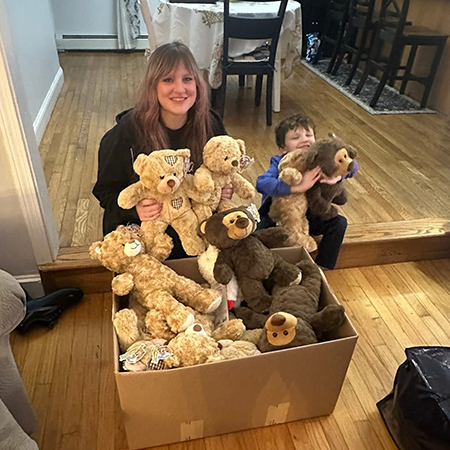
CUDDLES OF HOPE FOUNDER AMY ANTONE SITS IN FRONT OF A BOX OF TEDDY BEARS THAT WILL BE DONATED. /COURTESY AMY ANTONE
What inspired you to get started with this initiative?
In 2018, my 2-year-old son fell and required surgery. We had to take an ambulance to the emergency room because we were at our friend’s house at the pool. All we had was a pool towel over his eye that was bleeding. He held onto that towel the entire time he was getting looked at by doctors and nurses, holding it so tight, looking for comfort. It just tore me apart. All I remember thinking was how I wished I had his stuffed animal. But in emergencies, you can’t prepare for stuff like that. From there, it just hit me how so many kids experience these situations that are not planned, and they’re empty-handed.
What inspires you to volunteer?
It’s something that always came naturally. I could say that I’m very empathetic, but I don’t really think that’s what it is. It’s wanting to make a difference. With this organization, that’s not something that I get right away. A lot of these donations are given to these kids by nurses. We drop them off and we never see the kids who received these stuffed animals, so we never actually see the impact. But we hear stories, and just knowing that it’s making a difference, and hearing how something I did made a difference, makes everything worth it. If I can do something, why wouldn’t I?
Tell us about your volunteer role with Cuddles of Hope.
It’s just my husband and me who run it. I started the organization and made it into a nonprofit. I organize all of the drop-offs, packing donations, events and fundraisers. Everything that has to get done with the organization is what I do. It’s hours and hours of planning, organizing and trying to get the word out. I think most of my success has come through social media and the community that I live in. People know about it and they talk about it. It’s something that people feel good about donating to.
What are your long-term plans or goals for the organization?
Because we’re based out of Rhode Island, we really started by donating to local hospitals and shelters. As time went on, people from across the country found our organization and what we do, and have reached out to us asking if we could donate to their hospitals or foster care. I would love for it to become like a national organization where we can donate to as many hospitals, foster care homes and shelters as possible, so that anytime a child enters one, they’re getting a stuffed animal to help them go through whatever it is they’re about to go through.
What’s been the most rewarding part of your work?
We don’t hear too much about the impact, but there’s one story that really stuck with me and makes me realize how rewarding it really is. We donate to hospice hospitals, so when children go see a loved one that they’re losing, they have a stuffed animal. I received a message one day from my mom saying her son received a donation from us, and she had been trying to track down where it came from. He received it when his grandmother was in hospice, and he took it everywhere with him, but he lost it. For Christmas, he wrote Santa a letter saying he just wanted his teddy bear back. I was able to find the teddy bear and mailed it to the mom. They were going on a cruise, and it was their first vacation without the grandmother. When he walked into his cabin, the teddy bear was sitting there waiting for him with a note. She sent me the video, and that right there has been the most rewarding. It is actually making a difference for these kids.
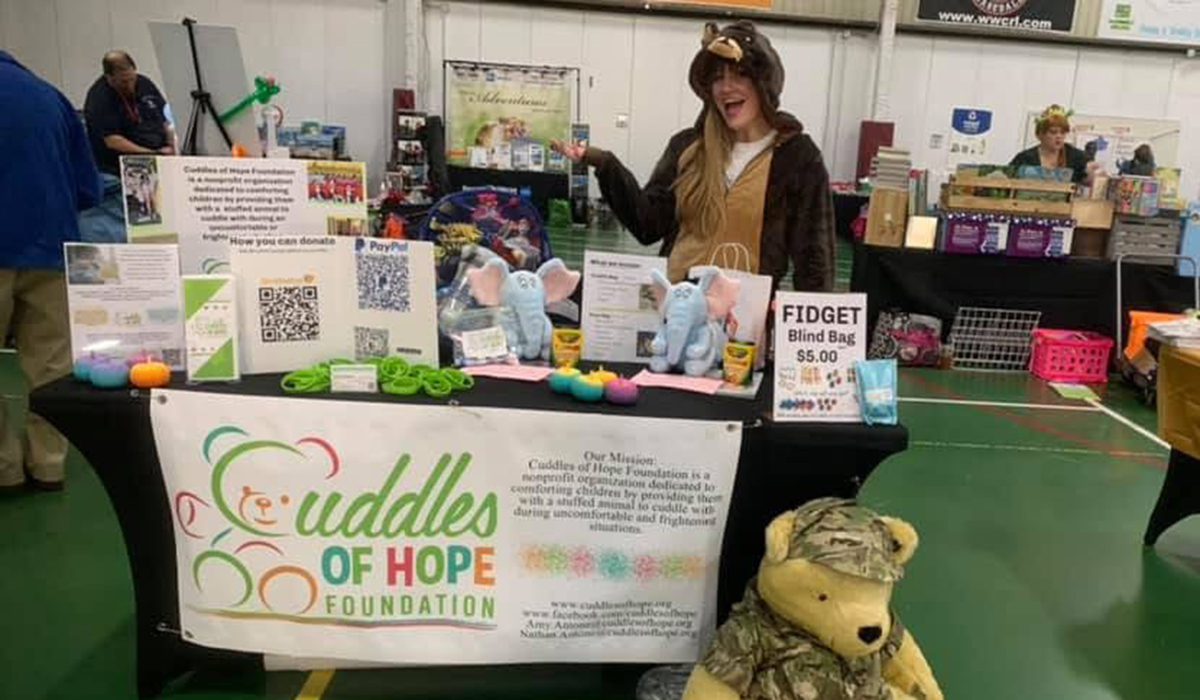
AMY ANTONE, FOUNDER OF THE CUDDLES OF HOPE FOUNDATION, STANDS BEHIND THE ORGANIZATION’S TABLE. /COURTESY AMY ANTONE
What have you learned through your experiences as a volunteer?
I’ve learned a lot. Not only did I learn how to start a nonprofit and run fundraisers, but I’ve learned who I am and who I want to be. It teaches my kids a lot, which has been great. We do things as a family, like putting together donations. I’ve definitely grown into someone who’s more vocal. I’m okay with people telling me no and moving on, and realizing that just because you get a no doesn’t mean you have to stop. There are many times I felt defeated. There are people out there who are trying to fund research for cancer. It’s been most rewarding realizing that I was able to grow past that, and that it actually does make a difference. It doesn’t always have to be so big; it can just be something as simple as a stuffed animal.
Any advice for people who want to start volunteering?
I was that person. I was always the quiet one who was very introverted. I was always nervous to start new things because I was afraid I was going to do something wrong, or I wasn’t actually going to help. I wouldn’t know what to do. You just have to jump into it. If there’s something that you truly want to do, if you just say this is everybody has a first time trying something, and once you get that first time over with, you’re going to be motivated to keep going. You’re going to be glad you did it. You’re going to volunteer, and you’re going to feel good about it. Just take that first step and think about how everyone has a first day. Once you get past that, it’s so worth it, and it just feels so good to know that you’re making a difference by volunteering.
What do you want people to learn from your story?
Simple things really do make a difference. Not just for the kids, but for the parents as well. Small acts are never actually small. When I started, I thought this was kind of dumb. Is this just a stuffed animal? Is it really going to make a difference? Then I find that we’re helping children in a time when emotions are usually overlooked because they’re dealing with the situation. People tend not to realize what the kids are feeling. Changing a child’s moment is really the way that I like to remember it.
Connecticut Teen Leads Nonprofit Bringing Debate Access to All
Meet Daily Point of Light Award honoree Chloe Wang. Read her story, and nominate an outstanding volunteer or family as a Daily Point of Light.
Chloe Wang was a quiet kid in middle school — the kind who struggled to raise her hand in class, let alone speak in front of a crowd. Then she discovered debate.
As she entered high school, debate gave her a voice, a framework for understanding the world and a community of driven, passionate peers. On the ride home from a tournament in New York during her freshman year, she and her peers noticed something that bothered them: the topics they discussed in rounds — economics, international relations, social justice — stayed inside the tournament. It never translated into real action. And the activity itself, with its high costs and access barriers, was out of reach for many students who could benefit most. So Chloe, then 14, co-founded CT Speech & Action (CTSA), a student-led 501(c)(3) nonprofit that provides free public speaking and debate programming to underserved students while channeling that discourse into hands-on community service.
Four years later, CTSA has grown from six friends to more than 100 members, secured over $300,000 in funding, and hosted six annual conferences and speech contests across Connecticut and the larger New York Tri-State area. Chloe, now 17, leads the organization as executive director, devoting 20 to 30 hours to a mission she started as a freshman – and is now focused on selecting the next executive board to ensure CTSA carries on long after she graduates.
What inspired you to start CT Speech & Action?
I grew up doing debate and after a tournament in New York, my co-founders and I were talking on the ride back about the high cost of debate and similar activities, like Model UN and Model Congress. Debate had changed our lives so much, and we really wanted to break down those barriers for other students who might be interested.
At the same time, we realized that everything we discussed in debate rounds like econ, international relations, all of these big issues, never really made it outside of the tournament. We wanted to take that knowledge and transfer it into community service so it could make an actual difference. That’s how CTSA was founded: bringing together discourse and service so that discourse is able to inform community service and then the community service can make a true difference in the world.
How has the organization grown since you started?
We started with just my two co-founders and a small group of friends — six people total. From there we grew through our personal networks to about 30. The real turning point was when we reached out to Rotary International. Usually, Rotary interact clubs are limited to one high school, but we became their state interact club, which meant we could reach the entire state. That’s when we really started gaining momentum and growing into a statewide organization. Today we’re at around 100 members.
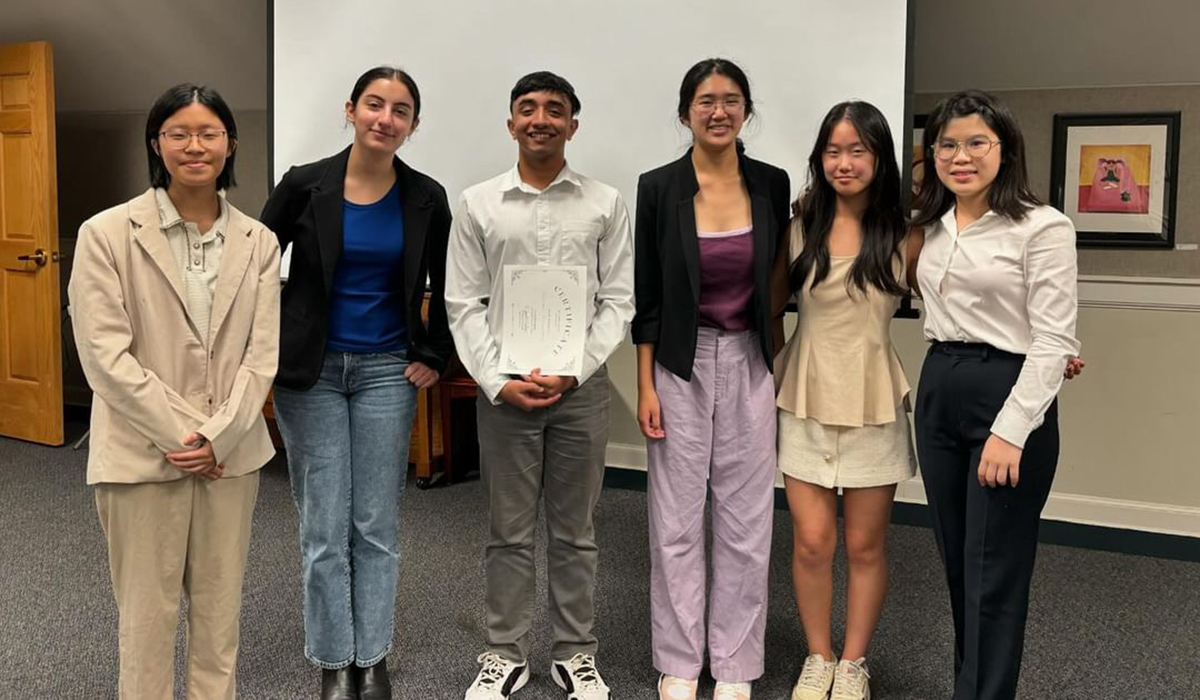
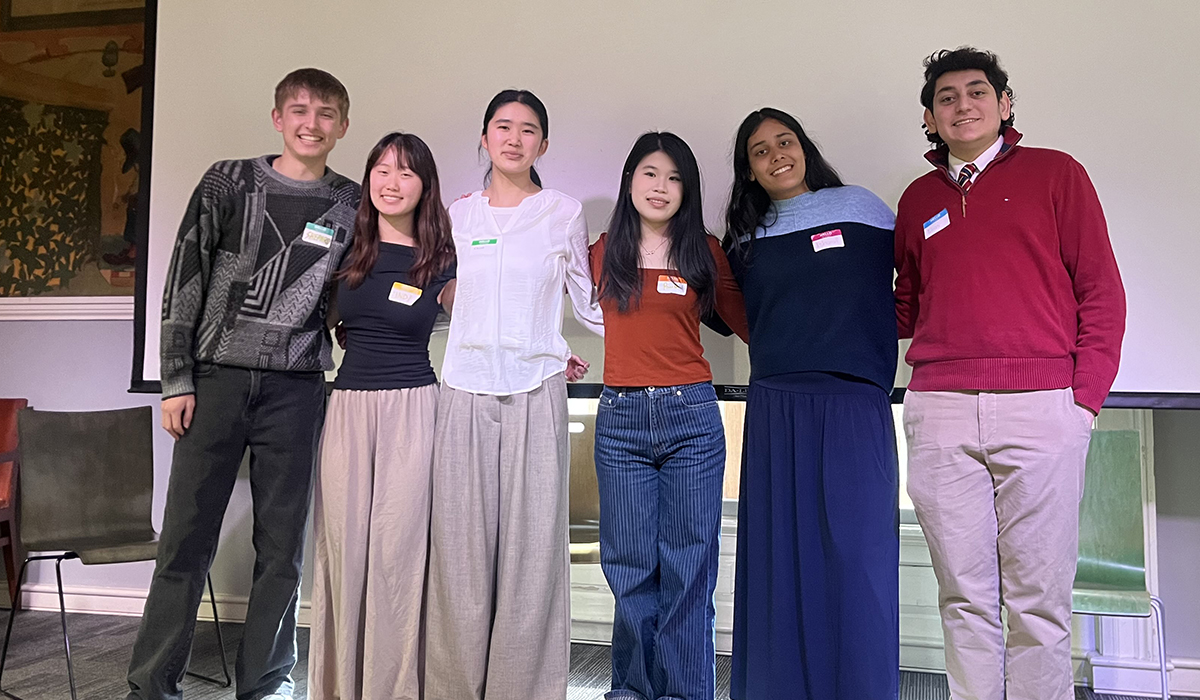
Chloe Wang, third from the right, at a conference to promote youth voices and activism./ Courtesy Chloe Wang
Can you walk us through what a speech contest looks like?
For our annual August tournament, students create a speech or slam poetry piece around a social issue they care about — climate change, housing disparities, immigration, whatever they’re passionate about. This year we had the Connecticut Youth Poet Laureate and several state officials on the judging panel. Winners receive a cash prize, and then we work with them to actually carry out the solution they proposed in their speech.
This year’s first-place winner spoke about immigrant rights. We connected him with IRIS Connecticut and local churches and nonprofits he was already tied to and helped him create “know your rights” posters and flyers that were distributed across the community.
Can you tell us about some of the service projects your mentees have launched?
Across all of our events, students I’ve mentored have gone on to launch dozens of service projects, collectively donating more than 300 school supplies and 500 hygiene products.
One student created a short film to raise awareness about sexual assault, recruiting volunteers to share their experiences on camera and pairing the film with testimony to the town’s school board of education about gaps in the health curriculum. Another student, focused on literacy disparities in New Haven, which is one of the most redlined cities in the country. That project ended up donating 300 reading lamps to students in the city.
What’s been the most rewarding part of this work?
Seeing an event come together after weeks or months of behind-the-scenes planning. A lot of what I do is on a computer — booking venues, organizing logistics, making calls. You don’t get that face-to-face interaction until the event actually happens, and then it’s just incredible to watch everything you’ve worked toward come to life.
I also love watching students return to CTSA events year after year and seeing their growth over time. Sometimes they’ll even join CTSA so I get to know them further.
Chloe Wang, third from the left, at a conference to promote youth voices and activism./ Courtesy Chloe Wang
What are your long-term plans for the organization?
I want to continue growing our geographic reach across Connecticut and make sure we’re truly reaching the students who would benefit most — not just those who already have access to resources. I also have my eye on eventually establishing chapters in other states, though we want to solidify our foundation in Connecticut first. And I plan to stay involved in an advisory capacity once I’m in college, the same way my co-founder has done since she graduated.
What’s the biggest lesson you’ve learned from starting a nonprofit?
Don’t underestimate what students can do. I was really scared as a freshman — scared of how sponsors would react, how other students would react. What I’ve learned is that the response from other people is almost always a lot more positive than you expect. I was probably judging myself more harshly than anyone else would have.
The best example is our first conversation with Rotary. I was so nervous pitching them this idea that was still just a concept. And they were just incredibly supportive — with funding, with guidance, with everything. Without them, honestly, none of this would have been possible. So my advice is just: go out and try.
The Sky Is No Limit for This Volunteer’s Life-Saving Mission
Meet Daily Point of Light Award honoree Madison Marsh. Read her story, and nominate an outstanding volunteer or family as a Daily Point of Light.
The cockpit of a fighter jet and the stage of Miss America may seem worlds apart, but for Madison Marsh, they’re both platforms for a life-saving mission. After losing her mother, Whitney, to pancreatic cancer in 2018, Madison refused to let grief be the end of the story. Recognizing that families often crumble under the weight of non-medical costs and resource gaps, she founded the Whitney Marsh Foundation. As a U.S. Air Force Officer and Harvard graduate student, Madison channeled her disciplined leadership into a force for clinical and communal change.
Through the Whitney Marsh Foundation, Madison’s leadership has mobilized over $500,000 in hospital grants and established national patient assistance funds that cover the often-overlooked expenses preventing families from reaching top-tier medical institutions. Whether she spends five hours a week keeping things running during the quiet seasons, or 20 hours a week during peak event planning, Madison remains hands-on with her efforts. Her work has reached over 1,000 homes through newsletters and educated more than 400 physicians, ensuring the medical community is prepared for the families they serve.
A Truman Scholar and an Astronaut Scholar, Madison conducts rigorous cancer research and lobbies for federal funding to ensure that the “wait for a breakthrough” doesn’t claim more lives. Serving as PanCAN’s Rural Health Equity Chair, she focuses on the most disadvantaged patients, working to ensure that geography never determines a person’s survival rate. And as the first active-duty military member to be crowned Miss America, Madison has used her 12.1 billion potential social reach to inspire over 200,000 students and patients worldwide. She has transformed a deep personal loss into a public legacy, engaging 5,000 event participants and 250 volunteers in a collective fight against a silent killer.
Madison visiting the University of Heidelberg in Germany to watch pancreatic cancer surgeries on a research trip for access to care with Harvard.
What inspired you to start the Whitney Marsh Foundation?
I started this nonprofit in 2018, and it all started because my mom was diagnosed with pancreatic cancer when she was 41 years old. We didn’t have any cancer history in our family. She wasn’t in any of the risk factor groups, by any means. So it was very shocking to all of us. She ended up passing away later that year, and having to watch that experience as I was a 17-year-old at the time—losing your mom and having to grieve the loss of a loved one even before they’re really gone—made me want to do something more, so that her memory could still be alive and that her loss wasn’t going to be in vain.
A couple of days after she passed, my older brothers forced me to leave the house and they brought me to the gym. I refused to work out, so I went and I sat in the locker room and started thinking: what can we do so that my mom isn’t forgotten, that we can help other people? We originally just started out as a small 5k/10k race because my mom was a huge runner, and we wanted to be able to bring our community together doing what she loved. That very first year, we had a record-breaking race in our town with nearly 1,000 people in Arkansas.
Since then, we’ve been able to grow and raise over half a million dollars given to patients and hospitals, ensuring that critical programs are in place to help people who are like my mom. I know what it’s like to lose a loved one and how hard that is. Whatever we can do to either help families never have to go through that, or at least alleviate some of the stress and pain that accompanies it, whether that is the financial burden, being able to help with patient assistance funds or the emotional burden and just being there as a support group so that people know that others are going to be in their corner.
That all eventually played into when I competed in Miss America, because you have to have a community service initiative to compete. I had been running my nonprofit for seven years at that point, and I was able to use that as a platform to educate people on pancreatic cancer, using my mom’s story to educate that pancreatic cancer can happen to anyone, even the healthiest people, and also sharing some of the big resources out there. We’re a small local nonprofit, and I’ve loved getting to work with big ones like the Pancreatic Cancer Action Network and utilizing their resources and networks over the years together. That’s how all of these experiences converged together with philanthropy, and then using my platform and the microphone that I was given for that year as Miss America to amplify that message.
Why is support for patients and loved ones so important after a cancer diagnosis?
When you think of pancreatic cancer, the survival rate is so low; most patients are going to pass away within the first year or two. There’ve been so many people that we’ve met throughout our nonprofit that have lost their parents within three weeks of a diagnosis, or several months. You’re not just having to deal with the grief that comes afterwards, but like I said, you are grieving the loss of the person before they’re even gone, and that is so incredibly difficult.
Not to mention how expensive all the different cancer treatments are. When you think of pancreatic cancer, one thing that’s really crucial is that patients get treated at what we call high-volume centers. Those are places that are performing a certain amount of pancreatic cancer surgeries every year, which is the one way that patients survive. There’re not a lot of them out there, and it can be quite expensive and burdensome to travel to those places, especially if you come from a rural area or a low-resource family. We never want anyone to have to choose between survival and time with their family and the resources that they have.
It’s absolutely crucial in that sense—one, removing that burden from people so that they can make the correct medical choices to help them survive, but also taking away that emotional burden of everything that comes with a cancer diagnosis so that you’re able to hopefully spend more time with your family instead of spending time thinking about your bills or any of the other things that come along with the cancer journey. There’re so many different aspects that pancreatic and really all cancer patients need, whether that is financial help or just resource and education to get people to the right places. Maybe what they really need is someone that has gone through this path before.
I remember when my mom was diagnosed, I didn’t know anyone that had ever had pancreatic cancer. And then if you search on Google, Google can be a pretty terrifying place, especially for pancreatic cancer, and everything that you see is the low survival rates and no hope. I think it’s so important to give people that hope and that comfort, and to use our resources with survivors, or even just someone who’s gone through it, to be there for someone in that moment where they don’t even know what questions to ask. What they need is just someone to be there for them.
What are your long-term plans or goals for the organization?
One of the biggest things that we would love to do moving forward is partner with more large hospitals for patient assistance funds. We have one set up right now with MD Anderson, we’re in the works of setting up with one in Colorado and we would love to really spread those throughout the United States to have a collective network. When pancreatic cancer patients say, “I want to be able to travel to this specific hospital,” we can say, “Hey, great. We will fund you and your family for all of your non-medical expenses to get there,” to make sure that we are not only incentivizing people to go to these places, but we’re removing whatever barriers exist.
I know that’s one thing that’s really important, having a caregiver—having your family with you—not only because it helps with the effectiveness of treatment and being able to follow along with some of those treatment plans, but also just emotionally, getting to have your kids or your spouse or whoever it might be there with you in that time of need.
In expanding those sorts of programs, I would love also to expand some of our support groups to meet a larger audience across the United States. I know there’re a couple of nonprofits that we would love to work with, especially in the tech industry, to be able to create a really easy pipeline that would exist either virtually or even through pamphlets for people that don’t have access to computers or smartphones. We want to give them a resource that very quickly will allow them to see what hospitals are closest to them that we fund, or maybe it’s going to be clinical trials, or resources about surgery—just to make it easier and education-filled so that people can make the best choice for them in their treatment journey.
What have you learned through your experiences running your organization?
It’s difficult sometimes, especially being a smaller nonprofit, because we feel like we can’t have as much impact as some of the big, huge ones that are in the community with multi-million dollar grants. But I think what it has shown me is that everyone has to start small, and it’s also okay to stay small. There are different benefits to every level of a nonprofit, and it has shown me as a leader how much impact we can have through the small things.
Because we’re a small nonprofit, I get to personally connect every single day with the patients and our survivors, and really make it targeted towards specific small communities to help them. You don’t have to do a big thing all of the time and make this massive, really visible change; sometimes the best change is the quiet, small piece of helping one family at a time. Anyone can be a part of that process, no matter what community you come from. To really make that difference ripple across the world starts with one person, in one place, with one action.
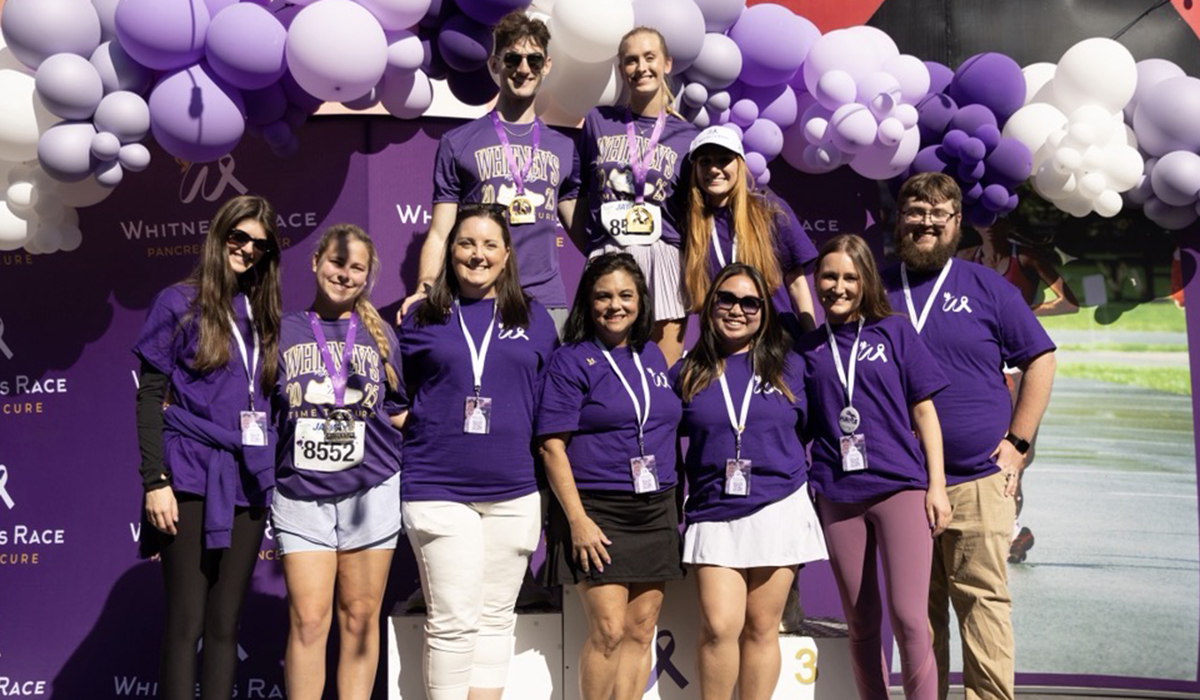
Whitney’s Race 2026 in Fort Smith, Arkansas, benefiting the Whitney Marsh Foundation.
What’s been the most rewarding part of your work?
I’ve loved over the past couple of years seeing more survivors come to our events and participating in our nonprofit. Most of the time within pancreatic cancer, finding survivors is really difficult. Especially when we have newly diagnosed family members, not having a survivor there to give them hope or some sort of positive outlook on what it could be can be really difficult.
Getting to see that now that we’re getting bigger and being able to attract everyone—whether that is caregivers, bereaved loved ones and now even survivors—to be a part of our community, I feel like we can take care of such a broader set of people that need help. Before, we weren’t able to do that. Now, we have this sort of diversity throughout our community.
Why is it important for others to get involved with causes they care about?
I think that volunteering and community change is what changes the world. Of course, we have all of the big pieces that might change within legislation at the government level, but I think what we forget is the power of staying small and the power of what you can change within your own locality.
What I saw from my mom’s own life was she only got 41 years, but life isn’t about how long you have, it’s about what you do with that time. Every day that I get up, I know that I don’t want to waste a moment that I have, and if that means going out serving others and being able to use my passions and my strengths in life to get involved in our community, that’s how we all can make change and also make our lives filled with meaning.
Who knows how long I have here? But living every day in a way that would serve my mom well and serve my community well is a lesson that we can all learn from people that have left us far too soon. We can use that in our own lives to lead a better, more service-fulfilled life, knowing that we can all make change through the small ways that we give back to people in our life every day.
Any advice for people who want to start volunteering?
When I was in college, also looking for volunteer opportunities outside of my nonprofit, I just started searching online and just went. All you have to do to make change is just show up. There’s always more than enough need to go around. If you look anywhere, there’re always hands needed at almost every single organization and volunteering event. You can be that change. Just take that step. Try something new, look it up online and make a deal with yourself that you’re going to show up.
From Pizza Slices to Purpose: Volunteer Fights Food Insecurity
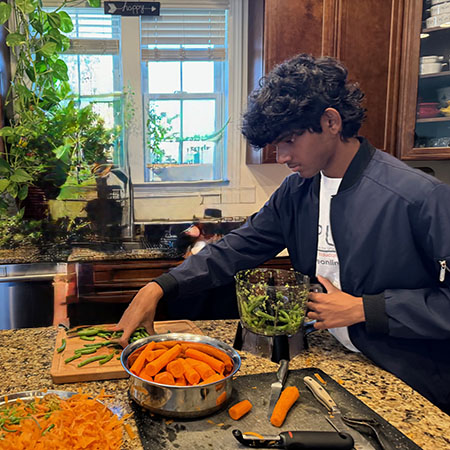
Meet Daily Point of Light Award honoree Anish Kaza. Read his story, and nominate an outstanding volunteer or family as a Daily Point of Light.
Anish Kaza is co-founder of Pizza for a Purpose, a youth-led initiative and app tackling food insecurity in Boca Raton, Florida. After volunteering at local food banks and seeing families with children his own age struggling to access meals, Anish helped create a simple but scalable solution: partnering with local pizza restaurants and food banks to distribute donated pizza slices to people in need. As co-founder, he designs the app, builds restaurant partnerships and coordinates food distribution efforts. To date, Pizza for a Purpose has facilitated the donation of more than 22,000 pizza slices, expanding access to meals through a food item that is easy to transport, store and share.
For Anish, volunteering is about proving that young people do not have to wait to lead. He believes youth bring creativity, innovation and urgency to the issues shaping their communities. Through Pizza for a Purpose, he hopes to inspire others to start small, stay consistent and take action on causes they care about. His long-term goal is to expand the initiative to more cities while continuing to develop community-driven solutions to food insecurity.
Meet Daily Point of Light Award honoree Anna Schmidt-Kittler. Read her story, and nominate an outstanding volunteer or family as a Daily Point of Light.
Anna Schmidt-Kittler is finishing up her junior year of high school but is already a pillar in her community. She’s a self-described foodie, and being half German and half Japanese puts her at the center of a unique culinary background. Anna started cooking after watching and wanting to help her mom, who is Japanese. With regular trips to see family in Japan, it’s easy to understand why Anna’s favorite dish is oden.
But it wasn’t just her mom whom Anna wanted to help. For more than two years, alongside her studies, she has often cooked for 50 to 75—sometimes up to 100!—people at the Community Day Center of Waltham (CDCW). The organization provides shelter and support for unhoused individuals in the form of things like showers, meals and one-on-one case management.
Anna has spent many hours making food and making clients’ day with a friendly face and a listening ear. Her openness and warmth have earned her many meaningful connections during her commitment to this initiative. In fact, listening to clients’ stories has become one of her favorite parts of her role.
Cooking gives people a platform for creativity and expressing their cultural background as much as a chance to try delicious-looking cookies from Instagram. And for Anna, it’s a way to show those who are struggling that someone cares. After graduation, Anna hopes to take a gap year and advance her skills with a culinary class before pursuing a bachelor’s degree in political science. And, of course, she hopes to continue feeding her community.
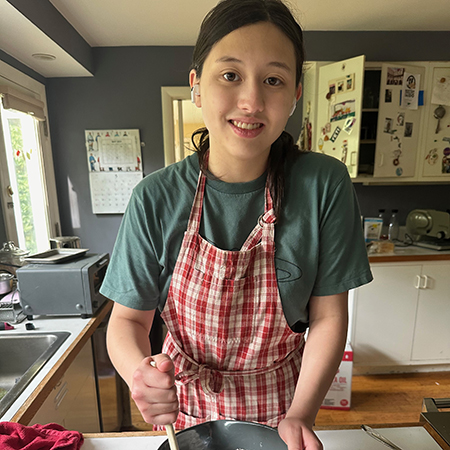
Anna Schmidt-Kittler cooks lunch at Community Day Center of Waltham
What inspires you to volunteer?
From a very young age, I thought it was really unfair that people were sleeping on the street, and I got to go home in a nice, warm bed in a house. At that age, I was too young to do much, but I never lost that mindset of wanting to help those in underserved areas or situations.
Tell us about your volunteer role with the Community Day Center of Waltham.
I volunteer as both a cook and a server. As a cook, I make full lunches from home. Sometimes, I cook breakfast or dinner. Wherever they need more food or extra hands, I’m happy to help. My mom helps deliver it, because the center opens when I’m at school. She also helps with shopping and funding.
On days I serve, I mostly serve preheated food. People choose what they want to eat, and I bring that out to them. I’ve had to cut back a bit during junior year due to schoolwork and college prep, but when I was cooking more regularly, I’d volunteer once or twice a week.
What inspired you to get started with this initiative?
When I entered high school, my school encouraged students to volunteer. That was my final push to actually start. I found a community fridge near where I live, and I started to package some home-cooked meals and pop them in. That’s how it went for a few months, but someone from the Community Day Center, who I believe managed it, also bought some food from the fridge to the center itself. She told me and my family that there were a few people who were hoarding all of our food and suggested we come cook directly for the center so we could ensure everyone gets a fair portion and see that it’s going directly to people who need it.
What are your long-term plans or goals for your volunteer work?
I want to continue serving the CDC as much as I can into my gap year and maybe into college. I want to keep cooking as long as I possibly can.
What’s been the most rewarding part of your work?
At first, I thought cooking would be the most rewarding part, but as time marches on, I’ve found myself more and more excited to see everyone at the Day Center, both the employees and the clients. I’ve learned so much from the clients, and I’ve heard so many unique stories that I’m sure we’re just waiting to be heard.
What have you learned through your experiences as a volunteer?
Of course, I’ve gained a lot of cooking and baking knowledge. At first, I could barely cook, and now I’m cooking meals for myself. From meeting and talking to the clients, I’ve also learned stories of why they’ve come to America and what they’re looking for, and I’ve learned that homelessness and food insecurity is much more prevalent than I first thought. A lot of people would come in with tidy, nice clothes–sometimes suits!–and you would never be able to guess that they’re not able to get a meal at home.
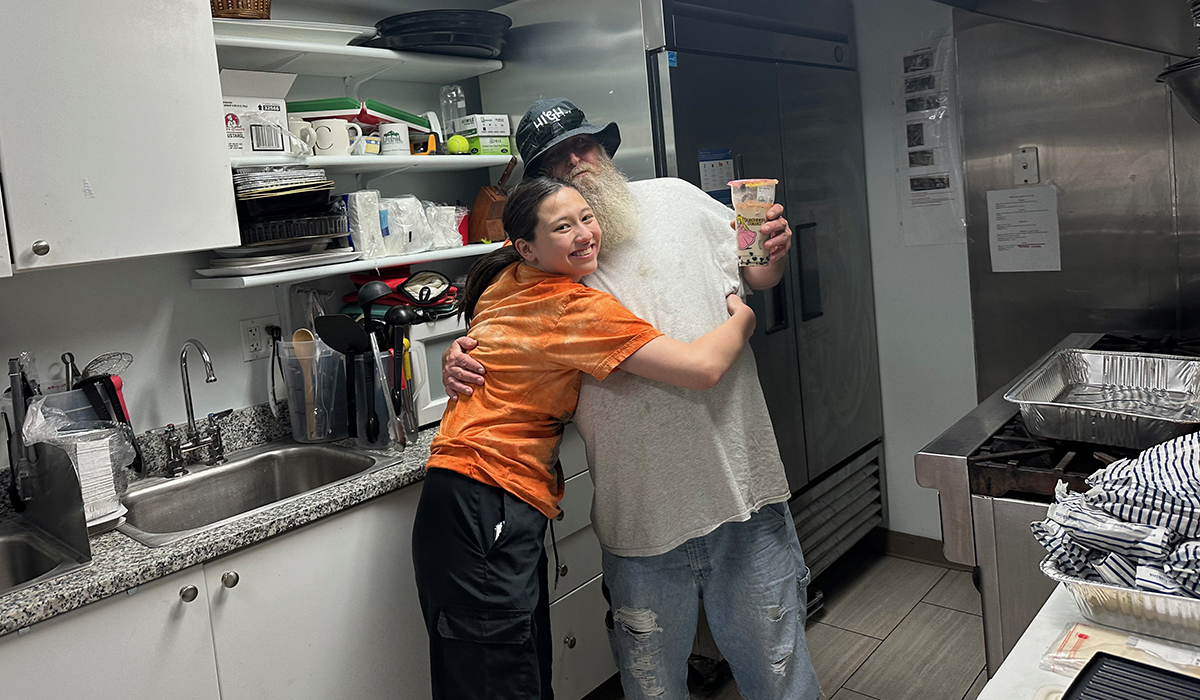
Anna shares a hug with a staff member in the kitchen of Community Day Center of Waltham.
Tell us about future partnerships, programs or events that you are excited about.
Sometimes, we celebrate holidays with the clients. We’ve celebrated Halloween, Christmas, Thanksgiving and Valentine’s Day. That’s always fun.
Why is it important for others to get involved with causes they care about?
What could be a very simple thing for you could be life-changing for someone else.
Any advice for how people can address food insecurity in their own communities?
I would recommend cooking a little bit more than you need, packaging your extras or leftovers and putting them in a community fridge. If you’re shopping, get some soup or canned tomatoes or something, and pop them in. It feels so simple, but it’s helping so many people.
What do you want people to learn from your story?
At first, it can seem like a lot of work, but it gets easier and easier. When I first started, it was really tough, and now it feels like I’ve been doing it all my life.
Meet Daily Point of Light Award honoree Micah Sawyer. Read his story, and nominate an outstanding volunteer or family as a Daily Point of Light.
Content Warning: Points of Light is proud to share the following uplifting and inspiring story. However, we acknowledge that portions of this story may be difficult for some readers. We encourage you to please care for your own well-being above all.
The transition from a quiet life running a construction business to the front lines of a public health crisis wasn’t a choice Micah Sawyer ever expected to make. It was born from the silence left behind after losing his 22-year-old son to a fentanyl overdose. In the wake of that devastating grief, Micah chose to build something that could help hold the weight of his pain: a nonprofit called Micah’s Hugs. While still managing his business, he and his partner have embraced the work as a secondary full-time career, each dedicating over 100 hours every month to the cause.
As the founder and lead volunteer, he is on the ground in Sonoma County, leading school presentations and coordinating distribution efforts. This is a fully hands-on endeavor, and Micah has personally invested over $100,000 of his own funds to keep the mission growing. In 2025 alone, Micah’s Hugs distributed 15,835 doses of naloxone (Narcan) and reached over 4,100 students with vital education on substance use and mental health. Since its inception, the organization has put more than 43,000 doses of the life-saving medication into the hands of the public.
Beyond immediate intervention, Micah is focused on the long road to wellness, having funded over $106,000 in sober living scholarships. He navigates the complexities of grant management, community partnerships and administrative duties with the same attention he offers to families currently walking the dark path of substance use. By engaging more than 8,300 community members last year, he is successfully shifting the narrative around the fentanyl crisis from one of shame to one of proactive response. Read on to hear more of Micah’s inspiring story.
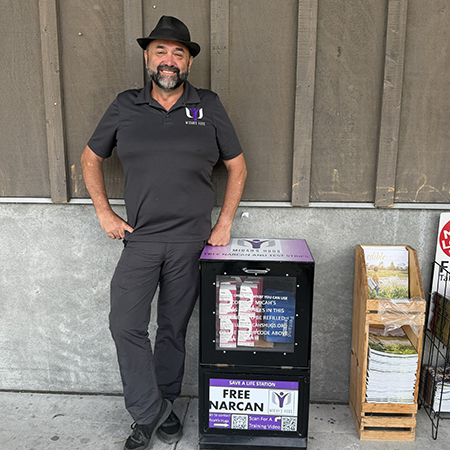
A repurposed newspaper box is now stocked with Narcan and fentanyl test strips.
Tell us about your volunteer role and organization.
I’m the president of Micah’s Hugs, a nonprofit organization. We help people, both people that are struggling with substance use issues, and also educating the general public around the issues of substances, especially fentanyl. These days, fentanyl has become the most dangerous substance out there that people are struggling with. We do a lot of work with schools, and we’ve been working primarily with the high schools lately.
We started doing this after we lost my son, Micah Jr., who the organization is named after. We lost him to fentanyl overdose, via fentanyl poisoning. It’s been almost seven years now, so we thought, after dealing with what we had to deal with and going through the grief and the struggle and the trauma of losing a child, we wanted to try to help other people not have to go through that struggle and trauma. So we started this organization to try to help anybody we could help, especially young people and families.
What are some things people should be aware of about fentanyl?
Fentanyl has unfortunately made its way into so many different places where we’re even finding some instances of it in cannabis, in marijuana, where people would never really expect it to be. It’s not super common—but we’ve had a handful of stories of people that have gotten fentanyl overdoses from smoking cannabis. The main thing we want to tell people is just that it’s gotten into everything.
We do a lot of harm reduction, which is trying to help people not become harmed while they’re doing anything they want to do. We understand that, in a perfect world, nobody would experiment with anything, and we’d all be safe. But unfortunately, that doesn’t happen. We often say the harm reduction that we try to teach is indeed reduction; it’s not harm elimination. We compare it to wearing a seat belt in a car. There’s still danger when you drive that car, but it can help you be a lot safer than if you weren’t wearing a seat belt.
Fentanyl is everywhere. It’s in pills. A lot of people, especially kids, are experimenting with pills—things like Xanax, Adderall, Oxycontin—and a lot of times they think that because those pills look pressed and look like they come from a pharmacy, that they must be safe. Unfortunately, over 85% of the pills that are bought off the streets these days actually contain fentanyl. We try to teach people a lot about the risks and what it looks like to have an overdose on fentanyl. We do a lot of training on Narcan. We’ve distributed about 43,000 doses of Narcan into our local communities to try to help people recognize an overdose and what you can do if you see an overdose.
What’s been the most rewarding part of your work?
The work that we do has really been what’s helped me deal with my grief the best way possible. We help a lot of people try to not get into that situation of fentanyl poisoning. We also work with a lot of people who have lost children—especially those who are newer to the situation—to help them navigate it.
The rewards that come to me have really helped me a lot in dealing with my own grief. I’m rewarded every time we can help somebody. We said when we first started this, if we could save one person’s life, that would be worthwhile enough. We’ve now had many stories of people coming back to us and saying that, in one way or another, they feel like we’ve saved their lives, either through Narcan and harm reduction, or helping them get into programs to get clean and sober.
We had a young girl who we ran into a year after we first met her, and she said that we had saved her life. We realized she was actually formerly unhoused and addicted to heroin. We had met her on the streets and gave her a scholarship to get into sober living a year earlier. She looked so different and so cleaned up that we didn’t even realize it was the same woman. That was the first situation where somebody said we had saved their lives, and now that has happened numerous times. That just gives us the incentive to keep doing what we’re doing.
We had a 16-year-old kid this year from our local high school whose mom got Narcan from the school that we worked with to help supply them. He came across a pregnant woman that was overdosing in a parking lot at a shopping center. He remembered that his mom had Narcan in her car, and he ran and got the Narcan out and helped save this pregnant woman. Every time we get one of those stories, it makes us want to keep doing what we’re doing.
What’s your advice for someone who finds out that a loved one, a friend or a family member is experimenting with substances?
That’s a really tough one, because everybody wants to jump in and completely save somebody or just end the situation altogether. But it’s not as simple as what people might hope it would be. There are no perfect answers. I usually tell people to be open and honest and meet people where they’re at with love, empathy and compassion.
When I first realized my son was struggling, the first thing you want to do is just sort of grab them and shake them and knock some sense into them. Unfortunately, that doesn’t really work. If people feel like you’re judging them, it actually makes them turn away and not want to be open and honest with you. So again, it’s empathy and compassion and love and understanding that can help in these situations. Tell people that you’re there for them and see if they can open up to you and ask for some help. If you’re too judgmental, they’re not going to ask for that help.
What have you learned through your experiences as a volunteer?
We’ve learned a lot. We started out just trying to help people who were reaching out and asking for help, or people that would call us and ask us to come talk in front of their groups. We never started out with the concept of trying to run a nonprofit; that just sort of came along the way. We had some people who were donating a little bit of money to try to help us out, and they asked if they could write it off on their taxes. That’s originally why we decided we’d better become official and start a 501(c)(3) so people can get a tax deduction when they’re donating. Since then, it’s just kind of snowballed and became larger and larger. It’s not completely full-time yet, but we put a lot of time into this.
What are your long-term plans or goals with volunteer work?
We certainly like to get more funding so we can expand some of these programs. We have a sober living scholarship program that we put into place, and we’ve done over $100,000 in scholarships now that will help pay for somebody’s first two months to go into sober living. We really found there’s a hole in the system where you can get your health insurance or Medi-Cal to pay for residential treatment, and then when people get out of that, they’re often at a loss. They don’t know where to go or where to live. Many people are coming from situations where there’s a lot of drug use or alcohol use around them, and they’re trying to stay clean, and they wind up having to go right back to where they came from. It’s very hard to stay clean when you’re with a lot of other people who are using.
Statistically, people are about two to four times as likely to be successful if they go into sober living after treatment, instead of just being released straight out of treatment. So we’d like to expand that program and expand our schools program. We worked with a high school and actually broke the Guinness Book of World Records’ record for the largest Narcan training in the world. It was a half-hour training during their homecoming rally with the entire student body, and we gave out 1,400 boxes of Narcan and 1,400 fentanyl test strips to every student in the school.
We’d really like to expand these programs to more schools. Years back, we had a lot more resistance from schools, but in the last couple of years, that mentality is changing. Our specialty has always been trying to find a place where something is lacking and jump in and help where we can. If what we’re doing becomes unnecessary at some point, we’ll switch to something else.
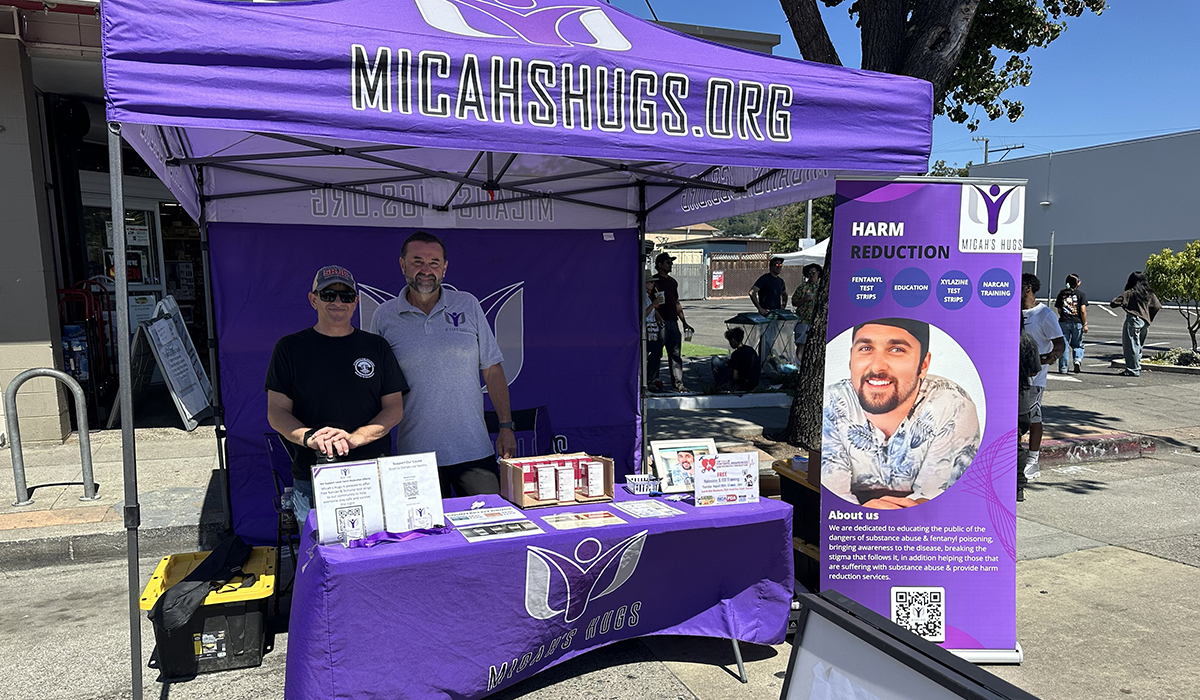
Micah volunteering at the Oakland Street Fair raising awareness, providing Narcan training and distributing Narcan and test strips.
Why is it important for others to get involved with causes they care about?
It’s pretty amazing just the way it makes you feel about yourself and how you can do things to help your community. Sometimes people say volunteering can be selfish—not really, but it sort of feels that way, because of how much it makes you feel better about yourself when you see how you help somebody else out or you change someone else’s life for the better. It affects your own life in such a positive way at the same time.
Any advice for people who want to start volunteering?
I would say to just reach out to some other organizations in your area if you find something that means a lot to you. We’ve done a lot of work with unhoused populations as well. Sometimes we go down to encampments and we’ll take people with us who have never done anything like that before, and it’s really eye-opening. The day before Christmas, we went down to the Tenderloin in San Francisco. We bought 100 Burger King hamburgers and scarves and socks and hats. We brought some people who had never done anything like that before, and they were really blown away. It just really changed their opinion about how they thought about the Tenderloin residents, or unhoused people in general, once they realized that these are just people. They all have a story, and so many of them want to tell their story—how they wound up there and what their life’s been like and their struggles. We often look at those people sleeping in a doorway and we’re scared of them, or we step across the street, but you realize if you just sit down and talk to them on their level and speak to them as a person, they’re some really interesting people who have had some really unfortunate struggles in their lives.
What do you want people to learn from your story?
Have empathy, compassion and an open mind. Educate yourself. The drug overdose and substance deaths numbers are coming down, and I think the biggest reason for that is that people are becoming more open-minded and more educated. They’re learning more about what the risks are. I have not yet heard anybody say they’re having a hard time finding drugs—the drugs aren’t disappearing—but I think people are becoming more educated about what the risks are and how they can protect themselves and their kids.
The numbers, of course, are still outrageously too high. It’s not like the problem is solved, but it’s at least headed in a better direction.
We’re somewhere around 80,000 people a year dying from substance overdose, and at one point it was up to almost 130,000. Even though 80,000 is a massive number, it’s a lot fewer people than what it was at its peak. I think that’s good, and I think it’s also really interesting how much we’ve seen society’s opinion changing. When we first started this, there was a lot more negativity. We had people pushing back and saying what we were doing was wrong, that we were telling people it’s okay to use drugs. That opinion has really changed, and we don’t get near as much of that as we did when we first started doing this.
Meet Daily Point of Light Award honoree William Kwok. Read his story, and nominate an outstanding volunteer or family as a Daily Point of Light.
During the early months of the COVID-19 pandemic, William Kwok wanted to help his community. While the world was still shut down, many members of his New York neighborhood, particularly Asian-American women, felt rather unsafe in public spaces. William started hosting free online safety workshops to teach community members important situational awareness skills. When the world opened up again, he started hosting live workshops through his organization, the Martial Arts Education Society, which aims to promote the positive values and cultures of martial arts education that allow positive role-modeling, moral leadership and caring relationships to the general public. Designed to teach practical safety skills, the workshops also help participants build awareness, confidence, empathy and a stronger community connection. The groups also discuss topics such as stereotypes, bias, psychological self-defense and how actions and interactions can influence how communities see one another.
Each month, William spends five to 10 hours researching, preparing, coordinating with community partners and facilitating workshops. Thus far, he has hosted over 30 workshops, each serving 60 to 120 participants, including seniors, immigrants and other vulnerable residents. But the impact has also been proven: After the first three workshops, an independent evaluation found that attendees’ confidence in personal safety rose from 36% to 60%, while their confidence in helping others rose from 32% to 77%. Every time an attendee leaves one of William’s workshops, they feel safer in their community.
William says he doesn’t need to save the whole world. Instead, he hopes to do one small thing that will plant a seed and create a positive change within his community. His powerful ability to recognize a need and subsequently take action is a strong example of being a force for good through volunteerism.
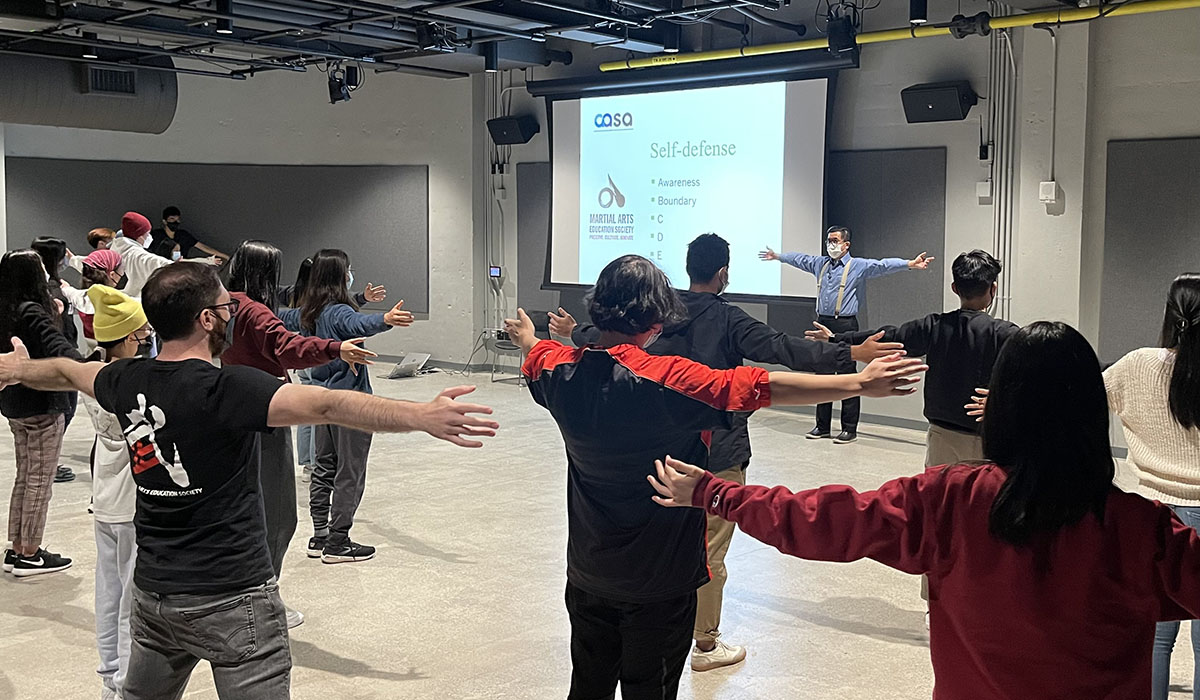
MARTIAL ARTS EDUCATION SOCIETY VOLUNTEER WILLIAM KWOK (BACK) GUIDES PARTICIPANTS THROUGH A COMMUNITY SAFETY EXERCISE AT UMASS AMHERST. /COURTESY WILLIAM KWOK
What inspired you to get started with this initiative?
During the early months of the COVID pandemic in New York, I saw many Asian American community members, especially women, feel unsafe in public spaces. At the same time, I was also dealing with severe Bell’s Palsy during the city-wide shutdown. Because the city was shut down, access to regular treatment was very difficult. My recovery is actually still ongoing, but that period gave me a deeper understanding of vulnerability. I began to see that safety was not only a physical issue, but also an emotional and a psychological one. I realized people know they should stay calm, set boundaries and seek help, but under fear and pressure, they often freeze.
Tell us about your volunteer role with the Martial Arts Education Society.
I do community workshops. Each group is different. I do research about the group, and I will adapt my presentation to the needs of the group. The workshops are mainly on situational awareness and teach people how to set boundaries, about de-escalation and also bystander responses. Of course, it’s also about how to use their voice and posture when something is not right, and how to support other people without escalating the situation. The goal is not to turn these people into fighters, but instead to help them feel safer and more prepared.
What are your long-term plans or goals for the organization?
I want to continue the work, because I’m a researcher and martial arts educator. I just want to continue spending more time working with others, but the long-term goal is to encourage more people to do the work I do, because I’m only one person, and the New York City Asian community is not the only group that should have access to this kind of public education. So I’d like to expand the work.
What’s been the most rewarding part of your work?
When I can see an older participant realize that she does not have to fight or freeze, but can also use a voice or a posture and learn to step back and be able to be seen for help, or help other people to be safe. To me, that’s very meaningful, because the workshop may be only a few minutes. I always encourage them to share with their family members and friends. I’m planting a seed. They are spreading the words, and they might change their mentality in life. They might want to help someone who will change the community. If everyone does a little bit extra, the whole community will be very different.
What have you learned through your experiences as a volunteer?
Every group is different. When I teach the workshops, I always tell them, I’m not here to tell you what to do. I’m here to listen to what you need to tell me. It helps me. This experience helped me read and understand the community first before I go through the process of facilitating these workshops every time. It helps me understand myself and how I interact with people.
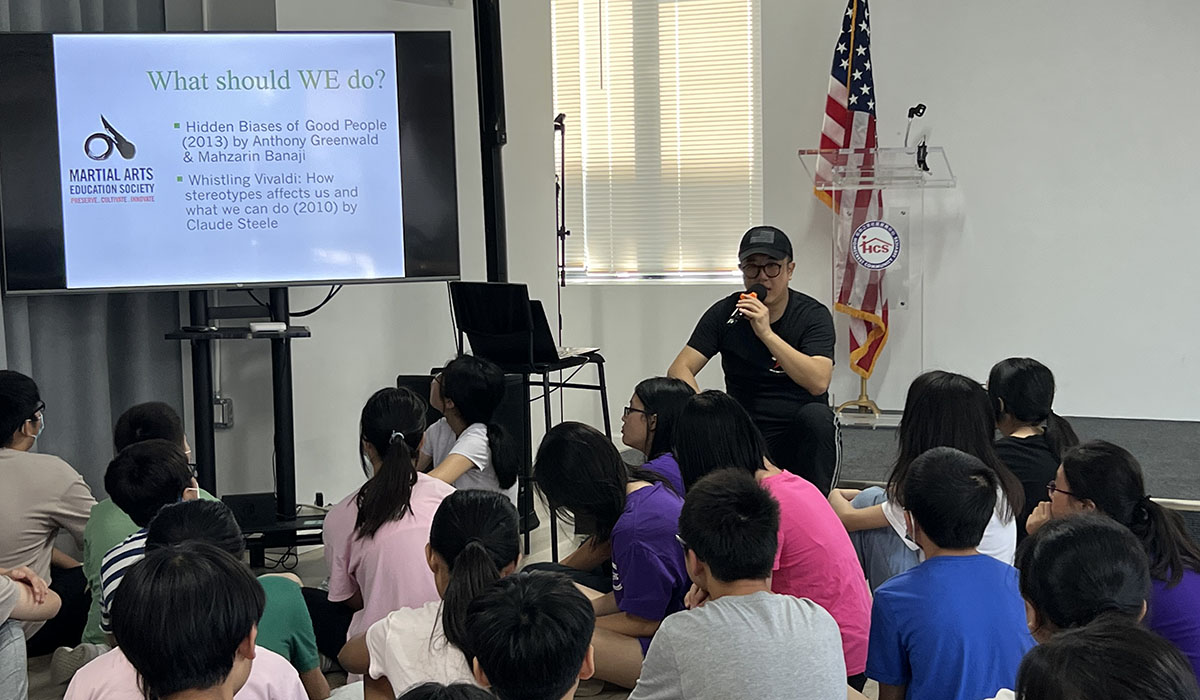
WILLIAM KWOK (CENTER) A VOLUNTEER WITH MARTIAL ARTS EDUCATION SOCIETY, LEADS A YOUTH WORKSHOP ON BIAS, STEREOTYPES AND SHARED COMMUNITY RESPONSIBILITY AT HOEMCREST COMMUNITY SERVICES. /COURTESY WILLIAM KWOK
Why is it important for others to get involved with causes they care about?
We will always have problems in our society, so everyone should just start with what they can see in their own community. If they’re willing to begin with one skill or one relationship, or just one group of people who need support, I think that makes society a lot more beautiful.
Any advice for people who want to start volunteering?
As I said, we all have different skills. I do this professionally, but I want to serve people who may never walk into a martial arts school. They should have access to the tools and support. People can just begin with what they like or enjoy doing. Just do something you like.
What do you want people to learn from your story?
I hope people understand that martial arts can be a form of service. It’s not only about fighting. People have a misconception of it. But traditional martial arts can help people’s awareness, self-regulation, confidence and reasonable responses in difficult situations. I hope my work helps people move from fear to clarity and helps them know what to do and be able to respond when it matters.
Leading With Purpose: A Student’s Journey to Empower Communities Through Service
Meet Daily Point of Light Award honoree Aditya Jain. Read his story, and nominate an outstanding volunteer or family as a Daily Point of Light.
Aditya Jain is founder and president of Hotels for Humanity, a student-led nonprofit turning discarded hotel linens and toiletries into resources for underserved communities across southeast Virginia. After noticing usable items being thrown away during a hotel internship, Aditya built partnerships with 11 hotels and eight nonprofits, helping donate more than 20,000 items worth $31,000 while creating hands-on service opportunities for more than 100 student volunteers.
Aditya believes meaningful change starts with paying attention to the needs around you. Through founding Hotels for Humanity, he has learned that leadership is built through trust, persistence and community partnerships. Aditya encourages other young people to start small, take initiative and not let age limit their impact. By connecting students with hands-on service opportunities, he hopes to inspire the next generation of changemakers to lead with empathy and action.
Meet Daily Point of Light Award honoree Shourya Pabba. Read his story, and nominate an outstanding volunteer or family as a Daily Point of Light.
Shourya Pabba’s journey with People For Urban and Rural Education (PURE) began as the contribution of a shy, 7-year-old volunteer. But since his quiet beginnings, Shourya’s service has blossomed into a prolific record of over 70 projects, each supporting PURE’s mission to connect individuals, groups and organizations with the urgent needs of the world’s children. Whether organizing local food drives and bake sales or coordinating expansive library setups and blanket drives for wildfire victims, the now-16-year-old Shourya helps provide essential support to veterans, foster youth and students in rural areas.
As Shourya moved from the sidelines to the center of his chapter’s operations, he proved that leadership is not a matter of age, but of initiative. His personal growth catalyzed growth throughout his entire chapter, and he led them through their most active year to date. This evolution from a participant to a leader brought a big transition – moving into the role of chapter director, where he learned to rally an entire community behind collective goals.
Now, Shourya serves as an assistant national student director. His influence spans the country as he mentors the next generation of student leaders. In a single year, he personally guided more than ten new ambassadors, empowering them to lead with the same compassion that defined his early days. With time and dedication, Shourya is ensuring that chapters nationwide have the communication tools and strategic planning necessary to thrive and keep passing on PURE’s mission to those who need it most. Read on to hear more of his inspiring story.
Shourya cooking to support the Chaat Night fundraiser, which supported Abhyasa schools through food sales and donations.
Tell us a little bit about the organization you volunteer with PURE.
PURE is a student-led nonprofit dedicated to promoting education equality, with another main focus of community development. PURE goes about this specifically through service projects, fundraisers and global initiatives where we, as volunteers, support disadvantaged communities in developing countries. This applies both locally and worldwide; it’s not restricted to a specific area. PURE also focuses on youth leadership. PURE Youth, specifically, is led by youth leaders, and the focus is on taking initiative and making sure that every action we take uplifts another community. That can be through bringing sustainable growth, raising funds, or raising goods that help people get what they need – especially in a world where so many people don’t have what they need to survive. Our focus is to provide people with these necessities.
What inspired you to get started with this initiative?
I joined PURE in 2018 when I was around 7 years old. I joined at a very young age because I saw my brother doing it, and I was interested because it seemed like my brother was doing something he cared about. From that point onwards, I’ve participated in over 70 projects. Rather than focusing on the quantity of the projects, I think the most important thing as an ambassador and volunteer was just my growth along the way.
When I first joined PURE, my big interest was actually connected to my birthday. My parents donated money on my behalf, and as a result, we were able to fund a dinner and a movie night for children at PURE Pabba schools, which is another program within PURE. I remember that moment specifically. When I saw photos of how those children had fun on my mom’s phone on Facebook, it made me realize that every small thing I can do is shaping the lives of other people.
Over time, I continued to grow more involved because I started to see how everything I do can help a community, especially communities that don’t have the opportunities I have. As I saw the impact of my initiatives firsthand – whether through talking to people who were donating or through photos – I was able to push my commitment further and tie myself to PURE’s mission to create change and support my communities.
Tell us about your volunteer role.
This year, I’m an ANSD (assistant national student director), and I work with a team of around seven other ANSDs and a few national student directors. We support multiple chapters nationwide. We have around 35 to 50 chapters in the U.S. I assist the admin team and the NSDs to help develop projects, reach our global initiatives and make sure that our communication is smooth. As a whole, we are essentially completing projects in the right way and making sure that we’re aligning ourselves with PURE’s goals and with the UN Sustainability Development Goals.
We meet with the directors of several chapters to see how they’re doing and make sure we’re all in unison. Our tasks vary from creating ideas for fundraisers or food drives to focusing on the other side of it, which is to bring awareness and outreach through our initiatives with providing global education.
Tell us about future partnerships, programs or events that you are excited about.
One of the things I’ve been focusing on recently is a new initiative I started with one of my fellow ambassadors. This initiative is focused on civic engagement. We are strong believers that civic engagement is a skill every student should have because people need to be confident and effective communicators. When we talk about providing people with education and opportunities, that’s more than just giving them tangible resources; it’s also about teaching people the skills and ideas they need to develop.
With this initiative, we want to create a global civic engagement campaign. We want to spread it to a large scale, where students have the access to work with other students, improve their public speaking skills and build off their own ideas so they are more confident in themselves and are more effective communicators. With this platform, we want people to have these opportunities. They shouldn’t feel left behind or that they don’t have access to things that kids in more resourced areas have. We want to make sure everybody has the same access and can learn and use these skills in their everyday life.
What are your long-term plans or goals for the organization?
This is a very important part of my life. I’ve been a volunteer for over half of my life, so I will definitely continue to volunteer as I get older. I don’t think it’s something that comes and goes; it’s more like a skill, to have the mindset that you can help other people. With PURE, there are no limits. If you strongly believe in something, PURE encourages you to go for it.
As I get older, I continue to believe that volunteering is the way to help people get what they need. My long-term goal is to maintain that same mindset – to make sure that with whatever action I take, I can help other people. To me, the most important thing is helping others. I know that sounds simple, but I’ve been given the chance and the framework to grow, and I now have a way to pay it forward to those who don’t have those same chances. I hope that they will come to realize that being helpful is not just something you do when you are in your “dream state,” or when you are happiest, or when you feel like you’ve completed your life. Getting involved in your community and helping people should be something that’s with you each step of your journey. My plan is to maintain this mindset, support other people and stress the importance of civic engagement and accessibility as a whole.
What’s been the most rewarding part of your work?
The most rewarding part is being able to see the impact that I get to make firsthand. I mentioned the chance I had in third grade to raise funds so that kids in a rural India school were able to watch a movie and have a nice dinner. That moment still shapes me to this day because I remember how mesmerized I was to see that the action I did allowed other people to have a moment to themselves and a chance to celebrate.
The most rewarding thing is hearing firsthand about the experiences of others and witnessing how grateful I am to be in this position where I can give back. I remember a conversation with members of the Red Cross who were raising funds for people during the Los Angeles wildfires. One of the directors was telling us about his experiences, and he said that the thing he remembered most wasn’t about the money or the logistics, but the individual conversations with people. Every handshake, every hug and every thank you reminded him why he serves to help others. That ties into my rewards – the ability to see the impact firsthand makes it important to stay connected to the people you help and truly get the chance to bond with them. When I have an opportunity to help, I feel the most important thing is to make the most of it.
Why is it important for others to get involved with causes they care about?
If you’re passionate about something, no matter what it is, you should express that passion because then you’re putting so much more of yourself into that scenario. Make the most out of every opportunity. If everyone is able to get involved with the causes they care about, society as a whole will be so much better because people are going to be happy and motivated, and have genuine passion.
As a youth leader, we’re shaping the future. You are tomorrow’s leader.
Any advice for people who want to start volunteering?
The best advice I would give is, honestly, just don’t think twice about it. Just do it and don’t look back. When I started volunteering, I wasn’t really the one making the decision. I saw my brother doing it and saw my mom involved, and I just decided to join. That’s one of the greatest decisions I’ve ever made because it taught me that there’s so much more to life than just looking at your own experience. As a volunteer, you get the chance to view things from other people’s perspectives and put yourself in their shoes.
Volunteering doesn’t feel like a commitment or something you’re doing out of force. Instead, it’s something you can grow from. You feel rewarded, you develop with each step you take and you never regret it. It’s just something you see as a way to get involved in the community, which is the most important thing.
Meet Daily Point of Light Award honoree Aaron Hudgins. Read his story, and nominate an outstanding volunteer or family as a Daily Point of Light.
Content Warning: Points of Light is proud to share the following uplifting and inspiring story. However, we acknowledge that portions of this story may be difficult for some readers. We encourage you to please care for your own well-being above all.
For retired U.S. Army First Sergeant Aaron Hudgins, the call to serve didn’t end with his retirement after 26 years of military duty. Having completed combat tours in Iraq and Bosnia, as well as critical domestic missions during Hurricanes Katrina and Harvey, Aaron’s life has been defined by his commitment to others. However, it was a profound personal tragedy—the loss of his wife, Staff Sergeant Jari Hudgins, to suicide in 2018—that fueled his resolve for service. As a Gold Star spouse, Aaron has channeled his experiences into a leadership role within the Travis Manion Foundation’s Central Oklahoma Chapter. Here, he ensures that the sacrifice of the fallen is never forgotten.
Through his work as a volunteer leader, Aaron orchestrates “Operation Legacy” projects that mobilize hundreds of people across the state to serve foster children, veterans and underserved communities. He organizes the assembly of care packages and leads cemetery flag placements to honor his fellow service members. His “Honor Project” and “Letters of Legacy” initiatives create a living tribute to heroism through tangible community action. Dedicating an average of 60 to 80 hours per month to volunteer service, he has successfully led dozens of projects that have resulted in thousands of volunteer hours contributed to Oklahoma. He is a constant presence in local schools, delivering “Character Does Matter” presentations that mentor students and student-athletes.
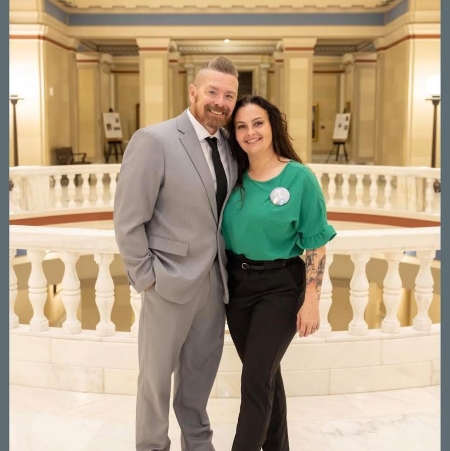
Aaron and his wife at the Oklahoma State Capital where he was recognized as the Veteran of the Week for Oklahoma.
Aaron’s journey is an inspiring story of turning grief and tragedy to hope and action. Through volunteering, he continues to prove that while heroes may fall, their spirit lives on through the selfless acts of those they inspired. Read on to hear more of his inspiring story.
What inspired you to get started with the Travis Manion Foundation?
To understand why I even do what I do, you have to understand where I came from. I did 26 years in the United States Army, and about six years before my retirement, I was married to another fellow soldier. Her name was Jari. She was a Staff Sergeant in the United States Army. She had two combat tours herself. She’d been in 10 years, and she was getting ready for her third deployment when she broke her hip. At the time, it was an injury to the point where the Army was going to medical her out. When that happened, she rapidly started to deteriorate. We lost a lot of who she was. Her identity was wrapped up in her career, and that made it extremely difficult. She was also a star athlete in high school. And she wasn’t able to walk correctly anymore. With those things factored in, on April 29, 2018, she took her own life, leaving back a very large, blended, beautiful family that had to figure out why, and how do we move forward?
I was in that boat. I spent the first two or three years after her death, still in the Army, trying to figure out where I go and what I do. I felt lost; I needed something. Out of nowhere, I got an email from an organization called the Travis Manion Foundation. It wasn’t on my radar. It’s based around Lieutenant Travis Manion, who was killed on April 29, 2007, in Iraq while saving his fellow soldiers. When I learned that, I immediately wondered why that date, April 29, coincided with one that meant so much to me. That’s what led me to read about the organization. They take veterans and Gold Star families and they develop character in future generations. We teach kids and adults about character—what it means to have character and what it looks like—but we do it through service. We do a lot where we get involved in the community, all in honor of a fallen hero.
All these things spoke to me because I’m a veteran myself now, and I’m a gold star spouse. Those two elements were very vital to me because when I lost my wife, I found myself in a weird position. I wasn’t connected to the Army anymore, but I wasn’t connected to civilians either. It was hard to find that perfect medium. This organization sent me a random email, and that email has now cascaded to what I’m doing now. They’ve given me the opportunity to run a chapter in the state of Oklahoma, and that is exactly what I did when given the opportunity. All the people in the organization are either veterans or families of the fallen. It has been life-changing because I’m able to get involved in the community. Service is the most vital part. Jari’s legacy continues to live on. I get to share her story at many of the different events that we do. I always share a couple of things about her. But I also share other veterans and other fallen heroes as well. We’re constantly making sure legacy is continued forward.
Tell us about your volunteer role.
Some of the things we do include cleanups and organizing Meals on Wheels for seniors. We bring the kids in. For example, I’ll bring a soccer team in to do Meals on Wheels. Meeting with senior citizens, a high percentage of whom don’t get a lot of people coming to their house, is impactful. One time, when we brought the kids in to deliver their food, I wish you could have seen it. A lot of the seniors put their Sunday best on when they came to the door. They brought the whole team in, shared their families, their pictures, their history and the things they like to do now. The kids responded very well to it. We did it in the neighborhoods they are from; a woman might live three houses down from them and they had no idea. Now, when they see them, they stop and socialize. Now, they’re starting to pick up after them and offer to do yard work. Why is an 86-year-old woman trying to mow the lawn? We just cleaned up an senior man’s yard; he had about three years’ worth of leaves. It cost us nothing. It took an entire weightlifting team about an hour, and we cleaned up almost 80 bags of leaves so you could see his lawn again. That’s the service aspect. It’s so simple, yet so effective because it doesn’t cost anything to do it. Thirty kids knocked out an entire front and backyard in an hour.
We also honor a fallen hero; we share their story, where they’re from, what they did and if they played the same sports as the kids. I try to tie it into something so they can connect with them. I find someone from their city or town so that their legacy continues on. That’s what we really want to bring—that legacy that continues to go long after they’ve paid the ultimate sacrifice.
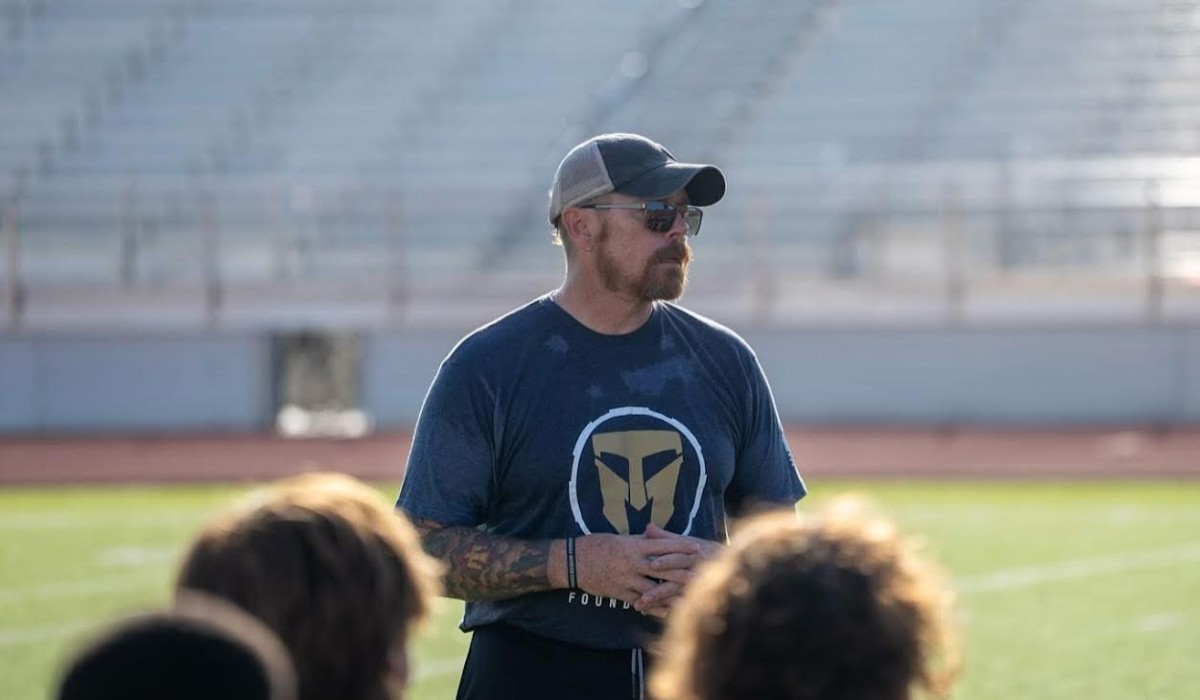
Aaron teaching a class to the Edmond Santa Fe Football Team, approximately 130 student athletes.
Tell us about future partnerships, programs or events that you are excited about.
TMF is a national nonprofit organization. They have approximately 54 chapters nationwide. Texas has five of them. Oklahoma is just now coming on board. We have national events like the Honor Project coming up on Memorial Day, Veterans Day and a 9/11 Heroes Run that we do in September. We have regular national events on key days like Martin Luther King Day and Earth Day.
What have you learned through your experiences as a volunteer?
Community changes when a group of people decide to show up and do something about it. The more action people see you taking, the more they realize it is not just talk. They drive by a corner one day and all of a sudden the trash is all picked up, and they wonder when that happened. The more people see you doing it, the more they will decide they need to do something about it as well. It becomes this “reaction to action.”
What’s been the most rewarding part of your work?
The work that matters is legacy. We’re not just honoring those who serve; we’re making sure their stories, sacrifices and values influence how we lead and serve today. I’ve seen firsthand what happens when people feel disconnected from purpose, and I have also seen what happens when they find it. Bridging that gap between veterans and civilians through shared values, service, responsibility and community is crucial. That connection is where it’s at.
Why is it important for others to get involved with causes they care about?
The biggest reason is that volunteering is taking ownership. When people get involved in something they care about, they stop being bystanders and start becoming part of the solution. Communities don’t change because of one person; they change because people decide to show up. We all have something to give, whether it is time, skills or simply effort. When people step up, the collective impact becomes powerful.
Any advice for people who want to start volunteering?
Start small. Find something as simple as a need in your community—perhaps something that needs to be cleaned up—then organize it and do it. It doesn’t require money or networking. It requires action. Action is what defines us. You just have to start.
What do you want people to learn from your story?
After the death of my wife, I struggled for several years to figure out my direction. Then this took off. Service became an outlet to help myself get through the times I was struggling because I was helping other people who were in the same boat. Now my life has taken an amazing turn.
I live by a quote: “I’ve learned to love the very thing I wish never happened.” If it wasn’t for my wife’s death, I wouldn’t be having this conversation. I wouldn’t be talking about community service, legacy or how we’re going to help other people. That was not on my radar. It was not in the cards. Now here I am, and I wouldn’t change a thing. The reason it got to where it’s at is because it started with a tragedy I never would have wished for.