Meet Daily Point of Light Award honoree Jesse Hicks. Read his story, and nominate an outstanding volunteer or family as a Daily Point of Light.
For Jesse Hicks, the oath taken upon entering military service in 2007 was never a temporary commitment. As a U.S. Disabled Combat Navy Veteran, Jesse spent eight years on active duty, including deployments aboard the USS George H.W. Bush in support of Operation Iraqi Freedom and Operation New Dawn. Then, after transitioning to civilian life, he channeled that same dedication into federal service at the Indianapolis Military Entrance Processing Station (MEPS). There, his guidance supported thousands of incoming service members, earning him multiple Army Civilian Service Achievement Medals and Employee of the Year honors.
At the local level, Jesse dedicates between 25 and 40 hours every month to community care in Johnson County, working directly on the front lines of crisis intervention. His efforts help find emergency shelter, food and long-term stability for unhoused veterans, while bridging the gap to employment for those struggling to find work. Through his local leadership, he has driven 3,243 volunteer hours, $26,967 in donations and $136,377 in direct community support, strengthening the safety net for vulnerable families.
Jesse also specializes in structural excellence and institutional revitalization. His exceptional management earned him the highest honors the Veterans of Foreign Wars can bestow at the local level: All American and All State Post Commander, alongside All American and All State Quartermaster. As the Senior Vice Commander for VFW District 7, his strategic oversight helps guide multiple posts across Central Indiana. This collaborative district-level mobilization has yielded 22,951 volunteer hours, over $285,000 in donations and more than $1 million in total regional community support.
Jesse actively serves as the Captain of the Guard in the Scottish Rite Lodge, backing children’s medical programs, educational scholarships and emergency family relief across the state through the Scottish Rite, Shrine, and Widow Sons. His appointment as a VFW National Aide-de-Camp allows him to represent Indiana’s veterans at the highest levels. Across every tier of service, Jesse continues to build systems that help ensure no veteran, family or youth is left behind.
Tell us about your volunteer role.
I currently serve as the Senior Vice Commander for VFW District 7, where I help lead and support multiple VFW posts across Central Indiana. My role includes mentoring post officers, coordinating district‑wide service projects, strengthening compliance and operations, and ensuring that veterans and their families receive consistent, high‑quality support across the district. District leadership means I’m responsible for the health, performance and impact of an entire region of veteran organizations — not just one post.
Before stepping into district leadership, I served as Post Commander of VFW Post 6978, where I led the post through major growth in community service, financial accountability and veteran outreach. I also served as Senior Vice Commander, House Committee Chairman and in multiple operational roles that strengthened the post’s long‑term stability.
Beyond the VFW, I serve as an officer in both the Scottish Rite and Jubilee Lodge #746, where I support statewide charitable programs, youth initiatives and fraternal service projects. My work in these organizations includes supporting children’s medical care, statewide charitable outreach and community‑building efforts that reach far beyond a single town or county. Across all organizations, my volunteer work is hands‑on, leadership‑driven and focused on building strong, sustainable institutions that serve people with dignity, purpose and compassion.
Why is getting involved so important to you?
As a disabled U.S. Navy veteran, service is not something I left behind when I took off the uniform — it’s something that continues to define my life. I served eight years as an Aviation Boatswain’s Mate, deploying aboard the USS George H.W. Bush, supporting flight operations, training junior sailors and contributing to missions during Operation Iraqi Freedom and Operation New Dawn.
I’ve seen the challenges veterans face — from navigating benefits to finding community after service. I’ve also seen how much families sacrifice alongside them. Supporting veterans and strengthening the organizations that serve them is deeply personal to me. It’s a way to honor those who served before me, stand beside those who serve now and help those who will serve in the future.
What inspires you to volunteer?
My inspiration comes from the leaders, mentors, and volunteers who shaped my life — the people who stepped in when I needed guidance, direction or support. When I joined the VFW and the Masonic fraternity, I saw firsthand how powerful it is when people unite around service.
My federal civilian career at the Indianapolis MEPS also shaped my commitment. Supporting the enlistment and readiness of thousands of new service members each year reminded me how important strong veteran organizations are — not just for those who served decades ago, but for the young men and women stepping forward today. I didn’t want to just be a member. I wanted to be someone who builds, strengthens and leads these organizations so they can continue serving long after I’m gone.
What are your long-term plans or goals?
My long‑term goal for VFW District 7 is to build a district where every post is strong, active and deeply connected to its community. That means developing future leaders, strengthening training and communication, expanding community service programs, improving accountability and operational readiness, and ensuring every veteran who walks through our doors finds support, purpose and belonging.
In my Masonic roles, my goal is to continue supporting statewide charitable work, youth programs and the fraternal values that strengthen families and communities. I want to leave behind organizations that are stronger, more resilient and more impactful than when I stepped into leadership.
What’s been the most rewarding part of your work?
The most rewarding moments are the ones where you see the impact directly — a veteran getting connected to resources they didn’t know existed, a family receiving support during a difficult time or a community event bringing people together who might never have met otherwise. Seeing the numbers is meaningful. But seeing the faces behind those numbers is what stays with me.
Those moments remind me why service matters. They’re the reason I put in the hours, the travel, the meetings and the behind‑the‑scenes work that most people never see.
What have you learned through your experiences volunteering?
I’ve learned that leadership is about consistency, humility and doing the work even when no one is watching. I’ve learned that small actions — a phone call, a ride, a conversation, a meal — can change someone’s entire day or even their life.
I’ve also learned that no organization succeeds because of one person. Success comes from teams, partnerships and a willingness to collaborate. When people work together, the impact multiplies. And I’ve learned that service is not a job — it’s a way of life.
Why is it important for others to get involved with causes they care about?
Communities thrive when people step forward. When individuals get involved, they bring new energy, new ideas and new strengths that make organizations better. Volunteering also gives people a sense of purpose and connection that’s hard to find anywhere else. When more people engage, the entire community becomes stronger, more resilient and more compassionate.
Any advice for people who want to start volunteering?
Start small, start local, and start with something you genuinely care about. You don’t need a title or a big commitment; just show up once. Be reliable, be willing to learn and don’t be afraid to ask where help is needed. Volunteering isn’t about perfection — it’s about presence. If you bring heart and consistency, you’ll make a difference.
Meet Daily Point of Light Award honoree Ahmed Hajj. Read his story, and nominate an outstanding volunteer or family as a Daily Point of Light.
Ahmed Hajj channels his passion for service into leadership with the Perception Foundation, where he serves on the executive board overseeing partnerships and fundraising efforts. Over the past several years, he has helped expand the organization’s reach through sensory rooms, classroom reading programs and donations of sensory items that support children with neurodivergence and families. Inspired by his cousin’s experience navigating limited autism resources as part of an immigrant family, Ahmed became determined to make support more accessible for others. He is helping drive the foundation toward its goal of reaching 1 million people impacted.
For Ahmed, volunteering is about proving that young people belong at the center of change. He encourages students to reject the idea that they are “too young” to lead and instead use voices and energy to strengthen their communities. Whether joining an existing nonprofit or starting something entirely new, Ahmed believes action begins when people stop waiting for someone else to solve a problem. Through his leadership, he is showing a new generation that service is not defined by age, but by commitment, compassion and persistence.
Meet Daily Point of Light Award honoree Danya Levin. Read her story, and nominate an outstanding volunteer or family as a Daily Point of Light.
Danya Levin, a 16-year-old high school junior, founded Ads4Impact after stumbling upon a bright idea. What if there was an organization that could repurpose unused digital advertising space for social good? Many nonprofits operate with limited marketing budgets, making it difficult to recruit volunteers or attract donors. Danya solves this by identifying “remnant” or unused ad inventory on television, websites and apps, and securing it as a donation for these organizations. By connecting media companies with causes in need, she helps provide visibility to nonprofits that would otherwise be priced out of the digital advertising market.
Danya leads outreach, handles day-to-day operations and manages all corporate partnerships. She spends approximately 20 hours per month contacting media firms to negotiate donated space and helping nonprofits adapt their creative content to meet specific platform requirements. Beyond securing the placements, she also teaches organizations how to use audience targeting and messaging to maximize the effectiveness of their campaigns.
To date, Ads 4 Impact has facilitated more than $125,000 in donated digital advertising. These campaigns have allowed nonprofits to reach over 1 million people, resulting in increased awareness, more volunteers and a stronger donor base. Danya enables these organizations to redirect their funds toward their core missions and direct services by removing the overhead costs associated with professional marketing. Read on to hear more about how she got started on her journey.
Tell us about your volunteer role and organization.
I’m a 16-year-old high school student and the founder of Ads4Impact. In my volunteer role, I help connect nonprofit organizations with unused digital advertising space that would otherwise go to waste. I spend a large portion of my time reaching out to media companies, streaming platforms, websites and apps to find ad space that isn’t going to be used. I explain how donating that space can support nonprofits while also giving companies a meaningful way to make an impact.
Once I can secure the ad space, I work directly with nonprofits to understand their goals. Some want to raise money, others want more volunteers and some want to spread awareness about their mission. I match them with the right opportunities and help them make the most of the advertising opportunity. I also help nonprofits actually run their campaigns. Many of them don’t have experience with digital advertising, so I help to guide them through things like creating ads, choosing the right audience and deciding how often ads should run. I explain everything in simple terms so they can learn and use these skills again in the future.
Over time, my role has grown beyond just connecting nonprofits with ad space. I now help them think more strategically about how they communicate and reach people. My goal is not just to help with one campaign, but to help organizations grow and become more effective long-term.
Why is this issue so important to you?
So many nonprofits are doing important work for our communities, but not enough people know about them. Many of these organizations don’t have the money to spend on advertising, so they have trouble reaching donors, volunteers or people who need their services. At the same time, there’s a lot of unused advertising space. When I realized both of these things, it felt like there was an opportunity. Instead of letting that space go to waste, it could be used to help organizations that are trying to make a difference.
What I really care about is the impact this can have on many different communities. Ads4Impact doesn’t just help one group, it helps multiple nonprofits, and each one serves a different population. That means the impact spreads across many causes, like education, health and social services. I also like that this idea improves a system instead of just solving one problem at a time. By reusing something that already exists, we can help nonprofits grow without taking money away from their programs. Plus, by teaching nonprofits how to use digital advertising, we’re helping them build skills they can use in the future.
What inspired you to get started with this initiative?
The idea for Ads4Impact came to me during the summer of 2023. I was on vacation with my family, and we were watching HGTV on a streaming service. During the commercial breaks, there were no ads. Instead, there was a message displayed on the screen that said, “Commercial break in progress. Your live stream will resume shortly.” That caught my attention because it meant there was ad space available, but no commercial was being shown. I started wondering why that space was empty and whether it could be used for something better.
That question led me to learn more about digital advertising. I found out that unused ad space exists on many platforms, not just streaming TV but also websites and apps. At the same time, I knew that many nonprofits struggle to afford advertising. That’s when the idea came to me: what if that unused space could be given to nonprofits? I started reaching out, testing the idea and eventually launching Ads4Impact. Over the last few years, we have facilitated the donation of over $125,000 in advertising that has reached more than one million people. It’s been really exciting to see something that started as a simple idea turn into something that has supported eight national organizations so far, including Pencils of Promise, Half the Story, Vote16USA and Sandy Hook Promise, with more planned for this year.
What are your long-term plans or goals for the organization?
My long-term goal is to grow Ads4Impact so that it becomes a reliable system that nonprofits across the country can use. I want to build more partnerships with media companies so we can access more unused ad space and help more organizations. In addition, I want nonprofits to be able to come back and keep using the platform as they grow. To me, this is a way to provide impact at scale by supporting a variety of nonprofits. Another goal is to continue teaching these organizations how to use digital advertising so they can become more independent and effective over time.
What have you learned through your experiences as a volunteer?
I’ve learned that big ideas can come from small observations. Ads4Impact started by noticing something simple and then asking a question. I’ve also learned a lot about communication and persistence. Building partnerships takes time, and it’s important to be clear, patient and willing to keep trying. And I’ve learned how important it is to listen and understand what different organizations need.
What’s been the most rewarding part of your work?
Seeing nonprofits reach people they wouldn’t have been able to reach otherwise. Knowing that something that would have gone to waste can instead go to help organizations grow is incredibly meaningful.
It’s also been especially rewarding to see organizations I have personally worked with benefit from Ads4Impact. For example, our very first client was Girls With Impact, whose Business and Leadership Academy played a big role in encouraging me to pursue social entrepreneurship. They not only inspired the name Ads4Impact, but also trusted us early on while we were still learning how to work with media companies and nonprofits together. Being recognized in their 2025 annual report was a full-circle moment and something I am really proud of.
Why is it important for others to get involved with causes they care about?
Change happens when people take action. Even small contributions can make a difference, especially when a lot of people get involved. Getting involved also helps people feel more connected to their community and gives them a chance to use their skills to help others.
Any advice for people who want to start volunteering?
Start simply by finding something that interests you. It doesn’t need to be anything big or complicated; you just need to take the first step and begin by helping one person or organization. In addition, I would also say something my dad often says to me, “Be curious.” Ads4Impact started because I noticed something small and asked a question. Opportunities to make a difference are everywhere if you’re paying attention.
Meet Daily Point of Light Award honoree Ria Rajesh. Read her story, and nominate an outstanding volunteer or family as a Daily Point of Light.
When Ria Rajesh started volunteering at 6 years old, she had no idea it would kick off a life of service. It started with simple food donations and sandwich assembly projects, taking on small tasks to benefit those in her community. By the time she was in the fourth and fifth grades, she was engaging with her peers through writing notes of kindness, bringing smiles to their faces while using her sense of creativity. When the COVID-19 pandemic hit, Ria’s service work went into high gear. Currently a high school junior, she’s the Maryland Youth Lead for NEST4US, an organization whose mission is to make the world better through kindness by mobilizing volunteers worldwide to advance progress on societal issues and spark equitable solutions for the greater good.
In this leadership role, Ria coordinates and supervises over 20 volunteers for large community service projects across Maryland, D.C. and Virginia, whether it’s food rescues across the region or book donation collections. She also leads the NEST4US Club at Clarksburg High School, spearheading service projects while helping mobilize fellow students to take action and be of service in their own community. While balancing additional volunteer roles, a busy calendar of extra-curricular activities and college preparatory classes, Ria is utterly dedicated to a life of service. In fact, she has contributed more than 650 hours of volunteer service across multiple organizations.
Ria’s service work has also informed her future career. Inspired by the community service she’s participated in thus far, she aspires to pursue a career in gynecology, deeply inspired to join the medical field by her community service participation. Hoping to show up for underrepresented communities like the ones she already volunteers in, Ria is a shining example of how volunteerism can serve as a launchpad that catapults young people into a triumphant adulthood. No matter one’s age, we could all learn from her desire to help others through volunteer work.
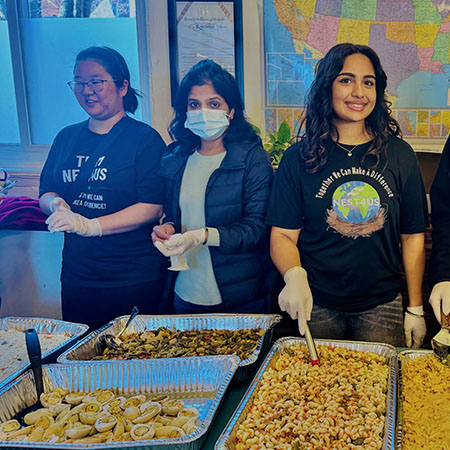
RIA RAJESH (RIGHT) SERVES THANKSGIVING MEALS TO COMMUNITY MEMBERS AT GEORGETOWN MINISTRY CENTER DURING THE NEST4US THANKSGIVING LUNCHEON. /COURTESY RIA RAJESH
What inspired you to get started with this initiative?
Growing up, I saw a lot of families, especially in my community, struggling with food insecurity, and it’s a hard thing to watch. I’ve always loved helping people and seeing how prevalent it was throughout my local community, I knew that I had to do something about it. Nest4Us and other nonprofits gave me a way to take action on those issues and helped me channel that passion and those feelings that I had. Once you start showing up for your community, and you get to interact and see how your actions have such a positive impact on others, it’s an amazing feeling. I never really wanted to stop after that.
What inspires you to volunteer?
When I look at it from a larger picture, at the end of the day, we are all human. All we have is each other. We need to be there for one another to uplift each other and to be a community. That’s so important to me, community, because a support system can really help a person. It can take them so far in life, and I want to be there, to be that support system for others. And if it’s in my capability to help others, I want to do the most I can, because we have to be there for each other.
Tell us about your volunteer role with Nest4Us.
During the COVID-19 pandemic, I took on the role of the youth leader for Nest4Us for the Maryland chapter. I mainly focused on publicizing these initiatives to students at local middle schools, elementary schools and high schools. I also serve as the Panera Food Rescue lead, and we collect excess goods and pastries that are produced by the company and redistribute them to local shelters and food banks. Currently, as a Maryland youth lead, I do a lot of book donations and pick-ups. I aid in supervising the food rescues and meal packing events in Maryland, while engaging in DC and Virginia service projects.
I also founded and am the president of the Nest4Us club at Clarksburg High School, where I lead a team of five members and supervise and organize projects for 40 club members. We do a multitude of projects, ranging from notes of encouragement and kindness to motivation posters for students during testing season to assembling mealtime inspiration kits. We have also hosted various drives through the school club.
What’s been the most rewarding part of your work?
I’ve always loved the in-person kinds of community service, like luncheons and hands-on distributions of the packages that we assemble and the meals that we cook, because being able to see someone’s face light up from an action that you’ve done is such an unforgettable moment and feeling. The conversations that I’ve had with the people that I’ve served are most notable to me. At the end of the day, when you finish your community service, and you’re sitting down, it’s that feeling of warmth and those genuine connections and moments that you’ve created that really last beyond the hours that you may have logged or the quantity of meals that you cooked or packed. It really emphasizes why community is so important.
What have you learned through your experiences as a volunteer?
A real impact doesn’t have to be grand gestures. It can be something as simple as giving someone a smile in the hallway or writing a note filled with words of kindness and encouragement, and it’s brought me back to this point that community is just so important, and building relationships can really go far. We all think about empathy in a certain light, but being at the forefront of volunteering and community service has taught me that it can go so much deeper than just a word or an action. It can have a ripple effect.
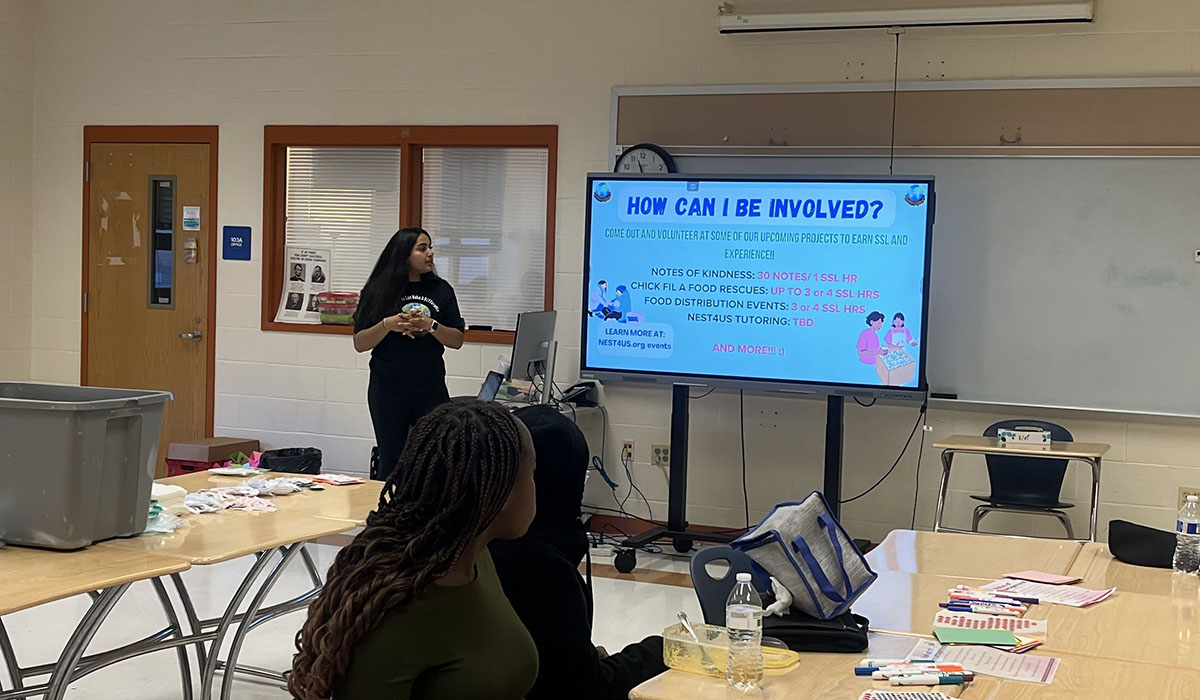
NEST4US VOLUNTEER RIA RAJESH LEADS A MEALTIME INSPIRATION KITS AND KINDNESS NOTE-WRITING SERVICE PROJECT AS HER SCHOOL’S CLUB PRESIDENT. /COURTESY RIA RAJESH
Why is it important for others to get involved with causes they care about?
I honestly believe that waiting for someone else to address issues that you’re passionate about just won’t work. If we all waited for others to take action on the things that we’re passionate about, then we wouldn’t be moving forward as quickly as we do. When I think about my experience, I started volunteering at the age of 6, but I knew that I wanted to be a person who was there for those around me, and that was all I needed to take action to the best of my ability. I feel like experience or age shouldn’t restrict someone from wanting to make a difference.
Any advice for people who want to start volunteering?
It can be just as simple as giving someone a smile in the hallway. Starting small really makes a big impact. We do a lot of notes of kindness projects and small packing projects. I feel like slowly integrating yourself into community service-related groups in your community. If you’re a student, slowly joining clubs that align with your volunteer goals and being exposed to those different communities and initiatives can help you see what type of impact you want to make. Maybe you want to start your own nonprofit and branch off from there, or maybe you want to continue volunteering with certain organizations or certain groups of people. But starting small really helps, because all it takes is one second.
What do you want people to learn from your story?
If they want to make a change, don’t be afraid of barriers. I mentioned earlier that my age, or not having a title, might seem like a barrier. But if you really want to make an impact on your community, every single person can do it. You just have to want it enough.
Remote but Far-Reaching: Empowering Volunteer Leaders Nationwide
Meet Daily Point of Light Award honoree Tonya Ackley. Read her story, and nominate an outstanding volunteer or family as a Daily Point of Light.
While most people think of volunteering as an in-person activity, remote activities can be equally impactful and convenient to participate in. Forty-eight-year-old Tonya Ackley has been a remote administrative volunteer with the Association of Leaders in Volunteer Engagement (AL!VE) since February 2025. AL!VE supports volunteer engagement professionals across the US with professional development, peer connection, advocacy and shared resources needed to succeed.
Tonya’s dedication to research has uncovered funding sources, nearly 100 chances for the executive director to speak and more than 95 recognition opportunities for volunteers. She has been instrumental in getting the word out about the organization and a vital part of building out the organization’s infrastructure and helping the new executive director transition into her role.
Prior to her work with AL!VE, Tonya served as a community-engaged learning assistant at Buffalo State University for three and a half years. She was also the director of community engagement at the University of Pittsburgh at Bradford for a decade and has always had a passion for working with college students. Her other roles have been in career services, residence life and academic advising. When she’s not researching, Tonya finds peaceful hobbies to enjoy like gardening and listening to audiobooks with her 19-year-old cat Linus or spending time with her husband of nearly 20 years.
What inspires you to volunteer?
It’s knowing that even small impacts can make a larger impact. It strengthens your purpose to feel useful and contribute positively to your community. I’m currently volunteering with AL!VE, but I’ve been on a regional board of directors for the American Red Cross for five years. And, since my freshman year of college, I’ve been involved with organizations that support survivors of domestic violence and sexual assault.
Most recently, I was on the YWCA victims’ resource advisory board. And I was an advisor for the Pitt Bradford chapter of Habitat for Humanity. As a big cat-lover, I’ve also fostered cats to keep them out of the shelters. Now my focus is AL!VE.
Tonya Ackley, longtime volunteer for AL!VE, provides pivotal research and coordinates projects for the organization.
Tell us about your volunteer role with the Association of Leaders in Volunteer Engagement.
I work on a variety of research projects to help them meet their strategic goals. I’ve researched colleges and universities that offer nonprofit management graduate programs as a way to promote internships and volunteer opportunities with the organization. I’ve researched nonprofit podcasts centered around volunteer engagement so that AL!VE might connect and spread awareness of the organization. And I looked into potential sponsors for the annual national conference that was just held in March. The focus varies.
It can be a challenge trying to find different ways to search for information. You have to dig a little deeper and find creative ways to see if you can discover something new. I’ve also started training on how to manage the general email account for the organization.
What inspired you to get started with this initiative?
They put the call out for volunteers. I thought it was interesting that you can volunteer for a professional development organization. It aligned with my career interests. I’ve valued those who work in volunteer engagement throughout my time in community engagement, and working with nonprofit community partners has always been important to me. The fact that they provide professional development, resources and support while advocating for people who work in the field impressed me.
What are your long-term plans or goals for the organization?
I got a certificate in human resources in December 2023 and I haven’t worked in that area yet. Our executive director was able to get me connected to the HR and Policy Committee, so I’m hoping to contribute in that capacity as well.
What’s been the most rewarding part of your work?
It’s been Nicole Smith, our executive director. She’s been very positive and a supportive mentor. I’m really grateful to serve as a volunteer with AL!VE, and I feel like they’ve helped me more than I’ve helped them. It means a lot to me to be a part of something bigger and have the capacity to positively impact other volunteer engagement professionals across the country.
What have you learned through your experiences as a volunteer?
From a practical perspective, I learned to use Excel. That has been important. AL!VE is unique in that there are not a lot of professional organizations designed to support volunteer engagement professionals.
Do you have any tips for organizations looking to attract and keep volunteers by giving them a good experience?
Marketing and communication are important, especially through social media. Promoting opportunities far and wide increases the chance of connecting with those who are a good fit. From my perspective working in higher education, getting to know your community partners and having conversations about shared priorities and how you might be able to work with them are also key. And lastly, recognize your volunteers. Make sure they feel appreciated and see the impact of their service.
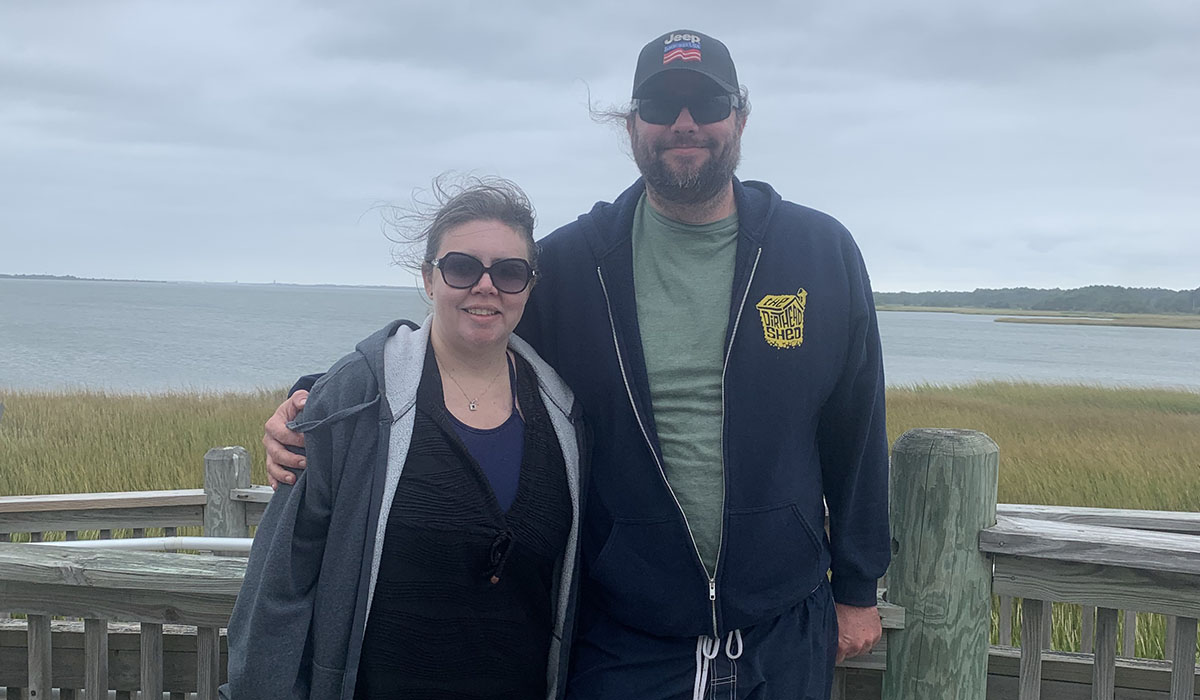
Tonya and her husband, Ryan, visit Chincoteague, VA.
Why is it important for others to get involved with causes they care about?
It’s important to have a sense of the broader community and your place in that. From working with college students, I’ve seen it help them recognize their passions and talents and show them how they can use those to make a positive impact.
Any advice for people who want to start volunteering?
I started with something small. My family decided to participate in a walk for multiple sclerosis. That was my first exposure to volunteering. Pick something–maybe a one-time experience–to get your feet wet before committing to something for longer. Then, think about other opportunities available that align with your passion and interests.
What do you want people to learn from your story?
AL!VE is a great way to get involved for volunteer engagement professionals, but there are also internships available to college students and community members who just want to expand their skill set. Whether you want to intern or volunteer, there are opportunities. Join us!
Meet Daily Point of Light Award honoree Bettina Lee. Read her story, and nominate an outstanding volunteer or family as a Daily Point of Light.
In January 2025, the Palisades Wildfire devastated Southern California. Beyond the destruction of land and impact to communities, it also exposed the severe health risks faced by those living in the nation’s most wildfire-prone region. Recognizing that firefighters, in particular, are chronically exposed to respiratory carcinogens, local high school student Bettina Lee took action by establishing Project Pulmonary. As the founder and executive director, she focuses on providing pulmonary rehabilitation and long-term health resources to fire crews.
Bettina’s work addresses the immediate physical needs of these first responders, while also advocating for proactive lung health management. She’s received more than $25,000 in funding to install detoxification saunas at fire stations, allowing firefighters to remove toxins from their systems post-exposure. Additionally, she has managed nationwide hydration drives that distributed over 13,000 items, including water and sugar-free electrolyte packets, to crews in the field.
Bettina coordinates directly with fire departments to ensure that all donated resources and equipment align with the specific operational needs of each station. The organization also prioritizes community engagement and mental health through the Letters for Lungs initiative, which saw 400 volunteers write and deliver more than 2,000 handwritten cards to over 120 stations in Southern California. These messages provide community support while specifically encouraging firefighters to seek regular lung cancer screenings. To date, these efforts have reached more than 10,000 firefighters across 200 different stations.
Project Pulmonary continues its influence through legislative and public advocacy. Bettina has partnered with two legislators and hosted booths at major events with a combined attendance of 12,000 people, to raise awareness for respiratory safety. Through social media and local business partnerships, she has built a network of chapters that provide recovery resources to over 1,200 firefighters. Read on to hear more of her inspiring story.
Tell us about your volunteer role.
I’m the founder and executive director of Project Pulmonary, a youth-led 501(c)(3) nonprofit dedicated to protecting the long-term respiratory health of firefighters in wildfire-prone communities. My role looks different every single day. One afternoon I might be coordinating a hydration drive across multiple fire stations, and the next I am sitting across from a legislator trying to convince them to fund detoxification sauna installations. I write the grant proposals, manage our chapter network spanning 15+ states, run our social media and show up to every fire station visit personally. It is a lot for one person, but honestly, I would not have it any other way.
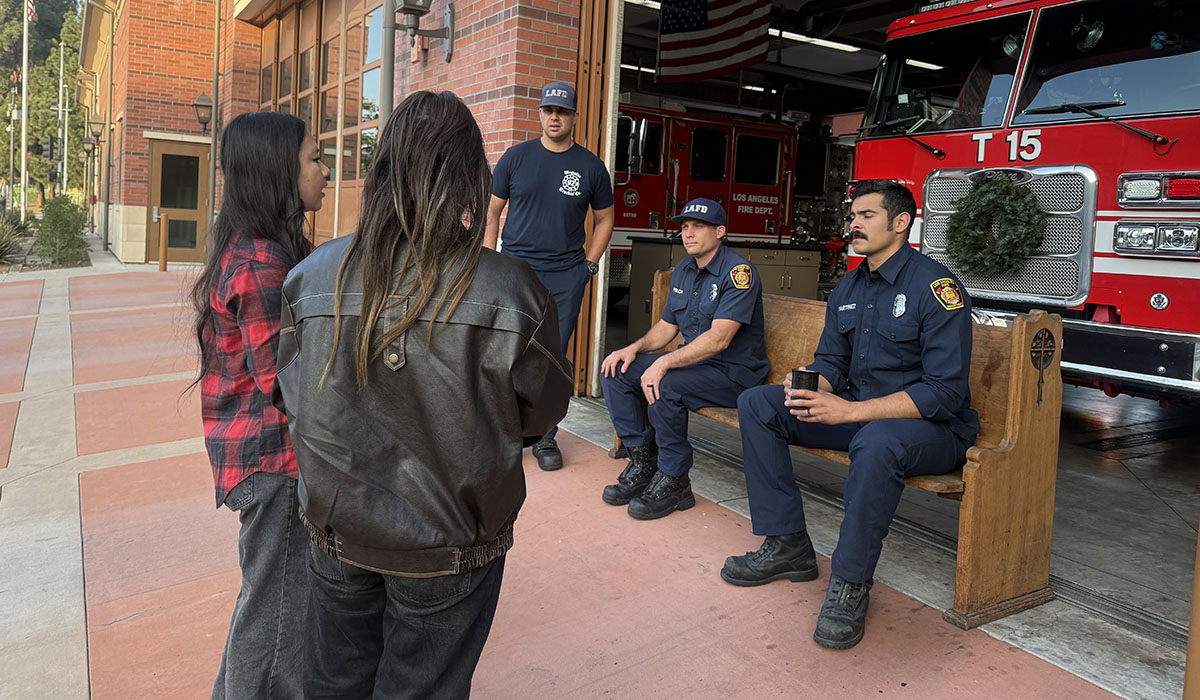
A fire station visit with LAFD for Letters4Lungs holiday donation.
What inspired you to get started with this initiative?
When I was 8 years old, my house caught on fire. I remember the heat and the panic, and then a 6’4” firefighter ran into my home and carried me out without hesitation. He did not know me. He did not stop to think about the risk. He just came in and got me out.
Years later, watching my grandfather lose his battle with lung cancer while simultaneously learning about the carcinogenic realities of wildfire smoke, everything clicked. I realized that the same people who had saved my life were quietly being failed by the systems meant to protect them. I felt a moral responsibility to do something about it, and so Project Pulmonary was born.
Why is this issue so important to you?
Because I’ve seen what it looks like when it’s too late. My grandfather was diagnosed with terminal non-small cell lung cancer, and I held his hand as he slipped away. That is not something you forget. Living in Rancho Cucamonga, at the base of the San Gabriel Mountains, wildfire smoke is not an abstract concept for me. It’s the air I breathe. It is the orange sky I watched swallow my neighborhood during the Palisades Wildfire. Knowing that the firefighters who run toward those flames are quietly accumulating carcinogens in their lungs with every deployment, and that most of them will not find out until the damage is irreversible, is something I simply cannot sit with and do nothing about.
What are your long-term plans or goals for the organization?
My long-term vision for Project Pulmonary is to make prophylactic pulmonary care a standard part of firefighter protocol nationwide, not an afterthought. Right now we’re operating across 30+ chapters in 15+ states, but I want every wildfire-prone community in the country to have a chapter actively advocating for their local firefighters.
Beyond expansion, I want to push for policy change at the federal level that mandates post-exposure rehabilitation resources like detoxification saunas and PPE washers in every fire station. I also want to continue developing our educational outreach so that the next generation grows up understanding that lung cancer screening is not optional, it is preventative.
What’s been the most rewarding part of your work?
Honestly, it’s the small moments that hit hardest. It’s a firefighter telling you that nobody had ever brought them LiquidIV before and asking where we had been all these years. It’s an elementary schooler running up to you after Letters4Lungs to tell you they told their parents about lung cancer screening at dinner. It’s a station captain shaking your hand and saying he shared our letter with his entire crew. None of those moments make the news, but they are the reason I keep going. Every single one of them reminds me that this work is reaching people, and that it matters.
What have you learned through your experiences volunteering?
I have learned that good intentions mean nothing without precision. When we first started our hydration drives, donation bins filled up with bottled water because that is what people defaulted to. But fire stations already had water. What they needed was electrolyte replenishment, something most donors had never even considered. That experience completely changed how I approached service. I stopped asking what I wanted to give and started asking what people actually needed. I also learned that persistence is everything. Navigating fire district hierarchies, legislative review cycles and county procurement processes as a 17-year-old is not easy, but every closed door taught me how to find a window.
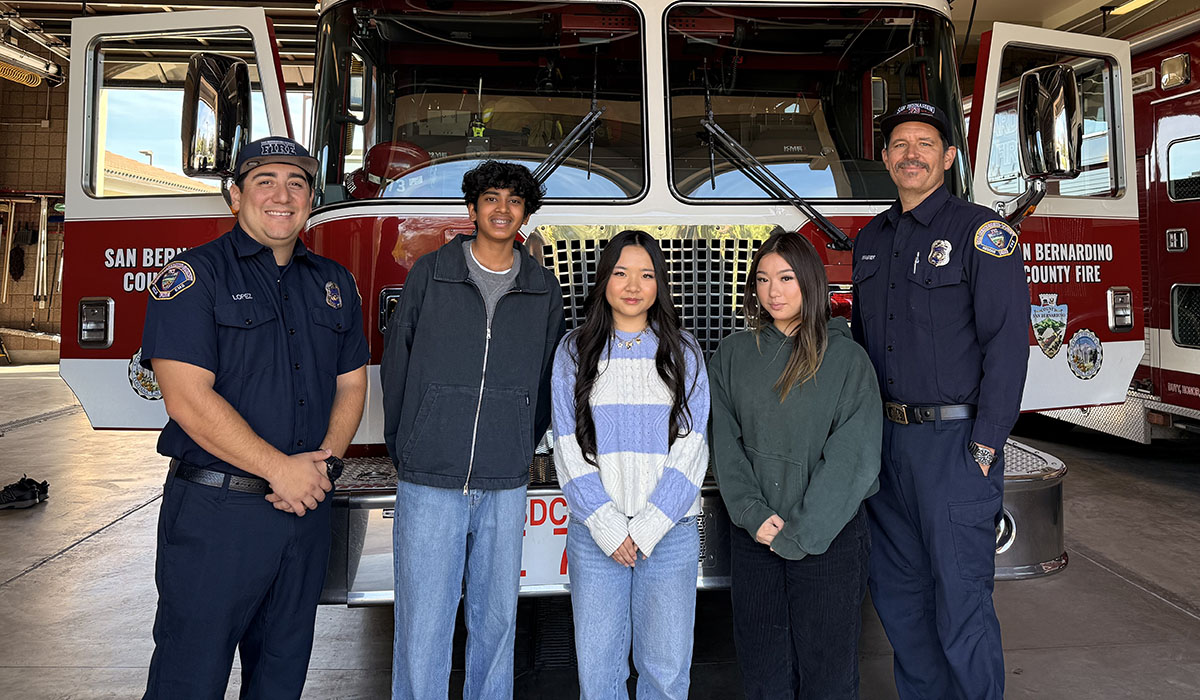
A fire station visit with Station 71 in Fontana Fire District for hydration drive donation.
Why is it important for others to get involved with causes they care about?
Because waiting for someone else to fix the problem is how the problem never gets fixed. I think a lot of people assume that change is something that happens to communities rather than something communities create. But every single initiative within Project Pulmonary started with one person deciding that the gap they saw was worth closing. You don’t have to have all the answers or a perfect plan. You just have to care enough to start. And once you start, you realize pretty quickly that there are so many other people who care just as much and were waiting for someone to take the first step.
Any advice for people who want to start volunteering?
Start before you feel ready, because you will never feel ready. When I founded Project Pulmonary, I was a 5’1” high schooler walking into fire stations and legislative offices trying to convince professionals twice my age and twice my height to trust me. It was intimidating every single time. But I showed up anyway, and I kept showing up, and eventually the trust came.
Find something that genuinely breaks your heart, because that heartbreak is what will keep you going on the days when progress feels invisible. And do not underestimate the power of being young. People expect less from you, which means that every time you exceed those expectations, you leave a lasting impression.
Meet Daily Point of Light Award honoree Yingman Tang. Read her story, and nominate an outstanding volunteer or family as a Daily Point of Light.
Yingman Tang is a 28-year-old Chinese PhD student at University of Illinois at Urbana-Champaign (UIUC). After earning her master’s in lighting design for theater, she is now researching AI and theater with a minor focus in Chinese-American theater.
As an only child and the first in her family to go to college, her high-level educational pursuits are especially meaningful. Her time in the U.S. has been productive outside of her studies, too, learning about how American culture vary as she explores different states on school breaks.
Yingman’s interest in cultural pursuits include that of her own as well. Recently finishing her term as president of the Chinese American Association of Central Illinois (CAACI)—the first student to hold the position—she now serves as president emeritus and strategic advisor. This well-regarded group has been organizing Chinese cultural, educational and civic events for 25 years.
In her role, Yingman builds bridges between Americans and their foreign-born neighbors as well as connecting the large Asian—particularly Chinese population—through things like holiday celebrations, educational opportunities and artistic performances. Whether connecting with their cultural roots or learning something new, both students and residents are delighted.
Through her 50 to 60 monthly volunteer hours, Yingman also helped secure CAACI’s first-ever $2,000 Urbana Arts Grant which expanded the organization’s programming. After graduation, she hopes to find a teaching role at a university and share her knowledge with students in pursuit of their goals.
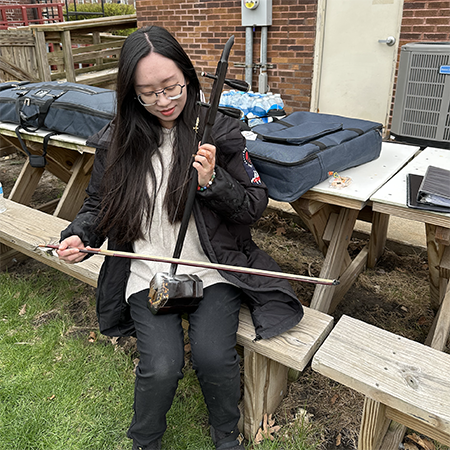
Yingman plays the erhu at an event she organized called “Get to Know Traditional Chinese Fold Music.” During the event, audience members were invited to explore and try different traditional instruments and experience the unique sounds they produce.
What inspires you to get started with this initiative?
As an international student, I’ve experienced how difficult it can be to feel connected in a new environment. Immigrants, international residents and students don’t always have access to cultural resources. They miss their hometown but may lack the information to connect, not just to Americans, but to those who share their cultural background.
CAACI organizes events and tries to help people. For example, we’ll do a Chinese Lunar New Year celebration. A lot of people look forward to it because they can’t go home. They feel isolated. Through that event, they meet friends from their native country and celebrate together. They eat food and share stories. That’s meaningful. It inspires me to create spaces where people feel supported, informed and culturally connected.
Tell us about your volunteer role with the Chinese American Association of Central Illinois.
My role isn’t huge, but there are a lot of details. When I host an event, I first look for the venue and negotiate the date and rental fee. Then, we find funding by reaching out to businesses. And I negotiate with the performers or musicians, etc. There are a lot of behind-the-scenes aspects to discuss.
We’ll have one or two events per month, and we have annual events like the Chinese Lunar New Year Festival, the Dragon Board Festival and the Mid-Autumn Festival. They’re the biggest festivals in China. Last week, our organization partnered with the Jasmine Field Orchestra, to host an event called “Get to Know Traditional Chinese Folk Music.” Families could come and bring their kids. We’re trying to find any opportunity to show how wonderful Chinese culture is, to let the city remember us.
Many events I’ve held were because of feedback from residents. For example, I invited students from UIUC to an event to share their academic experiences and their future careers. I’d heard from one of the homestay moms who is an immigrant herself, unfamiliar with the US education system. She asked if I could help parents help their kids find out about majors.
I also contribute to broader community engagement and cross-cultural understanding. I was invited to provide suggestions to the mayor of Champaign before her trip to China. I shared perspectives on cultural context and communication to support a more informed and respectful exchange. After her return, I helped organize a community conversation where she shared her experience with local residents.
What has been your favorite event?
My favorite is the Chinese Lunar New Year event. It’s the biggest event that CAACI hosts with 400 to 500 attendees this February. I enjoy hearing the applause from the crowd, especially when the show ends. I can see the artists smile. When other people are happy, it makes me happy.
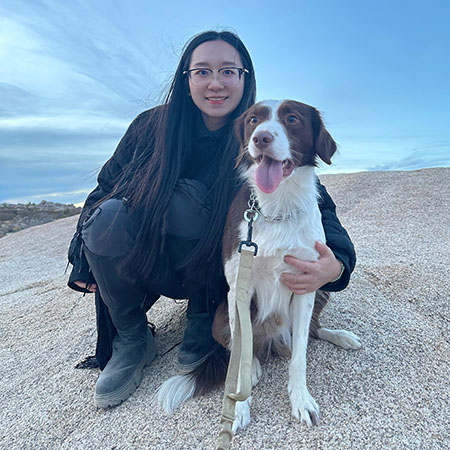
Yingman Tang studies theater and explores American culture with her dog Boshi, the Chinese word for a doctoral degree.
What are your long-term plans or goals for the organization?
We’re trying to build a platform to sell used goods. Many students don’t have enough money to buy new stuff when they move in but don’t have a trusted platform to buy used.
Additionally, not everyone can afford to eat at a restaurant, but restaurants throw away food at night because they only want to sell fresh items the next day. We think it might help both students and restaurants to ask the latter to sell food to students that would otherwise be wasted for a low price. So, we’re trying to build an application to facilitate that. The plan is to have it ready by the end of summer break.
What have you learned through your experiences as a volunteer?
I didn’t know there were so many needs from local people. Not just students, but moms. They aren’t familiar with the American educational system. And right now, politics are chaotic. People are worried about their visas and about speaking publicly about the relationship between China and America.
People have questions, but they don’t know who can help. Once I stepped into the role, I became the helper. No matter who you are, you can find me.
Tell us about future partnerships, programs or events that you are excited about.
The Mid-Autumn Festival is in September or October. I spoke with a local who wants to share Chinese tea and the clothing called Qipao, which originated in the Qing Dynasty. She wants to showcase them, so I’m helping with that.
What do you want people to learn from your story?
Help people. Even small actions can make a difference. I organize events. It’s not a huge thing, but it’s meaningful. What matters most is being willing to take the first step and stay committed.
Do you want to make a difference in your community like Yingman? Find local volunteer opportunities.
California Teen Dedicates Hundreds of Hours to Literacy
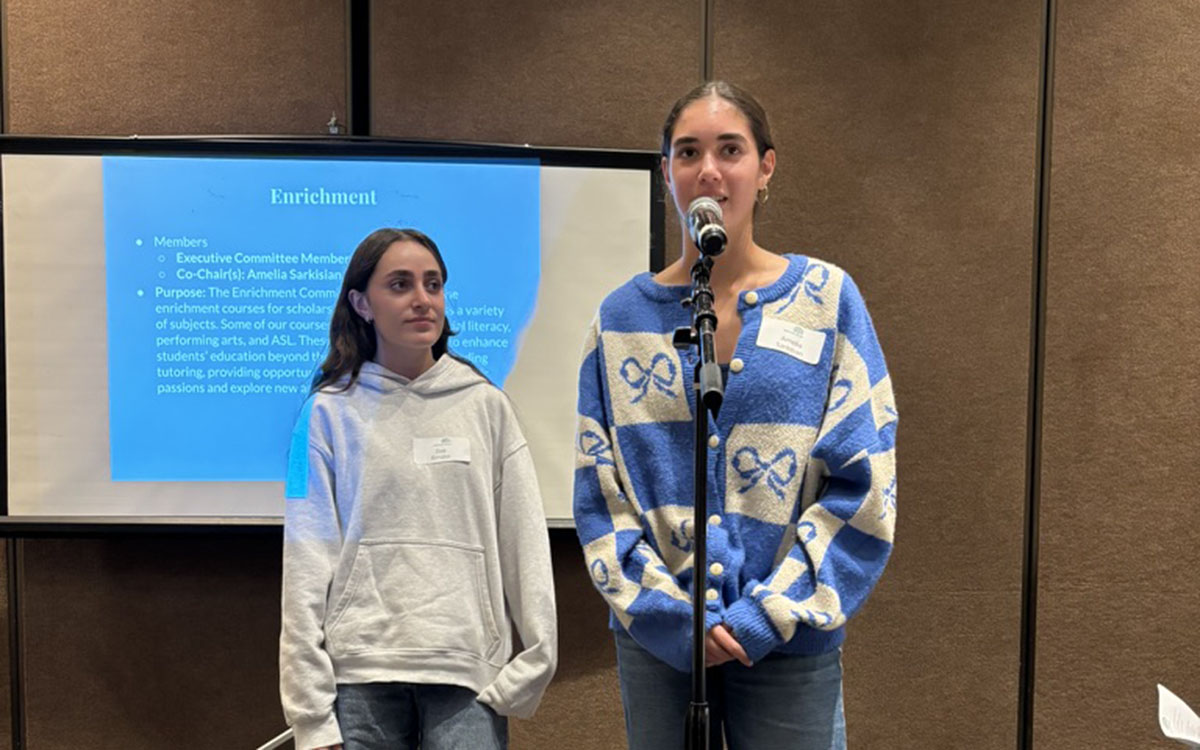
Meet Daily Point of Light Award honoree Amelia Sarkisian. Read her story, and nominate an outstanding volunteer or family as a Daily Point of Light.
Growing up as the child and grandchild of teachers, Amelia Sarkisian learned early that education has the power to change lives. It’s a lesson that has stuck and one she has spent the past three years putting into practice.
When the Los Angeles 11th grader arrived at high school and discovered Wise Readers to Leaders (WRTL) — a nonprofit that runs literacy programs for students from under-resourced Title I schools — she didn’t hesitate. Three years and more than 260 hours later, she has become one of the organization’s most invested teen volunteers.
Amelia tutors a third-grade student one-on-one each week throughout the school year, assists in a classroom of 40 second and third graders every summer, and co-chairs the Teen Board’s Enrichment Committee, where she oversees 37 high schoolers as they design and teach virtual enrichment courses — everything from coding to performing arts to journalism — to kindergarten through eighth grade scholars.
Back at her own school, she founded and runs a 13-member WRTL club, collected more than 600 donated books for the organization and launched the first city-wide Los Angeles Student Service Leadership Summit, bringing together 60 students from five high schools to share best practices in community service.
What first got you interested in Wise Readers to Leaders?
I’ve always loved reading — it’s been a big part of my life growing up. But when I used to go with my sister to read books to preschoolers at a child development center, I noticed how some of them couldn’t sit through an entire book. That really worried me, honestly. When I got to high school and found out about Wise Readers to Leaders, I knew it would be a perfect opportunity to keep working on the literacy gap.
Can you describe the different roles you have with the organization?
On the Teen Board, I co-chair the Enrichment Committee, overseeing 37 high schoolers who design and teach their own Zoom classes throughout the year to the same kids in the summer program — kindergarteners through eighth graders. We each teach whatever we’re passionate about, so I run a computer science class while others teach performing arts, journalism, architecture, ASL, fitness and nutrition to name a few. Through all of it, over 100 scholars have had the chance to explore subjects their families typically can’t afford to provide outside of school.
I also tutor a third grader named David one-on-one every week throughout the school year, and each summer I work as a Junior Literacy Leader in a classroom of 40 second and third graders. And at my school, I founded a WRTL club — now 13 members strong — where we recruit volunteers, run book drives, and spread awareness about the organization’s work.
As the WRTL Teen Board’s Enrichment Committee co-chair, Amelia introduces the committee’s mission to new members./ Courtesy Amelia Sarkisian
How do you make reading fun for kids who might be reluctant or struggling?
The most important thing is just acting like you love it yourself. I find that the scholars really look up to us as teens, so if we’re excited to read the next chapter, they’re going to want to be too. I also try to add game-like elements — we do a lot of Kahoot for comprehension at the end of chapters. And it’s not just reading the whole time. We’ll stop and talk about the story. For instance, would you have made the same choice as the character? Making it interactive is the best way I know to get them to love it.
Do you have a specific memory of a student having a breakthrough moment?
Last summer I was helping in a second and third grade classroom, and the teacher offered a little duck toy as a prize for whoever wrote the most sentences in their journal. Two girls in the class got so excited and really wanted that prize. They wrote so many sentences as I was helping them with the grammar and punctuation. But when journal time ended, they both begged to keep going. They wrote through lunch.
They gave up their recess. Just to keep writing and make sure everything was right.
What struck me was that at the start of the summer, a lot of those kids had been really reluctant to write at all because they didn’t have the confidence. And here these two were, giving up their free time because they wanted to. Seeing that transformation made me realize what we’re doing actually matters.
Tell us about David, your one-on-one tutoring student.
The biggest change I’ve seen in him is his confidence. At the beginning, he was really shy and we would take turns reading because he wasn’t sure of himself. Now we’ve actually moved into a fourth-grade book because he was flying through the third-grade ones so fast. We started with the Magic Tree House series because he loved those, and now we’re reading a new book from the suggested reading list. He tells me about his favorite books and gets excited to keep going. Honestly, we’ve become great friends.
You also launched the first LA Student Service Leadership Summit. What was that like to organize?
I had attended the Educators’ Consortium for Service Learning the year before and was really inspired by the keynote speaker, Cathy Berger Kaye, and the way she talked about community engagement. So we invited her back and brought together students from five different high schools in the LA area for a workshop day.
We learned about best practices for leading service clubs and what it means to be a good leader. But the biggest takeaway was this perspective shift — that service isn’t about imposing help on someone who needs it, but about a real exchange of ideas between people. I think everyone left with something meaningful to bring back to their school and community.
What keeps you going when things get overwhelming?
Just knowing that what I’m doing is actually helping people and making a difference in their lives. The education these kids are getting can change the whole trajectory of where they go. And then there are those moments — like the girls at journal time, or David telling me he wants to keep reading. When I remember those, it’s not hard to show up again.
What advice would you give to a young person who wants to start volunteering?
Start with what you think is the most important issue you see around you. It shouldn’t feel forced — it should come from something genuine, maybe something connected to an academic interest or something you notice in your community. And don’t think it has to be something huge. Helping one kid learn to read is going to change his life. Just do whatever you can.
Providing Hope Through Difficult Medical Diagnoses
Meet Daily Point of Light Award honoree Bhavya Uppalapati. Read her story, and nominate an outstanding volunteer or family as a Daily Point of Light.
Most Americans, at some point, have run into difficulties navigating the complicated–and expensive–American healthcare system. Fourteen-year-old Bhavya Uppalapati has had a front row seat on how those challenges affect people already dealing with life-altering conditions.
For the last two years, Bhavya has been leading efforts to support, educate and advocate for families affected by rare conditions with the Rare Disease Council of America (RDCA), an organization she founded to empower patients and give families like hers a louder voice in health policy. As executive director, her advocacy on Capitol Hill and beyond has led to increased visibility for funding priorities and ways for young people to engage.
Bhavya has raised over $25,000 through grants, sponsorships, partnerships and individual donations. Her coalition spans 20+ countries and connects patient families, researchers and policymakers. The organization produces educational materials that not only help families understand conditions but navigate diagnoses and access care. And their op-eds bring attention to associated issues.
What inspires you to volunteer?
I’ve watched people struggle, not just because resources don’t exist, but because they don’t know where to find them or how to navigate systems. That gap between what’s available and what people need–or can actually use–motivates me. Volunteering gives me a way to contribute solutions instead of just recognizing problems.
Tell us about your volunteer role with the Rare Disease Council of America.
Early on, I was involved in almost every part of the work–outreach, writing policy and briefs, researching issues and trying to get meetings with anyone willing to listen. A lot of it was learning by doing.
As we’ve grown, I’ve been more focused on leadership and long-term direction. One of my main responsibilities is overseeing the development of policy briefings. That involves identifying key issues in rare disease access, conducting research and translating that into clear, actionable recommendations that can be shared with policymakers and global health organizations. I’ve delivered more than 78 briefings to congressional offices, federal agencies and international bodies like the World Health Organization and the World Bank.
Another important part of my role is acting as a bridge between groups by making policymakers aware of patient experiences and helping researchers understand where there are gaps in care. I also strategize on building our chapter structures, creating systems for research and collaboration, and mentoring new members. It’s important to ensure our growth is sustainable and that the work can continue as leadership transitions.
What inspired you to get started with this initiative?
The rare disease was never theoretical for me; it was part of how my family experienced the healthcare system. I saw how much time, energy and persistence it took to get basic answers, a diagnosis, a specialist familiar with the condition and access to treatment.
At 12, I didn’t have the language to describe policy gaps or structural issues. I just understood that families were constantly trying to navigate something incredibly complex without support and that many of the decisions affecting them were being made in spaces they didn’t have access to. Starting RDCA was a way to give patients and families a voice.
What’s been the most rewarding part of your work?
What stays with me the most are the personal impacts. One example is when a family used one of our diagnostic navigation guides to successfully challenge an insurance denial and get the therapy their child needed. That kind of outcome puts everything into perspective. The work isn’t theoretical; it’s directly affecting people’s lives.
What other types of education materials do you create?
We build broader patient advocacy toolkits that walk someone through things like how to prepare for an appointment with a specialist or document symptoms in a way that’s useful. We put together policy explainers that break down things like Medicaid coverage, prior authorization or newborn screening in a way that doesn’t require a policy background to understand.
Another piece is template-based resources that include sample appeal letters, outreach emails and documentation formats that people can adapt to their own situation. We’ve also started creating shorter formats like one-pages and quick reference sheets meant to be easy to use in high stress situations where someone doesn’t have time to read long documents.
What have you learned through your experiences as a volunteer?
Initially, I thought that if I did research and presented strong data, it would be enough to drive change. Eventually, I realized that impact equally depends on how you communicate an issue. You can have the right solution, but if it’s not framed in a way that fits the priorities of the person in the room, it ultimately won’t go anywhere.
Why is it important for others to get involved with causes they care about?
The issues people care about don’t move on their own. Without people pushing, asking questions and staying involved, a lot of problems just stay where they are. The people closest to an issue usually understand it best, and when they get involved, they bring perspective that you can’t get from reports or data alone.
How can people help this cause in their own area?
Start by learning, so you can contribute in a way that’s actually helpful, not just well-intentioned. Rare diseases are complex, and each one is different, but there are common challenges across the board.
The most useful thing you can do is directly support patients and families. That could mean volunteering with advocacy organizations, helping with outreach or just sharing reliable information. Many families are navigating this without clear guidance, so connecting someone to the right resources matters.
What do you want people to learn from your story?
You don’t need to wait for the right moment or the right credentials to do meaningful work. When I started the RDCA, I didn’t have a clear roadmap or prior experience in policy. What mattered was recognizing a problem and being willing to take the first step. With consistency, small steps can grow into something much larger. If you can build something that empowers others to contribute and lead, that’s where lasting change happens.
Making the Desert Beautiful for the Next Generation
Meet Daily Point of Light Award honoree Natalia Smith. Read her story, and nominate an outstanding volunteer or family as a Daily Point of Light.
Natalia Smith always loved to be outside. But a random email request from an organization looking for volunteers to work outdoors catapulted her life of service into high gear. Back in 2017, Natalia was at work in her professional role when Natural Restorations submitted a request for volunteers through her company portal. The organization works to remove trash and graffiti from outdoor recreation and wilderness areas, revitalize natural areas through replanting projects and enrich the lives of military veterans and other community members. After one day of participation, Natalia was hooked.
From picking up trash and debris to clearing away invasive species that grow after wildfires, Natalia got to better the world for the next generation while embracing her love of the great outdoors.
Natalia views her volunteer work as a way to lead by example and inspire others. While she originally saw picking up trash as something minimal, she describes it now as a drop of water that accumulates together and becomes something much larger. She also finds tremendous solace by investing in a strong work/life balance, since being in nature provides her with restorative benefits for the mind and body. She encourages anyone who finds that restorative feeling through volunteer work to pursue the pathway that provides it.
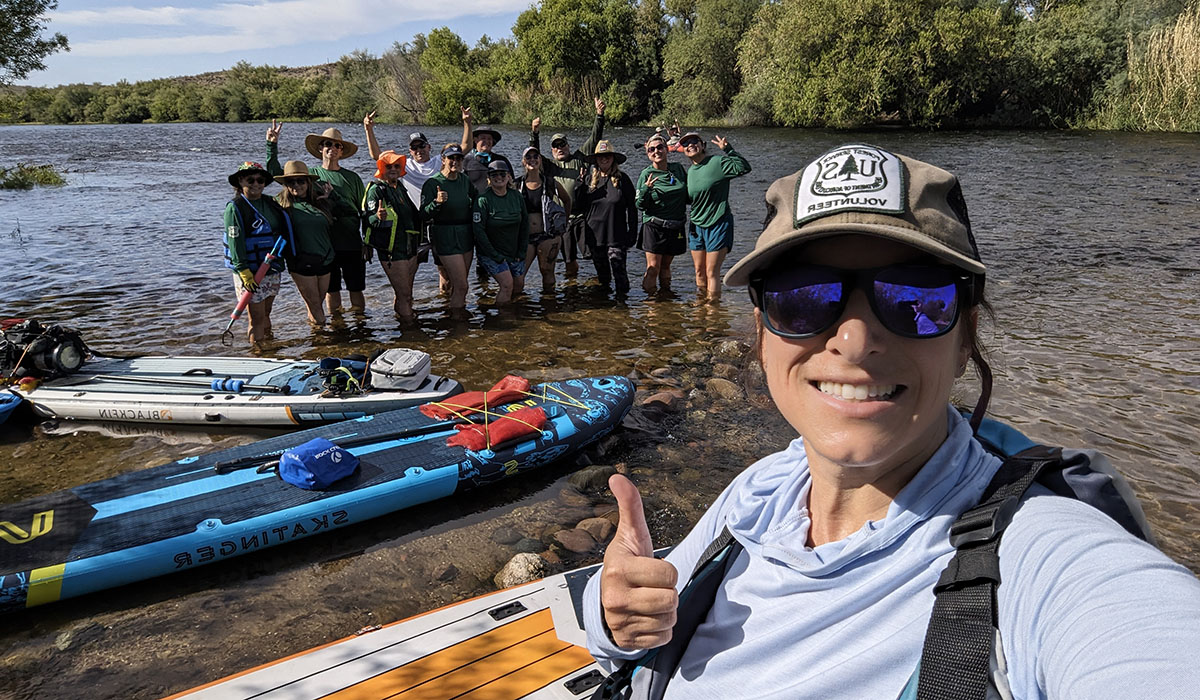
While Natalia has found great success in her volunteer work thus far, she’s only just getting started. After seven years as a volunteer, she’s hoping to get even more involved with Natural Restoration’s work by helping the organization fundraise and write new grants. She’s even expanded her sights beyond the organization, becoming a volunteer lead with the Tonto National Forest Mesa Ranger District. They have a River Rangers program, and in 2024 asked Natalia to lead their volunteer group. In that role, Natalia is literally guiding the next generation of environmental volunteers into action. Her experience is a strong example of just how far a volunteer can grow if they’re willing to step outside of their comfort zone.
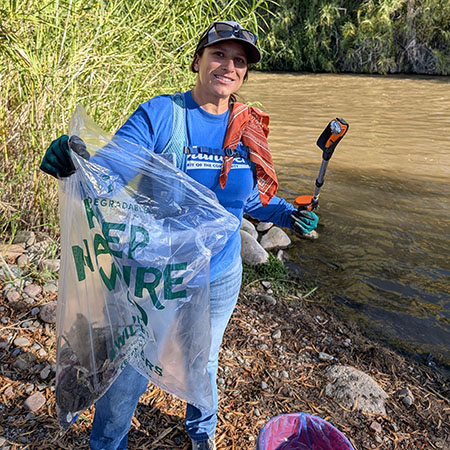
NATALIA SMITH, A VOLUNTEER WITH NATURAL RESTORATIONS, ASSISTS DURING A GREEN FRIDAY EVENT AFTER THANKSGIVING AT NEEDLE ROCK ON THE LOWER VERDE RIVER IN THE TONTO NATURAL FOREST. /COURTESY NATALIA SMITH
What inspired you to get started with this initiative?
Growing up, spending time outdoors with my family and friends was an inexpensive way to go out and have fun and explore the natural world around me. I’ve always enjoyed outdoor recreation, like hiking, biking, wildlife and being out in nature. I completed an environmental science degree in 2013 and started my environmental health and safety career at Salt River Project (SRP), where I work. I was looking for opportunities in my community that would match my passion for the environment and outdoor recreation and my skill set. Natural Restorations sent a request for volunteers through our company portal, and they did such a good job of organizing the event. It wasn’t completely 100% work. You still could listen to the birds and see the wildlife and make connections with other community members out there, but they were steadfast with the determination of getting these areas cleaned up and keeping them scenic and having an impact.
What inspires you to volunteer?
I think it just comes from the fact that I can. The tasks that I do aren’t really any more difficult than what I would do in my day-to-day life. Picking up trash seems like a dirty job, but it’s as simple as just seeing it there and taking care of it, and wanting to have some kind of positive impact. It’s the instant gratification of seeing an area that looked kind of messy beforehand. Just getting that stuff cleaned up, you turn around and see it’s so much better for the people that are going to come after you.
Tell us about your volunteer role with Natural Restorations.
We do a multitude of things. The bulk of what I do with natural restorations is go out to outdoor recreation areas, either public lands, state trust lands or natural forests, and clean up trash and debris. That is the main goal of what we do. We go in and clean up trash and debris that shouldn’t be there and should be out in dumpsters. We’ve also moved into doing invasive vegetation removal and replanting of native desert species like saguaro cactus in areas that have been scarred by human-caused wildfires on the forest service land. We’ll go in, clear an area of invasive, non-native grasses that would promote wildfire, and then we’ll plant native saguaro cactus.
Also, I do a lot of promotion with my company, SRP, so I try to encourage my coworkers to come out and join the volunteer events. I share my experience, like how my employer has a grant program that’s based on employee volunteer hours. Depending on how many hours I spend with that organization, I can get them grant funding to continue to support their mission of doing the cleanups and restoration.
What are your long-term plans or goals for the organization?
To get more involved. We’re in Arizona, so with this type of outdoor work, the limitations are always that the weather here gets pretty warm. I just always want to share their mission and support them, as well as engage with other folks in my community. I’d like to help them with their fundraising and educate the community, which is also part of what they do by making real positive differences and inspiring people to be good stewards of these areas that should be protected. We should pitch in and be responsible with outdoor ethics and how we go out and adventure, and make sure that we leave these areas in a condition that other people will enjoy for future generations.
What’s been the most rewarding part of your work?
I would say interacting with community members that may not be there for the event. Maybe they’re just out there doing their thing, fishing or whatever. They don’t know anything about it. But then they see us out there working, and they ask us what we’re doing, and they see that we’re just picking up trash and trying to tidy up the area, and they join in. With the right gloves, trash grabber and bags, they’re willing to jump in and help out. Of course, the kids are always my favorite, because they get to spend time with their family and friends and other youth volunteers that are out there. They get to see their peers out there doing the same thing, and I’m hoping that it inspires those future generations.
What have you learned through your experiences as a volunteer?
Changing conditions and adapting to challenges. We’re in an outdoor environment, so sometimes there’s weather, and sometimes there’s wildlife interactions. It can all change. Getting to interact with different members of my community, and being able to talk to them and engage them in a way that makes them want to join in, has been a good learning experience. I’ve had a lot of opportunities and now can network with additional organizations that have the same goals of environmental stewardship, ecosystem health and responsible recreation through these volunteer events.
NATALIA SMITH (RIGHT) LEADS VOLUNTEERS ON THE LOWER SALT RIVER AS THE VOLUNTEER LEAD FOR THE TONTO NATIONAL FOREST MESA RANGER DISTRICT RIVER RANGERS PROGRAM. /COURTESY NATALIA SMITH
Any advice for people who want to start volunteering?
There are lots of resources available. You can just go to Google and search. It was always intimidating for me initially. What could I do? I thought I didn’t have the experience, but there are a lot of organizations that are very welcoming to volunteers with varying skill sets. Then you find that organization that matches your passion. I find it very rewarding to have my work and then this other thing that I do, and sometimes they cross paths and mesh together. But I’ve also met a lot of really great people and built relationships and now friendships, and it’s all surrounding this positive impact on our community.
What do you want people to learn from your story?
There are lots of opportunities. Sometimes you just have to be the one to go out and initiate it. Take that first step. Reach out to your friends and family. Maybe the first one you choose isn’t the right one, but then you keep looking at other options and exploring your local municipalities or what your friends and family do. There’s likely an organization or nonprofit that could really use assistance and your skill set and another set of hands to help with the lifting and spreading the information and engagement with our community.