Meet Daily Point of Light Award honoree Elspeth Luu. Read her story, and nominate an outstanding volunteer or family as a Daily Point of Light.
Elspeth Luu, 18, is a long-time bicycling enthusiast. Experiencing the effects of climate change has also made her an advocate for sustainability. In 2022, Elspeth started Utmost Atmos in response to the California wildfires to promote sustainability, accessibility and environmental education. One of her signature programs launched by collecting bicycles local kids had outgrown or were no longer using.
She and her friends–and some of her 19-member team–refurbish and donate them along with often brand-new helmets. With a budget of over $22,000 thanks to donations and grants, they are able to purchase the tools needed to keep old bikes out of the landfill and make students who would otherwise be unable to afford them very happy. Funds also go towards environmental education in Title I schools.
When she’s not working on Utmost Atmos, Elspeth plays the cello with her school’s orchestra as well as the San Jose Youth Symphony and has written multiple pieces with lyrics following an environmental theme.
What inspired you to get started with this initiative?
One September morning, a wave of smoke filled my lungs as I stepped outside and an orange haze had settled over the sky, casting a glow over my backyard. Learning that this was fueled by wildfires intensified by climate change, I felt compelled to act. I started by meticulously separating my waste into recyclables, composting trash and swapping car rides for bike rides. But I realized it wasn’t a battle I could fight alone.
So, I gathered friends for weekly rides around the neighborhood that we called Cycle Saturdays, which eventually expanded to neighboring schools. I also noticed that some students in our community couldn’t afford bikes or helmets, and it sparked the idea to refurbish and donate secondhand bicycles to underserved youth to further promote both accessibility and sustainability.
Over several months, I worked on a grant proposal for this idea, eventually receiving $20,000 from the Silicon Valley Clean Energy Education Fund. With that funding, I put up flyers, reached out to my local church and knocked on doors to collect bicycles that families had outgrown. I recruited friends from school, orchestra and my neighborhood.
Together, we hosted Saturday repair shops, giving students from Title I schools safe, refurnished bikes. What started as a small project grew into Utmost Atmos, an organization dedicated to empowering youth to take action against climate change by hosting bicycle and helmet donation drives, leading safe riding workshops, organizing environmental art contests and visiting schools to talk about sustainability. Since its founding, our team has reached over 10,000 students across California.
I believe that one of the most impactful ways we can fight climate change is by educating youth. This is especially important for communities with fewer resources, as they are often the ones who contribute least to the factors of climate change, yet bear the greatest burden.
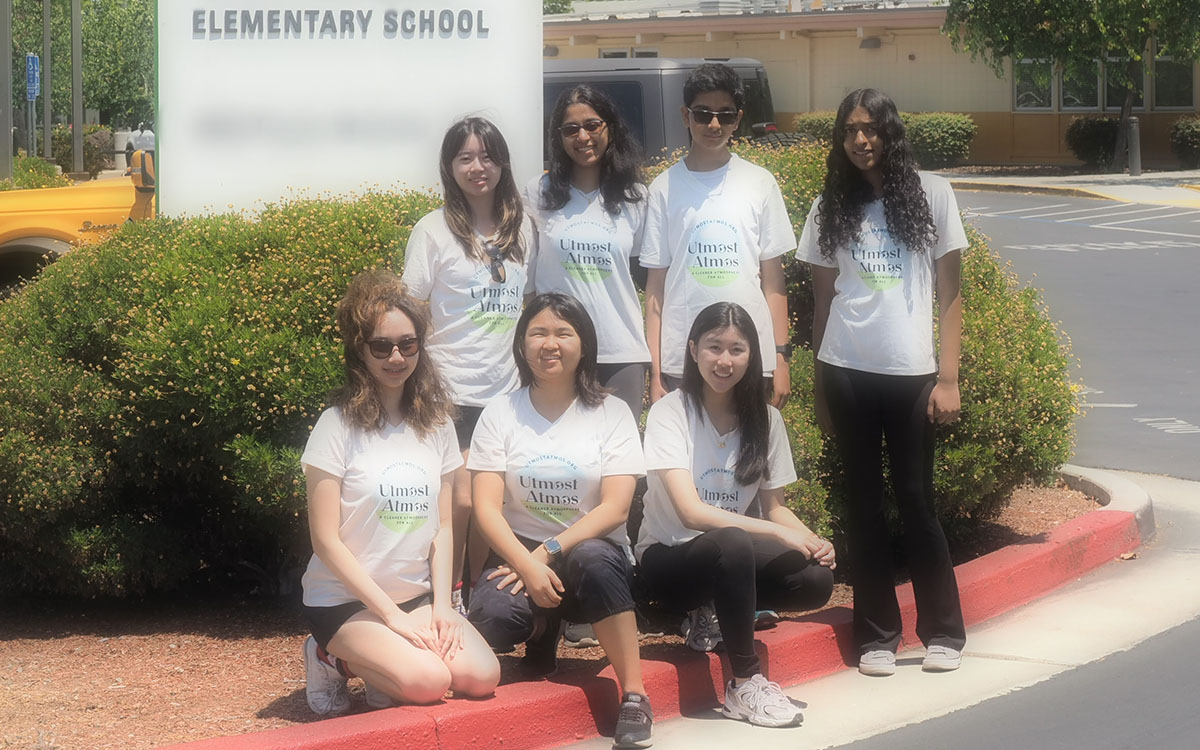
Elspeth Luu (back left), founder of Utmost Atmos, and team members meet up before a bicycle and helmet informational session and distribution events at an elementary school.
Tell us about your volunteer role with Utmost Atmos.
In my role as executive director, I write grant proposals, organize bicycle and helmet drives, lead sustainability visits to schools and generally, oversee our team. I coordinate partnerships and manage outreach as well.
For sustainability visits, we reach out to the school and ask if we can go in and present. It may be related to bicycling and bicycle safety or general environmental education, like what climate change is and what you can do to mitigate it.
One of the art competitions we did was the Canvas for Climate contest. Students submitted artwork relating to a prompt about climate change or a more general environmental concept they wanted to portray. For our current contest, the Earthlight Story Awards, elementary and middle school students will submit short stories, either a personal narrative or a work of fiction.
Refurbishing bicycles takes a lot of specialized knowledge. Is that something you’ve picked up through experience?
Yes. It’s a continual journey. I wouldn’t call myself an expert. We’ve had a lot of support from the community. One example is Mr. Tony Le who, the president of the Almaden Cycle Touring Club. He has a lot of knowledge and has connected us with some good resources.
What’s been the most rewarding part of your work?
Working with other passionate individuals to connect our community with environmental resources has made me value relationships over metrics: the smile of the 7-year-old girl whose helmet I fitted or the painting of a sixth grader entering our climate advocacy artwork competition. This is proof of what a team of students can accomplish together.
What have you learned through your experiences as a volunteer?
Growth starts small. It starts with an idea and, sometimes, asking for help. There will be times that feel less successful than others, but each step builds progress. Change is often slow, but it’s worth it to see the positive impact you’re making on other people’s lives.
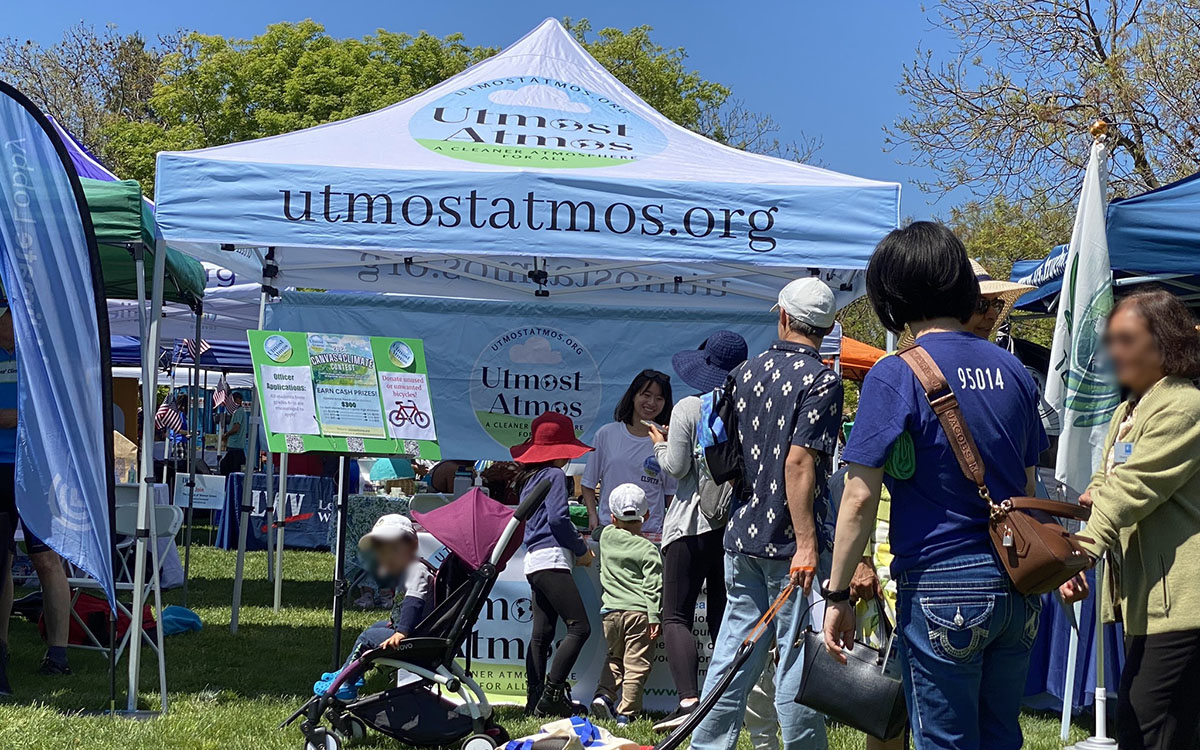
Elspeth promotes Utmost Atmos’ environmental initiatives to festival attendees.
Tell us about future partnerships, programs or events that you are excited about.
We’re currently working on the Earthlight Story Awards and would love more people to submit. We’re also working on a mobile app to promote climate literacy and environmental education. There are three parts to it. One is a gamified quiz, which helps users learn more about waste disposal. Another is an interactive map of different waste disposal locations. And the last part is a scholarship and opportunity database that we’ll be continually updating so students are aware of ways to get involved if they‘re passionate about the environment and sustainability.
Any advice for people who want to start volunteering?
Figure out what matters to you and why. If you care deeply about something, other people will see that, and they’ll care too.
What do you want people to learn from your story?
It doesn’t take a big person to create change, just a big imagination and the will to begin.
Meet Daily Point of Light Award honoree Maya Jones. Read her story, and nominate an outstanding volunteer or family as a Daily Point of Light.
Five years ago, in eighth grade, Maya Jones started volunteering with JaxTHRIVE. As the daughter of an immigrant, the idea of helping people who make the U.S. their adopted home adjust and feel welcome was an attractive mission. JaxTHRIVE supports refugee students in the transition to their new home with initiatives like financial literacy training and both virtual and in-person tutoring. While they consistently host around 40 students from the Jacksonville area, they’re always looking to welcome more students and volunteers.
Maya’s introduction to community service was through scouting. She has been in Scouts since middle school and, last year, became an Eagle Scout with a conservation education initiative designed to protect a local river. Given her lifelong love of sailing, protecting the water was personal. It’s where she and the varsity sailing team she co-captains spend much of their time. This fall, Maya will head to Dartmouth, where she plans to begin her path to medical school and, like her mother, become a doctor.
What inspires you to volunteer?
When scouting opened its doors to girls, I became one of the founding members of my troop. That was my entryway into community service. Through scouting, you have opportunities to do things like park cleanups and serve outdoor areas.
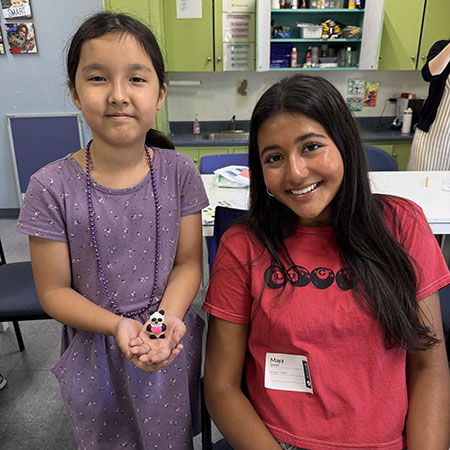
Maya Jones (right), co-president of JaxTHRIVE, helps a young refugee student with an art project at one of the organization’s weekly tutoring sessions.
Tell us about your volunteer role with JaxTHRIVE.
As co-president, I help galvanize over 150 volunteers from across 11 different high schools in Jacksonville. I do a lot of behind-the-scenes work, coordinating and making sure new volunteers know what to expect and what to do. On Super Saturdays, which are our in-person tutoring sessions, I usually welcome everyone and give a speech about what we do, who I am and my availability for questions. We divide students into three age groups and offer ESL, science, math and art instruction they can rotate through each week.
I’m also the founder and president of JaxTHRIVE at my high school. I essentially do the same thing there, but on a smaller scale. This year, I also started the EmpowHer initiative, which is our female empowerment chapter. It involved self-defense clinics, financial literacy workshops, a mind-body wellness clinic and a hygiene product drive. We also went to see the Barbie movie. We’ve increased our volunteer recruitment by 20% over the past year, mostly through word-of-mouth and by creating fun volunteering opportunities.
In many of the countries these students have come from, being a girl is hard. They deal with a lot of oppression. Learning more about our culture, embracing being a woman and getting to go to school, seems to help them adjust.
I also co-authored a children’s book last year, called Serena of Kandahar: An Afghan Girl’s Journey to Change the World. It’s a true story about a young refugee who came to the U.S. from Afghanistan. She was never involved in JaxThrive, but she’s helped us out a lot.
What inspired you to get started with this initiative?
The mission is meaningful to me, because my mom is an immigrant. She was born and raised in Mumbai, India and then decided to immigrate to the United States in her early twenties to continue studying. I can relate to how coming to this country can be a really unsettling process. JaxTHRIVE is all about making our students feel like they belong as they start their new life here.
What are your long-term plans or goals for the organization?
I think starting a JaxTHRIVE club at Dartmouth could be a really great opportunity, and we offer virtual tutoring, so they could be involved with that. I just hope to see the program grow and continue to flourish.
What’s been the most rewarding part of your work?
It’s watching students go from kids who can barely say a sentence in English without pausing or forgetting a word to fully conversing with them with enthusiasm and confidence. It’s amazing to see how fast they pick it up over the course of our tutoring sessions.
What have you learned through your experiences as a volunteer?
I’ve learned the importance of patience. It can be challenging not to jump right in, try to fix everything and make changes all at once. But if you’re a steady pillar of support for another person, over time, they’ll open up even more.
Tell us about future partnerships, programs or events that you are excited about.
We have some fun, camp-style activities planned for the summer. We’ll kick things off with a drive and ask volunteers to bring in summer reading books and different items–crayons, chalk, bubbles and fun things like that–for goodie bags for the kids.
Why is it important for others to get involved with causes they care about?
When you do something you’re passionate about, it takes form so much better than something your heart’s not in. I’ve seen the passion our volunteers have for working with these kids and how much they enjoy spending half of their Saturday with them.
Any advice for people who want to start volunteering?
In areas with higher refugee populations that don’t have resources like JaxThrive, it’s important to understand the barrier in language and culture. Be patient. This is a whole new world for them, and it’s important to be there to help with whatever they might need.
Often, our refugee students are put in a grade in their school based on age, not knowledge and skills. The education transition can be really difficult coming from one country to another. I think schools also should recognize that and be there to support them.
What do you want people to learn from your story?
It’s always easier to show kindness to someone than to ignore them. Often, our refugee students feel isolated. That’s a hard feeling at such a young age, to be so new to something and not be welcomed. I want people to learn to lead their life with love and kindness. We are all in it together, and that sense of community is so important. Spread love, not hatred.
Meet Daily Point of Light Award honorees Sumedha Rao and Sanvi Pandey. Read their story, and nominate an outstanding volunteer or family as a Daily Point of Light.
Sumedha Rao and Sanvi Pandey loved to read as children, and they want everyone to have that opportunity. During the COVID-19 pandemic, the duo was looking to do something positive for the community. Both high school students, they got the idea to start small. They began delivering books to children in hospitals and pediatric therapy centers. But with each book they delivered, Sumedha and Sanvi realized they possessed a world full of potential change.
Sumedha and Sanvi started gathering books off their own shelves, and even requested ones their friends, family and neighbors no longer wanted. They established The Bookmark Project, a student-led literacy initiative focused on expanding access to books for children in under-resourced communities. Along with a team of volunteers recruited from their classmates, the group continued to expand by leading book drives and partnering with schools, hospitals, therapy centers and libraries. Since then, they launched new chapters in Michigan and North Carolina and have collected and donated more than 41,500 books that have been sent as far as India and Uganda. The team’s international expansion is particularly exciting, as it has allowed The Bookmark Project to distribute books to children in a rural Indian village and support the construction of an Indian library so they can have their own space to learn and grow.
Sumedha and Sanvi’s work to encourage literacy across the globe exploded into a worldwide phenomenon. They’ve connected with community leaders and have been invited to speak about the importance of youth-led service. Still, the duo wants to make it clear that there’s nothing wrong with starting small and asking for help along the way. What began as a mission to help others find a bright light during a period of darkness evolved into a groundbreaking mission to comfort, educate and inspire children through the power of words. That journey is available to anyone ready to explore the world of volunteerism.
What inspired you to get started with this initiative?
Sumedha:We wanted to do something for the community. We know this was definitely a difficult time for a lot of people, especially with their mental health, and a lot of children were in the hospital. We wanted to do something small, so we collected books from our shelves and from our neighbors’ shelves and then donated them to a local hospital. We were seeing how much of an impact books can have on children, even though it was just a couple of books we donated. It just made it so meaningful to us. That’s why we continued growing it even further.
What inspires you to volunteer?
Sanvi:I think it’s very rewarding once you get into it. You meet a lot of different people and see a lot of different experiences that you aren’t exposed to in any other format. It also teaches you a lot about yourself, getting to help other people. It teaches you a lot about what’s important to you and what you value, which I think is just important to know and apply throughout your life. I think it makes you a better person because of what you learn, and by getting to interact with all different kinds of people.
Tell us about your volunteer role with The Bookmark Project?
Sumedha: Because we co-founded it at the beginning, it was just the two of us. We led a lot of the hands-on things, such as going to collect the books and then packing them, especially when it was smaller donations. Now we do a lot more leading of everyone else. We have volunteers who come in to help us with our book packing events. After we contact different libraries, bookstores and people willing to donate from schools or other places, we gather all those books, and then we contact places that want these books for donations. Once we get an idea of what they want, we get volunteers to come in to help us organize these books and get them ready to be shipped out. Now we have our team, and we have our roles divided within our team. We have different roles, like marketing, communications and just keeping track of the work and goals.
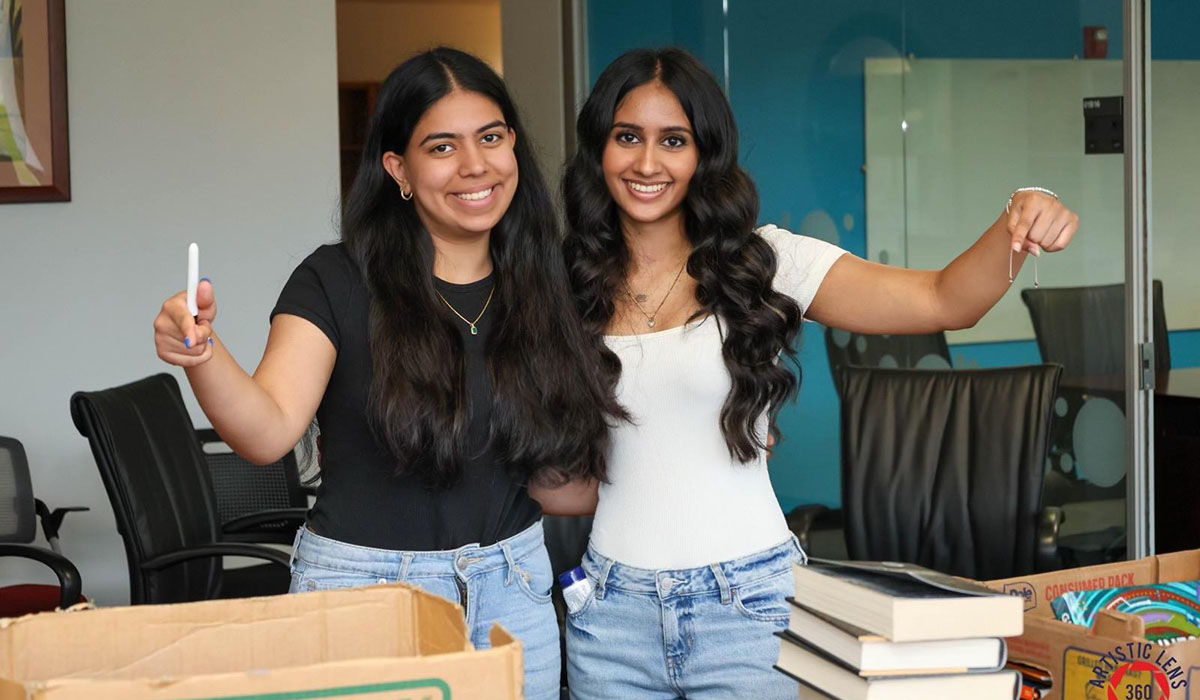
SUMEDHA (LEFT) AND SANVI (RIGHT) LEAD VOLUNTEERS AT A BOOK PACKING EVENT, HELPING SORT AND PACK BOOKS FOR COMMUNITIES LACKING EDUCATIONAL RESOURCES. /COURTESY SUMEDHA RAO AND SANVI PANDEY
What are your long-term plans or goals for the organization?
Sanvi: Within the last couple of months to a year, we’ve started doing a couple of international donations to India and Africa. We would like to continue expanding that. It’s a little more difficult for us to go abroad, of course, because it’s expensive, but that’s something we want to expand and see how we can effectively do. We also want to continue to expand throughout the United States. We’ve started building chapters in Michigan and Texas, so perhaps expanding to different states and identifying areas that have fewer resources that we could support.
What’s been the most rewarding part of your work?
Sumedha: One thing that is definitely rewarding is when we get to work with the little kids. We’ve actually gone into different Montessori schools and talked to these kids, and they have also done book drives for us. Just being there and seeing how much they want to help is so rewarding. Not only the Montessori schools, but also the kids to whom we donate the books. We’ve gotten a lot of videos from Africa and India, and just seeing how much those books mean to them is definitely very rewarding.
What have you learned through your experiences as a volunteer?
Sanvi: We didn’t realize how big and important our mission would eventually become. But we’ve learned a lot about just the importance of literacy, especially at a young age. I think it’s something that is not as considered, especially in more fortunate areas, but having books at a young age really impacts a child’s trajectory and how well they do in school. It can put certain children at a disadvantage compared to their peers, and I feel like we didn’t even realize that before we started.
SUMEDHA (LEFT) AND SANVI (RIGHT) ORGANIZE BOOKS DURING A PACKING EVENT, PREPARING DONATIONS TO BE SHIPPED TO UNDERSERVED AREAS, HOSPITALS AND SCHOOLS ACROSS THE CHICAGOLAND AREA, AS WELL AS UGANDA AND INDIA. /COURTESY SUMEDHA RAO AND SANVI PANDEY
Why is it important for others to get involved with causes they care about?
Sanvi:I think it teaches you a lot about yourself. I think you learn about what you value, and also, it’s just very meaningful to do something that is bigger than yourself. You learn a lot about your community, and you build a lot of valuable relationships with people that you wouldn’t have relationships with otherwise.
Sumedha: It’s also whatever is important to you. Being involved in volunteering, in that sense, can really broaden your perspectives and introduce you to new things that you wouldn’t have seen before.
Any advice for people who want to start volunteering?
Sumedha: It’s always okay to just start small. Nobody really knows what they’re doing once they start. But just getting that initial start and knowing that it’s okay to ask others for help. Nobody finds it annoying when you ask for help. I think just starting small and asking for help is definitely one of the main things.
One Teen’s Sustainability Strategy Is Put into Action
Meet Daily Point of Light Award honoree Josie Kim. Read his story, and nominate an outstanding volunteer or family as a Daily Point of Light.
Josie Kim’s mission to combat climate change all began with messy water faucets. A high school student, Josie’s mission for sustainability started through her co-presidency of her school’s Climate Club. As a freshman, she noticed that her school’s water faucets caused a tremendous amount of water waste because the flow was so strong. Along with the club, Josie was inspired to start investing in low-flow faucets, and had over 100 replaced within the school. The low-flow faucet aerator project went on to save over 300,000 gallons of water per year for her school, and catapulted Josie’s climate activism mission into full gear.
Now, Josie volunteers with the Student Climate Action Council, a student council working to advance sustainability initiatives and create a greener school system. A representative of 22,000 students, Josie works tirelessly to plan dynamic events that engage students and the local community to get active, whether it’s advocating for an eight-pillar plan that prioritizes sustainability or beautifying the local community. Josie dedicates around 15 hours a month to the organization, which is a hefty lift considering her full workload as a high school senior. Still, her unwavering dedication to the cause continues.
Josie is planning on heading off to college next year. She hopes to study a combination of government and environmental studies, so she can work to implement the knowledge of climate action she has learned through her volunteerism over the last several years. Through her dedication to service, Josie has carved out a path to a potential future career that is looking particularly bright. Her story is an empowering testimonial to just how much one person can learn if they’re willing to dip their toes into the world of volunteerism.
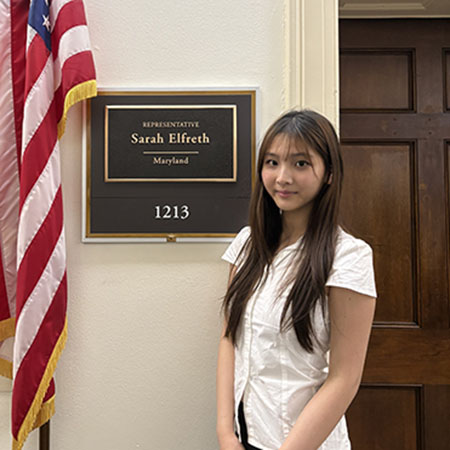
JOSIE KIM, A VOLUNTEER WITH THE STUDENT CLIMATE ACTION COUNCIL, STANDS IN FRONT OF MARYLAND REPRESENTATIVE SARAH ELFRETH’S OFFICE./COURTESY JOSIE KIM
What inspires you to volunteer?
I think what inspires me is my grandparents. Knowing that they come from an immigrant background from South Korea, I can see how hard they worked to build a life here. I think that coming from an immigrant family, a little bit later down the generational line, I’ve seen how every small change can really have a rippling effect throughout generations. Realizing that motivates me to put my best foot forward, even in daily aspects of my life. I try to put my best foot forward with this knowledge in mind.
Tell us about your volunteer role with the Student Climate Action Council (SCAC).
I’m the North Central Council Member for the Student Climate Action Council. In the role, I serve as the co-events chair, and I co-founded the events committee. In the events committee, we plan a lot of community events that encourage Montgomery County to get together and work towards advocating for different solutions to climate change.
For example, last year we hosted a town hall that had over 60 participants, both virtually and online, with several Board of Education members showing up to do Q&As and speeches. Beyond that, we also work to plan other events, like a beautification project at a local school where we did murals and tree planting. This year, we’re planning the Sustainability Summit, where we’re inviting a bunch of different organizations to come and talk to students about different climate careers and ways to get involved in climate advocacy.
What inspired you to get started with this initiative?
I’ve always had an interest in environmental studies because of the impact it has on the world, and especially the impact it has on a younger generation. We obviously aren’t seeing the full impact of climate change right now. We’ll see it in decades from now, or even a few years from now. During my freshman year of high school, I was able to get involved in a few different extracurricular activities, the main one being our school’s climate club. I was able to see the impact of climate change through this and learn about how a youth voice can get involved. In a lot of different other avenues, it’s very difficult to have this very young and active voice and advocacy, but I felt that in the climate change advocacy space, it was very receptive. From there, I worked up to a county level of advocacy, which I achieved through my position in the Student Climate Action Council.
What are your long-term plans or goals for the organization?
One of the projects we’re working on now is the climate change action plan, an eight-pillar plan that we’re hoping MCPS will adopt. For example, one of the eight pillars is climate literacy. We have a detailed plan that we talked about with different experts in the area to ensure that we’re getting the full range of knowledge that is needed to be put into investing in it. We’re working on that with MCPS, and we’ve been working on that for the past year or so. One of our main goals is to get that passed by the Board of Education. Once we do that, that would be one of our main projects for future years.
What’s been the most rewarding part of your work?
The most rewarding part is working with other students and learning about how they have gotten involved in the climate advocacy space. I know there are a lot of different ways for students to get involved. Being able to partner and learn about how they’re expanding their voice is such a great opportunity. Through the town hall, we were able to invite different student-led organizations and learn about the work that they’re doing. Seeing how broad this movement is within the youth community, and being able to help expand that, is something that is very impactful to me.
What have you learned through your experiences as a volunteer?
I’ve learned a lot of different skills, but I think one of the main things that most people can take away from this is that any advocacy movement is such a collaborative thing. It requires such close work with other people, whether that be in the same council or just communicating with teachers and adults, to make sure that your voice is heard. Communication and teamwork play such a central role, and they go hand in hand. To collaborate well, you also need communication. If everyone were to work together, then this goal would be able to progress even further.
Why is it important for others to get involved with causes they care about?
Our youth voice is often lacking in a lot of different areas. We always hear about how adults think, or what adults think are the best solutions to investing in infrastructure or green infrastructure within Montgomery County, but we don’t really account for what the students think or what they’re actually experiencing on a day-to-day classroom basis. For example, one of the main issues that I was facing in my freshman year was really messy water faucets. A lot of water would be wasted because the water flow was too strong. Because of that, my Climate Club was inspired to start investing in low-flow fountains. We actually replaced over 100 within our school. I think changes like that, that come from the student experience, are the most impactful.
What do you want people to learn from your story?
The key takeaway here is that the youth voice really can make a difference. For everybody reading this, I think one of the most important things is that they should get their voice out there and try to work on problems that they’re passionate about. Initially, I wasn’t sure if I could actually make any impactful changes within my school system. But the first step is to try to get involved with local organizations. If you do that, you’ll be working toward a pretty impactful and profound goal.
Military Spouse Turns Her Experience into a Lifeline for Others
Meet Daily Point of Light Award honoree Liudmila Frank. Read her story, and nominate an outstanding volunteer or family as a Daily Point of Light.
Born in Belarus and raised in Italy, Liudmila Frank met her husband in Italy and has spent the past four and a half years living on U.S. military bases in Japan. She holds a master’s degree and built a career in HR before her life as a military spouse brought everything to a halt — she couldn’t work for two and a half years while waiting for her green card and, later, citizenship.
That experience — the isolation, the stalled career, the feeling of starting over from zero — is exactly what drove her to volunteer with the Foreign-Born Military Spouse Network (FMSN), a community of more than 5,800 spouses from around the world. As Events Manager, she organized virtual workshops on everything from career development to mental health to cultural adaptation.
More recently, she transitioned into a Career and Education Coordinator role, meeting one-on-one with spouses to help them navigate resumes, job searches and the often-confusing process of getting foreign credentials recognized in the U.S. As a fellow foreign-born military spouse herself, she draws on her own experience navigating life in a new country to help others find their footing.
What inspired you to start volunteering with the Foreign-Born Military Spouse Network?
I always loved helping others — it’s something I enjoy and it feels natural to me. But when I learned about FMSN and their mission, I really connected with it. As a foreign-born military spouse myself, I understand the many struggles this community faces. I thought that through FMSN, I could use my own experience and my professional background to support not just one person I’d met, but many more spouses. I wanted to turn my wish to help others into something more meaningful and more organized.
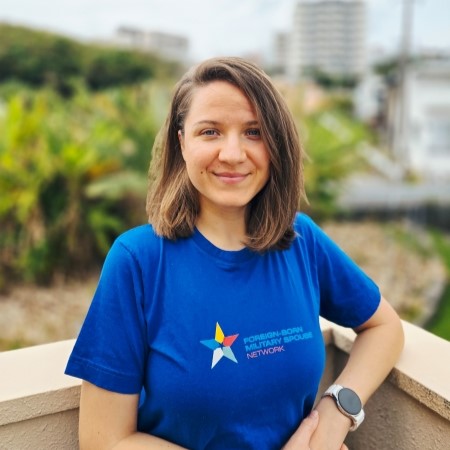
Liudmila proudly represents the Foreign-Born Military Spouse Network in Okinawa, Japan./ Courtesy Liudmila Frank
What are the particular challenges that foreign-born military spouses face?
A lot of foreign-born military spouses were highly educated and had established careers in their home countries. When they move to a new country to be with their spouse, they have to start from zero — their education or credentials may not be recognized, their English may not be strong and the cultural shock can be intense. They feel lonely, isolated, not understood.
And it becomes even harder when the spouse has to leave for a deployment or a TDY. Now they’re alone in a new environment, having to learn and adjust to a whole range of new things. If they have kids, they also have to manage the children and explain why their parent isn’t there. It can be very hard.
What kinds of events did you organize as Events Manager?
I organized events on career readiness, curfew safety, cultural integration and mental health — because mental health is something a lot of spouses really struggle with. We hosted speakers over Zoom, usually with 45 minutes of presentation followed by a Q&A. I also coordinated with partners who came to talk about the resources they offer, like degree evaluation services, which is so important for foreign-born spouses whose education may not automatically be recognized in the U.S.
One of my favorite events was on mental health. The speaker was a foreign-born military spouse herself, and she described the struggles of adapting to military life in a foreign country so well. People saw themselves in what she was saying. We came out of that event with more resources and a clearer sense of how to approach those difficulties. Every event is also a connection — we create opportunities for spouses to meet each other and share experiences.
Tell us about your new role as Career and Education Coordinator.
Now I get to use my HR background directly. I meet with foreign-born spouses one-on-one over Zoom to talk about their goals, their experience, and what they’re struggling with. I help them with things like resume reviews, job searches, certification options and understanding how to get their previous education or credentials recognized in America. A lot of them don’t even know where to start, so I try to guide them and help them figure out the next steps.
We also have partners who provide additional resources — things like degree evaluation or certification programs specifically for foreign-born spouses. And sometimes if a spouse speaks Italian or Russian, I can communicate in their language. But mostly we work in English, and if someone doesn’t speak it well, we can always find someone in our network who speaks their language.
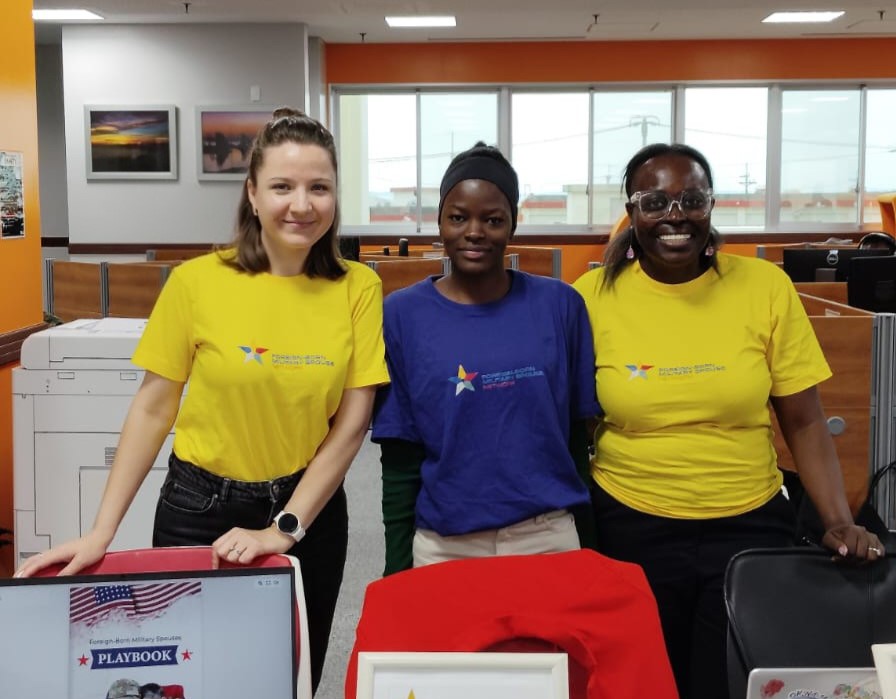
Liudmila (left) and fellow FMSN volunteers connect foreign-born military spouses with resources./ Courtesy Liudmila Frank
What has been the most rewarding part of this work?
When a spouse says, “Now I feel less alone,” or “Now I know what my next step is,” that is a moment that feels very special to me. I joke with my colleagues sometimes that I feel even more happy than the spouses do, because of how much joy it gives me to help them, to give them clarity, to give them some hope for the future.
FMSN makes sure that no spouse feels alone or left behind. We build community, we support each other, we share resources. And that feels very personal to me because I know what it is to need that.
What is the biggest lesson you’ve learned through volunteering?
I’ve learned that even a small gesture can make a big difference in someone’s life. Sometimes it’s just one conversation, one event, one piece of information — and it can completely change how someone feels about the future.
I’ve also learned that it’s very important to listen. Every spouse has a different story, a different culture, a different background. We cannot assume we know what they’re going through. Being patient, staying open and working as a team — that’s what allows us to really support this community.
What advice would you give to someone who wants to start volunteering?
Start small and start where you are. You don’t need a perfect plan or a lot of free time. Just a few hours can make a big difference for someone. Choose a cause that feels meaningful to you, and don’t be afraid to ask questions — the whole volunteering experience is a learning process. The most important thing is to show up, to care and to be consistent.
Meet Daily Point of Light Award honoree Sabrina Welch. Read her story, and nominate an outstanding volunteer or family as a Daily Point of Light.
Sabrina Welch, a 17-year-old high school senior, has always been interested in science, often mixing concoctions of dirt, grass and water to “cure cancer” as a child. Her parents took note and—aside from preventing her from sampling her yard potions—directed her towards educational experiences to nurture her curiosity.
In 2022, Sabrina decided to use her passion for neuroscience to inspire other kids like her. She founded Mind Tricks to teach advanced neuroscience concepts through free magic shows at museums and libraries. To the delight of seniors, she also performs in assisted living and nursing homes. The organization has grown to encompass 150+ members worldwide with 15 chapters. Together, they’ve directly reached over 10,000 people through the program.
That passion sparked another when federal funding for medical research and education was cut in 2025. Sabrina used Mind Tricks to fundraise for PBS’s children’s media, and she founded PEACE Youth Educational Advocacy Organization, an endeavor meant to bring attention to the importance of supporting both. As a research intern for Chai Laboratory, part of Brigham and Women’s Hospital and Harvard Medical School, she saw firsthand the difference research can make.
Using a podcast and public speaking opportunities, she highlights important issues and lifts up youth voices. While she would like to pursue a career in neurosurgery, she notes the need to advocate for policies that create access to healthcare before patients can be effectively treated and is open to addressing related policy issues before going into medicine.
What inspires you to volunteer?
When I was a kid, I was welcomed into the science community. The events for older kids would have minimum age requirements, but whenever my mom would ask for me to be allowed in, it was always a positive and welcoming energy. I want to make that more accessible. I don’t think there’s a lack of enthusiasm within the science community for youth to get involved. Youth just don’t know it’s there for them.
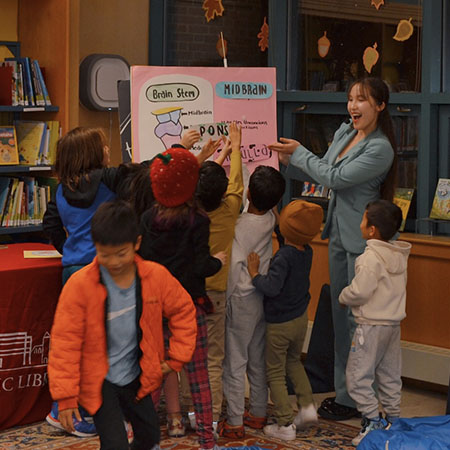
Sabrina (in blue blazer) holds a neuroscience magic show at the Cambridge Public Library to share the magic of neuroscience with families.
Tell us about your volunteer role with Mind Tricks: The Magic of Neuroscience.
I’m the founder and CEO. As the only magician in the Massachusetts chapter, I present the show. The biggest part of my role is scheduling. Onboarding chapters and teaching other people how to do the show effectively in their own region is a big commitment as well.
A lot of it is also social media outreach and managing my local team of 25. Prior to onboarding our new assignments manager, I created weekly assignments for members–finding new show spots, planning fundraisers, social media outreach, onboarding new members and more.
Now that we’re more established, we do a lot of community and school events. We do MIT Cambridge Science Festival, the carnival part and now the tabling event. We also collaborate with youth organizations like Moon Foods, which talks about how nutrition affects your brain. And there’s a large street performing culture in Cambridge, so I perform on the street, too. It’s one of my favorite parts.
What inspired you to get started with this initiative?
When I was young, my mom helped me find opportunities to explore STEM with two types of events on Eventbrite; one that targeted younger audiences and the other that was lecture-style for patients with a disorder or illness to learn from doctors and explore treatment options.
When I started my organization, I wanted to create a resource for kids to explore the advanced science that I found from the lectures but to experience it in an engaging way, like the kid events. Neuroscience is my personal passion, and I loved going to magic shows as a kid. Magic is really interesting at the neurological level. When you view a trick, the dorsolateral prefrontal cortex activates in your brain, and it’s processed as a reward. When you pair that with a lesson, it helps with learning retention.
I created PEACE because of my work with Mind Tricks and seeing how important it is to support research, especially in fields that don’t receive a lot of funding or that aren’t as popular to research. It started with hosting a mile-long walk for peace in my community that launched a community-based fundraiser to support medical research. I spent most of my summer going door to door, building interest.
My mom suffers from chronic kidney disease. Whenever there’s a new article about an upcoming kidney study, it always brings hope to my family. I want to help give other families hope for a brighter future.
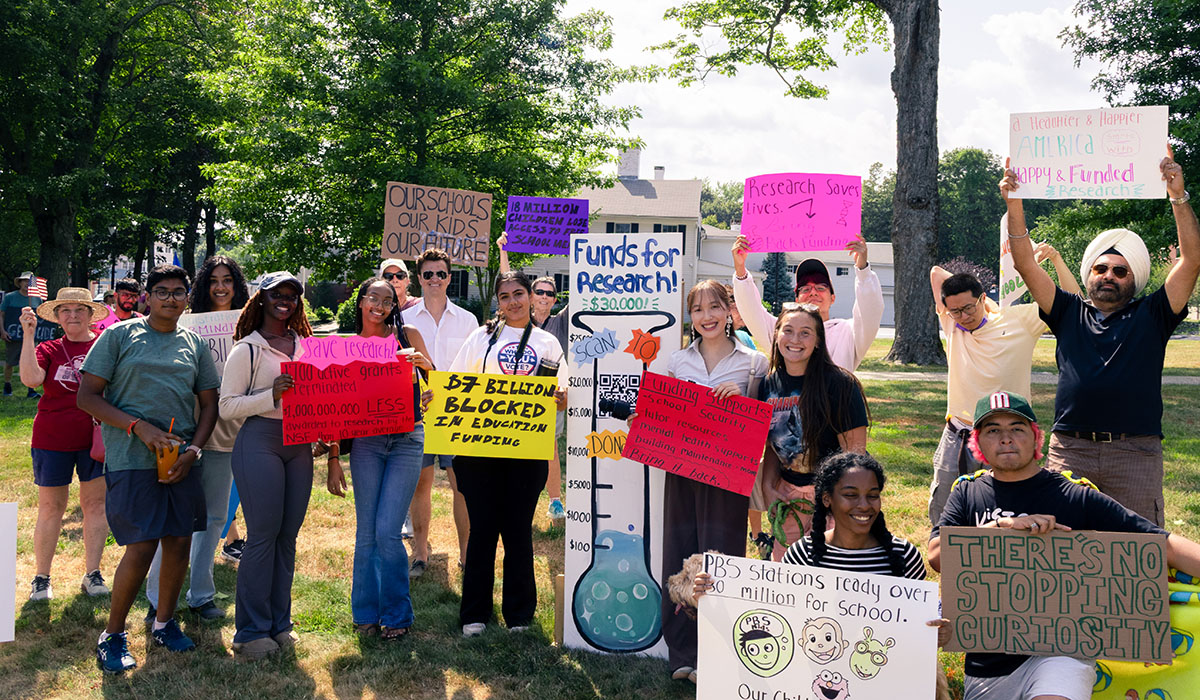
Sabrina (fourth from right, front with red sign) hosts and leads a Walk for Peace in her community to raise money for medical research affected by federal cuts and to advocate for education.
What’s been the most rewarding part of your work?
It’s an unexplainable feeling to be able to see how you’ve had even a small impact on someone’s life. Maybe you’re able to spark a kid’s interest in neuroscience. My favorite thing is when a kid stays after the show to ask questions. Maybe you explain what neuroscience is to someone for the first time. It’s also just nice to add a little bit of positivity into someone’s life, like a magic show. Maybe it brightens someone’s day. This cycle of passion and science is consistently perpetuated, and I get to participate.
What have you learned through your experiences as a volunteer?
I’ve learned a lot about myself and, of course, neuroscience. But I’ve also learned about people’s lives. I met a Nepalese man who leads tours of Mount Everest while street performing on his first day in America. He thanked me for sharing American culture with him and shared a bit about Nepal. I’ve also learned about logistics and how to organize and lead people.
What do you want people to learn from your story?
Founding an organization or being a leader in the youth demographic can feel very out of reach. I’d love for every kid to understand that everything they see other people doing is something they can also do. They just have to have the motivation and the ability to hold themselves accountable. Whether you’re a kid or an adult, you can start right now, and it can come to fruition in a beautiful way.
Keeping One of New York’s Most Famous Landmarks Beautiful
Meet Daily Point of Light Award honoree Wei Qiang Liu. Read his story, and nominate an outstanding volunteer or family as a Daily Point of Light.
Wei Qiang Liu isn’t originally from New York, but the Hong Kong native has found a home in Central Park. Since moving to the city, Wei has found comfort visiting New York’s beloved 843-acre park with his wife. While strolling in the park with her, he was inspired to jump in as a volunteer. Since June of 2025, Wei has volunteered with the Central Park Conservancy, an organization whose mission is to preserve and celebrate Central Park as a sanctuary from the pace and pressures of city life, enhancing the enjoyment and well-being of all. In just the last year, Wei has contributed over 100 hours as a Landscape Management Volunteer, as well as participating in various additional horticultural projects. From removing weeds and invasive plants to putting down new bulbs before the start of spring, Wei puts forth a positive attitude with every single shift he volunteers for. English isn’t Wei’s first language, which can be particularly intimidating.
However, Wei is always eager to learn from the other volunteers and improve his skills, and says he’s learning so much as he goes. In fact, Wei praises all the great people he’s met while volunteering, and mentions that they’re all much more qualified than he is, referring to them as his role models.
For an organization that greatly relies on its 4500 volunteers to keep Central Park shining for its 42 million annual visitors, the Conservancy makes it clear that Wei is a standout whose genuine enthusiasm is a shining beacon of example. Combining a dedicated work ethic with a true appreciation for the park, Wei is a powerful testament to the true spirit of service. His decision to put himself out there and participate in service is something anyone can do if they find that same spark of willingness.
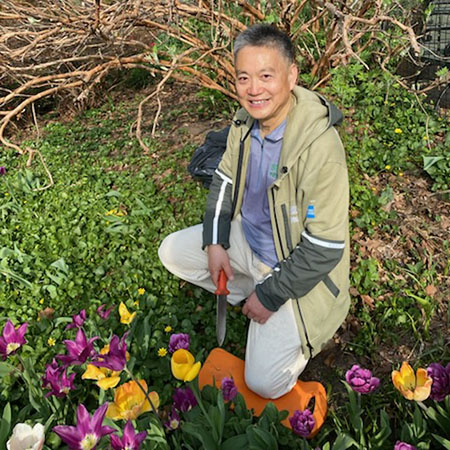
WEI QIANG LIU, A VOLUNTEER WITH THE CENTRAL PARK CONSERVANCY, SQUATS TO TRIM A FLOWER BED OF TULIPS IN CENTRAL PARK. /COURTESY WEI QIANG LIU
What inspired you to get started with this initiative?
Both my wife Anna and I were so curious while walking in the park. There are so many volunteers here and there, working so dedicatedly to improve the space. We really appreciate their hard work and the warm-hearted volunteers. They inspired us with their actions. It’s a pleasure and honor to be part of them. I started last June, and now I realize, compared with other volunteers, like those who have volunteered for over 30 years, I am just a baby.
Tell us about your volunteer role with the Central Park Conservancy.
My volunteer role is horticulture, gardening, removing weeds in the summer, planting tulips at the beginning of the winter, removing leaves in the fall and cleaning ice and snow in the playground and sidewalks in the winter. I may not know all the English names of the plants and tools we use, but I’m just following instructions and putting all my heart into it. If I cannot make it one day, I will make it up another day. As committed as I am, I position myself as a follower, a facilitator, a co-worker and mostly a learner. I really enjoy my role.
What are your long-term plans or goals for the organization?
I truly wish I could someday celebrate my 30th volunteer anniversary with the Central Park Conservancy like Fern, with whom I had a long chat the other day. We were working at the same time to remove lesser celandine, an invasive plant, and she’s almost my mom’s age. She’s optimistic, positive, healthy, friendly and full of sympathy.
What’s been the most rewarding part of your work?
There’s so much that is rewarding. You’re a change maker. The visitors’ satisfaction and learning new things. Every time I work, I explore new parts of the park. The Conservancy’s volunteer Christmas party and annual receptions are great and have awesome food!
What have you learned through your experiences as a volunteer?
I’m still learning! But I’ve learned the names of all sorts of weeds and tools. Also, I’ve learned a lot through the atmosphere and chemistry of volunteering by wishing each other good. The volunteers’ words and their behavior and their ways of thinking and their hearts.
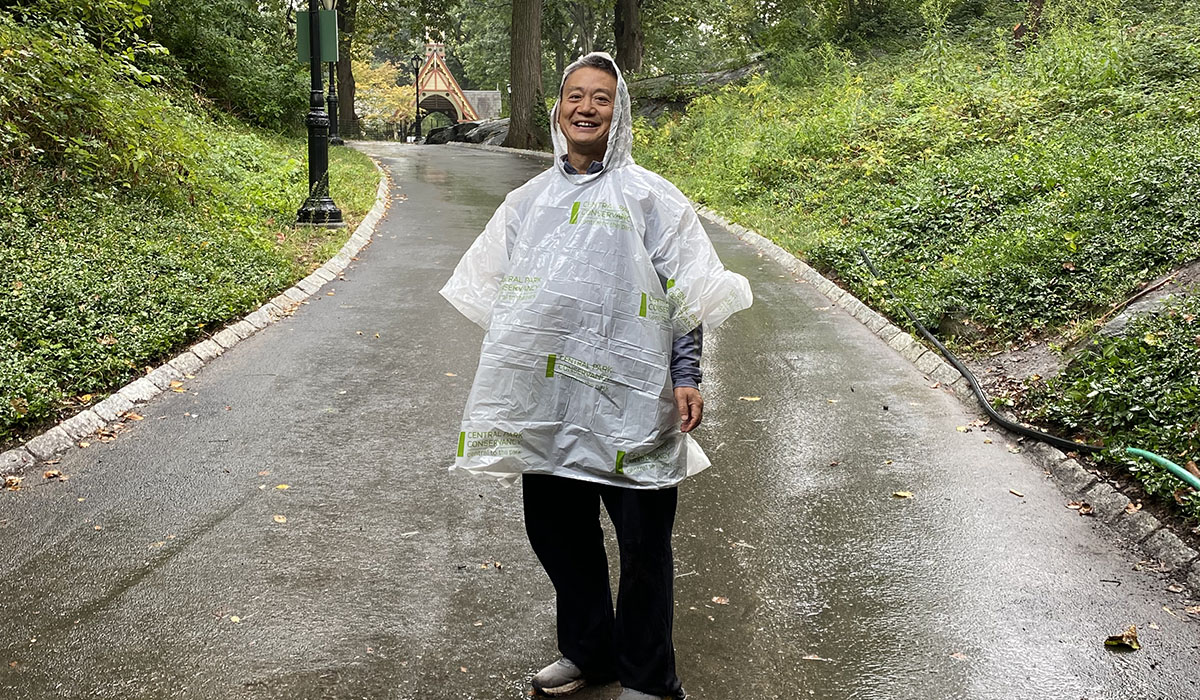
CENTRAL PARK CONSERVANCY VOLUNTEER WEI QIANG LIU WEARS A PONCHO ON A RAINY DAY IN CENTRAL PARK. /COURTESY WEI QIANG LIU
Why is it important for others to get involved with causes they care about?
Volunteering is sharing your love with the world, for people you may know, and then people you may not know. It’s being a role model for your kids and for the next generation. You’re sharing what you have and what you want to be. It is a mental and physical practice and experience that connects us more closely to the natural earth mother in the city.
Any advice for people who want to start volunteering?
The Central Park Conservancy has a great volunteering system. I have enrolled in the Weekly Landscape Management Volunteering Program, and there is also the flexible program, corporate program and school program. Over the weekend, there are family programs where children volunteer with their parents, and teen programs to let youth practice independence, curiosity, raise awareness of social responsibility and do hands-on work. Central Park is a perfect platform that fits all kinds of people.
What do you want people to learn from your story?
It’s all about give and take, and by volunteering, we are giving. We are helping other people live a better life. Being an individual success while facilitating others’ success is amazing. If we can be part of other people’s success, that is a wonderful thing.
Meet Daily Point of Light Award honoree Michael Panza. Read his story, and nominate an outstanding volunteer or family as a Daily Point of Light.
Michael Panza will tell you he gets more out of volunteering than the people he serves. The clients he delivers meals to would probably disagree.
For the past six years, Michael has been a dedicated volunteer with
in Houston, Texas — first through the AniMeals program, which provides pet food to homebound seniors with animals, and then expanding to deliver hot meals and groceries to clients on Tuesdays and Thursdays. Between meal deliveries, a monthly pet food run, twice-weekly shifts at a local food pantry and an annual holiday gift bag drive that produces 20 to 40 generously stocked bags for clients each Christmas season, Michael estimates he gives about 20 hours a month to the cause.
A Vietnam-era U.S. Air Force veteran who spent decades working in corporate sales, the New Jersey Lottery and hearing aid services before retiring to Houston, Michael also made good on some unfinished business in 2021, earning his bachelor’s degree nearly 40 years after he was supposed to graduate. He started volunteering simply because he needed something to do. Six years later, he can’t imagine stopping.
What first got you into volunteering with Meals on Wheels?
I needed something to do. Somebody told me about Meals on Wheels, and I was raised to help whenever I can. I’m a great believer that if everybody does a little, a lot can be accomplished. So I went down, asked them if they needed volunteers, they said yes, and I just started doing it. It’s very rewarding to help people.
Tell us about the AniMeals program and why it’s meaningful to you.
The program serves seniors who live by themselves and have a pet. For a lot of them, that pet is their companion — their world, in a lot of ways. Most of these folks are on fixed incomes, mainly Social Security, and they really can’t afford to buy all the food their pet needs. What AniMeals does is supplement that food, so the pet stays healthy and the senior keeps their companion.
Having three rescue dogs and five rescue cats myself, I know what that bond means. My wife and I deliver once a month — usually the fourth Saturday — and at the holidays, Dee will bake them a pumpkin pie or something, just to let them know that someone cares.
What does a typical Meals on Wheels shift look like for you?
On Tuesdays and Thursdays, I pick up the meals and drive to each client’s home to deliver them. For many of them, it’s usually the only hot, good meal they get that day. I’ll interact with the clients, see how they’re doing, talk if they have time. You get to know people over the course of time — I see them every week, so I ask how life is treating them, see if they need anything.
Everybody thanks me for doing it, but really, I get so much out of it just knowing these people are being taken care of. They’re very humble and grateful, and what matters most is that they know they’re not just thrown to the wayside.
Is there a client interaction that has really stuck with you?
There’s one gentleman I deliver to who said to me, “You have an aura about you — you don’t know what joy you bring to me.” He’s got family, but he’s pretty isolated. He’s extremely religious, and even though things are hard for him, he always says there are people a lot worse off than he is.
That perspective stays with me. Any time I start to feel sorry for myself, I just say, “ Michael, 90 percent of the people in the world would trade places with you right now.” This work gives you a real perspective on life. It teaches you to be grateful for what you have. And it shows you that you can literally make someone’s day just by a kind word or a little extra effort.
Tell us about the holiday gift bags you and Dee put together each year.
The gift bags are for people who don’t have a lot. We get the list, go shopping and pick up everything on it — plus a few extra things they can’t afford, maybe a nice blouse or a sweater. We deliver them the week before Christmas so they can have something nice and know that the holiday still means something.
We also participate in our church’s giving tree. We’ll pick out five or 10 families and buy things for the kids because they can’t afford Christmas gifts otherwise. Again, if everybody does a little, so much can be accomplished. It’s really not that hard.
You also volunteer at a food pantry twice a week. What is that work like?
It’s at Christian Community Service. People who qualify for supplemental food come in, and we fill their orders — enough food for a week, depending on family size. Right now we’re seeing a lot of large families, three generations under one roof. The people are so grateful.
You just treat everybody with dignity and respect. I try not to be judgmental about how someone got to where they are — they’re where they are, so let’s help them. And hopefully that can be the spark that helps them move on to a better place. But right now, let’s get them through this so they’re not choosing between paying the electric bill and feeding the kids.
Where do you think your heart for service comes from?
My parents. They always said to help people whenever you can, and we were all raised that way. You always have something to share, no matter how tough things may be for you, with people who have less.
The military also ingrained in me that we’re all in this together. You help when you can. That’s how I guess it all came about for me.
Why is it important for people to get involved with causes they care about?
No child or senior should go to bed hungry. That’s how I feel. These are people — human beings. And the time commitment is so minimal. Even one afternoon a week can make a huge difference in someone’s life. If there’s a way I can help, I’m all in.
What do you hope people learn from your story?
That if you just give a little and help a little, so much can be done. You don’t have to change your life or make radical decisions. Even one time a week for a couple of hours — you can make a huge difference in someone’s life. And that’s the most important thing.
Never give up hope and always have faith that good will triumph and that people will be taken care of.
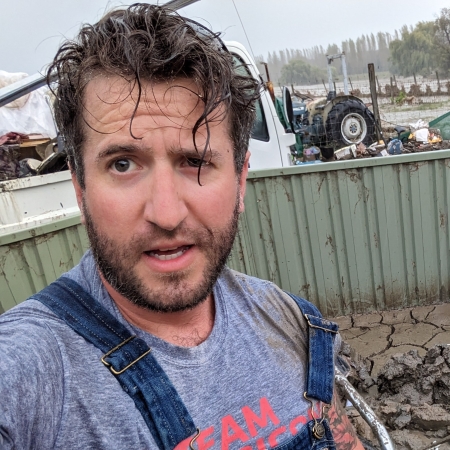
Meet Daily Point of Light Award honoree Phillip Reeves. Read his story, and nominate an outstanding volunteer or family as a Daily Point of Light.
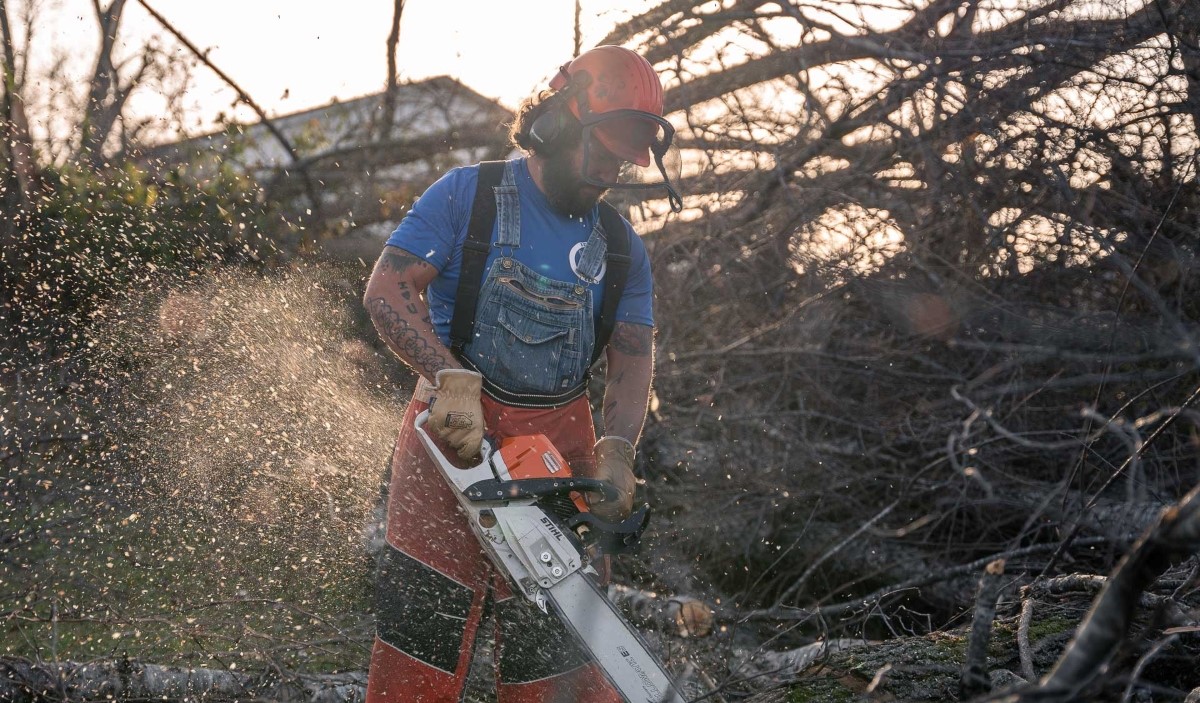
When Phillip Reeves pulls the cord on his chainsaw, he’s making a difference in the world. After leaving his role as a middle school teacher, Phillip was looking to find more volunteer opportunities that gave him the same amount of what he calls “feel goods.” Looking for a way to serve others and get out of his own head, he found a new appreciation for diving headfirst into the wake of disasters and helping others navigate their way out.
Phillip connected with Minuteman Disaster Response, an organization that deploys self-sufficient volunteer teams in the aftermath of disasters. Across the region, Phillip has been deployed to disaster sites, providing hands-on support to homeowners and community members facing unimaginable loss and crisis. After working with his hands his whole life, Philip also played a key role in developing and leading chainsaw training programs, helping volunteers learn how to operate a chainsaw safely and effectively in high-risk environments. When disaster strikes, Phillip and his team are ready to jump in and lend a helping hand. Thus far, Phillip has served in more than 40 storms, helping hundreds of homeowners recover from the unthinkable. This commitment can vary from teaching classes over a few weeks per year to three full weeks at a time in a disaster zone.
Because he loves the work so much, Phillip recently started his own smaller disaster response organization, Kosmopolite Disaster Response, which offers disaster relief services free of charge. While he’ll always serve with Minuteman, building his own organization will give Phillip the ability to design his own organization from the ground up. But no matter what he does, Phillip believes that serving others and surrounding oneself with other people is essential to maintaining adequate mental health. He encourages all people to find the motivation to step outside of their comfort zone, because it just might change their lives forever.
PHILLIP REEVES, A VOLUNTEER WITH MINUTEMAN DISASTER RESPONSE, CLEARS TREES AFTER A TORNADO IN TENNESSEE. /COURTESY PHILLIP REEVES
What inspired you to get started with this initiative?
In 2021, I quit my job teaching middle school. When you teach, especially in public school, you get a lot of feel-goods from that, and my feel-goods were very lacking. I started to look for volunteer organizations, and I got into disaster response shortly after that. My first volunteer group was with Team Rubicon. I knew a preacher in Houston who had given them housing in the Houston area after a huge hurricane. I joined Team Rubicon, worked with them for a few years and really enjoyed it, and then came across Minuteman Disaster Response, and got even more involved with that organization.
What inspires you to volunteer?
I get a little philosophical with it. I believe that humans are one of only a couple of super-social species on the planet. You’ve got bees, ants and then humans. Dogs run in packs and apes have a bit of a tribe. But we are super social. I truly believe that we require other humans to be fulfilled. I think when you don’t have that connection with other humans, when you live a life that isn’t in service, it manifests a lot of negative feelings.
Tell us about your volunteer role with Minuteman Disaster Response.
My current role is the chainsaw coordinator. I run the entire chainsaw program for the organization. We have around 40 chainsaws and 130-ish qualified operators, and half of those I’ve trained myself. I developed the curriculum for our chainsaw safety program and I have started to develop other instructors so that the load isn’t all on me. I have three instructors, and I’m going to pass one more into service next weekend. If he passes the instructor course, then he’ll be the new instructor in the Tulsa, Oklahoma area. I’m spreading them out on purpose so that they can train people locally to keep costs down, and we can keep on pushing safe and skilled operators into the field.
What are your long-term plans or goals for the organization?
My long-term goal with Minuteman Disaster Response is to build them a scalable chainsaw program that they can continue to flex as the organization grows. I want something that I can walk away from. I don’t want to do this forever, but I’m also not going to leave until it’s until it can run itself. I’m always going to serve with Minuteman. I love the organization. I love what they do. I like their attitude, but I don’t want to continue to be the coordinator forever. So right now, I’m building a chainsaw program where we can keep creating more and more safe and effective members that can go out and serve.
MINUTEMAN DISASTER RESPONSE VOLUNTEER PHILLIP REEVES CLEARS AWAY TREES AFTER A TORNADO IN ARKANSAS. /COURTESY PHILLIP REEVES
What’s been the most rewarding part of your work?
Disasters are really special in that although they seem very common on the news, they are very rare to the individual. Most people will never experience a natural disaster, and those who do definitely didn’t think they ever would. So they’re really in shock. No one trains you on that. No one really knows what to do. They’re very shocked. And when you can walk up to a survivor and tell them you know exactly what needs to be done, and they don’t have to worry about it, that’s a very powerful feeling. You can be the expert and you can provide it for free, because most people are not prepared for that kind of event.
What have you learned through your experiences as a volunteer?
I feel like I’ve been doing it so long that I’ve forgotten a lot of the things I’ve learned, and I’ve just internalized them at this point. However, I definitely always had the inkling that service was necessary for good mental health. I always knew that was true, but I really know it now, and I’ve watched people’s lives turn around whenever they start giving instead of just trying to survive.
Why is it important for others to get involved with causes they care about?
You sleep better at night. It’s like I’ve been getting at: I truly believe that service is required for a fulfilling life, and if you’ve never tried, then you can’t experience the benefits. I would say that no matter how skeptical you are, if you just give it a shot, then I think you’ll see what I mean.
What do you want people to learn from your story?
I want people to give service a chance in whatever way it looks in your life. I want people to get up off the couch, and I want them to get off their phones and find a more fulfilling life, because it’s not nearly as hard as it seems.
Providing a Global Lifeline to Men with Breast Cancer
Meet Daily Point of Light Award honoree Cheri Ambrose. Read her story, and nominate an outstanding volunteer or family as a Daily Point of Light.
For a long time, Cheri Ambrose has walked a path few others dared to tread, illuminating a corner of the oncology world often left in the shadows. As the founder and president of the Male Breast Cancer Global Alliance (MBCGA), she has dedicated her life to supporting a demographic that’s frequently misunderstood and underrepresented: men diagnosed with breast cancer. What began as a localized spark of awareness has ignited into an international movement, driven by her belief that no patient should feel invisible or unsupported.
Cheri’s leadership within the alliance is a loud, hopeful call for inclusion. Under her guidance, the MBCGA has expanded its reach to more than 40 countries. Today, the organization connects over 500 men globally. These connections are often a lifeline for those who previously lacked a community of their own, or were too silenced by stigma to seek out support. By collaborating with leading cancer centers and research initiatives, Cheri is working to ensure that the male perspective is no longer an afterthought in education or awareness campaigns, but a vital part of the global conversation.
Cheri often clocks 80-90 hours per month to steer the organization’s strategy and fundraising efforts. She frequently engages in public speaking to dismantle the persistent stigma surrounding the disease, as well as building partnerships and overseeing programs that deliver resources directly to families in need. For Cheri, the goal has always been to transform the “pink” landscape into one that is inclusive of every person affected by the diagnosis, regardless of their biology. She has successfully advocated for the inclusion of men in breast cancer clinical trials and has been instrumental in revising breast cancer bills at both the state and federal levels to ensure gender-neutral language. Her dedication is helping to rewrite the narrative for thousands of families worldwide.
Cheri is dedicated to supporting men throughout their breast cancer journeys.
Tell us about your volunteer role with Male Breast Cancer Global Alliance.
I do just about everything; I’m chief cook and bottle washer! I run the organization, basically. Were an online, internet-based, social media-based organization, and the reason why we do it this way is because we have men from around the world all on different time zones. It gives me the flexibility because I’m retired now, and I actually can do this full-time.
We support men diagnosed with breast cancer throughout their whole journey. We also support their care partners, and when someone passes, we stay in touch with their family members. We have three different Facebook private groups: one for the men, one for the care partners and one for those who have lost somebody. I post on there for birthdays, remembrances and anniversaries, plus whatever information I come up with on a daily basis.
We actually work with men who have been newly diagnosed to see if there are clinical trials available for them. We have a really robust medical advisory board who help us with second opinions if something is needed, and we can make connections with them. Most of them are so busy that if you had to get an appointment with them, it would probably take you anywhere from three to six months, but they will get on a call or an email and talk to these guys. That’s how committed they are. So I really feel strongly about them being a wonderful asset to us.
We advocate on men’s behalf with state and local government, and also on the federal level, for inclusion in any type of breast cancer screening bills that may be changing or being put up. Also, for anything to do with genetic testing, we want to include men in that as well. Primarily, we’re looking to change the wording in anything that has to do with breast cancer from “women” to “individuals.” That covers the LGBTQIA+ community as well, because they also face these hurdles. We advocate with scientists, researchers and medical companies for men to be included in the language on any research and on clinical trials, again using “patients” or “individuals” rather than making it a gender-specific disease, because it is not.
What inspired you to get started with this initiative?
A very dear friend of mine had been diagnosed, and I got a phone call from his wife. She said, “Brian’s been diagnosed with breast cancer. We haven’t even told our son.” I knew about three or four men here in New Jersey who were also diagnosed, so it sparked me wanting to do more. I started setting up Google Alerts to see if there were stories of other men around the world telling their stories. What resonated with me was that when these men told their story to a news outlet or in an interview, they felt as if they were the only man on the planet who had breast cancer. That just didn’t sit right with me. Everybody should have a support system. Being that there was so much support for females with breast cancer, I decided nobody else is doing it, so I’m going to make something work with this. Here I am, 16 years later, still doing it.
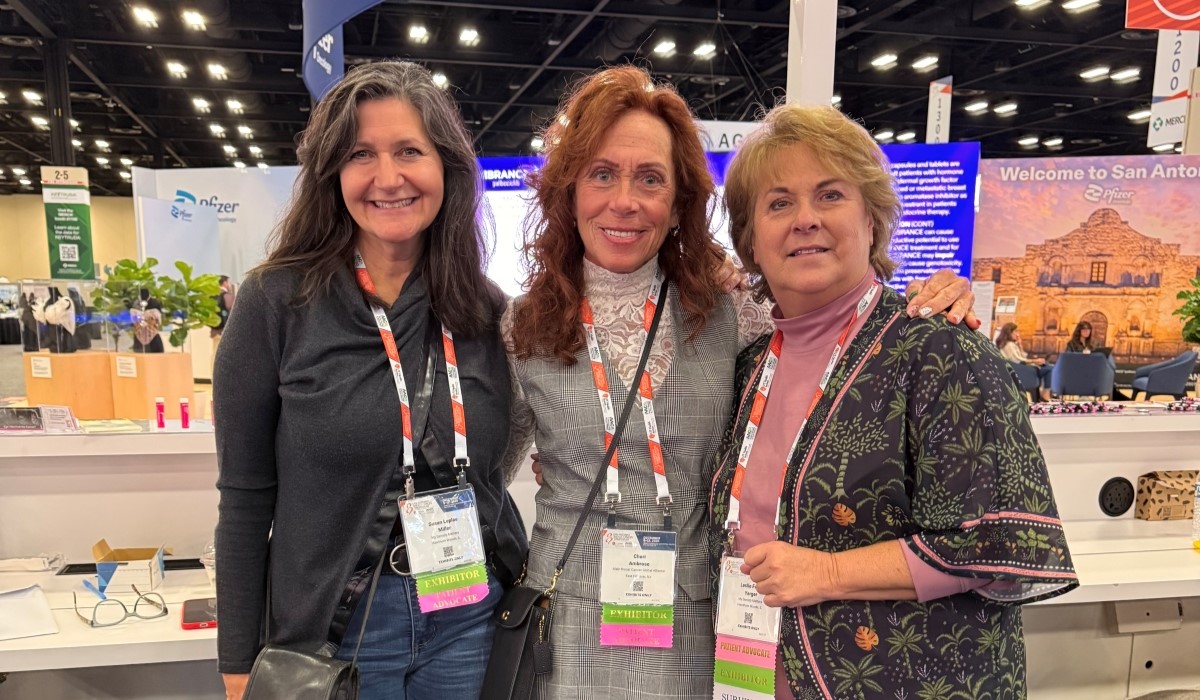
Cheri with fellow advocates at the 2025 San Antonio Breast Cancer symposium.
Tell us more about male breast cancer.
About 1 in 726 men are diagnosed with breast cancer in their lifetime. It is approximately 2,800 men just here in the United States. Unfortunately, because of no scanning, they don’t go for mammograms unless they find a problem. The stigma around breast cancer is that it’s a pink and fluffy thing. That could be no further from the truth; it is not a happy, fluffy disease. Because of the stigma, these men are going unchecked and ignoring signs. A lot of them are coming through as metastatic when they first realize they have a problem, because they find a problem in another organ that’s not working properly and then find out it was originally breast cancer.
The symptoms are exactly the same as in women. It could be leakage from the nipple, an inverted nipple or a lump—any type of lump, even under the arm where the lymph nodes are. If anything is swollen, or if the skin around the areola changes and looks like an orange peel or looks rough. Most times it’s not painful, so they think they just bumped themselves and they ignore it.
Men’s mortality rate with breast cancer is 19% higher than females. And that is strictly because of the stigma and lack of awareness.
What’s been the most rewarding part of your work?
The rewarding parts are when somebody sends me a random email or I look on social media and the comments we get are, “These people really care,” or “This organization really is looking out for us.” When we get a little bit of praise. You don’t look for it; I never started this because I wanted a pat on my back—but it means a lot.
Each one of these men has a profound impact on me. I don’t have siblings, and my mother was an only child. There are no aunts or uncles; it’s just me and my husband. They actually become like my family. I got word the other day that one of my men, who is in his 40s and just learned he was metastatic, is in the hospital and has only a few weeks to a month left. It’s like losing family, and it’s hard.
What have you learned through your experiences as a volunteer?
No one can do anything on their own. It does take a village. Even though I’m doing this by myself, I do have the support of other breast cancer organizations and foundations. I get on as many panels as I can to be the male voice, and they really do embrace our presence. To me, that’s one thing. My wish is that all these organizations could work together, because I’ve found that by working together, you get a lot further instead of just fighting for the little bit of money that’s available every year.
What are your long-term plans or goals you have with the organization?
My goal—one of my big wishes on my wishlist—is to have a CME-credited course on male breast cancer. We still have oncologists and techs at breast centers who, when they see a man, tell him, “I’ve never had a man before. I didn’t know men could get breast cancer.” That means to me that there’s teaching that needs to be done.
I would also like to see some type of annual check done on men. If someone were to do just a clinical breast exam on them annually, especially if there is a history of certain cancer in a man’s family, it would make a difference.
And actually, for it to be just called “breast cancer.” Females don’t have to specify, “I have female breast cancer.” I think everybody needs to realize it can happen to anyone and just call it breast cancer without having to put the “male” in front of it. That would be a huge step in de-stigmatization.
Why is it important for others to get involved with causes they care about?
Because if no one picks up a mantle and asks for change, nothing will ever change.
Any advice for people who want to start volunteering?
You have to be passionate about it. You can’t just jump into something you don’t really understand; you have to have a little bit of background or knowledge. But it makes you feel good at the end of the day when you can make a difference in one person’s life and get them to smile. It means a lot, and I would hope others feel the same way.