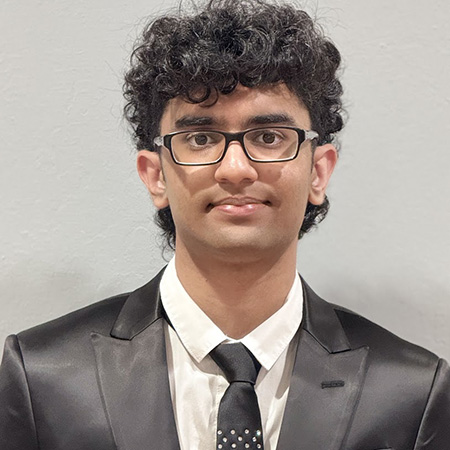
Meet Daily Point of Light Award honoree Aditya Rajesh. Read his story, and nominate an outstanding volunteer or family as a Daily Point of Light.
Aditya Rajesh didn’t just want to teach code; he wanted to rewrite the script of who gets to learn it. Starting his journey as a teacher and senior mentor, he mastered the nuance of the classroom before turning to the systemic barriers keeping students from the screen. As president of Computer Engineers of the Next Generation, he’s shifted the organization’s focus from general growth to targeted equity, utilizing data-driven outreach to identify Title I schools where computer science education was a distant luxury rather than a standard. By forming a dedicated outreach team and leveraging tools like Apollo.io, Aditya bridged the gap between Silicon Valley resources and underserved classrooms, expanding the organization’s partnerships from three to now 55 schools across California.
Under his strategic leadership, the organization welcomed over 3,600 students into its programs over the last two years, creating a community impact valued at $1.2 million. His commitment to the “CENG” mission focused on enrollment as well as fundraising efforts that raised over $14,000 in a single year, directly funding three $1,000 scholarships for graduates pursuing STEM majors. Whether he’s organizing four hackathons for over 150 participants or designing five distinct curricula — ranging from Scratch to ChatGPT — Aditya ensures that the quality of instruction matches the quantity of students served.
Now serving as an advisor and class supervisor, Aditya remains the backbone of the organization’s daily operations. He currently oversees the education of more than 100 students per session, maintaining high instructional standards while dedicating 15-20 hours a month to the cause. His influence is perhaps most visible in the legacy he has built through others; having recruited and trained more than 80 volunteers, he has ensured that the organization’s culture of mentorship remains self-sustaining. His transition from webmaster to executive strategist has left the organization with a robust digital infrastructure and a refined focus on underrepresented minorities in the tech space.
Looking forward, Aditya continues to serve as a senior mentor, hosting guest speakers and refining hackathon logistics to keep the momentum alive. Read on to hear more of his inspiring story.
Aditya Rajesh doesn’t just want to teach code; he wants to rewrite the script of who gets to learn it.
Tell us about your volunteer role.
I currently serve as the advisor for CENG and last year I was the president. CENG provides free computer science classes for underrepresented minorities, with a focus on reaching communities that lack access to CS education. Our ultimate goal is to give kids who aren’t usually handed those opportunities a real chance to explore computer science.
As advisor, I help oversee our major events like hackathons and Hour of Code, handle a lot of the administrative work and focus on expanding our outreach and bringing in guest speakers. But I’m also still really active during class sessions, whether that’s supervising, stepping in to teach or just making sure the quality of our curriculum stays strong.
Why is this issue so important to you?
It honestly surprises me that even here in the Bay Area, the heart of Silicon Valley, there are still communities without real access to computer science education. I grew up taking it for granted. From elementary school there were computers, there were CS classes, that was just the norm. But that’s not most people’s reality, even just a few miles away in places like Oakland or parts of the South Bay.
On a broader level, I deeply believe education should be democratized, and that’s something I’ve cared about and actively worked on throughout high school. CS is one of the most powerful tools someone can have right now, and the fact that it’s still so unevenly distributed feels like a problem worth dedicating real time to.
What inspired you to get started with this initiative?
I actually got started pretty young, around the middle of seventh grade. I had been taking CENG classes myself for almost two years, and Alice, the founder, noticed I was a more advanced student and asked if I wanted to help develop a Minecraft game design curriculum. But the real reason I said yes was because I thought it was such a genuinely noble cause. Teaching CS also forces you to understand concepts at a fundamental level, which I found really valuable for my own growth too. Mostly though, it just felt like the right thing to do. It combined something I cared deeply about with the chance to help more people care about it too, and that was enough for me.
What are your long-term plans or goals for the organization?
When I became president, one of my biggest priorities was scaling our reach and really getting our resources to the communities that need them most, not just the ones closest to us. Looking ahead, I think there is a real opportunity to take CENG to a national or even global level. We have already had students join from other parts of the world, which is exciting to see.
But more than just growth for the sake of growth, I want to make sure we stay true to our mission, which is not necessarily to produce as many CS majors as possible, but to give every kid the chance to explore it and see it as a real option for their future. So to me, ensuring that we are able to effectively target areas that need our CS classes the most is a priority. That focus on access and inspiration, while keeping class quality high, is what I want CENG to be known for.
What have you learned through your experiences volunteering?
A few significant things. On the leadership side, running an organization is genuinely hard, and you only really understand that once you are in it. Building clear, low-friction systems for communication and delegation is something I have had to actively develop and keep improving on. On the teaching side, I have learned how important it is to truly take the student’s perspective, not just in how you explain a concept, but in how you design the curriculum, how you market the class, how you run icebreakers, how you lay out slides. Every single touchpoint is an opportunity to make someone feel welcome and inspired. That perspective-taking has probably been the most transferable skill I have picked up through all of this.
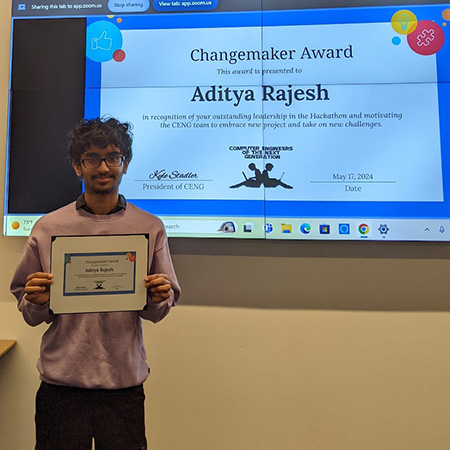
Aditya receiving the “ChangeMaker” award during a CENG team meeting.
What’s been the most rewarding part of your work?
Honestly, the direct teaching. I have had students come in shy, nervous or even just dragged there by their parents, and by the sixth session they are genuinely excited about computer science. That shift is everything to me. It tells me we are actually doing what we set out to do. And on the flip side, when a kid comes in already curious and motivated, and our classes give them a real platform to build on that, that is just as rewarding. Seeing a student realize they now have a path forward they did not know existed before is something that never gets old.
Why is it important for others to get involved with causes they care about?
If the people who care are not getting involved, who will? I do not think there needs to be a complicated reason behind it. If something genuinely matters to you, you will feel naturally pulled toward it. When I was asked to volunteer at CENG in seventh grade, it just felt right. I love CS, I care about equal access to education, so of course I wanted to be part of it. I think the only things that really hold people back are fear or the feeling that they will not make a meaningful impact, but both of those are worth pushing through. Doing something is always better than doing nothing, and if you truly care about it, you will find a way to make it count.
Any advice for people who want to start volunteering?
Just start. That is really the whole thing. Whether you are joining an existing organization or building something yourself, the biggest mistake is waiting until everything feels perfectly planned out. There are things you simply cannot figure out until you are actually in it. Find something you genuinely care about, a cause, a community, a problem you keep coming back to… and throw yourself in. Start small if you have to, stay patient and trust that things will come together as you go. It will not be easy and you probably won’t see results right away, but that is fine. Anything is better than nothing, and if you care enough to stick with it, only good can arise from your work and you will go far!
Meet Daily Point of Light Award honoree Reeti Rout. Read her story, and nominate an outstanding volunteer or family as a Daily Point of Light.
Reeti Rout may still be in high school, but she’s already working toward helping all young people have the opportunity to pursue STEM. Growing up surrounded by math and science, Reeti always loved solving problems. She started hosting STEM workshops back in 2017 on topics ranging from robotics and coding to genetics and maker projects. Inspired by the mentors who encouraged her to pursue her own dreams of building a community of her own, Reeti formed WeMake 4H, a STEM outreach organization that seeks to inspire the next generation of innovators through STEM and Maker education.
WeMake4H hosts a variety of classes and free workshops, all with the mission of closing the opportunity gap and providing access to education in underserved communities. The WeMake team visits community centers and Boys & Girls Clubs to host classes on programs like Java and Python, and occasionally teaches some science classes. The organization successfully engages high school volunteers to serve as instructors and mentors, therefore creating a pipeline of educators who can pass their knowledge on these advanced topics to young students who may not yet have the opportunity to embrace them. As a result, it creates a long-term chain of community impact.
Reeti dedicates a total of about 10 hours per month to WeMake 4H, and her time commitment is significant for someone preparing to graduate from high school this spring. However, she credits her fellow board members and volunteers for holding down the fort alongside her. In addition to giving Reeti a place to fulfill her incredible passion for STEM, creating WeMake 4H has also served as a platform for Reeti to build her own sense of confidence. When she arrives at college in the fall, she’s planning to major in computer science, largely because of the work she’s done with WeMake 4H. She believes her volunteer work with the organization has directly informed her future career, because she simply loves helping people. Reeti’s story of finding her purpose through volunteerism is an empowering testament to how helping others can point us in the direction of our dreams.
REETI ROUT IS THE FOUNDER OF WEMAKE4H, A STEM OUTREACH ORGANIZATION INSPIRING THE NEXT GENERATION OF INNOVATORS THROUGH STEM AND MAKER EDUCATION. /COURTESY REETI ROUT
What inspires you to volunteer?
There have been so many mentors in my life, encouraging me. I’ve had so many experiences in these classes where students say they’re having so much fun. But at the beginning of the class, they were scared, and then at the end, they’re really into it. They want to know how they can learn more. I’ve had students come up and ask how they can join or how they can be a teacher, and it means so much to me. I’ve had opportunities to teach in places other than WeMake, such as in school clubs, but in WeMake, you really are able to reach as many students as possible. I’ve met so many people who are passionate about increasing equality and equity in education, especially STEM education, and it’s just meant so much to me.
What inspired you to get started with this initiative?
Looking up to other people and seeing what other role models have done with their own organizations. I’ve seen a lot of very powerful women who made their own organizations, like Ayah Bdeir, who’s made littleBits. I’ve grown up seeing that, and it really inspired me, which is why I like creating these sorts of groups and spaces of my own where I can share my experiences and my knowledge. I will say that I did co-found this club with my brother and a few other friends, and that also is something that we value: working with other people who value the same things as us.
Tell us about your volunteer role with WeMake 4H.
It’s definitely shifted over the years. In the beginning, it was more about developing course material and developing my own skills as a leader and teacher. But after that, I started recruiting more high school students and middle school students as teachers and volunteers. Currently, I would say I’m mainly the head of communication with a lot of workshops. Fundraising is probably my biggest role, because I help apply for grants and reach out to various venues for placing classes and getting money for any larger events we’re doing. I also continue to teach. It has diminished because I’ve distributed that role more evenly across our volunteers, but I continue to teach, mostly programming classes, because that is my specialty, and I’m continuing to recruit more members and look for ways to generally expand our club.
What are your long-term plans or goals for the organization?
The content we currently teach will definitely be changing as the world changes, because artificial intelligence is becoming much more prominent, and students need to be aware of how technology is changing. They need to be prepared and maybe see how they can get involved in these different technologies, and I hope to create more classes that focus on that. Because this has largely focused on New Jersey, and I’m now a graduating senior, it will be more difficult for me to focus purely on in-person classes, so I’m hoping to create more centers closer to where I am, and maybe shift to virtual classes. I’d love to collaborate with more organizations and continue to increase our platform.
What’s been the most rewarding part of your work?
I have grown a lot through this process. I was quite young when we first started. I was a young middle school student when I started to teach classes. Now I’m a senior, and not only have I proven my own technical skills from teaching, but I’ve become so much more confident. I’ve become a leader. Also, I love seeing kids get so excited to do things. I know these kids will go on to do amazing things in the world.
What have you learned through your experiences as a volunteer?
I’ve learned a bit more about why students might be scared to participate in STEM. The biggest one is just being afraid to be wrong. Maybe they don’t want to participate because they think people will judge them for having the wrong answer. Coding doesn’t seem interesting. It’s really just a bunch of text and a black screen. But once you show them what it leads to, it’s something they can do. You can make games. You can make pictures. Once you really spark that imagination, it changes their mindset a lot.
Why is it important for others to get involved with causes they care about?
We all have benefited from other people passing down what they know. We all benefited from mentors, and it’s so important to value what our teachers do and eventually become teachers ourselves, however small that may be. Maybe it’s teaching one student, or teaching thousands of students virtually. It really doesn’t matter because helping your community is really important for whatever cause you believe is important. That’s really how we grow as a community. Our society works best when we’re all pitching in. There’s so much more progress that way.
Any advice for people who want to start volunteering?
Keep an eye out for opportunities and don’t be shy. Don’t be scared of asking to pitch in, because I know students are scared to show up to our fairs because they think they should be a certain age, but I was quite young when I started. You don’t have to be a high school student or an adult to teach classes. You can start young. Kids are the ones who can make the most difference, ultimately. I also think that you should go into this without setting benchmarks. Impacting one student is, at the end of the day, a big one. It’s more about helping one or two students feel interested in a topic or changing someone’s perspective on a class that you’re teaching.
Investing in Community Through a Variety of Volunteer Work
Meet Daily Point of Light Award honoree Anwesha Shah. Read her story, and nominate an outstanding volunteer or family as a Daily Point of Light.
For Anwesha Shah, volunteering is not only fun and fulfilling, it’s a family tradition she and her younger brother have participated in for as long as she can remember. It’s also a way to invest in the community that has invested in her. A violinist since sixth grade, Anwesha is currently in the second highest orchestra in her school as a freshman. One of the several places she volunteers has awarded her with multiple grants to assist with costs of her musical education.
When people help each other, everyone in the community benefits. Anwesha spends every other weekend at her temple getting younger kids involved in service initiatives, teaching them the lesson that already guides her life. And as a Girl Scout, a library volunteer, an assisted living companion and an advocate for education and mental health, she brings joy to all corners of her community.
What inspires you to volunteer?
My parents have taken us to volunteer since I was a little kid. Every year, for as long as I can remember, we’ve made around 300 meals for Wheeler Mission with family friends. Volunteering in the community that has given me so many opportunities has always been a big part of my life.
Carmel Porch Fest is a music festival with a music grant program you can qualify for once you volunteer for four hours. If you’re chosen, you get a certain amount of money to help pay for lessons, camps and instruments. I’ve received this grant three times. But mainly, I volunteer because I enjoy talking to the musicians and helping people there.
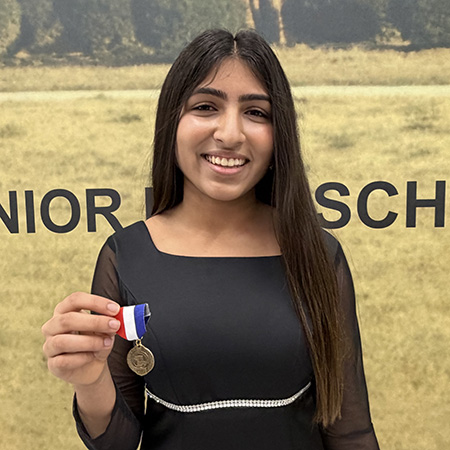
At the 2026 state-level competition, Anwesha wins an Indiana State School Music Association (ISSMA) gold medal.
Tell us about your various volunteer roles.
I’ve been involved with Girl Scouts for a long time and have done a variety of activities like baking cookies with members of a nursing home. A few years ago, I got my Bronze Award, which is 20 hours of work on an initiative that can be done with your troop. We made and donated around 100 kits to a children’s shelter. We sewed pillow cases and put toiletries and other goodies inside.
The Silver Award project is 50 hours of work and has to be more long-lasting. You can do it individually or in a group of two or three people, and I did it by myself. I made a Little Free Library in Arcadia, because the kids there don’t have as much access to books and educational resources. I regularly update the books as well, ensuring there are options for various age groups.
Outside of Girl Scouts, at the Hindu Temple of Central Indiana (HTCI), I teach younger kids to get involved in the community. We’ve done things like hold a food drive, make sack lunches for people facing food insecurity and make blankets for a shelter for the unhoused.
We run an annual music night fundraiser with other HTCI members to raise money for children and schools in rural India through Ekal Vidyalaya. For $500, you can fund a school for an entire year. I’ve helped organize it and collect donations for the past three years.
I volunteer at the Carmel Public Library by reading books and giving reviews so people can make more informed decisions when they’re borrowing. I organize activities and help put the books back on the shelf, too.
My dad, a few others from the temple, and I have run a 5k to raise money and awareness for the National Alliance of Mental Illness for the past three years. We raised around $30,000 or $40,000 this year as a group.
I also volunteer at an assisted living facility. My mom works as a physical therapist, so I’ve been going to her workplace since I was three and talking with patients. It can brighten their day and has always been something I enjoy. To help them improve their coordination, cognition and hand-eye movement, we also play games.
What are some of your long-term plans or goals with your volunteer work?
I want to complete my Girl Scouts Gold Award, though I don’t know what exactly I want to do yet. The project is done individually with 100 hours of work. Your initiative has to be completely sustainable and able to be used in the years after you’re done. I also want to expand our fundraising for EKAL.
What’s been the most rewarding part of your work?
The most rewarding part has been seeing the faces and hearing the stories of the people we’ve helped. It makes me feel like I’ve made a difference. It’s also the values and things I’ve learned.
What have you learned through your experiences as a volunteer?
Residents of assisted living facilities don’t often get to talk to people besides other residents. That’s why I like going back, to give them that connection to the outside world.
I’ve also learned that I have a great life. I’ve seen so many people struggling, who don’t have as much as I do, and I’m so grateful to my parents for everything they’ve given me. That’s what makes it possible for me to volunteer. They put so much work into coming here and giving me and my brother a better life.
Why is it important for others to get involved with causes they care about?
It takes a village to raise a kid, and contributing to that community and to the people who have done so much is valuable. Even a little bit can do so much; it can make someone’s day. The food we make for Wheeler Mission might just help someone for one meal, but it’s going to make them so much happier. Contributing to something that you’re invested and interested in is what your role in your community is.
What do you want people to learn from your story?
Everything you do counts. Even doing something that feels small can make an impact you might not even be able to see. It’s important to keep going, and always do your best.
Do you want to make a difference in your community like Anwesha? Find local volunteer opportunities.
The Heart of the Archives: Four Decades of Service and Storytelling
Meet Daily Point of Light Award honoree Diane Bryant. Read her story, and nominate an outstanding volunteer or family as a Daily Point of Light.
When Diane Bryant first walked through the doors of The Carter Center in Atlanta, the institution was still in its infancy. There was no formal volunteering program, just a group of people with a global mission. It was 1987, just five years after the center’s founding, and Diane found herself working under the direction of President Carter’s aunt. Her early days included the quiet, essential tasks that build a foundation: organizing newspaper clippings, stuffing envelopes and hand-writing cards. These modest beginnings sparked an impressive tenure of service, during which Diane has become a living bridge between the private values of the Carter family and the public they served.
As the institution evolved, so did Diane’s role. When the Jimmy Carter Library and Museum established its docent program, she joined the very second class of trainees, transitioning from behind-the-scenes administrative support to the front lines of education. Over nearly four decades, she has worn many hats, from puppet show performer to storyteller for toddlers, and even guide for visiting dignitaries. Whether she was traveling to rural school districts to give presentations or leading specialty tours for seniors from local nursing homes, Diane’s mission remained consistent: to show the true connection between Jimmy Carter the man and Jimmy Carter the president.
During the unprecedented challenges of the COVID-19 pandemic, the world retreated into isolation and the National Archives and Carter Center were forced to close their administrative doors. But Diane kept hospitality alive. Alongside a small security detail, she and a dedicated group of volunteers stepped up to ensure the museum remained accessible to the public. They greeted guests and navigated them through the facilities during a time of uncertainty, proving that the “accessibility and hospitality,” which were hallmarks of the Carter presidency, could persist even in a crisis.
Diane’s impact is measured not just in the decades she’s served, but in the thousands of connections she has forged along the way. Having known both President and Mrs. Carter personally – and having the profound honor of participating in their celebrations of life – she carries their stories with a unique intimacy. She understands that visitors arrive at the center because they feel a deep alignment with and curiosity about the former president’s values. By listening to their stories and sharing her own, Diane ensures that the legacy of service she helped build since the 1980s remains a vibrant, breathing reality for every person who walks through the doors.
Diane Bryant overlooking the grounds at the Carter Center displaying the statue commemorating his efforts to eliminate River Blindness through the Center’s health initiatives.
What inspired you to get started at the Center?
I am 74 years old, and I started there when I was in my 30s. Not being from Atlanta originally, I knew everybody was really incredibly proud of President Carter and that he was going to have the Carter Center in Atlanta. When it was finally here, everybody wanted to go see it. I had little kids at the time, babies who are now in their 40s, and I went there because I first went just to look at it. Everything was new. It was a way for me to be intellectually engaged; I’m a therapist by trade and I’ve always been really involved in a lot of volunteer activity, but not this type. There are so many things that engage you intellectually as well as emotionally at the center. I never go there without seeing something or learning something new.
There was not a volunteer program at the time. Miss Sissy, President Carter’s aunt, and Miss Alice, his Sunday school teacher from Plains, were trying to start up a volunteer program. When we first went, it was like anything you were asked to do, you would do. President Carter really appreciated hospitality, so he wanted somebody to stand at the door and say, “Come in. Come in. We’re so glad you’re here.” That is the feel he wanted to give, that it was open to anyone.
Tell us about your volunteer roles over time, and what you’re doing now.
When the education program first opened, we would actually go out into the schools to do programs on the presidency – like “How a Bill Becomes a Law” – using puppets. Eventually, due to gas shortages and security issues, the focus shifted to having classes come to the Library and Museum so they could experience the whole center. It’s a beautiful, unique piece of land.
As the years passed and the Carters got older, the focus changed again. We saw more adult groups, people who had memories of his time in office and felt connected to his ethics. My role covered the gamut: kids’ tours, specialty programs for scouts and meeting visitors who just wanted to connect. Now, I do specialty tours and education programs. Because I’ve worked on both the Carter Center side and the Library side, I can provide a sense of continuity. Now that he’s gone, people want to see the entire range of his life, from being a young man to his work as a private citizen.
Why is the preservation and retelling of history so important?
It’s vital because of the transparency it provides. After the Nixon administration, laws changed so that presidential documents became the property of the American people. President Carter was one of the first to operate under that. He insisted on showing what happened – good or bad, right or wrong. He didn’t want to whitewash history. He would say he operated with the best information he had at the time, even if hindsight suggested a different path.
When I talk to kids, I use his life as a lesson. I tell them how he lost his first few elections and wanted to quit, but he kept trying. It’s about how you approach leadership and values. There are so many parallels between history and today. If you don’t understand history, you are doomed to repeat its mistakes. Seeing how a leader uses their values to impact their time in office is a very telling tale.
What are your long-term plans or goals you have with volunteering?
Some of the early people that volunteered there were connected to the Carter administration. One of our volunteers, until she was well into her 90s, would sit at the door in a chair and welcome people. I have some crazy vision of myself at 90, sitting there saying, “Come on in, see the place.” I will continue to go there until they feel that my contribution isn’t useful. I’m lucky, because I always feel like I gain more than I give by being out there and being with people.
Why is it important for others to get involved with causes they care about?
Everybody can. And the feeling of being able to give and putting yourself out there and listening to other people’s stories – listening to people – is so important in our world today, because we don’t listen enough. President Carter always listened. That was one of his hallmarks – listening to whoever he was with and negotiating with them, starting on a very personal level before moving to higher issues in resolving conflicts.
I do believe in volunteerism, getting involved. Somebody asked me in a nonprofit that I work with, “Why do you do this?” And I said, “Because we’re supposed to do this.” If we can, if we have the ability, I really believe this is what we need to do. It’s purpose in life. I also was lucky enough to grow up in a family that really valued that, and my own family values it. And that’s unusual, because not all people believe that way.
Any advice for people who want to start volunteering?
I think it’s important to invite others to walk with you. If you’re a volunteer, reach out and say, “Hey, just come with me and see what you think.” That takes away the fear of the unknown.
People often worry about not knowing the answers. When a student asks me a question I don’t know, I just say, “I don’t know, but that’s a great thing to look up when you get back to the classroom!” We’re all in this together; it’s not just about imparting knowledge, it’s about working together.
What’s been the most rewarding part of your work?
I think it’s getting to see hope. How we’ve been able to almost eradicate diseases with very simple solutions. How there are people out there, with all of their struggles, who continue to work at a grassroots level. There’s a lot of hope out there.
Even when things don’t go your way, you keep on trying. President Carter did not see himself losing the second election. His hope was to be there for eight years, not four years. And he said, “Now I can do all the things that I wanted to do as a president, but as a private citizen.” And that’s very encouraging, to think that you actually can make an impact, even on a very small level.
Meet Daily Point of Light Award honoree Steven Thares. Read his story, and nominate an outstanding volunteer or family as a Daily Point of Light.
Steven Thares describes himself as a jack of all trades, master of none. But if there’s one thing he’s mastered, it’s volunteering. After losing his wife when she was just 50, Steven realized he needed to do something with his hands to pass the time. He dedicated himself to woodworking and found great joy in making things. Already a member of his local adult community center, Steven offered to help change an old toilet paper dispenser in the women’s bathroom that would have likely required a lengthy wait time from the maintenance department. When the team realized how handy he was, Steven got to put his passion for woodworking to use. A set of dilapidated benches was almost unusable for the center’s community, and Steven took the opportunity to transform them, creating a safe spot for seniors to wait for the bus. But he didn’t stop there. Every time something needs a little work done around the senior center, Steven jumps into action, putting his positive attitude to work by helping others.
Steven doesn’t limit himself to strictly woodworking jobs, however. He helps host community center events at a local restaurant, serving and mixing drinks for guests, and calling bingo numbers at the weekly game. Of course, Steven’s projects have culminated in his most exciting project yet: working on the community center’s library. With very little direction, Steven is hard at work creating a shelving system that will store everything from books to puzzles and serve as a home base for the center’s thriving book club. A true self-starter, Steven is creating something incredible out of the kindness of his heart.
Steven’s experience is a great example of how important it is to stay active throughout life. When asked why he continues to volunteer at the senior center, he says taking care of things around there just makes him feel good. His willingness to step outside of his comfort zone and use his skills to help others is a beautiful example of how volunteering can change the world for the better.
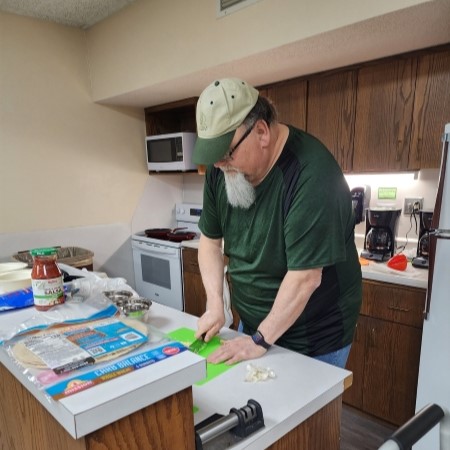
STEVEN THARES CHOPS FOOD IN THE KITCHEN AT THE ADULT COMMUNITY CENTER. /COURTESY STEVEN THARES
What inspires you to volunteer?
My wife passed away at age 50, and I was 51. I just had to do something with my hands. I worked nine more years, and then at age 60, I had to go out with medical disability. Now that gave me a whole seven days a week to do stuff, and I just mentioned to them at the senior center that if they needed something done, let me know, and I’d do it.
What inspired you to get started with this initiative?
I had just joined the senior center maybe a couple of months earlier, and I was watching two guys outside by a squirrel feeder. I went out because I’ve always worked with wood, amateur-wise. I saw these two gentlemen out there talking, and I told them I’d make them a new squirrel feeder. After that, the site coordinator for the senior center asked me if I could do anything about their two benches that they had that were really worn and needed to be redone. I took them home and took them apart, sanded them, re-stained them and put them back together, and everybody was wowed. I went to do the ones in the front, and they were so rotten that I was afraid that they would break. I talked with the site coordinator, and we decided to make two more benches for the front. People just kept on telling me how happy they were that I was going around doing this stuff, because they really needed it.
Tell us about your volunteer role with the Adult Community Center.
I got started in there doing little fix-me-ups. My first job there was taking out an old toilet paper dispenser that should have been taken out when they redid the women’s bathroom. Now, they’ll come up with something for me to do. I’ll go in to do activities there, and I’ll do anything with wood. I also help on Thursdays, doing the program at a restaurant across from us, mixing drinks. I help set up for bingo every week. This winter, I’ve been trying to design a shelving unit for a library.
What’s been the most rewarding part of your work?
Seeing the change and the people. I didn’t really expect it, but people went on their way to tell me that the benches are so nice. Seeing the response from the people and reflecting on my own skills. Doing something with my hands, I think, is the most satisfying. That I actually produce something that people want.
Tell us about future partnerships, programs or events that you are excited about.
Making the library. It’s going to be more decorative. This one will have a trim around the top, which is the fancy type of the way the wood is made. People bring in books, and other people will look through the books and take them home to read. We have a book club that meets once a month. They pick out a particular book, and then they discuss it at the club. They can just get a book there, go home and read it, and then bring it back so somebody else can read it. We’ve also had so many puzzles donated to us.
Why is it important for others to get involved with causes they care about?
Because if we don’t, who will? Everybody can use some help, whether it’s an hour a week or an hour a month.
Any advice for people who want to start volunteering?
Be brave. You want to volunteer for something? Go up to the person and say you’d like to volunteer to do whatever you feel like doing. We have volunteers at the hospice houses who volunteer to take care of the lawns so the staff doesn’t have to worry about mowing. You have to put yourself out there and talk to people and see who’s having trouble. Can we put together a group and go in and clean a senior’s house for them on a Saturday once a month? You’ve got to put yourself out there. You’ve got nothing to be embarrassed about.
What do you want people to learn from your story?
I want them to learn that it’s never too late to do something you love. Just because you can’t do it full-time doesn’t mean you can’t do it. It doesn’t matter what age you are. It’s your attitude of wanting to help. That’s what I’m trying to get across to people. Don’t be afraid to go out and show yourself.
Meet Daily Point of Light Award honoree Aamir Tinwala. Read his story, and nominate an outstanding volunteer or family as a Daily Point of Light.
At just 12 years old, Aamir Tinawala took his interest in birds to the next level by founding the Backyard Bird Project (BBP) to create and encourage the placement of nesting boxes in his community. As he got older, his interests naturally expanded to conservation, and he cofounded his high school’s Conservation Club, which spurred him to widen BBP’s focus.
In the past six years, Aamir has organized nearly 64 bird box events, both in-person and online, reaching thousands of people. There are now BBP chapters in 24 states and three countries.
Among his many achievements with BBP, Aamir has successfully advocated for the establishment of the American kestrel as his town’s “city bird” to boost civic pride and build awareness around bird conservation issues. “Birds and Brews” programming came after. And he co-hosted the town of Irving’s Arbor Day event last year, organizing presentations on environmental impact from school and community groups.
India’s Project Rise, an organization whose Indian Sparrows initiative supports repopulation, chose Aamir to lead their expansion and advocacy efforts in North America. He will tailor his work towards local endangered populations and is coordinating a 20,000-tree planting campaign. He’s also working with local government officials on environmental efforts and creating bird conservation guides for public spaces and parks around Coppell. When he’s not working on BBP, Aamir volunteers at his madrasa and works on his own clothing line—focusing, of course, on using a sustainable fabric and supply chain.
What inspires you to volunteer?
There’s a Jane Goodall quote we’ve talked about in English classes. “The greatest danger to our future is apathy.” I think Americans are more inclined to be apathetic towards our impact than others. That’s how most people are brought up, if you’re middle class. It’s how society caters to you.
Breaking out of the bubble in which I grew up is what inspires me to volunteer. Realizing, for example, that my carbon footprint has an impact on the rest of the world, and the goods and products I have in my house are causing environmental destruction in developing countries inspires me to focus on conservation efforts.
Tell us about your volunteer role with the Backyard Bird Project.
Our chapters are decentralized. I talk with people who want to start one, give them the information and then they pioneer their own path. I also keep up with partnerships and plan future initiatives and logistics for other chapters.
A lot of my work now is hosting community events around Dallas. I order wood and have it cut to different sizes. Then, around 60 people of all ages will come in–seniors, children, families–and I’ll teach them what birds do for the environment and the importance of a nesting box. I’ll show them how to make one and then spend the next two hours helping them make their own. I’ve personally installed over 750 since middle school for 16+ native Texan species.
I started setting up smart boxes seven months ago in different states where we monitor how humidity and temperature affects bird reproduction and the types of wood that do best. We’ve finalized a forecasting tool that integrates AirNow and eBird data from 2,500+ monitors and 100M+ annual observations–all data sets you can find online–to see how pollution affects bird migration, so we can predict the best places to put up nesting boxes.
What inspired you to get started with this initiative?
I had a pet cockatiel that sparked my interest and, during COVID, I did research on birds. I was looking for something to do, so I made nesting boxes and gave them to people around my community. I got a lot of positive feedback, so doing advocacy and education about birds’ roles in our environment and conservation eventually followed. Since then, it’s expanded to support the environment as a whole, like reforesting.
You’re currently trying to get your school campus Certified Bird Friendly by Audubon. What does that entail?
Audubon has a program that certifies college campuses but not high schools. Three years ago, I brought it up with contacts at Audubon, and it turned out to be something they’d planned to do but had put on the back burner.
Once we finalize the certification program, high schools will be able to certify themselves as Bird Friendly Audubon designated campuses. My school will be the first.
They look for things like policies ensuring new builds are completed so birds don’t fly into windows, student-led education campaigns and programs, and infrastructure like native green spaces, gardens and water spaces for birds.
What’s been the most rewarding part of your work?
The most rewarding part is hosting in-person events. I enjoy telling them about bird conservation and recognizing that it’s something they might want to do in the future. At the Irving Arbor Day event, I spoke with a 12-year-old for 20 minutes who had a passion for birds and was concerned with environmental stuff. Telling him my story, that I was 12 when I started this, inspired him which, in turn, inspired me.
What have you learned through your experiences as a volunteer?
Most people are receptive. Often, the media portrays a lot of the bad things, and it makes you think people are more closed off than they really are.
Do you have any tips for how people can help the bird populations in their own areas?
The simplest thing is to make a nesting box with your family. It takes two hours and is especially fun with kids and older parents. It’s a bonding activity that you can reap the benefits of for the next ten years as you see birds come to nest. You can also garden with more native plants that cater to native species.
What do you want people to learn from your story?
It doesn’t matter how old you are when you start something. Pursue your interests and what you care about. Opportunities will come. Start small and work at it over time.
Meet Daily Point of Light Award honoree Price O’Neal. Read her story, and nominate an outstanding volunteer or family as a Daily Point of Light.
Price O’Neal learned to get out of her comfort zone through volunteer work. While she’s not the biggest talker in the world, the 17-year-old high school student was inspired to get out there and help others. Through friends and parents in her community, she learned about the National Charity League, an organization that fosters the mother-daughter relationship through an ongoing commitment to philanthropy, culture and leadership. Whether she’s serving meals at the local Women’s Center or tutoring children who live in refugee communities, Price has learned to build self-esteem by performing esteemable acts, immersing herself in unfamiliar spaces and reaching out to new people.
Price is also the founder of Hope Goals, an organization that’s dedicated to empowering women and children through community service, education and sport. Her endeavor spearheads service projects like gathering winter clothing for children and undergarments for women dealing with homelessness. Thus far, she’s provided winter clothing for over 750 kids and supplied an entire week’s worth of undergarments for 750 women experiencing homelessness. In fact, she’s racked up over 250 hours of volunteering. That’s a significant lift on top of her heavy school workload and a busy lacrosse schedule. Still, Price is utterly dedicated to her volunteer work because the rewards are so worth it to her.
While Price will be graduating from high school and heading off to college in the fall, she’s not quite sure where the future will take her. But she knows one thing for sure: She will continue to help others wherever she goes. She feels volunteer work provides her with a sense of gratitude for what she has and instills her with a sense of purpose, fueling her motivations and giving her a greater sense of purpose. Price’s story is a powerful example of how volunteerism can serve as a launchpad for a brighter future.
PRICE O’NEAL (LEFT) JOINS AMY SMITH, EXECUTIVE DIRECTOR OF THE WOMEN’S CENTER OF WAKE COUNTY, TO HELP SET UP FOR THE ORGANIZATION’S ANNUAL GALENTINE’S FUNDRAISER, WHICH SUPPORTS PROGRAMS THAT EMPOWER WOMEN IN CRISIS. /COURTESY PRICE O’NEAL
Tell us about your volunteer role with the National Charity League.
With the National Charity League, I make meals for the Women’s Center, whether that’s breakfast, lunch or dinner. Then I’m also working on my own foundation, Hope Goals, where I have organized a donation drive to collect essential needs, like underwear, socks, mittens and anything they really need, and I’ve been doing that throughout the month. With the National Charity League, they’ve helped me raise those donations. I’ve reached out to a lot of different girls and moms, and they have been amazing and really helped me gather those things and raise those donations.
What inspires you to volunteer?
I would see firsthand how much these donations are really impacting other people. It really made me feel like I was helping others, and that feeling of helping others was something that I couldn’t really get from anything else. It was just something that I’ve never been able to get from anything. That was one of the reasons why it was something I wanted to put that time into. It really helped me gain my perspective, and I just wanted to help as much as I could.
What inspired you to get started with this initiative?
I’ve always felt especially connected to supporting women and children. After learning more about the needs of my community, I really realized how many people lack basic essentials, and that a lot of people take them for granted. I’m incredibly fortunate to have so much in my own life, and that perspective motivated me to take action. I just wanted to create something meaningful and tangible to make a difference.
What are your long-term plans or goals for the organization?
With National Charity League, I want to continue working with them throughout high school, but I would like to carry my foundation, Hope Goals, into college. And then probably out of college, and maybe even expand it outside of just Raleigh. I would just like to continue, whether or not I go to college somewhere outside of Raleigh. I want to make sure that I focus on helping others, because I know that it really fuels my life and makes me have purpose in life.
What’s been the most rewarding part of your work?
I know I keep saying it, but seeing the fruits of my labor and how they impact others and how powerful they are. Seeing at a younger age that I can really make that big of a difference and do something that meaningful and make a difference in others’ lives has really felt like a reward to me.
What have you learned through your experiences as a volunteer?
I’ve learned a lot about leadership and communicating with others. I’m not a big talker, and so it’s taught me a lot of communication skills with adults and other people who are in leadership positions. Also, it’s taught me how I can help people and how I can be a leader without being the loudest one in the room. I can be a leader and impact others in that way, too.
Why is it important for others to get involved with causes they care about?
I think it’s important because it helps you feel a lot of gratitude for the things you have. For me, it gave me a real sense of purpose, and it helped me feel like the things that I was doing weren’t just serving me, but were serving others.
Any advice for people who want to start volunteering?
If you’re able to find something, whether it’s helping children or supporting women or animals or the elderly, there are so many different organizations. Put in some research and find one, and test out some different organizations. You can probably find one that you connect to. If you find something that you really connect to, the work will become even more meaningful.
What do you want people to learn from your story?
I really want people to take away that at a younger age, there’s nothing you can’t do, especially when it’s helping other people. Maybe it’s making baskets and handing them out when you see someone on the street. You can make an impact no matter your age or what’s going on in your life. It’s helped me so much with leadership, but also my mental health and how I feel as a person. Just knowing that whatever’s going on in my life, I can always go and do something to help others, and I am making an impact in some sort of way. There’s always somewhere where you’ll be welcomed when it has to do with volunteer work.
Meet Daily Point of Light Award honoree Raunald Sebastian. Read his story, and nominate an outstanding volunteer or family as a Daily Point of Light.
Raunald Sebastian knows how much a role mentorship plays in volunteerism, because he gets to be one every day. A 17-year-old high school student, Raunald learned about Blood Cancer United, an organization with a mission to find a cure and improve the quality of life for everyone with blood cancer, for the first time from a friend on the school bus. Unfamiliar with the group’s work, he decided to go home and research it. He had never known anyone with blood cancer. But he decided to learn more, and that decision changed the trajectory of Raunald’s life.
Raunald got involved in BCU’s Student Visionaries of the Year Program, committing to join his team to raise money that would go toward creating a world without blood cancer. It was a long and arduous fundraising journey, and Raunald spearheaded fundraising events at local spots like Chipotle and Panera, while also managing outreach via email, calls and sponsorship meetings. He raised awareness on social media, getting the word out about the team’s mission and encouraging people to donate funds.
Ultimately, Raunald and his team raised $47,472, contributing to the $3.3 million raised in all of New Jersey. But Raunald proved to be so successful as a fundraiser that he was invited to the Junior Leadership Committee to help mentor different student visionary teams. He mentors two Student Visionary teams while leading and supporting 30 JLC members. He ensures recruitment and fundraising goals for the Student Visionaries of the Year program, bringing in new, vibrant minds to make sure the program is a success.
Throughout it all, Raunald hasn’t forgotten the reason behind why he’s so passionate about the cause. He’s had the opportunity to meet a little girl living with blood cancer that the funds his team raised will go toward. Seeing her smiling face on the stage as her crying parents watched from the crowd was a great reminder of why Raunald is just so dedicated to working toward eradicating blood cancer. Through serving as a mentor for others, Raunald’s passion could very well someday become a reality.
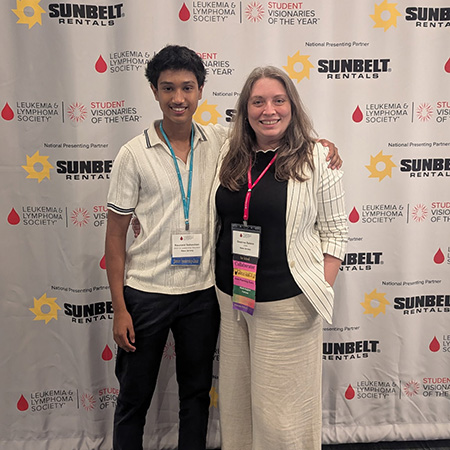
RAUNALD SEBASTIAN (LEFT) JOINS HIS CAMPAIGN DEVELOPMENT MANAGER, DESIREE SALARA, FOR THE NATIONAL JUNIOR LEADERSHIP CONFERENCE IN DALLAS, TEXAS. /COURTESY RAUNALD SEBASTIAN
What inspired you to get started with this initiative?
It started with a question that my friend asked me on the bus, which was if I wanted to be a part of Blood Cancer United. At that time, I had no clue what that was. If I don’t know something, I really want to research it, so I went home and researched it and asked my parents, and realized I really wanted to do this because blood cancer is a global issue. What inspired me was that impacting your community teaches you so many lessons along the way. It really builds you as a person, builds your personality, and builds your network and your skills through the volunteering journey.
What inspires you to volunteer?
I do it because you never know when you will experience these hardships. I want to help provide for the people who are going through these hardships. Maybe I’ll never experience these hardships that people go through, but if I do, that’s good, because it also teaches me a lesson. Volunteering really stood out to me because it teaches me disciplinary skills and shows me that effort is needed to achieve something. If I achieve it, that really teaches me so many more lessons along the way, and it just builds me as a person overall.
Tell us about your volunteer role with Blood Cancer United.
When I first volunteered for Blood Cancer United in 2025, I was a lead candidate, which means I was one of the high schoolers across the world that was part of the Student Visionaries of the Year program, a seven-week fundraising and philanthropic leadership program that students take across the nation to lead a group of people to fundraise money for blood cancer. My job at that time was to get my co-candidates to plan out how to go about the fundraiser, so we could reach our goal. Our goal was $50,000 in those seven weeks. I spent that whole summer trying to find people who would want to be on my team and who really had that passion to fundraise just like me. And it was really a long journey, because it taught me that leadership comes with a lot of patience and team collaboration skills. We went on to raise close to $50,000, and I personally raised $7,000. I got invited to the Junior Leadership Committee to help mentor different student visionary teams to raise money.
What are your long-term plans or goals for the organization?
I really want to stick with the Junior Leadership Committee and help other student visionary teams succeed and excel beyond how far I went. That really brings joy to me and shows how I can help them improve their goals. I also want to keep advocating for blood cancer awareness, because you never know when you will experience that type of issue. It teaches you so many lessons along the way.
What’s been the most rewarding part of your work?
Right now, on the Junior Leadership Committee, I would say the most rewarding part is seeing the team that I’m mentoring doing even better than I am right now. To see those 20 team members on their team light up and really have their joy to fundraise even more than my team and I really brings me so much joy, because it really shows me that I can steer them away from the problems that I had. It’s so rewarding to see me teaching other teams and other mentees how to fundraise and how to go about it, because it shows me I have played a role in their success, too.
What have you learned through your experiences as a volunteer?
I’ve learned so much from my volunteer work. But specifically, I’ve learned so many team collaboration skills. I’ve learned so much about patience. I’ve learned so much about different people, and I learned a lot about networking and personalities. I feel like everyone I meet has a different personality, and I hear their stories and how their lives may be affected by different stuff. That goes to show how judging people based on how they appear, or what they’re going through, is just terrible. You don’t know what their day’s been like, and it just really shows you that you should never be able to judge so quickly without really knowing their story.
Any advice for people who want to start volunteering?
Just go for it. Obviously, do your research. If you want to do it, you should do it because the thing that you’re questioning is what you want to do. That means you have to do it, because it really pushes you and teaches you a lot about who you are as a person, and it teaches you so many new skills. If you’re hesitant, you should always do it because it really pushes you out of your comfort zone, and really involves you with that specific community.
What do you want people to learn from your story?
I would love people to learn that age does not matter. Maybe you are young, and you feel like you can’t have an impact. That’s how I thought about it. I thought I was only a sophomore in high school. How was I going to fundraise $50,000 for Blood Cancer United? Then I realized, after viewing so many more high school students across the nation, I can get used to this. That’s because age doesn’t matter. If you have that drive, if you have that passion, if you have that perseverance, you can accomplish anything. At the end of the day, the goals that you want to accomplish are really dictated by the effort that you want to put in. You can get started at whatever age you want, and you can finish that goal by whatever age, but what truly matters is the drive that you have behind all of that.
The Fruit of Volunteer Labor: One Teen Harvests Hope
Meet Daily Point of Light Award honoree Elizabeth Milgrim. Read her story, and nominaten outstanding volunteer or family as a Daily Point of Light.
When the branches of Elizabeth Milgrim’s pear trees saw the weight of a heavy harvest, the 14-year-old saw more than just a surplus of fruit. While most would see a chore or maybe a gift for neighbors, Elizabeth saw a solution to a local crisis. Disturbed by the idea of fresh food going to waste while neighbors struggled with food insecurity, she took her extra yield to a local church pantry. That first delivery sparked a realization: if her backyard was overflowing, others likely were too. With a quiet determination, she stepped into the role of founder and launched Garden Givers Port Washington (GGPW), a grassroots initiative designed to bridge the gap between local gardens and hungry families.
The brilliance of GGPW lies in its simplicity, as well as Elizabeth’s ability to mobilize her community through social media. The organization’s volunteers act as a mobile bridge, driving to residential homes to collect donated produce and delivering it directly to the pantry. This ensures that home-grown nutrition reaches those who need it most, without placing the burden of transport on the donors or the recipients. In less than two years, this teen-led movement has successfully diverted and donated over 600 pounds of food.
Elizabeth is a creative thinker who sees potential where others see waste. When she encountered fruit too overripe for the pantry shelves, she didn’t toss it, but rather partnered with a local ice cream shop to transform the produce into a custom flavor. She also harvested vegetables from a school garden and, in a characteristic touch of grace, began delivering homegrown flower bouquets to pantry clients. Elizabeth remains humble, yet her vision has cultivated a more resilient and connected community in Port Washington. By turning backyards into “giving gardens,” she has created a sustainable model of neighborhood altruism that nourishes both the body and the spirit. Read on to hear more of her remarkable story.
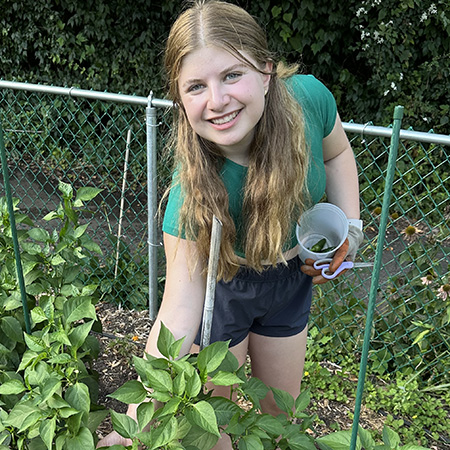
Elizabeth volunteering to pick produce at a local garden to be donated to the food pantry.
Tell us about your volunteer role.
I’m the founder and president of Garden Givers, which I started the summer going into my freshman year of high school. Basically, what I do is coordinate all of the pickups and drop-offs of the produce. I’m in communication with the food pantry and different local organizations that support us, and I’m also in communication with local schools to help with their garden. I also run all of the social media and publicity for the organization, and coordinate with the other volunteers.
What inspired you to get started with this initiative?
I have a small home garden in my backyard, and it was kind of more of my parents’ thing. They really enjoyed it, and I would always garden with them, but I was never really super interested in gardening. But we have a pear tree, and one summer, there was just so much fruit that we had no idea what to do with it. I suggested to my mom, “Is there any way that we could donate some of this fruit to people who may not be able to have access to fresh produce?”
We looked into connecting with the local food pantry. And once I started doing that for my own home garden, it made me really want to connect with the greater community and share my passion for volunteering and reducing food waste. I realized how much I cared about providing necessary foods to community members who don’t necessarily have access to it.
Why are you passionate about food insecurity?
Ever since I was young, I’ve always felt that everybody, no matter who they are or where they come from, should have their basic needs met. They should have access to food. Especially within my community, I don’t think I realized how much it impacted different community members or even my peers, until I was older. I think seeing the appreciation from the food pantry has only deepened my support for this cause.
While climate change is obviously a big topic on news media right now, I think that helping community members in need, specifically through Garden Givers, also aims to help with this. We reduce food waste by getting produce from people’s home gardens. Those foods, if they weren’t collected and donated, would probably just end up going to waste. And I really don’t think our planet needs more of that. So with this organization, I’ve combined these two ideas of helping the community while also
reducing food waste.
What’s been the most rewarding part of your work?
I think the most rewarding part of running Garden Givers has been realizing the impact I’ve made. When I started this, I didn’t set out to reach a certain number of pounds donated. I really just wanted to help the community, and that’s my goal even now. But I think over the summer, when we hit 600 pounds donated, that was kind of when it really clicked for me. I was like, “Wow. This is not just a small thing.” I’ve been able to make a huge impact, which I’ve been really grateful for. And I think also seeing different community organizations and the food pantry and the schools, all of their appreciation for the organization, has been really amazing and just makes me even more passionate about what we’re doing.
What are your long-term plans or goals for organization?
This summer, I’m planning to have more volunteers that aren’t just high school age, but adults or even younger kids. I want other demographics to help volunteer with the organization. And I’m going to be starting a student executive board. I would like to hopefully partner with more schools. Currently, we’re partnered with one elementary school in my community, and we’re working on a partnership with another one, and I would like to partner with any local schools that have gardens or want to teach their students about gardening or food insecurity. I think it’s really important to teach young children about these topics.
Additionally, I would also like to hopefully expand into different towns, because, well, it’s been amazing to make an impact on my town, but I’d like to take this model elsewhere. I think that if I can find connections in other local neighborhoods, I could hopefully expand my impact into those communities as well.
What have you learned through your experiences volunteering?
I think I’ve learned a lot of things I can take pretty much anywhere. I’ve learned how to run an organization, communicate effectively, do any sort of media. I never really had done any of that before, and this organization kind of forced me to learn how.
When we partnered with a different organization called the Grow Food at Home Club, which is a group of community members who enjoy gardening and sharing tips and progress in their home gardens, I found one of the members is a master gardener. She’s been a really big help in teaching me about gardening and plants and when different things need to grow, when the right times are for different plants. It’s been really nice to learn all of that because, like I said before, I didn’t really know that much about gardening before starting this organization. It made me a lot more interested in and passionate about something that I just used to do with my parents because they liked it.
Why is it important for others, especially youth, to get involved with causes they care about?
I’m a big believer in that nothing changes unless you try to change it. If anyone sees anything in their community that they believe can be changed for the better, I think that it’s really important, especially for young people, to know that there’s a possibility for them to change it. It’s not like everything has to remain the same. There is always a possibility for you to help change it. If you’re driven and you have the right ideas, you really can make a huge impact, even more than you might have thought at first.
Any advice for people who want to start volunteering?
Even if you’ve never tried volunteering, just go for it! I think taking that jump and starting with volunteering can feel like a big leap. But if you just go for it, nothing bad can come out of it, right?
Meet Daily Point of Light Award honoree Shaylen Mehta. Read his story, and nominate an outstanding volunteer or family as a Daily Point of Light.
Shaylen Mehta wanted to make a difference. A 17-year-old high school student, Shaylen saw the importance of service work on annual family trips to the Indian village of Sadra, where his father has deep roots. While there, Shaylen and his family help the underserved community. But Shaylen realized he wanted to continue the same volunteer work back home in his own community. In 2023, he established the South Piedmont Junior Optimist Club, an organization that spreads optimism throughout the community through acts of service.
In addition to getting the group up and running, Shaylen wanted to come up with a service project that was different than something anyone else had done in the area. He decided on a sneaker project in partnership with Got Sneakers, where the community donates old shoes. The shoes are then bagged up by team members and shipped off to Got Sneakers, who sends back money which can then be put back into other service projects. As a result of the sneaker drive, over 300 pairs of shoes were saved from landfills, displacing over 6,000 pounds of carbon dioxide and saving over a half million gallons of water. The group participates in a variety of other endeavors, including a highway cleanup, Santa’s Breakfast, which hosts kids and families for crafts, food, activities and a visit with Santa, and collecting and delivering school supplies to local schools that need them.
When Shaylen graduates from high school, he hopes to begin studying for a career in medicine. He considers his dedication to service to be the perfect launch pad for his future career goals because of the passion they both require. Shaylen dedicates 12 hours per month to his work with the South Piedmont Junior Optimist Club, demonstrating how volunteer work has instilled the values of discipline into his life that’s already busy with a heavy high school course load. Through volunteerism, Shaylen has grown into a bright young man with a future that has endless potential, and that opportunity is available to anyone eager to grab hold of it.
What inspires you to volunteer?
I feel like volunteer work is a big part of my life. For the past three or four years, my family and I have been volunteering in southern India. I was born and raised here in America, but my dad has a lot of history in Sadra, and that’s kind of his hometown. So we go there once a year. We’ve been going there for the past three or four years, and we volunteer there. We stay for about a week, and we help underserved villages. The whole reason that I got into it started from a multicultural standpoint, and I realized, why not just make it bigger? Why not expand? That goes for India, and also for my community, with the various projects I’ve done through the South Piedmont Junior Optimist Club.
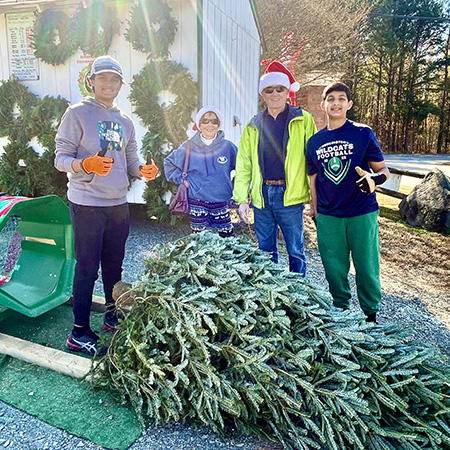
SOUTH PIEDMONT JUNIOR OPTIMIST CLUB FOUNDER SHAYLEN MEHTA (LEFT) GIVES A THUMBS UP WHILE STANDING IN THE CHRISTMAS TREE LOT. /COURTESY SHAYLEN MEHTA
Tell us about your volunteer role with the South Piedmont Junior Optimist Club?
My roles have changed throughout the years. In 2023, I was a founding member and president of the club. As founding member, my role was to start the club, in a way. I had to look at a bunch of rules and regulations, and I had to get in contact with the Optimists International. From there, I started meetings. We posted online about who would be interested, and had the first meeting at my house. My role was to kickstart the club and be that leader. I was responsible for facilitating the meetings. I had an agenda that I read. We covered various points, and I also delegated different tasks and service projects to people. Now, as a secretary, I assist the current president in their role. I’m also part of different service projects, besides the ones that I started as president.
What inspired you to get started with this initiative?
There’s an organization above the South Piedmont Junior Optimist Club called the Weddington Optimist Club, and that’s actually part of the international chapter that’s been around for multiple years. I attended a meeting with my mom. It was my understanding that I could start a club that was similar to the Wellington Optimist Club, but it was a place that could allow juniors to serve in a way that the community would benefit. I felt like it was an all-around win for everyone who wanted to really serve the community that couldn’t because of the infrastructure.
What’s been the most rewarding part of your work?
The most rewarding part of my work has been the Sneaker Project. No one really thinks that they can save just short of half a million gallons of water. But seeing those numbers is a reassurance to all my accomplishments and how far this club has actually come. We started with eight to 12 people in the living room of my house about two or three years ago. Now, we have the club with over 20 people. You see the progress, not only with the Sneaker Project or Adopt the Highway and how many people we help, but just to see the growth our community has had because of this club. Not only for the members in it, but for the community and the benefits that they reap because of us.
What have you learned through your experiences as a volunteer?
Listen more and talk less. As a leader, everyone wants to talk. Even as a volunteer, everyone wants to talk and make their ideas heard, but I feel like it’s those who listen that really take in the most information and then can form true and clear ideas within their actions. Being a volunteer, obviously, is about fostering this idea of selflessness and putting the world or the community’s needs above your own. The whole goal of this club has been to serve the community and bring more optimism. I feel like that has been the biggest thing that I learned. As a leader, especially when you listen more than you talk, you absorb the world around you, and then that not only helps you get a better idea of your surroundings and your environment, but also better ideas within your concept.
Why is it important for others to get involved with causes they care about?
I feel like people need to start and join organizations that they’re passionate about. It’s that passion that is one of the drivers of our entire lives. I was passionate about serving the community. I was passionate about going to India. I feel like it’s that passion that really drives true emotion, intent and impact. With that passion, I feel like you can achieve anything.
Any advice for people who want to start volunteering?
My advice for people who want to start volunteering is to just go out there and do it. Don’t wait until you think the time is right or a different slot on a page opens up. Find something that makes you happy, that you’re interested in and passionate about. If you’re hesitant about starting, know that volunteering is all about service and impact, and you can’t serve the community and impact others if you’re hesitant about volunteering. But once you start, you’re open to a whole new world of opportunities, emotions and feelings.
What do you want people to learn from your story?
I want people to learn that anything is possible. I know it’s a common statement, but this club wasn’t really an easy start. Anything is possible if you put your mind to it and you’re passionate about it. Another key lesson is to find people who are willing to stick by you. If it wasn’t for those few people who believed in me and my mission as the founding member, then we wouldn’t have this amazing club that has saved all these gallons of water and carbon dioxide and shoes, and have, beyond that, seen how the project has impacted the community in such an amazing way.