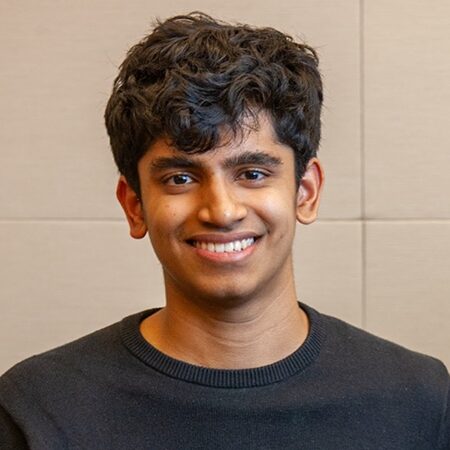
Meet Daily Point of Light Award honoree Shivansh Bansal. Read his story, and nominate an outstanding volunteer or family as a Daily Point of Light.
For Shivansh Bansal, education is not just about textbooks, but about the biological spark of human curiosity. As the founder of Project Catalyst, Shivansh has pioneered a unique approach to learning that bridges the gap between neuroscience and the classroom. By focusing on how supportive environments can shape gene-expression patterns related to memory and motivation, he’s mobilized over 150 volunteers to lead 75 workshops at prestigious venues like the Georgia Institute of Technology and various YMCAs. Shivansh believes that every student possesses potential that simply requires the right “catalyst” to unlock. And his movement has already touched the lives of 40,000 students across the United States.
Through Project Catalyst, Shivansh has overseen the distribution of 15,000 interactive books to schools in Ethiopia, Ghana and Brazil, which has saved these schools an estimated $1.2 million in educational costs. By developing free biotechnology and engineering courses consisting of over 100 lessons, he’s providing high-level intellectual tools to students who might otherwise be left behind. This global footprint has earned him a nomination for the International Children’s Peace Prize and a second-place finish in computational biology at the Regeneron International Science and Engineering Fair (ISEF).
The impact of his work is further amplified by his role as a U.S. youth ambassador to the United Nations. Beyond attending conferences, he actively shaped global policy by co-drafting UNESCO’s first youth constituency. His advocacy for science-informed learning strategies has influenced educational frameworks for over one million students worldwide. Whether speaking at the World Engineering Education Forum or the ECOSOC Youth Forum, Shivansh has become a primary voice for a generation demanding that education be both equitable and grounded in the latest scientific understanding of how humans actually learn.
Read on to hear more about how Shivansh is blending nonprofit leadership, scientific rigor and diplomatic grit to build the future of education.
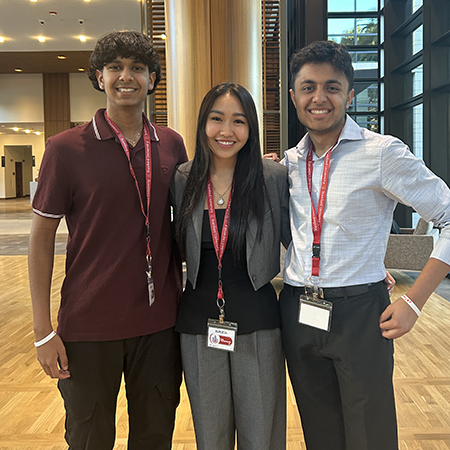
Founder Shivansh Bansal and Director of Research Raman Arora pictured at the 2024 Stanford SURGExpo, representing Project Catalyst, with Forbes 30U30 honoree, Pear Chotbunwong.
Tell us about your volunteer role.
I originally started this organization that I called Project Catalyst as a way to engage students in hands-on educational concepts in biotechnology and engineering. My mom has a daycare with a couple of centers around the Bay Area, and volunteering at those centers and seeing them evolve over time helped that dream emerge. On top of that, I had a background in scientific fields like biology and this fascinating phenomenon we call neuroplasticity, where the brain can reshape itself, and this idea of epigenetics. The goal of the organization became: how can we possibly create interactive and engaging learning environments so that proper neural pathways are able to form? This idea of epigenetics comes through to help students grasp and recall information better. That became the basis of the organization, and we went from there.
Within the organization, we focus a lot on delegating tasks. Originally, it was just me and a couple of friends; we would go to a school or an event, teach our stuff and call it a day. But then it became more like a movement where students wanted to join because they were passionate about this education revolution. From there, we were able to start writing grants and getting funding. I focus on making sure everything is running smoothly in terms of funds and reaching out to partners. I have friends who are directors of outreach, and their main role is just trying to get partnerships, because through collaboration, our reach has been able to expand much more than if it was just us. We have people doing grant writing, people curating materials and people focusing on how to get resources shipped internationally. I focus on managing that and conducting research on the science we involve in our learning resources.
What inspired you to get started with this initiative?
We started off hosting a bunch of workshops and conducting research into scientific literature on this whole process of neuroplasticity and genetics. Then we started curating our own educational resources and materials and hosting workshops around the country. We have three main headquarters: one in California, one in Georgia and one in New Jersey. We span from there, making free resources for students on our website and having in-person workshops. From there, we partnered with organizations like the United Nations and universities like Georgia Tech. Through these partnerships, we can expand our reach internationally and around the country as well.
Tell us a little bit more about the various initiatives you’re working on.
For the workshops specifically, we focus on engaging the students in a way where they’re questioning what is happening; we find ways to pique their curiosity. If you have ever sat in a normal university or school lecture where teachers use slideshows, it often becomes boring and repetitive, and you aren’t really motivated to ask questions or get hands-on with the learning. We found that if we make our entire workshop purely experiments, while explaining the concepts being done, the students can ask questions, form their own hypotheses and try out different things. One of the main things was that they are able to fail and try again, which is really important. That helps them grasp these specific concepts and apply them in the real world and at their own schools.
For our resources, we have two main initiatives. One is the online resources where we made interactive games that cover topics in engineering and biotechnology. They are free and cover over 100 different lessons that we curated using information from college, high school and middle school textbooks. The other initiative was this interactive book that was mainly a way for us to reach international students. We saw that although we have these free resources and can host webinars, some people in Africa, for example, just don’t have the internet capabilities to take part in this education revolution. We took everything from our games and workshops and stuffed it all into one neat package called “An Engineer’s World.” It’s a textbook that we can manufacture at low-cost, and then ship to countries for free. We have been able to distribute 8,000 to 10,000 books, and that’s how we are reaching people internationally.
Beyond this, I’ve been able to take these ideas to United Nations conferences and talk about the science behind epigenetics and neuroplasticity. It is causing a paradigm shift within stakeholders where they see that this idea of science-backed education is something very important that students around the world should take part in. It’s been cool to see how I am able to pitch in for that. There is a duality between being someone who wants to improve education and being a student myself, being able to pitch my voice to these stakeholders and policymakers. That is my representation at those conferences.
Tell us about future partnerships, programs or events that you are excited about.
We have a recurring program with the Georgia Institute of Technology; we partnered with them through Johnson & Johnson’s Pharmaceutical “Bridge to Employment” program to host workshops at Georgia Tech. Those workshops focus mainly on biotechnology. We also have recurring workshops with local YMCAs and an organization in Oakland called Girls Inc., which focuses on providing education for underserved girls in the area. We go out there quite regularly providing workshops, and on top of that, we also try to host at local libraries or county centers. We have those recurring as well.
What are your long-term plans or goals for the organization?
Our main long-term goal is working with a larger institution like the United Nations to implement this idea of epigenetics and neuroscience back into the education systems of less developed countries. We feel like if these ideas are able to help students learn better, then overall it can help uplift communities out of cycles of poverty and hardship. If they can have a fair opportunity to learn, they can become successful in whatever field they want. I feel like that’s something really important, how we can uplift each other as a community and uplift the world as a whole. If everyone is given a proper chance to learn, then we can become more connected as individuals.
What have you learned through your experiences volunteering?
When you’re creating an organization that you want to make global, you’re going to see things like funding falling apart or specific partnerships not coming through. Those things are small and manageable. Bigger issues we have faced involve trying to get more people on our side. When we go to these organizations asking for partnerships or help, sometimes we are not given priority just because we are students.
It has been my mission to amplify the voices of students throughout the world. I’ve been working with diplomats at the United Nations to increase youth participation within UNESCO’s framework. It is challenging, but it has been a rewarding experience to see that as a student, if I put my mind to it, I am actually able to go out and contribute my own voice to these events.
What’s been the most rewarding part of your work?
One of the most exciting things for me is when I see students smile and learn in front of me; they are having a great time, just being amazed by what we’re showing them. That is really heartwarming and wholesome. The other thing is being able, as a student, to contribute at such a big level where I can see how people’s lives can be changed by something I contribute – how that can actually affect communities abroad and people that I might never meet. I wanted to contribute to the world in that way; it is a big feeling of wanting to spread love and make the world a more connected place.
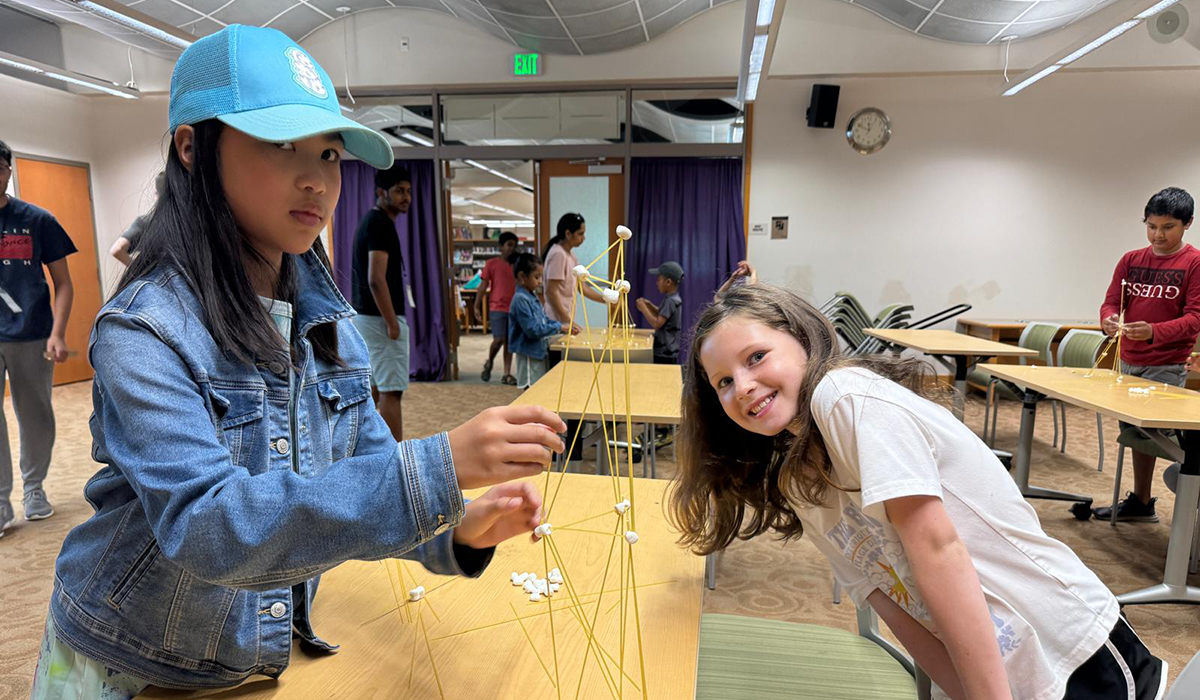
Students pose for a photo with their marshmallow tower moments before it collapses at one of Project Catalyst’s Alameda County district-wide events.
Why is it important for others to get involved with causes they care about?
I think this really comes down to how we can make a more loving world. It comes from recognizing as humans how connected we are. If one person’s smallest actions can positively influence somebody else, and we get a million people to do that, those actions ripple outwards and positivity starts spreading everywhere. If we can all work together as one world, we can address the biggest problems we face, like climate change, lack of education and poverty. If we can band together and recognize another person’s suffering as our own, we become motivated to address their problems.
As youth, we also have this unrecognized power, which is our young age. We have creative ideas and approaches. When we start recognizing that we can actually make a difference in even the smallest ways, it becomes really impactful because of the snowball effect.
Any advice for people who want to start volunteering?
Find something that you are really interested in and just get started. When I first started volunteering, it was at an organization called Kids Against Hunger. I was originally volunteering just for the service hours, to get those checked off, but I recognized once I got there that the people were just amazing. Being around them and seeing that we were all working towards one cause was truly heartwarming. Getting involved in any way whatsoever is the basis of what we should be doing as humans; it is fulfilling to ourselves and helping others as well. If you’re really passionate about something, just get started.
What do you want people to learn from your story?
Beyond this organization, I’ve also been really passionate about research into cancer. I was intimidated as a high school student – how could I possibly contribute to this field? But it’s important to get started on something you’re passionate about because once you go through with it, you’ll realize that you’re actually capable of making such a big difference in other people’s lives. You are able to have a positive effect on the world, and that’s the legacy we should all leave: one where we’ve helped other people and done our part in creating a more connected and loving world.
Meet Daily Point of Light Award honoree Michael Haskell. Read his story, and nominate an outstanding volunteer or family as a Daily Point of Light.
Michael Haskell didn’t realize what he stumbled upon one day at a storage unit facility, but it soon turned into a pathway to helping others.
The high school student was offered the opportunity to look through an unclaimed storage unit. While many people come to bid on storage units that are abandoned by their owners, sometimes nobody bothers to even place a bid. When he learned that around a million cubic feet of storage contents go un-auctioned and subsequently dumped in the trash every year, Michael knew it was time to take action.
Inside that abandoned storage unit, Michael discovered a goldmine. Everything from armoires to mattresses sat in the unit, and Michael realized that charitable organizations are often desperate for larger items to outfit homes. Knowing he was onto something, Michael founded Storage Angels, an organization that clears abandoned storage lockers and donates the contents to local charities.
Michael is responsible for choosing the units that he clears out with a team of dedicated volunteers. While small lockers can take less than an hour to empty, larger ones can require two or three hours. Luckily, Michael notes that they rarely have to dump items found in the storage lockers, because the items that are worth paying to store are decent enough to keep. After clearing out the units, Michael distributes the items to worthy organizations or sells the items on eBay and donates the profits. While items can be massive pieces of furniture, they can also be smaller, like a silver necklace he sold on eBay for $100 and donated the profits to charity.
MICHAEL HASKELL IS THE FOUNDER OF STORAGE ANGELS. /COURTESY MICHAEL HASKELL
Michael’s endeavor has been incredibly worthwhile: Since starting Storage Angels in his sophomore year of high school, the organization has cleared over 20 lockers and donated an estimated $20,000 worth of furniture and household items to worthwhile organizations. They’ve also donated 700 pounds of gently-used clothing. While Michael has a busy high school course load to carry, he doesn’t view his volunteering responsibility as a burden because he simply enjoys helping others that much. His passion for empowering those who need a hand up is a powerful example of how volunteerism can change lives.
What inspired you to get started with this initiative?
I think what inspired me was being at a locker facility one day and seeing the contents of a locker that would have otherwise gone into the trash being offered to me to look through. Seeing all of this stuff that would have otherwise been discarded in that locker– specifically in that one, I saw a lot of mattresses. I saw an armoire, a beautiful couch and smaller stuff. There were vintage toys from the fifties. All of this stuff would have been discarded because the locker facility usually contracts with a removal company to dump this all into the trash. Seeing all that stuff go to waste upset me a little bit, because it showed me that there are a lot of these lockers that don’t sell, and are going to go for zero dollars and have all that stuff thrown out. I really saw that as a way in which I could make a big impact by giving away the stuff in these lockers to charity that would have otherwise been thrown out.
What inspires you to volunteer?
The rewarding part of volunteering for me is getting together with other volunteers and collectively making an impact. Specifically with Storage Angels, it’s the feeling of going to a locker facility, seeing the mystery in this unsold locker, seeing if we can find really good stuff for charities, and having a lot of fun with volunteers and making a really big impact together. I think that’s really powerful, and that’s really what keeps me coming back to these lockers.
Tell us about your volunteer role with Storage Angels.
There are lots of responsibilities. I’m in charge of picking out the lockers that we’re going to clear out, gathering the volunteers who are able to come to the facility and clear out the locker and getting the trucks together to go there. Finally, I’m in charge of the sorting at the locker facility, and going to either a donation facility, Goodwill, Habitat for Humanity, or, for items that we think are better sold on eBay, having the cash donated. I would then take those items home, list them on eBay and then donate the cash.
What are your long-term plans or goals for the organization?
The long-term goal is just continuing to expand. Seeing what we’ve done already, we’ve made a very big impact. We’ve already donated $1,000 to Habitat for Humanity. We’ve donated an estimated tens of thousands of dollars’ worth of furniture to these charities. I think it’s just continuing to make that impact and not stopping, no matter what.
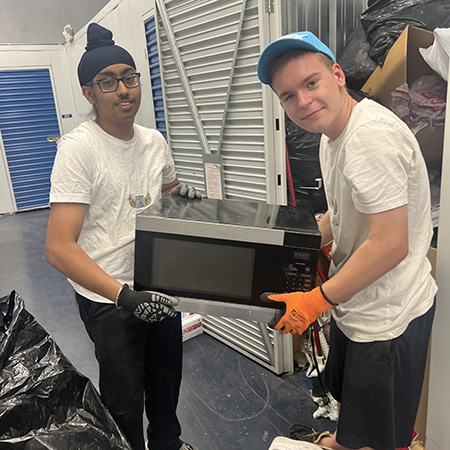
STORAGE ANGELS FOUNDER MICHAEL HASKELL (RIGHT) CARRY A MICROWAVE OUT OF A STORAGE UNIT SO IT CAN BE DONATED TO A WORTHY ORGANIZATION. /COURTESY MICHAEL HASKELL
What’s been the most rewarding part of your work?
I think the most rewarding part is at the end of the day, seeing that cleared locker and knowing that my volunteers and I made a big impact on that specific day. I think that that’s just a nice feeling. Seeing it in person after all that hard work, and getting rewarded with that feeling.
What have you learned through your experiences as a volunteer?
I think one of the best things I’ve learned is the power of getting multiple people in a space together and seeing the amazing stuff we could do. Clearing out these huge storage lockers in a relatively short period of time and making that big impact in a relatively short period of time. I think that’s kind of my biggest thing that I’ve learned–that multiple people can come together and do amazing things.
Any advice for people who want to start volunteering?
I would say that you don’t need to know where you’re going immediately. You just need to keep pushing along and doing something that you love doing. If you do that, you will definitely be able to make a large impact in your community. Not specifically knowing from the start, but just trying to make an impact. Every single day is really what’s going to lead to large successes and being able to make that impact.
What do you want people to learn from your story?
Having a passion for something, you’re able to do amazing things in the end. You’re able to donate thousands of dollars in furniture and cash to local charities. I think that if you just continue to persevere, no matter what, you will eventually be successful. You’ll be able to make a big impact on your community.
Teen Founder Gives Discarded School Supplies a Second Life
Meet Daily Point of Light Award honoree Grace Millard. Read her story, and nominate an outstanding volunteer or family as a Daily Point of Light.
When Grace Millard walked the halls of her Connecticut high school as a 14-year-old freshman, she noticed something that didn’t sit right with her: abandoned pencils, half-used notebooks and art supplies tossed aside in classrooms and cafeterias. At the same time, she knew that just a few counties away, schools and community centers were fundraising for basic materials their students couldn’t afford.
That disconnect sparked an idea. What if the excess in one community could become opportunity in another?
Together with her classmate and co-founder Jordan Chen, Grace launched Restoring Rainbows, a youth-led nonprofit that collects used school supplies, restores them and redistributes them to communities with limited resources. Two years later, at just 16 years old, Grace serves as co-CEO of an organization with more than 200 branches across 52 countries, powered by a network of 1,000 teen volunteers who have kept tens of thousands of restored supplies out of landfills and placed into the hands of children who need them most.
What inspired you to co-found Restoring Rainbows?
I’ve always grown up volunteering. My family has been very involved in our church, and from a young age I participated in food drives, clothing donations and community service projects. Even as a kid, I remember going to the grocery store with my parents and choosing items specifically to donate.
When I started high school, my co-founder and I connected over things that we were passionate about—art, sustainability and climate change. We noticed how many school supplies were being thrown away in our own school, while a few counties away, there were rec centers and school districts campaigning for more art supplies. So through exploring that and researching what it takes to run a nonprofit, we established Restoring Rainbows in 2023.
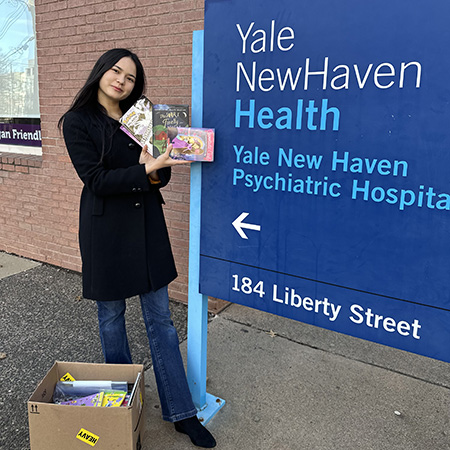
Grace Millard Donating Markers to Yale New Haven Health Donation] Grace Millard donates books and art supplies to a hospital in New Haven, Connecticut./ Courtesy Grace Millard
What does a typical donation and restoration process look like?
In our local community, we primarily collect supplies through donation boxes placed in museums, galleries and other public spaces. That allows people to donate easily and helps spread awareness.
Once supplies are collected, my co-founder and I do most of the restoration ourselves. We’ve been doing this for two years, so we have a lot of experience. We clean, repair and prepare each item so it’s ready to be used again, then distribute them to schools, after-school programs and community centers that need them most.
Do you have a favorite item to restore?
Definitely books. They’re very nostalgic for me. When restoring them, I’ll see familiar characters or handwritten names and doodles left behind by another child. It’s incredibly touching to know how loved those books once were.
We remove personal information for privacy, but I love knowing that a book that once brought joy to one child will now do the same for another. It feels like passing along a piece of wonder.
How did you build the organization from a small local project to an international nonprofit?
We started very small. We sent cold emails—about 30 at first—to local museums, schools, libraries and art galleries asking if we could set up donation bins. Once we collected our first supplies, we began restoring them ourselves, cleaning pencils, rebinding books and repairing materials so they could be reused.
After about six months, we started sharing our work on social media. That changed everything. Teens from all over the world began reaching out, asking how they could get involved. We created a branch program with digital guides, workbooks and video tutorials so young people could replicate what we were doing in their own communities. Social media really showed us how powerful connection can be when people our age want to come together to help others and reduce waste.
Why is art such an important part of your mission?
Art has a unique power to connect people. As a biracial person who is Korean and American, I’ve seen how creativity can bridge gaps in language and culture. Art helps children express emotions they might not yet have words for, and it builds confidence, empathy and joy. There’s nothing like watching a child light up—not just because they received supplies, but because they’re proud of what they can create with them.
What has been the most rewarding part of your work so far?
Seeing the impact on people. I love scrolling through social media and seeing photos and videos from places like El Salvador to India of children receiving supplies, volunteers setting up donation boxes with Restoring Rainbows written on them.
Restoring Rainbows is completely youth-led, and that’s incredibly powerful. Young people are often underestimated, but seeing teenagers around the world show up for their communities gives me so much hope for the future.
What are your long-term goals for Restoring Rainbows?
We want to continue expanding awareness so people know there are alternatives to throwing supplies away. Education around sustainability is just as important as donation numbers.
In terms of impact, we’re aiming to reach 100,000 school supplies donated by the end of this year and we’re on track to surpass that. More than anything, I want the organization to keep growing in ways that stay rooted in people and community.
How do you balance running a nonprofit with being a high school student?
Restoring Rainbows isn’t a phase or a hobby—it’s a passion. When you really believe in something, you find time for it. Whether it’s restoring supplies, attending Zoom meetings or answering emails, it feels meaningful because I know the impact it has.
I plan to continue working with Restoring Rainbows through college and beyond. And if there’s ever a time when I step back from leadership, we have plans in place to ensure the mission continues with capable, passionate young leaders.
What do you hope people take away from your story?
I hope people realize that if you have a passion or an idea, you shouldn’t wait until you feel “ready.” Fear of failure, judgment or being too young can hold people back, but there will never be a perfect time to start.
If you see a need and feel called to act, take that leap. You don’t have to have everything figured out to make a difference.
Volunteer Goes Beyond the Stacks for Her Local Library
Meet Daily Point of Light Award honoree Dharini Selvakumar. Read her story, and nominate an outstanding volunteer or family as a Daily Point of Light.
In 2023, Dharini Selvakumar joined the Carmel Clay Public Library with a quiet determination to get involved through volunteering, a commitment that has since blossomed into over 500 hours of selfless service. Her presence is felt in every corner of the building, from the meticulous organization of Mission Merchandising in the Youth Services Department to the careful stewardship of the library’s seed collection. Whether she is cleaning shelves, setting up for large events or reviewing books to help members find their next great read, Dharini approaches every task with a level of care that ensures the library remains a welcoming sanctuary for the community.
Dharini’s impact soared with the creation of her signature “Coding with Curiosity” workshops. Recognizing a need for accessible tech education, she designed and hosted a series of sessions over three consecutive Saturday mornings in December. These workshops were masterfully executed, showcasing her ability to translate complex concepts into engaging lessons. They also helped foster an environment where young learners felt empowered to explore digital frontiers.
Beyond her technical skills, Dharini is a vital voice in the Teen Library Council, where she collaborates with her peers to brainstorm improvements that enhance the library experience for everyone. Her maturity is a frequent point of praise among the staff, who note her unique ability to bridge generational gaps. While working alongside adults, mentoring fellow teens and guiding young children, Dharini navigates every interaction with a friendly demeanor and a professional poise.
Dharini has become an essential role model and a pillar of the Carmel Clay Public Library community. Her blend of technical expertise, organizational diligence and genuine kindness has left a significant mark on the institution. Read on to her more of her story.
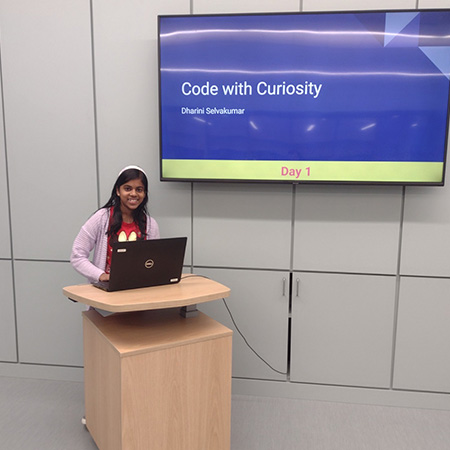
Dharini at one of her signature “Coding with Curiosity” workshops.
Tell us about your volunteer role.
At the library, they don’t really have one set role. It’s more like a series of activities that I like, and whichever one we have time for, we go and do it. I really love writing the reviews for the library. There are so many books there, and many people don’t get the time to see which ones they want to pick. As volunteers, we read them—especially if they were published within the last two years—and then we provide handwritten or online reviews. If the review is good, the library publishes it on their website, and then people will read it to pick out their books. This is very impactful from my perspective, because when I’m looking for books, I don’t always have time to read every summary. Instead, I read a review that a volunteer wrote, and usually, the reviews are pretty accurate.
I also do a lot of in-person volunteering, such as shelf straightening, dusting, cleaning and setting up for events. I have conducted some events myself for kids in elementary and middle school. I taught them things like drawing and math, at no cost, and that was a great experience. I also volunteer in the lab area for kids where I help them and talk to many people. I have a lot of interaction with the guests who come to the library, updating them on the new kits available. I do many things around the library—small tasks that help it run.
What inspired you to get started with this initiative?
When I was in middle school, they told me at school that there was an opportunity for volunteering at the library. I really love reading and writing, and the library was one of the places I used to go to a lot. I decided to start there, and I ended up loving it. I’m still doing it, and I hope to keep doing it for a long time.
Which programs at the library are you most excited about?
Right now, I am on winter break from school. During the winter, the library conducts many reading programs with prizes and challenges. I have finished some of their challenges, such as the goal to read 100 books before graduating high school to earn a gift basket. I get really excited about those. There are also reading programs where you read and participate in activities, and there is a lot of social interaction during those events.
I’m also part of the Teen Library Council, a council where we plan what events we host at the library. I am always excited to go to those meetings because I get to interact with people who are like-minded. I enjoy being involved in the planning process for the people who come in. When I am actually at the event, I see so many people who are participating in what we planned, and it’s really fun.
What’s been the most rewarding part of your work?
Mostly, I really love how much social interaction I have. Looking toward my career when I am older and go to college, I want to become a doctor—specifically a cardiologist—and that involves a lot of interaction with people. I love talking to new people and making connections. I have met many people outside of the library that I have talked to before, and now I have many connections that I can reach out to. It’s just about helping people. There are so many little kids who come to the library, and every time I help them, they become happy. I feel good that I can help them.
What have you learned through your experiences volunteering?
I used to be introverted. Now I am really extroverted, but when I was introverted, I just didn’t talk to a lot of people. Over my time at the library, I realized that you can’t really reach out or make connections with people if you don’t go out to them first; most people just don’t come up to you to build that connection. If you want it, you are the one who has to go and attempt to make that connection.
Once I started willingly going up to people first and just talking to them, I started realizing that so many people—even those who don’t look the part—are actually interested in talking to you. Even if you are not related to them, they just want to have a conversation. It is not always about something super important; they just like talking to other people willingly, without having a hidden motive. I have grown my social skills so much through that, and now it is really helping me in other programs and things that I do.
Why is it important for others, especially youth, to get involved with causes they care about?
Number one, when you become older, you’re going to have less time. Let’s be real; we all have so much going on, and even in high school, I don’t really have that much time. So I would recommend you start volunteering in middle school, because the more you get used to the environment you care about, the more you understand that this can be really impactful and helpful.
Through volunteering, you’re also able to realize your passions and know what you really want to do in the future. It’s important to help the community and all of the things that have helped you. The younger you are when you start, the more you get to learn and build your skills. It is not just social skills, but also communication and interpersonal soft skills that school or an office wouldn’t necessarily teach you. These are experience-based skills that you wouldn’t get otherwise if you don’t volunteer young. Then, you can build on those.
Any advice for people who want to start volunteering?
While it is good to care about your applications, volunteering is something you have to do wholeheartedly—it should be something you want to do, not just for service hours. Definitely volunteer where you want to be and, in an environment where you are comfortable and can build your passion. Do something that interests you.
Meet Daily Point of Light Award honoree Daniel Wu. Read his story, and nominate an outstanding volunteer or family as a Daily Point of Light.
In 2024, 17-year-old Daniel Wu started Humanity Hyde Park, a school club designed to address food insecurity in Chicago. Access is often affected by policy, and he aims to help the people left behind while advocating for change. Each Saturday, he brings 20 to 25 student volunteers to the Hyde Park-Kenwood Food Pantry, and he’s donated more than 80,000 pounds of fresh groceries through his organization. He even started a monthly newsletter where he writes about food access, culture and health.
But Daniel’s interest in food doesn’t stop there. Near the end of the pandemic lockdown, his passion for baking led him to launch a small-batch bakery and donate a portion of the profits.
Recognizing the daily effects of policy, he also encourages civic engagement through his criminal law and policy program designed to empower diverse students to entertain careers in law and government. Daniel developed the curriculum with educators and attorneys and has now taught more than 70 students. This fall, he plans to pursue a degree in public policy.
What inspires you to volunteer?
Initially, it was my school service requirements. We’re required to do 30 to 40 hours in order to graduate. During my sophomore year, I was volunteering at Hyde Park Neighborhood Club, an afterschool program for kids, as well as at food pantries and a place called Plant Chicago. I really enjoyed it.
Also, my grandparents experienced famine and social movements like the Cultural Revolution when they lived in China. I’ve seen how that trauma was passed down through generations. It impacted their relationship with food and the government. I live on Chicago’s South Side, a historically redlined community, which had a big impact on food access. And I love to cook, something not everyone has access to.
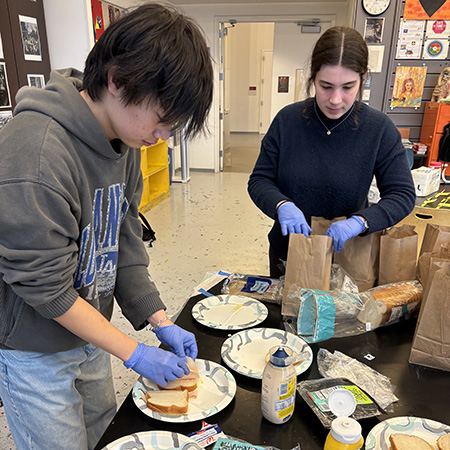
Daniel (left) and his co-president assemble meals to donate to the Love Fridge.
Tell us about your volunteer role with Humanity Hyde Park and beyond.
We do “Service Saturdays” where my co-president and I bring a group of volunteers to the food pantry. We’ll sort through donations and walk our neighbors around who are receiving food or pass it out ourselves. We also donate when we can.
We work with The Love Fridge, a group that sets up community fridges around Chicago. They’ve asked us to help repaint the one we help stock. We do fundraisers like bake sales and GoFundMe’s for money to buy ingredients to make packed lunches–250+ for The Love Fridge. Recently, we raised around $350, which we’re planning to use to make and serve hot meals at the Night Ministry, a shelter for unhoused people. I also organize engagement events like hosting a booth at the Wicker Park Farmers’ Market. And I designed and currently run our website and social media.
Outside of HPH, I run a small-batch bakery. I sell cookies and donate 15% of the proceeds to the Food Research and Action Center. They’re focused on food policy research, which is what I want to do in college. With each order, I send a pamphlet about food access and how to get involved.
What inspired you to get started with this initiative?
One of the things that really stuck out at the Hyde Park Neighborhood Club—especially with all the government cuts—was how consistent the educators were in making sure the kids were fed, maybe even paying out-of-pocket to do so. Sometimes, it was one of the only meals the kids would eat all day.
There wasn’t an organization at my school dedicated to food security or access at the time. It impacts 12 to 13 million Americans, even a block away from us, and I wanted to do something about it.
What’s been the most rewarding part of your work?
Everyone is amazing. Once, at the food pantry, I was walking around with one of our Nigerian neighbors receiving food who didn’t speak much English. I don’t know much about Nigerian cuisine, but I know about fufu and egusi. So, when we got to a table with cassava, one of the ingredients for both, I pointed at it and said the names of the dishes. He got really excited and gave me a hug, lifting me in the air. He and his wife asked for my phone number and if I could come over for dinner one day.
You get to meet and talk to some really kind and funny people. That’s been my favorite part of volunteering.
Is there something that people should know about food insecurity that might not be common knowledge?
People sometimes misunderstand what food insecurity is. Food insecurity can manifest in many forms. It’s not just about not having access to food but not having access to nutritional food. That’s a big problem in food deserts.
In Garfield Park, for example, the only big supermarket, one that prioritizes quality at low prices, has been closed. The City shut it down to build a big new complex that was supposed to have a grocery store in it, but the plan hasn’t come to fruition.
It’s left residents in the area without a way to access nutritious and clean food.
So, what do you do? You end up going to nearby fast-food chains. You don’t eat healthy, because it’s not accessible or affordable anymore. You have to spend more time, money and energy finding a grocery store further away. That’s an example of a policy move that’s detrimental to food access and public health.
What do you want people to learn from your story?
They tell you in kindergarten to treat other people the way you want to be treated, but somehow, we keep forgetting. Through volunteering, I’ve been able to meet and talk with many people from different walks of life. Often, we become so desensitized to things that we begin to lose empathy. We begin to think food insecurity and other inequalities just happen. But it doesn’t have to be that way.
Having empathy, especially right now, is really important. If more people volunteered and really tried to engage with their community, they could build that skill.
FOOD SAFETY FOR ALL IS THE FOCUS FOR THIS VOLUNTEER
Meet Daily Point of Light Award honoree Devin Sailer. Read his story, and nominate an outstanding volunteer or family as a Daily Point of Light.
Growing up with 31 life-threatening allergies, Devin Sailer knows how hard it is to find safe food to eat. That’s why he’s making a difference to ensure other people can.
As a kid in an underserved rural community in upstate New York, Devin saw firsthand how hard it was to acquire safe and healthy foods when you’re struggling with severe food allergies. If you’re in a domestic violence or homeless shelter, it’s almost impossible. One-third of domestic violence and homeless shelter residents in upstate New York are children, many of whom have fled an unsafe situation with no warning. Looking to help those living with deadly allergies like himself, Devin established Safe to Eat, a youth-led initiative that advocates for allergy-safe options in domestic violence and homeless shelters. Along with a small team of volunteers, Devin facilitates the flow of allergen and gluten-free foods into these shelters across upstate New York, ensuring that everyone has a safe meal to eat, no matter their situation.
Currently in his senior year of high school, Devin’s efforts to transfer allergy-safe foods from companies and individuals to domestic violence and homeless shelters are no small endeavor, particularly for someone who is carrying a full academic workload. But Devin wisely prioritizes his time, sharing that he believes there’s more time in each day than one would expect. He focuses on coordinating several large food runs each year, so each shelter can stock up on the allergy-safe foods they need to keep their clients fed. As a result, his work ensures that eight shelters across a combined area the size of Jamaica are stocked with over one-quarter ton of allergen-safe food. Through hundreds of hours of volunteer work, Devin has turned his own struggle into a solution. His inspired mission is a powerful testament to how one person’s story can become a force for good.
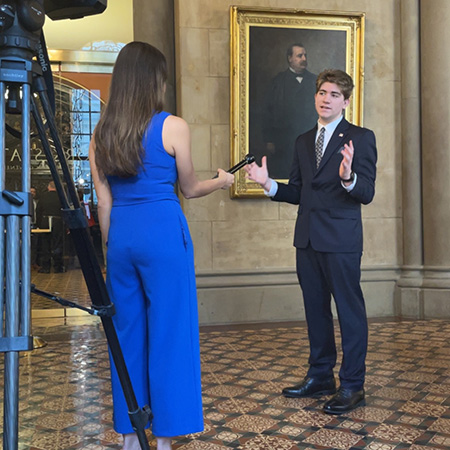
SAFE TO EAT FOUNDER DEVIN SAILER (RIGHT) SPEAKS TO A REPORTER AFTER A MEETING IN THE CAPITOL TO DISCUSS FOOD SAFETY AND ALLERGY ISSUES. /COURTESY DEVIN SAILER
What inspires you to volunteer?
We were not always well off in my family. We did not always have everything we could ever need. I was never in a domestic violence or homeless shelter, but we were not always in a fantastic financial position. Now that I am in a much better position, I feel obligated to help people who are in a position that I used to be in.
Tell us about your volunteer role with Safe to Eat.
I am the founder and director of the organization, so I’m the one making the phone calls and doing the paperwork. It’s either me or someone else driving the car, but I am very much an on-the-ground leader. I’m picking up the boxes, loading them and getting the donations. We all work together. We’re a very, very small team, so I do a lot of the work. But the people I work with help me; they help me load the boxes, but I’m the one making the calls and setting the schedules.
What inspired you to get started with this initiative?
I was in a position where I was able to do so. It was over the summer and I had enough time to devote myself to it. I had enough experience running things. I ran, and I continue to run a nationwide lobbying organization through FARE, the Food Allergy Research and Education organization. I got leadership experience through my other work that I’ve done through FARE in New York and on my own, and so I thought I was in a good enough financial, time and social position where I would be able to found and run this organization effectively and get some good work done.
What are your long-term plans or goals for the organization?
Long-term, I want to expand to the entirety of upstate New York. Presently, we serve an area the size of Jamaica in western New York. I think that is good for now, but I want to keep an eye on the prize and just keep moving until we can encompass the entirety of upstate New York, because these issues are not unique to our area. These are present across our region.
What have you learned through your experiences as a volunteer?
I’ve learned that there is this portrayal in media and in society that the less fortunate are there absolutely because of their own decisions. They’re always there because they have done something wrong or they have made a bad decision. I don’t think that’s true. I think most of the time, people have been dealt a bad hand, and they try to make the best of it, but sometimes you’re down on your luck.. I think that is a stigma and a narrative that we need to combat, not only in society but also in media organizations.
Why is it important for others to get involved with causes they care about?
If you don’t get involved, who will? Only you know the issues in your community, and only you know specifically what you believe needs to happen in your community to solve those issues. If everybody took an hour out of their week to volunteer their time to do what was necessary to improve their communities, we’d be living in a far, far better country and a far, far better world.
Any advice for people who want to start volunteering?
I would just say you’ve got to start somewhere. You’ve got to start small. If you want to, start a canned food drive. That’s something pretty small and simple that has a major impact. I also think you don’t necessarily have to do it on your own. I do volunteer work at the local Methodist church. Local churches, religious organizations and service organizations are a great way to get some experience and get started doing volunteer work.
What do you want people to learn from your story?
I want them to learn that this is an ever-present issue in rural communities. I’m somebody who has grown up and lives presently in an area of New York that is very rural. When we think of New York as a whole, we tend to think of the metropolis itself. That’s also what we think of when we think about domestic violence and homelessness. A lot of the time, it is people who are in these rural communities and small towns. But there are differences between urban and rural homelessness. It’s a lot harder for people in these rural communities to get the resources they need because the local and county governments have far less access to funding and resources to make warming centers and homeless shelters. I want people to realize that this is not a singularly urban issue. It is, in fact, a major problem in rural areas.
Igniting a Global Movement with the Language of Empowerment
Meet Daily Point of Light Award honoree Cindy Chen. Read her story, and nominate an outstanding volunteer or family as a Daily Point of Light.
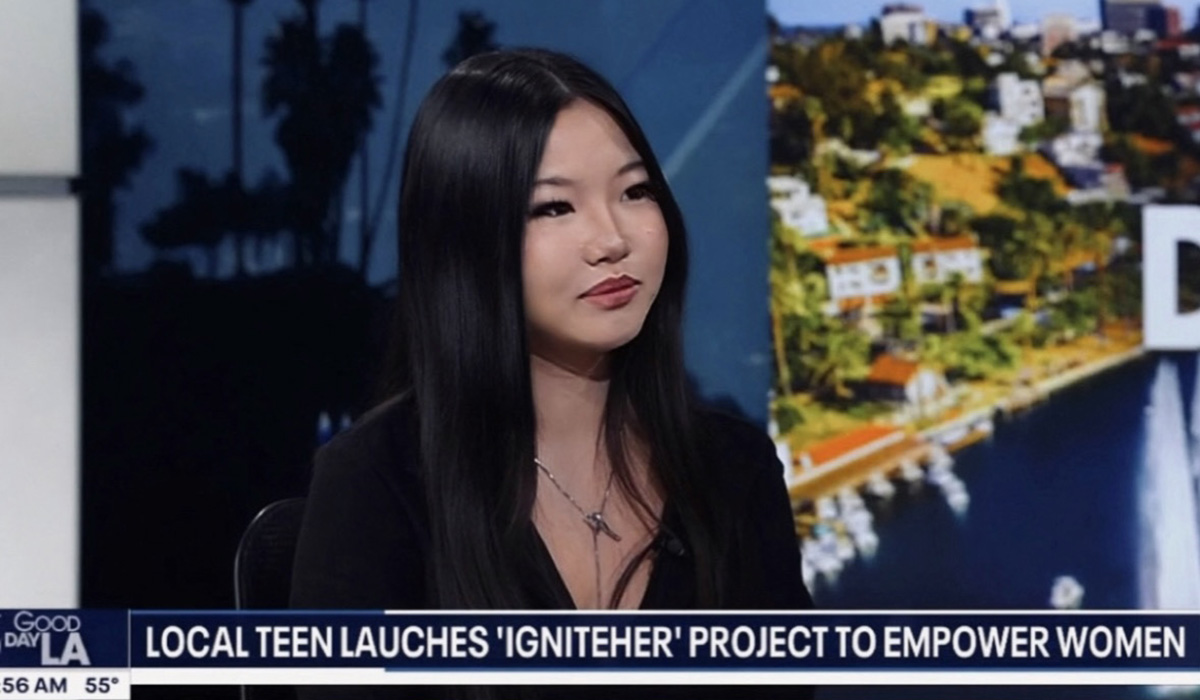
For Cindy Chen, humanitarian work isn’t just about the logistics of aid. It’s about the power of the human voice. As the founder and CEO of the IgniteHER Project, Cindy has pioneered an approach centered on “rhetorical feminism.” By teaching girls and marginalized communities to navigate the complexities of language, civic education and policy advocacy, she is giving them the tools to rewrite their own futures. While she dedicates roughly 30 hours a month to overseeing global partnerships and writing policy proposals, the scale of her influence is staggering. To date, Cindy has reached more than three million individuals globally and mobilized a network of over 50,000 activists.
The impact of IgniteHER is felt in the tangible essentials that restore dignity to those in crisis. Cindy has led the distribution of more than 50,000 items, ranging from backpacks and suitcases to menstrual products and clothing, supporting disaster survivors, people in shelters and incarcerated women. Beyond physical aid, the organization has trained over 3,000 young women in leadership and civic literacy. Under her guidance, IgniteHER has blossomed into a massive infrastructure of 120 chapters spanning 66 countries and 30 U.S. states, including the hosting of three global conferences aligned with prestigious platforms like the UN Youth Forum.
Despite the vastness of the organization, Cindy speaks of her overseas teams as close friends whose individual stories she treasures. This grassroots connection allows IgniteHER to adapt to the specific needs of different cultures. In India, she works with a chapter leader to protect rural girls from manipulation. In Nigeria, she empowers a volunteer leading local donation drives. In Pakistan, she mentors teams bringing digital literacy to regions where the internet is a rare luxury.
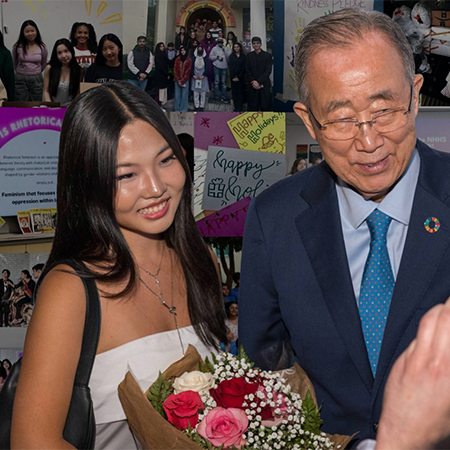
Cindy (left) receives recognition from Former United Nations Secretary-General Ban Ki-moon in Los Angeles.
Cindy’s tireless dedication has earned her recognition from the United Nations, Johns Hopkins University and state government bodies, as well as features on Spectrum 1 and Fox 11 News. Read on to hear more of her powerful story.
Tell us about your volunteer role.
I’m the founder and CEO of IgniteHER Project, a youth-led global initiative that empowers girls to become leaders through civic education, leadership development and community-based advocacy. In practice, my “volunteer role” is building the infrastructure that makes participation possible — especially for girls who don’t already have access to money, networks or proximity to power. That looks like recruiting and training student leaders, developing curriculum and toolkits, coordinating partnerships, running campaigns and mentoring teams across chapters so their work is sustainable, ethical and locally rooted.
Why is this issue so important to you?
Because gender equity is not abstract. It is safety, dignity and the right to move through the world without fear. Growing up, I struggled to find my voice as a girl who was constantly called “bossy” just for trying to lead. I know what it feels like to carry a voice and be taught to lower it; to watch girls learn early that their anger should be quiet, their ambition should be “reasonable” and their boundaries should be negotiable. That lesson isn’t just personal — it’s community trauma. It lives in what girls are taught to tolerate, what survivors are forced to carry alone and what institutions quietly normalize. IgniteHER is my way of pushing back by building survivor-informed, community-centered leadership: not just teaching girls to speak, but creating spaces where they can heal, organize and lead without having to translate their pain into “proof” to be taken seriously.
What inspired you to get started with this initiative?
IgniteHER began from a frustration: we talk about “empowering girls,” but we rarely give girls real pathways into power, especially in communities where influence is gated behind privilege. I wanted to build something that didn’t just celebrate girls’ potential, but trained it: a place where young women could learn how institutions work, how to organize, how to advocate and how to turn conviction into outcomes. And I also wanted it to be healing-centered. So much leadership work teaches girls to perform resilience while still enduring harm. We built IgniteHER to do the opposite: to treat care as strategy, to normalize survivor-led advocacy and to make space for girls to lead in ways that are not extractive — where their worth isn’t tied to how much they can endure.
What are your long-term plans or goals for the organization?
Long-term, I want IgniteHER to be a durable leadership pipeline that lasts beyond any individual student leader. That means expanding leadership programs, deepening our civic education work, and building partnerships that translate youth advocacy into real policy wins at the local and state level. Most importantly, I want IgniteHER to stay accessible. Leadership shouldn’t be something you have to earn through privilege before you’re allowed to practice it. And I want our model to keep centering survivor-informed care: training chapters to collaborate with local organizations, respond to community needs and build systems of support that outlive any single campaign.
What have you learned through your experiences volunteering?
I’ve learned that sustainable change is less about one big moment and more about consistent systems, like training, mentorship, accountability and care. I’ve learned that leadership isn’t a personality trait — it’s a skill you can build. And I’ve learned that community work only lasts when it’s collaborative and trauma-aware. People don’t need saviors; they need partners. Especially in gender justice work, “helping” can easily become extraction — taking stories, pain and resilience without building real support. Survivor-led healing means we follow community needs, protect dignity and build structures that make people safer after the spotlight moves on.
What’s been the most rewarding part of your work?
Watching someone who used to describe themselves as “quiet” or “not confident” realize they can lead, and then actually do it. There’s a specific moment I’ll never get over: when a student stops asking for permission to take up space. When they start writing their own agenda, organizing their own team and speaking like they know they belong in the room — because they always did. I’ve also found it deeply meaningful when girls use our spaces not just to achieve, but to heal: when they name what happened to them, find community that believes them and transform that truth into advocacy that protects others.
Why is it important for others to get involved with causes they care about?
Because caring is not the same as changing something. The world runs on participation — in schools, in local government, in mutual aid and in advocacy. When people opt out, decisions still get made; they’re just made without us.
And on a community level: involvement is how we heal. Silence doesn’t keep people safe — it isolates them. When we show up, we build the infrastructure of care that institutions often refuse to provide: survivor-informed support, community accountability and networks that protect people before harm escalates. Participation is how you protect your community, build power and turn values into something real.
Any advice for people who want to start volunteering?
Start small, but start now. Pick one issue you genuinely care about, find one local organization doing consistent work and ask what they actually need — not what feels most impressive. Be reliable. Learn from people already doing the work. And don’t wait until you feel qualified. You become qualified by showing up, with humility, consistency and respect for the community you’re joining.
Meet Daily Point of Light Award honoree Scarlett Mu. Read her story, and nominate an outstanding volunteer or family as a Daily Point of Light.
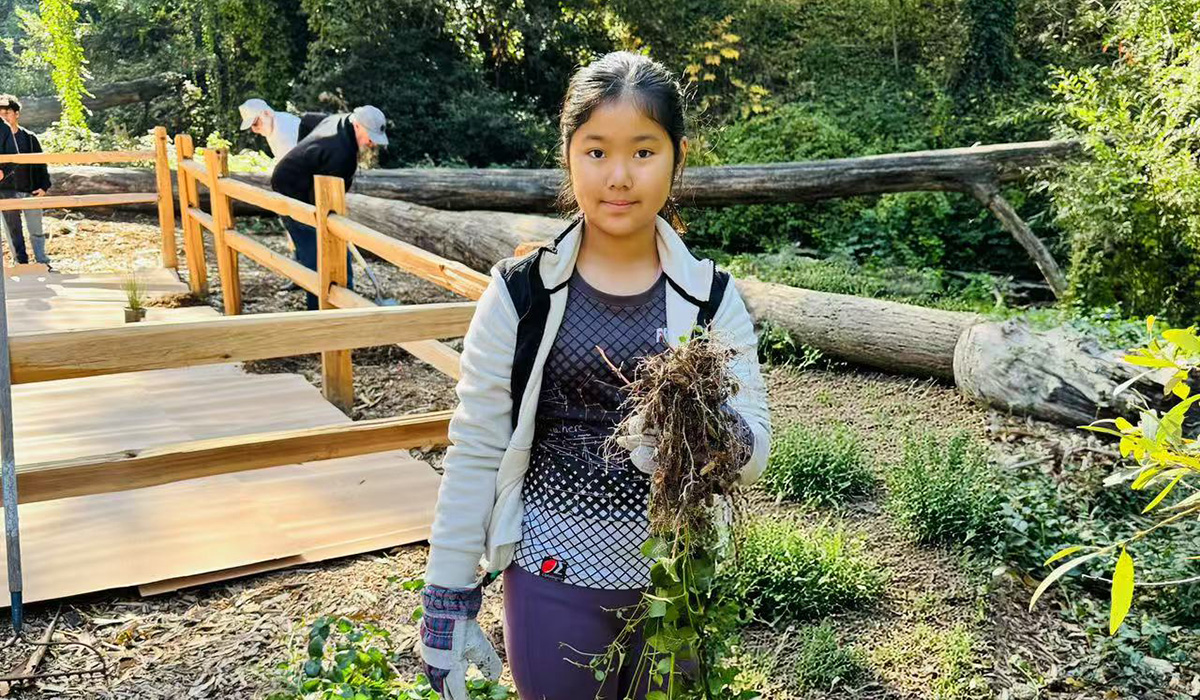
In San Leandro, California, 11-year-old Scarlett Mu doesn’t just see a park. She sees a canvas for community connection. Since early 2025, Scarlett has been involved with the Beautify San Leandro program, transitioning seamlessly from high-level project planning to the hands-on grit of shoreline cleanups at Marina Park. While many her age are just beginning to navigate their social circles, Scarlett is navigating the complexities of civic responsibility, contributing 15 to 20 hours per month to ensure that local public spaces remain safe and welcoming. For her, service isn’t a chore—it is “love in action,” a philosophy that has transformed her into a bridge between the city’s recreation departments and the people they serve.
This commitment to the common good is a family legacy that spans generations. Inspired by a childhood spent following her mother to various service projects, Scarlett now leads a multi-generational team that includes her 4-year-old sister and her 72-year-old grandmother. This family unit operates on a simple, profound belief: because society has nurtured them, they must contribute with their own collective effort. Whether she’s planting trees at Chabot Park or supporting the vibrant San Leandro Cherry Festival, Scarlett proves that age is never a barrier to impact.
Beyond her work with the city, Scarlett’s leadership shines through her roles as a den chief in her scout troop and as a budding social entrepreneur. She co-founded the “Cookies for Pizza” initiative, a creative endeavor where she and her sister bake and sell treats to fund warm meals for unhoused individuals in their community. By inspiring both her peers and adults to step up, Scarlett Mu is showing her city that when we act in service of others, we strengthen the fabric of our society. Read on to hear more of her story.
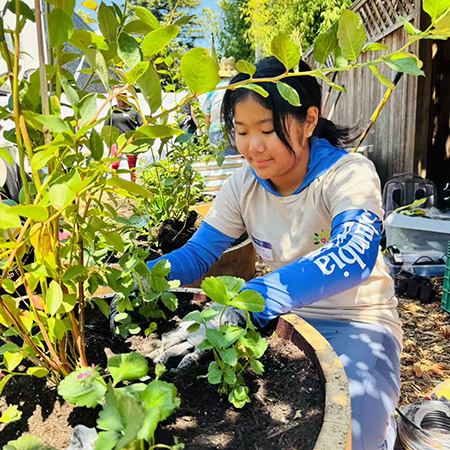
Scarlett as a Leap Center Garden Day planting volunteer, helping with planting activities.
Tell us about your volunteer role.
My primary volunteer roles include participating in community projects organized by the San Leandro Recreation and Parks Department, such as shoreline clean-ups and tree planting, supporting local events like the Cherry Festival and more.
What inspired you to get started with this initiative?
For me, service wasn’t something I started. It was a value I was born into. My mother ingrained it in me from a young age, bringing me along to her volunteer activities. Today, it’s a true family affair. My 4-year-old sister and my 72-year-old grandmother are right there with me. Service is more than just an activity. It’s our family’s expression of love in action, and we believe that since society has nurtured us, we have responsibility to contribute to society with our own strength. It’s a way of life.
What’s been the most rewarding part of your work?
My hope is to continue weaving services into the fabric of my life and encourage others to do the same. A moment that deepened this commitment was when I went to Costco to buy a pizza, and then I offered it to a man experiencing homelessness. He didn’t eat it immediately. Instead, he carefully shared it with his dog and saved a portion for a friend. This directly inspired my sister and I to start our “Cookies for Pizza” project where we bake and sell cookies to be able buy pizzas for unhoused individuals and volunteers at our local church. This moment also showed me that service is about human connection and mutual respect.
What are your long-term plans or goals for volunteering?
The impact I hope for is twofold. Firstly, I want to leave our public spaces cleaner and greener for everyone to enjoy. Secondly, just as importantly, I hope to inspire others. When people see a young person, or see my little sister or my grandmother actively beautify our city, it sends a powerful message that everyone can contribute. It’s about strengthening the bond we all share with San Leandro.
What have you learned through your experiences volunteering?
Some things I’ve learned are that San Leandro isn’t just somewhere I live. It’s a beautiful place where people can gather and do fun activities. Also, in Scouts, I also earned a Citizenship in the Community badge. It was also a call to participate in a system we can all be a part of.
Why is it important for others, especially youth, to get involved with causes they care about?
Starting at a young age feels more natural and joyful. A person at any age can volunteer. It’s not about how much you can do, but that you can do what you can with people you love.
Any advice for people who want to start volunteering?
Some advice I can give is to not think about working all by yourself, trying to be the best. Work together as a team. Teamwork makes things more fun, and faster than one person trying to be the best at everything. You don’t have to wait to make a difference. People can start today, right where they are, with the skills they have.
What do you want people to learn from your story?
You can put love into action. That’s how we build a better country, one small act of kindness at a time.
Meet Daily Point of Light Award honoree Ayaan Seshadri. Read his story, and nominate an outstanding volunteer or family as a Daily Point of Light.
Anyone with corrected vision can recall the moment they got their first pair of glasses and the world came into focus. For some, though, that is a moment that comes far too late, if at all. Nearly one in four children suffer from nearsightedness, also known as myopia, but 25% in the US go undiagnosed. That number is suggested to be higher globally due to the high number of children who have never even had an eye exam.
It’s a disease that starts as young as 3 years old, with many affected too young to understand or articulate what’s happening, leaving them without intervention. At school, a place where they are primarily doing visual work, they’re left struggling, their confidence taking a hit as well as their grades. Pediatric vision care can also be affected by socioeconomic factors, increasing the likelihood of overlooked vision problems within the underresourced population.
Ayaan Seshadri, 17, founded My Eyes My Life (MEML) in 2024 with a mission to train teachers in nursery to 5th grade classrooms to recognize the signs. He and his team of 14 volunteers in NYC, Boston, Austin and LA have trained over 300 teachers so far who, collectively, see nearly 8,000 students each day. But Ayaan goes even further.
He has teamed up with seven optometrists in the New York City area to offer pro bono eye care to children from resourced-constrained families as well as 19 families who have each agreed to sponsor care. Ayaan spends at least 40-50 hours a month on the mission. He also volunteers at a hospital and a local senior center, both of which also contribute to his interest in pursuing a career in public health.
What inspires you to volunteer?
My widowed maternal grandmother moved in with us when I was 9 or 10 years old. Realizing her needs led to me learning about the needs of senior citizens, which drew me to the senior center and hospital volunteering opportunities.
Ayaan Seshadri, founder of My Eyes My Life, engages primary school through 5th grade teachers to flag signs of myopia and help kids address vision issues.
Tell us about your volunteer role with My Eyes My Lift.
The first part is talking to educators in the New York City area. I set up appointments to talk to the full lower school or preschool staff of different primary schools and preschools about myopia. It’s a 15- to 20-minute presentation. We talk about the biology of the disease and how it can progress quickly.
We also talk about why, psychologically, it might be difficult for a kid to articulate that they have trouble seeing, necessitating the vital role that teachers play. I get educators’ feedback and encourage them to not only flag students for eye exams but to promote eye healthy behaviors in their classrooms.
The other part is inspiring other youth to help and walking them through the process of doing the same thing in their own communities. Given the high rate of myopia, it’s something many of our volunteers can directly relate to.
Every two or three months, we also invite different stakeholders and luminaries in myopia to interview on our channel. In some cases, this has been patients who have suffered from high myopia themselves. In others, they’re business people developing interventions, optometrists and ophthalmologists who treat myopia or researchers focused on understanding this at population-level.
What inspired you to get started with this initiative?
MEML was inspired by my own experience with myopia as well as that of my parents. I was able to receive alacritous care, but my mom, who is severely nearsighted, was only able to be diagnosed in her mid-twenties upon arriving to the U.S. Reconciling those experiences has taught me the importance of preventative care.
My organization is focused on pre-school and elementary school educators and the role they can play in flagging kids for further evaluation. Myopia is prevalent in over 25% in the developed world and over 50% in the developing world. UNESCO data shows us that around 90% of students go to some form of primary education. Exams only happen once a year, and parents only see their own two or three kids all the time.
Teachers see their students daily, 2,000-3,000 students throughout their career.
When kids become nearsighted, they’re unable to see the white board from their seats, or to play sports that require accurate targeting like tennis or soccer. They suffer from falling grades and reduced class participation. Worst of all, myopia takes a toll on their sense of self-worth and confidence, impacting mental health even at this young age. Teachers may even mistake this loss of enthusiasm in schoolwork for graver disorders like learning disability. I was able to regain a lot of esteem, both academically and socially, once I was diagnosed. That’s really what I’m trying to give future kids like me through MEML.
Ayaan presents My Eyes My Life teacher training seminar at The Caedmon School.
What are your long-term plans or goals for the organization?
I was fortunate enough to win the UNESCO Learning Planet Institute youth design challenge for 2025. Through that, I was able to connect with a lot of people from around the world–including in Tanzania, India and Kenya–and join forces on each other’s projects. As a result, I expect to have new chapters set up in all three places by June.
Another project that stemmed from that is a children’s book to normalize nearsightedness and teach the importance of teacher intervention in the diagnosis process. I’m hoping to find a partner for the illustration process this year.
What have you learned through your experiences as a volunteer?
I’ve learned the power of focusing on issues relevant to the local community, your loved ones or yourself. It allows you to find creative interventions and have a personal touch through your connection to an issue. Start there and then map out a broader national or global plan.
What do you want people to learn from your story?
Understand the power of devising a simple, scalable solution to a community problem… like using a 15-minute presentation to activate teachers as a catalyst to lower the rate of undiagnosed myopia in children.
How One Volunteer Radiantly Redefines Living with Cancer
Meet Daily Point of Light Award honoree Duncan Foley. Read his story, and nominate an outstanding volunteer or family as a Daily Point of Light.
In 2021, Duncan Foley’s life took an unexpected turn during what was supposed to be a routine gallbladder removal. The surgery revealed a sobering reality: stage 4 cholangiocarcinoma, a rare and aggressive form of bile duct cancer. Faced with the sudden weight of a life-altering diagnosis and the daunting uncertainty of treatment, Duncan chose a path defined not by despair, but by hope.
Rather than retreating, Duncan transformed his personal health battle into a mission of advocacy and connection. He’s since become a steadfast pillar of the Cholangiocarcinoma Foundation (CCF), dedicating his time and energy to ensuring that no one has to face the disease in isolation. Through his leadership within the Seattle Care Team, he has pioneered a localized network of support, bridging the gap between clinical care and the emotional needs of patients and their families. Through his active participation in the CCF Annual Conference, Duncan helps organize events that bring together patients, caregivers, clinicians and researchers. He also assists with translating complex medical information into understandable dialogue, ensuring that the latest research is accessible to those who need it most.
But what truly distinguishes Duncan is not his productivity; it’s the infectious optimism he brings to every interaction. He views each day as an opportunity to radiate positivity and proactivity, refusing to let the weight of his diagnosis dim his outlook on life. When Duncan speaks, his belief in a brighter future for cholangiocarcinoma patients is so palpable that it transforms the atmosphere of support groups, hospital corridors and one-on-one conversations alike. He teaches us that while we can’t always control our circumstances, we can always choose the spirit with which we meet them.
Read on to learn more about Duncan’s inspiring story.
Tell us about your volunteer role.
I’m a patient with the Cholangiocarcinoma Foundation (CCF), and I consider myself very lucky to be in my fifth year of survival. Depending on the statistics you use, only about 10% of patients reach this milestone, so I am very fortunate that things have been going well. CCF is an unusual organization in the cancer space because it serves five distinct populations: patients and caregivers, researchers, clinicians and drug development professionals.
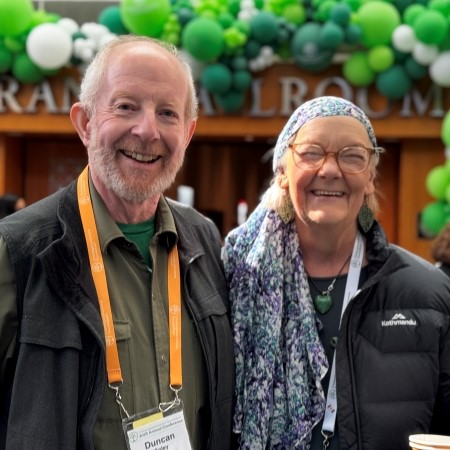
Duncan with Mechelle Stephenson, a fellow cholangiocarcinoma patient, at the Cholangiocarcinoma Foundation Annual conference in Salt Lake City.
I first found them following my diagnosis and realized they provided good, reliable data. I didn’t have to rely on Google for information. I went to one of their annual conferences and it was amazing. What these people are doing, and their support of the patient experience, are what led me to join a local care team and volunteer at the annual meeting. Those are the two primary ways I’m involved.
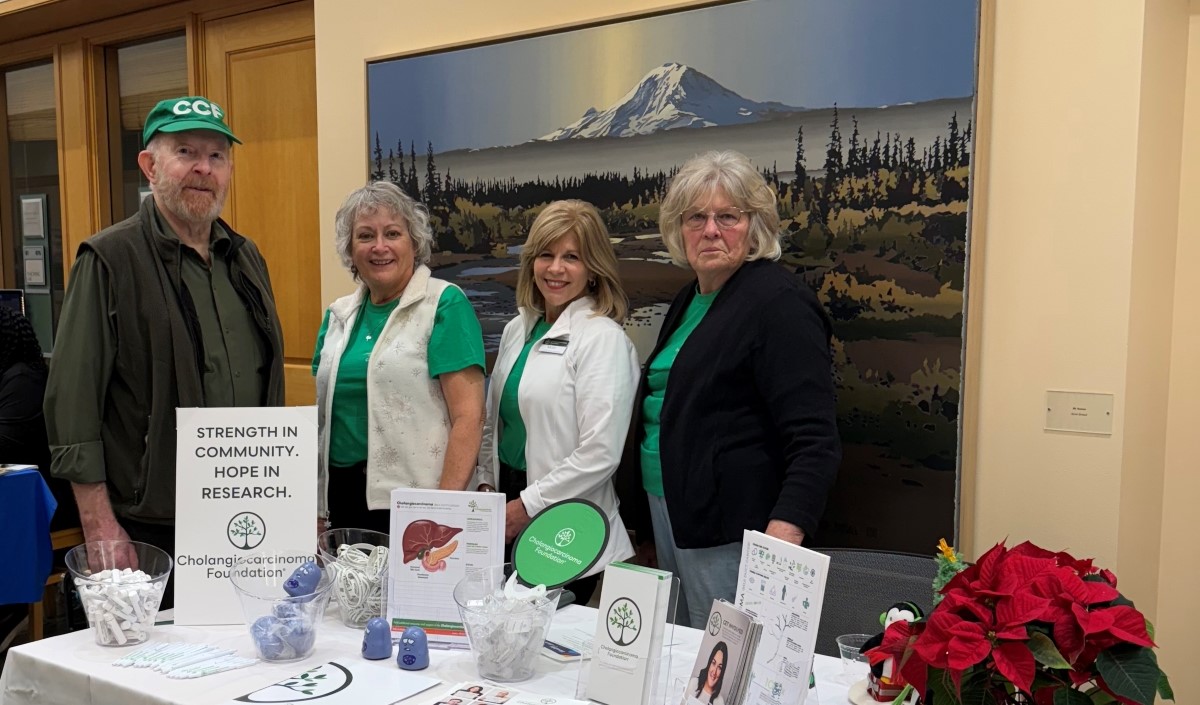
Our Seattle-Tacoma area care team currently has four members, with a fifth about to join. Our responsibility is to host regional meetings for patients and caregivers where we bring in speakers—nurses, clinicians and researchers—to discuss the various aspects of living with this disease. We cover everything from research updates and clinical practice to nutrition, fatigue and side effects. Because this is a rare cancer, affecting only 6,000 to 8,000 people in the U.S. annually, we also attend health fairs to find those one or two people who may not know the Foundation exists. We are more than happy to introduce new patients to the community. The Foundation provides the financial and logistical support to make these meetings possible, and I am happy to be involved with an organization that has given me so much.
Can you share a bit more about your journey with this cancer?
As my wife describes it, I had a “blessed gallbladder” that required surgical removal. During that process, an unusual MRI caught the attention of a very persistent physician’s assistant. He noticed something funny and had it interpreted by a specialist for a closer look. He eventually came back and said, “It looks like you’ve got cholangiocarcinoma.” My first thought was, “Gee, can I even pronounce that?”
Having the gallbladder out led to the discovery of the cancer. This is not atypical; cholangiocarcinoma is often discovered at Stage 4, meaning it has metastasized. I was lucky that mine had only spread locally near the liver. Once it was confirmed via biopsy, I began chemotherapy. And I have one piece of advice for people: do not get COVID-19 the day after receiving chemo. That landed me in the hospital for a week with sepsis. Once I got home, internal bleeding put me right back in. Fortunately, I had the same nurses and even the same ambulance crew. Since it’s a relatively small community, it was almost fun getting to talk with them about our mutual friends.
After that, I reached a very lucky stretch where I had more than three years without any chemo at all; the cancer remained stable. Recently, it started to grow again, and after six months of a new round, the chemo pretty much flattened me. We’re now looking at viable alternatives, such as radiation or a fascinating new technique called histotripsy. Histotripsy uses targeted ultrasound to destroy tumors externally without any cutting or slicing. It’s truly amazing.
Why is it so important for patients and caregivers to have this type of support?
One of the primary challenges with a rare cancer is the sense of going it alone. Often, patients feel they are the only ones facing this disease. For instance, when I was first diagnosed, my local oncologist had about 150 patients, and I was the only one with cholangiocarcinoma. This is not unusual; there are often only one or two patients per regional oncologist. This leads to a powerful sense of loneliness, which can quickly turn into hopelessness.
When you feel that way, the first thing you often do is turn to “Dr. Google.” Unfortunately, the internet is full of bad ideas, poor suggestions and people happy to sell you a magic potion to cure your cancer. As a retired geologist, my response is: “Show me the research. Show me the data.” Through our care team and the Foundation’s online support groups, we work to ensure patients and caregivers know they aren’t doing this alone and that there are reliable places to go for information.
What keeps you hopeful?
One of the reasons I maintain such strong hope is the incredible rate of change happening right now in both drug development and treatment. For example, the histotripsy technique I mentioned wasn’t even around two or three years ago. It was just being developed. One of the medicines I am scheduled to receive tomorrow was only authorized a couple of years ago.
The rate of change in how we analyze various cancers is phenomenal. Ten or 15 years ago, we didn’t have what we have now: genomic analysis. Today, it is vital for every patient to understand the DNA defects contributing to their specific cancer. Drug companies are working tirelessly to develop targeted medicines that address these specific defects. With new drugs and treatments constantly emerging, how can you not be hopeful?
What inspires you to volunteer?
What keeps me positive is the realization that while there is a finality to cancer, having a purpose is critical to dealing with it. There have been studies suggesting that cancer patients who have a sense of purpose actually live longer. In that way, my volunteering is partly selfish—it provides me with a vital motivating factor.
Contributing to others and helping them navigate this disease gives me that purpose. It is also easy to volunteer for the Cholangiocarcinoma Foundation because I believe so deeply in their mission and I am continually impressed by the high quality of their staff. From the director to the research team and throughout the entire organization, they are truly wonderful people. It makes the work of volunteering a joy.
Why is it important for others to get involved with causes they care about?
As I think about that, I bounce right back to purpose. Giving people purpose. It’s incredibly important to find something you can be passionate about, regardless of what you are volunteering for. In my own life, that passion has often been the theater; for five years, I served on the board and as board president of a local community playhouse because I believe so deeply in the power of the arts.
I also believe in the power of knowledge. I am a retired geology professor, having taught at the university level for 30 years in the Tacoma area. That desire to share reliable information is rooted deep within me. Whether it is in a classroom or a support group, my goal is to ensure people know their options—specifically the best possible options—for treating this cancer. When looking for an organization, make sure it is something you feel passionate about and that it is well-run, but also ensure you have a meaningful role as a volunteer within it.
Any advice for people who want to start volunteering?
First, think about what your passions are. Second, look for look for high-quality organizations that align with those passions. Are you passionate about feeding people? Working with unhoused populations? The theater? If you lead with your passions, you are going to feel more invested in your work, and you will ultimately do a better job as a volunteer.
Anything else you want people to learn from your story?
There is an aspect of volunteering that sounds a bit selfish, but I believe it to be true: the more you give, the more you get. It is only through volunteering that I have met so many wonderful people. If I hadn’t gotten involved, I wouldn’t have met the other members of my care team or the incredible staff at the Foundation. Without that connection, the Foundation would just be a website where I occasionally contributed.
By getting involved and learning the inner workings of an organization, you don’t just bring purpose and meaning to your own life; you are helping others. Perhaps the best way to phrase it is that helping others can help you as well. It creates a cycle of support that enriches everyone involved.