Meet Daily Point of Light Award honoree Frankie Peterson. Read her story, and nominate an outstanding volunteer or family as a Daily Point of Light.
Frankie Peterson found her community through service. But she may have also found her future career path. Like many other young people, Frankie found herself facing the COVID-19 pandemic during some of her most important formative years. While she is now 17 and a high school student, she previously faced the challenges of anxiety while reintegrating into the school environment after the pandemic shut things down. She found an answer in service work with SaLT, an organization that creates meaningful service-learning experiences that meet the needs of the local community while promoting personal growth and understanding.
Frankie became involved with SaLT’s Love2Learn program, a tutoring service at the local library for children from families who are a part of the organization’s Shop N’ Drop Program, which serves local families challenged by food insecurity. Frankie reads with the children and actively engages with them while serving as a caring mentor they can trust. She provides structured practice and informative feedback, working to adapt to the needs of each child and build a sense of self-confidence within them so they can go forth and find a passion for learning as they continue their academic journey.
In addition to her one-on-one tutoring work, Frankie demonstrates a keen sense of organization that she utilizes to ensure the Love2Learn program’s success. It’s often her responsibility to organize other volunteers, maintain attendance records and organize volunteer materials. On the whole, she commits around 30 hours per month to her volunteer work, which is no simple task considering her heavy workload as a high school student preparing to attend college.
As Frankie gets close to her graduation from high school, the experience she’s had volunteering has greatly informed her future. Through witnessing those struggling with food insecurity, Frankie is inspired to pursue a career in researching the role hunger plays in the risk of developing cancer. Not only has her volunteering experience built a new community around her, but it’s also formed a potential career path for the rest of her life.
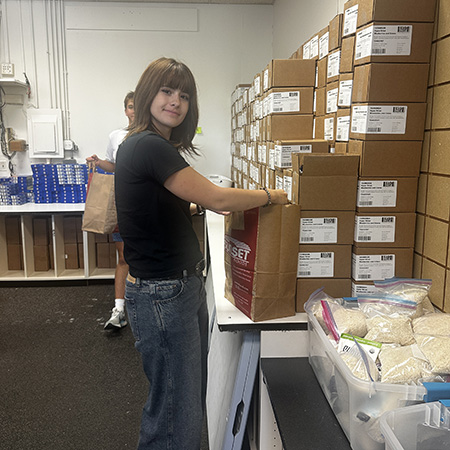
FRANKIE PETERSON HELPS ORGANIZE THE SITE WHERE SALT STORES FOOD AND SUPPLIES AS PART OF THEIR SHOP N’ DROP PROGRAM, WHICH PROVIDES FOOD AND SUPPLIES TO FAMILIES DEALING WITH FOOD INSECURITY. /COURTESY FRANKIE PETERSON
What inspired you to get started with this initiative?
SaLT is a program that stands for “service and learning together” that operates across many branches, and one of the areas is offering youth service trips. In 2023, I went on a youth service trip with SaLT to Alaska, and that really jump-started my passion for service. From there, I got super involved through various programs that it offers in the community, like the one that I’m with, which is Love2Learn, a tutoring service for underserved children from families in our other program called Shop N’ Drop, which is a food service program.
Tell us about your volunteer role with Love2Learn, powered by SaLT.
I am primarily at Love2Learn, a tutoring service at the local library, where we tutor children from families who are a part of our Shop N’ Drop Program, which serves local families challenged by food insecurity. Usually, I’m either organizing volunteers or directly tutoring children. I really like working with younger kids, and I usually work on reading. We will pick out a book, and for 30 minutes, we’ll do some reading. After 30 minutes, we reward them for reading by playing some kind of brain game and making sure to play and engage. We’ll do a craft, or sometimes, we’re able to send the families home with a little something, like a plushie. I help organize events and brainstorm ideas for upcoming activities. It’s really fun to be in a supportive learning environment for children.
What are your long-term plans or goals for the organization?
I plan to stay involved. Actually, for college, I’m going to be only 30 minutes away. I want to pursue an MD/PhD and do research in biomedical engineering and genomics, because a lot of the research that I’ve already done about people living with food insecurity says that they have a much higher chance of developing cancer. Especially regarding healthcare inequities, I’m really passionate about developing new clinical therapies through my research and treating patients to address those inequities.
What’s been the most rewarding part of your work?
I think with kids, seeing them interact with each other. Seeing them after solving a problem or reading a hard word, that’s so meaningful to me. Being able to capture that passion for learning in kids who might not have that support at school is so rewarding for me. I love to see that. I want them to also be passionate about learning. I want them to take it away. I know how it feels to solve a hard problem. It’s so exciting. It’s lovely. I feel so good when they’re able. I see them tick.
What have you learned through your experiences as a volunteer?
I’ve learned how to connect with people from all walks of life, and I think that’s really meaningful. I’ve found pathways of connection with people whom I would never expect to connect with. If there’s a new volunteer, we will work together to help tutor a child, and we partner up so that they can learn how to effectively tutor. When you meet people from different schools or different areas or different interests, it’s really interesting to see how we’re actually very similar, even though we come from different backgrounds and we may seem outwardly different. It’s interesting those conversations with those people, and there’s that same passion.
Why is it important for others to get involved with causes they care about?
We have seven guiding principles, and one of those that helps us through is “little by little.” You’re placing bricks down, little by little, doing this work. It’s important to remember that, but that’s also why we need it to be a community effort. We cannot do this alone. In order to serve as many families and as many kids as we’re able to serve, it’s got to be a group effort. Now, having been involved in service, I want to encourage my younger brothers to get involved. No matter what people think, there are service opportunities out there. There are service opportunities that need you and that are calling. I think there’s always a need and it’s absolutely important that people get involved.
Any advice for people who want to start volunteering?
Ask questions. Don’t let that passion die down inside you, because even if you think there’s no place for you, there is. You can pave a way. You need to know that, especially for younger people going to high school, you can do service. It’s important to encourage people to get involved and know that there can be a place for you, even if it doesn’t seem like it, and oftentimes, service can be that place.
What do you want people to learn from your story?
It is a community effort. Even if you think that there’s no place for you, you can find a community. You can find a space to walk on the sidewalk. There is a place for you, and I think that’s a really important thing to remember now, especially post-pandemic and feeling a lot of the isolation after that. I definitely had difficulty socially in the beginning of high school, but then I found a meaningful space to do work that has an impact on the community and myself through forming meaningful bonds and community.
From Business to Biology, One Woman Fuels Atlanta’s Wonder
Meet Daily Point of Light Award honoree Cheryl Kortemeir. Read her story, and nominate an outstanding volunteer or family as a Daily Point of Light.
For Cheryl Kortemeir, the path to becoming a pillar of Atlanta’s scientific community was a long detour that eventually circled back home. Growing up the daughter of a high school biology teacher and a computer science professor, she initially chose business school to chart a different course. However, the spark of curiosity was reignited in 2014 when she attended the inaugural Atlanta Science Festival with her family. What began as a weekend of exploration evolved into a deep commitment, and she joined the board of directors in 2019… just as the festival transitioned into the year-round nonprofit known as Science ATL.
Leveraging her professional background, she helped transform a “scrappy” startup into a polished, organized force capable of cultivating an equitable community of science lovers across the city. Since taking the mantle of board chair in 2022, Cheryl has guided the organization through a period of explosive growth and measurable impact. Under her leadership, the festival’s reach expanded from 60,000 to 87,000 attendees, while school programs successfully reached more than 29,000 local youth. This scaling was made possible by a significant boost in financial health, with revenue climbing from $800,000 to over $1.23 million.
As the chair of the Run With the Dogs 5K, she coordinates a beloved annual tradition that bridges the gap between fitness and philanthropy. In 2024 and 2025, she managed a massive logistical undertaking that saw more than 600 residents and their canine companions racing to support student athletics. This role requires an intense commitment, with Cheryl contributing up to 30 hours of volunteer service during the peak month of January to ensure the event’s success. Her efforts directly benefit more than 1,100 student athletes across 59 teams and 19 sports at Decatur High School and Beacon Hill Middle School.
Even in her professional life, Cheryl remains a champion for collective action. As the executive director of the Corporate Volunteer Council of Atlanta, she supports over 110 companies in their quest to create meaningful social impact. Her life is a full-circle journey, and Cheryl is proving that a business degree and a passion for science are a potent combination for civic good.
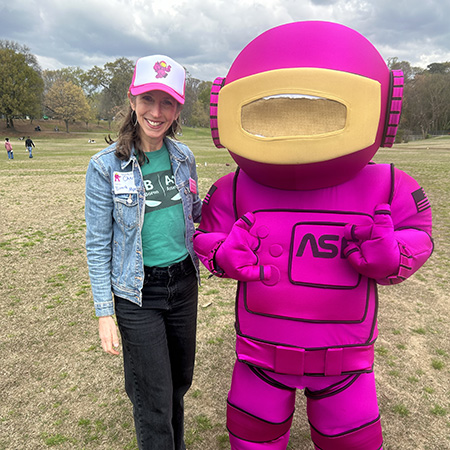
Cheryl with Atlanta Science Festival mascot, Alex, while visiting Science ATL sponsor exhibits.
Tell us about your volunteer role.
I joined the board of directors for Science ATL in 2019 and stepped into the role of board chair in 2022. The organization has such an interesting history. It actually began simply as the Atlanta Science Festival back in 2014. For nearly a decade, it was just a festival, but the city embraced it so enthusiastically that we realized we needed to offer science outreach year-round.
To meet that demand, we established Science ATL as a permanent, year-round nonprofit. Today, we describe ourselves as Science ATL, “engineers” of the Atlanta Science Festival. Because I have many years of experience in corporate communications and the nonprofit sector, I felt I joined at just the right time to offer counsel on building the infrastructure of a full-time organization. It has been incredibly rewarding to contribute to that growth.
As board chair, my primary role is to keep the board engaged as we establish our operational framework. I know setting up infrastructure and board committees isn’t always considered the flashy part of governance, but it is essential. These systems allow us to amplify our programs and events, helping us expand our reach into more communities. The mission of Science ATL is to create an equitable community of science lovers, and we achieve that through intentional programming, school outreach and community events.
Why is science so important to you?
I love science because there is so much wonder in it, and it is truly everywhere. When you look up at the night sky, you are observing science—the stars, the atmosphere, even the air we breathe. It touches everything from computer science and the STEM jobs of today to environmental health.
It’s easy for people to get caught up in the grind of their daily lives, but my involvement with Science ATL has taught me to press pause. When you slow down and observe, there are little moments of inspiration all around us. I try to bring that sense of discovery to our board meetings. While we are there to handle the business of the organization, I start every meeting with a moment of science, discussing a recent discovery or an amazing scientific event. It helps us expand our minds and puts us in the right frame of mind to focus on our work.
What inspired you to get started with this initiative?
I am the daughter of scientists. Growing up in Augusta, Georgia, my household was all science, all the time. My mom was a biology teacher who literally incubated baby chickens on our kitchen counter every semester. My father was a computer scientist, and my stepfather was a pharmacologist. We even had a pet newt that commuted to school with my mom. Science was everywhere.
Naturally, when I graduated high school, I headed straight for business school. I wanted to show my independence and chart my own path. But as I started my professional life, I felt a void. When the Atlanta Science Festival launched in 2014, I was so excited that I scooped up my family and told them, “We’re going.” We became regulars, visiting every booth and engaging with every exhibitor. It filled a part of my identity I hadn’t realized was missing.
Eventually, the co-executive directors reached out and said, “We see your professional skills and your passion, and we’d love for you to join our board of directors.” It was a dream come true. It allowed me to get my science fix and plug back into that world without leaving my career in business. Now, I get to have both.
What are your long-term plans or goals for the organization?
Beyond the festival, our organization works deeply with youth and professionals. In a time when science can feel like a polarizing issue, we believe it’s vital for science professionals to feel valued and for young people to see clear career pathways. Our “STEM Forward” program brings professionals directly into classrooms to inspire students.
Currently, we are in 30 schools across Metro Atlanta with about 40 STEM professionals involved. I would love to see those numbers double in the short term. I believe this program is a model that could eventually be replicated across the country. Similarly, while our festival currently reaches about 60,000 individuals over two weeks, I believe doubling that reach is entirely doable. Every year, we meet people who say, “I never knew this existed,” and that word-of-mouth excitement is what fuels our growth.
What have you learned through your experiences volunteering?
Through this work, I’ve had incredible tangible experiences, from learning how engineers at major airlines use STEM to design passenger seat comfort, to holding a human brain and learning about its delicate functions. I’ve even learned how to separate the DNA of a strawberry during hands-on activities with geneticists!
But the most significant thing I’ve learned from my colleagues at Science ATL is the power of thinking big. In our day-to-day lives, it’s easy to develop a micro-focus. At Science ATL, someone will name a “wild” idea, we’ll laugh… and then suddenly, we’re doing it. We transformed a one-day event into a massive two-week celebration with a huge expo because we have a group of visionary leaders. That spirit has inspired me to shoot for the stars in other parts of my life, too. Sometimes you get there, and sometimes you don’t—but it’s always an adventure.”
What’s been the most rewarding part of your work?
The most rewarding part of this work is witnessing the spark that goes off in our youngest students. You see a professional talking about their job, and suddenly a light bulb flickers on in a child’s mind. They realize, “I didn’t know I could do that.” I have a friend who is a physician, and she brought her second-grade daughter to the Atlanta Science Festival. After visiting several exhibitors, the little girl looked up and said, “Mom, I think I want to be a doctor.” They had never even had that conversation before! Her mother’s heart just exploded.
Being a witness to those moments of self-discovery is what keeps me going. I’ve seen it with my own kids, too. They’ve been along for the ride since the beginning, and every year they come home buzzing with excitement. As a parent, I’ve loved having this enrichment opportunity to underpin what has become both of my children’s favorite subject in school.
Why is it important for others to get involved with causes they care about?
I believe getting involved in your community significantly expands your quality of life. Volunteering helps us connect with others, stay curious as lifelong learners, and it is genuinely good for our health. Because I work professionally in the field of volunteerism, I am constantly helping others find their passion, but I have passions, too. I like to lead by example by getting involved in what makes my heart sing, then sharing that experience with others.
Everyone is different, and volunteering is a safe way to test new interests. You can be a more non-committal volunteer and try many different things, or you can go deep with one organization where you have expertise. Both paths enrich our lives. Beyond that, I feel a strong sense of civic duty. So many people have poured into me throughout my life; getting involved is simply part of being a good citizen and a positive force in our world.
Any advice for people who want to start volunteering?
My best advice for anyone looking to get involved is to simply show up and give it a try. I talk to so many people who say, “I’ve always wanted to do that” or “I’ve been meaning to.” A friend once shared a wonderful Meryl Streep quote with me: “Start by starting.” I think about that a lot. Just find something interesting—or tag along with a friend who is already volunteering—and give it a go. There are plenty of direct-service opportunities where you can show up, help out, and then reflect on how it made you feel. If it’s a fit, sign up again; if not, keep looking. Start by thinking about what you are already passionate about, whether it’s animals, literacy or healthcare. Whatever the cause, there is an organization working on it. Make a pledge to yourself—maybe to volunteer once a quarter or once a month—and just see where the adventure takes you.
Meet Daily Point of Light Award honoree Mirza Kafedzic. Read his story, and nominate an outstanding volunteer or family as a Daily Point of Light.
From the hallways of children’s hospitals to the classrooms of special education centers, the magic of interactive theatre provides a vital escape for children facing medical and developmental challenges. While the actors of Only Make Believe (OMB) take center stage, the sustainability of this joy is anchored by the quiet, dedicated work of volunteers like Mirza Kafedzic. Serving as the treasurer of the board, Mirza has transformed the traditional role of financial oversight into a catalyst for growth.
Mirza’s impact is perhaps most visible in the organization’s remarkable financial trajectory. In just the past four years, he has emerged as one of the top three fundraising board members, contributing between $200,000 and $250,000 through a combination of personal giving and strategic donor cultivation. Beyond the numbers, he has acted as a bridge-builder, leading cultivation events that introduced corporate sponsors and future leaders to OMB’s flagship gala. His ability to translate complex financial data into accessible narratives has empowered board members to engage deeply with the organization’s health, ensuring that every dollar raised is a dollar directed toward a child’s smile.
The post-pandemic landscape presented unique hurdles for nonprofits, yet Mirza stepped into the fray as a trusted partner to the executive director and CEO. By chairing the finance committee and guiding budget conversations, he helped OMB balance ambitious expansion with fiscal responsibility. In 2023, the organization reached a historic milestone: over 100,000 children, and record revenue.
Mirza’s leadership was instrumental in OMB’s successful expansion into Philadelphia, and he continues to scout new horizons, including South Florida. From serving as the board liaison to the junior board to his active role on the development committee, he brings a consistent pulse of energy and accountability to the organization. He views his role not merely as a title, but as a privilege—a chance to ensure that the 100,000 children served last year are just the beginning.
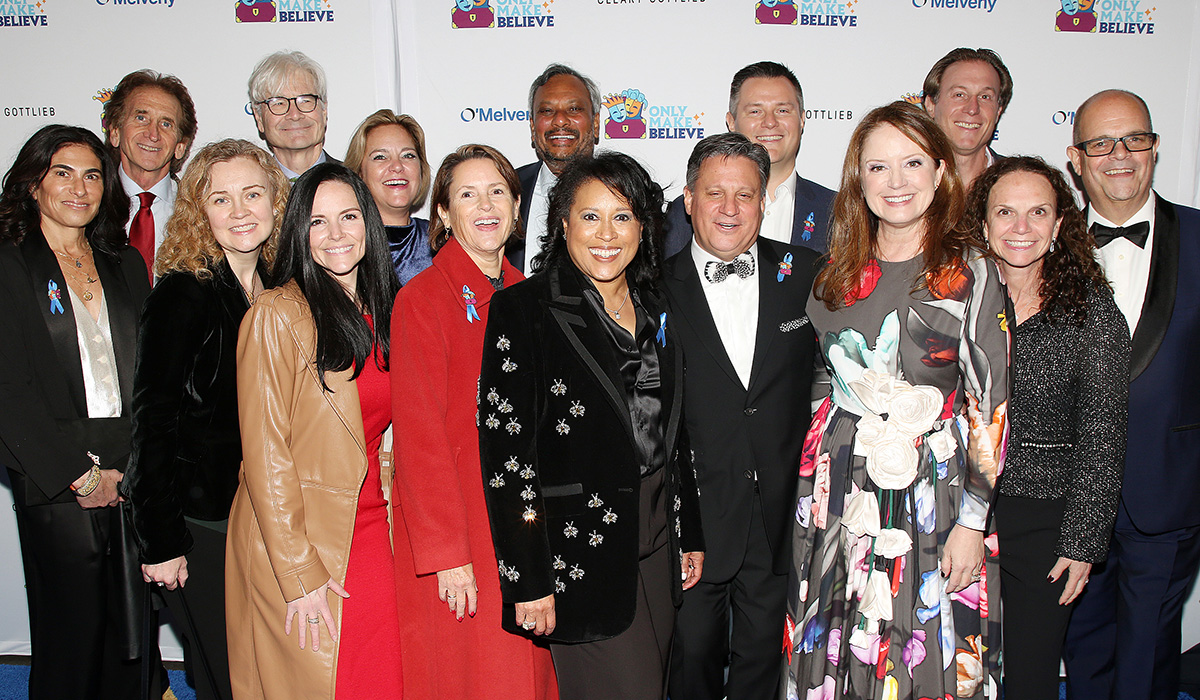
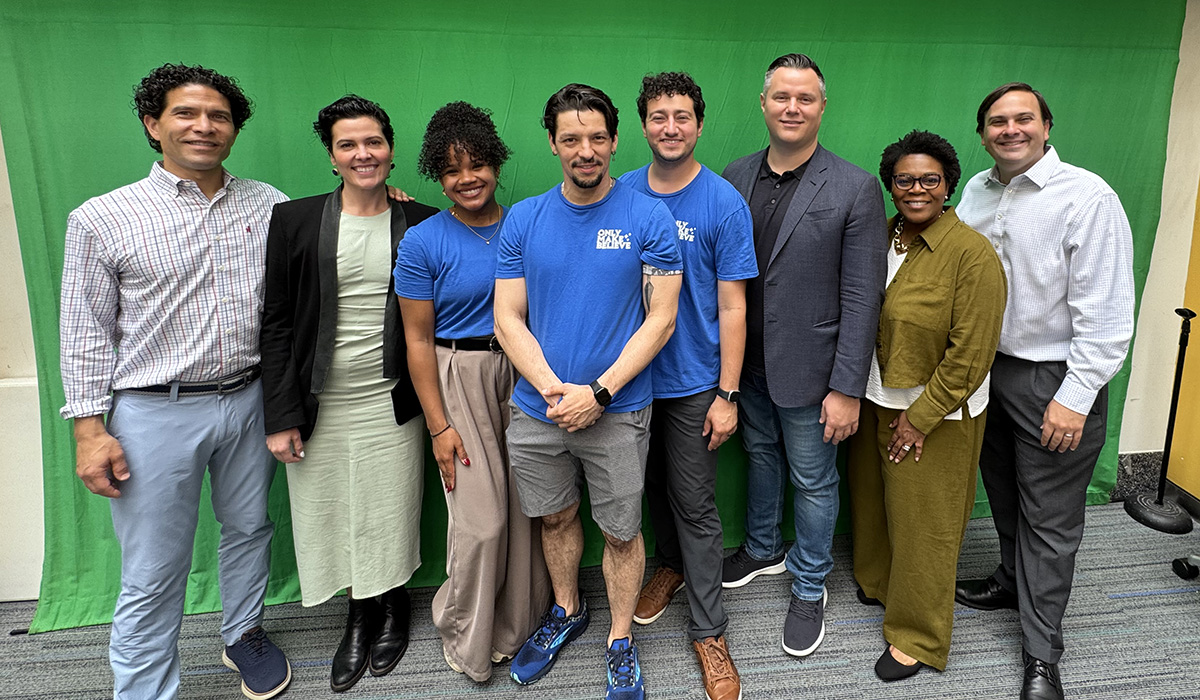
Mirza (third from right) serves as treasurer of Only Make Believe, a nonprofit that puts on interactive theater in children’s hospitals and care centers. /Photo by Bruce Glikas
Tell us about your volunteer role.
I have the privilege of serving on the Board of Directors of Only Make Believe (OMB) and the honor to be on OMB’s Board Executive Committee as treasurer. OMB is a nonprofit that, through its company of Broadway actors, puts on interactive theater in children’s hospitals and care centers. Shows are always free for children and their loved ones.
Aside from the usual governance aspect of non-profit board service, my role as a board member is to be an ambassador for the organization, spreading OMB’s mission, connecting OMB to like-minded people and companies, and fundraising. We are a nonprofit after all! My role as Board Executive Committee member and treasurer is to be a liaison regarding finances between the incredibly inspiring CEO and staff of OMB and the board.
What inspired you to get started with this initiative?
I was introduced to OMB by BoardLead, a great organization that introduces executives who wish to serve to nonprofits that are looking to expand their boards. I was drawn to OMB due to its mission and how personal it was to me, and how OMB responded during COVID when all in-person shows were canceled. OMB rallied and started virtual programming so that kids could still see live performances, and interact via phone or chat. Our virtual programing continues to this day and is a part of our expansion.
Why is this issue so important to you?
Having spent a lot of time in hospitals as a kid, OMB mission hit home for me. OMB’s motto is “imagination helps heal.” For those 30-45 minutes every time OMB does a show, the kids can escape their day-to-day life and using their imagination escape into this Only Make Believe world that is full of fun, play and song. It certainly aids in their non-physical healing.
What are your long-term plans or goals for the organization?
OMB is currently in 80 partner facilities across the NYC and Washington D.C. area for in-person performances. Since its founding over 25 years ago, we have performed for over 100,000 kids! We’re slowly expanding to facilities in Philadelphia and Boston. We expect to expand into other areas geographically. Additionally, thanks to a very generous grant, we’re building an in-house studio to be able to also expand our virtual programming.
What’s been the most rewarding part of your work?
Words cannot describe how full my heart gets when seeing the kids during our performances. I have seen kids who are just out of chemo, in their ropes and rolling their drip, smiling, laughing, singing and dancing along to the show. I have seen autistic kids who usually do not move or speak much move around and make sounds along to the music. I have heard kids call into our program from their hospital rooms with suggestions on what the actors should do next. And sometimes kids who have seen the shows, as we perform 4-6 times in a facility over a couple of months, give away the plot! Our actors are empathetic and inspiring performers, and they are taught how to adjust performances for their audience, which makes it that much more targeted and powerful.
Mirza (third from right) serves as treasurer of Only Make Believe, a nonprofit that puts on interactive theater in children’s hospitals and care centers.
What have you learned through your experiences volunteering?
It is not just money that makes an impact. One’s time, network and word of mouth are extremely helpful as well.
Why is it important for others to get involved with causes they care about?
Nonprofits are amazing organizations. With limited resources many are able to achieve much. By definition nonprofits provide a service that is usually not measured in financial returns. However, their non-financial returns are certainly there. OMB, for example, has performed for over 100,000 children and their families since our founding over 25 years ago. That is over 100,000 directly impacted children, and once you multiply that by their family members, you start to see the vast impact and reach that an
organization like OMB has been able to achieve, with limited resources. This is only possible through support from individuals, companies and governments.
Any advice for people who want to start volunteering?
Find something that you relate to in some way and just get involved. Just do it, no matter how big or small. Volunteer your time, network and money for a cause that is selfless. The return to others will be vast, and the return to your heart will be immeasurable.
Meet Daily Point of Light Award honoree Eva Boehm. Read her story, and nominate an outstanding volunteer or family as a Daily Point of Light.
Eva Boehm, 57, has been cancer-free for nearly two decades but fondly recalls the difference her family, friends, neighbors and healthcare team made in the days following the diagnosis that changed the course of her life. Many years later, as she retired from her career as an educator, she found a way to thank them.
Eva joined Gilda’s Club Minnesota‘s board of directors in July 2022 and has been board chair for a year. Gilda’s, named for famed comedian Gilda Radner, who passed away from ovarian cancer in 1989, is an organization that provides a wide variety of support to those affected by any form of the disease.
Since picking up the role as Gala co-chair two years ago, Eva has tripled donations from previous years and cemented the event as the organization’s largest fundraiser. She is a source of empowerment for board members, staff and community partners, and her ability to make people feel included, valued and capable has inspired many to join the cause.
What inspires you to volunteer?
It was modeled for me my entire childhood. My parents were always involved with the community, from our town council to school boards to professional organizations.
I later started volunteering through my professional organizations and went through secretary, vice-chair and president of those. And I got involved with my kids and the athletics and events they participated in.
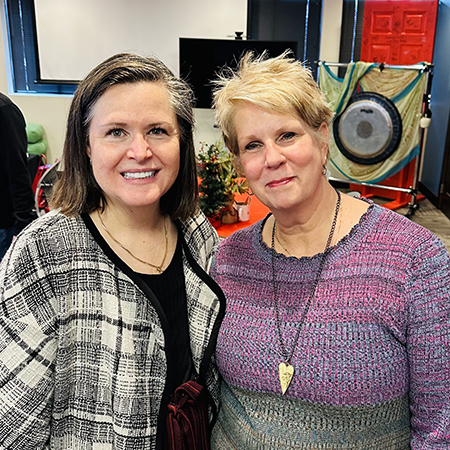
Gilda’s Club of Minnesota executive director Katherine Todd (left) and Eva (right) enjoy the annual holiday gathering designed to thank staff for their contributions and commitment to the club.
Tell us about your volunteer role with Gilda’s Club Minnesota.
I’ve gone from an at-large board member who was participating more as governance to co-chairing our annual gala and, at the beginning of 2025, to board co-chair. At the invitation of the executive director, I helped lead our first gala for our 10-year anniversary in 2024. Collectively, we were able to raise $500,000, which we repeated in 2025.
I also help plan Gilda’s annual retreat with our executive director and conduct our at-large board member meetings six times a year. And I love attending other events throughout the year and promoting our mission and services.
I’m an organizer. I bring people in, and I’m your cheerleader.
What inspired you to get started with this initiative?
As I was nearing retirement, a friend of a friend introduced me to it. I saw this opportunity as an enormous billboard-size thank you note to all of those that helped my family and me. I had an aggressive form of breast cancer. At 39, I was diagnosed and in chemo within seven days. I had two little kids and was in the last phases of a graduate program. Everything came to a standstill.
I’m a generally glass-half-full person, and I just want to get involved because I can. It has filled my bucket, so to speak. You can rally around this, because almost everybody has had some brush with cancer in some form.
What are some ways people can support loved ones going through cancer?
Meals were incredible. Several friends helped me keep my home clean. That was a godsend when I had weekly chemo treatments and surgeries.
That mental health piece wasn’t as well-known almost 20 years ago. Now, people are coming together and talking and finding hope and resources in each other. We have improv groups, too. You have to laugh through this cancer journey, or your mind will play tricks on you. There’s always something that’s going to happen, but there’s going to be hope on the other side.
What’s been the most rewarding part of your work?
We set pretty audacious fundraising goals, and when we first talked about a half million, I was hesitant. We have a team of five and 15 board members. But by using all of our strengths, we were able to meet that.
What have you learned through your experiences as a volunteer?
You get more out of it than what you give. I’ve really enjoyed getting to know people outside my field and figuring out how we can work towards a common goal.
Also, people going through cancer sometimes have to give up their pets for one reason or another. Our clubhouse has a support dog now, Hank. People can make appointments to cuddle with him. And we’re going to have a children’s book published called Hank Heels next year.
Tell us about future partnerships, programs or events that you are excited about.
Our third annual gala will be in April, at which we’ll recognize some of our long-term contributors and introduce our members and their stories. We also have a walk to support Gilda’s and volunteer appreciation events. We have over 1,000 members receiving support. We’re just going to keep that up and identify needs in the community.
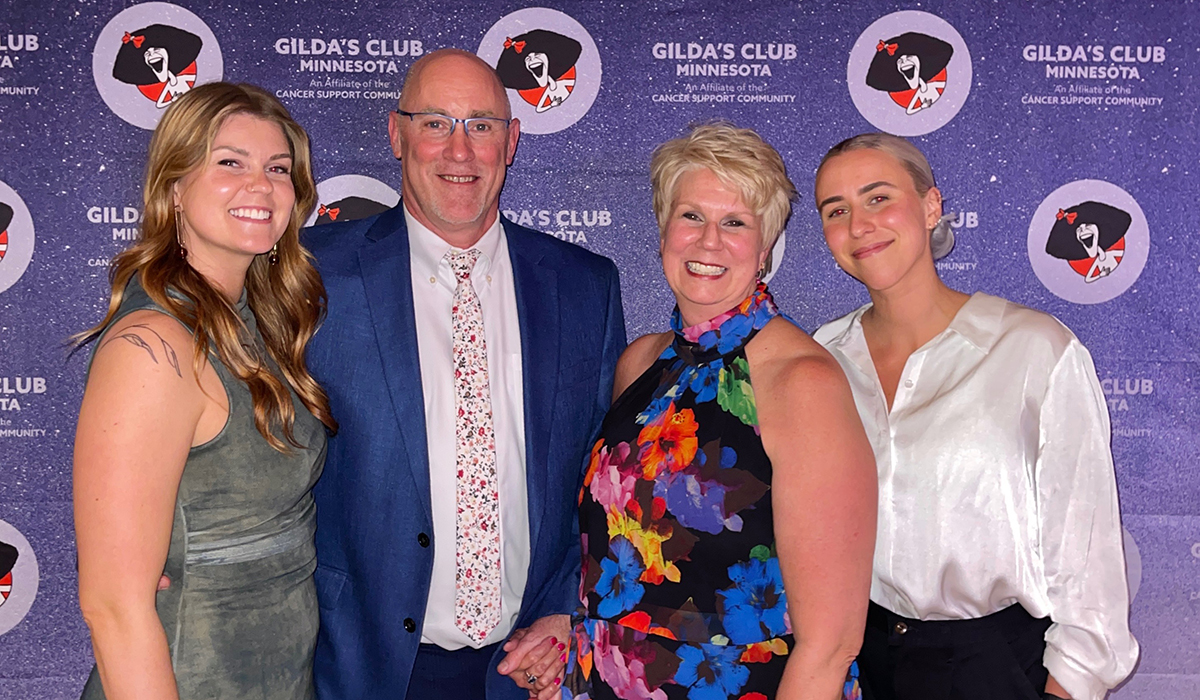
Eva and her family attend the 2024 Gilda’s Gala, an event that has raised $500,000 each year since its inception two years ago. (L to R: Emma Boehm Kreitz, John Boehm, Eva, Abby Boehm)
Why is it important for others to get involved with causes they care about?
It makes our community stronger. And it gives you a purpose. Helping the community is part of the fiber of who my family is, and now I’m hoping to model that for my daughters. There are so many people out there who have needs but are afraid to ask for help.
Any advice for people who want to start volunteering?
Because people know I’m involved with Gilda’s, people have told me about how they’re volunteering. One friend who loves rock climbing is belaying for people with Parkinson’s at our local Vertical Endeavors. Somebody else is coaching a basketball team.
Ask somebody where they volunteer or give money. Start a conversation. Especially in small communities, they always need people with a skill set and acumen to organize and provide service.
What do you want people to learn from your story?
I didn’t think I had the skill set to take over this board chair position. But I can coordinate and organize and do logistics. When you surround yourself with really high-quality people, it’s amazing what you can accomplish.
There is always another season in your life. And despite our darkest days, we can still laugh, be together and find comfort in community.
TEACHING YOUNG PEOPLE IT’S OKAY TO REACH OUT FOR HELP
Meet Daily Point of Light Award honoree Alexander Kovarovic. Read his story, and nominate an outstanding volunteer or family as a Daily Point of Light.
Content Warning: Points of Light is proud to share the following uplifting and inspiring story. However, we acknowledge that a small portion may be difficult for some readers. We encourage you to please care for your own well-being above all.
Alexander Kovarovic knows what it’s like to struggle with his mental health. Now he wants to help other young people who are going through the same thing he did.
As a painfully shy high school student, Alexander struggled with social anxiety and depression that was so severe that it led to a suicide attempt. After receiving mental health treatment that he found extremely helpful, Alexander wanted to change his life and do something to let others know that if they were dealing with the same level of personal turmoil, they could change their lives too. He started the One Life Project, an organization working to educate, support and advocate for young people and their mental health.
Since its official establishment in 2017, the organization has reached thousands of students through social media, school workshops, empowerment events and a support helpline that connects young people with crisis support and mentorship. Self-care workbooks and journals teach young people practical skills to manage their mental health issues, while thousands of volunteers have undergone training through the program to lead awareness campaigns and peer support networks. None of this would have ever started if it weren’t for Alexander’s idea to make the world a better place for those who are struggling.
With five executive offices and eight volunteer outreach centers from Maine to Florida, the One Life Project is thriving. But balancing a full-time career as a pre-K schoolteacher and serving as the organization’s executive director is no small task for Alexander. Still, he remains dedicated to the cause because he knows how important the mission is. He says getting the opportunity to change a young person’s life is well worth the significant time commitment. As a result, the One Life Project has worked with over 10,000 kids, teens and young adults in person through their educational, supportive or advocacy services, with an endless number of others reached through social media. Alexander’s willingness to turn his own painful journey into an opportunity to help others is an incredible example of volunteerism’s power.
What inspired you to get started with this initiative?
When I was in high school, I struggled a lot with social anxiety and depression. That led to a suicide attempt in my senior year. When I went to the hospital, I was in a mental health facility for three weeks or so. I learned a lot there, and when I came out, I wanted to turn my life around. I thought maybe I could do that by helping other people who might be struggling with the things that I was struggling with, but didn’t have the kind of support system I had through the hospital and therapy. I wanted to start something that could help people my age. I started organizing locally in my city. We did a few fundraisers and events.
We got the mayor involved and some volunteers from my school and friends from growing up. In 2017, I thought we should make it into a nonprofit so we can actually accept donations and take a more legal route.
Tell us about your volunteer role with the One Life Project.
When I started, I started as just the founder. Now I’m the executive president, so I run all of our offices. We have six offices on the East Coast. I run all of our event planning, marketing, education, advocacy and activism. I pretty much run the day-to-day stuff. I run our executive team across the East Coast, from Maine down to Florida and all the states in between. I bring on all the volunteers who run all the smaller teams.
What are your long-term plans or goals for the organization?
I think my biggest long-term goal would be to move further with our work into the rest of the country. Right now, we are solely in East Coast states. We started in New York, went up into New England, and we just started going down state by state. As we grew bigger, we’re able to afford more offices. I think the goal for the next two to five years or so would be to start moving into the Midwest, California and the West Coast area, and just see how we can help other communities. A big thing that we’re starting to look at now is rural communities. We went to Pennsylvania last year, and we’re going to West Virginia right at the moment. We will open the office there next year. But it’s those communities in rural Pennsylvania, New York and West Virginia that don’t really have the same kind of access to therapy and services. That’s a big thing we’re looking at in the next couple of years.
What’s been the most rewarding part of your work?
The chance to be able to help someone save someone’s life, and be able to put a smile on our face and make their day better. We like to try to teach our young people that there’s always a light at the end of the tunnel if they just hold on a little longer. We try to utilize that saying with everybody that we meet. That’s really my biggest goal– just being able to help somebody. It’s why all of us do this, and it’s why every volunteer signs up. We’re 100% volunteer, so we don’t have any staff anywhere, and it’s pretty wild how big we’ve grown just through volunteerism.
What have you learned through your experiences as a volunteer?
I’ve learned a lot about myself, if that makes sense. I never realized how much I would like it. Growing up, I was very shy and didn’t have a lot of friends. I would never approach someone or speak in class. Going from that to now giving presentations at schools and having meetings with hundreds of people, and meeting governors and high-level politicians is something I never thought I would even enjoy, let alone actually do. That’s a big thing for me personally.
Why is it important for others to get involved with causes they care about?
If people don’t get involved in the causes they care about, there won’t be anybody to help those people who need it. If I didn’t have as large a volunteer base as we do, we wouldn’t be able to do it. Every state we move into, if we didn’t have those volunteers ready to sign up and help in some way, we wouldn’t be able to go into that state. I tell people that we have volunteers who put in more hours with us than they do their actual job, and then we’ve got people who will volunteer at five events a year. And those people are just as important to our work as we move forward.
Any advice for people who want to start volunteering?
The first thing is to go to a local event. Go up to a tent and talk to someone. Find something that you’re passionate about. We get volunteers who just have to fulfill their volunteer service, and of course, we appreciate them, but it’s the people who are passionate about youth mental health and suicide prevention who will sign up and stay for years or forever because they are so passionate about what we do. I would say, find something that you’re passionate about. Also, with social media and online resources nowadays, you can Google search things you’re passionate about with different organizations in your area. You could either find a local one, or you could find something that’s more national that has a chapter in your area.
What do you want people to learn from your story?
If you give up and you cut your life too short because you feel like you’re not worth it, or you’re alone and can’t get help, you’ll never really know what’s in store for you. If I were successful in my attempt to end my life, I wouldn’t be where I am. Also, we wouldn’t have what we have, and we wouldn’t be helping the people that we do every day. You really never know what’s on the other side. I would say you’re never really alone. You have to reach out. There are so many people out there who will listen to you and help you and not judge you.
If you or someone you know may be considering suicide, contact the National Suicide Prevention Lifeline by dialing 988, or text HOME to 741741 to talk to a trained crisis counselor through Crisis Text Line. Both resources are anonymous, free and available 24/7.
Meet Daily Point of Light Award honoree Nishith Sadu. Read his story, and nominate an outstanding volunteer or family as a Daily Point of Light.
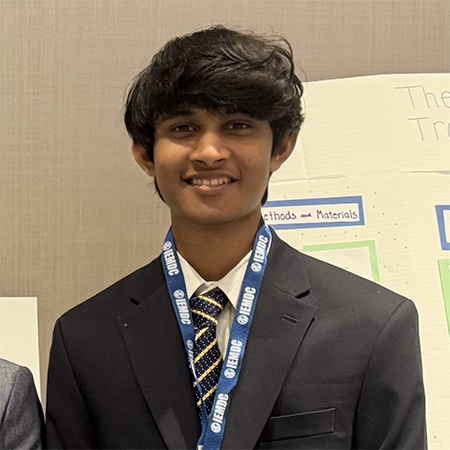
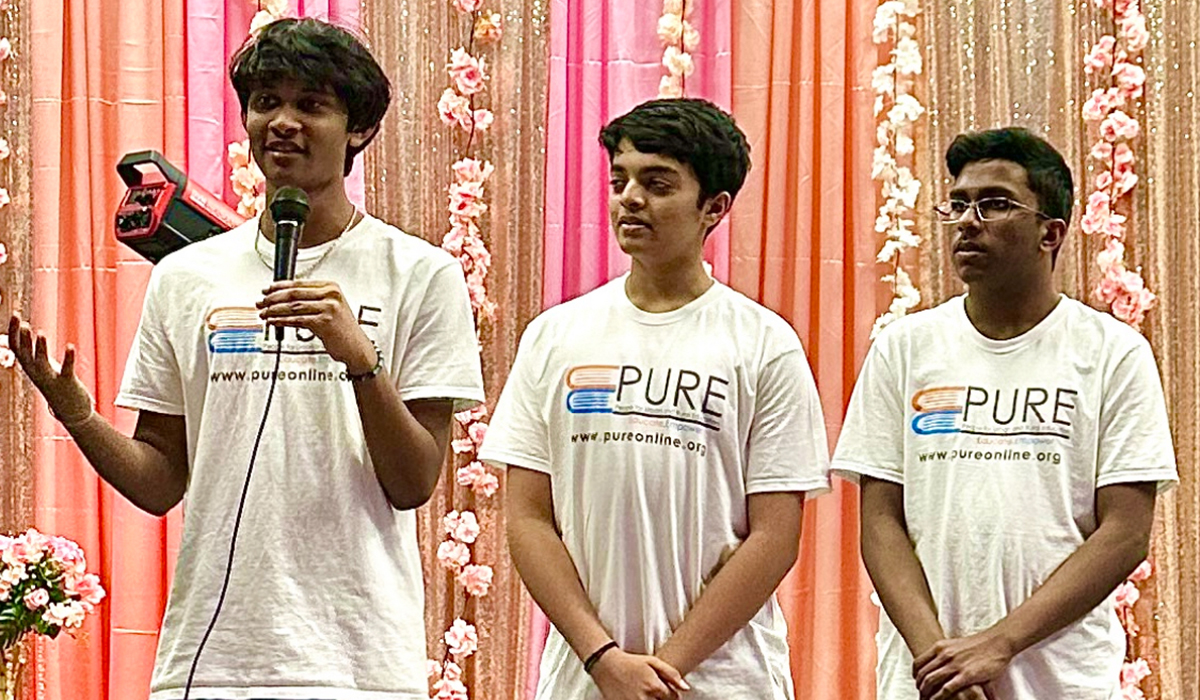
Since 2022, 18-year-old Nishith Sadu has held many roles at PURE Youth, an organization that addresses the urgent needs of children facing poverty and other hardships. From volunteer to chapter director, Nishith has led and assisted with many projects in more than 500 lifetime volunteering hours.
He’s been involved with many school supply, toy, clothing and food drives. He’s aided local conservation efforts and recruited friends to grow the impact. Now, as a national student youth director, Nishith supports 30 chapters with 300+ middle and high school student volunteers nationwide, driving national initiatives forward.
Unsurprisingly, his empathy extends to those who need help across the world as well. In three years, he’s helped raise $8,000 to rebuild roofs and ceilings for schools in India and South Africa. He’s sent 400+ pairs of sneakers to kids in Kenya and used $1,000-worth of bake sale money to buy kids in Barbados and Uganda wheelchairs. His work supports necessities for some of the world’s most vulnerable populations.
Outside of PURE Youth, Nishith brings joy to his community through Bollywood dance as both a member of a troupe–he has performed at Houston Rockets halftime shows!–and as the founder of a school club. Leading with compassion and enthusiasm, he engages others in building community and making the world a kinder place.
What inspires you to volunteer?
Something that helps me ground myself is the purpose that I’m volunteering for. For example, sometimes the goal is to raise money to fund or build schools that will create educational opportunities in rural areas. Keeping that in mind drives me.
National Student Youth Director Nishith Sadu helps lead PURE Youth’s mission to empower young volunteers across more than 30 chapters nationwide.
Tell us about your volunteer role with PURE Youth.
Originally, I joined as an ambassador or a volunteer. About two years later, I became a chapter director, meaning that I’d lead our chapter and coordinate volunteers. I came up with project proposals and ensured our chapter was raising enough money and hosting service projects benefitting our local community, like park cleanups. We also did civic engagement activities with a local fire department.
I was later named a national student youth director, which is essentially a chapter director role but on a national level. We come up with different projects, communicating our ideas and plans to chapter directors and all of the ambassadors. We train and mentor chapter directors, host orientations for new volunteers and do outreach to local businesses.
I’ve also been working towards becoming an Eagle Scout since second grade. I recently conducted an initiative using my interest in computer science and technology to create STEM kits.
Working with people more experienced with electronics, I put together about 30 different kits. We made instruction manuals for each and had volunteers test them to see if they could make the projects properly. Then, we gave them to underserved children in the community at a local event I coordinated with another organization.
What inspired you to get started with this initiative?
When I was in eighth grade, a few people from my community found Pure Youth and wanted to start a chapter. My mom got that information to me, and I expressed interest in joining. I’ve been volunteering ever since.
What have been some of your favorite initiatives?
One of the ones that stuck with me the most was a local chapter initiative to make a bookshelf for a local temple. We fundraised and collected books for visitors to read. It was the first project I’d ever led, and I learned a lot about communicating and making sure everyone was focused.
What’s been the most rewarding part of your work?
One of the most challenging and rewarding experiences was leading PUREthon, a nationwide 2K/5K walk/run organized and facilitated by all our chapters at the same time. Our goal was to raise awareness for femme care and period poverty. My job was to ensure every chapter had the tools, guidance and motivation to execute successfully.
It required a lot of coordination. I worked with social media managers from each chapter to promote the event and share venue details. I helped chapters prepare for contingencies like bad weather, secure supplies and accommodate children and seniors.
I saw firsthand how a shared mission can unite diverse teams and how leadership can spark impact. Chapters that had never hosted a public event before started engaging their communities.
What have you learned through your experiences as a volunteer?
It was really hard for me to communicate with others until I became a leader. It took me stepping out of my shell, and it has helped me get comfortable voicing my opinions. There were days when I felt like I wasn’t making a difference, but to be able to attribute some of our results to my actions has given me confidence that I’m capable of doing something for the greater good.
Why is it important for others to get involved with causes they care about?
Gandhi once said something like, “Be the change you wish to see in the world.” Hoping change will happen won’t actually create change. It’s when you start to take things into your own hands that you’ll start seeing it. Having the opportunity to do so can be very fulfilling.
Any advice for people who want to start volunteering?
Don’t hesitate. I’ve been able to learn a lot about leadership, fundraising and marketing. It’s not just about creating impact. There are a lot of things you take away from the experience.
I think the best way to get involved is to ask your friends if they’re part of any organizations. You can also get involved in your high school’s initiatives. They’re a good introduction and one of the easier ways to get started.
What do you want people to learn from your story?
Everyone has the ability to create impact. Take time out of your day to do something to help others, even if it’s small. It’ll build character and confidence in your abilities, and it’ll give you fulfillment.
Transforming Compassion for Malnutrition into Impactful Change
Meet Daily Point of Light Award honoree Viraja Shivhare. Read her story, and nominate an outstanding volunteer or family as a Daily Point of Light.
The fire of compassion often burns brightest when fueled by personal experience. For Viraja Shivhare, the co-founder and director of outreach for Fuel the World, her years spent living in India and her own struggle with anemia illuminated a heartbreaking reality: generational malnutrition. She witnessed firsthand how food aid, while well-intentioned, often lacked the dignity and crucial nutrition needed to break the cycle. Determined that the challenges she and others faced wouldn’t persist for future generations, Viraja set out to create systemic, youth-led change—a vision that has since grown into one of the world’s largest youth-led nonprofits.
Viraja’s dedication to thoughtful, community-focused service quickly crystallized into two flagship initiatives that offer both immediate and long-term solutions. The first, NourishNet, delivers fortified, culturally relevant meals, ensuring that food aid is not just filling, but genuinely nourishing and respectful of recipients’ heritage. The second, Nutrition Literacy Workshops, empowers families with the essential knowledge to sustain their health, teaching them to read labels, prepare affordable and nutritious meals and actively prevent chronic illness. This dual approach, blending tangible aid with vital education, demonstrates a profound understanding of the complex root causes of malnutrition.
Under Viraja’s passionate leadership, her commitment of roughly 30 to 33 hours per month—meticulously divided across 32 chapters, fundraising and hands-on volunteering—has yielded inspiring results. Fuel the World now boasts a network of over 300 volunteers, has achieved an incredible online reach of 90,000 people, and has successfully raised $24,000 to sustain its vital programs. Working with major partners like the Akshaya Patra Foundation, LifeMoves and the County of Santa Clara, and securing grants from organizations including Hershey’s and Destination: Home, Viraja has shown that even as a young leader, her vision is powerful enough to attract significant support and collaboration.
Viraja Shivhare co-founded Fuel the World.
Tell us about your volunteer role.
Fuel the World is one of the world’s largest youth-led nonprofits dedicated to combatting malnutrition in underserved communities by empowering them with the tools and knowledge to achieve lasting nutritional security. Through our flagship initiatives, NourishNet and our Nutrition Literacy Workshops, we deliver fortified, culturally responsive meal packages tailored to specific community health needs, such as iron-rich meals for anemic youth or low-sugar options for families managing diabetes, while prioritizing dignity, culture and long-term wellness.
We also run free, youth-led in-person and virtual workshops at schools, libraries and community centers that teach participants how to navigate nutrition labels, make affordable and healthy food choices and prevent chronic illness through diet. Over the past three years, we have collectively raised nearly $24,000, secured three grants worth upwards of $1,000, expanded to 31 chapters globally, partnered with organizations such as the Akshaya Patra Foundation, LifeMoves, SF Marin Food Bank, BigHelp for Education, CityTeam, Jamba Juice, Panera Bread, Chipotle, Shake Shack, Hot Table and the County of Santa Clara, mobilized over 300 youth volunteers and reached more than 90,000 people through outreach and social media.
As the co-founder and director of outreach of Fuel the World, I help to build and nurture partnerships with community leaders, organizations and stakeholders to the distribution of our nutritional programs. I oversee outreach campaigns, coordinate volunteer efforts, and advocate for policies that support nutrition security. I spend a majority of my time supporting leaders and helping them to plan events, coordinate distribution and stay aligned with our outreach and nutrition goals. I also manage the Fundraising and Partnerships Task Force and previously managed the Fuel the World Summer 2025 Internship, where I managed donor communication and identified partnership opportunities. I also spend time weekly meeting with grantors and collaborating with organizations like Destination: Home, Hershey’s Company, Youth Service America and Karma4Cara through fiscal sponsorships and monetary grant contributions.
What inspired you to get started with this initiative?
It was the moment I realized that thinking about change wasn’t enough; I wanted to put pen to paper and actually build something that made a tangible difference. I’d spent so much time volunteering, learning about nutrition insecurity and seeing the gaps in access and education, but eventually the question became: What am I going to do with what I know? I didn’t want my frustration or empathy to stay theoretical. I wanted to translate it into programs, partnerships and resources that people could feel in their everyday lives. Creating Fuel the World was my way of moving from intention to impact, designing real systems, organizing real volunteers and addressing real needs rather than just talking about them. That shift from idea to action is what started this entire journey, and it still drives me today.
Why is this issue so important to you?
It matters to me on a deeply personal level because I’ve experienced the effects of malnutrition in my own life and seen how it can echo across generations. Growing up Indian, I was surrounded by stories, from my parents, grandparents and extended family, about how nutritional deficiencies were almost normalized in our community. For many South Asian families, especially women, conditions like anemia are so common that people stop questioning why they persist. I dealt with anemia myself, and even though I had access to healthcare and information, it still affected my energy, concentration and overall wellbeing.
That experience made me think about how many children don’t have the same support systems or resources I had. If something as “quiet” as anemia could shape my daily life, what does it mean for kids facing more severe or chronic nutritional gaps with far fewer resources to fall back on? The more I learned, the more I realized that malnutrition isn’t just an individual issue; it’s a generational one. It affects how children grow, how they learn and what opportunities they can pursue. It’s woven into systemic inequalities, cultural norms and long-standing gaps in access to nutritious food and education. Working on this issue feels like a way of breaking that cycle, not just for one community, but for any family or child who has been told, implicitly or explicitly, to simply “live with it.” Addressing malnutrition isn’t just about food; it’s about giving people the health and foundation they deserve from the very beginning. That personal connection is why I’m so committed to this work.
What are your long-term plans or goals for the organization?
My goal is to continue leading Fuel the World as a co-founder and director of outreach throughout high school, building on the foundation my team and I have created. After graduating, I want to establish a new high school board to preserve the youth-led, community-centered identity that defines our organization, while also expanding Fuel the World onto college campuses to broaden our reach. As our credibility grows, I plan to develop larger partnerships with other nonprofits and integrate our initiatives like Nutrition Literacy workshops and NourishNet into mainstream hunger-relief efforts nationwide. Ultimately, I envision Fuel the World contributing to policy change in schools by advocating for healthier food options and high-quality nutrition education beginning early in childhood, addressing generational malnutrition at its root.
What’s been the most rewarding part of your work?
Seeing the real, human impact of what started as a small idea. Watching families benefit from NourishNet meals or seeing students light up during our Nutrition Literacy workshops makes the long hours feel worth it. Just as meaningful, though, has been watching our volunteer network grow seeing younger students step into leadership roles, build confidence and create their own projects within Fuel the World.
Another deeply rewarding piece has been the collaborations we’ve built along the way. Getting to work with organizations I’ve admired for years like Akshaya Patra and Hershey’s has felt surreal at times. Our most recent and upcoming partnership with Kendra Scott shows that youth-led initiatives can stand shoulder to shoulder with established nonprofits, and it’s validating to know that our team’s work is recognized at that level. Altogether, the personal impact, the community we’ve built and the partnerships we’ve formed make this work incredibly meaningful and keep me excited to keep growing it.
What have you learned through your experiences volunteering?
The biggest lesson I’ve learnt is the importance of curiosity, thoroughness and research. When I first started Fuel the World, we began under a different name, “Humanity Bundles Initiative,” with a different mission and a different approach to solving the nutrition crisis. But, after a few months of operations, we weren’t satisfied with the change we were creating. This is when our team took a step back and began digging deep into the root causes of malnutrition. As a result, we learned that malnutrition can’t just be characterized by a lack of good, but also shaped by generational and biological history that has to be addressed first. Understanding this complexity forced us to broaden our perspective: malnutrition is a personal issue, but it’s also a systemic one shaped by history, culture and inequality. This caused us to realize that our previous programs were simply a Band-Aid, not a real fix to the problem at hand and forced us to redesign our organization as a whole into a complete rebrand. I think it’s important for volunteers and founders like me to think outside the box and be okay with their mission evolving and becoming more specific as they learn, but I believe this starts first with empathetically looking towards other stories, as well as digging deeper into our own.
Why is it important for others to get involved with causes they care about?
Real change doesn’t happen from the sidelines. It happens when individuals decide to act, even if they don’t feel “ready” or “qualified.” And youth especially play a crucial role in that. Young people bring energy, urgency and a willingness to rethink systems that adults often take for granted. When I first began doing community service work, I saw how easy it was for young volunteers to second-guess ourselves. Adults didn’t always take us seriously, and sometimes that made us question our own ability to create meaningful change. But I also learned that the best way to challenge that doubt, both from others and from within, is to show what’s possible through consistent action. Every workshop, every fundraiser, every partnership becomes evidence that age isn’t a limitation. That’s why youth participation matters.
Young people don’t wait for the “perfect moment” or the “perfect credentials.” We build credibility by showing up, learning as we go and proving our impact step by step. And because we’re not locked into old assumptions, we’re often the ones who push for solutions that are more creative, community-driven and equitable. When young people get involved, they don’t just support a cause; they expand what that cause is capable of achieving. Their involvement signals that change is not only necessary, but urgent, and that anyone, regardless of age, can help move it forward. I encourage anybody reading this to take the next step that they’ve been thinking about but holding themselves back from, because young founders and volunteers can have an impact beyond their comprehension.
Any advice for people who want to start volunteering?
When I first got involved in community service, I used to think impact only came from big, dramatic accomplishments. But I realized pretty quickly that the most meaningful progress often comes from breaking things down into manageable steps. Instead of trying to tackle everything at once, I gave myself smaller benchmarks that felt realistic and kept me grounded. I’d aim to complete one project, connect with one new partner, or organize one event at a time.
Focusing on these short-term targets made the work feel less overwhelming and gave me a sense of direction, especially on weeks when the bigger picture felt too far away. What surprised me is how easily these small efforts began to build on each other. Before I knew it, those little goals had grown into outcomes I never imagined when I started, more outreach, more volunteers and a deeper impact in the communities I cared about. If you’re beginning your own volunteer journey, start with something simple and achievable. Those small commitments stack up faster than you think, and they can lead you somewhere far beyond what you expected.
Meet Daily Point of Light Award honoree Warren Bates. Read his story, and nominate an outstanding volunteer or family as a Daily Point of Light.
Warren Bates is only 16, but volunteerism has been his lifelong passion. Currently a junior in high school, Warren started volunteering alongside his brother at a retirement facility back in junior high. A light inside him turned on, and Warren realized his passion for service. When he got older, he joined the National League of Young Men, which required annual community service hours. Warren parlayed that into a role as an assistant counselor with the Friends of Tryon Creek in the summer of 2023, and he soon became a full counselor.
An organization that works to preserve the forested canyon that borders Lake Oswego and Portland, the group also hosts summer camps in its stunning forest landscapes. Warren jumped aboard, helping educate and inspire youth campers to appreciate nature and learn to feel safe in the forest. In the past 15 months, he has volunteered over 500 hours with this initiative, teaching important leadership skills and creating the next generation of people who will keep the forest thriving.
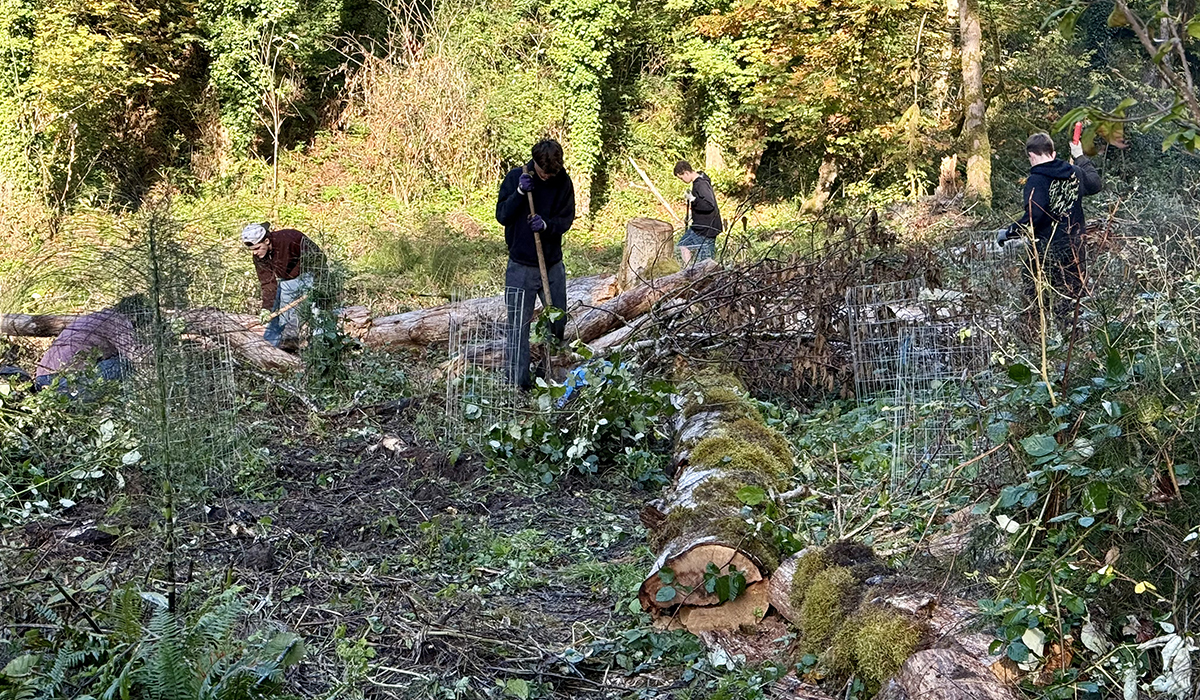
Outside of the summer season, Warren dedicates himself to Tryon Creek in another unique way. Recent bills passed by Oregon lawmakers affected one of the culverts in the Willamette River, which subsequently created issues in Tryon Creek. Warren works to preserve the area by removing overgrown plants and keeping the area functioning properly. He’s even interested in pursuing restoration in the future as a hobby.
While Warren already has 500 volunteer hours under his belt, he’s not slowing down. Looking forward, his goal is to complete 600 volunteer service hours at Tryon Creek before June 2026. Whether he’s leading a group of campers on a hike or clearing away ivy that has blocked a walking path, Warren’s dedication to the natural beauty of Tryon Creek is an inspiration to us all.
What inspired you to get started with this initiative?
My main motive was joining an organization called the National League of Young Men. It’s a nationwide organization, but here specifically, it’s the Lake Oswego Chapter. You have to commit at least 10 hours of volunteering each year in order to stay in the organization, but I just decided to take that opportunity to a much higher level.
Tell us about your volunteer role with the Friends of Tryon Creek.
There’s a group of about 13 of us camp counselors. Our responsibilities include creating a schedule for a whole five days. We have to figure out and determine which kind of activities our group would like to participate in. For example, last summer, I had a few groups that were ages 7 through 9. I thought that they would really enjoy going on pretty short hikes, as well as allowing them to do a few coloring books that include drawings of nature and education-based nature books. We also had them learn about Tryon Creek itself.
I also do volunteer work outside of the summer. Our Oregon law recently passed a bill on one of the culverts in the Willamette River, which caused environmental issues all across habitats and other natural state areas, but specifically Tryon Creek. Restoration includes dealing with that culvert and making sure we can do everything we can to help. Another thing is cutting down trees and replacing them, because there are some that are getting overgrown and getting on the walking paths. There’s also restoring dead plants and removing bad bacteria.
What are your long-term plans or goals for the organization?
My main goal was just to feel pride in myself, knowing that I can make a change in people’s lives, including retirees or younger children, or whichever audience I can reach. If I can even reach a bigger audience when I get older and join a bigger organization, that would be wonderful. That is definitely a huge goal of mine with volunteering.
What’s been the most rewarding part of your work?
I’ve got to say it’s definitely the gratification that comes from everybody who notices how young I am. I feel pride in that. Also, just seeing the number of hours that I’ve collected over the years. There’s a prestige in showing people that I really do truly care for volunteering and it’s something that I’m willing to do, regardless of whether or not it’s a paid position or not.
How do you balance volunteering with your high school career?
The reason why I mostly do my hours in summer is that I don’t have school, which allows me to make the biggest difference. But during the year, I really just try to section it out month by month. Sometimes I only do it once a weekend over the course of a month, or sometimes twice, depending on how busy my class schedule is. That’s kind of been my mindset ever since middle school. I’ve really just never decided to procrastinate, and I guess that’s a good habit of mine. You should definitely just try and find like two hours on a Saturday evening or a Sunday morning to just go after it and take a break from school, work or athletics.
Why is it important for others to get involved with causes they care about?
One extra person goes a really long way. That was especially proven to me, actually, in my own community here at Lake Oswego. There is an organization that I worked with for a very short period of time, so it wasn’t very consistent. I was able to help, even just on my own. If you’re trying to get into something and you’re trying to help an organization out, you should definitely go for it, because you should never have the excuse that you’re only one person and think that not going to make that big of a deal. It actually is, especially if you really care for what you’re trying to do and actually put your effort and hard work into it.
Any advice for people who want to start volunteering?
I’d say a good way to start is just by trying to put yourself out there. You’re not harming yourself and you’re not harming anybody else if you’re willing and truly passionate about volunteering for a specific cause. Just do it. I will definitely guarantee that there are options and opportunities for you.
What do you want people to learn from your story?
Being 16 years old or being young doesn’t determine whether or not you can start taking action. Like I said, I started in seventh grade when I was 12 or 13. Even if you’re 10 years old, don’t ever doubt yourself in anything you’re trying to do. Regardless of your age or your mindset, there’s always something that is possible and obtainable if you put your mind to it.
Content Warning: Points of Light is proud to share the following uplifting and inspiring story. However, we acknowledge that a small portion mentions domestic and sexual violence and may be difficult for some readers. We encourage you to please care for your own well-being above all.
Meet Daily Point of Light Award honoree Sue Baarts. Read her story, and nominate an outstanding volunteer or family as a Daily Point of Light.
Four years ago, when Sue Baarts retired, she immediately began dedicating her time to an organization she had been donating her money to for years. Committee Against Domestic Abuse (CADA) is an organization that supports survivors of domestic and sexual violence through things like shelter, legal assistance, hospital visits and more. They serve 1,200 to 1,400 survivors each year, providing education and advocacy as well.
For around 35 hours each month, Sue does everything from leading a fundraiser at the organization’s annual Galentine Gala to watering plants. No task is too big or too small in service of the mission. Her positivity and eagerness to dive in wherever she’s needed uplifts staff and makes her a cherished member of the team. The work often becomes a family affair when Sue recruits her six sisters to help with the appeal mailings. All of them, in turn, bring friends, spreading awareness of the cause and turning relatively monotonous work into joyful afternoons.
Sue is married to a man she met her freshman year of high school, one she reunited with at their 30th class reunion. Enjoying her own healthy relationship, Sue’s compassion for those who find themselves in harmful situations continues to power her volunteerism.
What inspired you to get started with this initiative?
I would volunteer a little bit at church and give blood–my sisters and I are still pretty competitive. We’d ring the bells for the Salvation Army, but between work and home, I didn’t have time to do much more. This is my first full-time role. And I help once a week at Echo Food Shelf in Mankato.
CADA has opportunities to do many different things. I really wanted to work for them because their mission is so important. Whatever they ask of me, I do. I think everybody should be safe in their home.
Tell us about your volunteer role with CADA.
I lead a committee of about eight in organizing Galantine Gala. This is the fifth year, and I’ve been there for all of them. Last year, we had 250 women, ages 20 to 40, supporting CADA. They make donations, and we have games and trivia. They all dress up.
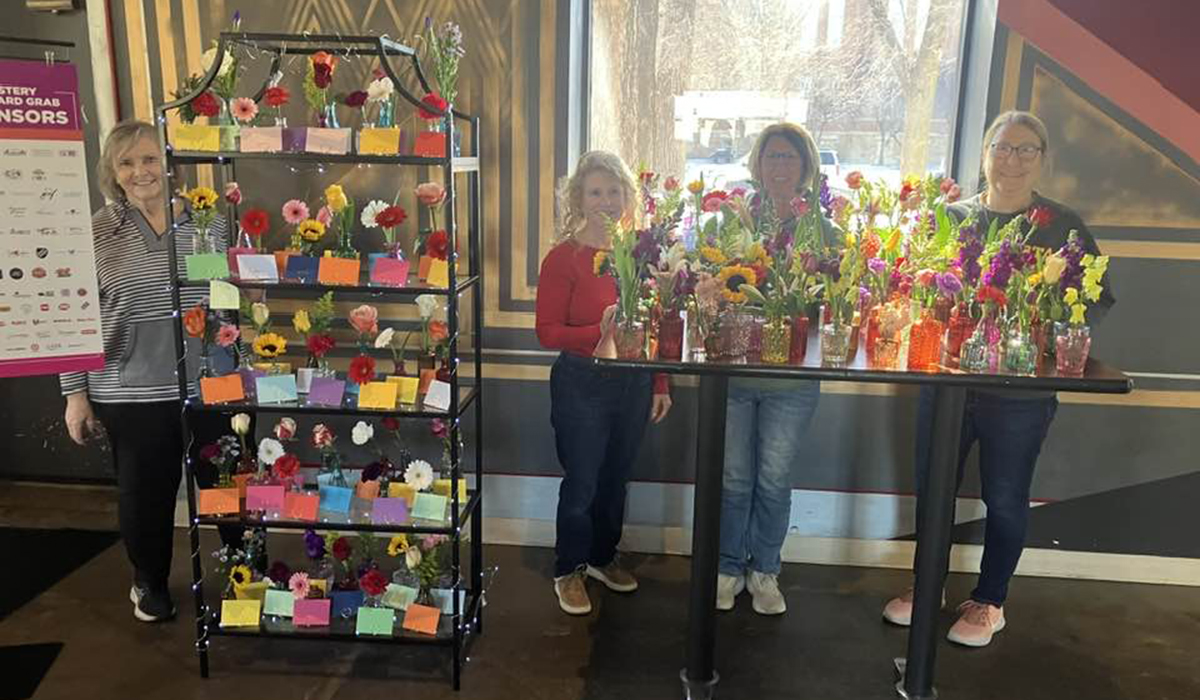
We have a mystery gift wall, and we get flowers and small vases donated. Then, people donate $20 per mystery gift card to take it home. The first year, we had 57. Last year, I suggested we do 200 in order to make $4,000 for the shelter. At the end of January last year, we had 129. By February 20, we had 210. It wasn’t just businesses that donated, but also all of the friends I tagged on social media.
We get some grants and some federal funding. We used to send out 1,700 appeal letters twice a year, but it’s down to 1,200 now. Last year, we made $29,000 through Galentine donations as well. It helps support our secure shelter and a space where kids can go for supervised visitation between parents.
In December, we have the Santa’s Elves program. We give toys and other items on their wish lists to people in the shelter and any who have had a connection with CADA. Maybe they’re out on their own now but just don’t have enough money.
At the office, I’m mainly in the front. If people come to the door with donations, I take them. We fill out forms. I pick up and organize donations, too. On Mondays, a Qwik Trip convenience store donates food that’s about to expire, because we have to feed people. We never know how many we’re going to have in our shelter.
I water the plants and clean the windows. I clean shared spaces, pick up mail and packages, take out garbage and recycling and stock supplies. Some days I come in, it’s quiet. Others are really busy and even stressful, depending on who comes to the door and how we need to handle it.
I also help at tabling events to raise awareness of CADA’s mission and services. At colleges, we hand out “10 signs of a healthy relationship” cards with “10 signs of an abusive relationship” on the back to start conversations. We’ll go to concerts like Rib Fest and fairs. A lot of people ask what they can do to help, and we might say, “We have babies in the shelter right now. We need diapers.”
Are there signs of abusive relationships people might not immediately think about?
Fear is pretty common. When someone is controlling, manipulating or isolating you. When someone makes you feel guilty. All of those things are signs. A healthy relationship is taking things at a comfortable pace, offering apologies, having fun, feeling safe and supported, having equality, independence and respect. That’s good to know, too.
What’s been the most rewarding part of your work?
As a community, we’re making a difference. It makes me feel good. I feel better physically and mentally when I’m doing something. I’ve met so many wonderful people, and I enjoy it. I feel needed and appreciated. And they’re really good about opening the floor for ideas. I’m also using organizational skills that I used to use for work.
What have you learned through your experiences as a volunteer?
I’ve learned to be less judgmental. At the beginning, someone came in and wanted food, and I thought, “That’s not this department. You should go to ECHO Food Shelf.” I would never say that out loud but wondered why they weren’t doing that.
When you think about it, maybe they couldn’t go there. Maybe they couldn’t sign up. Maybe if they didn’t have enough food, they’d get in trouble at home. You really have to think about situations from multiple angles.
What do you want people to learn from your story?
People should always feel safe at home. And everyone can make a difference if they just do a little to help. Try different things. See what fits.
Meet Daily Point of Light Award honoree Meera Mehta. Read her story, and nominate an outstanding volunteer or family as a Daily Point of Light.
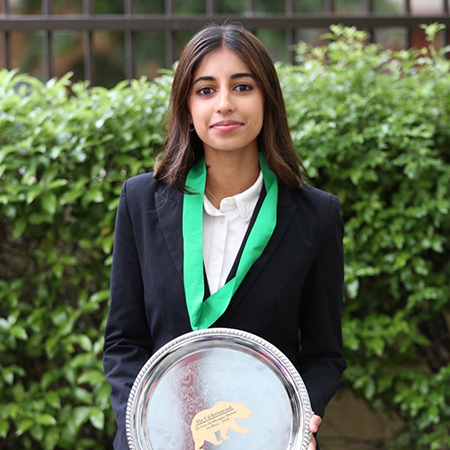
As pandemic restrictions began to disappear, testing showed that only 44% of New Jersey third graders were reading at grade level, a number that has still not returned to what it was prior. In 2022, writer and book-lover Meera Mehta decided to tackle the problem with Novel Futures, a nonprofit creating sustainable access to books and writing resources for underserved kids and families.
Over 600 volunteer hours later, now a high school senior, Meera’s book drives have helped thousands of kids build home libraries. She has built partnerships with schools, libraries and community organizations. And in two years, she has led more than ten free writing workshops for children. With a younger brother who has been steadily involved, Novel Futures should be increasing literacy for years to come.
Meera also serves as president of her school’s Feminist Club where she leads discussions on women’s issues and organizes drives to support various organizations and women’s shelters. Recently, she collected menstrual products to help stock the bathrooms at the local library. In college, she plans to study anthropology with a minor in women and gender studies and creative writing.
What inspires you to volunteer?
I just want to be helpful. That’s what leads me to work with the Feminist Club. I loved leading that period product drive, because I felt like I was really making a difference for people in my community.
During the pandemic, literacy rates in New Jersey dropped by about 8%. That number really stuck with me, because I’ve always loved reading, especially as a kid. Reading helps me look at things from new perspectives. Writing helps ground me in what’s going on around me. It allows me to share my beliefs or reflect on a specific moment or experience. I couldn’t imagine kids losing access to something so fundamental. So I started leading book drives and founded Novel Futures my freshman year.
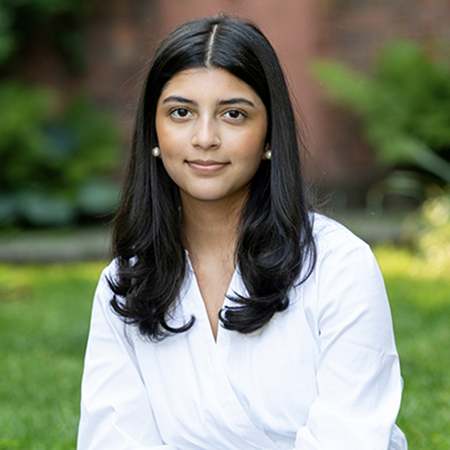
Meera Mehta, founder of Novel Futures, is addressing the post-pandemic drop in literacy of New Jersey school children through access to books and writing resources.
Tell us about your volunteer role with Novel Futures.
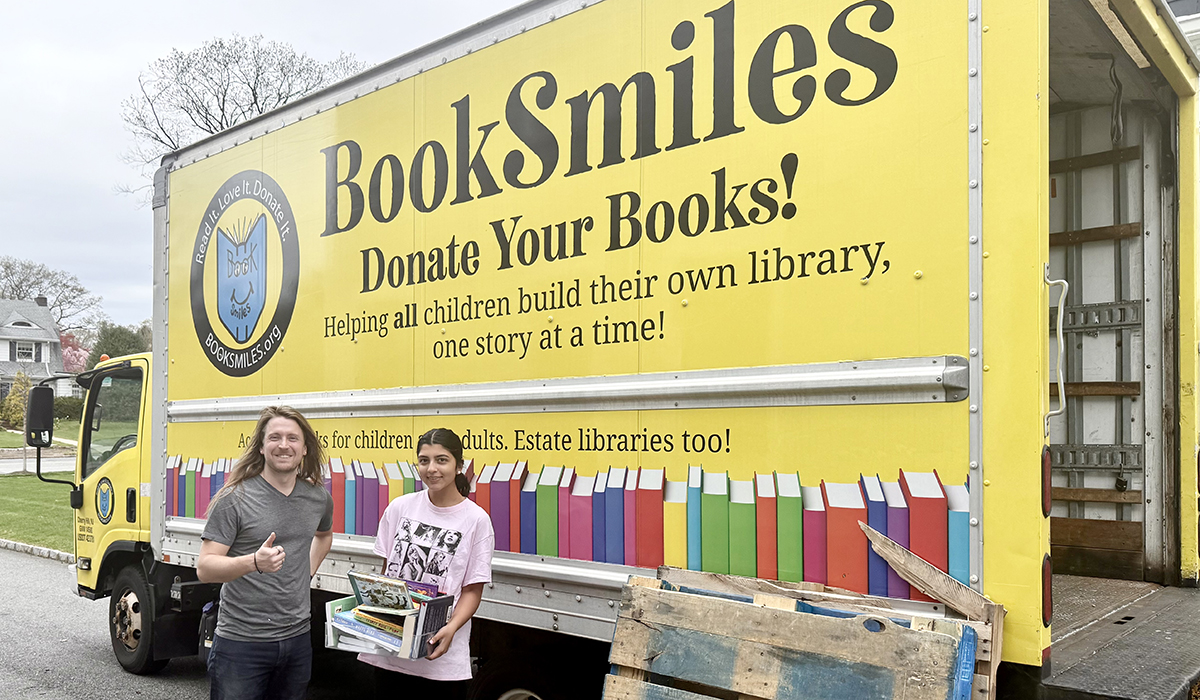
It started as a small book drive, but it became something bigger. I created Novel Futures with the initial idea of simply collecting and donating books. Our first and biggest partner has been BookSmiles, which distributes books we collect to schools and learning centers across the state. They’ve helped us scale our impact and put books into the hands of children who need them most.
We’ve also expanded more locally. I partnered with the Montclair Human Needs Pantry and Childhood Development Center, so more kids in our local community can access books they want to read. So far, we’ve collected and distributed over 60,000, but I’m aiming for 100,000 by the end of senior year. I coordinate volunteer teams, oversee book drives and manage year-round distribution systems.
As things grew, I developed online literacy tools to reach kids who might not have easy access to in-person programs. I created a diverse BookFinder tool on our website, which is a curated database organized by categories like ethnicity, gender and other themes to help kids and parents discover relatable books that reflect different identities and lived experiences. It can also filter for things like picture books or middle school books and is used year-round by families, teachers and partner organizations.
I started hosting free writing workshops to help kids build skills and write their first stories at my local library, school and even in partnership with Girl Scout troops. One of my favorite parts has been developing Story Explorers, a free downloadable workbook for kids to practice creative writing and build confidence on their own.
I’m also going to be a keynote speaker at Make a Difference Day this spring. In the past few years, I’ve gone to local elementary schools to talk about literacy equity and reading.
What’s been the most rewarding part of your work?
The first is seeing kids get books when they might not have any at home. Last year, I went to the Montclair Childhood Development Center to do a book drive, and each kid got to take one home. They all seemed so excited to start their own home library.
I also love doing workshops and watching kids develop their voices through writing. Some kids come in not knowing what to write or are intimidated, but by the end of one or two workshops, they’re able to get a better grasp on it.
What have you learned through your experiences as a volunteer?
Making a difference can start off as a really small project, but it can grow if you want it to. I started it with a single book drive, and as I saw the impact, I realized I could expand.
Tell us about future partnerships, programs or events that you are excited about.
I have another workshop scheduled with a Girl Scout troop coming, and as senior year frees up in the spring, I’m going to be reaching out to more partners to see how much I can expand before I leave.
Any advice for people who want to start volunteering?
Start small. I’m lucky, because now people ask me if they can drop off donations. A lot of people in my community have little kids who outgrow specific books, so they’re always looking for places to give them. There is less need to solicit donations.
What do you want people to learn from your story?
It’s important to have a passion or to find something in the community you care about, because if you’re able to make a difference, you should. If you’re interested in the environment, go pick up trash at a park. Not only does it benefit others around you, but you learn a lot about yourself. It makes you more aware as a person.