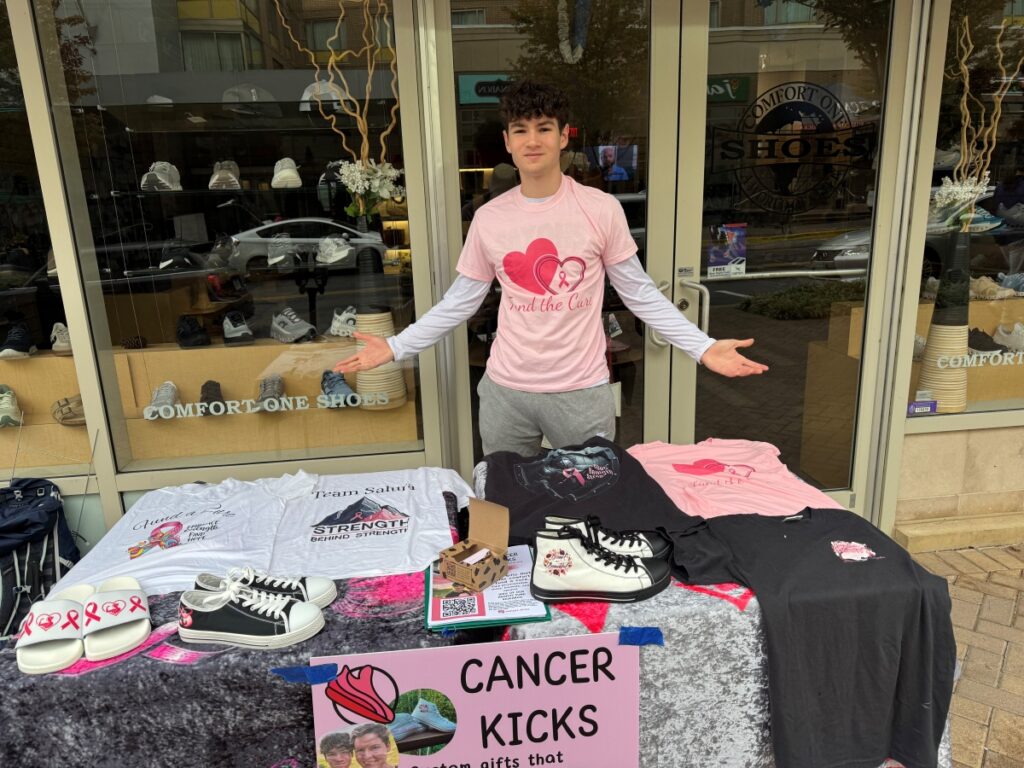
OWEN SINGER WORKS A TABLE OF CANCER KICKS MERCHANDISE AT A LOCAL BREAST CANCER AWARENESS WALK. /COURTESY OWEN SINGER
MeetDaily Point of Light Awardhonoree Owen Singer. Read her story, and nominatean outstanding volunteer or family as a Daily Point of Light.
Owen Singer credits breast cancer research for saving his mother’s life, and that’s why he’s doing everything he can to raise funds for it. When Owen was in eighth grade, he was faced with seeing his mother undergo cancer treatment again. By the end of the summer, when he was heading off to high school, he made his vision to fund breast cancer research a reality. He formally established Cancer Kicks, an organization that supports breast cancer research while providing comfort to those in treatment. With a catalog of more than 90 customizable products, including shoes, blankets, and apparel, every cent raised through selling Cancer Kicks’ fun merchandise is donated to the Breast Cancer Research Foundation. Thus far, he has sold more than 600 items and donated over $10,000 to the BCRF, funding more than 15 full days of cancer research.
When it comes to running the day-to-day of Cancer Kicks, Owen is doing it all. He handles everything from website development and product design to marketing and customer service. This totals about eight to 10 hours per week, which is no simple task on top of his busy high school course load. Despite the challenges, Owen is determined to keep going on the path to funding research. In fact, Owen’s experience running his own business that donates its profits to charity has directly informed his future. Now a senior in high school, Owen is planning on heading off to college next year and studying business. The knowledge he has gained running Cancer Kicks has instilled in him a variety of managerial skills, ranging from creative thinking to problem-solving, that will directly serve him in his career path. Owen’s dedication to volunteerism may have been inspired by his mother’s cancer battle, but it’s also a key part of the future he’s building for himself.
What inspired you to get started with this initiative?
My mom was diagnosed with breast cancer again when I was in eighth grade. Then she went through a mastectomy and also had to go through chemo. I watched her lean on small things to get through it, whether it was cold caps that helped keep her hair, heated blankets, or dyeing her hair pink and wearing pink Converse sneakers. It was her way of taking control of something out of her control, and that really stuck with me. I wanted to do something to turn it into something to help others and fund breast cancer research. That was how Cancer Kicks got started. I saw what she was using, and I was like, I can put the money towards a good cause instead of what I had already seen in the market, which is mostly people designing stuff to make a profit.
What inspires you to volunteer?
In terms of Cancer Kicks, breast cancer research is what saved my mom’s life. So I mean, that’s kind of my inspiration.
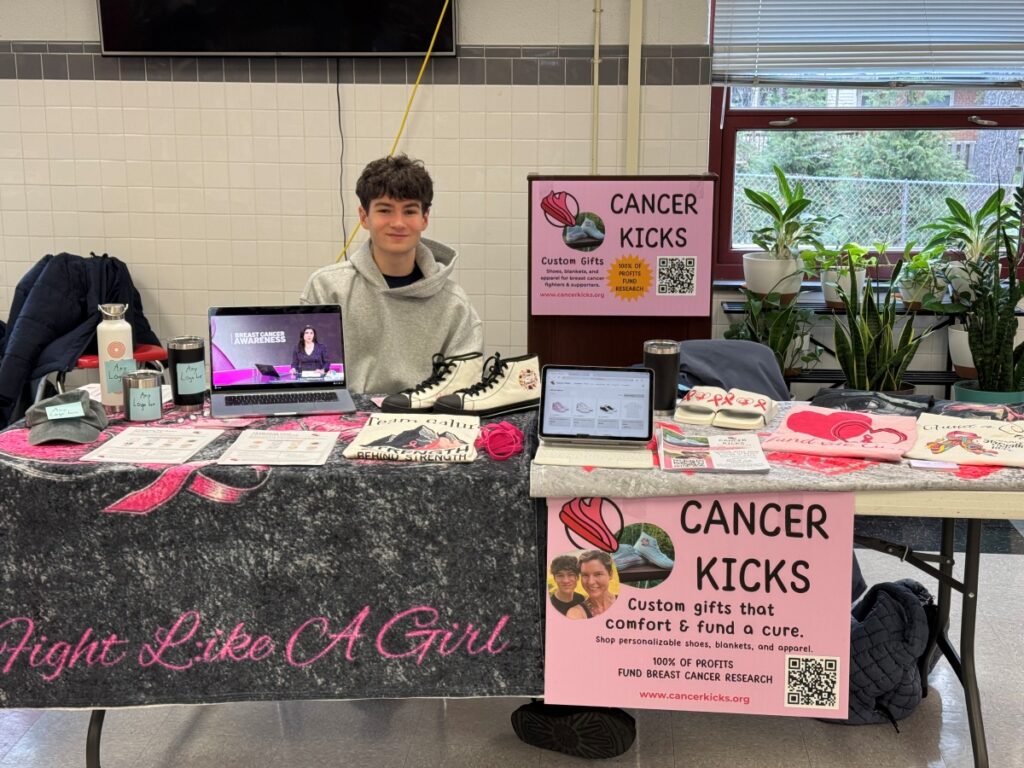
OWEN SINGER REPRESENTS CANCER KICKS AT A LOCAL HIGH SCHOOL’S HOLIDAY FAIR. /COURTESY OWEN SINGER
Tell us about your volunteer role with Cancer Kicks.
I’m the founder and the only member, so I do everything. We sell pretty much anything from hoodies and shoes to blankets and accessories. It’s all customizable. I run every part of it. I design the products, manage the website and the store, reach out to companies and organizations for potential partnerships, and handle customer and corporate orders. It’s continued to grow and grow. All the money goes directly to the Breast Cancer Research Foundation.
What’s been the most rewarding part of your work?
There’s the feeling of helping others. There’s also the closeness that has brought my mom and me together. It’s also hearing from people who’ve bought something and telling me what it meant to them. For example, someone who bought it for their wife who was going through treatment; she completely loved it and wore the blanket to every single chemo appointment. Every time I get a sale, or every time some sort of profit is made, it’s knowing the money went to a good cause.
What have you learned through your experiences as a volunteer?
I’ve kind of learned how to run a business. Not just having the idea, because I’m sure I’ve had plenty of charitable ideas. But I’ve learned how to build a website, manage the whole supply chain, and everything from shipping stuff directly to consumers to handling when things don’t go right. It’s through this whole experience, not just through Cancer Kicks, that I also learned more about stepping up. While my mom was in treatment, I had to step up on my own, whether it was just arranging my rides to basketball practice via my friends’ parents. That kind of carried over to how I run Cancer Kicks.
Why is it important for others to get involved with causes they care about?
I think everyone’s had something that’s touched them personally. You don’t need to be an adult. I think I was either 14 or 15 when I started this. I didn’t need to be an adult to do anything. I had help with some of the legal side, but you don’t really need to have a ton of resources to make a difference. I started with a product idea, and honestly, I don’t put a ton of money into it, and it’s turned into something that’s donated over $10,000 to breast cancer research. The small steps add up faster than people might think.
Any advice for people who want to start volunteering?
Start with something personal. Being personal to you definitely helps with both motivation and the cause. Be prepared to do everything yourself. It depends on your product, but for me, I did all the designing, marketing, outreach, and the legal stuff. I didn’t wait until I had a team. It started with an idea and just expanded from there. One more thing I would say is don’t be afraid to ask people, whether it’s for them to eventually buy a product or a partnership. The worst case is they can say no, and like a lot of people do end up saying yes.
What do you want people to learn from your story?
I would say that you can turn something bad that’s happened in your life around.
You’re able to make a bigger difference than you might think, no matter what your age might be. You can make a difference doing anything, really.
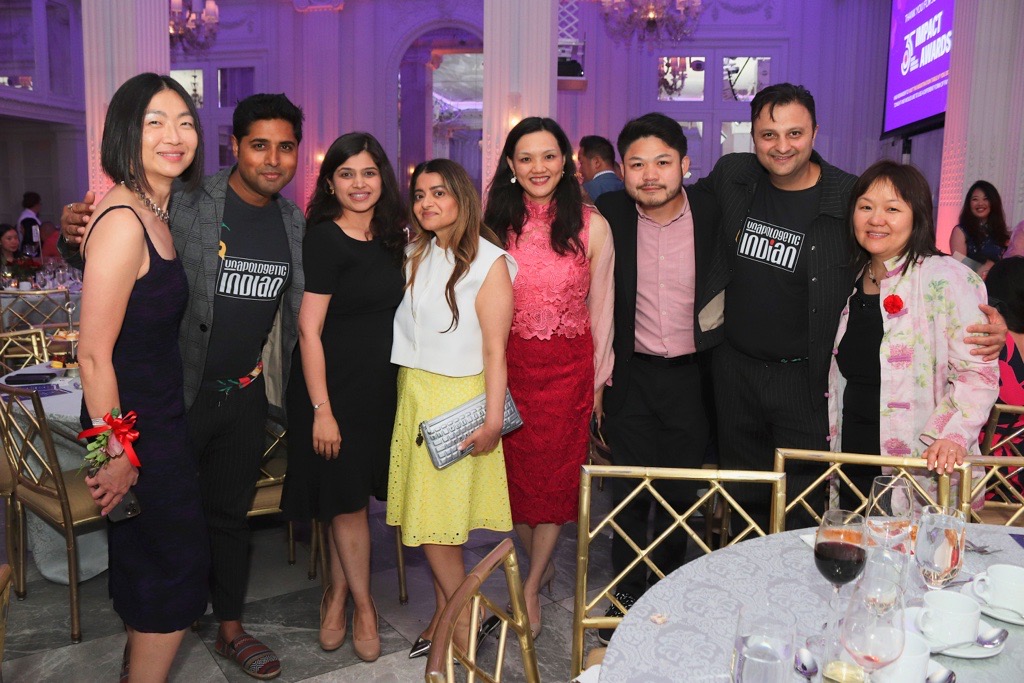
JEAN SIAO (LEFT) STANDS WITH HONOREES AT THE ASIAN AMERICAN FEDERATION’S GALA. /COURTESY JEAN SIAO
MeetDaily Point of Light Awardhonoree Jean Siao. Read her story, and nominatean outstanding volunteer or family as a Daily Point of Light.
Jean Siao wants AAPI New Yorkers to have every opportunity to succeed in their city, and she’s doing whatever she can to make it happen. As the Board Secretary of the Asian American Federation, an organization whose mission is centered on amplifying the influence and enhancing the well-being of the pan-Asian American community, Jean guides the CEO on goals and budgets, advises on strategy, and fundraises year-round, especially for the Impact Awards gala. Pulling from the detail-oriented nature of her professional career as a scientist, she diligently prepares for the monthly Executive Committee meetings and quarterly board meetings, where she’s responsible for tracking tasks for the board committees, compiling meeting notes, and serving as a source of support for the Board Chair and CEO on organizational strategy, particularly in areas of research and data collection.
She also works to cultivate an active donor base, channeling funds into the organization so they can help to strengthen small businesses and direct service nonprofits, aid owners in navigating compliance and digital marketing, and turn data into insights that inform policymakers. During her time with the organization, Jean’s diverse accomplishments have included working on the federation’s Hope Against Hate campaign, which provides safety tools and advocates with government while aiding victims of anti-Asian bias. She’s also launched a Mental Health Awareness initiative and built the first local map of in-language providers, helping to advance civic knowledge and rights.
Looking forward, Jean hopes to continue being an active participant in crafting the future of the organization. They just hired a new associate director, and she’d love to be more hands-on with this person and craft the future direction of the research arm. Of course, she’s planning to continue fundraising and seeking out additional board members who can advocate for the organization. Jean believes there is plenty of work to be done ahead of her, and she’s eager to channel her passion for volunteer work into bettering her community.
What inspired you to get started with this initiative?
I went to an event with some work colleagues and met someone at this event, and she turned out to be the chair of the board of directors at the Asian American Federation. We started talking about current events in 2017, and we talked about what we cared about in terms of socioeconomic situations in the country. Then, I went to a couple of galas, which are fundraising events for the Asian American Federation, and I was blown away by the passion and the enthusiasm from both staff and the board of directors. I was inspired to join them.
What inspires you to volunteer?
I’ve always liked the idea of volunteering, but never really had time. I would instead donate money, especially once I started working after school. But I felt at the time that I really wanted to do more for my community and to do more to amplify our voice in the community where we live. Also, as a scientist, I’m very passionate about data. The federation actually has an arm of the organization that’s dedicated to collecting and analyzing data and then publishing reports on it. That, plus the fact that I wanted to do something for the community, made me decide I wanted to devote the time to this. Initially, it was four board meetings a year, so it wasn’t really tough. Once I joined the executive committee as secretary, that took that started to take more time.
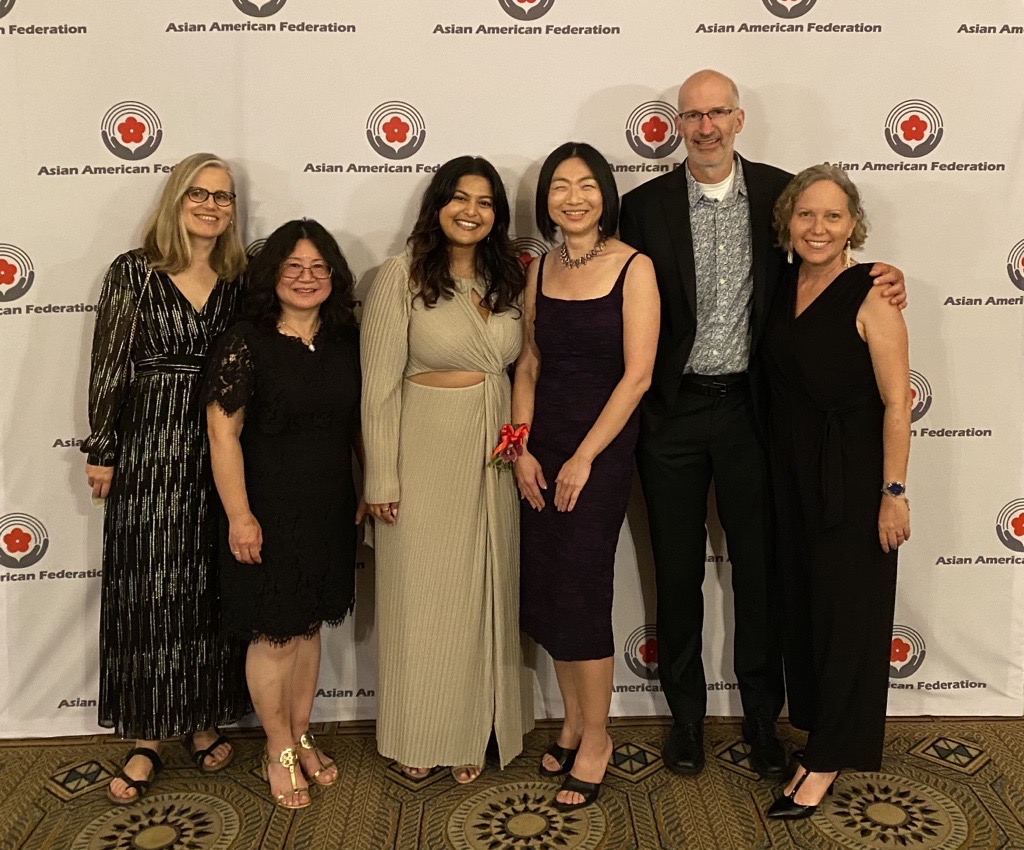
EAN SIAO (CENTER) STANDS WITH HER WORK COLLEAGUES, WHOM SHE INVITED TO JOIN HER AT THE IMPACT AWARDS TO CELEBRATE THE FEDERATION. /COURTESY JEAN SIAO
Tell us about your volunteer role with the Asian American Federation.
It’s a lot of meetings. It’s great because we get to really talk about the ongoing activities, celebrate the successes, and plan for the future of the federation. Big-picture-wise, it very much feels like I’m making a difference both to current goings-on as well as helping to plan the future direction of the organization. Practically speaking, most of it is trying to get other board members to take action. It’s really joining in whenever I can with ideas or suggestions or taking on actions that we end up discussing. Then the other part of what I do is actually fundraising. We have one fundraising gala a year, and we also do regular fundraising events throughout the year. I talk with folks that I know or organizations or groups that I know to see whether or not I could drum up funding for the organization.
What’s been the most rewarding part of your work?
Interacting with the hardworking and very passionate staff. The federation has member agencies and partner organizations in the community, and so I also get to meet the staff and some of the community members that they serve. The federation ourselves aren’t always making contact or connecting with individuals in the community, so it’s really impactful when I get to meet the people that we serve and the staff that is out there day to day doing the hard work.
What have you learned through your experiences as a volunteer?
I’ve learned that volunteering is hard, but making and maintaining those connections that I have started is really important for any initiative, whether it’s networking for work, networking for fundraising, or other goals. Maintaining those relationships is really important. I’m constantly making outreach and reinitiating contact just to say hello.
Why is it important for others to get involved with causes they care about?
I think It’s because it’s really satisfying to be working on something. Giving dollars is really nice if you can do it, because it’s also satisfying in a way. There’s a concrete, tangible goal for giving that money, but giving time is probably even more impactful for me, partly because we don’t have that much time, so every minute does count. Also that it’s just an additional point of satisfaction that I’m doing something that makes a difference. It’s something that I care about, and it’s goals and people that I care about. It just makes that much more important for me to do.
Any advice for people who want to start volunteering?
Sign up for something that they do care about. Figure out if it’s food insecurity, combating poverty, or education. Whatever it is they care about, find that first volunteering effort. That very first touchpoint establishes that contact, and it should only take a couple of hours, but it’s so worth it. Hopefully that’ll get them going to do more and more and more.
What do you want people to learn from your story?
Volunteering can take on so many facets. There are so many ways that we can contribute to the community. It’s whatever I could give at the time. When I was still in school and I couldn’t afford to contribute financially, I would give $10 to the food pantry, or I would volunteer a couple of hours on the weekend repacking food. But once I was able to make that financial contribution, that is what I ended up doing. What I want folks to know is what I’ve learned, which is that whatever way I could help others is the most impactful way. It really doesn’t matter what that looks like or how much that is. It’s what I can give at that moment.
Doing It Scared: Young Leader Builds Community Through Culture
Justin’s advice for anyone on the fence about volunteering is to do it scared, and start as early as you can.
Meet Daily Point of Light Award honoree Justin Cai. Read his story, andnominate an outstanding volunteer or family as a Daily Point of Light.
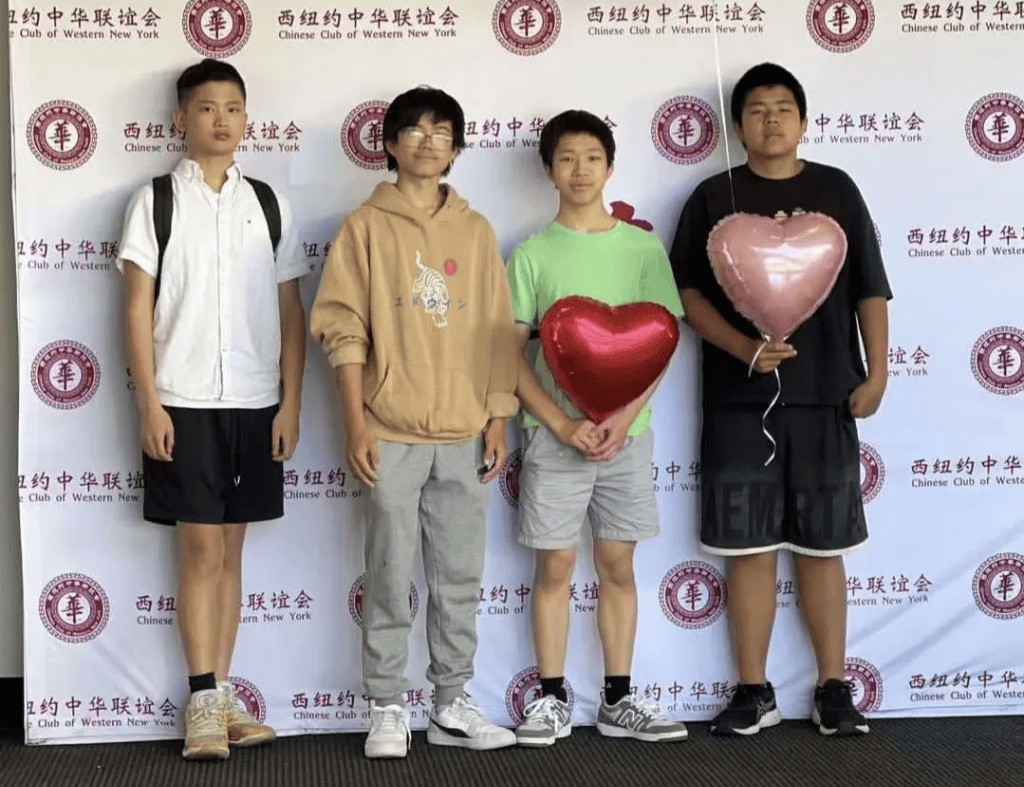
When Justin Cai joined the Chinese Youth Club of Western New York (CYC) as a sophomore, he wanted to do more than show up to volunteer events… he wanted to create them. Starting as Secretary, then Vice President, and now President, he has spent years building opportunities for local youth to lead, serve, and celebrate Chinese culture across Western New York.
Today, Justin oversees CYC’s student officers, coordinates events, and manages the planning and supplies that keep the organization running. His signature project, the club’s annual Easter Egg Hunt, drew more than 40 families and gave away over 500 eggs, filling a neighborhood with the sound of kids racing to fill their baskets. For Justin, that scene captured why the work matters. Seeing the joy on those children’s faces, he says, made him feel like he was genuinely benefiting his community.
Leading has also taught him to trust his team, listen to their ideas, and let others take ownership. He encourages anyone thinking about service to start small, start early, and “do it scared.” Any idea, he believes, can grow into something meaningful for the people around you.
Meet Daily Point of Light Award honoree Shannon Apgar. Read her story, andnominate an outstanding volunteer or family as a Daily Point of Light.
Shannon Apgar has spent her Thursday evenings over the past year at Covenant House Alaska, where anywhere from five to 15 young people gather each week to cook something they can eat, enjoy, and learn to make on their own. With a background in public health, Shannon designed her cooking class to build the confidence and independent-living skills that help youth experiencing homelessness thrive.
Shannon turns simple, approachable meals like breakfast casserole, fried rice, and taco salad into lessons that the young people can take with them for years to come. She also opens the art room as a safe creative space for drawing, painting, and fiber arts, and meets youth wherever they are, whether that’s a room full of energy or one person who simply wants quiet company.
Across more than 100 hours, Shannon has built meaningful connections with over 50 young people. These relationships, she says, have become the most rewarding part of her work. She’s quick to redirect the credit, describing the resilience and patience of the youth as her own source of inspiration. Shannon believes that when we look around your community and find something that bothers you, you’ll know exactly where to start in your volunteer efforts.
THIS VOLUNTEER HELPS OTHERS FIND FINANCIAL STABILITY
MeetDaily Point of Light Awardhonoree Kevin Patterson. Read his story, and nominatean outstanding volunteer or family as a Daily Point of Light.
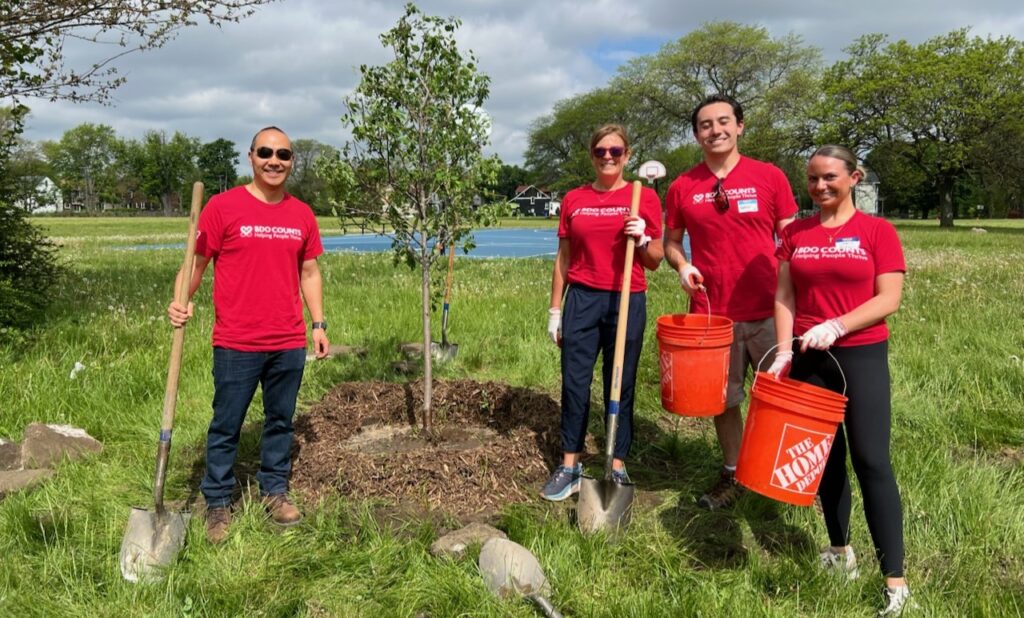
KEVIN PATTERSON (LEFT) HOLDS A SHOVEL ALONGSIDE COLLEAGUES DURING A VOLUNTEER DAY. /COURTESY KEVIN PATTERSON
Kevin Patterson knows how much a little help can change your life. That’s why he’s helping others find a pathway to financial stability. After being adopted from South Korea at five months old, Kevin was raised in a working-class family where luxuries were minimal. While he ultimately forged a successful career in accounting, he never forgot what it felt like to struggle to get by. A few years back, Kevin was looking for a volunteer opportunity that allowed him to use his expertise for good. He had no idea how much influence it would have.
Kevin volunteers with the Michigan CPAs (MICPA), Wayne State University School of Accounting, and the Accounting Aid Society, where he’s on the Board of Directors. The AAS prepares income tax returns for low-income Metro Detroit families that are not able to afford preparation assistance. The experience has been a profound one for Kevin, who has seen people cry because they’re getting an unexpected $1000 tax refund. The refunds also serve as an investment in Detroit, since around $30 million in tax refunds come back into the Metro Detroit area, as recipients tend to spend the money in their own communities. In his job on the board, Kevin helps to come up with locations that they should have open and the number of volunteers that should be involved with preparing the 1040s. As a member of AAS’ Audit Committee, Kevin ensures the organization’s financials are sound and healthy, allowing them to continue to serve their community.
Kevin’s story is one about lifting others up through volunteerism. Ultimately, Kevin said the message that he’d like to carry is that changing your situation is possible through hard work and determination. But when people don’t have the resources that he now has, Kevin will be there to help them keep going. His willingness to channel his professional skills into a thriving role as a volunteer shows just how much people can do with their talents to serve others.
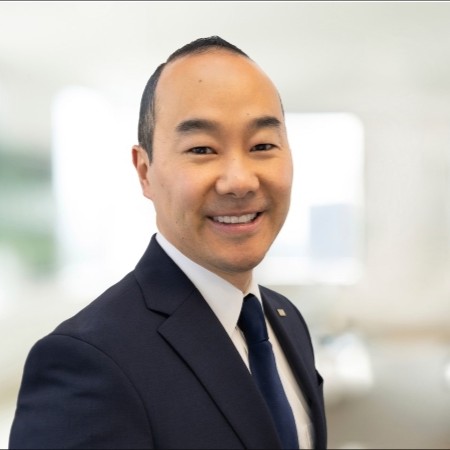
[Patterson]: KEVIN PATTERSON VOLUNTEERS WITH THE ACCOUNTING AID SOCIETY, WHERE HE’S ON THE BOARD OF DIRECTORS. /COURTESY KEVIN PATTERSON
What inspired you to get started with this initiative?
I’ve been involved with boards since I made partner in 2017. The Accounting Aid Society does free 1040 tax return preparation for families that make under a certain amount each year. So it can include students, lower-income individuals, and families that might be more working-class. It’s really cool to see because a lot of the work we do impacts Metro Detroit, since many of these individuals might not file their taxes if they don’t get them for free. They actually get refunds, and the number of tax returns we do, plus the amount of refunds that come back into Detroit, are pretty substantial.
What inspires you to volunteer?
I have very humble roots. I was adopted from South Korea when I was five months old, but I literally came here with nothing. My parents who adopted me were very working class. They were wonderful parents, but they didn’t have a lot of financial means. I’ve always looked at this as now that I’m in a position where I have a lot more financial resources, time, and talent, Accounting Aid Society helping lower-income families do 1040s. I think it is obviously aligned with my passion. It’s all aligned with where I’ve gotten to.
Tell us about your volunteer role with the Accounting Aid Society.
I am on the board of directors. We set the vision for where the Accounting Aid Society should go. We come up with the locations that they should have open, and the number of volunteers that should be involved with preparing the 1040s. It’s really driven by the fact that if we don’t get the volunteers, then we can’t prepare anything. I think it’s about $30 million in refunds that come back into the Metro Detroit area, because we do surrounding counties.
What are your long-term plans or goals for the organization?
For Accounting Aid Society, I just finished my first three-year term, and they asked me to renew for another three years. So I’m going to stay on for probably another three years from now. Then at some point, they’re probably going to want me to be in a higher-level role.
What’s been the most rewarding part of your work?
Helping people that I can see dealing with similar things that I dealt with growing up. Not having a lot of means, not having a lot of resources, and not really even knowing what is available to people. For me, it’s cool to see people who come from more humble beginnings, like myself, also start to make it. They’re taking that refund and putting it into more education, or maybe they’re just going to try to pay for things that are needed for the household in order to move it forward. That’s really cool to me.
What have you learned through your experiences as a volunteer?
That everybody is just trying to do their best with what they have. I also look at it like there are volunteers that I’ve worked with who have worked really hard to get really good at what they do from a volunteer perspective, and they’re making big impacts. Everybody seems like they’re trying to find their path, and that’s the beauty of volunteer work. You diversify your perspective on the world. It makes me appreciate more of what I have, but it also makes me realize that getting to where I am is possible.
Why is it important for others to get involved with causes they care about?
If you’re doing something that you have passion for from a volunteer perspective, it doesn’t necessarily feel like it’s work. If I ask somebody to do something and they don’t have any interest in the organization, they’re not going to do it long-term. They’re definitely not going to like it. Likely, they have to have passion for the mission. It’s really cool to see people find what they love, but you can’t really do that unless you try different things. I really like when people volunteer for things that are somewhat associated with their passions, and then see the passion grow even greater.
Any advice for people who want to start volunteering?
Back in 2014, I had no board experience. I was on no committees. I didn’t really know the nonprofit world or the volunteer world. I talked to my wife about it, and she and I agreed that I should find people who were doing things for different organizations that I’d be involved with. I told the guy I targeted that I was interested in getting involved at some point, if he ever needed somebody to help out. He got me on a committee and then eventually I took his board spot. It just kind of snowballed, but it really did take that first one.
What do you want people to learn from your story?
Probably the concept that anybody could make it and then help others. I don’t necessarily think I’m better than anybody else, but I definitely stay very positive, work hard, and just really try to figure out how to navigate both professional and personal avenues.
Planting Seeds to Help Youth Win, Against All Odds
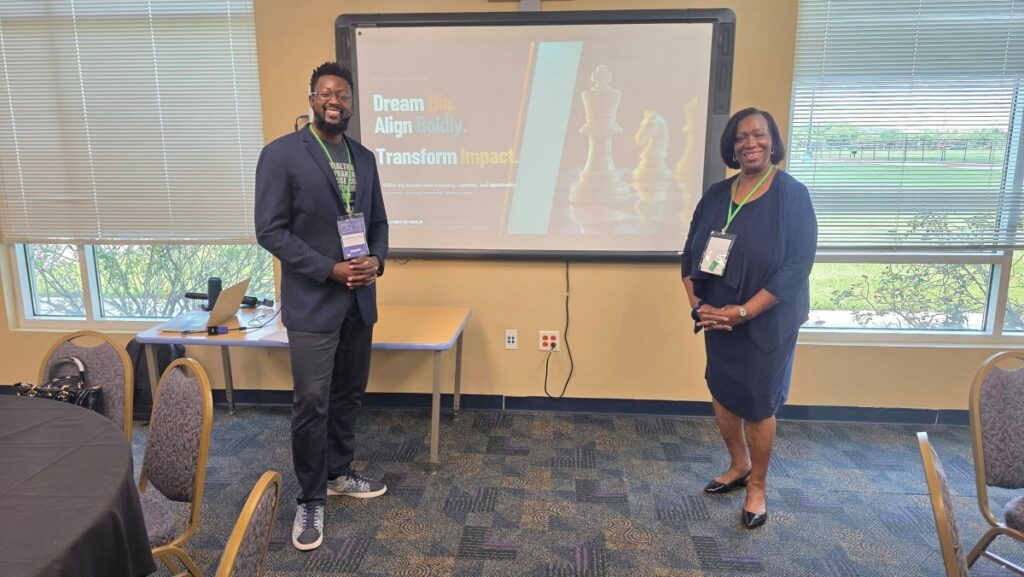
Karen has spent more than three decades opening doors of opportunity for young people who just need someone to believe in them.
Meet Daily Point of Light Award honoree Karen Levingston-Franklin. Read her story, andnominate an outstanding volunteer or family as a Daily Point of Light.
For more than 36 years, Karen Levingston-Franklin has shown up consistently, purposefully, and without pay, for young people who simply need someone to believe in them. As the volunteer CEO of the World Youth Foundation, she has helped grow a grassroots vision into an organization that has served over 85,000 youth and families, equipping underserved young people with digital skills, leadership development, character-building, and career pathways that prepare them to win in life against all odds.
Devoting 80 to 100 hours each month, often during evenings and weekends, Karen mentors students, cultivates community partnerships, and connects families with resources that too often fall through the cracks. Her greatest reward is watching the young people she serves grow into bold, successful adults — entrepreneurs, professionals, and community leaders who return to plant seeds for the next generation.
Karen believes that service is a two-way exchange that can shape a volunteer’s life. Her advice for anyone wanting to give volunteering a try? Start where you are, find a cause that connects with your heart, and let compassion become consistent action.
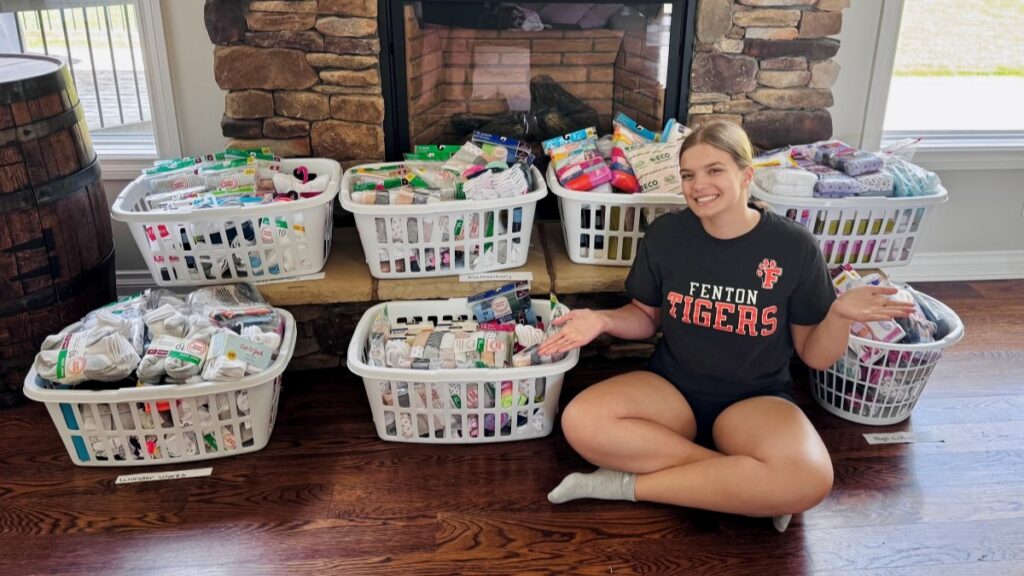
Eliana Galgoci, Founder of the NextGen Kindness Foundation, sorts items for donation to her school district as part of a dignity drive.
MeetDaily Point of Light AwardhonoreeEliana Galgoci. Readher story, and nominatean outstanding volunteer or family as a Daily Point of Light.
Born to a family of volunteers, Eliana Galgoci started helping others at a very young age. Participating was built into the culture around her. It was only natural that she eventually wanted to expand that culture to include her peers. So, last November, at 14 years old, Eliana started NextGen Kindness Foundation, establishing clubs at both her local high school and middle school.
Her goal was—and is—to engage her peers in helping other young people. In short, she creates opportunities for kids to help kids and foster a culture of volunteering. Each month, after discussing community needs with local schools and nonprofit leaders, Eliana organizes a donation drive to benefit young people. The organization has collected and distributed over $20,000 worth of clothing and donated $10,000 in funds among other things. Eliana averages 20 hours each week in her role alongside 65+ volunteers, and will join the board of directors when she turns 16 in December.
What inspired you to get started with this initiative?
I started volunteering when I was four years old, making blankets for children in local hospitals. My mom was part of the Junior League for a very long time. My experience and watching her help so many people inspired me to do more and involve my peers as well. Volunteering runs in my family. My Grandma Dee and Papa Wendell both volunteered as EMS drivers and delivered Meals on Wheels for decades.
I believe it’s important to start getting involved at an early age and to have school programs that support empathy and teamwork to help the community. It should be normalized. We’re so much stronger when we’re united in working toward a common goal: to help each other.
Tell us about your volunteer role with NextGen Kindness Foundation.
I’m the Co-Founder of NextGen Kindness, and I manage the club at my high school. During the school year and through the summer, we come up with one thing to do every month—usually drives. We’ve done the Dignity Project, collecting hygiene care and personal items. We’ve gathered back-to-school support for local schools. And in the winter, we’ve collected winter coats and blankets for children. We’ve also done Letters of Love, writing letters to people in the hospital.
We meet twice a month to come up with ideas, and I reach out to local schools and nonprofits to discern what people in our community need at that moment. I also design social media campaigns and solicit donations to fund our initiatives. We receive funding from family and friends, local businesses, auction item donations, and local grants.
What are your long-term plans or goals for the organization?
I would love to see NextGen Kindness clubs in different schools from elementary- through college-level. I want to open chapters all over the country and beyond. I truly believe that if we give youth the tools and motivation to support their peers, we can create a global network of empathy.
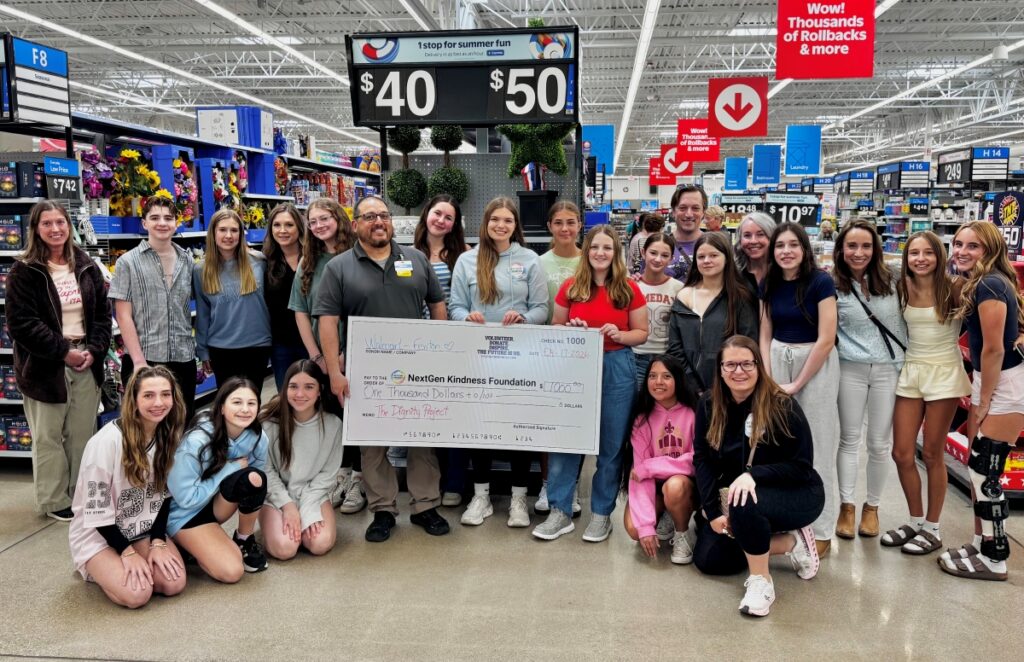
Eliana (center) and other NextGen Kindness Club members receive a grant from the local Walmart.
How has it affected your peers who volunteer?
I see a lot more people my age helping each other out, as well as helping those younger than them. I think doing these projects with us has started a ripple effect. I’m seeing a lot more people interested.
What’s been the most rewarding part of your work?
I love seeing acts of giving firsthand through our drives, but nothing compares to the feeling of knowing that our work can help people with their everyday lives. When we hand a peer a winter coat or make sure a middle schooler has the exact supplies they need for class, we can see the immediate relief on their face. It reminds me of exactly why we started NextGen Kindness.
What have you learned through your experiences as a volunteer?
When we work together and share a passion for helping people, the possibilities are endless. You realize very quickly that you can help so many more people as a team than you could ever help alone. I’ve also learned that kindness has a massive ripple effect, like I said before. You don’t have to change the whole world by yourself. You can spark passion in others, and together, you can grow the impact.
Tell us about future partnerships, programs, or events that you are excited about.
I’m looking forward to the back-to-school drive that we’re doing. We’re helping the middle and high school with school supplies, because while there’s a lot of help with the elementary school, there are not a lot of people who donate things like backpacks, pencils, binders, and folders for older students. And the older you get, the more expensive supplies are. It’s important to help kids my age with that.
Why is it important for others to get involved with causes they care about?
Not only are you helping someone else, but it can be good for your mental health. It can relieve stress and make you happier and feel needed.
Any advice for people who want to start volunteering?
Try a few different organizations—animal shelters, food banks, environmental organizations—before you commit to one. See what speaks to you. When you find the one you feel most connected to, volunteering won’t feel like work. It’ll be something you can’t wait to do.
What do you want people to learn from your story?
You’re never too young to volunteer. Helping people is important. A lot of people in high school volunteer for credits or hours, and I think it’s more important for kids to realize that even though you might not be changing the whole world, you’re helping someone, and that’s far more important.
How a Fundraiser Turned into 300,000+ Pounds of Rescued Food
Meet Daily Point of Light Award honoree Dhevesh Mahes. Read his story, andnominate an outstanding volunteer or family as a Daily Point of Light.
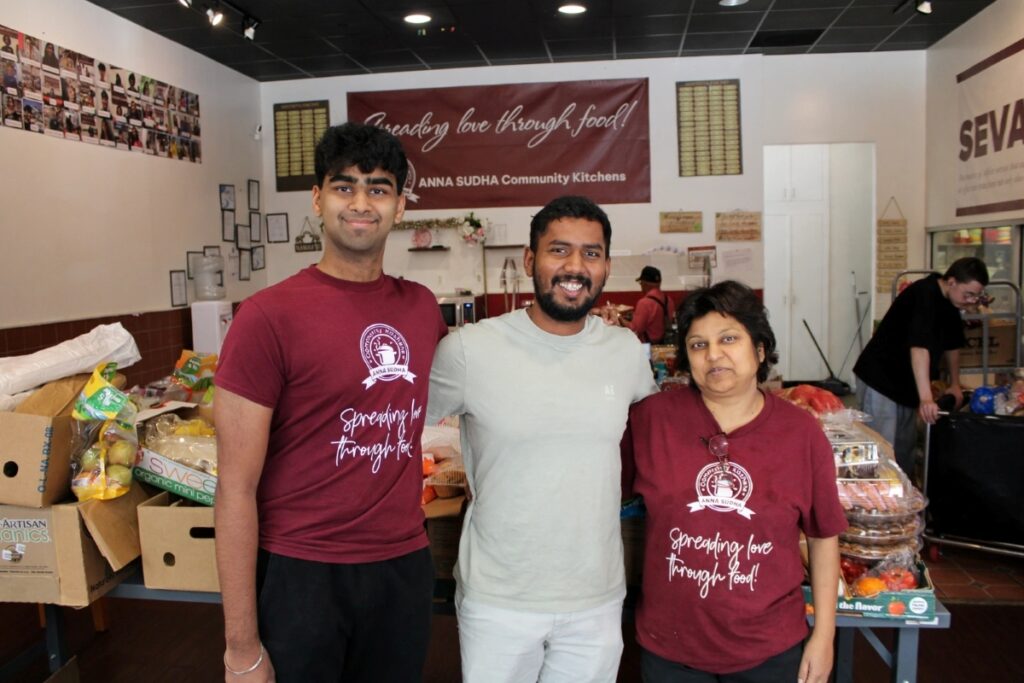
When Dhevesh Mahes turned his love of desserts into a fundraiser two years ago, he had no idea it would grow to have the impact it has today. That first small act connected him with Anna Sudha Community Kitchens, and sparked the creation of Nourishin Ninjas, a youth team with the mission of fighting food insecurity across Northern Virginia.
Since then, Dhevesh has built something remarkable. He has created hands-on service opportunities for more than 150 young volunteers, helped the team recover over 300,000 pounds of food, and forged partnerships with 10+ businesses and community organizations. He works directly with school family liaisons to reach families facing transportation barriers, connecting them with groceries and hot meals, and has raised nearly $52,000 to sustain and expand the work. Now a Youth Advisor on Anna Sudha’s board, he’s proving that leadership has nothing to do with age.
Inspired by his grandfather, who helped people simply because it was the right thing to do, Dhevesh sees young people not as leaders of tomorrow, but as vital, participatory members of their communities today.
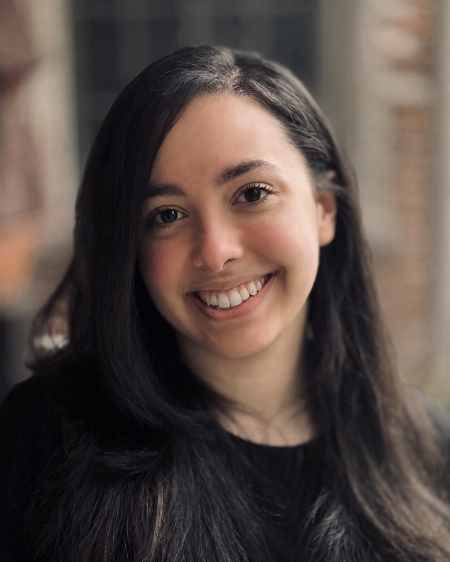
Meet Daily Point of Light Award honoree Noreen Hosny. Read her story, and nominate an outstanding volunteer or family as a Daily Point of Light.
Noreen Hosny’s background in molecular biology and visual arts might not be the most common combination you hear of, but she’s using those skills to change the world. Fascinated by art from a young age, Noreen was always intrigued by how graphic design can influence the way we process and understand information.
Noreen Hosny founded a pro bono educational design initiative focused on improving health literacy by making information easier to understand.
In 2019, she established a pro bono educational design initiative focused on improving health literacy by making health information easier for patients and families to understand. But it was during the COVID-19 pandemic that Noreen really started to make headway. In a period when organizations weren’t able to do the typical fundraising and live events that helped them function, Noreen stepped in to help.
She’s partnered with more than 30 clinics and nonprofits nationwide to create everything from information on hyperbaric oxygen therapy for veterans with traumatic brain injuries to cancer prevention materials for use in New Jersey free clinics. Noreen is now designing donor-facing materials and annual reports for organizations, giving them the power to successfully fundraise and make a bigger impact. Thus far, she’s saved these organizations more than $90,000 in design costs.
Looking forward, Noreen has a ton of projects in the works. She wants to teach others about graphic design, and she’d like to host more workshops where people can learn the skills. She’s already partnered with some local organizations and taught K -12 students how to make infographics. But there’s also one major endeavor in front of her: medical school. While Noreen always knew she had a sense for science and the arts, her ability to combine her skills to make an impact through volunteerism demonstrates an acute awareness of how one’s innate skills can make a difference. There’s no doubt she’ll continue this mission in her medical career, which has been vastly informed by her passion for serving others.
What inspired you to get started with this initiative?
I’ve always loved visual arts, drawing, and painting. I took a digital arts class in high school, thinking it would be something like Disney animation, and it ended up being more about graphic design. I really became fascinated by how graphic design can influence the way we process and understand information. I remembered how they carefully design things like subway signs in the city. It just made me so excited, and I really wanted to apply what I had learned.
I started the pro bono educational design initiative in 2019, shortly after I took that class, and I started working with local organizations in my town. When COVID hit, I found out that a lot of organizations couldn’t do any fundraising or events with educational outreach, so I decided to expand it nationally and support those organizations whose outreach had been disrupted.
What inspires you to volunteer?
My design initiative is focused on improving health literacy, so my goal is to make health information easier to understand. Health literacy is really important to me, and, drawing on my own experiences, I see how making health information accessible can directly shape how people understand their options and make decisions about their care. When information is too technical or confusing, it can actually become a barrier for people to access the care that they need. I really wanted to volunteer to help bridge that gap using my own skills.
Tell us about your volunteer role.
I have my website, and I usually get requests through that. I meet with organizations, and I really get to understand their needs and the community that they’re serving. Then, I start researching the relevant scientific or clinical information that they want to share. Throughout those weeks, I’ll develop a lot of drafts, and I’ll send them a lot of different options, and we go from there and keep refining until they’re happy with it. Typically, they’re used in the initial consultation and patient guides. The patients will understand the benefits and risks of a procedure, and if it’s more like a community organization, then it would be used in their educational sessions. Basically, it’s working with the organization for a very long time to really understand their needs.
What’s been the most rewarding part of your work?
Seeing the materials actually reach the people that they were created for. I spend a lot of time researching, designing, and revising. I think the most rewarding part is when the leader of the clinic or nonprofit calls me, and they tell me a patient is using this resource, they’re really able to understand their options, and we’re moving forward with screening or whatever. I think that’s the most important.
What have you learned through your experiences as a volunteer?
Education and teaching someone is not a one-size-fits-all thing. You really have to understand the community’s needs, what they already know, and what barriers they might be facing. I learned that you really have to get to know the person that you’re teaching or you’re working with. As a person who’s going into medicine, I feel that’s really important, especially with patient education, making sure people understand their options and how to make decisions about their health.
Why is it important for others to get involved with causes they care about?
It gives you a chance to connect with people and learn from their unique perspectives. It really gives you a chance to contribute to something you care about. It’s rewarding to have an impact and make a difference in people’s lives.
Any advice for people who want to start volunteering?
Do a lot of reflection. Reflect on what you’re passionate about, what your values are, and what your unique skills are. Think about how to help your community and what causes you care about, and start locally by seeing which organizations need support and how you can fit in and help with that cause.
What do you want people to learn from your story?
Everybody has their own unique skill set, and there’s always a way to contribute. With my graphic design skills, I’d say I really try to maximize how much I can help, and that’s a good lesson for people. You might not think a skill could help somebody, but if you really become creative and think of how that could make a difference in someone’s life, then that could really be the start of a greater initiative.
Meet Daily Point of Light Award honoree Dhiya Thirumurugan. Read her story, andnominate an outstanding volunteer or family as a Daily Point of Light.
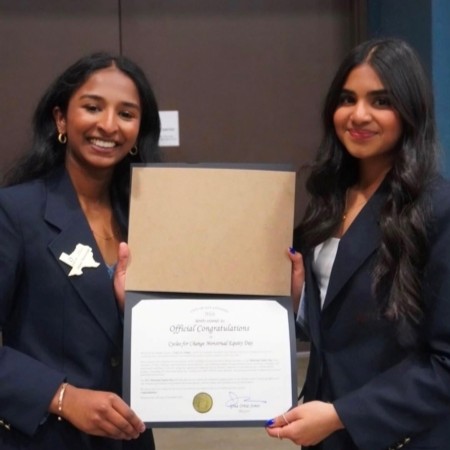
When Dhiya Thirumurugan was younger, periods were something she felt too shy to talk about or even to ask for help with. Noticing that menstrual products weren’t always available at school, she realized the barrier wasn’t only access; it was the stigma that made something completely normal feel like a secret. In 2023, she co-founded Cycles for Change, a youth-led nonprofit working to end period poverty and normalize conversations about menstruation.
Dhiya Thirumurugan turned her own discomfort talking about periods into a nonprofit focused on menstrual equity
Now 17, Dhiya serves as co-founder and CEO, leading student ambassadors, building partnerships, organizing product distributions, and driving the group’s fundraising, education, and advocacy. Cycles for Change has raised more than $10,000, directly supported over 5,000 women and girls, and reached more than 650,000 people through digital education and awareness. Dhiya has also helped put menstrual products into the hands of students across Texas public schools, so no one has to miss class for lack of hygiene essentials.
Volunteering, Dhiya says, taught her that impact starts with listening, and that you don’t have to wait until you’re older to make a difference.