Meet Daily Point of Light Award honoree Isabelle Enriques. Read her story, andnominate an outstanding volunteer or family as a Daily Point of Light.
When Isabelle Enriques founded She’s in Office in January 2025, she set out to do two things at once: end gender-based violence and put more women in political leadership. In under a year, the organization has grown into a global movement, partnering with more than 30 political campaigns, building a presence across 47 countries, growing a membership of over 2,000 women and girls, and reaching more than 5 million people through events and social media.
Founder and CEO of She’s in Office, Isabelle Enriques is building a global movement to elevate women in political leadership.
As CEO, Isabelle devotes roughly 100 hours a month to strategy, partnerships, and initiatives that give women and allies the tools to lead. She also champions menstrual equity, organizing large-scale drives that have raised more than 6,100 menstrual products for charities worldwide, and has collaborated with the United Nations on the organization’s projects.
Her work pairs empathy with systemic change, and it’s rooted in lived experience. As a childhood survivor of sexual assault, she has turned personal resolve into advocacy. For Isabelle, the community itself is the reward. She’s learned from women whose stories span countries and identities, and those friendships are her reason to keep going.
eet Daily Point of Light Award honoree Mia Fritsch-Anderson. Read her story, and nominate an outstanding volunteer or family as a Daily Point of Light.
Mia Fritsch-Anderson remembers what it’s like to be afraid to use her inhaler in front of other people as a child. Growing up, Mia would avoid using her inhaler at dance competitions or in gym class because the other kids would make fun of her. Now a college student, she’s helping kids and teens shake off the stigma of asthma.
In 2020, Mia read a study that said that fewer than 25% of kids take their medication in front of their peers, even if they’re having a life-threatening asthma attack. In that moment, she knew it was time to take action. She founded Choose to Breathe, which focuses on decreasing the stigma of asthma and increasing inhaler compliance in children and teens.
Choose to Breathe uses a three-point approach to destigmatize asthma. First, Mia creates fun inhaler covers, so people don’t feel they’re being looked at while taking their inhaler. Then, she creates educational content across social media platforms, knowing that focusing on digital is a great way to engage with kids and teens. Finally, she promotes a positive peer media campaign called #choosetobreathe, which pulls in followers and engagement. In 2020, she started with only 200 followers and a few videos. Since then, Choose to Breathe has produced over 500 educational videos, 40,000 followers, and millions of views across platforms. The organization also distributes thousands of inhaler covers across the world.
MIA FRITSCH-ANDERSON PACKAGES INHALER COVERS TO BE DISTRIBUTED THROUGH DIFFERENT PARTNERSHIP ORGANIZATIONS ALL OVER THE UNITED STATES. /COURTESY MIA FRITSCH-ANDERSON
Mia is currently in her senior year at Illinois Institute of Technology, where she’s studying mechanical engineering. While that’s a heavy workload while running her own organization, Mia feels the balance is important to her because she’s so passionate about the cause. In the future, she hopes to grow Choose to Breathe even more. She’s already partnered with some high-profile organizations and is working on some new partnerships right now. Her dedication to fighting the stigma of asthma shows that a personal connection to a cause can be the taproot that a thriving organization grows from.
What inspired you to get started with this initiative?
I grew up volunteering with a lot of different respiratory health organizations, specifically the Respiratory Health Association here in Chicago. I started volunteering with them when I was four, but I’ve been lobbying with them for a while. During COVID, I noticed that nobody was really doing anything about the stigma of asthma. A lot of people would make fun of me for taking my inhaler at dance competitions or even at school and gym class, and that was something that I really wanted to change. What really started it is when I read a study in 2020 that said that fewer than 25% of kids take their medication in front of their peers, even if they’re having a life-threatening asthma attack. I just thought that statistic was staggering, and it really encouraged me to start what I’ve been doing.
What inspires you to volunteer?
A lot of it comes from the fact that my parents took me to volunteer from a very young age, so I’m used to being around that. But also, I feel like it’s a really good way to be able to make change in the world, especially as a young person. I had a lot of people tell me growing up that I was never actually going to be able to make change, and that really inspired me to keep going.
Tell us about your volunteer role with Choose to Breathe.
A lot of the work that I do is on social media. Typically, it’s probably a video or a TikTok post. The reason that I work heavily on social media is that my main audience is kids and teens, and social media is a great way to reach them. I try to post something every single day, or at least three to four times a week. Besides that, a lot of the time I’m making inhaler covers. Inhaler covers are just things that go on your inhaler; they make it feel less like a radical device, make it a little bit more fun, and I donate them to organizations throughout the nation. I’ve been very busy making a lot of them, especially over the summer, to send out before heading back to school.
What’s been the most rewarding part of your work?
The most rewarding part is how the work that I’m doing makes someone feel more comfortable taking their inhaler. A lot of the time, I’ll have people reach out to me on social media with stories about how they feel more comfortable using their inhaler because they watched one of my videos. I’ve even had some school nurses reach out to me and tell me that they tell their students to watch my videos if they feel uncomfortable taking their inhaler.
What have you learned through your experiences as a volunteer?
It’s hard to pick just one thing that I’ve learned because there has been so much. I think one of the biggest things is that I’ve had the opportunity to be around a lot of other young people who are very passionate about what they’re doing and run different organizations. I was able to connect with other young women who are around the same age as me, doing very similar things, which is very exciting, and it keeps me motivated to see other young people doing these things. Not only for partnership purposes, but to learn from them. Because really, we can all learn from each other in this world and continue to grow together.
Why is it important for others to get involved with causes they care about?
I think a lot of the time people don’t think they can make a big change, but I promise you, we can. I know when I started this, I didn’t think it was going to be much, and now it’s a 501(c)(3) nonprofit organization. So I think it’s important to even get involved at a small level because you never really know what impact you’re going to have. Also, it’s very rewarding when you do get to have an impact.
Any advice for people who want to start volunteering?
Google and other available search engines are your friend. There are so many organizations out there. If you’re looking for a specific organization, you can pretty much Google the cause that you care about and look up an organization or volunteer work, and something will pop up. Especially on social media, a lot of these organizations now are on social media, and they’re advertising that they’re looking for volunteers. Just reaching out is a great way to get involved.
What do you want people to learn from your story?
I want people to learn that they should feel comfortable being who they are. I grew up being very scared to use my inhaler in front of others because of other people’s opinions on it, and that’s why it’s so important to me to be able to change the narrative of what having asthma is. A lot of that stigma isn’t true. Just because you have asthma doesn’t mean you’re weak, and I want people to be able to take that not only for things like asthma, but for other things, because there are so many things that also apply.
Meet Daily Point of Light Award honoree Liza Lowe. Read her story, and nominate an outstanding volunteer or family as a Daily Point of Light.
The COVID-19 pandemic revealed deep inequities between Los Angeles neighborhoods. A group of high schoolers decided to do something about it. And today, Liza Lowe serves as Chief Financial Officer of the organization they created, Level Up Los Angeles. This student-run nonprofit supports two under-resourced Title I elementary schools serving more than 400 students.
Over three years, Liza has personally raised more than $25,000 and helped grow the organization’s corporate partnerships from five to 12, beating a spring fundraising goal by over $82,000. But the numbers are only half the story. Nearly every week she’s on campus, coaching 5th graders on public speaking, designing after-school math and finance classes, leading a weekend beautification event, and even dressing as an elf to hand out holiday gifts to kids who might not otherwise receive any.
Level Up is what Liza calls “double impact:” the students it serves get funding and enrichment, while the high schoolers running it learn to fundraise, pitch, and lead. Having thrived in public school herself, Liza wants every child to feel that same spark. She believes there’s always a place for everyone in advocacy.
Meet Daily Point of Light Award honoree Michelle Ye. Read her story, and nominate an outstanding volunteer or family as a Daily Point of Light.
Points of Light is proud to share the following uplifting and inspiring story. However, we acknowledge that portions may be difficult for some readers. We encourage you to please care for your own wellbeing above all.
Seventeen-year-old Michelle Ye has always loved dance, but the associated pressure spurred on body image issues from a young age. And she wasn’t the only one affected. With their discovery of shared challenges and the lack of support for young people experiencing disordered eating, Michelle and her Co-Founder Diya Mankotia created Project EDSA (Eating Disorder Support & Awareness) to bridge the gap. Now, as the world’s largest youth-led eating disorder organization, Project EDSA is a network of youth across 59 countries that embeds prevention, awareness, and peer support systems into schools across the world.
In just a year and a half, Michelle has helped train 2,000 student leaders who have, in turn, educated 100,000 peers through events and workshops. Youth are more likely to confide in someone their own age than an adult when they’re struggling. By equipping young leaders with the knowledge to help, the organization hopes to empower them to seek support amongst their peers.
What inspires you to volunteer?
Growing up, my grandparents helped my parents take care of me while they were at work. That led to a feeling of responsibility to take care of others. I just want to contribute to my community.
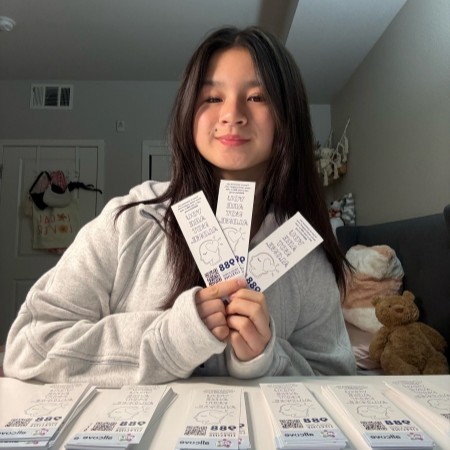
Michelle packages 988 Suicide & Crisis Lifeline bookmarks for distribution to schools and libraries.
Tell us about your volunteer role with Project EDSA.
Our main focus is our chapter program, through which students create a club in their own school or community. We’re partnered with ANAD (National Association of Anorexia Nervosa and Associated Disorders) and work closely with their school ambassador program. Our chapter leaders undergo training with ANAD to learn about eating disorders, facilitating discussions, and advocating on their campus. After that, we give them a 30-day starter kit with basic guides for them to get set up.
Our other major focus is our volunteering program, but that’s more to help with our operational work. One in three youth report lacking reliable access to mental health resources, and about 50% wouldn’t know what to do if they felt like harming themselves. In honor of Suicide Prevention Month last year, we distributed 7,500 bookmarks across 40 schools and libraries with the 988 Suicide & Crisis Lifeline and local mental health resources.
As the Co-founder and COO, I oversee everything and do social media. I help with a lot of internal work like onboarding our chapters—120 so far—and volunteers and creating guides for them. I also strategize with Diya.
What inspired you to get started with this initiative?
Growing up dancing, there was a lot of pressure to have a certain body type. That pressure really got to me when I was nine. I never had an eating disorder, but I started hating my body and have had body dysmorphia since then. When I was 14, one of my dance teachers body shamed my peers and me. That’s why I stopped competitive dancing and left that team. It led to many of us developing disordered eating habits, and motivated me to volunteer at a local eating disorder nonprofit, where I met Diya.
Together, we realized that while there was support there, all the programs were designed for adults despite adolescents being most at risk. She had her own EDSA club at her school, but she wanted to expand it, so together, we launched the organization.
What are your long-term plans or goals for the organization?
We’re in the process of onboarding our new executive leadership board. That’s our main focus. We’re also working on the State of Eating Disorders. Each chapter leader will report on their school’s current level of support, so we can use the information to advocate for policies.
We’re also trying to get into crafting care packages for those struggling with eating disorders in hospitals. When Diya was in recovery, she really enjoyed the art supplies people brought. It can be isolating when you don’t really have anyone to speak to. And we’re working on a formal Eating Disorder Awareness Week campaign that we can do every year.
What’s been the most rewarding part of your work?
It’s being able to connect people from all over the world. It’s cool how an initiative one chapter is doing in Texas, for example, can be adapted for New York City or expanded to Peru. We have a Slack channel for everyone and an Instagram group chat for chapters. Everyone always likes each other’s messages. Even though they don’t really know each other that well, we’re connected by this shared community.
What have you learned through your experiences as a volunteer?
Volunteering is super rewarding, but it also requires patience. I work with many different people, and it can be challenging when the same questions are being asked over and over. Patience is important.
Also, volunteering instills empathy. You have to empathize and be an active listener to understand the struggle. It’s important that you’re passionate and knowledgeable about the issue you’re focusing on, so you’re able to do meaningful work.
Tell us about future partnerships, programs or events that you are excited about.
We were awarded a $5,000 grant for our 9/11 initiative. There are multiple chapters participating, and we’ve been able to give them—and some close partner organizations—up to $500 to each.
My chapter will assemble care packages at my local American Legion Auxiliary Post to target hunger within the veteran community. Many veterans rely on food stamps, and we want to address that by packing shelf-stable nutritious food and recipes along with positive messages in each box to brighten their day.
Why is it important for others to get involved with causes they care about?
Throughout your life, there have been people who have helped you along the way, and sometimes those actions shape or help you the most. It’s important to do that for others. Also, if you have a certain lived experience, volunteering is a great way to help those who are going through that same type of challenge.
What do you want people to learn from your story?
Youth can change the world. We’re dominating as changemakers now more than ever. There are so many amazing initiatives out there proving we have this ability.
From a Single Campus Book Drive to a Global Literacy Movement
Meet Daily Point of Light Award honoree Adam Shamoun. Read his story, andnominate an outstanding volunteer or family as a Daily Point of Light.
Adam Shamoun’s father grew up in Syria without access to educational opportunity, an experience that shaped everything his son would go on to build. That story lit a spark, and today Adam serves as President of the Brophy chapter of the Driving Empowerment Action & Learning (DEAL) Club and Chief Operations Officer of the national DEAL nonprofit, working to connect books to the people who need them most: tribal communities, families, and literacy organizations in Arizona and around the world.
Since joining in 2024, Adam has run four book distribution events, helped donate more than 120,000 books, and led fundraising efforts that have raised over $5,000, all while building the strategic systems to expand DEAL into new chapters and states. It’s work he traces directly back to his father, and to a belief that young people can’t afford to wait to make a difference.
For Adam, the secret is to find what you’re passionate about, start small, and show up every day. Literacy and sustainability are the causes that keep him coming back.
Meet Daily Point of Light Award honoree Grace Sun. Read her story, andnominate an outstanding volunteer or family as a Daily Point of Light.
At 15, during the loneliest days of the pandemic, Grace Sun sat down at her piano and began playing over Zoom for isolated older adults. That small gesture became a global cause. Today a junior at Wellesley College, Grace is the founder and president of Melodies for Remedies, a student-run 501(c)(3) that channels the healing power of music and the performing arts to seniors, individuals with chronic illness, and patients living with Alzheimer’s and dementia.
The spark came earlier, at an impromptu talent show at a senior home across from her high school. When the residents clapped wildly for teenagers — overjoyed simply to share in music — even when they made mistakes, Grace, a classically trained pianist, saw her art transform into a bridge to people living in isolation.
“If there’s a vision that you have for whatever you are pursuing, the vision will pull you forward.”
What began with one student now spans 500+ members across dozens of high schools, nearly 20 universities, and five countries, who have delivered more than 10,000 hours of music through monthly concerts, one-on-one sessions, and dementia awareness initiatives, raising over $5,000 for Alzheimer’s research.
An aspiring physician fluent in three languages, Grace has published research in Music and Medicine and earned the Barron Prize and the Reagan Leadership Medal. Since Alzheimer’s has no cure yet, she keeps showing up with music, uplifting one senior at a time.
Meet Daily Point of Light Award honoree Maanya Pandey. Read her story, and nominate an outstanding volunteer or family as a Daily Point of Light.
Growing up, Maanya Pandey would hear her mother’s stories about how inaccessible and expensive period products were in her native India. But when Maanya discovered that women in America were facing significant obstacles to finding adequate period products, she knew she could take action to make a change.
After doing significant research, Maanya learned that from prisons to her local community, women were struggling to find period products. This was especially true in Maanya’s area of Iowa, where few organizations addressed period poverty. As a high school sophomore, Maanya decided to start her own organization to help women feel clean and maintain dignity during their periods. In May 2020, she founded Love for Red, an organization working to end period poverty through service, advocacy, and awareness.
With a focus on schools, Maanya has volunteered thousands of hours leading a student‑run effort that has donated about 362,000 menstrual products to 207 organizations, including 170 schools in 78 districts. The organization works to move products into school bathrooms, create “period packs,” and establish student ambassador teams that ensure their classmates’ supplies are stocked without asking an adult or going home. With a strong focus on partnering with shelters, clinics, and refugee groups, Maanya has served as a face of the mission, representing the group to support bills that would fund free products in school restrooms.
Maanya just graduated from the University of Iowa and is planning on attending medical school. She hopes to incorporate Love for Red into her medical career, addressing women’s health while advocating for health equity. By dedicating her volunteer work to a cause that’s close to her heart, Maanya has already forged a path that will lead to her future as a physician. Her dedication to the cause shows just how much volunteerism can change the future and, in this powerful example, inform one’s professional career.
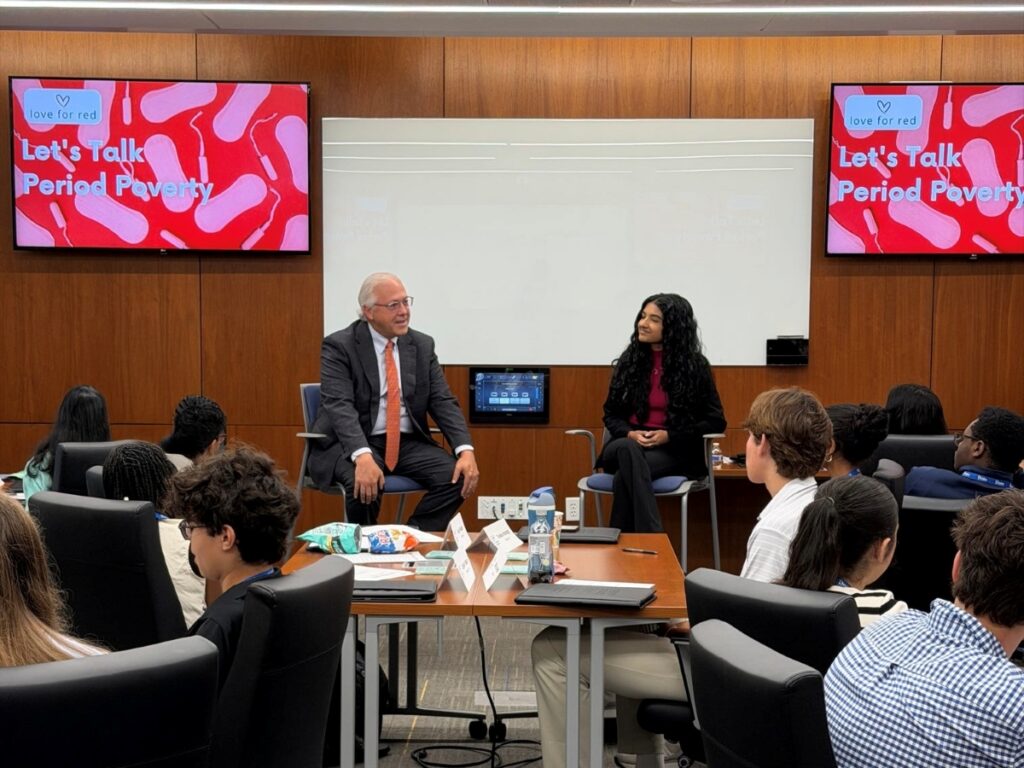
LOVE FOR RED FOUNDER MAANYA PANDEY (RIGHT) PRESENTS ‘LET’S TALK PERIOD POVERTY’ TO CIVIC LEADERSHIP ACADEMY STUDENTS WITH REP. DAVID YOUNG. /COURTESY MAANYA PANDEY
What inspired you to get started with this initiative?
When I was growing up, women in my life would tell me about their experiences with menstruation when they were young, and that was so different from my experience. My mom grew up in India, and she wasn’t devoid of resources. But at the time, period products like the ones that we know today weren’t on the market. And if they were, they were so expensive and inaccessible. She would tell me about the negative experiences that she had with menstruation, and that was so different from what I experienced. When I got my first period, I was so excited to be a woman. In my sophomore year of high school, I saw an Instagram post about women in prisons and the struggles that they go through because they can’t access period products. They were using things like bed sheets and mattresses as period products and subjecting themselves to assault by prison staff to get period products. That’s where I really saw that this issue was in the U.S. and not just another country.
What inspires you to volunteer?
So many people are suffering in silence. I think that truly was my motivation. It felt so fulfilling to be able to address something that wasn’t being talked about in general. That’s why I continue what we’re doing, because when we started, we didn’t think that there would be much of a need. Once we got to schools, it completely skyrocketed, and we now support over 200 schools in Iowa. Being able to uncover need and directly help those in need is honestly so fulfilling, and that’s why I continue.
Tell us about your volunteer role with Love for Red.
My title is Founder and President, and so it’s my mom and me who do almost everything for the organization. We have a board of advisors and other things, but my role is overseeing the organization. I help with gathering the donations, going to schools, and dropping them off. We plan period packing events. For the past four years, I was at the University of Iowa for my undergrad, and so I ran our Iowa City team. We have our newsletter, our social media posts, events, and fundraisers. I run all of our meetings, and we actually have a student ambassador program that creates a leadership opportunity for students to take care of their school’s menstrual product needs.
What are your long-term plans or goals for the organization?
One of our really big strategies is advocacy. It’s something that we started in 2023, when we went to the Iowa State Legislature to advocate for policy change for free menstrual products. Our legislative goals for the past few years have been getting free period products for students in Iowa and making them free in all Iowa schools. I would say that one of our goals is to be able to get something passed. We got really, really close. It’s something where we’ve gained so much traction and progress in the past few years, specifically for students. That’s something that I really want us to be able to get passed.
What’s been the most rewarding part of your work?
We send a feedback form out towards the end of the year to see if these products are helping people and making a difference. That’s when it’s so eye-opening to see staff and students talk about their experience with having these products accessible to them. They’re talking about how, otherwise, they were spending their own money for these products or missing school.
Students are so grateful to have these products accessible to them. It just feels like we’re truly actually making a difference for Iowans.
What have you learned through your experiences as a volunteer?
One of the biggest things is just how much I’ve changed as a person over the past six years because of Love for Red. A lot of people are shocked when they hear me say that I’m like an introvert. I’m scared to talk to people on the phone. But with Love for Red, it’s truly changed me as a person. It’s changed my confidence, my skills, and my outlook on the things that I want to do. I’m applying for medical school right now.
Why is it important for others to get involved with causes they care about?
We all see issues that happen in our world, and we all have the desire for them to be solved. But they’re not going to be solved unless we do something about it. I know it can be really scary for people to take that initiative. When we started, we had no idea that it would grow this much. But we started because I wanted to do something about this, and then we uncovered more of the need that we saw in Iowa. Because of that, we were able to create such an impact. It’s really important to take that first step in addressing things that you want to see solved because one person can truly make a difference.
Any advice for people who want to start volunteering?
Research organizations that do exist for the issues you do want to solve. Some organizations always need help, and just email them, reach out to them, or look on their website. There are so many places that need help, and we just have to reach out and ask what it is. If you have a cause that you want to help, there are so many more people out there that want to do the same. If you start it, other people will join you as well.
Meet Daily Point of Light Award honoree Andrew Coram. Read his story, andnominate an outstanding volunteer or family as a Daily Point of Light.
Andrew Coram began volunteering with Erie Neighborhood House in 2022 because he was looking for a way to channel his time toward something meaningful. And he found it — as an after-school mentor to Alex, then a sixth-grader at the Chicago nonprofit that serves immigrant and low-income families. Four years later, the two still meet weekly. They tackle homework, but they also talk sports, family, tough decisions, and the future. Andrew has watched Alex grow into a high school junior, and this past year, he even advocated for Alex’s mother during her residency process.
But Andrew’s commitment didn’t stop at mentoring. In 2023, he joined Erie House’s Associate Board, becoming Co-Chair in 2024 to help drive fundraising. The board’s signature June event has raised over $27,000 across recent years and more than $23,000 in 2026 alone. These dollars fuel childcare, ESL classes, legal aid, and wellness services, while spreading awareness of Erie House’s mission.
For Andrew, the work has been a lesson in community. Neighborhood businesses, he’s found, are eager to help; they just need to know organizations like Erie House exist. His advice to anyone hesitant to start is to not set impossible expectations. The strength is in numbers, and you just need to show up.
Meet Daily Point of Light Award honoree Claire Wang. Read her story, and nominate an outstanding volunteer or family as a Daily Point of Light.
Claire Wang grew up hearing that her beloved grandmother had to leave school in the second grade to join the workforce in China. That’s how she knew how lucky she was to have the opportunity to get an education. However, Claire also knew that, like her grandmother, many girls across the world weren’t as lucky as she was. They face tremendous obstacles to accessing proper education. She soon learned that over 119 million girls worldwide lack access to education, and she wanted to do something about it. Little did she know at the time, but Claire was about to spearhead a movement that would grow into a global organization.
In the ninth grade, Claire and her best friend Vivian co-founded Future Female Scholars, an organization that connects underserved girls worldwide with passionate tutors who believe in the transformative power of education. Claire works diligently to recruit and coordinate volunteer tutors and match them with mentors. She also spends significant time managing partnerships and sponsorships, organizing outreach initiatives, and growing Future Female Scholars’ social media presence to over 146,000 followers on Instagram. Her work has been so successful that FFS has built partnerships with Lady Gaga’s Born This Way Foundation, Krispy Kreme, and TrueLeap. As a result of Claire’s dedication, which includes spending 35 to 40 hours per month on her volunteer work, over 10,000 girls receive free one-on-one tutoring. She has built a network of 2,000 verified volunteer tutors, providing students with academic support they may not otherwise have access to.
Currently a high school senior, Claire is planning on heading to college, where she’ll study chemistry with a minor in education. She hopes to continue growing the organization while pursuing her degree. While FFS has already expanded on a global scale, Claire hopes to go even bigger. She dreams of partnering with a major organization like the United Nations to make it clear that women’s education needs to be emphasized in other countries, not just in the United States. Looking at everything Claire has accomplished thus far, there’s no doubt she’ll reach her goals someday.
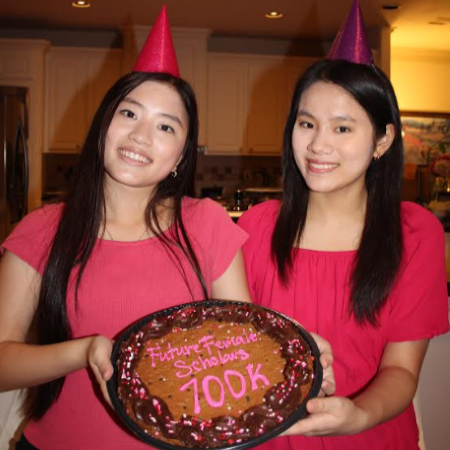
CLAIRE WANG (RIGHT) CELEBRATES FUTURE FEMALE SCHOLARS SURPASSING 10,000+ INSTAGRAM FOLLOWERS IN JANUARY 2026, MAKING A MAJOR MILESTONE IN THE ORGANIZATION’S RAPIDLY GROWING GLOBAL COMMUNITY. /COURTESY CLAIRE WANG
What inspired you to get started with this initiative?
Growing up, my grandmother lived at my house, so it was really nice to just hear her stories. She grew up in a place called Hunan, China, where most of the people are farmers. She told me that she had many dreams of becoming a teacher. Unfortunately, she had to drop out of school in the second grade to join the workforce with the other villagers in her town.
I had been going to kindergarten at that point, and I was always complaining about going to school. But this new perspective shed light on how much of a privilege education is, and this really inspired me. In ninth grade, I started Future Female Scholars with my friend Vivian Lu because we realized that so many other girls like my grandmother are in the same situation where they have to sacrifice education just to live, and that shouldn’t be the case. Education and your own well-being should go hand in hand.
What inspires you to volunteer?
I just like talking to people and meeting new people. Every time I volunteer, it’s a great experience because you’re introducing yourself to new people. It’s a new experience every time. You’re not always going to meet the same people with the same backstory. Through volunteering, I’ve learned some of my greatest lessons. And these lessons have carried forward whether I’m interacting with teachers, professors, or friends.
Tell us about your volunteer role with Future Female Scholars.
I’m the co-founder and co-CEO with my friend Vivian. Day-to-day, it mostly looks like me registering tutors. We have about 2,000 registered, verified tutors right now in over 70 countries, which is significant. It’s usually me pairing up students with tutors, or sometimes the students will naturally find tutors themselves on our website. We have a place on our website where people can find tutors who list their contact information. I also manage our Instagram, which has over 145,000 followers. It’s pretty wild to see how something we started almost two years ago has grown on a global scale.
What’s been the most rewarding part of your work?
This sounds cliché, but meeting students from each country is so cool. Hopping on a Zoom call with someone from Morocco or France. It’s so cool to see the cultural differences, and we bond over struggles. We both have to take the SAT or do college applications, stuff like that. Even though we’re in different parts of the world, we’re still connected by education and our love for learning.
What have you learned through your experiences as a volunteer?
I’ve learned resilience. Starting in 2024, we were really small. We had about 300 followers on Instagram, and we only had about 10 tutors sign up on our website. It was really sad at first because I really wanted to reach as many people as possible. But I decided just to keep going. I worked with my co-founder every day throughout the summer and throughout the school year. Even if we had tests or quizzes, we worked through holidays. Consistency is the real solution to everything. Every day we just focus on improving something differently.
Why is it important for others to get involved with causes they care about?
You can really step out of your comfort zone. It’s really easy to say you have a passion for something, but not take any action. Anyone can have a passion for, let’s say, chemistry, but if you don’t actually take initiative to work in a lab or do some research, there’s nothing really tangible that’s produced out of it. I think young people these days really need to have initiative. There needs to be some actual human interaction, and I think the tutorial aspect has worked for most of our Future Female Scholars.
Any advice for people who want to start volunteering?
Go to your local community center, church, or library. Find out what your school offers. I started volunteering at the food bank and the library. Through these constant volunteering opportunities that I did, I realized I wanted to do something more. I wanted to do something where I could lead my own cause. If you do something that personally connects to you, that really makes a much better impact, and you yourself are going to be constantly motivated.
What do you want people to learn from your story?
I would like people to learn that it’s always possible, even if you start and you might not have as many volunteers as you’d like. Just keep going and try to improve something every day. If you improve something every day and stay consistent, things will eventually work out for you. Two years ago we had tutored only 100 girls, but now we’ve tutored over 10,000 girls across the world. I think young people can do that just through the power of social media and staying consistent.
Water Safety: Spreading Knowledge That Saves Lives
Meet Daily Point of Light Award honoree Kate Casciato. Read her story, and nominate an outstanding volunteer or family as a Daily Point of Light.
It is often assumed that everyone knows how to swim at a certain age, but that’s not always the case. Geographic location, historical segregation laws, financial barriers, and other factors can all play a part in why a child might not be safe in the water. Seventeen-year-old Kate Casciato is dedicating her life to changing that, starting with childhood education, where feet are firmly on dry land.
When Kate was a toddler, a close family member nearly drowned in a riptide, and it shaped how her parents raised their kids. They enrolled her and her four brothers in swimming lessons from a very early age and strictly enforced safety rules. While they can all swim well, Kate has become a competitive swimmer. In fact, she loves anything to do with water, which is why it saddens her to see so many accidents happen to young children who haven’t been taught to safely interact with it.
In 2022, Kate decided to take things into her own hands. She founded Own Your Float to bring water safety education into preschool and elementary classrooms across New York City and spends 15 to 20 hours each week running programs with 40 volunteers. Swimming lessons can be hard to access, but thanks to Kate, knowledge isn’t. The organization has also distributed nearly 3,000 pairs of goggles and swim caps with partner companies.
Own Your Float has reached over 1,200 students, and Kate has published op-eds in The Washington Times and other national outlets on the topic. As part of her advocacy, Kate has also co-chaired Turning the Tide, a friend’s initiative, organizing logistics and helping raise $140,000 for swim lessons for underserved swimmers.
What inspires you to volunteer?
My parents were always talking about water safety, and it always interested me. I used to hand out booklets outside pools as a kid. I wanted to do something about it, but I hadn’t really volunteered before this.
In Albany, Kate stands on the steps of the New York State Capitol after meeting with the Director of the Senate Education Committee to advocate for a bill that would mandate water safety education in New York schools.
Tell us about your volunteer role with Own Your Float.
I started by asking schools if I could talk about water safety. Many said no, because they didn’t want to scare the children. Eventually, after really writing countless emails and using every connection I could, I got into classrooms and assemblies, Boys and Girls Clubs, and camps. Now, I do lesson prep and, during lessons themselves, read a water safety book and use scenario-based poster boards to help kids spot danger.
That’s our main focus, but I also solicit donations to help us distribute goggles and swim caps as an avenue into talking about safety. I’ve negotiated a wholesale equipment partnership with FINIS, Inc. and Speedo. We hope goggles in their child’s hand are a reminder to parents to sign them up for a swim lesson.
The last part of what we do involves librarians. I wrote a children’s book called Captain Goggles Saves the Day! that I self-published about water safety, because the books I read didn’t represent the diverse children I see. By contacting state librarians, we were able to send free copies of my book or another one on the topic to around 270 libraries across five states. We help librarians build engagement around the books using activities I created with downloadable sheets. And we’ve launched a middle school club with students who will hopefully take over after I graduate.
I also volunteer every Sunday most of the year as a swim instructor with the Swim Strong Foundation for children from low-income circumstances. My organization focuses on education, but a child that has a swimming lesson is 88% less likely to drown, so that’s a big part of the solution, too.
You advocated for state bill S. 9480 to mandate water safety in schools. Why is that important?
The goal is to get water safety required in classrooms. Only Louisiana has implemented this so far. We should be teaching children to respect the water without being fearful of it. So, I went to Albany to meet with the Director of the State Education Committee, find out the status of the bill, and share what I’m seeing in classrooms and swim lessons.
What inspired you to get started with this initiative?
I grew up understanding that anyone can drown and everyone eventually encounters water, whether you’re swimming, on a boat, or in a flood. It was always in the back of my mind.
As I got older, I got invited to talk about being a competitive swimmer and noticed the children I spoke with had little understanding of water safety. I realized that was why you can’t pick up a newspaper in the summer without seeing a tragedy of a child who snuck into a neighbor’s pool or was swept away on a beach.
We have to talk to kids about water safety like we do about fire and lockdown drills. The sooner we reach them, the better. Many tragedies are preventable, but it’s not as simple as telling people to get a lesson. There are barriers, and that’s why I want to study public policy. I’m just getting started.
What’s been the most rewarding part of your work?
It’s when a kid confirms they’ll follow the rules and a teacher decides to incorporate water safety into their curriculum. This work is so much more than one person. It’s going to take a movement.
Why is it important for others to get involved with causes they care about?
We owe it to each other. We’re part of this world, and no one can get by without help from other people. If you can contribute, you have an obligation to. Plus, it makes you feel good. Nothing makes me feel better than helping somebody.
What do you want people to learn from your story?
There’s no substitute for a swim lesson, but anyone involved in a child’s life can talk about water safety. Education is an easy part of the solution that we’re ignoring. You don’t need a pool. Children are already in classrooms. Why can’t we get this done?