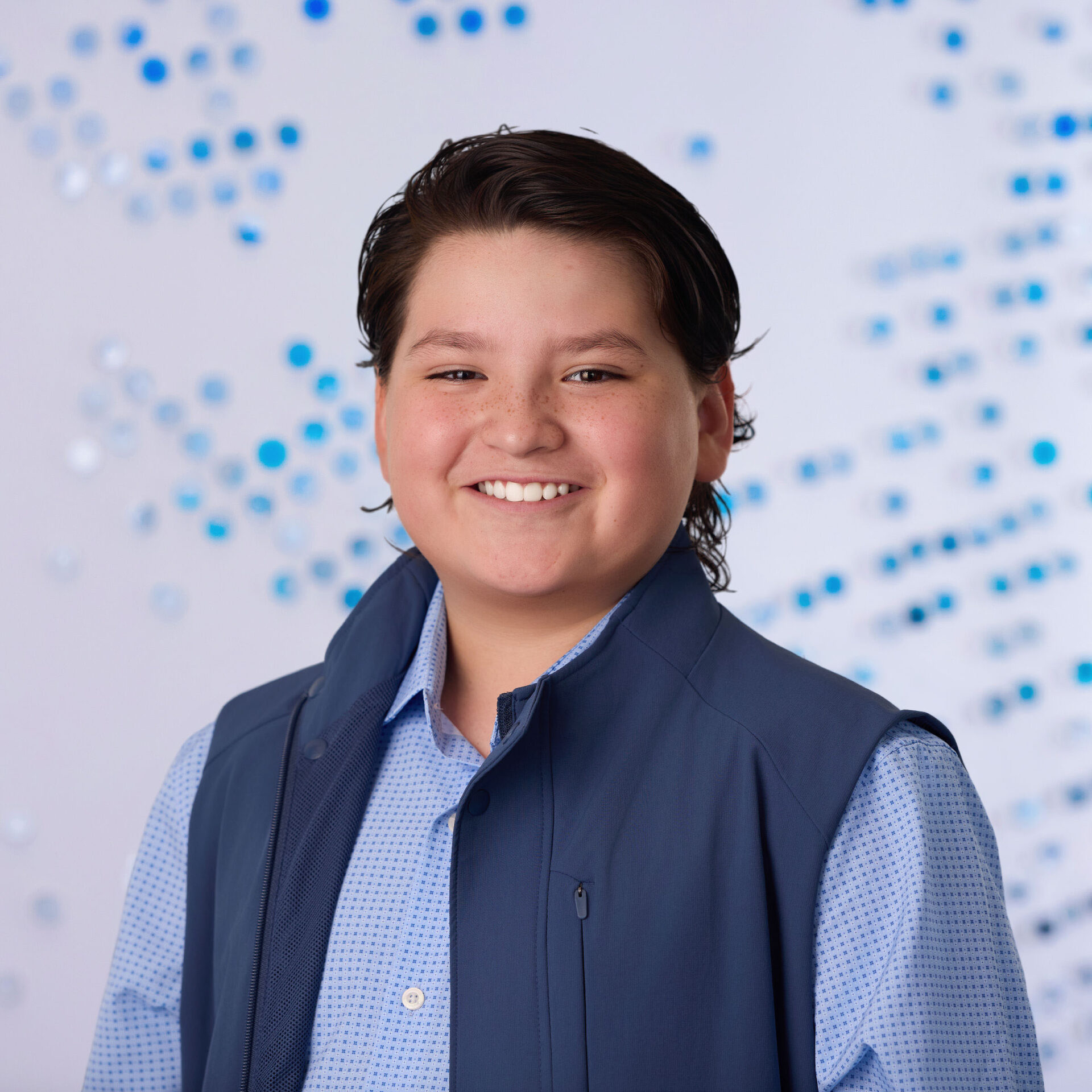
Meet Daily Point of Light Award honoree Liam Toledo. Read his story, and nominate an outstanding volunteer or family as a Daily Point of Light.
Liam Toledo has always loved to read, and now he’s helping other young people have the opportunity to do the same. A few years back, Liam was perplexed by the lengthy drive to the library. He recognized that the Rio Grande Valley, which has a high level of poverty, didn’t make it easy for children to have access to reading material. This exacerbated their academic struggles in school. Looking to find a means to close the literacy gap, he established Liam’s Community Library, where children can come and take out books from a storage area provided by the local community center. Once a month, Liam and his team of volunteers set up the library and allow kids to take out as many books as they want. Next month, they simply return them.
Liam has also seen the ups and downs of managing your own organization. After attendance decreased following the library’s first year, he realized he needed another means of funding it. Inspired by his own sweet tooth, Liam established a cotton candy business that would raise funds to maintain the library. Using the tools he learned in tycoon Warren Buffett’s Letters to Shareholders, Liam realized he could make cotton candy for around 30 cents and sell it for $4 each. He uses the profits to fund the library, as well as to provide donations to the local hospital and police department. Liam has also established two permanent bookshelves at the South Texas Health System Children’s Hospital in Edinburg.
Now a rising high school sophomore, Liam is balancing a busy academic workload with 15 to 20 hours of volunteer work at the library each week. Whether he’s managing inventory or negotiating with sponsors and donors, Liam’s prime focus continues to be using his time to serve his community and demolish the literacy gap. Thus far, he has over 3,000 books in circulation and has donated 1,425 books to hospitals, police departments, and schools. But he’s also inspired his fellow community members to throw their hats in the volunteer ring. He has trained over 15 volunteers to help operate the library, therefore providing his peers with the rewarding experience of seeing volunteerism’s power. Liam’s Community Library is a testament to how volunteerism directly affects a community for the better.
What inspired you to get started with this initiative?
After a long drive to the library just to get a book, I realized that drive was more than just an inconvenience. It was a barrier to most kids living in the Rio Grande Valley. Many kids don’t have easy access to books in the area due to high levels of poverty. I recognized that need, and I wanted to help. I’ve always been an avid reader and have always known the power and knowledge that books provide. In school, I recognized early that many of my classmates struggled to read. I wanted to provide easy access to books. I started thinking about how I could share my book collection with other kids. I realized then that if kids cannot get to the library, I could bring my books to them. I asked to borrow space from my local community center, and one month and 800 books later, Liam’s Community Library was born.
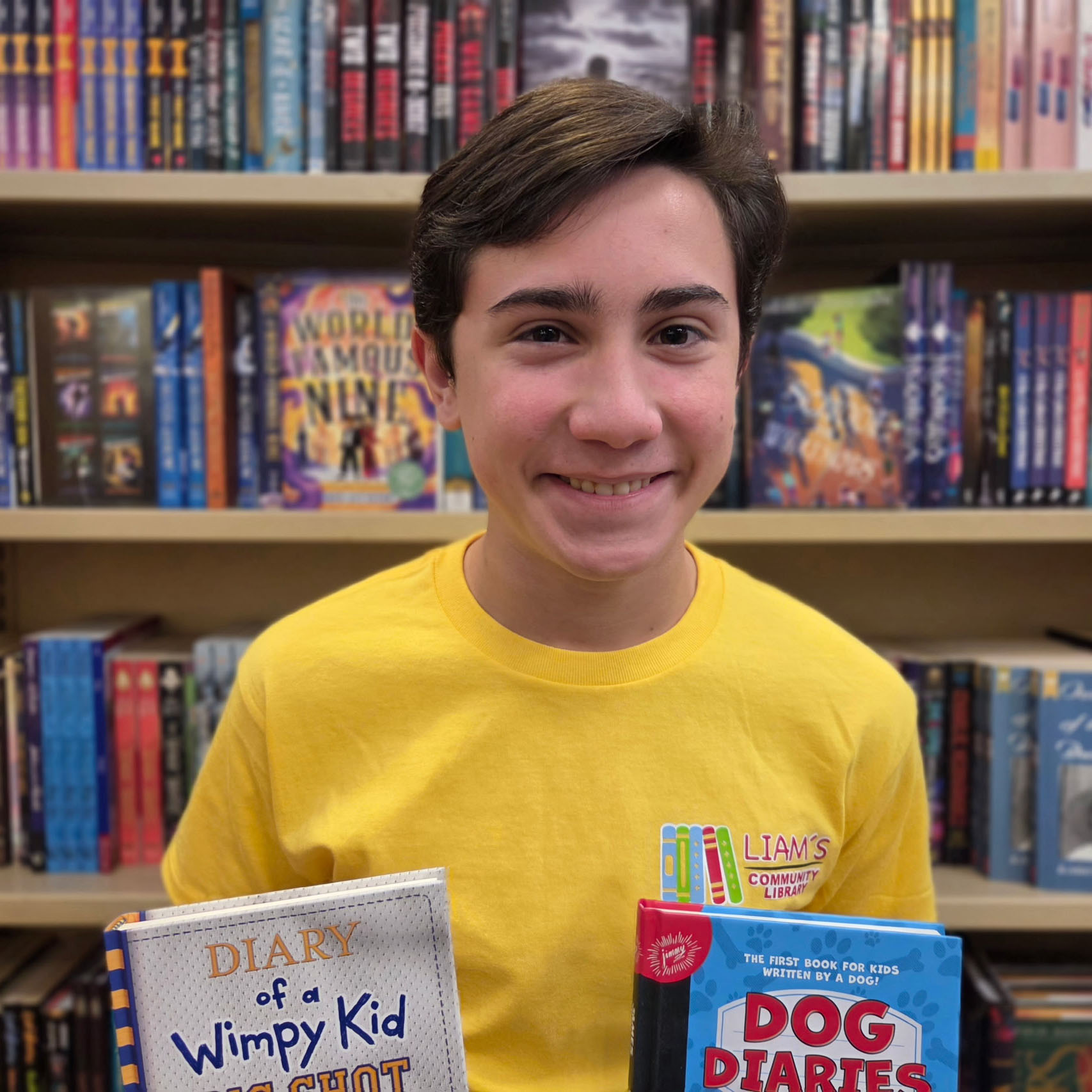
LIAM TOLEDO, FOUNDER OF LIAM’S COMMUNITY LIBRARY, HOLDS UP BOOKS AVAILABLE AT THE LIBRARY. /COURTESY LIAM TOLEDO
What inspires you to volunteer?
The challenge of finding creative solutions to local problems. I just really enjoy looking at a puzzle in the community, breaking it down, and figuring out a strategy to fix it using a little bit of business logic. But the best part is just seeing the direct impact on people, knowing that a simple idea and some hard work generally made someone else’s day a little better or gave a kid a new opportunity.
Tell us about your volunteer role with Liam’s Community Library.
When I first started the library, I was doing everything on my own, but I realized I couldn’t do it without volunteers or my community. Now, my main job is to keep track of our inventory, which has grown to over 2,500 books. I manage checkouts and sort through donations. I also spend a lot of time organizing events for kids. I handle our partnerships by calling and emailing local businesses like Copy Zone, Starbucks, and Chick-Fil-A to see if they can help us out with flyers or donations for our events. It takes a lot of teamwork, but working with our volunteers, community leaders, and corporate partners has helped the library grow.
What are your long-term plans or goals for the organization?
My long-term plans include expanding my catalog and the library’s reach to other cities in the Rio Grande Valley. To do this, I plan to install more bookshelves in hospitals and shelters across the valley where kids need them most. My long-term goal, however, is for the library to continue after I go to college. To do this, I am training my little brother to run the library and my cotton candy stand, which funds my library, to keep the library growing and to spread literacy for many years to come.
What’s been the most rewarding part of your work?
Some of the big ones are parents telling me that their children are reading more at home and are excited to come back to the library, or providing comfort to the kids in the hospital and the police department with my book donations. Also, achieving true self-sustainability by way of the cotton candy stand, and how something I made helps fund this other thing I made. But to me, the most rewarding part of this work is seeing kids excited about reading. It’s amazing to watch them come back asking for another book and develop a real love of reading. Knowing that the library is helping close the literacy gap and inspire a lifelong love of learning makes every hour of hard work worth it and gives me hope for the future.
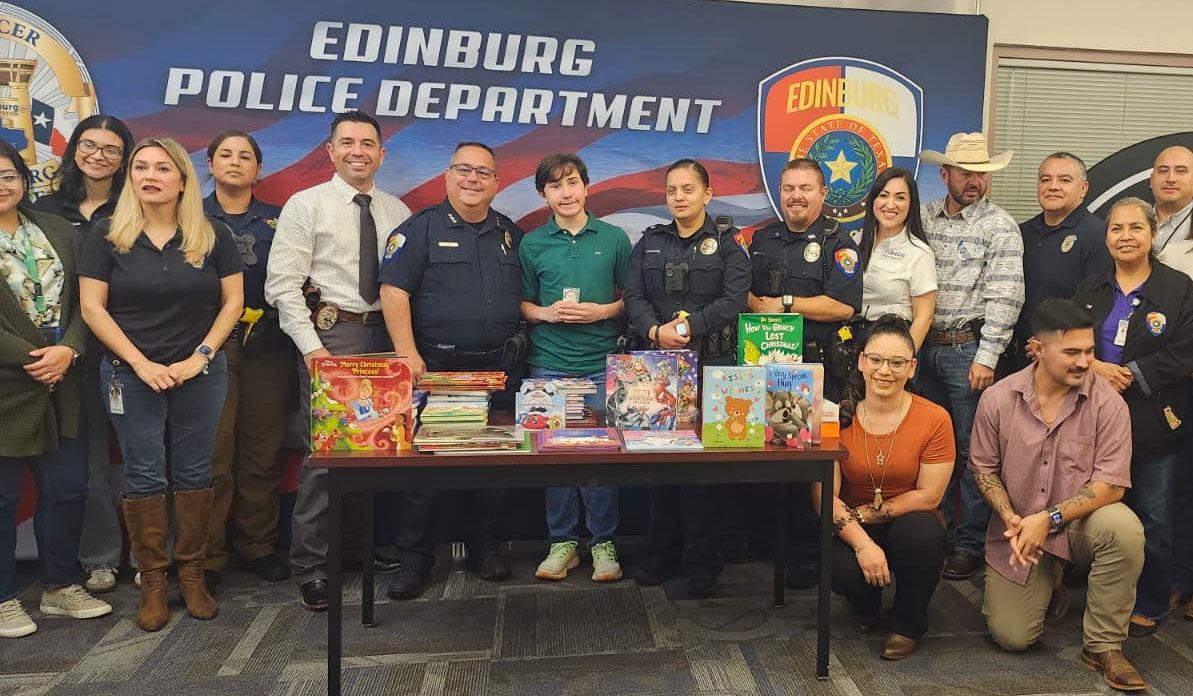
LIAM TOLEDO (CENTER), FOUNDER OF LIAM’S COMMUNITY LIBRARY, DONATES BOOKS TO THE EDINBURG POLICE DEPARTMENT. /COURTESY LIAM TOLEDO
What have you learned through your experiences as a volunteer?
Running the library has helped me develop valuable negotiation, collaboration, and leadership skills that are necessary to keep it thriving. More importantly, I learned how to pivot and solve problems when things get tough. After the first anniversary, attendance began to decline. I switched my strategy from donation-based to self-sustaining. This strategy has proven successful over the past two years by providing a constant stream of funds to purchase new popular books that kids want to read, maintaining interest in the library in the long term. Another important thing I’ve learned from the library is how collaboration can make projects successful. My volunteers and I work as a team to make the library the success it is today.
Why is it important for others to get involved with causes they care about?
Through this process, I have learned that when you take something and move it into action, you grow as a person and you serve your community. Even the smallest act of service inspires others to take action. If each of us took some small act to help others, we could change the world in some small way for the better.
What do you want people to learn from your story?
So many people are capable of thriving when they are given the resources and the support they need. I have seen kids go from reading below their grade level to mastering more challenging books with confidence and developing a passion for lifelong learning. This experience has shown me that you do not have to wait until you are older or have a lot of resources to make a difference. If you see a need in your community, taking the first step can create opportunities that change lives. With passion and dedication, even a simple idea can have a lasting impact.
Two Decades of Advocacy for Maternal and Infant Health
Meet Daily Point of Light Award honoree Amanda Braverman-Brohn. Read her story, and nominate an outstanding volunteer or family as a Daily Point of Light.
For nearly two decades, Amanda Braverman-Brohn has volunteered as an advocate for maternal and infant health. After a life-threatening moment when her own son was in utero, she has dedicated herself to fetal movement education and stillbirth prevention so that other families can receive the support and information they deserve. Seeing the gaps that still exist in education and access to resources, Amanda founded the Moving Forward Foundation, an organization dedicated to education and advocacy through evidence-based programs, professional education, and community collaboration.
Amanda’s dedication to her community runs deep. In addition to her advocacy, she has volunteered as a coach for Girls on the Run for almost 10 seasons, committing her time to developing the confidence, leadership, and lifelong healthy habits of more than 100 girls. As a musician and former music teacher, she regularly supports local arts initiatives as well. And with five kids, she can often be found helping out local school service initiatives.
Read on to learn more about Amanda’s inspiring volunteer journey.
What inspired you to get started as a maternal and infant health advocate?
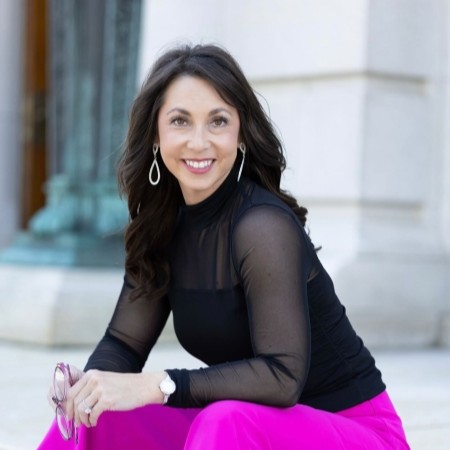
Amanda Braverman-Brohn has volunteered for nearly two decades as an advocate for maternal and infant health.
I initially started volunteering with an organization that teaches pregnant people how to track fetal movement so they can learn the unique movement patterns of their child. By learning to track fetal movement and recognize their child’s unique movement pattern, parents can notify their provider and be seen right away when there’s a change. This saves lives. During my own pregnancy, I noticed a significant change to my baby’s movements, spoke up, and my medical team took immediate action. My baby had a stroke in utero and were born via emergency C-section. He was resuscitated in the operating room. A member of our community connected me with the organization, and I began volunteering in 2008.
Tell us about your volunteer roles.
Volunteering has been one of the most meaningful parts of my life. Over the past two decades, I’ve dedicated thousands of hours to serving my community through organizations focused on maternal and infant health, youth development, education, and community leadership. I have supported maternal health and stillbirth prevention, helping educate families and healthcare professionals about methods to prevent some stillbirths; served with organizations like Girls on the Run; supported local schools, libraries, Rotary Clubs, and other community initiatives; and today volunteer as the founder of the Moving Forward Foundation, where I work to expand education, advocacy, and support for families, healthcare professionals, and volunteers of this mission.
I believe our communities are stronger when people share their unique gifts. Every volunteer brings something valuable—whether it’s professional expertise, lived experience, creativity, compassion, or simply a willingness to help. When we each use our talents to serve others, we strengthen our communities and create a lasting impact together.
What are your long-term plans or goals for the Moving Forward Foundation?
My long-term vision for the Moving Forward Foundation is to become a trusted resource for maternal health education, advocacy, and support. We are developing accredited continuing education programs for healthcare professionals, expanding community outreach initiatives, and building partnerships that improve maternal and infant health outcomes. I also hope to create opportunities for volunteers to be supported to use their unique talents and experiences to educate, advocate, and guide families, ensuring that every community has access to evidence-based resources that can make a difference.
What’s been the most rewarding part of your work?
The most rewarding thing is hearing about families that have been saved, that this made a difference. It gives me goosebumps, even to say it out loud.
With Girls on the Run, I have third through fifth graders, so I get to see them participate in running programs as middle or high schoolers or become leaders on Student Council or as their band board president. It’s so cool to see them continue to use those skills in the school community.
Any advice for people who want to start volunteering?
Find something that matters to you personally. When you care about the mission, it doesn’t feel like “one more thing.” It feels meaningful.
What have you learned through your experiences as a volunteer?
Volunteering has taught me that meaningful change happens when people come together with a shared purpose. I’ve learned that listening with compassion, building relationships, and working collaboratively often have a greater impact than any one person could achieve alone. Every experience has reinforced my belief that education empowers people, service strengthens communities, and even the smallest act of kindness can create a ripple effect that changes lives. Those lessons continue to guide both my volunteer work and the mission of the Moving Forward Foundation.
Meet Daily Point of Light Award honoree Brian Blowers. Read his story, and nominate an outstanding volunteer or family as a Daily Point of Light.
Brian Blowers, 53, is what some might call a “boy scout.” His friendly, upbeat attitude is contagious, and he seems to always be helping someone out or encouraging others. Perhaps that’s because he was once, in fact, a Boy Scout. It was a formative experience as a child that introduced him to what volunteering was all about and one that led to a life of kindness and a drive to lend a hand.
After earning his degree and U.S. Coast Guard license, he spent 10 years at sea on big tankers before getting hired by Phillips 66, where he has spent the last 30 years. Today, as Director of ESG Standards & Frameworks, Brian inspires colleagues, steering them to opportunities through the Social Impact team and employee resource groups.
In early childhood, Brian’s family depended, in part, on government assistance. The memory stuck with him. Now Brian is that assistance for others facing life’s challenges, lifting them up with empathy and a smile.
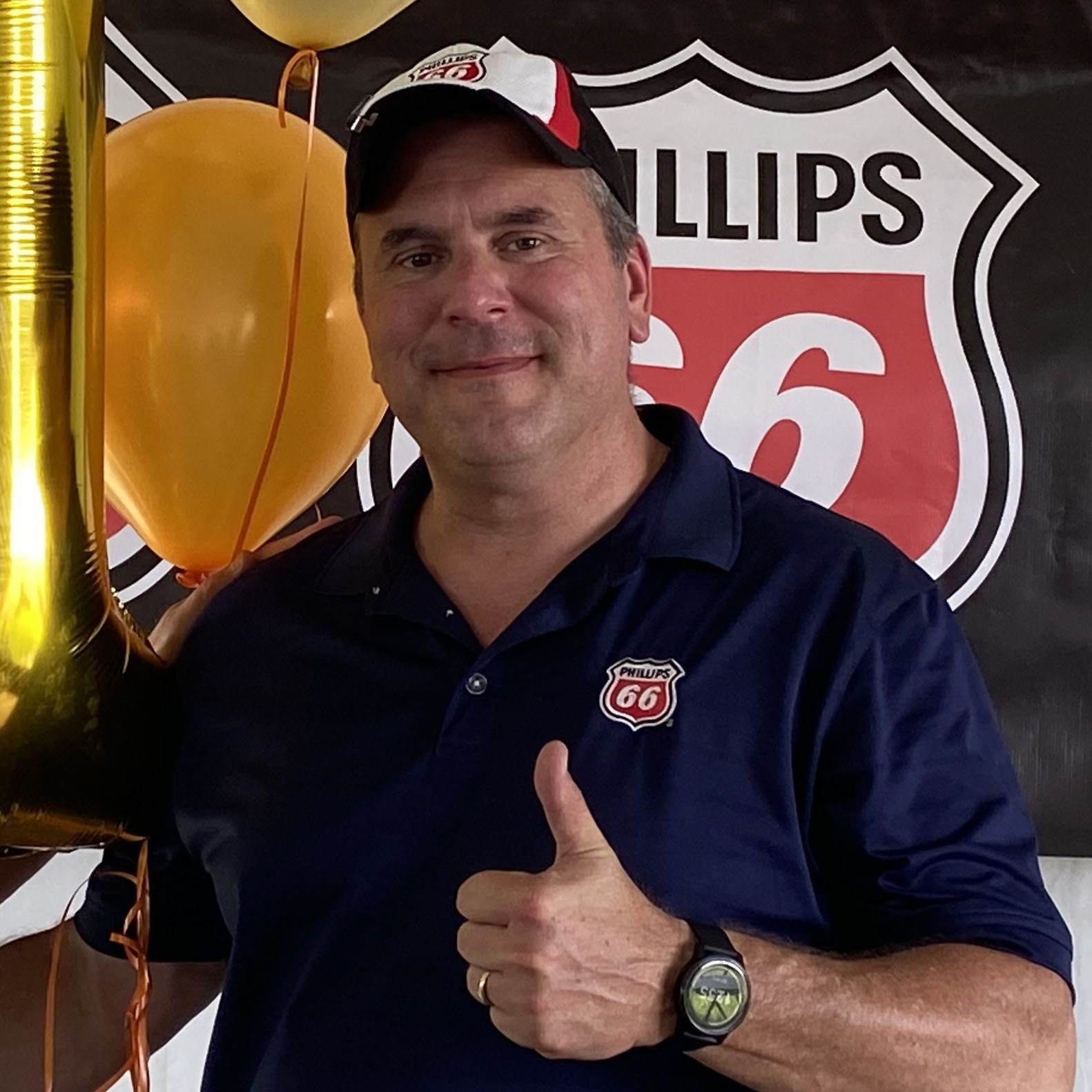
In 2020, as the Phillips 66 Texas MS 150 cycle team Co-President, Brian celebrates $1M raised.
What inspires you to volunteer?
As a kid in Cub Scouts, I got the feel of it. Then, I got busy with life. As my kids left and in my later years, I had some free time and decided to start doing some things for other people to stay busy.
Opportunities have arisen through my company. Also, my sister has arthritis. My wife has multiple sclerosis (MS), and there’s cancer in the family. I’ve volunteered for organizations that support patients and research.
Tell us about your volunteerism.
I’m still involved with the National MS Society with my wife. I started fundraising in 2010 and rode in the MS 150-mile Texas ride for three years. After that, I became affiliated with the Phillips 66 team as Co-Captain and helped organize the team, the tent, and the activities around that ride. I bought food, got the caterer, and organized masseuses, porta-pots, etc. with a $20,000 budget for the four-day event.
I’ve personally raised around $35k or $40k. In 2024, the team cleared the $1M fundraising threshold. We were around $1.3M before we dissolved it a year and a half ago. Since then, my wife and I have done walks instead of the bike ride.
Relying on government assistance for a while as a kid inspired my work with the Houston Food Bank. My company organizes for us to go and help. I try to get to Target Hunger about once a month, too. We report to sites and divide up the food for the cars in line. And WHAM also allows me to go out into the community and give people food and essential items.
I’ve also been involved in the United Way for a few years. There’s a big annual event at HQ. I give monthly through fundraising, but I’ve also been involved either as a leader or co-lead for achieving our business unit’s goals. This past November, we decided to do a wine tasting with various vendors. I was part of the project team that set up.
My biggest current role is Toastmasters, an international club that helps people become better communicators. I got involved with the club at work in 2017. My job requires me to be public-facing at times, so I needed to improve my public speaking. I haven’t reached the Distinguished Toastmaster level yet, but I’ve gone through enough where I can help others. Teaching helps reinforce what I’ve learned, too.
As the current president, I help set up and run meetings and mentor individuals with private lessons. And what a difference that makes! I’ve seen people improve to the degree of moving up the corporate ladder or leave the company for bigger and better things. I’ve seen people break out of their shells to become eloquent speakers. It’s rewarding to see somebody succeed who was struggling.
What else has been the most rewarding part of your work?
There’s satisfaction at the end of a volunteer session. It’s like putting in a hard day’s work. I weeded a garden, for example. I helped build a house or packed 10,000 limes into bags to hand out. We accomplished a task that benefited people. I got to see smiling faces and work in a positive environment. That rejuvenates me.
What have you learned through your experiences as a volunteer?
You don’t know everything. Patience is a virtue. Don’t be quick to judge. There are people who look like they’re doing well, but they’re not. Volunteers are the hardest workers, especially when they’re passionate about something. Amongst all the chaos we live through in today’s world, I still believe people can be positive and help each other.
Why is it important for others to get involved with causes they care about?
There are people less fortunate in certain areas than I am, so I’ll help them out. I’ll give them a boost if they need it. Sometimes, all it takes is that one connection, that one spark. Then, you run into that person a few years later, and they’ve completely pivoted and are doing really well. Those are cool moments.
Any advice for people who want to start volunteering?
If you’re going to commit to something, do it wholeheartedly. But don’t overcommit yourself and dilute your efforts. That’s doing it a disservice.
What do you want people to learn from your story?
Try it all, and stick with what you enjoy. And be positive. Do what you can, and just try to be a good, upstanding person. That’s the bottom line. Be a part of something bigger. I look forward to it.
How This Student Is Rewriting South Africa’s Literacy Story
Meet Daily Point of Light Award honoree James Bloom. Read his story, and nominate an outstanding volunteer or family as a Daily Point of Light.
James Bloom has spent much of the last several years living between two countries and two callings. As a dual U.S.-South African citizen, James saw firsthand the depth of South Africa’s literacy crisis, where many schools operate without any dedicated library space or age-appropriate books. Rather than treat the problem as too large to tackle, James co-founded Libraries for Literacy and partnered with Breadline Africa to do something concrete about it: build libraries, one school at a time. Since 2020, that partnership has helped establish seven libraries at severely under-resourced schools, giving thousands of students a place to read, learn, and imagine for the first time.
Getting books onto those shelves has been just as demanding as building the shelves themselves. James has personally transported tens of thousands of English and African-language books to South Africa, often packed into his own luggage and checked bags, then unpacked, organized, and shelved by hand once he arrives. But as James dug deeper into the work, he noticed a critical gap. There simply weren’t enough early-reader books written in African languages. So… he wrote his own. His “African Folktales for Kids” series, now six books strong, has been translated into Zulu, Xhosa, Sepedi, and Xitsonga with the help of local school librarians, giving young readers stories that reflect their own languages and traditions.
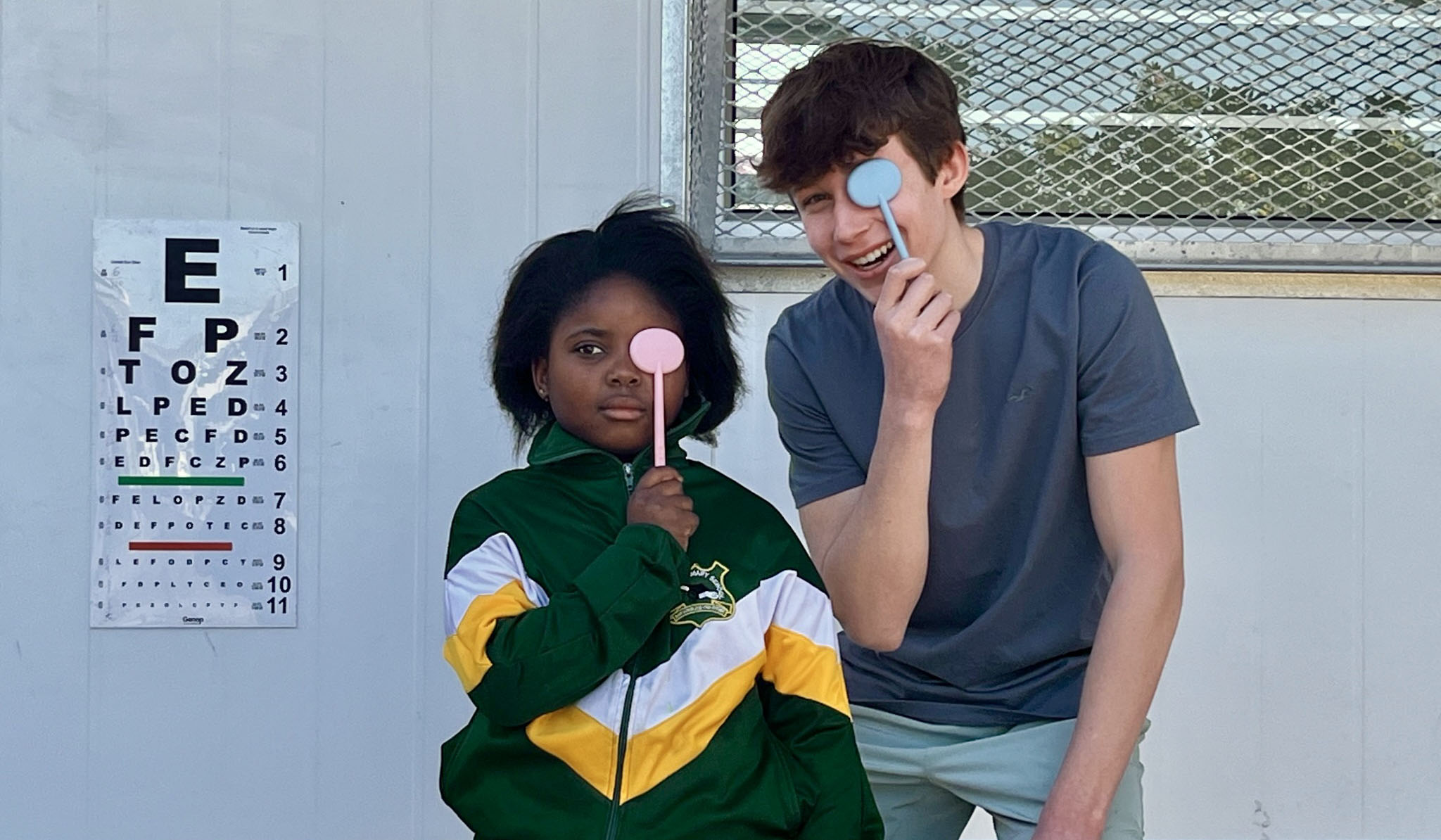
But James’s commitment to these students didn’t stop at literacy. While visiting the libraries, he discovered that some children were struggling not because they couldn’t read, but because they couldn’t see the words in front of them. In response, James partnered with OneSight Africa to bring free vision screenings and glasses to students who needed them, removing yet another barrier standing between kids and their education. It’s the kind of problem-solving that defines James’s approach: notice the obstacle, find the partner, and build the solution.
Today, James’s monthly involvement ranges from about 12 hours during quieter planning stages to more than 50 hours as a library installation date approaches. His responsibilities span fundraising, coordinating with partner organizations, sourcing books through schools and community sales, and working with local publishers to bring more African-language children’s books into print. Each summer, James returns to South Africa to volunteer in person at the libraries he’s helped build. For James, literacy isn’t just a skill, it’s a foundation for equity, and it’s one he continues to build, book by book, library by library.
Tell us about your volunteer role and organization.
sI’m the founder of Libraries for Literacy. Since 2020, I’ve helped establish seven school libraries in severely under-resourced township and rural schools across South Africa. So far, I’ve transported approximately 21,000 English- and African-language books to stock library shelves, serving 5,000 students each year.
We raise funds through initiatives like “Lemonade for Literacy” and “Brownies for Books” stands on NYC streets and I collect donated books from local schools and libraries. Months before a library opens, I reach out to the South African school principal to build a relationship and determine which reading levels, languages, and types of books their students actually need.
Because there is a severe shortage of children’s books in African languages, I’ve written a series of books called “African Folktales for Kids,” in which I retell African folktales in English and work with local librarians to translate them into languages including Zulu, Xhosa, Xitsonga, and Sepedi. I also manage our partnerships with organizations such as Breadline Africa, which provides pre-fabricated library buildings; Room to Read Africa, which offers librarian training; and OneSight Africa, which conducts vision screenings and eyesight testing, since good eyesight is essential to a child’s ability to learn to read.
My work continues after each library opens. I return to South Africa to work directly with librarians and students because I’ve learned that while providing books is important, the real work is building a culture of literacy in which those books are actually used.
James helps with eyesight testing in the Limpopo region of South Africa.
Why is this issue so important to you?
I’ve always loved to read; I honestly cannot imagine what my life would look like without books. Growing up, I spent almost every spare moment of my school day in my lower school library, and I never went home without a book checked out. I’m also a dual South African-U.S. citizen and when I discovered that the majority of South African kids grow up in homes without a single book and that over 90% of South African schools don’t have libraries, it really shocked me. I was determined to do something.
What inspired you to get started with this initiative?
On one of our family trips to South Africa, my brother and I were walking through a grocery store in Johannesburg when we noticed that every package of food had pictures of its contents. “Why don’t the cans just say what’s inside?” I asked my dad. I was used to packaging with just words, like a can of Campbell’s tomato soup. My dad, who grew up in South Africa, explained that many South Africans couldn’t read. I was stunned. Even at a young age, I couldn’t imagine a life without reading. That grocery store visit was the first time I understood that literacy wasn’t something everyone could take for granted.
Any future partnerships, programs or events that you are excited about?
We’re excited to keep growing our partnership with OneSight Africa to provide eyesight testing (and free glasses for students who need them) at library openings. Literacy and vision are very much intertwined; a child can have all the books in the world, but if they can’t see the page clearly, none of it matters.
What are your long-term plans or goals for the organization?
Today, only 8% of South African public schools have libraries compared to 93% of US schools. My goal is to keep expanding Libraries for Literacy, province by province, and get more schools equipped with libraries stocked with age-appropriate books in both English and local African languages like Zulu or Xhosa. This might sound simple, but in reality, it is extremely difficult. The libraries are located in areas of extreme economic need and there’s also a severe shortage of children’s books published in African languages, even though most South Africans speak one at home.
That gap is why I started “African Folktales for Kids,” retelling traditional folktales and translating them into languages like Zulu and Xhosa. Scaling that up — to more titles, more languages, more printing partnerships — is a big part of where I want to take this next.
What’s been the most rewarding part of your work?
For me, it’s going back to work in the libraries. Opening a library for the first time is an incredible experience, but being able to return afterward to actually teach in that library, working directly with the kids, and watching them grow more confident as readers over time, shows the potential for the libraries to truly change lives.
What have you learned through your experiences volunteering?
Probably the biggest lesson has been to communicate more. When we opened our first library in Soweto, the principal told us she wouldn’t let children borrow the books — she was worried they’d be stolen and sold. That wasn’t the outcome we wanted, but it wasn’t our place to override her judgment. It taught me to communicate with the local leadership and to gain clarity before acting.
Why is it important for others to get involved with causes they care about?
I think people underestimate how far a small, consistent effort can lead. We started with 1,500 books in suitcases; that’s it. We’ve now opened seven libraries and supplied over 21,000 books. The hardest part in any project is starting.
Any advice for people who want to start volunteering?
Start with what’s already around you. You probably don’t need a big plan or a lot of money. Don’t wait for a perfect time; do something small today.
Meet Daily Point of Light Award honoree Reece Johnson. Read his story, and nominate an outstanding volunteer or family as a Daily Point of Light.
Reece Johnson didn’t see a space for the LGBTQ+ community in Pike County, so he decided to start his own. Growing up in the rural Ohio community, Reece knew what it was like for people in a small town who didn’t have a space where they felt seen, supported, and included. Instilled with a passion for helping people from a young age, Reece realized he would have to create his own safe haven to give other people that vital sense of community.
Using the area code for Ohio’s Pike County, Reece established Haven 740, an organization focused on LGBTQ+ advocacy and community in southern Ohio. The organization is focused on bringing people together, sharing resources, creating events, and helping people understand that they’re not alone through meetups, open houses, support circles, and other fun events. Whether they’re a member of the LGBTQ+ community or just an ally looking to learn more, there’s a place for them at Haven 740.
Wherever Reece goes, he’s telling people about Haven 740. His word-of-mouth campaign has been so successful that Haven 740 just completed their first Pride walk last month. Starting at a local park in the town of Waverly, a group of about 15 participants gathered in the park for music, snacks, and giveaways before walking a loop downtown. His grassroots efforts, which include about 20 to 25 hours of volunteer work a month on top of a college course load and a job as a Direct Support Professional, demonstrate his dedication to creating a thriving organization that benefits everyone.
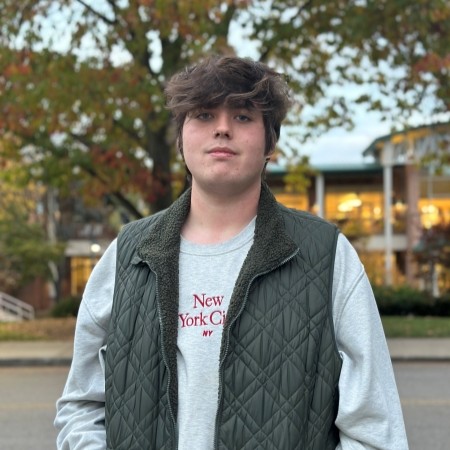
HAVEN 740 FOUNDER REECE JOHNSON STANDS OUTSIDE AT KENT STATE UNIVERSITY, WHERE HE IS STUDYING PUBLIC HEALTH TO BECOME A REGISTERED NURSE. /COURTESY REECE JOHNSON
Reece’s dedication to helping others with Haven 740 has also helped him establish his future career. Currently a college student working toward earning a degree in nursing, Reece has parlayed his work with Haven 740 into a lifelong mission of helping others. His willingness to lend a helping hand shows just how much someone can achieve when they’re dedicated to a cause.
What inspired you to get started with this initiative?
What inspired me was growing up in Pike County. I really felt that there wasn’t any space for the LGBTQ+ community. There wasn’t a space or anything dedicated, like a group, for the LGBTQ+ community in Pike County. I decided I wanted to make the place a little better than when I was there and build Haven 740. Our goal is to create safe and welcoming spaces for LGBTQ+ people and allies within the area of Pike County. Anyone within Pike County or surrounding counties is more than welcome. We focus on bringing people together, sharing resources, creating events, and helping people know that they’re not alone out there. Even though we’re in a rural space, we just want to let people know that there are other LGBTQ+ people out there, and that we’re all there to help and share these resources.
Tell us about your volunteer role with Haven 740.
With Haven 740, I’m the founder. I do a lot of overseeing the events that we are hosting, planning the events, and scheduling. I lead a lot of the meetings with other organizations around the area. I’m up in Kent, Ohio, right now for college, so I do a lot of traveling from Kent down to Pike County when there are things that need to be done. I just bounce around from role to role wherever I can help out the most.
What are your long-term plans or goals for the organization?
Right now, we are just a community organization. I really want Haven 740 to continue growing into a stronger resource for the Pike County area and the surrounding areas. I’d love to continue doing the events and building partnerships with local businesses or more nonprofits within the area. Eventually, I hope to get more people involved in Haven 740 and to keep it going.
What’s been the most rewarding part of your work?
The most rewarding part is probably knowing that I’m helping someone, whether it’s by them showing up or them just knowing that there is now an LGBTQ+ resource in Pike County. I think that’s probably the best thing for me. As I said, I just really like helping people, and just knowing that I’m helping someone is amazing.
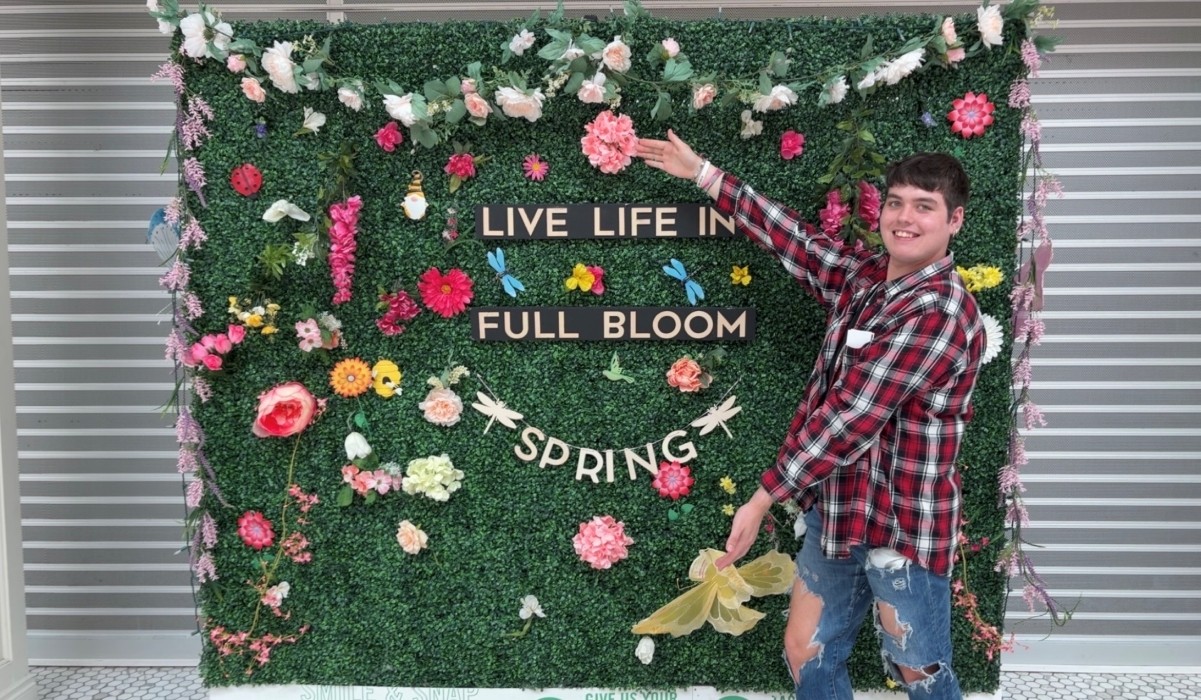
HAVEN 740 FOUNDER REECE JOHNSON STANDS NEXT TO A “LIVE LIFE IN FULL BLOOM” SIGN AT THE LOCAL MALL. /COURTESY REECE JOHNSON
What have you learned through your experiences as a volunteer?
I feel like I’ve learned a lot. I’ve learned that I’m still not done growing. I still have a lot to learn myself. I still have a lot of growth to do. It’s made me realize there are a lot of challenges. You don’t think about all of the challenges that a nonprofit has to face to get an event set up, like talking to the city about whether or not they can do it. You don’t think about all that until you’re actually in that position and you’re doing it yourself. There’s a lot more to it. I definitely say that’s something else that I’ve realized along these paths.
Why is it important for others to get involved with causes they care about?
I think it is important for people to get involved because not only does it show that they have passion, but it also helps show other people that there are people out there doing these things, whether it’s with a nonprofit organization or they’re doing just an Earth Day cleanup on their own. It’s showing that there are people that do care, and it spreads awareness for what they’re doing.
Any advice for people who want to start volunteering?
My advice would definitely be to hop on Google and look for nonprofits in your area, or maybe even go to your local library and check out their bulletin board. A lot of times they’ll put out postings for nonprofits, community organizations, or fundraisers and things that they have going on. There are definitely a lot of different ways that people can get out there. You have to have that drive in you to go do it.
What do you want people to learn from your story?
I would want them to learn that no matter where you come from, no matter what your challenges are or what the background you came from is, you can do it. If you want it done, you can accomplish your goals. You can build your path up to your goals.
Veteran Leads Nonprofit Guiding Heroes from Trauma to Growth
Meet Daily Point of Light Award honoree Allen Scott. Read his story, and nominate an outstanding volunteer or family as a Daily Point of Light.
When Allen Scott’s cousin Rick came home from combat, he did everything he was supposed to do to heal — and still struggled to find help. It took a program at the Boulder Crest Foundation for him to push through post-traumatic stress into what the organization calls post-traumatic growth. But there was nothing like it near home in northeastern Pennsylvania. So in 2021, with Allen’s encouragement and his promise to push him the entire way, Rick founded Heroes Hearthstone, a volunteer-run nonprofit guiding veterans, first responders, and their families from post-traumatic stress toward post-traumatic growth.
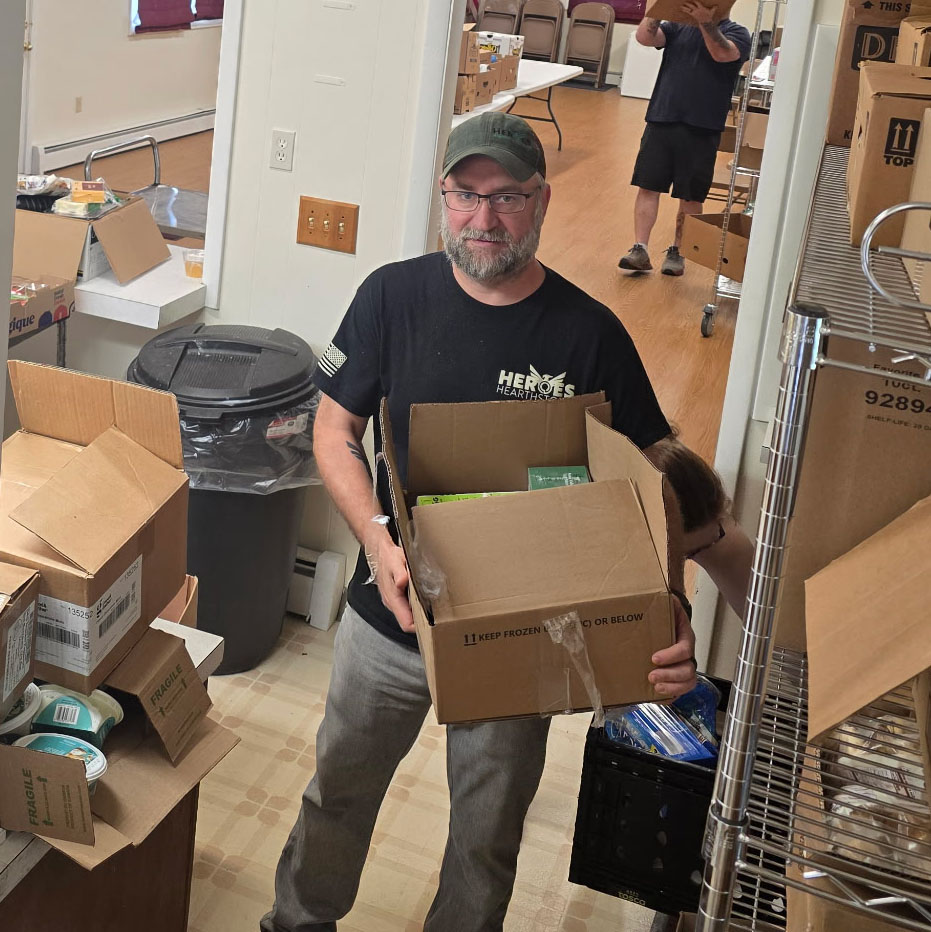
Allen, a veteran himself, has been there since the beginning, first as an executive board member and now as President. He leads the board, serves as the primary contact for community partners like The Luzerne Foundation, delivers programming such as the organization’s Kintsugi Wellness Workshop and manages its Community Goods Distribution Program — weekly pickups of donated goods from a local big-box store that have put more than 1 million pounds of food and supplies into the hands of veterans, a veterans homeless shelter, local food pantries, Lake Lehman High School, and fellow nonprofits such as Mama Bird and Rescue Pets.
Between monthly Campfire and Coffee gatherings, tai chi in the park, visits to a local rehabilitation facility, and a new coffee group for Korean War and Vietnam veterans, Heroes Hearthstone reaches an estimated 100 to 150 veterans in Pennsylvania – with plans to take its programs national.
What inspired you to get involved with Heroes Hearthstone?
Well, I’m a veteran, so that kind of helps — although I was not a combat veteran. Pretty much my whole family joined the military, and the founder of Heroes is my cousin. He was a combat vet. He did all the things he was supposed to do to fix himself and couldn’t get help, then found the Boulder Crest Foundation that was able to help him and pushed through the trials and tribulations of trying to get better from PTSD into what we consider post-traumatic growth. We found out there was nothing like it in our area that could help people, so I said, well, let’s start your own thing, and I’ll be behind you. I’ll push you the entire way, and I’ll help you with whatever I can.
In 2021, he started Heroes Hearthstone, and I helped as much as I could as an executive board member. Come to find out, I don’t have PTSD, but I do suffer from anxiety. So the mission really resonated with me — if he could go start all this, what can I do to help myself as a veteran dealing with anxiety and past traumas? It just really hit home for me. That’s why I got involved and continue to stay involved, and I’m even more involved now.
Allen sorts through donated goods at a food pantry./ Courtesy Allen Scott
How does Heroes Hearthstone build that sense of community for veterans?
A big thing that stems from PTSD is a loss of community. When you’re in the military, you have that brotherhood. Your food, your room, your friends, medical — everything’s taken care of for you. And then when you get out, they kind of drop you like a wet rag, and a lot of people just struggle at that point. So we’re trying to bring back that sense of community. The last Tuesday of every month, we have what we call Campfire and Coffee. Any veteran or first responder who wants to come, come on in, and we welcome you with open arms. It’s a very close group of people at this point, and it’s one of my favorite events — because who doesn’t like sitting around a campfire?
Tell me about the Community Goods Distribution Program.
We partner with a big-box store, and instead of throwing things they pull off their shelves into a dumpster, they give them to us. Every week is different — sometimes it’s food, sometimes it’s baby supplies, snacks, drinks, diapers, paper towels. On the way to the food pantry we partner with, we stop at a veterans homeless shelter that houses upwards of 20 people and drop off what they can use. Then at the pantry, we call all the veterans we can possibly think of, and whatever they need, they take. Our staff and volunteers unload the trailer, sort and organize everything, and the veterans walk through and pick what they need.
Whatever they don’t take, we leave at the pantry so the church can help the local community as well. We also set things aside for other nonprofits around us — dog food, cat food, and litter go to Rescue Pets. Diapers, formula, and kids’ toys go to Mama Bird, which helps moms who are struggling. And we partner with our local high school: snacks for their refreshment breaks, supplies for the school nurse, Gatorade, and water for the sports teams. So we’re not just helping veterans — we’re helping the community as well.
What are some upcoming events or programs you’re excited about?
We’re in the process of developing three different programs, and we’re on the final stretch. Hopefully by the end of the year we’ll have them ready. Our first one coming out is called the Pathfinder program. It’s a 12-week curriculum — once a week, online, or in person — and we’ll work with you either way.
What we’re designing is a peer-to-peer support thing, not a clinical thing. We’re going to be very upfront: hey, we’re not doctors. We’re trying to tell you what helped us get to where we’re at and how our brains are working a little bit better through self-regulation practices — plus things you don’t get taught before you get out of the military, like how to set up a budget. In the first release, we’re going to take 10 or 12 local people through it, tweak the program, and hopefully by the end of next year we’ll be able to offer it to any veteran in the country. The cost will be completely free. We’ll send you the books, the workbooks, everything. You just have to supply us with a DD-214, the Certificate of Release or Discharge from Active Duty.
What’s the most rewarding part of your work?
The smiles on the veterans’ kids’ faces. A lot of veterans who come to the food pantry for help bring their kids with them so they can help too. As we’re loading the trailer, I’m personally looking for lollipops and candy. I found one little girl a headband with cat ears, and I kept it in the trailer so that when I saw her, I could say, hey, I found this for you — and she got a big smile on her face. We got bubble guns last week, so I gave her and her sister each one, and I said, this one’s for your dad so he can shoot back. They all got a kick out of that. It’s for the veterans ultimately, but it’s seeing the kids happy because daddy or mommy is not angry anymore. We give them that decompression time. You’re around veterans and first responders, we know what you’ve gone through, and you can let your guard down and have a little fun with us. The kids see that, and it’s like, oh, okay, this is fun.
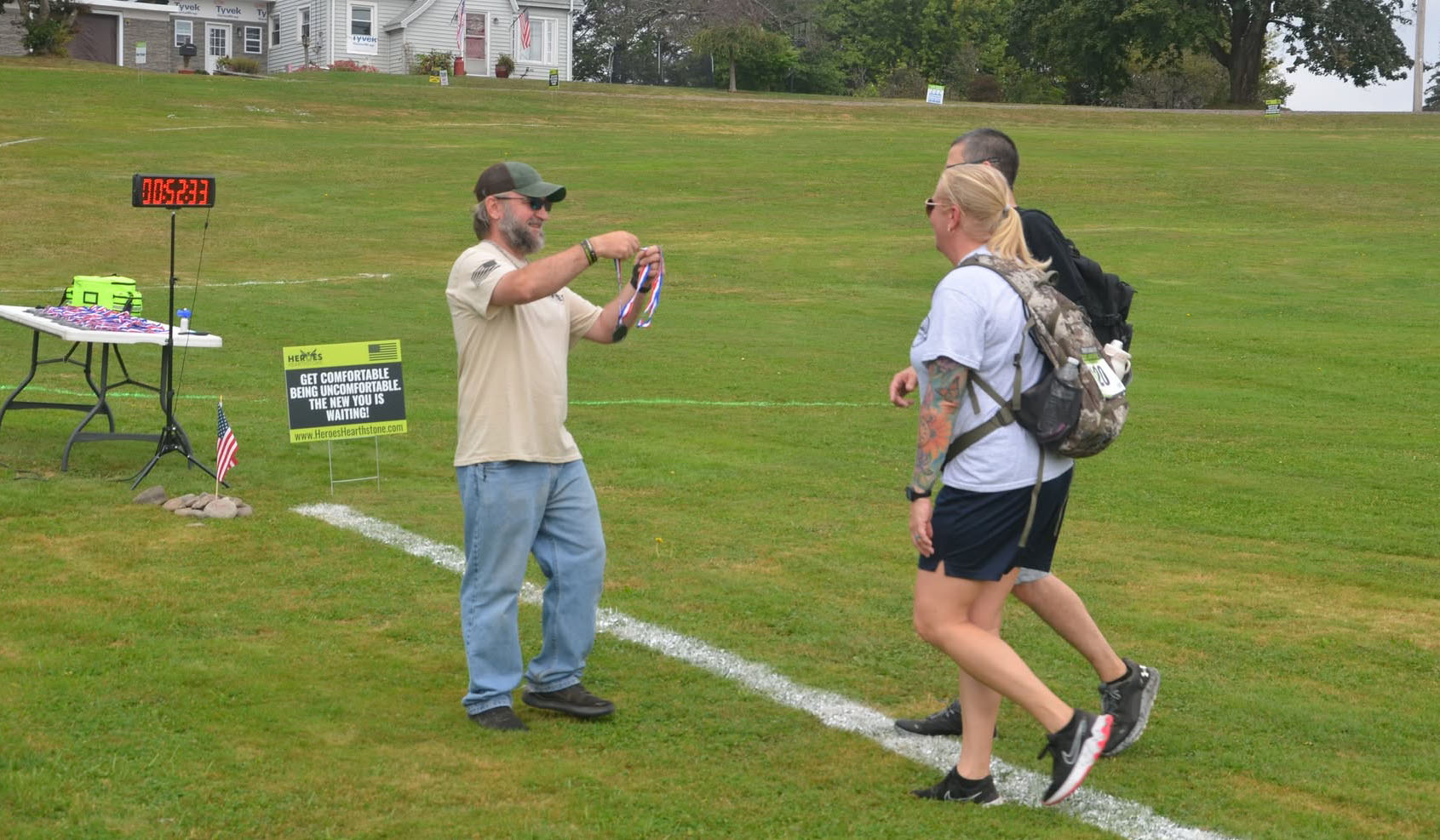
Allen hands out awards to participants at Heroes Hearthstone’s 5K Ruck event./ Courtesy Allen Scott
What are your long-term goals for the organization?
Right now, we’re getting our programming up and going. Once we get through that, we’ll have more of an angle to get the grants we desperately want, so we can get our own brick and mortar. Our big thing is self-regulation, and not one thing works for everyone. I enjoy meditation — I do it every morning for 10 minutes — so we want a Zen garden where you can come do that. If that’s not really your jam and you like archery, we’re going to have an archery range where you can grab a recurve and shoot at the targets. You want a garden? We’re going to have a garden. We want a fully equipped gym. If you’re a veteran, come on in, you’re free. If you’re not a veteran, you can pay a membership, and all the proceeds cover the cost of the veterans who go there for free. Then we can move the food pantry to our location and host our events there, so we can grow our community with a home base. That’s our five-to-10-year plan.
Why do you think it’s important for people to get involved with causes they care about?
If they don’t, who will? If you feel strongly about something, you should get involved in it, because it’ll give you that sense of community and that sense of purpose. For me, it’s the veterans — that’s who I am. I am a veteran, and that’s who I want to help. My wife is a mother, and that’s how we got involved with Mama Bird. If you have a purpose and you feel passionate about it, you’re going to do whatever you can. As you get older, you realize community means more than things. Just being a part of that community is what drives me.
What do you hope people take away from your story?
I just want to bring more awareness to PTSD — and post-traumatic growth is the better way to describe it. You’re only going to get out what you put in. If you want to get better, it’s going to take work.
Meet Daily Point of Light Award honoree Greg Carafallo. Read his story, and nominate an outstanding volunteer or family as a Daily Point of Light.
Once a corporate employee, 66-year-old Greg Carafello has been a small business owner and entrepreneur for nearly 45 years. He has started seven businesses over the course of his career, one of which was on the 18th floor of the south tower of the World Trade Center on September 11, 2001. Greg and his employees survived that day, but his lifelong best friend, James Martello, who also worked in the building, never made it home.
Not long after it opened 14 years ago, Greg started volunteering at the 9/11 Memorial and Museum, going through extensive training before serving over 1,550 hours. As a museum docent, he walks visitors from all over the world through the museum, giving context to exhibits and answering questions.
His dedication inspired his oldest child to visit the week it opened and his youngest to follow in his docent footsteps as a high schooler. They’re a tight knit family, and two of his four kids are now in business with him. Greg still owns three different companies, and every other Friday, he remains committed to sharing information about the day that changed everything. Today, when he’s working, he sits on the 85th floor of One World Trade Center, the building he once fled, just a short walk from the museum and memorial that quiets his mind and brings him peace. Greg will always remember, and thanks in part to him, so will the rest of the world.
What inspires you to volunteer?
My father volunteered. He coached and helped out with various things. I’ve been coaching football since my early twenties, though not continuously. I also coached lacrosse for about 14 years and baseball in between. I’ve always given business classes at colleges–how to franchise, run a business, sell a business–and helped certain professors out. I was also on the board of the Independent College Fund of New Jersey that generated about $3 million in scholarships. As much as you give, you get back in spades, and I try to give as much as I can.
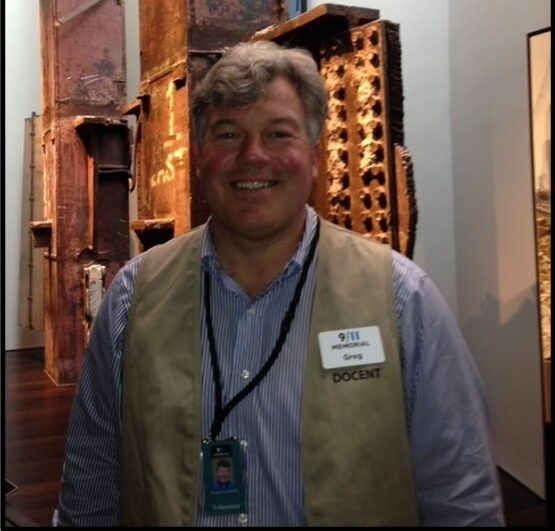
A survivor of 9/11, Greg now volunteers as a docent with the 9/11 Memorial and Museum.
Tell us about your volunteer role with the National 9/11 Memorial & Museum.
I started in September 2012. As a museum docent, my job is to teach visitors what happened that day and about all the artifacts. We’re educators, so we want to make sure that we’re accurate.
Training was four hours every Sunday for five months, and then it was four hours of study after that, special events, field trips, and tests. It was hard. The museum wasn’t open when our class went into the docent program, so we were working from books and pictures and having special investigators coming in from the FBI and CIA. Some photos were being released for the first time.
I volunteer in the museum all morning until about 1 pm, then I visit one or two schools around New York City and the outskirts to educate people with a short presentation. I go to Jersey City, too, where my wife is a teacher.
For years, I volunteered every Friday, but since COVID, it’s been every other Friday. And we fill in when we can–special events or whatever else is needed. We all support and learn from each other. We’ll shadow, listen, and advise. There’s a very high level of professionalism and respect for the environment.
What inspired you to get started with this initiative?
I’m a survivor of 9/11; I was in the building that day. There were 407 tenants or businesses in the seven buildings of the World Trade Center campus, and my digital printing company was one of them. We’d been in business for 14 or 15 years. Thankfully, most of my employees were not in, and the one who was got out safely.
For a long time, I had zero interest in going back to Manhattan at all, but in 2007, I bought a business there. Then, I started volunteering and engaging myself more and more, and when I had the ability to sign a lease back in the building in May 2015, I did. I’m still the only business tenant from 9/11 to return to the Trade Center.
When the opportunity to volunteer at the memorial came about, I felt the pull to go back. There are seven of us together almost every Friday. We call ourselves Friday’s Finest and have become very close friends.
It’s been 25 years since the attack. There are generations who don’t know the details. I provide context and help people understand what happened. And it’s cathartic. It gives me a chance to digest that day and the pain, suffering, and loss.
What’s been the most rewarding part of your work?
For four or five hours every week or two, I’m completely engrossed in presenting the proper information and in a way that isn’t overwhelming. I don’t think about work or anything else. I’m disconnected. It’s wonderful.
What have you learned through your experiences as a volunteer?
There are so many people that really care about doing a good job as volunteers. I’ve also learned that, as a social mechanism for people as they get older, it’s something that everyone should do in some capacity.
The rewards of volunteering are huge. My wife has been a Girl Scout leader for 35 years. We both volunteer. It’s part of life. It’s the quality of life it allows you to live.
What do you want people to learn from your story?
No matter how busy you are, dedicating yourself to a volunteer initiative like this is healthy. To commit yourself to something that is an educational resource like this, that allows you to not do anything but think about this, is extremely rewarding internally.
We just want to continue to make sure people understand that freedom is not free. People pay the price. It’s normally warriors, but on this day, it was just people going to work.
A Movement Found at the Intersection of STEM and Service
Meet Daily Point of Light Award honoree Adhya Garlapati. Read her story, and nominate an outstanding volunteer or family as a Daily Point of Light.
For Adhya Garlapati, service was never a box to check. It began in childhood, when she tagged along to community events and environmental projects and discovered that every act of helping came bundled with a lesson about leadership, teamwork, and what it means to get involved. Those early experiences shaped a conviction that would eventually take institutional form: that young people don’t just have to imagine a better community, they can build one. That belief became the foundation of the 4C STEM Club, a student-led 501(c)(3) nonprofit Adhya founded to help students turn ideas into action.
At the heart of the organization is a simple but ambitious premise: that STEM education and community service belong together. Adhya designed the club to integrate scientific learning with environmental sustainability and hands-on outreach, and she runs nearly every gear of the operation herself, from planning workshops to coordinating events, from mentoring student volunteers to developing curriculum, from fundraising to managing partnerships with schools and community organizations.
Over three years, that work has added up in striking ways. The club has reached more than 4,500 individuals, delivered over 630 STEM learning hours, facilitated 385-plus hours of leadership and engagement, hosted more than 200 events, and raised over $20,400 to fuel its programs. The club’s environmental flagship, Project EcoCatalyst 360, is where Adhya’s vision becomes especially tangible. Through it, she and her volunteers have repurposed more than 40,000 pill bottles for recycling and medical reuse, collected over 1,500 pairs of shoes, and distributed more than 2,000 native plant seed packets to encourage local ecological restoration. She also established a community library stocked with over 10,000 books, an enduring resource that will outlast any single event. Beyond her own organization, Adhya volunteers roughly 25 hours a month and lends her time to the Buffalo Grove Environmental Action Team, the Buffalo Grove Prairie Guardians, the Park District, and the local Farmers Market, weaving herself into the fabric of the community she serves.
That combination of vision and follow-through has drawn recognition, including the Caring Community Award from the Village of Buffalo Grove and consecutive years of national volunteer service honors. But the numbers and accolades tell only part of the story. What distinguishes Adhya is the way she has turned personal passion into a scalable engine that mentors the next generation of volunteers even as it plants seeds, stocks shelves, and cleans up the environment. Her goal is to keep creating opportunities that empower young people to use STEM and service together, proving again and again that meaningful change is something students can lead, not just wait for.
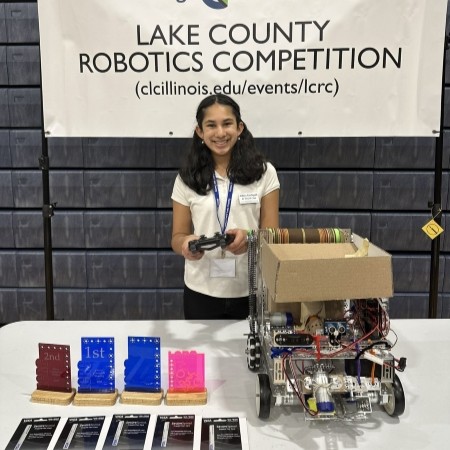
Adhya shows off a robot she built at the Lake County Robotics Competition.
Tell us about your volunteer role and organization.
I’m the founder of 4C STEM Club, a student-led nonprofit organization dedicated to making STEM education accessible while encouraging young people to use their knowledge to solve real-world problems through community service. As a part of our club’s executive board, me and my team organize STEM workshops, educational events, science fairs, environmental projects, and service initiatives that inspire students to become leaders in their communities.
Outside of the club, I lead several environmental service projects. Since 2022, I have organized the collection of more than 60,000 used prescription pill bottles for medical reuse programs and over 2,000 pairs of shoes that support people in need while also helping fund tree-planting efforts. I have also led native seed collection, distributed milkweed seeds to support monarch butterflies, participated in prairie restoration projects, and educated community members about environmental sustainability. Through every project, my goal is to combine leadership and service to create a meaningful and lasting impact.
Why is this issue so important to you?
Ever since I was young, I have enjoyed volunteering because it allows me to make a difference while learning from every experience. I believe that STEM should not only be about discovering new technologies; it should also be about improving our communities and protecting our environment.
Environmental sustainability is especially important to me because the choices we make today affect future generations. Whether it’s reducing waste, protecting wildlife, or encouraging recycling, I believe even small actions can create a lasting impact when people work together.
What inspired you to get started with this initiative?
My passion grew through both my love of STEM and my volunteer experiences. As I learned more about environmental challenges, I realized that many problems could be addressed through simple community actions. Instead of waiting for someone else to solve these issues, I wanted to help create solutions.
Starting the 4C STEM Club gave me an opportunity to combine STEM education with community service. I wanted to show other students that they don’t have to wait until they’re adults to make a difference. They can start today by using their ideas, creativity, and compassion.
What are your long-term plans or goals for the organization?
My long-term goal for the 4C STEM Club is to inspire and educate as many students as possible by making STEM learning accessible, engaging, and meaningful. I want to give more children in the community the opportunity to explore science, technology, engineering, and math through hands-on experiences that spark curiosity and build confidence. I hope to help students discover a passion for STEM, develop leadership skills, and realize that they can use their knowledge to make a positive impact in their communities.
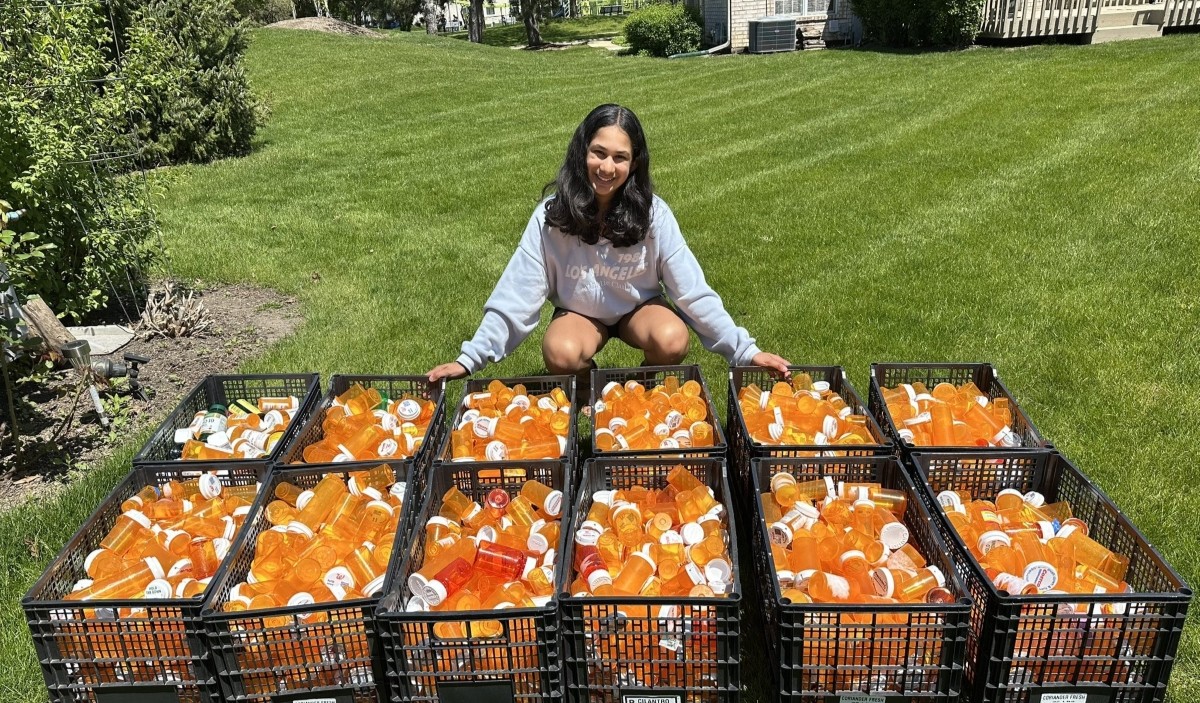
Adhya poses with pill bottles she and fellow volunteers have collected for recycling and medical reuse.
Tell us about future partnerships, programs or events that you are excited about.
One partnership is our recent collaboration with the Buffalo Grove Park District on the Buffalo Grove STEM Expo. It was an incredible experience to see students, families, educators, and community members come together to celebrate STEM learning. The event was a tremendous success. Looking ahead, I’m excited to build on that momentum by collaborating with more park districts, villages, and nonprofit organizations to create additional STEM events, workshops, and community service opportunities.
What have you learned through your experiences as a volunteer?
Volunteering has taught me that leadership begins with service. I’ve learned how to communicate with people from different backgrounds, organize projects, solve unexpected challenges, and work as part of a team. Most importantly, I’ve learned that meaningful change doesn’t always require huge resources. It starts with one person willing to take the first step. Every volunteer, every project, and every small act of kindness can inspire others to get involved.
What’s been the most rewarding part of your work?
The most rewarding part of my work has been seeing students discover a passion for STEM that they never knew they had. It’s incredibly meaningful to watch them become more curious, build confidence through hands-on learning, and develop an interest in science and technology that could even lead to a future career they had never considered before. Seeing students grow, ask questions, and become excited about learning reminds me why this work is so important.
It’s also incredibly rewarding to see community members visit our booths and events, learn something new, and become more informed about STEM and the impact it can have on everyday life. Knowing that our programs inspire both students and families is something I’m truly proud of, and it motivates me to continue creating opportunities that make STEM accessible and exciting for everyone.
It’s also rewarding to see our environmental initiatives grow. Knowing that thousands of pill bottles and shoes have been diverted from landfills while helping people in need reminds me that even simple ideas can have a significant impact when a community comes together.
Why is it important for others to get involved with causes they care about?
When people volunteer for causes they genuinely care about, they’re more likely to stay committed and inspire others to join them. Communities become stronger when everyone contributes their unique skills and passions. No matter your age, your contribution matters. Whether you volunteer for one hour or hundreds of hours, your actions can positively impact someone else’s life and encourage others to do the same.
Any advice for people who want to start volunteering?
Start with something you’re passionate about. You don’t need to create a huge organization or lead a major project on day one. Begin with one small act of service, learn from the experience, and continue building from there.
Don’t be afraid to ask questions, work with mentors, and collaborate with others. Some of the best opportunities come from simply saying “yes” to helping. Every volunteer starts somewhere, and every small effort has the potential to grow into something much bigger than you ever imagined.
Meet Daily Point of Light Award honoree Emily Jankowski. Read her story, and nominate an outstanding volunteer or family as a Daily Point of Light.
Aside from wreaking medical havoc, the COVID-19 pandemic increased food insecurity across the country. Often an invisible problem, it can be difficult to know who is struggling, and who is one missed paycheck or one hospital visit from being unable to afford groceries. So when Emily Jankowski learned that a child at her son’s elementary school hadn’t been getting enough food, she was surprised. In an area where most people live comfortably, it wasn’t an issue she was aware of. After speaking to school and local nonprofit leaders, she decided to do something about it.
Soliciting the help of her company’s volunteer engagement leaders, she got connected with the United Way of Bay County, the Food Bank of Eastern Michigan, local leaders and volunteers. Together, they’ve put on 12 food distributions in the past three years, supporting an average of 150 families.
Emily uses her logistics skills from her role at Dow to organize details and oversee 35 to 40 volunteers at each event, 50 during winter distributions due to the change in locale. Most come back repeatedly, and nearly all are from Dow, including Emily’s husband. Together, the couple joins coworkers to give families a reprieve when they need it most.
Emily Jankowki leads a food distribution event that helps an average of 150 families.
What inspired you to get started with this initiative?
I went to pick my oldest up from school for a doctor’s appointment. When I was waiting in the office, Carol, an administrator, asked a little girl who had just been dropped off if she’d eaten yet that day, and she said no. It was 1 o’clock in the afternoon.
I couldn’t stop thinking about it, so I called Carol, and she told me some children’s only meals during the day are the ones they get from school. I went to Costco and grabbed some things for the school to have for them. I talked to the principal, who mentioned families were struggling after COVID.
Due to certain rules, I couldn’t give money, because the school would lose their funding. There has to be a nonprofit involved. We have employee engagement programs at Dow, and, through them, I got in touch with the United Way and talked through the need in the area with the president.
I learned about the ALICE (Asset Limited, Income Constrained, Employed) population, the number of people facing poverty, and those who are unhoused. We talked through their options to get food and how at some places, you have to give invasive information about yourself to get access. Sometimes people don’t get food they need due to pride, so I wanted to find a way that felt safer, with no questions asked.
Tell us about your food distributions.
I’m the organizer. In the beginning, we’d had many meetings to talk through logistics. Now, we’re a well-oiled machine. I pick a date revolving around school breaks, so we can cover periods when school food is unavailable. Sometimes, we’ll do it for the back-to-school season so parents can focus on school supplies or new clothes for their kids without worrying about how they’ll get groceries.
The city has graciously allowed us to put on the event for free and helps us prepare. City employees set up traffic cones and get the tables ready, and the United Way works with the food bank to organize food delivery. I put out the request for the volunteers, sign them up and direct them. I send them prep emails ahead of time: whether we need wagons, cars to take recycling to the recycling center, and so forth.
The food bank truck drops food off, and our volunteer manager from Dow calculates how many of each item we can give people. Volunteers place items on the tables and bring wagons through to fill up. If we have leftover food, we take it to local pantries. Then, I follow up with volunteers to thank them.
What are your long-term plans or goals for the organization?
I’d like to engage more with the school about other ways we can help. For a while, we put together discrete hygiene bags for children filled with items the school nurse pinpointed as needed. We even branched out to other elementary schools in the district. Unfortunately, after two or three rounds distributing around 100 bags each time, we weren’t getting enough donations to continue. I think we need to revisit that.
What have you learned from your experiences as a volunteer?
There’s a mindset shift that happens when you participate in something like this. I initially went into this angry that someone would let children be in a situation of need. I’ve since learned that not everybody has the support that they need to break the cycle.
I needed help in my earlier adulthood, but I had family to rely on. Some people are also trying to support their parents, grandparents, or extended family. They’re the ones being relied upon.
What’s been the most rewarding part of your work?
I feel more connected with my community and like we’re making a difference. The school has brought me other opportunities, too. It feels great that they know they can come to me. Why is it important for others to get involved with causes they care about? Not everybody’s willing to do it. We all need to help each other out. If you can help somebody get to the level where they no longer need help, it changes their life forever. That’s what we should be striving for.
What do you want people to learn from your story?
Assume people have good intentions. We’ve had people come through in fancy cars, and I heard whisperings, only to find out later that they’re an in-home care nurse taking food to their patient. Or, it’s somebody who just lost their job after getting this new car. Now, they don’t have health insurance, and it would just help them to have a fridge full of food.
That’s the whole point: if you feel like you need the help, come get the help.
Building “Core Memories” and Leadership for Foster Youth
Meet Daily Point of Light Award honoree Nate Gonzalez. Read his story, and nominate an outstanding volunteer or family as a Daily Point of Light.
At just 7 years old, Nate Gonzalez looked at the world around him and saw an opportunity to bring joy to children navigating the foster care system. Now 12 years old—and preparing to celebrate his 13th birthday this October—the Texas native has spent nearly half his life building a powerful movement rooted in a beautifully simple philosophy: kids helping kids. The movement has since blossomed into Nate’s Next Kid Up, a thriving nonprofit organization that now serves more than 5,000 children annually. From its roots in the Coastal Bend, the organization has expanded its reach across the Lone Star State, bringing vital resources and unforgettable experiences to youth in Houston, San Antonio, Dallas-Fort Worth, and the Rio Grande Valley.
As the founder and CEO of the organization, Nate balances life as a student with dedicating 40 to 60 hours each month to volunteering, a commitment that spikes even higher during holiday drives and major events. His hands-on leadership keeps the organization running, from coordinating volunteers and fundraising to planning community service projects and organizing massive donation drives. His efforts have earned him significant recognition, including being named the youngest honoree in the Corpus Christi Under 40 program, as well as the youngest recipient—and the first ever from his region—to receive the Texas Department of Family and Protective Services Commissioner’s Excellence Award.
Among the organization’s most impactful initiatives is the Foster Road Trip Program, which has helped take more than 700 children in foster care to their first Major League Baseball game or on educational adventures to destinations like zoos and NASA. In a single year, Nate completely removed financial barriers for 100 foster youth by coordinating a massive trip to Houston, managing every detail from transportation and meals to activities and goodie bags. For Nate, these excursions are about more than just a day out; they’re about creating “core memories” and inspiring children to dream bigger about their futures. These travel experiences are paired with large-scale seasonal efforts, including the back-to-school “Stuff the Pack” school supply giveaways, Dream Big Movie Nights, and the Dream Big Christmas toy drives.
Looking ahead, the young leader is expanding his vision of youth empowerment by working to launch the Nate’s Next Kid Up Youth Leadership Academy, an initiative designed to teach young people how to become leaders through community service. His passion for youth advocacy also extends to his role as a spark leader for GivingTuesday, where he encourages kindness, generosity, and volunteerism among his peers. While the state awards and regional accolades speak to the magnitude of his impact, Nate remains anchored to his core mission. For him, the greatest reward will always be seeing a child smile, gain confidence, and realize that no matter where they come from or what challenges they face, their dreams truly matter.
Nate Gonzalez CEO, Founder of Nate’s Next Kid Up
Tell us about your volunteer role and organization.
I have my own nonprofit called Nate’s Next Kid Up. What I do is help children in foster care and kids within the community through different events and programs. Our biggest program is called Nate’s Foster Road Trip, where we take at least 100 children in foster care to their first MLB game. We actually took them to NASA last year, and this year we just took them to the Astros and also the Alamo. Overall, last year we helped over 700 kids.
What inspired you to get started with this initiative?
When I was 7 years old, during COVID, it was Christmastime, the time of giving. I wanted to contribute to my community because I kept seeing kids in the hospital who couldn’t be with their friends, family, people they love, or even their pets. I told my parents about this, and they said that children in foster care are a great example of that. So I said I wanted to help them. Then we had our first toy drive, and we collected over 200 toys and sports equipment. It just kept progressing from there. Last year we actually got 10,000 toys, and we keep on growing. This is our sixth year doing this, and we’re excited. What are your long-term plans or goals for the organization? Long term, I just want to put a smile on the faces of children in foster care. I want to be someone they can trust and talk to about any problems, and I just want them to feel like they have someone there. I also want to grow this nonprofit bigger.
We have our Dream Big Center, which is technically a distribution center. It’s a safe place for children in foster care and kids who just want to have fun. We let them pick out a toy that they want and we get to see their smiles. We have already grown out of it, so we want to get our Dream Big Center bigger and spread the word.
Tell us about future partnerships, programs or events that you are excited about.
We’re having the MLB Pitch Hit & Run. It’s at Whataburger Field here in Corpus Christi. This is a big game-changer for the nonprofit because we get to help kids within the community by supporting their interests, like baseball and softball, and just letting them have fun.
We also recently helped schools that were shutting down in our community. We actually gave toys to all the children at the school from pre-K to fifth grade. That was about 3,000 kids.
What have you learned through your experiences as a volunteer?
We always learn through several of our events and programs. We usually learn what is best for the kids, like activities and prizes. We also learn how to bring the right energy around the kids; we technically want the area to be happy and just joyful for them. Every single event that we do teaches us something, and what we have learned throughout the years is that we always want to make an area safe for them while making sure they have fun at the exact same time.
Why is it important for kids in the foster care system to have these experiences?
We want them to have fun and we want them to have their own adventures and their own experiences. That’s why we have our Road Trip, where we take the children in foster care to their first MLB game, or to their first NASA trip or Alamo trip. We always want them to have fun. We provide breakfast, lunch, and dinner. It’s all for the kids.
What’s been the most rewarding part of your work?
Just seeing them smile at the end of the day, and just knowing that you have helped someone who needed help.
I met this boy who was about 7 years old. He invited me to his birthday party, so we asked the people who were taking care of him, and they said, “Yes, you can join the birthday party.” We got toys to give to all the kids who were going to be at his party. He gave me a hug and started tearing up. That’s why it’s worth helping kids. You can always do better every single day. I choose to do better, and that has gotten me here so far. I want to keep on doing it.
Why is it important for others to get involved with causes they care about?
It’s great to help other people just to show how you express your feelings, but also to show that you care about someone other than yourself. It’s just good to see other people follow their interests and help. Seeing a kid smile is a big dream of mine, and it makes me want to continue my mission. I want other people to continue their mission of helping other kids and pursuing their dream of doing something bigger than themselves.
That’s what we do at Nate’s Next Kid Up. It just started with one dream, and it led to hundreds, even thousands. It takes a village—maybe a whole city—to just make that one spark light up into a blazing fire. We did that in my community, and we have made a big difference in other children’s lives. I’ve seen some children who are just a few years old and they’re already in foster care, and it just made me want to help more.
Any advice for people who want to start volunteering?
I would just say to follow your heart. Follow your heart, and if you like it, then keep on doing it because it can grow. The amount of kids that you can help just grows and grows, and that has been an eye-opener for me and other people. It starts with you wanting to help. Seeing these kids smile really just lightens up my day. Every single time that I see a child in foster care smile, it is heartwarming.