And while there is a lever that can boost a girl’s earning potential by 20 percent later in life, it remains out of reach for many – one additional year of education.
We still have a long way to go for gender equality.
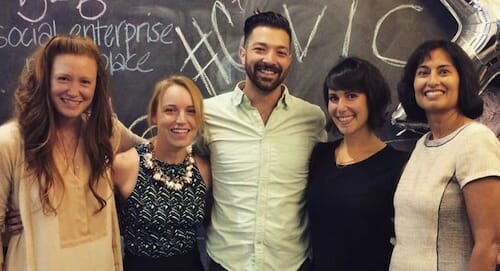
Megan Christenson, Points of Light Civic Accelerator; Jill Carey, Mission Propelle; Ben Fischer, Move This World; Annie Warshaw, Mission Propelle; Ayesha Khanna, Points of Light Civic Accelerator
With that landscape in mind, the Points of Light Civic Accelerator – a 10-week, boot-camp-style program for startups that address critical social problems – adopted a gender lens for our spring 2015 program. All 13 participants work to create greater opportunities for women and girls to succeed in today’s economy.
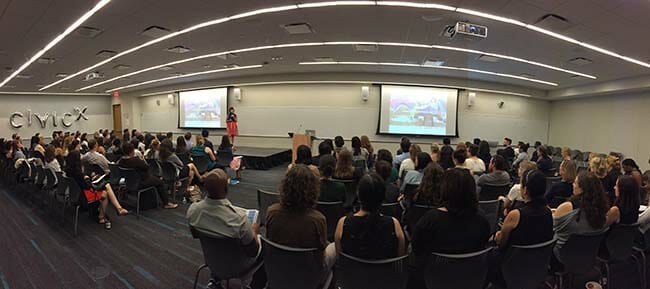
As we celebrated the close of the spring program at the Microsoft Technology Center in New York – the lights of Times Square sparkling through the windows – the Civic Accelerator teams pitched their ideas to about 200 sponsors, mentors, investors and other supporters. It was an inspiring night.
At the end of each Civic Accelerator session, the participants choose two ventures from the group, one nonprofit and one for-profit, to each receive a $50,000 investment. Shortly after the Times Square gathering, those investments went to Chicago-based
, a New York-based nonprofit that harnesses the power of creative expression to foster safe and supported learning environments.
The commitment of these startups to social issues gets to the heart of why Points of Light created the Civic Accelerator. The program launched in the fall of 2012 with the intention of building new civic solutions: finding new ways people are leveraging technology and using their time, talent, money/purchasing power and voice to drive change.
Whereas technology and changing norms are important, it is the power of people acting collectively that is going to move the needle. It is this intersection of business and purpose where true innovations are happening. Points of Light is excited to be contributing new solutions as we collectively build a purpose-focused economy with our corporate and community partners around the country.
, have helped 74 civic ventures graduate from our startup boot-camp and investment fund.
The Civic Accelerator provides these and other corporate partners a unique way to engage their employees – and often their leadership – to offer strategic guidance, business planning and more as mentors and advisers. While themselves building skills from the experience, these professionals also offer the ventures corporate assets to support growth and impact.
“Most accelerators we spoke with focused solely on tech,” said Annie Warshaw, founder of Mission Propelle (formerly Smarty Pants Yoga), one of the spring 2015 Civic Accelerator participants that received a $50,000 investment. (She’s presenting in the photo at top.) “The Civic Accelerator recognizes the power of citizen action and scaling models that include – but are not reliant on – technology alone. We found that really compelling.”
We believe this is what makes the Civic Accelerator fundamentally different from other innovation and accelerator programs. We have been intentional in our design to attract diverse founders and incorporate peer learning and evaluation, with a nod to one of our founding partners,
, which began testing the peer investment approach five years ago.
Most importantly, our biggest differentiator and impact is that we are lifting up and accelerating new civic solutions and 150 civic innovators – from those 74 ventures – who are tackling social issues in new ways that are sustainable and scalable.
We are also targeting issues in depth – such as our recent focus on economic opportunities and access for women and girls – to achieve deeper and more systemic insights and solutions.
We believe driving more citizen action is where the magic lies for long-term change. We look forward to propelling many more ventures focused on critical and pressing social issues that require disruptive and new thinking and working models to get real results.
With Her Knitting Needles, This Young Hero Helps Women in Extreme Poverty Earn a Living
Before KidKnits, prospects weren’t good for a Rwandan woman named Catherine.
Widowed in the 1994 Rwanda genocide, the young mother suffered from HIV. Though the Rwandan government provided medicine to treat the condition, she couldn’t take it without food, and she couldn’t afford much food.
“A lot of people there only eat every two to three days. Pay for a full day’s work might be a cucumber or a potato,” said Ellie Zika, 14, who was 9 years old when she founded KidKnits, a not-for-profit company that sells knitting kits and yarn. She is the daughter of Steve and Kristin Zika of Peoria.
Today, Catherine spins yarn for KidKnits. She makes about $55 a month, an above-average salary for most Rwandans.
This Teen Will Paint Your Pet to Save Other Animals’ Lives
This post is by Annie Blumenfeld, a 17-year-old from Connecticut and founder of Wags 4 Hope, an organization that supports animal shelters and rescue groups.
One day after coming home from a soccer tournament, my mom told me that she wanted to get a new dog. I was ecstatic.
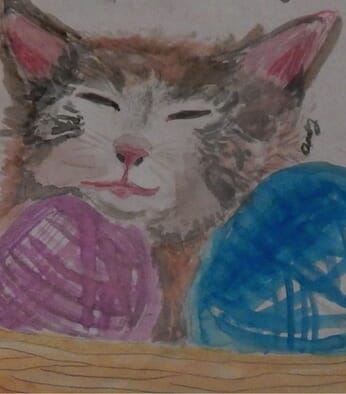
Wags 4 Hope painting by Annie Blumenfeld
It wasn’t a simple love story at first.
Although our new dog, Teddy, looked dazzling when he arrived to our home, he had heartworm disease – a disease that is transmitted from an infected mosquito, which produces larva that grows in the dog’s heart, lungs and surrounding blood vessels.
Teddy was in a cage for more than a month after being treated. After hearing more about his back story, I went online to research heartworm disease.
Being 14 at the time, I had heard of issues in the animal-welfare world, ranging from “adopt, don’t shop” to animal testing, but was unfamiliar with the disease.
I learned from Teddy’s amazing rescuer, Kathy Wetmore of the Houston-based Shaggy Dog Rescue, that heartworm disease runs rampant in shelters in Texas.
I discovered that animals with heartworm disease are often euthanized, due to the cost of the treatment (ranging from about $600 for a small dog to $2,000 for a larger dog) and the amount of time it takes to treat these animals (anywhere from a month to four months depending on the severity).
Wags 4 Hope painting by Annie Blumenfeld
A few days after Teddy’s rescue, a sheepdog painting that I did was selected for a local art show. As I walked into the display room, there were a few people around my painting.
One nice lady approached me and asked if I was the artist. She told me that she wanted to buy the painting and then her friend asked if I painted other dogs. On the car ride home, Wags 4 Hope was formed.
My organization, Wags 4 Hope, works to support shelter animals’ medical needs and spread heartworm disease awareness. I sell custom dog and cat portraits and give all of the proceeds to shelters and rescue groups.
For more than a year, I worked with the Connecticut Department of Agriculture, sharing my story and advocating for a change to be made on the dog license: I wanted a heartworm disease educational message to be featured on it. I believed this would be such an incredible channel to bring awareness to pet owners across the state.
I’m happy to say that the Connecticut dog license now includes a heartworm message! The state agriculture department ordered 100,000 copies, which are available in vet offices, town halls and online statewide.
If you are a part of an animal advocacy group, or if you can write a letter to your state representative after hearing about this idea, please do so. Imagine how many dogs could be saved from having this disease by having this change done in your state.
6 Ways the Internet Has Changed How You Can Volunteer and Give
This post is by Sarah Landrum, a freelance writer and founder of Punched Clocks, a site on which she shares advice on finding career happiness and success.
Volunteering isn’t what it used to be and that’s a good thing. More nonprofits are modernizing and utilizing the Internet. Whether it’s stay-at-home volunteer work or detailed listings of volunteer opportunities, both nonprofits and potential volunteers are benefitting. Here are six ways the Internet is changing how you can volunteer for and give to nonprofits.
1. Makes It Easy to Find Opportunities
Not too long ago, nonprofit organizations relied on word-of-mouth and newspaper listings to find potential volunteers. Now, through a number of websites, you can search for volunteer opportunities by your location and the causes that most interest you.
AllforGood.org, a Points of Light website, is one of the biggest sites that connect volunteers with organizations looking for help. You can find opportunities from thousands of organizations big and small, touching on a vast array of issues.
2. Raises Awareness About Organizations
If you are looking to contribute your valuable time to a cause, you’d probably like to know what kind of difference an organization is making. What was once difficult to assess is easier to determine, thanks to a wealth of online resources. Sites like GuideStar rate charities based on their transparency and finances, while highlighting dubious organizations.
3. Allows More People to Help From Home
Some volunteers don’t need to leave home to help. Thanks to tools like Google Docs, Skype and Facetime, volunteers can contribute in meaningful ways without having to show up to the office.
Organizations of all shapes and sizes are welcoming online-only volunteers to help contribute – from grant writers to mentors to web developers. (On AllforGood.org, click “More Options” when doing your search, and check the “Virtual opportunities” box.)
4. Allows Crowdsourcing to Make a Difference
The British Museum had a problem. With limited resources and 30,000 catalogue cards that needed to be transcribed, its staff soon found a solution: crowdsourcing. They turned to their online supporters – a virtual crowd – to help.
The information has been invaluable, and volunteers are also contributing digital photographs of ancient, Bronze Age artifacts that can be used to freely print 3D copies of the items. “Opening the treasures of the Bronze Age to the widest public is why I get up,” said the museum’s curator in The Guardian.
Many organizations are turning to the wisdom of the crowd, and volunteers with interests in the project can easily help.
5. Empowers Supporters
Nonprofit organizations are ditching old-fashioned mailers and expanding their online presence to raise funds. Through social media campaigns and crowdfunding, supporters are better able to help their favorite causes.
Online crowdfunding allows dedicated supporters to actively obtain support from their friends who would otherwise not donate. Plus, the ability to donate online saves time and makes it easier to give.
In the past, volunteers and donors had to make an effort to help, whether donating their time or sending a check. Thanks to sites like Amazon Smile and eBay, part of the purchase price is donated to organizations chosen by the buyer and/or seller, allowing the consumer to easily help out. Sometimes making an impact requires doing just a little.
How has your volunteer or giving experience changed, thanks to the Internet? Let us know on Facebook or Twitter.
How Tackling Personal Finances Helped One Entrepreneur Take Charge
When Makeda Perryman was getting ready to launch her life coaching business, she never thought that when it came to finances, she might need some coaching herself.
Makeda Perryman (Photo by Naim Hasan Photography)
While she had some student loan and credit card debt, Perryman said she was not worried about money because she had multiple streams of income through her work as a tax preparation specialist, artist, dancer and now her burgeoning life coaching firm.
“I was totally avoidant and resistant because it’s something that I don’t think too much about,” she said.
The Financial Opportunity Corps is an innovative coaching program powered by Points of Light, Bank of America and the Corporation for National and Community Service. Together, the organizations are mobilizing AmeriCorps VISTA members and community volunteers to deliver free financial coaching and asset-building services in economically disadvantaged communities around the United States.
Volunteer coaches receive specialized training and strategies to help clients refine objectives and build healthy financial habits to reach their goals.
Erin Marcoccia
Perryman was partnered with Erin Marcoccia, and they began meeting two Saturdays a month at their local library. During the first meetings, they calculated Perryman’s debt, explored her income and discussed her short- and long-term personal and business goals.
“When we started actually crunching numbers it was very clear to me that this was an opportunity that was just invaluable,” Perryman said. “I was like, ‘Oh, I have how many digits of debt?’”
She added: “There is this really big feeling of relief that comes from actually telling someone, ‘I owe this much money with student loans and credit card debt’ – to actually say that out loud and not feel judged at all and not have to justify it.”
While discussing money can be uncomfortable, Perryman said those feelings quickly dissipated because she knew Marcoccia was there to help.
“I can really empathize with the people I work with because I’ve been there and I understand what they are going through,” said Marcoccia. “My husband and I have been in a situation where I had been laid off and I didn’t qualify for unemployment. We were just living off of his paycheck and it just felt like the apocalypse was happening. So, when you crawl your way out of that, it feels rewarding.”
Marcoccia served as a sounding board as Perryman vocalized her challenges and together they mapped out a plan.
“Everyone’s situation is really different, so it’s nice that someone can sit down and take your situation for what it is and then help you to figure out what is next,” Perryman said.
Immediately, Perryman opened a savings account and now has a percentage of her pay directly deposited into it each week. She is also taking advantage of student loan deferment programs and paying down her credit cards each month. She makes it a habit to check in on her finances regularly.
The new habits and accountability have been key.
“She doesn’t pressure me, but knowing we will be meeting helps,” Perryman said of Marcoccia. “I don’t want to waste her time, so I know I have to have my budget figured out and keep getting things done.”
Coaches and clients make a commitment to work together for at least six months, so they can assess trends, see progress and deal with real-life situations as they crop up.
After just a few months, Perryman said she feels a huge shift – in her finances, her business and her confidence.
“This has changed my life,” she said. “It is very exciting.”
5 Ways Volunteering Can Help Your Career
This post is by Sarah Landrum, founder of Punched Clocks, a site dedicated to sharing advice on navigating the work world.
“It’s easy to make a buck. It’s tougher to make a difference.” – Tom Brokaw, journalist
Volunteering for a good cause changes lives and doesn’t just benefit the people you’re helping. Beyond the obvious benefits of helping out in the community and making a difference, volunteering can both further your career and improve your life. Everybody wins.
Here’s how volunteering can help boost your career and your personal branding in ways you might not have expected.
1. It’s a Chance to Network
By volunteering, you’ll meet people you otherwise never would have met. The bonds formed between volunteers are strong, and friendships quickly form. These friendships could be a big benefit by expanding your network of contacts. It’s a nice side effect of the work you’ll be doing.
2. You Could Discover Your Passion
Barbara Abbot was out of work for almost a decade when she decided to start working again. Instead of focusing on corporate management again, she volunteered at the San Francisco Food Bank. Her diligent work lead to a full-time position. She never expected that to happen.
“The first day I volunteered here, I never thought I’d end up with a full-time job,” she told Monster.com. “Looking back, though, it seems that was a sensible way to make an impression and get in.”
Abbot’s story isn’t uncommon. There are countless examples of people who have turned their volunteer experience into a satisfying job.
3. Hiring Managers Value Volunteers
Even if your volunteer work is unrelated to your desired job, hiring managers take notice. A LinkedIn survey found 41 percent of hiring managers view volunteer work as equal to a paid job. This is especially beneficial to anyone who has been unemployed but volunteered while searching for a job.
There’s a disconnect between applicants and hiring managers based on how they value volunteering. Eighty-one percent of hiring managers feel volunteer experience is valuable, according to the Deloitte Volunteer Impact Survey. Despite that, only 46 percent of college students felt volunteering would help them land a job.
It turns out volunteers aren’t sharing their experience in their resumes. Another LinkedIn survey found 89 percent of people volunteered, yet only 45 percent listed it on their resume. Talk about a missed opportunity.
4. You’ll Learn New Skills
Employers also value volunteering efforts because they engage employees and help them build new skills. There are no shortages of nonprofit organizations in any city, and their missions can range from education to advocacy to animals. With many nonprofits short-staffed and lacking resources, there are a number of potential tasks out there.
You could work on the website, track donations using special products or organize large-scale events. If you’re interested in trying anything, local organizations will welcome you on board. Every new skill you pick up is a chance to improve and expand your personal branding. You won’t be paid, but you’ll receive valuable hands-on experience that you can take ownership in.
5. You’ll Grow as a Person
Volunteering makes most people happier in life and improves their mental health. A study found volunteers have a 20 percent lower risk of death than people who don’t volunteer. Being happier in life can have a huge impact in your “real” job and ensure you don’t get burned out.
Your disposition and energy levels will improve, while the risk of burnout decreases. Happiness makes the day-to-day work more enjoyable.
Self-confidence goes a long way in furthering your career, and volunteering provides the outlet to improve this valuable trait. It doesn’t matter what you’re doing as long as it gives you a sense of purpose and satisfaction.
Make Volunteering Work
The most important thing when choosing how and where to volunteer is to find something you’re passionate about. Keep an eye on Facebook and check with your friends about any volunteering opportunities. Sites like AllforGood.org and Idealist.org can also lead you to some promising volunteering options. When you find something you enjoy doing, all the above benefits will come to fruition.
Father’s Day Gets Me Thinking About How My Daughter Inherited My Passion for Volunteering
This post is by Matthew Little, who says his service in AmeriCorps two decades ago shaped not only the way he looks at the world, but who he is as a father.
Matthew Little, center, with his father, Steve, and daughter, Maggie
Since she was 3, my daughter Maggie has happily volunteered to collect items for children in need. She gives of herself to reach out to others who are hurting and keeps my wife and me honest when we don’t live up to our own ideals. She has donated her toys (even some baby dolls) and raised funds to support those who have nothing.
As I think about Father’s Day, I’m reminded of how much my daughter still reaps the benefits of my year of service in AmeriCorps – despite being born years after I joined AmeriCorps’ first class, in 1994.
I recognize and celebrate all that Maggie – now 5 – does for others. Thanks to AmeriCorps, I came to realize that even as a small child she could give so much, if only she were provided the opportunities.
The opportunities I see my daughter given all began because of a decision I made at 18. After high school, I dreamed of going to college. Unfortunately, I had no way to make that dream a reality.
I came from a family with few financial resources, but an abiding belief that I would go to college and a strong sense of responsibility to help others in need. While we had no treasure, we gave our time freely.
You could find my father assisting those who came to the public library where he worked, and they would leave with food from his own lunch or a path to get the help they needed. My mother was actively engaged where we lived, too, and stepped up to lead a Cub Scout pack when no one else would, becoming the only female pack leader in Tennessee.
Matthew Little and his daughter, Maggie, participate in an event benefiting an Alabama center for grieving children and families.
Soon after graduating high school, I heard about a new program called AmeriCorps and about City Year, a nonprofit that deploys AmeriCorps members to schools to help students succeed. With my ingrained sense of service and the chance AmeriCorps would give me to fund college, it was an easy choice to join City Year’s team as an AmeriCorps member.
Early in my term of service, City Year hosted its annual Serve-a-Thon, and I was lucky to have my mother and 7-year-old brother, Bentley, join me for the event. I watched that 7-year-old pull weeds and mulch a community garden. My brother worked his heart out that day, and gave back just as much as any other volunteer.
That may have been the first time that I realized that children were not only to be served, but also could lead volunteer efforts themselves.
After my year of AmeriCorps service, I was more committed than ever to giving more people, especially students, the chance to learn and serve. I became the first person in my family to graduate with a bachelor’s degree and now work as the First-Year Experience Director at the University of North Alabama. I provide first-year students with opportunities and connections to our community through service and support.
And what become of that 7-year-old who worked so hard at a Serve-a-Thon? My brother also became a proud AmeriCorps alum and father after serving in 2006.
AmeriCorps gave both of us so much, and in turn has made the lives of our children better. Both our families serve together, sometimes following in the footsteps of our children now. As much as I appreciate the benefits my time in AmeriCorps gave me, I am even more appreciative of what it has done for my daughter.
Would You Know What to Do in a Disaster? We Can Help You Get Prepared
Summer officially starts this weekend, which means we can look forward to some warm and sunny weather across the country. It also means that hurricane season is in full swing in the mid-Atlantic region; tornado season is rolling across the plains states and the Midwest; and the West coast is bracing itself for wildfires.
Eight-year-old Cash, center, learns about disaster preparedness from an Allstate volunteer in Cincinnati. He later said, “I got a backpack of tools to keep my sisters safe!”
Since 1980, weather-related disasters have more than doubled. Yet, research shows that 85 percent of Americans are not prepared for disaster.
Are you?
Education and preparation are essential in helping to prevent unnecessary loss of life and property. To help people across the country get prepared, The Allstate Foundation and Points of Light have launched a 14-city disaster preparedness and education tour. Throughout the tour, tens of thousands of people will have the chance to put together their own disaster preparedness kits – including hand-crank flashlights, first aid kits and other essentials – and to learn strategies they can use to stay safe.
This weekend, the tour stops in Seattle and Reston, Virginia. In Seattle, we’ll team up with local Allstate agents and volunteers from Seattle Works at the Fremont Fair from 10 a.m to 2 p.m. on Saturday. And in Reston, just outside Washington, D.C., we’ll join local Allstate agents and Volunteer Fairfax at the Taste of Reston from noon to 4 p.m.
A sample disaster preparedness starter kit
Both events will give members of the community a chance to learn valuable information about disaster risks in their areas and to take home a disaster kit of their own.
So far the tour has stopped in Oklahoma City; Springfield, Missouri; Houston; West Palm Beach, Florida; and Cincinnati. Future stops include New Orleans; Bergen County, New Jersey; Boston; Charleston, South Carolina; Coney Island, New York; Oakland, California; and Chicago.
Can’t Attend an Event? Here’s What You Can Do to Get Prepared
One of the most effective ways to stay safe in the aftermath of a disaster is to have a plan and supplies in place. Getting ready is a matter of three simple steps:
Build a disaster preparedness kit. Our starter kits (see photo above) include a first aid kit, hand-crank flashlight, blanket, water bottle, rain poncho, whistle, dust mask, hand sanitizer and a trash bag. Start there, then add to it until you have everything you need.
Create a household emergency plan. Make sure it includes a designated family meeting place in your neighborhood.
Help your community get ready for a disaster. Spread the word of disaster preparedness and consider participating in an official disaster training. Visit goodandready.org/trainings for more information.
It doesn’t matter where you live, disasters can strike anywhere, at any time. Don’t wait. Get Good & Ready today!
Creating a Global Community Through Local Acts of Service – and Learning Along the Way
An army of volunteers responded over the weekend to community issues by creating, leading and engaging others in projects designed to fit each community’s unique needs. They read to children in Miami to address literacy challenges, cleared soccer fields in New York to give kids a safe place to play, added sweat equity to a home in Los Angeles to benefit a veteran and more.
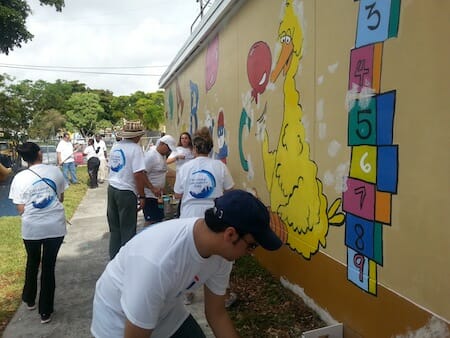
Volunteers paint a mural at the Liberty City Head Start Center as part of a Citi Global Community Day project organized by Greater Miami Service Corps, which hosts ServiceWorks.
employees, friends and family – volunteered at Saturday’s events, part of Citi’s Global Community Day. That day, more than 70,000 Citi volunteers served communities around the world.
In the U.S., from New York to Los Angeles, Citi volunteers worked alongside teams of ServiceWorks participants and the
– uses volunteer service to help underserved young adults in 10 cities develop the skills they need to prepare for college and careers.
Citi’s Global Community Day provided a great opportunity to shine a light on the effort and energy that is ServiceWorks. Through the myriad of projects, ServiceWorks participants demonstrated that they are learning to tap into their own power to be change agents in their communities, while developing the skills and relationships that will set them on a path toward success.
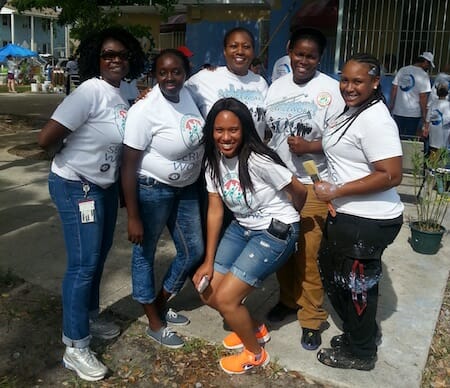
Volunteers at a Miami-based Citi Global Community Day service project, alongside participants of the ServiceWorks program, show their pride.
Service – the key ingredient of ServiceWorks – is a proven way to help us feel connected, to our communities and to each other. Too many young people from low-income families aren’t reaching their potential, in part because they lack support.
ServiceWorks participants, young people ages 16 to 24 from low-income households, benefit from training on a host of skills, from volunteer service project planning to conflict resolution to collaborating in a group.
Skilled professionals – including Citi employees – volunteer as success coaches, skills trainers and workshop facilitators throughout the program.
And the young participants use their newly developed skills to create service projects, such as the activities they took part in for Citi’s Global Community Day.
Eighteen-year-old Emmanuel Harris, a ServiceWorks participant in Chicago, told us recently, “What I liked most about the ServiceWorks program is the volunteer service – that we were able to help people who were truly in need. It made my day to see that I had a hand in making their day.”
6 Ways to Celebrate AmeriCorps Grads
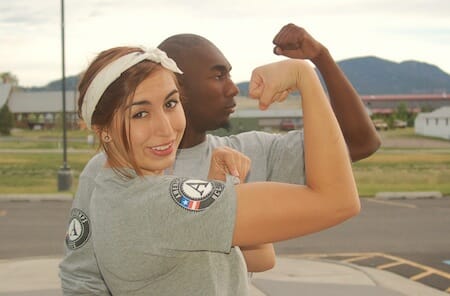
Each year Points of Light’s AmeriCorps Alums welcomes 80,000 corps members to an alumni network that is already nearly one million strong. When they graduate from AmeriCorps, we want to make sure they are connected to the people, ideas and resources to help them grow as engaged citizens and civic leaders.
AmeriCorps Alums invites graduating corps members, alums, alumni chapters, AmeriCorps programs and state commissions, and all national service champions to join in celebrating the AmeriCorps Class of 2015 and their transition to the alumni network. Here are six ways to celebrate the year of service and beyond (#YSAB):
Click here to sign up for the fair or share the information with a graduating AmeriCorps member. If you think your company could benefit from having an alum on staff, click here to sign up for a booth.
If you represent an AmeriCorps program or state commission, click here to explore our professional development program and share resources with your corps members.
3. Join the Alums movement. Register with AmeriCorps Alums and help build the alumni network and movement of civic leaders.
If you represent an AmeriCorps program, state commission or chapter, click here for a membership guide to help you share information about Alums. The guide includes a registration link for your website, newsletter/email templates, a one-page flyer, an introductory PowerPoint and additional graduation message templates. Join the more than 70 organizations already partnering with AmeriCorps Alums!
If you’re a member or alum, click here to tweet to your fellow corps members and alums that you’ve just joined AmeriCorps Alums and invite them, too.
5. Get social! Join AmeriCorps Alums in late June for a social media celebration (#YSAB, for “year of service and beyond”) that will include the release of a Class of 2015 video slideshow. Email [email protected] the best high-resolution picture of your graduating corps members. We’ll be choosing the strongest pictures for our slideshow and featuring more on our social media pages.
6. Print a graduation certificate. Download and customize a certificate to celebrate your AmeriCorps graduation and proudly hang it in your home or office!
For more about AmeriCorps Alums and how to get involved, please visit www.americorpsalums.org.










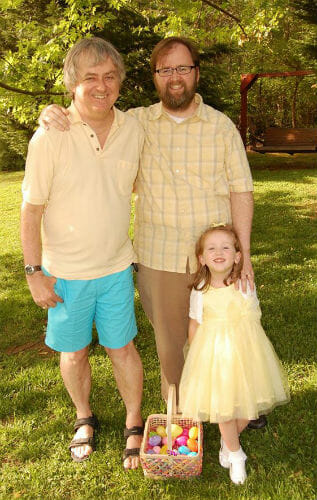 Matthew Little, center, with his father, Steve, and daughter, Maggie
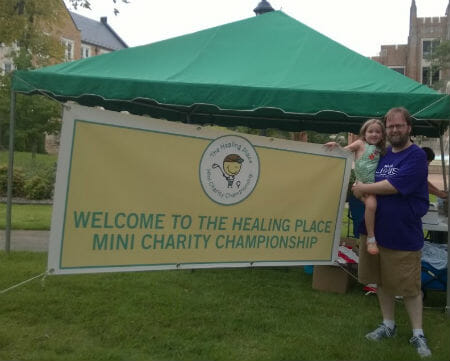 Matthew Little and his daughter, Maggie, participate in an event benefiting an Alabama center for grieving children and families.
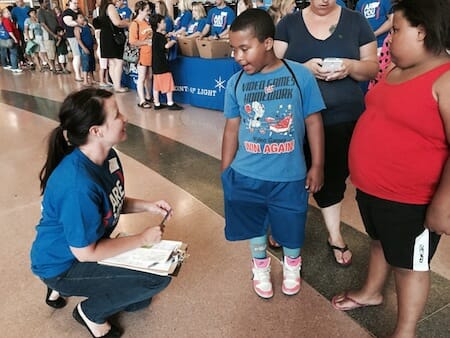 Eight-year-old Cash, center, learns about disaster preparedness from an Allstate volunteer in Cincinnati. He later said, “I got a backpack of tools to keep my sisters safe!”
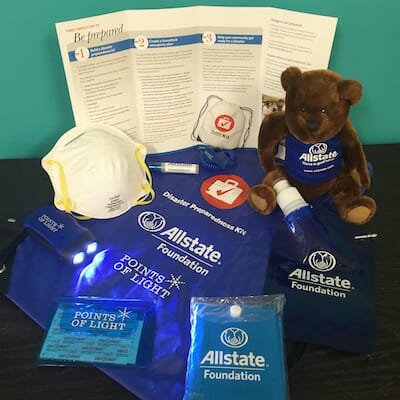 A sample disaster preparedness starter kit