The Harrilal family loves volunteering, and volunteering loves them right back.
The family – and other dedicated volunteers – received surprise Valentines last week from staff members of the Florida nonprofit HandsOn Broward.
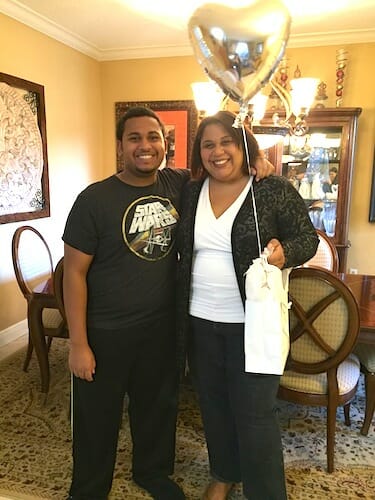
Justis and Paula Harrilal show their surprise Valentine’s Day gift from HandsOn Broward.
With balloons, candy and other goodies in hand, the staff members visited the homes, offices and nonprofit service sites of several of its most dedicated volunteers, including the Harrilals, who got a visit from HandsOn Broward’s director of youth programs, Melissa Sutliff.
“When we opened our door and saw Melissa’s smiling face on a cold winter morning – that enough would have warmed our hearts, much less the beautiful gift bag and balloon that she presented us with from the HandsOn Broward team,” said Paula Harrilal, of Miramar, Fla. “We love being part of their family and moments like this remind us how special they are.”
The Harrilal Family – Paula, Charles and Justis – participate in and help lead a variety of projects with HandsOn Broward, which provides opportunities to volunteer in Broward County, Fla. Justis is the founder of Team Justis, a group of volunteers who provide support to local nonprofit agencies that focus on the hungry and homeless.
HandsOn Broward’s show of appreciation continued from the city of Sunrise to Fort Lauderdale, as deliveries were made to 12 more volunteers who have spent countless hours providing support to projects that help strengthen communities and help local nonprofits provide services.
“We wanted to spend Valentine’s Day saying thanks to some of our volunteers who show great love for our communities,” said Dale Hirsch, president and CEO of HandsOn Broward, part of Points of Light’s HandsOn Network. “By contributing their time and talents, these volunteers are making a significant impact in the lives of others every day.”
Yearlong Family Road Trip Uncovers the Generosity of Kids
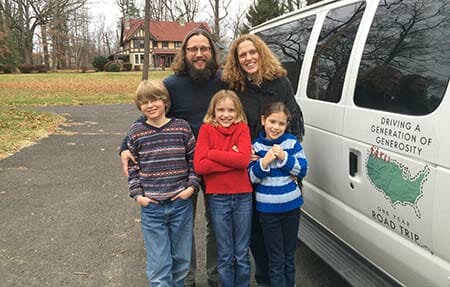
The Webb family of Pasadena, Calif., is spending a year traveling to all 50 states in a trailer, speaking to young people who are tackling problems in their communities. During this project, One Year Road Trip: Generation of Generosity, the family is creating a documentary film to highlight these young innovators. We asked Matt and Eva Webb why they took their kids – Evie, Solveig and Jack, ages 8, 9 and 11, respectively – on the road. Here’s what they told us.
The Webb family – parents Matt and Eva and kids, from left, Jack, Solveig and Evie – stop in Philadelphia during their yearlong road trip. (Webb family photo)
The One Year Road Trip: Generation of Generosity project is a story of beauty from ashes. For us, 2010 was a challenging year. We struggled to keep a healthy work/life balance.
To rebuild, we spent most of 2011 in marriage counseling and by November were back on our feet. At the end of our last session our facilitator asked, “What is one dream you have for your family?” Finally able to dream again, Matt replied, “I’d like to travel the U.S. for a year and visit all 50 states as a family,” to which Eva responded, “What?!”
As kids we were transformed by experiences in Haiti and Mexico serving among the poor with our families, and we wanted to create a transformative experience for our three young children, too. Since Matt is a filmmaker we thought, “Let’s make a documentary about people who are doing lasting, transformational change,” and then, “What if we found kids making change?”
We researched and found kids whose stories had to be given a wider audience. We felt that if we didn’t try, we’d be going against our conscience as a family. So in June 2012 Matt resigned from his full-time job in graduate school administration to focus the next two years on building the One Year Road Trip.
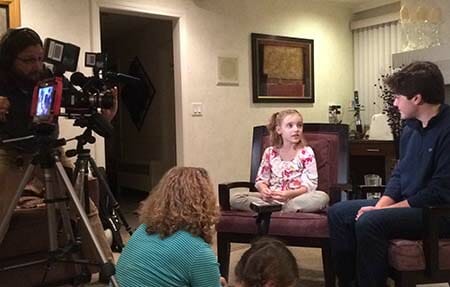
The Webb family interviews Nicholas Lowinger from Gotta Have Sole. (Webb family photo)
It wasn’t hard to get the kids excited about the project. We left our home in September, and five months later – though we miss our community dearly – we’re making new friends around America.
Our support comes in a variety of ways. Our producing team worked tirelessly for a year to prepare us to get on the road. We’re also partnering with the nonprofit arts organization Fractured Atlas, through which we have raised more than $80,000 of our $135,000 budget through tax-deductible donations.
Another foundation, We Encourage, has also supported our project financially and donated more than $10,000 over the past year. While on the road we’re continuing to raise funds, and need only $45,000 to meet our production goal.
On the road many individuals and families have provided meals, a place to park our trailer overnight, access to museums and events that have enriched our experience, and we have made contact with several young change-makers through people we’ve met along the way.
If you doubt that kids can change the world, check out some of the young people we’ve interviewed:
Colorado: Olivea Borden loves to sew and at 12 years old started her business, Oli-Bo-Bolly, selling handmade textiles from recycled materials. When you purchase one of her handmade dolls a second doll is made by women in Nicaragua whom Olivea trained and pays a fair wage, and the doll is given to a child in the community.
Rhode Island: After visiting a homeless shelter and seeing that siblings sometimes share shoes to go to school, Nicholas Lowinger started his nonprofit, Gotta Have Sole. He partners with shoe companies and homeless shelters to provide brand new shoes for children to fit their feet and their specific footwear needs (school, athletics, work, etc.).
Florida: Joshua Williams was turning 5 when he saw a man who was hungry. Josh gave him the $20 he received for his birthday and vowed to help others. Ten years later Joshua’s Heart Foundation provides almost 1 million pounds of food to people in South Florida annually through his team of more than 2,500 volunteers.
These are just three of the dozens of kids we are meeting on the road, all of them using their passions to address huge issues – hunger, homelessness, poverty, bullying and hate, nutrition, health and medicine – creatively and effectively.
Our goal of helping to drive a “Generation of Generosity” begins with sharing the stories of this already growing community of young change-makers in order to inspire others to go out and make the world better.
Digital Connections Get Personal on These Special Days
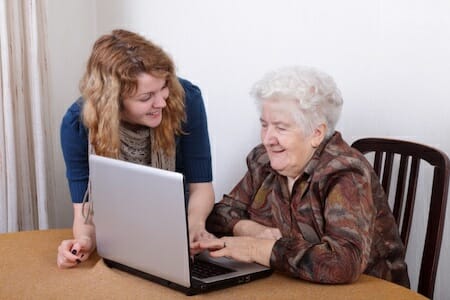
Alex, a teen volunteer, regularly visits with Anne to help her stay digitally connected. Since her stroke, Anne has had difficulty remembering things, especially passwords for online accounts and her email. Alex shows her how to use the Reminder App on her iPhone, which provides an easy and convenient way for Anne to always have access to her passwords.
Young people and older adults benefit from volunteer projects that bring them together.
The YouthSERVE program at the Volunteer Center of Santa Cruz County, which connected Alex and Anne, recognizes that as “digital natives” young people are the perfect candidates for helping seniors learn how to better connect with online technology.
The program coordinates monthly technology workshops – Senior Tech Days – during which seniors are invited to drop in and receive one-on-one training with teen tutors. The workshops open the potentially daunting online world to seniors while giving youth a chance to practice communication and leadership skills.
“To me teaching is something that not only helps others but also is the best way for me to learn,” says Suresh, a youth volunteer and senior tech leader with the program. A senior who has participated in the program adds, “I am impressed with the youth, not only about their skills and knowledge, but also the politeness, patience, and respect and eagerness to help out.”
The Volunteer Center of Santa Cruz has expanded the program with the help of a JPMorgan Chase grant focused on innovation, which the center won at the 2014 Conference on Volunteering and Service.
Participants still bring in their own smartphones, tablets, laptops and even full desktop systems, but the center now has its own equipment, too. The center has been offering Senior Tech Days in four locations since 2011 and expects to expand to three more in 2015.
A new documentary demonstrates the possibilities such programs by focusing on a similar project called Cyber-Seniors. In 2009, high school students and sisters Macaulee and Kascha Cassaday started Cyber Seniors to help seniors learn how to use Facebook and Skype to reconnect with grandchildren. Participants demonstrate the ability to learn at any age. Teens and seniors become friends and partners. Youth begin to be lifelong leaders.
To learn more about Senior Tech Days check out the Volunteer Center of Santa Cruz County’s website. You can also request a screening of Cyber-Seniors and learn more about the movie here.
My love story with AmeriCorps didn’t start in a movie theater or a restaurant, but on a farm in rural Appalachia. We first met while repairing homes with Bethlehem Farm.
Caitlin Morneau (Photo by Smith Center for Healing and the Arts)
We got serious when I served as a caseworker at a homeless shelter through Catholic Charities’ Project SERVE. We went on wild adventures to college campuses across the country recruiting for Catholic Volunteer Network. And we walk side by side each day in my journey as a proud AmeriCorps alum.
This ongoing relationship has impacted my career, deepened my faith in God and enhanced my understanding of the world around me.
No, this is not a story about how I met my husband through AmeriCorps. This is a story about how AmeriCorps taught my husband and me to serve each other in marriage. Furthermore, it is about how making service a priority in our home has challenged us to be better stewards to our family, friends and community.
In each of my AmeriCorps experiences, I lived with others in intentional community.
When I grew frustrated with myself because I knew absolutely nothing about home repair, when I broke down in tears after a difficult day at the shelter, when I felt completely lost for a sense of direction in my life, they held me up, they helped me process and they got me through.
I did not begin to understand how these community relationships would inform my marriage until September 2013. Two months after our wedding, my husband Aaron accepted a job, teaching band at a Title 1 middle school.
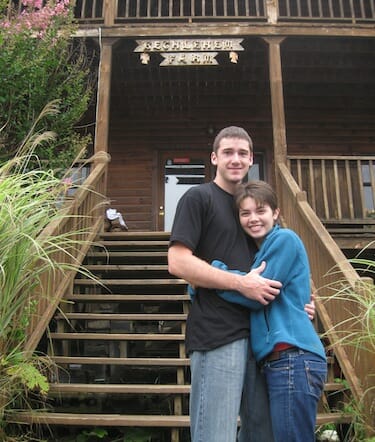
Caitlin Morneau and her husband, Aaron, visit Bethlehem Farm, the first place Caitlin first served through AmeriCorps.
Watching Aaron struggle with limited resources and the ups and downs of teaching a disadvantaged population, I was reminded of my own struggles while serving.
When he grew frustrated with his students’ lack of discipline in the classroom, I recalled my frustration with a client who refused to attend the parenting classes that I knew would benefit her and her son. When he rejoiced with his students for an “Excellent” score at their band competition, I remembered rejoicing the day that I moved my first client into permanent housing.
Each day that was taxing, I envisioned the light of hope that came when someone offered me the encouragement to keep going. I offered that same support to my husband, and in turn, he shared it with the students he served.
Striving to put the other person’s needs before our own is how we approach our marriage, family and community life. For us, valuing service also means rescuing our dog from a shelter and participating in Martin Luther King, Jr. Day of Service activities together. It means setting a portion of our income aside to donate to our churches and beloved charities and planting a garden in our backyard to reduce our carbon footprint.
I am truly grateful for the ways that AmeriCorps has taught me to be not only a worker for justice and peace, but also a better wife, daughter, sister, aunt, friend and citizen of the world.
On Valentine’s Day – if you’re part of a couple – you might go out for a romantic dinner or catch a movie. If you’re single, you might celebrate your independence or avoid thinking about Valentine’s Day altogether.
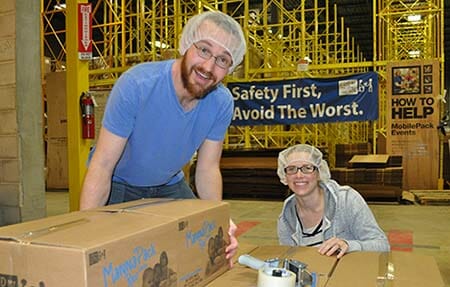
Chris and Shelly Zenner help pack food for Feed My Starving Children in Coon Rapids, Minn., which sends meals specifically formulated for malnourished children to nearly 70 countries.
But I’ve got a better alternative for you: Go volunteer!
Why volunteer on Valentine’s Day? First, volunteering makes you feel better. If the idea of Valentine’s Day gets you down, research shows that volunteering may improve your mental health and make you feel happier. Doing good makes you feel good.
Second, it will save you money. No need to spend big bucks on dinner and a movie. All you need is a good attitude and the willingness to help.
Third, volunteering is an excellent way to meet new people. Possibly, single people who are compassionate and caring.
In many ways, my wife Shelly and I started off like most couples; we opened up to one another about what we wanted out of life. The catalyst in our relationship was when we discovered we had both wanted to join the Peace Corps.
A year after we started dating we got married and six months later, in 2009, we were Peace Corps volunteers serving in Hukuntsi, Botswana.
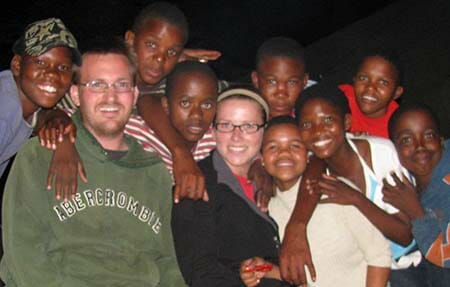
Chris and Shelly Zenner, serving as Peace Corps volunteers, spend time with orphans during a camping trip in Botswana.
We participated in HIV/AIDS education and training events, assisted individuals in computer skills development, helped entrepreneurs with their business plans and coached youth basketball. It was an empowering experience.
Not only did the Peace Corps bring us together, it made us stronger as a couple. Living in a remote village in Botswana’s Kalahari Desert with your partner will do that. At the end of the day you are each other’s main support system. Our time in the Peace Corps has made a huge impact on our relationship and our lives.
The Peace Corps made us realize that volunteers share a lot of the same values and ambitions. On top of that, we noticed that Peace Corps volunteers regularly end up marrying other Peace Corps volunteers.
After putting two and two together Shelly and I decided to start iHeartVolunteers, an online dating service for people who volunteer. We want the love of service to bring people together, as it did for us.
So get out and volunteer this Valentine’s Day! You could meet someone who shares your passion. If not, check out iHeartVolunteers and sign up for free for a limited time as our community grows.
Do good, together!
To find volunteer opportunities in your area, please visit AllforGood.org.
Answer a Call for Kindness for a Chance to Receive a $500 Grant
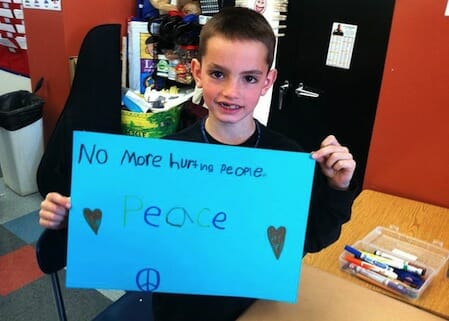
Days after the Boston Marathon bombing, a photo of 8-year-old Martin Richard holding a handmade poster that read, “No more hurting people – Peace” circulated the Internet and was shared by media outlets worldwide. The boy, who was killed when the second of two bombs exploded near the finish line, believed in a more peaceful world.
Martin Richard holds up a sign he made that reads, “No more hurting people. Peace.”
Young people ages 5 to 18 submit ideas for service projects that promote peace and kindness and create positive change in their schools and communities.
The program will award $500 grants to the top 30 replicable project ideas. Projects will be conducted in April and May.
Submissions must be made by this Friday, Feb. 13, through the generationOn website.
Ten projects will be developed into official Martin Richard Bridge Builder project guides, created to inspire other kids and teens to take action. Three projects will be turned into public service announcements to amplify the message of peace and inspire others to create and spread kindness worldwide.
“By encouraging kids to pay attention to what is happening around them, we can help shape attitudes of tolerance and kindness,” said Denise Richard, Martin’s mother. “We try to teach our own kids that they are not too young to lead by example – something that at age 8, Martin seemed to understand well.”
For more information on how to submit service projects to The Martin Richard Bridge Builders Grant Program, please visit generationOn.org.
Startup – Like a Girl
“Lean In,” “#GirlBoss,” “Thrive,” “Playing Big.” The list of books that aim to empower women goes on, and for good reason. In this spirit,
– a viewer favorite – challenges us to rethink what it means to do, run, throw and fight “like a girl.”
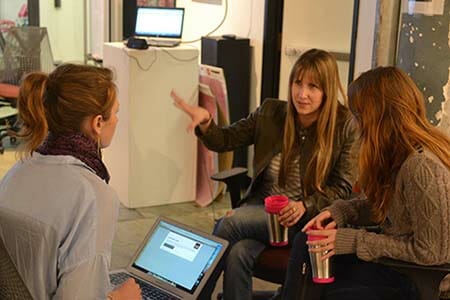
Co-founders from Union Capital Boston, SparkMarket and Akimbo chat during the fall 2014 Civic Accelerator program in San Francisco.
That theme drives the spring 2015 session of the Points of Light Civic Accelerator, which will focus on startups that create greater opportunities for women and girls to succeed in today’s economy. (
for the12-week boot camp for startups.)
We reached out to some Civic Accelerator alumni – who are in the thick of testing products with customers, networking and pitching investors – to get their take on leading a social enterprise as a woman. In other words, what is it like to startup like a girl?
Here’s what they told us.
, a crowdfunding platform designed for users of all ages: “When I show up, people notice because I’m not like everyone else in the room. And though I’m sometimes underestimated, I like to see it as having many more opportunities to prove people wrong and exceed their expectations.”
, a nonprofit that creates opportunities for blacks and Latinos in technology: “In terms of creating a gender lens within the organization, we do try to proactively consider any unique barriers, external or internal, that women in our network may experience as applicants or participants in our programming.”
Mackenzie Hughes and Danielle Gaglioti, co-founders of Akimbo
, which itself is creating a more inclusive workforce by connecting workforce organizations to companies: “As female entrepreneurs, we seek to not only exemplify strong women ourselves, but to change the perspectives of people all over the world so that one day they can see that with equality and inclusivity comes great change and success.”
Are you a woman running a civic-minded social enterprise, or are you from a startup focusing on solving issues affecting women and girls? Our Civic Accelerator is interested in exploring a range of solutions, including STEM (science, technology, engineering, math) education; workforce, leadership and 21st century skills development; and innovative childcare, public safety and community development solutions.
For more information and to apply visit
Fidelity’s School Transformation Days Breathe New Life Into Schools
Nicky Niewinski’s school was built in 1961 and looked like it.
With about 83 percent of her students qualifying for free or reduced-cost lunch, Niewinski worried the dated appearance could be sending the wrong message.
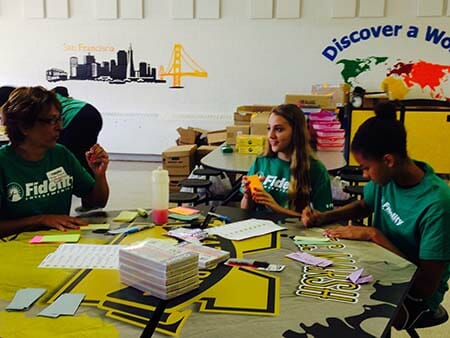
Fidelity employees and Marsh Preparatory School students put together financial literacy kits at the Dallas school during its School Transformation Day.
“I believe that perceptions influence behavior,” said Niewinski, principal of Marsh Preparatory School in Dallas. “One of the things I have wanted to do here – with help – was change the appearance of the building on the inside.”
Fortunately, help wasn’t far away.
Since 2010, Fidelity Investments, one of the world’s largest providers of financial services, has partnered with HandsOn Network by engaging thousands of employees, families and friends via Fidelity Cares – the company’s employee volunteer program, which, among other things, strives to revitalize the learning environments for students in need.
The mission of Fidelity Cares is to support a solid education foundation and reinforce or, in many cases, introduce financial education principles. This is often achieved through the projects implemented, whether creating financial literacy kits, hosting a STEM (Science Technology Engineering and Math) fair or designing or constructing a bucolic reading garden.
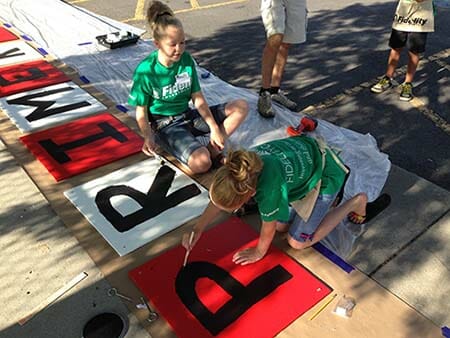
With help from Fidelity employees, students paint boards for a sign during School Transformation Day at Jackson Elementary School in Salt Lake City.
Affiliates of Points of Light’s HandsOn Network organize School Transformation Days, developing and managing the volunteer tasks and logistics for each daylong project. School Transformation Day has taken place at 23 schools across the country, reaching an estimated 35,000 students.
Nationwide, 81 percent of students graduate from high school with a regular high school diploma and more than 7,000 students drop out of school every day, according to the U.S. Department of Education. Nearly half of dropouts occur in the ninth grade.
School Transformation Day projects are identified through collaboration with a number of relevant stakeholders, such as school administrators, teachers, students, parents, civic leaders, Fidelity employees and HandsOn Network staffers. Projects are designed to enhance the learning environment, reinforce college messaging, support school needs, and encourage and inspire students.
School Transformation Days have become Fidelity’s largest annual employee volunteer effort.
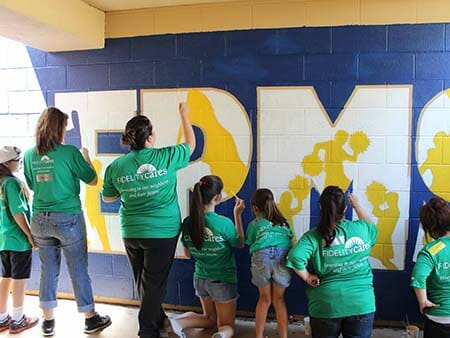
Fidelity volunteers and Ernie Pyle Middle School students paint a mural at the Albuquerque, N.M., school during its School Transformation Day.
“School Transformation Days are one of our most popular volunteer events, engaging thousands of employees to help thousands of students year after year.” said Gary Blank, senior vice president of regional public affairs and community relations. “There’s no other event like it where our employees can join together in such large groups and make an impact for students that they can see and feel at the end of the effort.”
Since its launch, the Fidelity Cares program has received positive feedback and praise from Fidelity employees, students, teachers, HandsOn Network affiliates and partners, along with recognition from local, state and national elected officials.
John Chickering has volunteered as both a participant and a leader for School Transformation Day since the project’s inception at two Rhode Island public schools in Providence and Pawtucket. His volunteer tasks have included building cabinetry, painting, assembling benches, removing safety hazards and even scraping bubble gum off the underside of classroom tables.
Volunteering “is just in my DNA,” said Chickering, who also participates in regular service projects through his church and with his family.
He’s drawn fulfillment from hearing teachers and principals talk about how valued the work has been by students. He has also enjoyed watching coworkers come together around their projects.
“Part of it is a chance to reinforce the working bonds I have with people that I have already established and the other is to build new connections,” he said. “There’s a personal development aspect to this.”
For Fidelity, proof of its popularity has been in the growing number of volunteers. Niewinski counted 100 volunteers at Marsh in 2013 and 250 volunteers last summer. They painted classrooms, offices and hallways and built outdoor benches around trees. Some Fidelity employees partnered with student volunteers to put together 1,200 financial literacy kits containing information such as how to start saving money and how to calculate interest.
School Transformation Days have done so well at Marsh, it has led to other projects. Fidelity has also invested in a new Lego robotics program at Marsh, supplying funding to help the school buy equipment.
“I don’t believe that would have happened had it had not been for School Transformation Days,” Niewinski said.
Getting Engaged – With Volunteers
This post is by Tricia Thompson, vice president of training and consulting at Points of Light.
I don’t know about you, but I’m not a big fan of being managed. Being managed feels constraining and restrictive.
I do like to be engaged though. Being engaged sets me up as an active participant in supporting and achieving a goal. It means that I have something to contribute. I have a hunch I’m not the only one who prefers being engaged rather than managed, and I think there’s a lesson here about how we approach our work with volunteers.
For example, Feeding America San Diego (FASD) has been embracing a philosophy of volunteer engagement rather than volunteer management. It wasn’t always this way. It had an efficient system for volunteer sorting and packing of food boxes. The volunteers had good experiences and many came back to serve again – but there was a limit to what they could do.
The food bank’s staff realized so much more was possible.
First, they recognized that their repeat volunteers could make great project leaders and began to recruit and train them for that role. Then, they asked the new project leaders for their opinions on the volunteer experience. After all, they were on the front lines with other volunteers and could see and respond to needs firsthand.
The project leaders set up a special area with a log book to note how projects went – what worked and what needed improvement. As a result, the food bank had a better picture of what went on with volunteers and a system for continuous improvement.
But they didn’t stop there. The FASD staff began to get to know the people who were packing boxes and realized that there were nutritionists, chefs and other professionals in their ranks. They engaged these volunteers in creating recipe cards for nutritious meals and offering cooking classes.
With more skilled volunteer roles available, volunteer programs manager Teresa Dale noted a 40 percent increase in the hours skilled volunteers contributed.
“These volunteers typically serve longer, bring specialized experience and directly build departmental and organizational capacity,” Dale says.
The volunteer department needed additional capacity, too. It took up a volunteer on her offer to create new tracking spreadsheets. She now maintains and updates these spreadsheets to produce reports on volunteer hours, group participation and impact of service. The expanded metrics are used in board, fundraising, volunteer recruitment and marketing materials.
Even the food box packers, who may only serve once, are engaged in deeper ways. The warehouse now features an area where volunteers and their groups can take photos that highlight their service. Participants are encouraged to share these photos on social media and their company websites.
These new roles have given more volunteers a chance to get directly involved with the work of the food bank. Moreover, they have helped attract even more volunteer prospects to recruiting sessions – a 40 percent increase, according to Dale.
All of these strategies are consistent with being an organization that engages volunteers well at all levels – or what we call a Service Enterprise.
Service Enterprises recognize that engaging, rather than managing, volunteers means that we are more likely to see all the talents, skills, connections and passions that people bring when they show up to serve. And that means a richer experience for the volunteers, our organizations and our causes.
What are your thoughts about engaging versus managing volunteers?
Can You Weather a Winter Storm? We’ll Tell You How to Prepare
The winter storms that have punished the Northeast during the past couple of weeks have gotten many of us talking about how best to prepare for bad weather.
Do you know how?
Join us this Friday, Feb. 6, from noon to 1 p.m. Eastern, for #GoodandReady for Winter – an interactive chat on Twitter.
During this online discussion, you’ll get safety tips and more from Good & Ready, a Points of Light program that convenes select business, nonprofit and government partners to increase the ability of individuals and communities to prepare for, respond to and recover from disasters and emergencies.
Find out how to build an emergency supply kit. Ask us about winter volunteer opportunities. Share your winter preparedness plans. What’s on your mind?
To participate, follow @goodandreadyorg on Twitter and use the hash tag #GoodandReady.