This post is by Tracy Hoover, Points of Light’s president.
I’ve been thinking a lot about tables lately. The holiday tables we gather around at this time of year, and the friends and family seated around them. The oak table at my grandmother’s farm growing up in Tennessee. The cafeteria table at a homeless shelter here in Atlanta, where volunteers will share a holiday meal with neighbors who live on the streets.
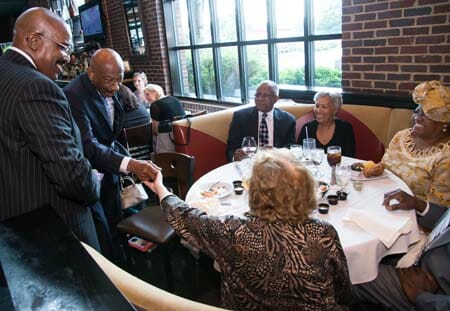
Guests become acquainted at an America’s Sunday Supper in Atlanta in June 2014.
And in the past couple of weeks, as events unfolded in Ferguson, New York City and Cleveland, I’ve thought about Dr. Martin Luther King, Jr.’s “table of brotherhood.” It’s one of his most enduring and powerful images: “I have a dream that one day on the red hills of Georgia, the sons of former slaves and the sons of former slave owners will be able to sit together at the table of brotherhood.”
As we look ahead to a new year, I invite you to reach across the table – and the fence, the neighborhood, the city – to come together as volunteers in bridging differences and seeking new ways to create needed change in our communities.
A great way to start is by honoring the legacy of Dr. Martin Luther King, Jr. on Jan. 19, 2015. You could take part in a service project in your community; host or join one of the thousands of community dialogues – “America’s Sunday Suppers” – happening around the country; or begin a community conversation in a way that fits your lifestyle and interests.
It doesn’t matter where you meet – your home, coffee shop, dorm or community center. Gather old friends, invite new ones, find a table and start talking. Points of Light has tools and resources for you to host a Supper or dialogue in your community, including conversation starters, celebrity chef recipes, and downloadable films.
As you gather with friends and family in the coming weeks, I hope you’ll make plans to get together again and reach across the table in January. Volunteer to join America’s Sunday Supper, participate in a service project in your community or get started today by taking action online.
It’s O.K. to Profit From Community Engagement
In December, Points of Light and Bloomberg LP released the 2014 Civic 50—a list of the most community-minded companies in the country. The Civic 50 sets a national standard for good corporate citizenship, honoring companies that are effectively lending their time, talent and resources to improve the communities where they do business.
John Peloza, an academic panelist for The Civic 50, and associate professor of marketing at the College of Business and Economics at the University of Kentucky kicks off the five-part blog series that will examine key trends and highlights released in our first comprehensive report, The Civic 50: A Roadmap for Corporate Community Engagement.
John Peloza
As a contributor on the academic panel that helped shape The Civic 50 survey, I waited for the 2014 results with great excitement. Now that the report is out, complete with profiles of the companies within this elite group, I predict two important changes will take place. Consumers will make the first change, and companies not on the list will make the second.
First, consumers who want to reward community-minded firms now have information they can use. The companies on the Civic 50 list deserve this recognition and subsequent support.
In the past, consumers’ perceptions of community engagement haven’t always aligned with reality. In an insightful report, Tenet Partners found extreme misalignment between what companies actually do and what people think they do. In some cases, companies that are very civic minded are perceived as being average, or even below average, on this dimension. And vice versa. The Civic 50 is an important data point to externally validate these companies’ efforts. I expect that, equipped with this validation, consumers will vote with their pocketbooks.
Second, I expect companies not on the Civic 50 list will work to emulate the firms that are on it, possibly because they see a clear connection between community-mindedness and the bottom line. And that’s a good thing!
The beauty of The Civic 50 is that it’s not simply a list of who is giving the most. Those lists are out there and, quite frankly, don’t do much to offer guidance to managers who invest in community engagement or the consumers who wish to support them.
Instead, the Civic 50 rates companies highly when they integrate community engagement with the business of the firm, institutionalize it with policies and incentives, and perhaps most important, carefully evaluate its impact.
I think many companies are reluctant to tie community engagement to the bottom line for fear of being seen as exploitative. Based on my own research and that of many others who study community engagement, they shouldn’t worry. Most people acknowledge that benefits to the firm should be part of the expectation from community engagement.
In fact, a 2012 study found that 76 percent of people believe “it is okay for brands to support good causes and make money at the same time,” up from 57 percent in 2008.
The companies on The Civic 50 list take steps to ensure the positive impacts they enjoy are more than just public relations from cash donations.
Companies like AT&T, with its “It Can Wait” campaign to stop texting-while-driving, are building their own platforms for community engagement, with their employees at the center of their efforts. This suggests a meaningful difference in the way these firms view community engagement and checkbook philanthropy. Programs like this provide a benefit to the community, employees and the bottom line.
And that’s the way business should be done.
To learn more about highlights and best practices from the 2014 Civic 50, download our webinar recording from the Dec. 17 event.
What’s the True Value of a Volunteer?
This post is by Tricia Thompson, vice president of training and consulting at Points of Light.
Tricia Thompson
As the chair of volunteers, Marcie Land coordinates, trains and recognizes those who serve with Navy-Marine Corps Relief Society (NMCRS) in San Diego. What’s more – she is a volunteer herself, logging at least 20 hours a week.
Her contributions are significant and far more than the sum total of her hours would suggest. Which is why NMCRS is thinking creatively about the value of Marcie’s and other volunteers’ time.
Most organizations use the Independent Sector rate for the value of volunteer time. It is a useful tool, but it doesn’t tell us what all that volunteer time accomplishes. Service Enterprises – organizations that strategically leverage volunteers to meet their missions – take additional steps to showcase the quantity and quality of what their volunteers offer.
Direct service is one of the most common volunteer contributions. Volunteers often enable an organization to serve more clients or project sites, or deliver more programs than they could with paid staff alone.
For example, a local agency that serves mentally ill clients hosts a monthly celebration where volunteers provide food and visit with clients. NMCRS volunteers provide financial counseling and assistance programs to military families in need. The service is all the more meaningful because it’s delivered by volunteers who choose to be there rather than staff who are paid to be there.
In some cases, programs are only possible with volunteer support. Volunteers who assist police departments may check on homebound seniors or vacationers’ properties and provide an added sense of safety and security that most communities can’t pay for. The NMCRS volunteers who sew baby blankets for military families offer a service that is unlikely to be filled by a paid staff member.
Volunteers also contribute to organizations’ finances. They run fundraising events, request “Dollars for Doers” funds from their employers, and make personal donations and in-kind gifts.
A corporate volunteer group building bikes for kids was so impressed with the cause that employees collected money on the spot so more kids could have bikes. The NMCRS board supports fundraising goals and expands awareness about the need for donations to help support the organization’s important work.
Consider these ways to value volunteer time:
Number of projects, programs and sites that volunteers enable the agency to serve
Number of clients served
Number of volunteers recruited
Number of volunteers supported and/or led
Special services delivered
Dollars and in-kind gifts raised
Dollars and in-kind gifts donated
Legislation introduced or passed
Strategic or operational projects completed
Number of full-time equivalent employees that volunteers represent
The Navy-Marine Corps Relief Society in San Diego is thinking strategically about the ways volunteers make their mission possible. They then use these metrics to share volunteers’ impact with the community, funders, current and prospective volunteers, and their board members.
It adds up to far more than volunteer hours or the Independent Sector rate alone. In fact, it adds up to more military members and families supported in their time of need.
How does your organization track volunteer value?
Tribute to a Shining Light of Volunteer Engagement – Jill Friedman Fixler
This post is by Beth Steinhorn, president of JFFixler Group; Tricia Thompson, vice president of training and consulting at Points of Light; and Lori Jean Mantooth, director of training programs at Points of Light.
Jill Friedman Fixler
While the field of volunteer engagement shines brightly thanks to thousands of points of light, the field is just a tad dimmer today as it lost one of its shining stars. Jill Friedman Fixler, leader, consultant and mentor to many, passed away over Thanksgiving weekend at the age of 61.
Jill had dedicated her career, first as a director of volunteer services and eventually as a consultant, to shifting the field from traditional volunteer management to a culture of more robust and meaningful volunteer engagement.
A longtime resident of Denver, Jill worked in volunteer engagement at multiple organizations in Colorado, crosscutting many nonprofit service areas, including animal welfare at Denver Dumb Friends League, human services at Arapahoe House, health care at National Jewish Hospital, and the arts and sciences at Ocean Journey, now known as Denver Downtown Aquarium.
By 2000, Jill recognized that her passionate vision for what’s possible when organizations really tap into people’s interests and skills was one she could share more widely through consulting. At the core, Jill believed that when organizations mobilize volunteers meaningfully, they can more effectively better the world.
She founded the company that would eventually be known as JFFixler Group in 2000 with the goal of helping others effect that vision and, within just a few years, landed national clients, published articles and eventually books, built a team of consultants, and became a nationally recognized thought leader on how engaging volunteers in new and innovative ways will, simply put, make the world a better place.
A partner and supporter of Points of Light, Jill often led workshops at the Conference on Volunteering and Service and the Summit on Advanced Volunteer Engagement. She served on many Points of Light committees focused on strengthening volunteer engagement.
She was also a frequent presenter at national and regional conferences those of the Association of Hospital Volunteer Resource Professionals and the American Society on Aging. She led webinars regularly through VolunteerMatch, STAR: Synagogue Transformation and Renewal and elsewhere.
As a dynamic presenter, Jill was often seen at conferences with a bevy of followers trying to get a few minutes of her time for advice or inspiration. She lived her commitment to mentoring by coaching – formally and informally – hundreds of professionals throughout her career, working to strengthen the network of volunteer engagement professionals and nurture a community of practice within our field.
“She understood what makes volunteering potentially so powerful and shared her knowledge and experience with thousands of folks in the field who benefited greatly from her wisdom, passion and compassion,” says Betty Stallings, a fellow trainer, speaker and consultant.
Katie Campbell, executive director of Certification in Volunteer Administration, adds: “Among her lasting contributions was her fearless drive to explore solutions and tackle change that sets an example for all nonprofit leaders.”
Most notable about Jill’s career and her life was her commitment to focusing on what she called “a mindset of abundance.” She truly believed that most organizations already have everything they need to fulfill their mission – that the resources are already in their world in the form of the skills and talents of the volunteers, donors, constituents and advocates. The secret was simply to learn how to strategically harness that resource.
Her professional passion reflected her personal mission as well, in that she embraced on a daily basis an attitude of abundance, focusing on the many blessings she had, even in the face of her terminal diagnosis. That attitude is one of the many powerful lessons Jill leaves to all of us in this field.
Jill began cutting back her work with JFFixler Group in 2012 and officially retired in 2013, but her legacy endures in JFFixler Group’s ongoing work, which continues to build on the foundation of her commitment. And, each of us can carry on her legacy by continuing the important work of mobilizing volunteers in innovative strategic and meaningful ways to make our world a better place. Certainly the world is a better place for having had Jill in it.
Since Jill trained, mentored, collaborated with and coached so many people in the field, we ask those who knew her – or saw her speak – to share a memory, piece of advice or lesson that you learned from Jill and to share it in the comment field below.
TIME Magazine Honors ‘A Ragged Army of Volunteers’ That Needs Your Help – 3 Quick Ways to Support The Ebola Fighters
This post is by Tracy Hoover, Points of Light’s president.
It’s not often that TIME magazine names volunteers as its Persons of the Year.
In this series of covers, TIME magazine collectively named volunteers fighting Ebola as its Person of the Year.
But last week, TIME honored the “ragged army of volunteers and near volunteers” – doctors, nurses, public health workers, and those who helped transport the sick and bury the dead – who risked their lives to save others.
“The rest of the world can sleep at night because a group of men and women are willing to stand and fight,” TIME writes. “For tireless acts of courage and mercy, for buying the world time to boost its defenses, for risking, for persisting, for sacrificing and saving, the Ebola fighters are TIME’s 2014 Person of the Year.”
If you’ve ever doubted that a small group of dedicated individuals can change – in this case, save – the world, I encourage you to read TIME’s story about the Ebola fighters and then do something to support their efforts.
You can:
Learn more about Ebola so you can fight misinformation and stigma. Read the Centers for Disease Control and Prevention’s “Ten things you really need to know about Ebola” and spread the facts.
Join World Community Grid volunteers and donate your spare computing power to help researchers find effective Ebola treatments.
Earlier this month, senior leaders from government, nonprofits and some of the world’s largest corporations came together in Washington, D.C., to coordinate efforts to fight Ebola.
One last thing we can all do this holiday season: Thank the extraordinary points of light in our own lives by making a call or sending a note, a tweet or a nomination for the Daily Point of Light Award.
In times of worldwide crisis and times of everyday stress, our actions to help others matter. Every single one.
`A From-the-Top Type of Priority’ – Altria’s Volunteer Program Challenges Employees to Serve Their Communities
For an hour-and-a-half most Mondays, Debbie Colvin’s work schedule is full. That’s the block of time she spends with her “little” through
. “There is nothing more important than that child during that time each week, because they are not going to understand if [I] don’t show up,” says Colvin, a program manager at Altria.
Debbie Colvin, a program manager at Altria, participates in an Altria-sponsored volunteer project.
and a number of other nonprofits in the Richmond, Va., area. Colvin, like many other Altria employees, are allowed and encouraged to volunteer with local organizations throughout the year such as mentoring local middle school students through Big Brothers Big Sisters.
“One of the great things about working here at Altria is that the company supports our volunteerism,” says Colvin. “That makes it really nice and really easy for us to give back to our communities.”
Employees like Colvin are just one example of how Altria is able to give back to the communities where its employees call home.
Over the last decade, Altria, headquartered in Richmond, has given $1 billion in cash and in-kind contributions to hundreds of nonprofit organizations and supported hundreds of thousands of hours of volunteer service. Giving is mainly focused on the key areas of middle school-age youth and the goal to reduce underage tobacco use, the environment, civic engagement, and arts and culture.
An Altria employee, foreground, helps out at a company-sponsored volunteer service project.
Altria involves employees in volunteer efforts across the country through its partnership with the
, part of Points of Light.
In 2013, volunteer activities at the Altria family of companies generated more than 34,000 hours of service. Altria also matched more than $1.2 million in employees’ charitable contributions.
But volunteering at Altria is more than just allowed; it’s rewarded. In 2013, Altria sought to inspire greater participation by challenging various divisions across its family of companies to work together to better their best volunteer efforts.
Called the Volunteer Challenge, employees were encouraged to identify projects that aligned with their work – for example, engineers building a greenhouse for a community garden.
In one project, nearly 50 volunteers participated in a makeover of
, renovating the art courtyard and learning garden, creating murals on the library and cafeteria walls, and building a portable kiosk to serve as the school store.
Altria employees participate in a company-sponsored volunteer project.
During the Volunteer Challenge, nearly 5,000 employees contributed more than 30,000 hours of time in company-sponsored events. This represents a 90 percent increase in participation in volunteer efforts during the same period the prior year, growing from a 30 percent participation rate to a 57 percent participation rate.
Another result of the challenge was the creation of a Volunteer Council. The group represents leaders from across Altria’s divisions working to build on the volunteer program by raising awareness within the company, collecting stories from volunteers like Colvin to encourage others to get involved and sharing feedback with nonprofits.
“One of the big elements of the Volunteer Challenge was really raising awareness of telling a better story,” said Amber Roos, community relations manager at Altria. “We knew we had more people engaging in projects than we were talking about because they weren’t putting [their volunteer hours] in the volunteer management system.”
Recognition was key to the success of the challenge. At the end, individuals were honored during a lunch with executives followed by a volunteer event at a
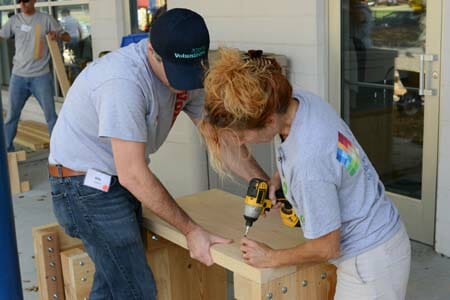
, where participants built furniture, completed a makeover of the teen center and prepared the center for after-school programs, among other projects.
For Colvin, recognition recently came in the form of a Presidential Volunteer Service Award honoring her work at Big Brothers Big Sisters and numerous other company-sponsored and personal volunteer efforts.
“I’ve found that the more you give, the more you want to give,” she said. “It’s one of those things that no money could pay you what you get back here.”
“They are a vital, engaged, intentional partner in the community,” said Regais Wilson, corporate program manager at
, which helps about 500 nonprofit agencies in the community find volunteers. “They recognize it as a from-the-top type of priority companywide.”
In 2013, Altria partnered with HandsOn Greater Richmond for 23 projects between its service months of April to June and September to November. In one project, Altria provided $39,000 and 125 volunteers to make over the
. According to Wilson, “The money was used to pay for playground equipment and furniture for a new elementary school on the organization’s campus, as well as building renovations and maintenance projects.”
In addition to Altria’s volunteer and recognition programs, employees who volunteer more than 25 hours a year with an eligible nonprofit organization can earn a $500 grant for that organization through its Dollars for Doers program.
“They have some of the best volunteers I’ve ever come across,” Wilson said. “They’re excited about projects. If you put anything in front of them, they’re going to knock it out of the ballpark.”
Companies Eager to Work Together in Response to Ebola
Unlike the empathy that characterizes the reaction to a natural disaster like a hurricane or earthquake, the public response to Ebola has been driven by fear. The result has been a lack of support for much-needed relief efforts. Companies are joining nongovernmental organizations, philanthropic partners and public sector leaders to change that.
(Photo courtesy USAID)
“I don’t know that I’ve ever seen a private sector group come together like this before,” said David Barash, a physician and head of GE Foundation’s Global Health Portfolio, at a recent gathering of corporations, nongovernmental organizations, philanthropic organizations and government partners in Washington, D.C.
“For all of their own reasons, some the same as ours at GE, companies are just more engaged, more interested,” Barash explained later. “There’s a desire to come together. There’s enough awareness, enough companies paying attention finally.”
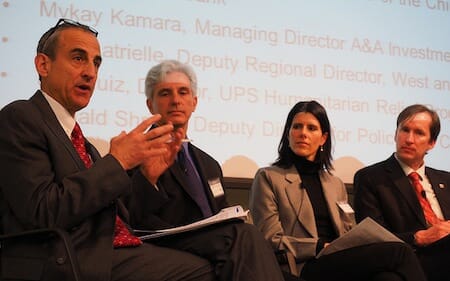
From left, Donald Shriber, CDC Center for Global Health; David Barash, GE Foundation; Amy Latrielle, PSI; and David Evans, World Bank, at the Dec. 3 event.
Speakers included representatives from the White House, the U.S. Agency for International Development, the State Department, the Centers for Disease Control and Prevention, and leading nonprofits responding to Ebola in the region.
Moussa Abbo, senior regional director of West and Central Africa at PSI, delivered a set of welcoming remarks; Amy Latrielle, deputy regional director for West and Central Africa at PSI, served on an afternoon panel discussion focused on how to strengthen health systems to respond effectively to tomorrow’s outbreaks.
The corporations’ representatives emphasized the need to share information on who’s already doing what and where, what’s needed and where, and what’s in the pipeline. They also discussed the basis for effective partnerships.
Many stressed that lessons learned today in the fight against Ebola should be used to strengthen health systems for tomorrow. Partners In Health co-founder Paul Farmer noted that the Ebola outbreak might have been avoided if science from previous health epidemics had been considered.
“This wasn’t the first instance of zoonosis – disease moving from animals to humans,” Farmer noted. “And it won’t be the last.”
Some of the most important problems right now in West Africa have to do with the supply chain.
“The largest rubber plantation in the world is in Liberia, and yet we can’t get enough rubber gloves,” Farmer pointed out. “We need to be able to get staff and stuff to where it’s needed.”
Farmer currently works with groups in Liberia on the Ebola response, but most of his experience and reputation were built in Haiti.
“[Partners in Health] worked with the GE Foundation not only to build a proper health system, but to have it train Haitians,” he said.
The idea of training local talent to sustain change beyond the life of a specific intervention period resonated deeply with the participating executives.
Moussa Abbo, senior regional director of West and Central Africa at PSI, noted the need to address the real roots of a problem like Ebola meant setting up “stronger infrastructure, community supports, market investment and governance that will ensure sustainable solutions that prevent another epidemic.”
Large operations, like IBM’s Corporate Citizenship programs, depend heavily on nongovernmental organization or government partners.
“Our partners are key,” said Diane Melley, vice president for corporate citizenship at IBM. “We rely on them for on-the-ground information and assessment. We can only be most effective when we know exactly what the needs are.”
IBM’s partners receive something extremely important in return — human resources. Over 260,000 of IBM’s 450,000 staff worldwide participate in pro-bono or volunteer work, according to Melley.
The event was not a call to checkbooks but an opportunity to collaborate and connect on potential next steps for long-term involvement based on interests and core business competencies. The group plans to reconvene in early 2015 to follow up on these initial collaborations.
Despite the challenges, “The real tragedy would be failing to leverage these resources,” Barash said throughout the day. “Let’s use Ebola as a leveraging point for strengthening health systems for the long term.”
When it Comes to Engaging Volunteers, Here’s What Really Matters
This post is by Tricia Thompson, vice president of training and consulting at Points of Light.
Good volunteer engagement is more than traditional volunteer management training, yet that’s where many organizations focus their efforts. Recent research tells us that taking a broad organizational approach means better results for our volunteers and our organizational effectiveness.
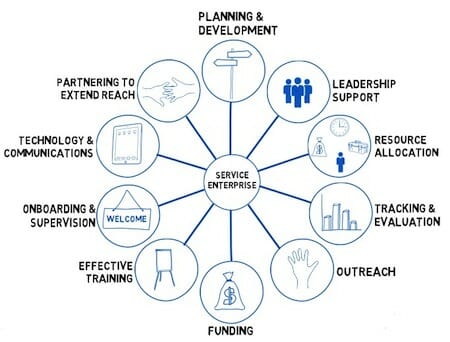
They have found that 10 characteristics distinguish organizations that are engaging volunteers well. (See graphic above.) What’s more – organizations with 50 or more volunteers that demonstrate these characteristics outperform their peers who do not engage volunteers.
Service Enterprises address each of these functions:
Planning and development – strategies and infrastructure for mission-driven volunteer engagement. Service Enterprises are thoughtful and intentional about where volunteers are best suited to contribute to the cause.
Leadership support – executive commitment to volunteer engagement. The board and executive director (or equivalent) of Service Enterprises value the importance of volunteers.
Effective training – volunteer and staff training. Volunteers and paid staff at Service Enterprises are equipped to successfully work with each other.
Outreach – Service Enterprises conduct volunteer recruitment for programmatic and operational roles.
Onboarding and supervision – process to bring volunteers into their roles. Service Enterprises match volunteers to appropriate positions, clarify their roles and orient and support them throughout their service tenure.
Partnering – mutually beneficial relationships with service groups, funders and other stakeholders. Service Enterprises increase engagement and reach through community partnerships.
Technology and communication – Serivce Enterprises leverage technology for connecting with and supporting volunteers.
Tracking and evaluation – outputs and outcomes of volunteer service. Service Enterprises assess the quality and contributions of the volunteer experience and how it can be improved.
Funding – Service Enterprises fundraise for volunteer engagement.
Resource allocation – Service Enterprises allocate sufficient resources (time, money, people, tools) to volunteer engagement.
While there are similarities between basic volunteer management training and Service Enterprise practices, there is an important difference, too.
The Service Enterprise practices require commitment from the entire organization rather than the volunteer manager exclusively. The characteristics include organization leadership and infrastructure support as ingredients for success. In essence, Service Enterprises have an organizational cultures and support systems that fundamentally leverage volunteer time and skills.
These features help explain why volunteer management training is necessary, but not sufficient. Volunteer management training often provides the tools for working with volunteers. However, it typically doesn’t address the organizational factors that support the widespread adoption of these tools.
Organizations wanting to utilize this broader approach in developing their volunteer engagement will find the Service Enterprise characteristics are a useful road map.
For those wondering where to start, the researchers recommend focusing on leadership support, planning and development, or effective training. These characteristics are especially important practices for success and help lay a strong foundation for operating as a Service Enterprise.
Serving Those Who Served Their Country – Exelis Action Corps Members Make it Their Mission
Lindsey Kirksey’s childhood home was in such bad shape, two of the rooms were separating. But the Korean War veteran in his early 80s couldn’t afford to do anything about it. He needed help.
Korean War vet Lindsey Kirksey stands in front of his house before its renovation.
Volunteers from the Exelis Action Corps came together to repair his four-room Montgomery, Alabama, house.
“The volunteers I spoke to – they are just like me,” said Kirksey, who taught math in low-income neighborhoods in the Montgomery area. “They want to help people just like I want to help people.”
For decades, veterans and military service members of all ages have faced unique challenges. And there is growing concern in particular for the one million veterans transitioning out of the military between 2013 and 2018.
The volunteers from Exelis Action Corps, the signature volunteer service program of aerospace and defense company Exelis, have been on the front lines.
They’re lending their time and expertise – whether it’s providing career coaching to a new veteran, sprucing up a veterans support center or working with military families overcoming the challenges of military life, such as frequent relocation or deployments.
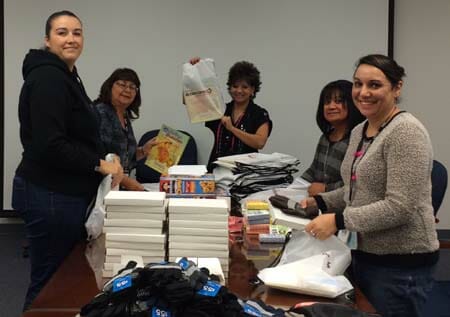
Exelis Action Corps volunteers put together care packages for veterans traveling through the Honor Flight Network.
Across the country, the young program – launched in October 2012 through a partnership with Points of Light – has already engaged 4,374 volunteers and completed 317 projects, serving thousands of veterans, service members and their families.
“We are proud of what the Exelis Action Corps has accomplished, but it’s not just about the numbers,” said David Albritton, vice president and chief communications officer at Exelis. “It’s about the difference we are making in the lives of those who served and the families who sacrificed for us.”
Just a few examples from 2014:
Across the country, Exelis employees created Family Fun Night packages for service members and their families. Volunteers shared with others what they like to do as a family, including playing games, watching movies and working on crafts. Each package was different depending on what the family decided to put into it. Service members received the packages so they could enjoy their own free “family fun night.”
In Salt Lake City, Exelis employees worked with Canines With a Cause, helping train 10 dogs to act as service companions for veterans. They also built 35 dog beds for veterans who already had service dogs.
In Clifton, New Jersey, Exelis employees collected turkeys for veterans at St. Peter’s Haven, a local shelter serving veterans. Their efforts yielded 47 turkeys and enough funds to purchase complete thanksgiving meals for 27 families.
Employees supported the Honor Flight Network, which flies veterans for free to Washington, D.C., to visit their respective war memorials. The volunteers assembled care packages for veterans on six flights. Each veteran received a flight bag containing items to make his or her visit more memorable and enjoyable.
In various locations, Exelis leadership provided resume assistance and interview coaching to hundreds of veterans seeking employment over the course of the year.
Ten Exelis offices held large projects, which engaged employee volunteers in the communities of Fort Wayne, Indiana; Roanoke, Virginia; Clifton, New Jersey: Rochester, New York; Washington D.C.; McLean, Virginia; Philadelphia; Salt Lake City; and Colorado Springs, Colorado. These projects ranged from a health fair to horse therapy sessions and revitalization of several veterans’ facilities.
For many Exelis Action Corps volunteers, it’s personal. As a veteran and volunteer, Erica Jeffries is clear on what matters: “To do good for others – it’s our purpose in life.”
Jeffries recalls one of her most gratifying volunteer moments with Exelis Action Corps came through Final Salute, an organization that provides housing to homeless female veterans in the Washington, D.C., area. The volunteers worked on landscaping, painting and otherwise making the house a comfortable living environment.
“The experience working with Final Salute was powerful because we knew we were preparing a home for veterans and their families,” Jeffries said.
As another Exelis Action Corps member pointed out: A wonderful feeling comes from “seeing the appreciation on the vet’s face. All that matters is making their day a little brighter.”
‘Thank You’ Doesn’t Have to Mean ‘Goodbye’ for Your Donors
, the Chicago-based company’s new fundraising product.
Matthew Rattigan, Edgeflip co-founder, participates in a Points of Light Civic Accelerator spring 2014 session in New York.
On the surface, Donor Boost is simple: It’s a Facebook-enabled share button that can be embedded into any webpage or email. Behind the scenes, however, Donor Boost – which is in a public testing phase – is intricate. It collects data that can both inform your organization about its online supporter base and optimize performance.
By embedding the button on a thank-you page or in a thank-you email donors see after contributing, your organization can make it easier for donors to encourage their friends to give.
Donor Boost users aren’t just “sharing” on behalf of your organization, they’re advocating. When they click, their friends receive personalized notifications, coming from a trusted source.
By enabling your donors to advocate on your behalf, you enlist the mighty force of peer influence, which can lead to demonstrably higher response rates. The goal: more high-quality impressions, more supporters and more donors.
Learn more about Donor Boost and other leading Chicago-based civic ventures, and meet 13 of the most innovative civic startups from across the country as the Points of Light Civic Accelerator celebrates its fall 2014 Demo Night in Chicago on Dec. 17 from 5:30 to 9 p.m. at