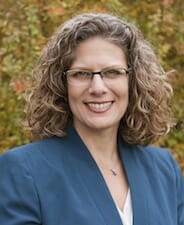
This post is by Tracy Hoover, Points of Light’s president.
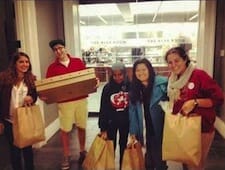
Food Recovery Network volunteers collect food for distribution to the hungry.
I found out today that my office is in the middle of a desert. On a U.S. map, it’s in Atlanta. But on the USDA’s Food Access Research Atlas, we’re located in the middle of a “food desert.” That means that supermarkets are more than a half mile away and getting access to fresh, healthy food is challenging.
The USDA estimates that a shocking 23.5 million Americans live in food deserts. According to No Kid Hungry, 1 in 5 children in America struggles with hunger.
Today is World Food Day, a United Nations-sponsored day of awareness and action focused on making sure people have regular access to enough high-quality food to lead active, healthy lives. Globally, the United Nations estimates that there are 805 million hungry people in the world. The problem is huge and complex.
But in the face of these enormous challenges, volunteers are finding promising solutions.
In the U.S., Ben Simon and Mia Zavalij started the Food Recovery Network when they noticed that surplus food from their University of Maryland dining halls and sporting events was begin thrown away. Today their organization – which collects and distributes surplus food from college campuses to those who need it – is one of a growing number of civic startups inventing new solutions to long-term problems.
Making hunger a thing of the past will require all of us to take action. The good news is there are lots of ways volunteers of any age can help. Here are things you can do to end food insecurity, food waste and hunger in your community and around the world:
Use Your Time & Talent
Organize a healthy food drive or join a food rescue team to help fill the gap left by food deserts in your area. Download a Healthy Food Drive toolkit to get started. Or download the HandsOn Network’s Food Pick-Up Playbook for tips on starting your own food rescue project.
Volunteer in your community. Go to AllforGood.org and search “Hunger” and your zip code. Encourage your friends to join you!
Kids and teens can apply for a $500 grant to support projects to fight hunger. Check out “Make Your Mark on Hunger,” a youth-led campaign supported by ConAgra Foods Foundation, C&S Wholesale Grocers and the National Turkey Federation.
Parents and educators, download the Farm to Table curriculum to use in teaching kids about food production and supply, where it comes from, why food security is an issue and what can be done to help.
Use Your Voice & Influence
Visit No Kid Hungry to find out how you can advocate for policies that help address hunger in your community.
Use Your Money
Shop at retailers who donate a portion of their proceeds to fight hunger. FEED Projects is one of my favorites.
Every action counts. Let’s make a difference today.
What a Change in Perspective Can Mean for Your Volunteers
This post is by Tricia Thompson, vice president of training and consulting at Points of Light.
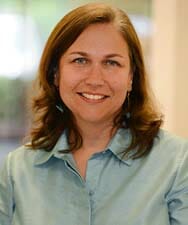
Tricia Thompson
It’s time to get rid of our volunteer programs.
It seems harmless enough, but calling our volunteer activities “programs” often sets them up to compete with our direct service programs. At budget time, it can be hard to allocate scarce dollars to volunteer support because it seems like we are taking them from client support.
As an alternative, I propose reframing volunteer programs as volunteer strategies. This shifts their position from one that competes with clients to one that supports clients. From this new perspective, volunteer time becomes an asset to leverage on behalf of clients and the community, not a drain on resources.
Making the most of our assets requires an investment. Research from the Urban Institute tells us that the more we invest in volunteer engagement, the more our organizations will benefit from volunteer contributions.
It’s an intuitive finding that Service Enterprises – organizations that engage volunteers strategically to help meet their missions – have taken to heart, but one that many organizations still struggle with.
When we bring volunteers onboard without a plan, without time for clarifying expectations, without training the people who supervise them or without a clear sense of what they are best suited to offer, we often find that they don’t come back.
Without the investment of time that these tasks take, we end up with poor volunteer retention and staff who lament that they haven’t had a good experience with volunteers.
A volunteer strategy, like any effective operational strategy, addresses these issues with planning and an investment of time, energy and money. This planning and investment are hallmarks of Service Enterprises and any organization engaging volunteers strategically and well.
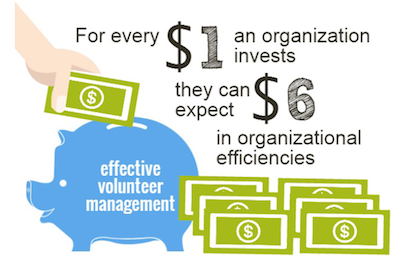
These organizations thoughtfully consider where volunteers are needed and in what ways they can best help the organization meet its mission. In return, operational volunteer strategies power their programs and help make them successful. In fact, Service Enterprises see up to a six-fold return on their volunteer investments.
The move toward volunteer strategies instead of programs also helps us think about ways that we can weave volunteers throughout our organizations – another characteristic of Service Enterprises.
Most of us engage direct service and board volunteers, but where else could volunteers support our work? An advocacy volunteer could promote our messages with key stakeholders and policy makers. A human resources volunteer could update the employee handbook so it meets current standards. An information technology volunteer could advise on the benefits and drawbacks of a new CRM (constituent relationship management) system.
The way we talk about volunteers influences the way we think about how we can partner with them.
Moving from a volunteer program to a volunteer strategy represents a subtle shift. But, it’s one that can have powerful and positive implications on how we practice volunteerism in our organizations.
Do Good for a Chance to Win $10,000 for Your Favorite Charity
On Oct. 25, millions of volunteers across the nation will unite with a common mission – to improve the lives of others. For more than 20 years, USA WEEKEND magazine, in collaboration with Points of Light, has brought you Make A Difference Day, the largest national day of community service.
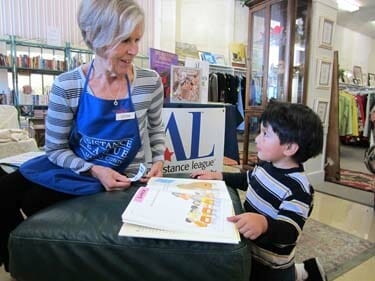
An Assistance League volunteer from San Mateo County,
Calif., bonds with a child over a donated book during a Make A Difference Day activity last year.
For a chance to win a $10,000 grant from Newman’s Own for your favorite charity you simply need to register your project here.
After completing your project on Oct. 25, fill out a simple form describing what took place and the impact you made in your community.
Make Your Volunteer Program More Effective by Considering New Roles for Volunteers
This post is by Beth Steinhorn, president of JFFixler Group. She works with organizations and associations across the United States and Canada to embrace volunteer and member engagement as a key business strategy.
Beth Steinhorn
Recently, while facilitating a reunion of organizations that participated in a yearlong High Impact Volunteer Engagement project – which included coaching, mentoring and training – I was once again struck by the powerful potential that one strategic change can have on an organization overall.
Ten staff/volunteer teams had worked to develop one new way each to engage skilled volunteers at their organizations, learning along the way how to effectively recruit, support and acknowledge skilled volunteers. On reunion day, they gathered to share their stories of challenge and success.
One team’s story, in particular, exemplifies how engaging volunteers in high-impact roles can be meaningful far beyond that one position.
Before joining the volunteer engagement program, Home Health and Hospice Care (HHHC) of southern New Hampshire already had an established volunteer program, with volunteers serving many crucial roles. The program included “vigil volunteers,” caring individuals who stay with dying patients, offering company and comfort to the patients and their families.
Despite having a dedicated team of vigil volunteers, HHHC faced a major challenge: one volunteer coordinator handled all vigil volunteer scheduling. Understandably, scheduling is unpredictable and time-consuming. HHHC determined to create a new position of vigil team leaders to coordinate scheduling and communications with vigil volunteers.
Seems simple enough on the surface – but the concept is more complicated given the needs for both technological support and compliance with HIPAA (healthcare privacy standards). They needed user friendly, fast and nimble technology they could afford that would interface with the existing database and meet HIPAA requirements.
They took a two-pronged approach. First, the team developed a team leader position, with volunteer leaders each taking on a week per month to handle the scheduling and support of vigil volunteers. Meanwhile, they systematically explored technology options.
The system in place now includes the volunteer coordinator making one call to the on-duty vigil team leader with details about emerging needs for vigil volunteers; the team leader then broadcasts messages through texts and emails to the volunteer roster. The system now allows volunteers to see a shared calendar, identify empty slots and sign up for time slots that fit their schedules.
The benefits of this new system are far-reaching and truly profound. Here are a few:
Scalability: They now can scale the program without adding any staff. Shortly after launching, HHHC encountered an unusually high need for vigil volunteers. Through this program, they could fill coverage of more than 80 hours, without adding any staff.
Place for Skilled Volunteers: They now have a position to offer skilled volunteers seeking ways to support the organization beyond direct service, as well as leadership opportunities for existing volunteers who aspire for more.
The Big Picture: Most profound, the ability to see the calendar online has helped current volunteers to appreciate that they are part of a bigger team.
Think about not only what that one new position could accomplish, but also whether the project could be expanded to help other areas of your organization and how it might impact the bigger picture within your volunteer culture.
Selecting the right project is challenging – but taking time to be strategic about where to engage volunteers in high-impact positions has the potential to ensure that your efforts have a significant return on investment.
I suppose that seems about as accurate as saying I became an overnight success in Hollywood. But that’s how it feels.
I had a moment this week when a member of my work team confronted me with a challenge – and I thought about it, made a decision and acted. That’s it.
It seems simple. And to many leaders, I’m sure it is. But, since I was a kid, I have often been paralyzed by making decisions. My brain wraps around all the possible scenarios – evaluating actions and outcomes – for what I’m sure seems like an eternity of inaction to others. And, often, while I’m playing out this “War Games” scenario in my head, someone else makes the decision.
I always thought of it as a character flaw until something in my recent training broke through the paralysis and helped me understand my style – OK, so I’m a Pragmatist nearly dead center on the spectrum between Conservers and Originators. That actually makes sense!
So, I’m not wishy-washy, I’m just incredibly open-minded! Ha! And A-ha!
In the past, I might have heard that message, said “a-ha” and gone back to work without any real knowledge of what to do differently. I feel so lucky to have been selected for the American Express Leadership Academy that actually provided the individual assessment and resources to help me not only understand my leadership style, but to use it as a strength.
The American Express Leadership Academy is an intensive, two-day leadership development training program, facilitated by the Center for Creative Leadership and sponsored/underwritten by American Express. Points of Light and American Express include the academy as part of Points of Light’s Conference on Volunteering and Service each year.
This past June, I joined 23 high-performing, high-potential emerging nonprofit leaders from across the country. We each received a 360-degree feedback tool and personality tools to help us recognize strengths and areas of development around our leadership styles.
The program helped us identify potential career derailment and gain an understanding of how our leadership styles are perceived by others. The biggest gift for me was a confidential, one-on-one feedback and coaching session with a certified Center for Creative Leadership executive coach.
At the beginning of the first session, we were warned that the training might be “transformational.” I thought, “Sure. All leadership trainers say that.” Now I realize I had to be ready to receive the information – and this experience had all the meat to go with the promise. A full assessment from my boss, peers and direct reports along with the leadership tools and professional coaching to actually do something with that assessment.
A member of my small discussion team during training said, “You know, sometimes you just have to scream and then move on.” Yes. Now I think I finally have. I cleansed my leadership palate. I trust in myself to make decisions and ask people to help implement them.
A very successful friend of mine says, “You cannot hit a target that you cannot see.” This week, I saw the target and I hit it. What a gift.
If you are interested in applying for the 2015 American Express Leadership Academy, email Stephanie Armelin ([email protected]), who will contact you when the application period opens.
Here’s the Place, Now Save the Date for 2015 Conference on Volunteering and Service
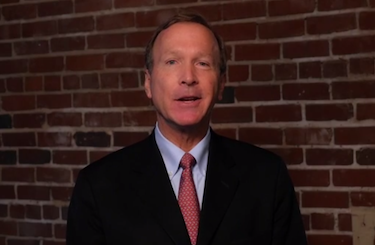
This message is from Neil Bush, chairman of Points of Light.
Neil Bush shares five reasons to mark your calendar for the 2015 Conference on Volunteering and Service.
We usually meet in June, but trust me, the weather’s way better in October down here in Texas.
Consider yourself invited to the biggest, smartest gathering of volunteer leaders from business, nonprofits and government – all under one roof. You’re going to meet fascinating people, learn a lot and have a great time.
I hope you’ll join me as we celebrate 25 years of Points of Light with volunteer leaders from around the world, along with some big names and big conversations about the future of volunteering.
I can’t wait to welcome you to my hometown!
Reserve your spot now and receive 10 percent off the early bird registration rate. The first 500 people to preregister will also be entered for a chance to win an all-expenses-paid trip to the 2015 Conference.
What Would You Do in a Disaster? Allstate Shows How Easy it Is to Prepare
Read about how folks in Los Angeles are preparing for disaster. To help your family take action, visit Good & Ready, where you’ll learn how to create various disaster plans, build a preparedness kit and more.
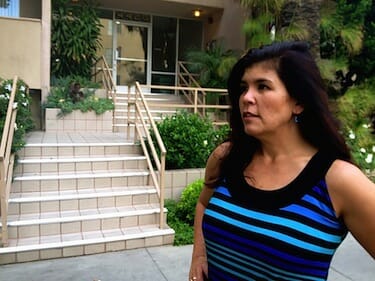
Paula Solano recalls the morning when the walls of her apartment fell apart around her during an earthquake.
Paula Solano was asleep when her walls started violently shaking and loudly crumbling around her. The patio sliding glass doors in her Los Angeles apartment blew out, spraying glass everywhere. She made a run for it, cutting her bare feet on glass shards and breaking a toe as she fled.
“I really thought that, maybe, I was going to die,” Solano recalled of that day 20 years ago, when an earthquake jolted the Northridge neighborhood of Los Angeles. “I wish I would have known where to go when the earthquake started. … I was literally caught unaware – out of a dream.”
The 1994 Northridge earthquake rated a 6.7 magnitude and left nearly 60 people dead. Thousands of others were left without shelter – including a young Solano, who had just arrived in town to teach, write and act.
Today, Solano makes sure her family is prepared, right down to having slippers next to her children’s beds, in case they have to run out in the middle of the night like she did. “You need to have a plan,” she said. “I call it a ‘clear path to safety.’”
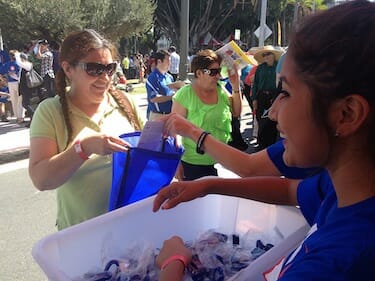
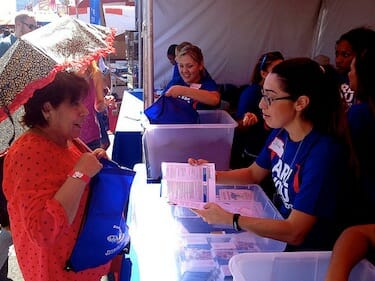
A participant at the Los Angeles tour stop receives a pamphlet for her disaster kit.
That’s the mission of the national disaster preparedness tour created by The Allstate Foundation and Points of Light. Among others, stops have included Portland, New York City, Baltimore and Savannah in the East, Baton Rouge, Houston and Indianapolis in the south and Midwest, and Los Angeles.
At the Los Angeles event September 13, dozens of volunteers from Allstate insurance agencies and Volunteer Los Angeles – part of Points of Light’s HandsOn Network – lent their time to help people get ready for all types of disasters.
“This is one stop in a 14-city countrywide campaign,” said Jan Epstein, senior manager at The Allstate Foundation. “We want to educate people on the perils they face in their particular region of the country; and we want to help them become more prepared for those times of disaster During the tour, Allstate is providing supplies to hands-on build 10,000 kits, but just as importantly, we are educating people as they build their kits and by directing them to online resources”
Folks who attended the annual Dieciseis de Septiembre (Mexican Independence Day) celebration in downtown Los Angeles worked with volunteers to build free disaster starter kits. Inside blue Allstate drawstring satchels, people placed items such as first aid kits, water bottles, emergency checklists, escape plans, battery-free flashlights, whistles and dust masks.
A bilingual volunteer speaks with an event participant in Spanish to explain the importance of being prepared.
Allstate agency owner Beatriz Zaragoza spent the day talking with people at the festival in English and Spanish. “Some of the people don’t have anything in place, because they just don’t think it could happen,” she said. “But you just never know.”
The good news is that there was a sprinkling of families who stopped by to add to what they already had at home. “I’m kinda, sort of prepared, but not like this,” said Julian Bueno from the Echo Park neighborhood of Los Angeles. “I have a flashlight, I’ve got bottled water, but not the rest.”
Patricia Garza, Allstate Foundation director of strategic philanthropy, said the foundation is focused on demonstrating how easy it can be to set aside critical items.
“Every person, and every family, deserves the chance to realize their hopes and dreams. Poor disaster preparation leads to a needless loss of lives and property,” Garza said. “Doing a few simple things, like building an emergency kit or creating an evacuation or communications plan will go a long way to keeping people safe. That’s why The Allstate Foundation and local agency owners want to get Americans thinking about preparedness, before a disaster strikes.”
Marisela Magaña of La Crescenta, California, attended the Los Angeles event to reinforce what she has been teaching her kids about disaster preparedness. The mother of five has two autistic children who need frequent reminders of what they should do in an emergency. Magaña brought her 12-year-old sons with her – Mark, who is autistic, and Jonathan, who has ADHD and severe asthma.
“Kids with special needs, you have to continuously tell them and remind them and reprogram them so they are prepared for what might happen,” Magaña said. “If they weren’t prepared, a disaster would get them into a total frenzied panic.”
Julian Bueno, from Echo Park, acknowledged the need to be much better prepared after the kit-building activity. He had no idea until the event that he’d need more than a basic starter kit. He only had one emergency bottle of water to share with his son, Christopher, in case of disaster.
“I thought I was prepared, but I guess I wasn’t,” said Bueno. “I feel more complete now.”
Three Things You Can Do to Help During the Ebola Outbreak
This post is by Colleen Clay, senior director of disaster services at Points of Light.
People respond to crisis with action, and as the world faces the first Ebola epidemic and the largest Ebola outbreak in history, that desire to help has mobilized volunteers from around the globe to serve affected communities.
A micrograph of the Ebola virus (Centers for Disease Control and Prevention)
Finding an effective way to help can be difficult when the epidemic and greatest need is in Africa, and you are not a medical professional nor in an affected area. However, you can make a difference in prevention, reduction in suffering and support for responders. Here are three steps you can take to help.
1. Get informed. Deadly epidemics are scary and misinformation can actually make things worse. The U.S. Centers for Disease Control and Prevention has the facts on risk, transmission, diagnosis and treatment, and they have multiple fact sheets for travelers and people and organizations that want to provide factual information to their networks.
Get all the facts here. Share them with friends and family and through your social networks. Click here for a great infographic you can share that communicates the most important basic facts.
2. Take action to prepare your family and household for disaster, including pandemic flu. The U.S. government’s pandemic preparedness is focused on health care system preparedness, hospitals and medical providers. But every family should have a family disaster plan and supplies, and should talk together about their family plan.
GoodandReady.org has resources available to help your family learn about and plan for all hazards. The CDC and the U.S. Department of Health and Human Services have produced guides and checklists to help your family and community prepare for flu epidemics. These guides are helpful in thinking through communicating with schools and workplaces, and ensuring you have needed supplies should an outbreak occur in your community. Click here and here for examples.
3. Help support the response to Ebola and other disasters by donating cash, goods and services, and by volunteering. The Center for International Disaster Information has useful information about how to help. Cash is the most useful assistance and CIDI has listings of nongovernmental organizations working specifically on Ebola.
There is great need for medical supplies, particularly personal protective equipment. But general donations are usually best donated to local charities. Alternatively, you could hold a rummage sale, and donate the proceeds to response organizations.
Points of Light partners with the American Red Cross and Save the Children. Both organizations are working to halt the epidemic and provide care to affected communities.
You can take action to stop the epidemic and provide needed resources to affected communities. Get informed, get prepared and share facts and resources to halt the epidemic.
Volunteering Can Lead to Greater Economic Opportunity for Youth
A new report released this week by Opportunity Nation, with support from the Citi Foundation, provides fresh and compelling evidence that certain types of civic engagement predict positive outcomes for at-risk and low income youth and the economic health of states.
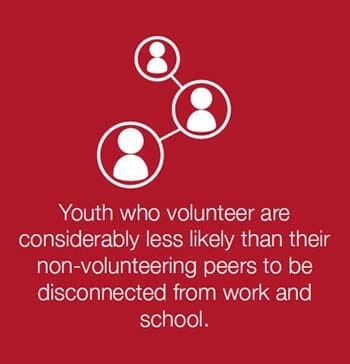
The chance that a young adult is disconnected from work or school drops in half, from 11.1 percent to 5.7 percent, if he or she volunteers.
Civic engagement – specifically volunteering and participation in a civic or service organization – is a significant predictor of economic opportunity across states.
In places with higher rates of volunteerism, income inequality tends to be lower.
The report highlights how civic engagement may help youth – particularly low-income teens and young adults ages 16-24 – build social capital and skills that can help them find meaningful education and career pathways.
The analysis also found that two forms of civic engagement – volunteering and membership in a civic or service organization – are significant predictors of economic opportunity across states.
“We hope our findings serve as a rallying cry for increased attention and support for civic engagement initiatives,” said Russell Krumnow, managing director of Opportunity Nation. “Volunteering or joining in a charitable cause are not just feel-good activities, but powerful ways to increase economic opportunity at a time when Americans are searching for as many tools as possible to improve their prospects and provide for their families.”
“Today 5.8 million young people – about one in seven Americans between the ages of 16 and 24 – are neither working nor in school,” said Kristen Lewis, co-director of Measure of America. “Finding ways to connect them to mainstream opportunities is vital to their futures.”
The report’s findings support specific calls to action, including:
The expansion of volunteering opportunities for low-income youth
Increased membership in civic and service organizations for Americans of all ages
More employer-led volunteer programs and civic projects to ensure professionals interact with youth one-on-one with a goal of helping more young Americans build the skills, confidence and networks they need to succeed in today’s workforce
In March 2014, the Citi Foundation launched Pathways to Progress, a $50 million commitment to jumpstart economic opportunities for 100,000 low-income young people in 10 major U.S. cities. A key component of this initiative is ServiceWorks, the largest corporate-sponsored AmeriCorps VISTA program – funded by the Citi Foundation and launched in partnership with Points of Light in July. Through ServiceWorks, AmeriCorps VISTA members engage young people in civic engagement and volunteerism activities.
“As the needs of employers continue to evolve, it is crucial that young people are prepared with the workplace skills and leadership experience necessary to compete in a 21st Century economy,” said Brandee McHale, chief operating officer of the Citi Foundation. “The findings of this report by Opportunity Nation confirm that civic engagement and volunteerism activities – like those happening through ServiceWorks – can be an effective onramp for helping young people move towards college and career success.”
Read about how folks in Salt Lake City, Utah, are preparing for disaster. To help your family take action, visit Good & Ready, where you’ll learn how to create a disaster plan, build a preparedness kit and more.
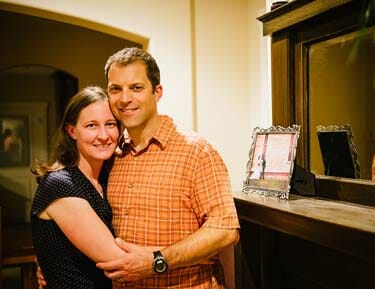
Emily and Jim Weigel stand beside the only part of their house that survived a 2010 fire, the living room mantle.
Just after lunch on July 26, 2010, Emily Weigel was startled by a banging on the front door. A neighbor warned that the house next to Weigel’s was on fire, so Weigel grabbed her baby – who was wearing just a diaper – and ran outside barefoot.
Within minutes, 10-foot-tall flames ripped into the second floor of Weigel’s Salt Lake City, Utah, home. She watched helplessly as fire burned everything in her house, grateful that at least her family was safe.
“Sure, I miss my wedding dress,” Weigel said, “but I’d rather have my husband and kids with me than a wedding dress.”
Weigel and her husband, Jim, learned that though they can’t predict when a disaster will strike, there are things they can do to prevent harm and minimize headache. Now, for example, they frequently check the smoke detectors in every room and have fire extinguishers at the ready.
To help Utahns and others around the country prepare for disasters, The Allstate Foundation and Points of Light have paired up to present a 14-city preparedness tour. After stops in Savannah, Ga., Baton Rouge, La., Colorado Springs, Colo., among other cities, the tour landed at the Hogle Zoo in Salt Lake City last Saturday.
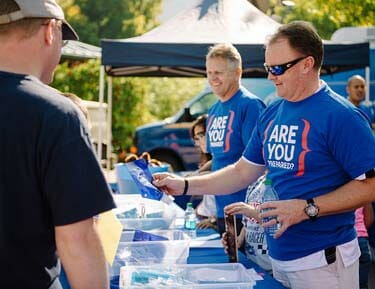
Volunteers help Hogle Zoo visitors assemble disaster preparedness kits.
Dozens of volunteers from Allstate and Points of Light’s HandsOn Network helped hundreds of Utahns build free disaster kits, which contained first-aid kits, cleaning supplies, battery-free flashlights, emergency planning checklists and several other items. They assembled more than 500 kits in less than two hours.
“The thing that is unique to Utah is that we have seasonal disasters,” said Gavin Seal, a Salt Lake City Allstate agency owner. “We have the wildfire season (June through October) and those living in the foothills or the mountains face that risk. Then, we move into winter. Last year, we had a series of extreme cold temperatures, which can cause a lot of destruction – from plumbing freezing to power outages. And finally, there’s the underlying risk of a catastrophic earthquake at any time.”
According to FEMA, 85 percent of Americans are unprepared for disaster, which can lead to the unnecessary loss of property and lives, Seal said.
The educational component of the event was helpful for Casey and Jillian Koon, who were reminded that they need to have clothes packed for themselves and their two children.
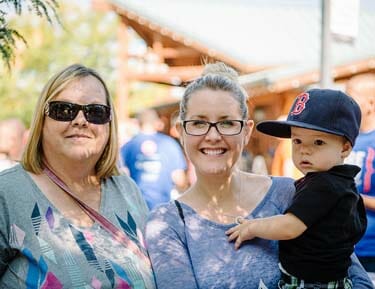
Autumn Shaw, center, came to learn about disaster preparedness with her mother, Paula, and son, Boston.
“They were helpful in telling us what extra supplies to pack, what things to think of and what to use in case of an emergency,” Casey Koon said. “Having kids heightens your awareness and definitely raises more concerns about making sure you have everything you need in case of emergency.”
Many locals receiving kits said they had previously either done nothing or too little to prepare. Autumn Shaw, who attended the event with her mother, Paula, and son, Boston, said she was not prepared for a disaster and was surprised about some of the items in her starter kit.
“I never thought about having a garbage bag and using that as a poncho or for sanitary reasons,” Shaw says. “I think that’s one of the last things you think about when you think about being prepared in an emergency – ‘Where am I going to go to the bathroom?’”
Supplies in preparedness kit were just a start. Volunteers encouraged Shaw and others to add food and water. The recommendation for a standard 72-hour kit is one gallon of water per person per day and food that is dehydrated and plentiful.
“It’s so simple,” Shaw said. “It’s just a matter of doing it.”