Can You Listen? This Might Be the Right Volunteer Activity for You
This post is by Marc Wong, author of “Thank You for Listening: Gain Influence & Improve Relationships, Better Listening in 8 Steps.”
Marc Wong
Meghan watches her mother finish a telephone call.
“Mommy, why are you crying?” she asks gently.
“I’m OK,” Mommy sighs, “I’m OK.”
Meghan leaves the room and comes back moments later. “When I’m sad, I hold on to Mr. Brown,” she says, handing over a teddy bear to her mother.
On another occasion, Daddy is talking to Meghan about a tough decision he has to make.
“When I have to make a big choice, I ask Mr. Brown,” Meghan says.
“And what does Mr. Brown say?” asks Daddy.
“Nothing,” she says matter-of-factly. “He listens.”
In this scenario, Meghan’s actions give us a glimpse of what selfless, dedicated hotline volunteers do on a daily basis. Just like Meghan, these volunteers do not judge. They do not solve problems. They do not interrogate.
Sometimes they will just be quiet.
Volunteers’ actions, like Meghan’s, are also gently supported by an unspoken sense of hope and decency. Implicit in Meghan’s words is the message that things will get better, that there is good in this world.
Volunteers are not going to rush you to get “better.” They’re not even going to tell you what “better” means. Instead, they’ll be more than happy to hear what better means for you.
I still think about the conversations I had as a volunteer for a crisis hotline. I remember a caller making peace with a life-changing decision he had to make. I remember his calmness despite his knowledge of the rough road ahead. I remember a girl who happily read me a poem she had written; the hopefulness and optimism of her words in contrast to the sadness of her past.
What struck me with these calls was not our different circumstances, but our common struggle for dignity. I did not simply take note of the callers’ courage and resilience, I admired it and hoped inwardly that I could face my own demons with the same strength and poise. I didn’t just hear their words, I tried to hope and fear with them. And I am grateful for what they shared with me.
A hotline volunteer offers what is unique and precious to her as a human being so that callers may talk about what is unique and precious to them. In the process, both grow and connect through their humanity.
To find hotline and other volunteer opportunities, visit the All for Good website.
Here’s a Way to Use Your Volunteers More Strategically
Three years ago, Feeding America San Diego was at a turning point. The local volunteer center had closed, which meant a loss of volunteer team leaders who facilitated food packing projects along with fewer referrals of individuals and corporate groups. I knew the power of volunteers, but our food bank had limited internal resources to make up for the gap.
Since we would not be able to fully meet our mission with a decreased volunteer flow, I asked our team to consider new ways to attract volunteers while offering a meaningful service experience. We invested in new technology to help volunteers find and register for projects, renovated our warehouse entry area to create a welcoming orientation and education space, and developed our own corps of volunteer team leaders.
These steps all made a difference, but I knew we had more potential. That’s why I jumped at the chance to join the Service Enterprise Initiative when it launched in San Diego. A Service Enterprise is an organization that uses volunteers strategically to achieve its mission.
The Service Enterprise Initiative, a training program of Points of Light, includes an organizational diagnostic tool, 16-hour curriculum, and follow-up coaching, proven to help organizations like ours transform the ways we engaged volunteers in our work. I liked that the program featured a team-based approach to ensure implementation occurred at all levels of our organization.
I chose our volunteer programs manager, operations director, and development director to join me at the training sessions. We developed a vision and action plan for Feeding America San Diego’s volunteerism and learned change management techniques to engage the rest of the staff.
“Engaging volunteers has always been a high priority for us,” said Alicia Saake, our director of operations. “The Service Enterprise experience gave us the tools for making that priority real for staff and volunteers.”
Teresa Dale, our volunteer programs manager, came away with a new vision for her work: “The Service Enterprise training transformed how I see my department’s role in the organization. I realized we had so much more potential to engage people beyond food sorting and office volunteers. We needed volunteers involved in our whole organization.”
So Teresa shifted from just working directly with volunteers to supporting the organization’s team in their work with volunteers. “I now teach others how to make volunteer engagement more accessible and successful,” she said. “And when there are problems with a volunteer, I don’t fix it myself; I work with the team member to determine the best approach for resolution.”
This kind of work and culture change takes time, even with senior management buy-in. However, our efforts are paying off. “Before, we were always the ones to make suggestions about working with volunteers,” Alicia said. “Now, other staff come up with ideas about new volunteer roles and then work with the volunteer department to plan for, recruit and implement those roles.”
Our Service Enterprise participation validated our investment in volunteer engagement. It gave us language for talking about the significant value and impact of volunteers in Feeding America San Diego’s work, which we can use with donors, our board, volunteers and the community.
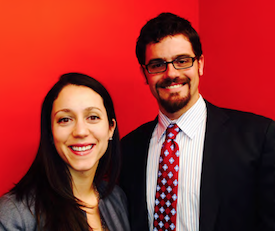
This post is by Mary Bruce and Ben Duda, co-executive directors of AmeriCorps Alums, the only national network that connects the nearly 900,000 alumni of all AmeriCorps programs to the people, ideas and resources that support their commitment to a lifetime of service.
Mary Bruce and Ben Duda
Do you know any ruthless optimists? You know, the friends who just won’t take no for an answer and instead organize the best food drive you’ve ever seen? Know any rugged idealists, who can make a fundraiser out of nothing in no time to support disaster relief efforts? It’s always more than just “something,” it’s fabulous, and the local paper features them as “everyday heroes” because they made it look so easy.
If you know folks like these, you probably know humble, hard-working AmeriCorps alums.
Today, at the White House and in all 50 states, the nation will celebrate the 20th anniversary of AmeriCorps. Since 1994, nearly 900,000 individuals have joined AmeriCorps, providing more than 1.2 billion hours of service that’s done what it was designed to do: “make our people safer, smarter, and healthier.”
AmeriCorps members don’t take the easy road. We break tradition, and our parents’ expectations, by taking a year on (it’s not a year off). We serve, even if it’s not the cool thing to do. We serve when it’s hard – probably because it’s hard.
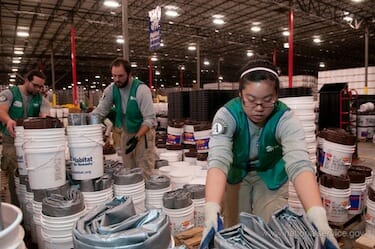
AmeriCorps members pack supplies bound for Haiti after the earthquake there.
We help kids get back on track to graduate. We organize community days of service. We set up data systems for small nonprofits. We log sweaty hours in the California back-country doing forest fire remediation and we will be among the first responders when the next tornado or hurricane strikes.
AmeriCorps members don’t stop serving when our year’s up. When we joined AmeriCorps, we promised “to get things done for America… this year and beyond.” We were made in AmeriCorps and nearly all of us still find ways to serve every day.
Kyle Kimball served with AmeriCorps in 1994 doing AIDS Outreach in Birmingham, Alabama. Now 42, he’s the president of the New York City Economic Development Corporation. Responsible for one of the largest public development entities in the country, Kyle says, “AmeriCorps was a critical training ground for me, making it possible for me to succeed in this work.”
Dayna Long also served in 1994. Her year as a peer health educator inspired her to become a pediatrician at UCSF Benioff Children’s Hospital. “I am still trying to tackle poverty and inequity in our youth,” she says, “just like I did in AmeriCorps.”
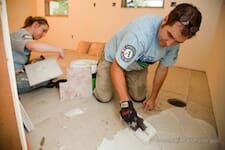
AmeriCorps members work on a Habitat for Humanity home in Milwaukee.
This week, we’re sharing some of AmeriCorps Alums’ most powerful stories because we know that while service changes lives and communities, it also catalyzes careers with impact. Like Kyle and Dayna, two-thirds of all AmeriCorps alums go on to careers in nonprofit and government roles. A health educator turned global social entrepreneur. A literacy tutor turned corporate philanthropist. A legal aid worker turned gubernatorial appointee.
AmeriCorps represents the best of America – hard work, opportunity, bipartisanship. Launched by President Clinton in 1994, AmeriCorps was expanded by President George W. Bush after 9/11. In 2009, the Serve America Act, heralded by Senators Hatch and Kennedy, called for a massive expansion of national service opportunities.
Sadly, that didn’t happen. The number of AmeriCorps positions now lags well behind goals authorized by the Serve America Act. That’s why we’re working closely with the Aspen Institute’s Franklin Project, which “envisions a future in which a year of full-time national service — a service year — is a cultural expectation [and] a common opportunity.” We’re also working to ensure that all AmeriCorps members and alums are connected with the people, ideas and resources that support their commitment to a lifetime of service.
AmeriCorps alums are the ruthless optimists and rugged idealists who serve at the highest levels of business, government and nonprofits. We vote. We serve on boards. We show up for the creek cleanup. We’ve even been known to empty the dishwasher at work and refill the coffee maker. Why? Because we’re AmeriCorps alums; we get things done.
We have an opportunity, and an obligation, to grow and strengthen national service opportunities and life beyond them. Failing to do so is a disservice not just those who want to serve and have served, but to our country, which so desperately needs more civic leaders.
This post is by Tracy Hoover, president of Points of Light.
The journey of a thousand miles may begin with a single step – but for more than 900,000 AmeriCorps alumni, the journey of a lifetime of service began with 11 words from a powerful pledge.
An AmeriCorps member in Minnesota tutors a child in reading.
“I am an AmeriCorps member, and I will get things done.”
This month marks 20 years since the first class of AmeriCorps members began their year of service. As part of the anniversary celebrations this week, Points of Light with AmeriCorps Alums will honor 20 exceptional AmeriCorps alumni, more than 50 leaders who helped AmeriCorpsget started and more than 20 companies for their tremendous work supporting and advancing national service.
Service unites Americans and transcends politics and partisanship. When President Bill Clinton signed AmeriCorps into law, he praised Americans’ “fundamental desire to do something to reach beyond themselves.”
This week, President Obama and three former presidents – including Points of Light founder President George H. W. Bush – will honor AmeriCorps and remind us that volunteer service is an essential part of our national character. It’s how we get things done.
AmeriCorps isn’t just a one-year commitment. Research shows that AmeriCorps is creating pathways and commitments to a lifetime of service. Long after their terms expire, AmeriCorps members are still getting things done here in America and across the globe.
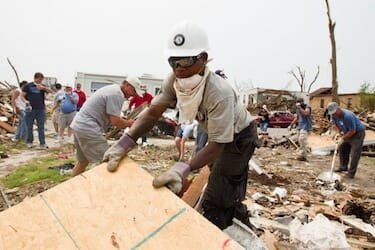
AmeriCorps members help clean up after a tornado in Missouri.
Kyle Kimball served in 1994 at AIDS Outreach in Birmingham, Alabama. Today he manages economic development for the City of New York.
Mona Mowafi served as a health educator at the Latin American Youth Center in Washington D.C. Today she is president of an organization that encourages social entrepreneurship and civic engagement in Egypt by Egyptians across the globe. Rebecca Langebuilt houses and trails with the National Civilian Conservation Corps. Today she is an active duty Air Force major and works in the Office of the Chairman of the Joint Chiefs of Staff, bringing the perspectives from both civilian and military service to her role.
Since AmeriCorps’ founding in 1994, AmeriCorps members have contributed more than 1.2 billion hours in service, helping 15,000 community organizations mobilize 4 million volunteers to help tackle some of the toughest issues, from poverty to education, health care to disaster recovery and environmental cleanup.
We have many to thank for 20 powerful years of AmeriCorps. That’s why we are honoring companies that have demonstrated outstanding commitment to national service as thought leaders, investors in national service programs, and mentors and employers of alums. We’ve named these companies National Service Corporate Champions, and you can see the full list here.
We’re also grateful to the many who played a role in founding AmeriCorps. The AmeriCorps Alums Founders Club has brought many of these individuals together again to support AmeriCorps and the alumni network.
AmeriCorps members, AmeriCorps alumni and millions of volunteers are transforming our communities and our country – all because those who served in AmeriCorps have proven that they continue to believe – and live – a simple, 11-word credo.
“I am an AmeriCorps member, and I will get things done.”
Vice President Joe Biden Joins Points of Light on 9/11 Day of Service to Pay Tribute to First Responders
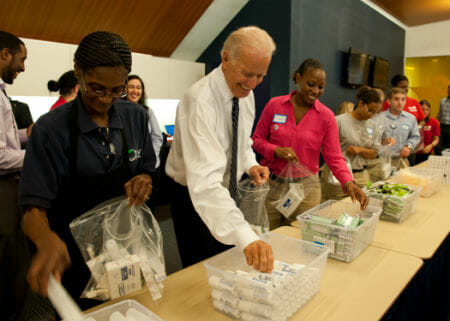
Vice President Joe Biden joins volunteers at George Washington University to assemble hygiene kits.
“What you’re doing matters to them,” he told the volunteers. “The recognition matters.”
The vice president then circled through an assembly line with volunteers from the university, AmeriCorps and various nonprofit organizations. They put together 500 hygiene kits – with toothpaste, nail clippers, shampoo, combs and more – for Operation Gratitude, which distributes care packages to veterans, first responders and the caregivers of wounded military members. There was also an opportunity to talk to first responders from local fire stations.
Points of Light – in partnership with Operation Gratitude and George Washington University, and with support from the Corporation for National and Community Service – organized the volunteer service project.
Wendy Spencer, CEO of the Corporation for National and Community Service, came to applaud the volunteers. She said to them that volunteering on 9/11 is a sincere way to “participate, honor and give back.”
How did you recognize the 9/11 Day of Service? Tell us at [email protected].
In the last couple of years and since the financial crisis in Greece started, we have seen Greek civil society expanding. New nongovernmental organizations have sprung out, the majority fighting poverty and social inequality.
Support became accessible through state or private funds. At the same time, the needs in human resources naturally increased, yet Greece has never had the strongest volunteering culture.
As a Greek living in Greece, I have always identified this as an area of development. The building of strong bridges between civil society and citizens is necessary, especially during times of financial difficulty. This is what brought me to Volunteer4Greece in March 2013 when I joined the team as a volunteer, handling public relations and communications.
For those not already familiar, Volunteer4Greece serves as a platform promoting volunteer opportunities in Greece, with the goal of connecting volunteers with nonprofits looking for people to support their activities.
So far, in my role, I have promoted announcements of volunteering opportunities through our communication channels and made sure that our activities and mission are reaching a wide audience.
We have organized capacity-building workshops and seminars addressed to nongovernmental organizations that wish to develop their performance in areas such as resource management. Examples of training sessions include how to use digital tools, draft funding proposals and manage social media.
By engaging in these workshops, I had the opportunity to meet representatives of Greek nonprofits – extraordinary people, inspired visionaries, determined to fight for their cause and deliver results to the collective benefit.
Volunteer4Greece currently hosts 100-plus nonprofits from all over the country and since it kicked off, it has covered more than 350 volunteer positions, while I have seen more than 11,500 applications go through its platform. A collective effort with a promising future.
It feels great to be part of HandsOn Network, whose fundamental values we fully endorse and seek to further develop in the Greek context. Through our membership we aspire to make clear connections between Greek and international civil society, explore opportunities for synergies, provide effective support to Greek nonprofits and of course motivate Greek citizens to further engage in volunteerism.
It’s impossible to forget the moment when I realized finding myself was less about finding a career, and actually about discovering my purpose. For me, that moment was on Sept. 11, 2001 when I saw my friend brutally murdered as her plane slammed into the World Trade Center.
I was angry, confused, and sad. I had questions. How was this possible? What could I do? I was looking for a way to respond to this tragedy that rattled our nation and our world. So, faced with apathy, I took action.
Until Sept. 11, I wasn’t concerned with these matters. I was focused on building my career. Growing up, I was one of only a few immigrants in the small town of Stoneham, Massachusetts. My family was from Hong Kong. I was encouraged to focus on how to do well in school and achieve career success.
I often suppressed the culture of my home country because I thought I needed to do so to fit in and to be successful. I felt a high level of responsibility to support my family by finding a decent-paying job. But as the planes crashed into the towers, they also crashed into my life plans.
At a time of sadness and shock, my service with AmeriCorps taught me how to fight for a better world. Rather than turning away, through AmeriCorps, we chose to tackle tough community challenges head on. I facilitated a citywide dialogue to reverse declining rates of civic engagement.
I learned about program design and the importance of building in measurement tools to assess progress toward your goal. I learned how to build relationships with communities and find the seemingly-elusive leverage points that catalyze change.
Through AmeriCorps, I also realized I wanted to spend my life working to help individuals overcome societal barriers as I had done – and launched a career in global philanthropy. My career trajectory was no longer about the bottom line or what I was “supposed to do.” I learned that a life of service isn’t contradictory to success.
Now, working in corporate social responsibility initiatives at international corporations like Charles Schwab and eBay, I manage strategic partnerships, charitable giving programs, and engage employees in volunteering. I know in no uncertain terms I would not have these roles, nor be as well-equipped to perform them, were it not for my service with AmeriCorps.
This week, which marks the 13th anniversary of when the towers fell, also marks the 20th anniversary of AmeriCorps. It’s a time of grief and remembrance, but it’s also a time of celebration. This week, the President is leading a nationwide saying of the AmeriCorps pledge on the anniversary of the first class of AmeriCorps.
This pledge will help kick-off the service year for tens of thousands of new AmeriCorps members across the country, as well as encourage the nearly one million alumni of AmeriCorps to recommit to this pledge. On this day and all days, I hope we remember the lives lost on 9/11 and the lives changed.
After 9/11, I could have walked away unchanged. Rather, I learned that through service all things are possible. As the AmeriCorps pledge says, “Faced with apathy, I will take action. Faced with adversity, I will persevere.”
This post is part of a series produced by The Huffington Post and The Franklin Project at the Aspen Institute, in conjunction with both 9/11 (designated a national day of service & remembrance) and the 20th anniversary of AmeriCorps (9/12). The Franklin Project envisions a future in which a year of full-time national service — a service year — is a cultural expectation, a common opportunity, and a civic rite of passage for every young American. The Franklin Project is chaired by General Stanley McChrystal. To learn more about The Franklin Project, watch this video.
Reclaim the Legacy of 9/11 by Volunteering – Here’s Something Anyone Can Do
On Sept. 11, 2001, I walked into my classroom in Paramus, N.J., like it was just another day. At 8:35 a.m., our town, located just eight miles from New York City, was changed forever. On Sept. 12, I made a decision to allow my computer students to collect images from the Internet and place them into a PowerPoint project.
The next three days they worked quietly, expressing their grief and their fears on their screens. As the weekend approached, I instructed the children to ask their loved ones for a list of their favorite songs. On Monday, Sept. 17, they placed the music into their PowerPoint shows.
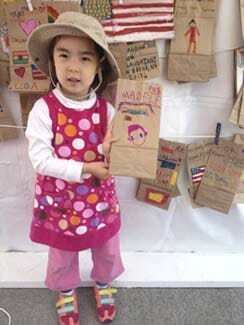
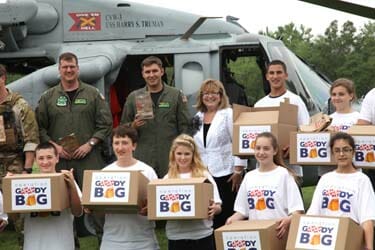
Sixth through eighth graders shared their work with classmates and teachers, families and first responders across the state. But, they felt they weren’t sharing with enough “heroes.” So, Operation Goody Bag was born.
Just a brown lunch bag, hand-colored and filled with a thank-you note, inspirational poem and candy treats. One delivery was made, and then the next, in total 1,783 in the first month. A job well done! But then the first thank-you note arrived and we were hooked. Goody Bags were shipped to the troops, to first responders in New Orleans after Hurricane Katrina and 5,000 to the children in Haiti after the earthquake.
To date, more than 325,000 Goody Bags have been packed and shipped to say thanks to those who keep us safe. Sept. 11 may be remembered for the tragic act of evil, but more importantly, it should be remembered for a time when real heroes, without concern for their own well-being, sacrificed their safety to protect others.
On the 10th anniversary of Sept. 11, the Corporation for National and Community Service held a 9/11 challenge, and Operation Goody Bag got top honors, with over 17,000 volunteers coloring Goody Bags and writing thank-you notes to troops and first responders. This year, we are reaching out to all Americans to help us achieve a new goal: 50,000 thank-you notes in 50 states on 9/11!
When Rose Joseph began volunteering at Loaves and Fishes Food Pantry in Devens, Mass., about five years ago, she started as a food distributor helping clients shop for food in the pantry. It was a great way to help, but she found that she could do more good by putting her professional skills to use.
Her background in data analysis led her to getting involved with helping the pantry director and client advocate with their reporting needs, compiling survey results and other such tasks. Now Joseph is responsible for upgrading the pantry’s databases and day-to-day operating software.
She has also written software that enables the pantry to run more efficiently, which helps improve the experience for both the clients and volunteers.
“Economic conditions in recent years have greatly increased the number of clients needing the food pantry to make ends meet,” Joseph says. “I compute pantry usage statistics that help us better serve our clients and create reports used for obtaining funding.”
Joseph began volunteering at age 14, when she worked as a hospital candy striper. She continued her volunteer work wherever she lived.
“Being of service to others is an expression of my faith, and I have been drawn especially to efforts that battle hunger,” Joseph explains.
While in college, she was part of a group that aimed to increase awareness of hunger in the Boston area. Also while in Boston, she volunteered at the Greater Boston Food Bank and helped with the sorting and packaging of donated food. When living in Chicago she worked at a homeless shelter and soup kitchen, and in New York she did grocery shopping for homebound seniors.
Joseph, a mother of three, says it was harder to volunteer when her children were little, but when her youngest child started kindergarten she began helping out at Loaves and Fishes. Her children will sometimes assist her with data entry and they have participated in food and bottle collections in support of Loaves and Fishes.
“We like being part of an organization that helps people in such a direct and fundamental way,” Joseph says.
What is Joseph’s advice for others who may be interested in volunteering? “Just dive in and give it a try. It may take a little while but eventually you will find something that is a good fit for your talents.”
Memories of Hurricane Sandy and Recent Floods Bring Long Islanders Out to Prepare
Read about how folks on Long Island, N.Y., are preparing for disaster. To help your family take action, visit Good & Ready, where you’ll learn how to create a disaster plan, build a preparedness kit and more.
Hear what Colleen Popp learned about disaster preparedness after Hurricane Sandy severely damaged East Rockaway, N.Y., home. (Click photo.)
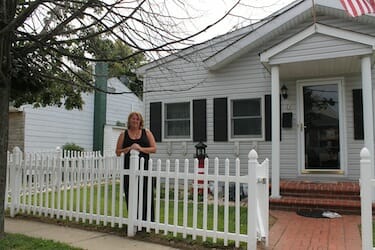
For her 50th birthday in 2012, Colleen Popp and her best friend headed to New Orleans to celebrate. She remembers being shocked by the lasting effects of the devastation caused by Hurricane Katrina in 2005.
“Everything was either new construction, still in disrepair or just desolate,” she said. “I just remember us looking at each other and thinking, could you imagine?”
Six weeks later – while sitting in the living room of her East Rockaway, N.Y., home watching Hurricane Sandy blow into town, water rushed in – sending her, her husband and two grown kids scurrying to the second story of their home.
It only took a few hours for the storm to destroy the first floor.
The Popps thought they were prepared – they had moved their cars to higher ground, had flashlights, candles, food and water on hand, and moved most of their electronics up to their second floor.
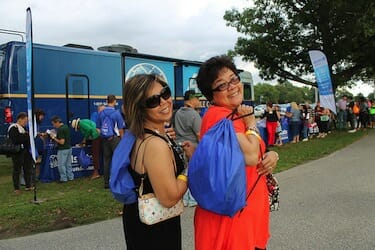
Lidia Fajardo of Franklin Square, N.Y., and Elizabeth Gosioco of Bayside, N.Y., show off their disaster kits.
“I thought we were just going to get it on the floor, I didn’t think to empty out the cabinets or counters,” she said.
According to Jan Epstein, senior manager of the Allstate Foundation, the Popps are not alone. “Only 15 percent of Americans are prepared for a disaster, which means that 85 percent are not,” Epstein said.
The Allstate Foundation and Points of Light hope to change that. This summer, they launched a 14-city disaster preparedness tour to help people take action. Last Saturday, the tour came to Long Island at Eisenhower Park, taking place before a free KC and the Sunshine Band concert.
“We want to give people the tools they need to take care of themselves and their families,” Epstein said.
Hundreds of Long Islanders lined up to create more than 750 free disaster preparedness kits. The kits include flashlights that don’t need batteries, dust masks, ponchos, first-aid kits and whistles. Volunteers from Allstate and the Long Island Volunteer Center, part of Points of Light’s HandsOn Network, provided tips and advice as they gave out the items.
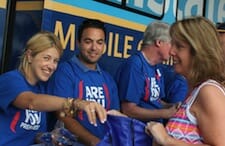
Allstate agent Christina Shaw, second from left, hands out supplies for disaster preparedness kits.
The event was just what friends Elizabeth Gosioco, Lidia Fajardo and Marilyn Jara – who are admittedly part of the unprepared 85 percent – needed.
With the recent storms hitting Long Island – Hurricane Sandy in 2012 and even the recent heavy rains that flooded many parts of the island just two weeks ago – they know that complacency is not an option.
“It happens so unexpectedly,” Gosioco said, shaking her head. She said she worries about what she would lose if her neighborhood flooded, her basement filled with 30 years of memories.
Now, the friends say they’ll take preparations more seriously. “This is a good start,” said Jara, pointing to their newly prepared disaster kits.
Diana O’Neill, executive director of the Long Island Volunteer Center, said she hopes that the event helps people realize that being prepared can offer some semblance of control at a time when many feel powerless.
“It’s up to us to be responsible for our preparedness, our response and the recovery,” she said.
Mary Halcott of Hicksville, N.Y., said that after Sandy, she faced extra challenges in caring for her elderly mother. “I came because I wanted to see if there was anything new to learn,” she said, adding she now knows how much water she should have on hand – one gallon per person for at least three days.
While the kits provide many items needed during a storm, Allstate agent Christina Shaw said it is only a start.
“Every family needs to really sit and think about their own personal needs – including medicine, how much water they may need – and really make it their own,” she said.
Shaw knows firsthand how devastating a disaster can be. She was six months pregnant with her daughter when five feet of water barreled into her home in Long Beach during Sandy. Her Allstate office was also without power, so she set up shop behind a Starbucks to help her customers file claims.
“Even if you weren’t directly affected or hit, almost everyone knew someone who was,” Shaw said. “We need to be prepared – especially because right now we are in the height of hurricane season.”
As for Colleen Popp and her family, it took them a year to renovate their home. Their neighborhood is still struggling to recover. Walking the quiet streets, many houses are still under construction, some have been leveled and others are still vacant.
“We were lucky. We didn’t lose our cars, we didn’t lose our jobs,” Popp said. “These are just things. And we are all fine.”