From Combat to College: Helping Veterans Transition
For many veterans, transitioning from active duty back to civilian life begins on a college campus, where they can receive the additional training and educational foundation they need for success. And you can help.
Points of Light Military Initiatives is proud to partner with the
.
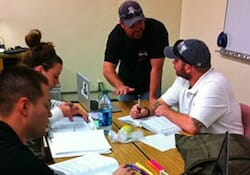
For this program, Points of Light Military Initiatives will soon begin recruiting 20 AmeriCorps members to serve on 10 college campuses across the country. These members will help Veterans Affairs counselors provide student veterans with services and resources to ease the transition to college life. VetSuccess on Campus will also offer career development guidance and access to health benefits.
Here are the 10 participating schools:
Cleveland State University
Community College of Rhode Island
Portland State University
Rhode Island College
Salt Lake Community College
Texas A&M University, Central Texas
University of Alaska, Anchorage
University of Michigan, Ann Arbor
University of Texas, San Antonio
University of Utah
Interested in learning more? Contact Raleigh Keagan at
Join Us for a Free Webinar Oct. 8 and Create a Buzzworthy Conference Session
Interested in presenting your ideas about volunteerism at a fun, informative gathering of people who care about the world? Here’s some advice from Lori Jean Mantooth, Points of Light’s director of training programs.
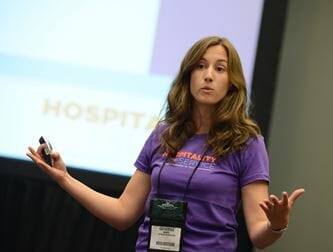
Catherine Ward of Taproot Foundation presents
at the 2013 Conference on Volunteering and Service.
Many of us have been there. We’ve pored over the list of workshops at a conference, reading descriptions and speaker bios in an attempt to decide which sessions to attend. I mean, if you’re going to dedicate 90 minutes to a workshop, you want to make sure it’s worth your time, right?
Or maybe you’ve been on the other side. You’ve spent hours developing a workshop proposal, hoping it would be accepted and then working hard to make sure the session lived up to your original vision.
Each year around this time, my colleagues and I get to figure out how to bring these two perspectives into one beautiful experience at the annual Conference on Volunteering and Service. We’ve just opened the Call for Presenters for 2014.
It’s an exciting time for us. We get to read about the great work that’s happening in communities around the globe. We receive proposals from nonprofits, government agencies, companies and individuals (both seasoned experts and first-timers) who can inspire and teach us all.
To help people develop strong proposals, we’re hosting a webinar on Oct. 8 at 3 p.m. (The proposal submission deadline is Nov. 8.) If you miss the webinar, you can find a recording on the registration page.
Last year we published an eVOLve issue about developing workshop proposals for any conference. Here is an updated look at those tips, tailored for the Conference on Volunteering and Service.
Learn about the Conference. Visit the website to learn about the Conference and who attends. The Call for Presenters page will give specifics about what to expect for workshops.
Review information from previous Conferences. Check out the session locator to learn about content and speakers from the 2013 Conference. Don’t just copy ideas from a past event; expand on those ideas or bring something new.
Align with the tracks and impact areas. The Conference workshops will be categorized into both tracks and impact areas this year. Your proposal can fit into one of each, so determine where your session fits best.
Use a catchy title. Many times Conference attendees don’t read past the session title. Find a creative way to catch attention.
Write a concise session description. Convey the topic and what people will learn if they attend your session. Be mindful of character limit (250, including spaces).
Narrow your focus. Don’t try to cover everything about volunteer management in 90 minutes. Pick one or two things to focus on.
Develop strong learning objectives. Don’t just relay information. Know what you want participants to learn and be able to do as a result of your session. (Hint: Use action words!) Then build a session that will achieve those objectives.
Plan your teaching methods. Create a session that blends presentation (lecture) with discussion, activities and other interactive elements to appeal to different learning styles and keep people engaged. Convey this in your proposal so reviewers understand how you will share, not just what.
Share your bio. Provide a brief sketch of your background, especially things relating to your presentation topic and your previous training experiences.
Consider engaging co-presenters. Your session may be stronger if you have multiple presenters. Note: The Conference on Volunteering and Service has a maximum of three presenters per session.
Follow the guidelines. Complete every step in the online system and meet the submission deadline of November 8. Even if a question is optional, providing an answer can help put your proposal over the top.
If you have a question about your proposal or the submission process, ASK! Sign up for the webinar on October 8. Check the Call for Presenters system and the Conference website, which contain the answers to most of your questions. If you still need assistance, contact us.
As you develop your proposal, ask colleagues to help you talk through ideas and read the proposal to ensure you’re sharing the right information in the best possible way. It may take a couple of rewrites, but the effort will be worth it. Don’t be discouraged if your proposal isn’t accepted this year. Ask the reviewers for feedback to help you improve for next time. Good luck!
How Volunteering Broke a Veteran’s `Vicious Cycle of Hate’
This post is by Heath Cobb of Georgia, a member of the Veteran Leader Corps, an AmeriCorps program run by Points of Light. He explains that volunteering helped ease his transition from military service back to civilian life.
Heath Cobb, second from left, visits a
VFW post in Savannah, Ga.
My experiences as a Marine serving in the Middle East do not make me special, nor am I a hero. I do not shed tears for my brothers who gave their sacrifice in the sand. In fact, I consider them fortunate to have died in such an honorable way.
It’s not about how long you live; it’s about how well you live. This is what so many of our returning military members quickly forget as we try to acclimate back into society. This, I am certain, is the cause of so many of the problems we face after leaving the service.
As a Marine I understood why it was necessary to fight, but more importantly, I discovered why Americans are the “good guys.” As Marines we learn what makes us special isn’t that we are the finest fighting force in the world. We are special because we are not bullies, we are not savages. We are protectors.
I believe this sense of protector, this profound feeling of inner peace, can be restored to many of our veterans simply by exposing them to the very spiritual act of giving. Volunteering within the community is very similar to serving our great country in the military. Working to help others, for the betterment of man, is almost tangible. It truly honors our mothers and fathers and restores that sense of pride that many of our veterans lose so quickly.
I was fortunate to have a relative who is a champion of peace, Dr. Rose Marie Clarke. She worked with another notable person, Jeremy Foreman whose foundation, Georgia Serves, was responsible for recruiting me to AmeriCorps. Both have souls of an angel and are very active within the community. They are quick to help others and prefer charity work to food.
Aunt Rose witnessed my struggles firsthand. She saw me suffer from the scars of war. Rehab and mental institutions became commonplace. My often bizarre behavior was fueled by rage and I found myself in a vicious cycle of hate. Even the birth of my precious little daughter wasn’t enough to bring me out of the hell I was in.
Then, following a suggestion from my aunt, I got involved in the community by volunteering my time. I had inadvertently opened a door that would finally start healing the pain that plagued my heart like a rotting cancer. I didn’t know it but I was being exposed to an environment filled with folks who volunteered their time and effort simply because it made the world a better place and I noticed immediately how happy these people were.
I found the pride I felt when serving others was the same pride I felt by defending others. Suddenly, almost overnight, my sense of self was restored, my identity renewed. This, my friends, is the answer that many of our vets are seeking.
Unless we can really communicate the spiritual value of volunteering and charity work to those who may be struggling or even those who simply may need some guidance, we will fail to have any meaningful effect. I am very excited to be a member of AmeriCorps for this reason. The support and resources from this organization are second to none and I am fortunate to be involved with several key partnerships that offer a wealth of knowledge and experience. I look forward to building upon the shared goodwill of AmeriCorps, the American Red Cross, Points of Light and Georgia Serves.
God bless us all!
A longer version of this post originally ran on the ServiceNation website in honor of the 20th anniversary of AmeriCorps. Read it here.
In These Divisive Times, What Can Bring Us Together?
This post is by Tracy Hoover, Points of Light’s president.
Uniting in volunteer service can be about setting aside ideological differences and finding common ground to solve community problems. It can be about stuffing a tote bag with desperately needed supplies and saying, “We’re here to help.” And sometimes it’s both.
Tracy Hoover
Earlier this week, I was proud to join volunteers, community leaders and education activists from the Chicago area for a compelling discussion and day of service in support of public education and Points of Light’s One America campaign. One America, sponsored by our partners at JPMorgan Chase, is about creating meaningful and lasting change in our communities.
Retired Cubs pitcher Kerry Wood and his wife, Sarah, whose
. And Kerry reminded us all that one of the most powerful ways to make a difference is through a sustained commitment in the life of a young person – as a mentor, tutor, coach or adviser. Then dozens of volunteers pitched in to stuff resource kits for public school teachers. A professional athlete, nonprofit and corporate leaders, community volunteers and students worked shoulder to shoulder, united by a belief that we all have a role in building strong schools.
That unity is central to the message of One America. And this week we’re seeing that message resonate even in the halls of Congress.
From the Senate floor, Sen. John McCain saluted the 20th anniversary of AmeriCorps and the service initiatives founded by presidents on both sides of the political aisle – including Points of Light – that unite Americans through volunteerism. “With so much division and discord throughout the country today, national service can help bring our country closer together,” he said.
We’re looking forward to bringing the idea – and the actions – of One America to more cities throughout the year, and I encourage you to find your own way to get involved.
, check out our custom app, and see what you can do to unite members of your community through service. One America is more than an idea
– it’s a
movement. And it needs you!
Three Things You Can Do Right Now to Help Colorado Flood Victims
Today’s post is by Kristy Judd, executive director of Metro Volunteers, a HandsOn Network affiliate in Denver. See the end of the post for recommendations from Points of Light about how you can help.
Floods have devastated parts of Colorado,
including this stretch of road in Jamestown.
Colorado is one of those states where collaboration and cooperation matter a great deal. We have small communities with limited capacity to manage large scale disasters. Together, we’re stronger.
The volunteer centers in Colorado have adopted that same philosophy when tasked with managing spontaneous, unaffiliated volunteers, especially when multiple incidents are happening concurrently. For that past five years, our Colorado Volunteer Center Network has worked together to develop the Volunteer Coordination System. Crafted by phenomenal VISTA members, this scalable program can be implemented remotely with Internet connections. It gives us the ability to have Aimee Liotino in Colorado Springs support Sue McCullough in Boulder. Or Emma Woods in Greeley support Jami McMannes in Fort Collins.
Even though we’re in a state where disasters aren’t frequent, when they hit, they are devastating. That our network took the time to develop this system, train our staff and establish clear communication tools has given us the ability to be the “go to” organization. While we’re the quiet, behind-the-scenes group, we have the opportunity to put citizens to work to help their neighbors in meaningful and impactful ways.
This work is important. Sign up to volunteer with your HandsOn Network affiliate and please, also write them a check. Without their organizational skills and knowledge, much of the work in communities to recover from a disaster wouldn’t happen.
Here are three things you can do to help Colorado’s flood recovery efforts:
Register your interest to volunteer here. (Please do not self-deploy to affected areas.)
employees deployed across the Washington, D.C., area during three simultaneous events to remember the thousands of military men and women who have sacrificed their lives since the terror attack and to help those who have come home.
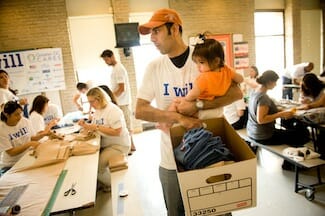
Exelis volunteers and Veterans On The
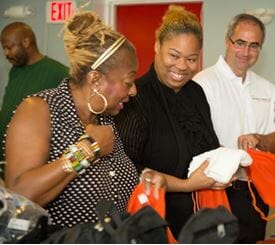
Rise staff assemble job-readiness kits.
in northeast D.C. to prepare 100 job-readiness backpacks, which included portfolios, deodorant and toothpaste. Volunteers then worked together to cook a nutritious meal for 50 residents and staff members of Veterans On The Rise, which provides housing and supportive services to homeless veterans.
At the Army and Navy Club in northwest Washington, 20 veterans heard from A. John Procopio, senior vice president and chief human resources officer for Exelis, about how to get ready for job hunting. They then sat down with Exelis executive volunteers for personalized career counseling sessions and had the opportunity to participate in a workshop hosted by tailor Aaron Goode, of VM Clothiers, on how to dress for corporate America. In a raffle, two veterans won tailor-made suits.
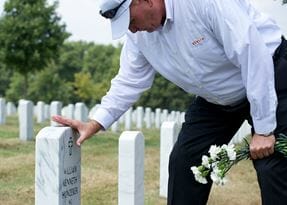
Ken Hunzeker, Exelis executive vice
president and president of Mission Systems,
lays flowers at a fallen soldier’s gravesite.
Across the Potomac River at Arlington National Cemetery, Exelis executives gathered with local veterans to pay their respects to the fallen. Following a wreath-laying ceremony at the Tomb of the Unknown Soldier, volunteers walked together throughout section 60 of the cemetery, laying flowers on gravesites. Volunteers then worked to build 100 MedEvac bags for wounded warriors arriving at Walter Reed and Ft. Belvoir medical centers.
“Military service men and women have dedicated themselves to a cause greater than themselves,” said Mike Monroe, vice president of military initiatives at Points of Light. “To show them that their nation, its citizens and corporations do not take this selfless act lightly, Points of Light and Exelis show their support on 9/11 and every day.”
To learn more about how Exelis and Points of Light are serving veterans, go to pointsoflight.org/veterans.
Civic Accelerator Moves Neighbor.ly Toward Serving More Neighbors – Maybe You
got some national attention for its success in the recent Points of Light Civic Accelerator and its innovative idea that could soon have you sparking civic projects in your community.
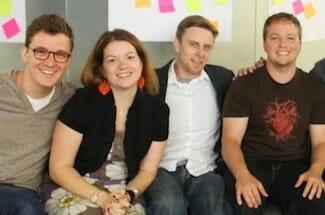
From left, Sean Connolly, Sarah Shipley, Briston
Davidge and Jase Wilson of Neighbor.ly
, “Oddly, very little of the conversation focused on the $50,000 investment they had just won for being selected by their peers as the accelerator’s top for-profit startup. … Rather, there were a number of takeaways that had them excited about their crowdfunding startup’s future and evolution.”
Namely, Wilson said, the accelerator helped the team “realize it’s not just about individuals, but bringing together an entire community.”
The 12-week Points of Light Civic Accelerator provides mentoring, peer support, entrepreneurial education, networking and investment for startups that solve education, environmental and economic issues by engaging people as part of the solution. At the end of the 12 weeks, the participating entrepreneurs select two ventures – one nonprofit and one for profit – to each receive $50,000 investments. Last month, the program’s third group of participants chose Neighbor.ly and the
of Kansas City, Mo., a for-profit business, uses the idea of crowdfunding – calling upon large numbers of people, local businesses and community organizations – to raise money and awareness for projects that benefit communities, such as wireless Internet access for low-income housing, restoration of historic city fountains and a playground built to accommodate children with disabilities. (Click
to start a project for your own community.)
And as Wilson told Bauters: “We’re hellbent on helping greenlight tens of thousands of projects by raising millions of dollars. Points of Light really helped accelerate that process.”
Read the full Silicon Prairie News article
Volunteers make quilts for children in need during a
previous 9/11 Day.
Today, the 9/11 Day of Service and Remembrance, Americans across the country are reclaiming the legacy of 9/11 by doing good in their communities through volunteer service.
Won’t you join them?
Check out 911Day.org or Points of Light’s volunteer search for ideas. If you don’t have the time to participate in an organized event today, pledge to serve at another time. You can even create your own opportunities. Maybe you’d like to organize your child’s class to assemble care packages for troops overseas. Or perhaps you’d like to cook a meal for your local firefighters.
Click here to see if there are Points of Light affiliate events in your area.
Let us know what you decide to do to commemorate 9/11 at [email protected]. We might feature your story on our website and share it on social media.
The Most Important Shopping List You’ll Make This Weekend
A flashlight with extra batteries. A first-aid kit. A three-day supply of water. Add these items – and a few others – to your weekend shopping list, and you’ll be taking a big step toward helping your family be more prepared should a disaster.
September is National Preparedness Month, and in communities across the country, volunteers are helping families prepare for disasters by participating in “Good & Ready” emergency preparedness kit-building events. Disasters can happen anytime, anywhere, with little or no warning. Research from the Federal Emergency Management Agency (FEMA) found that 85 percent of Americans are not prepared for potential disasters.
Good & Ready is an online and on-the-ground emergency preparedness program led by Points of Light in partnership with Ready.gov, the American Red Cross and the Federal Alliance for Safe Homes, with support from Target and The Allstate Foundation. You can help your family and community be better prepared for, and recover more quickly from, disasters.
Visit www.GoodandReady.org to take an emergency preparedness quiz, download a checklist to build an emergency preparedness kit of your own, or find a kit-building event in your community.
And get Good & Ready this month!
Today’s Education Crisis and the Table of Brotherhood
This post is by Tracy Hoover, president of Points of Light.
Tracy Hoover
If you’ve ever imagined a fantasy collection of dinner companions, then you might understand the excitement I felt last Sunday when America’s Sunday Supper came to Atlanta
As the sun set on the Martin Luther King, Jr. historic district, I arrived at an event that would kick off our national commemoration of the 50th anniversary of the 1963 March on Washington. Hosted by Bernice King, daughter of Dr. King, and President and Mrs. Jimmy Carter, Atlanta’s Sunday Supper brought together a spectacular assembly.
Guests included the Rev. C.T. Vivian, a hero of the civil rights movement and a recent recipient of the Presidential Medal of Freedom; members of Dr. King’s family, including his sister, Mrs. Christine King Farris; Atlanta Public School Interim Superintendent Erroll Davis and an exceptional group of principals, teachers and students; Doug Shipman, who leads the Civil Rights Museum; Laysha Ward, president of Community Relations for Target; NBA superstar Dikembe Mutumbo; dozens of Atlanta media, business and community leaders … and me.
It seemed entirely fitting that we came together to share a meal – an enduring ritual of community. By breaking bread together and reflecting on Dr. King’s messages, it was easy to celebrate how far we’ve come. “I have a dream,” he said, “that one day, on the red hills of Georgia the sons of former slaves and the sons of former slave owners will be able to sit down together at a table of brotherhood.”
Last Sunday, it seemed our supper tables had become those tables of brotherhood, and I found myself rejoicing in the dream fulfilled.
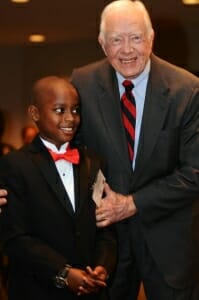
Zaqary and President Carter
But it wasn’t long before our dinner conversation turned to the crisis in American education and the shocking statistics that reveal a profound disparity in access and achievement. Provocative discussions erupted at every table, and guests began to challenge misconceptions, grapple with entrenched issues and suggest creative solutions.
Through diverse voices of young people and seniors, educators and business leaders, parents and neighbors, one common affirmation rang out: Effective education for all must be part of our shared dream for America’s future. It is still a promise unfulfilled for too many of our children.
The evening ended with two profound reflections. First, eight-year-old Zaqary Asuamah (pictured left with President Carter) recited the entire “I Have a Dream” speech flawlessly and by heart, a feat that Dr. King’s daughter laughingly confessed she might find daunting. And in closing, Bernice King left us with a powerful charge and a promise. “We will do better,” she said to America’s youth. “We must do better.”
Atlanta’s Sunday Supper was a touchstone for a renewed commitment to addressing the crisis in education in America. You can watch the program here.
America’s Sunday Supper is a national movement that promotes the concept of people coming together across divides to share a meal and talk about how to engage volunteers to help solve critical community problems. Discussions like the one in Atlanta are happening each week, in communities all across America, engaging more than 100,000 people.
America’s Sunday Suppers are made possible by Target, which gives 5 percent of its profit and thousands of volunteer hours to communities every day, and Points of Light, the largest organization in the world dedicated to volunteer service.