How the Service Enterprise Initiative Drives Nonprofit Capacity Building
By Karen Baker, Chief Service Officer, CaliforniaVolunteers
Nearly a decade ago, we noticed a troubling trend in California: one out of every three volunteers was leaving their service site within the first six months of their experience. Simply put, California nonprofits were not providing solid recruitment, on-boarding, training and recognition of volunteers. Simultaneously, volunteer centers that had this knowledge lacked the investment dollars needed to put together a business model that would allow them to assist nonprofits in their markets for a reasonable fee.
At Points of Light’s Conference on Volunteering and Service in 2009, companies, volunteer centers, service commissions and nonprofits learned about new research reported from the TCC Group confirming that only 15 percent of nonprofits were operating as “Service Enterprises.” These were organizations that engaged volunteers, and which outperformed their peers in every measure of organizational capacity, including leadership, management, adaptive and technical capacities. At the same time, the Corporation for National and Community Service happened to announce a new grant opportunity, the Volunteer Generation Fund, which could potentially put these seemingly disconnected developments together into one grand idea by providing the funding needed for nonprofits to create a business model to scale Service Enterprises.
It was the perfect storm. By bringing together four leading volunteer centers — OneOC, The Volunteer Center Serving San Francisco and San Mateo Counties, HandsOn Central California and The Center for Volunteer and Nonprofit Leadership — CaliforniaVoluteers was able to provide the resources needed to create the Service Enterprise curriculum. The program now had a strong foundation, but wasn’t national. In 2012, Points of Light joined the initiative to further develop and scale the program.
Today, the Service Enterprise Initiative is a national program that helps organizations transform the way they engage human capital for social good. Through an assessment, training, coaching and certification model, selected nonprofits are equipped with the tools and technical assistance needed to transform their operations to better meet their missions. In fact, research shows that Service Enterprises are just as effective as their peers — yet they operate at almost half the average annual budget. For every $1 they invest in effective volunteer engagement, Service Enterprises can also expect $3-$6 in return through more effective program delivery. More than 300 nonprofits across the country have become certified Service Enterprises, joining a growing movement of organizations dedicated to meeting their missions more effectively using the power of volunteers.
This is true for Connolly Ranch, a nonprofit in Napa, California, that connects children and family to nature through farm-based education to inspire the next generation of environmental stewards. By becoming a certified Service Enterprise, “our leadership and staff has learned … that our return on volunteer investment was $4 for every $1 invested! This allows us to maximize what our community contributes to our organization and helps us better achieve our mission,” said Jennifer Fotherby, executive director at Connolly Ranch.
Habitat for Humanity in Fresno has also transformed the way it engages volunteers through the Service Enterprise Initiative. Now, volunteers are key to the success of the organization’s core mission to provide affordable housing. They are integrated into operational areas like fund development, and drive critical parts of Habitat’s programming, including their Neighborhood Revitalization and ReStores programs. This has helped shape a culture of volunteering at the organization. “When I think of the Service Enterprise Initiative,” said Matthew Grundy, CEO of Habitat for Humanity in Fresno. “I think of two words: investment and focus. It was an investment to participate in SEI that focused our efforts to build on our solid foundation, making sure our organizational culture embraced volunteers 2.0. Service Enterprise asked the right questions and we have experienced significant impact in moving our organization forward.”
For CaliforniaVolunteers, our proudest moment over the years was recognizing that not only was the Service Enterprise Initiative going to happen, but that it played to everyone’s strengths. We knew that the volunteer centers in California had the know-how, that researchers – such as Sarah Jane Rehnborg and Peter York – had the wisdom to develop a diagnostic tool, and that Points of Light was the right player to ensure credible national expansion. Our role was to put the deal together and get out of the way, and the rest is history.
The Service Enterprise Initiative today stands as a powerful tool to build nonprofit’s organizational capacity and is a resource they can use to help them better engage volunteers. Last year, more than 80 percent of Service Enterprises reported an increase in both volunteers and skills-based volunteers, which represents an additional 207,000 volunteers and 31,000 skills-based volunteers helping nonprofits and communities. And California? Far from being a laggard in volunteer engagement, the nonprofit sector in California now leads the national Service Enterprise movement and is on the cutting edge of innovative volunteer service models.
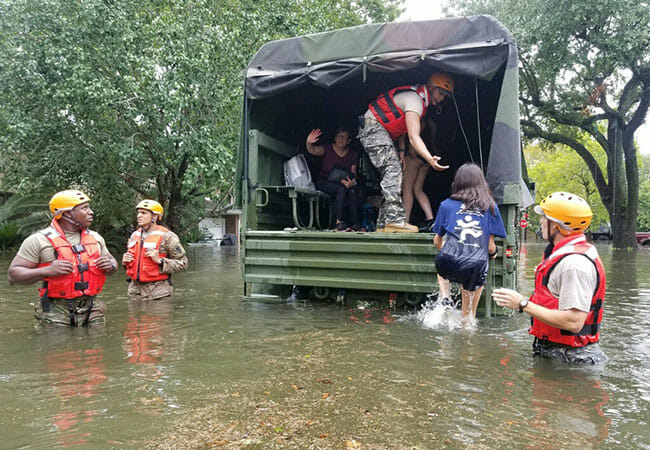
Texas National Guard soldiers arrive in Houston to aid citizens in heavily flooded areas from the storms of Hurricane Harvey.
Hurricane Harvey is the first Category 4 storm to strike the United States since Hurricane Charley in 2004, and the first major hurricane since the record-breaking 2005 Atlantic hurricane season, which saw such devastating storms as Katrina and Wilma. The slow-moving system is virtually unprecedented, forecasted to maintain tropical storm strength for five days as it moves along the Texas coast. While Harvey’s winds have weakened following landfall on Friday night, catastrophic flooding and life-threatening hazards continue to arise. In this current situation, with tropical storm Harvey still producing a lot of rain over the Gulf Coast, safety is our top concern. At this time, it is critical that people who want to volunteer, especially those outside of the immediate area, do not self-deploy.
Points of Light is currently supporting first responder organizations, like FEMA and the American Red Cross, connecting with Voluntary Organizations Active in Disaster chapters across the United States to assess the situation, and coordinating with our affiliates and partner organizations in the affected areas. All disasters are local; the members of the Points of Light HandsOn network are the local experts in volunteer management, and are often the lead organization in managing spontaneous unaffiliated volunteers throughout the response and recovery effort.
Texas is still in response mode and, until the storm has stopped, we will not have a clear sense of the damage or when it will be safe to begin recovery efforts. If you would like to support the recovery effort, here’s what you can do now to help:
Please don’t:
Don’t self-deploy at this time. The situation is still critical, highways and secondary roads are underwater, and travel is extremely difficult or unsafe throughout much of the affected area.
Don’t bring supplies or donations to fire stations, police departments, etc. First responders need to focus on immediate needs and emergency situations.
Please do:
Make a donation to help Points of Light and our affiliates support the mobilization of volunteers in ongoing response and recovery efforts.
If you are in the Houston area, volunteers are encouraged to contact Volunteer Houston, a Points of Light HandsOn Network affiliate, for opportunities to get involved. Nonprofits requesting assistance from volunteers can register their needs with the Volunteer Houston Virtual Volunteer Reception Center.
It’s been remarkable as a Houstonian to see the uprising of benevolent, kind-hearted points of light in our community that are trying to help each other, neighbor helping neighbor…it’s amazing to see this community come together to help people in their greatest time of need.
Points of Light is communicating and coordinating a humanitarian response with our affiliates and corporate partners. As the storm dissipates and a more clear assessment of the crisis and need is available, we will provide updates on how to get involved.
For the latest, please sign up for Points of Light email news and announcements, follow us on Twitter and check out our updates on Facebook.
Solutions for Community Resilience: Meeting the Urgent Needs
When government agencies, nonprofits and community changemakers focus on strengthening educational and economic advancement for youth and families, social equity and cultural expression, their collective action can lead to clear, measurable impact and sustainable long-term change.
Participants of the
learned about successful models that empower and equip everyday citizens to create healthy, vibrant, thriving communities, as well as best practices for engaging volunteers from across the community in consensus building and community organizing to tackle some of today’s toughest issues.
Citywide Volunteer Initiative Sparks Youth Interest In Careers
Local schools issued a challenge to 11 of the largest employers in Indianapolis: Open your doors so our kids can learn about the world of work and the skills they need to succeed. “Schools with 95 percent of their children living in poverty are a complex environment with complex issues,” said Joe Gramelspacher, special assistant to the superintendent of Indianapolis Public Schools. Fifteen months later, a broad cross-sector collaboration delivered an answer.
Workshop attendees learned how the
initiative – a team of businesses, educators, government agencies and nonprofits in Indianapolis – brought together 115 of the city’s employers, more than 3,000 volunteers, and 400 educators to build a two-day event to spark career inspiration for more than 7,000 eighth graders. Filled with hands-on learning experiences and demonstrations, the event presented on the types of jobs needed in the future for different industries, the skills needed and the pathways to acquiring them.
Whereas schools are primarily focused on closing the achievement gap, Jennifer Burk, president and CEO of Junior Achievement of Central Indiana, explained that, “JA JobSpark’s goal is to tackle the ‘exposure gap’ – the lack of opportunities for a student to see something that inspires them to consider what their future could look like.”
Engaging Veterans: The Second Mission
Veterans who served in the last decade represent less than half a percent of the total population, but their dedication to service and American democracy supports 100 percent of Americans. Jason Alves, program manager for the Washington State Department of Veterans Affairs, and Peter Schmidt, program coordinator for the Washington State Department of Veterans Affairs, led an engaging conversation around how we can access the strengths, skills and talents that exist in every service man and woman leaving our nation’s military. Workshop attendees discussed how it is crucial to evaluate situations from multiple perspectives when considering how a veteran’s experience and skill set can be used in a civilian volunteering opportunity. Jason and Peter also encouraged attendees to reframe post-traumatic stress as an opportunity for post-traumatic growth, as Jason explained it, “the experience of positive change resulting from the struggle with major life crisis.”
New Pathways to the American Dream for Youth
The path to college and career success is not always a straight one. More than 5 million youth are in need of new opportunities to participate in the labor market or continue school. Marcia Page, president and CEO of Education is Freedom, Terra Gay, senior vice president of programs at Points of Light, and Stephanie Lloyd, director of monitoring and evaluation at Points of Light, shared how volunteer service has provided opportunities for success for youth, as well as become an integral part of the solution in closing the opportunity gap via the
program.
A joint partnership between AmeriCorps, the Citi Foundation and Points of Light, ServiceWorks had a three-year charter, from 2014 to 2017, to provide 25,000 low-income youth scholars with the specific tools and platforms needed to increase their access to economic advancement through college and career success. “The idea isn’t to go and serve simply to fulfill a gap. It’s to help [opportunity youth] understand the need to serve as a volunteer so they can become the ones to teach it to their peers; it’s a building process,” Terra said. “ServiceWorks takes them through the process of elevating their thinking of how they are citizens within their own community and agents of change.”
In spring 2017,
, Lincoln Filene professor of citizenship and public Service and associate dean for research at Tufts University’s Jonathan M. Tisch College of Civic Life, conducted a review of ServiceWorks based on an assessment of program data and documents, plus interviews with participants and stakeholders.
Recent scholarship suggests a path to economic mobility lies in investing in low-income neighborhoods. Brian Humphreys, director of financial empowerment at South Sound Outreach; Megan Karch, CEO of FareStart; Catherine McConnell, vice president of advancement at Goodwill; and Kim Vu, senior vice president, Seattle market manager of enterprise business and community engagement at Bank of America, shared how community-level problem solvers, resident volunteers and local nonprofits can accelerate and sustain change by promoting financial empowerment while also re-imaging neighborhood community spaces to stabilize and, optimally, boost economic opportunity. “Where we are most successful are in the relationships that we build over time,” Megan said. “How we engage with volunteers is more in how they are establishing relationships and the appropriate boundaries with those that are being served.”
Nonprofits and government agencies’ abilities to solve societal issues are often constrained by organizational capacity. When your roof is leaking, you focus on the immediate issue of repairs and may put off a much-needed basement remodel. The same can often be said for capacity building initiatives; they take time, resources and staff capacity that many nonprofit organizations don’t feel they have, even if it would pay off in the long run.
The
, sponsored by JPMorgan Chase & Co., focused on these issues and offered attendees proven and feasible solutions for increasing nonprofit capacity. Across the nine sessions, three trends emerged as to how nonprofits can leverage existing assets and resources to do more.
1.
Move from Partnerships to Collaboration
The biggest trend across all the sessions was the need for a pragmatic shift in how nonprofits engage companies and work with other organizations. During the “Corporate-Nonprofit Partnerships Blown Way Out of Proportion” session, Bea Boccalandro, president of VeraWorks, pushed attendees to think about how they could triple their impact by focusing on cultivating integrative partnerships – where the success of both the nonprofit and company are intertwined. “Most relationships between business and nonprofits are philanthropic or transactional. But to get at impact, we need to push towards integrative,” Bea said.
Bea recommended starting small, with pilot initiatives. This was echoed by Rebecca Wang, senior manager of corporate affairs at Hewlett Packard Enterprise, who offered a corporate perspective. Rebecca compared the process of entering a new partnership to taking it slow with a new romantic partner. “When I am working with a newer organization that maybe another company has referred to me, it’s kind of like the dating phase. You are really thinking more about your own benefits. As you go through multiple dates, you start to understand each other better. You may decide to become exclusive. At that point, the commitment to each other becomes integrative.”
Sessions also encouraged nonprofit sector attendees to rethink how they partner with each other. Too often, nonprofits feel that they are competing against one another and therefore cannot truly collaborate. Shonna Ferree and Rikki Wheatley-Boxx of the Public & School Partnership, an AmeriCorps VISTA program, shared best practices for collaborations between organizations and recommended leveraging
mandated days of service as platforms for local collaboration and outlets for raising awareness of national service efforts.
2.
Be Data Driven, Not Numbers Numb
Two sessions focused on the importance of leveraging data, but in strategic and creative ways in order to see real community impact, not just a shift in numbers. In the hands-on “Survey Sense/Let the Creativity In: Exploring Alternative Methods for Data Collection” workshop, Stephanie Lloyd, manager of evaluation and performance measurement at Points of Light, walked participants through a visual survey methodology called SHOWeD, first developed by Wang and Burris in 1997.
For attendee Leah Vanhoeve, the session was thought-provoking. “It was great to be engaged and feel like we could be engaging other people through this instead of staring at a computer screen codifying qualitative data, because it’s really not that different from quantitative data, it’s just two sides of the same coin,” she said. “This felt very out of the box and applicable, and not something I had ever heard of before.”
3.
Leverage the Power of Pro Bono
Many nonprofits are interested in recruiting pro bono and skills-based volunteers but are unsure how to start or struggle to find ways to effectively leverage these volunteers to build capacity within their organization. Yet, pro bono volunteers can provide up to 500 percent greater value to nonprofits than the value of traditional volunteering, by supporting needs such as general operations, technology and professional services.
Panelists at the Making the Most of Corporate Skills-Based Volunteering: A Fireside Chat with JPMorgan Chase & Co. session shared tips and best practices for developing a pro bono strategy. Attendees broke into small groups and worked through Common Impact’s skills-based volunteering
.
“We are a volunteer-based organization, so we are very familiar with plugging volunteers into our actual programs, but thinking about pro bono from a capacity building standpoint is something we are just starting to dig into,” said Jessie, an attendee from Grid Alternatives. “It was helpful to hear some examples of how other organizations have done that, but also just some of the resources that Common Impact provided around potential projects and the questions you need to think about before you even approach a company with a pro bono idea.”
These are just a few of the highlights from the Capacity Building track. Across the sessions, attendees were exposed to new ideas, trends and resources to take back to their organizations.
Atados Wins George W. Romney Award for Volunteer Program Supporting Refugees in Brazil
In difficult times, we often look to humanitarian groups to support those in need. Since the onset of the refugee crisis, this has certainly been the case in Brazil – where the number of refugees has doubled each year since 2011.
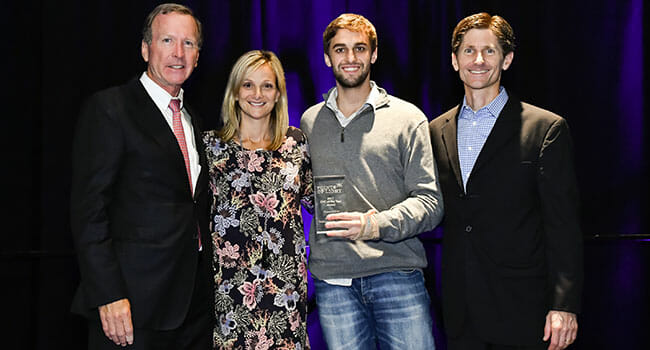
, the winner of Points of Light’s 2017 George W. Romney Award, adapted its successful volunteer engagement model to respond to the global refugee crisis and provide aid to the people taking refuge in Brazil.
The Romney Award, presented annually at the
to an affiliate from Points of Light’s global network, aligns with core strategies impacting volunteering and service and celebrates the extraordinary work taking place around the world in local communities. In the past, awards have focused on collaboration, innovation, collective impact and mobilizing local changemakers.
This year’s award, inspired by Points of Light’s resilient communities framework and aligned with the UN’s
, recognizes an affiliate’s contribution to healthy, vibrant, thriving communities by leveraging the contributions of neighbors, networks and nonprofits. Points of Light created the resilient communities framework based on the four domains of community resiliency as recognized by the
, highlighting the critical role that volunteerism plays in education, neighborhood/built environment, economic stability and overall health. Our approach to building resiliency is grounded in three core components: partnerships, programs and people. The framework provides opportunities for Points of Light to lean into cross-sector partnerships that align with local community needs to make an impact and drive change.
Scaling programs that work is essential to how we drive community change. Equally as important is ensuring people and nonprofits in the community have the leadership and capacity building opportunities to sustain this change. Atados, recognized for their work inspiring volunteers and building engaged communities across Brazil, identified a need and developed a program that engaged the community in solving the challenge. In 2014, as Brazil hosted the FIFA World Cup, there was an influx of refugees into the country. In response to the challenges that often accompany the transition to a new cultural environment, Atados created opportunities for volunteers to train refugees for employment as language teachers. What started with a small team and many volunteers has evolved into
– a language school that has trained and created opportunities for more than 60 refugees, who teach the language and culture of their native countries to more than 2,000 students in Rio de Janeiro and Sao Paulo. The program is a shining example of the role that networks, neighborhoods and nonprofits play in engaging community members, both as participants and beneficiaries of programs.
“Cities are only as resilient as their residents. A community’s ability to adapt and progress is dependent on the strength of its local networks. Too often the human infrastructure to create viable, locally-driven, sustainable solutions does not exist,” said Gared Jones, senior vice president of global at Points of Light. “Atados’ work demonstrates how our network is mobilizing and equipping volunteers to create local solutions to some of the world’s more pressing challenges. Innovative solutions like Abraço Cultural are what Points of Light’s network is scaling and replicating around the world.”
The George W. Romney Excellence Award was established in 1996 to honor
Gov. Romney
and his personal commitment to volunteer service. Romney was chairman and CEO of American Motors, a three-term governor of Michigan and U.S. Secretary of Housing and Urban Development. He was also founding chairman of the National Volunteer Center and a founding member of the board of directors of Points of Light.
Building Capacity: Strategic Volunteer Engagement
This post was written by Teri Johnson, senior vice president of strategic partnerships, training and consulting for Points of Light.
The nonprofit sector spends a lot of time agonizing over organizational strategy and how to meet mission with increased demand and fewer resources. Though volunteers seem like an oversimplified solution to the problem, through strategic volunteer engagement, they can be viable and, oftentimes, necessary assets to nonprofit capacity building.
The good news is, people want to volunteer! According to the
, 1 in 4 Americans volunteer through an organization. The report also indicates that volunteers are twice as likely to donate money to organizations compared to non-volunteers. Why, then, are some organizations unhappy about the idea of volunteers knocking on their doors?
Great volunteer engagement is done strategically, as a part of the organizational culture; however, this approach takes an investment of time and energy that many organizations don’t feel they have. The result is a resistance to developing a more vibrant volunteer engagement program. Even some of the strongest nonprofits with vibrant programs engage volunteers either episodically, or because they are mandated to do so. When you engage volunteers with a fill-the-gap approach, without a needs assessment, compared to one of strategy, it’s harder, more time consuming, and generally less fulfilling for both the organization and the volunteer.
However, organizations that build a culture of volunteerism, and purposefully embed volunteerism into their strategy, experience stronger retention rates, increased volunteer engagement and higher
, for example, experience a 23 percent average increase in new volunteers in their first year after being certified by implementing strategic volunteerism practices.
Strategic volunteerism means embedding volunteers as capacity builders into your operational and programmatic strategies. Any organization, regardless of size, is capable of engaging volunteers strategically. It takes time and commitment, but the outcome is stronger mission delivery. Here are a few tips for helping your organization tune in to a culture of volunteerism:
Enlist the support of senior leaders and decisions makers for volunteers to be more integrated into your organization.
Perform an internal needs assessment to determine where there are gaps.
In every program design or strategy session ask the question, “How can we engage volunteers to help us achieve this work?”
Commit to a codified recruitment, training and recognition program for your volunteer program.
Track your volunteer efforts and report on outcomes and outputs.
When volunteers are an afterthought, it can be challenging for everyone involved – but when volunteerism is a part of organizational culture, your efforts will return bigger results. Volunteers will be your ambassadors in the community, your capacity builders and some of your greatest assets. Volunteers will step in to fill the necessary gaps to allow your organization to make a bigger impact.
5 Reads To Help You Cope
At every turn, stories from every corner of the world tell of human suffering caused by war, poverty, hatred and injustice. The constant onslaught of the last few months have left many feeling overwhelmed, at a loss for words and actions. How do we make sense of recent events? How do we talk to our children about things we as adults cannot understand? How do we turn the division into unity to build stronger bonds of civic engagement and equity?
There are no simple answers. Perhaps that’s why there’s some comfort in one blogger’s headline, “Whatever you’re feeling is OK.” Vu Le is the executive director of Rainier Valley Corps, a Seattle nonprofit that helps develop and support leaders of color to strengthen the capacity of communities-of-color-led nonprofits. Le acknowledges that, whether you’re a dedicated volunteer, in national service, or work at a nonprofit, many people “get into this line of work because we are empathetic by nature. That means that often we will feel things acutely and also absorb others’ emotions like a sponge.”
Points of Light’s own AmeriCorps Alum leaders Mary Bruce and Ben Duda penned an aptly titled message to their members: “We’re restless.” They poignantly state that each act of violence is a “brutal reminder that we have much work ahead to live up to the promise of the AmeriCorps pledge and ‘bring Americans together to strengthen our communities.’” In addition to offering up resources for their members struggling with finding their role, they’re undertaking an effort to be more active in leading dialogue and action to address disparities and social injustice.
During these troubled times, many resources have come to the fore:
The American Psychological Association has guidance and resources for coping with tragedy.
For children, the feelings run even deeper, leaving them filled with distrust and fear. GenerationOn, the youth division of Points of Light, has compiled an archive of articles from youth development and parenting experts about how to talk to kids and teens after a tragedy.
Sharing resources and engaging in dialogue help break through feelings of isolation and disconnection that evolve when a pattern of violence takes hold. We can find opportunities to come together, to understand and heal the divisions among us. And chances are, if you’re reading this, you already believe deeply that connecting people through service offers hope for the power of individuals to be bright points of light in all of this darkness.
Share resources you’re finding useful, inspirational voices and ideas for bringing people together at #PointsofLight.
Nonpartisan Volunteering: Trick or Vote
Trick or Vote is the nation’s largest get out the vote effort … in costume!
So what do you do?
Trick or Vote volunteers will dress up in costume on Halloween and knock on doors in their neighborhoods reminding people to vote. In other places, they’ll make phone calls to deliver the message or collect vote pledges.
This year, on and around Halloween, Trick or Vote events will take place across the country and volunteer monsters will talk to thousands of voters with one simple, nonpartisan message: VOTE.
Check out the F.A.Q. page to learn more about getting involved.
Join Trick or Vote to raise awareness and funds for increased civic engagement — it’s democracy at its spookiest. You can make 2012 be the biggest year yet by signing up to host a Trick or Vote event in your community. Help scare out the vote.
Friday Volunteer News Round Up!
It’s Friday! Hamilton Stand the Conference Penguin is already enjoying summer weekend weather! We are busy preparing for our National Conference on Volunteering and Service in June. Hope you’ve registered because sessions are filling up! Check out our last email communication we sent out this week that highlights Conference speakers and sessions. This is an event you don’t want to miss! Look forward to hearing more exciting announcements in the upcoming weeks!! Have a great weekend!




 It’s Friday! Hamilton Stand the Conference Penguin is already enjoying summer weekend weather! We are busy preparing for our