Corporate Citizenship and Social Good at Clif Bar & Company
At Points of Light, we envision a world where it is impossible to sit on the sidelines, where every individual has the opportunity to get involved. Businesses are increasingly realizing the importance of this, too, making it easy to do good – both through the empowerment of their employees, and through executive leaders who choose to take a stand on important social issues.
Clif Bar is no stranger to this. Last year, we featured the company’s
through it’s employee volunteer program, CLIF® CORPS. And, the company recently took a stand in advocating for closing the gender wage gap, with its LUNA brand
to make up the difference in roster bonuses between the men’s and women’s teams.
Jenny Lawson, chief civic innovation officer spoke with Cassie Cyphers, Clif Bar’s community program manager, to learn more about their culture of giving back and social impact.
More and more, the demand from customers to have an opinion on social issues, and to engage appropriately, is a challenge for many companies. Do you view this as a risk, and how do you decide when to take a stand?
It can be a risk because we have employees in different parts of the United States, and with different backgrounds and perspectives. We struggle with supporting and ensuring that we are being sensitive to what employees care about, but also what’s right for Clif Bar & Company. I think that closing the pay gap in women’s soccer was successful because it aligned with a really strong brand that started with a very clear vision to create a product for women. The neat thing about Clif Bar is that we are beginning to take a look at each of our brands and ask, “what does this particular brand stand for, and how can we dig in and have an impact in area that’s specific to that brand?”
How do you balance aligning issues authentic to your brands with supporting employees to just be great citizens in their community?
We’re fortunate to be able to fall back on the inspiration of the programs from the founders and co-CEOs who are leading the company today. Kit Crawford’s inspiration was her mother, who volunteered a little bit every day. Her inspiration is very important to the company and it is why we support volunteering on company time. This provides us a with a broad approach and our employees with a broad perspective.
We’re at a time at Clif Bar where we can dig deeper into a specific issue or cause where we want employees to participate, and we can build their acumen around how you show up and how you work with a nonprofit. I think it grounds people, which is going to make them stronger when they decide to engage in what they’re passionate about.
Listen to the full interview between Jenny Lawson and Cassie Cyphers:
Learn more about Clif Bar’s innovative social impact programs:
which provides networking opportunities, best practices and new ideas that catalyze high-impact social change initiatives. To learn more about how your company could benefit from membership, connect with us at
The Power of Connectivity: A Reflection on Volunteering and Service
Craig Arnold supporting the Salvation army during a relief effort in Tacloban City, Philippines, following a cyclone. (Photo courtesy of Craig Arnold/UPS)
When I started at UPS, the plan was just to pay the bills during college and move on. More than three decades later, I’m still here —
why
?
Craig Arnold, Vice President of Sales, UPS
It comes down to service. My parents worked for the Salvation Army their entire adult lives, so I grew up seeing service in action.
I saw the same commitment when I walked through the doors at UPS. I still remember my first training class as a young supervisor when the instructor told us quite simply:
UPSers
serve
. Service is in our name. We serve customers, each other, shareowners and the community. I love that concept.
The instructor on that fateful day challenged us as leaders to make our decisions through the lens of service. I was hooked. All these years later, against the backdrop of
. As he said, the starting point for giving back starts within. When you find something you’re passionate about, giving time, sharing knowledge and offering financial support come naturally.
For me, the path was clear. My 32 years of developing logistics expertise and my passion for helping those in need were accelerators for giving back. I’m now part of an early-response Salvation Army team that goes to large-scale international disasters. Usually, we’re on the ground in the first couple of days after an event.
During the past nine years, I’ve deployed to Haiti, the Philippines, Vanuatu, the U.S. Virgin Islands and Puerto Rico. In each case, my role is to build a supply chain to deliver urgent aid to those in desperate need.
All disasters are different, but for me, they all have one common thread: We maximize our impact when we’re truly connected.
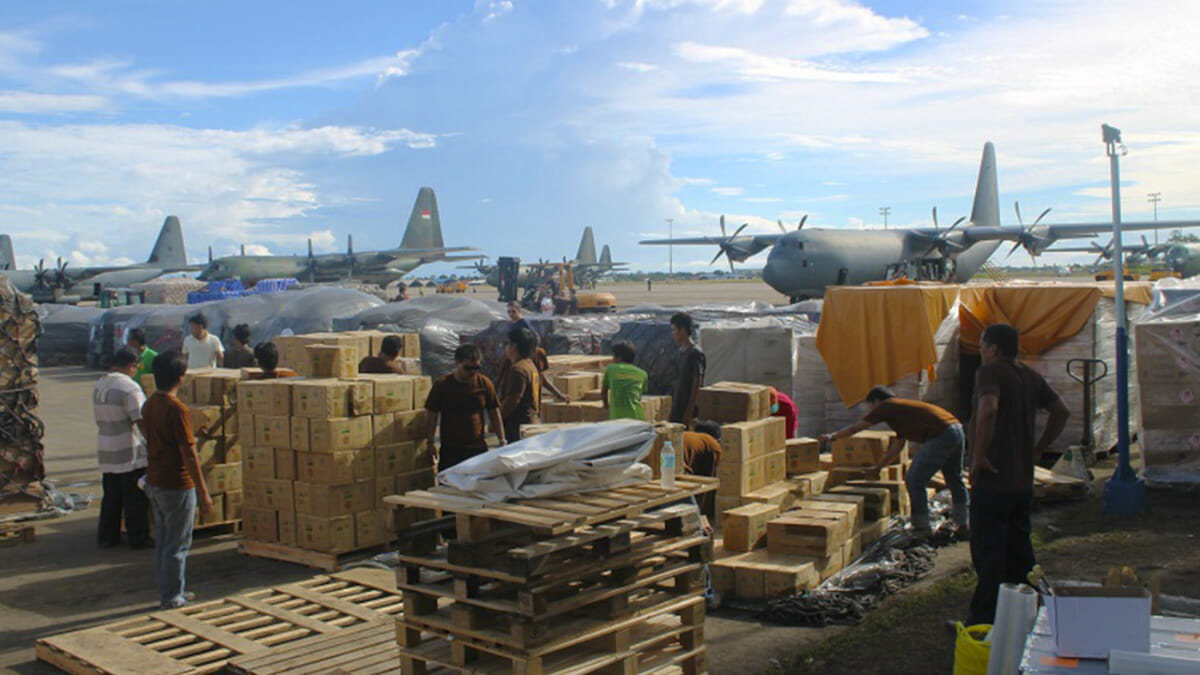
SUPPLIES BEING STAGED DURING A UPS HUMANITARIAN RELIEF OPERATION. (PHOTO COURTESY OF UPS)
Getting results
For example, after the earthquake in 2010 in Haiti, the Salvation Army cared for 15,000 displaced people living in a soccer stadium. They had more than 100 local volunteers, five trucks and an international team of disaster response experts, but they needed aid from outside the country as well.
UPS had never landed in Port Au Prince and needed landing rights, custom processes and a partner who could effectively distribute aid to people in need. I was blessed to be in the right place at the right time. From the ground in Port Au Prince, I could organize the inbound processes, set up local trucking and engage the 82
nd
Airborne to help us deliver support.
In 23 days, we delivered 1.2 million meals.
In Vanuatu, after the devastation brought by Cyclone Pam, a community in a remote island village perched on the side of a mountain needed PVC, plumbing connectors and hardware. The need here wasn’t for big jets — it was about connecting different networks.
UPS provided funding for a series of small charter flights from Vanuatu’s capital city to the island every day to provide enough water every 24 hours. The Salvation Army funded barge space to move the pipe. The French military supplied helicopter lift from the barge up the mountain. The local villagers rebuilt their own water supply system.
This was the power of connectivity at work.
More opportunities to give back
Most recently, in response to Cyclone Idai’s devastation in East Africa, UPS and The UPS Foundation worked with nonprofit organizations to
.
As the region rebounds, the need for support will continue. The work in all these countries shares the same common theme. It’s all about connecting people and networks. No single person can get these large-scale results. But working together, each person brings their own experience and expertise, ultimately creating a domino effect that produces life-changing solutions.
In 2018, UPS and The UPS Foundation responded to 29 major world disasters. Relief spanned 71 countries across continents around the globe. Beyond these headline stories are the stories of people in need. Some of them are in your neighborhood. Some are complete strangers. Either way, the opportunities to give back are endless.
As we celebrate National Volunteer Week, I’ll challenge you like my UPS instructor challenged me more than 30 years ago:
Go serve.
Craig Arnold joined Points of Light President & CEO Natalye Paquin for an interview with Atlanta’s 11Alive during National Volunteer Week:
Craig Arnold is vice president of sales for UPS. Since 2010, he has deployed as a front-line responder into disaster sites to help coordinate relief logistics after cyclones, hurricanes and earthquakes around the globe.
This story originally appeared on UPS Longitudes and was reposted by permission.
Trends in Business & Social Good: What Changes Will 2019 Bring?
By Jenny Lawson, Chief Civic Innovation Officer
I am lucky to love what I do. For the last eight years I have had the privilege to watch and encourage the incredible growth of civic and social engagement in companies. Over this time, we’ve seen incredible growth – from only 24 percent of companies offering pro bono programs (CECP, Giving in Numbers, 2011) to 56 percent offering such skilled talent to communities today (CECP, 2018). From CEOs speaking out to Super Bowl ads focused on social action, companies are leading and lending talent and resources at an unprecedented scale.
This year, we are already witnessing more change. Each year in January the Points of Light Corporate Service Council meets to exchange new ideas, hear from experts and shape their company community engagement strategies. Over two days, members from leading companies gather to discuss building purpose into the center of their business and breaking down barriers that prevent people and their employers from taking action that changes the world. Just ahead of Davos, where CEOs and world leaders would tackle some of the toughest global challenges, conversations at this year’s annual CSC meeting helped us understand how the challenges we face in our own communities can be examples for larger social issues.
Through our work and partnerships with these companies, which are working to strengthen their value and connection to communities, we see a few trends for 2019 that haven’t made the headlines yet.
Companies are building out the “S” in ESG
The powerful environmental, social, and governance factors have rapidly weighted and shaped investment decision making. Spurred by BlackRock’s Larry Fink’s letter ahead of Davos 2018 and reinforced in his 2019 update, companies continue to develop measures to capture created value beyond profit. With a highly visible demand from stakeholders to tackle climate and environmental challenges over the last five years, and issues of governance watched closely by investors and creditors, clear and commonly understood measures around the “S” in ESG have been slower to develop. But 2019 promises to be the year of the “S.” Several powerful studies and initiatives are tackling social impact measures head-on. We see inspiration and action from:
Coalitions building consensus and reporting muscle among leading brands like CECP’s Investor Initiatives and Impact2030 efforts to build measurement strategies connecting the impact of volunteerism to the SDGs.
Companies are innovating how they work with the social sector.
With ESG awareness and interest flooding into business thinking, companies are seeking shared value relationships and opportunities with external partners and inside the organization, too.
Companies are expecting more measurement and data analysis and seeking transparency around impact and value from their nonprofit partners. Companies are also understanding that nonprofit partners need support, including pro bono staff time from the corporate world, to build the capacity and infrastructure to be meaningful data-driven partners. Initiatives like Booz Allen Hamilton’s Data Science for Social Good are opening new pathways and partnerships.
Moving beyond support to stewardship, companies are seeking next-generation collaborations among stakeholders, including clients, vendors and respected NGO partners, to add depth, leverage and shared value to causes that reflect authentic interest in social challenges that align with the voice and values of the brand.
While companies are driving to connect their social engagement strategies to authentic brand values and have natural alignment with their products and services, they are also understanding that the “whole employee” has relationships, social values and causes that they care about. As Gen Z comes into the workforce, companies are getting creative with community engagement strategies and initiatives that support employee passion as attributes of their authentic brand values. It’s a tricky but doable objective for an increasing number of companies, focused on blending a suite of opportunities from company-sponsored events, to matching gifts, to recognition for civic action through rewards. There’s a growing interest in more family volunteering, too, that may build as companies look to support millennial and Gen Z families.
Over the next year, we look forward to partnering with corporations and business to achieve these goals. As society expects more from business, we help companies engage their customers and employees in the challenges facing their communities and our world.
The Points of Light Corporate Service Council provides networking opportunities, best practices and new ideas that catalyze high-impact social change initiatives. To learn more about how your company could benefit from membership, connect with us at [email protected].
With Unique Employee Programming, Arconic Connects Corporate Values with Meaningful Community Engagement
Companies of all sizes are seeking strategies to engage diverse employees and advance inclusive values. Arconic, a global leader in lightweight metals manufacturing and engineering, is on the cutting edge of diversity and inclusion initiatives. Leveraging three unique programs to engage its more than 41,500 employees worldwide, Arconic links organizational goals and values with opportunities to make a meaningful difference in the communities where its employees live and work.
Employee Resource Groups have a proactive role in inclusion and diversity efforts, as critical drivers of employee engagement; recruitment and retention; and brand building through community engagement. There are six ERGs available to Arconic employees, representing women, people of African heritage, Hispanics, LGBTQ, early-career employees and veterans. One of the longstanding ERGs, the Arconic African Heritage Network, has made community engagement a cornerstone of its mission. The group partners with the National Society of Black Engineers on several initiatives, including activities for middle school and college students. For example, Howard University students get hands-on manufacturing exposure through touring Arconic’s facility in Lancaster, Pennsylvania, and interacting with plant personnel. And in Davenport, Iowa, employees sponsor and train a local robotics team with grant support from the Arconic Foundation, which provides funding for STEM and workforce development initiatives in communities where Arconic facilities are located.
Arconic’s ERGs have played a major role in leading volunteerism for the company; in fact, nearly 50 percent of the more than 200 volunteer events Arconic has participated in to date in 2018 have been led by ERGs – many of them supporting engineering and technical skills training at colleges and technical schools, and creating access to STEM education opportunities for members of under-represented communities. By connecting the ERGs to available nonprofit support through the Arconic Foundation, the company is able to build the narrative of manufacturing as an exciting profession and career option.
“As chair of the Arconic African Heritage Network and a director of Arconic Foundation, I am sensitive to and proud that our ERGs and foundation work together to expand and multiply our impact in communities where we work and live,” said Bruce Thompson, who also serves as vice president, internal audit, at Arconic. “Their collective work has been tremendous and all employees should be proud of it.”
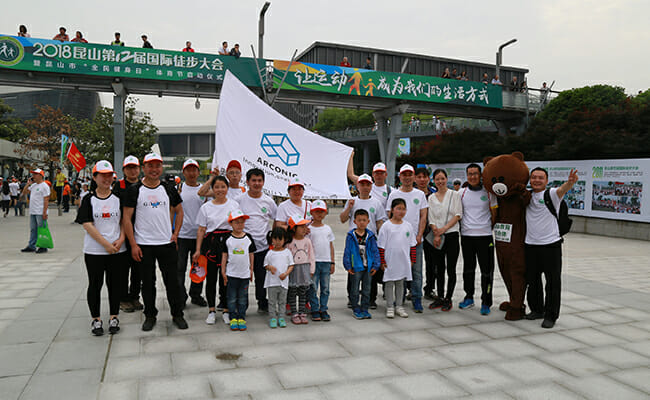
Arconics in Motion promotes wellness and physical fitness through charity. AIM encourages employees, as well as their friends and families, to participate in marathons, walks, rides and other fitness events that benefit cause-based community organizations. The program offers a way to make an impact, encourages teamwork and builds camaraderie amongst employees.
Arconics Coming Together in Our Neighborhoods supports employees volunteering their time, energy and skills for service projects that directly address community needs. ACTION projects are as diverse as the communities they serve and are not prescribed by foundation or corporate leadership. Projects range from skills-based volunteering in STEM camps and school robotics programs, to hands-on community clean-ups, packing meals for charitable meal delivery, and rebuilding homes for veterans.
To maximize impact, project participation carries a minimum of 16 hours, where at least four employees engage for four hours. Opportunities are deployed through ERGs, employee-led community advisory boards or a single point of contact at each Arconic location, with a focus on diverse projects that employees care about and that foster a direct connection to communities.
Recognition of employee volunteerism efforts and community commitment is a key part of Arconic’s culture. Through partnerships with DonorsChoose.org and GlobalGiving, all volunteers are awarded charitable gift cards, enabling them to donate to causes they care about. Throughout the year, employee teams receive recognition by company leaders and through employee media channels and social media. And each October, Arconic holds a company-wide Month of Recognition and an Arconic Foundation-sponsored contest where the best volunteer initiatives are acknowledged with a trophy and $10,000 grants are awarded to the nonprofits with whom they volunteered.
Arconic is a member company in the Points of Light Corporate Service Council, which provides networking opportunities, best practices and new ideas that catalyze high-impact social change initiatives. To learn more about how your company could benefit from membership, connect with us at [email protected].
CSAA Insurance Group: Supporting Community Safety During Disaster
By Roger Hancock, Manager of Community Affairs, CSAA Insurance Group, a AAA Insurer.
This year’s Northern California wildfires burned more than 600,000 acres – the largest wildfire in California history. The fires were devastating, resulting in the destruction of numerous structures, the displacement of thousands of residents, and several fatalities. While first responders met the wildfires head-on, volunteers also played an important role, providing comfort and counsel for those at risk of losing everything.
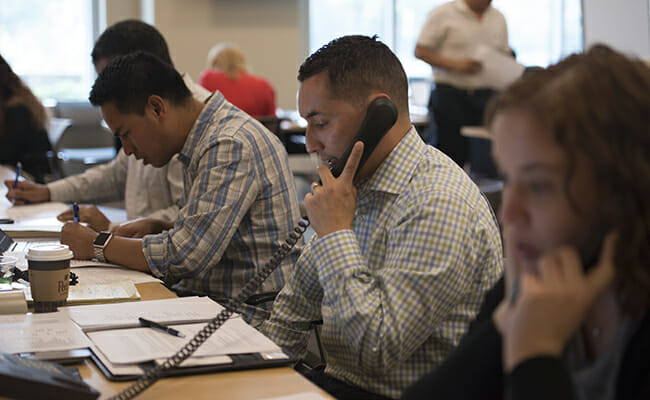
CSAA Insurance Group’s award-winning corporate volunteer program, AAA Volunteers, empowers and motivates employees to address diverse community needs through volunteer service. In response to the wildfires, employees volunteered to take time from their normal job duties and daily routines to contact impacted customers. These calls helped confirm that those who were forced to evacuate or prepare for displacement were safe and had the information they needed to provide for themselves and their families. Within a single week, more than 4,000 calls were made to individuals impacted by the fires.
While our employees are always looking for ways to give back, it is in times of urgent need that we often receive an overwhelming number of requests from our staff to help out. Any one of us could need help in an emergency, so we all want to be there for those who do.
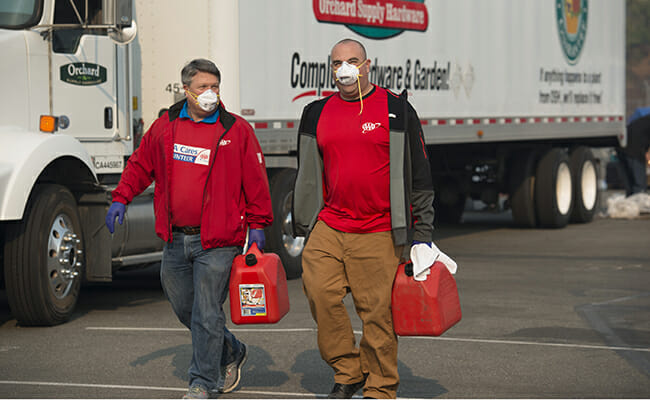
In addition to the phone bank, employees volunteered to provide on-the-ground assistance at evacuation shelters and local assistance centers. While customers await news about their home and family members, AAA Volunteers are often there to provide a cup of coffee, share a stuffed animal for a child, or offer a sympathetic ear. These simple gestures of kindness can have a profound effect.
In anticipation of catastrophe-related needs, employees who deploy for emergencies receive up to 80 hours of paid time off to volunteer, and help position skilled labor, supplies and other critical resources before disaster strikes. In addition, training on personal preparedness, including courses in First Aid and CPR, is also available.
As demonstrated during the recent wildfires, as well as during other natural disasters, anyone can be impacted by catastrophic events. AAA Volunteers play a critical role in response and recovery, and provide for the safety and stability of our communities.
Last year, 99 percent of the employees at CSAA Insurance Group volunteered, largely because service is the cornerstone of the company’s community involvement efforts, and all of the company’s outreach programs are built around employee volunteerism.
Our employees tell us they choose to give back because they find the experience meaningful and rewarding. AAA Volunteers provides each of them with the opportunity to find ways to make a lasting difference, and know that they are contributing to something important.
Roger Hancock is a volunteer manager with more than 30 years of leadership experience creating and managing award-winning national corporate volunteer programs. He has managed the “AAA Volunteers” program since 2003, is a past-president of the Volunteer Centers of California, and has served under two governors on California’s Volunteer Service Commission.
Committed to serving AAA members for more than 100 years, CSAA Insurance Group offers AAA-branded automobile and homeowners insurance in 23 states and the District of Columbia
How DTE Energy is Reviving the Skilled Trades in Detroit
By Bill Blaul, Writer, Corporate Communications, DTE Energy
Generations of skilled tradespeople built the Motor City, put the world on wheels, and created the American middle class. In recent decades though, interest in skilled trades careers has diminished among youth and young adults nationwide along with vocational education options.
Investment has returned to Detroit and skilled trades jobs are in high demand. But, more than half of Detroit’s youth and adults are unemployed and outside the workforce while the Detroit Free Press reports redevelopment projects are hindered by a shortage of skilled trades workers.
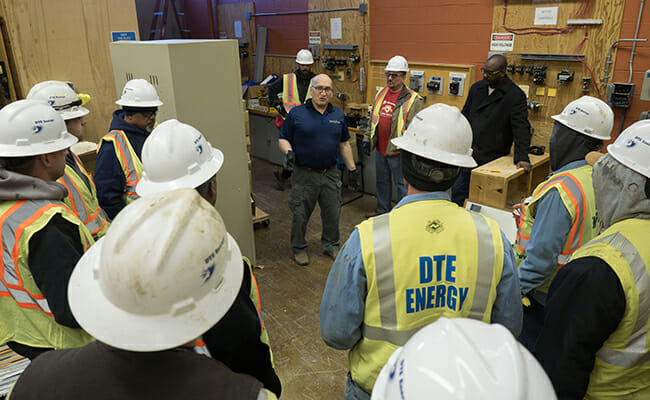
Leaders at Detroit-based DTE Energy saw these challenges unfolding. DTE, Michigan’s largest energy company, is also experiencing a workforce changeover with 50 percent of its 10,000 employees eligible to retire over the next five years. So the company joined public and private partners, including the Detroit Mayor’s Workforce Development Board and the Detroit Public Schools Community District, to tackle the related challenges of unfilled skilled trades jobs and gaps in education and training. At DTE, our focus is on helping revive Detroit’s trade schools, placing high school students in paid summer work experiences and launching a skilled trades program at Henry Ford College in nearby Dearborn.
In 2016, the Randolph Career Technical Center, a city high school, had only 100 students. Closure was looming. “The building was in rough shape, equipment was outdated and there was inadequate funding,” said David Meador, vice chairman and chief administrative officer of DTE Energy. “In carpentry classes, students built projects then disassembled them because there wasn’t money for new nails and wood. We saw the potential of the students. We met dedicated instructors and staff. It was clear Randolph was worth saving.”
The DTE Energy Foundation provided $500,000 to refurbish Randolph and relaunch its skilled trades curriculum. The seed funding spurred community partner contributions totaling $10 million. Enrollment at Randolph tripled in 2017 to more than 300 students. An additional 250 adults began taking evening classes. Admissions are increasing again this fall.
Ronald Wood recently graduated from Randolph, earning certificates in Masonry and Marketing & Entrepreneurship. “After the renovations, it was a much more comfortable and better work environment,” he said. “We need a lot of young talent to work in the trades, and Randolph is key to making that happen.” Ronald was among 14 Randolph students participating in paid internships at DTE this summer.
Roger Bonds graduated from Randolph in Computer Aided Drafting and Design. “Randolph is very important for those looking to start a career right away,” he said. “I am very grateful for such a great opportunity.”
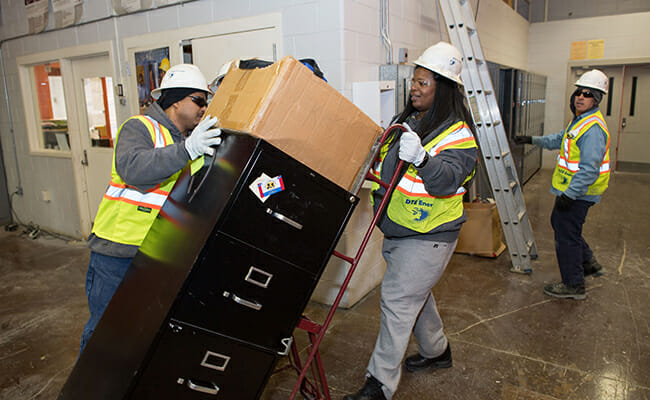
Building on the Randolph success, DTE joined a similar effort a few miles away at the Breithaupt Career Technical Center. The DTE Energy Foundation provided $500,000 to help update Breithaupt with workplace-modeled classrooms. Painting, flooring, and lighting work followed. DTE is also providing full-time construction and curriculum project management at Breithaupt. Our employee volunteers have helped with demolition, construction and landscaping, and DTE is donating equipment and supplies to create an industry-recognized instruction and learning environment.
DTE strengthened the training pipeline through $600,000 from the DTE Energy Foundation to establish the Henry Ford College Power and Trades Pathways Program. The first students in the program started classes and training a year ago and 12 are pursuing energy careers or additional studies.
DuJuan Stewart is entering his senior year at Randolph’s HVAC program. “The teachers push you to do your best. Randolph is important among Detroit schools because the trades they teach are in high demand,” he said. “I want to get my HVAC certificate, go to Henry Ford College and become an overhead line worker at DTE.”
“There are more career opportunities available to Detroiters than there have been in decades, so it’s important to ensure the next generation has the skills they need to get good, quality jobs,” said David Meador, who also co-chairs the Mayor’s Workforce Development Board. “We are honored to help bring new life to Breithaupt through private and public partnerships, as we did for Randolph.”
Clif Bar & Company: Sustaining the Environment Through Service
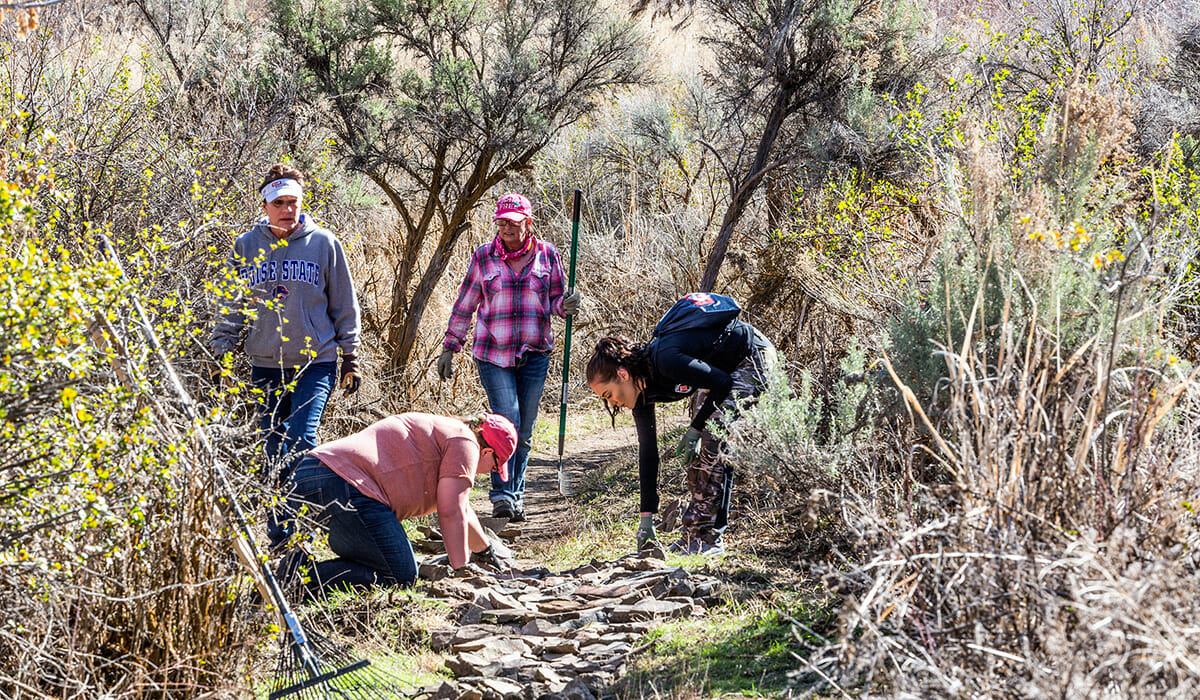
Clif Bar employees in Twin Falls, Idaho, rebuilding trails and picking up trash during the Companywide Service Day at Centennial Park.
By Cassie Cyphers, Community Programs Manager, Clif Bar & Company
, and our volunteer efforts largely focus on giving back in ways that help the planet. That’s probably not surprising, since we’re a company that relies on a clean and healthy environment to grow the ingredients we use in our food, and on the outdoors as a treasured place for us and our adventure-loving consumers to play.
Whatever your company’s volunteer focus, the benefits of community service are numerous. “Through the simple act of extending a hand, not just once in a while but as a regular part of life, we are changed as individuals and as a company,” said Kit Crawford, Clif Bar’s co-owner and co-chief visionary officer.
Kit and her husband, Gary Erickson, Clif Bar founder, co-owner and co-chief visionary officer, have built community service into everything we do. Clif Bar’s business model is comprised of five bottom lines, or Aspirations, as we call them – sustaining our business, brands, people, community and the planet.
CLIF® CORPS, our employee giving and engagement program, enables our employees to support communities in three ways, via service, funding and food. We encourage employees to volunteer in the community on company time — and do they ever, with a participation rate of more than 98 percent and nearly 117,000 hours volunteered since the program began in 2001. In 2017 alone, our 1,200 employees volunteered nearly nearly 20,000 hours.
Given our commitment to food and the outdoors, nearly 40 percent of employee community service is devoted to environmental causes. Pick a day at our California headquarters, or one of our two bakeries in Idaho and Indiana, and you’re likely to find a few employees or an entire department volunteering in the community, often on behalf of the planet. They might be restoring community gardens, clearing trails in a public park, planting trees, cleaning up beaches or building birdhouses.
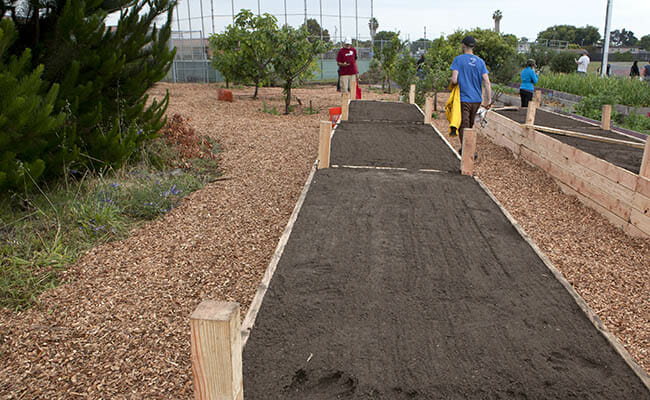
Once a year, we shut our doors and send everyone off on a day of service. A few years ago, our headquarters employees — then more than 300 strong — spent the day volunteering at two local urban gardens to benefit Urban Tilth, a nonprofit that cultivates agriculture in West Contra Costa County. “Clifsters” weeded, planted and built raised garden beds, picnic tables and a pollinator habitat.
We’re happy to share our recipe for community service because we think it can work for a lot of companies, no matter what your cause or focus. Build it authentically into your company’s DNA, encourage employees to take part, make it easy for them to participate, and let them choose the causes that interest them.
While we’ve won awards for our community service, that’s not what drives us. It’s doing the right thing for us, for others and for the planet, which is under siege and deserves a special nod here in April (and beyond), home of Earth Day, Earth Week and Earth Month. And the best part is hearing from the people we touch with our service — people like Brandy, a grandmother in Twin Falls, Idaho, who recently sent us this note via Facebook:
“Huge Rave – With the weather so nice today I decided to take my 2 grandsons walking (the trail at Centennial Park). There was a huge mass of Clif Bar employees working down there clearing the trails, picking up trash, trimming bushes and fixing the bridges. Not to mention the shopping carts and other trash they loaded onto a boat and hauled off. Everyone we passed was so polite and kind. I just wanted to say THANK YOU, not only for what you did for our community but for being awesome examples to my grandchildren.”
Now that is reward enough!
An advocate for community service and environmental conservation, Clif Bar & Company is just one example of the corporate citizens that make up the Points of Light Corporate Service Council. Does your company exemplify corporate citizenship, have an incredible team of employee volunteers or make a strong impact in the community?
, hunger — an often unseen issue — affects individuals of all ages, demographics, and backgrounds, and is often tied with other issues of poverty and economic insecurity.
Two members of the Points of Light
, Food Lion and General Mills, are going above and beyond to address hunger and food security in the communities where they do business. With ambitious goals to improve situations of hunger in the United States and around the world, both companies are working to strengthen food security through employee talents, industry leadership and corporate resources.
Food Lion
As a leading grocery store chain in the United States,
is certainly familiar with the ordering, processing and selling of food. However, in 2014 the company realized that in the area of hunger and food security, it could be doing more.
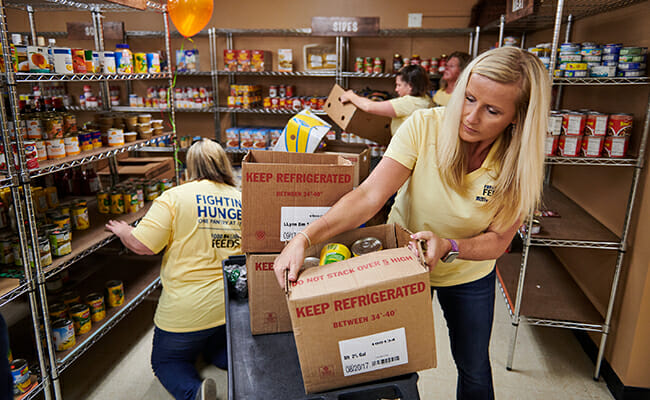
was born — a philanthropic platform powered by Food Lion and operated in partnership with 30 Feeding America food banks across 10 states. Through this initiative, Food Lion works to feed those who are hungry by leveraging its unique position to provide food, product donations, equipment and volunteers to food banks and nonprofits, supporting mobile food pantries to increase access to meal services, and increasing awareness about an issue that often lives closer to home than most are aware. To celebrate its 60th anniversary, Food Lion hosted
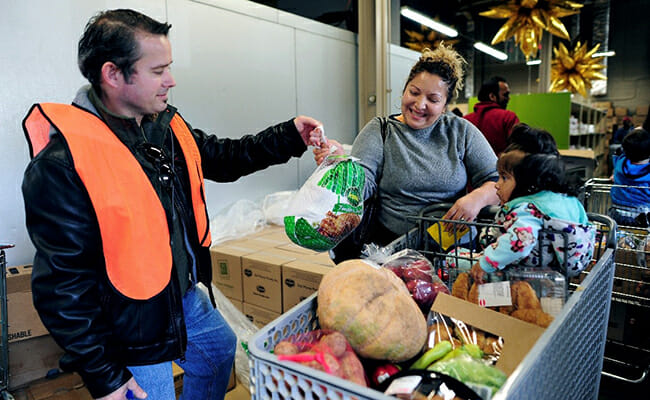
and rebuilt and restocked 60 individual food pantries. The volunteer-fueled initiative resulted in more than 2.5 million meals donated and 2,000 volunteer hours for Food Lion associates.
Food Lion is also using its presence in communities and online to raise awareness about hunger and food insecurity. Food Lion encourages its wide range of stakeholders – employees, customers, community members, and more – to take action by volunteering, giving spare change, or donating the extra canned goods in one’s pantry to collaboratively solve this widespread issue.
Thanks to the support of this network, and the company’s strong commitment to the cause, Food Lion has donated more than 370 million meals since 2014 and is its way to donating 500 million meals by 2020.
General Mills
If you’ve ever snacked on Chex Mix or treated yourself to Häagen-Dazs, you’re familiar with the
in the countries where they do business. As experts in food production and processing, the company has taken advantage of these unique strengths to spearhead initiatives around the world aimed at strengthening food security. Since 2010, General Mills has enabled the donation of more than 200 million meals to people in need.
Working with Feeding America, General Mills has also focused on another important food-related issue: waste. MealConnect™, an online platform enabled through this partnership, allows food providers to catalogue their excess food, which is then donated to food banks and local nonprofits, and in turn distributed to people in need. Thanks to the company’s support, MealConnect has
.
General Mills is also dedicated to ensuring all students are on the path to success. Because youth are often affected by issues of food insecurity to an even higher degree, the company works to increase access to nutritious meals for students around the world. Working with the
in India, General Mills is both increasing access to school lunch and making these meals more nutritious. And in partnership with the Food Research and Action Center, it has helped increase breakfast access for students who qualify for free and reduced lunch – a habit that has been shown to
Food Lion and General Mills are just two examples of corporations that share a commitment to ending hunger in our world and ensuring communities have the resources they need to be healthier and more resilient. Does your company exemplify corporate citizenship, have an incredible team of employee volunteers or make a strong impact in the community? Consider joining the Corporate Service Council today.
Corporate Service Council Asia Meeting: A New Era of Corporate Engagement
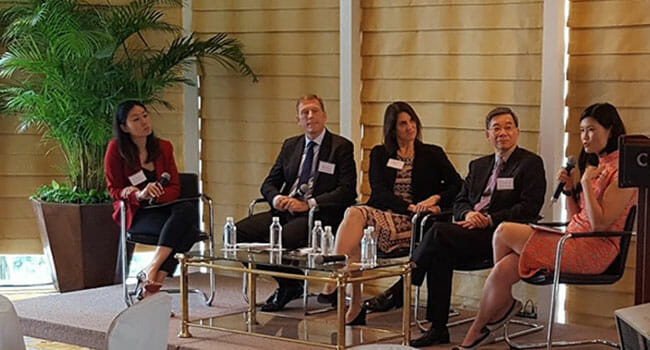
More than 60 leaders in corporate social responsibility, employee engagement, and volunteerism convened in Hong Kong on May 25, 2016, for the Points of Light
Asia Meeting. Excitement in the air was palpable, as attendees explored opportunities for accelerating the impact of corporate citizenship in Asia.
“We are at the cusp of a boom in corporate social responsibility,” said Neil Bush, Points of Light Chairman. “The enthusiasm in this room, all centered on the topic of corporate service in Asia, is contagious. In the next 20 years, we are going to witness a complete restructuring of the CSR industry, and the leaders and organizations gathered in this room will be at the helm.”
Participants echoed the importance and strong need to lead purpose-driven organizations. “When you align life values with work, work is more fun,” said Joanne Oswin, COO of
, reiterated the changing trends across Asia and strong enthusiasm of all attendees. “At GE, the culture of service goes from the top to the bottom,” he said. “It has changed me, and changed how I lead.”
Guest speakers shared best practices from their service-leading brands, and representatives from our host partner
attended the meeting, along with Points of Light affiliates from China, India, Japan, Korea, Philippines and Singapore.
Looking for more ways to engage with Points of Light?
Employee Volunteers Demonstrate Fidelity’s Commitment to Education and Service
Corporations that embrace social responsibility make a lasting impact on the communities where they live and work, and also do better financially while maintaining higher employee satisfaction rates. Members of the Points of Light Corporate Service Council demonstrate a commitment to mobilizing, equipping and inspiring high-impact volunteering through successful employee engagement programs. Fidelity Investments is one shining example of this dedication to service.
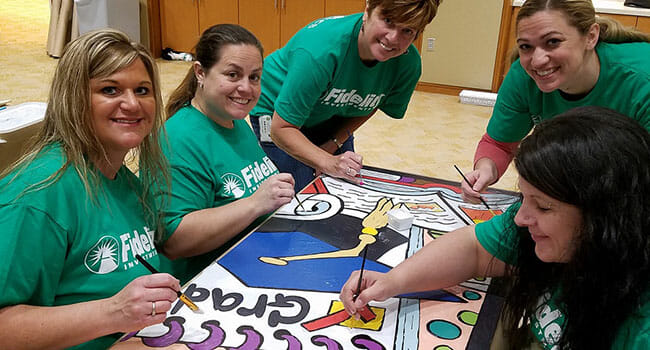
Demonstrating a long-term commitment to education, employee volunteers and their families invest in local schools through Fidelity’s School Transformation Days, which take place throughout the year. Volunteers clean classrooms, plant gardens, build or fix odds and ends around the schools, and paint murals to create a friendly and clean environment for students. Fidelity volunteers also engage in STEM projects with students, promoting skills for future career success.
Building on its efforts throughout the year, the company, through it’s Fidelity Cares program, recently celebrated its annual Fidelity Cares Day, with more than 6,000 employee volunteers sharing their time and talent with 27 schools and 81 projects across the United States, Canada and India. The day’s projects reached nearly 18,000 students and more than 2,600 teachers. Employees found volunteer opportunities that matched individual passions to connect with colleagues and develop leadership skills in their communities while benefiting local education and financial initiatives. In partnership with nonprofit organizations and regional school systems, Fidelity focused on creating opportunities for employees to leverage their insights and experience to help provide students in need with an educational foundation to feel more confident, make smart decisions, and achieve success in personal and financial goals.
In North Carolina, more than 120 Fidelity volunteers joined Stop Hunger Now to pack 20,000 meals for distribution to local families in need.
In Texas, volunteers energized students by creating hands-on chemistry demonstrations in line with Fidelity STEM (science, technology, engineering, and math) educational goals.
450 volunteers served the Boys and Girls Club of Greater Cincinnati, the Ronald McDonald House, Holmes Middle School, and Crayons to Computers where these volunteers assembled math kits for middle school students, which included a handwritten note of encouragement to boost confidence and show students that Fidelity cares about their success.
75 volunteers worked at the Boys and Girls Club Camp Foster in Manchester, New Hampshire, helping to refurbish buildings.
This is just a small glimpse into the meaningful changes made in local communities on Fidelity Cares Day. Check the hashtag #FidelityCaresDay on Twitter to see more Fidelity volunteers in action.