5 Things You Should Know About Using Data for Good
This post is by Miriam Young, communications specialist at DataKind.
As someone who has built her career engaging business, technology and data professionals in pro bono service to change the world, I could not have been more excited to participate in this year’s
, held a couple of weeks ago in Houston, as a panelist for the Using Big Data to Advance Social Missions session. In the session, we explored the many ways that nonprofits can use big data to advance their missions.
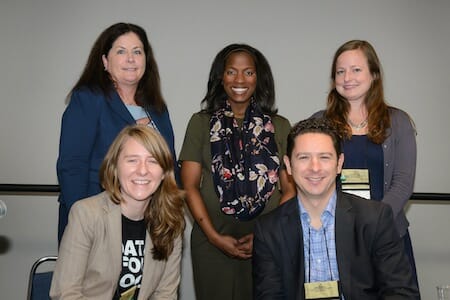
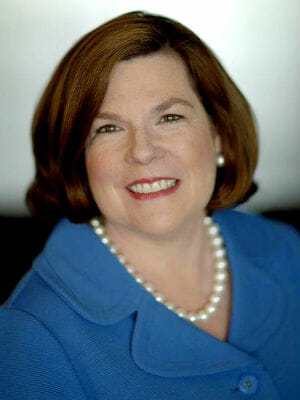
Clockwise from top left, Diane Melley, Crystal Barnes, Katherine Price, Corey Marshall and Miriam Young
When we talk about big data, we’re really talking about the scale of data generated by everything around us at all times. Today, data is constantly being produced from a variety of sources at an amazing velocity, volume and variety. It comes from cell phones, social media accounts, websites, satellites – you name it. But to extract meaningful value from big data, you need analytics capabilities, tools and skills. That’s where the volunteers come in.
Joining me for this discussion was a power panel (pictured above), including Crystal Barnes, vice president of corporate social responsibility at
, moderating the session.
If you couldn’t make it, here are my top five takeaways.
5. Full house for an 8:30 a.m. panel on data!? Who are these people?
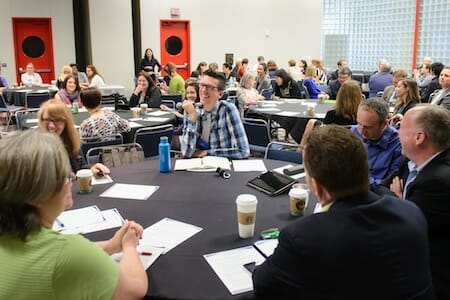
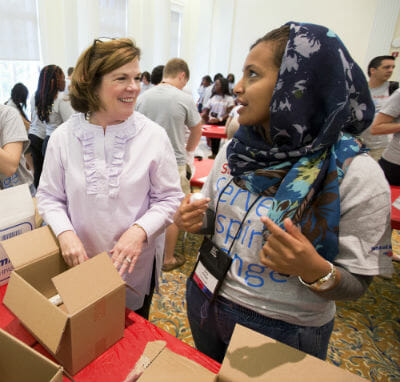
Conference on Volunteering and Service attendees interact at the Using Big Data to Advance Social Missions session.
My kind of people. Professionals starting the day equally excited about changing the world using volunteer power as they are using the power of data. We had a mix of more than 80 corporate social responsibility (CSR) folks from companies like Humana, NetSuite and Capgemini, and nonprofit professionals from groups like VolunteerMatch, KaBOOM! and United Way, which made for a lively discussion about the ins and outs of using data for good.
4. There is humanity and a story behind the numbers.
Panelists and audience members alike shared many powerful case studies of how data can be used for the greater good:
Splunk4Good analyzed text messages from Hurricane Sandy to help the Federal Emergency Management Agency Innovation Team inform resource deployment for natural disasters.
Nielsen helped the United Nations World Food Programme more efficiently collect data to inform its work battling hunger by using mobile phone surveys.
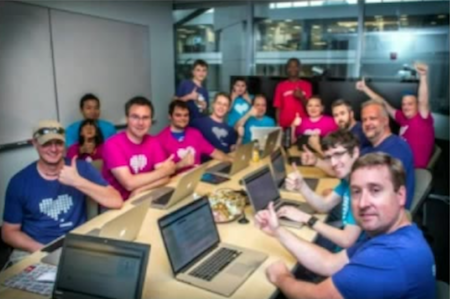
The City of Houston is rallying citizens in a series of hackathons to help design solutions to make government services more efficient.
3. And what if my organization/the nonprofits we serve don’t have any data?
Got a website? You got data. Got social media accounts? You got data. There’s census data to learn more about the populations you serve, open data to make your city smarter, crowd-sourced data to give you on-the-ground insights, information from websites and PDFs that can be scraped into a usable format.
But you know what? Forget about data. Start with the
to measure poverty levels of villages in Kenya and Uganda using satellite imagery is a perfect example. They came with a question: Which villages should we expand to next? Our volunteers used satellite data to create a novel solution to answer it. You don’t need to know what dataset might be useful – you just need to know what question will help advance your mission.
P.S. We’d love to help you with this! Learn more about
Kudos to Crystal Barnes of Nielsen for hammering home a critical ingredient for any volunteer or data-for-good initiative – measurable outcomes. Before you think about the data or the tools, you must first surface the key question, need or opportunity you’re trying to address. Then decide how you’re going to measure what success looks like. Measurable outcomes help us learn, fail fast and iterate to do even better the next time.
1. What if we all worked together?
Measurable outcome of a successful panel? One that inspires action after everyone goes home. My favorite moments of the session were when opportunities for collaboration surfaced.
The workshop helped spark new ideas for folks and we’ve already heard from a few people thinking of ways they can join the Data for Good movement – from Blue Cross Blue Shield to our friends at
to NetSuite – who are thinking about how they can connect project managers to nonprofits to help in the “problem discovery” and scoping process.
Here’s to many more gatherings that help surface more collaborations – the only way forward is together.
If you want to learn more about the power of big data for social good, Points of Light has packaged all the tools you need to get started on this
Do You Work for a Community-Minded Company? Check Out The Civic 50!
Does your company care about the communities where it does business? Join us Oct. 30, 2015 for a free webinar about participating in The Civic 50, an initiative of Points of Light that honors the 50 most community-minded companies in the nation each year as determined by an annual survey.
Benchmarking and sharing the best practices of community engagement offers companies that participate in The Civic 50 a roadmap for using their time, skills and other resources to improve the quality of life in the communities where they do business. The Civic 50 will help translate good intentions into sound business practices for years to come.
In this webinar, from 1 – 2 p.m. Eastern, you will learn:
What makes The Civic 50 survey unique
Why your company should participate
Technical and logistical details about the survey submission process
in Houston today, Points of Light honored the Greater Philadelphia Corporate Volunteer Council as 2015 Corporate Volunteer Council of the Year for serving as a primary local resource for encouraging, educating and connecting businesses that support employee volunteerism.
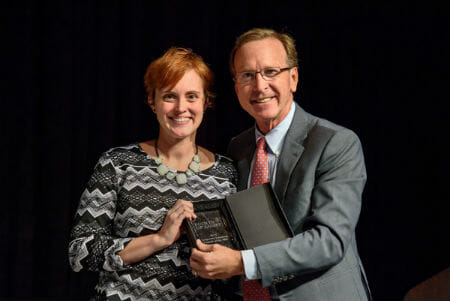
Kate Laepple Hertzog and Neil Bush
Corporate Volunteer Councils are local networks that businesses join to share best practices and address community needs through workplace volunteering. The Corporate Volunteer Council of the Year Award recognizes councils that have a clear purpose, activities that relate to that purpose and measurements for success. All entries are reviewed and winners selected by an awards committee comprised of national Corporate Volunteer Council leaders and convened by Points of Light.
The Greater Philadelphia Corporate Volunteer Council was presented the Corporate Volunteer Council of the Year award by Neil Bush, chairman of Points of Light, during the conference’s Business Track Luncheon. Kate Laepple Hertzog, manager of the council, accepted the award on the organization’s behalf.
Since its founding in 2011 by
, the Greater Philadelphia Corporate Volunteer Council has grown both in numbers and in impact. Its corporate members have opportunities to increase their skills and find new ways to engage their employees in order to better meet the needs of their community.
“The Greater Philadelphia Corporate Volunteer Council has provided me with the opportunity to connect with colleagues who are also focused on employee engagement. Through peer learning and sharing of best practices, I’m able to implement my knowledge to ensure our employees are giving back to the community in new and impactful ways,” shared Debbie O’Brien, senior vice president, market manager, Bank of America, and co-chair of the Greater Philadelphia Corporate Volunteer Council.
Led by an active steering committee that reflects its corporate members and managed by United Way, the council offers its members robust year-round programming that includes skill-building and issue-based sessions, along with monthly roundtable discussions that provide practical knowledge to use in members’ daily work. It also makes available satellite programming specifically for suburban members and small businesses.
“As a one-person community impact department at my company, I find the Greater Philadelphia Corporate Volunteer Council to be a fantastic resource,” said Jan Waldauer, manager of global corporate social responsibility and internal communication at Quaker Chemical Corporation. “Not only do I learn best practices from other companies, but expand my professional network as well as gain valuable insight into the Philadelphia-area volunteer space.
Celebrating a Decade of Powering Volunteer Service and Accelerating Social Change
From global community days and home-builds to civic hackathons, companies have an immense power to mobilize and inspire their employees to achieve social change through service.
Alcoa’s employee volunteers serve nearly 2,000 nonprofit organizations every year during its signature month of service.
This year, we celebrate the 10th anniversary of the
, the premier global platform for mobilizing, equipping and inspiring high-impact volunteering. For the past decade, Council members have been trailblazers in turning their bottom lines into the front lines for social change.
To celebrate this anniversary, Points of Light has collected videos that share the inspiring role that service plays in companies and communities around the world. The new
features multiple messages from Council members reflecting on the power of volunteering.
Companies featured in the videos include Alcoa, Altria, Citi, Edelman, PepsiCo, Pfizer and Southwest. The challenges of our time – from poverty and hunger to inequality and education – are increasingly requiring large-scale and multi-sector responses. Council members are stepping up to this challenge by lending their most precious assets – their time and talent – to be transformative drivers of social change.
Service is still at the heart of the Corporate Service Council. Its learning communities and gatherings spark innovative thinking and inspire companies and employees to volunteer in ways that deliver transformative and lasting value.
Celebrate with us and visit our
to hear about 10 amazing years of powering corporate service.
To Thrive, Your Company Needs a Soul – Find It in Volunteer Service
This month we’re celebrating the 10th anniversary of Points of Light’s Corporate Service Council, an elite platform for mobilizing, equipping and inspiring high-impact volunteering. Every week leading to our Conference on Volunteering and Service in Houston, Oct. 19-21, we will add a video to our YouTube channel or a post to this blog. Today Stewart Whitney, president of Timberland, a Corporate Service Council member, explains how his company inspires its employees to become “agents of service.”
Stewart Whitney
In my 25-plus-year career, one thing has become abundantly clear to me. Companies with an engaged employee base are the companies that tend to thrive. Of course, you need a sound business model and products that consumers demand, but that’s not enough.
Your company needs a soul.
Here at Timberland, where I’ve had the pleasure of working for 15 years, we have a deep heritage focused on environmental and social justice. We’re also fortunate to have a truly impassioned and engaged employee community. To better serve this community, we launched the Path of Service program in 1992 to engage employees, business partners and consumers in service to others.
We started by offering employees up to 16 paid hours each year to serve in their communities; a few years later, given the overwhelming response, we increased that number to 40 hours.
We have one simple goal when it comes to service: equip employees with direct experiences to make a difference and hope that, in turn, they become proactive agents of service beyond their years with our organization.
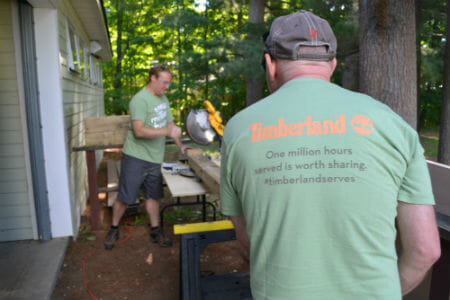
Timberland volunteers help make improvements a New Hampshire park, as part of the company’s Serv-a-palooza.
I am proud to say that in 2014, 78 percent of Timberland employees served more than 72,000 hours in some 100 locations in 19 countries, reflecting a 10.3 percent increase in hours served from 2013. This growth contributed to a major milestone: reaching 1 million hours served, largely through our two companywide service days – Earth Day in the spring and Serv-a-palooza in the fall.
Both events were organized by employees worldwide through Timberland’s Global Stewards program. Launched 10 years ago, Global Stewards solved a common problem – how to scale corporate social responsibility (CSR) efforts nationally or globally when your CSR team is based in in the U.S. (Ours is in New Hampshire.)
Through this program, a network of passionate employees volunteer, above and beyond their regular job responsibilities, for a two-year term to drive engagement agendas in their locations. Timberland relies upon and supports the Stewards to plan events and initiatives that translate and bring to life CSR programs and messages in their countries’ languages and cultural traditions.
Timberland’s reforestation project in China’s Horqin Desert has planted enough trees to fill the equivalent of 1,200 football fields.
And they often come up with creative solutions, like Stewards at our factory in the Dominican Republic riding the morning buses with factory workers – who don’t have access to email – to get them engaged in service.
For a program to succeed, it’s critical to have this level of involvement. We are constantly gathering feedback from employees and consulting our Global Stewards to shape future initiatives and activities. Employees regularly suggest community partners and service locations, volunteer to lead projects and collaborate on ideas for how the business can be more environmentally responsible.
Just recently, we planted our 2 millionth tree in the Horqin Desert in China. This major initiative, today a key piece of Timberland’s global commitment to tree planting, started back in 2001 with an idea from a single employee who was concerned about deforestation in her region.
At Timberland, we take good ideas seriously and by listening to and harnessing the passion of our employees around the globe we are able to work toward making a lasting difference.
Through years of research and experience, we have found that service is a key factor in employee job satisfaction, leadership development and also an integral part of drawing great talent to the company. Employees really value the opportunity to become leaders in the workplace, gain new skills and receive visibility in their community while doing important work.
Because of our own experience in employee engagement, we welcome the opportunity to support other businesses and organizations looking to engage in their communities for the greater good. We recently relaunched our Service Toolkit, which provides information and tools for developing and executing meaningful service events for 25 to 1,000-plus volunteers.
In our view, there is no room for competition when it comes to giving back.
Points of Light Brings the Volunteering Experts to You
Do you wish you could hear from the experts as you manage and scale your employee engagement and citizenship programs? Now you can! The latest trends in corporate volunteering are now at your fingertips and on video with Points of Light’s Corporate Video Lecture Series.
Marketing professionals celebrate after completing a CreateAthon, a pro bono marathon event to strengthen the marketing capacity of nonprofit organizations.
Watch and learn as corporate social responsibility experts from the Points of Light Leadership Faculty explore virtual volunteering, job purposing, organizing CreateAthons and hackathons, managing pro bono service, global volunteering and more.
Bea Boccalandro, president of VeraWorks, on job purposing. Job purposing, a new management practice of broadening the social mission of corporate jobs, can help drive up employee engagement at your company.
Erin Dieterich, director of corporate citizenship at NetSuite, on hackathons. Hackathons are events during which technology professionals collaborate to produce software projects for social good. Learn how you can organize a pro bono hackathon to engage key stakeholders and deliver social impact.
Jared Chung, founder of CareerVillage.org, on virtual volunteering. Find out what virtual volunteering is, how the Internet is a powerful enabler of volunteering and how you can get involved.
Teresa Coles, founder of CreateAthon on pro bono CreateAthons. Learn how you can engage your marketing professionals to support the social sector through CreateAthons, or pro bono marathons, and how you can get involved in this movement.
Cheryl Naja, director of pro bono and community service at Alton & Bird, on how to manage pro bono projects for success. You’ll find out how to manage effective pro bono projects and how you can successfully match corporate talent to nonprofit needs.
Greg Cotton, president of Cotton 7 Global Enterprises, on how to manage international corporate volunteer projects. Hear how a midsize security and clean technology company has managed and navigated global volunteer projects for impact.
Interested in learning more? Join hundreds of corporate social responsibility professionals and industry leaders at the Business Track at Points of Light’s Conference on Volunteering and Service in Houston on Oct 19-21.
Enhancing Corporate Volunteerism to Strengthen Communities
We are excited to kick off our 10th anniversary celebration of Points of Light’s Corporate Service Council, an elite platform for mobilizing, equipping and inspiring high-impact volunteering. Every week in the run-up to our Conference on Volunteering and Service in October, we will add a video to our YouTube channel or a post to this blog. We invite you to join in the celebration and read this post by Kerry Sullivan, president of Bank of America’s Charitable Foundation and chair of the Corporate Service Council.
Kerry Sullivan
It’s hard to believe that Points of Light is already celebrating its 25th anniversary and, with it, 25 years of mobilizing volunteerism across the globe.
That commitment to creating social action that brings change to communities has resonated with countless volunteers, nonprofits and companies. As the chair of Points of Light’s Corporate Service Council, the organization’s impact is something I’ve been delighted to be a part of.
For many years, volunteerism has been a key component of Bank of America’s efforts to strengthen and support local communities. Our employees bring a huge passion for making a difference to the people and communities we serve, and are the ones who make it possible for us to deliver on our mission to make financial lives better.
This passion is something I’ve seen up close through our employee volunteer work, and from lines of business leaders, with 2 million volunteer hours recorded last year alone among Bank of America employees.
The Corporate Service Council has enabled us to grow our efforts and empower our employees to do more, especially in economically disadvantaged communities. In particular, the Council’s regional meetings and expert hotlines have sparked new thinking on how to inspire our volunteers and work with our partners in a way that delivers lasting value.
Kerry Sullivan, left, chair of the Corporate Service Council, volunteers at a service event at Points of Light’s Conference on Volunteering and Service.
We’ve changed the dialogue with our nonprofit partners and have really looked to marry the passion of our employees with their needs. This has really enhanced the volunteer experience and the value to the community.
On a personal level, the executive networking and learning seminars have offered me a chance to work with corporate citizenship executives from dozens of the world’s leading companies, sharing best practices and working with a wide network full of fresh ideas and experience.
To me, the most gratifying part of the Corporate Service Council is that the conversations are elevated beyond the nuts and bolts of employee volunteerism and really focus on the collective impact we can have in communities, whether engaged in financial coaching or mentoring, working at a food pantry, volunteering for park cleanups or helping with a home build. The results of our collective work are part of the solution.
The Council underscores the idea that pairing the right resources with the right people can have a substantial impact. Through this platform and other initiatives, Points of Light has helped make huge inroads over the past 25 years to encourage the very type of partnership and collaboration that makes a real difference to the challenges our communities face.
As the importance of corporate volunteerism continues to grow in the next 25 years, I’m excited to see what Points of Light will achieve.
The Points of Light Corporate Service Council is the premier global platform for advancing corporate volunteerism. Since its inception in 2005, the Council has convened an elite group of companies to leverage the power of corporate volunteerism to create change in communities. Council members include more than 75 of the world’s largest and most successful companies. To learn more, click here or contact [email protected]. Many thanks to Edelman for pro bono support of the Council’s 10-year anniversary campaign.
Want to Volunteer Virtually? Here’s How
Virtual volunteering is a trend that promises to grow, as more and more of our lives move online. In this Q&A, Yvonne Siu Turner of Points of Light sat down with Jared Chung, founder of CareerVillage.org, an organization that crowdsources career advice for at-risk youth, to explore the growing micro and virtual volunteering movement.
In this video, learn about virtual volunteering from Jared Chung, founder of CareerVillage.org.
Q: What is virtual volunteering?
A: Virtual volunteering – sometimes called “e-volunteering” – is any kind of volunteering that supports a cause with a primarily online interaction. In some cases, I’ve seen virtual volunteer activities kick off or end with an in-person activity, but the core of the volunteering program takes place online.
Virtual volunteering is actually not that new – it started to emerge in the 1990s and is now maturing with some really interesting models.
Q: How do people volunteer virtually?
A: There are a couple of flavors of virtual volunteering: the remote/telecommuting model and what I would call the “Virtual Volunteering 2.0” model. With the remote/telecommuting model, you can do a pro bono marketing project, for example, for a nonprofit organization in another city, state or country.
Zynga employees volunteer virtually together during the company’s Spring Service Days.
In that case, the volunteer’s communications with the NGO (nongovernmental organization) and the core project would be done virtually. You could find those opportunities on marketplaces including UN Volunteers, Points of Light’s AllforGood.org, or VolunteerMatch.
The other flavor of virtual volunteering is the Virtual Volunteering 2.0 model. These are volunteer projects that are enabled only through the Internet, and are in many ways similar to the Web 2.0 revolution in usability and interaction. Wikipedia, which allows volunteers to contribute to an online encyclopedia, is a good example. Crisis Text Line, which allows volunteers at home to text message with young people who are facing a personal crisis, is another.
CareerVillage.org, the organization I lead, uses online volunteers to share career advice with low-income youth over the Internet. Since we started three years ago, we have scaled to reach over 500,000 learners who are using the platform to get advice from our online volunteers.
Q. What’s unique about virtual volunteering?
One of the nice things about virtual volunteering is that we tend to engage a lot of first-time volunteers. In fact, 80 percent of volunteers who sign up through CareerVillage are first-time volunteers. There are a lot of reasons for this. First, it’s accessible and inclusive – anyone with access to the Internet can participate in CareerVillage.org or a virtual program.
Second, virtual volunteering is very flexible, so it’s a great option for employees or people that don’t have a lot of spare time. For example, at CareerVillage volunteers can share advice in 15-minute increments on their break during the day or on nights and weekends, as projects aren’t as time sensitive.
Third, it’s easy to get started – on CareerVillage we have our volunteers create an account with their LinkedIn account so they can be up and running within a minute or two giving advice to students.
Q. What has surprised you most about virtual volunteering?
Probably the most gratifying discovery has been that we haven’t lost the humanity of volunteering by going online. Actually, it turns out volunteering online has just as much personality and humanity as volunteering in-person. Young, Internet-connected volunteers don’t actually have to see the face of the beneficiary every time they do a service activity online.
If they can connect a couple times with the beneficiary – at the beginning and end of a project – they still feel like there’s a face behind the screen and that they are having a big impact. So, we’re seeing that the Internet has not dehumanized volunteering. It has actually become a catalyst to unlock even more volunteers in service to their communities. And that’s exciting.
Q. How can people get involved?
If you’re looking for a personal volunteer opportunity, please consider signing up as a volunteer at any of the platforms I mentioned (Wikipedia, Crisis Text Line or CareerVillage.org).
If you’re looking to explore virtual volunteering broadly, I’d encourage you to reach out to Points of Light (at [email protected]) for other great examples of virtual volunteer programs, or search for opportunities on AllforGood.org or other online volunteer marketplaces.
If you’re a corporate social responsibility professional looking for a virtual volunteering program to engage your employees, we can also help with that (for example, by email we’re available at [email protected]).
Points of Light Leadership Partners Invest in the Future Workforce, Prepare Americans for Disaster and More
As Points of Light celebrates its 25th anniversary this year – building upon founder President George H. W. Bush’s vision of a “thousand points of light” – we recognize the socially responsible investments from our top 2015 corporate contributors, companies that have helped Points of Light become the largest organization in the world dedicated to volunteer service.
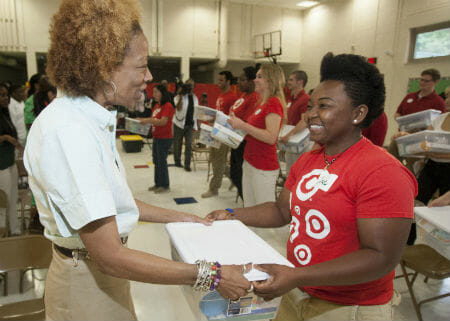
Target volunteers hand out school supplies assembled at the Turner Field service project to Atlanta teachers.
“Points of Light’s corporate partners have always been important stakeholders in our success,” says Madden DeGarmo Manion, Points of Light’s Chief Development Officer. “Over the past 25 years, corporate volunteering has become the new norm. Businesses are increasingly seeking to make philanthropic investments that incorporate volunteer activities for their employees and strategically link to their overall business objectives. Points of Light has developed strategic, multifaceted partnerships that are best-in-class examples of this type of programming.”
Here is some of the work Points of Light’s Leadership Partners made possible in 2014, with many projects continuing into 2015.
Investing in the future workforce – ServiceWorks, powered by AmeriCorps, the Citi Foundation and Points of Light, is a groundbreaking, national program that uses volunteer service as a strategy to help 25,000 low-income young adults in 10 U.S. cities develop the skills they need to prepare for college and careers. The Citi Foundation’s three-year, $10 million commitment is the largest single grant to Points of Light and supports the largest privately funded AmeriCorps VISTA program.
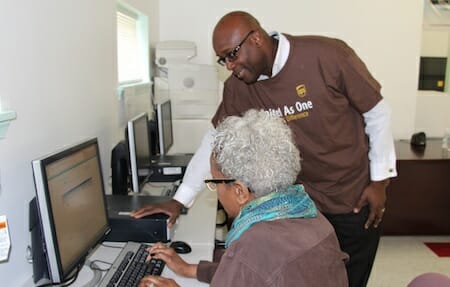
UPS employee Tony Heath, standing, volunteers at the Better Living Center in Chester, Pennsylvania, which offers free Internet access to the community.
Strengthening key programs – The expansion of Points of Light’s disaster, veterans and global programming, and an enhancement of the organization’s technology offerings, was made possible with funds from The UPS Foundation. During the 2014 Conference on Volunteering and Service, UPS CEO David Abney announced the company’s commitment toward reaching 20 million hours of employee volunteer service by the end of 2020. Investments in Points of Light’s mission represent a strategic commitment to the value and ideals of volunteerism at UPS.
Investing in HandsOn Network affiliates to increase employee volunteering – Altria Group works closely with Points of Light’s HandsOn Network affiliates throughout the country to engage their employees in community volunteerism in local markets. In 2014, through the HandsOn Network, Altria employees completed 80 service projects in 36 states, engaging more than 2,000 employees and delivering more than 10,000 hours of service to local communities.
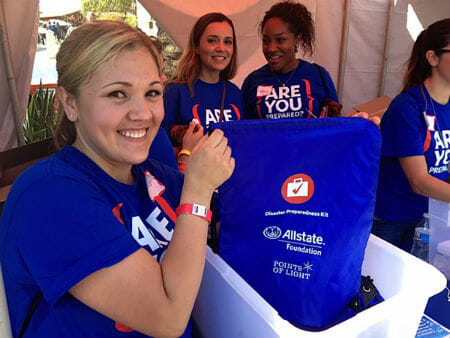
A volunteer shows a disaster kit during the Los Angeles stop of a 14-city disaster preparedness tour created by The Allstate Foundation and Points of Light.
Preparing Americans for disaster – Tens of thousands of people are participating in a 14-city, disaster preparedness tour sponsored by TheAllstate Foundation and run by Points of Light and its HandsOn Network. As volunteers, Allstate insurance agents educate attendees about the perils of local disasters and the best ways to prepare. The agents also help participants assemble their own disaster preparedness kits – including such items as hand sanitizer and flashlights that don’t require batteries. During the national tour, 10,000 visitors take home kits.
Providing financial coaching for success – Through the Financial Opportunity Corps, a national service program funded by Bank of America and managed by Points of Light, AmeriCorps VISTA members train volunteers as financial coaches at local nonprofits across the nation. More than 400 economically disadvantaged individuals and families have been empowered through these coaches to adopt better money habits, such as reducing debt, paying for school, saving for emergencies or building assets. An additional 2,000 individuals and families have participated in financial workshops by trained Financial Opportunity Corps volunteers. Bank of America employees have embraced the Financial Opportunity Corps, serving as volunteer coaches and financial workshop facilitators, and contributed more than 35,000 volunteer hours to a broader range of financial education initiatives last year.
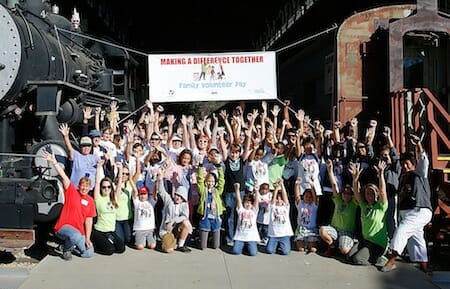
Volunteers celebrate Family Volunteer Day at The Travel Town Museum in Los Angeles.
Making family time count – Together, Disney and Points of Light are inspiring families to get out and serve. In 2014, more than 16,000 parents and kids participated in Family Volunteer Day, serving close to 90,000 people. Disney is a multiyear supporter of Family Volunteer Day – managed by generationOn, Points of Light’s youth division. The company also invests in Points of Light’s Daily Point of Light Award to honor families who volunteer together.
Fostering collaboration and innovation in service – JPMorgan Chase & Co. and Target helped bring together thousands of leaders from the nonprofit, corporate and civic sectors as impact sponsors of Points of Light’s 2014 Conference on Volunteering and Service in Atlanta. During the conference, JPMorgan Chase held an innovation summit, awarding four nonprofits a share of $100,000 for creating new ways to help people volunteer. And at a Target-sponsored volunteer project before an Atlanta Braves-Philadelphia Phillies baseball game, more than 300 volunteers and game-goers packed 5,000 kits full of school supplies for local teachers.
In addition to the companies mentioned above, here are Points of Light’s 2015 Leadership partners:
T-Mobile – engages employees to transform afterschool centers
Hasbro – provides ongoing leadership support for generationOn, Points of Light’s youth service division, including recognition of outstanding young volunteers
Hilton Worldwide – invests in a Global Month of Service and other core Points of Light programs
GE – engages 100,000-plus employee volunteers in 60 countries across industry sectors and in 2014 donated more than 1.1 million volunteer hours
ConAgra Foods – inspires and engages people to dedicate their time, talents and voice in the fight against child hunger
McKenna Long & AldridgeLLP – providing pro bono legal support to advance the mission of Points of Light for more than 15 years
IBM – as a strategic in-kind partner, supports A Billion + Change (a campaign managed by Points of Light, focused on skills-based and pro bono service) and other significant organizational priorities
Points of Light’s Leadership Partners each contribute $500,000 or more annually. Their 2014 investments have enabled Points of Light to develop and grow innovative programming that makes good business sense for the companies and a big difference in the communities Points of Light serves.
Challenging What’s Possible in Pro Bono Service
This post is by Tracy Hoover, Points of Light’s CEO.
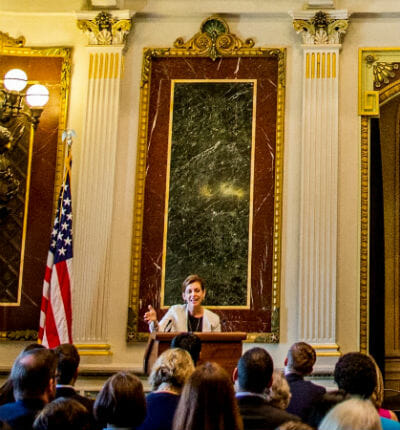
Points of Light CEO Tracy Hoover addresses government, business and nonprofit leaders at the White House. (Photo courtesy JPG Photography)
At the height of last year’s Ebola outbreak, the citizen engagement team at IBM Connections in Sierra Leone put their talents in technology to work, creating a way for citizens to report Ebola-related issues and concerns via text or voice calls.
The people behind the project – which provided real-time insight to the government and helped health care companies more effectively deliver trial vaccines – were not only highly skilled IBM employees. They were volunteers.
Across the country and the world, companies like
are putting their unique business muscle to work for the greater good. These pro bono volunteers – top-notch professionals in technology, public health, systems engineering, logistics, manufacturing and more – are using their industry-leading skills and relevant issue expertise to help nonprofits change lives.
Yesterday at the
– that brought together corporate and nonprofit leaders for a change-making expo. We showcased some of the newest tools and innovations in pro bono service.
With business titans like IBM,
, there was ample evidence that pro bono service can be a powerful new weapon for tackling tough societal issues.
And the solutions on display yesterday provided an exciting glimpse into the future of social innovation. It was easy to imagine a day in the not-too-distant future when socially and community-minded companies look first to their core business assets – those skills, systems, products and operations that give them a competitive
business
advantage – as their most powerful resource for change-making.
In some ways, today’s event was the continuation of an effort that started nearly four years ago, when Points of Light took on the management of the
campaign, asking 500 companies to pledge $1 billion in skills-based and pro bono service.
American businesses far surpassed that goal, with more than 2,500 companies pledging more than $2 billion in pro bono service. But as exciting as the numbers are, I found myself most excited about how this pro bono field is evolving to more
precisely
marry specific corporate assets and expertise with the community issues and nonprofit organizations where they can have the most impact.
At its best, this new breed of business and nonprofit collaboration has real breakthrough potential.
Just imagine the possibilities of deploying the same American business ingenuity that fuels the world’s leading economy to tackling the most critical issues of our time – such as eradicating extreme poverty, ensuring strong community health and education systems, protecting our natural resources.
We’re already on the verge of this new kind of sharing in pro bono service – one that goes beyond one-time service delivery and focuses instead on developing tools and resources to help address the world’s biggest challenges.
The most effective pro bono service is about thoughtful partnerships that match up the right talents, and that lead more directly to solutions. Our collective charge now is to take that partnership model to scale, with as many businesses and nonprofits sharing successes along the way.
I’d love to know how your company or nonprofit is leveraging pro bono service for making change!
To contribute to the conversation, comment below or email [email protected].