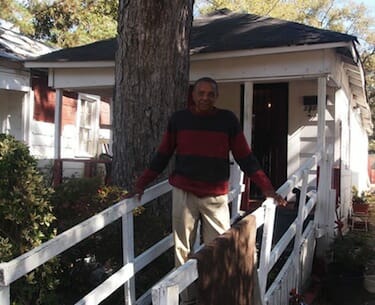
Lindsey Kirksey stands outside his childhood home.
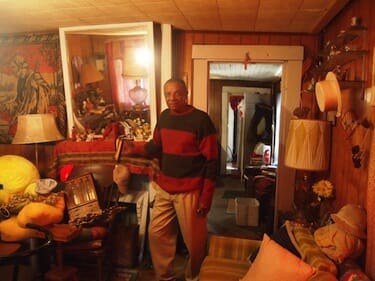
Lindsey Kirksey’s childhood home is falling apart – two of the four rooms are literally separating from each other. And while he cherishes the memories of growing up in the cozy, one-story house in Montgomery, Ala., he knows it’s time for it to go.
“The volunteers I spoke to – they are just like me; they want to help people just like I want to help people,” Kirksey says. “I believe what comes around goes around. I have been so blessed and because of that I try to help others. And I think they feel the same.”
Kirksey served in the Army Chemical Corps during the Korean War, laying ground cover for troop movement. Since then, he has led life of service. He has taught math in low-income neighborhoods in the Montgomery area; used his teaching skills at Bidwell Training Center, a vocational school in Pittsburgh that reaches out to those who need help turning their lives around; and served as a corrections officer in Selma, Ala.
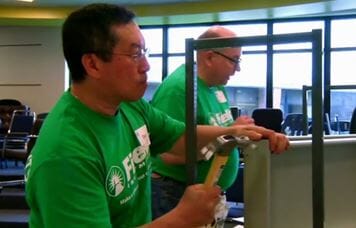
Volunteers are helping Lindsey Kirksey move out of his
home temporarily, including packing his possessions.
Kirksey’s home – known as a “shotgun house,” one room wide and four rooms deep – is beyond repair. The volunteer project will require demolishing the nearly 100-year-old structure and erecting a new house based on the original floor plan.
“When we reviewed his application (for assistance), what really stood out was his overwhelming story and the fact that he has dedicated his life to service,” says Nell Weisenfeld, volunteer coordinator and program manager at HandsOn River Region. “He also grew up in this home. In fact, when we reviewed the home we even found paperwork from his father when he was helping the church across the street – and that really hit a chord with us.”
The volunteers from Exelis Action Corps, the signature volunteer service program for aerospace and defense company Exelis, are stationed at Maxwell Air Force Base in Montgomery. Exelis supports the base through civil engineering, airfield management, communications, recreation and more.
“At Maxwell we employ all kinds of trades, people who are experts in doing this kind of work, and a large percentage of us are also veterans,” says Jeffrey Jackson, deputy program manager at Exelis at Maxwell. “We’re excited about joining forces with our local community and making life better for one of our own.”
For Kirksey, the new house has more than just physical significance: “Where I live, they used to call it the Beverly Hills, but now the neighborhood is going down and people are leaving. People ask me why I want to stay here and I say this is my background, there is history here.”
Dee Moody, executive director of Rebuilding Together Central Alabama, says the focus is on rebuilding, not destroying.
“Our purpose is to revitalize neighborhoods and keep communities together,” Moody says. “Sometimes people have to choose between home repairs and medicine, or home repairs and food on the table, and our job is to make it easier for them.”
Transforming a School, Rebuilding a Community After Hurricane Sandy
Though his feet splashed in about an inch of water, Principal Brian Walsh could see a water line two feet high marking the walls of Memorial School in Union Beach, N.J. Mud, mulch and who knows what else was scattered throughout the building. Everything was wet.
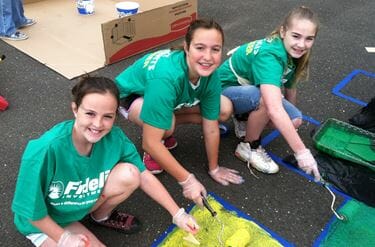
Students paint hopscotch squares at Union Beach, N.J.’s
Memorial School, which was damaged by Hurricane Sandy.
“The school smelled,” Walsh said, recalling a visit to the school after Hurricane Sandy battered it a year ago this week.
“We got used to the smell of that floodwater everywhere we went. You couldn’t escape it.”
Given the overwhelming damage to the building, the students were divided among four schools in three nearby districts. To Walsh it felt as if the Memorial School family was being split up.
As construction crews made repairs, Sherry Lynn Fazio of Jersey Cares came out to see how her group could help. The organization, part of HandsOn Network, coordinates volunteer opportunities to address critical community needs.
“The first time we visited Memorial School in Union Beach, it was filled with contractors and looked more like a construction site than a school,” she said. “There were areas we couldn’t walk through, no flooring, water-stained walls and Halloween decorations up in the hallways.”
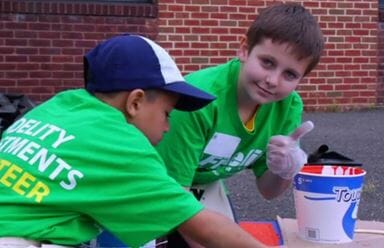
A young volunteer shows his positive attitude.
Insurance would cover much of the physical damage caused by the storm, but it wouldn’t help rebuild the school community. Working with school administrators and Fidelity Investments, Jersey Cares came up with a plan: They would reunite the Memorial School family.
May 18, 2013 became School Transformation Day at Memorial School, marking the first event in a partnership between Fidelity Investments and the school. (The second was a school supply drive during the summer.) Transformation events are part of Fidelity Investments’ national partnership with HandsOn Network to help revitalize the learning environments and support the education needs of 12 schools across the United States.
On School Transformation Day, students, teachers, school staff and Fidelity Investments employees came from all over New Jersey to volunteer at Memorial School. Nearly 150 volunteers, including students from Rafael Cordero and Saint Peter’s University, in addition to members from the Hudson County Chamber of Commerce, participated in the event – contributing a total of 699 hours. (Watch a video of the activities here.)
In a single day, the participants upgraded two teachers’ lounges and created an iPad lounge for the media center. They painted multiple murals in the hallways, painted colorful games on the courtyard blacktop, created a mascot design on the school fencing and built several new seating areas outside.
Volunteers build furniture for Memorial School.
“The human spirit was evident and alive,” Walsh said. “It was incredible.”
Everything from the iPads to the murals sported the Memorial School blue and white. Just weeks before the school reopened, school spirit was coming alive throughout the building.
“We had students painting murals and staining benches and teachers helping with the furniture location throughout the (teachers’) lounges,” Fazio said. “We also had the mural artists sketch restaurants and local businesses in one of the Union Beach murals to really integrate the love of community that permeates the city.”
The school felt like home again.
“The nice thing about teaching in Union Beach is the sense of community; it has always been here,” said teacher Debbie Byrne. “Whenever there is something happening at the school it is a community event – from the Halloween parade to the eighth grade graduation. For us to not be in our school physically was hard. It was so nice to return.”
While the students of Memorial School spent the majority of the last school year in different schools, they’re back together now. Unified.
“Fidelity and Jersey Cares – they did things that took us above and beyond where we were,” Walsh said. “It helped us become stronger than we were before the storm.”
On the Ground with the Financial Opportunity Corps
Nathalie Carril-King had been on the job less than a week when a young student walked into the College and Career Pathways Center at Flushing High School in Queens, N.Y., with a look of anxiety and frustration on her face.
“She told me she wanted to go to college, but had no idea how to pay for it or where to start,” Carril-King recalls.
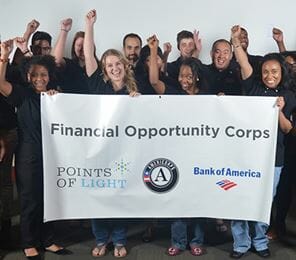
Carril-King is an AmeriCorps VISTA member serving with Asian Americans for Equality (AAFE) in New York City. She is part of Points of Light’s Financial Opportunity Corps, an innovative partnership between Points of Light, the Corporation for National and Community Service and Bank of America.
This fall, Carril-King and 19 other Financial Opportunity Corps members began their service with local nonprofit organizations in 10 communities around the country. Financial Opportunity Corps members will train volunteers to be financial “coaches” in their communities, helping residents learn strategies for reducing debt, improving credit, building assets, saving for emergencies and planning for the future. Like going to college.
“This program could not come at a better time,” says Christopher Kui, executive director at AAFE. “While many think that all of New York City has recovered from the recent recession, the reality is that almost half of New Yorkers are making less than 150 percent of the poverty threshold.”
Carril-King knows problems like these aren’t solved quickly – and won’t be solved before her term of service is over. But that’s part of what attracted her to the Financial Opportunity Corps in the first place. Its innovative peer-to-peer training model is designed to equip community residents and volunteers to keep it going over the years she knows it will take to effect lasting change.
It’s also one of the key reasons Bank of America partnered with Points of Light and the Corporation for National and Community Service to make the Financial Opportunity Corps a reality.
Carril-King
“Financial wellness is core to our company’s purpose,” said Kerry Sullivan, president of the Bank of America Charitable Foundation. “Through this partnership with Points of Light, we are supporting financial education efforts that can be scaled and sustained at the local level, leveraging the service of AmeriCorps VISTA members and our own employees to create positive change. That means customized solutions that put low and moderate income people – and their communities – on the pathway to long-term economic success.”
Volunteers from the community and Bank of America employees will serve as coaches. Through its partnerships with Points of Light and other nonprofit organizations, Bank of America employees donated more than 1.5 million hours of volunteer service last year alone.
Carril-King is already seeing the potential one-on-one coaching can have.
“As we talked, I could see her face change,” she says of the student she spoke with those first days on the job. “She was excited and more confident. I’m looking forward to more students being empowered to say, ‘I can change this.’”
How you can get involved
The Points of Light Financial Opportunity Corps is looking for volunteer financial coaches. If you live in one of the following locations and would like more information on volunteering as a Financial Opportunity Corps coach with one of our nonprofit partners, please click a link below and send us a note!
Advisory Board Company employees advise
Girls on the Run staff about fundraising.
They’re both playing a part in the Super Service Challenge. The story contest will award $1 million – in prizes ranging from $100 to $15,000 – to deserving nonprofit organizations nominated by their volunteers. A panel of judges will help select this year’s winning volunteer teams, some of whom will receive tickets to the Super Bowl.
To participate, volunteer teams must submit service stories between now and Nov. 30.
Here’s how:
Get a group of three to eight people and do a skills-based volunteer activity between now and Nov. 30, 2013. Projects completed since June 1, 2013, are also eligible.
Take photos or a short video discussing your service and the impact it had on your nonprofit partner. Answer three questions in your video – click here for the questions.
Here’s an email template to help you share the news with your pro bono teams.
Benefits:
Nonprofit partners are eligible to win part of the $1 million prize money. (Hundreds will win gifts of $100 to $15,000.)
Submitting teams are eligible for eight Super Bowl tickets and national media recognition with prizes going to the teams with the top four stories. The Super Bowl will be played Feb. 2, 2014 at MetLife Stadium in New Jersey.
Super Service Challenge winners will be announced just before the big game.
Employees from The Advisory Board Company, a health care and research consulting firm, are entering the contest, telling the stories of pro bono work they completed this month. For instance, staff members recently advised Girls on the Run (a nonprofit started by Daily Point of Light Award winner Molly Barker) on a fundraising strategy.
The Super Service Challenge is “a great way for staff to further their impact with an organization they care deeply about by trying to win funds for their organization, and also honors their work with an amazing prize of Super Bowl tickets,” said Graham McLaughlin, senior director, community impact, at The Advisory Board Company.
For more information on the Super Service Challenge and how to get involved, visit www.superservicechallenge.com or follow the #cChange movement on Facebook, Twitter and Instagram.
Look for more opportunities to engage with the Super Service Challenge with additional announcements from Points of Light and One America coming soon as we seek to bring volunteers and powerful voices together around vital issues of our time – education, the environment and hunger. Find out more about One America at www.facebook.com/joinoneamerica.
Learnings From the Civic 50: America’s Most Community-Minded Companies
Today’s post is written by Elissa Gathman, Corporate Services Fellow at Points of Light.
During the 2013 Conference on Volunteering and Service, I had the pleasure of attending, “Learnings From The Civic 50: America’s Most Community-Minded Companies,” a workshop that featured three leaders from the top 50 companies of 2012.
This workshop drove home the value of incorporating social responsibility into corporate strategy, and of companywide involvement in addressing community needs. It was inspiring to hear these leaders discuss the key trends they are most excited about in the world of corporate social responsibility (CSR).
Susan Portugal, senior vice president and CSR philanthropy director of Bank of America, highlighted the change in partnerships between companies and nonprofits, which now go deeper than just dollars. Today, companies and nonprofits are establishing longer term and evolving relationships that are mutually beneficial.
Janine Rouson, director of global volunteerism and corporate citizenship of GE, focused on the direct tie-in involving volunteerism, leadership development and positive company image. “No longer should volunteerism be looked at as something that’s separate and to the side,” Rousen said, as she pointed to the value of employee volunteerism for professional development, character building and community connectivity.
Tracy Moore, group manager of community relations for Target, said she was excited about the shift in the movement of community-minded companies embracing a more impact-oriented mindset. She explained that leaders are now asking deeper questions about the depth and social impact of their company’s CSR programs, and noted that companies that embrace this trend attract millennials, whom she called “a generation of people who want to contribute. They want to work for a company that does no harm.”
To round out the workshop, the opening of the 2013 Civic 50 survey was announced. This year, The Civic 50 – an initiative that identifies the country’s 50 most community-minded companies – is partnering with True Impact, and will be focusing on key elements of community engagement: civic commitment, strategic resource allocation, business integration, company policies and measurement. All S&P 500 companies are eligible to take the survey, which will remain open through August 16. The 50 most community-minded companies will then be featured by Bloomberg in early December 2013.
To take the survey, visit The Civic 50 website: civic50.org.
Corporate Pro Bono Support Matches Charitable Giving
Today’s post is written by Jackie Norris. Jackie is the Executive Director of the Points of Light Corporate Institute and leads the corporate strategy and employee engagement programs.
Imagine the 2020 CECP Giving in Numbers report with a headline like that! Imagine a time when every CEO and corporate leader asks, “How can I use the time and talent of my employees for good in the community and create the shared value for company and society alike?”
Just a few years ago, A Billion + Change set out on a mission to mobilize billions of dollars of pro bono service from the business community to build non-profit capacity at home and around the world. And companies big and small joined the movement to create and expand their pro bono programs.
The 2011 Giving in Numbers report showcases an increase in pro bono activity by CECP companies. We welcome this growing trend and encourage all CECP companies to join the movement as we drive the transformation of business culture in America to increase the quantity and quality of pro bono service. To take the pledge or learn more, http://abillionpluschange.org/
Submitted by Jackie Norris, Executive Director, Points of Light Corporate Institute
How to Build and Grow a Successful Cross-Sector Partnership
Today’s Post is written by Jeff Hoffman, an accomplished corporate executive who has served on the global stage in the areas of corporate philanthropy, human resources, operations, special projects and events. Through board and commission leadership roles, he has a distinguished history working with non-profit, civic and government agencies on strategic direction and innovative programs. Jeff is president of Jeff Hoffman & Associates, a global philanthropy and civic engagement firm that enables businesses, organizations and individuals re-imagine a world full of hope, promise and opportunity.
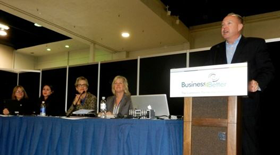
Business professionals and not-for-profit directors often have very different perspectives. There are inequities in power and differences in resources. Building a good working relationship is critical to success. Differences can be worked through by developing strategies, including setting clear expectations and goals, based on achieving mutually beneficial results. This is the description of, Partnerships That Work, the panel I moderated at the Business4Better conference last week. To illustrate the best attributes of partnerships, I choose two that demonstrate the positive impact to both parties when there are shared goals and defined outcomes; Disneyland Resort and CHOC Children’s, The Boeing Company and Inside The Outdoors.
Inside The Outdoors is a unique entity as it is part of the Orange County Department of Education and is not taxpayer supported as they raise their own funds. They are an environmental education organization where they “make the world your classroom.” This partnership with Boeing has been in existence for more than five years and is an excellent example of skills-based volunteering. Volunteers from Boeing worked with students to create a new shade structure at the Outdoor Science School. These volunteers were engineers and paired with groups of students who competed against each other for the winning design. Each team designed a structure, determined what materials and skills were needed, developed a budget and then pitched their idea. The winning team’s design was then actually built at a later date by Boeing volunteers. This effort demonstrated to the student’s real world applications, to the disciplines they learn, such as science and engineering. It now provides the school with a new shade facility replacing one that had burned.
The Disneyland Resort partnership with CHOC Children’s (Children’s Hospital of Orange County) spans 50 years. Walt Disney was part of the committee of Orange County leaders who worked for the creation of the hospital. This partnership is based on alignment, the complimentary audience of children and families. It truly is a two way partnership with both organizations receiving value. Components include cash contributions, in-kind support, product donations, board participation, Disney VoluntEARS and character visits. The new CHOC building’s lobby was designed with the help of Disney Imagineers and has an under the sea theme including elements from “Finding Nemo.” The big annual CHOC Walk in the Park actually takes walkers through Disneyland Resort.
These two examples showcased are from large global companies, yet they are local Orange County based divisions paired with local organizations. While every company doesn’t have Mickey Mouse, most of the examples can be translated into smaller enterprises. It’s about using the core competencies of the company, the skills of its employees and matching with organizations where a partnership is organic and mutually beneficial. This was the purpose of the Business4Better conference, helping a community partnership movement that fosters strategies, practical guidance and inspiration for businesses that want “to do better.” What particularly intrigued me about this conference is their focus on midsized companies. This is a category that has long been doing good, but without the resources afforded to their larger counterparts. This is the first B4B conference to take place in the U.S. with the first three being in Brazil, India and the United Kingdom. The sponsor, “UBM, is a global live media and B2B communications, marketing service and data provider.” They are a producer of conferences and conventions. This is an example of utilizing one of their core competencies, that of convening, to bring together businesses and NGOs to tackle serious problems more effectively. There plan is to produce B4B annually and they already have scheduled conferences in London, Sao Paulo and Mumbai through 2013.
Points of Light, along with its local HandsOn affiliate OneOC, were part of the advisory board for the conference. Neil Bush, Chairman of Points of Light, gave an inspiring closing keynote address. Many of the principals of Reimagining Service were evident in the presentations such as making volunteering a core strategic function, not an add-on.
There is much momentum around companies providing pro-bono services using their core competencies such as web design, human resources, marketing, finance and program design to help nonprofits be more effective in achieving their mission. Many of these companies, including ours, are taking the Billion + Change pledge as part of the largest commitment of pro bono service in history. Business4Better is exactly what it says and hopefully more businesses of all sizes will learn that creating societal value is also a good business strategy. http://www.business4better.org/ http://www.reimaginingservice.org/
This is a reprint of an article that originally appeared on Reimagining Service’s website
Why Millennials Are Not Interested In Your Corporate Service Program
When a Millennial employee swipes their card to gain access to the company’s building, their interests, networks, and personal passions don’t remain at the door. After all, the concept of work-life balance is not a term with which Millennials are familiar. They live an environment where work-life blending is the norm. Like it or not, the lines are blurring.
When it comes to community engagement, the lines are also blurred. Millennials see their involvement with causes not as a thing that happens outside of work, but as an interest to be explored throughout the day. The data continues to suggest that Millennials place higher value on companies that offer service and pro-bono, skills-based volunteering opportunities.
If this is the case, then why are Millennial employees not getting involved in your organization’s CSR programming?
The answer lies in how corporations approach volunteer programming, and whether or not they can be an asset in a Millennial’s search for community interaction, experimentation and action.
It is Not About Your Company
Millennials are interested in making things happen in their communities, and look to any institution – their work, home, and/or faith – to channel their passion. When doing ‘good’ through the company is focused on corporate attention in the process, it will loose its importance with Millennial employees. Millennials care about the issues, not the company wanting to gain awareness for efforts addressing the issues. The goal of the company should be to help Millennials channel their passion to causes and experiment with service to find the issues they care about.
It Is About Being Challenged
Millennials are inspired by the opportunity to tackle a challenge, build a prototype that will solve a problem, and create a concrete solution. Volunteer programming based on long standing relationships with community organizations is appreciated, but may not be personal and challenging to the Millennial. Identifying and providing opportunities that will challenge their thinking and test their skills will draw them closer to community organizations and ultimately more service.
The Big Question – Why?
Millennials need to know why their participation in service or workplace giving matters. Not why it matters to the company, but why their work will matter to the people they help. If companies are going to ask Millennials to participate in service, just like nonprofits, they need to report back on the people helped and how the community issue is different because of their efforts. Even if the experience is a one-time volunteer project, it is imperative that Millennials are provided feedback to quickly inspire future engagement. Remember: this generation gets instantaneous feedback from social networking all the time.
The ultimate goal of any corporation is to be the conduit for Millennial cause action. Companies acting as honest and fair brokers of Millennial service, skill, and interest with causes will move into a different role than where they are currently. This new role, as manager and advisor to Millennials on their cause interests, will place a new value on the company. A value driven by their Millennial employees that represents one of trust, appreciation, and openness to a very personal thing – the issues in the community that drive their passion. The bottom line? Millennials invested in the ethos of the company.
Join us on July 18, 2013 at MCON to explore how Millennials are redefining their workplace engagement, connection with causes, and how they activate for good.
, a ranking of America’s most community-minded companies, thanks in part to the work of the Citi Foundation, the bank’s philanthropic arm.
The Civic 50
, a
partnership between National Conference on Citizenship and Points of Light, ranks corporations on seven dimensions of local involvement. The
measurement and strategy
dimension requires a firm to show that it has defined its programs’ goals, performance metrics and interim indicators – or in plain English, that it can trace its community funding to actual changes in individuals’ lives.
How Did The Citi Foundation Do It?
First, they realized they had room to grow. While the Foundation has always been able to count how many people its community-oriented grants and projects reach, getting beyond that was a challenge.
“We were really tracking activities, not the impact we were trying to achieve,” recalled Pamela Flaherty, president & CEO of the Citi Foundation and Director of Corporate Citizenship at Citi.
Second, they implemented a results-oriented measurement system, reevaluating their strategy and designing new ways to identify and track the impact of their grantmaking on people’s lives.
People like Ernst Nicolas.
A New York resident, Nicholas came to The Financial Clinic for help in sorting out his debts, repairing his credit rating and getting his spending under control. The clinic is one of 31 organizations seeking to strengthen their financial capability coaching programs through the work of the Citi Foundation’s partner NeighborWorks America.
With coaching, Nicolas made critical changes.
“Right now I have my priorities set,” Nicolas said. Top on his new budget: rent, child care and transportation, while one-on-one counseling is helping him restore his credit and rebuild his savings.
“I do have a plan, and because of the coaching I’m getting, I’m more disciplined now when it comes to finances.”
A Measurement System Built Around Results
The results-oriented measurement system allows the Citi Foundation to focus on creating positive gains for individuals and their communities. And they can begin to understand how their efforts are helping nonprofit partners to transform and how all this is informing broader systemic change.
Maggie Grieve, NeighborWorks director of success measures, said she worked with the Citi Foundation to develop yardsticks for people’s financial status, habits of behavior and resilience, “things that hadn’t been easily measured before.”
The Foundation provided a $5 million grant to NeighborWorks to put the criteria into practice: selecting the 31 organizations whose financial coaches would be trained, establishing project objectives, planning training activities and setting benchmarks.
“The Citi Foundation really partnered with us to achieve mutual goals,” Grieve said. “We were able to demonstrate that significant numbers of low- and moderate-income people who participated were really able in less than a year to make progress toward their financial objectives.”
The 400 coaches trained under the program have served some 65,000 people in just two years.
Using Measurement & Results to Scale Impact
Third, the Foundation uses the results of its new measurement system to lay a solid foundation for scaling up impact.
The Citi Foundation hopes the new tracking system will show that its grant to NeighborWorks helped create a financial coaching model that can be used nationally to assist low- to moderate-income individuals in adopting positive financial behaviors that build and preserve their assets over time.
This investment is part of Citi and the Citi Foundation’s commitment to “financial inclusion” – ensuring widespread access to affordable, high-quality financial products, services and asset-building opportunities for individuals, families and communities.
The more people who become financially savvy, carry less debt and rack up more savings, like Ernst Nichols, the better for any community and for the national economy.
And finally, the Foundation goes beyond grants and numbers to leverage the expertise and resources of its people to enhance philanthropic efforts. Its Volunteer Management System identifies ways employees can help, then tracks what they do.
In 2012, Citi employees contributed more than 1.3 million volunteer hours in efforts they know made a difference.
To learn more about optimizing your company’s community engagement programs, check out this upcoming
featuring IBM’s success in the “Community Partnerships” scoring dimension and Citi’s success with “Measurement and Strategy.”
Big or small, your business has the power to lead change through skills-based service
Today’s post is written by Jim Corcoran, the president and chief executive of the Fairfax Chamber, which represents 650 businesses with nearly 500,000 employees in Northern Virginia.
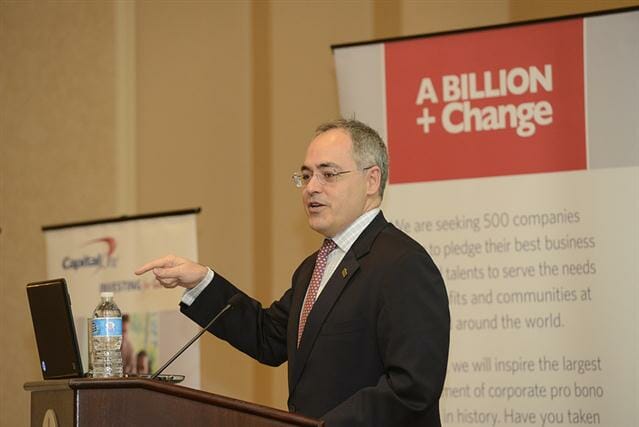
Photo of Dr. Angel Cabrera, president of George Mason University, who spoke at A Billion + Change’s pro bono summit on Monday. “The emerging generation of employees don’t want to follow a path of ‘make money now and give back later,’ he said. They “want opportunities for change from day one.”
, “collaboration is critical” emerged as the central theme. From the opening remarks to a vibrant keynote discussion, to a panel of corporate pro bono leaders and breakouts, the idea of cross-sector partnership and “we’re all in this together” (non-profits, government, educational institutions, intermediary organizations and the private sector) was the common thread. Throughout the day, the group discussed how to harness the power of pro bono – or skills-based volunteering – to move the needle on pressing issues like disconnected youth, hunger, affordable housing, homelessness, education, the environment and more.
For the
, pro bono is an important part of the solution to issues facing our region. The brain trust of knowledge and talent of the workforce in Northern Virginia and metro DC is exceptional. The intellectual capital of our people plays a key role in addressing our challenges. It was a pleasure to partner with these diverse organizations to leverage our private sector network to bring companies to the table – and more importantly – into the dialogue.
As Dr. Angel Cabrera, president of
, said in his opening remarks, the emerging generation of employees doesn’t want to follow a path of “make money now and give back later.” They “want opportunities for change from day one. They want to get involved and give back as they build their careers, and do so in a way that builds their skills, leadership capacity and furthers their professional development.”
For today’s employees, it’s about more than “here’s a T-shirt, go do something fun,” according to Deloitte’s National Leader of
Evan Hochberg. CEOs don’t want to see volunteering, they want to see impact. “It’s about change, not charity,” he says. And the great thing about skills-based volunteerism is that your company doesn’t have to be a large professional services firm like Deloitte to engage.
, which was represented by Vice President of Corporate Responsibility Jennifer Silberman at the summit, has a workforce that is largely hourly, and according to Silberman, there is an opportunity for the entirety of the company’s workforce to use their unique experiences and hospitality skills to help nonprofits deliver a better experience to their stakeholders. This means that employees from all levels of the company– from management and front desk staff to cleaning crews, food and beverage employees and more—can participate in service to their community.
According to
, the return on investment for their company has been tangible. CSR boosts employee engagement more than base pay and matters more than employee’s relationships with their manager, she told attendees.
Mid-size companies and small businesses have an important role to play in the pro bono movement. Margie Johnson, Acumen Solutions Senior Director of Corporate Care, spoke about her company’s Board Leadership Program, which trains Acumen’s leaders to effectively sit on nonprofit boards. Carrie Fox of C.Fox Communications also shared her small businesses’ “Inspired Thought” award, which provides a deserving nonprofit at least $20,000 worth of pro bono PR and marketing services every year.
and others to broker new pro bono partnerships in Northern Virginia and bring pro bono resources of business to local government and non-profits that are tackling our most pressing issues,” stated Patti Stevens, Executive Director of
, invest your human capital in partnering with Northern Virginia non-profits that are already making an impact on issues but need your support, and continue to dialogue with corporate peers on pro bono and other CSR issues through the