A Blackhawk Pilot and Now a Civilian, She Knows How to Serve Those Who Serve
As a veteran and a volunteer, Erica Jeffries is clear on what matters:
“To do good for others – it’s our purpose in life.”
On Veterans Day, Jeffries will be creating care packages for deployed troops with Exelis Action Corps, a program that encourages employees of the aerospace and defense company Exelis to serve veterans as volunteers.
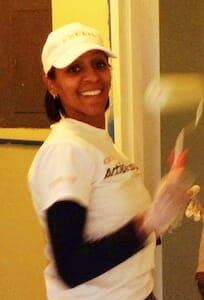
Erica Jeffries participates in an
Exelis Action Corps project.
Jeffries, who is in charge of developing a diverse workforce for Exelis, appreciates the opportunity through Exelis Action Corps to participate in regular volunteer events that benefit veterans, including ongoing work with Fisher House. The nonprofit provides temporary housing for military families near hospitals where their loved ones are recovering from combat injury, illness or disease.
“The Fisher House is important to me, because when I was on active duty, my mother was able to stay at a Fisher House in Texas while I was in the hospital,” says Jeffries. “It was a wonderful gift and a blessing to our family.”
Jeffries recalls that one of her most gratifying volunteer moments with Exelis Action Corps came through Final Salute, an organization that provides housing to homeless female veterans in the Washington, D.C., area. The volunteers worked on landscaping, painting and otherwise making the house a comfortable living environment.
“The experience working with Final Salute was powerful because we knew we were preparing a home for veterans and their families,” Jeffries says.
Jeffries shares a kinship with the veterans she serves, having been in the military herself. She attended the United States Military Academy at West Point and served with the Army for five years, piloting Blackhawk helicopters to bring equipment to troops.
She’s also using her experience transitioning from military to civilian life to help others do the same, through a program she developed designed to teach leadership skills to veterans. The Leveraging Military Leadership program, in partnership with Points of Light and executive search firm Korn Ferry, launches in January and will became a signature part of Exelis Action Corps.
In the meantime, Jeffries – who directs a ministry for veterans at her church – says she is looking forward to doing good for others on Veterans Day.
From Combat to College: Helping Veterans Transition
For many veterans, transitioning from active duty back to civilian life begins on a college campus, where they can receive the additional training and educational foundation they need for success. And you can help.
Points of Light Military Initiatives is proud to partner with the
.
For this program, Points of Light Military Initiatives will soon begin recruiting 20 AmeriCorps members to serve on 10 college campuses across the country. These members will help Veterans Affairs counselors provide student veterans with services and resources to ease the transition to college life. VetSuccess on Campus will also offer career development guidance and access to health benefits.
Here are the 10 participating schools:
Cleveland State University
Community College of Rhode Island
Portland State University
Rhode Island College
Salt Lake Community College
Texas A&M University, Central Texas
University of Alaska, Anchorage
University of Michigan, Ann Arbor
University of Texas, San Antonio
University of Utah
Interested in learning more? Contact Raleigh Keagan at
How Volunteering Broke a Veteran’s `Vicious Cycle of Hate’
This post is by Heath Cobb of Georgia, a member of the Veteran Leader Corps, an AmeriCorps program run by Points of Light. He explains that volunteering helped ease his transition from military service back to civilian life.
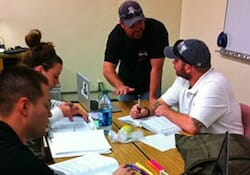
Heath Cobb, second from left, visits a
VFW post in Savannah, Ga.
My experiences as a Marine serving in the Middle East do not make me special, nor am I a hero. I do not shed tears for my brothers who gave their sacrifice in the sand. In fact, I consider them fortunate to have died in such an honorable way.
It’s not about how long you live; it’s about how well you live. This is what so many of our returning military members quickly forget as we try to acclimate back into society. This, I am certain, is the cause of so many of the problems we face after leaving the service.
As a Marine I understood why it was necessary to fight, but more importantly, I discovered why Americans are the “good guys.” As Marines we learn what makes us special isn’t that we are the finest fighting force in the world. We are special because we are not bullies, we are not savages. We are protectors.
I believe this sense of protector, this profound feeling of inner peace, can be restored to many of our veterans simply by exposing them to the very spiritual act of giving. Volunteering within the community is very similar to serving our great country in the military. Working to help others, for the betterment of man, is almost tangible. It truly honors our mothers and fathers and restores that sense of pride that many of our veterans lose so quickly.
I was fortunate to have a relative who is a champion of peace, Dr. Rose Marie Clarke. She worked with another notable person, Jeremy Foreman whose foundation, Georgia Serves, was responsible for recruiting me to AmeriCorps. Both have souls of an angel and are very active within the community. They are quick to help others and prefer charity work to food.
Aunt Rose witnessed my struggles firsthand. She saw me suffer from the scars of war. Rehab and mental institutions became commonplace. My often bizarre behavior was fueled by rage and I found myself in a vicious cycle of hate. Even the birth of my precious little daughter wasn’t enough to bring me out of the hell I was in.
Then, following a suggestion from my aunt, I got involved in the community by volunteering my time. I had inadvertently opened a door that would finally start healing the pain that plagued my heart like a rotting cancer. I didn’t know it but I was being exposed to an environment filled with folks who volunteered their time and effort simply because it made the world a better place and I noticed immediately how happy these people were.
I found the pride I felt when serving others was the same pride I felt by defending others. Suddenly, almost overnight, my sense of self was restored, my identity renewed. This, my friends, is the answer that many of our vets are seeking.
Unless we can really communicate the spiritual value of volunteering and charity work to those who may be struggling or even those who simply may need some guidance, we will fail to have any meaningful effect. I am very excited to be a member of AmeriCorps for this reason. The support and resources from this organization are second to none and I am fortunate to be involved with several key partnerships that offer a wealth of knowledge and experience. I look forward to building upon the shared goodwill of AmeriCorps, the American Red Cross, Points of Light and Georgia Serves.
God bless us all!
A longer version of this post originally ran on the ServiceNation website in honor of the 20th anniversary of AmeriCorps. Read it here.
On 9/11, Remembering the Fallen and Those Needing a Hand Up
As Americans across the country honored the victims of 9/11 last week through volunteer service,
employees deployed across the Washington, D.C., area during three simultaneous events to remember the thousands of military men and women who have sacrificed their lives since the terror attack and to help those who have come home.
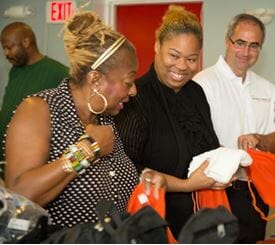
Exelis volunteers and Veterans On The
Rise staff assemble job-readiness kits.
in northeast D.C. to prepare 100 job-readiness backpacks, which included portfolios, deodorant and toothpaste. Volunteers then worked together to cook a nutritious meal for 50 residents and staff members of Veterans On The Rise, which provides housing and supportive services to homeless veterans.
At the Army and Navy Club in northwest Washington, 20 veterans heard from A. John Procopio, senior vice president and chief human resources officer for Exelis, about how to get ready for job hunting. They then sat down with Exelis executive volunteers for personalized career counseling sessions and had the opportunity to participate in a workshop hosted by tailor Aaron Goode, of VM Clothiers, on how to dress for corporate America. In a raffle, two veterans won tailor-made suits.
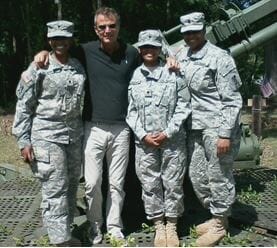
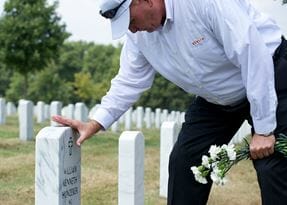
Ken Hunzeker, Exelis executive vice
president and president of Mission Systems,
lays flowers at a fallen soldier’s gravesite.
Across the Potomac River at Arlington National Cemetery, Exelis executives gathered with local veterans to pay their respects to the fallen. Following a wreath-laying ceremony at the Tomb of the Unknown Soldier, volunteers walked together throughout section 60 of the cemetery, laying flowers on gravesites. Volunteers then worked to build 100 MedEvac bags for wounded warriors arriving at Walter Reed and Ft. Belvoir medical centers.
“Military service men and women have dedicated themselves to a cause greater than themselves,” said Mike Monroe, vice president of military initiatives at Points of Light. “To show them that their nation, its citizens and corporations do not take this selfless act lightly, Points of Light and Exelis show their support on 9/11 and every day.”
To learn more about how Exelis and Points of Light are serving veterans, go to pointsoflight.org/veterans.
Why I Volunteer in My Marine Corps Community and Why You Should Too
Volunteering feeds the soul. When you help someone in need or an organization that shares your beliefs or represents an aspect of your life, you are filling a need and potentially changing lives including your own. When people ask me why I volunteer in so many different capacities with the full plate I carry on a daily basis, I always tell people the same thing: The warm and fuzzy that I get from helping create something or make a change in my community makes me feel good. That warm and fuzzy is what volunteering is all about.
When I see a need I want to do what I can to fill that need if it is within my capabilities. My personal passion is helping Marine Corps families. As a Marine Corps spouse I know the feeling of needing community. I have experienced lost opportunities because I simply didn’t know about something or people didn’t reach out to me to share in the fun of an event. I have volunteered in my civilian community since I was a kid* and when I became a part of the Marine Corps community through my marriage I felt a drive to make myself as much a part of the new community as I could.
The bond Marine Corps families have is not always just felt but seen as well. When I organize fun events for fellow United States Marine Corps (USMC) families, it feels good to see kids having fun and spouses smiling and relaxing while they share stories about their kids that have happened at earlier duty stations. That feeling is what moves me forward to planning the next event. By giving USMC families an event to bond at, I am giving something positive to their lives.
I volunteer to help spouses reach their goals in their careers because one of my secret spouse powers is developing professionally while living the life of an Active Duty spouse through Permanent Change of Station (PCS), deployments, long recruiting duty hours, and whatever else this life we choose throws my way. Not everyone knows how to further themselves and I feel like since I do, I should help other spouses reach their dreams. If you know how to do something and you also know that your neighbor or friend or the brand new 18 year-old spouse attached to your spouse’s unit doesn’t but they are clearly in need, you should offer your hand to help them. Someone asked me why I think helping others is important. My answer is simple, because in my heart I want to help the person I see in need be successful in whatever it is they are working towards. Successful spouses equal successful families and the Marine Corps and our nation need successful families.
Even the smallest gesture such as making homecoming signs, working a community clothing drive, or baking for a fundraiser makes a positive impact. It is amazing what might be accomplished when you help others. There are many important reasons why Marine Corps spouses should volunteer, below are some important reasons why you shouldn’t let a volunteer opportunity pass you by.
Learning new skills: When you volunteer, you get to meet people who live their lives in many ways. You meet people who are in need, and then you meet people just like yourself who are looking to lend their talents and give back. Network with those who organized the homecoming sign event and chat with those people who are just looking for a warm coat. In the end, you not only will expand your network of people, but your life will be forever affected by the stories that you hear. You can develop your communication skills and learn how to build leadership skills. By networking with people you are developing “people” skills to take with you to the next duty station and beyond. The more volunteering you do, the further your leadership skills will develop as you begin to volunteer in different roles and take on more responsibility.
Make an impact: Whether it is cooking meals and handling carpool for a pregnant spouse who has a deployed husband with 3 school age children and a baby on her hip or working a booth at a USMC family day, one thing will always be the same: it is the thought that counts. Your gesture will help benefit those who are in need in some way. You have the choice to make a change, and when you make a change you begin to see the positive impact you are making on your community.
Personal development and satisfaction: Your time is valuable. Spend an hour organizing an on-base neighborhood pot-luck, or give two hours of your time at the child-care center. No matter what the task, in the end you are ultimately bettering yourself and your Marine Corps community. As you spend your time on different functions, you will come to know what you enjoy and what you don’t and what volunteer activities give you your own warm and fuzzy. Once you take a break from the everyday stresses of life, such as work, bills, kids, deployment, reintegration, etc., you will begin to see that all the little things and seemingly meaningless tasks matter.
Volunteering helps challenge you and can take you out of your comfort zone. Use these challenges to your advantage. Prove to yourself that no task is too small or role is too big. You will feel a satisfied happiness and experience feelings of accomplishment when fellow Marine Corps families say thank you and you step back and look at what you are doing for your community. Knowing that you make a positive impact on people’s lives, will help you to become a more positive person.
Always be grateful for what you have been given. Be grateful for your talents and skills and put them to use for no reason other than because someone needs what you can give. Give back to your Marine Corps community and “be the change you want to see.” (Mahatma Gandhi)
*Reference can be read about on USMC Families website, in part one of the volunteerism series “
Find ways you can help the military community in your area through the Community Blueprint.
Change Notes: Five Years Later, Reflections on a Merger
Friends,
When President George H. W. Bush described his vision of 1,000 points of light, I was one of a handful of 20-somethings in Atlanta trying to build a movement of people who wanted to roll up their sleeves and solve local problems. It was 1989, and we were raising money by asking people to fill up empty beer mugs with small donations.
At the same time, President Bush was assembling an influential group of business and community leaders at Camp David to launch a new voice for volunteer service supported by millions in federal funding.
For almost 20 years, the group I helped to build, the HandsOn Network, and the group President Bush helped start, Points of Light Foundation, sometimes worked together and sometimes competed. Always, we shared a commitment to create change through volunteer service and civic engagement.
Five years ago, our two groups took a step that’s all-too-radical in nonprofit circles: We merged. It hasn’t been easy, but it has been effective. Together we mobilized more volunteers and created much more change than either organization could have alone.
In 2012 alone, Points of Light mobilized more than 4 million volunteers to serve 30 million hours. Over the years, we reduced our reliance on federal funding from 44% to 5%, while at the same time adding affiliates in 42 cities across the globe. We brought together four organizations to create generationOn, Points of Light’s youth service initiative, and added 500 kids clubs leading change.
We consolidated our Affiliate Networks into a single network with standards, benefits, and a return on investment of $27.61 for every $1 of dues. From 2009-2011, Affiliates increased volunteer engagement by 22% (an additional 460,000 people), added more than 17,000 new partners.
Our Corporate Institute, through an amazing coalition called Billion + Change, obtained commitments for $1.9 billion of pro bono service from over 250 companies to date. In partnership with Bloomberg BusinessWeek and the National Conference on Citizenship, we created the Civic 50 to recognize companies with the most robust civic engagement practices.
HandsOn Tech Corps, launched in 2011 through a signature partnership with Google, has trained 4,400 nonprofit staff in seven cities to date to leverage technology to engage volunteers more effectively. We have mobilized 68,000 volunteers in long-term recovery efforts in disaster response in 11 states. We are deploying VISTA members in 28 cities with HandsOn Schools Attendance Corps to increase school attendance. And we have partnered with Exelis and a coalition of veteran organizations to launch the Community Blueprint. Veteran Leader Corps members are serving veterans and military families in 35 communities in total with plans to grow to 200.
Clearly the whole is greater than the sum of the parts.
Is your organization ripe for merger? As competition for funds and attention gets tougher, mergers will be increasingly important and necessary. So what can make them easier?
Pro bono help. Points of Light was lucky to have the pro bono support of Accenture’s dedicated strategy team and McKenna Long & Aldridge’s extraordinary legal team. Their help was essential to our success. A pro bono bank of private sector resources combined with a philanthropic investment would create enormous leverage.
Patient funders. While funders unanimously herald the idea of consolidation and the cost efficiencies that mergers promise, there are precious few willing to invest the patient capital required for a successful merger. We need more.
Good will and honesty. I must have had a hundred people tell me that “culture eats strategy’s lunch” every time. And it’s true: Culture and relationships do trump all else. Mergers can only work when both parties share a vision and work to create a merged culture of honesty and good will.
Stamina. When we merged, people told me it would take three years to complete the merger. I couldn’t imagine it would take that long, but it took every bit of that and more. To make mergers work, we must focus on the horizon, with support from board members and other champions who understand the long-term nature of the task.
It’s been a long but rewarding journey, and I’m proud that we can call it a success. For more about what our merged organization has accomplished read our Five-Year Reflections on the Merger of Points of Light Foundation and Hands On Network.
In service,
Michelle Nunn
CEO, Points of Light
Change Notes: Vice President Biden Joins Points of Light on Day of Service
Dear Friends,
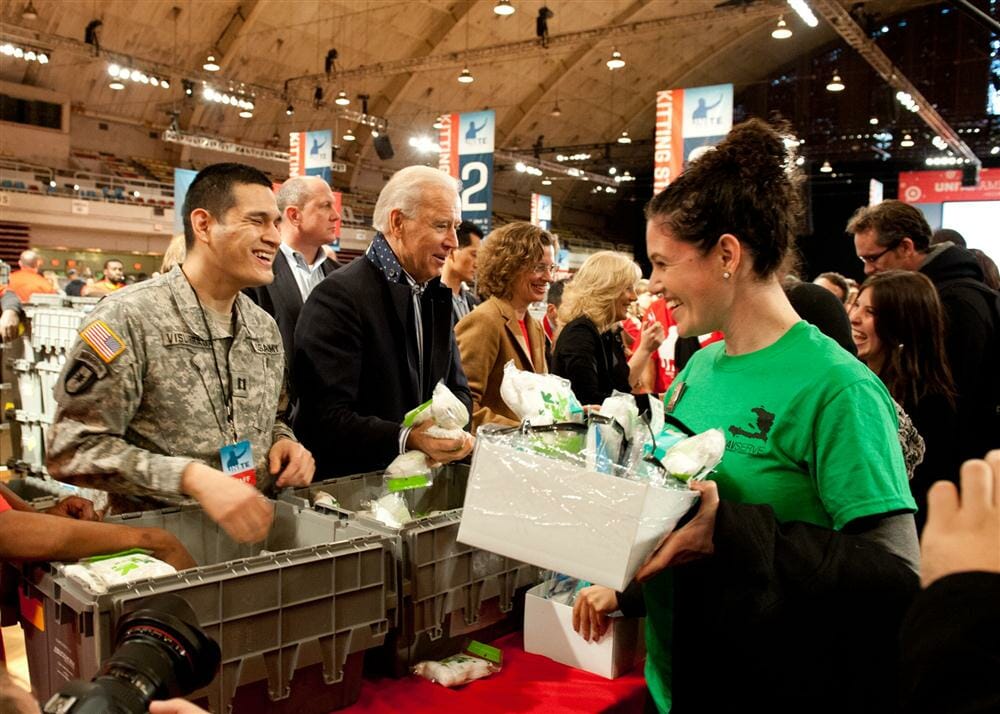
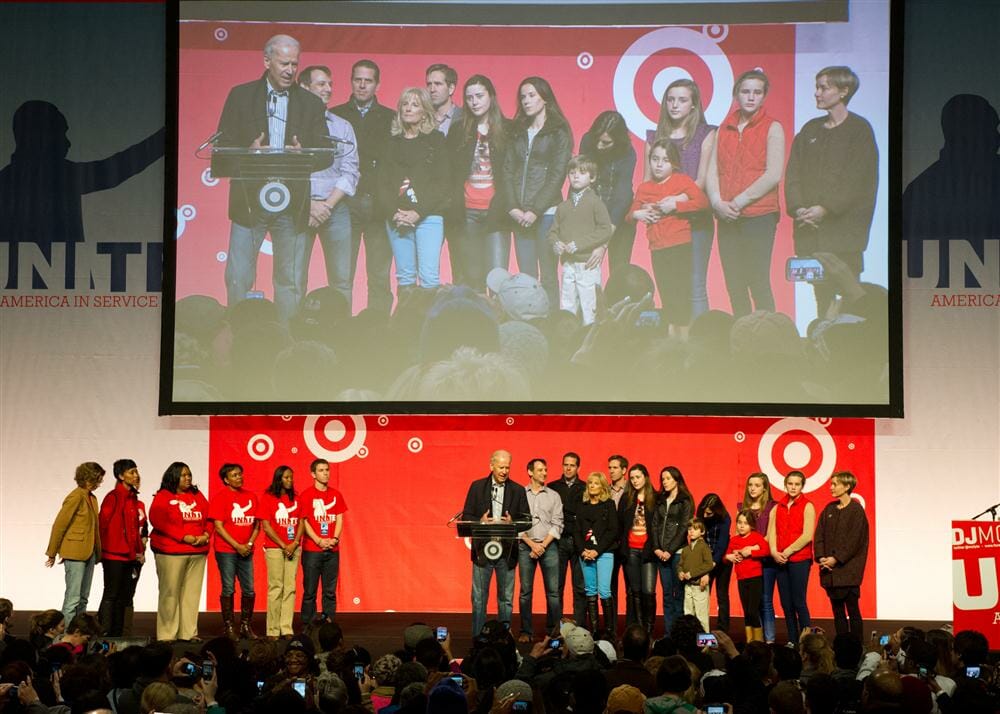
Vice President Joe Biden, Dr. Jill Biden and a dozen of their kids and grandkids joined Homeland Security Secretary Janet Napolitano and nearly 10,000 volunteers at the D.C. Armory yesterday to put together 100,000 care kits for U.S. military personnel, disabled veterans and civilian first responders. In his remarks thanking the thousands gathered for donating their time, Vice President Biden said, “Dr. King imbued in the public this notion of absolute service,” and noted that it was this legacy of volunteerism and service that Points of Light and President George H. W. Bush have continued.
It was an amazing day in Washington, DC and across the nation, as millions of volunteers honored Dr. Martin Luther King, Jr. with a National Day of Service. Points of Light mobilized hundreds of thousands of people, including volunteers who mucked out homes devastated by Hurricane Sandy in New York, transformed veterans’ homes in Phoenix, and completed school makeovers in Los Angeles. Check out some of the great photos and extensive news coverage here.
Points of Light’s signature event in DC, the largest single-site service project of the inaugural weekend, was made possible by Target, which gives 5% of its profit and thousands of volunteer hours to communities every day. We are so proud of our partnership with Target and inspired by their extraordinary corporate leadership.
This weekend of service, celebrating Inauguration Day and Dr. King, is a great reminder that we each have a leadership role to play in setting the course for our nation.
Let us know what you did this weekend – and what you plan to do all year long, as we rededicate ourselves to Dr. King’s dream. Connect with Points of Light on Facebook and on Twitter at #2013MLKDay or at [email protected].
In service,
Michelle Nunn
CEO, Points of Light
2012 Election: Implications for the Service Sector
Today’s guest post is written by Julie Murphy, vice president of government affairs and public policy at Points of Light.
On Wednesday, Nov. 7, the nation awoke to a familiar political scene: the re-election of the incumbent President and Congress still split between a Democratic Senate and a Republican House of Representatives. Here are some trends and opportunities for the service and volunteerism sector:
Cooperation, Compromise, Common Purpose
“What makes America exceptional are the bonds that hold together the most diverse nation on earth, the belief that our destiny is shared, that this country only works when we except certain obligations to one another… That’s what makes America great.” President Barack Obama on election night
At Points of Light, we share the president’s view that the greatest hope for our country lies in our impulse to honor the obligations of our citizenship through service. In the next four years, we will work with both the White House and Congress to promote policies and programs that advance and integrate volunteer strategies directed toward national needs across the public sector.
Some of these strategies may even be derived from our own in-house initiatives:
How can HandsOn Schools and generationOn inform education reform and resuscitate federal service-learning policies?
How can the work of our disaster team and our affiliates engaged in the response to Hurricane Sandy improve federal disaster response programs?
What are we learning from the Community Blueprint regarding veterans’ and military families’ services?
What does the Civic 50 tell us about the potential for greater coordination between private and public sectors and does this imply changes in such areas as tax policy?
What can the 750,000 alumni of AmeriCorps over the last 20 years tell us not just about national service but also about social policies writ large?
How has volunteering changed employment strategies in this country over the past four years and does that need to be reflected in federal economic policies?
Are there ideas from our thought leadership agenda such as converting federal student work study programs to “serve study” programs or creating a volunteer background check “fast pass” that are ripe for consideration by Congress?
Status Quo
An election that yields no substantial shifts in power means we need to renew our relationship with our bipartisan Congressional and White House allies and introduce ourselves to the newbies — quickly. Given that we have status quo, the time and energy needed to hand over the keys and unpack the boxes can now be spent by the White House and Congress on getting busy, and we need to be ready to be the voice for citizen engagement in Washington.
Fiscal Cliff
The looming budget crisis means that we will need to be aggressive and smarter in our opposition to further cuts to the Corporation for National and Community Service. We will need to gather our best stories about the impact of service and volunteering programs such as the Volunteer Generation Fund and rapid fire these into the inboxes of members of Congress.
Our AmeriCorps alumni, our affiliates and our partners will all be called to become vocal advocates for a resolution to our country’s fiscal problems, a resolution that 1) does not compromise effective volunteer and national service programs; and 2) protects the most vulnerable in our society.
Demographic Shifts
“What the world saw this week was a picture of America at its best: edgy, experimental, open-minded – and brilliantly diverse.” Fareed Zakaria, Washington Post, Nov. 9, 2012
Zakaria framed it well and we, as a sector, will need to rise to this same challenge to embrace the changes in our country’s demographics to ensure that all Americans have opportunities to serve.
Limited but Energetic Government
David Brooks said this about the 2012 election: “It’s about leaving behind the stale Big Government versus Small Government framework and figuring out how to use limited but energetic government to help people work harder and strive more.”
We, at Points of Light, believe that an energetic government’s best fuel is its people and our policy agenda for 2013 will include the smartest investment the federal government could make: identifying and replicating volunteer-driven community solutions that show proven results.
Any thoughts/ideas on what the election means to the volunteer and nonprofit sector? Share in comments.
Service to Help Veterans Get Back On Track
Today’s post is about Kelly Landry, who is an AmeriCorps VISTA member assigned to the Community Blueprint Network at American Red Cross South Florida Region (FL) through the American Legion Auxiliary Call to Service Corps. In her assignment as a service to the armed forces associate, Kelly coordinates resources and services that better respond to the strengths and needs of the military community in South Florida.
When Kelly Landry met Capt. Juan Fernandez, he was lost. After retiring from 20 years in the Marine Corps, including time in Afghanistan, he was facing a disease that left his vision impaired, depression and feelings of isolation. To help him get back on track, Kelly knew what she had to do.
She and her team had to ask him to serve.
Kelly, an American Legion Auxiliary Call to Service Corps member with American Red Cross South Florida, said she has long felt a responsibility to help veterans and military families. “My dad is a combat veteran and raised me give back. I know it’s a cliché, but I believe in the idea of ‘home of the free because of the brave.’ Veterans gave everything and we are obligated to support them in return.”
Her work, part of the Community Blueprint, focuses on three important areas: homelessness, reintegration and volunteerism. She said this work deals with the continuum of challenges returning veterans face and solving each bridges the gap between a life in the military and finding a successful, satisfying place in the community.
“Having even one veteran on the street is unacceptable. After that, we focus on helping veterans find the right job for their skills, following up with them throughout their employment and finding ways for them engage with and serve others in the community,” Kelly said. “These men and women just need a little boost to get on their feet. From there, the potential is sky-high.”
For Capt. Fernandez, opportunities to serve other military families as a Red Cross volunteer gave him a reason, he said, to “keep fighting.” He’s now employed as a Junior ROTC leader, has connected to other veterans and is seeing improvements in his health.
“All he needed was to be asked to help,” Kelly said. “Our veterans are an untapped resource who naturally want to serve. It’s up to all of us to make sure they get the opportunities and support they need.”
Honor Our Veterans
Today’s post is written by Mike Monroe, vice president of military initiatives at Points of Light.
I am a U.S. Marine Corps veteran. I continue to serve out of uniform at Points of Light, working to create initiatives that will help veterans.
Around Veterans Day, so many people are thinking about causes and ways to help. I wanted to offer a few things to think about.
When you think about veterans, please also think about military members, their families (including their children) and families of the fallen. All of these people have made sacrifices. They all deserve our appreciation.
Don’t make Veterans Day a day of just pausing and reflecting. Make it a day where you annually reaffirm a personal commitment to do something to help.
Not all veterans have had the same experiences. Not all were in combat. Some may not have had a good experience during their time of service.
If you are talking to a veteran, listen… but don’t prod. Many may be reluctant to share what they went through. Do not be offended—they are coping the best way they know how.
Veterans are not charity cases. They want a fair shot at a good life, just like everyone else.
If you want to help—donate or volunteer. Look for organizations that are doing more than providing “moments.” What I mean is that while veterans are appreciative of free concerts or theme park tickets, these are things that only help them for a moment of their life. You need to donate or volunteer at organizations that are providing services to veterans that are bettering their lives over the long haul. Organizations that are giving them reasons to get out of bed in the morning. Look for organizations that are doing work around basic needs—health care and wellness, education, employment. These form the foundation that ensures a vibrant veteran and translates to an amazing asset to your community.
Look for organizations that are working at the community level. Veterans leave the military and return to communities. Services provided at the community level are the ones that are making real differences. A suggested place to start for more ideas: www.the-communityblueprint.org
This Veterans Day, make the commitment to look around your community and figure out where you can donate your time and resources in meaningful ways – ways that will give a veteran, military member, their families or the families of the fallen a reason to want to get up in the morning. To find volunteer projects that focus on veterans, check out www.signupandserve.org.