Verified Volunteers recently surveyed clients and non-clients alike — all of whom run volunteer programs – to better understand their background screening needs and processes. The 967 survey responders represented a wide range of organizations including social and human services, education, healthcare, religious and youth development groups. Responders were mostly volunteer managers and program managers and directors whose organizations relied heavily on unpaid volunteers.
Katie Zwetzig, executive director of Verified Volunteers and Toby Chalberg, chief digital officer at Points of Light, weighed in with insights from the third annual research study on the state of volunteerism and volunteer screening in America during the most recent Verified Volunteers webinar, “Volunteer Screening 2018: Research Results & Insights.”
Why are Organizations Screening?
Organizations are screening candidates for many reasons, but the majority of volunteer managers (91 percent) screen to protect constituents and vulnerable populations. The other top reasons to screen were:
89% to provide a safe and secure environment
77% to protect the organization’s reputation
48% to improve compliance/required by law
41% to improve volunteer quality
20% to increase volunteer retention
How are Organizations Screening?
Our survey found that 53.61 percent of organizations use an external third-party service to conduct background checks while 26.31 percent go directly to a government source and 15.98 percent perform the checks in-house. Almost half of the organizations screen all volunteers regardless of their position or how often they volunteer, but volunteers who work with vulnerable populations are most likely to be screened. Approximately 88 percent of organizations are not screening short-term, one-time and infrequent volunteers.
The overwhelming majority of the survey respondents (92 percent) said they conduct criminal record checks. The next most common background check used by volunteer organizations is the sex offender search at 73 percent. Toby found the large gap between the top two screens concerning and surmised that people might not know that the sex offender check is already part of their background screening package. Moving down the list in terms of commonality, 41 percent use identity verifications, 16 percent conduct drug and health checks and 12 percent conduct social media checks.
Top Three Trends Report Takeaways
There are many interesting volunteer screening trends and findings that we uncovered with the survey. We wanted to highlight just a few, but keep an eye out for future blog posts which will delve deeper into the survey findings. The top three takeaways are:
1. Social Media Checks
More and more nonprofit organizations have been asking about social media checks. Social media screening can be very valuable to volunteer managers during the onboarding process, as it humanizes the candidate. On the other hand, social media profiles can reveal both positive and negative information in what is a very public domain. It is critical that organizations understand the legal ramifications of this type of background screening. The volunteer must be told that a social media or other online source is being used to research information that could affect their application. Consent for doing these types of checks must be received. Social media searches should be carried out as late in the recruitment process as reasonably practical to avoid any biases.
It is highly recommended that organizations use a third-party screening company for social media searches. A third party social screening solution will only focus on information that relates to the volunteer role. This is important as “protected characteristics” such as age, disability, gender identity, marital status, race, religious beliefs, sex or sexual orientation, which can be easily seen on social media profiles, cannot be considered by organizations. Organizations need to have a clear policy in place for social media searches.
2. Rescreening Volunteers
Continual screening of volunteers can seem daunting, especially if you have a large team of volunteers. However, rescreening is very important especially since organizations might only see a volunteer once a year. The survey showed that rescreening volunteers has increased over last year and doubled among short-term volunteer positions.
21% rescreen all volunteers
25% rescreen those working with vulnerable populations
19% rescreen those in long-term volunteer positions
20% rescreen those in short-term volunteer positions
17% rescreen those in administrative or back office positions
How often should you rescreen? Every year, if possible. However, this will depend on your organization’s budget and the volunteer position of the person you are rescreening. Volunteers in leadership roles and volunteers working with vulnerable populations should be rescreened annually. What checks organizations use when they rescreen volunteers will vary. Some will run the full background check search again, while others will only run criminal record or sex offender checks. It is important to tell the volunteer if they are being rescreened.
3. Compliance is Key
The survey found that half of organizations disqualify only a small minority of volunteers whose checks return criminal results. Organizations disqualify volunteers based on sexual assault records (94 percent), felony convictions for violent crimes (94 percent), misdemeanor convictions for violent crimes (72 percent), felony convictions for nonviolent crimes (55 percent), driving convictions (30 percent), and misdemeanor convictions for nonviolent crimes (17 percent).
Compliance is a critical factor when conducting background screening. When an organization uses a volunteer candidate’s background information to deny them the position, they must comply with federal and state laws that protect the applicant from discrimination. When using consumer reports to make employment decisions, including hiring, retention, promotion or reassignment, companies must comply with the Fair Credit Reporting Act. The FCRA guidelines also apply to nonprofit organizations who have a volunteer staff. Volunteer managers must get consent to conduct screening, be transparent with the volunteer candidates and follow an adverse action process.
Based on the survey results, only 15 percent of organizations send both pre-adverse and adverse action notices to disqualified candidates, which means they may not be compliant with the FCRA. An adverse action process must include:
Steps for sending and receiving both pre-adverse and adverse action notifications
Sending a copy of the candidate’s background report
Adequate time for the candidate to respond and dispute findings
This post was originally published by Verified Volunteers and appears here with permission.
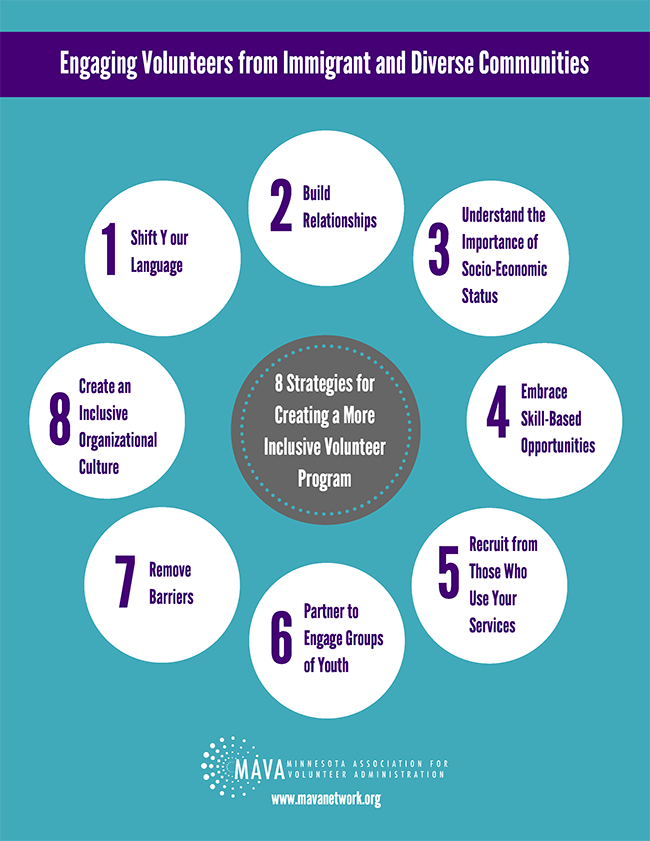
8 Strategies for Creating a More Inclusive Volunteer Program
Do volunteers at your organization represent the racial and ethnic diversity of the community you serve?
The answer, for most governments and nonprofit organizations, is “no.”
But this can change.
The Minnesota Association for Volunteer Administration has spent the last year researching the challenges, barriers and best practices for volunteers from immigrant and diverse communities. While this project focused particularly on government organizations, the findings can largely be applied across both government and nonprofit entities. To reach these findings, MAVA built on several previous initiatives and conducted new research to more deeply explore questions such as:
How is the concept of volunteerism understood and perceived in racially and ethnically diverse communities?
What barriers currently exist to engaging diverse and immigrant populations as volunteers with government organizations, and how can these barriers be overcome?
What outreach or recruitment strategies are most effective in immigrant and diverse communities?
Are there particular volunteer roles that are more appealing to people of diverse backgrounds and, if so, how can governments or organizations develop these roles?
What efforts have organizations found successful in engaging diverse and immigrant volunteers, and how can other entities replicate these efforts?
The result of this research is a set of eight strategies for engaging diverse and immigrant volunteers, which governments and organizations can develop into an action plan for change.
Some of the strategies are relatively simple. For example, we heard from a number of people new to this country that the word “volunteer” is not well understood in their community. Framing volunteerism in terms of how they can help their neighbors is a more effective way to discuss how they might be involved. And focusing on how someone might help their community, as opposed to how they will help your organization, will be a more compelling recruitment message.
Other strategies are much more difficult, like building relationships with communities of color and creating an inclusive organizational culture. While employing these strategies will not happen overnight, starting today by taking small steps forward will slowly build inclusion into your volunteer program in the months and years to come.
All eight strategies are represented in the infographic below, and the executive summary of MAVA’s report (featuring a brief overview of all eight strategies) is available at www.mavanetwork.org/inclusive.
If you would like to receive the full report or discuss MAVA’s work, contact Lisa Joyslin.
How the Service Enterprise Initiative Drives Nonprofit Capacity Building
By Karen Baker, Chief Service Officer, CaliforniaVolunteers
Nearly a decade ago, we noticed a troubling trend in California: one out of every three volunteers was leaving their service site within the first six months of their experience. Simply put, California nonprofits were not providing solid recruitment, on-boarding, training and recognition of volunteers. Simultaneously, volunteer centers that had this knowledge lacked the investment dollars needed to put together a business model that would allow them to assist nonprofits in their markets for a reasonable fee.
At Points of Light’s Conference on Volunteering and Service in 2009, companies, volunteer centers, service commissions and nonprofits learned about new research reported from the TCC Group confirming that only 15 percent of nonprofits were operating as “Service Enterprises.” These were organizations that engaged volunteers, and which outperformed their peers in every measure of organizational capacity, including leadership, management, adaptive and technical capacities. At the same time, the Corporation for National and Community Service happened to announce a new grant opportunity, the Volunteer Generation Fund, which could potentially put these seemingly disconnected developments together into one grand idea by providing the funding needed for nonprofits to create a business model to scale Service Enterprises.
It was the perfect storm. By bringing together four leading volunteer centers — OneOC, The Volunteer Center Serving San Francisco and San Mateo Counties, HandsOn Central California and The Center for Volunteer and Nonprofit Leadership — CaliforniaVoluteers was able to provide the resources needed to create the Service Enterprise curriculum. The program now had a strong foundation, but wasn’t national. In 2012, Points of Light joined the initiative to further develop and scale the program.
Today, the Service Enterprise Initiative is a national program that helps organizations transform the way they engage human capital for social good. Through an assessment, training, coaching and certification model, selected nonprofits are equipped with the tools and technical assistance needed to transform their operations to better meet their missions. In fact, research shows that Service Enterprises are just as effective as their peers — yet they operate at almost half the average annual budget. For every $1 they invest in effective volunteer engagement, Service Enterprises can also expect $3-$6 in return through more effective program delivery. More than 300 nonprofits across the country have become certified Service Enterprises, joining a growing movement of organizations dedicated to meeting their missions more effectively using the power of volunteers.
This is true for Connolly Ranch, a nonprofit in Napa, California, that connects children and family to nature through farm-based education to inspire the next generation of environmental stewards. By becoming a certified Service Enterprise, “our leadership and staff has learned … that our return on volunteer investment was $4 for every $1 invested! This allows us to maximize what our community contributes to our organization and helps us better achieve our mission,” said Jennifer Fotherby, executive director at Connolly Ranch.
Habitat for Humanity in Fresno has also transformed the way it engages volunteers through the Service Enterprise Initiative. Now, volunteers are key to the success of the organization’s core mission to provide affordable housing. They are integrated into operational areas like fund development, and drive critical parts of Habitat’s programming, including their Neighborhood Revitalization and ReStores programs. This has helped shape a culture of volunteering at the organization. “When I think of the Service Enterprise Initiative,” said Matthew Grundy, CEO of Habitat for Humanity in Fresno. “I think of two words: investment and focus. It was an investment to participate in SEI that focused our efforts to build on our solid foundation, making sure our organizational culture embraced volunteers 2.0. Service Enterprise asked the right questions and we have experienced significant impact in moving our organization forward.”
For CaliforniaVolunteers, our proudest moment over the years was recognizing that not only was the Service Enterprise Initiative going to happen, but that it played to everyone’s strengths. We knew that the volunteer centers in California had the know-how, that researchers – such as Sarah Jane Rehnborg and Peter York – had the wisdom to develop a diagnostic tool, and that Points of Light was the right player to ensure credible national expansion. Our role was to put the deal together and get out of the way, and the rest is history.
The Service Enterprise Initiative today stands as a powerful tool to build nonprofit’s organizational capacity and is a resource they can use to help them better engage volunteers. Last year, more than 80 percent of Service Enterprises reported an increase in both volunteers and skills-based volunteers, which represents an additional 207,000 volunteers and 31,000 skills-based volunteers helping nonprofits and communities. And California? Far from being a laggard in volunteer engagement, the nonprofit sector in California now leads the national Service Enterprise movement and is on the cutting edge of innovative volunteer service models.
Nonprofits and government agencies’ abilities to solve societal issues are often constrained by organizational capacity. When your roof is leaking, you focus on the immediate issue of repairs and may put off a much-needed basement remodel. The same can often be said for capacity building initiatives; they take time, resources and staff capacity that many nonprofit organizations don’t feel they have, even if it would pay off in the long run.
The
, sponsored by JPMorgan Chase & Co., focused on these issues and offered attendees proven and feasible solutions for increasing nonprofit capacity. Across the nine sessions, three trends emerged as to how nonprofits can leverage existing assets and resources to do more.
1.
Move from Partnerships to Collaboration
The biggest trend across all the sessions was the need for a pragmatic shift in how nonprofits engage companies and work with other organizations. During the “Corporate-Nonprofit Partnerships Blown Way Out of Proportion” session, Bea Boccalandro, president of VeraWorks, pushed attendees to think about how they could triple their impact by focusing on cultivating integrative partnerships – where the success of both the nonprofit and company are intertwined. “Most relationships between business and nonprofits are philanthropic or transactional. But to get at impact, we need to push towards integrative,” Bea said.
Bea recommended starting small, with pilot initiatives. This was echoed by Rebecca Wang, senior manager of corporate affairs at Hewlett Packard Enterprise, who offered a corporate perspective. Rebecca compared the process of entering a new partnership to taking it slow with a new romantic partner. “When I am working with a newer organization that maybe another company has referred to me, it’s kind of like the dating phase. You are really thinking more about your own benefits. As you go through multiple dates, you start to understand each other better. You may decide to become exclusive. At that point, the commitment to each other becomes integrative.”
Sessions also encouraged nonprofit sector attendees to rethink how they partner with each other. Too often, nonprofits feel that they are competing against one another and therefore cannot truly collaborate. Shonna Ferree and Rikki Wheatley-Boxx of the Public & School Partnership, an AmeriCorps VISTA program, shared best practices for collaborations between organizations and recommended leveraging
mandated days of service as platforms for local collaboration and outlets for raising awareness of national service efforts.
2.
Be Data Driven, Not Numbers Numb
Two sessions focused on the importance of leveraging data, but in strategic and creative ways in order to see real community impact, not just a shift in numbers. In the hands-on “Survey Sense/Let the Creativity In: Exploring Alternative Methods for Data Collection” workshop, Stephanie Lloyd, manager of evaluation and performance measurement at Points of Light, walked participants through a visual survey methodology called SHOWeD, first developed by Wang and Burris in 1997.
For attendee Leah Vanhoeve, the session was thought-provoking. “It was great to be engaged and feel like we could be engaging other people through this instead of staring at a computer screen codifying qualitative data, because it’s really not that different from quantitative data, it’s just two sides of the same coin,” she said. “This felt very out of the box and applicable, and not something I had ever heard of before.”
3.
Leverage the Power of Pro Bono
Many nonprofits are interested in recruiting pro bono and skills-based volunteers but are unsure how to start or struggle to find ways to effectively leverage these volunteers to build capacity within their organization. Yet, pro bono volunteers can provide up to 500 percent greater value to nonprofits than the value of traditional volunteering, by supporting needs such as general operations, technology and professional services.
Panelists at the Making the Most of Corporate Skills-Based Volunteering: A Fireside Chat with JPMorgan Chase & Co. session shared tips and best practices for developing a pro bono strategy. Attendees broke into small groups and worked through Common Impact’s skills-based volunteering
.
“We are a volunteer-based organization, so we are very familiar with plugging volunteers into our actual programs, but thinking about pro bono from a capacity building standpoint is something we are just starting to dig into,” said Jessie, an attendee from Grid Alternatives. “It was helpful to hear some examples of how other organizations have done that, but also just some of the resources that Common Impact provided around potential projects and the questions you need to think about before you even approach a company with a pro bono idea.”
These are just a few of the highlights from the Capacity Building track. Across the sessions, attendees were exposed to new ideas, trends and resources to take back to their organizations.
track at the Conference on Volunteering and Service highlighted stories of civic-tech leaders who are using technology to help solve social problems, creating empathy in their communities and encouraging others to use their tech skills for good.
Rohit Malhotra, founder and executive director of Atlanta-based
, spoke about creating local innovation communities to spark change in our cities. His passionate and inspirational presentation highlighted the importance of building trust and empathy through real relationships with people in our communities. The secret sauce, he said, is engaging people in the creation of companies, organizations and communities through civic and community engagement. This leads them to see the good over the bad of creating these institutions – not only because they had something to do with it, but also because they know the whys and hows of what was created and become a true part of improving their community.
to create a better volunteer experience in their organization, Jenn Downs, director of user experience design at Points of Light, built on Rohit’s theme of creating trust in communities. Workshop attendees practiced conducting user interviews, learning about the power of silence in active listening, and the value of using the phrase “tell me more about that” to dig deeper into problems. This group of volunteer organizers were also able to see that by sharing with and asking what others are struggling with, they could collaborate on solutions to common volunteer management problems like budgeting, retention and using new technologies to craft better volunteer experiences.
In a workshop sponsored by
, attendees learned how to use social data to engage volunteer networks and address common problems many organizations face. Presenters discussed applying the lessons and practices of social listening – identifying and mobilizing micro-influencers among a social media following – beyond fundraising and advocacy goals. Participants also learned how to use technology to address volunteer management challenges like recruitment, attrition and retention, as well as matching volunteers to the right roles.
Expanding on Blackbaud’s ideas about social media data, Clay Johnson, senior vice president of digital at Points of Light, and Rebecca Wang, senior manager of corporate affairs at Hewlett Packard Enterprise, highlighted changes to
, Points of Light’s digital hub for volunteerism and community engagement. And, looking toward the future of All for Good, Clay and Rebecca envisioned a platform where social data can be used to encourage sharing opportunities with friends and family, leading to an increase in participation in volunteer activities around the world.
The relationship between All for Good and HPE started with HPE’s
, which asked people what apps and digital tools they would create to improve people’s lives. The Points of Light digital products team pitched an idea to empower volunteers through social sharing and machine learning within All For Good – the team was 1 of 4 winners, each receiving HPE’s support in the form of time and talent to help make their idea a reality.
These were just a few of the insights that the Tech for Good track offered attendees as they learned about and discussed the latest developments in tech-focused volunteerism. The discussions that took place and the lessons learned from these sessions shed a positive light on the future role that technology will play in helping nonprofits and social organizations recruit and retain volunteers – and in broadening the scope of impact individuals are able to make in their communities.
Jenné Meyers, CEO of Chicago Cares, explained, “nonprofits that engage volunteers are better led, better managed, more adaptable and capable of going to scale.”
Across the globe, volunteers are a powerful force for good, changing the world by giving their time, talent and other resources. Guiding these individuals are volunteer managers who help volunteers thrive by channeling their passions and skills.
The
at the Conference on Volunteering and Service offered 20 sessions to equip organizations with breakthrough tools and strategies for recruiting, retaining and managing high-impact volunteer programs. In recognition that the nonprofit landscape continues to evolve, the track focused on the question of how organizations can capitalize on the passion and enthusiasm of volunteers, some who have never before added their voice to a cause. The sessions placed special emphasis on innovation and idea exchange with peers who manage multi-issue programs.
Across the sessions, five trends emerged:
1. Volunteer management can make or break an organization.
shared, “research tells us that organizations that engage volunteers are better led, better managed, more adaptable and capable of going to scale.” Additionally,
shared how nonprofits can leverage skill-based corporate volunteers to develop professional development programs for their employees, increasing retention and human capacity.
Yet, volunteer management is something that takes work and intentionality. During a breakout session, Katie Zwetzig, executive director of
found that the number one challenge nonprofits face is volunteer management. When nonprofits invest staff capacity and resources into effective volunteer management it has a strong return on investment.
2. Everyone has a role in volunteer management.
In order to get a high ROI on volunteer engagement, everyone from board members to program managers to event volunteers must be passionate about cultivating and retaining volunteers. Karmit Bulman, executive director of the
, found that the scope of volunteer involvement within an organization hinges on the excitement of staff at all levels, as well as an organization’s readiness to support and partner with volunteers. In order to fully maximize the value of volunteers, every staff member needs to be involved in the process.
3. The paradigm of volunteering is shifting.
A common theme across multiple sessions was a shift in how nonprofits and individuals perceive the role of volunteers. Rick Lynch, principal consultant at
, framed the changes as a series of gradual shifts. According to Lynch, the volunteer management era “grew up” when many people volunteered as an alternative to professional work, whereas today’s volunteers do so as an alternative to other leisure activities. In order to be effective practitioners, Lynch encouraged volunteer managers to focus on cultivating relationships with individuals and engage them as consultants, building toward serial involvement, not as unpaid employees.
4. Nonprofits can expand their volunteer capacity by focusing on causes and impact.
As baby boomers retire and millennials are increasingly looking to give back, the sector needs to respond to changing volunteer motivations. Emily Holthaus, national director of social responsibility at
, shared that often, organizations are only able to engage volunteers at the surface level, leaving a large gap between the service provided and the volunteers’ true capacity and desire to create impact. Today’s volunteers want to make tangible impact toward specific causes or programs. Beth Steinhorn, president of
, encouraged organizations to put to rest the idea of a volunteer “belonging” to one organization versus another and focus on inspiring volunteers around specific causes and projects.
5. Technology is not a silver bullet, but it is powerful tool.
Many nonprofit leaders believe they don’t have the resources or capacity to fully leverage data and technology to advance their work. Several sessions debunked this idea by offering concrete (and achievable) steps nonprofits can take to use technology. Gary Bagley, executive director of
, shared how they used Google Ad Words grants to increase their SEO and overhauled their volunteer recruitment process, automating communication at key steps, to increase new volunteer signs ups by 14 percent.
These trends are just a sliver of the knowledge shared during the Volunteer Engagement track. Through informal chats, dine-arounds and networking sessions, attendees made personal and professional connections with peers around the globe. Through a shared passion and commitment to volunteerism they will continue to grow the service movement, helping turn volunteers’ passions into progress.
This post was written by Teri Johnson, senior vice president of strategic partnerships, training and consulting for Points of Light.
The nonprofit sector spends a lot of time agonizing over organizational strategy and how to meet mission with increased demand and fewer resources. Though volunteers seem like an oversimplified solution to the problem, through strategic volunteer engagement, they can be viable and, oftentimes, necessary assets to nonprofit capacity building.
The good news is, people want to volunteer! According to the
, 1 in 4 Americans volunteer through an organization. The report also indicates that volunteers are twice as likely to donate money to organizations compared to non-volunteers. Why, then, are some organizations unhappy about the idea of volunteers knocking on their doors?
Great volunteer engagement is done strategically, as a part of the organizational culture; however, this approach takes an investment of time and energy that many organizations don’t feel they have. The result is a resistance to developing a more vibrant volunteer engagement program. Even some of the strongest nonprofits with vibrant programs engage volunteers either episodically, or because they are mandated to do so. When you engage volunteers with a fill-the-gap approach, without a needs assessment, compared to one of strategy, it’s harder, more time consuming, and generally less fulfilling for both the organization and the volunteer.
However, organizations that build a culture of volunteerism, and purposefully embed volunteerism into their strategy, experience stronger retention rates, increased volunteer engagement and higher
, for example, experience a 23 percent average increase in new volunteers in their first year after being certified by implementing strategic volunteerism practices.
Strategic volunteerism means embedding volunteers as capacity builders into your operational and programmatic strategies. Any organization, regardless of size, is capable of engaging volunteers strategically. It takes time and commitment, but the outcome is stronger mission delivery. Here are a few tips for helping your organization tune in to a culture of volunteerism:
Enlist the support of senior leaders and decisions makers for volunteers to be more integrated into your organization.
Perform an internal needs assessment to determine where there are gaps.
In every program design or strategy session ask the question, “How can we engage volunteers to help us achieve this work?”
Commit to a codified recruitment, training and recognition program for your volunteer program.
Track your volunteer efforts and report on outcomes and outputs.
When volunteers are an afterthought, it can be challenging for everyone involved – but when volunteerism is a part of organizational culture, your efforts will return bigger results. Volunteers will be your ambassadors in the community, your capacity builders and some of your greatest assets. Volunteers will step in to fill the necessary gaps to allow your organization to make a bigger impact.
Today’s nonprofits face challenges that extend far beyond meeting the needs of their community and clients. Delivering on a mission means cross-sector collaboration, volunteer management, fundraising, performance measurement, and more.
To meet these challenges, many nonprofits are turning to
, a strategy that helps nonprofits build their capacity and increase their community impact by maximizing their effective use of volunteers.
The Service Enterprise model was developed by the Reimagining Service campaign and through the efforts of Points of Light and partners like Algorhythm and RGK Center for Philanthropy and Community Engagement. The
grants to state service commissions.
Starting in California with the partnership of CaliforniaVolunteers, Points of Light has refined Service Enterprise and today supports 29 hubs in 18 states and soon, Puerto Rico.
Already, 169 organizations have become Service Enterprise certified. State commissions in Arizona, Iowa, Maine, Massachusetts, Nevada and Utah are helping bring the model to more nonprofits in their states.
Service Enterprise organizations undergo a diagnostic that indicates areas for improvement and then receive extensive training, coaching, and certification. By the end of 2015, Service Enterprise organizations will be able to display the seal on their Guidestar profiles showing the world that they are cutting costs and better serving their communities by building in efficiencies through volunteers.
What does this mean? More than 165 organizations are investing in their future by putting the necessary culture in place that supports the deployment of volunteers, both skills-based and traditional, to deliver their missions.
Service Enterprise gets to the heart of organizational capacity by measuring capacity and volunteer engagement practices in 10 key areas identified through research performed by Deloitte and the Service Enterprise researchers. TCC Group found that “Service Enterprises not only lead and manage better, they are significantly more adaptable, sustainable and capable of going to scale.”
Why does this matter? Research demonstrates that Service Enterprise nonprofits operate at almost half the median budget as their peers. Managing volunteers takes time and an investment, both in the volunteers as well as in the staff who manage them.
Service Enterprise ensures that a culture of volunteerism is embraced at the highest levels of the organization so that proper support and training exists to carry out the organization’s mission.
Today’s nonprofits need support in order to be a part of community solutions. Service Enterprise is a tested and proven way to maximize volunteer efforts, reduce cost, and make a difference.
For more information about the Service Enterprise Initiative, please click here.
Top Six Resources for Nonprofits
From managing volunteers to making your organization more hospitable, these key resources will give you effective strategies for addressing challenges that face nonprofits today. For more resources, check out the searchable resource library managed by Points of Light’s HandsOn Network.
Bringing on Highly Skilled Volunteers
There are likely skilled professionals – specialists in accounting, information technology, human resources and more – in your community ready to volunteer at your nonprofit, but are you ready to receive them? The Skills-Based Service Engagement Tool, which takes about 10 minutes to use, can help your nonprofit determine how prepared it is to engage skills-based volunteers.
Through thought-provoking questions and instant feedback, the tool provides tangible recommendations for nonprofits looking to boost their ability to meet their missions by attracting talented professionals as volunteers.
Managing Volunteers
For many nonprofit organizations, volunteer help is vital. However, recruiting and engaging volunteers in an organized way can be tough. This HandsOn Volunteer Management Guidebook can help.
The guide outlines various strategies for organizing a strong volunteer structure, from recruiting and scheduling volunteers to retaining and recognizing their efforts. Paired with questions to consider and activities to help map out goals, the Volunteer Management Guidebook provides resources you can adapt to meet your local program needs.
Calculating Economic Impact of Volunteers
There are many ways to recognize the value of volunteer work. For nonprofits, this often means calculating the monetary worth of volunteer duties, which varies. To make it easier, Points of Light has created the Economic Impact of Volunteers Calculator.
By providing a complete list of volunteer jobs, the calculator can help give your nonprofit a better idea of your volunteers’ economic impact. The calculator lists standard hourly rates and hourly benefits of specific positions. After you input the number of hours, the calculator does the rest of the work.
Nurturing Volunteer Leaders
A solid corps of volunteer leaders can make a big difference in helping your nonprofit achieve its mission. Points of Light’s Volunteers as Leaders guidebook is designed to help your organization establish the processes needed to develop a strong volunteer leader program.
This guide outlines various stages of program evolution, from development to volunteer leader recruitment, training and support. Equipped with user-friendly questions, tools for brainstorming and suggestions, Volunteers as Leaders provides pointers and resources you can adjust to meet the needs of your nonprofit.
Assessing Volunteer Leaders
Volunteer and staff feedback on organizational management is your nonprofit’s key to growth and success. The Organizational Assessment for Volunteer Leaders, created by Points of Light, provides a thorough questionnaire to help extract important responses about how your project is running, from a volunteer perspective.
This resource includes activities that help staff or the volunteer coordinator assess organization readiness, recruitment, retention and recognition.
Making Hospitality Part of Your Organization’s Culture
Hospitality is crucial in any company culture, and the same is true for nonprofit organizations. Created by Hilton Worldwide, Points of Light and Taproot Foundation, the Hospitality + Service curriculum is designed to help you serve your clients better by improving communication and connections with clients, creating warm and welcoming environments and effectively managing challenging situations.
Hospitality + Service’s leadership toolkit, Hospitality by Design, shows how to build hospitality into your organizational culture from the ground up, deliver more to your clients, strengthen your team and build your reputation and impact in the community.
Getting Engaged – With Volunteers
This post is by Tricia Thompson, vice president of training and consulting at Points of Light.
I don’t know about you, but I’m not a big fan of being managed. Being managed feels constraining and restrictive.
I do like to be engaged though. Being engaged sets me up as an active participant in supporting and achieving a goal. It means that I have something to contribute. I have a hunch I’m not the only one who prefers being engaged rather than managed, and I think there’s a lesson here about how we approach our work with volunteers.
For example, Feeding America San Diego (FASD) has been embracing a philosophy of volunteer engagement rather than volunteer management. It wasn’t always this way. It had an efficient system for volunteer sorting and packing of food boxes. The volunteers had good experiences and many came back to serve again – but there was a limit to what they could do.
The food bank’s staff realized so much more was possible.
First, they recognized that their repeat volunteers could make great project leaders and began to recruit and train them for that role. Then, they asked the new project leaders for their opinions on the volunteer experience. After all, they were on the front lines with other volunteers and could see and respond to needs firsthand.
The project leaders set up a special area with a log book to note how projects went – what worked and what needed improvement. As a result, the food bank had a better picture of what went on with volunteers and a system for continuous improvement.
But they didn’t stop there. The FASD staff began to get to know the people who were packing boxes and realized that there were nutritionists, chefs and other professionals in their ranks. They engaged these volunteers in creating recipe cards for nutritious meals and offering cooking classes.
With more skilled volunteer roles available, volunteer programs manager Teresa Dale noted a 40 percent increase in the hours skilled volunteers contributed.
“These volunteers typically serve longer, bring specialized experience and directly build departmental and organizational capacity,” Dale says.
The volunteer department needed additional capacity, too. It took up a volunteer on her offer to create new tracking spreadsheets. She now maintains and updates these spreadsheets to produce reports on volunteer hours, group participation and impact of service. The expanded metrics are used in board, fundraising, volunteer recruitment and marketing materials.
Even the food box packers, who may only serve once, are engaged in deeper ways. The warehouse now features an area where volunteers and their groups can take photos that highlight their service. Participants are encouraged to share these photos on social media and their company websites.
These new roles have given more volunteers a chance to get directly involved with the work of the food bank. Moreover, they have helped attract even more volunteer prospects to recruiting sessions – a 40 percent increase, according to Dale.
All of these strategies are consistent with being an organization that engages volunteers well at all levels – or what we call a Service Enterprise.
Service Enterprises recognize that engaging, rather than managing, volunteers means that we are more likely to see all the talents, skills, connections and passions that people bring when they show up to serve. And that means a richer experience for the volunteers, our organizations and our causes.
What are your thoughts about engaging versus managing volunteers?