This post is by Alex Roth-Kahn, managing director of the Caring Commission at UJA-Federation of New York, a philanthropic organization that funds a network of nearly 100 beneficiary agencies to help care for New Yorkers of all backgrounds and Jews everywhere.
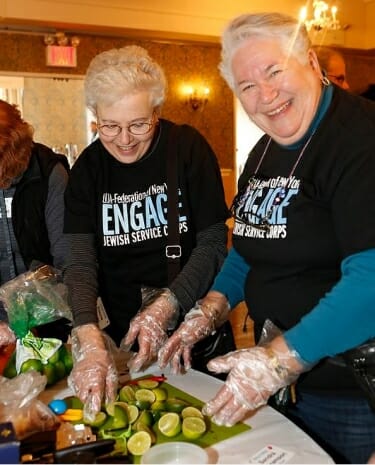
Volunteers Elaine Good and Sandra Abramson help package bags of food for people in need at the Union Temple of Brooklyn on Martin Luther King, Jr. Day.
Our organization strives to build a community in which individuals experience both a sense of belonging and a sense of responsibility. To achieve this, we inspire the Jewish community to make a collective commitment to volunteering and engage in acts of caring throughout our region. This ensures that those struggling with life’s challenges feel the warm embrace of the Jewish community.
We knew an important first step to engaging more volunteers at our nearly 100 beneficiary agencies was to invest in the capacity of select organizations to engage volunteers in their critical work.
We wanted to ensure that our beneficiary agencies had the tools and systems to handle an influx of volunteers as well as a mindset that welcomed volunteers as service providers.
So we reached out to Points of Light to participate in the Service Enterprise Initiative (SEI). We needed a model that emphasized the regular engagement of volunteers and their skills, beyond days of service and collection drives.
We liked that the Service Enterprise model elevated the role of volunteers so they were part of a holistic care continuum of paid and unpaid team members.
We were also impressed with the peer-learning component of SEI. By learning together, our beneficiary agencies were inspired by each other to find solutions to challenges, think creatively, and be proactive in their planning. They also came away with a stronger sense of being part of a movement.
The Service Enterprise model has helped us lay the groundwork for our next steps of encouraging the Jewish community to volunteer more.
By investing in the SEI and providing additional grants to our beneficiary agencies for implementing the model, we believe we will have more meaningful service opportunities and an improved service experience available when we issue a call to action.
It’s an exciting and innovative approach we recommend to other federations or community funders that are looking to inspire individuals to help address community challenges. The SEI has helped us create a space for professionals in the field to envision things differently. To make that vision a reality though, it has been incumbent upon us to serve as a thought leader and funder in the process.
Change is difficult, but the combination of our federation assets and the SEI approach has made important changes possible. We are eager to move forward and reach more people with services and the warm embrace of our community. A community that says: “You matter. You count. You’re just like me. We come from the same places and we’re headed for the same future.”
5 Tips for Engaging Boomer Volunteers
“We are a generation that understands the power of rallying around a cause we believe in to make a difference in the world. Join us and see how great it feels to change the world again.”
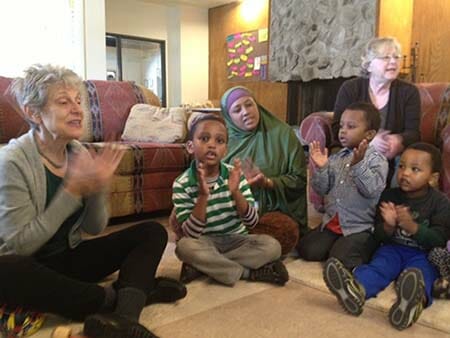
Boomers Leading Change in Health volunteer Phyllis Hanfling, left, teaches a “Healthy Tots” class for refugee parents and children at Spring Institute for Intercultural Learning in Denver.
That’s the call to action a Denver-based nonprofit, Boomers Leading Change in Health, uses to recruit volunteers over 50 to serve as patient navigators, health policy advocates and community health workers.
The pitch appeals to boomers’ sense of nostalgia, belonging, individual and collective power, and generational pride. That’s a lot to squeeze into 36 words – and underscores just how much the relatively young nonprofit knows about its older audience.
The demographic is a critical one in Denver – where boomers make up about one-third of the metro population today – and across the nation, where by 2030 one in four Americans will be over 60.
At a recent conference sponsored by Encore.org – a nonprofit encouraging second acts for the greater good – Barbara Raynor, managing director of Boomers Leading Change in Health, provided these tips for engaging boomer volunteers.
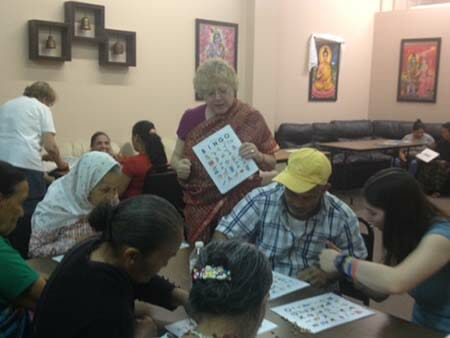
Boomers Leading Change in Health AmeriCorps Encore Member Julie Rotenberg, center, uses “Body Part Bingo” to teach refugees how to communicate their health care needs.
Be flexible.
“They don’t call us the sandwich generation for nothing,” Raynor says. Boomers are engaged in jobs (including searching for jobs), kids, taking care of parents, grandchildren and travel, which can make committing to volunteering somewhat challenging. “But,” she adds, “as long as they feel what they’re trying to do is worthwhile, they’ll be there.” Provide as many options as you can to allow boomers to find a volunteer pattern that fits their lives and their work styles.
Be patient.
“Just because they sign up to volunteer doesn’t mean it’s the right time for them,” Raynor says. Other things come up; it’s just life. “Don’t give up on them,” she said. “Stay in touch. They know when the time is right, and they take their volunteer commitments very seriously.”
Give them opportunities to learn.
“Boomers are not afraid of training, especially if they can benefit from it personally,” Raynor asserts. “They enjoy it and value it, and they use it.”
Provide a professional experience.
Boomers take the commitment to volunteer seriously. “Many come dressed for a job interview,” Raynor says, “and they expect professionalism from us.” That means being prepared, respecting people’s time and experience, and being clear about expectations and responsibilities.
Capitalize on boomers’ experience.
Are boomers demanding? “Not true,” Raynor says. “They’re highly skilled. They bring expertise and with that comes knowledge, wisdom, insight and ideas. Capitalize on that. Look at it as an asset, rather than as a challenge.”
Use boomers as problem-solvers, Raynor adds. “These are volunteers with life experience. Don’t be surprised if they come up with solutions to problems you didn’t know existed.”
Got a tip you’d like to add to the list? Send it to
When it Comes to Engaging Volunteers, Here’s What Really Matters
This post is by Tricia Thompson, vice president of training and consulting at Points of Light.
Good volunteer engagement is more than traditional volunteer management training, yet that’s where many organizations focus their efforts. Recent research tells us that taking a broad organizational approach means better results for our volunteers and our organizational effectiveness.
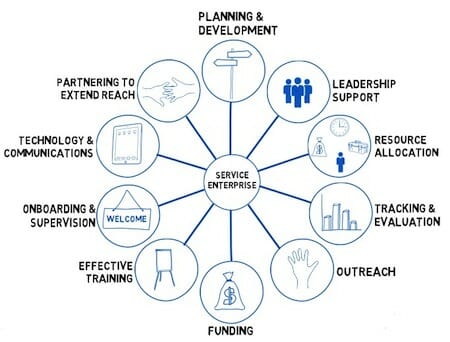
They have found that 10 characteristics distinguish organizations that are engaging volunteers well. (See graphic above.) What’s more – organizations with 50 or more volunteers that demonstrate these characteristics outperform their peers who do not engage volunteers.
Service Enterprises address each of these functions:
Planning and development – strategies and infrastructure for mission-driven volunteer engagement. Service Enterprises are thoughtful and intentional about where volunteers are best suited to contribute to the cause.
Leadership support – executive commitment to volunteer engagement. The board and executive director (or equivalent) of Service Enterprises value the importance of volunteers.
Effective training – volunteer and staff training. Volunteers and paid staff at Service Enterprises are equipped to successfully work with each other.
Outreach – Service Enterprises conduct volunteer recruitment for programmatic and operational roles.
Onboarding and supervision – process to bring volunteers into their roles. Service Enterprises match volunteers to appropriate positions, clarify their roles and orient and support them throughout their service tenure.
Partnering – mutually beneficial relationships with service groups, funders and other stakeholders. Service Enterprises increase engagement and reach through community partnerships.
Technology and communication – Serivce Enterprises leverage technology for connecting with and supporting volunteers.
Tracking and evaluation – outputs and outcomes of volunteer service. Service Enterprises assess the quality and contributions of the volunteer experience and how it can be improved.
Funding – Service Enterprises fundraise for volunteer engagement.
Resource allocation – Service Enterprises allocate sufficient resources (time, money, people, tools) to volunteer engagement.
While there are similarities between basic volunteer management training and Service Enterprise practices, there is an important difference, too.
The Service Enterprise practices require commitment from the entire organization rather than the volunteer manager exclusively. The characteristics include organization leadership and infrastructure support as ingredients for success. In essence, Service Enterprises have an organizational cultures and support systems that fundamentally leverage volunteer time and skills.
These features help explain why volunteer management training is necessary, but not sufficient. Volunteer management training often provides the tools for working with volunteers. However, it typically doesn’t address the organizational factors that support the widespread adoption of these tools.
Organizations wanting to utilize this broader approach in developing their volunteer engagement will find the Service Enterprise characteristics are a useful road map.
For those wondering where to start, the researchers recommend focusing on leadership support, planning and development, or effective training. These characteristics are especially important practices for success and help lay a strong foundation for operating as a Service Enterprise.
From managing volunteers to making your organization more hospitable, these key resources will give you effective strategies for addressing challenges that face nonprofits today. For more resources, check out the searchable resource library managed by Points of Light’s HandsOn Network.
Managing Volunteers
For many nonprofit organizations, volunteer help is vital. However, recruiting and engaging volunteers in an organized way can be tough. This HandsOn Volunteer Management Guidebook can help.
The guide outlines various strategies for organizing a strong volunteer structure, from recruiting and scheduling volunteers to retaining and recognizing their efforts. Paired with questions to consider and activities to help map out goals, the Volunteer Management Guidebook provides resources you can adapt to meet your local program needs.
Calculating Economic Impact of Volunteers
There are many ways to recognize the value of volunteer work. For nonprofits, this often means calculating the monetary worth of volunteer duties, which varies. To make it easier, Points of Light has created the Economic Impact of Volunteers Calculator.
By providing a complete list of volunteer jobs, the calculator can help give your nonprofit a better idea of your volunteers’ economic impact. The calculator lists standard hourly rates and hourly benefits of specific positions. After you input the number of hours, the calculator does the rest of the work.
Nurturing Volunteer Leaders
A solid corps of volunteer leaders can make a big difference in helping your nonprofit achieve its mission. HandsOn Network’s Volunteers as Leaders guidebook is designed to help your organization establish the processes needed to develop a strong volunteer leader program.
This guide outlines various stages of program evolution, from development to volunteer leader recruitment, training and support. Equipped with user-friendly questions, tools for brainstorming and suggestions, Volunteers as Leaders provides pointers and resources you can adjust to meet the needs of your nonprofit.
Assessing Volunteer Leaders
Volunteer and staff feedback on organizational management is your nonprofit’s key to growth and success. The Organizational Assessment for Volunteer Leaders, created by Points of Light, provides a thorough questionnaire to help extract important responses about how your project is running, from a volunteer perspective.
This resource includes activities that help staff or the volunteer coordinator assess organization readiness, recruitment, retention and recognition.
Making Hospitality Part of Your Organization’s Culture
Hospitality is crucial in any company culture, and the same is true for nonprofit organizations. Created by Hilton Worldwide, Points of Light and Taproot Foundation, the Hospitality + Service curriculum is designed to help you serve your clients better by improving communication and connections with clients, creating warm and welcoming environments and effectively managing challenging situations.
Hospitality + Service’s leadership toolkit, Hospitality by Design, shows how to build hospitality into your organizational culture from the ground up, deliver more to your clients, strengthen your team and build your reputation and impact in the community.
Where Should Nonprofits Use Volunteers? Everywhere.
This post is by Tricia Thompson, vice president of training and consulting at Points of Light.
For every dollar nonprofits invest in effective volunteer engagement, they can expect up to $6 in return – a six-fold return on investment. Organizations that effectively engage volunteers are more adaptable, sustainable and capable of expanding. And they operate at almost half the median budget as nonprofits that don’t make full use of what volunteers have to offer.
Nonprofits that use their volunteers effectively are more efficient and nimble.
Points of Light calls these effective nonprofits “service enterprises” – organizations that leverage volunteers across all leadership levels, in all departments, to address community needs. Research tells us fewer than 15 percent of nonprofits nationwide operate as service enterprises.
Want to become one of them?
To help more nonprofits become service enterprises, Points of Light, in collaboration with CaliforniaVolunteers, is launching the Service Enterprise Initiative in select locations in 11 states (California, Georgia, Illinois, Indiana, Iowa, Maine, Massachusetts, Michigan, Minnesota, Virginia and Wisconsin). Through a comprehensive, research-backed assessment, training, consulting and certification model, nonprofits are equipped to better engage volunteers.
Rosario Di Prima, programs vice president at Catholic Big Brothers Big Sisters in Los Angeles County, Calif., said the program made staff at her organization realize the different and powerful ways to incorporate volunteers.
As a result of the Service Enterprise program, Catholic Big Brothers Big Sisters has increased its network of junior partners (a diverse group of skills-based volunteers, primarily young professionals) by about 20 percent, and plans to continue expanding the network.
Now, Di Prima said, “volunteers are throughout the organization.”
Since 2012, seven California volunteer centers piloted this model and have worked with more than 60 organizations. By June 2014 Points of Light will have worked with 12 other leading nonprofits to transform more than 180 nonprofit organizations into certified service enterprises.
Thanks to the leadership of CaliforniaVolunteers and the Corporation for National and Community Service for their investment and support, and thanks to TCC Group, Deloitte and University of Texas Austin for investing in the research, building the assessment tools and providing the data and analysis that built the foundation for this endeavor.
Points of Light and CaliforniaVolunteers are working with the organizations below to expand this work. If your nonprofit is in the same area as one of those linked below, you may contact the relevant organization directly to express interest in participating in the Service Enterprise Initiative. Otherwise, to learn more about the program, please email me, Tricia Thompson, at [email protected].