From managing volunteers to making your organization more hospitable, these key resources will give you effective strategies for addressing challenges that face nonprofits today. For more resources, check out the searchable resource library managed by Points of Light’s HandsOn Network.
Managing Volunteers
For many nonprofit organizations, volunteer help is vital. However, recruiting and engaging volunteers in an organized way can be tough. This HandsOn Volunteer Management Guidebook can help.
The guide outlines various strategies for organizing a strong volunteer structure, from recruiting and scheduling volunteers to retaining and recognizing their efforts. Paired with questions to consider and activities to help map out goals, the Volunteer Management Guidebook provides resources you can adapt to meet your local program needs.
Calculating Economic Impact of Volunteers
There are many ways to recognize the value of volunteer work. For nonprofits, this often means calculating the monetary worth of volunteer duties, which varies. To make it easier, Points of Light has created the Economic Impact of Volunteers Calculator.
By providing a complete list of volunteer jobs, the calculator can help give your nonprofit a better idea of your volunteers’ economic impact. The calculator lists standard hourly rates and hourly benefits of specific positions. After you input the number of hours, the calculator does the rest of the work.
Nurturing Volunteer Leaders
A solid corps of volunteer leaders can make a big difference in helping your nonprofit achieve its mission. HandsOn Network’s Volunteers as Leaders guidebook is designed to help your organization establish the processes needed to develop a strong volunteer leader program.
This guide outlines various stages of program evolution, from development to volunteer leader recruitment, training and support. Equipped with user-friendly questions, tools for brainstorming and suggestions, Volunteers as Leaders provides pointers and resources you can adjust to meet the needs of your nonprofit.
Assessing Volunteer Leaders
Volunteer and staff feedback on organizational management is your nonprofit’s key to growth and success. The Organizational Assessment for Volunteer Leaders, created by Points of Light, provides a thorough questionnaire to help extract important responses about how your project is running, from a volunteer perspective.
This resource includes activities that help staff or the volunteer coordinator assess organization readiness, recruitment, retention and recognition.
Making Hospitality Part of Your Organization’s Culture
Hospitality is crucial in any company culture, and the same is true for nonprofit organizations. Created by Hilton Worldwide, Points of Light and Taproot Foundation, the Hospitality + Service curriculum is designed to help you serve your clients better by improving communication and connections with clients, creating warm and welcoming environments and effectively managing challenging situations.
Hospitality + Service’s leadership toolkit, Hospitality by Design, shows how to build hospitality into your organizational culture from the ground up, deliver more to your clients, strengthen your team and build your reputation and impact in the community.
When it Sounds Like a Baseball Team Is Pitching Balls Against Your House, Will You Be Ready?
Read about how folks in Milwaukee are preparing for disaster. To help your family take action, visit Good & Ready, where you’ll learn how to create various disaster plans, build a preparedness kit and more.
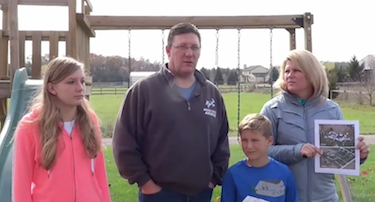
Julie Brown of Eagle, Wis., could barely see as she drove home one June evening four years ago – hail and rain pounded on her car relentlessly. She tried to phone her husband, Jason, who was home with their two children, Jillian and Joseph, ages 8 and 4 at the time.
The Brown family of Milwaukee share their story about surviving a tornado. (Click photo to play video.)
But Jason Brown and the kids were huddled underneath a basement staircase, bracing for a tornado.
Above them, the house shook. Jason recalls feeling air pressure so strong, “It felt as if the top of my head was going to explode.” In addition to a deafening roar, the father and children heard what sounded “like an entire baseball team pitching balls against the house.”
Minutes later, the noise stopped. When Jason ventured upstairs, he found the inside walls of the home plastered with garden mulch and mud, blown inside through windows that now bowed outward. The garage door was gone, as was the kids’ heavy, wooden backyard climbing gym and slide.
Meanwhile, Julie had to abandon her car, as all roads leading to her subdivision were blocked with fallen trees and power lines. Julie had no flashlight, no rain gear and no sturdy shoes or boots for wading through deep water or climbing over limbs.
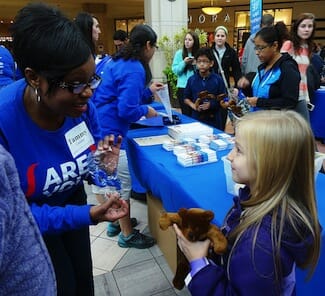
Volunteer Tammy Lockhart helps Delilah Haggerty fill her family’s emergency kit at Mayfair Mall.
Hundreds of shoppers who lined up Oct. 18 at Mayfair Mall in suburban Milwaukee to assemble starter emergency kits admitted they also would be unprepared for a sudden disaster, even though Wisconsin gets hit by deadly tornadoes each summer and howling blizzards each winter.
“Thank you, because I just never even think about it,” said Merline Levers of Milwaukee, who uses an electric scooter for mobility, after receiving her emergency kit.
The Allstate Foundation teamed up with Points of Light in Milwaukee to raise awareness about preparing for disasters as the final stop on a 14-city nationwide tour that began in May. Similar events were held in Los Angeles, Houston, Salt Lake City, Colorado Springs, New York, Indianapolis and other cities.
As the tour wrapped up, more than 10,000 emergency kits had been distributed nationwide. In Milwaukee, event participants and volunteers put together 500 kits in a little over two hours.
Volunteers from local Allstate agencies, The Allstate Foundation and Allstate’s national catastrophe team teamed up with local volunteers from the American Red Cross and the Nonprofit Center of Milwaukee – part of Points of Light’s HandsOn Network – to explain the purpose of each item in the kit, from hand-cranked flashlights to rain ponchos to dust masks to loud whistles for attracting the attention of rescue workers.
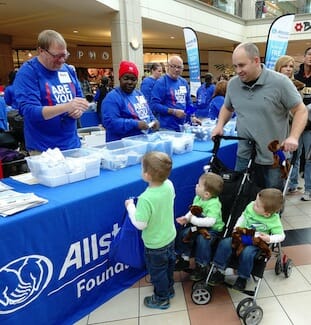
Ryan Bagley and his sons Jack, 4, and twins Luke and Max, 2, put together an emergency kit.
For the Wisconsin event, waterproof mylar “blankets,” designed to retain 90 percent of a person’s body heat, and lists of winter safety tips were added to the kits.
Bilingual agent Alex Ferreira of Milwaukee explained the kits and conducted surveys in Spanish when needed. Yong Yang, an agent in Brookfield, Wis., who helped distribute emergency kits, said many people appreciated the opportunity to learn how to prepare.
Andre Walls of Milwaukee, one of the attendees, said he once shivered for nearly an hour awaiting help after one of his tires went flat on a bitter winter night. Walls said that from now on he plans to stock his vehicle with a blanket, flashlight and battery jumper cables.
Event participants with young children seemed especially interested in getting prepared.
“Usually, you figure, `I’ll be OK,’ but now that I have other people to care for, I’m making sure they’re OK and they’re all set,” said Jessica Olbrot, who attended the event with her husband, Kris, and toddler, Olivia.
Ryan Bagley – who turned heads as he expertly managed a double stroller shuttling identical twin sons Luke and Max, 2, while his 4-year-old son, Jack, held his hand – vowed to create a home emergency kit that would contain safety essentials as well as toys to keep the boys occupied and calm in the event of a disaster.
Children at the event were given small teddy bears – just as they are during real disasters by the Allstate “Cat” team, which often finds families bereft of all possessions, including their children’s stuffed toys.
“They’re devastated and they don’t have anything,” said Mark Smith of Traverse City, Mich., who works with Allstate’s flood disaster team based in Mobile, Ala.
Tanya Joeng of Allstate Foundation’s Northbrook, Ill., office, said it’s been gratifying to help prepare the public for emergencies. “People really listen,” she said. “They really take in the information, which I think it is really great.”
Would Your Organization Know What to Do With an Influx of Volunteers?
Amy Chapman is responsible for supporting 12,000 Capital One employees in volunteering, but she faced a problem. Though she had thousands of potential volunteers ready to use their skills for good in their communities, nonprofits weren’t necessarily able to receive them.
Amy Chapman of Capital One
“We are passionate about pro bono work, but we know that it requires capacity,” said Chapman, Capital One’s community affairs manager for central Virginia. “Organizations need to be ready to receive that kind of support.”
The volume of meaningful volunteer projects Capital One needed led Chapman to a conversation with HandsOn Greater Richmond, a local affiliate of Points of Light’s HandsOn Network that supports effective volunteer engagement. Both the company and the nonprofit had a commitment to engaging volunteers in better ways and to working across sectors to make that vision possible.
So they crafted a partnership around the Service Enterprise Initiative that enabled each sector to play to its strengths. The Service Enterprise Initiative is a comprehensive training and coaching model that strengthens nonprofits by helping them better leverage volunteers strategically throughout the organization.
Capital One provided the financial support and invited a select group of its grantees to participate. HandsOn Greater Richmond delivered the training, coaching and technical assistance.
“We saw the Service Enterprise Initiative as a way to help organizations build capacity,” Chapman said.
HandsOn Greater Richmond Director Vanessa Diamond appreciated Capital One’s thoughtful approach: “They wanted to understand how a large-scale company could engage its volunteers responsibly and in helpful ways that were not overwhelming to nonprofits.”
Chapman added, “The Service Enterprise Initiative gives nonprofits tools for transforming their approach to service. It is a way for them to think differently about how they leverage volunteers. It helps them talk differently about the value of time and resources invested into volunteerism. It’s not a ‘nice to have’, it is fundamentally a part of their organizations and how they measure success.”
Chapman credits a comprehensive and collaborative approach to volunteer capacity to the Service Enterprise Initiative’s local success. It also helped that Capital One determined in advance what level of commitment, involvement and investment it wanted to have, a strategy Chapman would recommend to other funders interested in this work.
“We knew that financial capacity and volunteer expertise were important to making an impact in our community,” Chapman said. “We funded a two-day volunteer management training to enhance participants’ skills in the basics. We also gave grants so that organizations could invest in the areas of need they identified in their action plans.”
The strategy is working in Richmond and shows great potential for other communities. Chapman encourages organizations seeking support for volunteer engagement to make a business case for it.
“It’s not only about hearts and hands, you need to have data to show how volunteer work will impact the community and the organization,” Chapman said. “Do your homework to understand a company’s strategy for volunteerism and show how your work aligns with that.”
Diamond agreed. “Approach funders as partners and ask for ideas and input, not just dollars. It helps that this is a national model that is bigger than any one partner. It was an asset for our region. It felt like we were all part of the same team.”
Chapman is pleased with the results. “One of our participants summed it up best. They thought the Service Enterprise process would transform volunteerism at the organization. They discovered that it would transform the organization through volunteerism.”
For more information about the Service Enterprise Initiative, visit the program’s website.
In the last couple of years and since the financial crisis in Greece started, we have seen Greek civil society expanding. New nongovernmental organizations have sprung out, the majority fighting poverty and social inequality.
Support became accessible through state or private funds. At the same time, the needs in human resources naturally increased, yet Greece has never had the strongest volunteering culture.
As a Greek living in Greece, I have always identified this as an area of development. The building of strong bridges between civil society and citizens is necessary, especially during times of financial difficulty. This is what brought me to Volunteer4Greece in March 2013 when I joined the team as a volunteer, handling public relations and communications.
For those not already familiar, Volunteer4Greece serves as a platform promoting volunteer opportunities in Greece, with the goal of connecting volunteers with nonprofits looking for people to support their activities.
So far, in my role, I have promoted announcements of volunteering opportunities through our communication channels and made sure that our activities and mission are reaching a wide audience.
We have organized capacity-building workshops and seminars addressed to nongovernmental organizations that wish to develop their performance in areas such as resource management. Examples of training sessions include how to use digital tools, draft funding proposals and manage social media.
By engaging in these workshops, I had the opportunity to meet representatives of Greek nonprofits – extraordinary people, inspired visionaries, determined to fight for their cause and deliver results to the collective benefit.
Volunteer4Greece currently hosts 100-plus nonprofits from all over the country and since it kicked off, it has covered more than 350 volunteer positions, while I have seen more than 11,500 applications go through its platform. A collective effort with a promising future.
It feels great to be part of HandsOn Network, whose fundamental values we fully endorse and seek to further develop in the Greek context. Through our membership we aspire to make clear connections between Greek and international civil society, explore opportunities for synergies, provide effective support to Greek nonprofits and of course motivate Greek citizens to further engage in volunteerism.
It’s impossible to forget the moment when I realized finding myself was less about finding a career, and actually about discovering my purpose. For me, that moment was on Sept. 11, 2001 when I saw my friend brutally murdered as her plane slammed into the World Trade Center.
I was angry, confused, and sad. I had questions. How was this possible? What could I do? I was looking for a way to respond to this tragedy that rattled our nation and our world. So, faced with apathy, I took action.
Until Sept. 11, I wasn’t concerned with these matters. I was focused on building my career. Growing up, I was one of only a few immigrants in the small town of Stoneham, Massachusetts. My family was from Hong Kong. I was encouraged to focus on how to do well in school and achieve career success.
I often suppressed the culture of my home country because I thought I needed to do so to fit in and to be successful. I felt a high level of responsibility to support my family by finding a decent-paying job. But as the planes crashed into the towers, they also crashed into my life plans.
At a time of sadness and shock, my service with AmeriCorps taught me how to fight for a better world. Rather than turning away, through AmeriCorps, we chose to tackle tough community challenges head on. I facilitated a citywide dialogue to reverse declining rates of civic engagement.
I learned about program design and the importance of building in measurement tools to assess progress toward your goal. I learned how to build relationships with communities and find the seemingly-elusive leverage points that catalyze change.
Through AmeriCorps, I also realized I wanted to spend my life working to help individuals overcome societal barriers as I had done – and launched a career in global philanthropy. My career trajectory was no longer about the bottom line or what I was “supposed to do.” I learned that a life of service isn’t contradictory to success.
Now, working in corporate social responsibility initiatives at international corporations like Charles Schwab and eBay, I manage strategic partnerships, charitable giving programs, and engage employees in volunteering. I know in no uncertain terms I would not have these roles, nor be as well-equipped to perform them, were it not for my service with AmeriCorps.
This week, which marks the 13th anniversary of when the towers fell, also marks the 20th anniversary of AmeriCorps. It’s a time of grief and remembrance, but it’s also a time of celebration. This week, the President is leading a nationwide saying of the AmeriCorps pledge on the anniversary of the first class of AmeriCorps.
This pledge will help kick-off the service year for tens of thousands of new AmeriCorps members across the country, as well as encourage the nearly one million alumni of AmeriCorps to recommit to this pledge. On this day and all days, I hope we remember the lives lost on 9/11 and the lives changed.
After 9/11, I could have walked away unchanged. Rather, I learned that through service all things are possible. As the AmeriCorps pledge says, “Faced with apathy, I will take action. Faced with adversity, I will persevere.”
This post is part of a series produced by The Huffington Post and The Franklin Project at the Aspen Institute, in conjunction with both 9/11 (designated a national day of service & remembrance) and the 20th anniversary of AmeriCorps (9/12). The Franklin Project envisions a future in which a year of full-time national service — a service year — is a cultural expectation, a common opportunity, and a civic rite of passage for every young American. The Franklin Project is chaired by General Stanley McChrystal. To learn more about The Franklin Project, watch this video.
Could You Put Your Skills to Good Use Like This Volunteer?
When Rose Joseph began volunteering at Loaves and Fishes Food Pantry in Devens, Mass., about five years ago, she started as a food distributor helping clients shop for food in the pantry. It was a great way to help, but she found that she could do more good by putting her professional skills to use.
Her background in data analysis led her to getting involved with helping the pantry director and client advocate with their reporting needs, compiling survey results and other such tasks. Now Joseph is responsible for upgrading the pantry’s databases and day-to-day operating software.
She has also written software that enables the pantry to run more efficiently, which helps improve the experience for both the clients and volunteers.
“Economic conditions in recent years have greatly increased the number of clients needing the food pantry to make ends meet,” Joseph says. “I compute pantry usage statistics that help us better serve our clients and create reports used for obtaining funding.”
Joseph began volunteering at age 14, when she worked as a hospital candy striper. She continued her volunteer work wherever she lived.
“Being of service to others is an expression of my faith, and I have been drawn especially to efforts that battle hunger,” Joseph explains.
While in college, she was part of a group that aimed to increase awareness of hunger in the Boston area. Also while in Boston, she volunteered at the Greater Boston Food Bank and helped with the sorting and packaging of donated food. When living in Chicago she worked at a homeless shelter and soup kitchen, and in New York she did grocery shopping for homebound seniors.
Joseph, a mother of three, says it was harder to volunteer when her children were little, but when her youngest child started kindergarten she began helping out at Loaves and Fishes. Her children will sometimes assist her with data entry and they have participated in food and bottle collections in support of Loaves and Fishes.
“We like being part of an organization that helps people in such a direct and fundamental way,” Joseph says.
What is Joseph’s advice for others who may be interested in volunteering? “Just dive in and give it a try. It may take a little while but eventually you will find something that is a good fit for your talents.”
Thirteen for Thirteen: Reflections on Hands On Manila’s 13th Birthday
This post is by Ami Valdemoro, executive director of Hands On Manila. To find a HandsOn Network affiliate near you, visit www.handsonnetwork.org.
Ami Valdemoro
I joined the Hands On Manila family in April, fresh from a two-year sabbatical in graduate school and full of ideas for how make a meaningful impact in the Philippines, where my family is originally from. I quickly learned just how powerful a small handful of individuals can be when they set their minds and hearts to do good.
People have thought of the Philippines often over the past year, with the devastation wrought by Typhoon Haiyan last November. While the efforts of people from around the world to help the affected communities recover are well-documented, there are many more stories of service and daily acts of kindness, that occur below the radar.
Stories of everyday heroes who work tirelessly to help those in need. Stories of people who – even with limited free time – choose to be a point of light. It is these stories that make Hands On Manila who we are and that give us the energy and spirit to continue to be of service.
In honor of our 13th birthday this month, and the thousands of individuals who have shaped us and helped us grow, here is my list of 13 ways that Hands On Manila works to make our community a better place:
Cultivating curious young minds by mentoring high-achieving middle school students in public schools through our Hands On Schools – Galing Mo Kid! Program
Engaging young professionals in volunteer service to rebuild and prepare classrooms for the school year
Spending quality time and giving care to the elderly at a beautiful shelter in the hills of Tanay, Rizal
Teaching young people who have suffered tremendous hardship or abuse skills to help them get on their feet and make a livelihood for themselves and their families
Beautifying public spaces like the Freedom Islands through urban gardening and coastal cleanups
Developing volunteer leaders through our Sherpa program, named after the guides who patiently and diligently guide trekkers up Mount Everest in the Himalayas
Encouraging individuals with one or two hours of time to volunteer with any of our more than 30 nonprofit partners through our Volunteer Passport program
Reading to street children in a weekly Read-Along hosted with our friends at the Philippine Daily Inquirer, a widely circulated daily newspaper
Bringing the arts to children through mural painting in school classrooms and art classes in children’s shelters
Inspiring people to give back even when they are on vacation through our Hands On Volunteer Vacations in Boracay, Mindoro, and other popular holiday destinations
Creating personalized service opportunities for corporate partners who are new to social responsibility or volunteering throughout the year
Bringing together thousands of volunteers in an annual day of service that we like to call Servathon (Our next one is coming up on September 27 – stay tuned. #homservathon2014.)
Sharing our successes, and our challenges, with our friends at other HandsOn Network affiliates in the U.S. and around the world to inspire us to do good better
For more information on Hands On Manila, visit www.handsonmanila.org. To find a HandsOn Network affiliate near you, visit www.handsonnetwork.org.
Volunteers Go for the Win at Turner Field
Against the backdrop of America’s national pastime, hundreds of volunteers came together to recognize a national treasure: teachers.
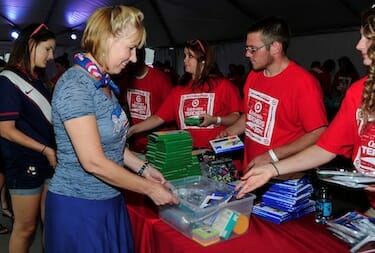
Volunteers help game-goers at Turner Field assemble containers of school supplies for Atlanta teachers.
Before an Atlanta Braves-Philadelphia Phillies baseball game at Turner Field, more than 300 volunteers and game-goers packed 5,000 kits full of school supplies for local teachers. Target team member volunteers stacked tables high with supplies and volunteers visiting Atlanta for Points of Light’s Conference on Volunteering and Service filled plastic bins with water bottles, sticky notes, disinfectant wipes, pens, pencils and more – items teachers too often have to buy with their own money.
The June 16 event was part of Target’s All-Star Teachers program, in partnership with Major League Baseball, designed to engage Target guests and MLB fans in celebrating the nation’s teachers, and Target’s involvement in Points of Light’s Conference on Volunteering and Service as its Official Excellence in Education sponsor. (See below for the July 31 presentation ceremony.)
Target supplied the products, funding, infrastructure and dozens of team member volunteers. Hands On Atlanta – part of Points of Light’s HandsOn Network of 250 volunteer centers – coordinated the service project to distribute the kits to dozens of Atlanta public schools.
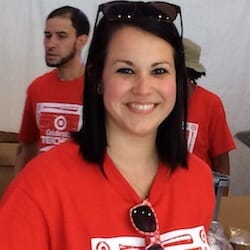
Target team member Jessica Johnson
Across the United States, public school teachers during the 2012-2013 school year spent $1.6 billion of their own money on school supplies and instructional materials, according to the National School Supply and Equipment Association. That’s an average of $500 per teacher.
In addition to assembling kits for the classroom, volunteers at the Turner Field event could vote for their favorite All-Star Teacher at an on-site kiosk and, by way of a photo booth, share photos of themselves via social media. Future MLB Hall-of-Famer and former Atlanta Braves pitcher John Smoltz came by for a few photos and to encourage the volunteers.
Jessica Johnson, who has worked at the Target store in Douglasville, Ga., for the past two years, says she appreciates the service opportunities Target provides its team members.
“It makes you feel good to work for a company that cares about things beyond just money, that cares about the community and the people who live there,” she said, as she reached for more supplies to stock the line. “That comes across in opportunities to go out and do things like this.”
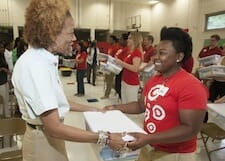
Target volunteers hand out school supplies assembled at the Turner Field service project to Atlanta teachers.
“The Turner Field event, part of the Conference on Volunteering and Service’s opening day, reflects our core values at Target,” said Reba Dominski, senior director of community relations. “Through raising awareness for teachers and celebrating the impact they have on our children, we are also able to demonstrate our longstanding commitment to service.”
“At Target, we believe every child deserves a quality education, regardless of race or socioeconomic status,” said Dominski. “Through our partnership with Points of Light, we’re able to invest in communities by offering programs that help provide the tools and resources educators need to help students succeed.”
Target team members volunteered alongside attendees of the Conference on Volunteering and Service, like Allan Collins. He embraced the chance to participate in a hands-on volunteer experience as part of the Conference, which brought together thousands of leaders from the nonprofit, corporate and civic sectors to celebrate and shape the future of volunteerism.
“Learning about the programmatic side of volunteer engagement is vital,” said Collins, director of HandsOn Inland Empire, a volunteer mobilization organization in Rancho Cucamonga, Calif. But Collins said that engaging in a tangible expression of volunteerism is “a powerful way to bring it all together.”
On July 31, representatives from Hands On Atlanta and Target presented the kits to Atlanta Public Schools teachers and Superintendent Meria Carstarphen at West Manor Elementary School. Target volunteers then helped teachers prepare their classrooms for open house the following evening and the first day of school, Aug. 4.
“Thanks to the generosity of Target, and literally, the hands of Hands On Atlanta, the 3,000 teachers of Atlanta Public Schools were given additional tools to actively engage and instill hope in our students this year,” Carstarphen said. “Target represents the important role of corporate partners in supporting student achievement by connecting the needs of our students and schools with the financial resources and goodwill of the community.”
17 Tornadoes and a House Fire Would Get You Thinking About Getting Prepared, Too
Read about how folks in Maine and Texas are preparing for disaster. To help your family take action, visit Good & Ready, where you’ll learn how to create a disaster plan, build a preparedness kit and more.
Audrey Castro
As a child, Audrey Castro survived tornadoes and a house fire, shaping how she and her family prepare for emergency.
“With my husband and kids, we’ve always had an escape plan,” said Castro, 53, who lives in Cape Elizabeth, Maine, a suburb of Portland, with her husband and children, ages 18 and 21. “When they were little, our kids knew what to do if they heard a smoke alarm go off. We bought ladders to hang from their bedroom windows to be able to get out, and they knew to head to a neighbor’s yard to a particular tree. We made them take a first-aid class.”
Nearly 60 people died on April 21, 1967, when 17 tornadoes hit northern Illinois in one day. With the sky darkening and alarms sounding, Castro – 6 at the time – and her family rushed to their basement safe room to cover themselves with mattresses. Five years later, while living in Portland, a middle-of-the-night fire caused by a cigarette ember in a trash can forced Castro’s family out of the house, fleeing heavy smoke. In both cases, they survived, unharmed.
Today, Castro’s family takes no chances: “Everyone in our house has a flashlight on their nightstand, and they’re in the bathrooms. We have gallon jugs of water in the garage, along with snacks. It’s the same thing with our cars. We have our valuable belongings videotaped. It’s just better safe than sorry … because you just never know what’s going to happen.”
Carlos Libby of West Gardiner, Maine, at the Portland disaster preparedness event, explains why he feels preparing for disaster is critical. (Click photo for video.)
That was the message relayed at recent disaster preparedness events in Houston and Portland, Maine. The
and Points of Light have teamed up for a 14-city tour to help people around the country become better prepared for emergencies.
People attending these events – with the help of volunteers from Allstate and affiliates of Points of Light’s
– assembled starter disaster preparedness kits. Participants received blue bags to fill with kit items and attentively listened as they made their way down a line, as each volunteer explained an item to add to their kits.
The donated kits included items such as a whistle, a flashlight that doesn’t require batteries, a mini first-aid kit, a poncho, a mask to wear if debris is in the air, a water receptacle, a trash bag, hand sanitizer – and brochures and handouts that provide a variety of emergency information.
“The event today is just to remind people that disasters occur,” said Adam Pisani, an Allstate agent in Sugar Land, Texas, who volunteered at the July 26 tour stop at the
. “They occur when we least expect them. And so being prepared is very important,” Pisani said.
A participant at the Houston disaster preparedness event gets help filling his disaster kit from a volunteer.
At the July 29 Portland event, held at a Sea Dogs minor league baseball game, Allstate spokesperson Julia Reusch noted that only about 15 percent of Americans would be considered prepared for a disaster, and these educational events aim to change that.
The goal is to teach people how to “build a kit that will help them be prepared and have enough to sustain them for 72 hours in the event of an emergency,” Reusch said.
Event participants said they appreciated the opportunity to learn about, think about and prepare for disaster.
Kristen Lue King, who put a kit together with her 9-year-old daughter at the Houston event, said the exercise was a great lesson for her child: “This helps show her that while there’s a reason for concern, there are some practical things you can do.”
Look How These Volunteers Show Compassion for Young People in Their Community
Today we recognize three volunteers we learned about through the United Way of King County in Seattle, part of Points of Light’s HandsOn Network – 250 volunteer centers across the globe. To find a center near you, visit the HandsOn Network map.
Fighting Childhood Hunger
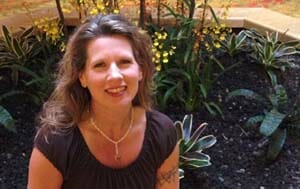
McKenna Knight
McKenna Knight is a driving force behind the Healthy HIP Packs Program, a project of Hunger Intervention Program, at John Rogers Elementary in Seattle. The Healthy HIP Packs Program gets nutritious and kid-friendly food into the hands and mouths that need it most. Each Friday at several schools in north Seattle, backpacks are discretely filled with six meals and two snacks for 40 children per school who are at risk of hunger. So over the weekend, when school meals are not provided, the children are still able to eat well.
The collection, sorting, distribution and packing for this program takes a lot of volunteer support, and at John Rogers Elementary, this couldn’t be done without Knight’s coordination. Plus she supports the program by networking, helping to raise funds and garnering community support. She is the kind of volunteer who generates great ideas and is willing to do the work herself.
Getting School Supplies for Kids in Need
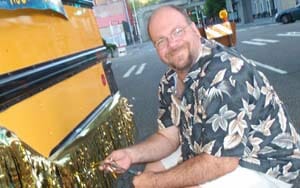
Jerry Johnson
How much do you think a family spends per child on school supplies? On average it’s between $60 and $100 each fall – and many families have more than one child in school. Not to mention the fact that teachers spend an average of $400 of their own money to cover classroom supplies.
Communities in Schools of Seattle organizes an annual Stuff the Bus campaign during the summer to help low-income families manage these costs and ensure that students are able to start the year with sufficient supplies.
For the past five years, Jerry Johnson has played an integral part in Stuff the Bus, which collects more than 50,000 school supplies for Seattle Public Schools students in need. As a volunteer, he drives the bus across Seattle to pick up supplies from collection sites collection events. His energy and enthusiasm pump up the entire team.
Showing You Can Give Back at Any Age
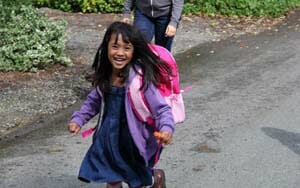
Eden Heu-Weller
Eden Heu-Weller volunteered at Friends of Youth’s administrative offices for the first time at age 5, on a Wednesday in January 2013. She arrived with her nanny. Eden spent her first day counting name tags for Friends of Youth’s annual Celebration of Youth luncheon, and she and her nanny have returned to volunteer every other Wednesday since.
Friends of Youth’s youngest volunteer, Eden has labeled and sorted volunteer packets, made thank-you cards, stocked food, organized toiletry bags and greeted attendees at a ribbon cutting. She is now 6, and she recently finished helping Friends of Youth prepare for another Celebration of Youth luncheon, counting and sorting name tags and helping stuff packets.