Let’s Disconnect to Connect this Holiday Season and Teach Kids the Value of Caring
This post is by parenting expert Dr. Michele Borba and Daniel Horgan, executive director of generationOn, Points of Light’s youth and family division.
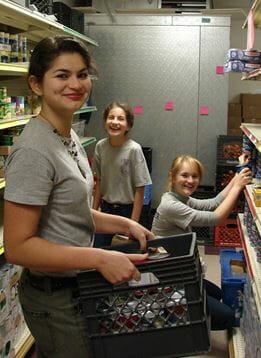
The Miscoe family of Texas help at a food pantry.
While parents are consumed with their iPads and phones, their children are modeling their actions by being engrossed in games or listening to their music on their own handheld devices.
When asked about their parents’ chatting, clicking and texting during a recent “Dateline” report, kids complained about feeling like they didn’t matter as much. Families may be physically together these days, but they are often disconnected from each other and the community around them.
The holiday season is a perfect time to disconnect from the distractions around us and connect with our families through service to others. That’s why I am partnering with generationOn, the youth and family division of Points of Light, and Disney Friends For Change to invite thousands of families around the country to serve on National Family Volunteer Day on November 22.
There are many ways to take part – from creating baskets of cheer for the elderly to providing Thanksgiving meals to those in need to making cards for children in the hospital.
Volunteer and then share your service story for a chance to win one of several exciting generationOn prize packages and be featured in FamilyFun magazine. You can learn more, explore project ideas, and search for local volunteer opportunities at www.generationOn.org/fvd.
Most parents instinctively want their children to develop a strong moral character and to care about others. Volunteering is a powerful way to teach kids valuable real life lessons about empathy and caring.
Caring is the trait that helps sensitize our children to different points of view and it increases their awareness of other’s ideas and opinions. It also enhances empathy, which is the foundation of moral behavior. Kids who care will grow into adults who have the skills they need to live successfully in our diverse, multicultural, 21st century world.
Here are five tips to raising caring kids…
1.Be the change you want to see.
You know what makes kind and considerate kids? Kind and considerate parents! The simplest and most powerful way kids learn behaviors like kindness and consideration is by seeing them in action.
In fact, parents are one of the biggest influences on whether their kids volunteer. Parents can lead by example, talk about important social issues and urge their children to donate their time and money to causes important to them.
2. Prioritize regular, meaningful time with your kids.
Plan regular, emotionally intimate time with your children. Some parents do this through nightly bedtime reading or building one-on-one time with their children into their weekly schedules rather than leaving it to chance.
When together, take turns asking each other questions that bring out your thoughts, feelings and experiences such as what was the best or worst part of your day and what did you accomplish today that you feel good about.
3. Make caring for others a priority.
Consider the daily messages you send your children about the importance of caring. For example, you might say, “The most important thing is that you’re kind and that you’re happy.”
When your kids run into conflicts with other kids, encourage them to work out problems by considering the others’ feelings. Ask your kids’ teachers and coaches about how they are demonstrating empathy for others in addition to their academic skills, grades or performance.
4. Nurture an attitude of gratitude.
Consider making expressing gratitude a daily ritual at dinnertime, bedtime, in the car or on the subway. Encourage children to express appreciation for family members, teachers, friends or others who contribute to their lives.
Have your kids keep a gratitude journal where they log the things that they appreciate each day. Give your kids opportunities each day or week to practice caring at home, at school or in extracurricular activities.
5. Get your kids to give back.
Children learn habits at an early age, and the best way to teach them behavioral life skills is to get them involved in a hands-on way by doing caring deeds. Help your child chose a charity or cause that he/she is interested in and then get them involved.
Explore the cause further by reading a children’s book about the issue, meeting with an organization to learn more about their work in addressing the issue, or brainstorming a family volunteer project to do together.
Be sure that you are intentional in your quest to raising a caring child, and check out www.generationOn.org/fvd for more resources and ideas to connect this holiday season!
When You Feel Compelled to Address Community Challenges, Leadership Skills Come in Handy
This post is by Ross Allen, a senior in philosophy and economics, minoring in leadership studies at Kansas State University. Below, he shares how he used his leadership skills to help solve community problems. To find out more about the programs offered through Kansas State, including the new Community-Engaged Leadership certificate program – in partnership with Points of Light – click here. (Watch a video featuring the program and Allen’s work here.)
Ross Allen, center, interacts with kids as part of his hometown’s Bookmobile program.
Sometimes the concept of “engaging one’s community” can seem a bit daunting. I know that was certainly the case for me in my job as a program coordinator at HandsOn Kansas State, our campus’ volunteer center.
We looked at how college students are often driven to cheap, nutritionally devoid diets as a by-product of juggling tuition, rent and other costs of college. We became aware of a problem and found that we could help, but we didn’t know where to go from there.
Sometimes, though, you feel compelled to act and just do something.
Another student working at HandsOn Kansas State and I researched possible solutions. Last winter, we developed a long-term hunger initiative. Our team hosted a food distribution event where free and healthy food was given to anyone in the community who expressed need. We fed 1,300 people.
But we recognized direct service couldn’t solve the problem: We needed to get involved with a community of service providers. We helped host the Kansas Hunger Dialogue the following February, allowing those in the nonprofit field a space to share ideas, discover innovations and network.
While engaging in powerful conversations and building coalitions are vital to addressing hunger, neither the immediate needs of our community nor our direct efforts have ceased. We now host a food distribution every semester and regularly offer free, healthy food to hundreds of students.
I met a similar challenge as I recognized the problems in my rural hometown of Soldier, Kansas. The majority of the population lives below the poverty line, aging houses are in disrepair, and a large number of youth are left disengaged and find themselves getting into trouble.
It initially seemed like it would be hard to affect change in any one area without first making necessary fixes elsewhere. The road to revitalization seemed long and impassable, but as the old saying goes, the journey of a thousand miles begins with one step.
While I began this project looking to help a local youth pastor renovate a retired gym into a community center over the summer, we quickly became aware that there was a further need to formalize an existing community alliance, CommunityCORE, into a nonprofit organization that could seek the outside grants and donations needed to revitalize the community.
A needs assessment further revealed that what our community needed most urgently was educational opportunities for our youth, more so than recreational space. So, we invested in two summer programs called Bookmobile and The Lunchbox.
With Bookmobile, we retrofitted a recreational vehicle into a mobile learning lab, which we stocked with donated books. The Bookmobile made a weekly stop in four rural communities surrounding Soldier, and offered books to borrow and a story time with volunteer-led activities.
Participants also included many senior citizens who lacked the mobility to access the county library, which, for many, is 20 miles away.
The Lunchbox was a summer nutrition program for K-12 students who qualified for free meals during the school year. This program partnered with the local school district; each participating student received a box of nonperishable food items each week.
By having these two initiatives share distribution points, we were able to strategically encourage overlap in program participation.
I am rewarded by this project because it allows me see change in the lives of people near me. I want to reinvest in Soldier, and re-engage our sense of community so that its inhabitants can aspire to lives beyond the limitations of poverty.
Helping to found a nonprofit in my hometown has shown me the impact that community engaged leadership can have. This experience has taught me that when you see problems you can help solve, you should.
For more information about the Certificate in Community Engaged Leadership, click here. For more information on Community CORE and how you can support revitalization efforts in Soldier, Kansas, click here.
What a Change in Perspective Can Mean for Your Volunteers
This post is by Tricia Thompson, vice president of training and consulting at Points of Light.
Tricia Thompson
It’s time to get rid of our volunteer programs.
It seems harmless enough, but calling our volunteer activities “programs” often sets them up to compete with our direct service programs. At budget time, it can be hard to allocate scarce dollars to volunteer support because it seems like we are taking them from client support.
As an alternative, I propose reframing volunteer programs as volunteer strategies. This shifts their position from one that competes with clients to one that supports clients. From this new perspective, volunteer time becomes an asset to leverage on behalf of clients and the community, not a drain on resources.
Making the most of our assets requires an investment. Research from the Urban Institute tells us that the more we invest in volunteer engagement, the more our organizations will benefit from volunteer contributions.
It’s an intuitive finding that Service Enterprises – organizations that engage volunteers strategically to help meet their missions – have taken to heart, but one that many organizations still struggle with.
When we bring volunteers onboard without a plan, without time for clarifying expectations, without training the people who supervise them or without a clear sense of what they are best suited to offer, we often find that they don’t come back.
Without the investment of time that these tasks take, we end up with poor volunteer retention and staff who lament that they haven’t had a good experience with volunteers.
A volunteer strategy, like any effective operational strategy, addresses these issues with planning and an investment of time, energy and money. This planning and investment are hallmarks of Service Enterprises and any organization engaging volunteers strategically and well.
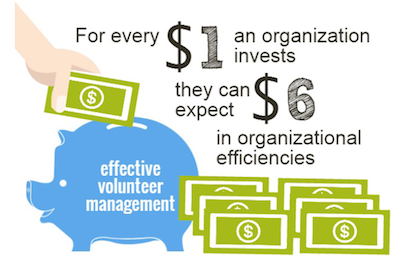
These organizations thoughtfully consider where volunteers are needed and in what ways they can best help the organization meet its mission. In return, operational volunteer strategies power their programs and help make them successful. In fact, Service Enterprises see up to a six-fold return on their volunteer investments.
The move toward volunteer strategies instead of programs also helps us think about ways that we can weave volunteers throughout our organizations – another characteristic of Service Enterprises.
Most of us engage direct service and board volunteers, but where else could volunteers support our work? An advocacy volunteer could promote our messages with key stakeholders and policy makers. A human resources volunteer could update the employee handbook so it meets current standards. An information technology volunteer could advise on the benefits and drawbacks of a new CRM (constituent relationship management) system.
The way we talk about volunteers influences the way we think about how we can partner with them.
Moving from a volunteer program to a volunteer strategy represents a subtle shift. But, it’s one that can have powerful and positive implications on how we practice volunteerism in our organizations.
Make Your Volunteer Program More Effective by Considering New Roles for Volunteers
This post is by Beth Steinhorn, president of JFFixler Group. She works with organizations and associations across the United States and Canada to embrace volunteer and member engagement as a key business strategy.
Beth Steinhorn
Recently, while facilitating a reunion of organizations that participated in a yearlong High Impact Volunteer Engagement project – which included coaching, mentoring and training – I was once again struck by the powerful potential that one strategic change can have on an organization overall.
Ten staff/volunteer teams had worked to develop one new way each to engage skilled volunteers at their organizations, learning along the way how to effectively recruit, support and acknowledge skilled volunteers. On reunion day, they gathered to share their stories of challenge and success.
One team’s story, in particular, exemplifies how engaging volunteers in high-impact roles can be meaningful far beyond that one position.
Before joining the volunteer engagement program, Home Health and Hospice Care (HHHC) of southern New Hampshire already had an established volunteer program, with volunteers serving many crucial roles. The program included “vigil volunteers,” caring individuals who stay with dying patients, offering company and comfort to the patients and their families.
Despite having a dedicated team of vigil volunteers, HHHC faced a major challenge: one volunteer coordinator handled all vigil volunteer scheduling. Understandably, scheduling is unpredictable and time-consuming. HHHC determined to create a new position of vigil team leaders to coordinate scheduling and communications with vigil volunteers.
Seems simple enough on the surface – but the concept is more complicated given the needs for both technological support and compliance with HIPAA (healthcare privacy standards). They needed user friendly, fast and nimble technology they could afford that would interface with the existing database and meet HIPAA requirements.
They took a two-pronged approach. First, the team developed a team leader position, with volunteer leaders each taking on a week per month to handle the scheduling and support of vigil volunteers. Meanwhile, they systematically explored technology options.
The system in place now includes the volunteer coordinator making one call to the on-duty vigil team leader with details about emerging needs for vigil volunteers; the team leader then broadcasts messages through texts and emails to the volunteer roster. The system now allows volunteers to see a shared calendar, identify empty slots and sign up for time slots that fit their schedules.
The benefits of this new system are far-reaching and truly profound. Here are a few:
Scalability: They now can scale the program without adding any staff. Shortly after launching, HHHC encountered an unusually high need for vigil volunteers. Through this program, they could fill coverage of more than 80 hours, without adding any staff.
Place for Skilled Volunteers: They now have a position to offer skilled volunteers seeking ways to support the organization beyond direct service, as well as leadership opportunities for existing volunteers who aspire for more.
The Big Picture: Most profound, the ability to see the calendar online has helped current volunteers to appreciate that they are part of a bigger team.
Think about not only what that one new position could accomplish, but also whether the project could be expanded to help other areas of your organization and how it might impact the bigger picture within your volunteer culture.
Selecting the right project is challenging – but taking time to be strategic about where to engage volunteers in high-impact positions has the potential to ensure that your efforts have a significant return on investment.
Can You Listen? This Might Be the Right Volunteer Activity for You
This post is by Marc Wong, author of “Thank You for Listening: Gain Influence & Improve Relationships, Better Listening in 8 Steps.”
Marc Wong
Meghan watches her mother finish a telephone call.
“Mommy, why are you crying?” she asks gently.
“I’m OK,” Mommy sighs, “I’m OK.”
Meghan leaves the room and comes back moments later. “When I’m sad, I hold on to Mr. Brown,” she says, handing over a teddy bear to her mother.
On another occasion, Daddy is talking to Meghan about a tough decision he has to make.
“When I have to make a big choice, I ask Mr. Brown,” Meghan says.
“And what does Mr. Brown say?” asks Daddy.
“Nothing,” she says matter-of-factly. “He listens.”
In this scenario, Meghan’s actions give us a glimpse of what selfless, dedicated hotline volunteers do on a daily basis. Just like Meghan, these volunteers do not judge. They do not solve problems. They do not interrogate.
Sometimes they will just be quiet.
Volunteers’ actions, like Meghan’s, are also gently supported by an unspoken sense of hope and decency. Implicit in Meghan’s words is the message that things will get better, that there is good in this world.
Volunteers are not going to rush you to get “better.” They’re not even going to tell you what “better” means. Instead, they’ll be more than happy to hear what better means for you.
I still think about the conversations I had as a volunteer for a crisis hotline. I remember a caller making peace with a life-changing decision he had to make. I remember his calmness despite his knowledge of the rough road ahead. I remember a girl who happily read me a poem she had written; the hopefulness and optimism of her words in contrast to the sadness of her past.
What struck me with these calls was not our different circumstances, but our common struggle for dignity. I did not simply take note of the callers’ courage and resilience, I admired it and hoped inwardly that I could face my own demons with the same strength and poise. I didn’t just hear their words, I tried to hope and fear with them. And I am grateful for what they shared with me.
A hotline volunteer offers what is unique and precious to her as a human being so that callers may talk about what is unique and precious to them. In the process, both grow and connect through their humanity.
To find hotline and other volunteer opportunities, visit the All for Good website.
Having served myself and being married to a U.S. Navy veteran, I have experienced the tough transition process from the military life to a civilian career. And even though we seem to have made it, I can relate to others who are having a hard time adjusting to the change.
When you leave the military, it is not like just changing your career but changing your whole life. You come from a system that completely took care of you, starting with giving you strict guidelines about your work schedule and location, to setting expectations regarding your physical fitness, while providing you with health care. You are part of a unit, you go to places that others will never (want to) go to and you have buddies you would die for, and they for you. And then it all stops.
There are some fantastic programs in place that ease the transition, but the newly gained freedom that comes with being on your own can be overwhelming and lonely.
One fantastic organization that I was introduced to thanks to fellow AmeriCorps VISTA member, Alley Smith, is Team RWB. Team RWB’s mission is to enrich the lives of America’s veterans by connecting them to their communities through physical and social activity.
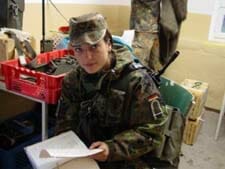
Birte Keays participates in a training exercise with the German Army, in which she served as an officer from 2002 to 2008.
Another great opportunity to get involved is First Lady Michelle Obama’s Mayors Challenge to End Veteran Homelessness. Launched in June, the initiative is a way for mayors across the country to solidify partnerships and secure commitments to end veteran homelessness at the local level. Learn more about supporting veterans and others who are facing homelessness by getting involved with a project near you.
To find other national volunteer opportunities, check out the U.S. Department of Veterans Affairs to find a medical center or hospital. You could also get involved with Habitat for Humanity’s special Veterans Build initiative to help provide housing.
One of the projects that I am working on aims to bridge the gap between veteran, military service members and military family service providers and the volunteers interested in supporting them. While there are a number of service providers in the area, all too often they are not aware of each other. (For those of you in the D.C. area, Serve DC’s volunteer opportunity database, NeighborGood offers one way to find volunteer opportunities.)
During my service, the military built on toughness and encouraged a team spirit, which often led us to look out for others first rather than ourselves. Admitting weakness and helplessness is hard for everyone, and from my own experience, I think it can be even harder for veterans – myself included.
By volunteering with each other you can learn from and support each other without forcing help on someone who does not need any or is not able to accept it at that time. However, they will know that you are there if and when they need someone.
A New Facebook App for Finding Volunteer Opportunities
It’s all about The Ask. Before you ran a nonprofit, you were a volunteer.
Think about that last time you volunteered. What inspired you? Chances are there was a social spark. A friend was volunteering. Your church held a service day. A coworker or classmate mentioned their weekend volunteering plans and invited you to come along. Basically, someone asked, and you answered.
Now your nonprofit can make The Ask on Facebook with All for Good Volunteer – the first app for finding volunteer opportunities right on Facebook.
How does it work? Nonprofits posting their projects via AllforGood.org or a Partner Portal can install the app (announced today in Atlanta at the Conference on Volunteering and Service) to get a feed of their projects built into their organization pages. Visitors to the page can then search for projects that fit what they’re looking for – and, once they sign up, they’ll be able to share the news with their Friends List and encourage other folks to come along.
It’s another way to build connections and make sure we keep up with volunteering as it evolves. By putting projects right on Facebook, we’re meeting people where they already are, putting important causes on the front page to help volunteers connect to change.
Points of Light Digital offers a portfolio of volunteer management tools, including All for Good and HandsOn Connect, to help power the nonprofit sector. To learn more about the All for Good Volunteer Facebook app, or check out any one of our tools, head to www.allforgood.org/services.
Five Lessons Volunteering Taught My Family
This post, which originally ran on SaportaReport, is by Ronit Walker, a judge in the Georgia Office of State Administrative Hearings in Atlanta. To explore ways you can volunteer with your family, check out these resources from generationOn.
Ronit Walker
When my daughter was very young, we visited my grandmother on Fridays. After my grandmother passed away, Fridays felt lonely to us so we spent time delivering Meals on Wheels to residents of a senior living facility. The residents beamed when my daughter would toddle to their front doors, clutching a meal in her tiny hands.
But I soon realized that as much as the residents delighted in visiting with a toddler each week, it was my daughter who was really having a good time. She loved the attention she received and her feeling of accomplishment after we completed our route.
Now I have two more children, and my toddler is on the verge of obtaining a driver’s license. As my children have grown, I recognize that many of our most memorable experiences have been the times we have spent volunteering in our community. Our commitment to engaging in philanthropy, whether through service or charitable donations, has strengthened us as a family. I would like to share five lessons I have learned.
1. Volunteering has helped me to know and understand my children better. My daughter loves to be with younger kids. If volunteering involves entertaining a roomful of preschoolers, she can’t wait to participate. Another one of my children is shy around large groups of people. Packaging food at Project Open Hand, and being able to see the meals that he has helped to prepare stacked and ready for delivery, provides him with a tangible way to measure his achievement.
2. Volunteering creates rituals and traditions for our family. We have committed to providing birthday cakes for homeless children on certain months of the year, and preparing and serving food at shelters on designated Sundays. Although the holidays can be a wonderful time to volunteer in the community, we know that we have dates throughout the year that we will spend time working together as a family – and away from the screens that can isolate us from one another.
3. Being philanthropic generates important and passionate discussions. During the holiday season, we decide as a family that we will pool and donate a portion of our holiday gifts to charity. Each child gets to advocate for a charity that they feel is most in need of the donation. At the end of the discussion, we vote on the winner. Not everyone is always satisfied with the result, but learning that sometimes one has to make difficult choices with limited resources is also a valuable lesson.
4. Volunteering gives my children a perspective on how much they already have. My daughter has been working at a summer program for homeless children for the past three years. Last summer, she was so excited when some of the children remembered her and gave her big hugs – until she realized that this meant that their families had not secured permanent housing. She is reminded how fortunate she is to have a home to return to at the end of the day.
5. Volunteering doesn’t have to be formal. Opportunities to perform even small acts of kindness, such as helping an elderly person with his or her groceries, donating to a local charity or visiting a sick friend, are available to our families almost every day. Moreover, it gives us the opportunity to gently remind our children not only of how much others may need, but that they have the ability to make things better.
Leaning Toward Leadership? Consider a Nonprofit Board
Once involved, volunteers often see they can make a difference – and want to do more. Feeling that pang, longtime volunteer Anne Fisher considered serving on a nonprofit board of directors to make more of an impact on her community.
Anne Fisher
“I thought joining a board might be a great way to do that, but I wasn’t quite sure where to start,” Fisher said.
Having no prior board experience, Fisher decided to take part in The Bridge, a Seattle Works program that prepares people for board service.
About 10 years ago Tara Smith, the executive director of Seattle Works, saw the organization’s method of placing people on boards for a yearlong trial period wasn’t ideal. “We wanted to connect people more quickly to boards,” Smith said.
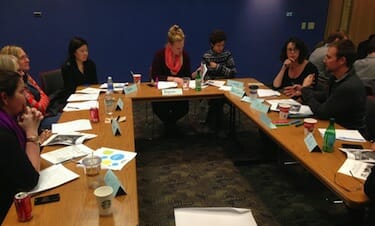
So The Bridge was born. During the one-day program, participants learn from experts in different fields about fundraising, finance, leadership development and different board structures. The program also includes an interactive board simulation. The goal is to help participants figure out whether board service is right for them. (If you’re not in the Seattle area but would like to find out more about serving on a nonprofit board, check out these resources from The Bridgespan Group.)
“The Bridge was a helpful introduction to board service,” Fisher said. “It helped me understand what questions to ask when considering an organization and how to articulate both what I had to offer and what I wanted out of the experience.”
Prospective nonprofit board members participate in a Bridge session at Seattle Works.
Aside from training participants how to be board members, Seattle Works – part of Points of Light’s HandsOn Network – helps program graduates meet and get paired with different boards.
These Board Speed Dating nights, as Seattle Works calls them, bring together Bridge graduates and prospective nonprofits looking for board members.
Ben McCarthy, who heads The Bridge, says Seattle Works partners with more than 40 nonprofit partners focused on such issues as community engagement, the environment, health and wellness, the economy, the arts, education and more.
Following Fisher’s graduation from The Bridge she became a board member for Youth in Focus in 2011 and is currently the board’s president. Youth in Focus, now celebrating its 20th anniversary, uses photography to help at-risk youth see the world in new ways so they can make positive choices in their lives.
“I’ve found my board service to be an incredible learning experience,” Fisher said. “It’s been a chance to take on new challenges, build my leadership skills and feel like I’m making a meaningful impact. It can be a lot of work at times, but it’s very rewarding.”
Trina Gadsden, executive director for Youth in Focus, acknowledges how The Bridge has helped Fisher and in turn Youth in Focus: “The Bridge program prepared Anne for the role of board president because it gave her the necessary tools and experience to navigate and lead positive change.”
Seattle Works runs The Bridge four times a year for the public in addition to holding private sessions for corporations, such as Microsoft and Boeing. Since its first year The Bridge has prepared approximately 1,500 people.
Because of The Bridge’s success and in response to feedback from people who wanted more training and support, Seattle Works created Bridge 201 – a six-hour advanced training session designed for current board members to become more effective leaders.
For those thinking of board service Fisher has some advice: “I believe that having a passion for the organization’s mission is essential. … Spend time understanding an organization’s missions and goals, what they need from their board, their greatest challenges and opportunities, as well as the time and financial commitment required from their board members. Clear expectations and the right fit help to create a fulfilling and valuable experience.”
Got Skills? Here’s How to Use Them to Help Others
If you’ve got professional skills you can share to help people in your community, pro bono volunteering may be for you.
Jackie Norris
Investor’s Business Daily recently highlighted the practice by telling the story of Rebecca Fayed, associate general counsel and privacy officer at the Washington, D.C.-based Advisory Board Company, a consulting firm. The company offers its employees 10 hours of paid time a month to volunteer at local nonprofits.
Reporter Amy Alexander writes: “Fayed sharpened her planning smarts while doing pro bono work at Wonders Child Care, a nonprofit day care serving D.C. and Maryland. She crunched a corporate vision statement for Wonders. She studied the kiddie care competition. She floated ideas for new offerings. Then she joined the tots as they played with water.”
Alexander quotes Jackie Norris, the head of the Points of Light Corporate Institute, who explains why pro bono volunteering benefits employees and companies alike: “Norris tells about designers who volunteered at a disability association, then returned to work and cranked out a revolutionary refrigerator. `Their whole design was different,’ she said. `They asked questions like: If you are in a wheelchair, can you access the ice maker?’”
For tips on “how you can leverage good works at your firm,” read the Investor’s Business Daily article here.
Interested in having your company pledge pro bono service to make life better for others in your community? Check out A Billion + Change, a national campaign managed by Points of Light that is inspiring the largest commitment of pro bono service in history.
And if you have your own great example of pro bono volunteering, tell us your story at [email protected].