Here at Points of Light, we’ll celebrate Global Volunteer Month in April – and with good reason! We’re
all
part of a global community and when we volunteer, we make that community stronger. Of course, our global community includes everyone – children, adults and families – and when families volunteer together, they share a special experience with a very special impact.
As anyone who’s tried to plan volunteering events for young people or for families knows, it can be hard to get it right! Making time is tough for busy families. You have to make sure there’s something for little ones, teens and adults to do. You have to make the most effective use of time – and resources – that you can. And you have to communicate, communicate, communicate so that everyone knows where to be, what to expect and how they’re making a difference.
I’ve definitely been there!
I was once tasked with putting together a service project showcase for students in Chicago. I needed a space for 2,000 students and their families, their teachers, chaperones and volunteer judges. I also had to develop an on-site service project for the group to complete while they waited to be judged. My team and I had to be creative about programming and about budgets. (Hint: If you plan for an outdoor event to save on rental costs and don’t have a rain plan, it will rain.
It’s just a fact.)
There were several times during the three years that we put on the event that I could have benefitted from some guidance. Creating meaningful events for young people and families requires a different approach and a different set of planning considerations.
At Points of Light, we also know in addition to the different needs for family volunteering projects, this can be an even larger challenge to smaller schools or nonprofits, or those who are new to working with families.
Mother and daughter volunteer in Hong Kong on Family Volunteer Day 2018.
With that in mind, Points of Light recently partnered with Disney Parks to create a guide for small organizations for working with family volunteers. We interviewed 1,000 participants of organizations under a $1 million revenue who have participated in the Disney Family Volunteering Rewards Program to understand how to encourage schools and non-profits to engage families in volunteer activities. We wanted to know how to create programs that work for families, how to recruit families to participate and how to make it easy – and fun! – for them to volunteer.
Here’s what we heard from project coordinators we surveyed about how to engage families and young people in volunteer efforts:
Include Youth Voices in Planning: Talk to young people about why volunteering matters. Let their excitement help make it a family priority. Let them describe what they’re doing – they use simple words – and can quickly explain how they’re having an impact.
Communicate via Multiple Methods Well in Advance and with Reminders: Send an email and a text. Remind volunteer families several weeks before, a week before, day before and the day-of. People are busy and reminders help to ensure they fulfill their intention and their commitment to volunteer. If you can, keep your events at the same time of year – so families can plan.
Create a Family-Friendly Environment: Ensure families know that their children of all ages are welcome. Make plenty of age-appropriate activities available and create opportunities for little ones to help. Make sure there are plenty of kid-friendly refreshments as well.
Reward Volunteers: Create incentives for your volunteers to want to come back, and make sure they know about the impact they’re having. Offer student volunteers extra hours if they bring a parent or feature students with families who volunteer on social media.
Start Early, Plan and Be Organized: Make sure people feel as if their time is being used well. If they have a great experience, they’re more likely to return. The organization I worked with didn’t have a lot of success doing several small family volunteer events throughout the year in a city where there were so many competing interests. However, doing an “end of the year” project where students got to show off their work and win prizes combined with the group volunteering experience resulted in higher attendance and participation each year. We used their time – and ours – efficiently and it worked well for everyone.
Family and youth volunteer projects are so impactful – and getting them right makes a huge difference for families and for the people and organizations who benefit from their service!
. And to learn more about the Disney Family Volunteering Reward Program – which rewards eligible schools and nonprofits with up to 20 Disney Parks tickets per year for hosting family volunteer projects – visit
Charissa Townsend is the vice president, Recognition and Youth Programs at Points of Light. Her career focus for the past 20 years has been on out of school and out of work youth, experiential education, and social justice. She has completed this work through nonprofits, local government and colleges and universities.
How Volunteers Supported Wildfire Response and Long-Term Recovery Efforts in Northern California
Over the past few decades, several major disasters have tragically shaken communities across the United States. From natural disasters like hurricanes, tornadoes and wildfires, to man-made disasters like the Flint water crisis, these events test the unity, strength and resilience of our communities. The path to recovery and rebuilding is long, often continuing for years after a disaster strikes – and this work is most successful as a collaborative, cross-sector effort that includes the ongoing support of volunteers. Disasters can be scary and unpredictable, but the incredible individuals who step up to help represent the great humanitarian spirit that we see rise up, time and time again, in moments of need. As local experts in volunteer management, Points of Light Global Network affiliate often play a critical role in managing volunteers throughout response and recovery efforts.
North Bay Wildfires, Fall 2017
Wildfires are incredibly powerful and can gain speed rapidly, quickly devastating entire neighborhoods. The North Bay Wildfires caused thousands of families across Northern California to lose their homes and businesses, and brought more than 8,000 firefighters in to battle against raging flames.
In Napa, Marin, and Sonoma counties, the
serves as an emergency volunteer center, overseeing spontaneous volunteers and donations in the aftermath of a disaster. We spoke with CEO Linda Jacobs and Elaine Tokolahi, director of volunteer services, to learn more about their disaster preparedness, response and recovery efforts – and the critical role played by volunteers.
How did the North Bay Wildfires impact your community or region, and what was your organization’s role in the disaster response and recovery efforts?
In the last four years, CVNL has stood up an emergency volunteer center multiple times due to fires and earthquakes. The most recent disaster that struck our region was the North Bay Fires, which started on Oct. 9, 2017. We operated two EVCs simultaneously in two different counties. In Napa, we managed more than 2,000 volunteers who staffed three evacuation centers and shelters, and in Marin we managed nearly 1,000 volunteers who staffed one large evacuation center and shelter. Following the fires, we partnered with Redwood Credit Union to distribute $1.621 million to people impacted by the fires. We also distributed grants to nonprofits that provided direct services to people and animals impacted by the fires. CVNL is still involved in Napa’s long-term recovery by recruiting and managing volunteers for Napa’s Long-Term Recovery Group, comprised of nonprofit and government agencies dedicated to the whole community’s recovery.
How did this disaster impact your community?
In Napa County, more than 600 families lost their homes in the fire, many more people lost their jobs because businesses burned down, and thousands more residents suffered financially due to the weakened economy. Nonprofits saw a significant increase in the number of clients and in the severity of client needs.
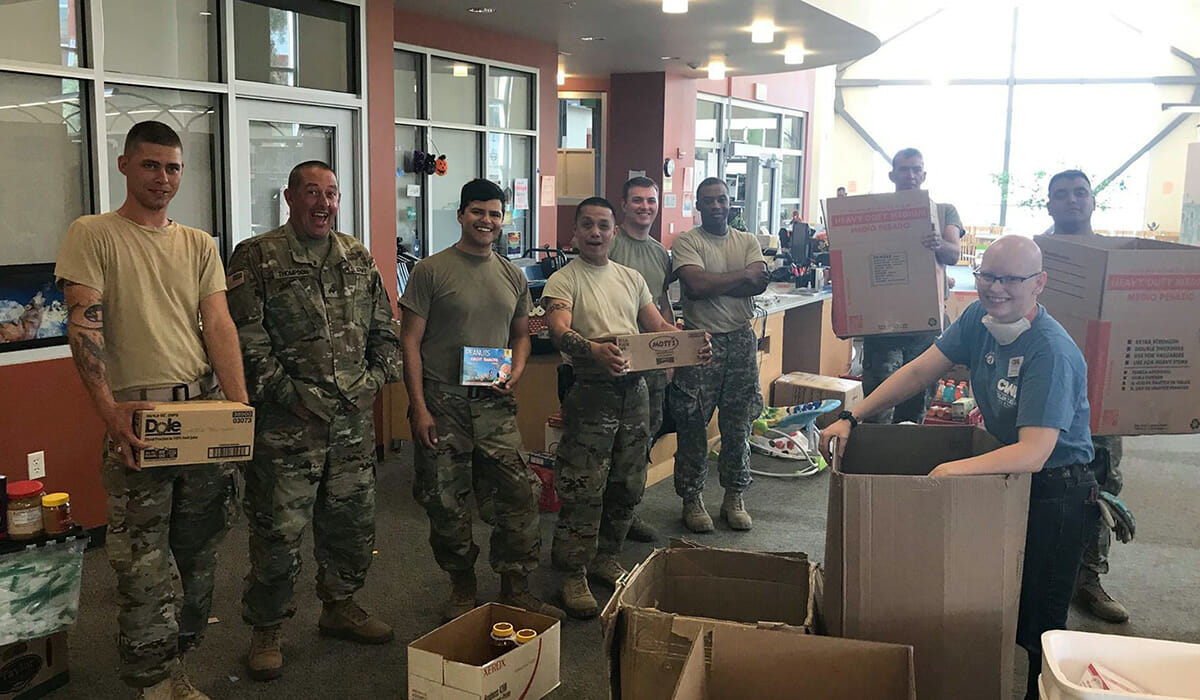
National Guard members from Travis Air Force Base visit the American Canyon shelter to help sort donations.
What role did volunteers play in supporting your organization and the community, both in the immediate response and long-term recovery?
During the fires, volunteers stepped up to fill nearly every role in the shelters and evacuation centers. They cooked and served food, set up cots, took care of animals, interpreted between Spanish and English, and sorted mountains of in-kind donations. Volunteers with professional affiliations provided medical care and childcare. AmeriCorps members filled volunteer lead positions. After the fires, volunteers continue to help. They rebuild homes and schools, plant trees, hold donation drives, and rally their coworkers to volunteers alongside them.
What do you want eager disaster-relief volunteers to know before they begin serving affected communities?
Registering in advance through the organization that manages the emergency volunteer center guarantees that you will be used if there is a need. Just showing up often gets in the way of the first- and/or second-responders. We recommend getting training ahead of time, as knowing what the roles are and how the process works in advance makes service smooth and more supportive during a chaotic time.
What lessons has your organization learned, and what advice do you have for other volunteer management organizations that may face a similar situation in the aftermath of a disaster?
As the old adage says, “practice makes perfect.” Dedicate time to practice your emergency plans and continuity of operations plans. Learn how to serve as an emergency volunteer center by practicing at least once a year. Work with your local government agencies so that they know how to integrate volunteers into their own plans. Ultimately, you will be staffing the response efforts that they lead, so show them that volunteers can be assets during disaster response. Government agencies often fear that spontaneous disaster volunteers will become liabilities, but when we strategically plan ahead for volunteer involvement in response, those fears go away and volunteers can significantly contribute to disaster response efforts.
Is there one particular moment or memory that stands out to you as you think back to this period of response and recovery?
Disaster volunteers come from all walks of life, yet share the same goal: alleviate suffering. One particular memory comes to mind. The local Islamic Center learned of our need for shelter volunteers, so three teenage sisters who worship there signed up for an evening shift at a shelter. They said they finished their homework and came right over, with their parents’ permission. On the second night, they volunteered again and brought their cousins to help. On the third night they brought their parents, too. By the last evening shift, the original group of three sisters had grown into a group of 12 volunteers, who stepped in to feed people, help the elderly walk around at night, gave water to sleepy children, signed-in new fire evacuees, and did anything else needed to make the shelter a warm and welcoming place.
In the event of a disaster, Points of Light supports first-responder organizations, like FEMA and the American Red Cross, connects with Voluntary Organizations Active in Disaster chapters across the United States to assess the situation, and coordinates with our Points of Light Global Network affiliates and partner organizations in the affected areas. Remember – in the immediate aftermath of a disaster, it is critical that people who want to volunteer, especially those outside of the immediate area, do not self-deploy. Connect with local organizations responding to the disaster to find out the best way to get involved.
Bringing MAVA to the Masses at the Points of Light Conference
had the unique opportunity to join forces with Points of Light as content partner for the 2019 Points of Light Conference, held in St. Paul, Minnesota. MAVA focused on what it does best — providing educational sessions for hundreds of nonprofit professionals looking for best practices in their industry. Points of Light brought its large following to Minnesota, exposing so many new people to our work, and the response was immense! Extra sessions added to meet the demands of the larger audience gave conference attendees from all over the world the chance to get their first taste of what MAVA has to offer.
Many participants were introduced for the first time to established leaders in our industry. Rob Jackson, director of Rob Jackson Consulting Ltd., and Beth Steinhorn, president of VQ Volunteer Strategies, led an inspiring educational plenary at the Nonprofit Volunteer Engagement Opening Session, focused on the far-reaching effects that can be seen when we engage and enable volunteers. Attendees watched a series of videos, collected from across the globe, featuring volunteer managers speaking to the ripple effects that volunteers have had on projects within their communities. Buzzing with ideas and new motivation, the crowd set off for two and a half days of learning and sharing best practices, conversations with colleagues and those “ah ha!” moments. Sessions on creating an environment of inclusion displayed the trend of demographic changes in the volunteer population and our need to stay on top of them. And MAVA’s own Lisa Joyslin presented data collected from a recent inclusion study and the
. The need for data tracking and reporting on trends grows with the industry, and MAVA is a leader in these studies.
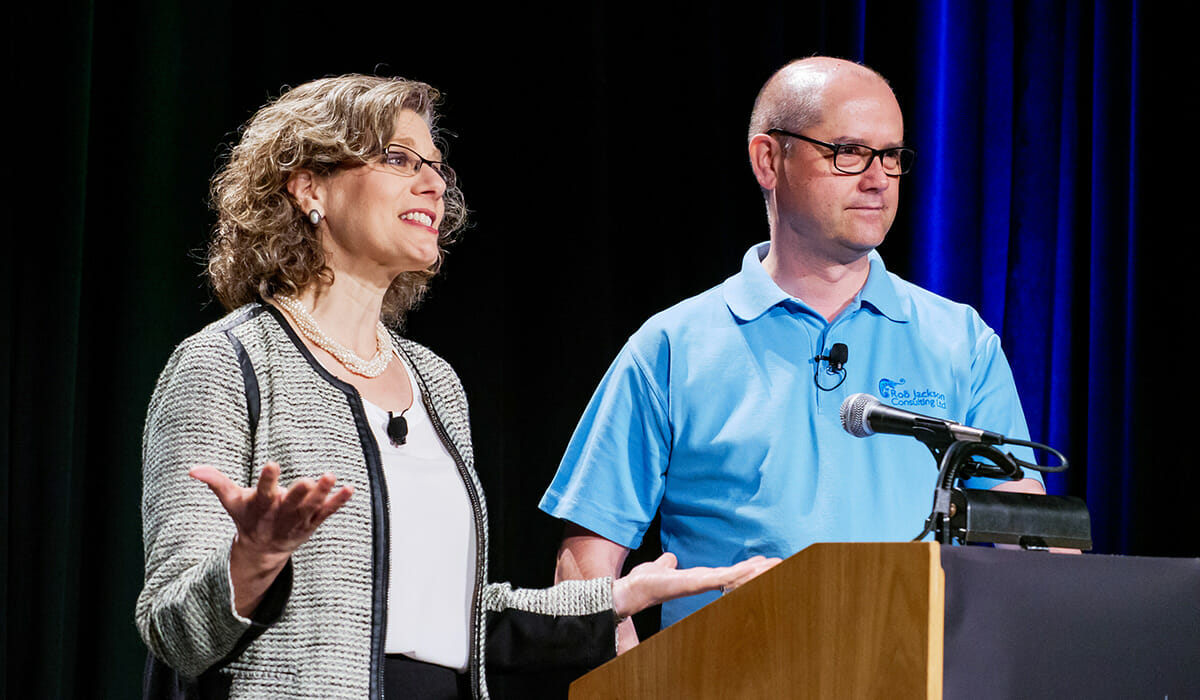
Beth Steinhorn and Rob Jackson lead an inspiring educational plenary at the Nonprofit Volunteer Engagement Opening Session.
“The interactions and questions that sprang forth from the participants were energizing, and really displayed the need for continued transparency and establishment of best practices to help each other move the industry into the professionally recognized and rewarding job we know it can be,” said Kristina Wilkes, manager of volunteer projects at Chicago’s Museum of Science and Industry. Kristina was among the volunteers staffing the MAVA information table, which offered attendees the opportunity to learn how MAVA might benefit them — even if they’re not in Minnesota.
“As a member who lives and works in Chicago, I was able to talk to the benefits that institutions receive even if they aren’t within the Minnesota State lines,” Kristina said. “It was empowering to share how best practices for the management of volunteers are being presented from state to state and professional to professional every week through MAVA. The foundation may lay in the Twin Cities, but the work we do is universal.”
With the learning and networking that we did at this year’s Points of Light Conference I know that next year’s MAVA Conference, June 3-5 in Minnesota, will be another great step in supporting not just Minnesota, as the land of volunteering, but all of America.
We extend our heartfelt thanks to Points of Light for bringing the conference to Minnesota and for shining a light on MAVA,
and the stellar volunteer engagement work conducted in Minnesota.
The 2020 Points of Light Conference will be held June 10-12, 2020, in Washington, D.C.! Subscribe to our email newsletter, and be the first to get conference-related news and updates, including the call for proposals and early-bird registration discounts.
Karmit Bulman is the executive director of the Minnesota Association of Volunteer Administration. She oversees strategic planning, board development, financial management, fundraising, program development and day-to-day programming at MAVA.
Creating a More Vibrant Canada Through National Leadership on Volunteer Engagement
American Express Canada employee volunteers plant trees with Ontario Streams, a nonprofit dedicated to environmental conservation. In communities across the country, Volunteer Canada convenes and collaborates with volunteer centers, nonprofits, businesses, governments and educational institutions to create powerful tools for citizen engagement.
Volunteer Canada is at the forefront of providing nationwide leadership centered on volunteer engagement and is a member of the
. It convenes and collaborates with volunteer centers, nonprofits, businesses, governments and educational institutions to create powerful tools for citizen engagement. In the midst of an ever-changing world and political shifts, the organization works to increase the participation, quality and diversity of volunteer experiences that build strong and connected communities.
Since its founding in 1977,
, has provided national leadership and expertise for organizations and volunteers alike. It identifies common community issues, and seamlessly mobilizes the knowledge of experts to produce learning tools that help build stronger communities. With a network of 220 local volunteer centers, the organization helps promote volunteering, connect people with opportunities to volunteer, build organizational capacity and provides leadership around relevant issues.
With a deep focus on research and policy, Volunteer Canada has conducted several studies centered on volunteerism and the constantly evolving volunteer landscape. Its
study addresses a growing gap between what volunteers look for and the opportunities organizations offer. The organization understands what motivates today’s volunteers: they’re mobile, have goals, are driven by results, self-directed, have multiple interests and often seek short-term opportunities that use their skills.
To better understand these motivations and emerging trends, the organization has also worked alongside Statistics Canada to give insights into the state of volunteering in Canada. Their latest
found that Canadians volunteer an average of 154 hours per year, and that 82 percent of Canadians volunteer informally, helping people directly without the involvement of an organization or group. Youth are more engaged than past years, with 66 percent volunteering an average of 110 hours per year, and 38 percent of adults aged 55 and up continue to volunteer the most hours – 220 a year on average – out of any demographic.
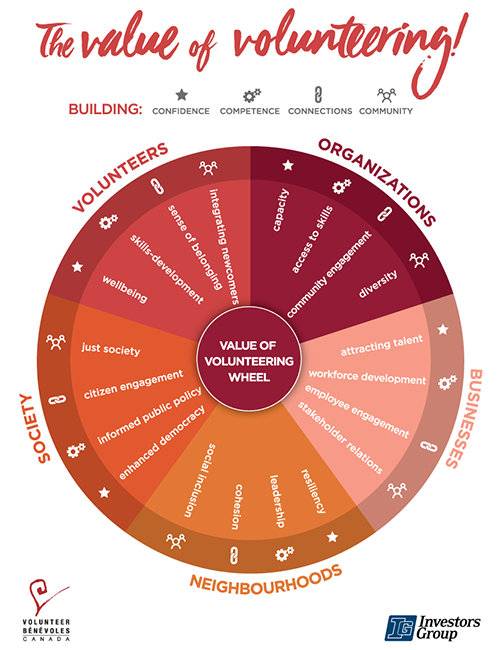
In order to portray the social and economic value of volunteering to organizations, businesses and individuals, Volunteer Canada created the
This tool illustrates the many benefits of volunteering, including building confidence, competence, connections and community.
The Value of Volunteering Wheel illustrates the many benefits of volunteering, including building confidence, competence, connections and community.
By developing its wide network of partners and resources, the organization has seen volunteer centers evolve in their leadership roles, which has led to increased volunteer involvement across Canada.
“I see volunteering as a form of social inclusion and participation in neighborhoods, communities and society, so that the places we live reflect our values,” said Paula Speevak, president and CEO of Volunteer Canada.
The organization also looks for ways to make an impact beyond its national borders. It has adopted the
to mobilize global efforts to improve social, economic and environmental conditions around the world. The organization is looking at the degree to which Canadian volunteers are already contributing to the SGDs, and what volunteer contributions may look like in the future.
Volunteer Canada also provides a variety of resources, services and supports to help companies adopt gold standard corporate community engagement programs.
report, for example, summarizes key findings from the largest survey of Canadian employees to date on the connection between their levels of engagement with their workplace and their employer’s commitments to community.
The organization organizes the country’s National Volunteer Week each year in April, a weeklong celebration to thank and recognize volunteers and celebrate the impact of volunteer service. This year’s theme was
, highlighting the exponential impact of volunteers and the ways they lift communities.
“Volunteering is such a beautiful, free spirited act of generosity,” said Paula. “There’s a component of giving to the community, however I see volunteering as shaping the community you live in. It’s having your voice and having your space.”
Do volunteers at your organization represent the racial and ethnic diversity of the community you serve?
The answer, for most governments and nonprofit organizations, is “no.”
But this can change.
The Minnesota Association for Volunteer Administration has spent the last year researching the challenges, barriers and best practices for volunteers from immigrant and diverse communities. While this project focused particularly on government organizations, the findings can largely be applied across both government and nonprofit entities. To reach these findings, MAVA built on several previous initiatives and conducted new research to more deeply explore questions such as:
How is the concept of volunteerism understood and perceived in racially and ethnically diverse communities?
What barriers currently exist to engaging diverse and immigrant populations as volunteers with government organizations, and how can these barriers be overcome?
What outreach or recruitment strategies are most effective in immigrant and diverse communities?
Are there particular volunteer roles that are more appealing to people of diverse backgrounds and, if so, how can governments or organizations develop these roles?
What efforts have organizations found successful in engaging diverse and immigrant volunteers, and how can other entities replicate these efforts?
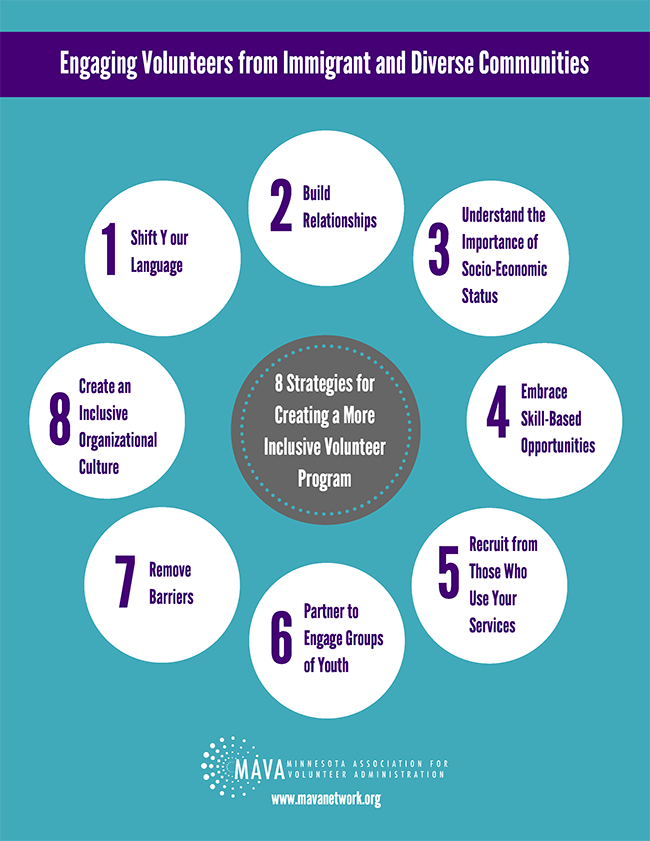
The result of this research is a set of eight strategies for engaging diverse and immigrant volunteers, which governments and organizations can develop into an action plan for change.
Some of the strategies are relatively simple. For example, we heard from a number of people new to this country that the word “volunteer” is not well understood in their community. Framing volunteerism in terms of how they can help their neighbors is a more effective way to discuss how they might be involved. And focusing on how someone might help their community, as opposed to how they will help your organization, will be a more compelling recruitment message.
Other strategies are much more difficult, like building relationships with communities of color and creating an inclusive organizational culture. While employing these strategies will not happen overnight, starting today by taking small steps forward will slowly build inclusion into your volunteer program in the months and years to come.
All eight strategies are represented in the infographic below, and the executive summary of MAVA’s report (featuring a brief overview of all eight strategies) is available at www.mavanetwork.org/inclusive.
If you would like to receive the full report or discuss MAVA’s work, contact Lisa Joyslin.
How Tech Skills and Innovations Support Nonprofits, Increase Volunteer Impact
track at the Conference on Volunteering and Service highlighted stories of civic-tech leaders who are using technology to help solve social problems, creating empathy in their communities and encouraging others to use their tech skills for good.
Rohit Malhotra, founder and executive director of Atlanta-based
, spoke about creating local innovation communities to spark change in our cities. His passionate and inspirational presentation highlighted the importance of building trust and empathy through real relationships with people in our communities. The secret sauce, he said, is engaging people in the creation of companies, organizations and communities through civic and community engagement. This leads them to see the good over the bad of creating these institutions – not only because they had something to do with it, but also because they know the whys and hows of what was created and become a true part of improving their community.
to create a better volunteer experience in their organization, Jenn Downs, director of user experience design at Points of Light, built on Rohit’s theme of creating trust in communities. Workshop attendees practiced conducting user interviews, learning about the power of silence in active listening, and the value of using the phrase “tell me more about that” to dig deeper into problems. This group of volunteer organizers were also able to see that by sharing with and asking what others are struggling with, they could collaborate on solutions to common volunteer management problems like budgeting, retention and using new technologies to craft better volunteer experiences.
In a workshop sponsored by
, attendees learned how to use social data to engage volunteer networks and address common problems many organizations face. Presenters discussed applying the lessons and practices of social listening – identifying and mobilizing micro-influencers among a social media following – beyond fundraising and advocacy goals. Participants also learned how to use technology to address volunteer management challenges like recruitment, attrition and retention, as well as matching volunteers to the right roles.
Expanding on Blackbaud’s ideas about social media data, Clay Johnson, senior vice president of digital at Points of Light, and Rebecca Wang, senior manager of corporate affairs at Hewlett Packard Enterprise, highlighted changes to
, Points of Light’s digital hub for volunteerism and community engagement. And, looking toward the future of All for Good, Clay and Rebecca envisioned a platform where social data can be used to encourage sharing opportunities with friends and family, leading to an increase in participation in volunteer activities around the world.
The relationship between All for Good and HPE started with HPE’s
, which asked people what apps and digital tools they would create to improve people’s lives. The Points of Light digital products team pitched an idea to empower volunteers through social sharing and machine learning within All For Good – the team was 1 of 4 winners, each receiving HPE’s support in the form of time and talent to help make their idea a reality.
These were just a few of the insights that the Tech for Good track offered attendees as they learned about and discussed the latest developments in tech-focused volunteerism. The discussions that took place and the lessons learned from these sessions shed a positive light on the future role that technology will play in helping nonprofits and social organizations recruit and retain volunteers – and in broadening the scope of impact individuals are able to make in their communities.
Jenné Meyers, CEO of Chicago Cares, explained, “nonprofits that engage volunteers are better led, better managed, more adaptable and capable of going to scale.”
Across the globe, volunteers are a powerful force for good, changing the world by giving their time, talent and other resources. Guiding these individuals are volunteer managers who help volunteers thrive by channeling their passions and skills.
The
at the Conference on Volunteering and Service offered 20 sessions to equip organizations with breakthrough tools and strategies for recruiting, retaining and managing high-impact volunteer programs. In recognition that the nonprofit landscape continues to evolve, the track focused on the question of how organizations can capitalize on the passion and enthusiasm of volunteers, some who have never before added their voice to a cause. The sessions placed special emphasis on innovation and idea exchange with peers who manage multi-issue programs.
Across the sessions, five trends emerged:
1. Volunteer management can make or break an organization.
shared, “research tells us that organizations that engage volunteers are better led, better managed, more adaptable and capable of going to scale.” Additionally,
shared how nonprofits can leverage skill-based corporate volunteers to develop professional development programs for their employees, increasing retention and human capacity.
Yet, volunteer management is something that takes work and intentionality. During a breakout session, Katie Zwetzig, executive director of
found that the number one challenge nonprofits face is volunteer management. When nonprofits invest staff capacity and resources into effective volunteer management it has a strong return on investment.
2. Everyone has a role in volunteer management.
In order to get a high ROI on volunteer engagement, everyone from board members to program managers to event volunteers must be passionate about cultivating and retaining volunteers. Karmit Bulman, executive director of the
, found that the scope of volunteer involvement within an organization hinges on the excitement of staff at all levels, as well as an organization’s readiness to support and partner with volunteers. In order to fully maximize the value of volunteers, every staff member needs to be involved in the process.
3. The paradigm of volunteering is shifting.
A common theme across multiple sessions was a shift in how nonprofits and individuals perceive the role of volunteers. Rick Lynch, principal consultant at
, framed the changes as a series of gradual shifts. According to Lynch, the volunteer management era “grew up” when many people volunteered as an alternative to professional work, whereas today’s volunteers do so as an alternative to other leisure activities. In order to be effective practitioners, Lynch encouraged volunteer managers to focus on cultivating relationships with individuals and engage them as consultants, building toward serial involvement, not as unpaid employees.
4. Nonprofits can expand their volunteer capacity by focusing on causes and impact.
As baby boomers retire and millennials are increasingly looking to give back, the sector needs to respond to changing volunteer motivations. Emily Holthaus, national director of social responsibility at
, shared that often, organizations are only able to engage volunteers at the surface level, leaving a large gap between the service provided and the volunteers’ true capacity and desire to create impact. Today’s volunteers want to make tangible impact toward specific causes or programs. Beth Steinhorn, president of
, encouraged organizations to put to rest the idea of a volunteer “belonging” to one organization versus another and focus on inspiring volunteers around specific causes and projects.
5. Technology is not a silver bullet, but it is powerful tool.
Many nonprofit leaders believe they don’t have the resources or capacity to fully leverage data and technology to advance their work. Several sessions debunked this idea by offering concrete (and achievable) steps nonprofits can take to use technology. Gary Bagley, executive director of
, shared how they used Google Ad Words grants to increase their SEO and overhauled their volunteer recruitment process, automating communication at key steps, to increase new volunteer signs ups by 14 percent.
These trends are just a sliver of the knowledge shared during the Volunteer Engagement track. Through informal chats, dine-arounds and networking sessions, attendees made personal and professional connections with peers around the globe. Through a shared passion and commitment to volunteerism they will continue to grow the service movement, helping turn volunteers’ passions into progress.
Through Strategic Volunteer Engagement, KPMG and Freeport-McMoRan Promote Youth Education
There are a variety of ways companies support education initiatives across the country, from philanthropic investments and fundraising to employee engagement activities and skills-based volunteering. For 2016 Civic 50 sector leaders KPMG and Freeport-McMoRan, investment in education translates to a firm-wide commitment and strategic business opportunity. Not satisfied with one-and-done service opportunities, these companies are using strategic corporate citizenship initiatives to ensure maximum impact for students in the communities where they do business.
For KPMG, Civic 50 industrials sector leader, an emphasis on youth and education has always been a focus of their philanthropic and foundational work. In an effort to improve reading levels across the country, KPMG established its signature community involvement program, Family for Literacy, which provides families and children from low-income areas with books. Since 2007, the program has engaged employees across all levels of KPMG – interns, its partners and professionals alike – to donate books to local schools and education centers. KPMG also finds ways to engage key stakeholders – including clients, alumni, and family members – in their community involvement initiatives. At KPMG, supporting learning and literacy is more than just providing books. For example, after realizing a lack of diverse representation in children’s books, KPMG worked with an outside publisher to create a children’s book about a disabled man in Ghana. Through its work in education, KPMG is striving to ensure all children grow up with a love of reading.
Freeport-McMoRan saw a different opportunity to strategically align philanthropy efforts with the needs of educators and students. After identifying a recruitment gap, the Civic 50 materials sector leader decided to work with universities around the country through their University Teams program. The company sent representatives from key business areas to eight universities with strong mining engineering, metallurgy and geology programs to create high-impact partnerships. This mutually beneficial program helps the company identify and cultivate a new talent pool and also gives the University Teams a chance to work hand-in-hand with schools to identify opportunities for grants, educational programs, scholarship needs, and more. The program also ingrains a strong culture of service at Freeport-McMoRan by offering employees an opportunity to be key players in the recruitment process and see first-hand how investments are helping students across the country.
By investing time, money and other resources in education programs, and connecting community engagement initiatives to key business functions, KPMG and Freeport-McMoRan demonstrate a strategic commitment to students across the United States. As sector leaders of The Civic 50, they scored highest in their industries in the annual Civic 50 survey, a benchmarking effort to recognize and honor the 50 most community-minded companies in the nation.
Do you work with a company that excels in community involvement and exemplifies the ideals of The Civic 50? The Civic 50 is currently looking for the next cohort of community-minded champions to take the 2017 Civic 50 survey, the deadline for which has been extended to 11:59 PM EST on March 13. The entirely quantitative survey looks at four dimensions of community engagement: impact, investment, institutionalization and integration. Any company with operations in the United States and an annual revenue of $1 billion or more is eligible to apply. For more information – including a best practices report, resources for survey-takers, and a full list of the 2016 Civic 50 honorees – visit www.civic50.org. For further updates and insights, follow The Civic 50 on LinkedIn or Twitter.
New App Connects Houston Volunteers to Organizations with Immediate Needs
In the smartphone era, we are constantly searching for innovative ways to automate our lives and creating technological solutions to the world’s most pressing issues. Volunteer Houston, a Points of Light Affiliate, is one of many organizations joining this trend.
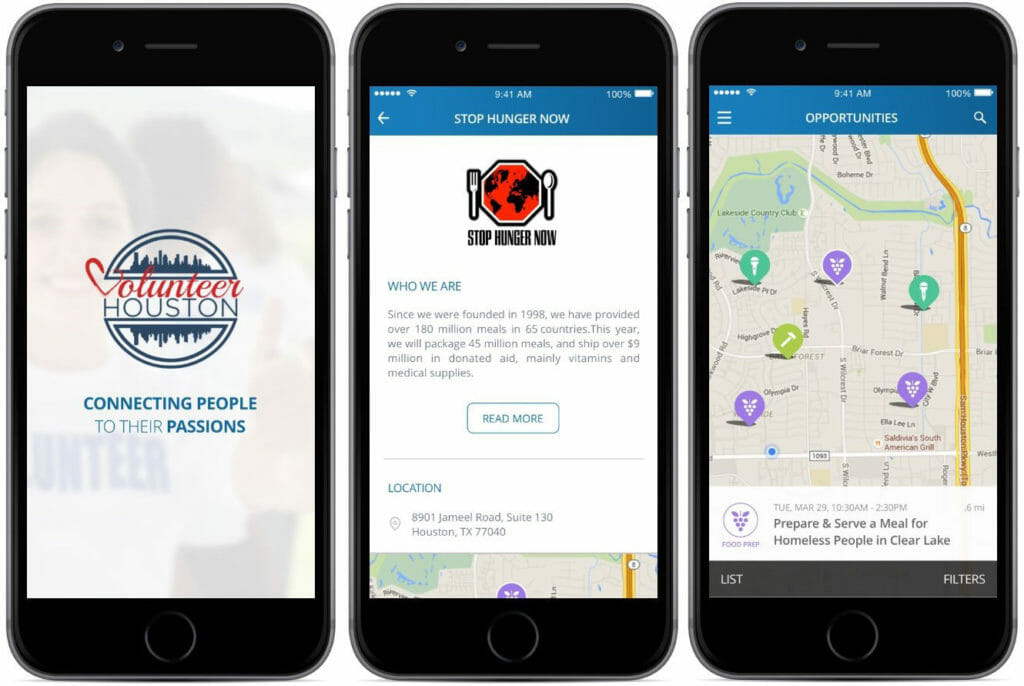
In spring 2016, Volunteer Houston became one of the first volunteer centers in the United States to develop a mobile application designed to engage volunteers by connecting them to nonprofit volunteer opportunities. Now, with more than 544 downloads, the app has already impacted more than 1,200 organizations in the Houston area.
Built in collaboration with Headspring, a Houston-based software development company, the app allows volunteers in Houston and the surrounding areas to search local nonprofit agencies, find volunteer opportunities based on their interest areas, and easily track volunteer hours. Volunteer Houston also leveraged the skills-based service of an AmeriCorps VISTA, Rafay Munir.
Though he was gainfully employed as a project manager for NAXION in Philadelphia, Rafay wanted to get involved in national service, while his lifestyle still permitted him to do so. His workflow management and consultant skills would be ideal for helping the technical development team turn the idea of the app into a reality.
“[Rafay] moved to Houston to actualize on that – something very powerful, something very cool when you look at the impact he had on our organization, as well as all of the other organizations that are benefitting from the app itself,” said Cameron.
The Houston Independent School District is one such organization, which Volunteer Houston expects will benefit from the app’s hour-tracking feature, beginning in the 2017-2018 school year.
Prior to this app, all hour tracking had to be done with pen and paper, creating greater room for error if students lost their hour sheets or forgot to log their service. The app is designed to provide automatic checks and balances to the process. For example, Cameron said, if a student “volunteered on the 28th of February with the food bank for 6 hours, [the app] sends it to the food bank administrator and they look at it and say, no it’s really 5.5 hours.” This reduces strain on the volunteers for tracking their own hours and provides more reliable data for Volunteer Houston to report.
With the app providing immediate access to hundreds of volunteer opportunities, there have been a number of positive effects on the volunteer process. By allowing volunteers to easily post their volunteer experiences to social media directly from the app, it has helped foster community awareness of nonprofit agencies and the opportunities they have available. It has also enabled a quicker response time for those in need – which could be particularly valuable for disaster response.
“You look at Houston and in the last several years, we had a Memorial Day flood in 2015, we had a Tax Day flood in 2016, and then we the had a Memorial Day flood in 2016 as well,” said Cameron, who expects that the app will be very beneficial in coordinating volunteer responses to natural disasters.
Coordinating with several local emergency management offices in the Houston area, Volunteer Houston will begin marketing the app during times of disaster as a better way to make volunteers aware of where help is needed and which organizations are leading response efforts.
Looking toward the future, Volunteer Houston has already begun working on plans to implement a geolocation function that will help the app track volunteer hours automatically by recording when the volunteer arrives at the physical location of the service project and when they leave. They are also working on plans to create sponsored incentives for volunteers. For example, once a volunteer reaches a certain number of hours, they might get a free cup of coffee or some other reward through email.
“It’s going to work, I think, to [create] a much larger gain than we’ve ever had in the past of connecting people with immediate need.”
Building Capacity: Strategic Volunteer Engagement
This post was written by Teri Johnson, senior vice president of strategic partnerships, training and consulting for Points of Light.
The nonprofit sector spends a lot of time agonizing over organizational strategy and how to meet mission with increased demand and fewer resources. Though volunteers seem like an oversimplified solution to the problem, through strategic volunteer engagement, they can be viable and, oftentimes, necessary assets to nonprofit capacity building.
The good news is, people want to volunteer! According to the
, 1 in 4 Americans volunteer through an organization. The report also indicates that volunteers are twice as likely to donate money to organizations compared to non-volunteers. Why, then, are some organizations unhappy about the idea of volunteers knocking on their doors?
Great volunteer engagement is done strategically, as a part of the organizational culture; however, this approach takes an investment of time and energy that many organizations don’t feel they have. The result is a resistance to developing a more vibrant volunteer engagement program. Even some of the strongest nonprofits with vibrant programs engage volunteers either episodically, or because they are mandated to do so. When you engage volunteers with a fill-the-gap approach, without a needs assessment, compared to one of strategy, it’s harder, more time consuming, and generally less fulfilling for both the organization and the volunteer.
However, organizations that build a culture of volunteerism, and purposefully embed volunteerism into their strategy, experience stronger retention rates, increased volunteer engagement and higher
, for example, experience a 23 percent average increase in new volunteers in their first year after being certified by implementing strategic volunteerism practices.
Strategic volunteerism means embedding volunteers as capacity builders into your operational and programmatic strategies. Any organization, regardless of size, is capable of engaging volunteers strategically. It takes time and commitment, but the outcome is stronger mission delivery. Here are a few tips for helping your organization tune in to a culture of volunteerism:
Enlist the support of senior leaders and decisions makers for volunteers to be more integrated into your organization.
Perform an internal needs assessment to determine where there are gaps.
In every program design or strategy session ask the question, “How can we engage volunteers to help us achieve this work?”
Commit to a codified recruitment, training and recognition program for your volunteer program.
Track your volunteer efforts and report on outcomes and outputs.
When volunteers are an afterthought, it can be challenging for everyone involved – but when volunteerism is a part of organizational culture, your efforts will return bigger results. Volunteers will be your ambassadors in the community, your capacity builders and some of your greatest assets. Volunteers will step in to fill the necessary gaps to allow your organization to make a bigger impact.