What a Change in Perspective Can Mean for Your Volunteers
This post is by Tricia Thompson, vice president of training and consulting at Points of Light.
Tricia Thompson
It’s time to get rid of our volunteer programs.
It seems harmless enough, but calling our volunteer activities “programs” often sets them up to compete with our direct service programs. At budget time, it can be hard to allocate scarce dollars to volunteer support because it seems like we are taking them from client support.
As an alternative, I propose reframing volunteer programs as volunteer strategies. This shifts their position from one that competes with clients to one that supports clients. From this new perspective, volunteer time becomes an asset to leverage on behalf of clients and the community, not a drain on resources.
Making the most of our assets requires an investment. Research from the Urban Institute tells us that the more we invest in volunteer engagement, the more our organizations will benefit from volunteer contributions.
It’s an intuitive finding that Service Enterprises – organizations that engage volunteers strategically to help meet their missions – have taken to heart, but one that many organizations still struggle with.
When we bring volunteers onboard without a plan, without time for clarifying expectations, without training the people who supervise them or without a clear sense of what they are best suited to offer, we often find that they don’t come back.
Without the investment of time that these tasks take, we end up with poor volunteer retention and staff who lament that they haven’t had a good experience with volunteers.
A volunteer strategy, like any effective operational strategy, addresses these issues with planning and an investment of time, energy and money. This planning and investment are hallmarks of Service Enterprises and any organization engaging volunteers strategically and well.
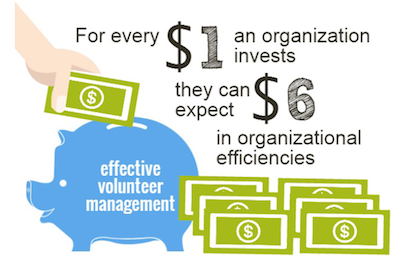
These organizations thoughtfully consider where volunteers are needed and in what ways they can best help the organization meet its mission. In return, operational volunteer strategies power their programs and help make them successful. In fact, Service Enterprises see up to a six-fold return on their volunteer investments.
The move toward volunteer strategies instead of programs also helps us think about ways that we can weave volunteers throughout our organizations – another characteristic of Service Enterprises.
Most of us engage direct service and board volunteers, but where else could volunteers support our work? An advocacy volunteer could promote our messages with key stakeholders and policy makers. A human resources volunteer could update the employee handbook so it meets current standards. An information technology volunteer could advise on the benefits and drawbacks of a new CRM (constituent relationship management) system.
The way we talk about volunteers influences the way we think about how we can partner with them.
Moving from a volunteer program to a volunteer strategy represents a subtle shift. But, it’s one that can have powerful and positive implications on how we practice volunteerism in our organizations.
Make Your Volunteer Program More Effective by Considering New Roles for Volunteers
This post is by Beth Steinhorn, president of JFFixler Group. She works with organizations and associations across the United States and Canada to embrace volunteer and member engagement as a key business strategy.
Beth Steinhorn
Recently, while facilitating a reunion of organizations that participated in a yearlong High Impact Volunteer Engagement project – which included coaching, mentoring and training – I was once again struck by the powerful potential that one strategic change can have on an organization overall.
Ten staff/volunteer teams had worked to develop one new way each to engage skilled volunteers at their organizations, learning along the way how to effectively recruit, support and acknowledge skilled volunteers. On reunion day, they gathered to share their stories of challenge and success.
One team’s story, in particular, exemplifies how engaging volunteers in high-impact roles can be meaningful far beyond that one position.
Before joining the volunteer engagement program, Home Health and Hospice Care (HHHC) of southern New Hampshire already had an established volunteer program, with volunteers serving many crucial roles. The program included “vigil volunteers,” caring individuals who stay with dying patients, offering company and comfort to the patients and their families.
Despite having a dedicated team of vigil volunteers, HHHC faced a major challenge: one volunteer coordinator handled all vigil volunteer scheduling. Understandably, scheduling is unpredictable and time-consuming. HHHC determined to create a new position of vigil team leaders to coordinate scheduling and communications with vigil volunteers.
Seems simple enough on the surface – but the concept is more complicated given the needs for both technological support and compliance with HIPAA (healthcare privacy standards). They needed user friendly, fast and nimble technology they could afford that would interface with the existing database and meet HIPAA requirements.
They took a two-pronged approach. First, the team developed a team leader position, with volunteer leaders each taking on a week per month to handle the scheduling and support of vigil volunteers. Meanwhile, they systematically explored technology options.
The system in place now includes the volunteer coordinator making one call to the on-duty vigil team leader with details about emerging needs for vigil volunteers; the team leader then broadcasts messages through texts and emails to the volunteer roster. The system now allows volunteers to see a shared calendar, identify empty slots and sign up for time slots that fit their schedules.
The benefits of this new system are far-reaching and truly profound. Here are a few:
Scalability: They now can scale the program without adding any staff. Shortly after launching, HHHC encountered an unusually high need for vigil volunteers. Through this program, they could fill coverage of more than 80 hours, without adding any staff.
Place for Skilled Volunteers: They now have a position to offer skilled volunteers seeking ways to support the organization beyond direct service, as well as leadership opportunities for existing volunteers who aspire for more.
The Big Picture: Most profound, the ability to see the calendar online has helped current volunteers to appreciate that they are part of a bigger team.
Think about not only what that one new position could accomplish, but also whether the project could be expanded to help other areas of your organization and how it might impact the bigger picture within your volunteer culture.
Selecting the right project is challenging – but taking time to be strategic about where to engage volunteers in high-impact positions has the potential to ensure that your efforts have a significant return on investment.
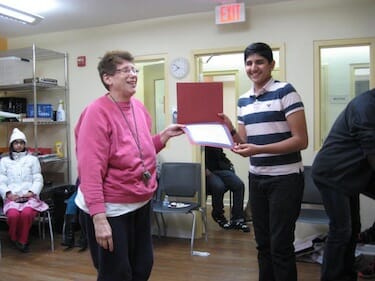
Stony Brook residents participate in a computer class graduation ceremony.
Two years ago, when I came to Stony Brook, a 204-unit, low-income apartment complex in Alexandria, Va., I noticed two things right away. First, adult community members were not engaged in programming and meetings, and second, there were a lot of youth. By a lot, I mean, a lot. Almost 50 percent of the residents were under 18 years old. They contained a boundless amount of energy and enthusiasm, but didn’t know how to channel that youthful excitement into action.
I dove into engaging residents immediately, but took the same worn path: I went door-to-door, speaking with adult residents, persuading them to join programs. We held town halls, hired contractors to run programs and held engagement events, but each had similar results: a handful of residents who found the programs and events only moderately useful. But when I held an event for youth, children were lined up outside the door. I decided to change my approach and focus on engaging a specific subset of residents: the young ones.
It started out small – passing out flyers, community trash clean-ups and teens tutoring younger kids. We had always run an introductory computer course, spending large amounts on a contractor who would routinely see classes of two or three residents. After a less-than-stellar computer course with only two graduates, I approached our teenage residents with an idea: teach a computer course to adult residents. I would provide snacks, help with lesson planning and would assist in recruiting residents.
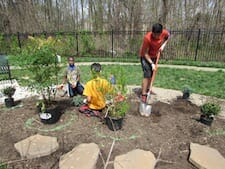
Stony Brook residents work on a landscaping project.
The teens accepted hesitantly. None of them had ever taught anything, let alone a professional course with adults. But the results were spectacular.
Our first course had eight graduates learning basics in Word, Excel and PowerPoint. Pre- and post-tests showed enormous gains in knowledge, much more than any previous course. As many of our teens come from bilingual homes, they were able to teach and engage residents with little to no English speaking ability. Residents felt comfortable taking courses with other residents and people they knew.
A second course, this time with an advanced class for previous graduates, proved even more productive, with 13 graduates. The demand is now so high that the teen residents are planning on three separate courses, with a specialized course for residents with more advanced skills.
This activity branched off into a Zumba and yoga class led by teens, with two full classrooms of participants, as well as a community health initiative led entirely by teen residents. Our younger residents have even gotten into the action. Our youth who attend elementary school spent a school break turning a long abandoned plot of land into a community gathering garden, complete with an array of plants and a walking path, with future additions in the works.
The work of these youth has invigorated residents, and participation in adult programming is at an all-time high in our community. We plan on using this momentum to have adult residents begin running their own programming and meetings. But it was that youthful enthusiasm that started it all, enthusiasm that exists in every community, no matter the size or place.
They Taught Kids What it’s Like to Be Homeless – What Will You Teach Your Volunteers?
Want volunteers who are more connected to your organization and the people you serve? One way is to develop a range of interactive experiences for volunteers to participate in before serving your organization.
Thereasa Winnett
Our church took a group of elementary school children and created an entire summer of activities to develop empathy for others. Many of these activities would work for teens and adults as well.
Perhaps one of the most meaningful was the week we dealt with homelessness. Outside the back of our building is a small grassy area that resembles the alley area behind many restaurants and shops. We placed large cardboard boxes and other types of things one might find in an alley around the area.
The children were introduced to the concept of being homeless in today’s world. They learned many homeless people are afraid of shelters for a variety of reasons and choose to stay on the streets.
We took the kids into our mock alley and instructed them to build some type of shelter. They struggled to create something that would protect them from the current high heat and humidity as well as the rainstorm they could see coming.
After completing the activity, we spent time discussing what they had experienced. We examined the emotions, fears and needs the homeless might have. After our discussion, the children were much more empathetic and connected as they worked on the service project we had planned.
Children participate in an activity designed to teach them about homelessness.
Most likely your new volunteers have life experiences very different from the people they will serve. Plan or suggest activities requiring the volunteers to simulate aspects of this very different world. After the experience, have them share their insights.
How accurate are their realizations? Can they understand the emotions living in that manner every day would create? What would be their needs? What might volunteers do that they think is helpful, but actually makes things worse?
Taking a little extra time to prepare volunteers in more meaningful ways will prove extremely beneficial to any organization. Connected volunteers can save you time and money in your fundraising and volunteer recruitment efforts. Their service will be more effective and help you meet your program’s goals more easily.
Points of Light Staff Partake in Summer Volunteering
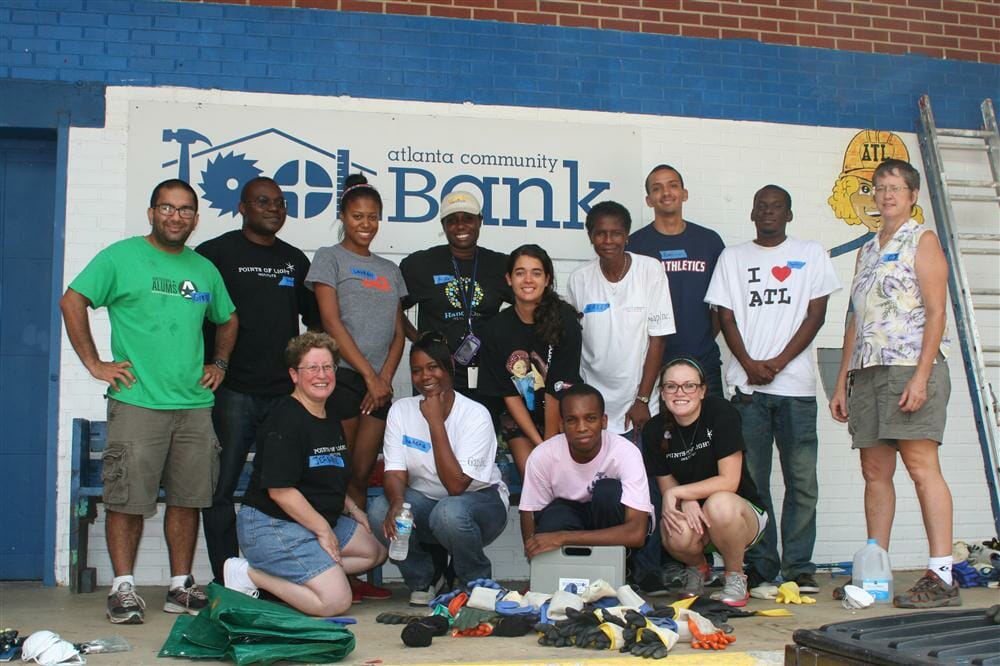
Hammers and rakes and gloves! Oh My! Yes, these were just a few of the tools that Points of Light employees sorted, labeled, and painted on July, 25, 2012, when we volunteered to help with the Atlanta Community Toolbank. Upon entering the toolbank, Points of Light staff received a brief orientation and tour of the warehouse from the Atlanta Community Toolbank’s Master Tool Librarian C.J. Clark. From this orientation, staff members learned about how the toolbank is impacting the surrounding community with its tool loan system. This system allows for Atlanta area nonprofits and religious organizations to borrow the tools to beautify the community.
The roles of Points of Light staff members ranged from cutting garden tarps, to clearing the toolbank’s sidewalk, to labeling and sorting gloves, to painting the outside of the toolbank. Employees had a blast building camaraderie, while contributing to the toolbank’s mission. At the conclusion of the service, Points of Light staff members were presented with toolboxes in appreciation for their awesome work. In exchange, Points of Light donated a mound of sharpies and Thank You notes. The Points of Light staff enjoyed serving with the toolbank and look forward to serving as a team again in August.
Into the Cloud for Non-Profits! Learn the Best Practices to Share Projects and Documents
Today’s article is written by HandsOn Tech AmeriCorps members John Jarvis, Melissa Reynolds, and Diana Bui, from the HandsOn Atlanta office. This article was first published in the evolve newsletter and has been published on the Learn It Live Blog.
More and more, our lives and our work are moving to the Internet. We have our files, our mail, our news, our photos, and even our social networks, all on the Internet. Work within the office is no exception. Professional teams are currently taking advantage of the many collaborative tools available through cloud computing. By using cloud computing tools, you can become more efficient and productive not only as a professional, but also as a volunteer manager.
Whether you realize it or not, you’re probably already using cloud computing tools. Essentially the whole concept of “the cloud” is simply the Internet rebranded. Web mail services like Gmail, Hotmail or Yahoo are three prime examples of popular cloud tools; we just don’t think of these services in those terms.
Cloud computing is having every piece of data you need at your fingertips and ready for use. This data is mobile, shareable, and instantly accessible. The appeal to this kind of productivity with cloud computing is the ability to sync your data among all your computers, mobile devices, as well as to access shared data. One of the most robust and popular set of collaborative tools available is Google Docs.
By using Google Docs, your team can take advantage of three key features of cloud computing: File Sharing, Mobility and Security.
File Sharing
With Google Docs, you can easily share typical office documents (spreadsheets, presentations, etc) with every member of your team. Additionally, everyone can jump in and make edits to these documents at the same time. This method eliminates back-and-forth email attachments and multiple versions that can be hard to keep track of.
Mobility
With all of your documents stored “in the cloud,” you can access your work from any device with a Web browser – your computer, phone or tablet – and stay productive even when you’re away from the office. Maybe you need to edit a spreadsheet while at the airport waiting for a flight? Or respond to an email from a hotel business center computer? These kind of cloud computing solutions make it easy to stay connected to projects you’re working on with your team, no matter where you are or what device you’re using.
With these tools you can also work with your colleagues as if you’re in the same room while you’re away. Arrange an impromptu video chat from your Gmail inbox or jump into the same document and edit it together as if you’re sitting at the same computer.
Security
It may seem ambiguous to say your data is stored “in the cloud.” It is actually stored across many large facilities known as data centers. Should a critical accident happen – if your computer crashes or is stolen – your files are secure at this offsite location and are always available from a different computer.
Google also offers an extra security feature in the form of data encryption. Through this, your critical and sensitive data is protected from the risk of hackers and other digital thieves.
So, in considering Business Cloud Computing Services, remember:
File Sharing
• Allows you to work with multiple colleagues on the same document, at the same time
• Eliminates file duplication
• Automatically tracks edits to a document
Mobility
• Allows you to access your files from any computer, including your phone or tablet
• Connects remotely via simple, and free, video-conferencing
Security
• Ensures that your work is always backed up
• Increases reliability
• Provides strong encryption
To learn more about the best technological practices for nonprofits, register for the following events:
HandsOn Tech seeks to develop the nonprofit sector’s effective use of technology to increase community resources and improve outcomes for low-income communities and families.
Inspiration I Took Away From the National Conference on Volunteering and Service
Today’s post is written by Chelsea Murphy, Communications Coordinator at Points of Light.
We are back from Chicago with a renewed and revitalized outlook on volunteering. This year’s conference was inspiring and thought-provoking and has left me with new ideas for making lasting change and positive measurable impact in our communities.
I continue to relive all the amazing information I’ve heard these past couple of days over and over again in my mind. I can’t wait to do it again in a year in D.C.
Below I’ve compiled some uplifting and inspirational quotes from our speakers over the past 3 days – Please share your favorite quote or “AHA” moment you walked away with from this year’s National Conference on Volunteering and Service in our comments.
“No matter your background, your platform, your economic status, everyone can pitch in to make our world better.” –Israel Donijie
“When we volunteer & serve, we become healthier, happier, & more purposeful.” –Eric Liu
“You must be able to see worlds that have not yet been created as if they have already been created.” –Rev. Otis Moss, III
“All people want is an opportunity” – J.R. Martinez
“Service is center and indispensable to tackle the challenges that we face.” –Wendy Spencer
“Programs where neighbors are helping neighbors are the essence of the American spirit” –Barbara Bush
“One of the key successes to finding fulfillment in life is giving to others without expecting anything in return” –Pierce Bush
“We’re all better off when we’re all better off” –Eric Liu
“People of common ground can make huge change if we put the dignity of our youth above all else” –Alberto Carvalho
“The actions we take affect our neighbors down the block and on the other side of the world. We are all connected.” –Kevin Bacon
“Serve. Serve. Serve. For in the end it will be the Servants who save us all.” –Mark Shriver
As a national multi-sector coalition dedicated to increasing social impact through effective volunteer engagement, Reimagining Service continues to focus its efforts on increasing the adoption of effective practices, gathering new insights via research and encouraging funding investment to effectively leverage volunteer talent to address true community needs.
We continue to develop our nonprofit service enterprise model. Research conducted by the TCC Group demonstrates that organizations that strategically leverage volunteers outperform peer organizations on all measures of organizational capacity and have greater impact.
These organizations, known as service enterprises, often deliver these results with fewer financial resources than peer organizations. In fact, a $1 investment in volunteer capacity can deliver up to $6 in return.
Service enterprises fundamentally leverage volunteers and their skills to successfully deliver on the social mission of the organization. Such organizations employ strong volunteer management practices that enable them to provide significantly more services with fewer monetary resources, thereby enabling them to accomplish their mission and strategic objectives and have greater impact in their community.
And yet, despite this compelling data, less than 15 percent of nonprofits nationwide demonstrate the characteristics of a nonprofit service enterprise.
As a result, we continue to build resources to help nonprofit organizations who are interested in becoming a service enterprise think about this work. Our nonprofit service enterprise quiz provides a simple set of questions that helps organizations think about their existing volunteer engagement practices and directs them to research and other tools and resources to begin the journey of becoming a service enterprise.
Further, we are excited to be partnering with CaliforniaVolunteers and Points of Light to develop and deliver nonprofit service enterprise training. Leadership and funding for this initiative is provided by CaliforniaVolunteers, via a Volunteer Generation Fund grant from the Corporation for National and Community Service. We believe this initiative will be groundbreaking – a pilot group of HandsOn Network affiliates in California will provide assessment, training and additional supportive services to assist nonprofit organizations in their regions become service enterprises. Learnings from the roll out of this initiative this fall will be leveraged for a national roll out in 2013.
Our nonprofit research efforts will continue to document the value that effectively engaged volunteers provide to a nonprofit organization. As we move forward, we’ll be able to identify pathways that organizations can take to maximize the value of volunteers serving with their organizations.
As a multi-sector coalition, we recognize the importance of cross-sector collaboration. We continue to encourage businesses to consider how the alignment of their employee engagement and giving practices can multiply impact in the community. Examples of this work continue to increase and we have recently launched our Reimagining Service Endorsement Process as a way to highlight initiatives that focus on effective corporate practices. Our first set of endorsements include: A Billion + Change, Civic 100, True Impact’s Volunteer ROI Tracker and the Taproot Foundation’s Powered by Pro Bono initiative.
And finally, we continue to believe that increased investment in this work is critical to ensure its success. As a result, we are encouraging the funding community to view investment in volunteer infrastructure (a key to effective volunteer engagement) not as a program investment, but as a cost-effective strategy to increase the impact of initiatives they already invest in.
We are excited about the progress that we are making, and invite you to join us in our work by signing on in support of the Reimagining Service principles and sharing our work with those you partner with.
Why I Do What I Do
Today’s guest post is written by Faiza Kanji, speaker at our National Conference of Volunteering and Service in Chicago. Kanji is currently the General Manager, Volunteer Development at the YMCA of Greater Toronto.
I’ve been working in the field of volunteer engagement for 12 years. I can say with full confidence that I am living out my life’s purpose. This is the only career I’ve ever known and for a member of Generation X, I might be one of those few people who doesn’t change careers multiple times in my life. Why do I do what I do? It all began in Canada on October 3, 1972. I wasn’t even born but this was a day that changed the course of my life forever.
Rewind two months prior to August 4, 1972. My Mom and Dad were both 25 years old and living in Tororo, a town in Eastern Uganda. They were a young newlywed couple and 6 months pregnant with my oldest brother Karim. Mom was a nurse and Dad had a blossoming career in hotel management and hospitality. Their world was forever changed when former Ugandan President Idi Amin issued a decree expelling 60,000 Asians from their birthplace of Uganda. This act of ethnic cleansing came with a condition of giving Ugandan Asians 90 days to leave the country or else. Or else what? I’m not sure really when I hear stories of police brutality, corruption, murder and abuses of the worst kind that took place immediately after the decree. Luckily, my Mom and Dad had family in England and in Canada, two countries who had opened their borders to those that had been expelled. My pregnant Mom went to England right away and stayed there to deliver my brother Karim. Dad had planned to wrap a few things up before following my Mom to England so he could be there for the birth of my brother. He was victim to his own individual hardships as a result of corruption amongst local authorities. He’s only ever talked to me twice about a painful day that he experienced that had him escape to England sooner than he planned. I can’t even imagine what my 25 year old Dad was going through and where he got the strength to envision a future for his family in Canada.
Dad missed the birth of Karim and arrived on Canada on October 3, 1972 to set about building our family’s life. Four months later, Mom and Karim joined Dad and for the first 6 years of their life in Canada, my parents grew their family (my brother Aneez came first and then me) and moved from one community to the next trying to figure out where they could work and where they as newcomers could establish security for their young family. In the Canadian context, a newcomer is a person that is newly arrived. It has no socio-economic, cultural or political connotation. It simply denotes how long your feet have been on Canadian soil.
This year, on October 3, 1972 our family will celebrate 40 years of building a life and legacy in Canada. My parents don’t really talk about leaving Uganda and what that was like for them. Perhaps, at 25 they weren’t able to process all that was happening to them. Maybe they are trying to protect us from realities they hope are never ours. What I do know is that they’ve lived in Canada longer than anywhere else in their lives. Canada is home. Canada, a country built on immigrants, diversity and global influences is also a place where they learned to belong as newcomers through receiving kindness from volunteers. Canada has also been a place where they can actively and freely contribute as volunteers. My sense of belonging comes from witnessing my Mom and Dad in various incarnations as volunteers. As new Canadians, they were leaders in the Canadian Scouting movement. My Mom took on various leadership roles in our mosque. My Dad chaired a provincial Association of Dry Cleaning Professionals and showed me what leadership looked like. They’ve taken their decades old experience as newcomers and turned it into learning and support for newly arrived Central Asians to Canada. My Mom spends her weekends promoting heart health in the South Asian community. Dad visits a senior’s home once a week and has gone back to school to learn how to be a teacher so that he can compete for meaningful volunteer roles as he prepares for retirement.
I do what I do because my life wouldn’t be the privilege it is today without the generosity and compassion of volunteers who paved the way for my parents. I do what I do because there is no greater gift that we can give each other than a few moments of our time. To facilitate that process for others is an honour. I do what I do because volunteers and volunteerism are transformational on an individual, community and global level. I do what I do because the currency of kindness makes us all wealthier than we can ever imagine. Why do you choose to do what you do? Share your story with me on the blog or come say hello at this year’s National Conference on Volunteering and Service. I’ll be presenting “Youth Matter: Introducing Youth to Volunteerism” on Thursday June 19th at 2pm and can’t wait to talk to you about how to get youth fired up about volunteerism!
From a very young age, Faiza Kanji’s parents instilled in herself and her brothers a strong sense of volunteerism. They, as immigrants to Canada 40 years ago, made a successful transition into Canadian life with the help of many kind and generous volunteers. A volunteer herself from a very young age, Kanji has successfully managed volunteers at the Aga Khan Foundation Canada (AKFC), Youth Employment Service (YES) the Canadian Breast Cancer Foundation (CBCF) and Surrey Place Centre. Kanji believes strongly that a community with a sound sense of volunteerism and a committed volunteer base improves the overall quality of life and health of all its members. Kanji will present at Why Volunteer? Introducing Youth to Volunteerism.
New Website, New Look, New Feel!
Today’s post is written by Chelsea Murphy, Communications Coordinator at Points of Light.
Last week amidst all of our Conference planning we launched our
! Below is a peak of what our homepage looks like-
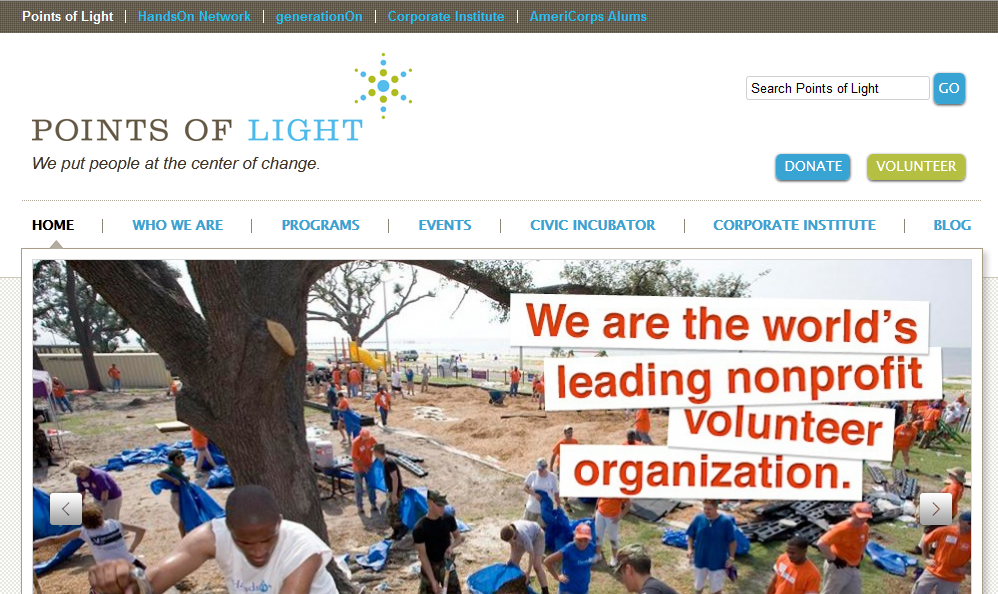
After about a year of work we are excited to share with you our new website envisioned by Perfect Sense Digital with all updated content. We’ve added sections for our events and programs, Civic Incubator and Corporate Institute. As the go-to organization for volunteers we hope whether you are an individual, nonprofit, government, or corporation you can find useful resources to help connect you to your power to engage in social good.
With the new site in place we will add Conference event highlights and recaps during and after Conference if you can’t make it to Chicago. We hope you find this new website engaging, fun, informative and interactive. You can find more photos, top volunteer resources, and event video recaps to watch among many other cool new features. While browsing our site you can search volunteer opportunities from any page you are on or share/like specific pages on social media.
Feel free to comment and leave your feedback to let us know your thoughts on the new website. If you wish to reach out to me personally, email: listen[at]pointsoflight dot org.








 Today’s post is written by Chelsea Murphy, Communications Coordinator at Points of Light.
 I continue to relive all the amazing information I’ve heard these past couple of days over and over again in my mind. I can’t wait to do it again in a year in D.C.
 As a national multi-sector coalition dedicated to increasing social impact through effective volunteer engagement,